
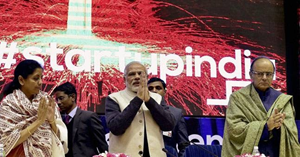
Startup India is an employment programme of India, this program is the opportunity for new entrepreneur In India. Startup India was a campaign which was first addressed by the PM Narendra Modi on 15th August 2015 at Red Fort, New Delhi. This campaign was introduced under the Government of India as an initiative to develop over 75 startup support hubs in the country.
Startup India scheme is an important government scheme which was launched on 16th January 2016 with an aim to promote and support the start-ups in India by providing bank finances. It was inaugurated by the former finance minister, Arun jaitley.
Organized by the Department for promotion of industry and internal trade, the major objective of Startup India is to discard some of the restrictive States Government policies which include:
- License Raj
- Land Permissions
- Foreign Investment Proposals
- Environmental Clearance
Startup India is a Government of India flagship initiative to build Startups and nurture innovation. Through this initiative, the Government plans to empower Startup ventures to boost entrepreneurship, economic growth and employment across India.
The Government’s Action Plan will help accelerate the growth of Startups throughout India, across all important sectors – in Tier 1, 2 and 3 cities, including semi-urban and rural areas – and includes promoting entrepreneurship among SCs/STs and women communities.
Definition of a Startup (for the purpose of Government Schemes only)
A Startup means an entity:
- incorporated or registered in India not prior to five years
- with an annual turnover not exceeding INR 25 crore in any preceding financial year
- working towards innovation, development, deployment or commercialization of new products, processes or services driven by technology or intellectual property
The entity shall cease to be a Startup if:
- it is formed by splitting up, or reconstruction, of a business already in existence
- its turnover for the previous financial years has exceeded INR 25 crore
- it has completed 5 years from the date of incorporation/registration
Further, the Startup shall be eligible for tax benefits only after it has obtained certification from the Inter-Ministerial Board, set up for such purpose.
Eligibility Criteria for Startup India Scheme
- The start-up must be registered as a Private Company, LLP or Partnership Firm: …
- The start-up must not be a product of restructuring: …
- The Startup must not be older than 5 years: …
- Annual turnover of the start-up must not be more Rest. …
- The business must be involved in a new product or service.
Four major steps to register a company/ startup in India:
- Step 1: Acquire Digital Signature Certificate (DSC)
- Step 2: Acquire Director Identification Number (DIN)
- Step 3: Create an account on MCA portal- New user registration @ mca.gov.in.
- Step 4: Incorporate or Apply for the company to be registered.
Under the Startup India programmed, startups were defined and redefined. For instance, the startups’ age was also increased from 5 to 7 years (10 in the case of biotech). The government has taken various initiatives to boost the growing startup culture in the country such as fast-tracking of startup patent applications, income tax exemption, and self-certification.
This is the plan which is released by the government of India to enhance the employment and encouragement for Indian people.

 Track2Training
You must be logged in to post a comment.