
By Shashikant Nishant Sharma
The concept of a National Transit Pass System (NTPS) called ‘One Nation-One Pass’ refers to a unified, nationwide system for public transportation passes in a country. This system aims to streamline and simplify the process of using public transit by providing a single pass or card that can be used across different modes of transportation such as buses, trains, subways, trams, and more, regardless of the city or region within the country.
The ‘One Nation-One Pass’ initiative intends to make travel more convenient for commuters, tourists, and regular transit users by eliminating the need to purchase separate tickets or passes for different transportation networks. It promotes seamless mobility and ease of access, potentially encouraging more people to use public transit due to its simplicity and accessibility.
Implementing such a system involves collaboration between various transit authorities, government agencies, and technology providers to develop a unified infrastructure that can manage and integrate the different transit networks into a cohesive, interoperable system. This may include the use of smart cards, mobile apps, or other digital platforms that can store fare information, track usage, and enable payments across multiple transit services.
The benefits of ‘One Nation-One Pass’ include reducing administrative complexities, improving commuter experience, potentially lowering travel costs, and encouraging more sustainable modes of transportation. However, the implementation may involve challenges related to technological integration, data management, and coordination among different stakeholders.
The success of an NTPS like ‘One Nation-One Pass’ largely depends on effective planning, investment in infrastructure, collaboration between relevant authorities, and the adoption of user-friendly technologies to ensure a seamless and efficient transit experience for all users across the nation.
Union Minister for Environment, Forest and Climate Change and Labour and Employment Shri Bhupender Yadav today launched the National Transit Pass System (NTPS) pan-India to facilitate the seamless transit of timber, bamboo, and other forest produce across the country. Currently, the transit permits are issued for transport of timber and forest produce based on state specific transit rules. The NTPS is envisioned as a “One Nation-One Pass” regime, which will enable seamless transit across the country. This initiative will streamline the issuance of timber transit permits by providing a unified, online mode for tree growers and farmers involved in agroforestry across the country, contributing to the ease of doing business.
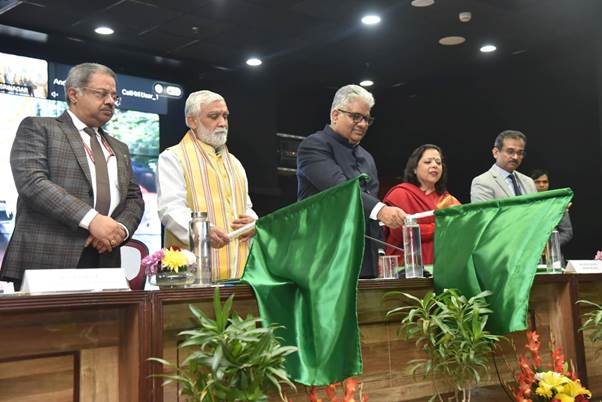
In order to create awareness and showcase the applicability and ease of using NTPS, special Pan Indian vehicles carrying forest produce were flagged-off by Minister of Environment, Forest and Climate Change, Shri Bhupender Yadav today. Two vehicles carrying timber and other forest produce from Gujarat and Jammu & Kashmir were flagged-off which are bound for West Bengal and Tamil Nadu. The QR coded transit permits generated under NTPS will allow check gates across various states to verify the validity of the permits and allow seamless transit.

On the occasion of the flag-off event, Shri Bhupender Yadav expressed that this marks a historic achievement with the nationwide implementation of the NTPS. He said NTPS will help strengthen the journey towards greater transparency which is Prime Minister Shri Narendra Modiji’s guarantee for India’s development. Shri Yadav said this initiative is poised to facilitate the seamless transportation of timber and various forest products across the country. He said its impact extends beyond merely encouraging agroforestry and tree farming; it also promises to incentivize the entire value chain.
Additionally, the Union Minister highlighted several other recent initiatives by the Ministry, such as the Indian Forest and Wood Certification Scheme and the Trees Outside Forest Initiative. These endeavours collectively aim to boost agroforestry practices in the nation.
Shri Ashwini Kumar Choubey, the Minister of State for Environment, Forest, and Climate Change, emphasized that the NTPS is a game-changer for agroforestry and trees outside the forest. Launched to streamline the transit of timber and other forest products, it is expected to enhance the ease of doing business in this sector. Secretary, Ministry of Environment, Forest and Climate Change, Smt. Leena Nadan and Director General of Forests and Special Secretary, Shri. Chandra Prakash Goyal were present during the flag-off event.

Prior to the introduction of NTPS, obtaining transit permits from different states along the route was a time-consuming process, causing hurdles in transporting timber and forest products across the states. Each state has its own transit regulations which meant that in order to transport timber or forest produce across states, one was required to get a separate transit pass issued in each state. NTPS offers seamless transit permits, managing records for both inter-state and intra-state transportation of timber, bamboo and other forest produce obtained from various sources like private lands, government owned forest and private depots.

NTPS is designed for user convenience, featuring desktop and mobile applications for easy registration and permit applications. Transit permits will be issued for tree species which are regulated, while the users can self-generate No Objection Certificates for exempted species. Presently, 25 States and Union Territories have embraced the unified permit system, streamlining interstate business operations for producers, farmers, and transporters. This move is expected to provide a significant impetus to the agroforestry sector. The NTPS can be accessed at https://ntps.nic.in .
***
References
Lodhi, A. S., Sharma, S. N., Dehalwar, K., & Jaiswal, A. (2023). Framework for Road Safety Improvement Measures for Madhya Pradesh. Vision Zero: Systems, Approaches and Implementation, New Delhi. Blumsburry. https://doi.org/10.5281/zenodo.10396811
Khosa, M. M. (1995). Transport and popular struggles in South Africa. Antipode, 27(2), 167-188.
Ugboaja, P. C. (2010). The economic sustainability of Nigeria’s National Transport Policy. Journal of Academic Research in Economics (JARE), (3), 348-365.

 Track2Training