Decoding Indian ways of Eating

Food is a very complex subject to understand. The world is experimenting new types of food, new recipes, new combination and new styles of consuming it to make it more aesthetically beautiful. But they are breaking the age-old science of healthy eating.

How we eat is equally important to what we eat. Our ancestors have passed on to us the right recipes, the right way to eat, and the right way to make it. We should start acknowledging the science and it’s significance. Food depends many variables:-

  • Season
  • Geography
  • Local availability
  • Attitude
  • Body type

Right Medium of Food Consumption

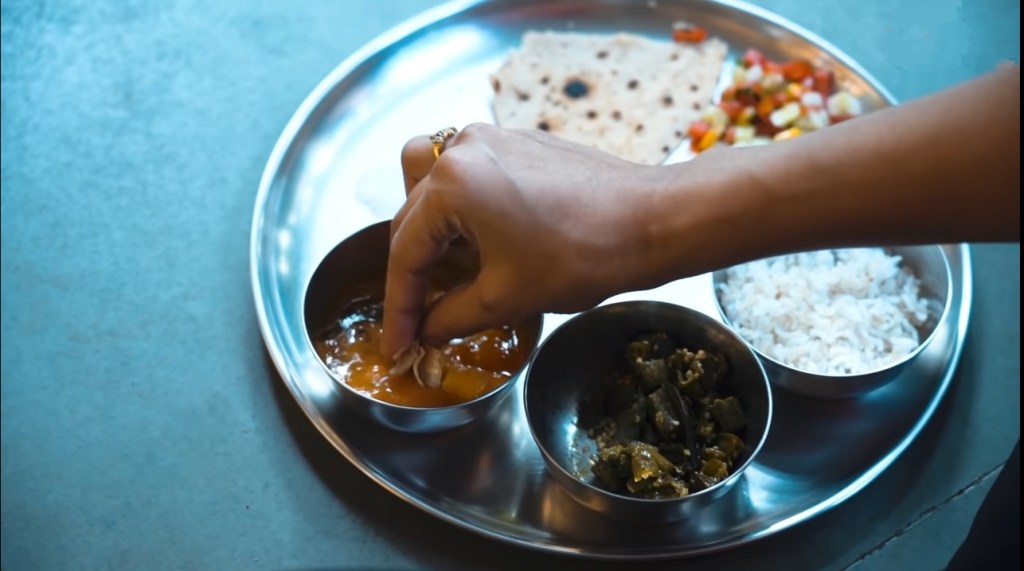
1. Eating with hands

People are getting used to eating with spoons and they consider eating with hands as unhygienic and unpleasant. According to Ayurveda, eating food should involve all senses. The touch of food to your fingers and feeling the texture can really trigger the nerve endings of your fingers which are connected to your digestion. These nerves stimulations are know to activate and stimulate your digestive juices. Also according to Ayurveda the five fingers represent the five elements:-

  • Thumb represents Fire (agni)
  • Index finger represents Air (wayu)
  • Middle finger represents Sky (Akash)
  • Ring finger represents Earth (Prithvi)
  • Little finger represents Water (jal)

Holding food with all five finger symbolises the union of all elements, which are essential for the normal functioning of our body.

2. Sitting on the floor

In India, sitting on the floor and eating is a family activity. It involves many muscles, the sitting position presses our lower spine and relaxes the whole body. The back and forth movement while eating gives a nice compression to your abdomen. Compression is maximum in sitting position and this also stimulates the digestive juices. It also has an effect on your mind. When the individual sits on the floor, the nervous systems performances better and transmission of signals happens very effectively. As a result sitting on the floor and eating has a huge weight reduction advantage.

Sitting on chair brings more pressure on your heart. When you’re sitting on chair your heart has to pump blood from toe to upwards against gravity and that is a strain. If you sit on a chair with folded legs that will reduce the gravity force that would help your heart and general health conditions so that more blood will be facilitated for digestion.

3. Food containing vessels

Vessels have an important effect on food, it can be positive as well as negative. In Indian tradition, every vessel has its own advantage in cooking or storing food.

For example, copper as has a strong intoxication property over water. That’s why copper vessels was used to store water in India. Another example, Ghee, if stored in a bronze vessel can become toxic. That is why ghee is stored in a metal vessel like steel.

In old times, food used to be kept in the leaves covered with leaves and it always remains healthy. Stones which were used for crushing, grinding is said to be more superior than done in mixers. So make sure to put right food in the right container.
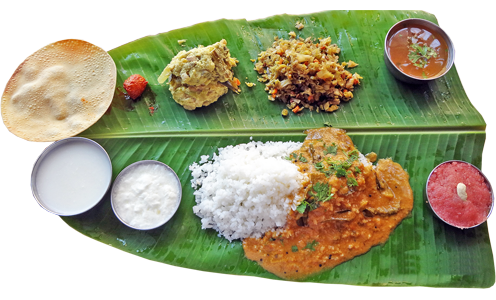
Even the healthiest of food can become toxic if not consumed in right way. The ways of eating food is always been highlighted in all the cultures because it is the cultural identity of every community. Indian have always tried to introduce every healthy aspects into the food. So let’s follow these food habits and acknowledge deep science in the ancestral way of eating. We should not forget the valuable lessons which are passed down to us and understand that food once consumed can become medicine or junk. Your way of consuming it will decide what it will turn to – healthy or junk. So eat food in a right way, the Indian way.
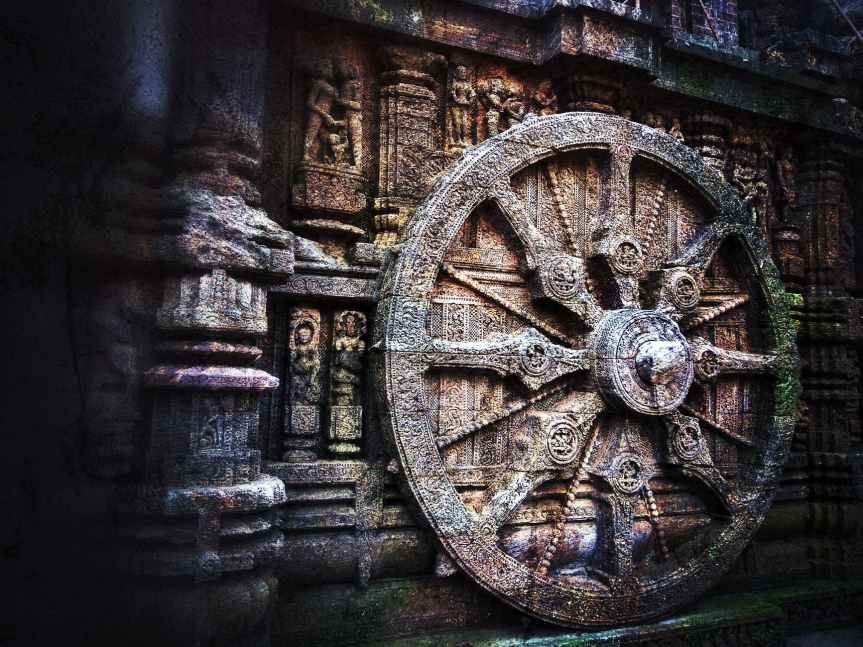
THE HISTORIC FRAMEWORK OF INDIAN TRADITION

Tradition is a custom or belief passed from past generation to present generation. India has a continuous history covering a long period. By following the Indologist, DR.A.L.Basham’s analysis, the Indian heritage can be best appreciated with different historical periods. This period is broadly discussed as follows:

BEFORE 1500 BC: PRE-VEDIC CULTURE OF THE INDUS VALLEY:

This culture came to light through excavations at Mohenjodaro (in Sind) and Harappa (Punjab) – both now in Pakistan, Harappa/Kalibangan (Rajasthan), Lothal (Gulf of Cambay)(Gujarat) and Surkotada (Gujarat). The Indus Valley finds reveal a great civilization that flourished in the dim, distant past. The civilization – the material aspects of life or the external features of living – was marked by: streets and lanes laid out according to a set plan; houses built of bricks; public tanks; places of worship; granaries for storing grain; fortifications. The people occupied themselves in agriculture, made use of pottery, and sculpted on metal. It was the Age of Bronze – objects made of the bronze-like knife – blades, saws, sickles, chisels, celts, razors, pins, tweezers, fishhooks were used in households. Spears, arrowheads, and short swords made of bronze were used for defense.

1500 BC – 1000 BC: EARLY VEDIC AGE:

The Vedic hymns which are chanted even today, the personal rituals that are practiced, The patriarchal and patrilineal family system are some of the legacies from this period.

1000 BC – 600 BC: LATER VEDIC TIMES:

To this period we owe the passion for speculation on ultimate causes (as reflected in the Upanishads), the quest for the Absolute (the concept of Brahman), the doctrine of transmigration and rebirth (the idea of Karma and consequences of good and bad acts), the concept of a release from a cycle of births and deaths ( the goal of Liberation or Moksha) and the glory of mysticism. This period saw the crystallization of the four classes (‘Varnas’, a social order originally conceived as a functional division of labor, which has turned out to be a mixed blessing though corruption); the introduction of iron; the domestication of the elephant; and the development of kingdoms out of tribal chieftainships.

600 BC – 320 BC: THE EMERGENCE OF BUDDHISM

Siddhartha Gotama, known as the Buddha, is the founder of Buddhism. The four main principles taught by Buddha are life is suffering, craving causes suffering, suffering can be overcome, following noble 8-fold paths to end suffering.

320 BC – 185 BC: THE MAURYAN EMPIRE:

We have inherited from this period: the Indian idea of statecraft as embodied in Arthasastra of the Mauryan Minister, Kautilya, also known as Chanakya; the earliest surviving sculpture of India (the Ashoka Pillar at Sarnath); the oldest artificial caves ( Lomas Rishi Caves, Barabar Hills, Bihar) and the most ancient Buddhist stupas (Sanchi). The national symbol of the Ashoka Chakra is taken from the Ashoka Pillar at Sarnath with its Lion Capital. The Dharma Chakra represents the dharma or the Law of the Buddha, and the lions the temporal power of the emperor who has dedicated all his resources to the victory of dharma (dharma Vijaya). “The symbolism of Indian art attained its highest expression in the Sarnath capital, which is as much Buddhist as Vedic in the significance of its several parts”.

184 BC-AD 320: THE PERIOD BETWEEN THE MAURYAS AND THE GUPTAS:

New forms of devotional religion, with Shiva and Vishnu as the central deities, emerged. The Mahabaratha and The Ramayana were edited. Sanskrit literature, consisting of drama and poetry, developed. Philosophical schools characterized by logical reasoning emerged.

AD 320 – AD 647: THE PERIOD BETWEEN THE RISE OF THE GUPTAS AND THE DEATH OF HARSHAVARDHANA:

This is the classical period of Indian civilization from which we have inherited the works of Kalidasa (Sanskrit drama and poetry); the paintings of Ajanta; the place notation of numerals (with nine digits and zero); The Puranas (legends illustrating the Vedic religious conceptions and philosophical doctrines). Stone-built temples appeared throughout the land. Worship of the deity as Mother Goddess came into vogue.

AD 647 – AD 1200: THE PERIOD OF BHAKTI SCHOOLS AND THE PHILOSOPHICAL SYSTEMS OF SRI SANKARA AND   SRIRAMANUJA:

The devotional hymns of the Alwars and the Nayanmars of the South gave an impetus to the bhakti movement in the country. To this period belong the imposing temple structures of the South and the bronze images of various gods.

AD 1192 – AD 1526: THE SULTANATE PERIOD (MUSLIM RULE):

The new style of architecture with the dome and the arch made its appearance. Vernacular literature appeared instead of Sanskrit which was the main vehicle of literary expression till then.

AD 1526 – AD 1707: THE MUGHAL EMPIRE:

Imposing edifices like the Taj Mahal belong to this period. Sikhism belongs to this period – ‘born as a small devotional sect and reborn, when the period concluded, as a martial brotherhood’.

18TH, 19TH, AND 20TH CENTURIES: THE DOMINANCE OF THE ENGLISH:

After a period of stagnation in the 18thcentury, India began to feel the impact of the West. The study of the English language was made compulsory and the English system of administration was introduced. As a reaction, the modern Indian renaissance, which included a revival of ancient learning and reform of Hindu social customs and practices, began with Raja Rammohan Roy is in the lead. Sri Ramakrishna, Swami Vivekananda, Dayananda Saraswati, Sri Aurobindo, among others, held up the glories of our religious and philosophical heritage, by precept and example. Mahatma Gandhi emerged as the Father of the Nation delivering the people from bondage into freedom. The subcontinent was divided into India and Pakistan and both countries attained complete independence from foreign rule. India became the Sovereign Democratic Republic on January 26th, 1950 with freedom and dignity assured to every individual citizen under the country’s new Constitution.