
SUSTAINABLE DEVELOPMENT

Sustainable Development has been the buzzword for a while now. People are constantly asking what it looks like and how to implement it. There have been many differing opinions on what sustainable development actually is, however some key principles remain:

  • The concept of sustainable development is about making sure that you live in a world where people are able to stay self-sufficient and thrive indefinitely.
  • Sustainable development does not need to take the form of major changes, but rather building upon what we already have.
  • A major component of any successful Sustainable Development project is social-justice based thinking.

The Principles of a Sustainable Development Project:

A sustainable development project is one that will allow you to reach the following principles:
-Managing resources efficiently.
-Responsible consumption.
-Treating others with respect and dignity.
These four principles are what make up an overall healthy and productive society. The management of resources, responsible consumption, and treating others with respect and dignity can be applied to almost anything we do; whether it is being environmentally conscious, being respectful of your parents, or being a good soccer player. The real issue here is that these principles go hand in hand. If we constantly abuse a resource and consume in a way that hurts the environment, we are not being respectful of the Earth. If we are being very selfish in our consumption, then we are not being respectful of our fellow human beings. Lastly, if we do not treat people with respect and dignity, then they will not be treated with respect and dignity by their neighbors.

These four principles allow us to have a healthy society. This can be seen clearly in the following quote by E. F. Schumacher: โ€œThe great first commandment is to love the Earth and that means loving it enough to take care of it for the sake of future generationsโ€.

The way we approach development affects everyone. The decisions that we make also impacts the society, and has very real consequences for people’s lives. Poor planning of communities, for example, reduces the quality of life for the people who live in them.

Sustainable development provides an approach to making better decisions on the issues that affect all of our lives. By incorporating health plans into the planning of new communities, for instance, we can ensure that residents have easy access to healthcare and other facilities.

Sustainable development should provide a solution in terms of meeting basic human
needs, integrating environmental development and protection, achieving equality,
ensuring social self-determination and cultural diversity, and maintaining ecological
integrity. Although the concept of sustainable development has undergone certain
changes during the past, its fundamental principles and goals have contributed to a
more conscious behaviour adapted to the limitations of the environment. This is the
reason of adopting the concept in different areas of human activities. Numerous international organizations have been involved in implementation of the concept, while
it has found positive implementation locally, but it did not produce significant results
on a global scale. This fact proves environmental problems which, 30 years after the
introduction of the concept, are still ongoing. Contemporary understanding of the
concept of sustainable development is considered through the United Nations Millennium Development Goals focused on a complex global situation, such as population
growth, hunger and poverty, wars and political instability, and further degradation
of the environment. There is a huge gap between developed and underdeveloped country and many of the countries are not even close to sustainable development. Fundamental constraints of the implementation of the concept of sustainable development are the degree of socio-economic development that many countries have not yet achieved, associated with a lack of financial resources and technology, but also the diversity of political and economic goals on a global scale.

Source: https://www.unesco.org/en/education/sustainable-development
How to properly plan out your week

Become more organized

To be successful and reach your goals, you need to be organized.
One first step in this direction refers to starting your day planning: choosing the agenda that works best for you can be a game-changer.

Practice a lot

Acquiring organizational skills, as in getting better at planning, can take a while. While finding the appropriate agenda is essential, making a habit out of using it is just as important.

Plan important moments monthly

When preparing your schedule monthly, make sure to add not only the daily tasks and objectives but also the big moments.
For instance, integrating your friends’ birthdays can prove both useful and time saving for the future.

Establish a day for planning your schedule

Establishing a certain day, when you can sit and plan your next week can prove extremely useful.
For instance, choosing Friday to be that day, seems pretty clever, as this day marks both the end of a working week and, why not, the beginning of another one.

Manage priorities first

To have successful days at work and not only, make sure you keep track of your tasks. Furthermore, taking care first of the priorities should be on everybody’s calendar.

Necessities are the real thing

Whenever you plan your schedule, write down whatever you need to do, but not everything you need to do.
Some tasks do not require being noted down, as they have become part of a daily ritual and can not be forgotten.

Use colours to plan your agenda or not

You choose how you want your planning to look like, therefore avoid trusting too much others’ opinions, but rather choose to prioritize your own.
For instance, using colour appeals to many individuals, but not to everybody. Just choose your style and get started.

reference

https://www.domino.com/content/how-to-plan-your-week/

THE COBRA EFFECT

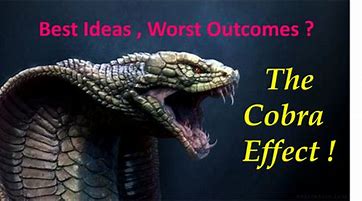
The economic term ‘The Cobra Effect’ was coined by German economist Horst Siebert. The Cobra Effect refers to a situation where in, an attempted well planned and intended solution given to any problem makes the problem worse. This leads to an unintended negative consequence. This term is used to illustrate the causes of incorrect solutions in economy and politics.

This term was coined with regards to a real situation that occurred in Colonial India. There was an alarming increase in the number of venomous cobras in the city of Delhi. The British government expressed their concern regarding this issue. The government planned to offer a sum to the public for killing the cobras. A large number of venomous snakes were captured and killed by people in order to earn the reward. This served as a very successful strategy initially. But, over a period of time, people began to trick the officials by breeding cobras, expanding their numbers and later killing them to continue getting the reward from the government. Ultimately, the government became well informed about the ill happenings in hunger for the reward. Hence, they scrapped this entire plan. After scrapping of the scheme, people were no more interested in capturing, breeding and killing cobras. Therefore, they set all their wild cobra population free in the city. This in turn, increased the population of venomous cobras in the city. Thus, a planned solution to the problem lead to the problem worsening.

A similar instance occurred in Hanoi, Vietnam during the French Colonial rule. The officials designed a scheme in which people would earn a bounty upon killing rats. In order to earn the cash reward, people had to kill a rat, chop off it’s tail and provide it to the responsible officials. Over a span of time, the government noticed rats wandering in places without tails. They were surprised on being aware of the fact that, rat catchers were collecting rats, chopping off their tails and later leaving them into sewers where breeding would take place. This produced a humongous number of rats. The idea of offering a bounty on exchange of dead rat tails failed miserably.

Airbus Airlines, formally suggested their design engineers to make it’s airplane cabins quieter to ensure a pleasant travel experience. The idea was executed and cabins were made more silent than usual. Instead of making the travel more peaceful, it worsened the travel experience of the passengers onboard. People could easily eavesdrop on other people’s conversations, could hear louder noises of food and beverage trollies rolling in the aisle, babies crying on board and restroom doors opening and shutting throughout the journey. This economic decision of Airbus did not succeed.

In 1989, Mexico proposed a plan of action called – ‘Hoy No Circula’ . According to this scheme, people were debarred from using their private vehicles from 5:00 a.m to 10:00 p.m depending on the last digit of their vehicle’s number plate. This was in context of odd and even numbers. The scheme was introduced to limit the number of vehicles on road which in turn would cut down release of pollutants in the atmosphere. Instead of abiding by the norms in a fair manner, people began purchasing two vehicles in the same household, one with an even number plate and another with an odd one. This particular scheme did not serve very fruitful in the longrun.

Perverse Incentive or better known as Cobra Effect may not always be an outcome of poorly planned modules or shortsighted decisions. It may cause due to unpredictable behaviors of the recipients. A strategy planned to curb anything may cause adverse outcomes when people find the same strategy rewarding. In such contrast outcome scenarios, planning authorities may either scrap the plan or re-design it in order to get constructive outcomes.

Planning Techniques for Village Development: A Case Study of Sanawadiya, Indore

By Maitri Singhai

This article explains how various planning techniques can be applied in practice, with examples drawn from case study of Sanawadiya, a peri-urban village near Indore. The objective was to demonstrate how these techniques contribute to prepare a comprehensive Village Development Plan.


1. Base Map Preparation

A base map serves as the foundation of any planning project. Using GIS, we georeferenced raster data, identified the village boundary, and imported layers from OSM (OpenStreetMap). Key elements such as roads, building footprints, natural features, and landmarks were digitized to create an accurate spatial framework for further analysis.


2. Land Use and Building Use Maps

Prepare a land use maps by overlapping existing records (like Khasra) with the proposed Master Plan. This helps to identify residential, commercial, industrial, and mixed-use zones. In addition, building height and building use maps provided insights into the settlementโ€™s density and structural profile.


3. Questionnaire & Sampling

To capture the social and economic dimensions of Sanawadiya, designe household surveys and focus group discussions. A sample size of 100 households was selected using the simple random sampling method to ensure representativeness.


4. Data Collection

Combined primary data (surveys, interviews, observations) with secondary data (census reports, government records). The process included:

  • Household surveys (socio-economic and demographic data)
  • Visual surveys (land use, infrastructure, public spaces)
  • Transportation surveys (traffic patterns, pedestrian behavior, parking availability)
  • Focus group discussions to capture community perspectives

5. Data Representation

Collected data was analyzed and represented through maps, charts, and projections. This included:

  • Demographic trends and population projections
  • Economic sector distribution over time
  • Road network proposals (Town Planning Scheme vs Master Plan)
  • Social infrastructure mapping to highlight gaps and opportunities

Conclusion

The Sanawadiya study showcased the importance of integrating spatial analysis with socio-economic surveys to create a holistic development plan. Planning techniques like GIS-based mapping, sampling, and focused data collection and more proved essential for generating actionable insights. By applying these methods, we not only documented the existing conditions of Sanawadiya but also outlined strategies for sustainable village development in the context of Indoreโ€™s urban expansion.

References

Chen, J., Wang, C., Dai, R., Xu, S., Shen, Y., & Ji, M. (2021). Practical village planning strategy of different types of villagesโ€”a case study of 38 villages in shapingba district, chongqing.ย Land,ย 10(11), 1143.

Hao, S. (2021, June). Research on the application of GIS technology in the preparation of village planning–Take Feng Sheng Village as an example. Inย IOP Conference Series: Earth and Environmental Scienceย (Vol. 791, No. 1, p. 012150). IOP Publishing.

Sharma, S. N. (2014).ย Participatory Planning in Plan Preparation. BookCountry.

Yen, N. T. K., & Van Luong, P. (2008). Participatory village and commune development planning (VDP/CDP) and its contribution to local community development in Vietnam.ย Community Development Journal,ย 43(3), 329-340.