
“No aquarium, no tank in a marine land, however spacious it may be, can begin to duplicate the conditions of the sea. And no dolphin who inhabits one of those aquariums or one of those aquariums or one those marine lands can be considered as normal”- Jacques Yves Cousteau
The ocean is known to absorb about 30 percent of the carbon dioxide present in the atmosphere. The carbon dioxide released in the atmosphere comes from various sources naturally for example respiration plants and animals, weathering of carbonate rocks, etc. However, various human activities are also there which are responsible for increased carbon dioxide emission in the atmosphere such as burning fossil fuel and forests and deforestation.
Now when the levels of atmospheric CO2 increase, the amounts of CO2 absorbed by the ocean also increases. It has been observed that since the advent of the industrial revolution, due to human activities the concentration of CO2 has been increased in the oceans and seas.
What is ocean Acidification exactly?
According to the National Oceanic and Atmospheric Administration, ocean acidification refers to a reduction in the pH of the ocean over an extended period, caused primarily by the uptake of carbon dioxide from the atmosphere.
After the industrial revolution, studies show that the pH of the ocean water has fallen by 0.1 pH units which equivalent to approximately a 30 percent increase in acidity.
This increased amount of carbon dioxide which is absorbed by the sea and ocean results in the occurrence of series of a chemical reactions. This chemical reaction releases a high amount of hydrogen ion concentration. When the concentration of hydrogen ion (H+) increases, the acidity of seawater increases, and carbonate ions (HCO3-) decreases.
How does ocean acidification affect marine life?
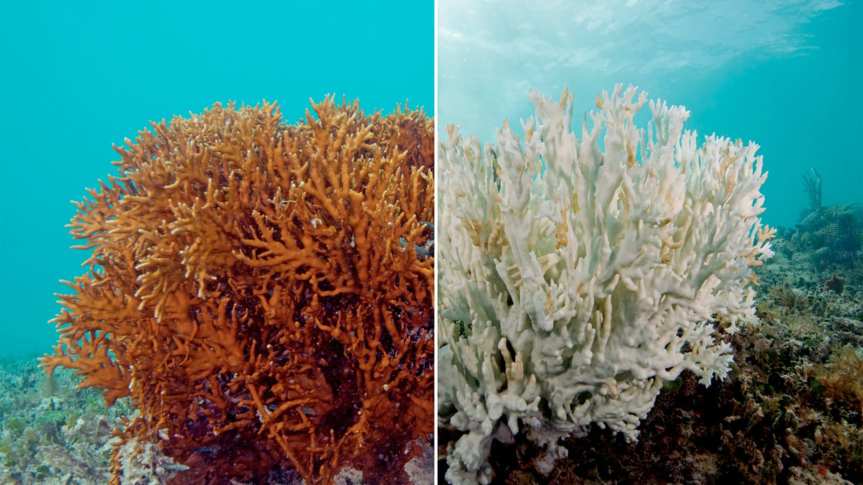
Carbonate ions are crucial building blocks of seashells and coral skeleton. When the carbonate ions in seawater decrease, the ability to build and maintain these shells and corals also decreases and calcifying becomes difficult for shell-builder organisms like oysters, sea urchins, deep-sea corals and calcareous planktons as the shells starts to dissolve due to the acidity.
The non-calcifying organisms are also affected. Certain fishes are not able to detect their predators in more acidic water. This disturbs the prey-predator population which in turn disturbs the ecology.
The pteropods commonly known as ‘sea butterflies’ are tiny sea snails about the size of a pea. Like every other organism, these pteropods are also an important part of the food chain and are eaten by wide-ranging organisms from krill to whales. When the shells of these pteropods start to dissolve due to acidity, this imposes a threat to other marine life too as they are dependent on these pteropods for nutrition.
A report by the Intergovernmental Panel on Climate Change finds that 99 percent of the world’s warm-water coral reefs could disappear if global average temperatures rise 2°C or more above pre-industrial levels.
Various species of diatoms lose their content of biogenic silica as a result of ocean acidification.
How to limit ocean acidification?
The increased amounts of carbon dioxide in the atmosphere are changing the chemistry of the ocean, making it more and more acidic and harming shellfish and other marine life.
The only way to reduce ocean acidification is to act on climate change. The need of the hour is to implement solutions to reduce the use and burning of fossil fuels. The marine ecosystems can only be saved if activities like fossil fuel burning, forest fires, and deforestation are controlled.
References
https://www.noaa.gov/education/resource-collections/ocean-coasts/ocean-acidification
https://www.frontiersin.org/articles/10.3389/fmars.2019.00322/full

