
Repair, Retrofitting, and Rehabilitation Materials
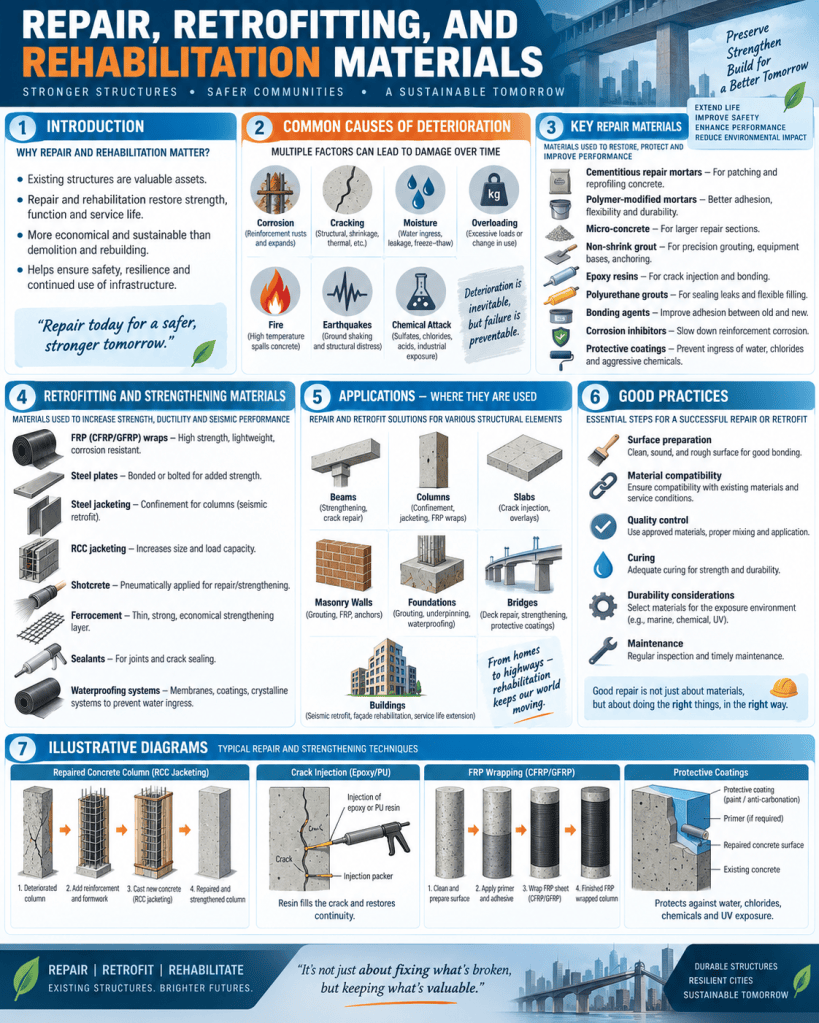
Introduction
Buildings and civil engineering structures deteriorate over time because of aging, environmental exposure, poor workmanship, overloading, corrosion, moisture penetration, chemical attack, settlement, fire, earthquakes, and changes in use. Instead of demolishing damaged structures and replacing them completely, engineers often use repair, retrofitting, and rehabilitation techniques to restore or improve structural performance.
Although these three terms are closely related, they have different meanings. Repair usually focuses on correcting local defects such as cracks, spalling, leakage, or damaged concrete. Retrofitting involves strengthening an existing structure so that it can carry higher loads or perform better under hazards such as earthquakes. Rehabilitation is a broader process that restores the overall functionality, safety, durability, and serviceability of a structure.
The success of these processes depends greatly on selecting suitable materials. Modern rehabilitation work uses a wide range of cementitious, polymer-based, metallic, fiber-reinforced, and composite materials. Proper diagnosis of the defect is essential before selecting the repair system.
Objectives of Repair and Rehabilitation
The main objectives are to:
- restore structural strength;
- improve durability;
- stop further deterioration;
- protect reinforcement from corrosion;
- seal cracks and leakage paths;
- improve seismic performance;
- increase load-carrying capacity;
- extend service life;
- improve appearance and functionality.
Repair should not simply cover visible damage. The underlying cause should first be identified and controlled.
Common Causes of Structural Deterioration
Structures may require repair because of:
- reinforcement corrosion;
- carbonation;
- chloride attack;
- chemical exposure;
- freeze-thaw action;
- water leakage;
- shrinkage cracking;
- foundation settlement;
- overloading;
- poor detailing;
- fire damage;
- earthquake damage;
- impact damage.
Concrete structures are particularly vulnerable when moisture and aggressive chemicals reach reinforcement and initiate corrosion.
Cementitious Repair Mortars
Cementitious repair mortar is one of the most widely used materials for concrete repair. It is generally made from cement, graded sand, water, and chemical or mineral additives.
It is used for:
- patch repairs;
- surface restoration;
- filling shallow defects;
- repairing spalled concrete;
- rebuilding damaged edges.
Advantages include:
- compatibility with concrete;
- ease of application;
- relatively low cost;
- good compressive strength.
However, shrinkage must be controlled, especially in larger repairs.
Polymer-Modified Mortars
Polymer-modified mortars contain polymers such as acrylic, styrene-butadiene, or latex.
The polymer improves:
- adhesion;
- flexibility;
- water resistance;
- tensile strength;
- durability.
These mortars are suitable for thin repairs, overlays, façade repairs, and areas where better bonding with the existing substrate is required.
Micro-Concrete
Micro-concrete is a flowable, high-strength cementitious repair material containing small aggregates.
It is commonly used for:
- column jacketing;
- beam repair;
- machine foundations;
- congested reinforcement zones;
- structural strengthening.
Because of its high flowability, it can fill narrow or difficult spaces without requiring heavy vibration.
Micro-concrete is especially useful when conventional concrete placement is difficult.
Non-Shrink Grout
Non-shrink grout is used where dimensional stability is important.
Common applications include:
- base plates;
- machine foundations;
- precast joints;
- anchor bolts;
- structural gaps;
- column bases.
The material is designed to minimize shrinkage after placement and maintain full contact between connected surfaces.
Epoxy Resin
Epoxy resins are widely used in structural repair because of their strong bonding capability.
Applications include:
- crack injection;
- bonding old and new concrete;
- anchoring reinforcement;
- surface sealing;
- structural adhesives.
Epoxy can develop high tensile and compressive strength.
However, epoxy is generally less tolerant of wet surfaces and elevated temperatures than some cementitious systems.
Epoxy Injection
Epoxy injection is used for repairing fine structural cracks in concrete.
The procedure typically includes:
- cleaning the crack;
- sealing the surface;
- installing injection ports;
- injecting epoxy under controlled pressure;
- allowing the resin to cure.
This can restore continuity across cracks if the crack is dormant and the underlying cause has been addressed.
Polyurethane Resins
Polyurethane materials are especially useful for sealing cracks that experience moisture or minor movement.
Polyurethane injection may be used for:
- water leakage;
- basement cracks;
- tunnels;
- retaining walls;
- wet joints.
Some polyurethane systems react with water and expand into a foam, helping block active leaks.
Unlike rigid epoxy, polyurethane can provide greater flexibility.
Bonding Agents
Bonding agents improve adhesion between existing and new materials.
Common types include:
- epoxy bonding agents;
- polymer latex;
- cement slurry with additives.
They are used before placing repair mortar, overlays, or concrete.
Surface preparation remains essential even when bonding agents are used.
Corrosion Inhibitors
Corrosion inhibitors are materials used to slow or prevent reinforcement corrosion.
They may be:
- mixed into repair materials;
- applied to exposed reinforcement;
- applied to concrete surfaces.
Their purpose is to reduce electrochemical activity and protect steel.
Corrosion inhibitors are often used together with patch repairs and protective coatings.
Rust Converters and Reinforcement Coatings
When corroded reinforcement is exposed during repair, rust must be removed and the steel cleaned.
Protective coatings may then be applied.
These coatings may be:
- cementitious;
- epoxy-based;
- polymer-based.
Their role is to provide a protective barrier and improve bond with the surrounding repair material.
Protective Surface Coatings
Protective coatings are applied to concrete or masonry surfaces to reduce water and chemical penetration.
Examples include:
- acrylic coatings;
- epoxy coatings;
- polyurethane coatings;
- silane or siloxane water repellents;
- elastomeric coatings.
These systems help reduce:
- carbonation;
- chloride ingress;
- moisture penetration;
- chemical attack.
Elastomeric coatings are useful where small surface cracks need to be bridged.
Fiber-Reinforced Polymer
Fiber-Reinforced Polymer (FRP) is an important modern strengthening material.
It consists of high-strength fibers embedded in a polymer matrix.
Common types include:
- CFRP – Carbon Fiber-Reinforced Polymer;
- GFRP – Glass Fiber-Reinforced Polymer;
- AFRP – Aramid Fiber-Reinforced Polymer.
FRP can be supplied as sheets, strips, plates, bars, or wraps.
CFRP Strengthening
Carbon fiber-reinforced polymer is widely used for strengthening concrete structures.
Applications include:
- beam flexural strengthening;
- shear strengthening;
- column confinement;
- slab strengthening;
- seismic retrofitting.
Advantages include:
- very high strength-to-weight ratio;
- corrosion resistance;
- low added weight;
- rapid installation;
- minimal increase in member size.
Its main limitations are relatively high cost, surface preparation requirements, and sensitivity to high temperature unless protected.
GFRP
Glass fiber-reinforced polymer is generally less expensive than carbon fiber.
It offers:
- corrosion resistance;
- low weight;
- good tensile strength.
GFRP is used for strengthening, reinforcement bars, façades, and other applications where extreme stiffness is not essential.
Steel Plate Bonding
Steel plates can be bonded or bolted to existing concrete members to increase capacity.
This method may be used for:
- beams;
- slabs;
- columns;
- connection regions.
Steel plate strengthening can be effective but requires corrosion protection and careful detailing.
Steel Jacketing
Steel jacketing is used to strengthen columns and sometimes beams.
Steel plates or angles are placed around the existing member and connected through bolts or welding.
Advantages include:
- significant increase in strength;
- improved confinement;
- rapid installation.
Steel jacketing is especially useful where high load capacity is required.
RCC Jacketing
RCC jacketing involves increasing the size of an existing reinforced concrete member by adding:
- new reinforcement;
- new concrete or micro-concrete;
- shear connectors or dowels.
It is commonly used for columns and beams.
Benefits include:
- increased axial capacity;
- improved flexural strength;
- greater stiffness;
- improved seismic resistance.
However, jacketing increases member dimensions and adds weight.
Shotcrete and Gunite
Shotcrete is concrete or mortar pneumatically projected onto a surface at high velocity.
It can be applied to:
- walls;
- tunnels;
- bridges;
- retaining structures;
- damaged concrete surfaces.
Shotcrete provides good compaction and bond.
It is useful for repairing large irregular surfaces and for seismic strengthening.
Gunite generally refers to a dry-mix sprayed mortar process, while shotcrete may include wet-mix systems.
Ferrocement
Ferrocement consists of a thin cement mortar matrix reinforced with closely spaced layers of wire mesh.
It is used for:
- thin jackets;
- walls;
- tanks;
- shells;
- repair overlays.
Advantages include good crack control, lightweight construction, and ease of forming around complex shapes.
Grouting Materials
Grouting is used to fill voids, cracks, joints, or spaces in soil and structures.
Common grouting materials include:
- cement grout;
- chemical grout;
- epoxy grout;
- polyurethane grout.
Applications include:
- foundation strengthening;
- void filling;
- masonry consolidation;
- crack sealing;
- soil improvement.
Crack-Filling Materials
Not all cracks require structural epoxy.
Different materials are selected according to crack type.
Common options include:
- epoxy for structural dormant cracks;
- polyurethane for leaking cracks;
- polymer sealants for movement joints;
- cement slurry for larger non-critical cracks;
- flexible sealants for dynamic cracks.
Correct crack diagnosis is essential.
Sealants
Sealants are flexible materials used at joints and cracks where movement is expected.
Common types include:
- silicone;
- polyurethane;
- polysulfide;
- acrylic.
They are used around:
- façades;
- windows;
- expansion joints;
- concrete joints;
- roofing systems.
Sealants must remain flexible and maintain adhesion.
Waterproofing Materials
Waterproofing is often an important part of rehabilitation.
Common systems include:
- cementitious coatings;
- bituminous membranes;
- liquid-applied polyurethane;
- acrylic coatings;
- sheet membranes;
- crystalline waterproofing.
Waterproofing prevents future deterioration caused by moisture.
Crystalline Waterproofing
Crystalline waterproofing contains chemicals that react with moisture and cement compounds to form insoluble crystals within concrete pores.
It is used for:
- basements;
- tanks;
- tunnels;
- foundations.
The crystals reduce water permeability.
Repair of Masonry Structures
Masonry rehabilitation may use:
- lime mortar;
- compatible cement-lime mortar;
- grout injection;
- stainless steel ties;
- crack stitching bars;
- stone replacement.
Historic masonry requires special care because overly strong repair materials can damage original bricks or stone.
Compatibility is more important than simply achieving maximum strength.
Crack Stitching
Crack stitching involves inserting metal bars across cracks.
Slots are cut across the crack, and bars are fixed with grout or resin.
This helps reconnect separated masonry and distribute tensile stresses.
Underpinning Materials
Foundation rehabilitation may require underpinning.
Materials include:
- concrete;
- reinforced concrete;
- structural steel;
- micropiles;
- grout.
Micropiles are especially useful where access is restricted or stronger soil lies at greater depth.
Seismic Retrofitting Materials
Earthquake retrofitting aims to improve strength, stiffness, and ductility.
Common materials and systems include:
- FRP wraps;
- steel bracing;
- RCC jackets;
- steel jackets;
- shotcrete;
- shear walls;
- dampers;
- base isolation devices.
Material selection depends on the existing structure and expected seismic demand.
Steel Bracing
Steel bracing can improve the lateral resistance of framed buildings.
Common systems include:
- X-bracing;
- V-bracing;
- inverted V-bracing.
Bracing can often be installed with relatively limited disturbance compared with adding large concrete walls.
Addition of Shear Walls
Reinforced concrete shear walls may be added during rehabilitation to increase lateral stiffness.
They are particularly effective in buildings with weak resistance to wind or earthquake forces.
However, foundation strengthening may also be required to support the additional loads.
Repair of Fire-Damaged Structures
After fire exposure, concrete, steel, and masonry should be carefully assessed.
Repair may include:
- removal of weakened concrete;
- reinforcement replacement;
- protective coatings;
- section rebuilding;
- FRP strengthening;
- steel plate strengthening.
Fire-damaged materials should not be covered until their residual strength has been evaluated.
Surface Preparation
Surface preparation is one of the most important steps in repair work.
Before repair materials are applied, surfaces may need:
- removal of loose concrete;
- cleaning;
- roughening;
- dust removal;
- reinforcement cleaning;
- moisture conditioning.
Poor surface preparation can cause repair failure even when high-quality materials are used.
Compatibility of Repair Materials
Repair materials should be compatible with the existing substrate.
Important properties include:
- strength;
- modulus of elasticity;
- shrinkage;
- thermal expansion;
- permeability;
- bond strength.
A repair material that is much stronger or stiffer than the original material can sometimes create stress concentrations.
Durability Considerations
A successful repair should address the long-term environment.
For example, repairing corrosion damage without stopping chloride or water ingress may only provide temporary improvement.
Durable repair therefore combines:
- defect removal;
- structural restoration;
- corrosion protection;
- waterproofing;
- protective coatings;
- proper drainage.
Quality Control
Repair and retrofitting work requires careful inspection.
Important checks include:
- substrate preparation;
- crack condition;
- reinforcement cleaning;
- material mixing;
- application thickness;
- curing;
- bond quality;
- anchor installation.
Specialized strengthening systems such as FRP should be installed according to approved procedures.
Non-Destructive Testing
Before and after rehabilitation, non-destructive tests may be used.
Examples include:
- rebound hammer testing;
- ultrasonic pulse velocity;
- cover meter surveys;
- half-cell potential;
- infrared thermography.
These methods help assess condition without extensive damage to the structure.
Sustainability Benefits
Repair and rehabilitation can be more sustainable than demolition and reconstruction.
Benefits include:
- conservation of existing materials;
- reduction in demolition waste;
- lower demand for new resources;
- lower embodied energy;
- extension of building life.
Retrofitting also allows existing buildings to meet new functional, structural, or energy requirements.
Selecting the Right Repair Material
Selection should consider:
- cause of damage;
- structural importance;
- exposure conditions;
- crack movement;
- moisture;
- required strength;
- access;
- cost;
- durability.
There is no single material suitable for all repairs.
For example, epoxy may be ideal for a dry structural crack, while polyurethane may be more appropriate for a leaking moving crack.
Maintenance After Rehabilitation
Repaired structures should continue to be monitored.
Periodic inspections should check for:
- new cracks;
- coating deterioration;
- water leakage;
- corrosion;
- movement;
- joint failure.
Early maintenance helps protect the investment made in rehabilitation.
Conclusion
Repair, retrofitting, and rehabilitation materials play a vital role in extending the service life of buildings and infrastructure. Materials such as cementitious repair mortars, polymer-modified mortars, micro-concrete, epoxy resins, polyurethane, FRP composites, steel plates, shotcrete, sealants, waterproofing systems, and protective coatings provide a wide range of solutions for structural and durability problems.
The choice of material should always follow a proper investigation of the damage. Repair treats defects, retrofitting improves structural capacity, and rehabilitation restores the overall performance and usability of a structure.
The most effective rehabilitation does not merely hide visible damage. It addresses the underlying cause, restores structural behavior, protects the repaired area from future deterioration, and ensures compatibility between old and new materials.
When supported by good diagnosis, proper surface preparation, skilled application, quality control, and continued maintenance, modern repair and retrofitting materials can significantly improve the safety, durability, resilience, and sustainability of existing structures.


You must be logged in to post a comment.