
Alternative & Earth-Based Building Materials: CSEB and Bamboo
Introduction
Alternative and earth-based building materials are becoming increasingly important in sustainable architecture and construction. Conventional materials such as fired clay bricks, cement, steel, and concrete are widely used because of their strength, availability, and established construction practices. However, their production can require large amounts of energy, natural resources, and transportation. In response, architects, engineers, and builders are exploring materials that are locally available, renewable, low in embodied energy, affordable, and environmentally responsible.
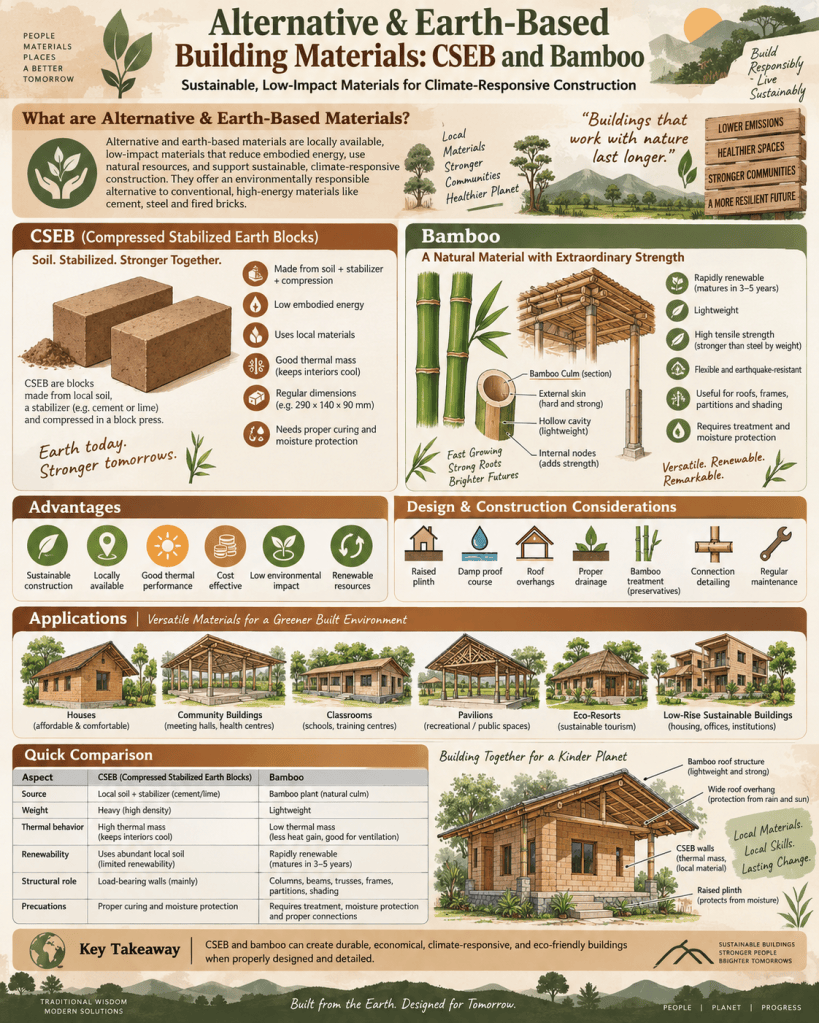
Among the most promising alternatives are Compressed Stabilized Earth Blocks (CSEB) and bamboo. CSEB combines earth with a small quantity of stabilizer and mechanical compression to produce strong masonry units. Bamboo is a rapidly renewable natural material with high tensile strength and a long history of use in houses, bridges, roofs, scaffolding, and furniture.
Both materials demonstrate how traditional knowledge can be combined with modern engineering to create durable, efficient, and climate-responsive buildings.
What Are Alternative Building Materials?
Alternative building materials are materials used as substitutes for conventional construction products when they offer environmental, economic, social, or technical advantages.
Examples include:
- compressed earth blocks;
- stabilized mud blocks;
- rammed earth;
- adobe;
- bamboo;
- straw bale;
- recycled aggregates;
- fly-ash blocks;
- lime-based materials;
- recycled timber;
- agricultural-waste panels.
The choice of material depends on local climate, available resources, required structural performance, workmanship, maintenance, and building regulations.
Earth as a Building Material
Earth is one of the oldest construction materials used by humans. Traditional earth construction techniques include adobe, cob, rammed earth, mud masonry, and earthen plaster.
Earth offers several advantages:
- local availability;
- relatively low embodied energy;
- good thermal mass;
- low transportation requirements;
- recyclability;
- affordability.
However, untreated earth can have limitations such as low water resistance, shrinkage cracking, and variable strength. Stabilization and controlled production methods help improve its performance.
Compressed Stabilized Earth Blocks
Compressed Stabilized Earth Blocks, or CSEB, are masonry units made from suitable soil mixed with a controlled amount of stabilizer and compacted under pressure.
Typical ingredients include:
- soil;
- sand where required;
- cement or lime;
- water.
The mixture is placed in a manual or mechanical press and compressed into blocks of uniform size.
Unlike fired bricks, CSEB units are generally not fired in kilns.
Soil Selection for CSEB
The performance of a CSEB depends strongly on soil composition.
Suitable soil generally contains a balanced mixture of:
- gravel;
- sand;
- silt;
- clay.
Too much clay can cause shrinkage and cracking, while too much sand may reduce cohesion.
Before production, soil should be tested for:
- grain-size distribution;
- plasticity;
- moisture content;
- organic matter;
- stabilizer requirement.
Locally available soil may often be modified by adding sand or other materials.
Stabilization
Stabilization improves the strength and water resistance of earth blocks.
Common stabilizers include:
Cement
Cement is widely used because it improves compressive strength and resistance to moisture.
Lime
Lime is especially useful for certain clay-rich soils and can improve workability and long-term stability.
Combined Stabilizers
In some cases, cement and lime may be used together.
The amount of stabilizer should be optimized because excessive use increases cost and embodied energy.
Manufacturing Process of CSEB
A typical CSEB production process includes:
- selecting suitable soil;
- removing organic matter and oversized particles;
- sieving the soil;
- proportioning soil and stabilizer;
- dry mixing;
- adding controlled water;
- placing the mixture in a block press;
- compressing the block;
- removing the block carefully;
- curing under controlled conditions.
Proper curing is particularly important for cement-stabilized blocks.
CSEB Block Presses
Blocks may be produced using:
- manual presses;
- semi-mechanical presses;
- hydraulic machines.
Manual presses are useful for small-scale and community-based construction, while hydraulic machines provide higher production rates and more consistent compaction.
Advantages of CSEB
CSEB offers several benefits.
Lower Energy Requirement
Because blocks are not fired in conventional brick kilns, production generally requires less energy.
Local Material Use
Soil can often be obtained near the construction site, reducing transportation.
Uniform Dimensions
Mechanical compression creates regular blocks, reducing mortar consumption and improving construction accuracy.
Thermal Performance
Earth walls have high thermal mass, helping moderate indoor temperature fluctuations.
Reduced Waste
Broken or rejected blocks can sometimes be crushed and reused as earth material.
Architectural Character
Exposed earth blocks provide a natural texture and color.
Limitations of CSEB
CSEB also has limitations.
These include:
- need for proper soil testing;
- sensitivity to poor curing;
- potential water damage if detailing is inadequate;
- requirement for skilled production control;
- need for protective design in heavy rainfall regions.
CSEB walls should not be continuously exposed to standing water.
Construction Detailing for CSEB
Good detailing is essential for long-lasting earth buildings.
Important measures include:
- raised plinths;
- damp-proof courses;
- roof overhangs;
- proper drainage;
- protected wall bases;
- suitable plaster or surface treatment where required.
The principle often summarized as “good boots and a good hat” is particularly relevant to earth buildings: protect the base from water and provide adequate roof protection.
Mortar for CSEB
Mortar should be compatible with the blocks.
Possible mortars include:
- stabilized earth mortar;
- cement-lime mortar;
- thin joint mortar where suitable.
Very strong cement-rich mortar may be unnecessary and can create compatibility problems.
Structural Use of CSEB
CSEB can be used for:
- load-bearing walls;
- non-load-bearing partitions;
- infill walls;
- low-rise buildings;
- community facilities;
- residential construction.
Structural use should be based on tested block strength, wall thickness, building height, and applicable design requirements.
Bamboo as a Building Material
Bamboo is a fast-growing natural material that has been used for construction for centuries, especially in tropical and subtropical regions.
Although commonly called a wood material, bamboo is botanically a grass.
Its structural advantages include:
- high tensile strength;
- low density;
- flexibility;
- rapid renewability;
- ease of cutting;
- good performance in lightweight structures.
Bamboo can be used in both traditional and engineered forms.
Characteristics of Bamboo
Bamboo has a hollow cylindrical form divided by nodes.
The fibers run mainly along the length of the culm, providing high longitudinal strength.
Its performance depends on:
- species;
- age;
- moisture content;
- diameter;
- wall thickness;
- harvesting method;
- treatment.
Mature bamboo is generally preferred for structural use.
Applications of Bamboo
Bamboo can be used for:
- columns;
- roof trusses;
- rafters;
- purlins;
- floor systems;
- wall frames;
- scaffolding;
- bridges;
- partitions;
- furniture;
- screens and shading devices.
Modern engineered bamboo products expand these possibilities further.
Bamboo Structural Systems
Post-and-Beam Systems
Bamboo culms can act as columns and beams in lightweight buildings.
Roof Trusses
Bamboo is suitable for roof trusses because of its light weight and ability to resist tensile forces.
Space Frames
Properly connected bamboo members can create lightweight three-dimensional structures.
Curved Structures
Bamboo’s natural flexibility allows the creation of curved roofs, pavilions, and organic architectural forms.
Bamboo Connections
Connections are one of the most challenging parts of bamboo construction.
Because bamboo is hollow and can split, conventional timber connections may not always work effectively.
Common connection methods include:
- rope or fiber lashing;
- bolts;
- dowels;
- steel plates;
- clamps;
- threaded rods;
- filled joint systems;
- specially designed connectors.
The connection should distribute forces without crushing or splitting the bamboo.
Lashing Connections
Traditional bamboo buildings often use natural fiber or rope lashings.
Advantages include:
- simplicity;
- flexibility;
- low cost;
- ease of replacement.
However, lashing durability and long-term performance must be considered.
Bolted Connections
Bolts can provide stronger mechanical connections.
To reduce splitting, designers may use:
- washers;
- internal fillers;
- reinforced nodes;
- steel sleeves.
Bolt holes should be carefully located and drilled.
Bamboo Treatment
Untreated bamboo is vulnerable to insects, fungi, and decay.
Treatment is therefore essential for durable construction.
Common methods include:
- borax-boric acid treatment;
- soaking;
- pressure treatment;
- heat treatment;
- surface coatings.
The selected treatment should be suitable for the intended exposure conditions.
Protection from Moisture
Bamboo should be kept away from prolonged ground contact and standing water.
Good detailing includes:
- raised foundations;
- steel or concrete base connections;
- roof overhangs;
- ventilation;
- protective coatings.
Direct embedding of untreated bamboo in soil should generally be avoided where long-term durability is required.
Fire Performance of Bamboo
Bamboo is combustible and requires careful fire design.
Fire safety measures may include:
- fire-retardant treatment;
- protective linings;
- separation from ignition sources;
- adequate escape planning;
- sprinklers where required.
Fire performance should be assessed as part of the complete building system.
Engineered Bamboo Products
Modern manufacturing techniques can transform bamboo into more standardized products.
Examples include:
- laminated bamboo lumber;
- bamboo boards;
- bamboo plywood;
- bamboo composite panels;
- strand-woven bamboo.
These products can provide more predictable dimensions and properties than natural culms.
Laminated Bamboo
Laminated bamboo is produced by cutting bamboo into strips, treating them, and bonding them together.
It may be used for:
- beams;
- flooring;
- furniture;
- panels;
- interior finishes.
The process allows bamboo to be manufactured in regular rectangular sections.
Bamboo Flooring and Panels
Bamboo flooring is popular because it combines a natural appearance with good hardness and renewability.
Bamboo panels can be used for:
- interior partitions;
- furniture;
- ceilings;
- decorative wall systems.
Surface treatment improves resistance to wear and moisture.
CSEB and Bamboo in Sustainable Construction
CSEB and bamboo can complement each other effectively.
For example, a low-rise building may use:
- CSEB walls;
- bamboo roof trusses;
- bamboo shading screens;
- earth or lime finishes.
This creates a construction system based largely on locally available and renewable materials.
Embodied Energy
One of the major sustainability advantages of alternative materials is the potential reduction in embodied energy.
CSEB avoids energy-intensive firing associated with many conventional bricks.
Bamboo grows rapidly and requires relatively limited processing in its natural form.
However, the environmental benefit depends on:
- transportation distance;
- stabilizer quantity;
- adhesives;
- treatment chemicals;
- durability.
Life-cycle thinking is therefore important.
Thermal Performance
Earth materials have high thermal mass, which helps absorb and release heat slowly.
This can improve comfort in climates with significant day-night temperature variations.
Bamboo, being lightweight, has different thermal characteristics and is often used in roofs, frames, or shaded envelope systems.
Together, the materials can support climate-responsive design.
Seismic Considerations
Lightweight bamboo structures can perform well under earthquake forces because lower building mass reduces seismic loads.
Earth walls, however, require careful structural design in seismic regions.
Measures may include:
- horizontal bands;
- vertical reinforcement;
- confined masonry techniques;
- lightweight roofs;
- good wall connections.
Unreinforced heavy earthen walls can be vulnerable during strong earthquakes.
Water Management
Water protection is one of the most important considerations for both materials.
For CSEB:
- provide raised plinths;
- avoid prolonged saturation;
- protect the wall base;
- use suitable roof overhangs.
For bamboo:
- avoid direct soil contact;
- keep joints dry;
- provide drainage and ventilation;
- protect cut ends.
Good architectural detailing can greatly extend service life.
Economic Benefits
Both CSEB and bamboo can support affordable construction, particularly when materials and skills are locally available.
Possible economic advantages include:
- reduced transportation costs;
- local employment;
- community production;
- lower structural weight;
- use of simple tools.
However, cost savings should not come at the expense of testing, treatment, and quality control.
Social and Regional Benefits
Alternative materials can help preserve traditional building skills while creating modern employment opportunities.
Local production can support:
- rural economies;
- craftspeople;
- small enterprises;
- decentralized construction industries.
Buildings can also reflect regional identity through natural materials and construction methods.
Quality Control
Alternative construction must be based on proper quality assurance.
For CSEB, checks may include:
- soil testing;
- mix proportion;
- compression pressure;
- block dimensions;
- curing;
- compressive strength.
For bamboo, checks may include:
- species;
- maturity;
- treatment;
- moisture content;
- defects;
- connection quality.
Standardization can help alternative materials achieve greater acceptance.
Common Problems in CSEB Construction
Typical problems include:
- erosion at wall bases;
- cracking;
- weak blocks;
- poor bonding;
- insufficient curing;
- excessive stabilizer variation.
Most of these problems can be prevented through proper production and detailing.
Common Problems in Bamboo Construction
Common problems include:
- insect attack;
- fungal decay;
- splitting at connections;
- moisture damage;
- weak joints;
- poor-quality culms.
Proper harvesting, treatment, storage, and connection design are therefore essential.
Maintenance
CSEB and bamboo buildings require regular inspection.
CSEB walls should be checked for:
- erosion;
- cracks;
- moisture staining;
- damaged plaster.
Bamboo should be checked for:
- insect holes;
- splitting;
- decay;
- loose joints;
- coating deterioration.
Early maintenance significantly extends service life.
Future of Alternative Materials
Growing concern about climate change, resource consumption, and construction waste has renewed interest in earth and bio-based materials.
Research is expanding in areas such as:
- engineered bamboo;
- prefabricated earth blocks;
- hybrid structural systems;
- digital fabrication;
- bio-based composites.
Future construction may combine traditional materials with modern engineering, testing, prefabrication, and building science.
Conclusion
Alternative and earth-based materials such as Compressed Stabilized Earth Blocks and bamboo offer important opportunities for sustainable construction. CSEB uses locally available soil, stabilization, and mechanical compression to create durable masonry units with relatively low energy requirements. Bamboo offers a rapidly renewable, lightweight, and structurally efficient material for frames, roofs, screens, and engineered products.
Both materials require careful design. CSEB must be protected from excessive moisture and produced using properly selected soil and controlled stabilization. Bamboo requires treatment against biological attack, good moisture protection, and carefully designed connections.
When supported by testing, quality control, skilled workmanship, and appropriate architectural detailing, CSEB and bamboo can provide durable, economical, low-impact, and visually distinctive buildings. Their use demonstrates that sustainable construction does not always depend on highly industrialized materials; it can also emerge from intelligently adapting local resources, traditional knowledge, and modern engineering principles.


You must be logged in to post a comment.