
Structural Design: Elastic Design vs Limit State Design
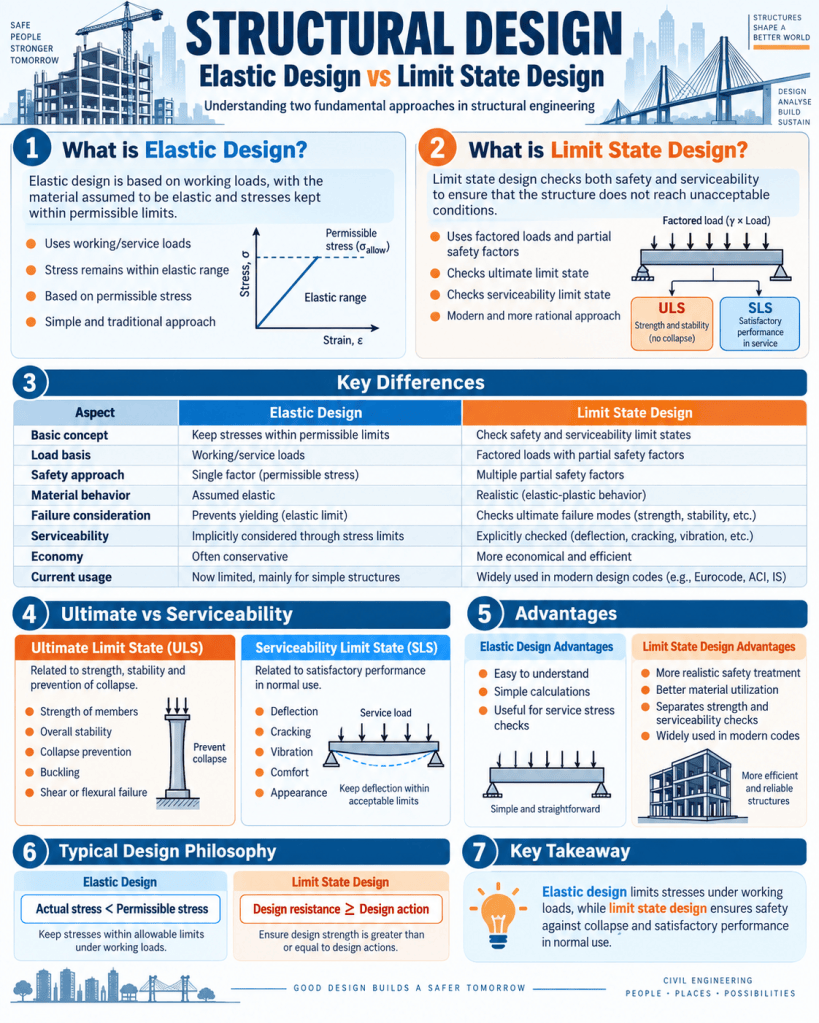
Introduction
Structural design is the process of determining the size, shape, material, reinforcement, and arrangement of structural members so that a building or infrastructure system can safely resist the loads acting on it throughout its service life. The designer must ensure that the structure is not only strong enough to avoid collapse but also sufficiently stiff and durable to remain usable under normal conditions.
Two important approaches used in structural engineering are Elastic Design and Limit State Design. Elastic design is based mainly on the assumption that structural materials behave elastically under working loads and that stresses should remain within permissible values. Limit State Design, on the other hand, evaluates a structure against clearly defined failure and serviceability conditions and uses partial safety factors for loads and materials.
The shift from elastic or working stress methods to limit state design represents an important development in structural engineering because it provides a more realistic treatment of material behavior, loading uncertainty, structural safety, and serviceability.
Concept of Elastic Design
Elastic design is based on the principle that a structural member should remain within the elastic range when subjected to normal working loads.
In the elastic range, stress is approximately proportional to strain, following Hooke’s law:
Stress ∝ Strain
or
σ = Eε
where:
- σ = stress,
- E = modulus of elasticity,
- ε = strain.
If the applied load is removed while the material remains within the elastic range, the member returns approximately to its original shape.
Elastic design is closely associated with the Working Stress Method, in which allowable or permissible stresses are obtained by dividing the material strength by a factor of safety.
Working Stress Concept
In working stress design, the loads expected during normal use are called working loads or service loads.
The calculated stress under these loads should not exceed the permissible stress.
A simplified expression is:
Permissible Stress = Material Strength / Factor of Safety
For example, if a material has a specified strength of 300 MPa and a factor of safety of 1.5 is used:
Permissible Stress = 300 / 1.5 = 200 MPa
The member is then proportioned so that the calculated working stress remains below 200 MPa.
Assumptions of Elastic Design
Elastic design generally assumes that:
- materials behave elastically under service loads;
- stress and strain have a linear relationship;
- sections remain within permissible stress limits;
- factors of safety are applied mainly to material strength;
- the structural response is predictable through elastic analysis.
These assumptions make calculations relatively straightforward.
Advantages of Elastic Design
Elastic design offers several benefits.
Simplicity
The method is conceptually simple and easy to understand.
Service Load Focus
Because calculations are performed directly at working loads, stresses and elastic deformations can be assessed easily.
Suitable for Certain Materials and Structures
Elastic methods remain useful in areas where service stress control is particularly important.
Long Historical Use
Many existing buildings and bridges were successfully designed using elastic or working stress principles.
Limitations of Elastic Design
The main limitation is that the method does not always represent actual structural behavior near failure.
Materials such as reinforced concrete and structural steel can develop significant reserve strength beyond initial elastic behavior.
Elastic design may therefore be overly conservative in some cases and may not distribute safety as consistently across different types of loads and materials.
Other limitations include:
- limited representation of ultimate failure;
- single overall safety approach;
- less rational treatment of load variability;
- inability to make full use of plastic behavior;
- possible uneconomical member sizes.
Concept of Limit State Design
Limit State Design (LSD) is a modern approach in which a structure is designed so that it does not reach any unacceptable condition during its intended life.
These unacceptable conditions are called limit states.
A limit state represents the point beyond which a structure no longer satisfies the required performance criteria.
Limit states are broadly classified into:
- Ultimate Limit States
- Serviceability Limit States
Ultimate Limit State
The Ultimate Limit State, or ULS, concerns structural safety against collapse or major failure.
Examples include:
- flexural failure;
- shear failure;
- compression failure;
- buckling;
- overturning;
- sliding;
- loss of equilibrium;
- fatigue in relevant structures;
- rupture of structural members.
The structure must possess adequate strength and stability under factored loads.
Serviceability Limit State
The Serviceability Limit State, or SLS, concerns the satisfactory functioning of the building under normal use.
Typical serviceability issues include:
- excessive deflection;
- excessive cracking;
- vibration;
- settlement;
- water leakage;
- discomfort;
- unacceptable appearance.
A structure may be safe against collapse but still be unsuitable for use if it deflects excessively or develops severe cracking.
Thus, Limit State Design explicitly checks both safety and usability.
Characteristic Loads and Strengths
Limit state design generally uses characteristic values of loads and material strengths.
Characteristic loads may include:
- dead load;
- live load;
- wind load;
- earthquake load;
- snow load;
- other environmental actions.
Characteristic strength refers to a statistically defined material strength below which only a specified proportion of test results is expected to fall.
These characteristic values are then modified using partial safety factors.
Partial Safety Factors
One of the key features of Limit State Design is the use of separate safety factors for:
- loads;
- materials.
This is more refined than applying a single overall factor of safety.
The design action may be expressed conceptually as:
Design Load = Characteristic Load × Load Factor
Similarly:
Design Strength = Characteristic Strength / Material Safety Factor
The exact factors depend on the applicable design code, load combination, material, and limit state.
Load Combinations
A structure rarely experiences maximum values of all loads simultaneously.
Limit State Design therefore considers various load combinations.
Typical combinations may involve:
- dead load + live load;
- dead load + wind load;
- dead load + live load + wind load;
- dead load + earthquake load.
Different combinations are checked because each may produce a different critical response.
Elastic Analysis Within Limit State Design
It is important to understand that Limit State Design does not necessarily mean elastic analysis is abandoned.
Many structures are still analyzed using elastic structural analysis to determine:
- bending moments;
- shear forces;
- axial forces;
- reactions.
However, the design of members is then checked using limit state principles and factored values.
Thus, elastic analysis and elastic design are not always identical concepts.
Elastic Design of Reinforced Concrete
In traditional working stress design of reinforced concrete, both concrete and steel stresses are kept within permissible limits under working loads.
Because concrete is weak in tension, tensile forces are primarily resisted by reinforcement.
The method assumes elastic behavior and generally produces larger sections or more conservative stress levels compared with modern ultimate strength approaches.
Limit State Design of Reinforced Concrete
In Limit State Design, reinforced concrete members are designed using their behavior closer to ultimate conditions.
For example, a reinforced concrete beam is checked for:
- ultimate bending strength;
- shear resistance;
- reinforcement requirements;
- deflection;
- cracking.
The method recognizes nonlinear concrete behavior and allows more realistic use of reinforcement and concrete strength.
Structural Steel and Elastic Design
Steel behaves approximately elastically up to its yield point.
Traditional elastic steel design limits stresses below yield under service loads.
This provides straightforward analysis but may not make full use of steel’s capacity beyond first yield.
Limit State Design of Steel
Limit state steel design checks structural members against conditions such as:
- yielding;
- buckling;
- local buckling;
- lateral torsional buckling;
- connection failure;
- fatigue;
- excessive deflection.
Modern steel design therefore addresses both material strength and instability.
Factor of Safety Philosophy
The difference between the two methods can be better understood through their safety philosophy.
Elastic Design
Elastic design generally applies safety by limiting allowable stress.
The main idea is:
Actual working stress < Permissible stress
Limit State Design
Limit State Design applies safety separately to loads and material resistance.
The main concept is:
Design resistance ≥ Design action
This provides a more transparent and consistent approach to uncertainty.
Comparison: Elastic Design vs Limit State Design
| Aspect | Elastic Design | Limit State Design |
|---|---|---|
| Basic concept | Keep stresses within permissible elastic limits | Prevent specified ultimate and serviceability limit states |
| Loads | Working/service loads | Factored loads for ULS and service loads for SLS |
| Material strength | Reduced by overall factor of safety | Characteristic strength modified by material factors |
| Structural behavior | Mainly elastic | Includes ultimate and service behavior |
| Safety factors | Usually global or permissible-stress based | Partial factors for loads and materials |
| Failure prediction | Less direct | Explicitly considers failure modes |
| Serviceability | Often inherent in working stress check | Checked separately |
| Economy | Often more conservative | Usually more efficient |
| Modern usage | Limited/special applications | Widely used in modern codes |
Example of a Beam
Consider a beam carrying permanent and imposed loads.
Under elastic design, the designer calculates bending moment using service loads and determines the bending stress.
The calculated stress must remain below the permissible stress.
In Limit State Design, the procedure is different.
First, ultimate load combinations are generated using appropriate partial factors. The beam is designed so that its ultimate moment resistance exceeds the factored bending moment.
Then separate checks are performed for serviceability, such as:
- deflection;
- cracking;
- vibration.
This separates collapse prevention from normal-use performance.
Strength and Serviceability
One of the most important principles of modern structural design is that strength alone is not sufficient.
For example, a floor beam might be strong enough to avoid collapse but may vibrate excessively when people walk across it.
Similarly, an RCC slab may have adequate ultimate capacity but may develop excessive cracking.
Limit State Design directly recognizes this by requiring separate ULS and SLS checks.
Reliability-Based Approach
Limit State Design is more closely connected with probabilistic thinking.
Loads and material strengths are not perfectly predictable.
For example:
- actual live loads vary;
- material strength varies between batches;
- dimensions may differ slightly;
- workmanship varies;
- environmental effects are uncertain.
Partial safety factors are intended to account for such uncertainties in a rational way.
Ductility
Ductility is another important consideration.
A ductile structure can deform significantly before failure, providing warning and redistributing forces.
Modern limit state codes often include detailing requirements to achieve ductile behavior, especially in earthquake-resistant design.
This is particularly important for:
- reinforced concrete frames;
- steel moment frames;
- seismic structures.
Economy of Limit State Design
Because Limit State Design makes better use of material strength and provides a more refined safety approach, it can often produce more economical structures.
Possible benefits include:
- smaller member dimensions;
- optimized reinforcement;
- efficient material utilization;
- better load combination treatment.
However, economy should never compromise durability or serviceability.
Role of Codes and Standards
Structural design must follow applicable national or international standards.
Design codes specify:
- loads;
- load combinations;
- material strengths;
- safety factors;
- detailing rules;
- serviceability limits.
Different jurisdictions may use different terminology, coefficients, and calculation methods.
Therefore, designers should always work with the current applicable code rather than relying on generic values.
Elastic Design in Present Practice
Although Limit State Design dominates modern structural engineering, elastic concepts remain extremely important.
Elastic analysis is still used for:
- structural response calculations;
- serviceability analysis;
- stress distribution;
- preliminary sizing;
- certain specialized design situations.
Thus, the development of Limit State Design did not make elasticity irrelevant.
Instead, it placed elastic analysis within a broader safety framework.
Limit State Design in Seismic Engineering
Seismic design particularly demonstrates the importance of limit state thinking.
A structure may be expected to experience different performance levels during different earthquake intensities.
Possible objectives include:
- limited damage during minor earthquakes;
- repairable damage during moderate events;
- prevention of collapse during severe earthquakes.
This approach cannot be captured adequately through a simple permissible-stress check alone.
Durability as a Design Consideration
Modern structural design also recognizes that a structure must remain safe throughout its intended life.
Durability issues include:
- reinforcement corrosion;
- carbonation;
- chloride exposure;
- weathering;
- moisture;
- chemical attack.
Limit state-based codes often include minimum requirements for cover, crack control, materials, and exposure conditions.
Construction Quality
No design approach can compensate for poor construction.
Even a well-designed structure can perform poorly if:
- reinforcement is misplaced;
- concrete is inadequately compacted;
- bolts are improperly tightened;
- welds are defective;
- member dimensions are incorrect.
Quality control and inspection therefore remain essential under both design philosophies.
Advantages of Limit State Design
Major advantages include:
- rational safety treatment;
- consideration of multiple failure modes;
- separate serviceability checks;
- better representation of actual material behavior;
- efficient use of materials;
- compatibility with modern reliability concepts.
Limitations of Limit State Design
Despite its benefits, Limit State Design can be more complex than basic elastic design.
It requires:
- multiple load combinations;
- separate ULS and SLS checks;
- detailed understanding of material behavior;
- careful code interpretation.
For complex structures, computer-based analysis is often used.
Importance for Architecture and Construction
Architects and construction professionals should understand these design concepts even when detailed calculations are performed by structural engineers.
Structural design influences:
- column spacing;
- beam depth;
- slab thickness;
- floor-to-floor height;
- structural form;
- material selection;
- cost.
Early coordination between architectural and structural design can therefore produce more efficient buildings.
Conclusion
Elastic Design and Limit State Design represent two important approaches to structural engineering. Elastic Design is based primarily on keeping stresses under service loads within permissible elastic limits. It is conceptually simple and has a long history of successful use, but it does not fully describe structural behavior near failure.
Limit State Design provides a broader framework by checking both Ultimate Limit States and Serviceability Limit States. It uses partial safety factors for loads and materials, evaluates different failure modes, and recognizes that a structure must be safe against collapse while also remaining functional, comfortable, and durable during normal use.
The basic distinction can therefore be summarized as follows:
Elastic Design asks: “Are the stresses under working loads within allowable limits?”
Limit State Design asks: “Is the structure safe against failure and satisfactory in normal service under all relevant design conditions?”
Modern structural engineering largely adopts the second philosophy because it provides a more comprehensive, realistic, and economical basis for designing reinforced concrete, steel, and other structural systems.


