Survival of the innovative

Its easy to give birth but to make it grow into a complete institution is a whole different journey!

Innovation is a Necessity for Survival

Innovation is defined as an idea, method, process, product, or practical solution to meet a need. It implies research, analysis, creativity, learning, and continuous improvement.  In the modern era, innovation is associated with computers, digital tools, automation, and technology, but it doesn’t always have to involve any of these things. Innovation could simply be a new solution or approach to a problem that a business association or chambers have not utilized before. It could be a new perspective on how to look at a problem.

Some sectors, particularly related to healthcare, personal care and hygiene, certain food industry segments, cleaning supplies, information and communications technology, big data analytics, drones, health technology, education technology, e-commerce, delivery services, artificial intelligence, and financial technology are thriving during this pandemic crisis’ economy. Others are questioning their business models and value proposition to innovate, adapt, and survive. Informal sectors in many emerging markets are incentivized with amnesty programs to move to the legally registered and tax-paying formal sector to be able to take advantage of government economic protection measures.

Inclusive Private Sector Engagement is a Must and Part of Good Governance :

As governments manage the crisis, each in their own manner, they struggle to balance the preservation of life and integrity of their health systems with economic activity and productivity. Many countries are operating under a state of emergency, granting them unprecedented powers. Some are placing an emphasis on transparency, accountability, and collaboration. Others are seizing the opportunity to create state-run monopolies and/or curtail rights and freedoms.

Some countries are bullying the private sector, blackmailing them to contribute to national economic relief funds, threatening them covertly with nationalization, or, imposing tough measures to safeguard employees at businesses’ expense. Other countries are only protecting select sectors or large enterprises, forgetting that small and medium enterprises are the engines of most economic activity. Others are using quasi-government business institutions to rubber-stamp government decisions, allowing them to claim private sector engagement as they roll out economic relief and recovery efforts.

Inclusive and diverse private sector engagement in formulating economic relief and recovery plans is a key strategy in managing the crisis successfully by any government. Business associations and chambers have a responsibility towards their members and sectors to ensure this level of engagement.  They also have the responsibility to provide practical solutions, raise awareness, garner support, effectively advocate, in addition to raising red flags pointing out problems.

some essentials of innovation :

Discover :

Innovation also requires actionable and differentiated insights—the kind that excite customers and bring new categories and markets into being. How do companies develop them? Genius is always an appealing approach, if you have or can get it. Fortunately, innovation yields to other approaches besides exceptional creativity.

The rest of us can look for insights by methodically and systematically scrutinizing three areas: a valuable problem to solve, a technology that enables a solution, and a business model that generates money from it. You could argue that nearly every successful innovation occurs at the intersection of these three elements. Companies that effectively collect, synthesize, and “collide” them stand the highest probability of success. “If you get the sweet spot of what the customer is struggling with, and at the same time get a deeper knowledge of the new technologies coming along and find a mechanism for how these two things can come together, then you are going to get good returns,” says Alcoa chairman and chief executive Klaus Kleinfeld.

The insight-discovery process, which extends beyond a company’s boundaries to include insight-generating partnerships, is the lifeblood of innovation. We won’t belabor the matter here, though, because it’s already the subject of countless articles and books.2 One thing we can add is that discovery is iterative, and the active use of prototypes can help companies continue to learn as they develop, test, validate, and refine their innovations. Moreover, we firmly believe that without a fully developed innovation system encompassing the other elements described in this article, large organizations probably won’t innovate successfully, no matter how effective their insight-generation process is. 

Evolve :

Business-model innovations—which change the economics of the value chain, diversify profit streams, and/or modify delivery models—have always been a vital part of a strong innovation portfolio. As smartphones and mobile apps threaten to upend oldline industries, business-model innovation has become all the more urgent: established companies must reinvent their businesses before technology-driven upstarts do. Why, then, do most innovation systems so squarely emphasize new products? The reason, of course, is that most big companies are reluctant to risk tampering with their core business model until it’s visibly under threat. At that point, they can only hope it’s not too late.

Leading companies combat this troubling tendency in a number of ways. They up their game in market intelligence, the better to separate signal from noise. They establish funding vehicles for new businesses that don’t fit into the current structure. They constantly reevaluate their position in the value chain, carefully considering business models that might deliver value to priority groups of new customers. They sponsor pilot projects and experiments away from the core business to help combat narrow conceptions of what they are and do. And they stress-test newly emerging value propositions and operating models against countermoves by competitors.

Amazon does a particularly strong job extending itself into new business models by addressing the emerging needs of its customers and suppliers. In fact, it has included many of its suppliers in its customer base by offering them an increasingly wide range of services, from hosted computing to warehouse management. Another strong performer, the Financial Times, was already experimenting with its business model in response to the increasing digitalization of media when, in 2007, it launched an innovative subscription model, upending its relationship with advertisers and readers. “We went against the received wisdom of popular strategies at the time,” says Caspar de Bono, FT board member and managing director of B2B. “We were very deliberate in getting ahead of the emerging structural change, and the decisions turned out to be very successful.” In print’s heyday, 80 percent of the FT’s revenue came from print advertising. Now, more than half of it comes from content, and two-thirds of circulation comes from digital subscriptions.

Scale :

Some ideas, such as luxury goods and many smartphone apps, are destined for niche markets. Others, like social networks, work at global scale. Explicitly considering the appropriate magnitude and reach of a given idea is important to ensuring that the right resources and risks are involved in pursuing it. The seemingly safer option of scaling up over time can be a death sentence. Resources and capabilities must be marshaled to make sure a new product or service can be delivered quickly at the desired volume and quality. Manufacturing facilities, suppliers, distributors, and others must be prepared to execute a rapid and full rollout.

For example, when TomTom launched its first touch-screen navigational device, in 2004, the product flew off the shelves. By 2006, TomTom’s line of portable navigation devices reached sales of about 5 million units a year, and by 2008, yearly volume had jumped to more than 12 million. “That’s faster market penetration than mobile phones” had, says Harold Goddijn, TomTom’s CEO and cofounder. While TomTom’s initial accomplishment lay in combining a well-defined consumer problem with widely available technology components, rapid scaling was vital to the product’s continuing success. “We doubled down on managing our cash, our operations, maintaining quality, all the parts of the iceberg no one sees,” Goddijn adds. “We were hugely well organized.”

Mobilize :

How do leading companies stimulate, encourage, support, and reward innovative behavior and thinking among the right groups of people? The best companies find ways to embed innovation into the fibers of their culture, from the core to the periphery.

They start back where we began: with aspirations that forge tight connections among innovation, strategy, and performance. When a company sets financial targets for innovation and defines market spaces, minds become far more focused. As those aspirations come to life through individual projects across the company, innovation leaders clarify responsibilities using the appropriate incentives and rewards.

The Discovery Group, for example, is upending the medical and life-insurance industries in its native South Africa and also has operations in the United Kingdom, the United States, and China, among other locations. Innovation is a standard measure in the company’s semiannual divisional scorecards—a process that helps mobilize the organization and affects roughly 1,000 of the company’s business leaders. “They are all required to innovate every year,” Discovery founder and CEO Adrian Gore says of the company’s business leaders. “They have no choice.”

Organizational changes may be necessary, not because structural silver bullets exist—we’ve looked hard for them and don’t think they do—but rather to promote collaboration, learning, and experimentation. Companies must help people to share ideas and knowledge freely, perhaps by locating teams working on different types of innovation in the same place, reviewing the structure of project teams to make sure they always have new blood, ensuring that lessons learned from success and failure are captured and assimilated, and recognizing innovation efforts even when they fall short of success.

Internal collaboration and experimentation can take years to establish, particularly in large, mature companies with strong cultures and ways of working that, in other respects, may have served them well. Some companies set up “innovation garages” where small groups can work on important projects unconstrained by the normal working environment while building new ways of working that can be scaled up and absorbed into the larger organization. NASA, for example, has ten field centers. But the space agency relies on the Ames Research Center, in Silicon Valley, to maintain what its former director, Dr. Pete Worden, calls “the character of rebels” to function as “a laboratory that’s part of a much larger organization.”


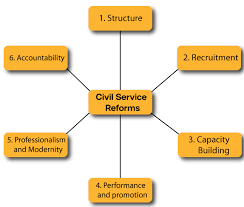
Role of civil services in a democracy.

In a democracy, the civil services play an extremely important role in the administration, policy formulation and implementation, and in taking the country forward towards progress and development.

Democracy is an egalitarian principle in which the governed elect the people who govern over them. There are three pillars of modern democracy:

  1. Legislature
  2. Executive
  3. Judiciary

The civil services form a part of the executive. While the ministers, who are part of the executive, are temporary and are reelected or replaced by the people by their will (through elections), the civil servants are the permanent part of the executive. 

  • The civil servants are accountable to the political executive, the ministers. The civil services are thus, a subdivision under the government. 
  • The officers in the civil services form the permanent staff of the various governmental departments. 
  • They are basically expert administrators. 
  • They are sometimes referred to as the bureaucracy or also the public service. 

Importance of the Civil Services :

  1. The civil service is present all over India and it thus has a strong binding character.
  2. It plays a vital role in effective policy-making and regulation.
  3. It offers non-partisan advice to the political leadership of the country, even in the midst of political instability.
  4. The service gives effective coordination between the various institutions of governance, and also between different departments, bodies, etc.
  5. It offers service delivery and leadership at different levels of administration.

Functions of Civil Services

  • Basis of Government: There can be no government without administrative machinery. 
  • Implementing Laws & Policies: Civil services are responsible for implementing laws and executing policies framed by the government.
  • Policy Formulation: The civil service is chiefly responsible for policy formulation as well. The civil service officers advise ministers in this regard and also provides them with facts and ideas.
  • Stabilising Force: Amidst political instability, the civil service offers stability and permanence. While governments and ministers can come and go, the civil services is a permanent fixture giving the administrative set up a sense of stability and continuity.
  • Instruments of Social Change & Economic Development: Successful policy implementation will lead to positive changes in the lives of ordinary people. It is only when the promised goods and services reach the intended beneficiaries, a government can call any scheme successful. The task of actualising schemes and policies fall with the officers of the civil services.
  • Welfare Services: The services offer a variety of welfare schemes such as providing social security, the welfare of weaker and vulnerable sections of society, old-age pensions, poverty alleviation, etc.
  • Developmental Functions: The services perform a variety of developmental functions like promoting modern techniques in agriculture, promoting the industry, trade, banking functions, bridging the digital divide, etc.
  • Administrative Adjudication: The civil services also perform quasi-judicial services by settling disputes between the State and the citizens, in the form of tribunals, etc.

Accountability of a Civil Servant :

The civil servants are responsible to the ministers of the departments in which they serve. The ministers are accountable to the people through the Parliament or State Legislatures, and the civil servants are accountable to the ministers. They should ideally serve the elected government of the day, as government policies are the functions of the civil services. However, an impartial civil servant is also accountable to the Constitution of India on which he has taken an oath of allegiance.

Problems Affecting Civil Services Today :

  • Lack of professionalism and poor capacity building.
  • An ineffective incentive system that does not reward the meritorious and upright civil servants.
  • Rigid and outmoded rules and procedures that do not allow civil servants to exercise individual judgement and perform efficiently.
  • Lack of accountability and transparency procedure, with no adequate protection for whistle-blowers.
  • Political interference causing arbitrary transfers, and insecurity in tenures.
  • An erosion in ethics and values, which has caused rampant corruption and nepotism.
  • Patrimonialism (a form of governance in which all power flows directly from the leader).
  • Resistance to change from the civil servants themselves.

Key Facts about Democracy in India :

  • Democracy in India federal republic.
  • Democracy in India is headed by the President as the head of the state and Prime Minister as the head of the government.
  • There is a parliamentary form of government at the central level.
  • There is a universal adult franchise.

Unbelievable Travel and Tourism Success Stories :

People sometimes refer to me as an explorer, but I am not. Those who follow maps are adventurers, those who wrote the maps were the explorers.

some Inspiring Traveler Tales From Around the World :

A JOURNEY TO RIVAL THE ODYSSEY :

Karl Bushby is attempting to be the first person to completely walk an unbroken path around the world. He began his quest, known as the Goliath Expedition , in 1998 at the tip of South America and is still on the move. He hopes to reach his home in England soon, and as of 2020 he was encountering some visa obstacles, but is still committed to finishing his walking adventure. At journey’s end, he’ll have walked over 36,000 miles, through icy seas, mountains, and deserts , across four continents and two dozen countries.

FORBIDDEN TRAVELS TO A FORBIDDEN CITY :

“Ever since I was five years old, a tiny precocious child of Paris, I wished to move out of the narrow limits in which, like all children of my age, I was then kept. I craved to go beyond the garden gate, to follow the road that passed it by, and to set out for the Unknown.

Famous French explorer Alexandra David-Neel made history in the early 1900s by walking, disguised as a male beggar, across China and Tibet and into the forbidden and fabled city of Lhasa. She then wrote over 30 books about Eastern religion, philosophy, and her travels, until her death at age 101. It is said that her teachings influenced beat writers Jack Kerouac and Allen Ginsberg. She is surely one of the greatest female adventurers of the 20th century, and her travel stories also rank as some of the best travel books of our time. Check out her entire collection of stories and be inspired—we particularly love her journey to Lhasa.

DANCING, BADLY :

The dancing gives me an opportunity to see places I’d never get to otherwise. I love to travel. The people and experiences have taught me a great deal.

In 2003, Matt Harding quit his day job to embark on a journey that would lead him to more than 39 countries in seven continents. Best known for a dance that looks very similar to running in place while snapping, Matt and his dance eventually attracted the attention of Stride Gum. The company then then paid Matt to travel, dance and record videos.

Matt has danced with locals in Mulindi, Rwanda; in a narrow canyon in Petra, Jordan; on a lush hillside overlooking Machu Picchu in Peru; and in a crowded street in Tokyo, Japan, all on his sponsor’s dime. Although he no longer actively updates his website, the videos live on, as does his collection of short travel stories on social media and elsewhere, and make for an entertaining and inspiring journey around the world.

Now it’s turn for some Indian travelling stories :

Exploring Rajasthan’s Ranakpur Temple

Between the intricate carvings, jungle views and visiting monkeys, Chaumukha Mandir, the Jain Temple at Ranakpur, will transport you to another world.

Built in the 15th century, this enormous complex has 1,400 pillars, each one hand-carved with its own unique patterns, icons and elements from nature – no two pillars are alike.

Wander around the different chambers and marvel at the craftsmanship that took around 65 years to complete.  Don’t forget to stop for a photo of the lush jungle through the temple windows, or to get a glimpse of the families of monkeys that leap between the columns and domes.

Guides aren’t allowed in the temple, so make sure to grab an audio guide before you head in so that you can make the most of your experience and learn a bit more about the Jain religion if you’re not families with its traditions and beliefs.

Kolkata & The Sunderbans

If you are talking to an Indian and mention the Kolkata, the first response is generally a wistful sigh and an explanation about the amazing street food available there.  When you are in a country that is known globally for having delicious food, this says quite a lot!  However, there is more to Kolkata than food.    The city was once the capital of British India and Kolkata is dotted with beautiful colonial buildings that remind visitors of a bygone era.   It is also the location of India’s biggest Durga Puja festival which transforms the city into a giant open air museum.  Adorable blue and yellow taxis whirl around the city like cartoon cars and iconic blue buses ply the streets and a wide variety of bars and restaurants line the streets.

Kolkata is a much-loved destination by expats in India because of the delicious food, beautiful architecture and calm city streets.  Yet, it gets even better!  Kolkata is also the entry point of the famous Sunderbans, a UNESCO World Heritage Site due to its incredible biodiversity.   Known as one of the largest mangrove forests in the world, the Sunderbans are home to Bengal tigers, crocodiles, wild boars, deer and a wide array of birds.   While the Sunderbans are located in both Bangladesh and India, the easiest (and cheapest) place to organize trips is from Kolkata itself.

You can opt for an overnight boat trip operated by the West Bengal Tourism Development Corporation.  However, we highly recommend staying in an eco-village located near the park which gives you the chance to help support the local community.  (Our favorite “village” employs women from the local village.  Most of the jobs available in the Sunderbans are very dangerous and this is a safe way for them to make a living and support their families.)

Kolkata is easily accessible from most major cities in India with direct flights from Mumbai, Delhi, and Bangalore.  For onward travel, flights to Port Blair in the Andamans are inexpensive and relatively frequent.  Otherwise, you can grab a train to Darjeeling or even travel overland to Dhaka, Bangladesh!

Ladakh

The region of Ladakh is jaw-droppingly beautiful and the warm Ladakh (similar to Tibetan) culture is welcoming to female travelers. Head to Leh, join up with a tour and make your way to the hotspots of Nubra Valley and Pangong Lake for a Ladakh trip that you are unlikely to forget!  Getting to Ladakh can either be very tricky or pretty straightforward.  Direct flights operate from Delhi or you can take a gruelling 2-day bus trip from Manali.

Patna Tourism

Prospering along the southern banks of river Ganges and set in the backdrop of a glorious historical past, Patna boasts of a dominating presence in history and enjoys the distinction of being one of the oldest cities in the world. In addition to being one of the major and most popular tourist destinations in India, this capital city of Bihar also holds significant religious and spiritual importance as it is a gateway to pilgrimage sites of Hindus, Sikhs, Jains and Buddhists.

Originally called as Pataliputra, Patna is currently a hot-bed for the culminating political fortunes. One of the oldest continuously inhabited places in the world, it is the quintessential North Indian town  – West of the city lies the area called Bankipur, while towards the southwest is the new area with wide roads and swanky buildings. The cultural heritage of Bihar is reflected in the many monuments housed in Patna, the most famous ones being Patna Sahib Gurudwara, Patna Planetarium, the Highcourt, Golghar, Secretariat Building and Padri ki Haveli among numerous other attractions. Typical of an Indian city, the riverside city of Patna is also known for some palatable dishes – litti chokha being the king of all! 

You never know what you’ll learn about yourself when you challenge yourself and experience the unexpected as you look to find your unknown.

Why Decision Making & Problem Solving is Afraid of the Truth

Many bad decisions can be remedied, however, the more people the decision impacts, the more difficult it will be to remedy the situation. When making a decision, determine how your choice will impact your life and as well as the lives of others, and respond accordingly.Problem Solving is the capacity and the ability to evaluate information and to accurately predict future outcomes. The ability to seek out logical solutions to complex problems. The ability to calmly and systematically solve problems without making things worse.

Photo by Nataliya Vaitkevich on Pexels.com

Every problem can be solved, you just have to learn how to solve it. There is a process to problem solving, but you also need skills, knowledge and information in order to be a good problem solver. Problem solving skills are the most important skills to have. They are the most widely used skills in every human’s life. The majority of our lives are spent solving problems. Most problems are easy to solve and take very little time, while other problems could take hours, days, weeks, months and even years to solve. But if you don’t start, you will never finish, and the problem will never go away. So if you don’t learn how to solve problems, then you will always have problems. Never underestimate the importance of learning. The benefits from learning are endless.

Important to solve a problem and make decision Don’t Afraid

The ability to solve problems and make decisions gives a person confidence. If you’re always struggling with what you should do and how and when you should do it, you’re languishing in a state of uncertainty.

Although it is important to solve a problem, it is far more important to avoid potential problems altogether, if at all possible. When you can make decisions to avert a situation right away, you can save yourself from going down a path of no return. That goal is achieved by having the ability to make concise decisions and avoid problems altogether. Developing that skill will save you tons of problems in your life.

Why is it important to solve a problem and make a decision?

If you’re faced with a problem and it’s impeding you and you feel uncomfortable because of it, then solving it means reducing the things that makes it a problem, which then makes the environment comfortable again.

If you like being uncomfortable, or the threshold of comfort hasn’t been crossed, you don’t really have to solve it, I suppose, and it’s “not that big” of a problem, but it can become one if left unattended and it gets worse.

Making a decision is a process of your brain where you try to incorporate all of the information you’ve acquired over the years and try to implement the best scenario option. So, technically, you’re not making decisions, you’re just following along the path best theorized based on your information. You just did science. Science is very important in solving problems because we’re able to recognize something as a problem using science.

Photo by David Cassolato on Pexels.com

Let’s begin with a quick experiment. You’ll soon find that we, as educators and researchers, have a fondness for experiments. We encourage you to try these simple exercises whenever they appear. You’ll learn more quickly the general principles we’re trying to convey. More important, you’ll learn about yourself and how you make decisions. Armed with that knowledge, you can better choose whether to replace your habitual approach to decision-making.

Imagine you have in front of you two coins. Both are biased: coin has a 55 percent probability of turning up heads; coin , a 45 percent probability of yielding heads. The coin you select will be flipped only once. If the head appears, you get $10,000 tax-free. If the tail turns up, you get nothing.

Coin : 55% chance of heads Coin : 45% chance of heads

Playing the odds, you choose coin . It’s flipped… and lands tails up. You get no money. Curious to see what would have happened with the second coin, you flip it. It lands heads up.

“Always remember that those with very important paths to fulfill will always be forced by life into the fear of the very things that their true paths consist of, in order to prevent the destiny from ever happening. Or perhaps, in order to strengthen the courage of the heart, because courage is to look into a direction, make a choice and to actually do that which you are afraid of, and what is destiny if it is not fulfilled by a heart full of courage and brawn.

The four categories of decision making:

1] Making routine choices and judgments. When you go shopping in a supermarket or a department store, you typically pick from the products before you. Those items, perhaps a jug of milk or a jar of jam, are what they are. You have no ability to improve them. Control is low. Moreover, you make the choice that suits you best—it doesn’t matter what anyone else is buying. Performance is absolute. The same goes for most personal investment decisions. You may be able to decide which company’s shares to buy, but you can’t improve their performance after you buy them. You want high returns but aren’t trying to do better than others. The goal is to do well, not to finish first in a competition.

2] Influencing outcomes. Many decisions involve more than selecting among options we cannot improve or making judgments about things we cannot influence. In so much of life, we use our energy and talents to make things happen. Imagine that the task at hand is to determine how long we will need to complete a project. That’s a judgment we can control; indeed, it’s up to us to get the project done. Here, positive thinking matters. By believing we can do well, perhaps even holding a level of confidence that is by some definitions a bit excessive, we can often improve performance. Optimism isn’t useful in picking stocks whose performance we cannot change, but in the second field, where we have the ability to influence outcomes, it can be very important.

3] Placing competitive bets. The third category introduces a competitive dimension. Success is no longer a matter of absolute performance but depends on how well you do relative to others. The best decisions must anticipate the moves of rivals. That’s the essence of strategic thinking, which Princeton professor Avinash Dixit and Yale professor Barry Nalebuff define as “the art of outdoing an adversary, knowing that the adversary is trying to do the same to you.” Investments in stocks are typically first-field decisions, but if you’re taking part in a contest where the investor with the highest return takes the prize, you’re in the third field. Now you need to make decisions with an eye to what your rivals will do, anticipating their likely moves so that you can have the best chance of winning.

4] Making strategic decisions. In this fourth category of decision making, we can actively influence outcomes and success means doing better than rivals. Here we find the essence of strategic management. Business executives aren’t like shoppers picking a product or investors choosing a stock, simply making a choice that leads to one outcome or another. By the way they lead and communicate, and through their ability to inspire and encourage, executives can influence outcomes. That’s the definition of “management.” Moreover, they are in charge of organizations that compete vigorously with others; doing better than rivals is vital. That’s where strategy comes in.

A Foolproof Guide to General Science

Photo by Ekrulila on Pexels.

General science :-

General science or science is one of the most important channels of knowledge and plays a vital role in the preparation of competitive examinations. Studying subjects like Physics, Chemistry & Biology is important for the general understanding of things around us.

Here, we have compiled all three Subjects in detail with proper study notes under the “General Science” Section.

General Science, Life Science, and Earth and Space Science Standards

The standards for generalal science, life science, and earth and space science describe the subject matter of science using three widely accepted divisions of the domain of science. Science subject matter focuses on the science facts, concepts, principles, theories, and models that are important for all students to know, understand,

Science in Personal and Social Perspectives Standards:

An important purpose of science education is to give students a means to understand and act on personal and social issues. The science in personal and social perspectives

Criteria for the Content Standards

Three criteria influence the selection of science content. The first is an obligation to the domain of science. The subject matter in the General, physical, life, and earth and space science standards is central to science education and must be accurate. The presentation in national standards also must accommodate the needs of many individuals who will implement the standards in school science programs. The standards represent science.

Occasionally:

there are advances in science and technology that have important and long-lasting effects on science and society. Examples of such advances include the following
Copernican revolution
Newtonian mechanics
Relativity
Geologic time scale
Plate tectonics
Atomic theory
Nuclear physics
Biological evolution
Germ theory
Industrial revolution
Molecular biology
Information and communication
Quantum theory
Galactic universe
Medical and health technology

The historical perspective of scientific explanations demonstrates how scientific knowledge changes by evolving over time, almost always building on earlier knowledge.