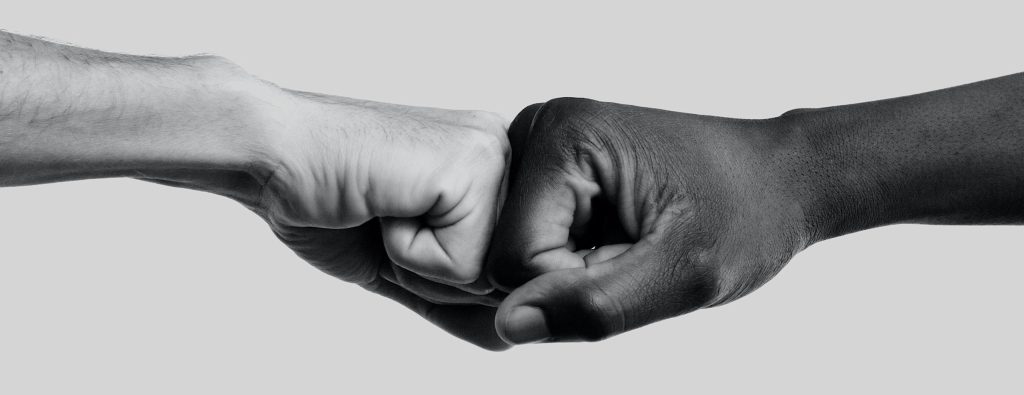
social issue: Racism

Racism is the illogical belief that a particular race has distinctive cultural traits endowed due to the genetic factors that make individual races inherently superior to the others and give them the right to exploit the inferior races. When we openly state the meaning of racism, we can see how inexplicable and unimaginable, such a thought is. But, racism is so deep-seated in our consciousness and subconsciousness that we have long bowed down to such infuriating ideals.

Such instances of subtle racism within a society are rampant and lead to inexcusable behavior of people towards others. Such unjustifiable behavior and actions are things like mental stress, social harassment, and even physical assaults. Since we have let racist comments and activities unnoticed, it is left untreated and leads to more division and anger between the two different people of different backgrounds. It is a never-ending, vicious cycle and a massive crisis in today’s world.

We should never judge others for the way they look for the way they speak. All people are born equal, and nothing can change that. Narrow-minded thoughts like racism should have extinguished with the increase in educated people and the intermixing of various races. Still, sadly, such behavior is the blatant reality and shows no signs of toning down. Racism makes people feel sorry for being born a certain way, of having a particular skin color. Racism has no scientific explanation, and the racist people are entirely ignorant about the feelings of other human beings.

No one can choose to be black, white, dark, fair, or anything in particular. God has made us, and there is nothing that should make us feel guilty for that. It is ridiculous and inhumane to make fun of people due to their cultural background or color of skin. We keep talking about how modern society embraces diverse cultures and diverse people. We try to accomplish gigantic things like World Peace, eradicate hunger and poverty, but we are not ready to unite to make such changes happen.

Racism is a barrier between the social advancement of our society. It is impossible to achieve something great with such narrow-minded and exclusive ideals. It is a delicate topic and requires people to have an open mind and embrace the changes. It is possible to eradicate racism in our society if we are more open about such sensitive topics and give simple matters like this a thought. Most of us are way too self-centered to think about such obstacles. It is so commonplace a behavior that we forget its adverse effects. It is high time we made a change.

Since racism is such a deep-seated belief, we will need some time to change. But, we can achieve anything if we put our mind to it. We do not need racism to divide us. People should acknowledge the fact that to achieve anything significant. We need to let go of narrow-minded beliefs. Only then can we advance as a society of the world.

Casual racism in India

Racism against Indians living in the northeastern region has been increasing day by day and is an issue of concern. States like Assam, Nagaland, Mizoram, and others surrounding it are the main ones to be part of the northeast.

 Recently, a Youtuber even got arrested for allegedly “defaming” the people of Andhra Pradesh and accusing them of being Chinese. While this was a good step and start, we are all aware of how casually the people of northeast India are called slangs like “Ch*nki”, “momo” etc. and no action is taken against them because it is so very engraved in our society now, that practicing this is not an offense. We must not forget how many spectacular pieces of art the north Indian part has contributed to India and continues to do so even now.

The simple answer to this is- The mentality. It’s not a big revelation that casual racism is not faced only by the northeastern people but by all the people belonging to different and seemingly “unconventional” parts of India. It comes out that our Indian society likes to put people into boxes and parts according to their skin color and way of living.

When I look around myself, I usually have this realization that most people are not even aware of the fact that using slangs and treating them differently is, in fact, wrong, which pilots us to our first point –

  1. Awareness- This is the most obvious but crucial point. People need to know that THIS is wrong in the first place. And I know that it is better said than done, but, at this point of time, even the so-called “progressive youth” of India is simply not ready to take up this topic into talks. “Black lives matter” was in the news rigorously for so long, as it should have been. But in my opinion, we should focus on making things right in our country first.
  2. Better representation in the media and government- This is absolutely no diversity when it comes to people from differing communities being recruited in the mainstream media and the parliament. This will even be a catalyst in achieving a society and country where decisions are made equally in the favor of all communities.
  3. Highlighting the achievements- The media plays a very big role in this one. We need to show our people that people from the northeast contribute a lot to the potency of India as a country.
  4. Better job opportunities and laws for all Although it’s nice to see that small steps have started to be taken by our government now, we all know that we still have a very long way to go to attain utter equality in all the fields.
  5. Speaking up -This point is valid for any kind of prejudice you witness in your life and can make the biggest change ever. Don’t be a standbyer when someone is being mistreated in this world because hashtags can’t save the world, only we can.

Ultimately, We are the change that we seek in this world.

Today, China is trying its best to gradually break India apart and snatch it’s parts little by little. And will Indians be able to survive this if they make it easier for China to tear us apart by disintegrating themselves on the basis of their race and language and whatnot? I wish I could say ‘yes’ to this question right now.

Black Man Shot by Police in Wisconsin, Protests Follow

Jacob Blake, a 29-year-old Black man was shot in the back by the Wisconsin police in the city of Kenosha. The incident happened on Sunday, while he was walking towards his car and was shot several times in the back. His three young sons witnessed the shooting from the car and were screaming after seeing their father being shot. Video footage of the shooting was shared on social media, which was taken from across the street, it shows the father-of-three leaning into the car. An officer is seen grabbing his shirt after which seven shots were heard. It is unclear what had happened before the video recording begun. He survived the shooting and had a surgery. His father had told the newspapers that his son is paralyzed but the doctors do not know whether its permanent.

At night, groups of protesters defying a dusk-to-dawn curfew gathered outside the courthouse. They confronted law enforcement officers in riot gear outside the county courthouse which was blocks away from where Jacob Blake was shot. They were shouting and tossing water bottles after which they were responded with tear gas and pepper balls.

Despite the curfew, demonstrations erupted on Sunday night, which lead the authorities to close public buildings. Governor Tony Evers have ordered National Guard troops to be deployed in the city to maintain order. He has condemned the incident and “the excessive use of force” and called for a special legislative session next week in order to reconsider police reforms. Protestors marched on the streets from Monday night into Tuesday morning. Many commercial and government buildings and vehicles were set ablaze. The disturbances and protests had slowed down by early morning. According to a protestor, the police used tear gas, rubber bullets and smoke bombs to disperse the crowd. Protestors were marching peacefully but a small group suddenly got violent and started setting fires and breaking glass. The instigators who were seen were reported to be white. After the demonstrations ended, the police and demonstrators had worked together to clean the debris.

The incident occurred three months after the death of George Floyd on May 25. The Black man was pinned to the street under the knee of a white police officer in Minneapolis. The incident sparked protests, against police brutality and racism within the U.S. criminal justice system, across the country and abroad.

Black Lives Matter activists have demanded the arrest of the officers involved in it. Attorney Crump, who also has also represented Floyd’s family, said in a statement, “Blake had been trying to de-escalate a domestic incident when the officers first shot him with a stun gun. As he was walking away to check on his children, police fired their weapons several times into his back at point-blank range.”

Sunday’s shooting had been termed a “domestic incident’ which the police responded to. According to a police statement, they had immediately taken him to the hospital. Authorities have given no further explanation of the details of the incident or what had led to the shooting. The officers who were involved in the shooting have been placed on administrative leave. The Wisconsin Department of Justice said on Monday that the investigation is underway.

#BlackLivesMatter: A Wake-Up Call for India’s Closeted Racism


‘Racism and prejudices are the exhaust fumes of damaged egos.’


As protests erupt in America, over the injustices inflicted on black lives after the institutional murder of George Floyd, we are finally forced to look closer into out own country for similar patterns of systematic and institutional racism that exists in our own country. At a time like this, it’s essential to introspect and heck our privilege in the everyday. When we start looking for their stories, it comes barely as a surprise that their voices are muffled amongst the clamour of noises. This begs the question- ‘Is there racism in India?’ Yes, there’s racism in India, but not just to other races, we are also racist towards our own race. It is almost like we hate ourselves, so much that we’d trade in our hide to be a white without batting an eyelash.

There exists racism on the basis of place a person belongs to which is nothing but an ugly truth of this nation. The hatred is such that people have died in thousands. People from north east are considered as aliens and those who belong to states like Bihar, Jharkhand are considered to be illiterate , mannerless, untouchable in metro cities like Delhi, Mumbai, etc. Just an example, that happens everywhere in this country. Not only metro cities but every state have their own reasons to hate one from other state. There’s racism on the basis of language we use. We are blessed to have hundreds of languages all with their own unique identity and importance and yet we have failed as a nation to give every language its due respect which includes one of the oldest languages of human civilization. There’s also racism on the basis of culture and colour. India is blessed with a rich variety of cultures, yet we leave no stone turned to mock each other’s culture, well, that’s how we show admiration to some of the oldest cultures in the world. And as of racism based on someones skin colour, all that can be said is that it’s extremely disheartening. Lastly, there also exists racism on basis of religion. As unfortunate as it is, this is probably the time when it’s most prominent.

People from Bihar have been subjected to racism from several decades. Everything about them from their looks, language, culture, accent is ridiculed pretty much all over the country. The term ‘Bihari’ itself is being increasingly used as a curse word in the northern parts of the country If there is ever a rape somewhere in India, the convict is automatically assumed to be a Bihari . If someone speaks Bhojpuri, he is assumed to be a ‘gavaar’ (illiterate). But this issue is never shown in the media, neither it is ever taken seriously, because according to some folks in our society these people are meant to be bullied. Whether someone is from Tamil Nadu, Kerala, Karnataka or Andhra Pradesh, he is no more than a “Madrasi” to a North Indian. Abusive comments on their skin colour, food habits, culture are quite prevalent among the North Indians.

People are so ignorant about their own culture that they even forget that their is an integral part of India called the “seven sisters” or the “North East”. Recently in an interview, the child actor of the movie “Tubelight”, who hailed from Arunachal Pradesh was asked by a reporter, “How do you feel after coming to India for the first time ?”.

It’s worth mentioning that with the outbreak of the pandemic, the situation of racism became more vivid and more clear as the people of North-eastern region were told to vacate their apartments or other accommodations. Some were beaten up, some were prevented to enter the grocery stores to buy their basic necessities and some were even abused on grounds of internalised racist assumptions around the virus. Well, they can’t really change how they look, can they? Can anybody suggest a ‘guru’ who can teach them what ‘Indian-ness‘ means without having to lose their identity?

To top it all off, there’s the whole conundrum of white skin versus dark skin, with underlying tones of colourism and casual racism. Being a dark-skinned Indian woman is significantly harder. The sexism endemic in Indian society is such that the beauty standards for women are stricter and less fluid compared to men. You do occasionally find the odd dark-skinned south Indian hero, but they are largely relegated to the roles of comedians or villains; dark-skinned Indian women are lucky to be cast as extras or auxiliary dancers. It is even more prominent during matchmaking. In Indian culture, aesthetics and beauty are said to be the jurisdiction of women, whereas work and wages tend to define men-or as the adage goes “udyōgam puruśa lakśańam”. My mother remembers when she had to stand up for one of my aunts during matchmaking negotiations when the groom’s parents demanded more dowry to compensate for my aunt’s dark skin. Even today when brides are in demand from decades of a skewed sex ratio, dark-skinned women fare poorly in the Indian marriage market; a cursory glance at any matrimonial ad using the search term ‘fair’ can substantiate this.

Essentially, every non-Hindustani Indian has a difficult time in India. They can find themselves obligated to learn more languages than their Hindustani counterparts, unable to take exams in their mother tongue or face difficulties accessing state services. None more so than the Northeast Indians. Lacklustre investment in their states has meant that youngsters move seeking greener pastures elsewhere in India. It is incredibly heart-breaking to hear the harrowing tales of men and women being treated so harshly, often disproportionately subject to molestation and harassment and called racist slurs within their own country. Government funding towards languages and other infrastructure is skewed in favour of Hindi, and even Sanskrit. This has resulted in several languages and tribal identities in India facing extinction, especially in the South and the Northeast. Northeast Indians, compared to their South Indian counterparts, have poorer representation in Indian media.

We have a long way to go to become a country where we learn to accept all cultures, religions and habits. after all, the first step in solving a problem is realizing that there is one. If Indians do not collectively admit that we have a problem with racism, we’re going to be in serious trouble. We have several ethnicities in India. This simple fact seems to be lost in the hullabaloo about religion in the mainstream. Media is not a passive entertainment industry. It is a projection of culture and aspiration for many. It directly affects our choices, preferences, tastes, fashion, trends and even politics. Young Indians, especially girls, consuming this diet of cultural crap from media and society will mean that a generation of Indians will emerge with serious physical and mental issues. An unregulated industry of face whitening products often containing dangerous carcinogens like hydroquinone makes medical risks very real. What makes this even more remarkable is the warm reception that dark-skinned people of South Asian heritage have received elsewhere in the world- Kunal Nair, Romesh Ranganathan, George Alagiah, Naga Muchetty, Aziz Ansari and the list goes on. Thus, the Black Lives Matter Movement should be wake up call for India.

‘Let us make it our purpose to listen deeply to those who suffer racism so that we may better comprehend what it is, how they feel and how we can build the society they need. It is wrong to become defensive, and right to open our hearts all the wider, to love and acknowledge that all are fully sacred. We are called to love, and the more we love each other the better our world will become.’

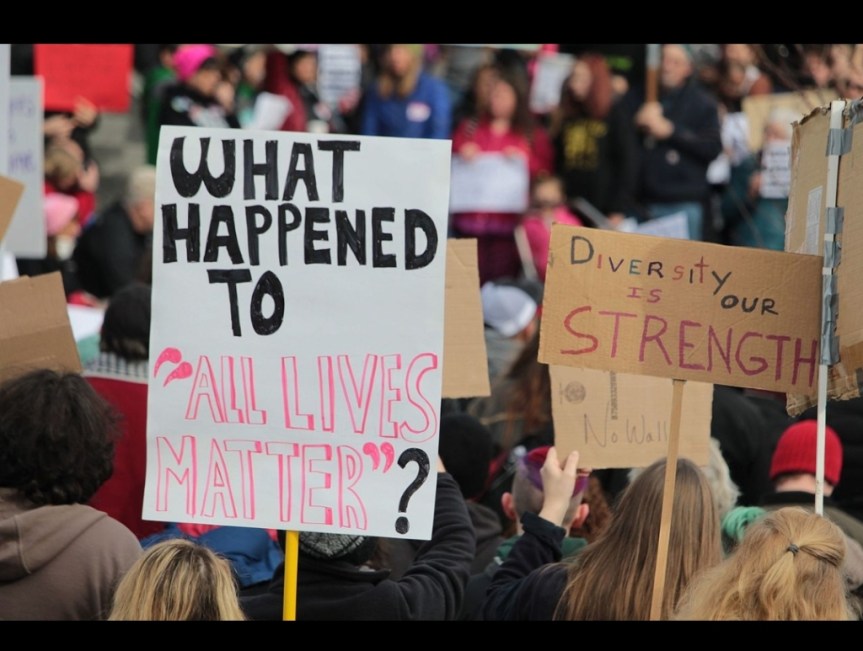
#BlackLivesMatter Vs. #AllLivesMatter

Saying that black lives matter doesn’t mean that other lives do not.

The tragic death of George Floyd at the hands of Minneapolis police has sparked intense debate over the question of racism in USA and triggered the Black Lives Matter movement. The protests have also sparked wide-ranging conversations about the responsibility industries and organizations — including the media — have to address institutional racism. To be clear, for much of its seven-year existence, the Black Lives Matter movement has been seen by many Americans as a divisive, even radical force. It’s very name enraged it’s foes, who countered with the slogans “Blue Lives Matter” and “White Lives Matter.” The tragedy, however, dramatically sparked a wave of protests sparked and enabled the Black Lives Matter movement to go has gone mainstream. The struggle is no longer confined to the national borders of the United States. However, soon enough, #AllLivesMatter became a slogan that has come to be associated with criticism of the Black Lives Matter movement. However, saying #AllLivesMatter completely missed the point of the Black Lives Matter.

Imagine that you’re sitting down to dinner with your family, and while everyone else gets a serving of the meal, you don’t get any. So you say “I should get my fair share.” And as a direct response to this, your dad corrects you, saying, “everyone should get their fair share.” Now, that’s a wonderful sentiment – indeed, everyone should, and that was kind of your point in the first place: that you should be a part of everyone, and you should get your fair share also. However, dad’s smart-ass comment just dismissed you and didn’t solve the problem that you still haven’t gotten any! The problem is that the statement “I should get my fair share” had an implicit “too” at the end: “I should get my fair share, too, just like everyone else.” But your dad’s response treated your statement as though you meant “only I should get my fair share”, which clearly was not your intention. As a result, his statement that “everyone should get their fair share,” while true, only served to ignore the problem you were trying to point out. That’s the situation of the “black lives matter” movement. Culture, laws, the arts, religion, and everyone else repeatedly suggest that all lives should matter. Clearly, that message already abounds in our society.

Just like asking dad for your fair share, the phrase “black lives matter” also has an implicit “too” at the end: it’s saying that black lives should also matter. But responding to this by saying “all lives matter” is willfully going back to ignoring the problem. It’s a way of dismissing the statement by falsely suggesting that it means “only black lives matter,” when that is obviously not the case. And so saying “all lives matter” as a direct response to “black lives matter” is essentially saying that we should just go back to ignoring the problem. The phrase “Black lives matter” carries an implicit “too” at the end; it’s saying that black lives should also matter. Saying “all lives matter” is dismissing the very problems that the phrase is trying to draw attention to.
Needless to say, dialogue matters and the George Floyd uprising has brought us hope for change. Now we must turn protest to policy.

screenshot_20200711-115801_chrome
All lives can’t matter until Black Lives Matter.

The Perusal of Animus!

Racism is the belief that a specific race is superior or inferior to another, that an individual’s social and moral traits are predetermined by his or her inborn biological characteristics. It means prejudice and discrimination directed against other people because they are of a different race or ethnicity.

The idea of race was invented to magnify the differences between people of European origin and those of African descent whose ancestors had been involuntarily enslaved and transported to the Americans. By characterising Africans and their African American descendants as lesser human beings, the proponents of slavery tried to justify the system of exploitation while portraying the United States as the flag- of human freedom, with human rights, democratic institutions, unlimited opportunities and equality. Along with all these, they seemed to demand the dehumanisation of those enslaved. Source:(Britannica)

According to a “United Nation convention on racial discrimination” superiority based on racial differentiation is scientifically false, morally condemnable and socially unjust. The Convention also declared that there’s no justification for racialism, anywhere, in theory, or in practice.
Yet racism has existed throughout human history. It is defined as the hatred of one person by another- or the belief that another person is less than human because of his/her skin colour, language, customs, place of birth or any factor that supposedly reveals the fundamental nature of that person. It has influenced wars and slavery, the formation of nations and legal codes. **Racism has long existed in the society, but the current sociopolitical scenario demands an analysis of one’s own position in being an apologist of this utterly discriminatory system. Examining the complexities of White racial belief proves essential in understanding how race is framed and disseminated within the dominant culture. Racism is so ingrained in the system and people’s lives that the subtle indicators of racist behavioural patterns are often ignored as humorous remarks.

Studies applying the colourblind racism approach examine the ways in which Whites use rhetoric to deny the impact of race on the everyday lives of individuals (Bonilla-Silva, 2006; Bonilla-Silva et al., 2004). This denial of privilege is one of the most problematic aspects because of which racism exists, even in the 21st century.
For dismantling this system white folks first need to acknowledge it’s existence. They need to understand that black people have their own culture, their own faith and their own being. Giving space to black people’s voices through literature, popular culture and various other platforms are the requirements. It’s been so long that white folks have been speculating about the lives of the black people, now is the time to listen and understand their experiences from their perspective.

Africa is not the dark continent which would quench the imperialist thirst of the Europeans. Its indigenous culture, customs, literature, language etc. is of as much importance as that of any other European country. Its homogenization needs to be stopped and it’s history to be recognized which was never taught and talked about in the larger social setup. The white folks need to educate themselves about the existence of Africa and it’s people in their totality and not in their distorted representation which has been there for centuries.