How To Break The Procrastination Cycle & Get Things Done

It’s 9 in the morning. You are fresh and focused and all set to work on that challenging project which needs to be completed urgently. You sit at your desk and fire up the laptop and while waiting for it to boot, you reach for your phone and then, as if on auto pilot, you find yourself opening Instagram (or Facebook or YouTube or news or whatever that is that you are obsessed with!) and start scrolling, and bam, the next thing you realise is it’s already 11, you are exhausted and you haven’t even logged in. Sounds familiar ? What exactly do you think happened here? Where did all that morning energy go ? Did the time just fly ? Well, this trap that most of us fall into is nothing but procrastination. 

What is Procrastination ?

Procrastination usually involves doing something easy or enjoyable instead of the unpleasant but important things that you are supposed to be doing. It is the irrational avoidance of a task or an activity. Most of the time we confuse it with laziness. Though outwardly both of them may seem similar and produce almost the same outcomes, they are fundamentally different.

Procrastination vs Laziness

Laziness is when a person is unwilling to put in the effort or energy needed to carry out a task. It is about avoiding responsibilities completely.Procrastination, on the other hand, is when a person has an intense desire to do the task and is even willing to put in the effort needed, but is stopped by an inner resistance or barrier that has been put up between his mind and the task at hand. Say for example, on a Sunday if you decide that you are not going to do anything but curl up on the couch and binge watch your favourite show, then you are deliberately making a choice not to do anything else at all on that day. On the other hand when you have an important assignment to submit and the deadline is fast approaching but you decide to put it off and  watch Netflix instead, then that’s a classic example of procrastination.

Effects of Long Term Procrastination

Long term procrastination can have serious adverse effects on our mental and physical health.The longer you procrastinate, the more overwhelming the task becomes, which in turn may cause anxiety, guilt and stress. Overall productivity of the individual decreases over time with procrastination and this might even lead to depression. As our mental health and physical health are deeply intertwined, a decline in one can have a serious negative impact on the other. Over time, chronic procrastination not only has productivity costs but also impacts our physical and mental wellbeing adversely.

Causes of Procrastination

Procrastination may stem from the need of the emotional part of our brain for instant rewards. When you have to deal with a task that is overwhelming or boring or unpleasant, the brain tries to find out ways to avoid doing it by replacing it with something easy or comfortable or instantly gratifying. And the momentary relief that the brain feels while putting off the task is the reward it gets for procrastination. And it’s our natural tendency to repeat things that we are rewarded for and thus this becomes a cycle rather than a one-off behaviour.

Procrastination may also be due to underlying mental health issues. People with ADHD (Attention Deficit Hyperactivity Disorder) find it hard to stay organized and have difficulties with time management which can make a task seem overwhelming. 

Those suffering from depression tend to have low self esteem which makes them doubt their ability to successfully complete a task. Anxiety also plays similar tricks on the brain and instills a fear of failure and lack of confidence in the person. 

Surprisingly, perfectionists are often procrastinators.The fear of doing a task imperfectly can lead them to putting off the task indefinitely. 

Certain other traits like poor decision making skills, lack of structure, ambiguity, absence of personal meaning and lack of instant gratification may also lead to procrastination.

How to Overcome Procrastination ?

  • If you are procrastinating because you find it boring or unpleasant, then try to focus on the long term benefits of completing the task. Identifying the long term benefits would help in aligning your present self with the future self. Also, it is equally important to focus on the consequences of putting off the task.  Think about all the ways in which not doing this task would affect you. Listing down the impact of avoidance of the task in the major areas of your life would give a realistic view about the situation and give the brain that necessary push to get you started on the task.
  • The brain finds it easier to deal with tasks which are unambiguous and properly structured. When you have a pile of half finished or pending  tasks, your brain goes into a state of panic, which makes focusing even on a single task difficult. Setting a roadmap with well defined milestones and breaking down the task into tiny manageable units can help in tackling those tasks which might otherwise seem overwhelming. Knowing what, how and when to do a task brings about a structure and clarity to the task.
  • More often than not, procrastination may also be a result of underlying mental health issues. Emotional regulation and stress management under the guidance of a therapist may be the best course of action in such cases.
  • In most cases, the biggest challenge one may face is in getting started on a task. For those struggling with the starting trouble, taking the tiniest possible first step would help in overcoming the inertia. Keep a timer for 5 minutes and tell yourself that you would stop after 5 minutes and get started on the task. Once you are successful in getting the brain to stay focused for those 5 minutes, then you are most likely to get into the flow of the task and continue doing the task. Just push yourself to take that initial step and the rest will follow.
  • Fear in any form – The fear of failure, fear of judgement or fear of rejection- holds you back from getting out of your comfort zone and is yet another reason why most people procrastinate. List down all possible fears and  worst case scenarios that you have conjured up in your mind. Once you have it all listed out right in front of you, analyse each of the scenarios. If you feel that your fear is logical and rational, then try and find ways to combat it. Cross out the irrational ones. Think about your whys and about what really matters to you. Ask yourself – Would you rather do it and face the consequences or give in to your fears and regret not doing it, years later ? 
  • The brain often looks for instant rewards. Putting off a boring or difficult task provides a relief which gives the brain the much needed instant gratification. Unless you give the brain a better offer, it continues to find ways to satisfy its craving for quick rewards. So rewarding yourself with a treat after the completion of a milestone would be a good idea to trick the brain into doing similar difficult tasks. Also focusing on and internalising the ‘feel good vibes’ that you get once you complete a difficult task would make the brain crave for such similar experiences which would eventually help in breaking the procrastination loop.
  • Thanks to scroll-culture, the attention span of most of us today has reached almost to the level of a goldfish’s. It just takes a beep from the phone or a mail pop up or even the sound of our own internal voices for us to get distracted. Not surprisingly, people who have difficulty in staying focussed on the task at hand tend to be master procrastinators. So stay away from the phone, close all those unnecessary tabs and if possible disconnect from the internet before you start an important task. When it comes to the constant chatter of your mind, try and find ways to calm it down through meditation or other calming techniques. You can also try writing down the random thoughts that come to your mind during a task so that they can be dealt with later. Assuring the brain that you have set aside a certain amount of time to deal with those thoughts will help in calming it down and bringing the focus back to the work that you are doing.
  • Last but not the least, rephrase your inner dialogue. When you tell yourself that you have to or you need to do a task, it creates an internal pressure on you to do it. The phrases ‘Have to’ or ‘Need to’ creates an impression that you have no choice but to do the task. Most of us do not like it when somebody forces us to work, even if we like the task. The rebel in you starts to resist and finds ways to avoid doing it. The conflict here is between you and your internal voice. So, be it any task,  rephrasing the internal dialogue to ‘I want to’ or ‘I choose to’ , puts you in a position of power. Here, you are not doing it because you have to, rather you are doing it because you want to. It makes you feel more in control and you start owning the work. Once this change in perception happens, it’s much easier to do the task, because hey, you are the boss and you are doing only those things that you really want.

To sum up, procrastination can be best described as the constant conflict between your present self and the future self. While the future self  has big dreams and goals for you and constantly comes up with ideas and plans for your bigger and better future, the present self pulls you towards the most instantly gratifying and comfortable option available. To break out of this habit loop, it is important that you learn how to manage your emotions and moods. I hope and wish that the tips mentioned above would help you kick-start your journey towards curbing procrastination. Good Luck !

To Read List (Non-fiction)

The challenge of non-fiction is to marry art and truth.

phyllis rose
See the source image

Introduction

The biblical definition of non-fiction is prose writing that is based on facts, real events, and real people. Non fiction encompasses the factual and literal aspect of the literary canyon, which includes everything from biography, history, self-help, health and fitness, politics, religion, spirituality, business and money, parenting, relationships etc.

According to recent findings by several sources including Forbes, non-fiction literature is rising in ranks compared to its other fictional counterparts. “Revenues for adult non-fiction have rapidly risen every year since: $4.97 billion in 2014, $5.59 billion in 2015, $5.87 billion in 2016, and finally $6.18 billion last year.

Non- fiction helps its readers get in tandem with the real world and connect to the everyday happenings as fiction sweeps them through different realms. Reading non-fiction can help one acquire knowledge about subjects crucial to the capitalist world today.

Curated below is a list of 4 non-fiction books that you must check out!

1. The Secret

52529

Rhonda Byrne’s, ‘The Secret’, is among one of the most celebrated and widely endorsed self help books ever. This book sets out to piece together a secret by sifting through age old oral traditions, religions, literature philosophy blending it with the acumen of modern day experts, ultimately giving rise to a secret like no other. This secret based on several simple factors, has perhaps what it might take to transform lives.

This book in a methodical manner unravels the secret and teaches its application in our everyday lives. This secret has the means to explore all that energy within you that you think is redundant and possibly channel it in a positive manner.

2.Blink: The Power of Thinking Without Thinking

40102. sx318

Malcolm Gladwell’s ‘Blink’, is best described by its title itself. Based on psychological aspects of decisions made in the blink of an eye, this book might after all, give answers to some of questions that everyone has had at some point about intuitions, good decisions and bad decisions.

Blink gives us insight into the makings of quality decisions and the minds of quality decision-makers. It explores a vast world of thinking or perhaps not thinking sometimes and explains how those decisions come to play.

3. Tuesdays with Morrie

6900

Mitch Albom’s, ‘Tuesdays with Morrie’, is an inspirational story of Mitch Albom’s reconciliation with Morrie Schwartz, his college professor from nearly twenty years ago who gave Mitch advice and understanding when he was lost and needed it the most. After Mitch meandered through life, after losing touch with his mentor, with several haunting questions of his.

As he meets his mentor, suffering from a fatal disease, almost two decades later, they get into a routine from the college days with Mitch visiting Morrie every Tuesday. Tuesdays with Morrie morph into insightful last lessons on life and living.

4. How to Win Friends and Influence People

11803016

Dale Carnegie’s masterpiece, ‘How to Win Friends and Influence People’, has influenced millions of people since getting published in 1936. This book contains solid and practical principles that can help one attain a steady footing on the ladder of success. This book focuses upon maximum discovery and use of one’s potential in the best ways possible.

One of the must reads in self help, this book preaches the principles to make people like you, to win people over by your way of thinking, to change people without arousing resentment.

Give Yourself a Hug

See the source image

“Society taught me that no matter what size I am, I will never be good enough. I’ll always be too skinny, too fat, too short, too tall. Too this, too that.”

– Unknown

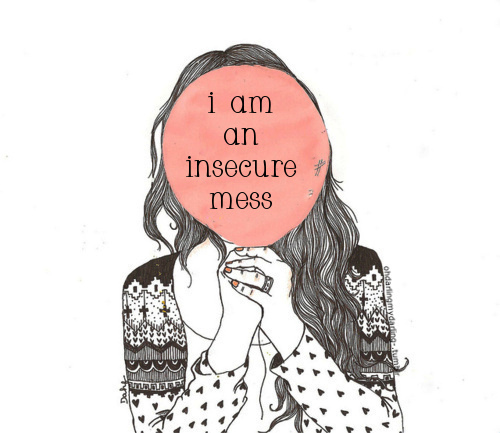
People from all walks of life, battle different forms of insecurities every second of the day. Insecurities basically sprout when all the broken fragments of society i.e. us, force other people to adhere to the so called norms of the society to ‘fit in’.

See the source image

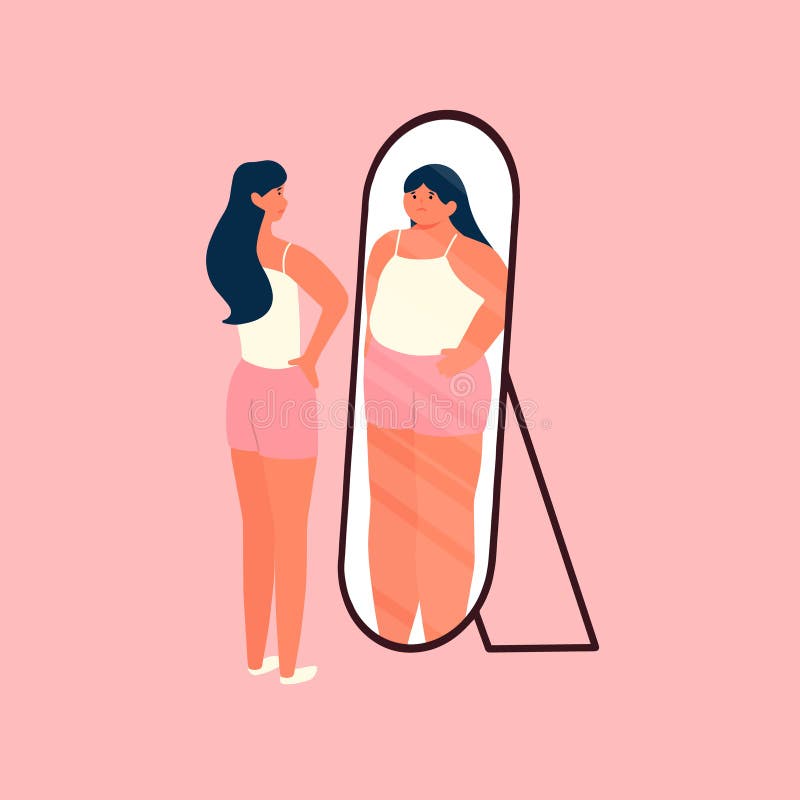
One of the biggest insecurity people encounter is with regard to their body and looks. The fact that beauty is absolutely subjective, seems to escape our minds while establishing the perfect body type , nose and lip shapes.

This image has an empty alt attribute; its file name is woman-ideal-bodies-looking-herself-mirror-feel-insecure-fat-cartoon-hand-drawn-style-flat-vector-design-human-177767081.jpg

Body Image

Body image refers to the subjective idea that a person has of his own body, it may or may not be actually the way he/she appears. According to Psychology Today, “Body image is subject to all kinds of distortions from the attitudes of one’s parents, other early experiences, internal elements like emotions or moods, and other factors.”

Negative body image may start forming when you notice, say, a minor flaw in your body and then overthink it out of proportions, so much so that it leaves an indelible impression on your mind.

See the source image

Body image of a person influences his/her social interactions and some level of mental functioning. Negative aspects of body image can lead to severe social and behavioural distortions.

See the source image

Also quoted from Psychology Today, “Thoughts and opinions about one’s body can start forming as early as 3 years of age. Often this is a direct result of a parent’s relationship with their own bodies. How a parent sees herself is influential and can mould a child’s ideas about their body.

See the source image

Although its as hard to be Ken as it is Barbie but the negatives of body image have been largely found in women. The statistics of men are found to be lower in this context.

Insecurities

According to statistics about 80% women and 34% men are insecure of and dissatisfied with their body. Body insecurities cause people to break down.

See the source image

These insecurities stem mainly from the desire to look a certain way and fit a certain beauty standard. Teenagers feel the need to be perfectly thin or perfectly proportionate and muscular, lack of which could lead to a state extreme mental trauma.

See the source image

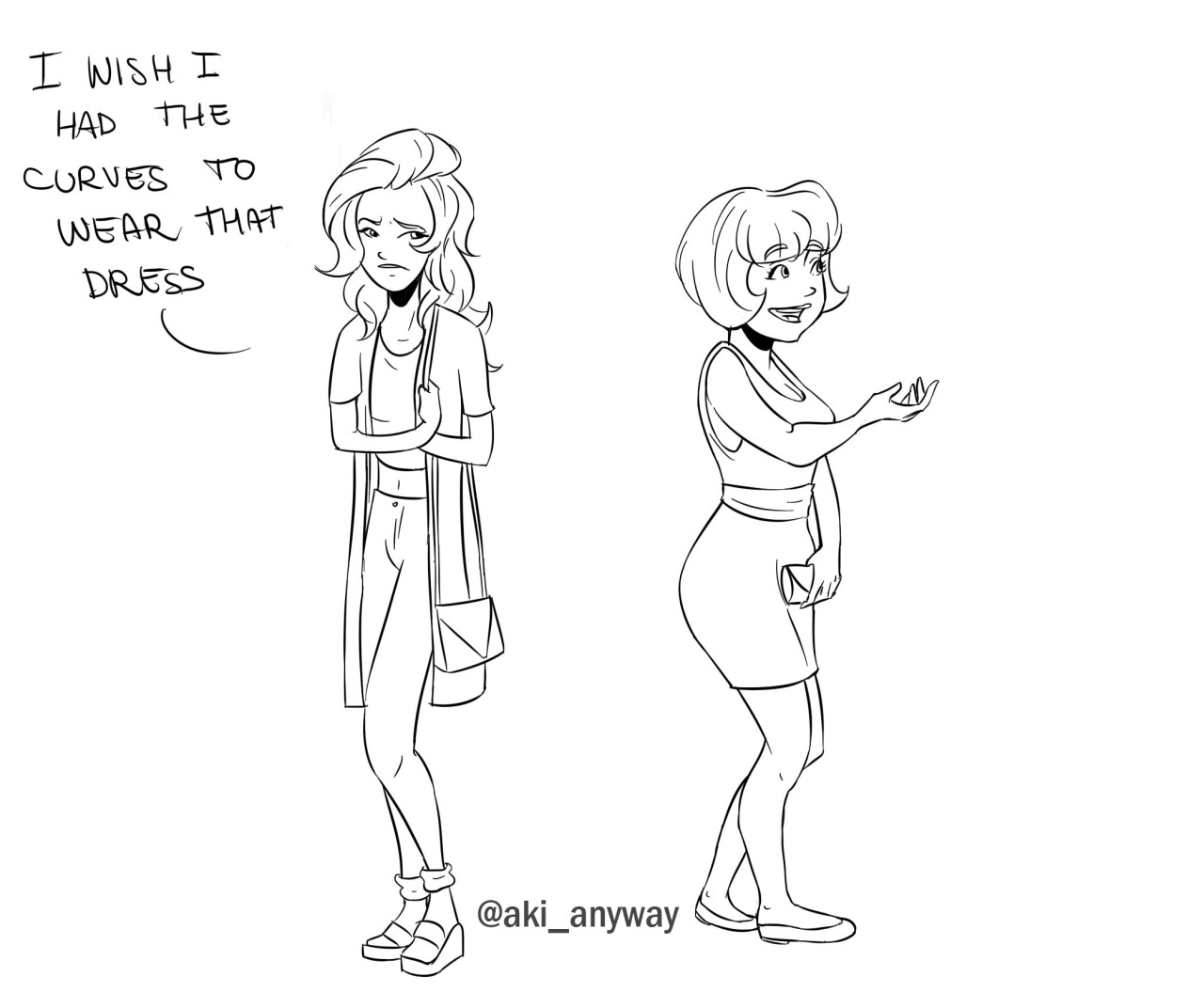
Also, people instead of focusing on their own physical and mental growth, divest a large portion of their time in useless comparisons with other people, which leads to them cornering their mental selves even further instead of something positive coming out of it.

See the source image

Give Yourself a Hug

Everyone in this world is insecure of one thing or the other. Body insecurity is a serious peril that people need to overcome, in order to enjoy this limited life to the fullest. Body insecurity and the negativity that it gives rise to prevents people from seeking joy in their life, it constantly looms like a dark cloud over their head.

See the source image

People dealing with such issues need to look for the silver lining in this dark cloud. People need to stop striving for perfection sand embrace themselves, flaws and everything.

See the source image

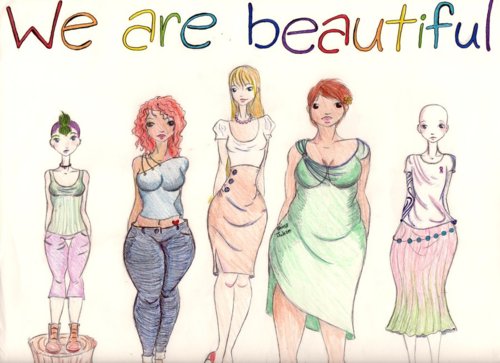
People suffering from insecurity need to strengthen their will and imbibe and assimilate the fact that,’ All bodies are beautiful’, completely.

See the source image

Every circle of darkness in life is followed by an impending circle of light. We must have a firm belief in the goodness of things and have a strong self confidence.

Wound your arms tightly around yourself and let your love heal you. Give yourself a tight hug!

See the source image

”Healing may not be so much about getting better, as about letting go of everything that isn’t you – all of the expectations, all of the beliefs – and becoming who you are.”

Rachel Naomi Remen

Reference(s): https://www.psychologytoday.com

Social Anxiety Disorder

SAD (Social Anxiety Disorder)

What is SAD?

Social anxiety disorder (SAD) more commonly referred to as social anxiety or social phobia is an inherent mental health issue characterized by senseless anxiety due to social interactions.

According to a research paper drafted by Phillip Jefferies and Michael Ungar, Social anxiety occurs when individuals fear social situations in which they anticipate negative evaluations by others or perceive that their presence will make others feel uncomfortable. (cited:

.https://journals.plos.org/plosone/article?id=10.1371/journal.pone.0239133

It is an intense persistent fear of being watched and judged by others. This fear can affect work, school and other day-to-day activities. It can even make it hard to keep friends. (cited:

https://www.nimh.nih.gov/health/publications/social-anxiety-disorder-more-than-just-shyness

According to some rough SAD statistics, this disorder affects about 7.1 percent of the population, 8 percent of women and 6.1 percent of men.

Though SAD can affect people regardless of age or gender, research points towards a general early (teenage) onset of social anxiety due to reasons unknown or some underlying trauma.

Causes of SAD

Social anxiety may have a plethora of underlying causes yet in some cases the disorder might be sudden and unexplained.

Ever since it was officially recognized as a disorder in 1980 by the American Psychiatric Association, scientists all over the world have been trying to identify and understand the causes of social anxiety disorder (SAD).

Like for most psychological conditions, the majority of contemporary professionals agree upon the idea that SAD is caused by a combination of genetics as well as environmental and socioeconomic factors.

What this means is that there is hardly one specific root cause of social anxiety, but rather a variety of factors that can lead to a certain vulnerability that favours its development. (Cited:

https://www.conquersocialanxiety.com/causes/

Social anxiety may also be directly linked to low confidence and constant self blame.

Visual search query image

social anxiety disorder likely arises from a complex interaction of biological and environmental factors. Possible causes include:

  • Inherited traits. Anxiety disorders tend to run in families. However, it isn’t entirely clear how much of this may be due to genetics and how much is due to learned behaviour.
  • Brain structure. A structure in the brain called the amygdala (uh-MIG-duh-luh) may play a role in controlling the fear response. People who have an overactive amygdala may have a heightened fear response, causing increased anxiety in social situations.
  • Environment. Social anxiety disorder may be a learned behaviour — some people may develop significant anxiety after an unpleasant or embarrassing social situation. Also, there may be an association between social anxiety disorder and parents who either model anxious behaviour in social situations or are more controlling or overprotective of their children. (cited:

https://www.mayoclinic.org/diseases-conditions/social-anxiety-disorder/symptoms-causes/syc-20353561

SYMPTOMS

Image
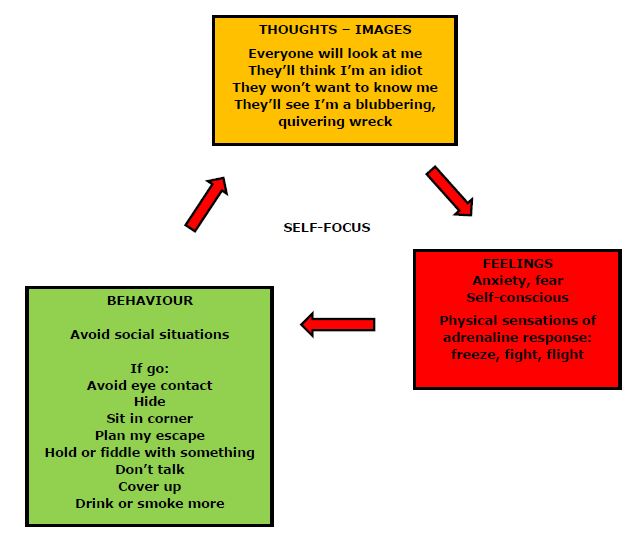
Getselfhelp.co.uk

Symptoms of SAD include physical, behavioural or cognitive changes that are often dead giveaways of some underlying issue.

Emotional and Behavioural Signs:

The following emotional and behavioural symptoms may show up in people with social anxiety:

  • Fearing situations where you might be judged
  • Fear of showing physical symptoms such as blushing, trembling, sweating, or an unsteady voice
  • Worrying you will embarrass or humiliate yourself
  • Intense fear of interacting with strangers
  • Avoiding any situation in which you will being the centre of attention
  • Getting anxiety in anticipation of an activity or event
  • Avoiding going places or speaking to people out of fear of embarrassment
  • Fearing people will notice your anxiety
  • Spending significant time analysing and critiquing the way you acted in a social situation
  • Expecting the worst outcomes from a negative social experience

For children, emotional and behavioural signs may include: 

  • Crying
  • Throwing temper tantrums (outbursts of crying and anger)
  • Clinging to parents or guardians
  • Refusing to speak to people 

Physical Signs:

Some of the external signs of social anxiety disorder include:

  • Blushing
  • Rapid heartbeat
  • Sweating
  • Difficulty catching your breath
  • Shaking
  • Nausea or upset stomach 
  • Light-headedness or dizziness
  • Tight muscles 

Social Signs:

One of the main signs of social anxiety is avoiding social situations. Someone with this disorder may avoid or find difficulty being in the following situations: 

Treatment and Self help

As established SAD is a disorder that requires thorough medical attention, which may include therapy, meditation, courses for instilling confidence etc.

  • Psychotherapy. Psychotherapy improves symptoms in most people with social anxiety disorder.
  • First choices in medications. Though several types of medications are available, selective serotonin reuptake inhibitors (SSRIs) are often the first type of drug tried for persistent symptoms of social anxiety.
  • Other medications. Other antidepressants. You may have to try several different antidepressants to find one that’s the most effective for you with the fewest side effects.
  • Stick with it. Don’t give up if treatment doesn’t work quickly. You can continue to make strides in psychotherapy over several weeks or months.
  • Alternative medicine. Several herbal remedies have been studied as treatments for anxiety. Results tend to be mixed, and in several studies people report no benefits from their use. (Reference: www.mayoclinic.org/diseases-conditions/social-anxiety-disorder/diagnosis-treatment/drc-20353567

Thinking Differently


When we’re in a social situation with a group of people, our focus of attention becomes totally caught up in our own thoughts and feelings.  We see everyone around us, but all we can think about is how they might be thinking critically about us!  The adrenaline response of anxiety makes us feel terrible too, so we’re thinking about how horrible that is, and how we just want to escape the situation. 

It is very helpful to learn how to change our focus of attention and take more control over how we react to thoughts.  We can learn to just notice the thoughts, acknowledge them, then let them pass.  Notice the Mind Bully and let it go – turn your focus of attention to something else.  First of all, you might learn to focus on your breathing.

Practise Mindful Breathing

(cited: https://www.getselfhelp.co.uk/socialanxiety.htm

Conclusion

In conclusion, social anxiety is the third most common disorder worldwide that affects millions of unsuspecting individuals every year throughout the world. It is high time that we treat social anxiety patients with respect and consideration and give this disorder its due attention without tiptoeing around it.

It is also absolutely essential for people suffering with SAD to seek medical help(easier said than done) but one has to start somewhere.

Lastly, there should be no embarrassment in seeking professional help and it should be absolutely normalised.

A strong will to overcome anxiety, is the guaranteed first step in the long overdue chain of recovery.

See the source image