IMPORTANCE OF INTERNSHIPS

Is it really important to join as an intern especially after you join college? Is there any real benefits of pursuing an internship? Does it add value to your resume? All these question will be answered below.

An internship is a short term work experience a person receives to gain practical knowledge from an organization. It helps a person to gain real life experiences and professional contacts. They time duration for an internship maybe for a few days, weeks or months. Some companies also provide payment to interns for their work in the form of stipend. Internships are pursued by students from colleges and universities to have the actual exposure to their field of interest. It naturally adds much weightage to that student’s resume. Generally internships were confined only to specific subjects or fields. But now, internship became a necessity for almost all fields.

In this highly competitive world, the more you qualify the more your standing. An individual will be placed unique in a crowd where others have just gained knowledge through books. For instance, when you go for an interview in an organisation or company with a resume carrying various internships that you pursued related to the job you are applying, you stand a better chance to get employed because the aim of each and every employer is to choose from the best. Also the employer needn’t train you because you already have on field experience which saves their cost of training. Thus it adds some weightage to your resume. Students choose a path as a career when they join college. However it might not be of their interest or comfort. Internships are a great way to explore your career path and aid the intern to know whether the field is suitable to him/her. Some internships help you bring out the talents from the inside that you never knew. Internships also help people to assess themselves by testing their subject and understanding it through practical application. There are also things that can never be learnt by reading. It is all about observing and following the same. University learning can only bring you to a certain level. A student can develop professional touch in his work only through internships. An internship is also used as a chance to prove oneself to be efficient, hard working and clever. There are also possibilities for the company to offer you a job in the near future because they know they are employing the right person with the perfect skills needed for a certain position in an organisation. Going through an internship, a person may encounter and establish a lot of professional contacts who can be very useful in career advising and job recommendations. In a field say marketing, an intern is hired for work in various departments such as product designing, product promotion, pricing etc. it exposes an intern to various departments and help the mentor to assess the capacity of the intern and aids him to delegate responsibilities to the intern. Finally, it is a safe environment to learn and mistakes can be corrected before you enter into your first job.

HAPPY LEARNING!!!

RELEVANT LINKS:https://blog.suny.edu/2018/06/10-reasons-why-an-internship-is-important-to-all-students/ https://www.thebalancecareers.com/is-an-internship-really-all-that-important-1986800

5 PART-TIME JOBS FOR COLLEGE STUDENTS

Education is very important but experience holds equal importance in life. It is not important that you complete your studies and then gain work experience. You can study and earn not only experience but also money. In your free time, there are many jobs that college students can do. Some can be done from home whereas you might need to step out for some.

It has three benefits:

  • You gain work experience,
  • You earn and therefore learn what financial independence is.
  • You learn how the real world works and how you can survive it.

Here’s a list of 5 simple jobs that college students can do. These are easy to do and do not require many skills or any prior experience.

  1. Baby-sitting: 

Babysitting is the most flexible job for students because you can work when you have free time. It’s even better if you love kids. The tasks you need to do in this job may include.

  • Homework help for school going kids
  • Basic household work
  • Meal preparation
  • Attending to the child’s health
  • School pick up and drop

It is one of the easiest jobs. There’s no set income for this job and depends on the parents of the kid and you.

  1. Call centre representatives:

Call centres require a large workforce. There are a variety of people working at call centres. Students also happen to be in large numbers. You need to have good command over language and must be well-spoken. The salary may vary company to company and time dedicated towards the job. The work of a call centre representative includes:

  • Managing calls
  • Reading pre-determined script
  • Selling products or asking for donations
  • Input customer data
  • Researching customer data
  1. Pet-sitter:

This is probably the most fun job on the list especially for people who love pets. You can search for this job yourselves or use apps like Rover. They connect you to the pet owner who needs a sitter. The income through this job also depends on the employer. 

You might need to perform the following tasks:

  • Dog walking
  • Cleaning the pet
  • Taking care of medications
  • Vet visits 
  • Pet transport
  1. Online tutor:

If you are academically strong and can teach other students. Online tutoring is the best job. You can hold classes yourselves or can join an institute as a teacher. This job will pay you good money. 

As an educator, you will have to do the following things:

  • Prepare study material
  • Clear doubts of the students 
  • Check academic progress 
  • Dedicate at least an hour to teach
  1. Social media manager:

This is one of the most rapidly growing jobs in today’s time. Social media has become a part of our lives. Businesses use it to promote their business. For this, they hire social media managers. This job is also well-paying and you can work according to your schedule. But make sure to meet the deadlines. 

Your job as a social media manager will include:

  • Promoting business through social media 
  • Handling social media accounts
  • Posting regularly 
  • Increasing engagement 
  • Holding online events

There are jobs as well which you can do as a college student. Some of them are:

  • Sales associates 
  • Content writers 
  • Translator
  • Web designer 

All these jobs mostly require very basic skills. But if you specialize in something then it’s even better. Like not everyone can do web designing. Only people you have learned it can do it. 

You can search for these jobs locally where you live or can surf the internet. There are many apps as well that connect students to employers who are looking to hire people. 

In the end, all you need is the determination to do something and keep learning. 

Civic Engagement for Young People During Social Distancing

Many of us feel a bit helpless to help others out during these coronavirus social distancing and isolation times. This also true for kids and young people. There are actions they can take as part of their home schooling. They can participate in civic engagement and activism activities.

Civic engagement is defined as “working to make a difference in the civic life of one’s community and developing the combination of knowledge, skills, values and motivation to make that difference (https://youth.gov/youth-topics/civic-engagement-and-volunteering).”

Quite frequently, not only do state standards permit teachers and schools to support student activism, but they encourage student activism as a means by which to develop civic understanding. Although standards vary from state to state, many of them are modeled on the National Council for the Social Studies (NCSS) College, Career, and Civic Life (C3) Framework for Social Studies State Standards (NCSS, 2013), which specifically endorses student activism:  “Civics is not limited to the study of politics and society; it also encompasses participation in classrooms and schools, neighborhoods, groups, and organizations . . . In civics, students learn to contribute appropriately to public processes and discussions of real issues. Their contributions to public discussions may take many forms, ranging from personal testimony to abstract arguments. They will also learn civic practices such as voting, volunteering, jury service, and joining with others to improve society. Civics enables students not only to study how others participate, but also to practice participating and taking informed action themselves” (https://kappanonline.org/student-activism-civics-school-response-singer/).

Civic engagement and activism in normal times has benefits, but in these times of coronavirus and social distancing-isolation, the benefits are amplified as such engagement can move young people from feelings of helplessness to feelings of empowerment.

Even in social isolation, there are actions young people and kids can do. The following activity guide can provide ideas and give some structure to civics activity engagement.

The following PDF has links with more information about how to do that challenge:

Sometimes Kids Just Need to Play During School

Teachers get so much pressure to meet standards and prepare students for state mandated tests, that I believe they forget their students are just kids. Because of this pressure, too many teacher education and professional development strategies stress the concept of time on task. For example, see Identifying (and Engaging Students in), Time-on-Task Activities, Increasing Time on Task, and Time on Task. This has some importance in teaching and learning but it shouldn’t always be the professed key to good instruction. This leaves little time for play. Play is important for students of all ages and grades.

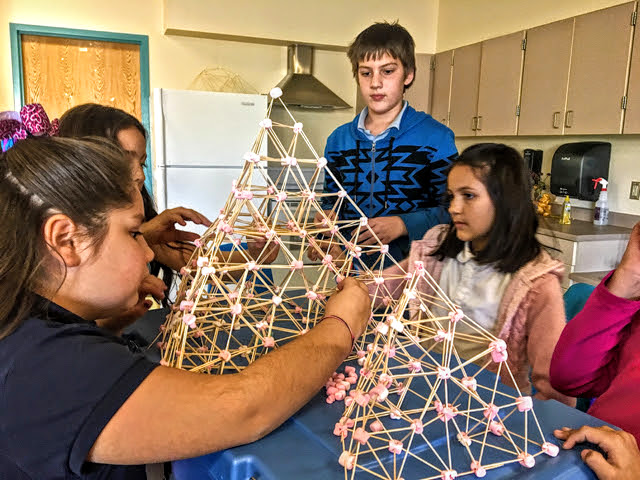
This week I was reminded of the importance of playing and having fun; and that play and fun are determined by the kids, themselves. I planned a math lesson based on visual patterning, The concluding activity was for them to make a Fractal Tetrahedron, a marshmallow-toothpick tower. I had planned to have them work on it during a series of math classes, but they asked to stay through lunch and recess to work on it.

I started working with this group of gifted middle school students in January. I always have a goal of engaging learners as I believe it is the foundation of all good learning. I have had difficulty engaging them even with the use of Breakout EDU escape boxes, art activities, and games. Some engaged. Some did not. This marshmallow-toothpick activity brought a new energy into this group. All of them participated. They worked together. They laughed. They excitedly kept building and building. They added pieces to it that weren’t part of the plan. They played and had fun. A new group and classroom dynamic emerged which I believe was due with just letting them play with this project.

I discussed the beauty of spontaneous play (lots of play is spontaneous) in An Education Filled with Wonder:

One day I was substituting for a 2nd grade class.  It had begun to snow as we arrived to school that morning.  By mid-morning, a few inches covered the ground.  It was time for recess but, as expected, a voice came over the intercom to state that recess would be inside within each teacher’s classroom.  I heard the kids moan as they came to school dressed for snow with boots and winter jackets.  I threw caution into the wind.  I asked the kids to bundle up so we could go outside.  The kids became . . . well, kids.  They ran through the fresh snow in the huge back-of-the-school play area with no other students out there. They examined the footprints they created in the snow.  When one found something of interest, they called the others over to see.  They caught snow flakes with their tongues and made snow angles.  There were no conflicts nor arguing as was common to this group of kids.  They just ran, played, and laughed together as a unified group reminding me of a flock of geese.  I watched them with a tear in my eye, one that reflected the beauty I was witnessing. 

I wonder (even though I intuitively know the answer) whether learners in their adulthoods will better remember the types of activities I described above or their very structured time-on-task classroom activities.

The Harvard Graduate School of Education discussed the importance of play in Playing to Learn: How a pedagogy of play can enliven the classroom, for students of all ages:

Play and school can seem diametrically opposed. School is structured, often focused on order; play, by definition, is not.

But within this paradox of play and school, educators can find meaningful learning opportunities, advancing students’ academic skills as well as the social skills that will allow them to thrive in adulthood and enjoy their childhood now, according to researchers from Project Zero (PZ), a research center at the Harvard Graduate School of Education.

“Play is a strategy for learning at any age,” says Project Zero’s researcher Mara Krechevsky. While older students and their teachers might have more curricular demands than younger students, playful learning still has an important role to play — it might just look different.

There is a universality to play: children are often more relaxed and engaged during play, and it’s enjoyable — all aspects that facilitate learning.

I think most educators innately know about the importance of play but according to many of them, they don’t have the time during the school day to permit kids to play outside of recess . . . but I ask, “What are the costs of not permitting them to play?”