INDIA’S STRUGGLE FOR FREEDOM

Indian colonial rule was overthrown after a protracted and difficult struggle for freedom. It started in the late 19th century and continued until 1947, when India attained independence. Many rallies, marches, and acts of civil disobedience were part of the movement, and all were directed towards bringing about India’s independence. The Indian Rebellion of 1857, commonly referred to as the Indian Mutiny, is the beginning of the Indian freedom fight. Widespread resistance to British authority was sparked by a number of grievances, including the imposition of British laws, excessive taxes, and the theft of Indian resources. Although the British brutally put down the revolt, it was a driving force behind the Indian independence movement.

One of the key figures in the Indian freedom struggle was Mahatma Gandhi. He was a leader of the Indian National Congress, and he advocated for non-violent resistance as a means of achieving independence. Gandhi’s philosophy of non-violent resistance, known as Satyagraha, inspired many Indians to join the struggle for independence. Gandhi’s famous Salt March in 1930, in which he and his followers walked 240 miles to the Arabian Sea to make their own salt in defiance of British salt taxes, is one of the most iconic events of the Indian independence movement.

Another important figure in the Indian freedom struggle was Jawaharlal Nehru, who became the first Prime Minister of independent India. Nehru was a leader of the Indian National Congress, and he worked tirelessly to achieve independence for India. He was also a strong advocate for democracy and secularism, and his vision for India was one of a modern, democratic, and secular nation.

The Indian freedom struggle was marked by many important events, including the Partition of India in 1947, which resulted in the creation of Pakistan. The partition was a deeply divisive event that resulted in the displacement of millions of people and the loss of countless lives.

The Indian freedom struggle can be divided into several phases, each marked by a distinct set of events, movements, and leaders. These phases are as follows:

The Early Nationalists (1857-1905)

The early nationalist phase of the Indian freedom struggle was marked by the Indian Rebellion of 1857, which is also known as the First War of Indian Independence. Although the rebellion failed, it laid the groundwork for the nationalist movement that followed. The early nationalists were a diverse group of people who shared a common goal of achieving independence from British rule. Some of the prominent leaders of this phase were Dadabhai Naoroji, Gopal Krishna Gokhale, and Bal Gangadhar Tilak.

The Extremists (1905-1918)

The extremist phase of the Indian freedom struggle was marked by the rise of the Indian National Congress and the emergence of a more militant form of nationalism. The Extremists, also known as the Swadeshi Movement, advocated for complete independence from British rule and launched several protests, boycotts, and agitations to achieve this goal. Some of the prominent leaders of this phase were Lala Lajpat Rai, Bipin Chandra Pal, and Bal Gangadhar Tilak.

The Gandhian Era (1919-1947)

The Gandhian era of the Indian freedom struggle is perhaps the most well-known phase of the struggle. Mahatma Gandhi, who was a key figure in this phase, advocated for non-violent civil disobedience and launched several mass movements to achieve India’s independence. The Salt Satyagraha, the Quit India Movement, and the Non-Cooperation Movement are some of the most significant movements of this era. Other prominent leaders of this phase were Jawaharlal Nehru, Sardar Vallabhbhai Patel, and Subhas Chandra Bose.

The Post-Independence Era (1947-Present)

The post-independence era of the Indian freedom struggle saw India gain independence from British rule in 1947. This phase was marked by the challenges of nation-building, including the partition of India and the integration of princely states. The post-independence era also saw the emergence of new challenges, such as poverty, illiteracy, and communal tensions. Some of the prominent leaders of this phase were Jawaharlal Nehru, Indira Gandhi, and Rajiv Gandhi.

Throughout the freedom struggle, there were several important contributors and contributions from different parts of the country. In Bengal, leaders like Aurobindo Ghosh, Bipin Chandra Pal, and Surendranath Banerjee played a significant role in the nationalist movement. In Punjab, Lala Lajpat Rai, Bhagat Singh, and Udham Singh were important contributors to the freedom struggle. In Maharashtra, leaders like Bal Gangadhar Tilak and Gopal Krishna Gokhale played a significant role in the nationalist movement. In South India, leaders like C. Rajagopalachari, K. Kamaraj, and S. Satyamurthy played important roles in the freedom struggle. In the Northeast, leaders like Rani Gaidinliu and Tirot Sing played significant roles in the nationalist movement. In Kerala, leaders like K. Kelappan, T. K. Madhavan, and A. K. Gopalan played important roles in the freedom struggle.

In conclusion, today, India is a vibrant and diverse democracy, with a population of over 1.3 billion people. The Indian freedom struggle was a long and difficult journey, but it ultimately succeeded in achieving independence for India and paving the way for the country’s future as a democratic and secular nation.

SUBHASH CHANDRA BOSE

INTRODUCTION

Subhash Chandra Bose
SUBHASH CHANDRA BOSE

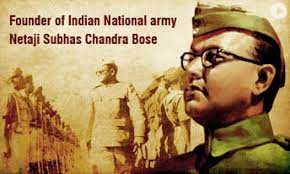
Subhash Chandra Bose is fondly remembered as one of the greatest freedom fighters of India, and popularly known by the name of ‘Netaji’ (Respected Leader). He was strongly influenced by Swami Vivekananda’s teachings, and also believed that the Bhagavad Gita was a great source of inspiration for the struggle against the British. Bose was an Indian nationalist, and a prominent figure of the Indian independence movement. He was superior head for Indian National Army during World War II. He always pitched for complete and unconditional independence of India from the British Rule.

CHILDHOOD

Subhash Chandra Bose was born to Prabhavati Devi and Janakinath Bose on January 23 in 1897 in Odisha. He took admission into the Protestant European School which was run by the Baptist Mission. He did B A in Philosophy from the Presidency College in Calcutta, and was later expelled for assaulting Professor for the latter’s anti-India remarks. After the incident, Bose was considered as one of the rebel-Indians.During his college days, he gradually developed nationalistic temperament, and became socially and politically aware. 

POLITICAL LIFE

18 Subhash Chandra Bose Books Which Prove Massively Impactful
THE GREAT FREEDOM FIGHTER

After a few years, Bose returned to India as he resigned from his civil service job in April 1921, and later joined the Indian National Congress to fight for the independence of India. Subhash Chandra Bose started the newspaper known as ‘Swaraj’, and took charge of publicity for the Bengal Provincial Congress Committee. In 1923, Bose was elected as the President of All India Youth Congress and as the Secretary of Bengal State Congress. He was also editor of the newspaper called ‘Forward’, founded by his mentor Chittaranjan Das, and he served as the CEO of the Calcutta Municipal Corporation. By December 1927, Bose was appointed as the General Secretary of the INC.

In November 1934, he wrote the first part of his book ‘The Indian Struggle’, which was about nationalism and India’s independence movement during 1920–1934, but the British government banned the book. By 1938, he agreed to accept nomination as the Congress President, and presided over the Haripur session. However, due to his strong differences with Mahatma Gandhi and Jawaharlal Nehru, he resigned in 1939.

ROLE IN INDIAN INDEPENDENCE

S C Bose was always in favour of armed revolution in order to expel the Britishers from India. During the time when the Second World War took place, Bose form the Indian National Army (INA) with the help of the Imperial Japanese Army, and also founded an Indian Radio Station called ‘Azad Hind Radio’.

A few years later, he travelled to Japan, where more soldiers and civilians joined the INA. Even when faced with military reverses, Bose was able to maintain support for the Azad Hind movement. In Europe, S C Bose sought help from Adolf Hitler and Benito Mussolini for the liberation of India. Bose had struck an alliance with Japan and Germany as he felt that his presence in the East would help India in the freedom struggle against the British.

MEMORIAL

Bose was featured on the stamps in India from 1964, 1993, 1997, 2001, 2016 and 2018.Bose was also featured in ₹2 coin in 1996 and 1997, ₹ 75 coin in 2018and ₹125 coin in 2021. Netaji Subhash Chandra Bose international Airport at Kolkata, Netaji Subhash Chandra Bose Island, formerly Ross Island and many other institutions in India are named after him. On 23 August 2007,Japanese Prime minister visited the Subhas Chandra Bose memorial hall in Kolkata. Abe said to Bose’s family “The Japanese are deeply moved by Bose’s strong will to have led the Indian Independence Movement from British rule. Netaji is a much respected name in Japan.

In 2021, the Government of India declared 23 January as Parakram Divas to commemorate the birth anniversary of Subhas Chandra Bose. Political party, Trinamool Congress and the All India Forward Bloc demanded that the day should be observed as DESHPREM Divas.

*****MY HERO IS SUBHAS CHANDRA BOSE THIS ARTICLE IS DEDICATED TO YOU*****

JAI HIND” this slogan is said by Subhas Chandra Bose .

Gandhi Jayanti

2nd October, Gandhi Jayanti ,a date which needs no introduction. Father of our nation Mohandas Karamchand Gandhi was born on this day. He was one of the strongest pillar for India during in struggle for freedom from British era.

He was very different from other freedom fighters. He believed in the concept of nonviolence and self sufficiency. His personality has impressed many leaders around the world like Martin Luther King Jr, Nelson Mandela, Einstein and even the Britishers one of those.

He was a gentleman who gained law degree in London and came back to the India and I was so touched by the living conditions of the people here that he decided to be one of them. He wore a dhoti and thin cloth on upper body.

He was a man of principle, in his aashram he did all of his work on his own and teach the same lesson to his followers. He was a tiny man but having a great speed. He walked miles on his foot that too with great speed, matching his speed was not easy.

He always live for his countrymen and tried to solve their problems and dedicated whole of his life for the country. He fought the fight of freedom with never compromising his principles. That’s the reason he was given the title of ‘Father of India’.

INDEPENDENCE DAY, BIRTH OF NEW INDIA

The Independence Day is celebrated on August 15 every year to commemorate India’s freedom from the British rule in 1947.
15 August is a day of her re-birth, a new start. At the midnight of 15 August 1947, the British rulers handed the country back to its Indian leaders, ending a remarkable struggle that lasted years. It was 15 August 1947, the historic date, on which sovereign India’s first Prime Minister Pandit Jawaharlal Nehru unfolded the tricolour flag of the nation on the glorious Red Fort. The day is significant in the history of India as bringing an end to the British colonial rule in India.
But do you know the struggle of independence started long before you might know.
India’s struggle for independence started in 1857 with the Sepoy Mutiny in Meerut and it gained momentum after the First World War. In 20th century, under the leadership of Mahatma Gandhi, the Indian National Congress (INC) and other political organisations launched a countrywide independence movement and revolt against the oppressive British rule.

During the Second World War in 1942, the Indian Congress launched the Quit India Movement demanding an end to the British rule which prompted colonial rulers detaining many campaigners, nationalists, and ministers including Gandhi.
Our first Prime Minister, Jawaharlal Nehru, gave a beautifully worded speech starting with the words, “At the stroke of the midnight hour, when the world sleeps, India will awake to life and freedom.”

Unfortunately as India got independence, it was divided into two countries, India and Pakistan. Pakistan celebrates it’s Independence Day on 14th August rather than 15th August though.

And that led to the birth of new INDIA .

RANI LAXMI BAI..[A GREAT WARRIOR]

As we know that we got our independence by sacrificing a lot….
There were some heroes (we call them freedom fighters ) who made the independence possible by their efforts…. today we are free from the chain of restrictions which were applied by the British rulers on that time…..and now we can breathe under the sky of freedom.

India’s history is fully filled by the stories of great people and I am talking about one of them.

Today I want to talk about a queen ,a warrior of our country who made a remarkable image of her in the pages of history… even today’s women are getting inspire with her journey.. With her soul..
I am talking about the RANI LAXMI BAI……..JHANSI KI RANI….

Her remarkable efforts, sacrifices.. Made her immortal…. Let’s start the journey of JHANSI KI RANI…..

The rani Laxmi bai was born to a high-caste prominent Brahmin family in Banaras (now Varanasi) on November 19, 1828. Formally named Manikarnika, she was called “Manu” by her parents. Her mother, Bhagirathi, died when she was 4. Under the care of her father, Moropant Tambe, she grew up. Her father worked for Peshwa Baji Rao II of Bithoor district. The Peshwa called her “Chhabili”, which means “playful”. Her education included horsemanship, fencing and shooting.

Laxmibai contrasted many of the patriarchal cultural expectations for women in India’s society at this time

Manikarnika was married to the king of Jhansi gangadhar rao in 1842 And was afterwards called Laxmibai in honor of the Hindu goddess Laxmi and according to the traditions. She gave birth to a boy, later named Damodar Rao, in 1851, who died after four months. The Maharaja adopted a child called Anand Rao, the son of Gangadhar Rao’s cousin, who was renamed Damodar Rao, on the day before the Maharaja died. The adoption was in the presence of the British political officer who was given a letter from the Maharaja instructing that the child be treated with respect and that the government of Jhansi should be given to his widow for her lifetime.

After the death of the Maharaja in November 1853, because Damodar Rao (born Anand Rao) was an adopted son, the British East India Company, under Governor-General Lord Dalhousie, applied the Doctrine of Lapse, rejecting Damodar Rao’s claim to the throne and annexing the state to its territories. When she was informed of this she cried out “I shall not surrender my Jhansi” (Main apni Jhansi nahi doongi). In March 1854, Rani Laxmibai was given an annual pension of Rs. 60,000 and ordered to leave the palace and the fort.

When the entire country was already fighting the first war for Independence, Rani joined the wagon after Sir Hugh Rose demanded the complete surrender of Jhansi.

She was further supported by great warriors like Gulam Gaus Khan, Dost Khan, Khuda Baksh, Sunder-Mundar, Lala Bhau Bakshi, Moti Bai, Deewan Raghunath Singh and Deewan Jawahar Singh among others. To strengthen her defence, Rani also had an army of women. She decamped to Kalpi with a few guards, where she joined additional rebel forces, including Tatya Tope. They occupied the town of Kalpi and prepared to defend it. On 22 May British forces attacked Kalpi; the forces were commanded by the Rani herself and were again defeated.

They came to Gwalior and joined the Indian forces The Rani was unsuccessful in trying to persuade the other rebel leaders to prepare to defend Gwalior against a British attack which she expected would come soon. General Rose’s forces took Morar on 16 June and then made a successful attack on the city.

It is said that she fought the British bravely with her infant son Damodar tied to her back and swords in her hands. After giving a tough fight to the Britishers, she was killed on 17 June 1988, following which troops whisked away her body so that her last wish of not being captured by the British could be fulfilled.

In the British report of this battle, Hugh Rose commented that Rani Laxmibai is “personable, clever and beautiful” and she is “the most dangerous of all Indian leaders”.

Today Rani Jhansi Museum in the Fort of Jhansi is home to some of the weapons used by Rani Laxmibai and her fellow warriors throughout the Rebellion of 1857. The museum houses a collection of archaeological remains of the period between the 9th and 12th centuries AD.

There is a famous poem on JHANSI KI RANI…

BUNDELE HARBOLON KE MUKH HMNE SUNI KAHANI THI
KHOOB LADI MARDAANI WHO TOH JHANSI WALI RANI THI…
….

There are also some poems which are written on the great JHANSI KI RANI…

As we have read above the story of RANI LAXMI BAI we see that how many challenges she faced but she didn’t compromise with her self-respect and she just fought, fought and fought with the British rulers…..

There are a lot of people born daily…. a lot of people die daily… but.. there are only few people who made their remark in history …only few become immortal in history…….we should learn.. form them…