EFFECTS OF GLOBALIZATION ON INDIAN SOCIETY

Globalization has many meaning depending on the circumstance and on the individual who is talking about. There is one of the term of Globalization is a process of the “reconfiguration of geography, so that social space is not entirely mapped in terms of territorial distance, territorial places and territorial borders.” The simple term of globalization refers to the integration of economies of the world through uninhibited trade and financial flows, as also through mutual exchange of technology and knowledge. Ideally, it also contains free inter country movement of labor.

Indian society drastically changes after urbanization and globalization. The economic policies has direct influence in forming the basic framework of the Indian economy. The government shaped administrative policies which aim to promote business opportunities in every country, generate employment and attract global investment. In which the Indian economy witnessed an impact on its culture and introduction to other societies and their norms brought various changes to the culture of this country as well. The developed countries have been trying to pursue developing countries to liberalize the trade and allow more flexibility in business policies to provide equal opportunities to multinational firms in their domestic market. The International Monetary Fund (IMF) and World Bank helped them in this endeavor. Liberalization began to hold its foot on barren lands of developing countries like India by means of reduction in excise duties on electronic goods in a fixed time Frame.

Globalization has several aspects and can be political, cultural, social, and economic, out of Financial integration is the most common aspect. India is one of the fastest-growing economies in the world and has been predicted to reach the top three in the next decade. India’s massive economic growth is largely due to globalization which was a transformation that didn’t occur until the 1990s. Since then, the country’s gross domestic product (GDP) has grown at an exponential rate.

Indian government did the same and liberalized the trade and investment due to the pressure from the World Trade Organization. Import duties were cut down phase-wise to allow MNC’s operate in India on an equal basis. As a result globalization has brought to India new technologies, new products and also the economic opportunities.

Despite bureaucracy, lack of infrastructure and an ambiguous policy framework that adversely impact MNCs operating in India, MNCs are looking at India in a big way, and are making huge investments to set up R&D centres in the country. India has made a lead over other growing economies for IT, business processing, and R&D investments. There have been both positive and negative impacts of globalisation on social and cultural values in India.

Economic Impact:

1. Greater Number of Jobs: The advent of foreign companies led to the growth in the economy which led to creating job opportunities. However, these jobs are concentrated in the various services sectors and led to rapid growth of the service sector creating problems for individuals with low levels of education. The last decade came to be known for its jobless growth as job creation was not proportionate to the level of economic growth.

2. More choice to consumers: Globalisation has led to having more choices in the consumer products market. There is a range of choices in selecting goods unlike the times where there were just a couple of manufacturers.

3. Higher Disposable Incomes: People in cities working in high paying jobs have greater income to spend on lifestyle goods. There’s been an increase in the demand for products like meat, egg, pulses, organic food as a result. It has also led to protein inflation.

Protein food inflation contributes a large part to the food inflation in India. It is evident from the rising prices of pulses and animal proteins in the form of eggs, milk and meat. With an improvement standard of living and rising income level, the food habits of people changed. People tend toward taking more protein intensive foods. This shift in dietary pattern, along with rising population results in an overwhelming demand for protein rich food, which the supply side could not meet. Thus resulting in a demand supply mismatch thereby, causing inflation.

In India, the Green Revolution and other technological advancements have primarily focused on enhancing cereals productivity and pulses and oilseeds have traditionally been neglected.

Shrinking Agricultural Sector: Agriculture now contributes only about 15% to GDP. The international norms imposed by WTO and other multilateral organizations have reduced government support for agriculture. Greater integration of global commodities markets leads to constant fluctuation in prices.

• This has increased the vulnerability of Indian farmers. Farmers are also increasingly dependent on seeds and fertilisers sold by the MNCs.

Globalization does not have any positive impact on agriculture. On the contrary, it has few detrimental effects as the government is always willing to import food grains, sugar etc. Whenever there is a price increase of these commodities.

• Government never thinks to pay more to farmers so that they produce more food grains but resorts to imports. On the other hand, subsidies are declining so the cost of production is increasing. Even farms producing fertilizers have to suffer due to imports. There are also threats like introduction of GM crops, herbicide resistant crops etc.

Increasing Health-Care costs: Greater interconnections of the world have also led to the increasing susceptibility to diseases. Whether it is the bird-flu virus or Ebola, the diseases have taken a global turn, spreading far and wide. This results in greater investment in the healthcare system to fight such diseases.

Child Labor: Despite prohibition of child labors by the Indian constitution, over 60 to a 115 million children in India work. While most rural child workers are agricultural laborer’s, urban children work in manufacturing, processing, servicing and repairs. Globalization most directly exploits an estimated 300,000 Indian children who work in India’s hand-knotted carpet industry, which exports over $300 million worth of goods a year. The many effects of globalization of Indian society and has immense multiple aspects on Indian trade, finance, and cultural system. Globalization is associated with rapid changes and significant human societies. The movement of people from rural to urban areas has accelerated, and the growth of cities in the developing world especially is linked to substandard living for many.

Sources: https://www.clearias.com/effects-globalization-indian-society/

International Business in Digital Age of Technology

In this Digital age, the market has became more global than ever it has been, the use of internet has been at peak, than it has never before, the small business that were in the street has started to open a wide market through the use of Internet, the local shop has reached to other parts of the world through the use of internet, websites, social media etc., many big multinational company has been facilitating the tools and facilities for the small business owner to come on the much bigger platform than ever before through the internet. Global integration through this medium that remove the barrier of trade, investment, communication, factor flows, bringing the economics together for the development.

There is a global change in the world, in this pandemic, changes in economies, business, technology, communication, politics and many more. This changes make the require the business to adapt to this changes as quick as possible or else they will get outdated, obsolete and might even wind up the business. There are many uncertainties in the business, so the entrepreneur must adapt to this changes, think about the future of the business. There are many other factors that are forcing the business to make changes, like limited resources, limited market, huge competition, highly skilled labor to change from traditional way to alternative way for getting the business more successful and to get in global market.
Advantages of going international:
It can able to take advantage of market opportunities in abroad countries through internet, trade.
It also defends and grips the position of the business from the competitive position in varying technology, and also from domestic rivalry or government policies.
It also enhances their return from the higher revenue and also lowers their cost of production.
It also reduces it imports and try to increase their exports
It breaks the barriers of places, geographical locations through internet.
It also amplifies their relations with the International Diplomats.
It also takes benefits from the international technology, labor and many opportunities.
To get more access to the global markets and get the resources at low price without compromising its quality.
The Domestic business is a business that buys or sells the goods and services within the national boundaries. It gets its resource within the country boundaries doesn’t have any option to search for the better option and even for the markets, it has limited its boundaries in terms of place, markets, resources unlike International business where goods and services are traded across the boundaries of the country, it can be either the countries or between the multinational companies from the different countries. The Domestic business has some limitation that it operates only within the boundaries, limited to narrow markets, no new customer, no customer visibility and reach, scare resources with high price, not good quality, but whereas International business all this limitations are eradicated with the help of technologies which remove the barrier of place, market, time, and new customer with high quality product with reasonable price, and the owner get the raw material with good quality and with reasonable price. In domestic business, the business get a constant threat of competition, rival companies as they don’t have new markets and large reach for their products, it becomes difficult for the domestic business to survive in the market. Many domestic businesses are going in the way of globalization, market integration with the use of technologies and becoming the international business and removing all the hindrance of the small business problems, competition.

Human-wildlife conflict has Climate Change as an emerging Factor

In 2015, the largest marine heat wave in the U.S. hit the Pacific Coast. Whales moved closer to shore to find prey, but they came across something dangerous—they were getting entangled in crab fishing gear.

Crab fishermen and women wouldn’t usually be out at that time of year. But the change in climate was also causing an algal bloom, toxic to crabs. So the fisheries delayed their timing by several months—the same time migrating whales were on the coast.


“It was this double-whammy,” said Briana Abrahms, an assistant professor in the Department of Biology and Center for Ecosystems Sentinels at the University of Washington.

This was one of the topics Abrahms was studying when she realized there hadn’t been much published research on how climate change is exacerbating human-wildlife conflicts. Looking at scientific literature and government reports, she came across only a few dozen. And many of those were either buried in obscure journals or just anecdotal mentions.


In a paper published in Science, she delved deeper into this area and wrote a call to action for managers and researchers to focus on this issue.Abrahms was working on another project at the same time as her whale research that was on completely different species in a completely different area, but seemed to have some similarities when it came to climate and conflict.

In Botswana, a government report cited some of the highest numbers of human-wild conflicts on record, mostly large carnivores preying on livestock. That happened to be during an extreme drought in 2018. “It struck me how different these systems were, but the story was the same,” she said. “I felt like it was really important to tell this story and draw attention since these climate changes and conflicts are likely to increase in the future.”


As part of her paper, Abrahms applauded a new, proactive risk assessment developed by the state of California to help managers figure out when and where to close fisheries under different climate and ocean conditions. “If you understand what the underlying driver is, in this case climate is a factor in these dynamics, you can better prepare to make management decisions and reduce conflict—or avoid it in the first place,” she said.


Abrahms also pushes for more research in these areas, especially where there are geographic and taxonomic gaps. “We definitely need more research and also need to be synthesizing research across everything already out there to understand how much we should be more worried about long-term changes,” she said.

Climate change: Everyone Focused on saving lives till now, time to save livelihood as well:

According to a Climate Central map, hundreds of cities on India’s eastern coast will be under water by 2050. CEEW says more than 80% of India’s population is vulnerable to “extreme climate risks”

According to a map created by Climate Central, hundreds of cities on the eastern coast of India will be under water by the year 2050. Over 27 states and union territories in India and more than 80% of the country’s population are vulnerable to “extreme climate risks”, says a report by the Council on Energy, Environment and Water.

These statistics show that the lives of many communities are put in danger due to climate change, and that a significant number of them lose their livelihood to it as well. Ritayan Mukherjee, a photojournalist, shares that while covering the pastoral nomads in the Himalayas, he came across the Changpa community who take their yak and sheep to grazing grounds that are 10,000-11,000 feet above the sea level. “The livelihood of these people is directly dependent on nature, because they move with their herd from one place to another,” says he.


Mukherjee shares that because of global warming, rising temperatures and the winter months getting shorter, the pastoralists have to take their herds to even higher grazing grounds. A report that Mukherjee worked on for the People’s Archive of Rural India said that the yak population in Leh fell about 57% between 1991-2010, according to the Department of Animal Husbandry and Dairying. A lot of these pastoralists don’t just depend on yak for their economic incomes, but they also use the yak-wool to build traditional tents, called Rebos. However, Mukherjee shares that these residential tents have disappeared over the past few years for reasons that can be attributed to climate change.

According to a Climate Central map, hundreds of cities on India’s eastern coast will be under water by 2050. CEEW says more than 80% of India’s population is vulnerable to “extreme climate risks”.

How many headlines and news articles did you come across in the last month that told you the condition of the climate is deteriorating? That a big chunk of our lives will be lost battling global warming in the next few decades? It’s no secret that climate change is impacting lives every single day, but let’s take a look at how it has been affecting us and what we can do to change its course.

Effect of globalisation on indian socirty

The term ‘globalisation’ means integration of economies and societies through cross country flow of information, ideas, technologies, goods, services, capital, finance and the people. The essence of globalisation in a broad sense is connectivity in all aspects of human life. Although economic forces are an integral part of globalisation, it would be wrong to suggest that they alone produced it. It has been driven forward above all by the development of information and communication technologies that have intensified the scope and speed of interaction between the people all over the world.

India became independent as one of the poorest countries of the world. The British colonial rule had destroyed the self-sufficient agrarian economy. The then Prime Minister of India Jawaharlal Nehru preferred mixed economy for planned economic development of the country. As a result of this, public sectors were set up along with a number of private enterprises, but like the socialistic model of economy, the mixed economy of India has not produced profitable results. A number of public sectors became sick and the growth rates of production began to fall. While the poverty of the people continued to grow at an alarming rate, there was an acute balance of payment crisis and due to low domestic savings, there was no adequate capital for investment. There was also the shortage of resources to provide educational and health facilities to a large growing population. Moreover, there was high rate of inflation and the balance of payment deficit was around $10 bn. In such a situation, PV Narsimha Rao government was compelled to introduce the policy of liberalisation, privatisation and Dr Manmohan Singh, the then Finance Minister played an instrumental role in the adoption of new economic policy (1991).

In the midst of all these developments, globalisation was adopted by Indian Government during 1990-91 when Indian economy was in a very bad shape. It was, however, adopted not as a solution to deteriorating Indian economy but to enable itself to get further foreign exchange loans from World Bank as its foreign exchange reserves were reduced to mere 3 weeks outflow. To rectify its ailing financial health, government simultaneously decided to amend its economic policies and go for privatisation and liberalisation of its economy. These decisions had immediate positive effect However, globalisation has proven to be double edged weapon. It did help government temporarily meet its emergent need of foreign exchange but it has, as a byproduct, caused some permanent damage to Indian economic system and Indian social structure.

For thousands of years, different countries have been doing trade with one another. But the process has got a tremendous boost in about last two decades due to high handed policies of International Monetary Fund, World Bank and World Trade Organisation who have been working on the agenda of developed countries like USA. They practically forced under developed countries to adopt full throttle globalisation by opening up their local markets to world trade by reducing artificial barriers to such trade. Development of advanced means of communication and transport, internationalisation of financial market and unprecedented mobility of goods, capital, data and manpower have further given boost to the recent process of globalisation.

As the process of interconnecting the diverse world order, globalisation has touched almost all spheres of human life: social, economic, political, cultural, environmental etc. On the economic front, the trade with other countries has tremendously increased; inflow of men, money, material, labour, technology etc from foreign countries to India has also increased; it has given nations access to global markets, technology, financial resources, quality services and skilled human resources; increased the purchasing capacity of nations through the creation of sizable middle class; high quality and low cost products flooded Indian markets, thus increasing consumers choice. In the agricultural sector, new varieties of farm equipment, new agricultural practices, application of biotechnology like drought resistant, pest resistant crops etc are emerging due to globalisation. Apart from these positive aspects, there are some negative developments also which are attributed to globalisation process only. Due to the interdependence of Indian economy and world economy, it has become very difficult for the government of India to insulate its economy from the economy. Indian people now prefer global brands over Indian brands because they are cheap, more fashionable and easily available. Steep and fast reductions in custom duties have snatched large part of Indian market from Indian industry and passed it on to imports from established global players. For its survival in the face of global competition, Indian industry has transformed itself from labour intensive to capital intensive by adopting global technologies and automatic machinery, which has resulted in the high rate of unemployment in India.

Improved economic conditions, increased recognition of human rights, unprecedented mobility and interaction of people from different countries have dented local cultures of people the world over. India is not an exception in this case. Indian family system is shifting towards nuclear family system instead of the joint family system. These nuclear families are getting further divided due to strained relations of partner. Old and handicapped persons in the families are being forced to support themselves without any support from their children.

Globalisation has undermined the traditional role of women in homemaking, farming, handicrafts, handlooms etc., and resulted in a relatively better environment for women. Today, women are working in all spheres of Indian economy and are enjoying the fruits of “empowerment process” brought in by globalisation. At the same time, their security has become a major issue in this changing scenario and they are bearing the double burden of family as well as that of the job because the role of men in India have not changed much. People today, especially the young, developed an identity that gives them a sense of belonging to a worldwide culture, which includes an awareness of events, practices, styles and information that are a part of the global culture. There is the development of a bicultural identity or a hybrid identity, which means that part of one’s identity is rooted in the local culture while another part stems from an awareness of one’s relation to the global world.

We cannot say that the impact of globalisation has been totally positive or negative. It has been both. However, it becomes a point of concern when, an overwhelming impact of globalisation can be observed on the Indian culture. Every educated Indian seems to believe that nothing Indian is to be approved unless recognised and recommended by an appropriate authority in the West. This should be checked in order to preserve the rich cultural diversity of India and to ensure the fulfillment of the principle of self-sufficiency.

Technological and Cultural impact of globalization in India

With the process of globalization, there is an access to television grew from 20% of the urban population (1991) to 90% of the urban population (2009). Even in the rural areas satellite television has a grown up market. In the cities, Internet facility is everywhere and extension of internet facilities even to rural areas. There is an increase of global food chain /restaurants in the urban areas of India. Excessive Multiplex movie halls, big shopping malls and high rise residential are seen in every cities. Entertainment sector in India has a global market. After economic liberalization, Bollywood expanded its area and showed a major presence in the global scale. The industry began to explore new ways to become more global and modern. In India, modernity is observed with the West. Therefore, Western philosophy began to be incorporated into Bollywood films. As these new cultural messages began to reach the Indian population, Indian moviegoers were pushed to re-evaluate their traditional Indian cultural ideology. Bollywood movies are also distributed and accepted at international level. Big international companies (Walt Disney, 20th Century Fox, and Columbia Pictures) are investing on this sector. Famous International brands such as Armani, Gucci, Nike, and Omega are also making investment in the Indian market with the changing of fashion statement of Indians.

Impact of globalization on education in India

There is immense effects observed in educational sector due to globalization such as literacy rate become high and Foreign Universities are collaborating with different Indian Universities. The Indian educational system faces challenges of globalization through Information technology and it offers opportunities to evolve new paradigms shifts in developmental education. The distinction between formal, non-formal and informal education will vanish when move from industrial society to information society takes place. Globalization promotes new tools and techniques such as E-learning, Flexible learning, Distance Education Programs and Overseas training.

It is observed in current Indian society that through globalization, women have gained certain opportunities for job options and to recognize women’s rights as a part of the human rights. Their empowerment has given considerable opportunities and possibilities of improving employment conditions through global solidarity and co-ordination. It is found that the growth of computer and other technologies enabled women with better waged, flex timings, and capacity to negotiate their role and status in home and at corporate level.

Advertisements

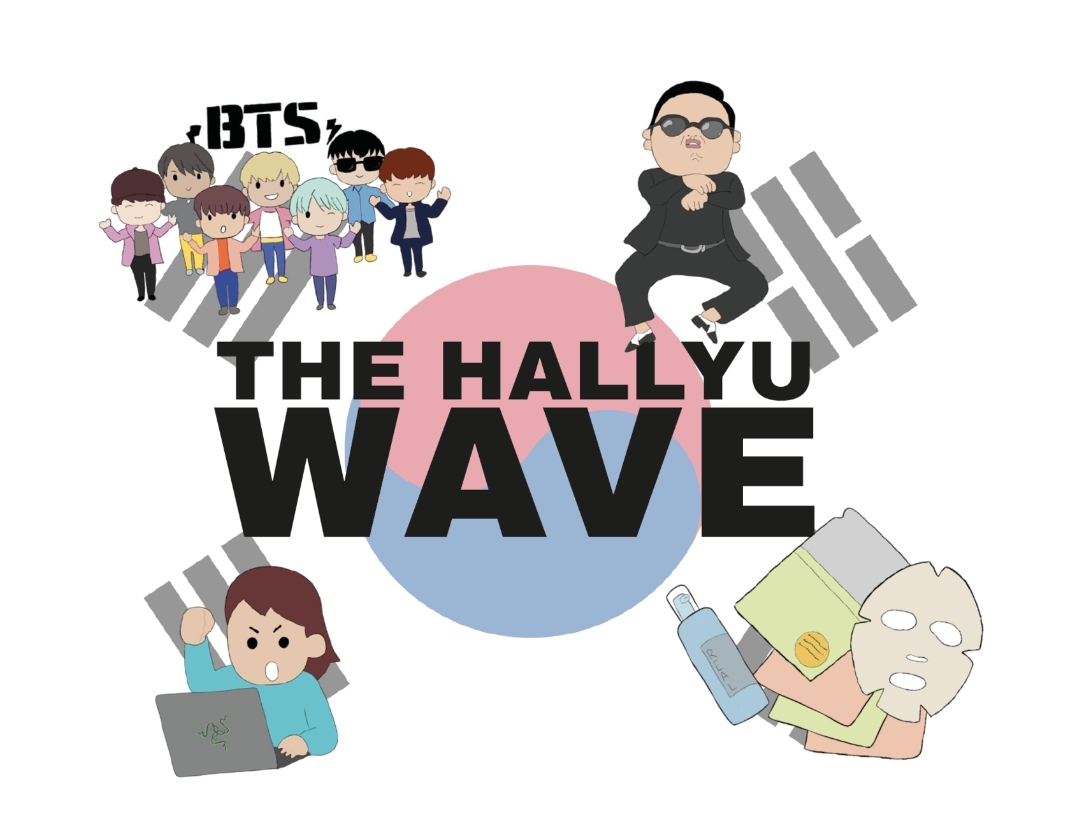
Hello, Hallyu!

It’s a wave that’s swept Indians off their feet, dictating everything from their choice of music and TV shows, right down to beauty and skincare… all of it made entirely in Korea.

Much of the world woke up to K-pop after Psy’s 2012 viral hit Gangnam Style, but the genre dates back to the 1990s, when ‘idol’ groups started making waves in the Korean music scene.

Most people trace the genesis of the ‘idol’ phenomenon to the 1992 debut of Seo Taiji and Boys, a trio that melded American pop, swingbeat and rap with Korean lyrics and musical tropes. Their immense – and unexpected – popularity encouraged Korean entertainment companies to jump on this new trend, and by the mid-90s the Korean music industry was dominated by boy bands such as H.O.T and SechsKies, who quickly built up large, passionate and competitive fandoms. These bands would lay down the template for generations of K-pop groups to follow – music that mixes elements of Korean pop culture with a wide cross-section of contemporary music genres from the West, a focus on over-the-top fashion, and a visual aesthetic that is fully committed to gleeful audiovisual excess. Around the same time, the South Korean Ministry of Culture started investing heavily in the country’s entertainment and pop culture industries in an attempt to stave off the impending influx of Japanese anime, manga and music, which had been banned in the country before 1998.

Recognising the potential of culture as soft power, the government also put into place policies to promote the production and export of Korean pop culture. This was the beginning of Hallyu – the Korean Wave – in which Korean films, TV dramas and K-pop gained rapid popularity across wide swathes of China, Japan and South-East Asia, before the internet allowed it to spread its reach across all the world. And since the late 2000s, K-Pop has been at its forefront.

So, what started the Hallyu Wave?

Winter Sonata, a KDrama, started the Hallyu Wave, in Asia. It was so popular in Japan that matchmakers started advertising that they could hook up Japanese women with Korean husbands.

KPop took a bit longer. BoA was the first Korean singer to make it big in Japan (2001), but she sang in Japanese and people didn’t necessarily know she was Korean. The first KPop group to hit Japan was TVXQ (all five of them) in 2006 – they became known as the Korean Beatles due to their immense fandom in Asia. SS501, Super Junior and SHINee also had great success in Japan, and the Hallyu Wave started lapping at the shores of Australia, New Zealand and California.

Groups started coming over to the US in the late 2000s, and after Gangnam Style went viral on the web, more came. Before BTS made it huge, several other groups had profitable tours, including Got7 and Big Bang (with the MADE Tour doing exceptionally well).

In 2012, KCon started in Los Angeles. This convention, with highlighted artist concerts each night, has grown exponentially since, with KCons in a variety of places around the world (Japan, Australia, Paris) and expanded to NYC as well as LA. 70,000 people attended KCon NY 2019, with the convention held at the Javits Center and the concerts at Madison Square Gardens. KCon LA had 94,000 fans in 2018 (figures aren’t out yet for 2019). Now of course BTS are the world’s biggest boy group, and have just finished a massive worldwide stadium tour that outgrossed most of the acts this year from ANY country.

But India’s first brush with Hallyu had more to do with local politics than it did with soft power diplomacy. In 2000 the Manipur Revolutionary People’s Front, an armed secessionist group, issued a notice banning Hindi films and TV shows – as well as the use of Hindi – in an effort to fight the ‘Indianisation’ of the north-eastern state of Manipur. As theatres and cable operators quickly acceded to the demand, people started looking further east for entertainment. Korean TV channels like Airarang TV and KBS World started being broadcast in Manipur and other north-eastern states, and soon the region was awash with cheap pirated Korean CDs.“The key factor that abets the popularity of Korean Wave is the cultural proximity of Korean and Manipuri societies,”

The fact that people from the region are rarely represented in Indian pop culture – and if they are, it’s usually as an offensive racial stereotype – also made the switch to Korean culture easier. When young people from the region travelled to cities like Mumbai, Delhi, Bangalore and Pune for college, they took their love for Korean TV and K-pop with them, seeding K-pop fandoms in their hostels. But it would take until after 2012 for these seeds to start bearing fruit.

The rise of YouTube and social media had already allowed K-pop to make inroads into the United States, Europe and India, but it was K-pop star Psy’s 2012 viral hit that really turned it into a global phenomenon. But why was BTS the band that finally broke through the culture barrier overseas to make significant waves in the US? The answer lies in a combination of factors, and most of them are about change: the changing nature of K-pop’s studio culture and the way “idols” are produced; changing depictions of masculinity in South Korea; changing ranges of acceptable expression in K-pop; and, above all, the approach BTS has taken to building its fan base and interacting with its fans.

It’s this high level of online engagement – as well as the lack of non-Bollywood boy bands or pop music in the country – that has helped K-pop acts build highly dedicated fandoms in India as well. Indian K-pop fans congregate on act-specific Facebook and Twitter pages, like Bangtan India (for BTS fans) and EXO-L India, as well as more general platforms like Destination K-pop India.

Screenshot_20200718-114235_Chrome
The Korean Wave.