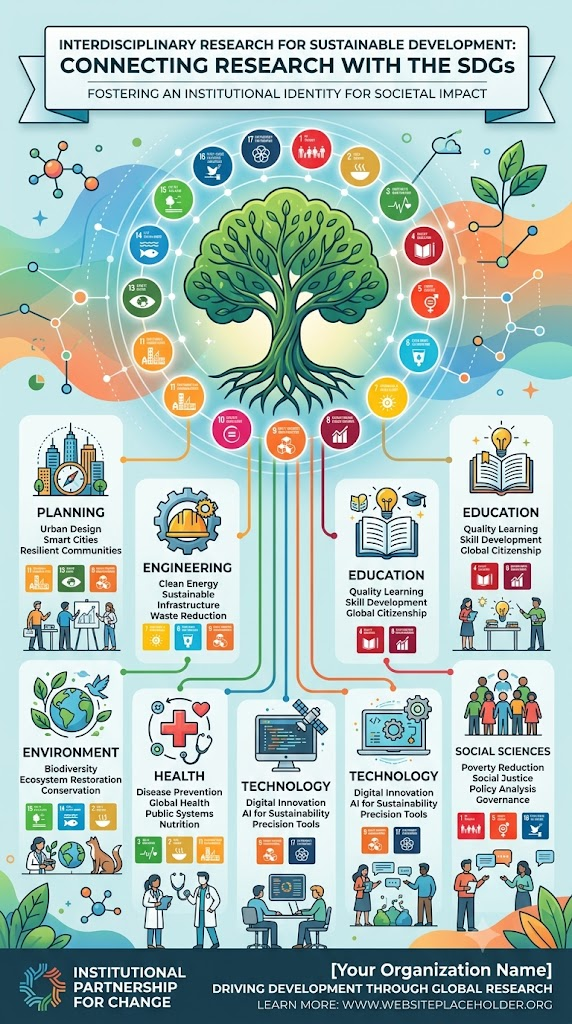
Which reInterdisciplinary Research for Sustainable Development: Connecting Research with the SDGs
Sustainable development is one of the defining research challenges of the twenty-first century. Climate change, rapid urbanisation, environmental degradation, inequality, public health challenges, technological disruption, pressure on natural resources, and unequal access to education and infrastructure cannot be effectively addressed through a single discipline.
At Track2Training, sustainable development is approached as an interdisciplinary research agenda connecting planning, engineering, education, environment, health, technology, social sciences, governance, and public policy.
The organisation recognises the importance of the United Nations Sustainable Development Goals (SDGs) as a broad framework for understanding interconnected development challenges. Research can contribute to these goals by producing evidence, identifying problems, evaluating interventions, developing technologies, strengthening institutions, and translating academic knowledge into solutions relevant to communities and decision-makers.
Track2Training therefore seeks to encourage research that moves beyond disciplinary boundaries and connects academic inquiry with meaningful societal outcomes.
Research and the Sustainable Development Goals
The Sustainable Development Goals provide a global framework covering social, economic, environmental, and institutional dimensions of development.
For research institutions, the SDGs provide an opportunity to connect academic work with wider societal priorities.
A transportation study, for example, may contribute to SDG 11: Sustainable Cities and Communities, while also addressing climate action, infrastructure, accessibility, and social inclusion.
Similarly, research on water infrastructure can simultaneously relate to health, sustainable settlements, climate resilience, environmental protection, and institutional governance.
The interconnected nature of the SDGs reflects an important principle of Track2Training’s research philosophy: complex development challenges require integrated knowledge.
Rather than treating each SDG as an isolated subject, interdisciplinary research can investigate relationships between them.
Urban Planning and Sustainable Cities
Urbanisation creates opportunities for economic and social development, but it also places enormous pressure on infrastructure, housing, transportation, public services, land, and the environment.
Research in urban planning, architecture, regional planning, and the built environment can make significant contributions to sustainable development.
Track2Training encourages research related to:
sustainable urban development,
transit-oriented development,
affordable and inclusive housing,
land-use planning,
public spaces,
infrastructure accessibility,
heritage conservation,
urban resilience,
informal settlements,
pedestrian-friendly environments, and
climate-responsive urban design.
These research areas are closely connected with SDG 11: Sustainable Cities and Communities.
However, their significance extends further.
Improved urban transport can support climate action. Accessible public spaces can promote social inclusion. Better water and sanitation infrastructure can contribute to public health. Energy-efficient buildings can reduce resource consumption.
Urban research therefore demonstrates how one area of academic investigation can simultaneously contribute to several sustainable-development objectives.
Engineering for Sustainable Infrastructure
Engineering plays a fundamental role in translating sustainable-development principles into physical systems and technologies.
Civil, environmental, transportation, electrical, mechanical, and computational engineering research can contribute to safer, more efficient, and more resilient infrastructure.
Track2Training encourages engineering research concerning areas such as:
sustainable construction, renewable energy, water systems, transportation infrastructure, structural resilience, waste management, energy efficiency, intelligent infrastructure, materials technology, and disaster-resistant development.
These fields have strong connections with SDG 6: Clean Water and Sanitation, SDG 7: Affordable and Clean Energy, SDG 9: Industry, Innovation and Infrastructure, and SDG 11: Sustainable Cities and Communities.
Sustainable engineering requires more than technical optimisation.
Infrastructure must also be affordable, accessible, socially appropriate, environmentally responsible, and resilient to changing conditions.
This makes collaboration between engineers, planners, economists, environmental researchers, and social scientists increasingly important.
Education as a Foundation for Sustainable Development
Education influences virtually every dimension of sustainable development.
SDG 4: Quality Education emphasises inclusive and equitable education and opportunities for lifelong learning. For research institutions, this creates a broad agenda involving teaching practices, research training, digital education, educational technology, curriculum design, accessibility, and skill development.
Track2Training promotes research on higher education, academic capacity building, digital learning, research methodology, scholarly communication, and technology-supported education.
A particular area of interest is the development of research capabilities among students, doctoral scholars, faculty members, and early-career researchers.
Sustainable development requires professionals who can understand complex problems, analyse evidence, collaborate across disciplines, and communicate findings effectively.
Research training is therefore itself a contribution to sustainable development.
Researchers trained in statistics, qualitative inquiry, GIS, systematic reviews, artificial intelligence, and evidence-based decision-making are better equipped to investigate societal challenges.
Environmental Research and Climate Action
Environmental sustainability forms a central pillar of sustainable development.
Climate change, biodiversity decline, pollution, water stress, land degradation, and ecosystem loss affect both natural and human systems.
Track2Training encourages environmental research relating to:
climate change, urban heat, water systems, air quality, environmental impact assessment, green infrastructure, ecosystem management, land-use change, waste management, energy consumption, biodiversity, and climate adaptation.
Such research contributes particularly to SDG 6, SDG 12: Responsible Consumption and Production, SDG 13: Climate Action, SDG 14: Life Below Water, and SDG 15: Life on Land.
Environmental challenges also demonstrate why interdisciplinary research is necessary.
For example, urban heat is not purely an environmental issue. It may be influenced by land use, building materials, vegetation, transportation systems, socioeconomic conditions, energy consumption, and planning regulations.
Understanding the problem therefore requires contributions from environmental scientists, architects, planners, engineers, public-health researchers, data scientists, and policymakers.
Transportation and Sustainable Mobility
Mobility is essential for access to employment, education, healthcare, markets, and social opportunities.
Yet transportation systems can also create congestion, pollution, road-safety risks, inequality, and high energy consumption.
Research into public transport, first- and last-mile connectivity, walking, cycling, accessibility, transit-oriented development, travel behaviour, and intelligent transportation systems can contribute to more sustainable mobility.
Track2Training’s transportation research agenda recognises that mobility should not be assessed only by speed or road capacity.
Accessibility, affordability, reliability, safety, environmental impact, and social inclusion are equally important.
A sustainable transport system should enable people to reach essential opportunities without creating unnecessary environmental or social costs.
Research in this area can contribute to sustainable cities, climate action, infrastructure development, reduced inequalities, and improved quality of life.
Health, Environment and Human Well-Being
Human health is closely connected with the environments in which people live, work, learn, and travel.
Environmental pollution, inadequate sanitation, unsafe mobility, extreme heat, poor housing, insufficient physical activity, and unequal access to services can all affect health outcomes.
Interdisciplinary research connecting health, urban planning, environment, engineering, and social sciences can help identify these relationships.
Track2Training encourages research examining areas such as healthy cities, environmental health, water and sanitation, climate-related health risks, active mobility, occupational environments, community well-being, and access to public services.
These themes connect particularly with SDG 3: Good Health and Well-Being while also intersecting with sustainable cities, clean water, climate action, and reduced inequalities.
Health-oriented research also highlights the importance of equity.
Development interventions should be assessed not simply according to their average benefits but also according to whether different groups can access those benefits.
Artificial Intelligence and Technology for Sustainable Development
Digital technologies are creating new possibilities for understanding and responding to sustainable-development challenges.
Artificial intelligence, machine learning, GIS, remote sensing, digital twins, sensors, data analytics, and automation can help researchers monitor systems, predict outcomes, identify patterns, and evaluate alternative interventions.
Track2Training supports research exploring the responsible application of technology in areas such as:
transport planning,
environmental monitoring,
smart cities,
education,
infrastructure management,
climate analysis,
land-use mapping,
resource optimisation, and
decision-support systems.
Technology can contribute significantly to SDG 9: Industry, Innovation and Infrastructure and support many other goals.
However, technological innovation should not automatically be assumed to be sustainable.
Questions of affordability, accessibility, privacy, bias, digital inequality, energy use, transparency, and governance must also be considered.
For this reason, Track2Training promotes responsible and human-centred technological research rather than technological advancement for its own sake.
Social Sciences, Equity and Inclusion
Sustainable development is fundamentally about people.
Economic growth, infrastructure, and technological innovation have limited value if their benefits are distributed unfairly or if vulnerable groups are excluded.
Social-science research provides tools for understanding inequality, livelihoods, institutions, behaviour, culture, participation, and community experiences.
Track2Training encourages research concerning:
social inclusion, informal economies, gender, livelihoods, community development, social justice, vulnerable populations, migration, citizen participation, accessibility, and institutional relationships.
These areas are particularly relevant to SDG 5: Gender Equality, SDG 8: Decent Work and Economic Growth, SDG 10: Reduced Inequalities, and SDG 16: Peace, Justice and Strong Institutions.
Social research can also reveal unintended consequences of development policies.
A technically successful urban project, for example, may still create displacement or livelihood difficulties for certain communities.
Including social-science perspectives helps researchers understand such impacts.
Public Policy, Governance and Institutions
Sustainable development depends not only on good ideas but also on institutions capable of implementing them.
Policies may be well designed on paper yet achieve limited results because of administrative capacity, fragmented responsibilities, financial constraints, poor coordination, weak monitoring, or limited public participation.
Track2Training therefore promotes research into public policy, governance, regulatory systems, institutional performance, planning legislation, implementation mechanisms, and public participation.
This work has particular relevance to SDG 16, which emphasises effective, accountable, and inclusive institutions.
Policy research can examine the difference between policy intention and actual implementation.
It can also help decision-makers understand which interventions work, under what conditions, for whom, and why.
Evidence-based governance is therefore an important part of the sustainable-development research agenda.
Water, Sanitation and Resource Management
Access to safe water and sanitation remains fundamental to public health and sustainable settlements.
Research in this area requires collaboration across engineering, planning, environmental science, health, governance, and community studies.
Track2Training encourages research relating to water supply, sanitation systems, wastewater management, river systems, water quality, urban drainage, community practices, resource conservation, and infrastructure governance.
Such work directly supports SDG 6: Clean Water and Sanitation but can also contribute to health, sustainable communities, environmental protection, and climate resilience.
In particular, research in small and medium-sized towns can help address contexts that sometimes receive less scholarly attention than major metropolitan areas.
Sustainable Consumption, Buildings and Energy
Buildings and urban infrastructure consume significant quantities of energy and materials.
Research on building performance, construction materials, lifecycle assessment, energy retrofits, passive design, renewable-energy integration, and resource efficiency can contribute to more sustainable built environments.
Track2Training supports investigations examining how buildings can reduce resource consumption while maintaining comfort, affordability, and functionality.
This work connects architecture and engineering with SDG 7, SDG 11, SDG 12, and SDG 13.
Lifecycle thinking is particularly important.
Sustainability should not be assessed solely during building operation. Researchers may examine environmental impacts associated with material extraction, construction, maintenance, adaptation, and eventual demolition or reuse.
Interdisciplinary Methods for Complex Problems
Research for sustainable development requires methodological diversity.
Track2Training encourages the integration of:
field surveys, interviews, focus groups, statistical analysis, structural equation modelling, machine learning, GIS, remote sensing, systematic reviews, bibliometric analysis, policy analysis, case studies, and mixed-method research.
Different methods answer different questions.
Quantitative analysis may identify relationships between variables. Qualitative interviews may explain why those relationships exist. GIS can identify spatial inequalities. Machine learning can detect complex predictive patterns. Policy analysis can examine institutional barriers.
Combining methods can therefore produce a more complete understanding of sustainable-development challenges.
From Research Findings to Societal Impact
Research contributes to sustainable development only when knowledge can inform understanding, decisions, or future inquiry.
Track2Training encourages researchers to communicate their findings through multiple channels.
These may include:
journal articles, working papers, policy briefs, research reports, datasets, conferences, workshops, training programmes, technical guidance, and public-facing research communication.
A journal article may advance academic theory, while a policy brief may help policymakers understand the practical implications of the same findings.
Similarly, a research dataset may enable other scholars to conduct additional studies, while a training workshop may transfer methodological knowledge to emerging researchers.
Knowledge dissemination should therefore be designed according to the intended audience and potential contribution.
Measuring Research Contribution to the SDGs
Connecting research with the SDGs should involve more than simply adding an SDG label to a publication.
Researchers should identify how their questions, methods, findings, and recommendations relate to particular sustainable-development challenges.
A project may contribute directly to one SDG while indirectly supporting several others.
For example, research improving public transport accessibility may primarily contribute to sustainable cities but may also support reduced inequality, climate action, economic opportunity, and health.
Track2Training seeks to encourage such substantive connections rather than superficial categorisation.
Over time, institutional research outputs can be mapped according to SDG themes to demonstrate where research activity is concentrated and where new research programmes may be needed.
Partnerships for Sustainable Development
The complexity of sustainable-development challenges makes collaboration essential.
This aligns closely with SDG 17: Partnerships for the Goals.
Track2Training seeks to encourage partnerships involving universities, research institutions, government agencies, industries, professionals, civil-society organisations, faculty members, students, and independent researchers.
Collaborative research can enable access to diverse expertise, locations, datasets, technologies, and perspectives.
Partnerships can also help transform academic findings into pilot projects, policy discussions, professional practices, and educational initiatives.
Building a Sustainable Research Ecosystem
Track2Training views sustainable development not as a separate research subject but as a framework capable of connecting multiple disciplines.
Planning provides tools for shaping settlements. Engineering develops infrastructure and technologies. Environmental research examines ecological limits. Health research focuses on human well-being. Education builds knowledge and capacity. Social sciences analyse communities and inequalities. Technology creates new analytical and practical possibilities. Public policy determines how many of these ideas are translated into action.
When these disciplines work together, research can address development challenges more comprehensively.
Research for Knowledge, Society and the Future
The long-term goal of interdisciplinary research at Track2Training is to strengthen the connection between academic knowledge and societal development.
Research should help explain problems, evaluate alternatives, develop solutions, challenge ineffective assumptions, and identify new opportunities.
The Sustainable Development Goals provide a valuable framework through which these contributions can be understood and connected.
Through research in planning, engineering, transportation, environment, education, health, artificial intelligence, technology, social sciences, and public policy, Track2Training aims to contribute to an academic ecosystem where knowledge is not produced in isolation from society.
Instead, research becomes part of a wider process of building more inclusive communities, stronger institutions, resilient infrastructure, sustainable environments, improved educational opportunities, responsible technologies, and better-informed public decisions.