Research Training and Capacity Building for Scholars, Faculty and Students
A strong research ecosystem depends not only on infrastructure, funding, and publications, but also on the knowledge, skills, and confidence of the people who conduct research. Scholars, faculty members, postgraduate students, doctoral researchers, and professionals increasingly work in an academic environment that requires competence in research design, data analysis, academic writing, digital tools, evidence synthesis, and ethical scholarly communication.
At Track2Training, research training and capacity building are viewed as core academic functions. The objective is to help researchers develop the methodological, analytical, technological, and communication skills needed to undertake high-quality research independently and responsibly.
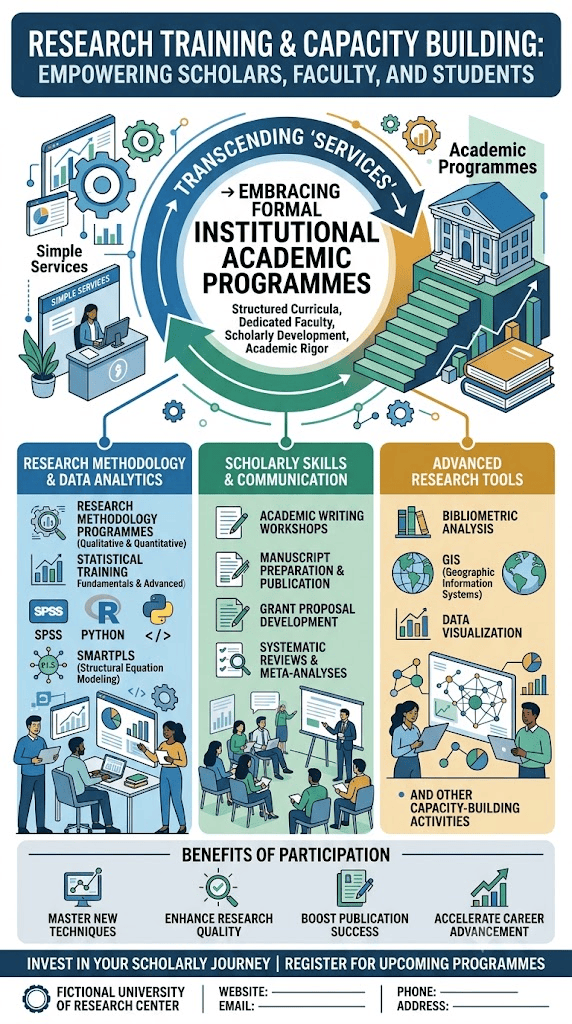
Rather than treating research training as a collection of isolated technical services, Track2Training approaches capacity building as a structured institutional programme that supports researchers across the complete research lifecycle—from identifying a research problem to designing a study, analysing data, interpreting findings, and communicating results.
Building Research Capacity Across Career Stages
Researchers at different stages of their academic journey require different forms of support.
A postgraduate student may need guidance in understanding research design and questionnaire development. A doctoral scholar may require advanced statistical or qualitative training. A faculty member may want to learn bibliometric analysis, structural equation modelling, machine learning, or GIS. An experienced researcher may need methodological updating as new analytical tools emerge.
Track2Training therefore promotes a layered model of research capacity building.
Programmes may be designed at introductory, intermediate, and advanced levels so that participants can develop progressively rather than being exposed to complex software before understanding the underlying concepts.
The emphasis remains on developing methodological literacy, not simply software familiarity.
Research Methodology Programmes
Research methodology forms the foundation of academic capacity building.
Track2Training’s research methodology programmes are designed to help participants understand how a research idea is transformed into a rigorous and feasible study.
Key areas may include:
- identification of research problems,
- formulation of research questions,
- development of objectives and hypotheses,
- literature review,
- theoretical and conceptual frameworks,
- research design,
- qualitative and quantitative methods,
- mixed-method research,
- sampling,
- questionnaire design,
- validity and reliability,
- data collection,
- interpretation of findings, and
- research ethics.
Participants are encouraged to understand why a method is appropriate before learning how to apply it.
This distinction is important because research quality depends more on methodological reasoning than on the complexity of the analytical technique used.
Statistical Training for Researchers
Statistical literacy is increasingly important across the social sciences, engineering, planning, education, management, health research, and many other disciplines.
Track2Training promotes statistical training that begins with conceptual understanding and progresses toward application.
Introductory programmes may cover descriptive statistics, distributions, data types, measures of central tendency, variability, cross-tabulation, and graphical interpretation.
Intermediate programmes may include hypothesis testing, correlation, regression, t-tests, chi-square tests, analysis of variance, and non-parametric methods.
Advanced programmes may focus on multivariate analysis, factor analysis, logistic regression, structural equation modelling, predictive modelling, and other specialised techniques.
The aim is to help participants select statistical methods appropriate to their research questions and data rather than applying techniques mechanically.
SPSS Training
SPSS remains widely used in academic research because of its accessibility and range of statistical procedures.
Track2Training’s SPSS-oriented programmes may introduce participants to data entry, coding, variable management, missing values, descriptive analysis, reliability analysis, correlation, regression, ANOVA, factor analysis, and related statistical procedures.
Participants can also learn how to interpret outputs correctly.
This is particularly important because statistical software can generate results very quickly, but incorrect interpretation can lead to unreliable conclusions.
Training therefore focuses on understanding assumptions, significance levels, confidence intervals, effect sizes, coefficients, model fit, and practical meaning.
R for Academic Research
R has become an important platform for statistics, data science, visualisation, reproducible research, and advanced modelling.
Track2Training encourages researchers to develop R skills because it supports both conventional statistical analysis and more advanced computational methods.
Capacity-building programmes may cover:
- introduction to R and RStudio,
- importing and cleaning data,
- data manipulation,
- descriptive statistics,
- statistical testing,
- regression,
- data visualisation,
- reproducible scripts,
- bibliometric analysis,
- spatial analysis, and
- advanced modelling.
One of the major academic advantages of R is reproducibility.
Researchers can maintain scripts documenting each analytical step, making it easier to verify, revise, and reproduce their work.
Python for Research and Data Analysis
Python is increasingly valuable for researchers working with data analytics, automation, machine learning, text analysis, and computational research.
Track2Training’s Python-based academic training may begin with programming fundamentals and progress toward research applications.
Possible modules include data handling with pandas, numerical analysis, data cleaning, visualisation, statistical analysis, machine learning, natural language processing, automation, and research workflow development.
Python is particularly useful when researchers are working with large datasets or need to integrate multiple forms of data.
The training approach should remain research-oriented. Participants are encouraged to understand how programming contributes to answering research questions rather than learning coding in isolation from academic inquiry.
SmartPLS and Structural Equation Modelling
Structural Equation Modelling has become widely used in management, social sciences, transportation, planning, education, consumer research, and behavioural studies.
Track2Training supports capacity building in SEM and Partial Least Squares Structural Equation Modelling using platforms such as SmartPLS.
Programmes may include:
- development of conceptual models,
- reflective and formative constructs,
- measurement-model assessment,
- indicator loadings,
- Cronbach’s alpha,
- composite reliability,
- average variance extracted,
- discriminant validity,
- variance inflation factors,
- path coefficients,
- bootstrapping,
- effect sizes,
- explanatory power, and
- model interpretation.
The emphasis is placed on understanding the conceptual logic behind SEM.
Researchers should not select structural equation modelling simply because it appears sophisticated. The method should follow from the research question, measurement structure, theoretical framework, and data.
Systematic Literature Review Training
Systematic reviews are becoming increasingly important across disciplines because researchers need transparent ways of synthesising rapidly expanding bodies of literature.
Track2Training promotes systematic literature review training that goes beyond conventional narrative summaries.
Participants may learn how to:
- formulate review questions,
- identify appropriate databases,
- design search strategies,
- develop inclusion and exclusion criteria,
- remove duplicates,
- screen titles and abstracts,
- undertake full-text assessment,
- extract data,
- assess study quality,
- synthesise evidence, and
- report the review transparently.
Programmes may also introduce recognised reporting frameworks where appropriate.
The objective is to help researchers develop reviews that are systematic, reproducible, and analytically meaningful.
Bibliometric Analysis and Science Mapping
Bibliometric analysis provides researchers with tools to examine large bodies of scholarly literature quantitatively.
Track2Training’s capacity-building activities may include bibliometric methods using tools such as VOSviewer, Biblioshiny, Bibliometrix, and related analytical platforms.
Researchers can learn to examine:
- publication trends,
- citation patterns,
- influential authors,
- institutions,
- countries,
- journals,
- keyword networks,
- co-authorship,
- co-citation,
- bibliographic coupling, and
- thematic evolution.
Training should also address interpretation.
A visually attractive network map is not, by itself, a strong academic contribution. Researchers need to understand what the network represents, how parameters affect results, and how bibliometric findings connect with substantive research questions.
GIS and Spatial Research Training
Many research questions contain a spatial dimension.
Track2Training supports GIS-based capacity building for researchers working in planning, geography, transportation, environment, public health, infrastructure, and regional development.
Training modules may introduce:
- spatial data types,
- coordinate systems,
- georeferencing,
- digitisation,
- spatial databases,
- thematic mapping,
- buffer analysis,
- proximity analysis,
- overlay analysis,
- network analysis,
- accessibility analysis,
- land-use mapping, and
- spatial interpretation.
Advanced programmes may include remote sensing, spatial statistics, change detection, and integration with statistical or machine-learning techniques.
GIS training is particularly valuable because maps can reveal patterns and inequalities that may remain hidden in conventional tabular datasets.
Academic Writing and Scholarly Communication
Research findings have limited impact if they cannot be communicated clearly.
Academic writing is therefore a major component of research capacity building at Track2Training.
Programmes may address the complete process of developing a scholarly manuscript, including:
- structuring a research paper,
- writing effective titles and abstracts,
- developing introductions,
- organising literature reviews,
- reporting methodology,
- presenting results,
- writing discussions,
- preparing conclusions,
- managing citations,
- preparing tables and figures,
- avoiding plagiarism, and
- responding to reviewer comments.
Researchers are encouraged to distinguish academic clarity from unnecessarily complicated language.
Strong scholarly writing communicates complex ideas accurately and efficiently.
Research Proposal Development
Developing a research proposal requires researchers to demonstrate that their question is important, theoretically grounded, methodologically feasible, and capable of generating useful knowledge.
Track2Training’s proposal-development programmes may help scholars work through:
research problem identification, research gaps, objectives, literature review, conceptual frameworks, methodology, timelines, expected outcomes, budgets, ethics, and dissemination.
Such programmes can support doctoral proposals, institutional research projects, grant applications, collaborative projects, and externally funded research.
Proposal training also helps participants think more systematically about research planning before data collection begins.
Qualitative Research Capacity Building
Quantitative methods represent only one part of academic inquiry.
Track2Training also promotes capacity building in qualitative research.
Training may cover:
- interview design,
- focus group discussions,
- observation,
- case-study methods,
- purposive sampling,
- transcription,
- coding,
- thematic analysis,
- content analysis,
- reflexivity,
- saturation, and
- qualitative interpretation.
Researchers may also be introduced to qualitative data-analysis software where appropriate.
The objective is to help participants understand the rigour required in qualitative research and avoid the misconception that qualitative analysis is simply informal description.
Mixed-Method Research
Many complex research problems benefit from combining quantitative and qualitative approaches.
Track2Training’s mixed-method capacity-building programmes may explain how different types of evidence can be integrated within a coherent research design.
Participants can learn about sequential, concurrent, exploratory, and explanatory approaches and how to connect data collected through surveys, interviews, field observations, statistical models, and spatial analysis.
The central principle is integration.
Using multiple methods does not automatically create a strong mixed-method study. Researchers should explain how different forms of evidence complement, confirm, or challenge each other.
Machine Learning for Academic Research
Machine learning is increasingly being incorporated into research in transportation, planning, education, engineering, environmental science, and social analytics.
Track2Training supports training programmes that introduce researchers to the responsible use of machine-learning methods.
Topics may include:
- data preparation,
- training and testing datasets,
- feature selection,
- regression and classification,
- decision trees,
- random forests,
- support vector machines,
- clustering,
- model evaluation,
- overfitting,
- validation, and
- explainability.
Participants should understand both the strengths and limitations of machine-learning models.
Predictive accuracy alone does not guarantee meaningful research. Interpretation, data quality, bias, reproducibility, and theoretical relevance remain essential.
Research Ethics and Responsible Scholarship Training
Research capacity building must include ethical capacity.
Track2Training encourages programmes covering informed consent, participant confidentiality, data integrity, plagiarism, authorship, conflicts of interest, publication ethics, AI-assisted research, and responsible scholarly communication.
Researchers should understand their responsibilities before beginning data collection rather than treating ethics as an administrative formality.
As digital platforms and artificial intelligence become increasingly integrated into research, ethical awareness will become even more important.
Workshops, Faculty Development Programmes and Research Schools
Institutional capacity building can take different forms.
Track2Training may organise:
- short-term workshops,
- faculty development programmes,
- research methodology courses,
- doctoral research clinics,
- summer or winter research schools,
- statistical bootcamps,
- software-based laboratory sessions,
- writing workshops,
- systematic-review programmes,
- research seminars, and
- interdisciplinary training programmes.
Some activities may focus on a single method, while others can provide integrated training across the complete research lifecycle.
Programmes may be offered in collaboration with universities, departments, research centres, professional organisations, and academic networks.
Learning Through Research Projects
One of the most effective ways to build research capacity is through active participation in research.
Track2Training therefore supports project-based learning in which participants develop skills while working on actual research problems.
A training cohort might develop a questionnaire, conduct pilot testing, collect field data, clean datasets, undertake statistical analysis, interpret findings, and prepare a research report.
Similarly, a systematic-review programme could guide participants from search strategy development to evidence synthesis.
This approach helps bridge the gap between theoretical methodological knowledge and actual research practice.
Building Institutional Research Culture
Capacity building has effects beyond individual researchers.
When faculty members, scholars, and students develop stronger research skills, institutions become better equipped to initiate collaborative projects, prepare funding proposals, produce high-quality publications, mentor younger researchers, and contribute to public knowledge.
Track2Training therefore views research training as part of institutional development.
Training can help departments establish common methodological standards, strengthen supervision, improve research documentation, and encourage interdisciplinary collaboration.
It can also create networks among participants who continue to collaborate after a programme has ended.
From Software Training to Research Competence
A central principle of Track2Training’s capacity-building philosophy is that software is a tool, not a research methodology.
Learning SPSS does not automatically make a researcher a statistician. Learning SmartPLS does not replace understanding measurement theory. Learning GIS does not replace spatial reasoning. Learning Python does not eliminate the need for research design.
For this reason, institutional training programmes should connect technical skills with conceptual understanding.
Participants should be able to explain:
why a method was selected, what assumptions it requires, what its outputs mean, what limitations apply, and how its results answer the research question.
This is the difference between technical software operation and genuine research competence.
Supporting Lifelong Academic Learning
Research methods continue to evolve.
New analytical techniques, data sources, software, reporting standards, and ethical questions emerge regularly.
Researchers therefore need opportunities for continuous professional development throughout their careers.
Track2Training aims to contribute to a culture of lifelong academic learning in which researchers continue updating their skills rather than viewing research methodology as something learned only during postgraduate education.
Such continuous development is particularly important as artificial intelligence, computational methods, open science, and digital research environments reshape academic practice.
Toward an Institutional Research Capacity-Building Ecosystem
The long-term objective of Track2Training’s Research Training and Capacity Building Programme is to create an academic environment in which scholars can progressively develop the skills required for independent and responsible research.
Research methodology, academic writing, SPSS, R, Python, SmartPLS, SEM, systematic reviews, bibliometric analysis, GIS, machine learning, qualitative methods, and research ethics should not operate as disconnected offerings.
Together, they form an integrated research-learning ecosystem.
By organising these activities as academic programmes, workshops, research schools, faculty development initiatives, methodological laboratories, and collaborative learning opportunities, Track2Training seeks to position research training as a central part of its institutional mission.
The ultimate objective is not simply to teach researchers how to operate analytical tools. It is to help them become capable of asking stronger questions, selecting appropriate methods, analysing evidence responsibly, interpreting findings critically, and communicating knowledge effectively.
Through sustained capacity building, Track2Training aims to strengthen researchers, academic institutions, and the broader culture of evidence-based scholarship.
Which relationship has taught you the most about yourself?
View all responses

