
Track2Training Research Review 2026: Publications, Projects, Conferences and Academic Contributions
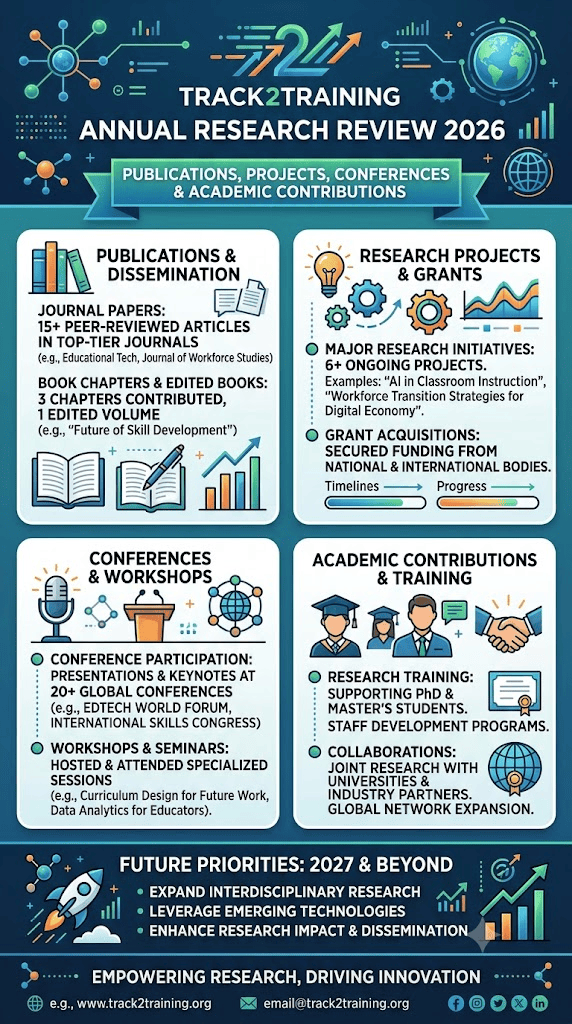
Advancing Research, Training and Academic Collaboration
The year 2026 has been an important period of research activity, academic collaboration, publication development, capacity building and institutional expansion for Track2Training. With an increasing focus on interdisciplinary research, evidence-based analysis, responsible academic publishing and research training, Track2Training has continued to strengthen its role as a research and knowledge-support organisation connecting scholars, faculty members, students, universities and professional communities.
The Track2Training Research Review 2026 presents an overview of major research projects, journal manuscripts, book chapters, edited publications, conferences, research training activities, collaborations and future research priorities undertaken or supported during the year.
Research Projects and Interdisciplinary Studies
A significant part of Track2Training’s research activity during 2026 has focused on sustainable urban development, transportation planning, land-use policy, heritage conservation, environmental sustainability, machine learning and evidence-based planning.
Several studies examined public transport accessibility, first- and last-mile connectivity, transit-oriented development and travel behaviour. Research relating to Bhopal explored how accessibility, infrastructure quality, service experience and transport efficiency influence public transport preferences. Advanced statistical approaches, including Partial Least Squares Structural Equation Modelling (PLS-SEM), were used to investigate relationships between transport-related constructs.
Research on Transit-Oriented Development in Delhi examined travel behaviour, mode choice, land-use characteristics, density, accessibility, safety, reliability and urban design. Large survey datasets were analysed using statistical and machine-learning techniques, including multinomial models, logistic regression, random forest algorithms and structural equation modelling.
Another important research area concerned Transferable Development Rights and land-development policy. Studies investigated development rights, farmland protection, compensation mechanisms, planning regulations, infrastructure capacity, market operations and implementation effectiveness. Comparative systematic reviews were also undertaken to understand international approaches to development-rights instruments and land-management policies.
Track2Training-supported research has additionally covered climate-responsive mobility, sustainable infrastructure, urban planning, building performance, environmental management, digital technologies and heritage conservation.
Journal Publications and Manuscript Development
Academic publication remained a central component of research activity during 2026. Manuscripts were prepared, revised or submitted to peer-reviewed journals covering urban planning, sustainable transportation, machine learning, civil engineering, environmental research, heritage studies and built-environment research.
Research topics included:
- Machine learning methods for sustainable transport planning and engineering
- Mode-choice modelling in Transit-Oriented Development areas
- Sustainable Development Goal indicators for urban planning
- Climate extremes and travel behaviour
- Public transport user perceptions and service-quality determinants
- Transferable Development Rights and land-management systems
- Energy retrofitting and building-performance improvement
- Land-use and land-cover change
- Heritage significance, conservation condition and adaptive reuse
- Tourism activation of historic urban heritage
Several manuscripts progressed through peer-review and revision stages during the year, reflecting the growing emphasis on rigorous empirical methods, transparent reporting and internationally relevant research questions.
Particular attention was given to improving research quality through systematic methodology, reliability and validity assessment, research ethics, transparent data reporting and appropriate statistical interpretation.
Systematic Reviews and Evidence Synthesis
Systematic literature reviews formed another major area of academic work. Reviews were conducted following structured screening procedures and, where appropriate, principles associated with PRISMA-based evidence synthesis.
One major review examined public transport research from the user perspective, identifying recurring determinants such as safety, frequency, fare affordability, passenger information, comfort, punctuality, cleanliness, travel time, accessibility and reliability.
Additional evidence-synthesis projects investigated topics such as development rights, farmland conservation, climate-related travel behaviour, building energy retrofits, machine learning applications and heritage conservation.
Track2Training has continued promoting systematic reviews as a method for moving beyond narrative summaries toward transparent, reproducible and academically defensible evidence synthesis.
Books, Book Chapters and Edited Publications
Book publishing and chapter development continued to expand in 2026. Researchers associated with Track2Training participated in academic book projects covering emerging technologies, urban development, sustainability, heritage, communication and interdisciplinary research.
Book chapters were developed on subjects including digital twins, smart cities, sustainable planning, artificial intelligence, place communication, cultural heritage and tourism.
Work also progressed on edited volumes, conference proceedings and academic collections designed to provide researchers with opportunities to disseminate specialised scholarship.
Track2Training continues to support academic book development through concept formation, calls for chapters, manuscript organisation, peer-review coordination, editorial preparation and publication planning.
Conferences and Academic Events
Academic conferences remained an important platform for knowledge exchange during the year.
Research-related activities included participation in and support for conferences focusing on sustainability, planning, materials, technology, environmental systems and interdisciplinary research.
Among the academic initiatives connected with 2026 activities were conferences and proceedings addressing river-sensitive planning, sustainable development, molecular materials and sensors, urban planning and emerging research methodologies.
Track2Training also encouraged researchers to use conferences not simply as presentation platforms, but as environments for developing collaborations, receiving academic feedback, identifying emerging research directions and transforming conference papers into stronger journal publications.
Research Training and Capacity Building
Capacity building continued to be one of the major institutional priorities of Track2Training.
Research training activities focused on helping students, doctoral scholars, faculty members and early-career researchers strengthen their understanding of research methodology and analytical techniques.
Important areas of training and academic guidance included:
Research methodology and proposal development, covering research questions, objectives, conceptual frameworks, sampling and research design.
Statistical analysis, including SPSS, R, Python, SmartPLS and structural equation modelling.
Systematic literature reviews, including database searching, screening protocols, PRISMA reporting and evidence synthesis.
Bibliometric analysis, using tools such as VOSviewer and Biblioshiny.
Academic writing and publication, including manuscript preparation, journal selection, reviewer-response preparation and research integrity.
GIS and spatial analysis, particularly for planning, transportation and environmental research.
These programmes are intended to strengthen independent research capability rather than treating statistical analysis or academic writing as isolated technical activities.
Research Collaboration and Academic Partnerships
Collaboration remained central to Track2Training’s research philosophy throughout 2026.
Research activities involved interactions among scholars from universities, planning institutions, engineering institutions, research organisations and professional networks. Collaborative projects included journal papers, systematic reviews, book chapters, conference initiatives, edited volumes and research proposals.
Particular emphasis was placed on interdisciplinary collaboration among researchers working in architecture, planning, engineering, environmental studies, computer science, transportation, social sciences, education and sustainability.
Track2Training continues to encourage institutional partnerships for jointly organised conferences, faculty development programmes, research projects, publications, edited books and funded research proposals.
Research Ethics, Transparency and Responsible Publishing
The expansion of artificial intelligence and digital research tools has made research integrity increasingly important.
During 2026, Track2Training strengthened its focus on ethical research practices, transparent methodology, appropriate citation, responsible use of generative AI, plagiarism prevention, data transparency and accurate reporting of results.
Researchers were encouraged to maintain clear documentation concerning authorship, conflicts of interest, funding, ethical approval, data availability and the role of digital or AI-assisted tools in research preparation.
Responsible publication practices remain essential for protecting both researchers and institutions from predatory journals, fabricated research, unethical authorship and unreliable analytical practices.
Future Research Priorities
Looking beyond 2026, Track2Training intends to further develop research programmes in several strategic areas.
Priority themes include sustainable cities and communities, artificial intelligence and machine learning, climate-resilient infrastructure, urban mobility, digital twins, GIS and spatial analytics, heritage conservation, sustainable buildings, land policy, environmental planning, public health, education technology and interdisciplinary applications of data science.
Greater attention will also be placed on collaborative international research, externally funded projects, high-quality systematic reviews, Scopus- and Web of Science-indexed publications, academic books, policy-oriented research and research training programmes.
Building an Institutional Research Ecosystem
The activities undertaken during 2026 reflect Track2Training’s evolving role as more than a publication-support platform. The organisation is increasingly developing an integrated research ecosystem combining research, training, publishing, collaboration and knowledge dissemination.
Through research projects, publications, conferences, academic partnerships, methodological training and interdisciplinary collaboration, Track2Training aims to contribute to stronger research capacity and more meaningful knowledge production.
The Track2Training Research Review 2026 therefore represents not only a summary of one year’s activities but also a foundation for future institutional growth.
As research becomes increasingly interdisciplinary, data-intensive and globally connected, Track2Training will continue working with scholars, universities, research organisations and professional communities to support credible, ethical and socially relevant research.
Track2Training – Research, Training, Collaboration and Knowledge for Sustainable Development.
Which relationship has taught you the most about yourself?
View all responses

