My Pleasant Moments with Honourable Judge of Tamil Nadu State Human Rights Commission, V Kannadasan: Cases of His Few Judgements

As an Indian, I am proud of my country. India is a country of pluralism and diversity, whether religions are concerned or languages, cultural issues, food habits, etc. Such diversity cannot be found in any other country, as I have visited many countries and heard from many foreigners. Our judiciary is neutral, and judges have been doing their best. Here, I wish to mention the activities of an honourable judge of Tamil Nadu whom I know closely, as I have visited Tamil Nadu many times. He is the Honourable Judge of the State Human Rights Commission (SHRC) of Tamil Nadu, V. Kannadasan, who was selected and joined in December 2022. It is pertinent to mention that the SHRC of Tamil Nadu is for the protection and promotion of human rights. V Kannadasan, a native of Mayiladuthurai, has more than 25 years of professional experience. He is a scholarly person in the legal field, particularly in civil, criminal, and human rights cases, and also an expert in prison and prisoner rights issues. He served as a special public prosecutor for the human rights court in Chennai from 2006 to 2011.
Among his many praiseworthy activities, I wish to mention a few covering the period from December 2022 to mid-October 2024.
Case 1: The Honourable Judge passed an order during his tenure while allowing a complaint moved by a woman, R. Vasuki, a resident of Besant Nagar, Tamil Nadu. Although the incident occurred on July 11 2013, the order was passed during his tenure. On July 11, 2013, sub-inspectors S. Rajasekharan and S. Ismayil, with the constables Padmanabhan and L. Umashankar attached to an anti-land grabbing cell, Kancheepuram, trespassed in her house. For these illegal activities, after the hearing, Honourable Judge Kannadasan directed the Tamil Nadu government to pay an amount of Rs 1.5 lakh as compensation to the victim of police access. Further, he directed the State Government to recover the money from the salaries of police personnel who were the culprits.
Case 2: This is the case of death because of drowning in a quarry. Divya, with her son Ariyan, went to an abundant quarry full of water for bathing. During the time of bathing, both died in drowning. The husband, M. Sankar, filed a complaint on June 13, 2020. After a thorough review, Honourable Judge Kannadasan directed the State Government to pay Rs. 5 lakh. Also, it is not noteworthy that the District Collector was directed to close the quarry.
Case 3: This case is related to the accident of a woman who was initially victimized by police inaction. Devi, a young woman going by two-wheelers, suffered severely as one pickup van dashed her two-wheelers from the back side on March 7, 2019. Subsequently, her left hand was amputated. But she did not get any justice from the police; Thiruvarur taluk police tried to hush up the case. After running from pillar to post, she filed a complaint to the State Human Rights Commission. The Honourable Judge of the SHRC passed a judgment and ordered the Tamil Nadu government to pay her an amount of Rs 3 lakh as compensation. Also, the honourable judge reprimanded the police for their inaction and recommended the government for appropriate departmental action.
Case 4: This case is from Tirunelveli, and the incident occurred recently. It happened in a NEET coaching centre run by a person from Kerala, where more than 250 students had undergone coaching. The owner was inhuman in his behaviour. For instance, one day during the class hour, one boy slept, and he was beaten with a stick by the owner of this Centre. Secondly, students should usually keep their chappals outside the class in order. One girl student kept her chappals improperly. So, the owner took the chappals and threw them over the students amidst all their classmates. All these inhuman activities were brought to Judge Kannadasan’s notice, and he took this case on his own and wanted to take action against the owner. But the owner fled to Kerala. Anyway, a police complaint has been filed.
Case 5: This is a case of custodial death in Madurai Central prison in 2007. One person, Pulipandi, was brutally killed in Madurai Central Prison, and later on, his father alleged that the prison authorities brutally assaulted his son. Judge Kannadasan, after a thorough hearing and review, recommended to the Tamil Nadu Government to pay a compensation of Rs. 3 lakh to the legal heirs. He concluded that it was a violation of human rights. In addition to compensation, he held Assistant Jailor Syed Shahul Hammeed and two Grade I Warders, Natarajan and Jayasrelan, responsible and legal action was recommended against them.
I have presented his few verdicts out of many so that readers can understand his dynamism. I have observed that he is a fair-minded judge. I wish him more laurels in his life.
Prof Shankar Chatterjee, Hyderabad

Discussion on the sociological aspects of space and place.

by Kavita Dehalwar

The study of the sociological aspects of space and place, particularly in the context of human culture, is a rich and multidimensional field of inquiry. Understanding how individuals and societies interact with and shape their physical environments sheds light on the complex interplay between social structures, cultural values, and spatial contexts. When it comes to space, sociologists examine both physical spaces, such as urban areas, rural landscapes, and built environments, as well as conceptual spaces, such as virtual communities and social networks. Meanwhile, place refers to the subjective and socially constructed meanings attached to specific locations, which can influence identity, social relations, and behavior.

Photo by Elina Fairytale on Pexels.com

In the realm of space exploration and the culture of space, several key sociological aspects emerge:

  1. Identity and Belonging: Human beings have an innate tendency to form attachments to particular places, which contribute to their sense of identity and belonging. In the context of space exploration, astronauts often experience a profound shift in their sense of place and belonging as they journey beyond Earth’s atmosphere. The experience of viewing Earth from space, often referred to as the “overview effect,” can lead to a heightened awareness of the interconnectedness of all life and a reevaluation of one’s place in the universe.
  2. Social Organization and Community: The culture of space encompasses a diverse array of communities, including scientists, engineers, astronauts, policymakers, and enthusiasts, who are united by their interest in exploring and understanding the cosmos. These communities often develop unique norms, practices, and rituals that reflect their shared values and objectives. For example, mission control centers serve as hubs of activity and coordination during space missions, embodying principles of teamwork, precision, and collaboration.
  3. Power and Inequality: As with any human endeavor, the exploration of space is shaped by power dynamics and inequalities. Historically, space exploration has been dominated by a handful of powerful nations and organizations, leading to questions of access, representation, and equity. Efforts to democratize access to space, such as the rise of commercial spaceflight and the growing interest in international collaboration, highlight ongoing debates about who gets to participate in shaping humanity’s future in space.
  4. Cultural Representation and Imagery: The portrayal of space in popular culture, media, and art plays a crucial role in shaping public perceptions and attitudes towards space exploration. From science fiction novels and films to iconic images of astronauts walking on the moon, cultural representations of space often reflect broader social anxieties, aspirations, and imaginaries. These representations can influence public support for space exploration and shape the collective imagination of what lies beyond our planet.
  5. Ethics and Responsibility: As humanity ventures further into space, questions of ethics and responsibility become increasingly salient. Issues such as environmental sustainability, planetary protection, and the potential impact of space activities on indigenous communities raise complex moral dilemmas that require careful consideration and dialogue. Sociologists play a crucial role in facilitating conversations about the ethical dimensions of space exploration and advocating for principles of social justice and environmental stewardship.

Overall, the culture of space offers a fascinating lens through which to explore the intersections of society, technology, and the cosmos. By examining the sociological aspects of space and place, we can gain deeper insights into the ways in which human beings navigate and shape their environments, both on Earth and beyond.

References

Artiles, A. (2003). Special education’s changing identity: Paradoxes and dilemmas in views of culture and space. Harvard educational review73(2), 164-202.

Agarwal, S., & Sharma, S. N. Universal Design to Ensure Equitable Society. International Journal of Engineering and Technical Research (IJETR)1.

Bonnemaison, J. (2005). Culture and space: Conceiving a new cultural geography. Bloomsbury Publishing.

Grossberg, L. (2002). The space of culture, the power of space. In The postcolonial question (pp. 169-186). Routledge.

Gupta, A., & Ferguson, J. (2008). Beyond ‘culture’: space, identity, and the politics of difference. In The cultural geography reader (pp. 72-79). Routledge.

Sharma, S. N. (2014). Urban forms in planning and design. International Journal of Research1(1), 7-16.

Exploring the Elements and Principles of Design: Building Blocks of Creative Design and Built Form

By Kavita Dehalwar

Design, whether in the realms of art, graphic design, architecture, or any other creative field, relies on a set of fundamental components that form the basis of visual aesthetics and functionality. These components are categorized into two main groups: the Elements of Design and the Principles of Design. Understanding and mastering these elements and principles is crucial for creating compelling and effective designs.

Elements of Design:

  1. Line: Lines are the basic building blocks of design. They can be straight or curved, vertical or horizontal, thick or thin. Lines guide the viewer’s eye and can convey a sense of movement, stability, or dynamism.
  2. Shape: Shapes are two-dimensional and can be geometric (circles, squares) or organic (natural shapes). They contribute to the overall structure and balance of a design.
  3. Form: Unlike shapes, forms are three-dimensional and have depth. They add a sense of volume and solidity to a design. Think of a cube or a sphere as examples of form.
  4. Color: Color is a powerful visual element that evokes emotions and sets the tone of a design. It involves the use of hues, shades, and tints. Colors can create contrast, harmony, or emphasis within a composition.
  5. Texture: Texture adds a tactile quality to a design. It can be perceived visually or through touch. Texture enhances the overall visual experience and can be smooth, rough, glossy, or matte.
  6. Space: Space refers to the area within, around, or between elements in a design. It plays a crucial role in determining the overall composition and balance. Effective use of positive and negative space is essential for a harmonious design.
  7. Typography: In graphic design, typography involves the arrangement and selection of fonts and typefaces. It contributes to the readability and visual appeal of text in a design.

Principles of Design:

  1. Balance: Balance is the distribution of visual weight in a design. It can be symmetrical, where elements are evenly distributed, or asymmetrical, where balance is achieved through contrast.
  2. Contrast: Contrast involves the juxtaposition of elements to create visual interest and emphasize certain aspects of a design. It can be achieved through variations in color, size, shape, or other visual elements.
  3. Emphasis: Emphasis directs the viewer’s attention to a focal point in a design. It can be achieved through color, contrast, size, or placement of elements.
  4. Unity: Unity brings a sense of cohesion and completeness to a design. It ensures that all elements work together harmoniously to convey a unified message or concept.
  5. Movement: Movement creates a sense of flow and direction in a design, guiding the viewer’s eye through the composition. It can be achieved through the arrangement of elements or the use of lines and shapes.
  6. Rhythm: Rhythm is the repetition or alternation of elements in a design. It creates a sense of visual tempo and can be regular, flowing, or progressive.
  7. Proportion: Proportion involves the relationship between the sizes of different elements in a design. It ensures that elements are appropriately sized in relation to each other, contributing to a balanced composition.

Understanding how to effectively utilize these elements and principles allows designers to communicate ideas, evoke emotions, and create visually appealing and functional compositions. Whether in the digital realm, on canvas, or in architectural structures, the elements and principles of design serve as the foundation for creative expression and aesthetic excellence.

References

Dehalwar, Kavita, and Shashikant Nishant Sharma. “Fundamentals of Research Writing and Uses of Research Methodologies.” (2023).

Farrell, Alex, Stacy D. VanDeveer, and Jill Jäger. “Environmental assessments: four under-appreciated elements of design.” Global Environmental Change 11.4 (2001): 311-333.

Fu, Katherine K., Maria C. Yang, and Kristin L. Wood. “Design principles: The foundation of design.” International design engineering technical conferences and computers and information in engineering conference. Vol. 57175. American Society of Mechanical Engineers, 2015.

Martin, Robert C. “Design principles and design patterns.” Object Mentor 1.34 (2000): 597.

Sharma, Shashikant Nishant. “Urban forms in planning and design.” International Journal of Research 1.1 (2014): 7-16.

Sharma, Shashikant Nishant. “Review of most used urban growth models.” International Journal of Advanced Research in Engineering and Technology (IJARET) 10.3 (2019): 397-405.

Watts, Ronald D. “The elements of design.” The design method (1966): 85-95.

Allahabad: A city of literary doyen

Allahabad is a venue for Urdu-Hindi literary feat.

A feast for the lovers of art and literature, Allahabad is a venue for Urdu-Hindi literary feat. Allahabad is a cradle of the Hindi and Urdu literary world which attracts writers, poets and scholars from all over the world. 

Allahabad has been a political hub since the very beginning and has also contributed to the making of at least six prime ministers, namely Jawaharlal Nehru, Indira and Rajiv Gandhi, Lal Bahadur Shastri, VP Singh and Chandrashekhar and it is very well known that politics leads to creation and invention of different forms art, poetry, stories.  

Art and writing, poems and stories, basically any form of art is revolutionary and hence, there was also a literary movement taking place during the time when politics was at its peak in Allahabad. One of the contributing factors was the Allahabad University, which was for a long while referred to by the proud alumni as the “Oxford of the East”. 

The city is also associated with some of the literary giants of the Hindi-Urdu world in the last century. Some of the legends are mentioned below: 

1.Sumitranandan Pant: Sumitranandan Pant was an Indian poet. He was one of the most celebrated 20th century poets of the Hindi language and was known for romanticism in his poems which were inspired by nature, people and beauty within. 

He is considered one of the major poets of the Chhayavaadi school of Hindi literature. Pant mostly wrote in Sanskritized Hindi. Pant authored twenty-eight published works including poetry, verse plays and essays. Apart from Chhayavaadi poems, Pant also wrote progressive, socialist, humanist poems and philosophical (influenced by Sri Aurobindo) poems. Pant eventually moved beyond this style. As the late scholar and translator of Pant, David Rubin, writes, “In the early forties the new psychological and experimental “schools” were emerging. It was typical of both Nirala and Pant that they themselves anticipated these trends and, by the time the new approaches were in vogue, they had already moved on to newer areas of experimentation.” 

2.Mahadevi Varma: Mahadevi Varma was an Indian Hindi-language poet and a novelist. She is considered one of the four major pillars of the Chhayawadi era in Hindi literature. She has been also addressed as the Modern Meera.  Poet Nirala had once called her “Saraswati in the vast temple of Hindi Literature”. Varma had witnessed India both before and after independence. She was one of those poets who worked for the wider society of India. Not only her poetry but also her social upliftment work and welfare development among women were also depicted deeply in her writings. These largely influenced not only the readers but also the critics especially through her novel Deepshikha. Varma was a feminist par-excellence even before the term became trendy in public discourse. She was turned down by her husband only a few years after marriage. Her looks were not the kind that the fashion industry portrays as desirable, but the physicality of being has little to do with the beauty of her soul and intellect. 

3.Firaq Gorakhpuri: Raghupati Sahay, better known under his pen name Firaq Gorakhpuri, was a writer, critic, and, according to one commentator, one of the most noted contemporary Urdu poets from India. He established himself among peers including Muhammad Iqbal, Yagana Changezi, Jigar Moradabadi and Josh Malihabadi. Some of his works are as followed, 

  • Gul-e-Naghma 
  • Gul-e-Ra’naa 
  • Mash’aal 
  • Rooh-e-Kaayenaat 
  • Roop   

4. Harivansh Rai Bachchan: Harivansh Rai Bachchan was an Indian poet and writer of the Nayi Kavita literary movement (romantic upsurge) of early 20th century Hindi literature. He was also a poet of the Hindi Kavi Sammelan. He is best known for his early work Madhushala. He is also the husband of social activist, Teji Bachchan, father of Amitabh Bachchan and Ajitabh Bachchan, and grandfather of Abhishek Bachchan. In 1976, he received the Padma Bhushan for his service to Hindi literature. 

As the river Saraswati flows in the city and is regarded as the goddess of education according to the Hindu scriptures, hence, Allahabad is gifted with literature. The city is buffet of art and literature and is a feast for explorers. 

About that Artist – Jan van Eyck

Jan Van Eyck was one of the earliest Netherlandish painters, most renowned for his religious and naturalistic oil paintings in the 1400s and is also believed to be the inventor of oil paintings. His work includes portraits, single panels, triptychs and polyptychs, most of them are speculated to be painted in the 1430s. He paid special attention to the religious subjects and realism. 

Even though the exact year and place of Jan van Eyck’s birth is unknown but is believed to be born in the 1390s in Maaseik, a territory that belonged to the Holy Roman Empire, a city now known as Belgium. He is classified under the Flemish painters (artists who were active during the 15th and 16th centuries in Flanders). He was working in Hague somewhere between the years 1422 and 1424. Van Eyck, was the official painter to John of Bavaria, Count of Holland and continued to to work in the palace of Hague until 1325, the year in which the Count died.

After the Count’s death, he began working for Philip the Good, duke of Burgundy and worked for the duke until his death. Under Philip the Good, he did not just work as a painter but was also given political and diplomatic tasks, for which Van Eyck travelled all around Europe.

He took a lot of trips around the continent on Philip the Good’s behalf working on projects that were kept a secret and was given a salary for the same and his income did not depend solely on commissions.

It is believed that Van Eyck came from a family of painters. His brother Hubert van Eyck and he collaborated on perhaps one of Jan’s famous works Ghent Altarpiece, a polyptych altarpiece in St Bavo’s Cathedral, Ghent, Belgium which is considered as one of the most profound oil paintings. It began in 1420 and was completed about 12 years later in 1432. 

In around 1431 Jan Van Eyck, bought a house in Burges and married a lady, Margaret with whom he had 2 children. The prime of his career began in the mid 1430s, a time during which he painted Madonna of Chancellor Rolin, Lucca Madonna and Virgin and Child with Canon van der Paele.

Madonna of Chancellor Rolin, in which Virgin Mary is being crowned by an angel while holding Jesus in her lap and presenting him to Rolin. This painting was kept in a church in  Notre-Dame-du-Chastel in Autun until a fire burnt the church down in 1793 and then later, it was moved to Musée du Louvre, Paris.

Lucca Madonna, an oil painting depicting Mary sitting on a throne with Jesus Christ sitting on her lap.

In July, 1441, Van Eyck passed away and was buried in the Church of St Donatian’s graveyard. After the artist’s death, his widow was paid Van Eyck’s annual salary by Philip as a sign of utmost respect towards the artist. His reputation continued to grow after his death and many of his unfinished works were completed after his death. His brother Lambert van Eyck conducted a workshop after his death as well. 

About 20 paintings are known to be made by him in the 21st century and all of them are still waiting for the mystery that encompasses them to unwind itself.

The Genius of da Vinci- 3

Leonardo and Science                                                                       

Leonardo’s genius went beyond art and paintings, he shared just as much of a connection with science as he did with his art if not more. His contribution to science and scientific inventions were most probably a result of his artistic abilities.             

Leonardo studied anatomy, botany, light, chemistry, astronomy, mathematics, to name a few without receiving any sort of formal education.                                                    

Leonardo kept a log of his ideas, observations, and scientific drawings. According to him science and art shared a resemblance with each other which is quite evident from his journals that seem to blend art and science together.

FACTOID  Leonardo sometimes wrote from right to left because he was a lefty. Therefore most of his writing is in mirror image.

Leonardo learned the basics of anatomy and the human body when he was working for Verrocchio. Leonardo dissected about 30 human corpses in his lifetime. The hospitals in Italy let him continue his studies for research purposes after he established himself as a great artist.

In his dissection studies, he would pull on different muscles to see the effect it would have on the movement of other muscles. His anatomy research also included his studies of facial features. He studied the changes that different emotions caused in the facial features and those of people with a facial deformity or a sickness as well. He studied the human skeleton and pointed out that the sacrum (a bony structure in the vertebral column) is a fusion of 5 bones, which now holds to be true. He did all of this back then, when relatively close to no resources existed.

He studied the human heart and figured out how the valves of the heart work but couldn’t figure out the whole circulation system. In 2005, a heart surgeon in The UK took aid from Leonardo’s journals of the human heart. His studies are being used by top surgeons in the 21st century, over 500 years later.

Leonardo da Vinci was granted the permission to perform his experiments and do all this research after establishing himself as a profound artist during that time. The hospital gave him corpses to dissect and so he did.

Leonardo’s journals contain drawings of some flying machines that he was working on at that time. One such machine had wings that resembled the wings of a bat. Though his drawings were not fully correct and would not have worked in practicality, it is still exceptional that a man like him without major resources could do so much. 

His journals contain much more than whatever has been mentioned so far and will probably remain alien to the world or even if someone is able to somehow get their hands on said journal will also need the intellect to understand it.

Leonardo was much more than an artist but sadly that’s exactly what most people know him as. His ability to blend art and science made him extremely special. Imagine the things he could have achieved if he were born in today’s time. We would know so much more about the things unknown to mankind. He was an artist ahead of his time and needs to be recognized not just for his art but his true genius.

The Genius of da Vinci – 2

Adoration of the Magi 

One of the many paintings that Leonardo left unfinished, that is a skill all artists possess. The painting portrays the Virgin Mary with her chid and the Magi (the three wise men who paid homage to Jesus as the king of Jews) kneeling in adoration in front of them. Behind them, some ruins along with a few horsemen that appear to be fighting and a palm tree which holds a significance in the Bible.

This unfinished masterpiece now resides at the Uffizi Gallery in Florence, Italy.

The Last Supper                                                                               

The Last Supper is a mural painting that depicts Jesus having his last supper (the last meal of Jesus with his disciples in Jerusalem before he was arrested and crucified). In the painting, Jesus’ Apostles can be seen reacting to him saying “one of you will betray me”, “one of you”, referring to one of his apostles.                                                          This was painted by Leonardo in the late 15th century and started to deteriorate quite quickly, due to humidity and the painting techniques used by the artist. It took a long time to restore this painting with the final restoration being done in 1999 and was then returned back to where it belongs- Convent of Santa Maria Delle Grazie in Milan, Italy.

Salvator Mundi                                                                                    

In this painting, Leonardo shows Jesus wearing a robe, with the fingers of his right hand forming a cross pointing upwards while holding a crystal ball in his left.                        

This painting was sold for $450 million to Badr Bin Abdullah, a Saudi minister, in 2017.   What makes it worth $450 million?                                                                                

Well, you see no piece of art is only famous for its artistic grandeur, most pieces of art involved in some sort of controversy have a tendency to embark themselves in textbooks. Salvator Mundi went through it’s fair share of controversies. There were multiple times since the birth of this painting when it was thought to be destroyed. The painting vanished from the public eye in the year 1763 and was found in the 1900s in a rather impaired condition. Then in 2005, a group of individuals bought this painting for about $10,000 and was densely overpainted which made it look like a knock-off. Dianne Dwyer Modestini was given the job to restore this painting and the process came to an end around 2010.                                                                                                       

Even now, theories exist about the whereabouts of this piece which adds to the fascination.

Mona Lisa                                                                                          

One of the greatest paintings to ever be painted. Mona Lisa is a portrait painting of an Italian woman Lisa Gherardini painted in the early 1500s. The painting shows the woman looking directly at the observer. The woman in the painting possesses a certain amount of poise and grace. The landscape shown by Leonardo looks very surreal making the painting all the more captivating. The lady’s smile has been a subject of discussion among art lovers but a 2003 study suggested that the smile vanishes when you look directly at her mouth and reappears when you observe the face as a whole.  Leonardo used a technique called ‘sfumato’ with this one which is a technique involving the blending of colors into one another making the transition between different tones easier and giving life to the painting.                           Mona Lisa is housed by the Louvre museum in France

The genius of da Vinci 1

Leonardo da Vinci, a Renaissance man born in Italy in 1452, considered as one of the greatest painters the world has ever witnessed, was not just a painter but a man of great intellect. His scientific journals and studies way ahead of their time are to this date used by scientists to get a better understanding of them . In addition to being a painter, a sculptor, he was an anatomist and was well known in the field of engineering, architecture and astronomy as well. da Vinci was unmatched, the only artist who was able to get close to his art was the sculptor of the statue David Michelangelo. The fascinating thing is that he was able to do all this without being exposed to a speck of formal education or training in any field except in painting. He was taught how to read and do basic mathematics all the rest was his own creation.

Leonardo was a genius to say the least, he possessed curiosity ever so great. Maybe, this is what made him so great, his desire for knowledge.                                                                   

His scientific evaluations and anatomic studies are very much evident in his paintings. He used his scientific knowledge to better himself as an artist, and so he did.                                     

Here, we are going to take a look at a few of his paintings and some of his contributions in the milieu of science.

Leonardo da Vinci was born in a town in Vinci, Florence. His father was a Florence based legal notary and his mother belonged to a lower class. Not much is known about his family.

PAINTINGS

Leonardo is undoubtedly one of the greatest artists to have ever lived, but where did he start his artistic journey from?

Leonardo worked as an apprentice under Andrea del Verrocchio, an Italian painter, and sculptor of the 15th century. Leonardo first got introduced to Verrocchio at one of his workshops. He learned a plethora of skills by working for Verrocchio and later also collaborated with him for a painting called The Baptism of Christ around 1475.

Baptism of Christ was a collaborative effort of Andrea del Verrocchio and his student Leonardo da Vinci. This painting depicts Jesus being baptized (the Christian act of sprinkling water on someone, symbolizing purification), with two angels beside him, kneeling. The one performing Jesus’ baptism is John the Baptist, who can be seen with a golden cross and a halo over his head. The pair of hands shown above Jesus’ head is God’s representing approval and acceptance. A dove can also be seen above Jesus’ head as well, symbolizing the Holy Spirit.

Saint Jerome in the Wilderness Another unfinished yet wonderful piece by da Vinci portrays Saint Jerome, a Latin priest in the Christian Church, in the middle of the desert, kneeling, looking fixedly upwards with his arm extending outwards. A lion can be seen resting on the ground looking at the Saint. The lion’s presence can be accounted for by the fact that Saint Jerome helped a lion that entered the monastery where he stayed once, by removing a thorn from the lion’s paw.                                                                                                              

Leonardo used a method called tempera for this painting, which involves mixing of painting pigments with water-soluble emulsions, along with classic oil painting techniques.                                                                                     

This painting is currently present at the Vatican museum in Rome.

Why the long face? The Scream

The Scream is one of the most famous artworks on the planet. Almost everyone of us must have seen it somewhere or the other. Either in memes or maybe on some educational TV channel but very little population knows the name of the artist or even the name of the painting itself. 

Figure on cliffside walkway holding head with hands

Edward Munch

The Scream is an artwork by the Norwegian artist Edward Munch completed in 1893.

Munch was a painter and printmaker born in Norway in 1863. His paintings were greatly inspired by the expressionism movement and symbolism. All his paintings  had a certain underlying psychological tone to it which is hard to miss. Munch had a miserable childhood, and that misery manifested itself later in his paintings. His mother and sister died of tuberculosis while he was very young and later, still at a young age he lost his father and his brother too. Death and gloom always meandered around him and followed him everywhere. Another sister of his suffered from mental illness too.

To understand a piece of art it is important to understand the artist, his experiences, his life to be able to get as close to meaning the artist was trying to show because there is no possible way that we can fully understand an artist’s psyche at the time of making it even though art is interpretive.Munch depicted raw and violent emotions in his work

The scream is an autobiographical work of art where while he was walking along a path one evening with a fjord below, feeling tired and ill, when looked over the fjord the scene looked to him as if blood was covering the sky. He felt a scream coursing through the clouds. Munch had a history of ill mental health in his family and during that evening it is possible that he heard the scream inside his own head.Soon after painting The Scream abandoned this style and barely went back to it.

Theft 

A work of art doesn’t become famous just because of the beauty or the skill behind it but a multitude of things influence it’s popularity like what it represents, political environment, controversies it was involved in.

Similarly this painting is not just famous for its artistic grandeur but it was in the news a lot due to the thefts.

In 1994 thieves broke into a museum in Oslo and stole the painting also leaving a note that read thanks for the poor security and demanded 1 million USD as ransom which was refused. About 3 months later the two men were caught as a result of the sting operation carried out by the Norwegian police.

In 2004, a 1910 version of The Scream was stolen from the Munch museum in broad daylight by two masked gunmen who stole The Scream and Madonna by Munch. The Munch museum was closed for 10 months after the incident for security reasons. It took about 2 years for the Norwegian government to recover the two paintings with some major damage to the paintings which were recovered later.

Who is the girl with the pearl earring

The woman stands, a dark, ill-lit scene surrounds her, making it seem 3D, almost real; that is the girl with the pearl earring. 

Girl with the pearl earring is perhaps one of the most famous paintings to ever exist, also known as The “Mona Lisa of the North” this art piece by the dutch artist Johannes Vermeer is undoubtedly his most recognized work.

Vermeer and his style

Johannes Vermeer, a dutch painter born in 1632, in Delft, Netherlands is one of the most celebrated artists of all time. Although he was not very well known in his time, his work was posthumously recognized by critics.

Vermeer portrayed typical scenes in his art, ordinary everyday scenes. People doing everyday tasks, nothing out of the box,but these scenes were very skillfully painted. The perspective and the orientation of light was all very precise. For instance his painting The Music Lesson (1665), at first glance it seems a pretty simple painting of a teacher giving a piano lesson but there’s always more than meets the eye, the tiles show a perspective leading up to the student, the light coming through the window forces the observer to focus their attention right in the middle. The observer is not conscious of these things but influences them in some way.

What is so special about it?

A painting’s prevalence is not just determined by how good the painting itself is, but what the painting represents,the political environment during the time it was painted, and controversies it is involved in.

Girl with the pearl earring was painted in 1665, which shows a young woman looking directly at the observer. She can be seen wearing a turban, a mustard cardigan and a pearl earring. This painting is different from all of vermeer’s paintings, the lady is not doing any chore rather she just looks at the observer, this along with her inconspicuous eyebrows led to it’s comparison with the Mona Lisa. but it is not a portrait, it is a tronie.

Her lips are slightly parted, her gaze is at the observer. It looks almost 3D. Vermeer used a technique called sfumato for this painting, a technique that involves blending of colors to give a blurry or hazy appearance. Vermeer left out a lot of details,It is a tronie 

This was painted during a time when the church or the royals held power and depicted a working class girl. The pearl earring could be ironic. also the pearl is too big to be real, therefore the critics speculate that he could’ve intentionally painted it that way, to make it seem fake and also 17th century dutch women did not wear turbans.

Later assessment 

Vermeer ‘s work was assessed in the 19th century by a critic, which led to his recognition and became widely mainstream only in the 21st century.

A novel has also been written around this painting called  Girl with the Pearl Earring in 1999, written by Tracy Chevalier and later in 2003, a movie was also made, inspired from the book, with Scarlet Johansen playing the protagonist.

The painting sits Mauritshuis, The Hague, Netherlands

Where does Ayurveda come from?

All of us are pretty familiar with the term Ayurveda. It is a part of an Indian household and is used almost every day. Not only is it an essential part of our household, but is also an important part of our culture. But have we ever sat back and wondered how and when did Ayurveda origin?

The term Ayurveda is derived from two Sanskrit words, ayur meaning life and veda meaning science of knowledge. Thus, the word Ayurveda as a whole means the science of life. 

Its origin dates back to some 5000 years ago. It is an old art of treating various diseases and conditions that originated in India. It is not only the art of healing but it also teaches us that our health is in balance with the environment, body, spirit and mind. The entire concept of Ayurveda is drawn and based on these 4 factors. 

Ayurveda was first put to practice by Dhanvantari, a physician to the gods in Hindu mythology. It is said that he received the art of Ayurveda from Lord Brahma himself. The first mentions of the Ayurveda are in the Vedas (manuscripts of Hindus), especially in Artharveda. The Vedas are filled with a thousand magical ancient practices of treatment.  It also mentions the ways to expel the demons out of one’s body which were traditionally thought to be the reason behind diseases. The primary conditions mentioned are cough, fever, diarrhea,  seizures, tumours, skin diseases and dropsy. 

Ayurveda is a very wide subject and not only revolves around medication and treatments. It also includes subjects like astrology, government, politics, art and human behaviour.
The recent knowledge of the Ayurveda can be studied through “the great triad” of texts called the Brhattrayi. It consists of three books: Charak Samhita, Sushurta Samhita and Ashtanga Hridaya. They describe the basic principles and theories through which the modern Ayurveda has evolved.
Ayurveda has a deep impact on your body and can give you long term relief. It not only focuses on the symptoms of a disease but focuses on the root of the problems. Thus, an Ayurvedic treatment may show slow progress and maybe long but it shows good results and keeps you healthy for a long time. One of the key reasons why Ayurvedic treatment is considered healthy and safe is because all the medicines and herbs used are organic. They come from the same 5 elements our body is said to be composed of. That is, earth, fire, air, water and space. 

There are several other benefits of Ayurveda.

Benefits of Ayurveda:

  • Aids in weight loss
  • Acts as a stress buster 
  • Balances hormones 
  • Reduces inflammation
  • Removes toxins from the body
  • Reduces risks of diseases
  • Makes skin healthy 
  • Cures insomnia 
  • Reduces bloating 

Some of the important Ayurvedic herbs are Ashwagandha, Brahmi, Turmeric, Cumin and Cardamom. There are hundreds of other herbs that are used in Ayurvedic medicines.
Ayurveda is now begin recognised all around the world. Even WHO has recognised it as a traditional system of medicines. India has also signed an agreement with the WHO for promoting this traditional art. This agreement also includes the practices of  Unani and Yoga. 

Earlier, Ayurveda lost its importance after the country was taken over by the British because they promoted the use of modern medications. This bruised this art form cruelly. 

But now it has slowly begun to be recognised again. Modern medical practitioners have also begun to realise the value of this art form. They are now trying to find a link that will connect Ayurveda to modern science. It is not long that Ayurveda will also see further developments and help in treating people just like ancient times. 

Indian Folk Art

India has always been portrayed as a land of cultural and traditional diversity. Every corner of the country has a distinctive cultural identity which is represented through different art forms. These art forms can be collectively put under the topic of Indian Folk Art. Each region has a different style and pattern of art which is practised by the rural folks. These art forms are colourful, simple and reflect the rich heritage. The country is home to around 2500 tribes and ethnic groups. So every state has a unique and interesting form of folk art.

Previously these were done using natural dyes and mostly used for decorating walls and houses. These forms which still exist today, have undergone many changes through all these years including change of medium, colours and pattern. Here are such art forms which give us a peek into the cultural heritage of different regions of the country.

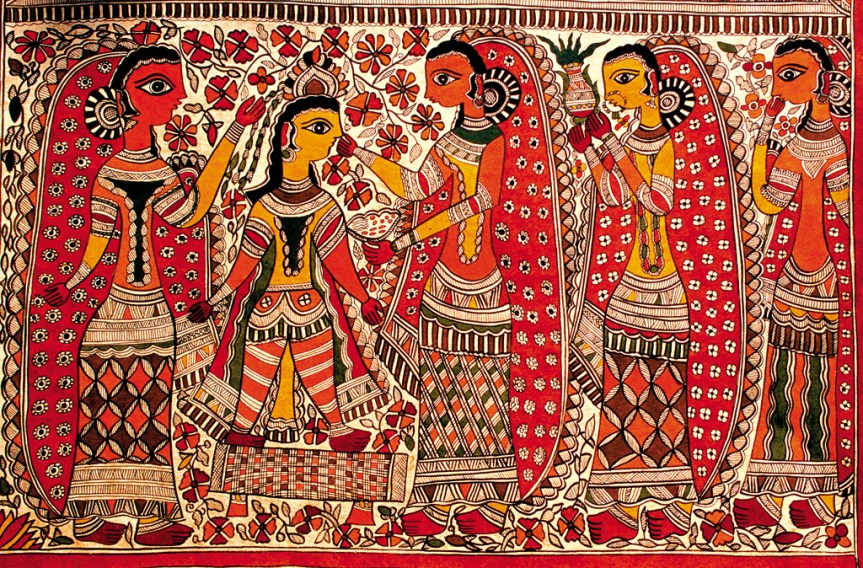
MADHUBANI

Madhubani, also known as Mithila art, was developed by women of Mithila in Northern Bihar. It is characterised by line drawings, colourful patterns and motives. These were practised for hundreds of years but were discovered in 1934 by a British collonial officer during an inspection after an earthquake on house walls.

PATACHITRA

The word ‘patachitra’ derives from the Sanskrit words patta, meaning canvas and chitra, meaning picture. It is one of the oldest art forms of Odisha. It is done on canvas and portrays simple mythological themes through rich colours and motives. Some of the themes include Thia Badhia – depicting the temple of Jagannath, and Panchamukhi – depicting Lord Ganesh as a five-headed deity.

WARLI

Warli is the name of cultivator tribes belonging to Northern Maharashtra and Gujarat. Though discovered in early seventies, the roots of the art form can be traced back to as early as 10th century A.D. Mostly featuring geometrical shapes, they potray daily life, hunting, fishing and festival scenes. They show a common human figure through a circle and two triangles, which move in circles resembling the circle of life.

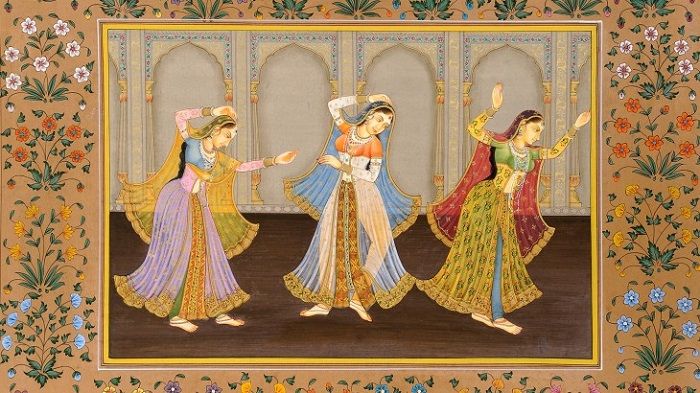
RAJASTHANI MINIATURE PAINTING

The art form is introduced by Mughals who brought in persian artists for creating the art. The Mughal emperor Akbar built an atelier for them to promote the artwork. They trained Indian artists who produced it in a new style inspired by the royal lives of Mughals. Eventually the paintings made by these Indian artists came to be known as Rajput or Rajasthani miniature. They are characterized by strong lines and bold colours made from minerals, precious stones, even pure gold and silver.

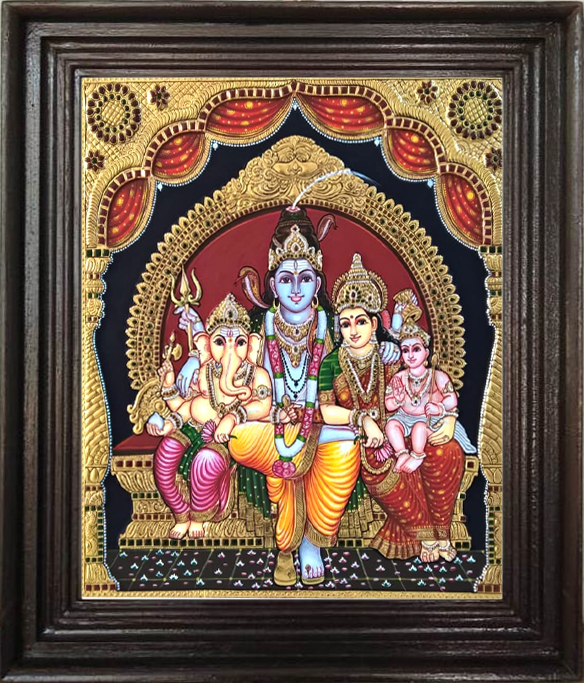
TANJORE ART

Orijinating in Tanjavore, about 300kms from Chennai, this art form evolved under the rulers of the Chola empire. Characterized by brilliant colour schemes, decorative jewellery with stones and remarkable gold leaf work, these paintings mostly consist themes of gods and goddesses.

KALAMEZUTHU

Simmilar to Rangoli and Kolam, this art form originated in Kerala. It mostly consists of the representation of deities like Kali and Lord Ayyappa on temple floors. Natural pigments and powders of mostly 5 colours are used by the makers and the art is done by bare fingers without the use of any tools. The 5 colour shades are made from natural pigments like – rice powder for white, burnt husk for black, turmeric for yellow, a mixture of lime and turmeric for red and the leaves of certain trees for green. Lighted oil lamps brighten the colours in the figures which usually feature anger or other emotions.

National Handloom Day to be celebrated on August 7th

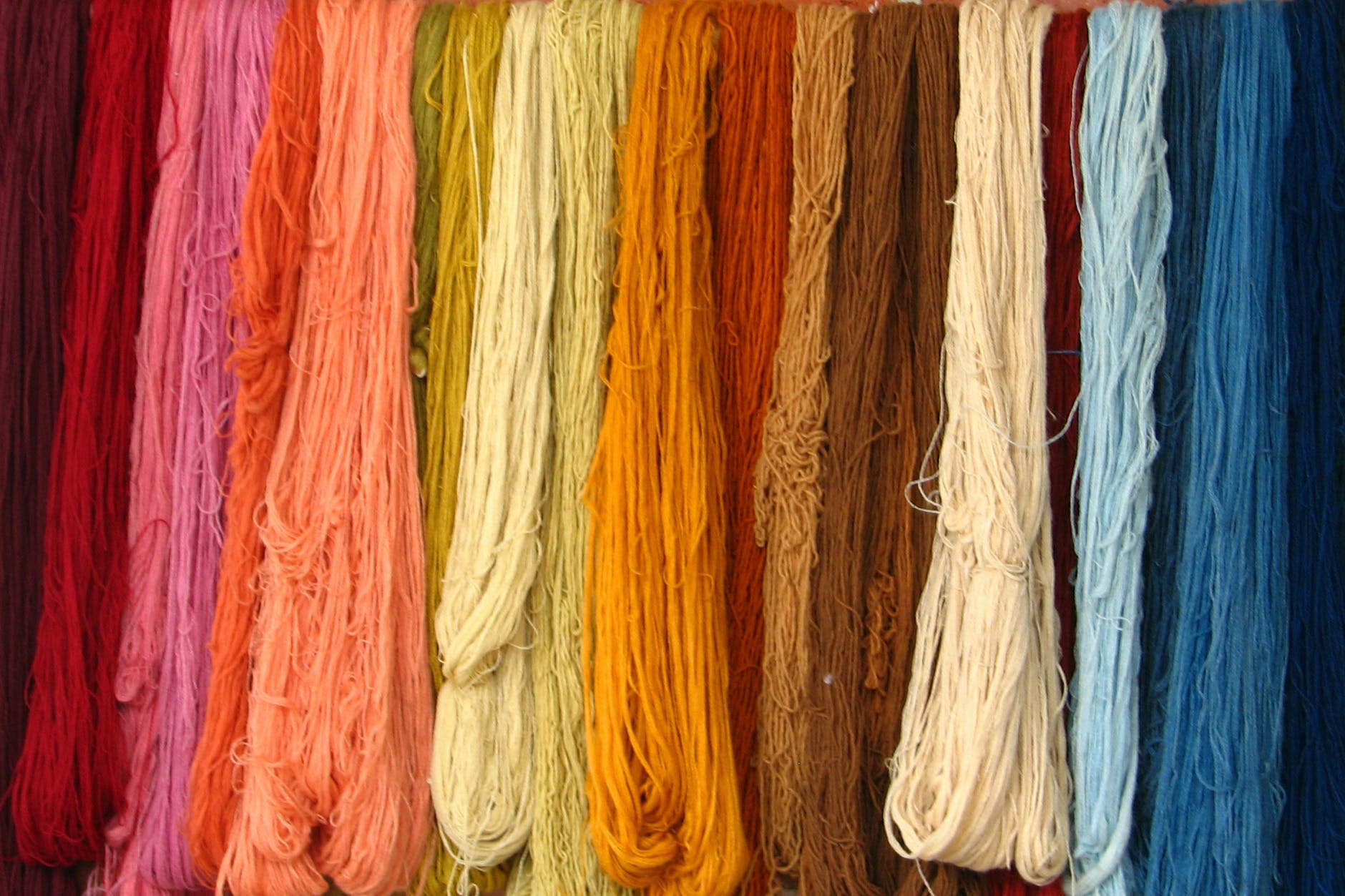
National Handloom Day is celebrated on the 7th of August annually in India. It is observed to create awareness about the importance of the textile industry in the economy. It began as an initiative to honour and provide work to handloom weavers and artisans. 7th August was declared as National Handloom Day by the Union Government in 2015 to generate awareness about the industry and its social importance. The day is celebrated through different functions and events across the country. Workshops are conducted to spread information about work opportunities among weavers and their families. Handloom fairs, exhibitions, parades, panels take place during various events.Through the celebrations of this day, handloom products get a wide recognition.

Handlooms have gradually emerged as the largest cottage industry. Almost 95% of the world’s handicrafts are from India. Weavers create from different natural fibres like cotton, silk and wool.While we celebrate the diversity of India’s art and crafts, its also important to address the problems and needs of the artisans. They should be provided with the knowledge of techniques, prices, and modern technology.

Photo by Skitterphoto on Pexels.com

Different schemes like Reservation of Articles for Production Act of 1985 and Handloom Census have been introduced so that artisans can benefit from them. Social media campaigns like #iwearhandloom have popularized the craft in recent times to an extent. These crafts should be included in contemporary industries so that younger generations can know about them and start supporting the cottage industries.

Historical Significance

Photo by Wallace Chuck on Pexels.com

August 7 was declared as the Handloom day in 2015 to revive the roots of handloom and to commemorate the Swadeshi Movement which began on the same day 115 years back. The first National Handloom Day was inaugurated on 7 August 2015 at the Centenary Hall of Madras University in Chennai. The movement was launched in Calcutta Town Hall on August 7, 1905 as a protest against the Bengal Partition by the British Government. The movement was started to facilitate the use of domestic products and production of goods within the country for boycotting British goods. There were also instances of burning British goods. When Lord Curzon announced the partition of Bengal in July 1905, the Indian National Congress started the movement. It led to the spread of revolutionary anti colonial and anti British movements across the country. Further movements like the Non Cooperation movement and the Satyagraha movement developed from the Swadeshi movement.

In recent times, the day is celebrated to spread awareness and develop consciousness of the public regarding textiles and the handloom industry which is extremely important for the socio economic development of the country. Handlooms and crafts empower artisans and represent the diverse cultural identities present in the country. They are eco-friendly and sustainable crafts which also function as the livelihood of so many people.

Celebrations this year

This year is the 6th National Handloom Day and the day will be celebrated through a virtual programme which will be conducted by the Union Ministry of Textiles. The textile minister Smriti Irani will be the chief guest for the event. The event will be observed with all the handloom clusters across India, 16 NIFT (National Institute of Fashion Technology) campuses, 24 Weaver Service Centres of different states and National Handloom Development Corporation.

Thinking through Act

“Acting is behaving truthfully under imaginary circumstances.”

Acting is basically an art of imitation or reflection or representation. It is the quality of utilizing your own spirit body and mind in being someone else. Actors on the stage do not show themselves up there, but they show the character they get into to people.”  Acting is equivalent to forgetting the original self.

actor-on-stage

Acting is not about being someone different. It’s finding the similarity in what is apparently different, then finding myself in there.

Benefits of acting

There are many benefits of acting :

  1.  It is a self-cleansing art.
  2. It helps us to forget ourselves, our worries, or goals, our life pressure, etc for the same time.
  3. It helps us to “be present”. Through acting, we enjoy “the moment”. We are at “the moment”.
  4. It helps us to understand the small little worlds as well as the big worlds of various people around us.
  5. Every act gives us a different perception that adds to build our character.

Methods of acting

  1. Stanislavski/Strasberg/Method: It uses affective memory considering our past. We need to relate to our past events. It draws situations from real life and there is an “emotional recall” as we get in touch with your emotional self.
  2. Meisner Method: It is the method based on the usage of imagination only. We need to enforce us to ask questions to ourselves. We ask the questions “what if”. We need time to contemplate under what situation will I be like this and considers the hypothetical future.

Voice Acting

Our emotions come out of our voices. Talking to a person over a voice call, we can immediately interpret if he is happy, sad, angry, guilty, lonely, or anything else. The Voice of a person gives a strong sense of the feelings of a person. Therefore, in addition to bringing the character by our body movements, we also need to bring out the character through our voice. Indeed, the voice acting is so powerful that it has opened up a separate domain for artists. Voice acting by podcasts are becoming popular day by day. It is easy to access and very interesting helping listeners to create a world of their own by listening to the voice artists. In addition, in these difficult times of pandemic, where shooting is difficult due to the rules of social distancing, podcasts are the way for artists.

1_zyAUE9v6UjHAmF8XA5nKfg

Irrespective of the form of acting, the main trick is to make your character your best friend. We need to study up on character traits; read testimonials, interviews, or watch videos. Then, we need to try to bring the traits through voice. Traits, in general, depending on age, geographical location, any distinct characteristic, or disability. There is a need to develops a culture of responsive acting. It is also important to tackles self-consciousness. It is an effective way of creating the world around us. An actor is an energy bank, always excited about his character and his story.

“Acting is a sport. On stage you must be ready to move like a tennis player on his toes. Your concentration must be keen, your reflexes sharp; your body and mind are in top gear, the chase is on. Acting is energy. In the theatre people pay to see energy.”

3 Ways for Students to Make Money Online Without Getting a Job

USE Depop

Similar to eBay, Depop is a platform for those who want to sell their clothing, jewelry, artwork, and anything else under the sun. The app is well known for being populated by vintage lovers and those who want to reduce their carbon footprint by practicing sustainability. The app also includes item recommendations based on your taste, top sellers based on style, and world favourites. Users can decide to follow shops and sellers in order to keep track of the items they are selling.

Starting up on this app is very elementary. The user only needs to connect their Paypal account for transactions and other payments. In addition to payments, many sellers and users on the app also participate in trades where they trade items from either store of similar value. After this step, the only thing left is setting up an account with a profile photo, a biography, and social media links, if that’s what your heart desires. From here, you can post photos of whatever you want to sell and choose the price.

If your item is a clothing item, a jewellery piece, or an accessory of any sort, wearing it in a photo for reference is normally preferred by buyers so they can see how it may fit another individual. Always take as many photos of your product as possible. This usually increases the likelihood that someone will buy it because you show all the angles of the product as well as the flaws it may have. Include a bunch of tags related to your item under the post. These tags are used for when other users search an item through keywords.

Youtube

For creators from all walks of life, Youtube is one of Gen Z’s golden media platforms. From compilations to make up tutorials to daily vlogs to art tutorials to photography tips, the platform is extremely versatile. And this is where you come in. Like the previous idea, take something you like and start a channel on it. If you’re really religious, start a channel on things you have learned or practice. If you love makeup, become a practicing beauty guru. Or maybe even just do daily vlogs and stream your routine in quarantine. The possibilities of Youtube are endless, but that doesn’t always promise you money. Many Youtubers correlate their large incomes from Youtube to brand deals, views and hard work But the message on success in the Youtube space is clear: you need to be patient. Success on Youtube doesn’t just come with the click of the upload button, you need to work for it or do something that is worth remembering. 

SELL YOUR ART

This option is much more universal than you think. Whether you are a skilled artist or not, selling paintings or art on eBay is much more simple than one would expect. If you’re an amateur then start by making a small abstract piece. If you’ve mastered an art form then you have an upper hand, show your art skills, create more art pieces since you have more time on your hand.