Impact of Covid-19 Lockdown on Students

Covid- 19 pandemic sparked widespread realization that our way of thinking is not working. It has shattered our understanding of what culture as we know it is natural and deconstructed. Education is one of those crucial fields, where the need for improvement has become apparent. The coronavirus’ consequences, and thus its preventive interventions, have turned the lives of students, parents, and teachers upside down. The clear imbalance in the ‘normal’ workings of education has put emphasis on many questions that were previously asked and left unanswered afterwards. So, what might the actual effects of this global pandemic mean for the education future?

While coronavirus keeps spreading throughout the entire planet, many countries have decided to close educational institutions as part of a policy of social distancing to slow transmission of the virus. However, this closure of schools, due to the coronavirus (COVID-19) pandemic, has affected the learning of more than 1.5 billion children and youth globally. It should be acknowledged that school closures are likely to widen the learning gap between the lower-income and higher-income families among children. Although many parents who have access to technology and the internet are gradually turning to online education technologies to keep their children studying at home while others may not be able to. In a survey conducted by India Welfare Trust, it has shed some light on how children endure the disproportionate burden of the astonishing outbreak According to the survey, 89 per cent of respondents believe that the delay in lifting the coronavirus lockdown will affect their children’s learning.
Coronavirus Will Change the World Permanently. Here's How. - POLITICO

Rapid Online Perception study investigates the impact of Covid-19 on Children. During the survey, 1,102 respondents from 23 states and territories of the Union were interviewed. “While children have not been in the face of this pandemic as they have been mostly shielded from Covid-19’s direct health effects so far, results from the study suggest that they have been among its biggest casualties with numerous side effects on their physical and psycho-social well-being,” said CRY chief executive Puja Marwaha.

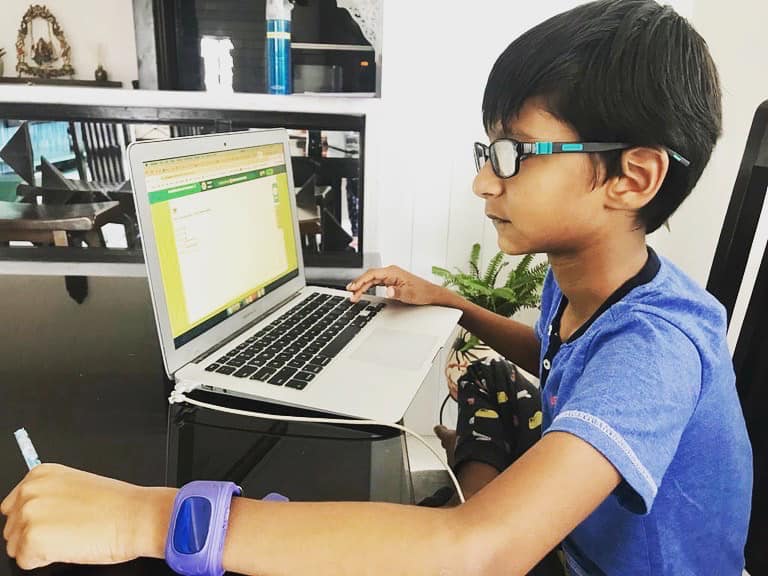
“More than half of the parents reported their child became more flustered and apprehensive during the lockdown,” the report said, adding, and “37 percent of respondents confirmed that the child’s mental well-being and happiness had been affected by the lockdown. In addition, 88 percent of respondents said that their children’s exposure to screens increased during the lockdown, with 45 percent reporting the increase “to a large extent” and only 43 percent of parents/primary caregivers said they were always supervising the child when it was online.

The things we can keep in mind while opening educational institutions post lockdown are:

Changing the way of Learning:

The teaching method and the way syllabuses are taught can change. Aspects once deemed fundamental to education can be revised to cater the life skills of the future in large measure. Not only careers but also future residents will need skills such as resilience, versatility, collaboration, communication, compassion and understanding, originality and emotional maturity. School learning will have a new purpose, and that will be a major departure from today’s details-focused education.

Implementing innovative methods in education system:

Aside from the upheaval faced by the novel coronavirus, there have been some major changes in schooling in our developing nations. Yet, even in the face of rapid innovation, the way we deliver education still needs to be shifted. Learning is knowledge acquisition, but it doesn’t have to occur primarily through age-old methods that don’t leverage the highest brain potential. Can students get an experience that shapes their learning, rather than being taught? Approaches such as integrated learning and experiential learning, with greater digital transformation, will fuel the future of school education.

Strengthening the bond with technology:

New technologies such as Zoom and Google Meet have been identified as a prominent life-saver in the face of a crippling pandemic. Communication is crucial to our interconnected existence, and the driving force that maintains our connections is technology. For education, that means creating content and delivery systems that make full use of and harness technology. Maybe education can become more flexible and accessible, giving up on its excessive-reliance on rigid structures that we consider necessary at the moment. They are generations identified by their use of technology; it has become an extension of their consciousness and without it, they don’t know a planet.

The future of education should find no room to ignore the use of technology as it can very well be the best platform for empowering learning in an age which integrates technology as a way of life. Such generations will have an effect on the evolution of education because they are the ones most impacted by the pandemic and are in the best place to learn from it and evolve from it.
Career Counselling in Today’s World and its progress in India

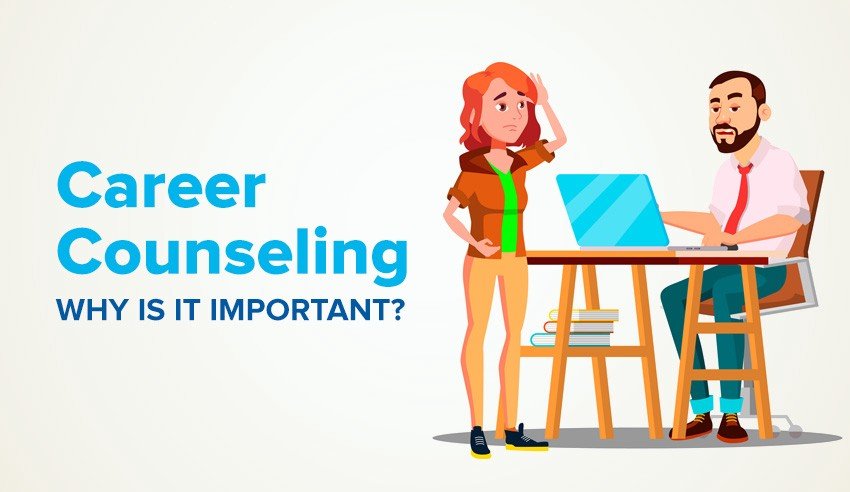
Counselling is a term which is expansive. In general, counselling relates to the procedure of helping a person by making recommendations, support and encouragement, and exploring solutions to the problems that are facing them. “Counselling” is generally associated with a professional who helps out a needy person. This specialist is someone who acknowledges human behavior, their personalities and knows how to deliver their thoughts the right path. This professional is a person to whom you can turn in times of confusion, and who maintains confidentiality of your identity and concerns.

What Is The Need And Importance Of Career Counselling For Students ...

A counsellor’s association with a counsellor is based on a good mutual relationship. This is crucial in therapy because it helps to accomplish the ultimate goal, i.e. helping the client find the answers to his issues. Career counselling is a method that specializes in helping one to understand one’s own self as well as job patterns so that one can make informed career and education decisions. Profession therapy helps address a number of problems such as low attention rates to poor time management, trusting family issues and conflict between parents and children over which profession to choose from.

The benefits of Career Counselling are as follows:

  1. Helps to choose the right career:

Career counsellors are experts in evaluating your ability, personality, interests and other aspects of yourself. Using this evaluation, they recommend the best career choices from all available and appropriate alternatives.

  • Assists the providing of expert resources:

Counselling provides access to the information and knowledge available to a career expert. From the perspective of a parent and child, this knowledge of careers, their applicability and the pathways to pursue them is most important since most of the time parents or guardians do not have this kind of knowledge.

  • Helps to build confidence and insight:

Career counselling helps a counsellor understand his / her career path of hurdles. This awareness helps create confidence in overcoming those hurdles. It is a good counsellor’s duty to provide the counsellor with such insight and confidence.

  • Helps change patterns of undesirable behaviour:

Students and instructors have hard-to-break habits, such as procrastinating, not keeping up to date with latest developments in their lives and careers, neglecting emotional and mental health, not trying to motivate themselves, etc. A Career Counsellor helps break down such behavioural patterns that lead to unproductive activities at home as well as in school / college / work.

  • Helps to reduce job pressure:

Choosing a career can be an arduous task for parents and children alike. A lack of any source of defusing out emotions and thoughts can add to the frustration there. Career counselling provides the opportunity for reducing such frustrations, and focus is redirected to selecting the best career opportunities.

  • Offers a role model:

Career counselling helps students connect with experts who share sufficient life experiences. They are role models who have accomplished a great deal, and have supported others throughout their lives. That’s why career counselling can be an inspiration to those who need it.
  • Helps to bring in peace of mind:

Career counsellors can help you stay calm when making a career decision. Counselling helps bring focus to our activities, and keeps that focus throughout. They try to make your life more efficient by proper scheduling and preparation

  • Scenario of Career Counselling in India:

India has a counselling deficit when talking about the educational system that presents a crucial challenge. We have an approximately 1 lakh professional career coach particularly in comparison with the need for 15 lakh career coaches to cater for a strong student market of 315 million people. In comparison, for 56 million students the U.S. has about 2.6 million student career advisors.

Only now is professional development and mentoring beginning to acquire the recognition it deserves and is witnessing exponential growth as a profession. Although the developed nations have recognized the criticality of career counselling, and a large number of advanced schools in India are also waking up to the truth, in reality the scenario is soberer. More than 90 per cent of Indian schools do not have career counsellors and the nation today has a massive shortage of qualified career counsellors.

Career counselling in India before pursuing a career has yet to become the most important discipline. But the awareness regarding career counselling has certainly increased due to technology and the internet. Online job therapy is certainly a convenient way to get your home easy therapy done.

“Playfulness, creativity and many other aspects can never be transferred through online learning”, says the former ISRO Chief

Implementation of the techniques to teach is lacking important facets.

The theory of procuring online education for school children does not seem favourable to the eminent scientist K Kasturirangan, who says that candid physical and cognitive association is essential to bring out the meaningful characteristics such as playfulness and ideation.

The National Education Policy, 2019, draft committee chairperson intensified the necessity for face-to-face communications, interactions, exchange of ideas and beliefs as he braced the traditional mode, amid a debate on online classes for children due to COVID-19 resulted in the closure of schools.

“Fundamentally, the physical and mental connection with children directly is extremely important. Playfulness, creativity and many other aspects can never be transferred through online learning”, Kasturirangan, who was Chairman of Indian Space Research Organisation between 1994 and 2003, told news agency PTI.

He stated 86 percent of the brain develops by the age of eight, expanding that issues associated with the initial stage of children need to be scrutinized and evaluated carefully and any sort of new strategy prefers a scientific footing.

Development of a brain is a continuous process within these eight years, and if you don’t stimulate the brain properly by continuous interactions, then obviously you are missing a chance of really getting the best out of youngsters in terms of brain boat and performance, the recipient of Padma Shri, Padma Bhushan and Padma Vibhushan said.

There are issues of these which need to be analysed very carefully. Just the kind of solutions that we talk of for higher education like online and so on may not be the way to deal when it comes to dealing with the early phase of children, the former Rajya Sabha member said.

The issue of online education for school children needs to be looked into very carefully and one should not jump into any kind of approach without any scientific basis.


“There is much to be evaluated, and it has to be assessed”, underlined Kasturirangan, who had also served as a Member of the now-defunct Planning Commission of India.

Another renowned scientist, Prof. C N R Rao, who was awarded ‘Bharat Ratna’ in 2014, also spoke out lately against inducting online classes for children, giving prominence to the importance of human interface for useful communication and motivating young minds.

The Honorary President of the Jawaharlal Nehru Centre for Advanced Scientific Research and the Linus Pauling Research Professor said online classes for young children such as KG, first and second grade should be terminated.

I am not an enthusiast about online teaching. We need a human interface with students for good communication. That is how young minds can be inspired, Prof. Rao, who was Chairman of the Science Advisory Council to the Prime Minister from 1985-1989, and from 2004-2014, told PTI.

A mis niños y niñas especiales: To my special students

This is a love letter to you, my special, smart, and beautiful students. You have touched my heart so deeply and profoundly that words cannot adequately convey how much you mean to me. I write this note, so you know the hopes and dreams I have for you.

You come to a school that is known as a Title 1 school meaning that a lot of students at our school come from economically disadvantaged families. You may not know this as the teachers and staff at our school demand that you receive educational resources and a quality education; the same kind of education that students receive at schools in the wealthier parts of our school district. My hope for you is that you always realize that true wealth is not measured by how much money one has but in how much one stays open to learning and gives of oneself to make the world a better place.

You come to a school that, before the state stopped rating schools, had C and D ratings (due to standardized test scores). You did not know that because when you or anyone else walks into our school, you are greeted with smiles and kindness. The walls throughout the school walls are filled with the wonderful academic work from our K-6 students.

During our gifted classes, as you know, respect for each other takes precedence over everything else. You are different ages, different genders, and different ethnicities. Conflicts happen as they do in life. You handled them with great sophistication, never calling one another names, talking about how the conflict made you feel, and discussing actions to avoid similar conflicts in the future. My hope is that you take this respect and ability to discuss your thoughts and feelings in other parts of your life now and in the future.

We live in a state that is 55% Hispanic and a school that is 85% Hispanic. Your Mexican customs and culture are so very beautiful. It has been a privilege to learn about the Mexican food, music, dance, art, and holidays. I hope you will always be proud of your culture and will freely share it with others who are unfamiliar with it. I owe you an apology in that I didn’t use curriculum materials and resources that featured the Mexican culture. You should have learned more about Mexican writers, artists, scientists, mathematicians, culinary artists, and athletes. I am making a commitment to use such materials during our next school year. To the few of you who are moving onto middle school and won’t be in my gifted classes any longer, I am deeply sorry. I can only wish that your future teachers will use and create such materials. My hope for all of you is that you will educate your children, relatives, friends, and others about your beautiful Mexican culture.

You come from a state that is 55% Hispanic and a school that is 85% Hispanic. Your background and culture are accepted here in New Mexico. You may not be accepted if you end up going to school or living in a state without a majority of a Hispanic population. I’ve had students in the past who told me stories of being shocked when living in another state where there were prejudicial acts against them such as being followed throughout a store; just because of the color of their skin. I hope, as MLK stated, that you will live in a world that you will not be judged by the color of your skin, but by the content of your character. My hope for you, in any case, is that you have developed the resilience that comes with loving and being proud of who you are regardless of what others may think. Black and Brown lives really do matter.

You come from families with parents who do not have college degrees. My hope for you is that, if you choose to, you will go to college. In my discussions with your parents, that is their hope for you, too. Even though you haven’t had some of the same advantages as wealthier students, you are smart enough, creative enough, and motivated enough to be successful in any college you choose; that you can keep up and even surpass other students at that college.

I write this note to you in times of unrest in the United States due to the murders of Black men and women by the police. I write this note in hopes that you will become an adult who works for justice for all. I know this is a lot of pressure, but my hope and faith come from knowing you will be our future leaders.

I leave you with this Mexican Dichos (Proverb):

You can’t succeed if you don’t try.

Emotional Check-Ins in a Teaching Webinar

I always start my classes with some form of emotional check-in regardless of age or grade level. I do so in my college classes as well as in my elementary gifted classes. I think this is even more imperative given the stress students are experiencing due to COVID19. The 10 to 15 minutes it takes is so worth the class time.

Some of the benefits of emotional check-ins discussed in the Edutopia article, A Simple but Powerful Class Opening Activity, include:

Students know that every voice matters: The emotional check-in gets every student’s voice into the room at the start of each class. Although students can always say “pass” instead of sharing, each student has the opportunity to be heard every class session. The check-in is also a great opportunity to practice active listening, turn-taking, and following group norms.

Students develop awareness of others’ emotions—and how to respond to them: When students share their emotions during the check-in, they give their classmates a snapshot of their emotional state. And if I hear a student say that “I didn’t sleep much last night” or “I feel like I can’t focus today,” I can adjust my interactions with that person accordingly.

The check-ins also acknowledge that how students are feeling is important to the educator, that they matter as human beings who have feelings and emotions.

One of my college classes moved from face-to-face to Zoom this semester. What follows are some of the check-in activities I have done with them.

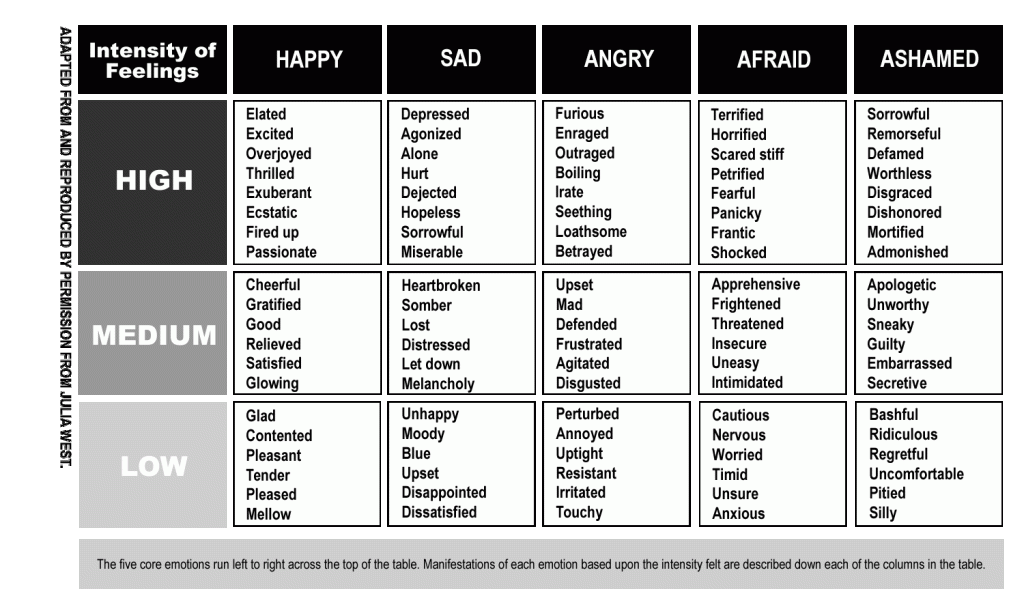
Using a Feeling Chart

Students use a feeling chart to describe how they are feeling. A side benefit of using feeling charts is that they help students increase their feelings vocabulary.

Source: Emotional Intelligence 2.0 by Travis Bradberry

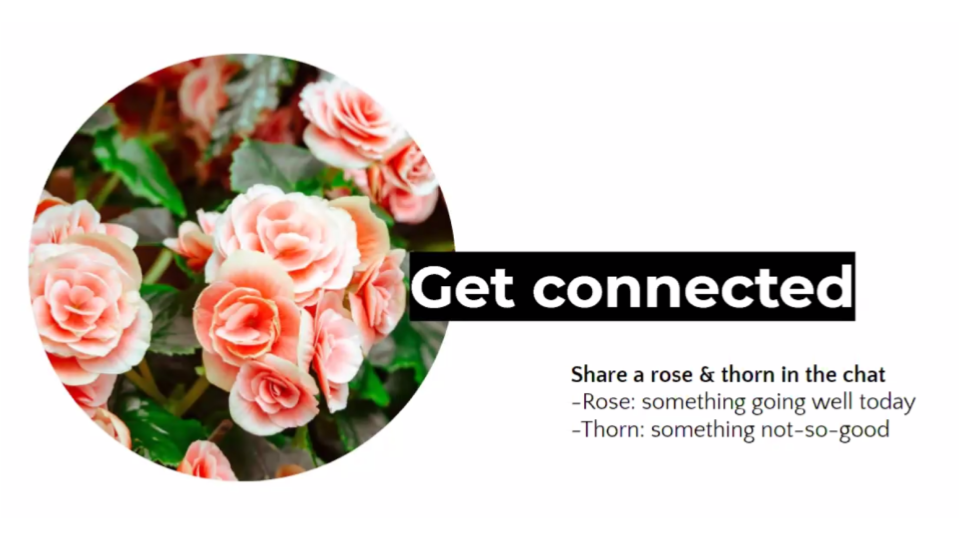
Share a Rose; Share a Thorn

Each student shares a Rose, something good or positive, from the day or week; and a Thorn, something not-so-good or positive, from the day or week.

Four Types of Care

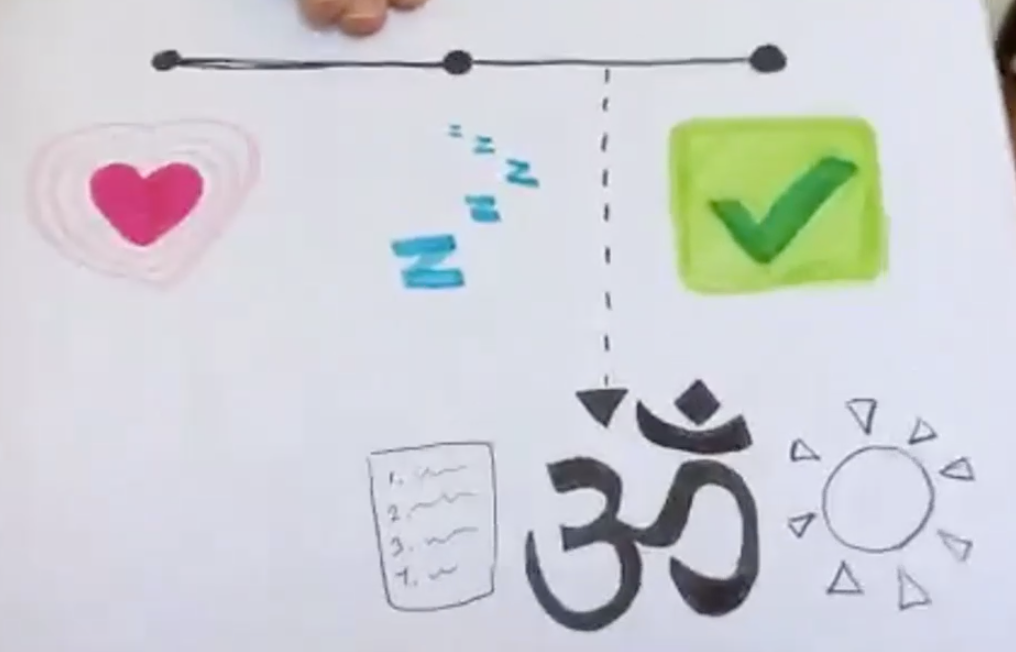
Students, during the check-in, take turns using the four types of self care graphic to describe strategies they are doing or would like to do to be physically, emotionally, socially, and spiritually healthy.

5 Step Check-In Process

The teacher leads students through the 5 step check-in process described in Emotional Check-ins: Why You Need Them:

  1. Tune into your body.
  2. Take a deep breath.
  3. Ask the question. Use the simple question, “How am I feeling?” Make it even more specific by tacking on the phrase “right now” or “in this moment.” 
  4. Use descriptive words to capture how you feel. 
  5. Brainstorm what might be contributing to those emotions.

Then each student is given an opportunity to share what came up for them during the exercise.

Pear Deck

Pear Decks are very similar to a PowerPoint or Google Slides presentation. But instead of simply static, informational slides, you get to create Interactive Slides that let every student respond to your questions or prompts. Once PearDeck is activated, through the Google Slides add-on, students are given a code to access the Pear Deck. There they interact with each slide through typing, drawing, and using a draggable icon depending how the teacher set up the slide. What follows is the Pear Deck I used for a check-in at the start of one of my classes.


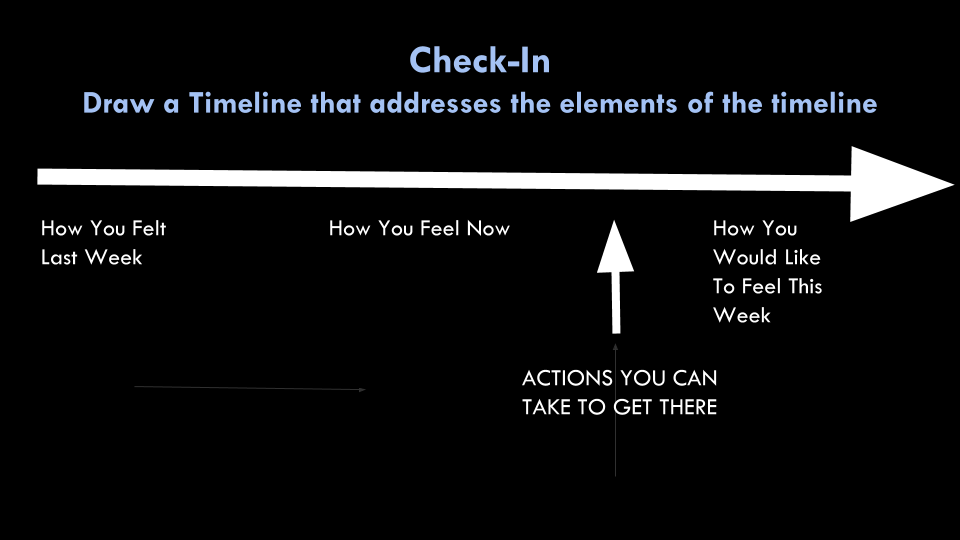
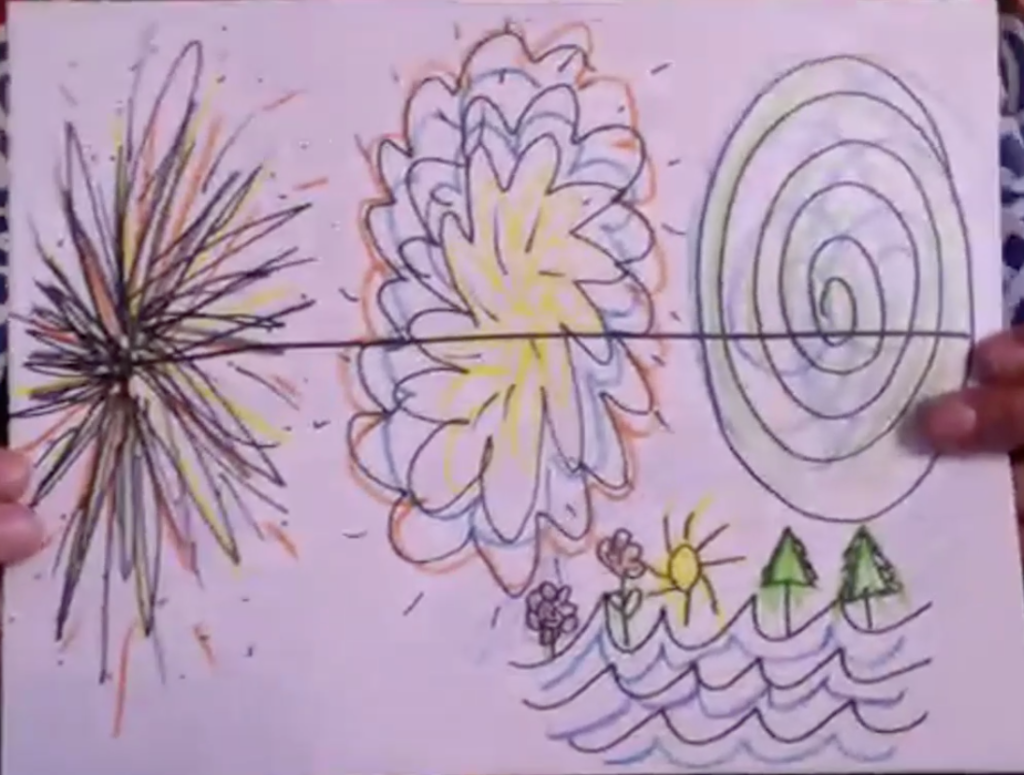
Create an Image Based Timeline of Feelings

Students create a timeline of images that represent: how you felt last week; how you feel today; how you want to feel this coming week; and finally, what strategies you can use to get to how you want to feel this coming week. Students then share their images via their webinar cameras and discuss their meaning with the rest of the class. What follows are (1) the prompt for this activity, and (2) sample student pictures:

Gif Image

Using Giphy students do a search for different feelings and emotions they are currently experiencing, and then select one or more Gifs that represent those feelings. They then take turns to do a screenshare of their selected Giphy and explain why they selected it.
Padlet Check-In

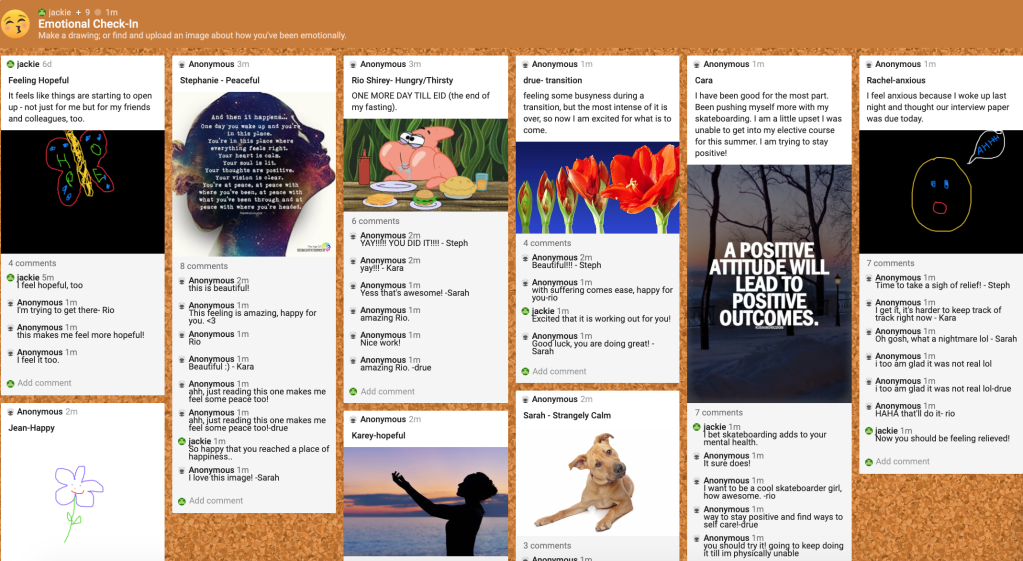
Padlet is an application to create an online bulletin board that you can use to display information for any topic. You can add images, links, videos, text, and drawings. Below is a Padlet I created for an emotional check-in.

Mentimeter

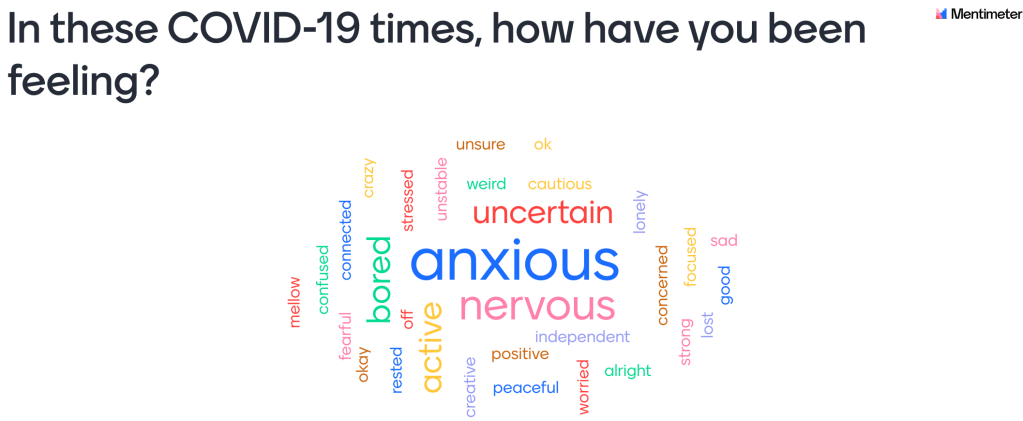
Menitmeter allows teachers to engage and interact with students in real-time. It is a polling tool wherein teachers can set the questions and your students can give their input using a mobile phone or any other device connected to the Internet. Their input is displayed on a slide in a selected format: Word Cloud, Speech Bubbles, One-By-One, and Flowchart. In the case of check-ins, it can be used to have students put in responses to a question related to how they feeling at the start of class and their responses then are shown to the class via a slide. The example below shows a slide with a Word Cloud of emotional check-in responses.

Flipgrid

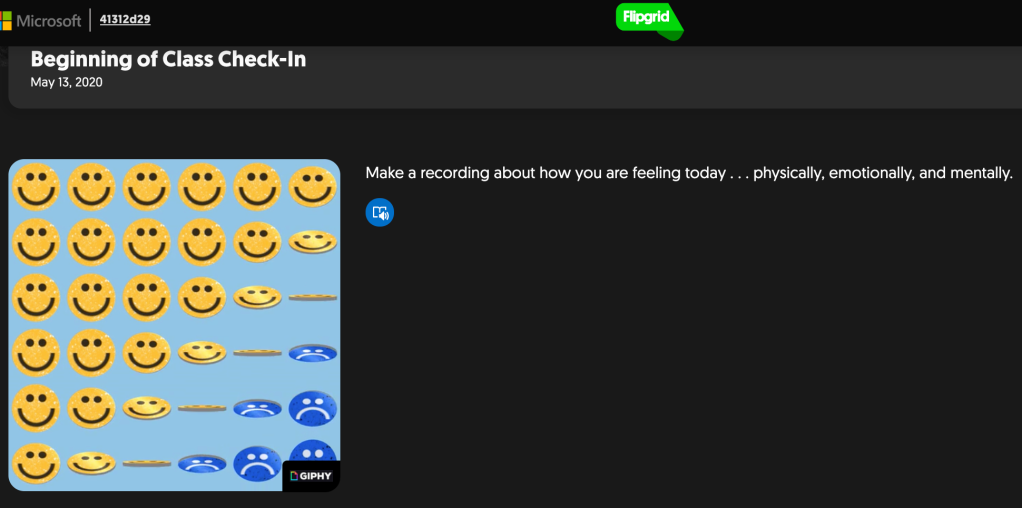
Flipgrid is a website that allows teachers to create “grids” to facilitate video discussions. Each grid is like a message board where teachers can pose questions, called “topics,” and their students can post video responses. For an emotional check-in, students record a short video about how they are feeling.

Snowy Day & Winter Lesson Ideas

We had our first Chicago snow storm this weekend which meant digging out my car, an unpleasant drive to work and basically feeling soggy all morning. But I am determined to maintain a romanticized winter wonderland mentality this year. To stay optimistic, I’m focusing on the upside of snow.

1. It’s pretty (esp. through the window while you’re warm and cozy next to a fire drinking cocoa).
2. Snowball fights and snowman building
3. Shoveling is great cardio.
4. Snow days!!!!
5. And, finally, seasonally sensational learning opportunities.

Stretching Ourselves as Educators

With so many lightning-fast connections at our doorstep, we find ourselves within reach of some of the most powerful learning resources that have ever existed on Earth. The quantity of choices intimidates many. However, the beauty of having so many choices, the beauty of digital media itself is its inherent flexibility and potential to serve all learners.

Why should we not make it a priority to improve our own flexibility as educators and learners at every available opportunity?

Online Collaboration Tools for 21st Century Learning

Educational technology is changing the way we teach and the objectives of classroom assignments. Online resources continue to emerge that offer new and exciting ways to teach and bring about new teaching standards. Online sharing is one way to meet collaboration standards and objectives for 21st Century learning.

It is important for all students to see the power of online collaboration and to learn the rules about collaborating with others.

Top 10 Holiday Learning Activities

As December rolls by, the holiday hype has most likely invaded your classroom. The energy of your students is on the rise as they shift focus from their science homework to their holiday break plans.

Why not capitalize on your students’ holiday spirit with these Christmas and winter holiday activities!

Exciting Nonfiction Science Books: Not an Oxymoron

As educators, we spend countless hours in professional development studying methods for improving teen literacy and planning ways to integrate literacy into our daily lessons.

Choosing the right books to read with or to your students can be tricky. I’ve found several nonfiction books that provide meaningful science lessons and engage adolescent minds equally well.

Video Writing Prompts: Ribbon Cutting Light Show

K-2: Transform Your House
They made the store look like a present, a castle and even a sweater. If you could transform your house, what would you make it look like? Draw a picture of your house “dressed up” and write what it is beneath the picture.

6-8: Modernize Traditions for the 21st Century
This is a technologically-advanced approach to a ribbon cutting ceremony for a new store. Think of other traditional ceremonies, like receiving a diploma at graduation, 4th of July fireworks celebrations, passing the Olympic torch, awarding statues at the Oscars or even a wedding. In at least two paragraphs, describe an updated version of the ceremony using technology to add some pizazz.

How to Handle Religious Holidays in Public Schools

Since 1776 the United States has grown from a nation of relatively few religious differences to one of countless religious groups. This expanding pluralism challenges the public schools to deal creatively and sensitively with students professing many religions and none.

The following questions and answers concern religious holidays and public education, a subject often marked by confusion and conflict. Teachers and school officials, as well as parents and students, should approach this discussion as an opportunity to work cooperatively for the sake of good education rather than at cross purposes.

Civic Engagement for Young People During Social Distancing

Many of us feel a bit helpless to help others out during these coronavirus social distancing and isolation times. This also true for kids and young people. There are actions they can take as part of their home schooling. They can participate in civic engagement and activism activities.

Civic engagement is defined as “working to make a difference in the civic life of one’s community and developing the combination of knowledge, skills, values and motivation to make that difference (https://youth.gov/youth-topics/civic-engagement-and-volunteering).”

Quite frequently, not only do state standards permit teachers and schools to support student activism, but they encourage student activism as a means by which to develop civic understanding. Although standards vary from state to state, many of them are modeled on the National Council for the Social Studies (NCSS) College, Career, and Civic Life (C3) Framework for Social Studies State Standards (NCSS, 2013), which specifically endorses student activism:  “Civics is not limited to the study of politics and society; it also encompasses participation in classrooms and schools, neighborhoods, groups, and organizations . . . In civics, students learn to contribute appropriately to public processes and discussions of real issues. Their contributions to public discussions may take many forms, ranging from personal testimony to abstract arguments. They will also learn civic practices such as voting, volunteering, jury service, and joining with others to improve society. Civics enables students not only to study how others participate, but also to practice participating and taking informed action themselves” (https://kappanonline.org/student-activism-civics-school-response-singer/).

Civic engagement and activism in normal times has benefits, but in these times of coronavirus and social distancing-isolation, the benefits are amplified as such engagement can move young people from feelings of helplessness to feelings of empowerment.

Even in social isolation, there are actions young people and kids can do. The following activity guide can provide ideas and give some structure to civics activity engagement.

The following PDF has links with more information about how to do that challenge:

Increasing Student Participation During Zoom Synchronous Teaching Meetings

Due to Coronavirus, many schools are moving online, and teaching through Zoom meetings. If it is only being used to present content to students, then why not just record videos and have students watch them on their own? The value of Zoom meetings is that the educator can create synchronous interactive conversations and activities. My goal is to have all my students actively engaged throughout the meeting. Below are some the activities I have used during my. teacher education Zoom meetings although they can be adapted for any age group and age level (3rd grade and up), and in training professionals. Along with the tools that come with Zoom, I also use online web tools and applications to increase interactivity and engagement. All tools I describe below are free and work on any device, any browser.

Whole Group Discussions

Whole group discussions should be just that – discussions. I believe that the teacher can use this forum for short lectures but, again, they should be short as the power of synchronous Zoom meetings is that it permits interactivity and active learning. Questions about class content can be posed with student responses elicited through verbal responses and/or through the Zoom group chat.

A favorite whole group activity I do is to have a group video viewing party. For this activity, I begin with a short overview of the video and a question of what they should look for during the video. Student responses are put in the chat during and/or after the video.

Whole group activities and discussions can also be used for Breakout Groups follow-up to share what they discussed and did. In this case, I inform the Breakout Groups to decide on a spokesperson or two to report to the whole group.

Breakout Groups

One of the best tools in Zoom is the ability to put students into smaller, self-contained breakout groups. Some ways to use the Breakout Rooms include:

  • To discuss a prompt or questions provided by the teacher or another student.
  • To do online research about a given topic.
  • To discuss a real life scenario or case study. This can be done in a jigsaw strategy whereby different groups are given different case studies. When they are brought back into the whole group, each Breakout Group shares their thoughts and conclusions.
  • To create projects using some of the web tools such as Google Slides, webbing tools, or comics that I discuss later. Time is then given to each group to share what they produced with the rest of the class in a whole group setting.

Quizzes

My students of all ages, kids and adults, absolutely love the competitive, real time quizzes – Kahoot and Quizziz. Both of these online tools – applications have huge archives of teacher created quizzes. They also let teachers create their own and remix the quizzes other teachers have created.

Kahoot

Kahoot! is a game-based learning platform, used as educational technology in schools and other educational institutions. Its learning games, “Kahoots”, are multiple-choice quizzes that allow user responses.

Mentioned Kahoot and any student who has played it just lights up. I like using it at the beginning of a session prime students about what they will be exploring during the session or in the middle to re-energize them.

Quizziz

Quizziz offers self-paced quizzes to students. During my Zoom sessions, I do live Quizziz quizzes where the students answer quiz questions on their own yet compete with one another. It is similar to Kahoot but Kahoot is teacher directed, it displays the questions and answers on the teacher’s device; whereas Quizizz is student directed, it displays all the information on the student’s device.

Polling

Polling web tools can get real time information about students’ opinions, thoughts, and ideas which can be shared with them immediately.

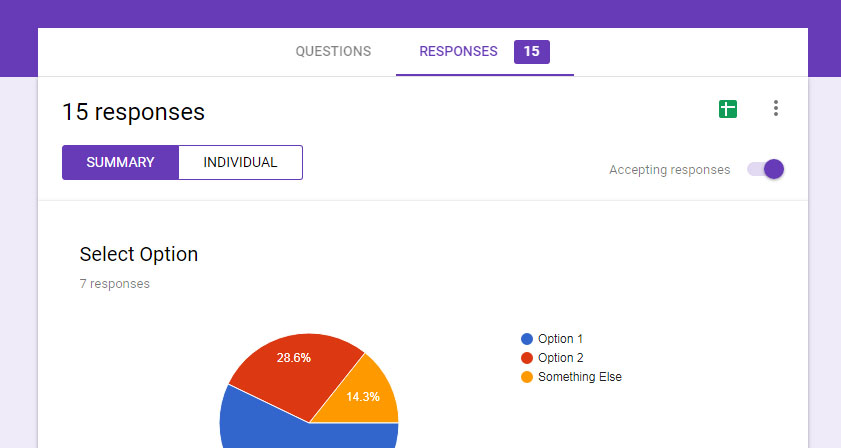
Google Form

Google Forms can be used for student surveys and polling. More information about how to do this can be found at How to Make a Survey With Google Docs Forms. What I really love about using Google Forms for surveys and polls is that immediate feedback can be presented to the students through the response tab.

I like using Google Forms to check in with students and to inquire about what topics they would like to discuss.

Poll Everywhere

Poll Everywhere is a live student-response tool that offers whole-class participation and assessment through teacher-designed surveys, polls, and discussion boards. Tutorial guides can be found at https://www.polleverywhere.com/guides and video tutorials at https://www.polleverywhere.com/videos.

An example I did recently was polling the student teachers with who I work about special education services at their respective schools (see screenshots below).

Web Tools

There are lots of free, relatively easy-to-use web tools that students can use in Breakout Groups to create products about a class topic. The benefits of doing so include:

  • Students get to be creative during the synchronous meeting.
  • Creating products with visual elements helps deepen the learning.
  • Students have fun during the synchronous meeting.
  • Community is built as students work together on such tasks.

Before I give them their task and send them into their Breakout Groups, I give a screen share tutorial on how to use the tool. There are also lots of online video tutorials that can be shared with students.

As mentioned above, the smaller Breakout Groups share what they did with the whole group. To insure that the others pay attention, I ask them to share in the chat the favorite thing or what they learned from the smaller group presentations.

Shared Google Slides and Docs

Having students help create a shared Google slide show is one of my favorite activities. Individual or small groups are asked to take a slide of a shared Google Slide presentation to report on a given topic. I give some broad guidelines including finding and adding both content and images. The following video explains this process.

Below is an example that focuses on classroom management. In Breakout Groups, they were give a topic. Breakout groups 1 and 2 were given the topic. , groups 3 and 4 Classroom Environment, and 5 and 6 Instructional Strategies. They were given several online articles as references and also encouraged to use their own experiences.

Padlet – A Collaborative Sticky Note Board

Padlet is a website and app that allows kids to curate information onto virtual bulletin boards using a simple drag-and-drop system. Students, alone or in groups, can start with a template or a blank page and add videos, text, links, documents, images — basically anything — to the wall and organize it, like a page full of Post-it notes (https://www.commonsense.org/education/website/padlet).

I typically use Padlet as a whole group activity. What I like about it is that the students can easily see the responses, images, links that their classmates have posted.

For example, I love starting my first Zoom meeting with the Padlet: Time to Take a Selfie Icebreaker developed by Catlin Tucker. Below is one I did with a group of teachers with whom I worked.

Made with Padlet

I have also created and used Padlets for partner interviews, where they posted the results of their partner interviews, SEL strategies, technology in the classroom, classroom management, and collaborating with the community.

Collaborative Webbing – Mind Mapping

“A mind map is a diagram for representing tasks, words, concepts, or items linked to and arranged around a central concept or subject using a non-linear graphical layout that allows the user to build an intuitive framework around a central concept (https://www.mindmapping.com/mind-map.php).

I like to use Coggle in Zoom Breakout Groups. Coggle is an online tool for creating and sharing mind maps and flow charts. It works online in your browser. It is easy to use and permits real time collaborative.

To collaborate, one of the group members starts a Coggle and then invites others by clicking on the + sign in the upper right hand corner and sends email invites.

Below is an example the student teachers did in a breakout about SEL strategies for the classroom.

Comic Creator

Students can be asked to create a comic strip in their Breakout Groups to depict a given topic. My favorite is comic creator is Storyboard That but it has a bit of a learning curve for those who are less technology savvy. Although Make Belief Comix lacks some of the tools and options that Storyboard That has, it is much easier for students to use, so I have moved to using Make Belief Comix in my Zoom meetings. For more technology savvy groups, though, I recommend Storyboard That.

Once back in the whole group. students do a screen share of their product and explain it’s content to the rest of the group. For example, a here is a comic about differentiating instruction using Storyboard That.

As mentioned earlier, Breakout Groups then do a show and tell of their mind maps, comics. The following video shows how to do a screen share. The teacher needs to make sure they have “All Participants” enabled under the sharing settings.

My Educational Learning Plan for the Coronavirus-Induced Hiatus

I, like many of you, have gone into a somewhat involuntary social distancing and isolation (mostly) due to my school and health club closures and recommendation to stay away from crowds. It’s just my cats and I (gives new meaning to home alone). Having a plan to engage my mind and body is of utmost importance. I am sharing my plan of activities, which are almost all free, as it may give other educators some ideas. If you have additional ideas, please share them in the comments.

Working Remotely with My Gifted Elementary Students

I work with gifted students one day a week. Our state and thus my district made an extremely quick decision to close the schools – heard last Thursday night and was told to send home with students Chromebooks along with lessons on Friday, a half day. Obviously most of the teachers didn’t have time to develop lesson plans and learning activities. I met with my learners quickly on Friday, as so much was going on, and asked them to check in with a shared Google doc and our Google Classroom. What follows are the general tasks they are being asked to do during our regularly scheduled gifted day.

  • Writing Children’s Book Narrative – Prior to the school closing, my learners spent quite a bit of time learning how to write a children’s book using a Dr. Seuss type of writing style (yes, I know he is controversial but I like his writing style). The goal is to have them write their stories, illustrate them with cut out shapes made with a Cricut or a laser cutter, and then create Makey Makey Talking Books out of them. They just reached the point of writing their own narratives when the school closed. I asked each of them to share their stories with me via a Google doc. They were instructed to add to their stories during our hiatus, that I would provide feedback and suggestions directly on their shared Google docs. Then when we return, we can jump into creating the illustrations.
  • Newsela – For those who don’t know, Newsela is best-in-class library of high-interest, cross-curricular current news and nonfiction texts.. They have offered all teachers access to Newsela ELA, Newsela Social Studies, Newsela Science and the SEL Collection for FREE for the rest of the school year. At home, my learners are being asked to do the same thing they do in class – pick an article of personal interest, read it, and take the quiz where they need to get at least 3 out of 4 correct. If they don’t, they need to choose another article to read and follow the same procedure.
  • Prodigy Math Game – For those who don’t know, Prodigy is no-cost math game where kids can earn prizes, go on quests and play with friends — all while learning math. With Prodigy math homework is disguised as a video-game. My learners love it. I typically don’t give them class time to play it as I prefer hands-on, learner-to-learner interactive math activities. Since they will be at home, I asked them to play it for an hour during our typical gifted days to keep up with and improve their math skills.
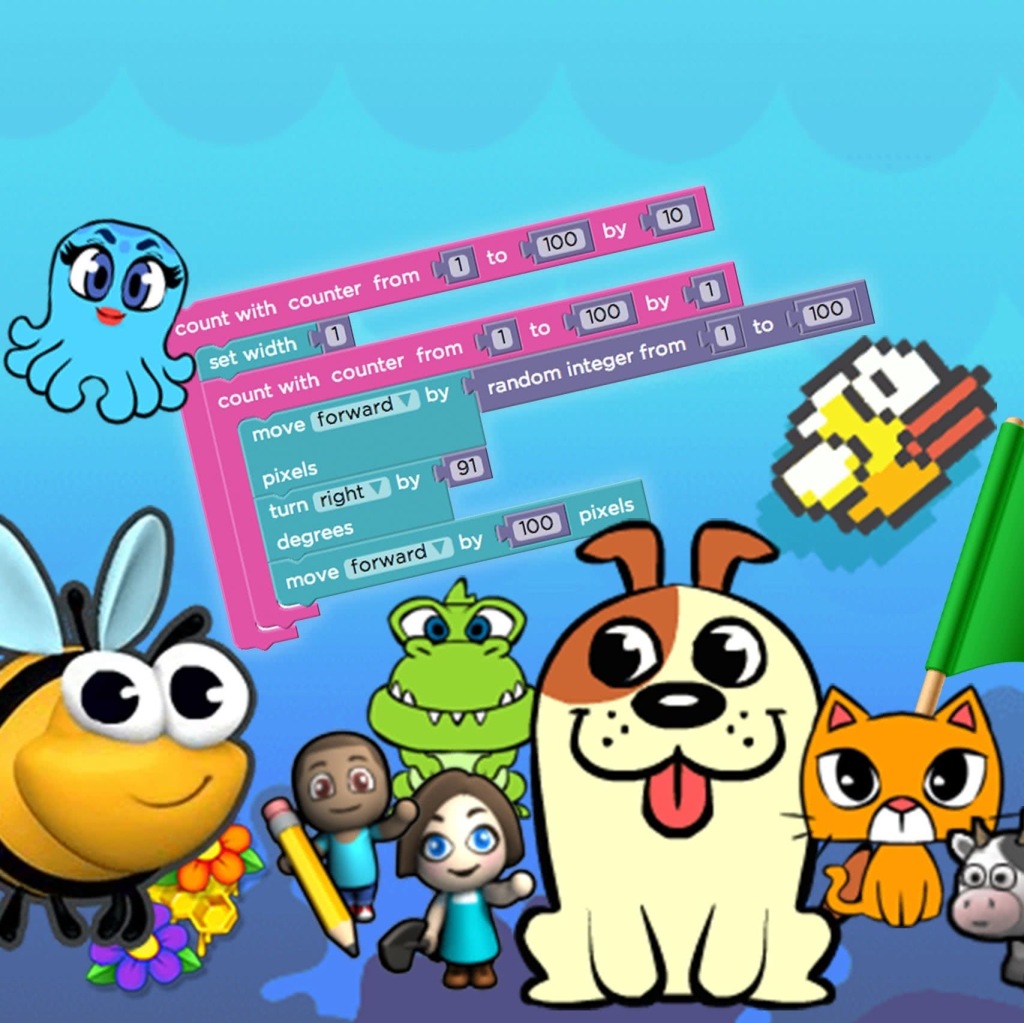
  • Code.org – My 4th graders have working through the Code.org Course F . They were asked to continue working on this through our hiatus while my 5th and 6th graders were asked to join and work on the Code.org CS in Algebra.
  • Maker Camphttps://makercamp.com/project-paths/ and the Maker Stations Home Pack (see download below) : Since we do a lot of making in my gifted classes, I am requesting that my learners pick a project or two to try at home. It has been posted as an assignment via Google Classroom and they have been asked to post pictures of it. I will later (at school or at home depending how long the school closing lasts) ask them to blog about their processes.

Here is their schedule that I posted in Google Classroom for them.

The online applications – Newsela, Prodigy, and Code.org – have teacher dashboards so I can track progress and give them feedback. For their writing, I can give feedback directly on their Google docs, and for their maker projects, they are to post pictures to Google classroom.


Professional Development – Virtual Style

I plan on doing some PD in my pajamas – in other words, virtual style.

Attending Some Virtual Conferences

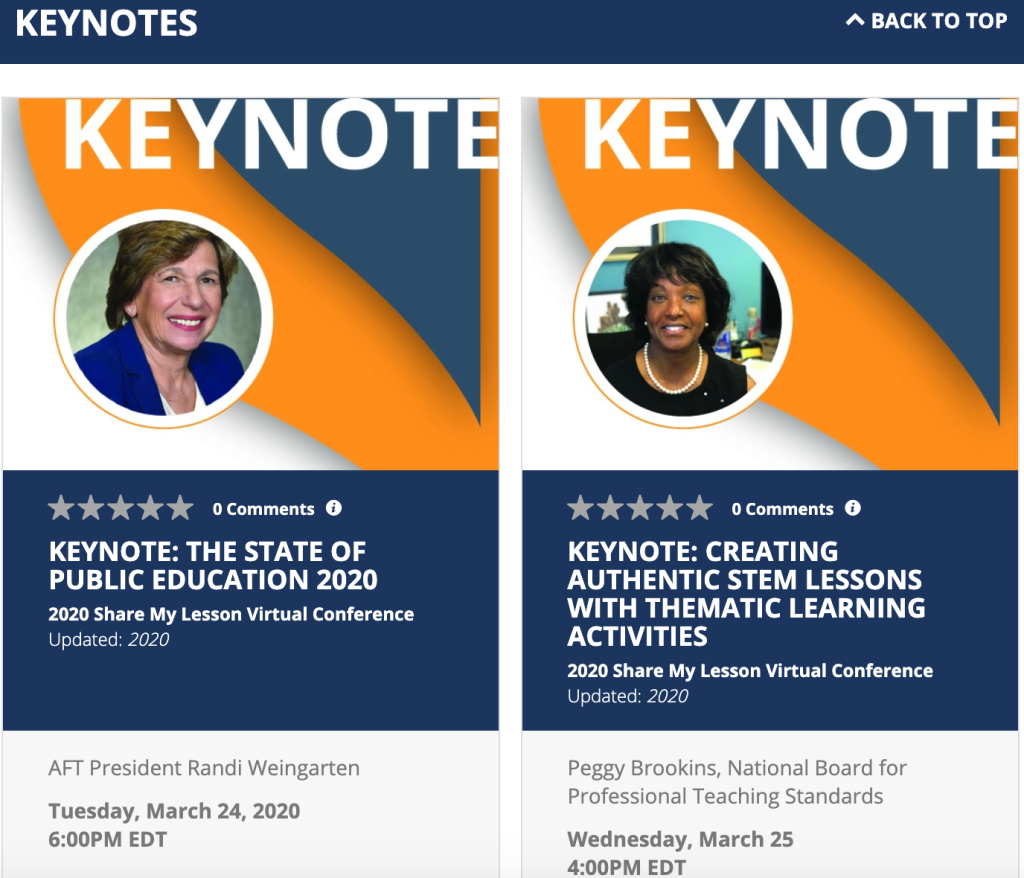
  • 2020 Share My Lesson Virtual Conference – is a free virtual conference from March 24-26, with over over 30 webinars focusing on instructional strategies across the curriculum, social-emotional learning, activism, STEM, and trauma-informed practices. This is a fantastic conference. I attend every year. The sessions and presenters from professional organizations are top notch!
  • CUE Spring Conference – Computer-Using Educators (CUE) is a California-based non-profit that offers a premiere educational technology conference each spring. This year, because of coronavirus, they are going virtual offering sessions from March 19 through April 5. There is a $75 fee for the virtual conference.

Taking Some Online Classes

  • The Power of Mathematics Visualization – There is a nominal fee for this course but it looks good and might help me develop some interesting strategies for teaching mathematics to my gifted students.
  • Code Academy Pro – They are offering Pro free to students and teachers. It’ll give me an opportunity to learn some advanced code.

Doing Some Maker Projects

Because I use lots of maker education projects in my gifted education classes and our school has a new STEAM lab, this forced hiatus is giving me the opportunity to try out some new projects including:


My Physical Health

I work out in group fitness classes several days a week. It verges on addiction. When I don’t get to do so, I get stressed out. Plus, it provides me with needed social interactions. So when my health club decided to limit their services, I became distraught. Luckily, though, I live in Santa Fe, New Mexico, so I plan to go on lots of hikes and am fixing up my bicycle to ride – hoping that the weather permits it. I am going to do online fitness classes. Oh, and, of course, cleaning my house from top to bottom will add an other fitness element. I absolutely know my physical workouts and health will positively affect my mental health.

Stay healthy, happy, and wise!

Sometimes Kids Just Need to Play During School

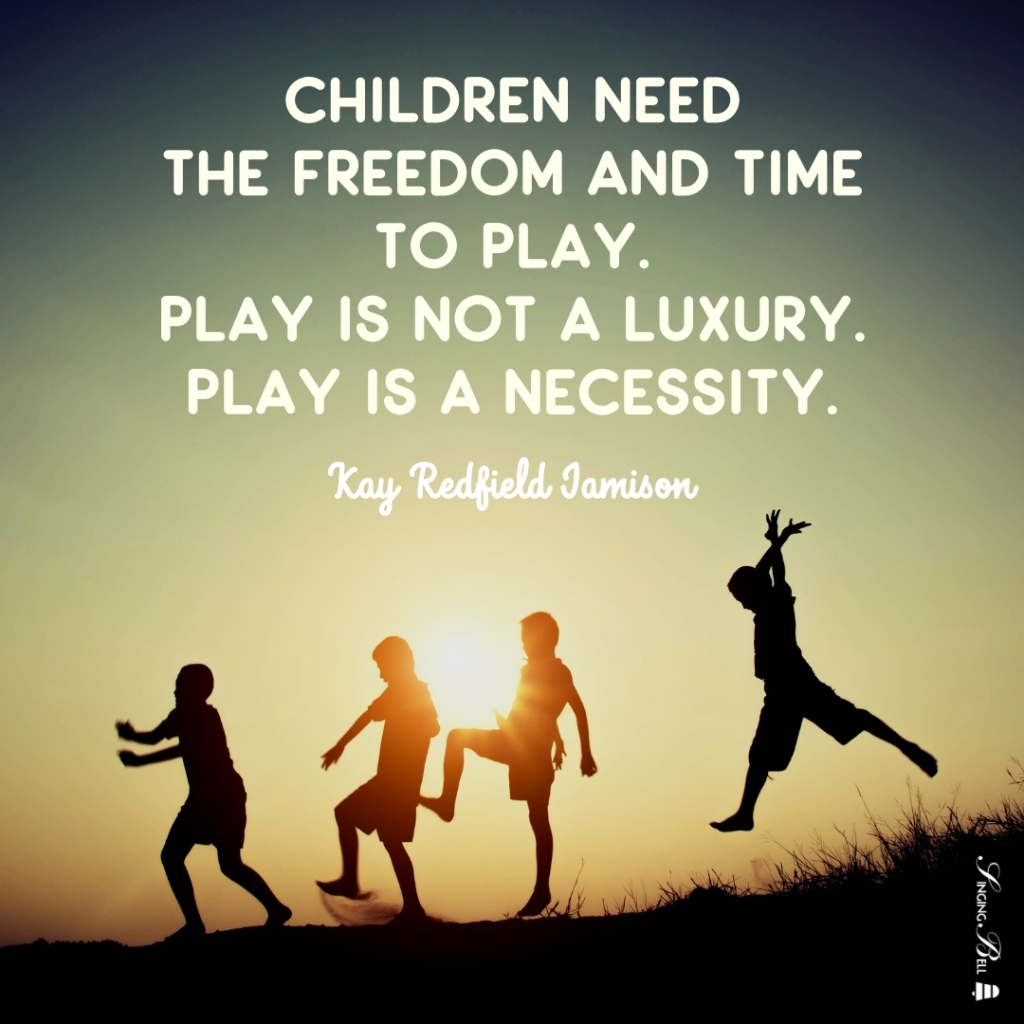
Teachers get so much pressure to meet standards and prepare students for state mandated tests, that I believe they forget their students are just kids. Because of this pressure, too many teacher education and professional development strategies stress the concept of time on task. For example, see Identifying (and Engaging Students in), Time-on-Task Activities, Increasing Time on Task, and Time on Task. This has some importance in teaching and learning but it shouldn’t always be the professed key to good instruction. This leaves little time for play. Play is important for students of all ages and grades.

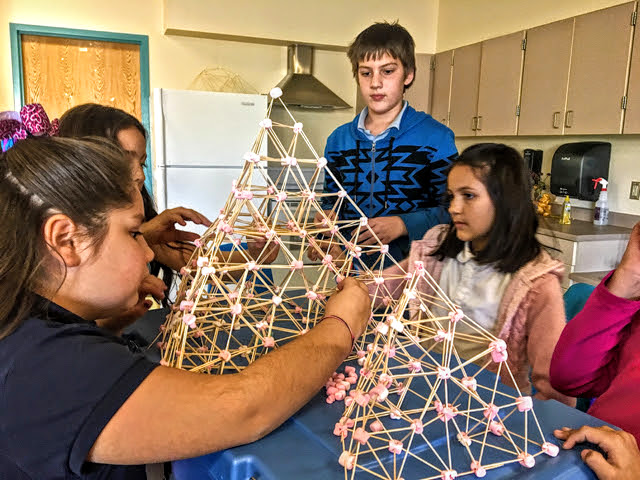
This week I was reminded of the importance of playing and having fun; and that play and fun are determined by the kids, themselves. I planned a math lesson based on visual patterning, The concluding activity was for them to make a Fractal Tetrahedron, a marshmallow-toothpick tower. I had planned to have them work on it during a series of math classes, but they asked to stay through lunch and recess to work on it.

I started working with this group of gifted middle school students in January. I always have a goal of engaging learners as I believe it is the foundation of all good learning. I have had difficulty engaging them even with the use of Breakout EDU escape boxes, art activities, and games. Some engaged. Some did not. This marshmallow-toothpick activity brought a new energy into this group. All of them participated. They worked together. They laughed. They excitedly kept building and building. They added pieces to it that weren’t part of the plan. They played and had fun. A new group and classroom dynamic emerged which I believe was due with just letting them play with this project.

I discussed the beauty of spontaneous play (lots of play is spontaneous) in An Education Filled with Wonder:

One day I was substituting for a 2nd grade class.  It had begun to snow as we arrived to school that morning.  By mid-morning, a few inches covered the ground.  It was time for recess but, as expected, a voice came over the intercom to state that recess would be inside within each teacher’s classroom.  I heard the kids moan as they came to school dressed for snow with boots and winter jackets.  I threw caution into the wind.  I asked the kids to bundle up so we could go outside.  The kids became . . . well, kids.  They ran through the fresh snow in the huge back-of-the-school play area with no other students out there. They examined the footprints they created in the snow.  When one found something of interest, they called the others over to see.  They caught snow flakes with their tongues and made snow angles.  There were no conflicts nor arguing as was common to this group of kids.  They just ran, played, and laughed together as a unified group reminding me of a flock of geese.  I watched them with a tear in my eye, one that reflected the beauty I was witnessing. 

I wonder (even though I intuitively know the answer) whether learners in their adulthoods will better remember the types of activities I described above or their very structured time-on-task classroom activities.

The Harvard Graduate School of Education discussed the importance of play in Playing to Learn: How a pedagogy of play can enliven the classroom, for students of all ages:

Play and school can seem diametrically opposed. School is structured, often focused on order; play, by definition, is not.

But within this paradox of play and school, educators can find meaningful learning opportunities, advancing students’ academic skills as well as the social skills that will allow them to thrive in adulthood and enjoy their childhood now, according to researchers from Project Zero (PZ), a research center at the Harvard Graduate School of Education.

“Play is a strategy for learning at any age,” says Project Zero’s researcher Mara Krechevsky. While older students and their teachers might have more curricular demands than younger students, playful learning still has an important role to play — it might just look different.

There is a universality to play: children are often more relaxed and engaged during play, and it’s enjoyable — all aspects that facilitate learning.

I think most educators innately know about the importance of play but according to many of them, they don’t have the time during the school day to permit kids to play outside of recess . . . but I ask, “What are the costs of not permitting them to play?”

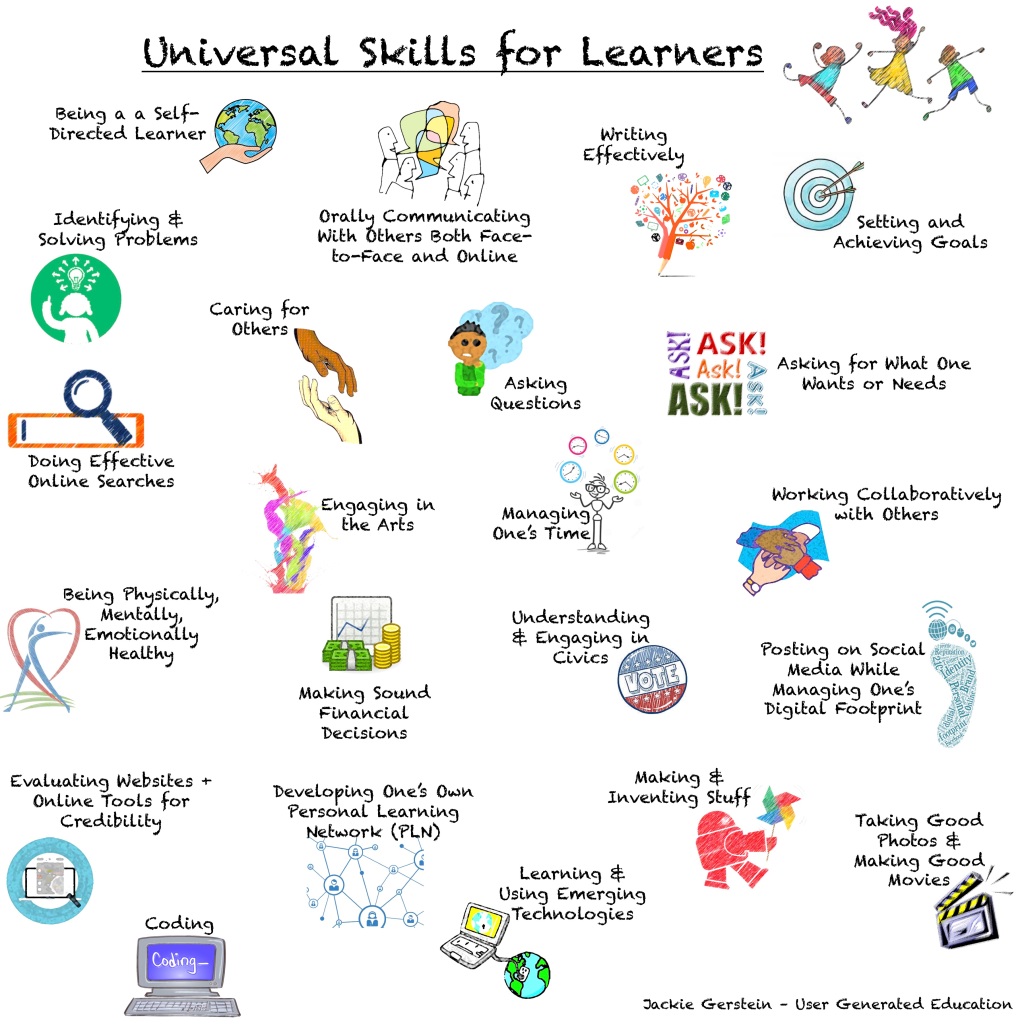
Universal Skills for Learners: Increasing School Relevancy

Kids are learning – but for way too many it occurs outside of the school environment rather than during school. Given today’s technologies, it makes sense and is exciting that learning occurs after schools hours, but for exciting, engaging, and profound learning not to occur during school hours is, simply put, a travesty.

I contend that school, especially in the latter part of the 20th century, had a high degree of irrelevancy but in today’s highly connected world, it is absurd, verging, in my perspective, as unethical practices. We are asking today’s students to spend so much of their school lives doing tasks that are unconnected to the the skills that need now and in their future lives.

. . . and the kids agree as studies have indicated.

Gallup has conducted more than 5 million surveys with students in grades five through 12 over the past several years. These students have come from every state and from a range of rural, suburban and urban school settings. Almost half of students who responded to the survey are engaged with school (47%), with approximately one-fourth “not engaged” (29%) and the remainder “actively disengaged” (24%). A closer look at the data by grade level reveals a disturbing trend. Engagement is strong at the end of elementary school, with nearly three-quarters of fifth-graders (74%) reporting high levels of engagement. But similar surveys have shown a gradual and steady decline in engagement from fifth grade through about 10th grade, with approximately half of students in middle school reporting high levels of engagement and about one-third of high school students reporting the same (School Engagement Is More Than Just Talk).

Just 54 percent of middle schoolers and 46 percent of high schoolers think their studies are relevant, according to new data from the nonprofit YouthTruth. Relevance was rated lowest on the survey of various measures of student engagement: if students take pride in their work, if they enjoy going to school, if their schoolwork is relevant, if they try to do their best, and if their teachers’ expectations help them with that goal (Only Half of Students Think What They’re Learning in School Is Relevant to the Real World, Survey Says).

Over five years ago, I wrote a post entitled Universal Skills All Learners Should Know How to Do in order to discuss those skills I believe are important for learners during this era. For this post, I revisited it. I revised it to now include financial literacy and civics.

  • How to be a self-directed learner – finding and using resources (both face-to-face and online) to learn and improve personal interests
  • How to do effective online searches
  • How to develop one’s own Personal Learning Network (PLN)
  • How to post on social media while managing one’s digital footprint
  • How to evaluate websites and online tools for credibility
  • How to orally communicate with others both face-to-face and online (e.g., Facetime, Skype, Google Handouts)
  • How to write effectively
  • How to ask questions
  • How to effectively ask for what one wants or needs
  • How to set and achieve goals
  • How to work collaboratively with others
  • How to manage one’s own time
  • How to be healthy – physically and emotionally
  • How to care for others
  • How to Enjoy and Engage in the Arts
  • How to identify and solve problems
  • How to make sound financial decisions
  • How to understand and engage in civics
  • How to take professional looking photos; make professional looking videos
  • How to learn and use emerging technologies
  • How to make and invent stuff
  • How to code

I think most administrators and educators (and learners) would agree with the importance of most of the skills on this list to assist learners to be successful now and in their futures. Sadly, though, too few of these skills are directly and intentionally taught to learners: writing, speaking, and for more progressive schools, engaging in the arts and the computer science related skills. Is the current school system model really the best we can do?

The Benefits of the Copy Stage of Making

In Learning in the Making: How to Plan, Execute, and Assess Powerful Makerspace Lessons, I propose a model for the stages of making.

I believe that the heart of making is creating new and unique things. I also realize that in order for this type of making to occur, there needs to be some scaffolding so that maker learners can develop a foundation of knowledge and skills. This post focuses on the Copy Stage of this model.

  • Copy – make something almost exactly as someone else has done.

In this age of information abundance, there really is an unlimited number of DIY resources, tutorials, Youtube videos, online instructors and instructions on making all kind of things. These resources provide a good beginning for acquiring some solid foundational skills and knowledge for learning how a make something one has never made before.

For a recent classroom activity, I wanted students to learn about and use Adafruit’s Circuit Playground. Some students made a Circuit Playground Dreidel (they learned about dreidels from an Orthodox Jewish student who was in my class and they loved it!) using the directions found at https://learn.adafruit.com/CPX-Mystery-Dreidel, and others made the Circuit Playground Scratch game with the directions found at https://learn.adafruit.com/adabot-operation-game/overview. I provided them with these directions and the expectation that the learners follow them pretty much on their own with me acting as an explainer and coach when they ran into difficulties. Here is a video of my learners enjoying their newly made dreidels.

The benefits of beginning maker activities with the Copy Stage includes:

  • Basic Skill Development and Acquisition
  • Foundational Skills for More Advanced and Creative Projects
  • Following Step-By-Step Directions
  • Positive Problem-Solving When Obstacles Occur
  • Asking for Help From Peers
  • A Sense of Accomplishment About Finishing a Project
  • Enjoying the Use of Finished Products They Made

There has been a fair amount of criticism leveraged against “paint-by-numbers” types of STEM and maker kits. This criticism revolves around the stifling of the creativity of learners. I contend that learners need foundational skills so that they can be freed up to be creative. Think about learning how to cook or play an instrument. The basic and foundational skills need to be there in order for the makers to go in directions that are new and creative for them. For example, I spent several decades as a ceramic artist, making wheel thrown and altered pottery. I needed to know how to throw a decent bowl before I could go in that direction (and yes, my pottery in this image began as wheel thrown cylinders).

Going On A STEM-Maker Journey WITH My Students

Last semester, I worked with a few high school students to create a project for the New Mexico Governor’s STEM Challenge. Being a learner-centric, process-oriented educator (hence, the name of my blog – User Generated Education), I embraced the following practices during this project.

  • Learners selected and developed their problem statement and guiding question.
  • Learners naturally tapped into one another’s strengths, managing their strengths without any intervention from me. Some were good at problem conception, others at envisioning solutions, others at research, and still others at creating the graphics.
  • My role was that of resource provider and feedback provider. I shared and explained the challenge requirements, reviewed the qualities of valid websites, gave feedback on their research and written work, and provided them with materials and tools such as Arduinos.
  • Community resources were used reinforcing that communities contain experts – that teachers don’t have to be experts at everything. We visited the local makerspace so the learners could learn and use their 3d printers and laser cutter.
  • Given the nature of this project-based, problem-based format, grading was based strictly on class participation using the criteria of, “Worked on the project during class time.”

Although, I often approach my classroom instruction using the practices as specified above, this one took me even farther from a place of knowing. They selected CO2 emissions and a chemistry-based solution of which I knew very little, so I was not a content expert. We learned about this together. I had a little experience with Arduinos but not lots so I was not a technology expert. We learned a lot more about how these worked together. We went on this journey together and I loved being a co-learner with my students.

Here is a highlight video of their project:

Much to my chagrin, they did not win an award (19 awards were given to the 43 entries). Their rewards, though, cannot be overstated:

  1. They learned some concrete and practical skills from going to the local makerspace, and getting instruction on their 3D printers and laser cutter. They also helped them work out some difficulties they had troubleshooting problems with the Arduino part of the project.
  2. They experienced the rewards and frustrations of working on a months long project including persistence, having a growth mindset, dealing with failure, and following through with a project through its completion.
  3. One of the students has pretty much checked out of school. She was mostly fully engaged throughout the duration of this project.

Even though their excitement about attending and presenting their project was obvious during the hour long ride home as they spent that time brainstorming ideas for projects for next year’s Governor’s STEM Challenge.

2020: A Clear Vision for Our Learners

20/20 vision is a term for visual acuity in which the numerator refers to distance and the denominator refers to size. Visual acuity (VA) commonly refers to the clarity of vision. Vision is all about clarity. 20/20 vision is perfect, high-definition clarity. The question is: How clear is your vision? Specifically, how clear is your vision [for your learners’] futures? (How to Have 20/20 Vision in 2020)

The year 2020 can act as metaphor for us, as educators, to have an overreaching vision for what we do. I really love the idea of approaching 2020 with a clear, well-articulated vision of our learners’ futures.

Grant Wiggins in Why Do You Teach had this to say about the importance of educators developing their vision-mission statements.

I am interested in [teachers being able to answer]:  Having taught, what should they have learned? What do you aim to accomplish as a teacher? What is your goal for the year, for all the years? What kind of a difference in their thinking and acting are you committed to?

Many teachers do not have good answers; most have no such personal Mission Statement; most have not even written a long-term syllabus in which they lay out the key goals for learners (and parents) and how those goals will best be achieved. But then – I say this with no malice –  you really have no goals. You are just marching through content and activities, hoping some of it will stick or somehow cause some learning.

 If you have no long-term accomplishments that you work daily to cause – regardless of or even in spite of the BS you encounter – then you are acting unprofessionally. What a professional educator does, in my view, is to stay utterly focused on a few long-term learning-related goals, no matter what happens in the way of administrative mandates, snow days, early dismissals for sports, or fire drills.

I have a vision – mission statement that I developed years ago but still holds true today:

To help learners developing the knowledge, skills, and passion to be self-directed, lifelong learners.

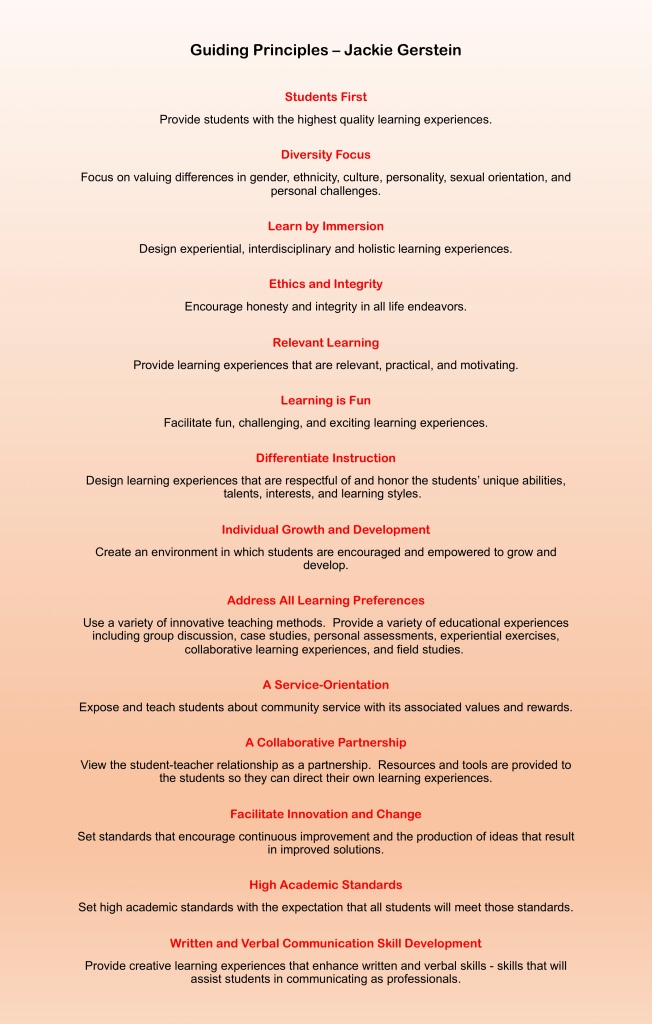
From my vision-mission statement I developed some guiding principles.

My vision-mission was not just a mental exercise I completed. It, along with my guiding principles, was developed to inform everything I do in my classrooms. I frequently revisit them as a form of self-assessment. Which principles are currently guiding my instructional strategies? Which ones are not being integrated into my classroom activities? What changes do I need to make to do so?

Here are some resources for developing your own vision-mission statement: