
Research at Track2Training: Our Vision, Priority Areas and Institutional Research Agenda
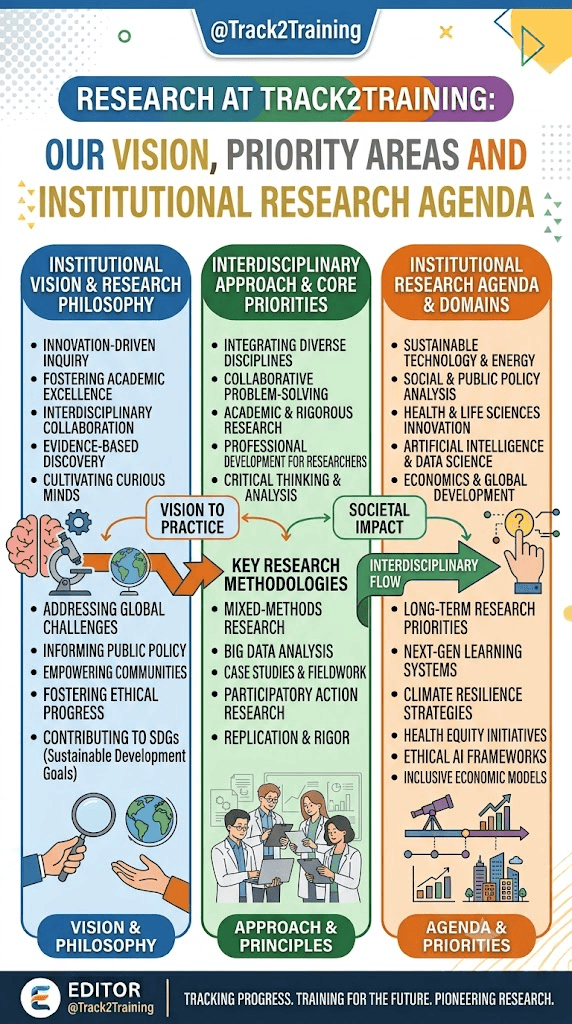
Research is central to the creation of knowledge, the improvement of professional practice, and the development of evidence-based solutions for society. At Track2Training, research is viewed not simply as an academic requirement but as a structured process of inquiry that connects ideas, evidence, technology, policy, and real-world challenges.
Track2Training functions as a multidisciplinary research and academic organisation committed to supporting knowledge creation, research capacity building, scholarly communication, and collaborative inquiry across a wide range of disciplines. Its institutional research agenda is designed around the belief that meaningful research should be rigorous, ethical, interdisciplinary, socially relevant, and capable of contributing to both academic advancement and practical problem-solving.
Our Research Vision
The research vision of Track2Training is to contribute to the development of an inclusive and knowledge-driven academic ecosystem where researchers, students, faculty members, practitioners, and institutions can participate in high-quality research and scholarly exchange.
Track2Training seeks to promote research that responds to contemporary societal, technological, environmental, and developmental challenges. The organisation encourages researchers to move beyond isolated disciplinary boundaries and engage with complex questions through interdisciplinary and multidisciplinary perspectives.
The long-term vision is to develop Track2Training into a platform for research collaboration, methodological innovation, academic training, knowledge dissemination, and evidence-based dialogue.
Research undertaken or supported through Track2Training is expected to contribute not only to academic literature but also to policy discussions, institutional practices, professional development, and community-level understanding.
Our Research Philosophy
The research philosophy of Track2Training is founded on five broad principles: rigour, relevance, interdisciplinarity, integrity, and accessibility.
Rigour requires that research questions are addressed through appropriate theoretical frameworks, systematic methodologies, reliable data, transparent analysis, and careful interpretation.
Relevance ensures that research remains connected to emerging academic debates and real-world challenges. Track2Training encourages studies that address issues affecting cities, communities, institutions, industries, education systems, technologies, and the environment.
Interdisciplinarity recognises that contemporary problems rarely belong to a single field. Issues such as climate change, urbanisation, artificial intelligence, public health, mobility, sustainability, and social inequality require knowledge from multiple disciplines.
Integrity remains fundamental to all scholarly activity. Research ethics, responsible authorship, transparency, proper citation, data integrity, and responsible use of artificial intelligence are therefore important components of the organisation’s academic philosophy.
Accessibility reflects the belief that research should contribute to wider knowledge exchange. Research findings should be communicated not only through scholarly journals but also through reports, working papers, policy briefs, conferences, training programmes, and public-facing academic communication.
Interdisciplinary Research Approach
Track2Training promotes interaction between disciplines because many of today’s most important research questions occur at the intersection of multiple areas of knowledge.
Urban research, for example, may involve architecture, transportation planning, environmental science, public policy, economics, sociology, data science, and governance. Similarly, research on artificial intelligence may involve computer science, education, research ethics, business, communication, and public administration.
This interdisciplinary orientation encourages researchers to examine problems from multiple perspectives and select research methods based on the nature of the problem rather than disciplinary convention alone.
Track2Training therefore supports a wide range of methodological approaches, including qualitative research, quantitative analysis, mixed-method research, systematic literature reviews, bibliometric analysis, case studies, surveys, statistical modelling, structural equation modelling, machine learning, GIS-based analysis, content analysis, policy analysis, and comparative research.
Priority Research Areas
The institutional research agenda of Track2Training covers several broad domains.
Urban Planning, Architecture and Built Environment
Urbanisation creates complex challenges involving housing, infrastructure, mobility, land use, accessibility, sustainability, public spaces, heritage conservation, and urban governance.
Track2Training promotes research related to urban planning, regional planning, architecture, urban design, transit-oriented development, land management, development regulations, infrastructure planning, heritage conservation, public spaces, and sustainable cities.
Research in this area seeks to contribute to more inclusive, resilient, accessible, and environmentally responsible urban development.
Transportation and Mobility Research
Transportation strongly influences economic opportunity, accessibility, urban form, environmental quality, and social inclusion.
Priority themes include public transport, travel behaviour, first- and last-mile connectivity, transit-oriented development, pedestrian mobility, cycling, accessibility, road safety, sustainable mobility, intelligent transportation systems, and the application of data science in transport planning.
Special attention is given to understanding how infrastructure, service quality, accessibility, behaviour, and urban design influence mobility choices.
Sustainability, Environment and Climate Research
Environmental sustainability represents another major area of institutional interest.
Research themes include climate change, energy efficiency, sustainable buildings, environmental planning, urban heat islands, ecosystem management, water systems, waste management, environmental impact assessment, climate-resilient infrastructure, and sustainable development.
Track2Training encourages research aligned with the broader goals of environmental responsibility and sustainable development.
Artificial Intelligence, Data Science and Emerging Technologies
Rapid advances in artificial intelligence and data science are transforming research, education, industry, governance, and professional practice.
Track2Training promotes research on machine learning, generative artificial intelligence, data analytics, digital twins, smart cities, automation, intelligent decision-support systems, and responsible AI.
Particular importance is placed on the ethical use of artificial intelligence, transparency of AI-assisted research, methodological validation, and the responsible integration of technology into academic and professional practices.
Education and Research Capacity Building
Education remains central to social and economic development.
Research priorities include higher education, research methodology education, digital learning, academic writing, research skills, educational technology, curriculum development, scholarly communication, student learning behaviour, and research capacity building.
Track2Training also seeks to understand how researchers can be better equipped with methodological, statistical, analytical, and communication skills.
Social Sciences and Public Policy
Research in the social sciences helps explain how institutions, communities, policies, and social structures influence development.
Track2Training encourages research on governance, social inclusion, public policy, gender, informal economies, community development, social justice, institutional performance, and citizen participation.
Evidence-based policy analysis is particularly important in connecting academic research with public decision-making.
Research Methods and Scholarly Communication
An additional institutional priority is the advancement of research methodology itself.
This includes systematic reviews, bibliometric methods, statistical modelling, survey research, structural equation modelling, qualitative analysis, reproducibility, open science, research data management, and scholarly publishing.
Track2Training promotes methodological literacy because the quality of research depends greatly on the quality of the methods used to generate and analyse evidence.
Research and Societal Relevance
The value of research extends beyond publication counts or citation indicators. Research becomes particularly meaningful when it contributes to understanding and addressing societal challenges.
Track2Training therefore encourages research that can inform planning, policy, professional practice, education, technological innovation, and community development.
Where appropriate, research outputs may be translated into policy briefs, technical reports, educational resources, working papers, professional guidelines, and public knowledge resources.
Such knowledge translation helps reduce the distance between academic research and practical implementation.
Research Ethics and Responsible Scholarship
Track2Training considers research integrity an essential institutional responsibility.
Researchers are encouraged to follow accepted standards relating to authorship, citation, plagiarism prevention, informed consent, confidentiality, data protection, conflicts of interest, and responsible reporting.
With the increasing use of generative artificial intelligence in academic work, responsible AI use is becoming particularly important. AI tools may support researchers in selected tasks, but scholarly responsibility, verification, interpretation, and accountability must remain with researchers.
Transparency regarding methods, data, limitations, and the use of computational tools strengthens confidence in research findings.
Building Research Capacity
Research institutions have a responsibility not only to produce knowledge but also to help develop future researchers.
Track2Training therefore places significant emphasis on research training and capacity building.
Academic programmes, workshops, training modules, research consultations, methodological guidance, and scholarly resources can help students, doctoral researchers, faculty members, and early-career researchers develop stronger research skills.
Key capacity-building areas include research design, literature review, systematic review methodology, statistical analysis, SPSS, R, Python, SmartPLS, structural equation modelling, bibliometric analysis, academic writing, reference management, and research publication.
Collaboration and Knowledge Networks
Research becomes stronger when knowledge is shared across institutions and disciplines.
Track2Training aims to develop research collaborations with universities, research organisations, faculty members, doctoral scholars, independent researchers, professional bodies, industry experts, and public institutions.
Collaborative research can support comparative studies, interdisciplinary projects, joint publications, conferences, workshops, edited volumes, policy studies, research training, and externally funded projects.
Building such networks forms an important part of the organisation’s long-term academic development.
Long-Term Institutional Research Agenda
The long-term research agenda of Track2Training focuses on developing a sustainable research ecosystem rather than isolated academic activities.
Future priorities include strengthening institutional research programmes, creating thematic research groups, publishing working papers, producing research reports, developing academic datasets, organising conferences and seminars, supporting methodological innovation, expanding international collaborations, and strengthening connections between research and public policy.
Track2Training also seeks to promote research aligned with the United Nations Sustainable Development Goals, particularly in areas such as quality education, sustainable cities, climate action, innovation, infrastructure, reduced inequalities, and responsible institutions.
Toward a Knowledge-Driven Research Institution
Track2Training’s institutional research agenda reflects a broader commitment to knowledge creation, academic integrity, interdisciplinary collaboration, and societal contribution.
The objective is not simply to support individual research outputs but to cultivate an environment where meaningful questions are investigated systematically, researchers receive appropriate methodological support, interdisciplinary collaboration is encouraged, and research findings are communicated responsibly.
As research challenges become increasingly interconnected, institutions must create spaces where disciplines, technologies, communities, and ideas can interact.
Through its research programmes, scholarly initiatives, training activities, collaborations, and knowledge dissemination efforts, Track2Training aims to contribute to a research culture that is rigorous, ethical, inclusive, innovative, and relevant to the changing needs of society.
Which relationship has taught you the most about yourself?
View all responses

