
Current Research Projects and Ongoing Studies at Track2Training
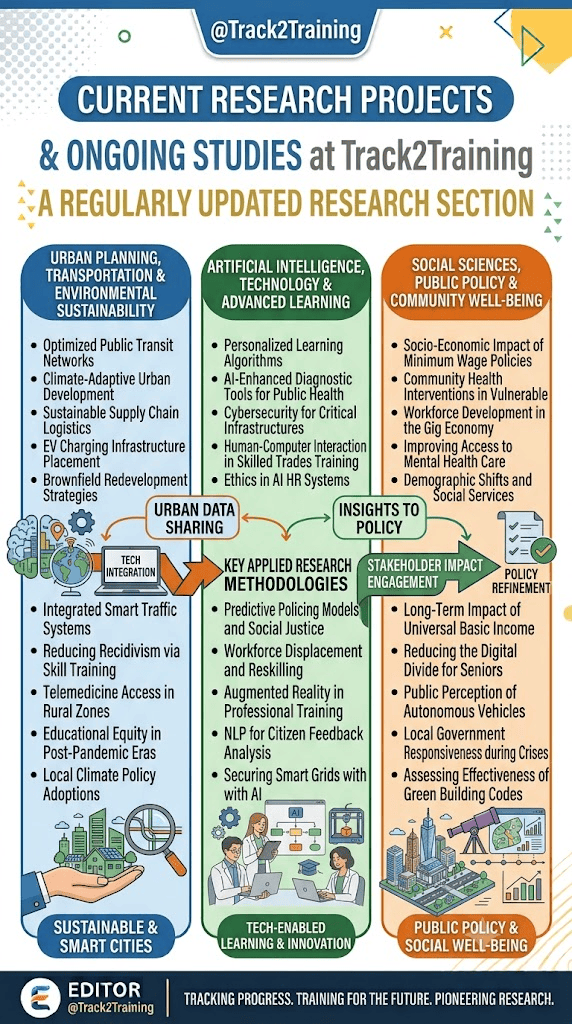
Research institutions are defined not only by the knowledge they disseminate but also by the questions they actively investigate. At Track2Training, ongoing research is organised around contemporary challenges in urban development, transportation, sustainability, education, artificial intelligence, social sciences, public policy, environmental management, and emerging technologies.
The organisation’s research portfolio reflects an interdisciplinary approach in which academic inquiry is connected with practical problems, policy concerns, technological change, and societal development. Projects are designed to contribute to scholarly literature while also generating insights that may be useful for planners, educators, policymakers, researchers, practitioners, institutions, and communities.
This page provides an institutional overview of the major research themes and ongoing areas of investigation associated with Track2Training. It can serve as a continuously updated Research Projects section documenting active studies, collaborative initiatives, methodological developments, and future research directions.
Urban Planning and Built Environment Research
Urbanisation is transforming cities at an unprecedented pace. Population growth, changing mobility patterns, land pressure, housing demand, environmental stress, and infrastructure requirements are creating new challenges for planners and urban institutions.
Track2Training is engaged in research addressing the relationship between land use, infrastructure, mobility, accessibility, urban form, and planning policy.
Current areas of investigation include transit-oriented development, land-use regulation, development rights, urban accessibility, infrastructure capacity, public space, heritage conservation, informal-sector planning, urban resilience, and sustainable neighbourhood development.
Studies in this domain examine how planning policies influence development patterns and how urban systems can be made more inclusive, efficient, and sustainable.
Particular attention is given to Indian cities, where rapid growth frequently creates tensions between development, infrastructure provision, heritage protection, environmental sustainability, and social equity.
Transportation, Mobility and Accessibility Studies
Transportation research forms an important part of the institutional research portfolio.
Mobility influences access to employment, education, healthcare, markets, and public services. It also affects urban productivity, environmental quality, social inclusion, and individual quality of life.
Ongoing research examines themes such as public transport preference, first- and last-mile connectivity, travel behaviour, transit-oriented development, pedestrian accessibility, multimodal transport, service quality, transport infrastructure, and sustainable mobility.
Researchers associated with Track2Training are also examining the factors that influence people’s choice of transport mode. These may include distance, accessibility, reliability, safety, comfort, travel time, infrastructure quality, household characteristics, and land-use conditions.
Quantitative techniques such as regression analysis, structural equation modelling, discrete-choice modelling, machine learning, and statistical comparison are increasingly being incorporated into transportation research.
A long-term objective is to generate evidence that can contribute to more accessible, integrated, and people-centred urban mobility systems.
Sustainable Development and Climate-Responsive Research
Sustainability is a cross-cutting theme connecting many Track2Training research activities.
Current studies explore how cities, buildings, communities, institutions, and infrastructure systems can respond more effectively to environmental challenges.
Priority themes include climate-resilient urban planning, sustainable transportation, energy-efficient buildings, environmental assessment, urban heat, water systems, waste management, green infrastructure, land-use change, and sustainable development indicators.
Research is also examining how climate extremes affect human behaviour and urban systems. Extreme heat, flooding, changing rainfall patterns, and other climate-related events can influence mobility, energy consumption, health, infrastructure performance, and everyday urban activity.
Such studies are important because climate change increasingly requires planners and policymakers to incorporate adaptation and resilience into long-term development strategies.
Track2Training also encourages research that connects local development challenges with the United Nations Sustainable Development Goals, particularly those relating to sustainable cities, climate action, infrastructure, education, clean water, innovation, and reduced inequality.
Artificial Intelligence and Machine Learning Research
Artificial intelligence is rapidly changing the way research is conducted and how decisions are made across many professional fields.
Track2Training is developing research interests in the application of artificial intelligence, machine learning, data analytics, generative AI, and automated decision-support systems.
Research in this area investigates how computational tools can be used for prediction, classification, pattern recognition, modelling, optimisation, and evidence-based decision-making.
Potential applications include urban planning, transportation, education, environmental monitoring, research analytics, infrastructure management, academic publishing, and public administration.
Researchers are also interested in comparing traditional statistical methods with machine-learning approaches. Such comparisons help identify the circumstances in which advanced computational techniques provide meaningful improvements and where conventional methods may remain preferable because of interpretability or data limitations.
Responsible artificial intelligence is another important research priority.
Track2Training recognises that AI systems raise questions regarding transparency, bias, accountability, privacy, authorship, data quality, and research integrity. Studies in this area therefore consider not only technological capability but also the ethical and institutional implications of AI adoption.
Education and Higher Education Research
Education is both a field of research and a foundation for broader social development.
Track2Training supports studies examining higher education, research training, digital learning, academic skills, educational technology, curriculum development, student engagement, research literacy, and scholarly communication.
One important area of interest is research capacity building among postgraduate students, doctoral scholars, and early-career researchers.
Academic researchers increasingly need competencies in literature searching, research design, statistics, data visualisation, systematic reviews, bibliometric methods, academic writing, research ethics, and digital tools.
Ongoing studies may investigate how such competencies are developed and how universities and research organisations can strengthen methodological training.
The use of artificial intelligence in education is another emerging theme. Research questions include how generative AI affects teaching, assessment, academic writing, creativity, research practices, and academic integrity.
Systematic Reviews and Evidence Synthesis
Evidence synthesis is becoming increasingly important across academic disciplines.
Track2Training promotes research using systematic literature reviews, scoping reviews, bibliometric analysis, meta-analysis, and structured evidence-mapping techniques.
Such projects help researchers identify patterns in existing scholarship, evaluate the quality of evidence, identify research gaps, and develop future research agendas.
Ongoing evidence-synthesis themes include transportation, sustainable development, building performance, urban policy, climate impacts, heritage conservation, educational technology, and emerging research methodologies.
Methodological standards such as transparent search strategies, eligibility criteria, systematic screening, quality assessment, and reproducible reporting are emphasised.
Research in this area also contributes to improved scholarly practice by demonstrating how reviews can move beyond simple literature summaries toward structured and evidence-based synthesis.
Social Sciences and Community Research
Social development cannot be understood only through infrastructure, technology, or economics. Institutions, communities, identities, livelihoods, social networks, and patterns of inequality also shape development outcomes.
Track2Training therefore supports research in areas such as social inclusion, informal economies, community participation, livelihoods, social justice, gender, vulnerable populations, urban informality, and citizen engagement.
Studies may examine how development policies affect different social groups and whether planning systems adequately represent the needs of people whose livelihoods or living conditions are often overlooked in formal policy frameworks.
Community-based and participatory research approaches are particularly valuable because they allow researchers to understand local experiences rather than relying solely on administrative or secondary data.
Such research can contribute to more inclusive planning and more responsive public institutions.
Public Policy and Governance Studies
Evidence-based public policy represents another important institutional research direction.
Track2Training encourages studies examining how policies are formulated, implemented, evaluated, and experienced by citizens.
Research themes include urban governance, planning legislation, institutional performance, development regulation, public service delivery, policy implementation, local government, infrastructure governance, and regulatory frameworks.
Studies may compare policy intentions with actual implementation outcomes.
For example, a development policy may appear effective in formal regulations but encounter difficulties because of market conditions, administrative capacity, public awareness, infrastructure limitations, or stakeholder participation.
Understanding such implementation gaps is essential for meaningful policy evaluation.
Public policy research at Track2Training therefore seeks to connect legal and institutional frameworks with empirical evidence from real-world settings.
Environmental and Natural Resource Research
Environmental research has become increasingly important as societies face pressure on land, water, ecosystems, and natural resources.
Track2Training supports research on water systems, environmental planning, ecological sustainability, river-sensitive development, environmental governance, land-use change, biodiversity, urban ecosystems, pollution, and climate adaptation.
Such projects often require interdisciplinary methods involving planning, environmental science, engineering, public policy, and community participation.
A key objective is to understand how development can be balanced with environmental protection.
Research may examine environmental impacts at different scales, from individual buildings and neighbourhoods to cities, river systems, and regional landscapes.
Heritage, Culture and Place-Based Research
Historic environments contribute to identity, tourism, cultural continuity, and local economies.
Track2Training is interested in research related to heritage conservation, adaptive reuse, cultural landscapes, historic urban areas, tourism activation, place identity, and cultural sustainability.
Studies may evaluate heritage significance, physical condition, visitor perception, management practices, and the relationship between conservation and economic development.
The organisation also encourages research exploring how cultural heritage can be integrated into contemporary planning without reducing historic places to purely commercial tourism assets.
This research area connects architecture, planning, history, tourism, sociology, conservation, and cultural studies.
Emerging Technology and Digital Transformation
Digital technologies are transforming both professional practice and research methodology.
Ongoing research interests include digital twins, smart cities, GIS, remote sensing, building information modelling, virtual environments, automation, data visualisation, digital fabrication, and technology-supported decision-making.
These technologies provide new opportunities to analyse complex systems, simulate alternative scenarios, and communicate information more effectively.
However, digital transformation also creates questions regarding accessibility, technical capacity, governance, interoperability, privacy, and technological dependence.
Track2Training therefore approaches emerging technologies as both technical tools and subjects of critical research.
Research Methods and Methodological Innovation
Strong research depends on strong methodology.
Track2Training supports methodological research and advanced analytical practices involving SPSS, R, Python, SmartPLS, structural equation modelling, machine learning, multivariate statistics, GIS, bibliometric tools, and qualitative research software.
Research in this area is not limited to applying software. Greater emphasis is placed on understanding research design, assumptions, measurement quality, reliability, validity, model interpretation, reproducibility, and appropriate reporting.
Methodological training and experimentation can help researchers select analytical techniques that are appropriate to their questions rather than simply using methods because they are popular.
Collaboration and Institutional Research Partnerships
Many contemporary research problems are too complex to be addressed effectively by individuals working in isolation.
Track2Training therefore encourages collaboration among universities, faculty members, doctoral researchers, research organisations, industry professionals, government institutions, civil-society organisations, and independent scholars.
Collaborative projects can include comparative research, multicity studies, systematic reviews, joint publications, policy reports, conferences, workshops, research proposals, datasets, and edited academic volumes.
The institution also seeks to support interdisciplinary teams in which researchers from different backgrounds contribute complementary expertise.
From Research Projects to Knowledge Outputs
An important objective of the Track2Training research programme is to ensure that research findings are communicated through appropriate channels.
Project outputs may include:
- peer-reviewed journal articles,
- conference papers,
- working papers,
- technical reports,
- policy briefs,
- research datasets,
- edited books and chapters,
- research methodology resources,
- seminars and workshops,
- public-facing research articles, and
- academic training material.
Different audiences require different forms of communication. A technical research paper may be appropriate for academic specialists, while policymakers may benefit more from a concise policy brief and students may benefit from an educational research summary.
Building a Dynamic Research Portfolio
The Current Research Projects and Ongoing Studies section of Track2Training is intended to evolve continuously.
As new projects are initiated, individual project pages can provide information about research objectives, principal investigators, collaborators, methodology, study location, funding, project duration, research outputs, publications, datasets, and project status.
Over time, this can develop into a structured institutional research repository documenting the organisation’s intellectual contribution across disciplines.
Looking Ahead
Track2Training’s research portfolio reflects its broader commitment to interdisciplinary inquiry, methodological rigour, academic collaboration, and socially relevant knowledge creation.
Future research will continue to focus on the major transitions shaping contemporary society: rapid urbanisation, changing mobility, climate change, artificial intelligence, digital transformation, educational innovation, environmental sustainability, and evolving governance systems.
By bringing together researchers, institutions, students, professionals, and communities, Track2Training aims to develop an active research ecosystem in which academic investigation contributes meaningfully to knowledge, policy, professional practice, and society.
The institution’s ongoing research agenda is therefore not a fixed list of projects. It is a developing platform for inquiry, collaboration, experimentation, and evidence-based contribution to the challenges of the present and the future.
Which relationship has taught you the most about yourself?
View all responses

