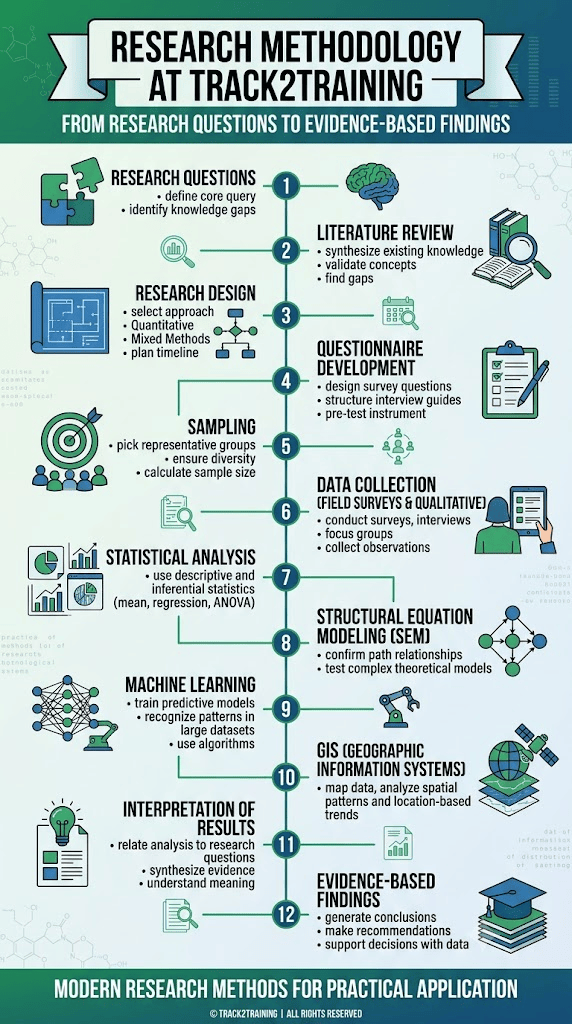
Which reResearch Methodology at Track2Training: From Research Questions to Evidence-Based Findings
Research methodology provides the foundation for credible academic inquiry. A well-designed study does more than collect information; it establishes a clear relationship between research questions, evidence, analytical methods, and interpretation. At Track2Training, research methodology is treated as a structured process that guides researchers from the identification of a problem to the development of evidence-based conclusions.
The organisation promotes methodological approaches that are rigorous, transparent, interdisciplinary, and appropriate to the nature of the research question. Depending on the study, this may involve literature reviews, questionnaire surveys, field investigations, interviews, focus groups, statistical modelling, structural equation modelling, machine learning, GIS analysis, qualitative interpretation, or mixed-method designs.
The objective is not simply to apply sophisticated tools. The central concern is to ensure that every method selected contributes directly to answering the research questions in a valid and meaningful way.
Beginning with a Research Problem
Every research project begins with a clearly defined problem.
A strong research problem identifies an issue that requires systematic investigation. It may emerge from gaps in previous research, practical challenges, policy concerns, changing technologies, environmental pressures, social problems, or inconsistencies in existing knowledge.
At Track2Training, researchers are encouraged to distinguish between a broad topic and a researchable problem.
For example, “urban transportation” is a broad topic. A more focused research problem may examine how first- and last-mile accessibility influences public transport preference in a rapidly growing city.
Similarly, “artificial intelligence in education” is broad, while a specific research problem may investigate whether generative AI affects academic writing practices among postgraduate students.
Once the problem is defined, researchers develop research questions, objectives, and where appropriate, hypotheses.
These elements establish the direction of the study and determine the type of evidence required.
Literature Review and Research Gap Identification
A literature review is one of the most important stages of research design.
It helps researchers understand what is already known, what methods have been used, where findings disagree, and which issues remain insufficiently explored.
At Track2Training, literature reviews may range from traditional narrative reviews to systematic literature reviews, scoping reviews, bibliometric studies, and evidence-mapping exercises.
A rigorous literature review generally involves identifying relevant databases, developing search terms, screening studies, applying eligibility criteria, organising evidence, and synthesising findings.
For systematic reviews, transparent procedures are particularly important. Search strategies, inclusion and exclusion criteria, screening processes, and quality-assessment approaches should be clearly documented.
The purpose of the literature review is not merely to summarize previous publications. It should establish the intellectual foundation of the research and demonstrate why the proposed study is necessary.
A clearly identified research gap helps connect previous knowledge with the objectives of the new investigation.
Developing the Conceptual or Theoretical Framework
Once the literature is reviewed, researchers may develop a conceptual or theoretical framework.
A theoretical framework draws upon established theories to explain relationships between concepts. A conceptual framework may combine ideas from previous literature into a structure that guides data collection and analysis.
For example, a transportation study might examine relationships among accessibility, service quality, infrastructure, safety, and public transport preference.
An environmental study may investigate how land-use characteristics, vegetation, density, and surface materials influence urban heat.
The framework helps researchers identify variables, constructs, expected relationships, and appropriate indicators.
In quantitative research, the framework often supports hypothesis development. In qualitative research, it can provide an interpretive lens while still allowing new themes to emerge from the data.
Questionnaire Development and Measurement Design
Questionnaires are widely used in research involving perceptions, attitudes, behaviour, preferences, satisfaction, and socioeconomic characteristics.
However, a questionnaire must be carefully designed if it is to generate reliable data.
At Track2Training, questionnaire development begins by linking each question or indicator with the study objectives and conceptual framework.
Researchers may use established measurement scales from previous studies where appropriate. When new items are developed, they should be clearly worded, relevant to the target population, and capable of measuring the intended concept.
Likert scales are commonly used for measuring perceptions and attitudes, while categorical and numerical questions may be used for demographic, behavioural, or contextual information.
Questionnaires should also avoid leading questions, double-barrelled questions, ambiguous language, and unnecessary technical terminology.
A pilot survey is strongly recommended before full data collection. Pilot testing helps identify problems in wording, sequence, interpretation, response options, and survey duration.
Depending on the study, reliability and validity testing may later be performed to determine whether the measurement instrument performs adequately.
Sampling Design
Researchers rarely have the resources to study an entire population. Sampling is therefore a critical methodological decision.
The sampling process begins by defining the target population. Researchers then determine who is eligible to participate and how participants will be selected.
Probability sampling techniques include simple random sampling, systematic sampling, stratified sampling, and cluster sampling.
Non-probability approaches include purposive sampling, convenience sampling, quota sampling, and snowball sampling.
The appropriate method depends on the research context.
A household mobility survey may require stratified sampling across neighbourhoods, while an expert-based heritage assessment may use purposive sampling because participants need specialised knowledge.
Qualitative studies often use smaller purposive samples because the objective is depth of understanding rather than statistical representation.
Sample size should also be justified. The required number of participants depends on factors such as population size, study design, statistical technique, model complexity, expected variation, and required statistical power.
Researchers should therefore avoid treating sample size as an arbitrary number.
Field Surveys and Primary Data Collection
Field surveys allow researchers to collect evidence directly from real-world contexts.
Track2Training encourages systematic fieldwork protocols to improve consistency and data quality.
Before entering the field, researchers should establish the survey instrument, sampling plan, study locations, ethical procedures, data-recording format, and quality-control measures.
Field data may include household surveys, commuter surveys, pedestrian counts, traffic observations, building assessments, environmental measurements, photographs, spatial observations, land-use records, or infrastructure audits.
Digital data-collection platforms can also improve efficiency by incorporating GPS locations, timestamps, validation rules, and real-time data entry.
Researchers should maintain clear documentation of how, when, and where data were collected.
This strengthens transparency and helps other researchers evaluate the reliability of the study.
Qualitative Research Methods
Not every research question can be adequately answered through numerical data.
Qualitative research is particularly valuable when researchers need to understand experiences, perceptions, institutional processes, cultural meanings, or complex social relationships.
Common qualitative methods include semi-structured interviews, in-depth interviews, focus group discussions, participant observation, case studies, document analysis, and content analysis.
At Track2Training, qualitative methods are used when the research problem requires depth, context, and interpretation.
Interview questions are typically designed around broad themes while allowing participants to explain their perspectives in detail.
Qualitative data can then be coded and analysed to identify recurring themes, patterns, contradictions, and relationships.
Researchers should also consider reflexivity, positionality, saturation, credibility, and transparency during qualitative analysis.
Where appropriate, qualitative findings can be integrated with quantitative data through a mixed-method research design.
Data Cleaning and Preparation
Analysis should not begin immediately after data collection.
Raw data often contain missing values, duplicate records, incorrect entries, inconsistent coding, unusual observations, or incomplete responses.
Data cleaning is therefore an essential methodological step.
Researchers may check frequency distributions, ranges, missing-value patterns, outliers, logical inconsistencies, and variable coding.
For questionnaire data, negatively worded items may need reverse coding. Composite variables may need to be calculated, and categorical data may require appropriate numerical encoding.
Proper documentation of these procedures helps ensure reproducibility.
Data should never be altered simply to produce a desired statistical result. Any exclusion or transformation should have a defensible methodological justification.
Descriptive and Inferential Statistical Analysis
Statistical analysis helps researchers summarise patterns and test relationships within quantitative data.
Descriptive statistics commonly include frequencies, percentages, means, medians, standard deviations, and distributions.
These provide an initial understanding of the sample and variables.
Inferential techniques may then be used to investigate research questions or hypotheses.
Depending on the data, researchers may apply:
t-tests,
chi-square tests,
analysis of variance,
correlation,
linear regression,
logistic regression,
multinomial models,
non-parametric tests,
factor analysis, or
multivariate statistical techniques.
Software such as SPSS, R, and Python can support these analyses.
However, Track2Training emphasises that software should not replace statistical reasoning. Researchers need to understand assumptions, variable types, sample requirements, effect sizes, confidence intervals, and the substantive meaning of results.
A statistically significant result is not automatically a practically important result.
Structural Equation Modelling
Structural Equation Modelling, including covariance-based SEM and Partial Least Squares Structural Equation Modelling, is increasingly used in behavioural, management, planning, transportation, and social science research.
SEM allows researchers to examine relationships among multiple latent constructs simultaneously.
For example, a study may investigate whether infrastructure quality, service experience, and accessibility influence public transport preference.
The analysis generally involves two major components: the measurement model and the structural model.
Measurement-model assessment evaluates whether indicators adequately represent their intended constructs. Researchers may examine indicator loadings, internal consistency, reliability, convergent validity, and discriminant validity.
Structural-model assessment examines relationships between constructs using path coefficients, significance testing, effect sizes, explanatory power, predictive relevance, and other appropriate indicators.
Software such as SmartPLS, AMOS, R, or other SEM platforms may be used depending on the model and research philosophy.
Researchers should avoid using SEM simply because it appears sophisticated. It should be selected only when the conceptual model and data structure justify its application.
Machine Learning and Predictive Analytics
Machine learning provides another set of tools for analysing complex data.
Unlike many traditional statistical models, machine-learning approaches may place greater emphasis on prediction, classification, and pattern recognition.
Techniques may include decision trees, random forests, support vector machines, gradient boosting, neural networks, and clustering algorithms.
At Track2Training, machine learning may be applied to transport mode choice, environmental prediction, urban classification, educational analytics, research trend analysis, or other data-intensive problems.
Model development typically involves data preparation, feature selection, division into training and testing sets, model training, validation, and performance evaluation.
Metrics such as accuracy, precision, recall, F1-score, area under the curve, mean squared error, or calibration measures may be used depending on the problem.
Interpretability is also important.
Tools such as feature importance or SHAP analysis can help researchers understand which variables contribute most strongly to model predictions.
The objective should not be to replace established statistical approaches automatically, but to select the method best suited to the research purpose.
GIS and Spatial Analysis
Many research problems have a spatial dimension.
Geographic Information Systems allow researchers to integrate, analyse, and visualise geographically referenced data.
GIS applications at Track2Training may include land-use analysis, transport accessibility, urban growth, infrastructure mapping, environmental assessment, service-area analysis, spatial inequality, heritage mapping, and climate-related studies.
Researchers can combine spatial datasets such as administrative boundaries, road networks, public transport routes, satellite imagery, population data, land-use maps, environmental indicators, and field observations.
Spatial techniques may include proximity analysis, buffer analysis, network analysis, density analysis, overlay analysis, hotspot identification, and spatial statistics.
Remote sensing can further support studies of land-use change, vegetation, surface temperature, urban expansion, and environmental conditions.
Maps should be treated as analytical outputs rather than decorative illustrations. Every spatial representation should communicate a clearly defined research finding.
Mixed-Method Research
Complex research questions often require both quantitative and qualitative evidence.
Mixed-method research combines these approaches systematically.
For example, a researcher may first conduct a large questionnaire survey to identify statistically significant factors and then undertake interviews to understand why those factors matter to participants.
Alternatively, qualitative interviews may be used first to identify themes that inform the design of a subsequent quantitative survey.
The strength of mixed methods lies in integration.
Simply conducting a survey and a few interviews does not automatically create a mixed-method study. Researchers need to explain how the two forms of evidence complement, confirm, expand, or challenge one another.
Interpreting Research Findings
Interpretation is the stage where numerical outputs, interview themes, spatial patterns, or model results are transformed into meaningful knowledge.
Researchers should return to the original research questions and explain what the findings reveal.
Results should also be compared with previous studies.
Where findings agree with earlier research, researchers can discuss how the new evidence strengthens existing understanding. Where they differ, possible contextual, methodological, or theoretical explanations should be considered.
Researchers should avoid overstating conclusions.
Association does not always imply causation, statistical significance does not necessarily imply practical significance, and findings from one location or population may not automatically generalise to another.
Limitations should therefore be acknowledged openly.
From Evidence to Recommendations
Evidence-based research can inform policy, professional practice, planning, education, technology development, and future scholarship.
However, recommendations should emerge directly from the findings.
A transportation study may identify the need for improved feeder connectivity. An education study may indicate gaps in methodological training. An environmental assessment may demonstrate the importance of protecting green areas. A policy study may reveal implementation barriers requiring institutional reform.
Recommendations become more credible when readers can clearly trace them back to the evidence.
Research Integrity and Reproducibility
Methodological quality is closely connected with research integrity.
Track2Training encourages researchers to document their methods clearly, report findings accurately, preserve research data responsibly, acknowledge limitations, and avoid selective reporting.
Where appropriate, research workflows should be reproducible.
This may involve maintaining code, analytical logs, questionnaires, data dictionaries, GIS procedures, search strategies, or methodological documentation.
Transparency strengthens confidence in academic research and makes it easier for other scholars to build upon previous work.
From Research Questions to Evidence-Based Knowledge
Research methodology is not a single technique or software package. It is the complete intellectual and practical process through which a research question is transformed into defensible evidence and meaningful conclusions.
At Track2Training, methodological choices are guided by the nature of the research problem, the available evidence, ethical considerations, theoretical foundations, and the type of conclusions researchers seek to draw.
By integrating literature review, survey design, sampling, field investigation, qualitative inquiry, statistical analysis, SEM, machine learning, GIS, and careful interpretation, Track2Training promotes a research culture based on methodological rigour rather than methodological complexity for its own sake.
The ultimate objective is to produce research that is transparent, reproducible, ethically responsible, academically credible, and relevant to society.
Through systematic research design and evidence-based analysis, Track2Training seeks to strengthen the connection between scholarly inquiry and meaningful knowledge creation.ationship has taught you the most about yourself?