
Research Ethics, Integrity and Responsible Scholarship at Track2Training
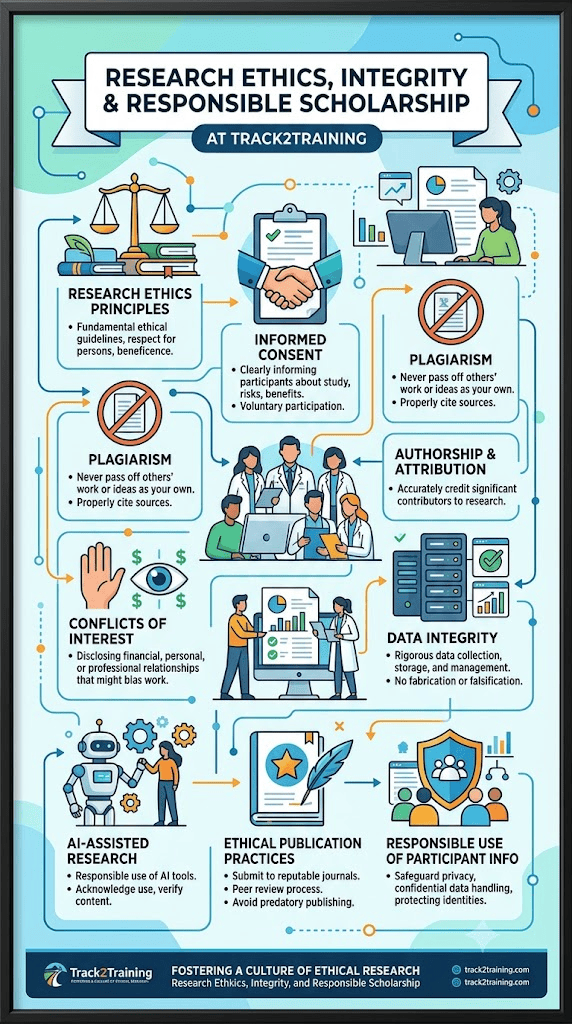
Research has value only when it is conducted responsibly. The credibility of academic knowledge depends not only on innovative ideas or advanced analytical methods but also on honesty, transparency, respect for participants, responsible authorship, accurate reporting, and ethical publication practices.
At Track2Training, research ethics and academic integrity are treated as fundamental components of scholarly activity. Researchers, faculty members, students, collaborators, and contributors are encouraged to follow principles that protect participants, preserve the reliability of evidence, and maintain public confidence in academic research.
Responsible scholarship begins at the planning stage of a study and continues through data collection, analysis, writing, publication, archiving, and dissemination. Ethical research therefore cannot be reduced to a single approval form or declaration. It is a continuous responsibility throughout the research lifecycle.
Research Ethics as a Foundation of Academic Work
Research ethics refers to the principles and standards that guide responsible academic inquiry.
Ethical research requires researchers to consider how their work may affect individuals, communities, institutions, and society. Researchers should minimise potential harm, respect participants’ autonomy, protect privacy, communicate honestly, and report findings accurately.
Track2Training encourages researchers to consider ethical implications before data collection begins.
Important questions include:
- Does the research involve human participants?
- Could participants face physical, psychological, social, professional, or reputational risks?
- Is personal or sensitive information being collected?
- Have participants been adequately informed about the purpose of the study?
- Is participation voluntary?
- How will the data be stored and protected?
- Are there conflicts of interest that need to be disclosed?
- Can the study be conducted in a manner that respects dignity, privacy, and fairness?
Ethical planning strengthens both the credibility and social value of research.
Informed Consent and Voluntary Participation
Informed consent is a central principle in research involving human participants.
Participants should understand what the study is about, why they have been invited, what participation involves, how their information will be used, and whether there are any foreseeable risks or benefits.
Consent should be voluntary.
Researchers should avoid coercion, inappropriate pressure, or misleading information. Participants should normally have the opportunity to decline participation or withdraw according to the conditions communicated during the consent process.
Informed-consent materials should use clear and understandable language appropriate to the participant group.
For online surveys, interviews, field studies, focus groups, experiments, or community-based research, the consent process should be adapted to the research context.
Where vulnerable populations are involved, additional safeguards may be necessary.
Privacy, Confidentiality and Participant Information
Researchers frequently collect information that participants may reasonably expect to remain private.
Responsible research requires careful management of such information.
Personal identifiers should be collected only when necessary for the study. Where possible, research datasets may use anonymisation, pseudonymisation, coded identifiers, or other techniques that reduce unnecessary exposure of participants’ identities.
Researchers should consider who will have access to the data, where it will be stored, how long it will be retained, and how it will ultimately be archived or securely disposed of.
Research reports should also avoid revealing information that could indirectly identify participants.
This is particularly important in small communities, organisations, workplaces, specialist groups, or case studies where individuals may be identifiable even when names are removed.
At Track2Training, respect for research participants extends beyond obtaining consent. It includes responsible stewardship of the information entrusted to researchers.
Plagiarism and Original Scholarship
Plagiarism undermines the foundations of academic research.
It occurs when words, ideas, data, images, arguments, or other intellectual contributions are used without appropriate acknowledgement.
Researchers are expected to distinguish clearly between their own contribution and material derived from other sources.
Proper citation is therefore essential.
This applies not only to direct quotations but also to paraphrased ideas, theoretical frameworks, datasets, figures, tables, methods, and previously published findings.
Self-plagiarism and inappropriate duplication should also be avoided. Researchers should not present previously published material as entirely new work without appropriate disclosure and citation.
Similarity-detection software can support manuscript checking, but responsible scholarship cannot be reduced to a similarity percentage. A manuscript may have a low similarity score and still contain poor attribution, while legitimate quotations and references may increase similarity scores.
Academic integrity ultimately depends on responsible authorship and accurate acknowledgement of sources.
Responsible Authorship
Authorship communicates both academic credit and responsibility.
Individuals listed as authors should have made meaningful scholarly contributions to the research and should be able to take responsibility for their role in the work.
Authorship should not be offered as a favour, institutional courtesy, financial arrangement, or reward unrelated to genuine academic contribution.
Similarly, contributors who have made substantial intellectual contributions should not be excluded unfairly.
Research teams should ideally discuss authorship at an early stage and revisit the discussion if responsibilities change during the project.
Author contributions may include conceptualisation, methodology, data collection, analysis, software development, investigation, writing, supervision, project administration, or other legitimate research activities.
Transparent contribution statements can help clarify the roles played by each researcher.
Practices such as guest authorship, honorary authorship, ghost authorship, and purchased authorship are inconsistent with responsible scholarship.
Conflicts of Interest
A conflict of interest exists when personal, financial, professional, institutional, or other relationships could potentially influence—or reasonably be perceived to influence—the research process.
A conflict of interest does not automatically mean that research is invalid. The important principle is transparency.
Researchers should disclose relevant relationships that may affect research design, data interpretation, publication decisions, or recommendations.
Funding sources should also be reported appropriately.
Where a sponsor has influenced the study design, data analysis, manuscript preparation, or publication decision, this should be transparently stated.
Clear disclosure allows readers to evaluate research with an informed understanding of the circumstances in which it was produced.
Data Integrity and Responsible Analysis
The reliability of research depends heavily on the integrity of its data.
Researchers should maintain accurate records of how data were collected, cleaned, transformed, analysed, and interpreted.
Fabrication, falsification, selective manipulation, or intentional suppression of inconvenient findings are serious violations of research integrity.
Data should never be changed simply because the results do not support the researcher’s expectations.
Researchers should also avoid inappropriate analytical practices such as repeatedly testing models until statistically significant results appear without transparent reporting.
Missing data, excluded observations, outliers, transformations, and analytical decisions should be handled using defensible procedures.
Where possible, analytical workflows should be documented so that results can be checked or reproduced.
Responsible data practices may include maintaining data dictionaries, analytical scripts, survey instruments, coding frameworks, GIS procedures, statistical syntax, and version histories.
Ethical Use of Artificial Intelligence in Research
Generative artificial intelligence is increasingly being used in academic research and scholarly communication.
AI tools can assist researchers with tasks such as language improvement, coding support, literature organisation, brainstorming, data processing, and technical explanation.
However, AI-assisted research introduces important ethical responsibilities.
Researchers remain accountable for everything submitted under their names.
AI-generated information should therefore be checked carefully because such systems may produce inaccurate statements, fabricated references, misleading interpretations, or inappropriate generalisations.
Researchers should not use AI to fabricate data, create fictitious participants, generate false citations, manipulate evidence, or misrepresent work that was never conducted.
Confidential research data, unpublished manuscripts, personally identifiable participant information, or restricted institutional material should not be entered into AI systems without appropriate consideration of privacy, security, and applicable policies.
Where publishers, universities, funders, or professional organisations require disclosure of AI use, researchers should follow those requirements.
AI should support scholarly work without replacing human responsibility, critical judgment, methodological accountability, or intellectual contribution.
Ethical Publication Practices
Responsible publication extends beyond writing a technically correct manuscript.
Researchers should submit work that accurately represents the research undertaken.
Data should not be fabricated or selectively reported. Images and figures should not be manipulated in misleading ways. Citations should be relevant and should not be added merely to inflate citation counts or satisfy inappropriate requests.
Simultaneous submission of the same manuscript to multiple journals should generally be avoided where prohibited by journal policies.
Duplicate publication should also be prevented.
Authors should select publication venues carefully and evaluate whether journals provide transparent editorial policies, credible peer review, clear fees, appropriate indexing claims, and verifiable contact information.
Researchers should be cautious of deceptive journals or publishing platforms that misrepresent peer-review practices, indexing status, impact indicators, or editorial credentials.
Publication decisions should prioritise scholarly suitability and integrity rather than promises of unusually rapid acceptance.
Peer Review and Confidentiality
Peer review is an important component of scholarly communication.
Researchers acting as reviewers should evaluate manuscripts fairly, constructively, and confidentially.
Unpublished ideas or data obtained through peer review should not be used for personal advantage.
Reviewers should declare conflicts of interest when appropriate and avoid reviewing manuscripts where impartiality may reasonably be questioned.
Constructive peer review should focus on research quality, methodology, evidence, interpretation, and presentation rather than personal criticism of authors.
Authors, in turn, should respond to reviewers respectfully and transparently, explaining how comments were addressed or why particular recommendations were not adopted.
Correction, Retraction and Scholarly Accountability
Responsible scholarship includes acknowledging errors.
Even carefully conducted research can contain mistakes.
If researchers identify an important error after publication, they should work with the relevant publisher or institution to determine whether a correction, clarification, or other action is appropriate.
Where serious problems undermine the reliability of published work, formal retraction may be necessary.
Correcting the scholarly record should not automatically be viewed as a failure. Transparent correction mechanisms are an important part of a functioning research system.
The more serious ethical problem arises when researchers knowingly conceal errors or unreliable findings.
Research with Communities and Social Responsibility
Researchers working with communities should consider the broader consequences of their work.
Community-based research should avoid treating participants simply as sources of data.
Where appropriate, researchers should communicate findings back to communities and consider how research outcomes may contribute to practical understanding or decision-making.
Studies involving vulnerable groups require particular sensitivity.
Researchers should avoid language that stigmatises communities or reinforces harmful stereotypes.
Context is essential when interpreting socioeconomic, behavioural, cultural, educational, or health-related findings.
Responsible research should recognise the dignity and agency of people whose experiences contribute to academic knowledge.
Ethical Use of Research Outputs
Research findings can influence planning decisions, public policy, professional practices, technologies, investment, and public understanding.
Researchers therefore have a responsibility to communicate evidence carefully.
Results should not be exaggerated to create stronger headlines or policy claims than the evidence supports.
Statistical association should not automatically be described as causation. Findings from limited samples should not be presented as universally applicable.
Limitations and uncertainty should be communicated clearly.
Responsible scholarship requires researchers to distinguish between what the evidence demonstrates, what it suggests, and what remains uncertain.
Building a Culture of Research Integrity
Research integrity is most effective when it becomes part of institutional culture.
Track2Training seeks to promote this culture through research training, methodological guidance, ethical awareness, scholarly communication, and responsible academic practice.
Students and early-career researchers should be introduced to research ethics from the beginning of their academic development rather than encountering it only during journal submission or ethics review.
Training may address topics such as:
research ethics, informed consent, plagiarism prevention, authorship, citation practices, data management, statistical integrity, AI use, publication ethics, peer review, and research transparency.
Senior researchers and supervisors also play an important role by modelling responsible research practices.
Our Commitment to Responsible Scholarship
At Track2Training, research integrity is understood as a shared responsibility involving researchers, supervisors, institutions, participants, reviewers, editors, publishers, and research collaborators.
Ethical scholarship requires more than compliance with rules. It requires a commitment to honesty, transparency, fairness, respect, accountability, and intellectual responsibility.
From informed consent and participant confidentiality to authorship, data integrity, AI-assisted research, and publication practices, ethical considerations should remain embedded throughout the research process.
As technologies and research methods continue to evolve, new ethical challenges will emerge. The principles underlying responsible research, however, remain consistent: protect participants, preserve the integrity of evidence, acknowledge contributions fairly, communicate transparently, and ensure that scholarly work deserves the trust placed in it.
Through these principles, Track2Training aims to strengthen a research environment in which academic quality and ethical responsibility advance together.
Which relationship has taught you the most about yourself?
View all responses

