Radio In India

N kavya

Radio broadcasting began in India in 1922. The Government owned radio station All India Radio dominated broadcasting since 1936.

Broadcasting in India actually began about 13 years before AIR came into existence. In June 1923 the Radio Club of Bombay made the first ever broadcast in the country. This was followed by the setting up of the Calcutta Radio Club five months later. The Indian Broadcasting Company (IBC) came into being on July 23, 1927, only to face liquidation in less than three years.

In April 1930, the Indian Broadcasting Service, under the Department of Industries and Labour, commenced its operations on an experimental basis. Lionel Fielden was appointed the first Controller of Broadcasting in August 1935. In the following month Akashvani Mysore, a private radio station was set up. On June 8, 1936, the Indian State Broadcasting Service became All India Radio.

The Central News Organisation (CNO) came into existence in August, 1937. In the same year, AIR came under the Department of Communications and four years later came under the Department of Information and Broadcasting. When India attained independence, there were six radio stations in India, at Delhi, Bombay, Calcutta, Madras, Tiruchirapalli and Lucknow. The following year, CNO was split up into two divisions, the News Services Division (NSD) and the External Services Division (ESD). In 1956 the name AKASHVANI was adopted for the National Broadcaster. The Vividh Bharati Service was launched in 1957 with popular film music as its main component

The phenomenal growth achieved by All India Radio has made it one of the largest media organisations in the world. With a network of 262 radio stations, AIR today is accessible to almost the entire population of the country and nearly 92% of the total area. A broadcasting giant, AIR today broadcasts in 23 languages and 146 dialects catering to a vast spectrum of socio-economically and culturally diverse populace.

Programmes of the External Services Division are broadcast in 11 Indian and 16 foreign languages reaching out to more than 100 countries. These external broadcasts aim to keep the overseas listeners informed about developments in the country and provide a rich fare of entertainment as well.

The News Services Division, of All India Radio broadcasts 647 bulletins daily for a total duration of nearly 56 hours in about 90 Languages/Dialects in Home, Regional, External and DTH Services. 314 news headlines on hourly basis are also being mounted on FM mode from 41 AIR Stations. 44 Regional News Units originate 469 daily news bulletins in 75 languages. In addition to the daily news bulletins, the News Services Division also mounts number of news-based programmes on topical subjects from Delhi and its Regional News Units

AIR operates at present 18 FM stereo channels, called AIR FM Rainbow, targeting the urban audience in a refreshing style of presentation. Four more FM channels called, AIR FM Gold, broadcast composite news and entertainment programmes from Delhi, Kolkata, Chennai and Mumbai. With the FM wave sweeping the country, AIR is augmenting its Medium Wave transmission with additional FM transmitters at Regional stations.

In April 2020, as per a survey by AZ Research PPL, commissioned by the Association of Radio Operators for India (AORI) Radio listenership in India touched a peak of 51 million.

Does radio have a future?

The consoles, connected watches and TV’s that we use every day will be just another way in which radio stations can broadcast and increase their audience numbers. Since its creation, radio has continually evolved with the times

Why Radio is still popular?

Portable and Inexpensive: Radio is portable among many modes of communication. They can be used in cars, stores, and other places, which helps to reach the targeted audience. According to researchers, broadcast radio reaches 99% of the Indian population today.

The Government decision for transition to the digital mode of transmission, AIR is switching from analog to digital in a phased manner. The technology adopted is the Digital Radio Mondiale or DRM. With the target of complete digitization by 2017, the listeners can look forward to highly enhanced transmission quality in the near future.

General issues on Environmental ecology

The environment plays a significant role to support life on earth. But there are some issues that are causing damages to life and the ecosystem of the earth. It is related to the not only environment but with everyone that lives on the planet. Besides, its main source is pollution, global warming, greenhouse gas, and many others. The everyday activities of human are constantly degrading the quality of the environment which ultimately results in the loss of survival condition from the earth.There are hundreds of issue that causing damage to the environment. But in this, we are going to discuss the main causes of environmental issues because they are very dangerous to life and the ecosystem.

Pollution โ€“ It is one of the main causes of an environmental issue because it poisons the air, water, soil, and noise. As we know that in the past few decades the numbers of industries have rapidly increased. Moreover, these industries discharge their untreated waste into the water bodies, on soil, and in air. Most of these wastes contain harmful and poisonous materials that spread very easily because of the movement of water bodies and wind. Greenhouse Gases โ€“ These are the gases which are responsible for the increase in the temperature of the earth surface. This gases directly relates to air pollution because of the pollution produced by the vehicle and factories which contains a toxic chemical that harms the life and environment of earth. Climate Changes – Due to environmental issue the climate is changing rapidly and things like smog, acid rains are getting common. Also, the number of natural calamities is also increasing and almost every year there is flood, famine, drought, landslides, earthquakes, and many more calamities are increasing.

Development recognises that social, economic and environmental issues are interconnected, and that decisions must incorporate each of these aspects if there are to be good decisions in the longer term.For sustainable development, accurate environment forecasts and warnings with effective information on pollution which are essential for planning and for ensuring safe and environmentally sound socio-economic activities should be made known.


THE EARTH IS WHAT WE
ALL HAVE IN COMMAN

History of India & Indian National Movement.

Early times the Indian subcontinent appears to have provided an attractive habitat for human occupation. Toward the south it is effectively sheltered by wide expanses of ocean, which tended to isolate it culturally in ancient times, while to the north it is protected by the massive ranges of the Himalayas, which also sheltered it from the Arctic winds and the air currents of Central Asia. Only in the northwest and northeast is there easier access by land, and it was through those two sectors that most of the early contacts with the outside world took place.

Within the framework of hills and mountains represented by the Indo-Iranian borderlands on the west, the Indo-Myanmar borderlands in the east, and the Himalayas to the north, the subcontinent may in broadest terms be divided into two major divisions: in the north, the basins of the Indus and Ganges (Ganga) rivers (the Indo-Gangetic Plain) and, to the south, the block of Archean rocks that forms the Deccan plateau region. The expansive alluvial plain of the river basins provided the environment and focus for the rise of two great phases of city life: the civilization of the Indus valley, known as the Indus civilization, during the 3rd millennium BCE; and, during the 1st millennium BCE, that of the Ganges. To the south of this zone, and separating it from the peninsula proper, is a belt of hills and forests, running generally from west to east and to this day largely inhabited by tribal people. This belt has played mainly a negative role throughout Indian history in that it remained relatively thinly populated and did not form the focal point of any of the principal regional cultural developments of South Asia. However, it is traversed by various routes linking the more-attractive areas north and south of it. The Narmada (Narbada) River flows through this belt toward the west, mostly along the Vindhya Range, which has long been regarded as the symbolic boundary between northern and southern India.

India’s movement for Independence occurred in stages elicit by the inflexibility of the Britishers and in various instances, their violent responses to non-violent protests. It was understood that the British were controlling the resources of India and the lives of its people, and as far as this control was ended India could not be for Indians.

On 28 December 1885 Indian National Congress (INC) was founded on the premises of Gokuldas Tejpal Sanskrit School at Bombay. It was presided over by W.C Banerjee and attended by 72 delegates. A.O Hume played an instrumental role in the foundation of INC with an aim to provide Safety Valve to the British Government.
A.O Hume served as the first General Secretary of INC.
The real Aim of Congress is to train the Indian youth in political agitation and to organise or to create public opinion in the country. For this, they use the method of an annual session where they discuss the problem and passed the resolution.
The first or early phase of Indian Nationalism is also termed as Moderate Phase (1885-1905). Moderate leaders were W.C Banerjee, Gopal Krishna Gokhale, R.C Dutt, Ferozeshah Mehta, George Yule, etc.
Moderates have full faith in British Government and adopted the PPP path i.e. Protest, Prayer, and Petition.
Due to disillusionment from Moderates’ methods of work, extremism began to develop within the congress after 1892. The Extremist leaders were Lala Lajpat Rai, Bal Gangadhar Tilak, Bipin Chandra Pal, and Aurobindo Ghosh. Instead of the PPP path, they emphasise on self-reliance, constructive work, and swadeshi.
With the announcement of the Partition of Bengal (1905) by Lord Curzon for administrative convenience, Swadeshi and Boycott resolution was passed in 1905.


ONE INDIVIDUAL MAY DIE; BUT THAT IDEA WILL, AFTER HIS DEATH, INCARNATE ITSELF IN A THOUSAND LIVES.

-Netaji Subhash Chandra Bose

Internet Protocol

What is an IP address?

An IP address abbreviation of Internet Protocol address, it is an address that is provided by the Internet Service Provider to the user, it is just like a postal address code that is pin code to find the location or place where to send the message.  An IP address is a unique group of number what are separated by the period (.), it varies from 0 to 255, and   every device has a separate and unique IP address that is assigned by the specific Internet Service Provider (ISP) to identify which particular device is communicating with them and accessing the internet from there.

If you want to access internet from you device which may be your Android, I phone, Computer the service provider assigned them a particular, unique  address  that is help them to communicate send, receive information from the right person without any misunderstanding, mistake the message is pass to the authentic person to whom it has to send.  This problem is solved by the IP address, in olden days; we have postal address to send the message/letter to the person, the message that has to be sent with the help of the address which may be his house number, city, town, postal code.  The sender will write the address on the top of the letter envelope so that it will be delivery to the right person.  If the person connected his device to internet provide by the hotel, the hotelโ€˜s Internet Service Provider will assign an IP address to the device.

Types of IP addresses

There are different types of IP based on different categories, types.

Consumer IP addresses

A Consumer IP addresses is the individual IP addresses of a customer who connects his/her  device to a public or private  network.  A consumer connects his device through internet from his Internet Service Provider, or from the Wi-Fi.  In these days the Consumer has many electronic gadgets which he connects to his router that transfer the data from the Internet Service Provider.

Private IP addresses

A  Private IP addresses are a secure one that is connected Private Network and every devices that is connected to this Private Network is assigned a unique IP address that is assigned by the Internet Service Provider.  All Mobile devices, Computer, and Internet of Things that are connected to this private network are assigned a unique string number to the devices.

Public IP addresses

A Public IP addresses is the main address that is related to your network, as stated above that the IP address are assigned by the Internet Service Provider, the Public IP address is also assigned by the Internet Service Provider, The Internet Service Provider has a large amount of IP addresses that are stored and assigned to the customer. The public IP address is the address that  devices that are outside the network use to identify the network.

The Public IP addresses are further classified into two types they are:

  1. Dynamic
  2. Static

Dynamic IP addresses

                The Dynamic  IP address  are the IP address that changes very frequently, so the Internet  Service Providers  purchase a very huge amount of IP addresses , they assign it mechanically to the customer . This frequently changing the IP address helps the customer not to make the security actions. The frequently changing IP address wonโ€™t let the hacks to track or pool your data.

 Static IP addresses

The Static IP addresses is the contradictory to the Dynamic IP address, it remain fixed. The IP address remains fixed when it is assigned by the Internet Service Provider.  The mostly many person and business man donโ€™t   choose static because it is risk of getting easily track, but most business which are trying host her own website server choose Static IP address so it will easier  for the customer to find them.

                The IP address can be protect by 2 ways that are using proxy and the other one is use of Virtual Private Network.   A proxy server acts as a intermediary between the internet server and your internet service providers, when you visit any website it will show the proxy IP address not yours. 

Where to find IP address is Device?

                The IP address set up in every device that is connected to the Internet, but the steps or direction is different in different devices. Some of device direction is given below:

In Window or any other Personal Computer

  1. Go to the Start Menu
  2. Type  โ€˜Runโ€™ in the Search bar
  3. A Run Tab pops up
  4. Type  โ€˜cmdโ€™
  5. A black screen pops up
  6. Type โ€˜ipconfigโ€™
  7. Your  IP address is found.

In Android Mobile

  1. Go to the Settings
  2. Tap on Network and Internet
  3. Tap on Wi-Fi, it will show the IP address

Horace as a Critic

Quintus Horatius Flaccus (65 BCEโ€“8 BCE ), more commonly known as Horace, was a Roman poet, best known for his satires and his lyric odes.

His letters in verse, particularly hisย Ars Poetica: Epistle to the Pisos, outline his beliefs about the art and craft of poetry. His main contribution to the traditions of literary theory we are exploring lie in his articulation of the purpose of poetry, or literature in general: it isย dulce et utile, sweet and useful.

Horace insists that literature serves the didactic purpose which had been Platoโ€™s main concern, and that it provides pleasure; the two goals are not incompatible, as Plato had feared. Poetry is a useful teaching tool, Horace argues, precisely because it is pleasurable. The pleasure of poetry makes it popular and accessible, and its lessons thus can be widely learned. Likeย Plato, Horace sees nature as the primary source for poetry, but he argues that poets should imitate other authors as well as imitating nature. Horace thus establishes the importance of a poet knowing a literary tradition, and respecting inherited forms and conventions, as well as creating new works.

Except for a few late Roman and early medieval writers who contributed to the discussion of theories about literature, such as Plotinus (204โ€“70), Boethius (480โ€“524),ย St. Thomas Aquinasย (1225โ€“74), and Dante Alighieri (1265โ€“1321), the writings of Plato, Aristotle, and Horace pretty much defined the parameters of thought about literature from the ancient world until the Renaissance.

The explosion of art, literature, and science which we think of as the hallmark of the European Renaissance in the fourteenth to the sixteenth centuries prompted not only a deluge of literary texts, including the works of such luminaries as Shakespeare, but also a torrent of writings about the purpose, form, and importance of literature. The Renaissance discourse on literary theory was stimulated at least in part by the rediscovery of Aristotleโ€™s Poetics, a text which had been lost to Western culture during the Dark Ages.

Aristotle as a Critic

Crucial to Aristotleโ€™s defense of art is his 

  • Rejection of Platoโ€™s Dualism

Man is not an โ€œembodiedโ€ intellect, longing for the spiritual release of death, but rather an animal with, among all the other faculties, the ability to use reason and to create

  • Rejection of Platoโ€™s Rationalism
    We must study humans as we would study other animals to discover what their โ€œnatureโ€ is. Look among the species; see who are the thriving and successful and in what activities do they engage? For Aristotle, this is how to determine what is and is not appropriate for a human and human societies
  • Rejection that Mimesis= Mirroring Nature

Aristotle: Art is not useless

  • It is Natural:
  1. It is natural for human beings to imitate
  2. Any human society which is healthy will be a society where there is imitative art
  3. Nothing is more natural that for children to pretend
  • Art production and training is a necessary part of any education since it uses and encourages the imaginative manipulation of ideas
  1. Nothing is more natural than for human beings to create using their imagination
  2. Since art is imitation, it is an imaginative use of concepts; at its heart art is โ€œconceptual,โ€ โ€œintellectualโ€

Aristotle: good art is not dangerous

A) Art is not deceptive:

  • Artists must accurately portray psychological reality in order for characters to be believable and their actions understandable
  • It teaches effectively and it teaches the truth
  • Convincing and powerful drama is convincing and powerful because it reveals some truth of human nature
  • Introduces the concept of โ€œOrganic Unityโ€ โ€“ the idea that in any good work of art each of the parts must contribute to the overall success of the whole
  • Just as in biological organisms each part contributes to the overall health and wellbeing of the creature, so too in good works of art reflects or imitates reality
  • Unified action, โ€œwith its several incidents so closely connected that the transposal or withdrawal of any one of them will disjoin and dislocate the wholeโ€

B) Sensuous art is not a bad thing:

  • Aristotle did not believe that the mind was one thing and body was something else and therefore Aristotle did not have the bias against physical pleasure that Plato had
  • The only way of acquiring knowledge at all, according to Aristotle, was through the senses and so developing, exercising and sharpening those senses through art was a healthy thing to do
  • Art was not solely concerned with the sensual pleasures, but rather was/should be an intellectual, conceptual affair.

C) (Good) Art is tied to Morality and Truth

  • (Successful Tragic) Drama always teaches morality. When trying to understand how tragedies achieve their peculiar effect (Pathos), he notes the psychology and morality on which they must be based
  • NB: Aristotle believe that drama imitated not only โ€œevensโ€ but actions. As such they imitated intended behaviours, psychological forces and the unseen โ€œinner lifeโ€ of persons
  • He unwittingly set up two functions for a work of art to fulfil; to imitate natureโ€™s perceptual detail and to imitate natureโ€™s โ€œorganic unity.โ€

Aristotle agreed that art did stir up negative emotions but, he claims it then purged these in harmless, healthy way. This led to the principle of Catharsis

  • Art is neither psychologically destabilizing nor politically destructive
  • Art is a therapeutic part of the healthy life of not only the individual, but of the nation

Aristotle: Mimesis is not equal to imitation

Mimesis is more like

  • Rendering
  • Depicting
  • Construing
  • Idealizing
  • Representing

Aristotleโ€™s Critical Responses

  • Poetry is more Philosophical than History
  • โ€œPoetry is sometimes more philosophic and of graver importance than history (He means a mere chronicle of events here), since its statements are of the nature rather of universals, whereas those of history are singularsโ€
  • Poetry describes โ€œnot the thing that has happenedโ€ as Aristotle imagines history does โ€œbut a kind of thing that might happen, (i.e, what is possible) as being probable or necessaryโ€
  • Thus history mere โ€œmirrors,โ€ but not art. Art is necessarily conceptual /cognitive.

Aristotle on Tragedy

In the Poetics, Aristotle compares tragedy to such other metrical forms as comedy and epic. He determines that tragedy, like all poetry, is a kind of imitation (mimesis), but adds that it has a serious purpose and uses direct action rather than narrative to achieve its ends. He says that poetic mimesis is imitation of things as they could be, not as they are โ€” for example, of universals and ideals โ€” thus poetry is a more philosophical and exalted medium than history, which merely records what has actually happened.

The aim of tragedy, Aristotle writes, is to bring about a โ€œcatharsisโ€ of the spectators โ€” to arouse in them sensations of pity and fear, and to purge them of these emotions so that they leave the theater feeling cleansed and uplifted, with a heightened understanding of the ways of gods and men. This catharsis is brought about by witnessing some disastrous and moving change in the fortunes of the dramaโ€™s protagonist (Aristotle recognized that the change might not be disastrous, but felt this was the kind shown in the best tragedies โ€” Oedipus at Colonus, for example, was considered a tragedy by the Greeks but does not have an unhappy ending).

According to Aristotle, tragedy has six main elements: plot, character, diction, thought, spectacle (scenic effect), and song (music), of which the first two are primary. Most of the Poetics is devoted to analysis of the scope and proper use of these elements, with illustrative examples selected from many tragic dramas, especially those of Sophocles, although Aeschylus, Euripides, and some playwrights whose works no longer survive are also cited.

Several of Aristotleโ€™s main points are of great value for an understanding of Greek tragic drama. Particularly significant is his statement that the plot is the most important element of tragedy:

Tragedy is an imitation, not of men, but of action and life, of happiness and misery. And life consists of action, and its end is a mode of activity, not a quality. Now character determines menโ€™s qualities, but it is their action that makes them happy or wretched. The purpose of action in the tragedy, therefore, is not the representation of character: character comes in as contributing to the action. Hence the incidents and the plot are the end of the tragedy; and the end is the chief thing of all. Without action there cannot be a tragedy; there may be one without character. . . . The plot, then, is the first principle, and, as it were, the soul of a tragedy: character holds the second place.

Aristotle goes on to discuss the structure of the ideal tragic plot and spends several chapters on its requirements. He says that the plot must be a complete whole โ€” with a definite beginning, middle, and end โ€” and its length should be such that the spectators can comprehend without difficulty both its separate parts and its overall unity. Moreover, the plot requires a single central theme in which all the elements are logically related to demonstrate the change in the protagonistโ€™s fortunes, with emphasis on the dramatic causation and probability of the events.

After We Fell by Anna Todd

Book Three of the After seriesโ€”now newly revised and expanded, Anna Toddโ€™s After fanfiction racked up 1 billion reads online and captivated readers across the globe. Experience the Internetโ€™s most talked-about book for yourself!


Tessa and Hardinโ€™s love was complicated before. Now itโ€™s more confusing than ever.ย AFTER WE FELLโ€ฆLife will never be the same. #HESSA
Just as Tessa makes the biggest decision of her life, everything changes. Revelations about first her family, and then Hardinโ€™s, throw everything they knew before in doubt and makes their hard-won future together more difficult to claim.
Tessaโ€™s life begins to come unglued. Nothing is what she thought it was. Not her friends. Not her family. The one person she should be able to rely on, Hardin, is furious when he discovers the massive secret sheโ€™s been keeping. And rather than being understanding, he turns to sabotage. Tessa knows Hardin loves her and will do anything to protect her, but thereโ€™s a difference between loving someone and being able to have them in your life. This cycle of jealousy, unpredictable anger, and forgiveness is exhausting. Sheโ€™s never felt so intensely for anyone, so exhilarated by someoneโ€™s kissโ€”but is the irrepressible heat between her and Hardin worth all the drama? Love used to be enough to hold them together. But if Tessa follows her heart now, will it beโ€ฆthe end?


5 stars(this review contains spoilers for After and After We Collided)


The After series keeps on getting better and better! After We Fell is by far my favorite of the three!
At the end of After We Collided we were left again on a cliffhanger with a rather unexpected turn of events, Tessa is trying to find a way to break the news of her impending move to Seattle to Hardin when she runs into her estranged father outside a tattoo shopโ€ฆ
I hope you guys are fond of rollercoasters because, this book like its two predecessors, is nothing short of one, so hang on tight!ย 

Itโ€™s no surprise when I tell you that as soon as I started I was already frustrated.Tessa is going ahead with her plans to relocate to Seattle with Vance Publishing, Things are rocky with Hardin though not completely called off.Hardin is wayyyyyyyy frustrating though, when one thinks that he is starting to understand that a relationship takes compromise and that it’s not all about him and what he wants, he turns into the most unreasonable person ever. He doesnโ€™t have a valid reason at all to not want to move with Tessa to Seattle other than his insecurities, but yet even when he knows this he still chooses to be a total idiot about it.Tessa talks him into coming on a weekend trip with her and his family, in an effort to try and mend things and have some fun together.The trip will prove to be anything but fun! I felt like jumping into the book and screaming at Hardin I just couldn’t even process what he was doing!

 Once again the Hardin from the past surfaces and itโ€™s like we took 10 steps backward rather than forward, again he proves he can be overly controlling and inconsiderate. I was seriously pissed with him when I found out the lengths that he went to in order to try and get his way. I couldnโ€™t blame Tessa for being tired of his antics, when over and over he screws things up and then expects her to just forgive and forget.

I was glad though to see that Tessa didnโ€™t give in to Hardinโ€™s wishes, and put herself and her career first. I think Hardin needs to learn that not everything can go his way.Though while super smart for some things Tessa can be soooo dense for others. She gets invited to a โ€œgoing awayโ€ party at the frat house out of all places. Why would she even consider going there and hanging out with all those people that were nothing but horrible to her? I was screaming at the top of my lungs in frustration, ok fine maybe I was screaming into my Goodreads updates, but seriously Tessa!!

This is the point when things start getting really screwy and my heart was racing out of my chest, I mean we have seen betrayal before and I really didnโ€™t think I would see anything that would have me totally flabbergasted againโ€ฆ! I was crying angry tears for Tessa, I had to put the book down and walk away from it for a bitโ€ฆ I was in total and absolute disbeliefโ€ฆ

I donโ€™t want to give you tooo many details but just know that there is drama, frat house drama, Tessaโ€™s dad drama, Tessaโ€™s mother drama oh! and if you didnโ€™t guess it? Yeah, there is plenty of Zed drama!I mean I get it Zed is hot, he is nice, he shows up at the right time and at the right place but come on Tessa!!!! How much more are you going to push Hardin? Again I found myself wanting to slap some sense into this girl.

In After We Fell, like After We Collided, we have Hardinโ€™s POV which again is crucial to the story because while he still makes you mad you can understand why he is the way he is. I cant deny the growth in him, trying to control his temper, trying not to be impulsive and especially being much more considerate with Tessa, even his relationship with Landon makes you smile in this book. Again you see the wonderful guy he can be if he can learn to love himself.

But, itโ€™s Hessa we are talking about here so drama doesnโ€™t stay at bay for too long and the last part of the book will prove to be jaw dropping totally unexpected drama, and for this I wonโ€™t drop even a hint because you really need to experience this for yourself. All I can say is that it was unexpected and devastating, Iโ€™m scared for Hardin and his state of mind and him falling into that downward spiral he seems to often flirt with. What he will face will definitely be a very tough pill to swallow.

The last line in this book left me hyperventilating and in disbeliefโ€ฆ

and in need of wine.. lots and lots of wine… 

It has been a very long time since I’ve had a book hangover, years even. I finished After We Fell and couldn’t stop thinking about it, let alone start another book right away.

The fourth and final installment will be hitting shelves on February 24, yup that’s 49 days from today (but who’s counting), I can totally wait, because I’m so not dying to know what happens next….

Top 5 books to read at least once in your life.ย 

This is an image of Top 5 books to read at least once in your life.
Photo by rikka ameboshi on Pexels.com

Reading is an immersive experience that often rewards you with a great story and good vocabulary. There are books across several genres one can choose from to indulge in a wonderful reading experience. But there are some books that fall under the category of โ€˜classicsโ€™ as their themes, characters, and plot lines become relevant for ages to come. These are written by some of the brilliant literary minds that became popular and they went on to influence many modern works of literature. 

Animal Farm- a satirical allegory

This is an image of Animal Farm
Photo by Amelie Lachapelle on Pexels.com

The story begins with a typical farm being run by a human with a variety of animals living in it. The farm animals are often mistreated, overworked and ignored by the human which agitates them. Hoping to overthrow the human race and reaping all the benefits of their work, they drive the human out of the farm. What follows is a satirical allegory to the events that happened during and after the Russian Revolution of 1917.ย 

Although the story revolves around farm animals, its  themes of corruption, slavery, dicatorship, class distinction, and characters, makes the readers draw parallels with the current political scenario. It is a must-read for a better understanding of the Russian revolution and an engaging experience. 

The Great Gatsby- The Jazz age novel

The Great Gatsby is a 1925 novel written by F. Scott Fitzgerald. It follows the life of a self-made millionaire named Jay Gatsby who is in pursuit of his long lost lover named Daisy Buchanan. The novel however, has little scope for romance and represents America in the 1920s. It highlights the era of unrivalled wealth and materialistic access. 

The novel upon its release didnโ€™t gain commercial success. Critics believed that it did not amount to Fitzgeraldโ€™s earlier novels. However, it began to gain popularity during World War II as free copies were distributed among American soldiers who were serving overseas. The Great Gatsby went on to become an important part of Americaโ€™s educational curriculum and pop culture. 

The novel continues to attract scholarly attention and is a contender for the title of โ€˜The Great American Novelโ€™. 

Harry Potter and the Philosopherโ€™s stone- You Know Who

This is an image of Harry Potter and the Philosopher's stone
Photo by Dzenina Lukac on Pexels.com

This book can be considered as J.K Rowlingsโ€™ stepping stone to success. After being rejected by 11 publications and finally being published by Bloomsbury publication, upon the request of the chief executiveโ€™s 8 year old daughter. Harry Potter and the Philosopherโ€™s stone went on to be translated into 73 languages and sold 120 million copies. Becoming the second best-selling novel of all time.ย 

The story follows Harry Potter and the readersโ€™ introduction to the world of magic, following Harryโ€™s discovery of his magical heritage and acceptance into the Hogwarts School of Witchcraft and Wizardry. As the readers alongside Harry manage to grasp the  revelation of a whole new world of possibilities, worthy opponents and dangers show up on whom magic must be used to defeat and protect. 

The Book Thief- Narrated by death.

Photo by Ingo Joseph on Pexels.com

Reading is an immersive experience that often rewards you with a great story and good vocabulary. There are books across several genres one can choose from to indulge in a wonderful reading experience. But there are some books that fall under the category of โ€˜classicsโ€™ as their themes, characters, and plot lines become relevant for ages to come. These are written by some of the brilliant literary minds that became popular and they went on to influence many modern works of literature.ย 

The book thief is a 21st century novel that uses the Nazi regime in Germany as its background. Although it has its fair share of horror and despair. The Book Thief delivers hope to its readers through love and tranquility among family and friends. 

The novel follows the life of Liesel, who moves into her new foster parentsโ€™ home following her brotherโ€™s death. As she goes on to witness the dangers posed by the Nazi regime, Liesel adopts her newly found passion for reading by stealing books from the rubbles and also the Mayorโ€™s house. One of the pivotal characters in the novel is death itself as it narrates the entire story.ย 

The Lion, The Witch, and The Wardrobe- A world of fantasy

This is an image of The Lion, The  Witch and The Wardrobe
Photo by Pixabay on Pexels.com

Open the book to a whole new world of fantasy, mythical creatures and magic. When 4 siblings are relocated to a large house in the countryside due to wartime evacuation. They discover a wardrobe in the house which had more than just clothes hanging inside. The 4 siblings venture into the world of dreams upon entering the wardrobe. They go on to encounter the witch and the lion, and participate in an impending war to end the evilโ€™s oppression over the good. 

This fantasy novel was the first to be published among the 7 volumes known as The Chronicles of Narnia. C.S Lewis wrote this novel as a dedication to his goddaughter named Lucy Barfield. 

Here are some of the classic novels from the 20th century across different genres to enhance your reading pleasure. 

Happy Reading.

Buy books on Amazon

References

Anna Chui, 26th  January 2021, lifehack.org

goodreads.com

wikipedia.org

Remembering R K Narayan, The Creator of Malgudi

R K Narayan is arguably one of the brilliant storytellers who could create stories and characters that were relatable yet intriguing. He was one among the few writers of his era, who could weave magic with simple words and effortlessly spin a tale out of the mundane everyday events.

Born as Rasipuram Krishnaswami Iyyer NarayanaSwami in Madras, R K Narayan spent a part of his childhood in Madras with his grandmother and later moved to Mysore when his father, a school headmaster, was posted to the Maharajah’s College High School. An avid reader, he devoured the works of Dickens, Wodehouse, Thomas Hardy and Arthur Conan Doyle during his boyhood. 

If you were to observe the trajectory of R K Narayanโ€™s life, you would find that he wasnโ€™t someone who has had a smooth ride. From failing his university entrance exam, taking an extra year to complete his bachelor’s degree, quitting his rather short stint  as a school teacher, remaining jobless for a very long time to being ridiculed for his writing and facing a series of initial rejections, setbacks were a part and parcel of his life. Through all these, what kept him going was his intense passion for writing. 

During his initial days as a writer, he wrote occasionally  for local publications. His first short story Dodo – about a boy who wanted to earn pocket money to roam about and buy peanuts – was published by The Merry magazine. Thereafter he managed to get several other of his works printed by the magazine and by the Hindu. Later, he had also worked as a reporter for The Justice, a Madras-based paper, after his marriage to the love of his life, Rajam.

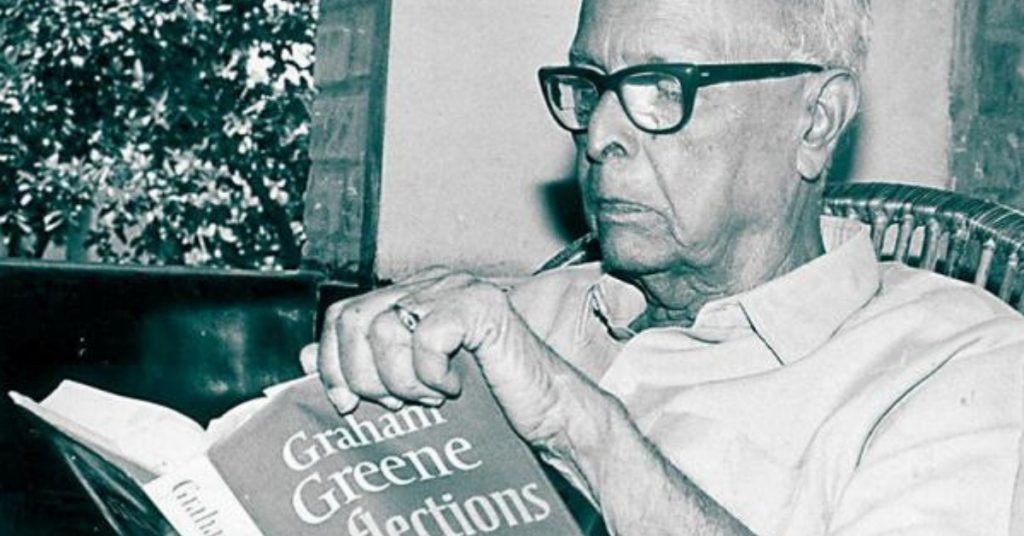
When he wrote his first book, Swami and Friends, it went through a string of rejections that, after a point, Narayan lost hope and asked his friend Kittu Purna in Oxford (whose address he had given as return address for the manuscript), to weigh manuscript  down with rocks and  drown it in the Thames if it were to be rejected again. Well, the novel did get rejected but his friend had a better idea than drowning it. He took it to Graham Greene, a writer who he had met in Oxford, who ended up loving it and even found a publisher for the book. The literary world would forever be indebted to Kittu Purna for not complying to his friendโ€™s request or else the magical town of Malgudi would have forever remained hidden in the depths of the Thames. 

Around the time when he was gradually making a mark as a writer, life was not being particularly kind to him on the personal front. He lost his father and his wife within a gap of merely a couple of years, which left him devastated. In the face of losses, it was the world of words that held his hands and he managed to channel his grief into creating masterpieces in literature. The English Teacher, as he later acknowledged, was a reflection of his emotions during the time of his wifeโ€™s death.He went on to write several other novels and short stories during his career and most of them were set in Narayanโ€™s very own Malgudi.

Image Credit: Farnaz Fever

Narayan was a brilliant storyteller who could capture the essence of the mundane everyday life and turn it into a literary masterpiece.Through simple words, punctuated cleverly by just the right amount of humour, he found his way into the hearts of millions of readers.

During the course of his literary career, he won various awards including the Sahitya Akademi Award for The Guide and the AC Benson Medal by the British Royal Society of Literature. He was also awarded Padma Bhushan and Padma Vibhushan  for his contributions to the country. 

He was a man of simple needs (well,ย  except for that coffee, which he needed exactly the way he liked it ! ) and just like his characters lived a rather simple life. He always made sure to keep himself rooted in reality.Even during his later years, he never missed the chance to have a chat with the people who he used to meet during his afternoon strolls. He treated these walks as his office hours for that is where he often met his characters.ย 

Narayan was a person who valued friendships more than anything else. Much of his later years were spent in having warm conversations and the perfect Narayan-style coffees with the people he treasured the most. Perhaps those were the things that kept him going after he lost his daughter to cancer.  His final novel, Grandmotherโ€™s Tale was dedicated to his daughter Hema. He was a writer who was so invested in his craft that he used to write around 1000 words daily, even while travelling (aspiring writers please make a note !). Even a few hours before he was shifted to the ventilator, all he wanted was for his friend, N. Ram, to get him a notebook for the next novel that he was planning to write. Unfortunately for the readers, that novel never got materialised as he passed away soon after, at the age of 94.

R K Narayan will always be remembered as one of the finest storytellers who inspired many generations of writers to discover the beauty of their own backyards and his legacy will live on through every reader, who secretly wish to pack their bags and move to Malgudi.

Things to know before taking up Mass Media and Communication courses.

Photo by Caleb Oquendo on Pexels.com

Letโ€™s begin by knowing what Mass Media or Mass Communication is. Mass media refers to the media technologies such as movies, songs, news, podcasts, advertisements and photos, that are utilized to carry information to the masses. 

Importance of Mass Media

This blog you are reading is helping you gain knowledge about Mass Media and communication. Hence this blog becomes a media technology and educating you in the field of Mass Media defines its importance. From applying for a job to reaching out to a friend on your phone, everything becomes a portion of Mass Media as they help users pass on information from one place to another or one person to another. 

Here are some advantages of Mass Media to highlight its importance. 

  • It becomes a voice for the voiceless: Mass Media provides every individual with an opportunity to practice their freedom of speech and spread their ideas among the world. YouTube is a great example of Mass Media. As a platform in this 21st century it helps both small and large creators publish their videos for everybody to watch. 
  • Enables widespread communication: Today, the world is often referred to as a global village. This is made possible due to several types of mass media technologies such as social media, internet, and other digital content. It helps governments, businesses and organizations to communicate with each other and stay connected. 
  • Diversifying culture: Mass Media helps in diversifying languages and cultures beyond its place of origin. A good internet connection and a mobile phone or a computer is all you need to learn a new language or gain knowledge about a new culture. You can even take a peek around the world without leaving your home. 

The Evolution of Mass Media

Mass Media can be traced back to the 800 AD which consisted of prehistoric arts, writings and some basic printing technology. The introduction of Gutenbergโ€™s printing press in the 1450s helped art and literature gain a wider reach among the people.The year 1605 witnessed the publishing of the first weekly newspaper in Antwerp, known as โ€˜Relationโ€™. This was followed by the inventions of radio and television in 1895 and 1925 respectively. Finally in 1990, the world wide web was introduced by Tim Berners Lee. 

The number of people benefiting from these media technologies witnessed a steady growth from a handful, to thousands, and millions with the introduction of newspapers, radios and televisions. Today, due to the internet, these numbers are reaching billions. In 2018, the number of  World Wide Webโ€™s users was estimated to be 4 billion. 

The 21st century has introduced the ability for even individuals to broadcast a customised message for thousands across the globe. You no longer need to be a part of some huge networking channel to do so. A good internet connection and a hand held device can do the job. 

The functions of Mass Media

Mass Media, in the form of writing, podcasting, and publishing, has a significant effect on the masses. Commercials on television, billboards and social media influence the audience into buying a product or availing a service. Hence companies across the world look for suitable mediums such as social media, blogs, forums, or video streaming platforms to convey their messages based on their businesses. Once they find the right mass media technology, they conduct campaigns to communicate their ideas. 

Majority of the companies today create and maintain their social media pages, maintain blog posts on their websites, and run advertisements on video streaming platforms to educate viewers about their products or to entertain them. These define the functionality of Mass Media. 

Courses in the field of Mass Media and communication

Photo by Redrecords u00a9ufe0f on Pexels.com

After addressing the โ€˜Whโ€™ questions of Mass Media, let us dive into the courses one can opt for in the field of Mass Media and communication. There are three kinds of courses available for aspiring students in the field of Mass Media and communication. Courses at undergraduate, postgraduate and diploma levels.

Both the course levels familiarise students both practically and theoretically in the field of Mass Media and Communication. 

Eligibility for courses in Mass Media and communication (UG PG) 

A student aspiring to seek admission in a Bachelor of Arts in Mass Communication course, he or she must fulfil some eligibility criterias. 

  • The applicant should have completed senior secondary schooling (10+2) from a recognized university. 
  • The applicant must have scored a minimum of 50% from the aggregate in their senior secondary schooling. 

Similarly, students aspiring for seeking admission in the Master of Arts in Mass Communication course must fulfil the following eligibility criterias. 

  • The applicant must have a Bachelorโ€™s degree in any stream from a recognized university. 
  • The applicant must have scored a minimum of 50% from the aggregates in their Bachelorโ€™s degree. 

Institutes may also require you to give an entrance exam to fulfil the admission process.

Hereโ€™s what you will learn from Mass Media and Communication courses

Courses in Mass Media helps you get acquainted with subjects such as Public Relations, Design and Graphics, Digital Media, Reporting and Editing for Print Media, Data Journalism, Photojournalism, Event Management, and Media Law and Ethics. The courses are inclusive of Computer based learning, Guest Lectures, Seminars, Workshops, Massive Open Online Courses, Individual and Group projects, and community based projects. 

Scope for Mass Media courses under employment prospect.

Photo by Pixabay on Pexels.com

With an increase in media technologies following new inventions and establishments such as Television Channels, Radio Stations, Advertising Agencies, PR Agencies, etc. Scope in this field is also parallely increasing. Here are some of the job profiles candidates can look out for upon completion of the course. 

  • Journalism
  • Public Relations
  • Advertising
  • Media Planner
  • Broadcasting and Production
  • Event Manager

Conclusion

Mass Media and Communication as a field in academics has a great scope in India and overseas. Freshers with expertise in specific areas and sufficient experience will be hired by prominent media companies for different job profiles. Individuals with good communication skills, writing proficiency, and passion for learning can pursue an undergraduate or a postgraduate course in Mass Media and Communication. 

References

Ritika Shrivastava, May 17, 2021 09:36 IST, shiksha.com

Akanksha Sirohi, July 15 2020, collegedekho.com

https://www.careers360.com/courses/mass-communication-course

About that author – Robert Frostย 

Robert Frost, most famous among us for his poem The Road not Taken which a lot of us might remember reading in school is one considered as one of the most famous poets in the world.  

Early Life 

Robert Lee Frost was born in 1874, in San Francisco, California and later moved to Lawrence, Massachusetts in 1885 after his fatherโ€™s death. Frostโ€™s father was a journalist and he died in 1885 due to tuberculosis. Frostโ€™s mother took him and his sibling to their grandparents in Massachusetts.

Frost graduated from high school in 1892 and was at the top of his class. He showed an interest in poetry from an early age which he continued to pursue even after his graduation. 

Robert got into Dartmouth College and in 1894, his first piece of work was published โ€œMy Butterfly: An Elegyโ€ in a weekly newsletter named The Independent. Frost dropped out of college in less than a year because the routine was too monotonous for him and he had grown tired of it. In 1895, he married his high school sweetheart Elinor Miriam White who shared the interest of poetry with frost. 

Adult Life 

In 1897, Frost went to Harvard University but was forced to leave 2 years later in 1898 due to illness. Between 1900 and 1909 Frost worked on a farm  near Derry, New Hampshire, which his grandmother had left for him before he died. He also worked as an english teacher in Pinkerton Academy while working on the farm and raising poultry there. During this time Frost wrote a lot of poems which were published later on and later became famous for as well. 

In 1912, Frost and his family set sail for England and settled there. The very next year he published his first book of poetry titled โ€œA Boyโ€™s Willโ€ which included poems such as Storm Fear,“”The Tuft of Flowersโ€. The next year he published another book of poetryย  North of Boston which includedย  โ€œMending Wall,โ€ โ€œThe Death of the Hired Man,โ€ โ€œHome Burial” and a lot more famous poems of his.ย 

Publications and Success 

During  World War I the family had to move back to America where an edition of  A Boy’s Will which went on to become the best seller. 

Frost was awarded 4 Pulitzer Prizes throughout his career for  New Hampshire in 1924,  Collected Poems in 1931, A Further Range in 1937 and A Witness Tree in 1943. Frost served as a resident poet in multiple colleges and universities between 1939 and 1963. 

After having an extremely successful career and making a profound impact in the world of poetry he died in 1963 at the age of 88 due to some complications from a surgery. He is survived by his eternal multitude of work. 

Frostโ€™s work revolved around despair that follows existence. His poems are described as poems that are a reflection of common people. He used poetic vocabulary and beautiful metaphors to describe some of the most common yet stark things of human life. He could write about one of the most abject experiences in one of the most beautiful of ways. 

About that author- Oscar Wilde

Oscar Wilde, a writer and a dramatist, this name noticeably sits on the plays that he wrote in the last decade of his life. 

Oscar Fingal Oโ€™Flahertie Wills Wilde, was an Irish poet and a playwright born in 1854 in Dublin, Ireland. Oscarโ€™s father, William Wilde was Ireland’s foremost ear and eye surgeon, his mother was an Irish poet who wrote under the pseudonym Speranza which is โ€œhopeโ€ in Italian. Wilde was homeschooled till he was 9 and learnt German and French. Later he went to the  Portora Royal School with his brother Willie. At school, Wilde was exceptional, academically and was also popular among his peers for his funny stories.

After attending the Portora School Wilde got into Trinity College, Dublin through multiple scholarships and later to Magdalen College, Oxford.

During his time in Magdalen College he wrote a poem Ravenna which won the Newdigate Prize.

Here is an excerpt from Ravenna

โ€œTaken from life where life and love were new,

He lies beneath God’s seamless veil of blue;

Tall lance-like reeds wave sadly o’er his head,

And oleanders bloom to deeper red,

Where his bright youth flowed crimson on the groundโ€

He was highly inspired by the likes of John Ruskin, a writer and philosopher of the Victorian era  and Walter Pater, who was a writer and an art critic, just like many others in his time. 

Wilde had established himself in the world of literature in the early 1880s.

In 1881, he published his first book โ€œPoemsโ€ , which received quite jumbled reviews. A periodical called โ€œPunchโ€ was at the forefront of this criticism and made him out to be a caricature. 

After a few years of the release of โ€œPoems’ ‘, he went to America to deliver a few lectures and was more accepted by the American readers.

Wilde got married in 1884, to Constance Lloyd and gave birth to two children Cyril and Vyvyan.

He became the editor of Womanโ€™s World,  a fashion magazine in 1887. During his time as an editor he published The Happy Prince and Other Tales (1888), which is a collection of stories for children though it consists of some stories that do not pertain to the young readers. The Happy Prince and Other Tales received positive reviews overall and Wilde was even validated by Walter Pater, who wrote to him praising the book.

In 1889, after giving up the editorship at the Womanโ€™s World Wilde started working on The Picture of Dorian Gray, which is a philosophical novel with witty dialogues, wilde was able to blend gothic themes with French decadence. Despite all his great, articulately written novels his success is attributed to his dramas. He wrote over 10 plays in his lifetime, some of the most famous being Lady Windermereโ€™s Fan (1893), A Woman of No Importance (1893), An Ideal Husband (1899). These plays were all societal comedies, most of them but one Salomรฉ , which offended a lot of people for itโ€™s violent acts and the representation of biblical characters.

After the essay โ€œThe Decay of Lyingโ€ was published in 1889 , Wilde was accused of indulging in sodomy and was found guilty 4 years later. He was released in 1897, and had gone bankrupt. A year after his release, he died due to acute meningitis followed by an ear infection.

About that author- Virginia Woolf

A woman must have money and a room of her own if she is to write fiction. 

Adeline Virginia Stephen, popularly known as Virginia woolf was born in 1882 in London, England. Her father was a famous literary figure and her mother was someone with artistic connections. Virginia grew up with 3 of her own siblings and 3 half siblings playing and bickering with them. 

In 1891, Virginia and her siblings started Hyde Park Gate News recounting the shenanigans of the Stephen family. Virginia ran this paper until 1895, when her mother died. 2 years later her half sister, Stella Duckworth died as  well. This was also the year when Virginia started keeping a diary. In 1904, her father passed away, after which the Stephen siblings moved away from their half siblings and started living on their own. They would host weekly gatherings. In 1906, her brother Thoby died of typhoid fever, which made Virginia lose her brother to a disease and then later she โ€œlostโ€ Vanessa when she got engaged. 

Virginia was secretly writing โ€œReminiscencesโ€ in which she describes the loss of her mother. This was published in 1908. She had seen a lot of death in her family and was almost always grieving for one of them.

In 1912, Virginia married Leanord Woolf and continued working on her first novel.

her novel the voyage out involves the protagonist going on a trip to south America and finds out about herself. A lot of characters in her novels are based on real life people, mostly her siblings. Her novel โ€œthe voyage outโ€ was published in 1915 .

Virginia attempted to kill herself in 1913, because she felt unloved by her sister and her husband and was consumed with self doubt, feeling that she is not a good enough writer. Later in life, she never encountered such thoughts.

In 1917, the woolโ€™s bought a printing press and the same year jointly published Two Stories.

Woolf was a very skilled and innovative writer of the 20th century.  Mrs Dalloway, one of her most famous novels published in 1925, revolves around a day in the life of Clarissa Dalloway. She goes around the city in the morning reminiscing about her youth and pondering over her choices.

In 1927 she published To the Lighthouse , about a familyโ€™s visit to Scotland.

Woolf experimented with a lot of genres in her lifetime and her writing is characterized by absolutely fine and also fluid narrative. Her writing style is quite modernist, meaning a style of writing which is characterized by โ€œself conscious  breaks with traditional ways of writingโ€.

Woolf published a novel Between the Acts in 1941 and received good reviews but despite that she felt that this novel was not enough considering at that time England was at the brink of invasion. This rendered her depressed and unable to write. The thoughts she had encountered during her first suicide attempt all came back to her.

in march, 1941 she walked behind a monkโ€™s house, filled her pockets with stones and drowned herself. Her novel Between the Acts was published posthumously later that same year.ย 

About that author- Emily Dickinson

One of the most prominent 19th century poet, who sharpened her skill with self reflection and seclusion and made such a huge impact in literature

Emily Elizabeth Dickinson born in 1830, in Amherst, Massachusetts, U.S. her father Edward Dickinson was a Whig lawyer and her mother was a docile housekeeper. Her parents were loving but strict with their 3 children. So Emily and her siblings Austin and Lavinia got closer. The 2 sisters never got married and stayed at home.

Emily was a well behaved, docile little girl just like anyone would expect a 19th century girl to be like. All the siblings went to the same school where Emily excelled academically and was particularly good in music and composition and she also played the piano. 

Emilyโ€™s family was highly religious and she grew up with religious faith all around her household and it inspired some of her work as well. Contrary to her familyโ€™s beliefs, Emily herself was not particularly religious and was the only member from her family who did not join Amherstโ€™s First Congregational Church.

Dickinson was introduced to the works ofย  William Wordsworth,ย  Ralph Waldo Emerson by one of her fatherโ€™s friends Benjamin Franklin Newton, who she also talks about in one of her poems.

It was during her late teens when Dickinson started writing poetry consistently. And later her poems took the form of letters assorted with a little bit of humor which she sent to her brother and her friends, one of whom was married to Austin. She was especially close with Susan Gilbert, her brotherโ€™s wife and sent more than 300 letters to her. Susan was very supportive of Dickinsonโ€™s work and was a very dear friend.

Her poems also possessed a sense of alienation and seclusion as she faced loss of friends in her life. 

As time passed Emily withdrew to herself and became isolated from the outside world. This was because of her motherโ€™s illness and someone had to stay with her at all times. During this time she found comfort in reading and writing. In 1858, she started rewriting her previously written poems. Between 1858 and 1865 she wrote around 800 poems, which no one was aware of until after her death. These are the works that Dickinson is most famous for.

Dickinsonโ€™s work possessed a certain melancholy to it, the kind that can also be seen in Sylvia Plathโ€™s work, which shows that Plath was inspired by Dickinson. Her poems mostly revolved around death, which for some weird reason she seemed aggressive, self reflection and immortality. Her poems have been punctuated with dashes that critics are still not sure as to why they were used by the poet.

The last few years of Emily’s life were extremely tough for the Dickinsons; one death followed another. In an 1884 poem she wrote “The Dyings have been too deep for me, and before I could raise my Heart from one, another has come.” In 1886 she died, her physician gave the cause of her death as Brightโ€™s disease. Before her death she asked her sister Lavinia to burn all her poems. Lavinia found 1800 poems after her sisterโ€™s death. Her first volume of poems was published four years after her death and Thomas H. Johnson published Dickinson’s Complete Poems in 1955.   

Edgar Allan Poe

By Track2Training

About that author- Edgar Allan Poe

Edgar Allan Poe established his name in literature majorly as a short story writer and poems with his great command in writing. He is also considered as the architect of the modern short story. Edgar Allan Poe, often discussed through his writing which was usually in the horror genre.

Early Life 

Edgar Allan Poe was born in 1809 in Boston, Massachusetts, U.S. his parents were both actors. He was very young when he lost both his parents and was then taken care of by John Allan and his wife. In 1824 Poe got into the University of Virginia and was doing well academically but had to leave due to financial stress. 

Early career 

After living with Allan for sometime Poe went to Boston and published a collection of poems Tamerlane, and Other Poems in 1827. He also was forced to join the army, because of his poverty. 

He published his next collection of poetry Al Aaraaf, Tamerlane, and Minor Poems in 1829. Both of the collections that were published did not receive much attention. The same year Poeโ€™s father helped him secure him an appointment at the U.S. Military Academy at West Point.

About 2 years later Poe moved to New York  , where he published another collection of his works, Poems.

He later went back to Baltimore to his aunt and began writing stories. His stories were getting published in newsletters, he also won a 50 USD cash prize for one of his short stories MS. Found in a Bottle involving an unnamed narrator who sails a ship and encounters a bunch of terrifying situations along his journey.

Poe was offered the position of an editor at Southern Literary Messenger in Richmond where he married his 13 year old cousin, which is bizarre but it was 1836. 

Poe established himself as a fine literary critic over the years although his writing did not grab peopleโ€™s eyes until the late 1930s. 

Later Years 

His career was going well but he was still not earning enough, his jobs were not getting him enough money so he went to New York again, where he was often seen drinking. In 1838, he published The Narrative of Arthur Gordon Pym, the only complete novel by him.

A year later, he was the editor of Burtonโ€™s Gentlemanโ€™s Magazine in Philadelphia and after that he was the editor of Broadway Journal in New York City. While editing in Philadelphia and New York he published several stories like Broadway Journal in New York City. which was published in Burton’s Gentlemanโ€™s Magazine while he was editing there, Burtonโ€™s Gentlemanโ€™s Magazine, his first detective story published in 1842 in Grahamโ€™s magazine.

Poeโ€™s work grabbed national attention after the publishing of his poem The Raven which led him to become an editor of the Broadway Journal. Virginia, Poe’s wife passed away due to tuberculosis in 1847 after which he was involved romantically with multiple women. 

Poe moved to Baltimore in 1849, where one morning Poe was discovered lying, almost unconscious and a few days later, he died. The cause of his death is still not known  

References

Beaver, H., & Poe, E. A. (2006).ย The Science Fiction of Edgar Allan Poe. Penguin UK.

Jain, Sarika, Kavita Dehalwar, and Shashikant Nishant Sharma. “Explanation of Delphi research method and expert opinion surveys.”ย Think Indiaย 27, no. 4 (2024): 37-48.

Kennedy, J. G. (Ed.). (2001).ย A historical guide to Edgar Allan Poe. Oxford University Press, USA.

Poe, E. A. (1895).ย The Works of Edgar Allan Poeย (Vol. 2). AC Armstrong &son.

About that author- Pablo Neruda

Neftalรญ Ricardo Reyes Basoalto, more popularly known as Pablo Neruda, was one of the most prominent Latin poets of the 20th century. 

Pablo Neruda was born in 1904, in Chile. He started writing poetry at a very early age. He grew up in Temuco. His father did not approve of his poetry, and did not encourage him of it. His father discouraging him could be the reason why he started publishing under the pseudonym Pablo Neruda.

Even though Neruda did not get any support from his father, he wasnโ€™t completely devoid of support. The major source of encouragement for him was Gabriela Mistral, a nobel prize laureate who won the nobel prize a few years before Neruda. Neruda published multiple poems in local newsletters and magazines.

Literary work

Pablo Neruda published his first work, an essay at the age of 13 in a local magazine. In 1921, he left Chile to move to Santiago to study at the University of Chile in order to become a French teacher. He adopted a different lifestyle in Santiago almost that of a bohemian and was able to complete during that time his first collection of poems entitled Crepusculario (book of twilights) in 1923. A year later, he published another book, Veinte poemas de amor y una canciรณn desesperada which when translated into English means Twenty Love Poems and a Song of Despair published in 1924. Both of these books brought him recognition. For the next few years he dedicated himself fully to writing poetry and continued to publish poems.

But unfortunately, he was unable to make ends meet through just his poetry so he worked as a consul in Myanmar for about 5 years. After that he moved to Sri Lanka. By this time he was quite familiar with South Asian culture and wrote a book called Residencia en la tierra meaning Residence onEarth.  In 1932, after spending time as a consul in Indonesia he moved to Chile with a woman he had married, Maria Antonieta Hagenaar. In 1933, he worked in Buenos Aires, Argentina as a consul. The following years Neruda moved around the world and became involved with the communist parties, also during this time he separated from his wife in 1936. He published another edition of Residencia en la tierra in 1935.

Political career 

He moved back to Chile again in 1937 and became associated with the politics of his country. When he returned to his home country in 1943 from Mexico, he ran for senator and won in 1945 and joined th communist party. In  1948, he was exiled from the position of a senate for writing an open letter against the leader and he left the country so as to not get arrested. He spent his exile travelling around the world writing poems, he published Tercera residencia. 

In 1952, he returned to Chile, again and lived there for the rest of his life. There he campaigned for political leaders and wrote a lot more books.

In 1971, he was awarded the Nobel Prize. He was terminally ill and died in 1973 in his home country of Chile. 

About that author- Rudyard Kipling

Rudyard Kipling, a journalist, short-story writer, poet, and novelist who is best known among us for his novel the jungle book, was an eminent  20th century writer. Kipling became the youngest person and till this date is the youngest person to receive the award in 1907, at the age of 41.

Life  

Rudyard Kipling was born in 1865, in Mumbai, India, which was a British colony during that time. He was born to John Lockwood Kipling and Alice Kipling. His father was an artist and an architect who used to work at an art school in Mumbai.

He spent his early childhood in India as an Anglo-Indian and at the age of 6 went to Britain and was vaguely perplexed with his identity, a topic he lightly touches on in his later work. In Britain, Kipling did not live with his parents; instead they left both Rudyard and his younger sister with a foster family. During this time, the couple that were looking after the siblings did not treat him very well. In his autobiography Something of Myself for My Friends Known and Unknown, which was published posthumously , Kipling looks back at this period of  his life with dread. Kipling felt abandoned and isolated throughout his childhood. First he was abandoned by his parents and then he was neglected in his foster home too.

In 1877 Kiplingโ€™s mother returned to England and pulled her children out of that foster home. The very next year, he was sent to the United Services College in Devon, where students would be prepared for the army. 

Career 

Towards the end of the school, Kipling dropped out as his family did not have enough money to send him to college so instead his father secured a job for him in India and worked as an editor and a journalist for a newspaper. This was the beginning of his journalistic career. It was in India that Kipling started to publish his collection of short stories. He published Plain Tales from the Hills in 1888 and he published 6 volumes of short stories which included soldiers Three, The Phantom Rickshaw; between 1887 and 1889. By the end of this decade, Kipling gained so much popularity that he was being considered one of the best prose writers of his time.

He left India in 1889 and went to San Francisco during this journey he met The Adventures of Tom Sawyer writer Mark Twain.

In 1892, he married Caroline Balestier and the couple lived in America before moving to England. In this decade Kipling he produced work that he is most known for, like ย The Light That Failed in 1891, The Jungle Book in 1894, The Seven Seasย  in 1896, a collection of poems, ย Captains Courageous in 1897.

In 1907, at the age of 41, he became the youngest and the first Englishman to receive the Nobel Prize for literature. Kipling is thought to be an imperialist; his ideology at that time and even during this time is not accepted by people  and has been long criticized for the same. However, he was a very popular writer of his time.

About that author- Charles Bukowski

โ€œWe are here to laugh at the odds and live our lives so well that Death will tremble to take us.โ€

This very famous quote by Charles Bukowski gives us an idea about the kind of individual he was. He was the kind of poet who wrote whatever was in his heart, whenever it was. He always spoke about a part of himself that exists inside us all but we choose to silence it. Bukowski, afraid of that part, still chooses to give it a voice through his poems.

Life 

Charles Bukowski was a German-American poet, writer known for the violent imagery he tries to depict with his writing. Bukowski left his home in Los Angeles to move to New York to pursue writing. In New York he took up a lot of odd jobs so that he could continue to write, but he did not see much success during that period of his life.

Career 

Charles Bukowski published his first story, titled  “Aftermath of a Lengthy Rejection Slip” in 1944, at the age of 24 in a magazine. He published another story titled “20 Tanks from Kasseldown” about 2 years later in 1946, but unfortunately he failed to make a breakthrough and was left disappointed. Bukowski wrote a lot, was published too little and received even less recognition. This led him to quit writing or rather take a break from writing in the year 1946.

Now, one could say that Bukowski did not do anything during his hiatus but I disagree. During these years Bukowski gathered material for his future work. He moved back to Los Angeles and lived the life of a hippie and wandered around the country staying in cheap places. He would travel. drink alcohol and observe. The observations are talked about in his later published books.

Bukowski talked about the harsh and crude reality of existence and is known for his raw and bare writing.

After a hiatus of almost a decade, Bukowski got back to writing. In the mid 1950s he was hospitalized for a fatal bleeding ulcer. After being released from the hospital he started to write poetry, at the age of 35. Charles Bukowski, in 1957 married Barbara Frye, who later died in India. This incident resulted in Bukowski going back to alcohol and writing poetry.

By this time, Bukowskiโ€™s poems were published in literary magazines. But still he was unable to see the success he very much deserved. In the 1960s, he published a lot of poems and short stories and only tasted success in his 50s.

Bukowski spent more than half of his life writing and not seeing any considerable amount of success. He did not give up, in fact there was no point in him giving up because he was not one of the writers who wrote to achieve success, he wrote because he was extraordinarily in love with his art. He did not try to be a writer, in fact he didnโ€™t try to be anything but true to himself and his work. He did not force himself to write, evident by his decade long hiatus. He thought that there had been too many writers in the past who forced themselves to try, whereas in his opinion if you truly love an art form you wouldnโ€™t have to try, it would come to the artist. In his opinion if you had to try to be or do something you shouldnโ€™t try at all. Even his grave has the words โ€œdonโ€™t tryโ€ engraved on it.

He died in 1994, due to leukemia after living an adventurous and fulfiled life. 

About that author- George Orwell

George Orwell, best known for his novels โ€œAnimal Farmโ€ and his dystopian novel โ€œ1984โ€. He was known for a dystopian world he could create through his imagination. His writings, in a sense were also satirical, criticism towards institutions that held power

Childhood

Born on june 25, 1903 Eric Arthur Blair wrote some of the best dystopian novels under the pen name George Orwell. He was born in Motihari, India. His father worked for the Indian Civil Services. His mother Ida Blair grew up in Burma. A year after Eric was born his mother took him and his sister back to England. Eric had 2 sisters and he was the middle child. He was sent to a boarding school, excelled academically and even secured a scholarship in school.

He did not come from a financially sound household and therefore could not go to a university to study further. So instead he left for Burma (a British colony back then) in 1922 to serve in the Indian Imperial police. 5 years later he resigned from the Imperial Police to go back to England in order to chase his dream of becoming a writer. But Burma left him inspired, inspired enough to write a novel about it entitled โ€œBurmese Daysโ€. His experiences in Burma shaped his perception of writing to a certain extent.

Career 

After leaving Burma, he spent some time with his family and also lived in the slums of London and Paris, working odd jobs, he even washed dishes at hotels in Paris. He collected all of these experiences and wrote them down in his first well recognized  work โ€œDown and Out in Paris and Londonโ€ published in 1933 under the pen name George Orwell. This work of his provides insights about the life of the impoverished and the working class in that economy. 

Orwellโ€™s second piece of work โ€œBurmese Daysโ€ published in 1934 gives itโ€™s readers a tour of Burma under British rule. This novel surrounds the grim facets of colonialism that he himself first handedly lived through.

His stories contain an alienated character, a character who feels a little detached from the environment. This alienation parallels his feelings during childhood and perhaps even his adult life.

Orwell published books in the next few subsequent years including โ€œA Clergymanโ€™s Daughterโ€ in 1935, โ€œKeep the Aspidistra Flyingโ€ in 1936, a rather political novel.

Orwellโ€™s writings became political due to political movements involving imperialism and the uprising of the communist ideology.

Orwell left for Spain in 1936 to fight in the Spanish civil war where he suffered some serious injuries. At the time, his wife, Eileen was taking care of the publishing of his next book โ€œThe Road to Wigan Pier ” (1937). In mid 1937 Orwell came back to London and was later diagnosed with tuberculosis. His time in Spain was one that he expresses in his novel โ€œHomage to Catalonia”. During WWII, he was working as a journalist at the BBC, a job that he left in 1943. Later working as an editor for a newspaper which led him to be known as a fine journalist.

In 1950, about a year after โ€œ1984โ€ was published, he died due to Tuberculosis, granting the world some great work to read.

To kill a mockingbird summary

To kill a Mockingbird is a novel written by Harper Lee. The book was published in 1960 and was successful right away. It was Harper Lee’s first novel which sold more than 30 million copies all over the world and was also given the Pulitzer Prize. This novel is a classic among and outside of the bibliophiles for some very valid reasons. Letโ€™s explore them

Plot

The story is set in a fictional town of Maycomb in Alabama and narrated by a 6 year old girl, Jean Louise Finch, the daughter of a righteous and virtuous lawyer Atticus Finch. 

The story begins with Jean Louise and her brother Jeremy Finch talking about their esoteric neighbour Boo Radley who never went out of his house and that fascinates the Finch siblings yet they are scared of him too much. It revolves around the adventures of the Finch siblings in the beginning.

These adventures are followed by some worries that rain down on the finch household by virtue of a case their father is working on, the case of Tom Robison, an African-American fellow who is accused of rape of a young white girl Mayella Ewell. Atticus Finch is fighting in favor of Robinson. This story is set up in the 1930s, when discrimination against African Americans was prevailing, a good evidence of that is provided in the book when different churches are mentioned for the white and African American people. Because Atticus was fighting for Robinson, he was looked down upon by the people of Maycomb, especially some of the more powerful figures of the town. Atticus Finch and his children are threatened all this while but he didnโ€™t deter, he refused to step down until Robinson was given a chance, but he didnโ€™t stand a chance.

The trial takes place and Tom Robinson is convicted of raping the girl even though all odds favor him. He is pronounced guilty because of the color of his skin. Nevertheless, an African American man being given the chance to explain himself was a huge leap for that town, all because of Atticusโ€™s determination and skill. This case affects the finch siblings as well.

A deeper look

At first glance, the story seems about the escapades of Jean Louise and her brother Jeremy Finch but after a close look one will discover that this novel explores more profound issues in Maycomb which parallels the issues that 20th century and to some extent even 21st century America faces. First and foremost it addresses racism, in not the best of ways but you can’t blame the author considering the times it was written in. it doesnโ€™t deal with racism nor does it offer any solution to deal with it. It simply mentions the bizarre laws that existed or rather lack of any laws. Understanding is a thing that Atticus does very well, he possesses the ability to understand even his enemies even When a mob is about to attack him. โ€œA mob’s always made up of people, no matter whatโ€ is what he says to his children when talking about the same incident. His empathy is something that keeps the readers wondering.

It touches on the subject of gender roles and how Jean Louise who was a tomboy was told by her aunt to act ladylike. And it talks about subjects that can only be realized when you read and think about it yourself

About that author James Baldwin

An American essayist and novelist, born in 1924 in Hampton, James Baldwin who addressed the issue of race in 20th century america. He grew up poor, in a black ghetto and in the 1930s, during a time when racism encompassed the whole of America and Baldwin too was subjected to it all his life.

His work revolves around the racial and social issues that existed in 20th century america.

Early life

James Baldwin never knew his biological father who was a drug addict, owing to this reason his mother left his father and moved to Harlem where she gave birth to James baldwin. Baldwin was the eldest to his 8 siblings. Baldwin figured out his affinity toward writing at an early age and was exceptional at it too. He wrote his first article when he was only 13, this article was published in his school magazine. Throughout his teenage years Baldwin published short stories and essays in local literary magazines. In his young teenage years Baldwin was a youth minister at the church. Bldwin was a devout christian, this could be because his father was a baptist minister. In later years of his life, he refused to being religious however his religious attitude shaped his perception to a great extent.

Throughout his life he faced incidents of racism, some of which he addresses in his work as well. 

Career

In 1943, he moved to Greenwich village to pursue literature and work with other writers and literaries. During his time at Greenwich he was also able to secure a writing fellowship. At this time Baldwinโ€™s short stories were being published and not in local but well recognized and reputed magazines.

About 3 years later Baldwin emigrated to France under another fellowship where he would not be treated with the racist remarks of the American and would be able to make a name for himself beyond his african -american community. In France he was met with his sexual conflict and hoped to come to terms with it and understand it better.

Work

Baldwin wrote his first novel Go Tell It on the Mountain which was published in 1953. a near autobiographical novel which revolves around a young teenager growing up in Harlem, New York and his relationship with his father and the church. The book deals with several issues that prevailed in america. It talks about racism, poverty, Harlem, New York, basically all the things that Baldwin endured in his childhood are mentioned in this work through the eyes of another character.

Giovanniโ€™s Room, was his second novel released in 1954, which deals with the sexul ambivalence of a man, and his relationship with other men  living in paris. Homosexuality was a tabboo during that time and who else could have talked about a topic so contreversial if not Baldwin.

Baldwinโ€™s subsequent novels Another Country and Tell Me How Long The Train’s Been Gone, talk about race and homosexuality.

James Baldwin is known for his thought inducing essays. He had the ability to write about an issue giving the reader another highly intellectual way to look at it. In addition to being an important literary figure of the 20th century he was also an important figure in the Civil Rights Movement.

Baldwin in 1987 died in Saint-Paul-de-Vence, France due to stomach cancer leaving his work enriched with revolution behind.

About that author- Sylvia Plath

If the moon smiled, she would remember you. You leave the same impression of something beautiful but annihilating.

This quote is from one of my favorite Sylvia Plath poems โ€œThe Rivalโ€. 

If you read Sylvia Plath you would find that her poetry wasnโ€™t about the beauty that surrounded her, the fruity aroma of the garden flowers or blistering sun shining on her face or the wind sweeping her way. No, it was about none of that. Her poetry style was confessional.

LIFE

Sylvia Plath was born on october 27 of 1932 in Boston Massachusetts. She was a poet and a novelist who shaped American literature to a great extent. Plath published her first poem at the age of 8 in an American newspaper under the childrenโ€™s section.From then on Plath went on to write  and publish multiple poems in different magazines and newspapers. At the age of 8 Plath also faced a great deal of personal loss, her father passed away due to untreated diabetes. Her father was also a subject for a lot of her poems that she wrote in her later years.

Plath was a good student, she excelled in academics and attended the Smithโ€™s College in Massachusetts. Plath also suffered from depression, which she elaborates in her poems. She underwent electrocution therapy for her depression. We are talking about the year 1950, when mental illness was not a socially acceptable concept. No points for guessing that the electrocution therapy did not work in fact it made matters worse for plath. In 1953, at the age of 21, the feeling of which she describes in one of her works as “blissfully succumbed to the whirling blackness that I honestly believed was eternal oblivion.” plath made her first suicide attempt by taking her motherโ€™s sleeping pills. After this incident she remained in psychiatric care for months. 

Career 

In 1960, Sylvia Plath released a collection of her poems, entitled the colossus and other poems.. In this collection she talks about death, suicide, her father, and her depressive periods and thoughts.

Sylvia Plath’s poetry wasnโ€™t particularly happy and that is because it was confessional or even autobiographical in a sense and Plath herself was deeply depressed. Here is an excerpt from one of her poems called Lady Lazarus;

โ€œDying is an art,

like everything else. 

I do it exceptionally well. 

I do it so it feels like hell. 

I do it so it feels real. 

I guess you could say I’ve a callโ€.

If it wasnโ€™t clear until now, then these lines give us an idea of the intensity of torment that her own mind was subjecting her to.

Marriage and the aftermath

Plath married Ted Hughes, a poet and writer in 1956. They had 2 children together. The two later separated in 1962. The couple did not have a great relationship, some controversy and rumors surrounded Hughes even after Plathโ€™s death.

During the last few years of her life Plath published exceptional work, some of the best work ever written. This vey period of Plathโ€™s life is the one that shaped literature and inspired the future confessional poets. Plath poured her heart out on the pages during these years. She published a novel โ€œthe bell jarโ€ in 1963 which did exceptionally well. But her career was cut short when at the age of 30, in 1962 after what is described as โ€œa burst of creativityโ€ she took her own life. Her posthumously published collection of poems โ€œArielโ€ also attracted a lot of readers and to this day transcends her.

Bloomโ€™s Taxonomy

A group of cognitive psychologists, curriculum theorists and instructional researchers, and testing and assessment specialists published in 2001 a revision of Bloomโ€™s Taxonomy with the titleย A Taxonomy for Teaching, Learning, and Assessment. This title draws attention away from the somewhat static notion of โ€œeducational objectivesโ€ (in Bloomโ€™s original title) and points to a more dynamic conception of classification.

The authors of the revised taxonomy underscore this dynamism, using verbs and gerunds to label their categories and subcategories (rather than the nouns of the original taxonomy). These โ€œaction wordsโ€ describe the cognitive processes by which thinkers encounter and work with knowledge.

A statement of a learning objective contains a verb (an action) and an object (usually a noun).

Using Bloom's taxonomy to help write lesson plans is the best way to start to differentiate your lessons. It can be tricky for new teachers and trainee teachers to plan lessons and differentiate effectively but I found using Bloom's taxonomy is a great help. This infographic shows exactly the differentiation possible.  #teacherofsci  #adviceforteachers #teacheradvice #teachertips #teachingtips #teacher #teachers #teaching #education #writinglessonplans #lessonplan #bloomstaxonomy #blooms
  • The verb generally refers to [actions associated with] the intended cognitive process.
  • The object generally describes the knowledge students are expected to acquire or construct. (Anderson and Krathwohl, 2001, pp. 4โ€“5)

The cognitive process dimension represents a continuum of increasing cognitive complexityโ€”from remember to create. Anderson and Krathwohl identify 19 specific cognitive processes that further clarify the bounds of the six categories. 

The Cognitive Process Dimension โ€“ categories, cognitive processes (and alternative names)

..

Remember

recognizing(identifying)

recalling (retrieving)

Understand

interpreting(clarifying, paraphrasing, representing, translating)

exemplifying(illustrating, instantiating)

classifying(categorizing, subsuming)

summarizing(abstracting, generalizing)

inferring (concluding, extrapolating, interpolating, predicting)

comparing(contrasting, mapping, matching)

explaining(constructing models)

Apply

executing (carrying out)

implementing (using)

Analyze

differentiating(discriminating, distinguishing, focusing, selecting)

organizing (finding, coherence, integrating, outlining, parsing, structuring)

attributing(deconstructing)

Evaluate

checking (coordinating, detecting, monitoring, testing)

critiquing (judging)

Create

generating(hypothesizing)

planning (designing)

producing (construct)

The knowledge dimension represents a range from concrete (factual) to abstract (metacognitive) (Table 2). Representation of the knowledge dimension as a number of discrete steps can be a bit misleading. For example, all procedural knowledge may not be more abstract than all conceptual knowledge. And metacognitive knowledge is a special case. In this model, โ€œmetacognitive knowledge is knowledge of [oneโ€™s own] cognition and about oneself in relation to various subject matters . . . โ€ (Anderson and Krathwohl)

 The Knowledge Dimension

Factual

  • knowledge of terminology
  • knowledge of specific details and elements

Conceptual

  • knowledge of classifications and categories
  • knowledge of principles and generalizations
  • knowledge of theories, models, and structures

Procedural

  • knowledge of subject-specific skills and algorithms
  • knowledge of subject-specific techniques and methods
  • knowledge of criteria for determining when to use appropriate procedures

Metacognitive

  • strategic knowledge
  • knowledge about cognitive tasks, including appropriate contextual and conditional knowledge
  • self-knowledge

Bloomโ€™s Revised Taxonomy Model

Note: These are learning objectives โ€“ not learning activities. It may be useful to think of preceding each objective with something like, โ€œstudents will be able toโ€ฆ:

The Knowledge Dimension

Factual

The basic elements a student must know to be acquainted with a discipline or solve problems in it.

The Knowledge Dimension

Conceptual

The interrelationships among the basic elements within a larger structure that enable them to function together.

The Knowledge Dimension

Procedural

How to do something, methods of inquiry, and criteria for using skills, algorithms, techniques, and methods.

The Knowledge Dimension

Metacognitive

Knowledge of cognition in general as well as awareness and knowledge of oneโ€™s own cognition

The Cognitive Process Dimension

Remember

Retrieve relevant knowledge from long-term memory.

Remember + Factual

List primary and secondary colors.

Remember + Conceptual

Recognize symptoms of exhaustion.

Remember + Procedural

Recall how to perform CPR.

Remember + Metacognitive

Identify strategies for retaining information.

The Cognitive Process Dimension

Understand

Construct meaning from instructional messages, including oral, written and graphic communication.

Understand + Factual

Summarize features of a new product.

Understand + Conceptual

Classify adhesives by toxicity.

Understand + Procedural

Clarify assembly instructions.

Understand + Metacognitive

Predict oneโ€™s response to culture shock.

The Cognitive Process Dimension

Apply

Carry out or use a procedure in a given situation.

Apply + Factual

Respond to frequently asked questions.

Apply + Conceptual

Provide advice to novices.

Apply + Procedural

Carry out pH tests of water samples.

Apply + Metacognitive

Use techniques that match oneโ€™s strengths.

The Cognitive Process Dimension

Analyze

Carry out or use a procedure in a given situation.

Analyze + Factual

Select the most complete list of activities.

Analyze + Conceptual

Differentiate high and low culture.

Analyze + Procedural

Integrate compliance with regulations.

Analyze + Metacognitive

Deconstruct oneโ€™s biases.

The Cognitive Process Dimension

Evaluate

Make judgments based on criteria and standards.

Evaluate + Factual

Select the most complete list of activities.

Evaluate + Conceptual

Determine relevance of results.

Evaluate + Procedural

Judge efficiency of sampling techniques.

Evaluate + Metacognitive

Reflect on oneโ€™s progress.

The Cognitive Process Dimension

Create

Put elements together to form a coherent whole; reorganize into a new pattern or structure.

Create + Factual

Generate a log of daily activities.

Create + Conceptual

Assemble a team of experts.

Create + Procedural

Design efficient project workflow.

Create + Metacognitive

Create a learning portfolio.

Power of your Subconscious Mind

The Power Of Your Subconscious Mind is a spiritual self-help book, which teaches you how to use visualization and other suggestion techniques to adapt your unconscious behavior in positive ways.

Understanding your subconscious mind as a photographic mechanism removes the emotion and struggle from changing your life, because if it is simply a matter of replacing existing mental images with new ones, you begin to see the ease with which you may change.

โ€˜The law of your mind is the law of belief itself,โ€™ Murphy says. What we believe makes us who we are. William James observed that whatever people expect to be true, will be so, irrespective of whether the object of their belief exists in fact. In the West we have made โ€˜the truthโ€™ our highest value; this motivation, while important, is weak next to the actual power of belief in shaping our lives.

1. You Receive Answers To Prayer Because Of Mental Acceptance About What You Pray

Murphy proposes that your religious affiliation is not what makes prayer effective. Rather, it is based on your ability and willingness to accept what you pray.

It makes sense that whatever you can and do accept on a conscious level has to be accepted by your subconscious as well.

Another statement that expands on this idea is this one: โ€œthe subconscious mind is subject to the conscious mind.โ€ What Murphy is saying is that you can train your subconscious mind to believe what you can accept on a conscious level.

2. Your Subconscious Mind Has The Answer To All Your Problems

This statement makes perfect sense if you donโ€™t have any problems with the idea that your subconscious mind = God.

Even if not for that, though, it speaks to the power of the subconscious mind. You donโ€™t need to go looking outside for the answers you seek โ€“ Murphy is saying โ€“ you can look inside, and pose questions to your subconscious.

The answers may not come immediately, but your mind is always working on problems you submit to it even when youโ€™re doing other things, and it will eventually present to you a workable solution.

3. Faith Is The Only Universal Healing Principle Operating Through Everybody

I believe the implication here is that faith is created by accessing and harnessing the power of our subconscious minds. Illness, physical ailments, and even traumatic experiences can be healed by repeatedly submitting thoughts of healing to our subconscious minds.

Can we be healed by any other means? According to Murphy, no. Faith is the universal healing principle. Of course, I donโ€™t think he would discount the importance of medicine and other orthodox cures, but I have to guess that in this case he is referring to instances of healing that have occurred in so-called โ€œhealing servicesโ€, churches, or religious gatherings.

4. If A Prayer Is Answered, It Is Answered Scientifically

What Murphy is suggesting is that there is a formula to prayers that are answered. He explains that โ€œscienceโ€ means knowledge that is coordinated, arranged and systematized, so the idea here is that we can cooperate with our subconscious minds to see more of our prayers answered.

If anything, the entire book sheds light on how little attention and thought we give to our subconscious minds, and what fantastic tools they are in helping us achieve ends that we desire to see in our lives.

5. Donโ€™t Compel Your Subconscious Mind To Accept Your Idea By Willpower

Although Murphy does talk about presenting positive thoughts and images to our subconscious minds, he is also quick to caution us that we canโ€™t force things. Our willpower is limited, and it continues to decrease and diminish throughout the day. Can you imagine how tiring it would be to force yourself to think the same things and visualize the same images all day long?

I think the idea is that we can plant seeds and nurture them, but we shouldnโ€™t be constantly uncovering the soil to see how our seeds are doing. We must keep pulling the weeds and watering the seed, and while that may require a daily investment, it shouldnโ€™t take more than a couple of minutes.

6. The World You Live In Is Determined By What Goes In Your Mind

Regardless of whether you subscribe to Murphyโ€™s theology, I think this is something we can all agree on. What goes into your mind is hugely important. If you choose poorly, youโ€™ll assimilate bad attitudes, behaviors, and thoughts. If you choose well, youโ€™ll begin to see positive changes within yourself.

What world do you want to live in? Have you thought about it? If you arenโ€™t sure what you want to achieve in your lifetime, it makes it much harder to select input that will assist you on your journey. If you are fully in alignment with your objectives, choosing the right input becomes much easier.

7. Man Punishes Himself With His False Concepts Of God

We create our own misery. No one else does it for us. I think I know exactly what Murphy was saying here. I can attest to the fact that my false concepts of God led me down a path of misery.

In 2014, I went through a period of depression. Up until that point, I had felt that there was a clear path laid out ahead of me. Suddenly, that path disappeared and I could no longer see what was ahead. I cried out to God, but to no avail. My prayers kept hitting the ceiling. And, in retrospect, I feel it was my false ideas of the divine that were responsible for my bouts of depression.

Mysticism is the belief that something outside you controls your life. Recognizing that you are in control and you can rely upon your subconscious mind for the answers you seek is empowering. Right or wrong is not something you can check against a book. Right or wrong is embedded deep within you already, and to try to fit yourself into someone elseโ€™s ideas is to try to put a square peg in a round hole.

  1. Be willing to see the unchangeable change.
  2. Give yourself permission to be successful.
  3. Donโ€™t allow other peopleโ€™s fears to cast shadows of doubt.
  4. Surround yourself with positive reinforcement.
  5. Speak your success as a present fact, not a future plan.

ABOUT THE AUTHOR – AGATHA CHRISTIE

Known Mysterious Incident About “the queen of crime” except her famous novels.

Born in Torquay in 1890, Agatha Christie became, and remains, the best-selling novelist of all time.

She is best known for her 66 detective novels and 14 short story collections, as well as the worldโ€™s longest-running play โ€“ย The Mousetrap. Her books have sold over a billion copies in the English language and a billion in translation.

Agatha Christie is one of the greats of mystery literature. For eleven days, she was at the center of her own mystery, that got international headlines. Unlike the plots in her brilliant books, the motives underpinning this particular storyline are rather vague.

The characters of this real and known incidents were the Two of Britainโ€™s most famous crime writers, Sir Arthur Conan Doyle, creator of Sherlock Holmes, and Dorothy L. Sayers, author of the Lord Peter Wimsey series and herself (Agatha Christie” the queen of crime”).

AGATHA CHRISTIE’S DISAPPEARANCE CASE

WHAT DO WE KNOW-

On the December night of 3rd,1926 she drove away from her home in Berkshire and vanished completely. Her car was found abandoned and a huge manhunt was launched. Arthur Conan Doyle, author of the Sherlock Holmes mystery stories and Dorothy L. Sayers, author of the Lord Peter Wimsey series, participated in the search.ย Their specialist knowledge, it was hoped, would help find the missing writer.

Her disappearance would spark one of the largest manhunts ever mounted. Agatha Christie was already a famous writer and more than one thousand policemen were assigned to the case, along with hundreds of civilians.

Agatha Christie’s disappearance prompted a nationwide search and for the first time in UK history, aeroplanes were employed as part of the search effort.

Newspapers offered rewards for information and her husband Archie was suspected of foul play.

The Home Secretary, William Joynson-Hicks, urged the police to make faster progress in finding her.

It didnโ€™t take long for the police to locate her car. It was found abandoned on a steep slope at Newlands Corner near Guildford. But there was no sign of Agatha Christie herself and nor was there any evidence that sheโ€™d been involved in an accident.

Not until 14 December, fully eleven days after she disappeared, was Agatha Christie finally located. Eventually, it was revealed that Christie had absconded to Harrow gate via train, where she spent eleven days hobnobbing with the young social crowd under the name of her husbandโ€™s mistress. Christie, upon being discovered, says she had no memory of the events.

The Speculations

  • Agatha Christie rarely talked about the incident, simply putting it down to about of temporary amnesia caused by a blow to the head.
  • The consensus of opinion at the time was that the whole affair (no pun intended) was an act of revenge aimed at her erring husband.
  • ย Recent researches on her medical condition suggest that she was suffering from Alzheimer’s disease or other dementia. She died of natural causes in early 1976.

He said, she said- Psychology of manipulation.

โ€œFake it until you make itโ€ has been a life mantra for many. Itโ€™s a scenario where you create a lie for yourself and keep believing that lie until it becomes your reality. But what if we are not the ones creating the lies? What if someone else lied to us and we made it our reality?

Hello readers, I welcome you to a new age of MANIPULATION. *cue evil laughter*

The lies we believe-

The term for this is Self fulfilling prophecy given by Robert Merton. The name itself is self explanatory but still I want to give some insight on it. This psychological term in short can be named as misconception that later becomes true cause at first we believed it to be true. So essentially a lie we believed in and subconsciously we commenced our work towards that lie and made it our reality.

Now what if somebody lies to us like โ€œI know what you did last summer.โ€  Pretty vague.  No oneโ€™s a psychic here. But subconsciously we already start reminiscing what haphazard thing we did last summer hence giving into the manipulation and believing a lie.

Classic manipulation, isnโ€™t it?

The lies made me do it-

Security dilemma is caused by Self fulfilling prophecies. It can lead to people not being able to distinguish between the actual truth and the prophecy discussed above. In general it is a political term which happens only 40% of times in a case of self fulfilling prophecy.

Take it like this, thereโ€™s a person, 2 parties A and B and an old age rivalry. So this person who favors none of these parties and wants to stir up some trouble. He goes to party A and says โ€œHey there, I found these filled water balloons near B. Weird right?โ€ Now that A has evidence that B might be preparing for a water balloon fight they start packing their own balloons and Nerf guns. B part sees the ammunition. And voila blow the toot for a full fledged WATER FIGHT!!!

Now imagine this scenario going on a bigger level and let the realization dawn upon you that how everything is just psychology.

The lies I am-

Talking about Behavioral confirmation, it is a very special kind of self fulfilling prophecy where we change our personality according to someoneโ€™s initial belief about us.

Letโ€™s make it clear with an example. Some random person comes up to you and says โ€œWhen I first saw you I thought you to be a little aggressive.โ€ Now remember this is a person whom you have met only 2-3 times and you are anything but aggressive. Now whenever this person come around youโ€™ll start acting a little aggressive and sometimes even when the person is removed from the equation.

Leading a belief/expectation to turn into reality just like in the 2 cases mentioned above.

All these scenarios are derived from self fulfilling prophecy. A very basic way of controlling human brain according to our wishes. These psychological ways can be used positively too but if you decide to go for manipulation then I didnโ€™t tell you this. Jokes apart, itโ€™s still quite wondrous how a little he said she said shenanigan can be used in our favor.  

Booktok made me read it. – Review on the book โ€˜We were liarsโ€™

Yes, you read it write. This book has been trending on Booktok (book recommendation tiktoks) under the titles of โ€œbooks that I would sell my soul to read for the first time againโ€, โ€œbooks that will make you sobโ€ or something as simple as โ€œmust have booksโ€. But this particular book made many heads turn.

So, whatโ€™s all the hassle about? Thatโ€™s exactly what we are here to find out.

Book history-

This book was written by E. Lockhart in 2014 and did a commendable job. The real hype began when in 2019 this book made an appearance in Booktok and ever since itโ€™s still in the lists of many.

Popular sites like Daily Trojan recently added โ€œWe were liarsโ€™ on their must read pile. Publishers weekly too has named it as one of the most discussed book on TikTok.

Plot check.-

Nope, sorry canโ€™t say. My lips are sealed.

ย But still for the sake of our lovely readers I will give you some insight. The plot is everything. Itโ€™s about a family, a rich one, whose story is narrated by a girl who canโ€™t remember the last summer she spent on that island. No literally she canโ€™t remember what happened. And believe me when I say thatโ€™s the only the start of the mysteries that revolve around the great Sinclair family.

Next up comes the plot twist. The suspense of this book will make you question reality. It will toy with your brain. But this book make every misery it puts us through worth it.

Theme park.-

The themes portrayed by the author E. Lockhart is quite literal slap on the society. The book challenges social norms head on. Ranging from racism to rich/poor and everything in between this book has it all. It also deals with psychological disorders which I might add is a very sensitive and controversial territory. But E. Lockhart sashayed her way into it quite elegantly.

This book can be added in our school syllabus and no one would question it. Cause that is life. Real one not the Shakespearean where people die unnecessarily or take unfinished revenges.

Why are Tiktokers hyped about it?

The reason behind this is one word โ€œnarrationโ€. The lines can be stolen, plot can be copied, hell even if entire idea of this book is plagiarized, still no one can copy the way the author narrates this book. The narration keeps you on edge, makes you restless and leaves a mark right on your soul. The ending will have you wailing in a corner of your room and question life and the entire credit goes to how beautiful the story has been narrated.

And thatโ€™s right I would personally sell my soul to read for the first time again.

Not just luck-

โ€˜We were liarsโ€™ made I to the popular list mainly due to Booktok but what makes this entire ordeal a little disappointing is that why such a great book written by a very talented author need a social media platform to get popular and sell some copies. Itโ€™s been a long time since I have been a reader, whilst social media is a great advertising platform, I still feel books should have a separate platform where we can find genuine books which are of our interest and not just the books which were lucky enough to reach Tiktokers.

โ€˜We were liarsโ€™ is like a ride on emotional rollercoaster. It takes you to another level of epiphany. This book has the capability to change one as a person and I am so not exaggerating.

Booktok made me read it but I hope you can say the review made you read it.

About that author- Franz Kafka

Franz Kafka is regarded as one of the greatest writers of all time who gave birth to a new manner of writing all while being tormented by his very existence.

Early life 

Kafka was born in 1883 in Prague, the capital city of what is now known as Czech. He was the eldest son to an acquiescent mother and a strong, assertive and highly dogmatic father.

Kafkaโ€™s father had an assertive and sturdy personality, his presence alone was enough to intimidate Franz or his mother.

Neither Kafka nor his mother could ever gather enough courage to contradict his father. For even if Kafka did gather it, it would lead to consequences that Kafka was extremely familiar with. His mother too, was too timid to ever try and protect her son. Much of Kafkaโ€™s personality is profoundly shaped by his relationship with his father. Kafka grew up with profuse self hatred,anxiety and despair. He was nothing like his father, in fact he was the exact opposite, and for that he was always a target for criticism.

Even as a young child, he had a particular inclination towards writing and literature, he wanted to write but this dream of his was highly detested by his father and his mother too failed to comprehend the intensity of his dreams or preserve them.

Kafkaโ€™s relationship with his father 

Kafka did not have a good relationship with his father and the same is well reflected in his novels. In his novels, Kafka often created an authoritative figure that cannot be vanquished.

In his unfinished work, The Trial,he talks about the bureaucracy, politicians and businessmen that hold the power to oppress and push around an office worker, Josef K., whose personality awfully resembled that of Franzโ€™s. In The Trial Josef .K, one morning was arrested for reasons he was unaware of, and didnโ€™t even attempt to find out because in his view he deserved every tiny bit of it. He doesnโ€™t try to protest or push back and is ultimately pronounced guilty.

Relationship with self

Kafkaโ€™s most famous novel, The Metamorphosis, published in 1915 acts as a great mirror to understand his relationship with himself. In The Metamorphosis, a salesman, Gregor Samsa, one morning wakes up only to find out that he has turned into an insect. The novel revolves around Gregor’s struggles after this significant change. 

The metamorphosis represents the hatred and disgust that Kafka held towards himself.

Franz Kafka’s most notable works include The Judgement, A Hunger Artist, and a series of short stories, and much of them were left incomplete. Kafka would burn down more than half of what he wrote because he did not like his work. The trial was written in 1914-15 but wasnโ€™t published until after his death by his friend, Max Brod. Kafka left all of his work to Max Brod, instructing him to destroy all of it, but luckily Brod disregarded his wish and went on to publish his work which attracted attention and was regarded as one of the greatest writers of the 20th century.

LEGACY 

Franz Kafka’s most notable works include The Judgement, A Hunger Artist, and a series of short stories, and much of them were left incomplete. Kafka would burn down more than half of what he wrote because he did not like his work. The trial was written in 1914-15 but wasnโ€™t published until after his death by his friend, Max Brod. Kafka left all of his work to Max Brod, instructing him to destroy all of it, but luckily Brod disregarded his wish and went on to publish his work which attracted attention and was regarded as one of the greatest writers of the 20th century.

Franz Kafka, in 1924 at the age of 40, succumbed to tuberculosis, leaving behind some of the best novels ever written. Kafka was a great literary figure, who inspired writers such as Albert Camus, and Jean-Paul Sartre.

Kafkaโ€™s world is often characterized by dark but very real themes. His work has a certain melancholy associated with it. It almost seems like a dread filled dream that sticks with the reader and leaves an everlasting impression on them. His work became so profound that it went on to inspire a style of writing called โ€œkafkaesqueโ€, which is often used to describe something with nightmarish, oppressive and despair-like qualities. His world is a place where most people at some point in their life find themselves, and most of them get out of there too but Kafka stayed there for as long as he lived, giving the world something that transcends their imagination.

10 Stress-Reducing Activities For Students To Chill Out!

Anyone can get stress from any situation. Dealing with stress does not have to be a boring routine. Stress-reducing activities are simple, relaxing, and you can do them anywhere. Find out why Stress, Anxiety, and Depression in students increased since COVID-19, and ways to stop them!! 

Stress is your body’s response to the physical, mental, and emotional pressure beyond your coping ability. Stress is a silent killer which is responsible for 60% of health issues in your body. Students are more prone to stress since the pandemic.

Let’s see the severity of mental health issues on students.

Onset of Covid-19 Pandemic: Surge in Mental Health Issues

Covid-19 has brought stern changes in our lives. People avoid areas of heavy public congestion to stay safe from any contagious virus. 

If you are a student you will know the effects pandemic has brought in your life. You are expected to change your mode of education and take online classes to continue your semester. Many students have seen the demise of their loved ones in the pandemic. 

Because of these sudden changes, students have faced extreme mental and emotional pressure.

Lee, Jeong, and Kimshows in their research show that in the US alone, the early stage of Covid-19 pandemic has marked increased stress in undergraduate students.

The research concluded that about two-third of students never used any mental health services. Moreover,

  • 88% students had moderate to severe stress
  • 44% students had moderate to severe anxiety
  • 36% students had moderate to severe depression

The students that were most vulnerable to these mental health issues were female, rural, low-income(below 22K), and academically underperforming students(cgpa<2.0).

The infographic shows the the need for mental health education in students and 10 Stress-management strategies for students to relax.

Want to display this infographic on your site?

Copy this code to attribute https://edupub.org/.

<a href="https://edupub.org/2021/09/01/10-stress-reducing-activities-for-students-to-chill-out/"><img style="width:100%;" src="https://track2training.com/wp-content/uploads/2024/03/9cd81-10-stress-reducing-activities-infographic-joysi-1.png"></a><br>Made by : Joysi7 from <a href="https://edupub.org/">EDUPUB</a>
INFOGRAPHIC: 10 Stress-Reducing Activities For Students To Chill Out!  Coping with stress; stress management
Infographic:10 Stress-Reducing Activities For Students To Chill Out!

Coping with Stress

Stress is called a silent killer. Why??

Because stress affects your hormones, blood pressure, memory, sleep pattern, appetite, immune system, and cholesterol. That’s a lot of damage to your health.

But you don’t have to worry about it. Managing stress at the initial level is FREE, EASY, and you can do it ANYWHERE. Stress management at the initial level is done by altering your physical, mental, and emotional status, even without taking any medications. Yay!!

Managing stress in the initial level is your best health investment.

Reduce Your Stress with 10 Easy Activities

1. Take a deep breath

This is a simple breathing exercise. Sit still, relax your body, and try to forget your anxieties. Now, take a deep breath count till 5. Exhale and repeat.

This exercise relaxes you in minutes. When you breathe slowly your heart slows down, signaling your nervous system – it’s time to calm down man.

2. Write yourself a motivational letter

You think no one understands you? Why not write a letter to yourself?

Make an inspiring note. You may add affirmations of your choice, and end the letter with motivation you want.

Just add your name here if you don’t have any clue:

Dear (Your/Name)

I know you are going through a lot. But I know you will be great(insert what you want to be) some day. Keep it up and never give up.

Keep a bunch of self motivating notes somewhere. Whenever you are stressed out, pop one out and read it. You will feel calm and composed.

This is a self motivation technique to calm you. It is your words pushing you to get up on your feet and face that day!

3. Brush up dance moves

If you feel no interest in doing any paperwork then this step is for you. Gen Zs are blessed with all the viral(and cringey) dance moves.

Take 5 minutes to practice a crazy step. Take up a viral challenge(safe, ofcourse). This might sound goofy, but it works brilliantly.

Dancing helps your body release endorphins and finishing a challenge motivates you. The result is positive energy and good vibes!

4. Snacks to help

Certain foods are mood boosters. Your empty stomach makes stress worse. So grab a healthy snack, sip your tea and see magic happen.

Try out variations in your snack including dark chocolate, bananas, oats, and berries. These foods release stress-reducing hormones that will elevate your mood. Stress managing activity sounds delicious.

5. IMAGINATION

Find out which visuals make you happy. Feeling calm starts with your mind. Here check the following steps to reach your calm space:

  1. Plug in your favorite soundtrack
  2. Get into a comfortable position
  3. Close your eyes
  4. Visualize your happy place
  5. Enjoy

This step will manage your stress in an hour, and you’ll end up sleeping like a baby. Visualizing is a guided imagery technique that helps to shift your focus from stress to something peaceful.

6. Keep a Happy Face

You have been told to keep a stiff upper lip to compose your emotions. Many, like me, feel an outburst of emotions that are difficult to control. What is needed is a big laugh. Do you need to force it? Yes you do. 

Force smiling releases a stress-reducing hormone that boosts your happiness level, and it’s also free.

7. Clean rooms

Your room mirrors your personality. A cluttered room shows a cluttered personality.

Start by arranging your desk, flipping bits of paper in bins, and re-ordering your books from frequently read to least. Then move to the other areas of your room.

This stress-reducing technique releases endorphins, burns your calories, cleans your room and leaves you with a calm mind.

8. Nature’s touch

A study on the impact of plant’s touch on our body shows:

that active interaction with indoor plants can reduce physiological and psychological stress compared with mental work. This is accomplished through suppression of sympathetic nervous system activity and diastolic blood pressure and promotion of comfortable, soothed, and natural feelings.

doi: 10.1186/s40101-015-0060-8

So bring in the greens in your house, keep a small sapling on your desk. Touching leaves is a great stress buster to gently reduce your blood pressure. Go green thumb.

9. Coloring

People find a variety of activities calming. There are many adult coloring resources available in the market. Coloring is a stress-reducing technique that is a fun and fantastic pre-bed time ritual. 

Creativity makes you happier and relaxed.

10. Nap time

Your health is related to your sleep pattern. Sleeping makes your mind to rejuneivate all the lost strength. Loss of sleep can cause altered blood pressure, fatigue, low concentration, and dull skin. 

And we haven’t even started talking about chaos when you are sleep deprived.

But taking midday sleep, even for 15 minutes, will change your mood game. Mid-day sleep or power naps is a stress reducing activity you can do at your station. You will feel fresh and stress free.

Final thoughts

Your health is the outcome of all the positive efforts you make.

Pro Tip: Tired doing all the activities? 

If you have done all you can to feel better, and still find no change in your mood. Do seek help from your Psychologist. You can also take help from your friends, family or Minister. Frequent mood changes signal an underlying problem. Stress can be more deadly if hidden for a long time.

Stay safe. Eliminate stress for a better life!! 

References:
  1. Jungmin . Hyun Ju . Sujin Kim, “Stress, Anxiety, and Depression Among Undergraduate Students during the COVID-19 Pandemic and their Use of Mental Health Services“, Innovative Higher Education, Springer, 2021. doi: 10.1007/s10755-021-09552-y
  2.  Min-sun . Juyoung . Bum-Jin . Miyazaki, “Interaction with indoor plants may reduce psychological and physiological stress by suppressing autonomic nervous system activity in young adults: a randomized crossover study” J Physiol Anthropol. 2015; 34(1): 21.doi: 10.1186/s40101-015-0060-8
  3. Sclhealth.org/blog/2019/06/the-real-health-benefits-of-smiling-and-laughing/

ALICE IN WONDERLAND FILM REVIEW.

What will be your response if your dreams become your reality? Wouldn’t you be delighted to live your alternate reality! What it’s a goofy fantasy? Let me take you all in the world of fantasy; Alice in Wonderland is a movie directed by Tim Burton, is a 3-D blend of live action and animation of Lewis Carroll novel Alice in Wonderland.

SYNOPSIS

The story starts with a girl named Alice who has a reoccurring dreams since her childhood. She has turned 19 year old mourning over the death of her father. She is attending a garden party at Lord Ascot’s estate, she is confronted into an unwanted marriage relation with Ascot’s son. Taking some time to take a decision she in haste follows a rabbit to a rabbit hole under a tree, unintentionally falling into it. The story takes a drastic turn by that incident and opens a portal to her recurring dream world from where she begins her journey to the Wonderland and also finding her true self. On her journey she meets the different characters of wonderland ; the Caterpillar (played by Alan Rickman), Mad Hatter (played by Johnny Depp), White Rabbit (played by Michael Sheen), Red Queen (played by Helena Bonham Carter), White Queen (played by Anne Hathaway) and many more. The destiny unfolds the secret of her presence in Wonderland. She was brought her to fulfill the pronounced Oracle. This adventure helps Alice to overcome her fears, insecurities and emerge as victorious. The adventure helps Alice to realise her potential and follow her own will and doesn’t get lost in the society rituals or let them decide your potential and future.

Overall the movie is pretty good, it’s a bit intense and scary at times for younger children who could not understand the film depictions just because of the scary secens. As it’s the Lewis Carroll bizzare imagination not many can match that level of fantasy creativity. The cast was great, everyone perfectly fits into their allotted characters. Their costumes, the makeup, the dialogue delivery everything was perfectly done. My personal favourite would definitely be The Red Queen I feel her presence on screen always keep’s the audience jolly and entertained. Her carzy acting her weird dressing sense everything just speaks confidence it just creates a feeling of nostalgia. I love everything about her in my opinion well sorry on advance for being baised! I feel the cinematography was substantial thr visual effects makes a person experience the scenes. According to me the story unfolds quite briskly. The direction was great but the writer could have added more parts of the actual novel, the film can be more descriptive. But what can we say after all it’s Tim Burton film who is unique in his work. So it’s a must watch movie .

DEEP LEARNING SERIES- PART 10

This is the last article in this series. This article is about another pre-trained CNN known as the ResNet along with an output visualization parameter known as the confusion matrix.

ResNet

This is also known as a residual network. It has three variations 51,101,151. They used a simple technique to achieve this high number of layers.

Credit – Xiaozhu0429/ Wikimedia Commons / CC-BY-SA-4.0

The problem in using many layers is that the input information gets changed in accordance with each layer and subsequently, the information will become completely morphed. So to prevent this, the input information is sent in again like a recurrent for every two steps so that the layers donโ€™t forget the original information. Using this simple technique they achieved about 100+ layers.

ResNet these are the three fundamentals used throughout the network.

  (conv1): Conv2d (3, 64, kernel_size= (7, 7), stride= (2, 2), padding= (3, 3))

  (relu): ReLU

  (maxpool): MaxPool2d(kernel_size=3, stride=2, padding=1)

These are the layers found within a single bottleneck of the ResNet.

    (0): Bottleneck

  1    (conv1): Conv2d(64, 64, kernel_size=(1, 1), stride=(1, 1))

  2    (conv2): Conv2d(64, 64, kernel_size=(3, 3), stride=(1, 1), padding=(1, 1))     

  3    (conv3): Conv2d(64, 256, kernel_size=(1, 1), stride=(1, 1))    

      (relu): ReLU(inplace=True)

   Down sampling   

   Conv2d(64, 256, kernel_size=(1, 1), stride=(1, 1))

    (1): Bottleneck

  4    (conv1): Conv2d(256, 64, kernel_size=(1, 1), stride=(1, 1))

  5    (conv2): Conv2d(64, 64, kernel_size=(3, 3), stride=(1, 1), padding=(1, 1))     

  6   (conv3): Conv2d(64, 256, kernel_size=(1, 1), stride=(1, 1))     

      (relu): ReLU(inplace=True)

    )

    (2): Bottleneck

  7    (conv1): Conv2d(256, 64, kernel_size=(1, 1), stride=(1, 1))

  8    (conv2): Conv2d(64, 64, kernel_size=(3, 3), stride=(1, 1), padding=(1, 1))

  9   (conv3): Conv2d(64, 256, kernel_size=(1, 1), stride=(1, 1))

   (relu): ReLU

There are many bottlenecks like these throughout the network. Hence by this, the ResNet is able to perform well and produce good accuracy. As a matter of fact, the ResNet is the model which won the ImageNet task competition.

There are 4 layers in this architecture. Each layer has a bottleneck which comprises convolution followed by relu activation function. There are 46 convolutions, 2 pooling, 2 FC layers.

TypeNo of layers
7*7 convolution1
1*1, k=64 + 3*3, k=64+1*1, k=256 convolution9
1*1, k=128+ 3*3, k=128+1*1, k=512  convolution10
1*1, k=256+ 3*3, k=256 + 1*1, k=1024 convolution16
1 * 1, k=512+3 * 3, k=512+1 * 1, k=2048 convolution9
Pooling and FC4
Total50

There is a particular aspect apart from the accuracy which is used to evaluate the model, especially in research papers. That method is known as the confusion matrix. It is seen in a lot of places and in the medical field it can be seen in test results. The terms used in the confusion matrix have become popularized in the anti-PCR test for COVID.

The four terms used in a confusion matrix are True Positive, True Negative, and False positive, and false negative. This is known as the confusion matrix.

True positive- both the truth and prediction are positive

True negative- both the truth and prediction are negative

False-positive- the truth is negative but the prediction is positive

False-negative- the truth is positive but the prediction is false

Out of these the false positive is dangerous and has to be ensured that this value is minimal.

We have now come to the end of the series. Hope that you have got some knowledge in this field of science. Deep learning is a very interesting field since we can do a variety of projects using the artificial brain which we have with ourselves. Also, the technology present nowadays makes these implementations so easy. So I recommend all to study and do projects using these concepts. Till then,

HAPPY LEARNING!!!

DEEP LEARNING SERIES- PART 9

This article is about one of the pre-trained CNN models known as the VGG-16. The process of using a pretrained CNN is known as transfer learning. In this case, we need not build a CNN instead we can use this with a modification. The modifications are:-

  • Removing the top (input) and bottom (output) layers
  • Adding input layer with size equal to the dimension of the image
  • Adding output layer with size equal to number of classes
  • Adding additional layers (if needed)

The pre-trained model explained in this article is called the VGGNet. This model was developed by the Oxford University researchers as a solution to the ImageNet task. The ImageNet data consists of 10 classes with 1000 images each leading to 10000 images in total.

VGGNet

I/p 1     2   3     4     5        6       7         8      9          10     11            12       13   o/p

Credit: – Nshafiei neural network in Machine learning  Creative Commons Attribution-ShareAlike 4.0 License.

This is the architecture for VGGNet. This has been found for the CIFAR-10 dataset, a standard dataset containing 1000 classes. This was used for multiclass classification. Some modifications are made before using it for detecting OA. The output dimension is changed into 1*1*2 and the given images must be reshaped to 224*224 since this dimension is compatible with VGGNet. The dimensions and other terms like padding, stride, number of filters, dimension of filter are chosen by researchers and found optimal. In general, any number can be used in this place.

The numbers given below the figure correspond to the layer number. So the VGGNet is 13 layered and is CNN till layer 10 and the rest are FNN.

Colour indexName
GreyConvolution
RedPooling
BlueFFN

Computations and parameters for each layer

Input

224*224 images are converted into a vector whose dimension is 224*224*3 based on the RGB value.

Layer 1-C1

This is the first convolutional layer. Here 64 filters are used.

Wi =224, P=1, S=1, K=64, f=3*3

Wo =224 (this is the input Wi for the next layer)

Dim= 224*224*64

Parameter= 64*3*3= 576

Layer 2-P1

This is the first pooling layer

 Wi =224, S=2, P=1, f=3

Wo=112 (this is the input Wi for the next layer)

Dim= 112*112*3

Parameter= 0

Layer 3-C2C3

Here two convolutions are applied. 128 filters are used.

Wi =112, P=1, S=1, K=64, f=3

Wo=112 (this is the input Wi for the next layer)

Dim= 112*112*128

Parameter= 128*3*3=1152

Layer 4- P2

Second pooling layer

Wi =112, P=1, S=2, f=3*3

Wo =56 (this is the input Wi for the next layer)

Dim= 56*56*3

Parameter= 0

Layer 5- C4C5C6

Combination of three convolutions

Wi =56, P=1, S=1, K=256, f=3*3

Wo = 56 (this is the input Wi for the next layer)

Dim= 224*224*64

Parameter= 64*3*3= 576

Layer 6-P3

Third pooling layer

Wi =56, P=1, S=2, f=3*3

Wo =28 (this is the input Wi for the next layer)

Dim= 28*28*3

Parameter= 0

Layer 7-C7C8C9

Combination of three convolutions

Wi =28, P=1, S=1, K=512, f=3*3

Wo =28 (this is the input Wi for the next layer)

Dim= 28*28*512

Parameter= 512*3*3= 4608

Layer 8-P4

Fourth pooling layer

Wi =28, P=1, S=2, f=3*3

Wo =14 (this is the input Wi for the next layer)

Dim= 14*14*3

Parameter= 0

Layer 9-C10C11C12

Last convolution layer, Combination of three convolutions

Wi =14, P=1, S=1, K=512, f=3*3

Wo =14 (this is the input Wi for the next layer)

Dim= 14*14*512

Parameter= 512*3*3= 4608

Layer 10-P5

Last pooling layer and last layer in CNN

Wi =14, P=1, S=2, f=3*3

Wo =7 (this is the input Wi for the next layer)

Dim= 7*7*3

Parameter= 512*3*3= 4608

With here the CNN gets over. So a complex 224*224*3 boil down to 7*7*3

Trends in CNN

As the layer number increases,

  1. The dimension decreases.
  2. The filter number increases.
  3. Filter dimension is constant.

In convolution

Padding of 1 and stride of 1 to transfer original dimensions to output

In pooling

Padding of 1 and stride of 2 are used in order to half the dimensions.

Layer 11- FF1

4096 neurons

Parameter= 512*7*7*4096=102M

Wo= 4096

Layer 12- FF2

4096 neurons

Wo= 4096

Parameter= 4096*4096= 16M

Output layer

2 classes

  • non-osteoarthritic
  • osteoarthritic

Parameter= 4096*2= 8192

Parameters

LayerValue of parameters
Convolution16M
FF1102M
FF216M
Total134M

It takes a very large amount of time nearly hours for a machine on CPU to learn all the parameters. Hence they came with speed enhancers like faster processors known as GPU Graphic Processing Unit which may finish the work up to 85% faster than CPU.

HAPPY LEARNING!!

DEEP LEARNING SERIES- PART 8

The previous article was about the padding, stride, and parameters of CNN. This article is about the pooling and the procedure to build an image classifier.

Pooling

This is another aspect of CNN. There are different types of pooling like min pooling, max pooling, avg pooling, etc. the process is the same as before i.e. the kernel vector slides over the input vector and does computations on the dot product. If a 3*3 kernel is considered then it is applied over a 3*3 region inside the vector, it finds the dot product in the case of convolution. The same in pooling finds a particular value and substitutes that value in the output vector. The kernel value decides the type of pooling. The following table shows the operation done by the pooling.

Type of poolingThe value seen in the output layer
Max poolingMaximum of all considered cells
Min poolingMinimum of all considered cells
Avg poolingAverage of all considered cells

The considered cells are bounded within the kernel dimensions.

The pictorial representation of average pooling is shown above. The number of parameters in pooling is zero.

Convolution and pooling are the basis for feature extraction. The vector obtained from this step is fed into an FFN which then does the required task on the image.

Features of CNN

  1. Sparse connectivity
  2. Weight sharing.

ย ย ย ย 

ย ย ย  Feature extraction-CNNย ย ย ย ย ย ย ย ย  ย ย ย  classifier-FNN

In general, CNN is first then FFN is later. But the order or number or types of convolution and pooling can vary based on the complexity and choice of the user.

Already there are a lot of models like VGGNet, AlexNet, GoogleNet, and ResNet. These models are made standard and their architecture has been already defined by researchers. We have to reshape our images in accordance with the dimensions of the model.

General procedure to build an image classifier using CNN

  1. Obtain the data in the form of image datasets.
  2. Set the output classes for the model to perform the classification on.
  3. Transform or in specific reshape the dimension of the images compatible to the model. The image size maybe 20*20 but the model accepts only 200*200 images; then we must reshape them to that size.
  4. Split the given data into training data and evaluation data. This is done by creating new datasets for both training and validation. More images are required for training.
  5. Define the model used for this task.
  6. Roughly sketch the architecture of the network.
  7. Determine the number of convolutions, pooling etc. and their order
  8. Determine the dimensions for the first layer, padding, stride, number of filters and dimensions of filter.
  9. Apply the formula and find the output dimensions for the next layer.
  10. Repeat 5d till the last layer in CNN.
  11. Determine the number of layers and number of neurons per layer and parameters in FNN.
  12. Sketch the architecture with the parameters and dimension.
  13. Incorporate these details into the machine.
  14. Or import a predefined model.  In that case the classes in the last layer in the FNN must be replaced with โ€˜1โ€™ for binary classification or with the number of classes. This is known as transfer learning.
  15. Train the model using the training dataset and calculate the loss function for periodic steps in the training.
  16. Check if the machine has performed correctly by comparing the true output with model prediction and hence compute the training accuracy.
  17. Test the machine with the evaluation data and verify the performance on that data and compute the validation accuracy.
  18.   If both the accuracies are satisfactory then the machine is complete.

HAPPY LEARNING!!

DEEP LEARNING SERIES- PART 7

The previous article was about the process of convolution and its implementation. This article is about the padding, stride and the parameters involved in a CNN.

We have seen that there is a reduction of dimension in the output vector. A technique known as padding is done to preserve the original dimensions in the output vector. The only change in this process is that we add a boundary of โ€˜0sโ€™ over the input vector and then do the convolution process.

Procedure to implement padding

  1. To get n*n output use a (n+2*n+2) input
  2. To get 7*7 output use 9*9 input
  3. In that 9*9 input fill the first row, first column, last row and last column with zero.
  4. Now do the convolution operation on it using a filter.
  5. Observe that the output has the same dimensions as of the input.

Zero is used since it is insignificant so as to keep the output dimension without affecting the results

Here all the elements in the input vector have been transferred to the output. Hence using padding we can preserve the originality of the input. Padding is denoted using P. If P=1 then one layer of zeroes is added and so on.

It is not necessary that the filter or kernel must be applied to all the cells. The pattern of applying the kernel onto the input vector is determined using the stride. It determines the shift or gaps in the cells where the filter has to be applied.-

S=1 means no gap is created. The filter is applied to all the cells.

S=2 means gap of 1. The filter is applied to alternative cells. This halves the dimensions on the output vector.

This diagram shows the movement of filter on a vector with stride of 1 and 2. With a stride of 2; alternative columns are accessed and hence the number of computations per row decreases by 2. Hence the output dimensions reduce while use stride.

The padding and stride are some features used in CNN.

Parameters in a convolution layer

The following are the terms needed for calculating the parameter for a convolution layer.

Input layer

Width Wi โ€“ width of input image

Height Hi โ€“ height of input image

Depth Di โ€“ 3 since they follow RGB

We saw that 7*7 inputs without padding and stride along with 3*3 kernels gave a 5*5 output. It can be verified using this calculation.

The role of padding can also be verified using this calculation.

The f is known as filter size. It can be a 1*1, 3*3 and so on. It is a 1-D value so the first value is taken. There is another term K which refers to the number of kernels used. This value is fixed by user.

These values are similar to those of w and b. The machine learns the ideal value for these parameters for high efficiency. The significance of partial connection or CNN can be easily understood through the parameters.

Consider the same example of (30*30*3) vector. The parameter for CNN by using 10 kernels will be 2.7 million. This is a large number. But if the same is done using FNN then the parameters will be at least 100 million. This is almost 50 times that of before. This is significantly larger than CNN. The reason for this large number is due to the full connectivity. 


Parameter= 30*30*3*3*10= 2.7M

HAPPY READING!!

DEEP LEARNING SERIES- PART 6

The previous article was about the procedure to develop a deep learning network and introduction to CNN. This article concentrates on the process of convolution which is the process of taking in two images and doing a transformation to produce an output image. This process is common in mathematics and signals analysis also. The CNNโ€™s are mainly used to work with images.

In the CNN partial connection is observed. Hence all the neurons are not connected to those in the next layer. So the number of parameters reduces leading to lesser computations.

Sample connection is seen in CNN.

Convolution in mathematics refers to the process of combining two different functions. With respect to CNN, convolution occurs between the image and the filter or kernel. Convolution itself is one of the processes done on the image.

Here also the operation is mathematical. It is a kind of operation on two vectors. The input image gets converted into a vector based on colour and dimension. The kernel or filter is a predefined vector with fixed values to perform various functions onto the image.

Process of convolution

The kernel or filter is chosen in order of 1*1, 3*3, 5*5, 7*7, and so on. The given filter vector slides over the image and performs dot product over the image vector and produces an output vector with the result of each 3*3 dot product over the 7*7 vector.

A 3*3 kernel slides over the 7*7 input vector to produce a 5*5 output image vector. The reason for the reduction in the dimension is that the kernel has to do dot product operation on the input vector-only with the same dimension. I.e. the kernel slides for every three rows in the seven rows. The kernel must perfectly fit into the input vector. All the cells in the kernel must superimpose onto the vector. No cells must be left open. There are only 5 ways to keep a 3-row filter in a 7-row vector.    

This pictorial representation can help to understand even better. These colors might seem confusing, but follow these steps to analyze them.

  1. View at the first row.
  2. Analyse and number the different colours used in that row
  3. Each colour represents a 3*3 kernel.
  4. In the first row the different colours are red, orange, light green, dark green and blue.
  5. They count up to five.
  6. Hence there are five ways to keep a 3 row filter over a 7 row vector.
  7. Repeat this analysis for all rows
  8. 35 different colours will be used. The math is that in each row there will be 5 combinations. For 7 rows there will be 35 combinations.
  9. The colour does not go beyond the 7 rows signifying that kernel cannot go beyond the dimension of input vector.

These are the 35 different ways to keep a 3*3 filter over a 7*7 image vector. From this diagram, we can analyse each row has five different colours. All the nine cells in the kernel must fit inside the vector. This is the reason for the reduction in the dimension of output vector.

Procedure to implement convolution

  1. Take the input image with given dimensions.
  2. Flatten it into 1-D vector. This is the input vector whose values represent the colour of a pixel in the image.
  3. Decide the dimension, quantity and values for filter. The value in a filter is based on the function needed like blurring, fadening, sharpening etc. the quantity and dimension is determined by the user.
  4. Take the filter and keep it over the input vector from the first cell. Assume a 3*3 filter kept over a 7*7 vector.
  5. Perform the following computations on them.

5a. take the values in the first cell of the filter and the vector.

5b. multiply them.

5c. take the values in the second cell of the filter and the vector.

5d. multiply them.

5e. repeat the procedure till the last cell.

5f. take the sum for all the nine values.

  • Place this value in the output vector.
  • Using the formula mentioned later, find the dimensions of the output vector.

HAPPY LEARNING!!

DEEP LEARNING SERIES- PART 5

The previous article was on algorithm and hyper-parameter tuning. This article is about the general steps for building a deep learning model and also the steps to improve its accuracy along with the second type of network known as CNN.

General procedure to build an AI machine

  1. Obtain the data in the form of excel sheets, csv (comma separated variables) or image datasets.
  2. Perform some pre-processing onto the data like normalisation, binarisation etc. (apply principles of statistics)
  3. Split the given data into training data and testing data. Give more preference to training data since more training can give better accuracy. Standard train test split ratio is 75:25.
  4. Define the class for the model. Class includes the initialisation, network architecture, regularisation, activation functions, loss function, learning algorithm and prediction.
  5. Plot the loss function and interpret the results.
  6. Compute the accuracy for both training and testing data and check onto the steps to improve it.

Steps to improve the accuracy

  1. Increase the training and testing data. More data can increase the accuracy since the machine learns better.
  2. Reduce the learning rate. High learning rate often affects the loss plot and accuracy.
  3. Increase the number of iterations (epochs). Training for more epochs can increase the accuracy
  4. Hyper parameter tuning. One of the efficient methods to improve the accuracy.
  5. Pre-processing of data. It becomes hard for the machine to work on data with different ranges. Hence it is recommended to standardise the data within a range of 0 to 1 for easy working.

These are some of the processes used to construct a network. Only basics have been provided on the concepts and it is recommended to learn more about these concepts. 

Implementation of FFN in detecting OSTEOARTHRITIS (OA)

Advancements in the detection of OA have occurred through AI. Technology has developed where machines are created to detect OA using the X-ray images from the patient. Since the input given is in the form of images, optimum performance can be obtained using CNNโ€™s. Since the output is binary, the task is binary classification. A combination of CNN and FFN is used. CNN handles feature extraction i.e. converting the image into a form that is accepted by the FFN without changing the values. FFN is used to classify the image into two classes.

CNN-convolutional neural network

The convolutional neural network mainly works on image data. It is used for feature extraction from the image. This is a partially connected neural network. Image can be interpreted by us but not by machines. Hence they interpret images as a vector whose values represent the color intensity of the image. Every color can be expressed as a vector of 3-D known as RGB- Red Green Blue. The size of the vector is equal to the dimensions of the image.


This type of input is fed into the CNN. There are several processing done to the image before classifying it. The combination of CNN and FNN serves a purpose for image classification.

Problems are seen in using FFN for image

  • We have seen earlier that the gradients are chain rule of gradient at different layers. For image data, large number of layers in order of thousands may require. It can result in millions of parameters. It is very tedious to find the gradient for the millions of these parameters.
  • Using FFN for image data can often overfit the data. This may be due to the large layers and large number of parameters.

The CNN can overcome the problems seen in FFN.

HAPPY LEARNING!!!

DEEP LEARNING SERIES- PART 4

The previous article dealt with the networks and the backpropagation algorithm. This article is about the mathematical implementation of the algorithm in FFN followed by an important concept called hyper-parameter tuning.

In this FFN we apply the backpropagation to find the partial derivative of the loss function with respect to w1 so as to update w1.

Hence using backpropagation the algorithm determines the update required in the parameters so as to match the predicted output with the true output. The algorithm which performs this is known as Vanilla Gradient Descent.

The way of reading the input is determined using the strategy.

StrategyMeaning
StochasticOne by one
BatchSplitting entire input into batches
Mini-batchSplitting batch into batches

The sigmoid here is one of the types of the activation function. It is defined as the function pertaining to the transformation of input to output in a particular neuron. Differentiating the activation function gives the respective terms in the gradients.

There are two common phenomena seen in training networks. They are

  1. Under fitting
  2. Over fitting

If the model is too simple to learn the data then the model can underfit the data. In that case, complex models and algorithms must be used.

If the model is too complex to learn the data then the model can overfit the data. This can be visualized by seeing the differences in the training and testing loss function curves. The method adopted to change this is known as regularisation. Overfit and underfit can be visualized by plotting the graph of testing and training accuracies over the iterations. Perfect fit represents the overlapping of both curves.

Regularisation is the procedure to prevent the overfitting of data. Indirectly, it helps in increasing the accuracy of the model. It is either done by

  1. Adding noises to input to affect and reduce the output.
  2. To find the optimum iterations by early stopping
  3. By normalising the data (applying normal distribution to input)
  4. By forming subsets of a network and training them using dropout.

So far we have seen a lot of examples for a lot of procedures. There will be confusion arising at this point on what combination of items to use in the network for maximum optimization. There is a process known as hyper-parameter tuning. With the help of this, we can find the combination of items for maximum efficiency. The following items can be selected using this method.

  1. Network architecture
  2. Number of layers
  3. Number of neurons in each layer
  4. Learning algorithm
  5. Vanilla Gradient Descent
  6. Momentum based GD
  7. Nesterov accelerated gradient
  8. AdaGrad
  9. RMSProp
  10. Adam
  11. Initialisation
  12. Zero
  13. He
  14. Xavier
  15. Activation functions
  16. Sigmoid
  17. Tanh
  18. Relu
  19. Leaky relu
  20. Softmax
  21. Strategy
  22. Batch
  23. Mini-batch
  24. Stochastic
  25. Regularisation
  26. L2 norm
  27. Early stopping
  28. Addition of noise
  29. Normalisation
  30. Drop-out

 All these six categories are essential in building a network and improving its accuracy. Hyperparameter tuning can be done in two ways

  1. Based on the knowledge of task
  2. Random combination

The first method involves determining the items based on the knowledge of the task to be performed. For example, if classification is considered then

  • Activation function- softmax in o/p and sigmoid for rest
  • Initialisation- zero or Xavier
  • Strategy- stochastic
  • Algorithm- vanilla GD

The second method involves the random combination of these items and finding the best combination for which the loss function is minimum and accuracy is high.

Hyperparameter tuning would already be done by researchers who finally report the correct combination of items for maximum accuracy.

HAPPY READING!!!

DEEP LEARNING SERIES- PART 3

The previous article gave some introduction to the networks used in deep learning. This article provides more information on the different types of neural networks.

In a feed-forward neural network (FFN) all the neurons in one layer are connected to the next layer. The advantage is that all the information processed from the previous neurons is fed to the next layer hence getting clarity in the process. But the number of weights and biases significantly increases when there is a large number of input. This method is best used for text data.

In a convolutional neural network (CNN), some of the neurons are only connected to the next layer i.e. connection is partial. Batch-wise information is fed into the next layer. The advantage is that the number of parameters significantly reduces when compared to FFN. This method is best used for image data since there will be thousands of inputs.

In recurrent neural networks, the output of one neuron is fed back as an input to the neuron in the previous layer. A feed-forward and a feedback connection are established between the neurons. The advantage is that the neuron in the previous layer can perform efficiently and can update based on the output from the next neuron. This concept is similar to reinforcement learning in the brain. The brain learns an action based on punishment or reward given as feedback to the neuron corresponding to that action.

Once the final output is computed by the network, it is then compared with the original value, and their difference is taken in different forms like the difference of squares, etc. this term is known as loss function.

It will be better to explain the role of the learning algorithms here. The learning algorithm is the one that tries to find the relation between the input and output. In the case of neural networks, the output is indirectly related to input since there are some hidden layers in between them. This learning algorithm works in such a way so as to find the optimum w and b values for the loss function is minimum or ideally zero.

The algorithm in neural networks do this using a method called backpropagation. In this method, the algorithm starts tracing from the output. It then computes the values for the parameters corresponding to the neuron in that layer. It then goes back to the previous layer does the computations for the parameters of the neurons in that layer. This procedure is done till it encounters the inputs. In this way, we can find the optimum values for the parameters.

The computations made by the algorithm are based on the type of the algorithm. Most of the algorithms find the derivative of a parameter in one layer with respect to the loss function using backpropagation. This derivative is then subtracted from the original value.

Where lr is the learning rate; provided by the user. The lesser the learning rate, the better will be the results but more the time is taken. The starting value for w and b is determined using the initialization.

MethodMeaning
ZeroW and b are set to zero
Xavierw and b indirectly proportional to root n
He w and b indirectly proportional to root n/2

 Where n; refers to the number of neurons in a layer. These depend on the activation function used.

The derivative of the loss function determines the updating of the parameters.

Value of derivativeConsequence
-veIncreases
0No change
+veDecreases

The derivative of the loss function with respect to the weight or bias in a particular layer can be determined using the chain rule used in calculus.

HAPPY READING!!

DEEP LEARNING- PART 2

This image has an empty alt attribute; its file name is deep-learning-logo-picture-id871793108

The previous article gave a brief introduction to deep learning. This article deals with the networks used in deep learning. This network is known as a neural network. As the name suggests the network is made up of neurons

The networks used in artificial intelligence are a combination of blocks arranged in layers. These blocks are called an artificial neurons. They mimic the properties of a natural neuron. One of the neurons is the sigmoid neuron.

This is in general the formula for the sigmoid function. Every neural network consists of weights and biases.

Weights- The scalar quantities which get multiplied to the input

Biases- the threshold quantity above which a neuron fires

NotationMeaning
XInput
YOutput
WWeight
BBias

Working of a neuron

This is the simple representation of a neuron. This is similar to the biological neuron. In this neuron, the inputs are given along with some priority known as weights. The higher the value of the weights, the more prioritized is that input. This is the reason for our brain to choose one activity over the other. Activity is done only if the neuron fires. A similar situation is seen here. The particular activity is forwarded to the next layer only if this particular neuron fires. That is the output must be produced from the neuron.

Condition for the neuron to fire

The neuron will produce an output only if the inputs follow the condition.

As mentioned before, the bias is the threshold value and the neuron will fire only when the value crosses this bias. Thus the weighted sum for all the inputs must be greater than the bias in order to produce an output.

Classification of networks

Every neural network consists of three layers majorly: –

  1. Input layer
    1. Hidden layer
    1. Output layer

Input layer

The input layer consists of inputs in the form of vectors. Images are converted into 1-D vectors. Input can be of any form like audio, text, video, image, etc. which get converted into vectors.

Hidden layer

This is the layer in which all the computations occur. This is generally not visible to the user hence termed as a hidden layer. This layer may be single or multiple based on the complexity of the task to be performed. Each layer processes a part of the task and it is sent to the next layer. Vectors get multiplied with the weight matrix of correct dimensions and this vector gets passed onto the next layer.

Output layer

The output layer gets information from the last layer of the hidden layer. This is the last stage in the network. This stage depends upon the task given by the user. The output will be a 1-D vector. In the case of classification, the vector will have a value high for a particular class. In the case of regression, the output vector will have numbers representing the answer to those questions posed by the user.

The next article is about the feed-forward neural network.

HAPPY LEARNING!!

DEEP LEARNING SERIES- PART 1

Have you ever wondered how the brain works? One way of understanding it is by cutting open the brain and analyzing the structures present inside it. This however can be done by researchers and doctors. Another method is by using electricity to stimulate several regions of the brain. But what if I say that it is possible to analyze and mimic the brain in our computers? Sounds quite interesting right! This particular technology is known as deep learning.

Deep learning is the technique of producing networks that process unstructured data and gives output. With the help of deep learning, it is possible to produce and use brain-like networks for various tasks in our systems. It is like using the brain without taking it out.  Deep learning is advanced than machine learning and imitates the brain better than machine learning and also the networks built using deep learning consists of parts known as neurons which is similar to biological neurons. Artificial intelligence has attracted researchers in every domain for the past two decades especially in the medical field; AI is used to detect several diseases in healthcare.

Sl.noNameDescriptionExamples
1DataType of data provided to inputBinary(0,1) Real
2TaskThe operation required to do on the inputClassification(binary or multi) Regression(prediction)
3ModelThe mathematical relation between input and output. This varies based on the task and complexityMP neuron(Y=x+b) Perceptron(Y=wx+b) Sigmoid or logistic(Y=1/1+exp(wx+b)) *w and b are parameters corresponding to the model
4Loss functionKind of a compiler that finds errors between the output and input (how much the o/p leads or lags the i/p).Square error= square of the difference between the predicted and actual output.  
5AlgorithmA kind of learning procedure that tries to reduce the error computed beforeGradient descent
NAG
AdaGrad
Adam
RMSProp
6EvaluationFinding how good the model has performedAccuracy
Mean accuracy

Every model in this deep learning can be easily understood through these six domains. Or in other words, these six domains play an important role in the construction of any model. As we require cement, sand, pebbles, and bricks to construct a house we require these six domains to construct a network.

 Now it will be more understandable to tell about the general procedure for networks.

  1. Take in the data (inputs and their corresponding outputs) from the user.
  2. Perform the task as mentioned by the user.
  3. Apply the specific relation to the input to compute the predicted output as declared by the user in the form of model by assigning values to parameters in the model.
  4.  Find the loss the model has made through computing the difference between the predicted and actual output.
  5. Use a suitable learning algorithm so as to minimize the loss by finding the optimum value for parameters in the network
  6. Run the model and evaluate its performance in order to find its efficiency and enhance it if found less.

By following these steps correctly, one can develop their own machine. In order to learn better on this, pursuing AI either through courses or opting as a major is highly recommended. The reason is that understanding those concepts requires various divisions in mathematics like statistics, probability, calculus, vectors, and matrices apart from programming.ย 


HAPPY READING!!

IMMUNOLOGY SERIES- PART 9- VACCINES

The previous article was all about the process of inflammation. This article is about vaccines.

The vaccines fall under the type of artificial active acquired immunity. This is artificial because we are giving the vaccine externally and this is active because the body is generating the antibodies/response and it is acquired because we are getting the immunity and it is not present by birth. You must have known what immunity is at least by now.

A vaccine is a biological preparation that provides active acquired immunity to a particular infectious disease. A vaccine typically contains an agent that resembles a disease-causing microorganism and is often made from weakened or killed forms of the microbe, its toxins, or one of its surface proteins (antigens). So these vaccines are nothing but the pathogen itself but it cannot cause any disease, instead, it triggers the immune system.

This is a quick recap of the principle of working on vaccines. The vaccine contains the pathogens as a whole or the surface antigens only. These antigens stimulate the immune system. If the immune system had a memory about this antigen, then it would immediately produce an antibody, and phagocytosis of the antigen occurs by the macrophage aided by the antibody. In this scenario, the antigen is new and there is no memory, therefore the immune system struggles and takes time to produce the antibody.

So the antigen reign over the body and this can lead to inflammation. As a result, some of the symptoms of inflammation like fever, heat, pain in the area of application, and swelling may appear. The chances of them are rare and also severity is less (last for a few hours/days) since the pathogen is attenuated.

Once the immune system produces the correct antibody, phagocytosis of the antigen occurs and hence the causative agent is eliminated from the body (primary response). So if the same or similar pathogen which has disease-causing ability enters into the body, the memory triggers the immune system to produce the correct antibody. So a heightened and rapid response is generated in order to kick away the pathogen quickly (secondary response).

There are three types of vaccines:-

Live- infection is caused without any harm โ€“ measles & polio

Dead- doesnโ€™t last long, requires booster dose- cholera

Microbial products- involves non-infectious pathogen, capsule and toxoid- anthrax, diptheria

Hence using the vaccine as a stimulus, the body is able to generate a response that is stored and can be useful for preventing the disease caused by the pathogen.

There might be an idea to generate vaccines for all diseases so that all humans are protected. But there are some difficulties in this which are listed below:-

There are new microbes being discovered every day and no one knows which microbe can cause disease. There can be multiple microbes causing the same or similar disease. So being immune to one microbe doesnโ€™t mean being immune to the disease

The disease-causing microbe can undergo mutation meaning that there can be changes in the genetic material and hence the antigen can change. In this case, the antibody which was stimulated by the vaccine wonโ€™t work. A suitable example is a common cold, it is impossible to produce a vaccine that covers all mutants of viruses

The pathogen has to be genetically modified so as to remove its disease-causing ability which is easy to say but difficult to implement

Also, it is important that the antigen chose for the vaccine must be close to that of the original causative agent of the disease. If the original pathogen is not so close to that of the vaccine, then it will not work

Hence all these above points explain the difficulties in producing a vaccine. Despite these many research organizations in many countries have produced vaccines especially for the pandemic and dreadful diseases like the COVID-19, hepatitis, polio, etc. in which some vaccines provide lifetime immunity to some of the diseases. We must take a minute to appreciate those who have done immense work and their contribution is stopping some of the dreadful diseases.

With this, we come to the end of the series. I hope that all the concepts explained in this were simple and clear and also would have inculcated an interest in immunology. By now, it would be clear how the immune system protects us from several microbes and diseases.

HAPPY LEARNING!!

IMMUNOLOGY SERIES- PART 8- INFLAMMATION

The previous article dealt with the types and functions of immunoglobulin. This article provides a complete explanation of the process of inflammation.

Inflammation is the process of protection which was seen as one of the six mechanisms of innate immunity.

Inflammation is one of the bodyโ€™s responses to the invasion of foreign particles. This is an important process in the human body that occurs to drive away from the pathogen. Inflammation is one of the stages seen in healing. Some of the changes that can be seen in the target site are:-

  • Changes in blood flow (mostly blood loss)
  • Increase in platelets (to plug the damaged vessel)
  • Increase in immune cells
  • Supply of nutrients

The word inflammation refers to a burning sensation. Hence there are five cardinal signs in inflammation namely:-

  • Rubor (redness)
  • Tumor (swelling)
  • Calor (heat)
  • Dolor (pain)
  • Functioleasia (loss of function)

These cardinal signs as well as the changes occur due to some mediators which are basically chemicals and also due to the action of various immune cells.

Mediator nameItโ€™s effect
Bradykinin, histamine, serotoninIncrease permeability
ProstaglandinDecreases blood pressure
CytokinesProduce fever
Toxic metabolitesDamage tissue

This inflammation can be either acute or chronic. As seen earlier, acute stays for a shorter time but produces more vigorous pain whereas chronic stays for a longer time with less vigorous pain. If the causative agent has been driven away then healing occurs either by complete restoration or scar formation. There are chances that the acute inflammation can become chronic which can be worse. It can lead to several diseases and complications.

The pathogen in order to establish its supremacy in the human body, it has to pass through the epidermis which is the outermost layer of the human body. This is known as SALT skin-associated lymphoid tissues. Hence T and B lymphocytes are prominent in the skin. Most of the pathogens get destroyed in this stage. Let us assume that our pathogen is strong and it had passed through it. The next layer it encounters is the dermis. As we go deep inside the skin, more and more immune cells get involved. In the dermis the following immune cells are seen:-

immunity in the skin
  • Macrophage
  • NK cells
  • Mast cell โ€“ produce histamine and serotonin
  • T helper cells โ€“ it provides help to other immune cells

The next stage is the hypodermis which has a large number of macrophages and neutrophils that phagocytosis the pathogen. Hence these following processes help in defending against the pathogens.

When a particular pathogen say a virus enters the cell, the immune system will get alerted through signals and they immediately send the correct immune cell to the target site. This occurs since either the immune system gets information naturally or artificially through previous infection or vaccine. This leads to the classification of immunity in humans.

So now we will consider a new and strong pathogen that has not been recognized by the immune system and has dodged those barriers and has entered inside the skin. Now it multiplies at a rapid rate and colonizes that particular area. Hence the cells in that area start to die and they release several signals like TNF, cytokines, interleukins. This gets combined with other signals like histamine, serotonin released from immune cells. Some of these signals produce direct effects on the target site as seen in the table.

An array of these signals triggers the immune system and it, in turn, starts the inflammation process and the cardinal signs are observed. This process lasts for some time and as it occurs; the pathogens decrease in number through phagocytosis and subsequently vanishes from the body. This can be observed by a decrease in the signs. After this process, the targeted site starts to heal and the immune system learns how to defend the pathogen when it enters the next time.

Now the damage caused by the pathogen has to be repaired by the process of healing.

  1. Haemostasis
  2. Inflammation
  3. Proliferation
  4. Maturation/Remodelling

The pathogen will rupture and damage the outer layer of blood vessels known as endothelium resulting in blood loss. Hence the blood vessels start to contract to prevent further loss. Also, a plug is formed at the site of leakage by the platelets. Then the process of inflammation occurs; clearing out the dead cells and the pathogen. In the proliferative stage, new blood cells are formed by a process known as neovascularisation and the new epithelium is formed. In the last phase, the newly formed cells become stronger and flexible. Hence the combination of these steps brings the affected area back to normal.

Hence the inflammation is an essential process in the immune system and it has to occur to prevent the conspiracy of the microbes. The next article is about vaccines and their principle of working.

HAPPY READING!!!

BOOK REVIEW “THE WIZARD’S OF OZ”

. ABOUT THE AUTHOR

L.Frank Baum was an American author born on May 15,1856 Chittenango New York. He has written 14 novel on Oz, plus 41 on others and many more works.

. SUMMARY

Let’s talk about one of the greatest literary work of L.Frank ‘The Wizard’s of Oz’ which became a classic of children literature. The novel is about a girl named Dorothy, who lives with her uncle Henry and aunt Em with her pet dog Toto in Kansas. A sudden cyclone strikes and swift away Dorothy and Toto along with her uncle’s farmhouse and dumped it in the land of Munchkin of Oz’s, in the process killing the wicked witch of East. Wanting to go back to her homeland the story embarks her journey on the yellow brick road to the emerald City of great wizard of oz. On the way she makes friends with the Scarecrow who wants a brain, the Tin woodmen who wants a heart and a cowardly Lion who wants courage. After many adventures they reach the Emerald City to the great wizard of Oz. The wizard lay’s a condition only if they kill the wicked witch of west the desires will be fulfilled. They commence their journey on killing the witch , after a lot of difficulties they are able to kill the witch. On returning back to the wizard they are left shocked………. Let me leave the summary on this note so the readers curiosity is not killed.

. THEME

The story has many theme ; one must find their strength in oneself and their friendship. The courage to tackle the problems comes from within and the good circle of friends who surrounds them. The grass is not greener on the other side , we should enjoy our present and stay contented from within . It also depicts there no place like home one can not find the happiness of a family to a foreign land but their own land . Life throws you many hurdles but one must fight with it with their full potential and never to lose hope .

IMMUNOLOGY SERIES- PART 7- TYPES OF IMMUNOGLOBULIN

The previous article dealt in detail with immunoglobulin and how they help in phagocytosis. This article is about the types of immunoglobulins, their functions.

The types of immunoglobulins are based on the types of light and heavy chains. There are two types of light chains namely the kappa and the lambda. An immunoglobulin contains either kappa (K-K) or lambda (L-L) but does not have a mixture of both (K-L not possible). About 60% of the immunoglobulins in humans have kappa chains.

So, the classes of immunoglobulins are based on the heavy chain. So based on this condition, there are five classes of immunoglobulins namely:-

  • Immunoglobulin G (IgG) โ€“ gamma
  • Immunoglobulin M (IgM) โ€“ mu
  • Immunoglobulin A (IgA) โ€“ alpha
  • Immunoglobulin D (IgD) โ€“ delta
  • Immunoglobulin E (IgE) โ€“ epsilon

These immunoglobulins have certain configurations and play different roles in the human body. The immunoglobulin G is present the most. It constitutes about 80% of the total immunoglobulin. These are mostly present in the blood, plasma, and other body fluids. This immunoglobulin has the lowest carbohydrate content when compared to the rest. This immunoglobulin has a half-life of 23 days which is the longest of all. Some of the unique features and functions of this immunoglobulin:-

  • This is the only immunoglobulin which can cross the placenta (this is a unique feature because this immunoglobulin provides immunity to the foetus inside the womb and also after birth for some months. Presence of others may indicate infection)
  • This helps in killing bacteria and viruses by opsonisation (the process of covering the pathogen with a protein coat such that the pathogens become more presentable to the immune cells)
  • Neutralize toxins
  • Activate complement by classical pathway (The complement system, also known as complement cascade, is a part of the immune system that enhances the ability of antibodies and phagocytic cells to clear microbes and damaged cells from an organism, promote inflammation, and attack the pathogen’s cell membrane)
  • Unique catabolism (breaking down of molecules) based on concentration
  • There are four sub classes (G1, G2, G3 and G4) out of which 1,3 and 4 cross the placenta and offer immunity
  • Also involves in the Rh immunization (there are two typesโ€™ Rh+ve and Rh-ve based on the presence of Rh factor in blood). The mother being Rh+ve and child the opposite is not a problem in the first pregnancy but can be fatal in second, killing the foetus.

The immunoglobulin M constitutes about 5-10% of total proteins. This is a pentamer structure with a J chain. This weighs about 900000-1000000 and is the heaviest of all. They have 5 days of half-life. Some of its features-

  • Presence in newborn indicate congenital infection as they donโ€™t cross placenta
  • Short lived, so their presence indicates recent infection
  • First Ig to participate in primary response
  • Opsonisation
  • classical pathway
  • bacteria agglutination
  • Play an important role in ABO blood grouping (discovered by Landsteiner). There are 8 types of blood groups based on antigen, antibody and Rh factor

Immunoglobulin A is also known as the secretory immunoglobulin and is mostly present in body secretions (tear, saliva, sebum, mucous, and milk) in which they are dimer and are monomer in blood. They constitute 10-15% of the proteins. They also have a J chain and secretory piece. Their half-life is 6-8 days.

  • The secretory piece protects the Ig from enzymes and juices
  • Complement activation by alternate pathway
  • Promote phagocytosis
  • Intracellular microorganism killing
  • First line of defense against some microbes

Immunoglobulin E is a dimer similar to IgG. This is present in low concentrations (about 0.3) and has the weight of about 1,90,000. These have a half-life of about 2 days and can become inactivated at 56 C.

  • Present extra-cellularly
  • Associated with allergic reactions like asthma, hay fever and anaphylactic shock
  • Bind with the Fc of mast cells and basophils resulting in degranulation and release histamine which causes allergy
  • Mediate the some immunity reactions
  • No complement activation
  • Provide immunity against helminthes

The last is immunoglobulin D.  It is present in low concentrations and on the surface of B lymphocytes. They constitute 0.2% of proteins. They have a half-life of 3 days. The IgM and IgD bind on the B lymphocyte to help in antigen identification.

Hence these were the different types of immunoglobulins and the mechanisms by which they help with immunity. The next article is about the process of inflammation.

HAPPY READING!!

IMMUNOLOGY SERIES- PART 6- IMMUNOGLOBULIN

The previous article was about the different types of immune cells. This article is about a special molecule in immunity known as immunoglobulin.

There might be a question that what is so special about this immunoglobulin. There is a reason for this. These molecules play an important and inevitable role in the phagocytosis of pathogens. To understand this, it is essential to know about immunoglobulins.

The immunoglobulin is a gamma globulin, a specialized group of proteins (glycoprotein) produced in response to pathogens. It is produced by the plasma cells (a globulin protein present in the plasma). These constitute 25-30% of the blood proteins.

There are two important terms that are more commonly known by the most, they are the antigen and the antibody. The antigen is the molecule present on the surface of the pathogen and can stimulate an immune response. There is a small part of the antigen called the epitope which interacts with the antibody.  The epitope is known as the antigen determinant site. An antigen can have unlimited epitopes.

On the contrary, the antibody is the molecule produced in response to the antigen in order to kick it away. The part of the antibody which interacts with the antigen is called a paratope. An antibody must have at least 2 paratopes. These antibodies belong to the immunoglobulins. All antibodies are immunoglobulins but not immunoglobulins are antibodies. To understand how the antibody helps in immunity, it is essential to understand the structure of an antibody/immunoglobulin. The image below shows the general structure of an immunoglobulin:-

There are two chains in an immunoglobulin namely the light chain and heavy chain. The light chain has 212 amino acids (the building block of protein) and the heavy chain has 450 amino acids. Each chain has two types namely the constant and variable. These regions are based on the amino acid sequences. Half of the light chain (1 out of 2) is constant and the rest is variable. A quarter of the heavy chain (1 out of 4) is variable and the rest is constant. These are linked by two types of sulfide bonds namely the intra (H-H AND L-L) and inter (H-L). These molecules contain carbohydrates (CHO) hence these are called as glycoproteins.

The tip of the variable regions of the heavy and light chain is hypervariable in nature and these constitute the antigen-binding site (Fab). These are hyper-variable because they have to produce amino acid sequences complementary to that of the antigen so that they can interact together. The other site is called a crystallizable region (Fc).

Having known all this, now it will be convenient to explain the process by which the antibody plays in the prevention of infections.

There are millions of substances that pass through the blood every day. So there must be a criterion/substance to identify them whether they are pathogenic. This is where antigen comes to play. These antigens present on the surface of the pathogens alert the immune system which then identifies this as a pathogen. So in response to the antigen, a suitable antibody is secreted and deployed to the target site. On reaching the antigen, the Fab region binds with the antigen.

The ultimate aim of the immune system is to abolish the pathogen and one way is by phagocytosing them. This is done by the macrophages. But it is essential for them to identify the substance before engulfing it. This is where the antibody comes to play. The Fc region of the antibody combines with the receptor of the macrophage. This facilitates the process of phagocytosis.

Hence the antibody acts like a bridge between the source (antigen) and the destination (macrophage) aiding in phagocytosis. This is essential because in most of the cases the macrophages, it is difficult to identify the non-self-objects and this is where antibody helps.

In the case of the new pathogen, the antigen is new, and therefore their might not be a suitable antibody. In that case, the macrophage cannot phagocytocise the pathogen and it reigns in the body causing infection and disease.

The next article is about the types of immunoglobulins.

HAPPY LEARNING!!

IMMUNOLOGY SERIES-PART 5- INTRODUCTION TO THE IMMUNE CELLS

The previous article was about the acquired immunity. This article is all about the immune cells, the warriors of the human body.

These cells play a major role in protecting the body from infections. Some of them contribute directly and some contribute indirectly. Despite the methods, all of them are required in optimum amounts so as to live a healthy life.

All of these cells are derived from a specific type of cell found in the blood. The blood is a freely flowing interstitial fluid that transports oxygen, nutrients, etc. to the cells of the body. There are two components in the blood in which the first one is called plasma. The plasma is the liquid carrying water, salts, enzymes, and proteins. There are three specialized proteins in the plasma-

Albumin- to maintain water balance

Globulin- for immunity (it is a part of immunoglobulin)

Fibrinogen- for clotting

Hence the plasma also contributes to immunity. This plasma constitutes about 55% of the blood. The rest 45% of the blood is constituted by the formed elements or corpuscles. There are three elements in it namely-

Erythrocyte or Red Blood Corpuscle- transport of oxygen

Leucocyte or White Blood Corpuscle- fight infections

Thrombocyte or platelets- for clotting

Out of these, the WBC is the one primarily contributing to immunity. A healthy person must have a WBC count from 4000-11000. Count less than 4000 means leukopenia meaning that the immune system is weak. If the count is more than 11000 then it means the condition of autoimmunity known as leucocytosis. There are some further classifications in the WBC which are displayed through the flowchart below.

There are two types of cells in the WBC namely the granulocytes and agranulocytes.

The granulocytes, as the name specifies have granules in their cytoplasm. There are three different cells in this.

The neutrophil constitutes to about 55-70% of the total WBC and they are ones involved in most of the fights against the infections. These defend against bacterial and fungal infections. These cells are mostly found in the epidermal regions and are in the first line of defense.  These cells engulf the pathogens by the process of phagocytosis. These cells have multiple nuclei hence these are also known as PMN (Poly Morpho Neutrophils). Neutrophils help prevent infections by blocking, disabling, and digesting off invading particles and microorganisms. They also communicate with other cells to help them repair cells and mount a proper immune response. The death of these cells often results in the formation of pus (suppuration).

neutrophil

The eosinophil constitutes about 2-4% of the total WBC. These cells are very little in the body but can increase in the case of allergic reactions, parasite infection, and so on. The functions of the eosinophil include movement to inflamed areas, trapping substances, killing cells, anti-parasitic and bactericidal activity, participating in immediate allergic reactions, and modulating inflammatory responses.

eosinophil

The basophil is present in the least concentration of all (0.2%) in total WBC. These cells play an important role in allergic reactions in which their count can increase. The basophil contains inflammatory mediators like histamine and heparin. The release of the compounds results in dilation of the blood vessels. Hence these cells regulate the inflammation process.

The agranulocytes are those which lack granules in their cytoplasm. There are two types in this. The lymphocyte can be called as the memory of the immune system. There are two types of lymphocytes namely T and B lymphocytes. These lymphocytes recognize the incoming pathogens and based on their memory it produces a suitable response in a short amount of time. These cells are involved in the secondary response in the acquired immunity.

B cells make antibodies that can bind to pathogens, block pathogen invasion, activate the complement system, and enhance pathogen destruction. The T cells mostly known as CD4+ T helper cells produce the cytokines (proteins in cell signaling) and coordinate with the immune system. There is another form called CD8+ cytotoxic T cells which is opposite to the previous type, they help in the destruction of tumors and pathogens.

The monocyte is the largest of all the cells in WBC. They function similarly to that of the neutrophils (phagocytosis of the pathogens). These cells present the pathogen to the memory cells upon which a response is generated. Once they leave the blood, they turn into macrophages which help in clearing cell debris and killing pathogens. These are known as the vacuum cleaners of immunity.

Hence all these cells work in different mechanisms and they coordinate together to make sure that we do not fall prey to the disease-causing microorganisms.

HAPPY LEARNING!!

Independence Day of India: History, Significance, Facts and Celebration!

Happy Independence Day 2021: Wishes, Messages, Quotes, Images, Facebook &  Whatsapp status

It is the 75th Indian Independence Day this year which means India has achieved 74 years of freedom from the britishers. We as Indians pay respect to all the leaders who fought bravely for our nation’s freedom in the past. The Prime Minister of India hoisted our tricolour flag at the Red Fort, Old Delhi. He also delivered a speech to the nation as well. However, all cultural programs and school celebrations didn’t took place this year due to the COVID-19 pandemic. Independence day i.e. the 15th of August is declared as a national holiday which means every government office, post offices, banks and stores will remain shut.

History:-

India was ruled by the Britishers for many years. The East India Company ruled India for about 100 years. It was in 1757 when the East India Company won the battle of Plassey. It was after the win went the Company started exerting power over India. Our nation had its rebellion against the foreign rule for the first time in 1957. The entire country united against British power. It was an unfortunate event as India was defeated back then but after that time. Indian rule was then passed to the British who ruled our country till India got its independence.

Our nation faced a long campaign to gain independence. Britain then began to weaken after two world wars and India was finally free. India’s freedom struggle has always been an inspiration to the work as it was the most non-violent campaign in the world.

Significance of this Day:-

This day reminds us of all the sacrifices that were made by our freedom fighters in order to set India free from British rule. 15th August is a national holiday and the day is then celebrated with flag hoisting, parades and cultural events.

India’s Independence Day is significant as it stands as a reminder of the sacrifices that many freedom fighters made to get independence from the British rule. It is a national holiday and it is usually observed throughout the nation with the hoisting of the tricolour, parades and cultural events. India’s first prime minister Jawaharlal Nehru raised the Indian national flag above the Lahori Gate of Red Fort in Delhi on August 15, 1947. It is a tradition that has since been followed by the incumbent Prime Minister,ย followed by an addressย to the country.

Some Rare and Unique Facts:-

  1. The song โ€˜Bharoto Bhagyo Bidhataโ€™ composed in 1911 by Nobel laureate Rabindranath Tagore was renamed as โ€˜Jana Gana Manaโ€™ and adopted by the Constituent Assembly of India as the national anthem on January 24, 1950.
  2. The Indian national flag with three horizontal stripes of red, yellow and green was hoisted on August 7, 1906, at Parsee Bagan Square in Kolkata. The first variant of India’s current national flag was designed by freedom fighter Pingali Venkayya in 1921. The current flag with saffron, white and green colours and the Ashok Chakra in the middle was officially adopted on July 22, 1947, and hoisted on August 15, 1947.
  3. ย Five other countries celebrate their independence on August 15 along with India. They are Bahrain, North Korea, South Korea and Liechtenstein.
  4. The Indian flag is manufactured and supplied from only one place in the nation. The Karnataka Khadi Gramodyoga Samyukta Sangha (KKGSS), located in Dharwad in Karnataka, has the authority to manufacture and supply the Indian national flag. According to the Bureau of Indian Standards (BIS), the flag is manufactured only with hand-spun and handwoven cotton khadi wafting.
  5. ย Even after India’s independence, Goa was still a Portuguese colony. It was annexed to India by the Indian Army only in 1961. Thus, Goa was the last state to join the Indian territory.

Celebrations Throughout the Whole Country:

The national anthem is sung on this day, flag-rising ceremonies and drills are also conducted in every corner of the country. Indians make an effort to dress in a specific way to celebrate their nation and culture. Kite flying is another tradition that is followed on Independence Day with people of all age groups as participants. It represents the freedom that we achieved on this day.

The Prime Minister of our country hoists our flag at the Red Fort in Old Delhi. A parade with members of the army and police also takes place. A speech to the nation is delivered by the PM where he speaks on the country’s accomplishments in all these years. He even speaks about the goals for future developments to be taken place in the coming years.

JAI HIND JAI BHARAT!

DEBATE CONCEPTS IN OSTEOARTHRITIS

This article deals with some of the concepts related to the progression of osteoarthritis. These statements were given by prominent researchers and resulted in a debate between two prominent groups of researchers against each other. All of these took place actively in the 19th century where the publications of research scholars were opposed to that of the scholars in the other group.

William Bauer told that mechanical trauma can result in OA directly or indirectly. By the 20th century ideologies were majorly split into two โ€˜inflammationโ€™ and โ€˜no inflammationโ€™. Henry Fuller and Robert Todd suggested that OA occurred due to disruption to nutrients required for knee development and doesnโ€™t occur through inflammation. On the other hand, Garrod and others stated that OA is partly degenerative and partly inflammative. Hence the study for OA continued under these two domains and each group of scientists trying to prove the other is false. But this situation can be compared to two sides of a coin where both the situations cannot be neglected. Hence both the domains of OA cannot be neglected.

Some others say that OA is a neurogenic immune homeostatic disorder. Garrod in 1988 stated that OA is associated with lesions in CNS in a peculiar manner. CNS refers to the central nervous system which constitutes the brain and spinal cord. The brain is the mastermind of the body which generates electrochemical signals to simulate several neurons in the body. The spinal cord is known as a warehouse of reflexes. Reflex is an involuntary (cannot be controlled by conscience) rapid sequence of actions. Reflex can be best explained by several experiments.

When someone comes to hit you; you will either duck or catch his hand spontaneously and this is known as a reflex and the spinal cord or vertebral column is responsible for this.

The reflex of the knee is tested by the doctor who takes a rubber mallet and taps it on the knee and what interestingly happens is that the knee starts to retract and the patient can feel the pain. In case of OA or any knee-related diseases, the patient cannot experience any pain and hence the doctor understands that there is some abnormality in the knee. Hence we can understand that there is a connection between the kneeโ€™s ability and CNS and an interruption in this connection can lead to knee diseases.

We have to understand that this is a basic relation and there are other complex associations between them and require more complex methods like electrophysiology and pharmacology to understand them. Later it was proposed that changes in the sympathetic nervous system can also lead to OA.

The sympathetic nervous system is a part of the autonomic nervous system. This can be correlated to the word โ€˜increaseโ€™. The sympathetic nervous system works in response to stimuli like emotions and increases some parameters of the human body like heart rate, eye dilation, blood sugar, blood pressure, etc. this proposal paved the way for using micro-circuitry to correct it.

There is also another field on which the world is divided into two namely โ€˜nociceptiveโ€™ and โ€˜neuropathicโ€™ where nociceptive refers to pain resulted due to receptors. These are present at target and send signals to the brain via the spine more or less like the reflex. On the other hand neuropathic refers to the condition where pain occurs due to nerves. The following table shows the difference between these two. 

NociceptiveNeuropathic
Receptor-mediated painNerve mediated pain
Doesnโ€™t affect nervesAffects the nerves
Due to painful stimuliDue to inflammation

However, some of the debate topics have not been resolved even till now but a lot of research articles about the progression of the disease and its underlying phenomena have been published. This is one of the cases in which a debate has done some good to the field of science!

HAPPY READING!!

India Of My Dreams.

The India of my dream would be a country where women are safe and walk freely on road. Also, it will be a place where there is freedom of equality to all and everyone can enjoy it in their true sense. Furthermore, it would be a place where there is no discrimination of caste, color, gender, creed, social or economic status, and race. In addition, I see it as a place that sees an abundance of development and growth.

Women Empowerment

There is a lot of discrimination against women. But, still, the women are stepping out of their houses and making a mark on different fields and on society. In addition, there are a lot of areas that need to be worked upon whether it is female feticide or restricting them to the household task. Besides, many NGO and social groups have come forward to promote women empowerment.

However, we have to work hard to change the mindset of society. I dream India as a country that sees women as its assets, not as liabilities. Also, I want to place women on an equal level as men.

Education.

Though there are many initiatives by the government to promote education. But there are many people who do not realize its true importance. The India of my dream will be a place where education will be mandatory for all.

Employment Opportunities.

Although there are many educated people in India. But, due to corruption and many other reasons they are unable to get a decent job. Besides, there are many employment opportunities in the country but they are either limited or donโ€™t pay well enough. One of the reasons for this is weak industrial growth in the country.

In addition, reservation is a hindrance in this path as most of the deserving candidates lose their good opportunity because of it. Many of these deserving candidates go abroad and work for the economic growth of other countries. The Indian of My dream will be a place where the deserving candidate will get the job first rather than reserved candidates.

Caste Discrimination

Though India got independence in 1947, still we are not able to get complete independence from the caste, religion, and creed discrimination. It is shameful to see how in certain parts of the country the people of the lower section of the society are denied the basic rights.

However, there are various social groups that speak for their rights and help them to oppose this oppression. Besides, I dream of an India where there is no discrimination of any kind.

Corruption.

Corruption is one of the major reasons that are hindering the growth of the nation. Instead of making an effort to serve the growth of the country the officials and politicians are busy filling their own pockets. So, I dream of an India where the minister and official are dedicated to their work and wholly for the development of the country.

In conclusion, the India of my dream will be an ideal country where every citizen will be equal. Also, there is no discrimination of any type. In addition, it will be a place where women are seen as equals to men and respected equally.

India of my dreams……… Where the bell of happiness rings,where the birds in harmony sings.

. —“Shumayla Mallick”………

Tourist Places in Mumbai

Photo by Darshak Pandya on Pexels.com

Mumbai, which is the capital of Maharashtra, is known as โ€˜the city of dreamsโ€™. Many tourist attractions will appeal you to visit the place again and again. From the common street food taste to the gleaming Bollywood, the city is just going to leave you open-mouthed.

Gateway of India: The Gateway of India is a landmark that denotes India’s main ports and is a noteworthy vacation destination for guests who touch base in India surprisingly. At a certain point in time, this landmark spoke to the greatness of the British Raj in India. A most loved spot for visitors, these days, and this landmark pulls in vendors, food stalls and also the photography buffs. The passing of the First Battalion of the Somerset Light Infantry; was recorded as the primary headliner that occurred at the Gateway of India.

Marine Drive: Are you a person who wants to sit back and relax from your busy day in a city that never sleeps? This is one of the most breath-taking places which calm your soul with the silence and beauty of the Arabian sea is the Marine Drive.ย It is a 4 km long promenade that lights up at night and looks like Queens Necklace. Because of the streetlights that make the road look like a pearl necklace.

Colaba Causeway Market- Colaba Causeway is also known as Shahid Bhagat Singh Road. If you are a shopping kind of person then this place is for you. Along with the small shops of garments, shoes and other materials to big boutiques all available in this market. You should know how to bargain and get some good stuff home.

Elephanta Caves- The perfect place to indicate the Indian Culture and architecture is the Elephanta Caves. It is built with solid rocks and delicately sculptured idols. There are seven caves present. The first big cave is made up of rock-cut stone sculptures dedicated to Lord Shiva. Further, there are six small caves with rock-cut sculptures representing Buddhism.ย 

Haji Ali: The structure of Haji Ali was on an arrangement of high rising rocks and was given its present day shape in the mid-nineteenth century after the Trust was lawfully framed as an element in 1916. Haji Ali Dargah is the complex that holds the tomb of the Muslim Saint Pir Haji Ali Shah Bukhari (R.A.). Alongside the tomb, there is likewise a Masjid at Haji Ali. This landmark has been the sentinel to the shores of Mumbai for quite a while. The structure has white vaults and minarets reminiscent of the Mughal architecture of the period and is a prominentย historical monument of Mumbai

Elephanta Caves: Towards the northern end of Marine Drive lies one of the most seasoned seafronts called Chowpatty Beach, which is acclaimed for its bazaars and dinners. ย Here one can find hundreds of salesmen are seen walking over the shoreline to sell various items of things, particularly on Sunday nighttimes. One can see stalls highlighting fast food and snacks, like Bhel Puri, Pav Bhaji, and so forth are set up in the territory each and every day. Going further down the path, is Walkeshwar, an exceptionally well-off and elegant range that gets its name from the popular and very loved Walkeshwar Temple.

How to Reduce Stress

Photo by Nathan Cowley on Pexels.com

If we get stressed often and quickly, it means that we are harboring many internal conflicts and are not conscious of them. This makes it impossible to get rid of stress quickly. First, we must learn what causes mental stress. The information we receive from the outside (which we dislike), creates a feeling that evolves into a negative emotion (negative mental energy). For example, the inability to understand or accept other peopleโ€™s point of view can cause mental stress.

In my late twenties, I struggled consistently with mental stress. I was happy to work in a global corporation and also excited to be responsible for many projects at once. Despite the work load I had, I was a victim of mobbing because of my keen engagement towards my tasks. I was physically and mentally exhausted because of the many complex purchase orders I had to place for the projects assigned to me. On top of that, there were certain people in the organization giving me hard time because of my desire to strive to improve.

There was an immediate disharmony between me and these people that generated a feeling of intolerance and non-acceptance. This grew into feelings of disappointment and frustration, which ended up creating emotion of anger and anxiety over not performing well or losing my job.

Day in, and day out, I was stressed. I understood that the people and the circumstances causing my mental stress wouldnโ€™t change, so I had to understand that, accept it, and find a way to approach my stress and conflicts efficiently. I saw it as a challenge and was grateful for it. I not only reduced my mental stress but found a way to never let it develop again.

A technique is applied successfully when its essence is really understood and absorbed. If a technique is to be applied quickly, there must be extensive knowledge of the situation in which the technique is required.

In the context of mental stress, for example, we get scared and anxious in (sometimes normal) situations because we donโ€™t know what is happening or what is going to happen. The uncertainty of the result causes tension and mental stress. The longer we move in that uncertainty, the greater and heavier our mental stress becomes.

Meditationย brings short-term stress relief as well as lasting stress management benefits. There are many different forms of meditation to tryโ€“each one is unique and brings its own appeal.2

You might develop a mantra that you repeat in your mind as you take slow deep breaths. Or, you might take a few minutes to practice mindfulness, which involves being in the moment. Simply pay attention to what you see, hear, taste, touch, and smell.

Yogaย combines physical movement, meditation, light exercise, and controlled breathingโ€”all of which provide excellent stress relief.13

And while you’re likely to reap immediate benefits from a single yoga session, you’re likely to receive long-term benefits if you incorporate it into your life in a consistent way.ย 

eisure activities can be a wonderful way to relieve stress.12 Yet, many people feel as though their lives are too busy for hobbies, games, or extra fun.

But building time for leisure into your schedule could be key to helping you feel your best. And when you feel better, you’ll perform better, which means leisure time may make your work time more efficient.

OSTEOARTHRITIS GRADING SYSTEM

Osteoarthritis can be mainly classified into two. They are primary and secondary. The criterion for this classification is based on the different types of risk factors. Primary OA is mainly due to age where the reason for cartilage breakdown is not known or maybe due to genetics. Secondary OA is due to direct injury through sports or trauma, stress, inflammation, or other metabolic diseases. In this case, the cause may localize.

OA grading

Grading is the process of classifying the disease based on its extent or severity. OA has been graded into 5 from grade 0 to grade 4

Stage numberCondition
 0Normal
1Minor
2Mild
3Moderate
4Severe

This was proposed by Kellgren and Lawrence and it is known as KL grading. The five grades have been proposed based on radiographic analysis of subjects. This was accepted as a standard measure by WHO in 1961. The grading has been done based on the narrowing of joint space and the formation of osteophytes.

  • grade 0 (normal): no changes in knee x-ray
  • grade 1 (minor): minimalistic joint space narrowing with possible osteophyte lipping
  • grade 2 (mild): definite osteophytes and  joint space narrowing
  • grade 3 (moderate): multiple osteophytes, definite narrowing of joint space and some sclerosis and possible deformity of bone ends
  • grade 4 (severe): large osteophytes, marked narrowing of joint space, severe sclerosis and definite deformity of bone ends

Grade 0

Grade 0 is considered normal. The subject will not exhibit any features for OA. The x-ray image from this grade is taken as a standard and the other grades are compared with this grade.

Credit:- Hรคggstrรถm, M (2014). “Medical gallery of Mikael Hรคggstrรถm 2014“. WikiJournal of Medicine 1 (2). doi:10.15347/wjm/2014.008. ISSN 2002-4436. Creative Commons CC0 1.0 Universal Public Domain Dedication
X-ray of a healthy knee 
Credit:- Hรคggstrรถm, M (2014). “Medical gallery of Mikael Hรคggstrรถm 2014“. WikiJournal of Medicine 1 (2). doi:10.15347/wjm/2014.008. ISSN 2002-4436. Creative Commons CC0 1.0 Universal Public Domain Dedication
This is the joint space which is observed in healthy patients.

Grade 1

Grade 1 is known as the minor. It can be considered as the initial grade. The joint space has just started to decrease. Osteophyte refers to excess bone growth. It is also known as bone spurs since spur refers to kind to sharp material. This bone growth can be observed as sharp spikes. Here there is very minimal growth of excess bone. Bone spurs occur only at the bones adjacent to the joint. There will be very minor loss of cartilage but this does not contribute to the narrowing of the joint space. Subject in this stage is not confirmed with osteoarthritis. However, subjects having any of the risk factors become more prone to the disease

Grade 2

Grade 2 is known as mild. In this grade, the narrowing of the joint space is more and is visible through the x-ray. There will be also more formation of osteophytes. This grade can be considered as the precursor to many complications like bone dislocation and rubbing. None of these complications are seen in this grade but these complications are soon to occur. The subject in this grade is confirmed with osteoarthritis. Special care has to be taken by those in this grade and through proper medications, they can prevent those further complications.

Grade 3

Grade 3 is known as moderate. Obvious damage occurs to the cartilage and the joint space narrows even at a faster rate. Swelling of the joints starts to occur in this stage. Erosion of cartilage becomes prominent in this stage. The joints become rougher due to spurs leading to stiffness. Inflammation occurs at regular intervals. Subjects can experience popping sounds from the knee.

Grade 4

Grade 4 is known as severe. It is the worst and highest grade of all. The changes become prominent and occur at larger scales. There will be no gap literally meaning the joint is absent. The bones start to rub over each other causing pain. The joint becomes stiff like a rock. The cartilage wears down and maximum growth of osteophyte is seen. Various cytokines are released at cartilage resulting in further death. Life would be dreadful for those in this grade. The arrow in the given X-ray indicates the bones are touching each other and there is no gap in between them.

Grade 4 osteoarthritis
Courtesy: – James Heilman, MD Osteoarthritis of the left knee. Note the osteophytes, narrowing of
 the joint space (arrow), and increased subchondral bone density (arrow). the joint space (arrow), and increased subchondral bone density (arrow). Creative Commons Attribution-Share Alike 3.0

HAPPY READING!!

THE DREADFUL DISEASE FOR THE AGED- THE OSTEOARTHRITIS

Osteoarthritis is the most well-known type of joint pain, influencing a huge number of individuals in the world. It occurs as a result of the wearing down of the cartilage that cushions the ends of your bone over time. It is a complex disease that integrates biomechanics and biochemistry associated with the knee. This is the standard way of defining OA which will be difficult to understand. Hence let us try to understand what OA is. The best way is by splitting the word and analyzing it part by part

Osteo- bone

Arth- joint                        

It is- inflammation    

Knee, Old, Care, Injury, Pain, Knee Pain
x-ray of the osteoarthritic knee joint


As mentioned earlier, the unit of bone is called osteon and any word ending with itis refers to inflammation. Also, arthro term refers to joints in general. Hence the combination of the terms corresponds to inflammation of bones in the joint. This rather sounds simplified. The previous definition had complex terms like biomechanics and biochemistry. Biomechanics refers to the study of movement in living beings. Biochemistry refers to the study of the reactions occurring in living things. So in short, osteoarthritis is such a disease that results in inflammation of joints that occur due to wearing down of the bones surrounding the joint hence affecting the movement and chemical reactions which used to occur properly during normal conditions.

Osteoarthritis can occur in any joint in the human body like elbows, hips, knees, etc. Since our primary focus is on the knee, we will take a deep dive into it. In view of its expectancy and the tolerance that goes with sickness in the knee osteoarthritis represents more prevalence with daily activities like climbing steps and walking when compared to other diseases. Osteoarthritis is the most standardized reason for total knee replacement. As a result of the frequency of this disease especially in middle-aged people, osteoarthritis can act as an extensive barrier towards work and can lead to early retirement.

Coining of OA

Many say that the term osteoarthritis was coined by the British physician John Kent Spender but it was Richard Von Volkmann who tried to separate it from rheumatoid arthritis. The other names which were offered to this disease were โ€˜chronical rheumatismโ€™

โ€˜senile arthritisโ€™

โ€˜hypertrophic arthritisโ€™

โ€˜arthritis deformansโ€™.

Effect of age

Osteoarthritis can affect people of any age group but it majorly affects old age people. National Library of Medicine suggests that people with an age greater than 70 have more risk to get osteoarthritis. The reason lies in the definition of osteoarthritis. The definition says that disease occurs due to the wearing down of bones. So the bones donโ€™t get worn down the next instant a baby is born. Every process requires time to occur. A mother has to wait for a minimum of 9 months to give birth to a healthy baby. A student must wait for 4 years to get a degree from college. Similarly, it takes time for the bones in the knee to get worn down.

This disease has always troubled old aged people in their lives. Living with osteoarthritis is dreadful. Even climbing the stairs will be a difficult task for them. Hence it is worth knowing about the disease.

HAPPY READING!!

โ€œPoverty is the worst form of violenceโ€. โ€“ Mahatma Gandhi.

We can define poverty as the condition where the basic needs of a family, like food, shelter, clothing, and education are not fulfilled. It can lead to other problems like poor literacy, unemployment, malnutrition, etc. A poor person is not able to get education due to lack of money and therefore remains unemployed. An unemployed person is not able to buy enough & nutritious food for his family and their health decline. A weak person lacks the energy required for the job. A jobless person remains poor only. Thus we can say that poverty is the root cause of other problems.

How Poverty is Measured?

For measuring poverty United nations have devised two measures of poverty โ€“ Absolute & relative poverty. Absolute poverty is used to measure poverty in developing countries like India. Relative poverty is used to measure poverty in developed countries like the USA. In absolute poverty, a line based on the minimum level of income has been created & is called a poverty line. If per day income of a family is below this level, then it is poor or below the poverty line. If per day income of a family is above this level, then it is non-poor or above the poverty line. In India, the new poverty line is Rs 32 in rural areas and Rs 47 in urban areas.

Causes of Poverty

According to the Noble prize winner South African leader, Nelson Mandela โ€“ โ€œPoverty is not natural, it is manmadeโ€. The above statement is true as the causes of poverty are generally man-made. There are various causes of poverty but the most important is population. Rising population is putting the burden on the resources & budget of countries. Governments are finding difficult to provide food, shelter & employment to the rising population.

The other causes are- lack of education, war, natural disaster, lack of employment, lack of infrastructure, political instability, etc. For instance- lack of employment opportunities makes a person jobless & he is not able to earn enough to fulfill the basic necessities of his family & becomes poor. Lack of education compels a person for less paying jobs & it makes him poorer. Lack of infrastructure means there are no industries, banks, etc. in a country resulting in lack of employment opportunities. Natural disasters like flood, earthquake also contribute to poverty.

In some countries, especially African countries like Somalia, a long period of civil war has made poverty widespread. This is because all the resources & money is being spent in war instead of public welfare. Countries like India, Pakistan, Bangladesh, etc. are prone to natural disasters like cyclone, etc. These disasters occur every year causing poverty to rise.

Ill Effects of Poverty

Poverty affects the life of a poor family. A poor person is not able to take proper food & nutrition &his capacity to work reduces. Reduced capacity to work further reduces his income, making him poorer. Children from poor family never get proper schooling & proper nutrition. They have to work to support their family & this destroys their childhood. Some of them may also involve in crimes like theft, murder, robbery, etc. A poor person remains uneducated & is forced to live under unhygienic conditions in slums. There are no proper sanitation & drinking water facility in slums & he falls ill often & his health deteriorates. A poor person generally dies an early death. So, all social evils are related to poverty.

Government Schemes to Remove Poverty

The government of India also took several measures to eradicate poverty from India. Some of them are โ€“ creating employment opportunities, controlling population, etc. In India, about 60% of the population is still dependent on agriculture for its livelihood. Government has taken certain measures to promote agriculture in India. The government constructed certain dams & canals in our country to provide easy availability of water for irrigation. Government has also taken steps for the cheap availability of seeds & farming equipment to promote agriculture. Government is also promoting farming of cash crops like cotton, instead of food crops. In cities, the government is promoting industrialization to create more jobs. Government has also opened โ€˜Ration shopsโ€™. Other measures include providing free & compulsory education for children up to 14 years of age, scholarship to deserving students from a poor background, providing subsidized houses to poor people, etc.

Poverty is a social evil, we can also contribute to control it. For example- we can simply donate old clothes to poor people, we can also sponsor the education of a poor child or we can utilize our free time by teaching poor students. Remember before wasting food, somebody is still sleeping hungry.

Overcoming poverty is not a gesture of charity. It is an act of justice.

—nelsen mandela

A Thriller Piece: The Maze

Photo by Tucu0103 Bianca on Pexels.com

The maze was dark. He could see a huge fire torch lit up in the distance. It was large enough to see that he was in a maze. He was in a different world. Somewhere totally different. Louis wanted to go back home, but some curiosity inside, pulled him to go further. He thought the end would be soon, but it wasn’tโ€ฆ

He took a few steps, and then โ€˜ oops! โ€˜. he tripped on something rocky. He bent down to take a closer look. He was able to smell something different and cheesy.He felt strange. It was covered with mud. He used his hands to remove the mud. When he saw it, it was white and bony. Yes, it was a skeleton. A dead body. Louis was now shaking.

He slowly stood up, and looked around. He saw torned clothes, bones, insects, tools, blood stains and fire burns around him. He realised that the whole place is now filled with dead bodies. Something has happened here. Something totally strange. He went near the walls, they were burnt too. He slowly touched the walls, it felt rough. He was not really sure of what the walls were made of. But, it just felt rough.Was this whole maze burnt? And that is why the people died? Did someone take over this place? Did anyone know that there is a place like this? These questions were fighting against each other in Louis’ mind. Will he get an answer for his questions?

He went further and further by trying to get out of the maze and observing everything around him. Then he stopped. He saw a torn t- shirt on the ground. It looked familiar. He has seen it somewhere. He tried looking more sharper. The smell was now stronger. He held his breath, went closer and took it up. He shook it a little, when he saw a letter inside the t-shirt. It was not clear. It looked like someone scratched the letter in a rough wall. He slowly tried to find out what the letter was about. All he got was this.

Get out Not safe.
ezcap
Outside worldโ€ฆ
Reli

Louis was shakingโ€ฆ he knew it. It was relic. But how? Did relic come here before me? the writing was not completed. It looked like someone grabbed relic away before he could finish. There were blood drops in the letter. Did a war take place?

Louis couldn’t stop thinking about relicโ€ฆ he was still. Forcing himself not to drop a tear. He couldn’t help it. Tears jumped out of his eyes. โ€œ You were the one who wanted us to come here. You were the one. But now you’re not here with me?!What am I doing?I was selfish! Why am I here! No! โ€œ he was now showering with tears. He frustratedly looked around searching for the doorkeeper. โ€œ where are you? You coward! Where are you? Just let me go! Where is relic? Give him back to me!โ€ Louis cried.

Someone laughed, the voice echoed. Louis looked around surprised. Someone was coming closer. He could hear the footsteps coming closer and closer. Louis moved back a little. The shadow appeared. It was a man. An old man.

The old man looked at Louis and said,โ€œ Get out of here as soon as possible. You might be dead soon. I am the only one who is still alive here. Nobody knows. Don’t tell him. Shhโ€ฆโ€ the old man warned. โ€œ Dont tell who? questioned louis. โ€œ you will know soon. Get out of here safely to reach home. Figure out how to escape from the maze. There is a secret way to escape, but I don’t know where it is. Figure it out. I wanted to help you. But nobody cared. Now I am telling you. ESCAPE. Just escape.โ€

Louis had infinite questions. But he had no time. โ€œ I am sorry. Thank you. Come with me. Let’s go!โ€ The old man smirked and said, โ€œ IMPOSSIBLE. Just run son. Just run. โ€œ
Louis hesitated, and had no choice, but to run. He ran wherever he could go. He never stopped. Louis realised the maze never ended.

It went on and on, or maybe he was running around and around. Louis stopped. He walked for a while, and then again stopped. He jumped on where he was. The sound was different compared to the ground. It was a huge โ€˜ THUD โ€˜. louis bent down and placed his ears near the ground. His eyes widened. He knew this particular area was different from others. He looked around for any tool that he could find to dig in. There was a rusted rod tangled with blood stained clothing. Louis quickly got up and pushed himself to take out the rod from the cloth.
He tried beating it hard to the ground. It made a greater echoing sound. Then, Louis tried digging with the rod, while his hands helped him too. Finally there he was. There was a round steel door like thing. Louis knew this was the escape route and he used his full power to open the door. The door creaked and louis opened itโ€ฆ

His eyes widened. there was a long creepy path, it looked like no one ever lived there. There was nothing inside. Louis saw a light source in the distance. He closed the door to make sure no one would see.This place was under this ground and nobody knew?Louis was so scared but he had to escape. He slowly moved on, totally terrifiedโ€ฆ

He went near the light source as soon as possible, so that his fear level would be reduced. As Louis was in the middle of his terrifying journey, he couldn’t hear a single sound.Nobody was around. Now, he was near the light source. It was a fire torch attached to the wall. He took the torch in his hands and moved on. It felt like the path never ended. He couldn’t see the beginning and the end. He was in the MIDDLE of the path, confused.

Louis decided to move on, he knew there would be an end. But his legs were hurting a lot as he roamed around too much. He didn’t give up. He rested in the middle and boosted himself up to go on. Finally he saw the same door again at the other end. Louis felt relieved as he pushed the door openโ€ฆ

He was there. As expected, he was back into his own world. But it looked like he was in a shop. Louis took a long breath and checked around to make sure where he was. He has already seen this shop. He realised he was in a milkshake shop that he used to come after school sometimes. But no one was there in the shop. He looked back, and noticed the door. It vanishedโ€ฆ Louis couldn’t believe it. But he didnโ€™t care, he BELIEVED that he was back to his own world. Louis slowly came out of the shop.

It was a normal day with people around. Louis was now the happiest person in the world. He amazingly looked around like he had never seen the real world before. Louis didn’t know where to go, and he remembered that relicโ€™s house was behind the shop. Louis walked 2 streets and was now in front of his friends house. His dead friend’s houseโ€ฆ
Louis hesitated. He didn’t know how to inform his parents about relicโ€™s death, but he had to. Louis rang the bell. It was relicโ€™s mom who opened the door. Louis wanted to cry and apologize to her.Louis didn’t see relics mom’s face. He didn’t want to. He couldn’t face her. He held his tears, and with a broken voice Louis started, โ€œ I am sorry, I am really sorryโ€ฆ” Louis started to break down in tears. โ€œ It was not my mistake. Relic was the one. He wanted to go there. I escaped, but relicโ€ฆ I am sorry.โ€

No one made a noise for a minute. Louis looked up. He was surprised. Relicโ€™s mom had a normal kind face. โ€œ Honey. I think you have mistaken the door. But, it looks like you lost someone. Don’t worry, it will be alright. โ€œ Louis looked confused. โ€œ No! No! I am right. You are relicโ€™s mom. It’s your son! It’s RELIC!! โ€œ

She looked worried. โ€œ Is everything okay there, hon? โ€œ It was her husband. Relicโ€™s father. โ€œ There is some kid here. I think he is mistaken.โ€ she replied. โ€œ no! It’s me! Louis, relicโ€™s friend!โ€ Relicโ€™s dad came near the door. โ€œHey kid, please dont disturb us. We don’t know anything you are saying. Please leave. โ€œ Louis had no choice, but to leave, with tears.
Louis was very confused. He walked a long way. He didn’t know where he was going. All his thoughts were about relic and his parents.He couldn’t believe that his own parents forgot him. That was not possible. Is it maybe that the ones who died in the other world have totally vanished from here?

Louis quickly thought that going back to the maze is the only way he can save relic. His only buddyโ€ฆ Louis bravely ran back to the tunnel. He was tired. He was exhausted. He was in pain. But he ran. He ran, for his only dead friend. He will be back, he believed. He purely believed. He will be back. He will be back for me.

INTRODUCTION TO THE KNEE DISORDERS

When there are some imbalances within the knee then it can lead to disorders which can be indicated by deviation of the knee in terms of function. Most of these disorders occur due to some conditions imposed onto the structures present inside the knee.

BURSITIS: – inflammation (burning sensation) of the bursa causes pain.

(TIP- a word ending with itis refers to inflammation)

FAT PAD IMPINGEMENT: – the fat pad gets swollen heavily and can burst due to over-expansion.

TENDINITIS: – inflammation of a tendon

TORN MENISCUS: – a sudden twist of the knee can tear the rubbery cartilage leading to serious issues.

FRACTURE: – the bones surrounding the joint may get broken especially the patella is viable to damage in the case of accidents.

DISLOCATION: – the knee bone slips and comes out from its original location leading to excruciating pain.

ACL AND PCL INJURY: – the anterior and posterior cruciate ligament gets torn which may occur when there are a lot of instantaneous turns. However, this occurs rarely since these are very strong ligaments naturally.ย 

OSGOOD-SCHLATTER DISEASE: – this is the swelling of the tendon between the tibia and patellar muscles.

STRAIN AND SPRAIN: – both are injuries but strain occurs in ligaments whereas sprain occurs in tendons.

These are some of the common disorders occurring to the knee. All of these disorders have something in commonโ€ฆ.PAIN but the intensity can vary based on time and severity of the disorder

ARTHRITIS                                                      

Arthritis is a commonly used word referring to the inflammation of joints. In fact, many people have an intuition that severe pain in the knee corresponds to arthritis mainly in old age groups. This is potentially a dreadful disease and can mainly affect the old aged. Most arthritis occurs over time but some can occur suddenly. Old-aged persons are more prone to this disease. This disease is likely to affect all age groups. This disease is more prevalent in women rather than men since their joints are weaker and more susceptible to motion when compared to men.

differences between normal and arthritic knee joint

ย ย 

In the case of arthritis, the bones start to wear down, the ligaments can tear, inflammation and swelling can occur, and also lead to internal bleeding (hematoma). There are about 100+ types of arthritis with different causes and symptoms.

comparisons between some of the arthritis

The different types of arthritis have symptoms different from each other. But arthritis, in general, shows some symptoms irrespective of the type.

Joint pain, stiffness in joints, red swollen mass, deranged and irregular motion is some of the common symptoms exhibited during arthritis. These symptoms are easy to identify by a common man and hence one can consult a medical practitioner known as a rheumatologist. The study of joints is known as arthrology and it is recommended to consult such a person.

As mentioned earlier cartilage is the one that protects the bones and also acts as a shock absorber. In the case of Osteoarthritis, this cartilage starts to vanish slowly. In the case of rheumatoid arthritis, the synovial fluid gets attacked by its own antibodies!!! This phenomenon in medicine is known as autoimmune disease and occurs due to error in the programming of these cells leading to the attack on their own cells.

In the case of gouty arthritis, there is a deposition of sodium urate crystals in the joints. It can lead to redness, pain, and heat around the joint. Uric acid which is generated in our body gets converted to purines (an essential component in DNA). Increased uric acid levels can lead to its deposition in the form of crystals. The best way is to remove the synovial fluid.

So these are the different types of disorders that can be seen in the knee. Proper diet and exercise and a healthy lifestyle can prevent most of them. So it is essential to be healthy to prevent the occurrence of these diseases.

HAPPY READING!!

INTRODUCTION TO THE BONES AND JOINTS

Our human body can be compared to a machine in terms of its functioning, but the magnanimous human can perform extremely better than a machine. As there are many nuts and bolts to connect many parts in a machine, there are too some bolts and nuts in our body which join several parts of the body like arms and legs. The so-called nuts and bolts of the human body are known as JOINTS. A joint in general is the articulation that is present in between two bones. This sounds a bit complex. So joint in the English language refers to the association. So the joints in the human body associate something. The something defined previously is bones. In order to understand this, we have to know about the structure of bone in detail.

Fig 1.1- structure of a bone 


The above image depicts the structure of a bone in general. Important information to be known is that the unit of a bone is called an osteon. Many osteons combine together to form a bone. Bone-destroying cells are known as osteoclasts and bone-forming cells are known as osteoblasts. The external structure of a bone has two parts namely epiphysis and diaphysis. Physis refers to the growing plate. An increase in the boneโ€™s height corresponding to bone growth. Epi means above and dia means through. Hence diaphysis is found in between two epiphysis which acts as the head and tail to the bone. The point of attachment of muscle in this bone is known as the trochanter. Everything present in the human body has some kind of protection. In the case of bone, that protection is offered by the periosteum. The inner layers can be visualized by peeling off those previous layers hindering them. Next, we have the cartilage which is a rubbery kind of protection to the bone. Hyaline cartilage present in bone is rather glassy in nature. The bone also has nerves and blood vessels since the bone requires nourishment and a proper message for its functioning. Bone marrow is the spongy tissue inside the bones. It contains stem cells. The stem cells can develop into the red blood cells that carry oxygen through your body, the white blood cells that fight infections, and the platelets that help with blood clotting. Bone marrow can be considered the mother of blood cells. This table provides insights on the types.

Type namePrevalenceContent
RedChildrenBlood
YellowAdultsFat

So now we move onto how a joint connects two bones. Consider this situation where there are two pipes and we want to connect them. The best way to connect so as to minimize their loss is by using a junction. There may be other options also, but there is no need to make a fuss about it.

Fig 1.2- the structure of a healthy joint

Hence from all these, we can come to an understanding of the importance of joints in the human body. To be short, the human body is meaningless and fragmented as the face, trunk, hands, and legs are separated without the joints.

HAPPY READING!!

Endless Celebration – Christmas

Christmas is a well-known Christian holiday set in December, celebrated the world over and famed for its decorations and Santa Clause. The Christmas means โ€œFeast day of Christโ€.It is a yearly celebration marking Jesus Christโ€™s birth; it is observed on the 25th of December as a cultural and religious celebration among a lot of people all over the world. Christmas is celebrated in all Christian countries but there are differences in the way each nation celebrates this date.

History Behind Christmas

The history of Christmas is one that dates back to a very long time; the first Christmas was celebrated in 336 A.D. in Rome. It played a very important role during the famed Arian controversy that took place in the 300s. During the early years of the middle age, epiphany overshadowed it.

Christmas was brought back to limelight around 800 A.D. when the emperor Charlemagne received the crown on Christmas day. During the 17th century, the Puritans had Christmas banned because it was associated with drunkenness and different other misbehavior.

It was made a proper holiday around 1660 but was still quite disreputable. Around the early 1900s, the Oxford movement of the Anglican Communion church started and this led to the revival of Christmas.

Preparations for Christmas

Christmas is a cultural festivity that entails a lot of preparations. It is a public holiday and so people get a Christmas break to celebrate it.

Preparations for Christmas start early for most people so that celebrations begin on the eve of Christmas. Preparations for Christmas involves a lot of activities. People usually buy decorations, food, and gifts mostly for children in the family and friends. Some families shop for matching Christmas outfits for everyone.

The common preparations include decorations of the place with Christmas trees, lighting. Before decorations begin, the house must be deep cleaned. The Christmas tree brings the Christmas spirit in homes.

Presents are placed under the Christmas tree in wrapped gift boxes and are not to be opened until Christmas day. The church is also decorated for the special event. Thorough cleaning of the churches is also done to usher in Christmas. Songs and skits to be performed on Christmas day.

People usually spend a lot on Christmas and so saving money for these plans should be the earliest preparation among all these. Families also plan to travel to stay together during this celebration period. Traditionally turkey is the common meal across the world in this day. Cards are also written to friends and family to wish them a happy holiday and to show love.

Christmas Day Celebration

Christmas carols are played on radios and televisions to mark the day. Most families start by going to church where performances and songs are done. Then later, they join their families to exchange gifts and celebrate with food and music. Happiness during Christmas is like no other.

Homemade traditional plum cakes, cupcakes, and muffins are the special treats on Christmas. Kids are showered with lots of presents and new dresses. They also get to meet the โ€˜Santa Clausโ€™, dressed in a fluffy red and white costume, who greets them with hugs and gifts.

Conclusion:

Christmas reminds us of the importance of giving and sharing with friends and family. Through Christmas, we know that Jesus birth is the beginning of great things in the world. It is generally an opportunity to think about nature and the reason for our existence. Christmas is such a festival which people from all religions and faith celebrate worldwide despite it being a Christian festival. It is the essence of this festival which unites the people so much.

What is Christmas?It is tenderness for the past, courage for the present,hope for the future.

—AGNES M. PAHRO