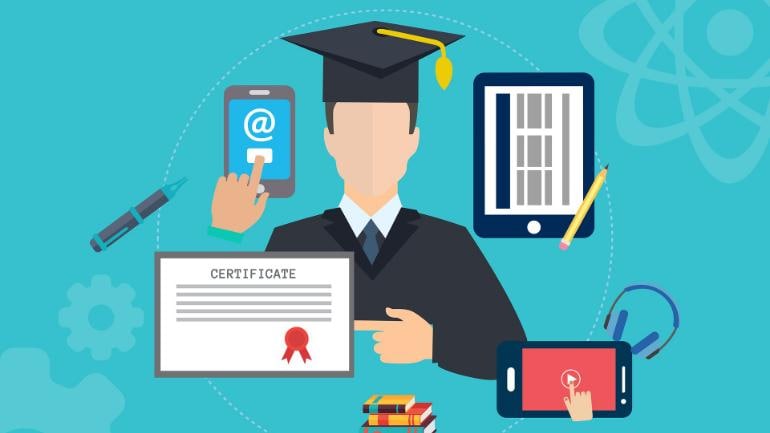
Learning how to learn!

“Focused” and “Diffused” Modes

When learning, there are times in which you are focused and times in which you allow your mind to wander. Both modes are valuable to allow your brain to learn something.
Take regular breaks, meditate, think about other things, and give yourself plenty of time in both modes.

Chunking

This is the idea of breaking what you want to learn into concepts. The goal is to learn each concept in a way that they each become like a well-known puzzle piece. 
To master a concept, you not only need to know it but also to know how it fits into the bigger picture.

Beware of Illusions of Competence

There are many ways in which we can make ourselves feel like we have “learned” a concept. Instead of highlighting or underlining, rather take brief notes that summarize key concepts.

Recall

Take a couple of minutes to summarize or recall the material you are trying to learn. It goes a long way to taking something from short-term memory to long-term learning.

Bite-Sized Testing

To avoid breakthrough illusions of competence, you should test yourself as you’re encountering new material. The recall is a simple example of this mini-testing.

Over-Learning

Do not spend too much time in one sitting going over the same material over and over again. The law of diminishing returns certainly applies. Spread it out over many sessions and many different modes of learning.

Interleaving

Once you have a basic understanding of what you are trying to learn, practice jumping back and forth between problems that require different techniques. This will solidify your understanding of the concepts by learning how to choose to apply them in various situations. Knowing when to apply a particular concept is as important as knowing how.

Process over Product

When facing procrastination, think of the process over the product.
Instead of thinking that you have to get X done, rather think to spend an hour on X. It is then not overwhelming and doesn’t require a long breakdown of tasks.

Metaphors and Analogies

They are often talked about as helpful study techniques. 
Try to make a deliberate effort to teach what you learn to someone else and, in doing so, you will likely be forced to explain concepts with relatable metaphors and analogies.

Study Groups / Teamwork

This has proven to be most beneficial to maintain continued progress and hold each other accountable. Finding the right group is key.

Reference

https://medium.com/learn-love-code/learnings-from-learning-how-to-learn-19d149920dc4
Sex Education

What is sex? Is it normal to talk about it? Why sex education is important?

Avoidance of this topic, increased my willingness to write on this topic. I will try to cover up these questions in my article.

Sex is the most common word used for sexual intercourse, having various synonymous such as coitus, commerce, lovemaking, sexact etc. It is completely obvious for mammals to perform intercourse. It’s the reason for our existence, so why we avoid talking about it? It don’t make us inferior if we talk about it, it must be included in primary education . Yeah it take time to bring a change, we have saw addition of reproduction and menstrual cycle in our Academic syllabus in past decades, now we are looking forward to include sex education also soon.

I was 10 years old , when I got my first period. A blood stain on my white frock, I was amused and scared , my mother watched me out and I was told, ‘Ab tum badi ho gyi ho’ It felt like lot, like my life has just changed in few minutes, I was a tiny girl few minutes back and now I am an adult with responsibilities. It felt like lot to bear, my mum guided me with how to handle sanitary napkins and hygiene. Knowing the fact that all this new thing is going to happen now every month scared shit out of me. So this is the story how I came to know about Menstrual Cycle.

In 6th , a boy became good friend of mine , charming , cute boy. I used to talk to him a lot, and one day he held my hands out, it might seem no big thing to you, but it beacame my biggest fear. My periods were delayed and all I could think was Am I pregnant because my friend holded my hand. Hilarious? Offcourse it is. But yes, that’s were we lacked acknowledging the requirement of sex education in our schools and family. I could not talk about this to anyone, back in those years I was not aware of incognito so searching ‘delayed periods reason’ which would apper in the search history of my parents phone abstained me from searching it. So I was all alone with my miseries and fear. I was scared if my own family is going to accept me because my friend holded my hand that made me pregnant.

Luckily ,I got my periods a week later. I felt so relaxed, as if god has listened to my prayers and helped me out from the trauma. Remembering that incident still make me laugh, if someone could have just told be right reasons, I won’t be that lonely kid feeling guilty then. If family is supposed to be the closest, then these things should be made normal to talk about, we can’t just wait and avoid.

Sex education is required in family, society and at schools. We can just normalize out things instead of covering it up. We will see a better understanding upcoming generations , where things will be heard and solution will be well entertained and implemented.

By Esha Singh Sisodiya

Accept to be the accepted one for others. 🙂

Importance of Education

Education is a powerful weapon that will help the person to survive the difficulties of life, and to overcome the social stigma such as poverty, fear, and status, in order to be successful. Education is the hope for the development of the Third World, and the world of dominion lands. Compulsory education creates the right conditions for the proper growth and development.

The role of the education system in India

The education sector has the potential to be a revolution for the people, of course, with a skilled and well-educated young people. The nation provides a higher rate of achievement of the objectives of economic growth, and the competition is known as a developed nation. The well-trained people reject all the obstacles that are holding back the growth, and strive hard in order to achieve sustainable development.

The education system in India refers to the process of education, training of human resources in colleges and universities. The government of india reflects some of its economic policies, with an emphasis on the importance of education in India.


The factors that contribute to the significance of education in India:

It is designed to eliminate the volatility of the unemployment rate

An important consequence of the presence is the “unemployment rate”. The unemployment rate is impeding the progress of the nation, which in turn leads to a decrease in the standard of living, and an increase in the crime rate.

In India, it is to be stuck in a critical situation, with almost 58 percent of the jobless graduates, and 77 per cent of the households are deprived of a permanent income tax. About 67% to receive an annual income of about 1.2 lakhs per anum.

In these circumstances people will not be able to afford a good quality of life aand it will take them to a life of poverty and unemployment.

Eliminates Poverty

India is one of the world’s fastest-growing economies in the year 2020, the poverty rate in the country is high and it is one of the greatest evils of illiteracy.

In India, nearly 70.6 million people still live in extreme poverty, and a way to break out of the vicious cycle of poverty is through Education. Education provides high level of skills, resulting in greater access to the labour market, which, in turn, allows for better living.

To eliminate the cabinets

The caste-system is the longest in the social hierarchy in the world and has remained in India. Caste discrimination has been tearing up the path, the path of sustainable development in India. As a company that discriminates on the basis of caste, religion, race, religion, color, continue to be entangled in the bonds of hatred, poverty, and lack of resources.

Education changes a person’s view of caste discrimination. This is what makes it a distinct caste-neutral, with a progressive mindset, which aims to make a constructive contribution to the nation.

Economic stability and growth

Education is an important tool that helps in the achievement of economic growth and stability. Providing education to young people and adults to reveal the hidden potential that could put India on the path of development.

Improvisation is in the health & hygiene

In countries with a high level of illiteracy is associated with poor health and hygiene conditions. India has gone through decades, millions of lives have been lost as a result of diseases caused by a lack of medical supplies and poor sanitation.

In order to improvise, the country’s health-and the health of the sector programmes, such as the “Mission Swah Bharat”, “Rashtriya Bal Swasthya Instagram, etc. are the attraction to the people to be secure under the state university. With the right person, you will get the knowledge about health and hygiene products.


Conclusion
Education is very important for every person in the country as it helps them to increase their knowledge and skill and develops their ability to compete with other people. Thus, it helps to provide them with good quality of life and higher standard of living and at a wider scale contributes in the growth and development of the country.

swami vivekananda’s teachings and philosophies

Swami Vivekananda was a hindu monk from india. He played a significant role in the growing indian nationalism of 19th and 20th century, reinterpreting and harmonising certain aspects of Hinduism. His philosophy was instrumental in introducing Vedanta and yoga to the west, and is credited with raising awareness, bringing Hinduism to the status of a major world religion during the late 19th century.

According to Vivekananda a country’s future depends on its people, stating that “man making is my mission.” It’s totally correct and obvious if people doesn’t want there country to be wealthiest, educated, and developed their present as well as future will also not be good or happy.

Swami Vivekanand believed in “unity of all religions”. He thinks that all religions are equally important and valueable, but in today’s world debates, fights even wars are common over religions. Religion is the most sensitive issue and although every religion encourages the idea of peace and tolerance, almost no one remains in peace or tolerates anything when it comes to their religion. History is full of relegious wars and some of them have continued for years and killed many.

He also said that “whatever you think, you will be. If you thinks yourselves weak, weak you will be; if you think yourselves strong, strong you will be”. It’s true as it reminds us that we are the incharge of our lives. When you allow negative thoughts about yourself and your life to build up, you start to project these thoughts out into the world.

Vivekananda thaught us that “If you have faith in all the three hundred and thirty million of your mythological gods, and still have no faith in yourselves, there is no salvation for you”. Have faith in yourselves, and stand up on that faith and be strong; that is what we need. There are thousands of example which proves that you can do anything in life if you have faith in yourself and your ability to handle whatever situations are presented to you. You are blessed with freedom from doubt in yourself.

He emphasized that success was an outcome of focused thoughts and actions; in his lectures on Raja yoga he said, “Take up one idea. Make that one idea your life – think of it, dream of it, live on that idea. Let the brain, muscles, nerves, every part of your body, be full of that idea, and just leave every other idea alone. This is the way to success, that is the way great spiritual gaints are produced”.

His teachings mainly focused on human development. He wanted “to set in motion a machinery which will bring noblest ideas to the doorstep of even the poorest and the meanest”.

Vivekananda linked morality with control of the mind, seeing truth, purity and unselfishness as traits which strengthened it. He advised his followers to be holy, unselfish and to have faith. He supported brahmacharya, believing source of his physical and mental stamina and eloquence.

There are many more teaching and philosophy of swami vivekananda. Even the great and successfull businessman Jamsetji TATA follows the preachings of swami vivekananda, he also establish the Indian Institute of Science, one of the best known research universities inspired by Vivekanand.