Land Reforms in India

A Necessity for an Emerging Economy
Many people are not aware that a reform of land tenure is one of the steps in the economic policy of many countries to facilitate industrialization and promote agricultural growth. The problem with this is that it can lead to increased conflict between production and ownership rights. Yet, India’s Prime Minister Narendra Modi has made reforming the country’s outdated laws by going back to medieval-era customs a top priority for his government.

In May, he set up a five-member panel to recommend changes to the Hindu Succession Act, which is based on customary law and governs inheritance in India’s Hindu majority. The panel was created following the Bombay High Court’s decision that women could inherit ancestral property under the act. India has also rolled out land reform bills to facilitate transparency in transactions of agricultural land.
Under the tradition of a joint family system, or joint Hindu family system, one may wonder how land ownership and succession in India is regulated. This system has prevailed for centuries without outside interference or control. Joint families consists of males typically brothers and their wives who have to share property.
The main purpose of this system was to safeguard women’s rights to the property, in a country where the widow has been traditionally stigmatized and often impoverished by the death of her man.Land Reforms usually refers to redistribution of Land from rich to poor. Land reforms include Regulation of Ownership, Operation, Leasing, sale and Inheritance of Land. In an agrarian economy like India with massive inequalities of wealth and income, great scarcity and an unequal distribution of land, coupled with a large mass of people living below the poverty line, there are strong economic and political arguments for land reforms.

Land reform is the major step of government to assist people living under adverse conditions. It is basically redistribution of land from those who have excess of land to those who do not possess with the objective of increasing the income and bargaining power of the rural poor. The purpose of land reform is to help weaker section of society and do justice in land distribution.

The Indian Government was committed to land reforms and to ensure distributive justice as was promised during the freedom struggle. Consequently, laws were passed by all the State Governments during the Fifties with the avowed aim of abolishing landlordism, distributing land through imposition of ceilings, protection of tenants and consolidation of land- holdings.

Government land policies are implemented to make more rational use of the scarce land resources by affecting conditions of holdings, imposing ceilings and grounds on holdings so that cultivation can be done in the most economical manner.

Objectives of Land Reforms

From the beginning, land distribution has been a part of India’s state policy.
The abolition of the Zamindari system was perhaps the most revolutionary land policy of independent India (feudal landholding practices).

ZAMINDARI SYSTEM

Lord Cornwallis introduced the Permanent Settlement in 1793. Under this system, a class of landlords called Zamindars was created whose responsibility it was to pay a fixed rent to the government for the lands they owned. They gave out parcels of land to farmers who became their tenants. Their title to the land was hereditary. What was intended as a system beneficial for all parties concerned soon turned out to be exploitative? The State was only concerned with maximising revenue with minimum effort. The Zamindar too wanted maximum rent from his tenants irrespective of the land’s true potential. He could increase his own wealth by extracting most out of his farmer tenants since his due to the State was fixed. In addition, several layers of intermediaries were created between the Zamindar and the tenants adding to the burden. The landless farmers and labourers suffered greatly in poverty. Also, this led to the creation of a group of rich Indians whose loyalty lay largely with the British. As you can see the Permanent Settlement gave rise to the Zamindari system of tenancy in Bengal and soon was adopted in other regions.

RYOTWARI SYSTEM

Under this system, the proprietor of land gave the rent and taxes directly to the government in the absence of any middlemen. This started in Madras and was later adopted in Bombay as well.

MAHALWARI SYSTEM

This system was introduced by William Bentinck’s government under which landlords were responsible for the payment of revenue to the State. These landlords or Zamindars had a whole village or a group of villages under their control. The Mahalwari system prevailed in UP, the North Western Province, Punjab and parts of Central India.


India’s land reform policy had two specific goals:
The first is to remove any impediments to increasing agricultural production that arise from the agrarian structure that has been passed down from generation to generation.
The second goal, which is closely related to the first, is to “eliminate all elements of exploitation and social injustice from the agrarian system.
To provide security to the soil tiller, and to ensure equality of status and opportunity to all sections of the rural population.

Objectives of land reforms:

  • Redistribution of land across society so that land is not held in the hands of a few people.
  • Land ceiling to disburse surplus land amongst small and marginal farmers.
  • Removal of rural poverty.
  • Abolition of intermediaries.
  • Tenancy reforms.
  • Increasing agricultural productivity.
  • Consolidation of land holdings and prevention of land fragmentation.
  • Developing cooperative farming.
  • To ensure social equality through economic parity.
  • Tribal protection by ensuring their traditional land is not taken over by outsiders.
  • Land reforms were also for non-agricultural purposes like development and manufacturing.

Public Policy

Public policy is a frequently used term in our daily lives. We often read in newspapers about a public health policy, education policy, environmental policy, agricultural policy, industrial policy, and so on. Public policies are primarily framed by the government to satisfy public needs and demands. They are the means by which ends of a collective community are served. Without a policy, government and administration are rudderless. Successful policies make for successful government and administration, and hence there is a saying that when a policy fails, the government fails.

Theoretical Dimensions : The Context

Public policy is a relatively new subfield in political science. Its development as an area of study emerged out of the recognition that traditional analyses of government decisions were incomplete descriptions of political activities. As the relationships between society and its various public institutions became more complex and more interdependent, the need developed for more institutions became more complex and more interdependent, the need developed for more comprehensive assessments of what governments do – how and why they pursue some policy alternatives over others.

The focus on the public policy process has developed with the emergence of modern society and industrialization. During the nineteenth century, representative governments began to evolve in some parts of the world. With increased political participation by larger portions of the public, government decisions assumed greater importance and legitimacy.

What Is A Public Policy?

The term “public policy” refers to a set of actions the government takes to address issues within society. For example, public policy addresses problems over the long-term, such as issues with healthcare or gun control, and as such, it can take years to develop. Public policy addresses issues that affect a wider swath of society, rather than those pertaining to smaller groups. To explore this concept, consider the following public policy definition.

For example, public policy might tackle the problem of student loans by creating a student loan forgiveness program that affects several students at once, rather than paying off the loan of one student. Something important to remember about public policy is that it does not just refer to the government’s actions, but also to the behaviours and actions that result from those actions.

Significance Of Public Policy

It is evident that the public policy is the significant factor in the democratic government and it
emphasizes on the public and its problems, in fact it is a discipline which is branded as
public. The concept of public policy assumes that there is an area of life which is totally
individual but said in public. Likewise, public policies have a significant purposes to work in
the society where the democracy is prevails.

The important role of the public policy is to make the society to lead a better life and to maintain the delivery of the goods and services are significant, it is regarded as the mechanism for developing economic-social system, a
procedure for determining the future and so on.

REFERENCES : Public Administration by Bidyut Chakrabarty and Prakash Chand Kandpal

NATIONAL EDUCATION POLICY 2021- SALIENT FEATURES

BY DAKSHITA NAITHANI

Who created NEP (National Education Policy)?

The challenges that would occur in the Indian education system – from school to college to work – were examined by a panel of experts chaired by former ISRO chairman K Kasturirangan. 

NEP- National Education Policy

The “New Education Policy 2020-2021” was recently adopted by the Central Government Cabinet Committee. 2 crore schoolchildren would be reintegrated into the mainstream under the NEP 2020. With 12 years of schooling and 3 years of Anganwadi/Preschool, a new 5 + 3 + 3 + 4 curriculum was launched.

Anganwadi will provide pre-school education to children for the first three years. The students will then be educated in first and second grades for the following two years. First five years of study will be completed by a new curriculum which will be developed. Activity-based learning will be the main focus. It will be available to youngsters aged three to eight. 

Preparatory stage – Classes three through five will be covered at this time. Children will be taught science, mathematics, the arts, and other subjects through experiments during this period. Children between the ages of 8 to 11 will be covered.

 Middle Stage – These subject-based workshops will include grades 6-8, as well as students aged 11-14. Courses in skill development will begin in sixth grade.

The secondary stage- From ninth through twelfth grade, students will be divided into two groups for intense study of the topics. There will also be the option of picking and choosing subjects. Previously, this system did not exist in government pre-schools. From first grade through tenth grade, there was a general education programme. 

With no clear distinction between academic streams, schools will focus a greater emphasis on extracurricular activities, professional development, reading, and numeracy. In accordance with the new policy 2020, vocational education will begin in the sixth grade. It will be mandatory to teach in the mother tongue / regional language till the fifth grade. Improvement of evaluation and tracking progress of students to accomplish learning goals, among other things, is covered with a full 360-degree progress card.

Other important changes in school education – Salient Features of #NEP2020

According to Dr. Kasturirangan, vocational education, led the committee created to approve the new education policy, and now the kid will get vocational education and skills beginning in the sixth grade. Internships will be available on a local level as well. Vocational education and skill development will be prioritised.

There will be no job losses as a result of the new education approach. The youngsters will receive the essential education in school for professional environment. The 10th and 12th grade Board examinations will be straightforward. The Board examinations for classes 10th and 12th will undergo modifications.

Exams conducted by the council will be undervalued. There are a lot of good ideas in this article. Exams, for example, should be given twice a year and divided into two portions, one objective and the other explanatory. When it comes to council examinations, students are always under pressure and rely on training to improve their grades. According to the education strategy, various councils will create a realistic model for board exams in the near future. Exams and units at the yearly and quarterly levels, for instance.

Changes will be made to children’s report cards, which will be used to evaluate their school achievement and performance. They will be graded on three different levels. The first will be a student, the second will be a classmate, and the third will be his teacher.

In 2019, the rough draft of NEP was introduced, and it received much praise as well as harsh criticism. The idea to declare Hindi one of the essential languages was quickly shot down. After that, the document was made public, and individuals and other stakeholders were asked to submit policy ideas for improvement.

Changes Made in Higher Education

50% Increase in GER

By 2035, the NEP intends to raise the existing GER (Gross Enrolment Ratio) from 26.3 – 50 percent. 3.5 Crore additional places in higher education would be added.

Interdisciplinary general education

The strategy aims to provide a complete, multidisciplinary, and broad-based college education with flexible plans, additional topic options, a greater emphasis on vocational education, and the ability to enrol and exit the programme with a recognised degree. For example, Certificate after 1 year, Advanced Diploma after 2 years, Degree after 3 years, License for research after 4 years.

India’s educational system is at a critical crossroads. On the one hand, it is expected to replace an out-of-date paradigm with the NEP 2020. New digital learning platforms and creative teaching approaches, on the other hand, are driving it to global standards and setting new milestones.

Any country’s education is judged by the quality of its human capital. A well-educated population with a high literacy rate is better prepared to take on social, economic, and political responsibilities responsibly while maintaining a broad understanding of global concerns. This is the goal embodied in the NEP 2020, which, if implemented well, would make education more comprehensive and enjoyable.

With the announcement to qualitatively improve 15,000 schools across India to adopt NEP in the Union Budget 2021-22 and these will act as role models for other schools to emulate. To maximise the benefits of the NEP, the education sector must harness the powers of technology in the future. This will result in a rising curve in the standard of education in India.

As we emerge from the coronavirus epidemic and begin a new academic year, it is critical to recognise the potential for change in Indian education as a consequence of these 3 forces: the National Education Policy (NEP) and the accompanying new platforms and teaching and learning methodologies.

.

India and South Asia

Southeast Asia is comprised of ten countries namely Burma, Brunei, Cambodia, Indonesia, Laos, Malaysia, the Philippines, Singapore, Thailand and Vietnam. All these countries are members of Association of South East Asian Nations (ASEAN). Burma (Myanmar) shares a contiguous land and sea frontier with India while Thailand, Indonesia and other countries in the region share
common maritime frontiers. Needless to say, that they are India’s close neighbors, with whom its relations date back to time immemorial. The history of the ancient Southeast Asian Kingdoms, i.e. Funan, Champa, Cambodge, Pagan, Dwarabati, Srivijaya and Majapahit indicate India’s intimate cultural ties. The art, architecture, epic and language have had similarities and their origin and growth cannot be understood in proper perspective without understanding their Indian counterparts. Ashoka the Great, had sent his emissaries, Sona and Uttara to spread the gospel of Buddhism in the region of Burma, Thailand, Laos and Cambodia. These nations declared Buddhism as their state religion. The impact of Hinduism still remains as part of their indigenous culture and religion. The ethnic Malays accepted Islam as their religion but the Muslims in Java have not yet disowned their Hindu traditions. Some of them still believe in animism and worship many spirits in different names. Bali remains a Hindu dominated society, and adherents of Buddhism
can be found in all parts of the Southeast Asia.


Malacca, Sunda and Lombok are the important sea-lanes linking East Asia with the rest of the world. Singapore, Malaysia and Thailand are industrially advanced. Singapore has an effective service sector in the field of finance, airlines, computers and shipping. Mainland Southeast Asia has diverse mountain ranges and rivers running from North to South, and most of them originate in Tibet. The main rivers are Mekong passing through Laos, Thailand, Cambodia and Vietnam. Other rivers are Irrawadi, Chindawin and Salween in Burma, Menam Chao Phraya in Thailand,
Song Koi (Red River) and Song Bo (Black Rivers) in Vietnam. These rivers bring rich alluvial deposits regularly to make the land fertile. Most fertile areas created by these rivers are lower Burma, Central Thailand, Tongking and Mekong deltas. Thailand and Vietnam are the largest rice exporting countries in the world. This unit examines various aspects of socio-economic-political features of South-East Asian countries. India’s relations with ASEAN countries are analysed in this Unit. India attaches great importance towards pursuing good neighbourly relations with the countries in Southeast Asia. The policy of “Look East” is the strategy of the Indian diplomacy ever since 1991 and its major thrust has been to improve India’s existing ties with the ASEAN region, and promote trade, investment, tourism, science and technology relations. Indian policies are endeavored to resurrect close historical and cultural ties, which were marred during the colonial period. The Cold War paradigm in the past prevented India to attend various issues in its bilateral relations but the situation changed only after the end of the Cold War. Various initiatives have been taken to rejuvenate our economic, cultural and strategic connections. Total bilateral trade with ASEAN countries has shown increasing trends from 5.98 billion in 1998-99 to 7.98 billion in 2002-03.


ASEAN investments which were dismal during the Cold War period, started coming and confidence was displayed on both sides. Various packages for the promotion of tourism were mooted and now it is not limited only to visit Buddhist sites in Bodh Gaya. India is willing to attract investments from the ASEAN region and they have been advocating liberalisation and free trade. ASEAN is trying to reciprocate the Indian gestures. They recognise the importance of
India as a great market where they find the existence of middle class people in millions. Besides, they have common historical, religious and security interests. Both of them support the policy of democratisation, liberalisation and free trade. Both are opposed to the rise of fundamentalism and terrorism and both are supporting human rights to be universally respected.

Importance of Atmanirbhar Bharat

A nation’s strength ultimately consists in what it can do on its own, and not in what it can borrow from others.” – Indira Gandhi.

Self-Reliance, one thing which is common in all developed nations and a thing that a developing nation wants to achieve. One of those developing nations which are striving to make themselves self-reliant is India. The battle to become self-reliant is not new but started back from the independence itself. At that time, India was the largest economy in South Asia, the self-reliance in the state heavy industries and strategic sectors in the post-independence decades put India before most of the developing world.

However, in the 1970s and 1980s, India did not modernize these industries to move up the technological ladder. Little was done to modernize light industries. The industrial ecosystem was held hostage to the license-permit-quota system that hampered innovation. As a result, self-reliance gave way to corruption and dependence on imports. A major turn came in 1991 after economic liberalization in India was initiated in 1991 by Prime Minister P. V. Narasimha Rao and his then-Finance Minister Dr. Manmohan Singh.

1) Atmanirbhar Bharat and the idea behind it

At a time when the world was plagued by the deadly pandemic, PM Narendra Modi launched a campaign which was meant to convert this crisis into an opportunity and strengthen India’s fight by becoming Aatmanirbhar or self-reliant.

-> There are five pillars of Atmanirbhar Bharat which focus on:

  • Economy
  • Infrastructure
  • System
  • Vibrant Demography and
  • Demand

-> The Five phases of Atmanirbhar Bharat are:

  • Phase-I: Businesses including MSMEs
  • Phase-II: Poor, including migrants and farmers
  • Phase-III: Agriculture
  • Phase-IV: New Horizons of Growth
  • Phase-V: Government Reforms and Enablers

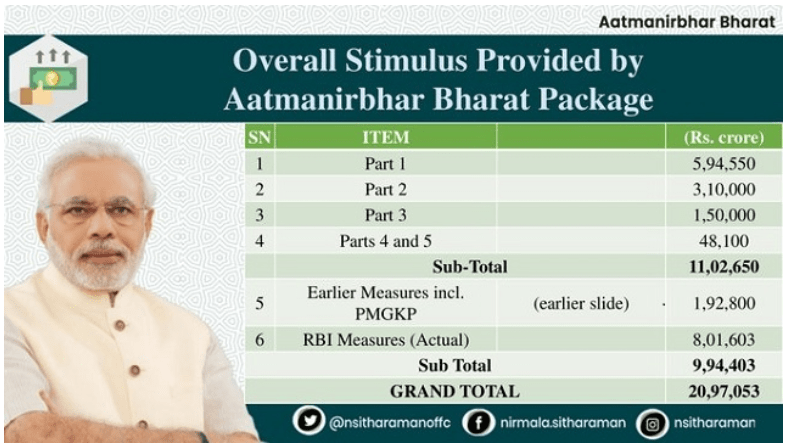
PM Modi emphasized the fact that it is time to voice our local products and make them global. A special economic package was created as part of this campaign. Established by the government, which will benefit various segments including the craft industry, micro, small and medium-sized enterprises (MSMEs), workers, the middle class and industry. The economic package announced by the Prime Minister, along with various packages launched during the lockdown period, amounts to around 20 lakh crore rupees ($ 283.73 billion), which was roughly 10 percent of India’s GDP. It was expected to support and empower different parts of the country and give new impetus to the development of the country in 2020.

In order to express the determination of an independent India, land, labor, liquidity and laws were included in this package. Minister of Finance & Corporate Affairs, Ms. Nirmala Sitharaman, made all the announcements related to several sectors on different days, divided into five tranches, and provided detailed information on the steps the government is taking.

2) Division of package for different sectors in Atmanirbhar Bharat

  • First tranche – Rs 5,94,550 crore

The first aid installment announced by Nirmala Sitharaman focuses on empowering the backbone of the Indian economy: MSMEs, which employ around 11 billion people and have a GDP share of around 29 percent. This included unsecured loans of Rs.3 billion and a capital injection of Rs. 50,000 billion for MSMEs through the funds

  • Second tranche – Rs 3,10,000 crore

Nirmala Sitharaman’s second installment of measures was targeted at migrant workers and street vendors. The minister introduced ‘one nation one ration card’ card so migrant workers can buy ration from any ration depot in the country. Around 50 lakh street vendors will have access to a special credit facility of Rs 5,000 crore within an initial working capital of Rs 10,000. Around 2 lakh crore rupees will be delivered to farmers via kisan credit cards, while 2.5 crore farmers, including fishermen and animal husbandry farmers will be able to attain institutional loans at a preferential rate.

  • Third tranche – Rs 1,50,000 crore

The third tranche worth Rs 1.5 lakh crore aims at agriculture and related sectors, including dairy, livestock and fisheries, as the government proclaimed measures to toughen the broad agricultural sector.

  • Fourth and fifth tranches – Rs 48,100 crore

The fourth installment of the Rs 20 Lakh Crore package included reforms for sectors such as coal, minerals, defense production, airspace management, airports, MRO, UT distributors, space and nuclear energy.

3) Sectors to benefit from Atmanirbhar bharat.

I. MICRO, SMALL, AND MEDIUM ENTERPRISES

Micro, Small, and Medium Enterprises have played a vital role in Indian economy. It has contributed one third to the GDP of India and also provided employment to large sections of society. The sector is source of livelihood to 110 million people. With the current phase of Atmanirbhar Bharat these MSME’s has become more significant to India’s financial and economic sector. Acknowledging the importance of this sector it would contribute to 50 million jobs and half of India’s GDP in the coming five years.

Benefits of MSME’s under Atmanirbhar Bharat:

  • Collateral free loans- The commencement of collateral free automatic loans will assist the existing borrowers and this will also give the fuel restart to the business operation.

Some of the key highlights of this benefits are-

-> According to bank policies, the current borrowers should have the standard ratings and turnover of rs.100 crore.

-> Four years of loan tenure and 12 months on principle payment.

-> No additional collateral is required.

  • Equity Infusion- Government is going to setup a fund for funds of 10,000 crore to overcome this situation of pandemic. FOF will be operated through a Mother fund and few Daughter fund. Through these funds the MSME’s can expand their size and capabilities. This will also encourage MSME’s to get listed on the board of stock exchange.
  • Debt for stressed MSME’s- To support MSME’s the central government will provide Rs. 20,000crore as subordinate debts. The infusion of fresh capital into the business will reduce the burden on MSME’s and will benefit two lakh MSME’s.

II. Agriculture and Fisheries

Agriculture is the most important sector of Indian economy. It contributes to 18% of GDP and provide employment to 50% of countries workforce. Government towards improving this sector has released two major initiatives Pradhan Mantri Kisan Samman Nidhi Yojana (PM-KISAN) and Agriculture Infrastructure Fund this will help to improve the financial and agriculture status of farmer.

Benefits of agriculture under Atmanirbhar Bharat:

  • Pradhan Mantri Kisan Samman Nidhi Yojana (PM-KISAN)- Under this scheme financial benefit of Rs 6,000/- is provided to beneficiary farmers and is payable in three equals that is 4 monthly installments of Rs 2,000/-. However, under this scheme an amount of more than 17,000 crore has been transferred to 8.5 crore beneficiary farmers.
  • Agriculture Infrastructure Fund- The objective of this scheme is to drive investment across the agricultural chain. This scheme will allow farmers to store their produce till they get better price and affordable post-harvest infrastructure. Farmers and other stakeholders will have access to financing 3% interest and credits from governments and this will help them to enhance their product value.

III. Coal Mining Reforms

India being the fourth- largest producer of coal in the world. In the vision to build Atmanirbhar Bharat a reform to promote commercial coal mining in India has been announced. Opening up of these sectors will expand world class production capacity and provide top product services with global supply chain.

Benefits of Coal mining under Atmanirbhar Bharat:

  • Forty-one coal mines are opened for auction and there are no end restrictions on the coal production for these mining. Bidders will not require any previous experience in coal mining they just have to put up sufficient amount of money. Mining plan approval will be provided in 30 days rather than 90 days. Coal mining will be determined through a National Coal Index for different grades of coal.
  • These 41 mines are likely to produce 225 million tones annually and Rs. 33,000 capital expenditure to get these mining going. Additionally, state government will generate more than 20,000 crore per year in royalties from these mining. This will generate direct and in direct jobs for more than 3 lakh employers and is expected to generate fund of Rs. 112 crores for the District Minerals Foundation Fund.

IV. Non-Banking finance (NBFCs), Housing finance companies (HFCs), Microfinance institutions

For the Non-banking finance companies (NBFCs), Housing finance companies (HFCs), Microfinance institutions (MFIs) Ministry of finance has announced following measures:

  • Special liquidity scheme worth Rs. 30,000 crores
  • Partial credit guarantee scheme worth Rs. 45,000 crores

Benefits of these schemes under Atmanirbhar Bharat:

  •  Main objective of Special liquidity scheme is to provide liquidity support to MSMEs that are impacted due to this pandemic. Under this scheme investments will be made both in primary and secondary transactions in investment papers of NBFCs, HFCs, MFIs. These securities will be fully guaranteed by government. This scheme will ensure operational continuity and promote leading MSME sector.
  • Partial credit guarantee scheme is for NBFCs, HFCs, MFIs, having low credit rating and provide liquidity to leading MSMEs and individual and first 20% loan will be given by the government. This also helps the MSMEs to avoid distress sale of their assets for meeting immediate funds.

Conclusion

This campaign can reach its epitome if supported well by the government. Keeping in mind the increasing incursions by China and India’s dependence on it, the success of the campaign is now more in need than ever. If the government is solemn about instigating this economic philosophy, it must clearly list the areas that need improvement to make Indian manufacturing competitive. Only then will entailed policies get outlined and implemented to bring about the change.

WhatsApp’s new privacy policy.

Identifiable living individual and includes names, email Ids, ID
card numbers, physical and IP addresses. Data is the large
collection of information that is stored in a computer or on a
network. Data is collected and handled by entities called data
fiduciaries. The processing of this data has become an
important source of profits for big corporations. Companies,
governments, and political parties find it valuable because
they can use it to find the most convincing ways to advertise
online. The physical attributes of data where data is stored,
where it is sent, where it is turned into something useful are
called data flows.

WhatsApp’s decision to delay the update of its privacy policy,
following a backlash from its users, is an implicit
acknowledgement of the increasing role played by
perceptions about privacy in the continued well-being of a
popular service. Problems for the Facebook-owned app
started earlier this January when it announced an update to
its terms of service and privacy policy, according to which users would no longer be able to opt out of sharing data with
Facebook.

February 8 was kept as the deadline for the new terms to be
accepted. This triggered a mass withdrawal from WhatsApp,
the likes of which it has never encountered, not even in the
aftermath of the Cambridge Analytical scandal, which did
bring a lot of bad press to its parent, or when the messaging
app’s co-founders called it quits a few years ago. The
WhatsApp policy update has clearly spooked many users,
who, concerned about their privacy getting compromised,
have shifted to alternative platforms such as Signal and
Telegram. WhatsApp has asked for data which contains your account
information such as Phone number, the name attached to
the account, the profile photo you currently have for
WhatsApp, the device you are using, the time when you have
been online, all your contacts, all group names of which you
are a part of, the device type, the IP address, device build
number, device manufacturer, details of the web/desktop
version and the platform which is used for WhatsApp Web,
your Status.

It also has the exact time when you set the
current profile photo and the current status message. The list
includes all contacts with whom you would have chatted on
WhatsApp, and only the mobile phone numbers are
mentioned. It also has your settings for the app, including the
privacy settings for Last Seen, Profile Photo, About Privacy

and Status Privacy. It also includes a list of the all numbers
you have blocked and whether you have Read Receipt on or
off. The issue has once again raised questions about what
constitutes legitimate uses of data and how businesses,
governments and political parties can and cannot use data .A
White Paper produced by a government-appointed
committee, headed by retired judge B.N. Srikrishna , which is
formulating a national data protection law for India and its people to safeguard there interest.

NEP 2020

An analysis of the National Educational Policy formulated by the Union Cabinet.

The pace at which the world is advancing is simply magnificent, promising a totally different way of human lifestyle within the next 30 odd years. Showing even promises of human life on a second planet, to cater to the present needs. 

This paves the need to adapt to such changes. To be a catalyst, rather than a fly on the windshield in the process.

The rapid advancements in most sectors aided by technology has only the human element slogging it in most developing and underdeveloped nations. But most developed nations showing promises of being able to provide to such changes, make them stand out as model nations.

It’s quite ironic, Us, humans, slowing down the process of advancements; the very reason behind such advancements and the very factor slowing it down.

Modern problems do require modern solutions. 

A brief analysis of the incompetency of ours, shows traces of troubleshooting in the education system. 

To quote the father of the nation would be the ideal solution to the current crisis. The Mahatma had signified the importance of education in the pre-independence era and post too; the relevance of it, in the present century shows evidence of where we’ve fell short in our rat race. His overviews require praise for looking out like a true father.

The importance of education in the thoughts of people and society is quite significant and needs no more emphasis. But still the turn over is indeed minimal.

It’s more of a necessity than a luxury, in the pursuit of overall development as an individual and the development of the nation. “A journey of a thousand miles begins with a single step.”

The Union Cabinet by the end of the last month announced a New policy governing the education system in India. Promising overhaul changes both in the school and higher education system, to cater to the needs  of the twenty first century. 

A change much needed to be precise.

It’s still a policy and not a law, as the Union has the mammoth task of passing it, as after all India is a federal state and education being a subject on the concurrent list, requires forward of all the states and Union Territories.

Rather than beating around the bush more, I’ll get to the point of emphasises on the highly ambitious New Education Policy, which was formulated only after a whopping gap of 34 years.

The National policy on education was last formulated in 1986 and modified in 1992. It took the nation more than a few decades to propose a change in one of the most important sectors.

The National Education Policy proposes radical changes to the educational system of India. The norms of the policy even makes it sound ‘too good to be true’, with the promise of implementing all the proposed, heavily criticised policy by 2040.

However, most proposed comprehensive changes like completely redefining the age-old school curriculum structure of 10+2 into a structure of 5+3+3+4 has been received well.

The new school structure puts emphasis on formative education via early childhood education with an overview to implement absolute literacy and numeracy education(ability to understand basic terms and do basic calculations) by the end of the second grade.

The reports of low literacy and numeracy rates among students of elementary schools had pushed the policy formulators towards universal implementation by 2025.

The need of ensuring proper nutrition and health of students have also been targeted, with the implementation of mandatory breakfasts and midday meals in schools.

With a strive to impart quality education, the pupil-teacher ratio has been set at 30:1 and a lesser ratio for socially backward areas with a view to eradicate the socio-economic differences.

As a step in the right direction, provisions for vocational education and internships from grade 6th with a restructuring of the curriculum to inculcate critical thinking and inquiry based, discovery based learning has also been put forward.

The need for education via mother tongue till grade five has received much friction from all sides. The often negligence of regional languages and mother tongue had made the Union consider it. 

Experts from the educational field has however resented such a decision hinting that in a Country like ours with high mobility, there’s a greater need for universal mediums in the education provided in schools. Making the students who’d have to travel for reasons outside their control adversely affected by the same.

The economically constrained sections of the society has also made their voice heard, stating the inadequacy of funds from their sides, would put their children at a disadvantage compared to the children of well off families, who could afford multiple tuitions to learn English.  (Sighting the universal application)

A crown jewel in the policy, is the widened scope of universal education from transforming the 6-14 years to 3-18 years of students, while incorporating further lifelong learning habits.

The policy of a multi-disciplinary approach in higher education is also mentioned, but a foolproof framework is what it lacks, as of now.

The policy also incorporates aspirational moves towards doing away with the need for coaching class trends for higher education and to reduce the hysteria towards private english medium schools by bridging the adversities faced by the public schools.

With regards to higher education, the union focuses on allowing prestigious foreign universities to set up shop in the country and to also to aid the setting up of glamorous Indian higher education institutions in other countries. But the policy fails to make promises to further expand the number of premium institutions like IIT’s on Indian soils.

Even though the experts have welcomed most policy reforms with both hands, they’ve also presented their fair share of doubts regarding the implementation of the nuances of the policy, sighting the lack of political will towards public education and fiscal burden upon the government.

The suggestion of educational expenditure to be bumped upto 6% of GDP has been doing the rounds and has been neglected by consecutive governments. The economic slowdown caused by the pandemic also raises further doubts of the finances, also considering the surge in health and defence sector expenditures in the following years.

The policy on paper encourages the need for critical thinking, holistic learning and increase of campus activities. However, the attacks on free and critical thinkers on campuses in the recent past, raises obvious red flags.

Sighting the surge in the number of educated unemployeds and the mishap regarding the imparting of appropriate skillsets to match the employment opportunities, overhaul have been suggested regarding the formulation of 4 year undergrads shows great promise and putting an end to MPhil programs. The union also aims to restrict the functions of the UGC.

Even though the overall policy has the potential to transform the nation into a status of a powerhouse of knowledge, subsequent formulation of clear and foolproof plans which wouldn’t aggrieve any promises of tomorrow would be the ideal path to tread upon.