paper making

Chemical pulping

Main articles: kraft process, sulfite process, and soda pulpingTo make pulp from wood, a chemical pulping process separates lignin from cellulose fibre. A cooking liquor is used to dissolve the lignin, which is then washed from the cellulose; this preserves the length of the cellulose fibres. Paper made from chemical pulps are also known as wood-free papers (not to be confused with tree-free paper); this is because they do not contain lignin, which deteriorates over time. The pulp can also be bleached to produce white paper, but this consumes 5% of the fibres. Chemical pulping processes are not used to make paper made from cotton, which is already 90% cellulose.

Mechanical pulping

There are two major mechanical pulps: thermomechanical pulp (TMP) and groundwood pulp (GW). In the TMP process, wood is chipped and then fed into steam-heated refiners, where the chips are squeezed and converted to fibres between two steel discs. In the groundwood process, debarked logs are fed into grinders where they are pressed against rotating stones to be made into fibres. Mechanical pulping does not remove the lignin, so the yield is very high, > 95%; however, lignin causes the paper thus produced to turn yellow and become brittle over time. Mechanical pulps have rather short fibres, thus producing weak paper. Although large amounts of electrical energy are required to produce mechanical pulp, it costs less than the chemical kind.

De-inked pulp

Paper recycling processes can use either Chemically or mechanically produced pulp; by mixing it with water and applying mechanical action the hydrogen bonds in the paper can be broken and fibres separated again. Most recycled paper contains a proportion of virgin fibre for the sake of quality; generally speaking, de-inked pulp is of the same quality or lower than the collected paper it was made from.

Additives

Besides the fibres, pulps may contain fillers such as chalk or china clay,[12] which improve its characteristics for printing or writing.[13] Additives for sizing purposes may be mixed with it or applied to the paper web later in the manufacturing process; the purpose of such sizing is to establish the correct level of surface absorbency to suit ink or paint.

Producing paper

Paper mill in Mänttä-Vilppula, FinlandThe pulp is fed to a paper machine, where it is formed as a paper web and the water is removed from it by pressing and drying.Pressing the sheet removes the water by force. Once the water is forced from the sheet, a special kind of felt, which is not to be confused with the traditional one, is used to collect the water. When making paper by hand, a blotter sheet is used instead.
Finishing

The paper may then undergo sizing to alter its physical properties for use in various applications.Paper at this point is uncoated. Coated paper has a thin layer of material such as calcium carbonate or china clay applied to one or both sides in order to create a surface more suitable for high-resolution halftone screens. (Uncoated papers are rarely suitable for screens above 150 lpi.) Coated or uncoated papers may have their surfaces polished by calendering. Coated papers are divided into matte, semi-matte or silk, and gloss. Gloss papers give the highest optical density in the printed image.The paper is then fed onto reels if it is to be used on web printing presses, or cut into sheets for other printing processes or other purposes. The fibres in the paper basically run in the machine direction. Sheets are usually cut “long-grain”, i.e. with the grain parallel to the longer dimension of the sheet. Continuous form paper (or continuous stationery) is cut to width with holes punched at the edges, and folded into stacks.

Paper grain

All paper produced by paper machines as the Fourdrinier Machine are wove paper, i.e. the wire mesh that transports the web leaves a pattern that has the same density along the paper grain and across the grain. Textured finishes, watermarks and wire patterns imitating hand-made laid paper can be created by the use of appropriate rollers in the later stages of the machine.

Rose And Uses Of Rose

Roses are best known as ornamental plants grown for their flowers in the garden and sometimes indoors. They have been also used for commercial perfumery and commercial cut flower crops. Some are used as landscape plants, for hedging and for other utilitarian purposes such as game cover and slope stabilization.

Ornamental plants

The majority of ornamental roses are hybrids that were bred for their flowers. A few, mostly species roses are grown for attractive or scented foliage (such as Rosa glauca and Rosa rubiginosa), ornamental thorns (such as Rosa sericea) or for their showy fruit (such as Rosa moyesii).Ornamental roses have been cultivated for millennia, with the earliest known cultivation known to date from at least 500 BC in Mediterranean countries, Persia, and China.It is estimated that 30 to 35 thousand rose hybrids and cultivars have been bred and selected for garden use as flowering plants.Most are double-flowered with many or all of the stamens having morphed into additional petals.
Cut flowers

Cut flowersBouquet of pink rosesRoses are a popular crop for both domestic and commercial cut flowers. Generally they are harvested and cut when in bud, and held in refrigerated conditions until ready for display at their point of sale.In temperate climates, cut roses are often grown in greenhouses, and in warmer countries they may also be grown under cover in order to ensure that the flowers are not damaged by weather and that pest and disease control can be carried out effectively. Significant quantities are grown in some tropical countries, and these are shipped by air to markets across the world.

Cut flowers

Main article: Cut flowersBouquet of pink roses

Roses are a popular crop for both domestic and commercial cut flowers. Generally they are harvested and cut when in bud, and held in refrigerated conditions until ready for display at their point of sale.

In temperate climates, cut roses are often grown in greenhouses, and in warmer countries they may also be grown under cover in order to ensure that the flowers are not damaged by weather and that pest and disease control can be carried out effectively. Significant quantities are grown in some tropical countries, and these are shipped by air to markets across the world.

Perfume

Rose oil and Rose waterGeraniol (C10H18O)Rose perfumes are made from rose oil (also called attar of roses), which is a mixture of volatile essential oils obtained by steam distilling the crushed petals of roses. An associated product is rose water which is used for cooking, cosmetics, medicine and religious practices. The production technique originated in Persia and then spread through Arabia and India, and more recently into eastern Europe. In Bulgaria, Iran and Germany, damask roses (Rosa × damascena ‘Trigintipetala’) are used. In other parts of the world Rosa × centifolia is commonly used. The oil is transparent pale yellow or yellow-grey in colour. ‘Rose Absolute’ is solvent-extracted with hexane and produces a darker oil, dark yellow to orange in colour. The weight of oil extracted is about one three-thousandth to one six-thousandth of the weight of the flowers; for example, about two thousand flowers are required to produce one gram of oil.

sunflower

Origin

EditSunflowers originate in the Americas. They were first domesticated in what is now Mexico and the Southern United States.Domestic sunflower seeds have been found in Mexico, dating to 2100 BCE. Native American people grew sunflowers as a crop from Mexico to Southern Canada. In the 16th century the first crop breeds were brought from America to Europe by explorers.

History

Sunflowers are thought to have been domesticated 3000–5000 years ago by Native Americans who would use them primarily as a source for edible seeds. They were then introduced to Europe in the early 16th century and made their way to Russia. In Russia, where oilseed cultivators were located, these flowers were developed and grown on an industrial scale. Russia then reintroduced this oilseed cultivation process to North America in the mid-20th century; North America began their commercial era of sunflower production and breeding.New breeds of the Helianthus spp. began to become more prominent in new geographical areas.

Benefits of pomegranate

Antioxidants

Pomegranates have been eaten throughout history for their health benefits. Nowadays, the juice of this fruit is a popular part of healthy diets.Pomegranate seeds get their vibrant red hue from polyphenols. These chemicals are powerful antioxidants.Pomegranate juice contains higher levels of antioxidants than most other fruit juices. It also has three times more antioxidants than red wine and green tea.

xidants in pomegranate juice can help remove free radicals, protect cells from damage, and reduce inflammation.

Vitamin C

The juice of a single pomegranate has more than 40 percent of your daily requirement of vitamin C. Vitamin C can be broken down when pasteurized, so opt for homemade or fresh pomegranate juice to get the most of the nutrient.

Alzheimer’s disease protection

The antioxidants in the juice and their high concentration are believed to stall the progress of Alzheimer disease and protect memory.

Digestion

Pomegranate juice can reduce inflammation in the gut and improve digestion. It may be beneficial for people with Crohn’s disease, ulcerative colitis, and other inflammatory bowel diseases.While there are conflicting beliefs and research on whether pomegranate juice helps or worsens diarrhea, most doctors recommend avoiding it until you are feeling better and your symptoms have subsided

Cancer prevention

Pomegranate juice recently made a splash when researchers found that it may help stop the growth of prostate cancer cells. Despite multiple studies on the effects of the juice on prostate cancer, results are still preliminary.While there haven’t been long-term studies with humans that prove that pomegranate juice prevents cancer or reduces the risk, adding it to your diet certainly can’t hurt. There have been encouraging results in studies so far, and bigger studies are now being doneTrusted Source.

pomegranate

Pomegranate is a tree. Various parts of the tree and fruit are used to make medicine.People use pomegranate for high blood pressure, athletic performance, heart disease, diabetes, and many other conditions, but there is no good scientific evidence to support most of these uses.Pomegranate has been used for thousands of years. It is in Greek, Hebrew, Buddhist, Islamic, and Christian mythology and writings. It is described in records dating from around 1500 BCE as a treatment for tapeworm and other parasites.Many cultures use pomegranate as a folk medicine. Pomegranate is native to Iran. It is primarily cultivated in Mediterranean counties, parts of the United States, Afghanistan, Russia, India, China, and Japan. You’ll see pomegranate in some royal and medical coats of arms.

Uses of pineapple

Pineapple is more than just a delicious tropical fruit — it offers significant health benefits as well. In fact, it’s been used in folk medicine since ancient times, according to a study published in September 2016 in Biomedical Reports. It’s native to the Americas and is also grown in tropical climates around the world, according to the National Center for Complementary and Integrative Health (NCCIH).“Pineapple is a great source of vitamin C, B vitamins, fiber, and minerals like manganese,” says Julie Andrews, RDN, a chef based in Appleton, Wisconsin.You’ll find pineapple offered fresh, frozen, and canned, making it a year-round option for those living in the United States. Canned pineapple is convenient, but be sure to look for an option that’s packed in its own juices, not syrup, says Allison Knott, RDN, a dietitian in New York City. “Fruit naturally contains sugar in the form of fructose, so even the canned fruit in its own juice will have grams of sugar listed on the label,” she says. “However, the syrup is considered added sugar and will increase the total grams of sugar while contributing to added sugar intake for the day.”REL

uses of apple

All parts of the fruit, including the skin, except for the seeds, are suitable for human consumption. The core, from stem to bottom, containing the seeds, is usually not eaten and is discarded.Apples can be consumed various ways: juice, raw in salads, baked in pies, cooked into sauces and spreads like apple butter, and other baked dishes.Apples are sometimes used as an ingredient in savory foods, such as sausage and stuffing.Several techniques are used to preserve apples and apple products. Apples can be canned, dried or frozen.Canned or frozen apples are eventually baked into pies or other cooked dishes. Apple juice or cider is also bottled. Apple juice is often concentrated and frozen.Apples are an important ingredient in many desserts, such as apple pie, apple crumble, apple crisp and apple cake. When cooked, some apple cultivars easily form a puree known as apple sauce. Apples are also made into apple butter and apple jelly. They are often baked or stewed and are also (cooked) in some meat dishes. Dried apples can be eaten or reconstituted (soaked in water, alcohol or some other liquid).Apples are milled or pressed to produce apple juice, which may be drunk unfiltered (called apple cider in North America), or filtered. Filtered juice is often concentrated and frozen, then reconstituted later and consumed. Apple juice can be fermented to make cider (called hard cider in North America), ciderkin, and vinegar. Through distillation, various alcoholic beverages can be produced, such as applejack, Calvados, and apfelwein

Apple

An apple is an edible fruit produced by an apple tree (Malus domestica). Apple trees are cultivated worldwide and are the most widely grown species in the genus Malus. The tree originated in Central Asia, where its wild ancestor, Malus sieversii, is still found today. Apples have been grown for thousands of years in Asia and Europe and were brought to North America by European colonists. Apples have religious and mythological significance in many cultures, including NorseGreek, and European Christian tradition.

Apples grown from seed tend to be very different from those of the parents, and the resultant fruit frequently lack desired characteristics. Generally then, apple cultivars are propagated by clonal grafting onto rootstocks. Apple trees grown without rootstocks tend to be large and much slower to fruit after planting. Rootstocks are used to control speed of growth and the size of the resulting tree allowing for easier harvesting.There are more than 7,500 known cultivars of apples. Different cultivars are bred for various tastes and use, including cooking, eating raw and cider production. Trees and fruit are prone to a number of fungal, bacterial and pest problems, which can be controlled by a number of organic and non-organic means. In 2010, the fruit’s genome was sequenced as part of research on disease control and selective breeding in apple production.Worldwide production of apples in 2018 was 86 million tonnes, with China accounting for nearly half of the total.

Life of Mukesh Dhirubhai Ambani

Mukesh Dhirubhai Ambani was born on 19 April 1957 in the British Crown colony of Aden (present-day Yemen) to Dhirubhai Ambani and Kokilaben Ambani. He has a younger brother Anil Ambani and two sisters, Nina Bhadrashyam Kothari and Dipti Dattaraj Salgaonkar.Ambani lived only briefly in Yemen, because his father decided to move back to India in 1958[7] to start a trading business that focused on spices and textiles. The latter was originally named “Vimal” but later changed to “Only Vimal”.[8][9] His family lived in a modest two-bedroom apartment in Bhuleshwar, Mumbai until the 1970s.[10] The family’s financial status slightly improved when they moved to India but Ambani still lived in a communal society, used public transportation, and never received an allowance Dhirubhai later purchased a 14-floor apartment block called ‘Sea Wind’ in Colaba, where, until recently, Ambani and his brother lived with their families on different floors.

Education

Ambani attended the Hill Grange High School at Peddar Road, Mumbai, along with his brother and Anand Jain, who later became his close associate After his secondary schooling, he studied at the St. Xavier’s College, Mumbai.He then received a BE degree in chemical engineering from the Institute of Chemical Technology.Ambani later enrolled for an MBA at Stanford University, but withdrew in 1980 to help his father build Reliance, which at the time was still a small but fast-growing enterprise.[15] His father felt that real-life skills were harnessed through experiences and not by sitting in a classroom, so he called his son back to India from Stanford to take command of a yarn manufacturing project in his company.

Ambani has been quoted as saying that he was influenced by his teachers William F. Sharpe and Man Mohan Sharma because they are “the kind of professors who made you think out of the box.

Sister Nivedita

Sister Nivedita (Bengali pronunciation: [bhågini: niːbediːtaː] About this soundlisten born Margaret Elizabeth Noble; 28 October 1867 – 13 October 1911)[1][2] was an Irish teacher, author, social activist, school founder and disciple of Swami Vivekananda.[3][4] She spent her childhood and early youth in Ireland. She was engaged to marry a Welsh youth, but he died soon after their engagement.

Sister Nivedita met Swami Vivekananda in 1895 in London and travelled to Calcutta (present-day Kolkata), India in 1898. Swami Vivekananda gave her the name Nivedita (meaning “Dedicated to God”) when he initiated her into the vow of Brahmacharya on 25 March 1898. In November 1898, she opened a girls’ school in the Bagbazar area of Calcutta. She wanted to educate girls who were deprived of even basic education. During the plague epidemic in Calcutta in 1899, Nivedita nursed and took care of the poor patients. Nivedita had close associations with the newly established Ramakrishna Mission. Because of her active contribution in the field of Indian Nationalism, she had to publicly dissociate herself from the activities of the Ramakrishna Mission under the then president, Swami Brahmananda. She was very close to Sarada Devi, the spiritual consort of Ramakrishna and one of the major influences behind Ramakrishna Mission, and also with all brother disciples of Swami Vivekananda. She died on 13 October 1911 in Darjeeling. Her epitaph reads, “Here lies Sister Nivedita who gave her all to India”.[5]

Bhuvaneswari Devi

Bhuvaneshwari Devi (19th century AD) was the mother of Swami Vivekananda and she lived a pious and a noble life, and contains very good qualities. At her younger age, she got married to a noble person Sri Vishwanath Datta, who was a barrister by profession. She gave birth to Swami Vivekananda in the year 1863 at Kolkata, and during that time, she got a dream that the powers of Lord Shiva was entering in her womb. After her husband’s death, she went to her mother’s house and lived along with Vivekananda, and at that time she was very poor. And in course of time, her daughter was also died and Swami Vivekananda has also become a saint.Even then, Mata Bhuvaneshwari Devi remained calm, and maintained her strength, and concentrated her entire attention towards worshipping Shiva-Parvati. Swami Vivekananda was very affectionate with his mother, and visits his mother’s home, once in a month, and used to help her.She spent most of her days by observing fasting and doing meditation, and gained more spiritual energy through that. After leading a spiritual and a noble life for several years, she died, and attained SALVATION.Let us worship the holy mother and be blessed.

Bhupendranath Datta

Bhupendranath Datta (4 September 1880 – 25 December 1961)[1] was an Indian revolutionary and later a noted sociologist and anthropologist. He associated Rishi Aurobindo in his political works. In his youth, he was closely associated with the Jugantar movement, serving as the editor of Jugantar Patrika till his arrest and imprisonment in 1907. In his later revolutionary career, he was privy to the Indo-German Conspiracy. His elder brother was Swami Vivekananda. The Asiatic Society today holds the Dr. Bhupendranath Datta memorial lecture in his honour

Datta was a writer too. He wrote several books on Indian culture and society. He wrote a book named “Swami Vivekananda, Patriot-prophet”.

Life of Sarada Devi

Saradamani Devi was born of Brahmin parents as the eldest daughter on 22 December 1853, in the quiet village of Jayrambati in present-day West Bengal, India.[2] Her parents, Ramachandra Mukhopadhyay and Shyama Sundari Devi,[3] were poor. Her father Ramchandra earned his living as a farmer and through the performance of priestly duties. According to traditional accounts, Ramachandra and Syama Sundari had visions and supernatural events foretelling the birth of a divine being as their daughter.[2][4]Sarada lived the simple life of an Indian village girl. As a child, Sarada—then known as Saradamani—was fascinated by traditional Hindu folklore and narratives. As in the case of most girls of rural upbringing, she did not receive any formal education but learned to serve others as she helped her mother run a large household and looked after her younger brothers.[5][6] During the terrible famine of 1864, Sarada worked ceaselessly as her family served food to hungry people.[7] She was interested in the clay models of goddesses Kali and Lakshmi, which she worshiped regularly. She is said to have started meditating from her childhood, and traditional accounts recount her mystic visions and experiences.[2] According to Sarada Devi, she used to see a bevy of eight girls of her age coming from an unknown place and escorting her in her chores during her childhood.[6]The mother and brother of Ramakrishna thought that a marriage would be a good steadying effect on him, by diverting his attention away from spiritual austerities and visions.[8] It is reported that Ramakrishna himself indicated Saradamani as the bride.[9] In May 1859, Sarada was betrothed to Ramakrishna. Sarada was 5 years old and Ramakrishna was 23; the age difference was typical for 19th century rural Bengal.[10][11]After the betrothal, Sarada was left to the care of her parents and Ramakrishna returned to Dakshineswar.[9] Sarada next met Ramakrishna when she was fourteen years old, and she spent three months with him at Kamarpukur. There, Ramakrishna imparted to Sarada instructions on meditation and spiritual life.[12] Ramakrishna’s frequent bhava samadhi (ecstasy)[13] and unorthodox ways of worship led some onlookers to doubt his mental stability, while others regarded him as a great saint.[14] Sarada joined Ramakrishna at Dakshineswar in 1872 on her own accord when she was eighteen, after hearing these rumours about his mental health. She found Ramakrishna to be a kind and caring person.[11]

Sarada Devi was born in Joyrambati, a village in present-day Bankura District in the state of West Bengal, India. She was married to Ramakrishna in 1859[citation needed] when she was only six years old while Ramakrishna was 23 years old. After the marriage, Sarada mostly stayed at Jayrambati and joined Ramakrishna in Dakshineswar Kali temple at the age of eighteen. According to her biographers, both lived “lives of unbroken continence, showing the ideals of a householder and of the monastic ways of life”. After Ramakrishna’s death, Sarada Devi stayed most of the time either at Joyrambati or at the Udbodhan office, Calcutta. The disciples of Ramakrishna regarded her as their own mother, and after their guru’s death looked to her for advice and encouragement. The followers of the Ramakrishna movement and a large section of devotees across the world worship Sarada Devi as an incarnation of the Adi Parashakti or the Divine Mother.

NATURE

All that we see around us, directly from the second we venture outside our house is essential for nature. The trees, creatures, scene, blossoms, trees, breeze, daylight, all that makes our environmental elements so lovely and hypnotizing are important for nature. Nature doesn’t emerge immediately however needs forever and a day to sprout and bloom.

Nature has given us such a great amount to contemplate at. It has turned into the focal point of the formation of numerous expressions and thoughts. It is the motivation and directing component for some. All incredible artists on the planet have referenced nature in their compositions as well. There are such countless grand and lovely scenes on earth, for example, the extraordinary valleys, seas, mountains, untamed life, and so on Individuals head out for a significant distance to see a nightfall, investigate a specific normally made spot, partake in the landscape. Everything gives us a feeling of unwinding as one contemplates and loses all sense of direction in the magnificence of nature. It is the Mother Nature who never hurts us yet consistently supports us. By giving us products of the soil, it sustains our body. By giving us water hydrates our body, and by giving oxygen, it scrubs our body. It is normally seen that individuals who live near nature, particularly the locals carry on with a fairly cheerful daily routine when contrasted with individuals experiencing in the midst of the great drifting high rises. Nature gives our ears sweet strong of birds, restores us with outside air, breeze fills our spirit with satisfaction, and rouses to stream like the waterway. Nature gives the unrefined substance to monetary improvement too.

Taking everything into account, nature has an amazing groundbreaking force which is liable for the working of life on the planet. It is fundamental for humanity to prosper so it is our obligation to preserve it for our people in the future. We should stop the childish exercises and make an honest effort to protect the regular assets so life can everlastingly be supported on the planet.

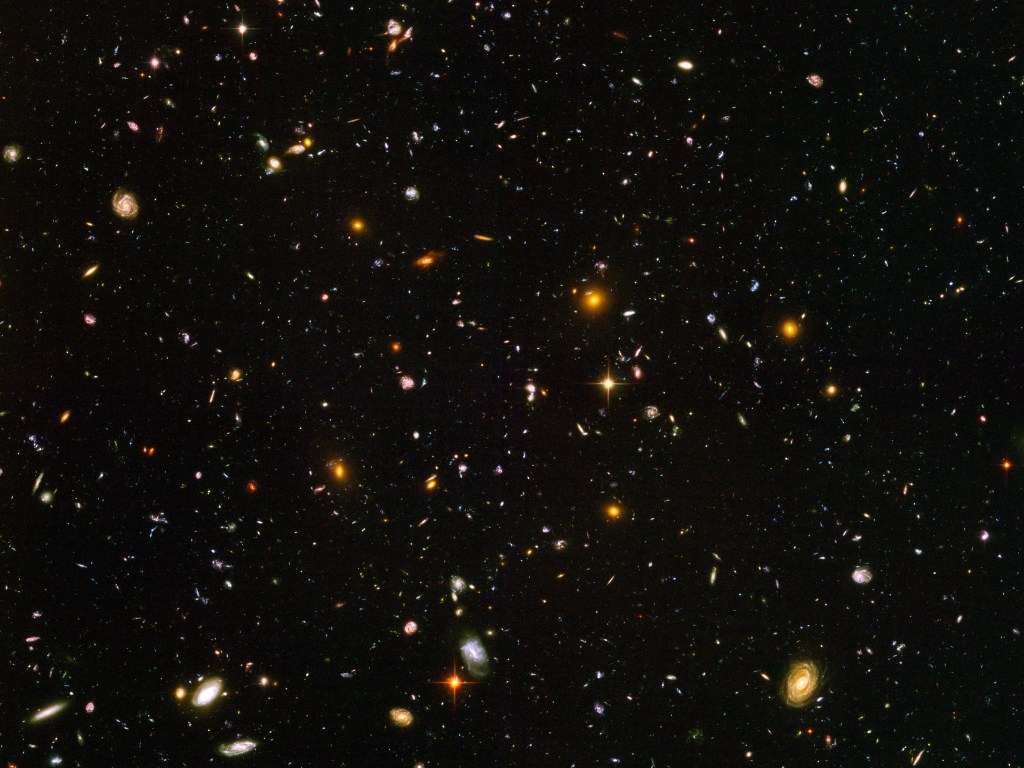
The deepest image of universe ever taken- Hubble Space Telescope

The Hubble space telescope is the most famous telescope in the world. It was named after the famous astronomer Edwin Hubble who changed our understanding of the universe proving the existence of other galaxies. It is an automatic observatory, has discovered millions of new objects in space. It helped us to witness the birth of new stars, found planets outside the solar system and see super massive black holes. Hubble was launched in 1990, and from December 1993 to may 2009, the telescope was repaired and updated four times. Astronauts visited HST five times in order to make repairs and new instruments.

Hubble holds the record for the longest range of observation. The light from the most distant galaxies has taken billions of years to travel across the universe and reach Hubble. By taking this picture, Hubble was literally looking back in time to the very early universe. You can notice on the right side of the image, there is a galaxy very much like the Milky Way that galaxy is about five billion years away, so we are looking back in time by five billion years. In March 4th, 2016, NASA releases a historic image, one that many believed was impossible. It captured the farthest away of all known galaxies; it’s located about 13.4 billion light years away from us. The light from his galaxy has just reached the earth crossing the distance that separates us; hat is now we can observe it as it was 400 million years after the big bang. This galaxy is 25 times smaller than our galaxy, the Milky Way.  It helped to find the age for the universe now known to be 13.8 billion years, roughly three times the age of earth.

This view of nearly 10,000 galaxies is called the Hubble Ultra Deep Field. The snapshot includes galaxies of various ages, sizes, shapes, and colours. The smallest, reddest galaxies, about 100, may be among the most distant known, existing when the universe was just 800 million years old. The nearest galaxies – the larger, brighter, well-defined spirals and ellipticals – thrived about 1 billion years ago, when the cosmos was 13 billion years old. The image required 800 exposures taken over the course of 400 Hubble orbits around Earth. The total amount of exposure time was 11.3 days, taken between Sept. 24, 2003 and Jan. 16, 2004.

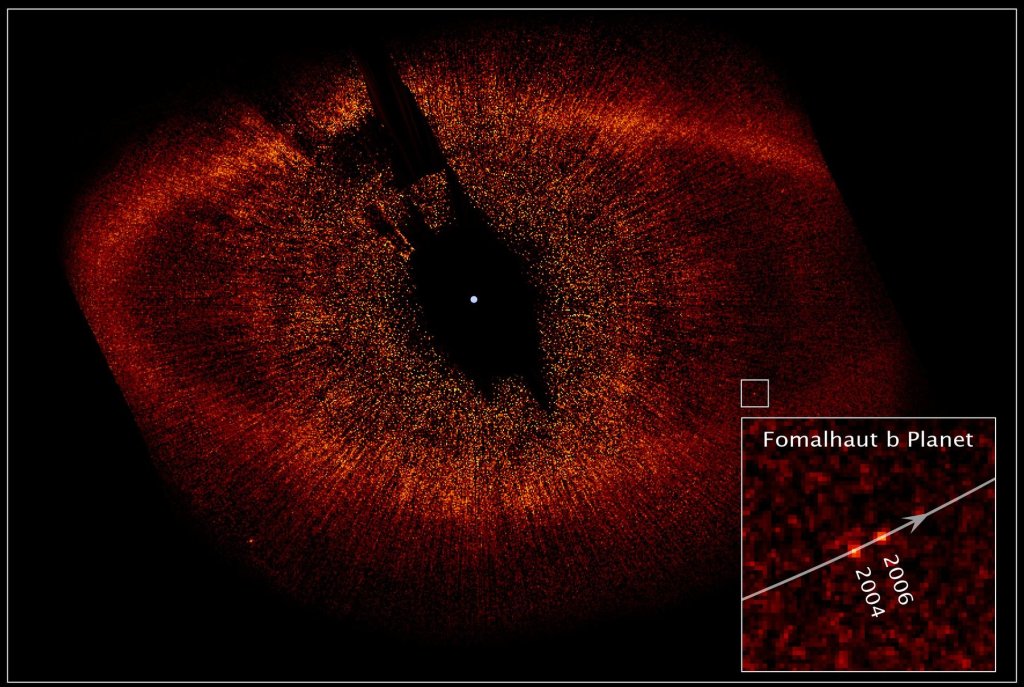
With the advanced camera of the NASA’s Hubble space telescope, it discovered a new planet called Fomalhaut b which orbiting is parent star Fomalhaut. Fomalhaut is 2.3 times heavier and 6 times larger than the sun around it is a disc of cosmic dust which creates the resemblance of an ominous eye. Fomalhaut b lies 1.8 billion miles inside the ring’s inner edge and orbits 10.7 billion miles from its star. Astronomers have calculated that Fomalhaut b completes an orbit around its parent star every 872 years. The Fomalhaut system is 25 light years away in the constellation Piscis Australis. But in April 2020, astronomers began doubting its existence; the planet is missing in the new Hubble pictures. Scientists believe that this planet was a cloud of dust and debris formed as a result of a collision of two icy celestial bodies.

Fomalhaut – The the brightest star in the constellation of Piscis Austrinus

In 1994, Hubble captured the most detailed image of the iconic feature called the pillars of creation. The pillars of creation are fascinating but relatively small feature of the entire eagle nebula. The blue color in the image represent oxygen, red is sulfur, and green represents both nitrogen and hydrogen. The nebula was discovered in 1745 by the Swiss astronomer jean Philippe Loys de Cheseaux, is located 7,000 light years from earth in the constellation Serpens. During its work Hubble has presented millions of images but unfortunately NASA has suspended missions to repair and modernize the telescope. It is assumed that in 2021, Hubble will be replaced with the new James Webb space telescope.

OBSESSION

The people of India have a special love for the language of English. With it being one of the official languages of India, people have obsessed over it now for years. It is considered supreme to any other local or regional language, the language of the elites, the language of the educated, the language of the rich, the language of the better, the language of the greater. Why the knowledge of an alien language has been recognised as the mark of standard or class? Why do Indians take pride in celebrating the English language more than any other? Why do the older generations boast about their children being able to speak English so much? Why do Indians being proud about their culture, traditions, ethnicity, customs and festivals are not as proud of their mother tongues as they are of English? These questions pop up every time a non- English speaking person is humiliated or belittled for their poor English speaking skills. But the real question is do we really need this toxicity of humiliating someone just for the sake of a mere language? No, absolutely we do not.

The answers to all these questions go back to the pre independent era. Ever since the British ruled over India they started with the policy of rejecting non-English, non-white, natives so as to establish strong foot of their supremacy. They dented the minds of naive Indians with the theory that only English speaking, white, educated (the western way) people were supreme and had the capability of ruling over others. With decades of humiliation and degradation, the people in pre independent India accepted the superiority of the English language and this made them bound to have inferiority complex about their very own language and mother tongue. The effect was so profound that even after independence, the people educated in English were considered better than those who were equally skilled but not in this supreme language. The Indian population were now interested in educating their children in an English medium school. The liking for the society with English read people enlarged to a level that it lead to the decay and ultimately the end of traditional schools with Indian native languages.

As India’s economy started to grow and new industries and establishments were born, the culture of hiring mostly and after some time only English speaking people grew to an unexpected level. The new businesses wanted English conversing people as they were now associated with better intelligence and know how. When we look back into the history of the relation between English language and the skills or expertise or wisdom we do not find any strong logical evidence to support that. It was merely the supremacy of the language created by the British that Indians starting judging themselves on the basis of the English speaking skills. The interviews were taken only in English language so as to ensure their hold of the language. Students with better grip of this foreign speech were preferred over others. Even this lingo came to be recognised as the symbol of intelligent, sincere and best for any job students.

Society made it very clear with their over likeness towards English that only the privileged, classy, affluent and powerful individuals could afford and were entitled to this learning. This obsession with a foreign tongue was so unhealthy and unwanted that till this day citizens of India have not been able to accept the fact that it is just a language and that the understanding of this speech has nothing to do with intelligence or wisdom. The folks with lesser experience or practice in English are judged too quickly as being the lesser ones. There is a swift shift in people’s attitude after they realize they are conversing with someone with no skills for English language than with the one who is an expert in it. Though with developing nature of the society today, the respect and glory of the local, regional or native language that was lost decades ago is returning back but nevertheless the tilt towards the English language continues, bent enough to stay an obsession.  

Time Management

In our daily life, we’ve got handiest twenty-four hours. Therefore we can’t do everything in one day. This creates obstacles in our ordinary work. In order to manage paintings, social life and sleep, division of time is crucial. In a particular way division of time is the need. This will help the character to finish all his obligations. You ought to write your duties in a schedule.

Time Management refers to the green use of time in order that it is able to be the most useful. The less complicated it seems, the greater difficult it is to observe this method. If you learn how to control the time, then he can attain nearly everything in lifestyles. It is said, “If you cannot control a while, you’ll not be able to set up every other part of your lifestyles”. Therefore, the first step toward success is to control a while effectively. If you master the art of organizing a while, then you may be capable of deal with your paintings higher. Time control will assist you to remove wastage, be organized for conferences, refuse immoderate workloads, screen challenge development, allocate aid (time) appropriate to a undertaking’s importance, ensure that long term initiatives are not unnoticed, plan every day successfully, plan each week efficiently.

With time management skill sets, you may get a deeper understanding of your self. As we develop antique, we lose music of the important matters in our lives. This may be averted to an quantity if you discover what you sincerely want to accomplish. Focus on quick term desires. Maintain a diary to maintain tune of your tasks. You also can put together a chart of your agenda on a paper and stick it in your bulletin board. This will assist you be updated for every mission. Learn to mark deadlines for your calendar. This acts as a consistent reminder if you want to obtain your dreams.

In conclusion, time control is a completely vital ability to be found out and to be mastered so as to have a higher way of life. By coping with nicely time, you will not suffer from strain and your works/tasks may be carried out on time and with exceptional great.

The beginning of covid culture

With the rise of coronavirus (COVID19), In the last few months, individuals, families, and communities in India have been negotiating a new social order. India’s roughly 1.3 billion people went under the first phase of lockdown in March 2020.  

The government had initiated these protocols concerning WHO :

  1. Wearing a mask in public 
  • Make sure your mask covers your nose, mouth, and chin.
  • Clean your hands before you put your mask on, before and after you take it off, and after you touch it at any time.
  • When you take off your mask, store it in a clean plastic bag, and every day either wash it if it’s a fabric mask or dispose of it in a trash bin if it’s a medical mask.
  • Don’t use masks with valves. 

2. Maintaining distance in public places

  • Avoid the 3Cs: spaces that are closed, crowded, or involve close contact.
  • Keeping 6 feet distance or a minimum of 3 feet in public
  • Meet people outside. Outdoor gatherings are safer than indoor ones, particularly if indoor spaces are small and without outdoor air coming in.
  •  Open a window to increase the amount of natural ventilation when indoors.

3. Keep good hygiene 

  • Regularly and thoroughly clean your hands with either an alcohol-based hand rub or soap and water. This eliminates germs that may be on your hands, including viruses.
  • Cover your mouth and nose with your bent elbow or a tissue when you cough or sneeze. Dispose of the used tissue immediately into a closed bin and wash your hands.
  • Clean and disinfect surfaces frequently, especially those which are regularly touched, such as door handles, faucets, and phone screens.

4. Vaccination 

  • Get vaccinated as soon as it’s your turn and follow local guidance on vaccination.
  • Do not believe in any false information about vaccination.
  • The vaccines approved in India are :

          1 Zydus Cadila. ZyCoV-D. 

          2 Moderna. mRNA-1273.

          3 Sputnik V.

          4 Janssen (Johnson & Johnson) 

          5 Oxford/AstraZeneca. AZD1222.

          6 Serum Institute of India. Covishield

          7 Bharat Biotech. Covaxin. 

What to do if we get sick?

  • If you have a fever, cough, and difficulty breathing, seek medical attention immediately. Call by telephone first and follow the directions of your local health authority.
  • Do not take any random medicines without the concern of a proper physician. 
  • Know the full range of symptoms of COVID-19. The most common symptoms of COVID-19 are fever, dry cough, tiredness, and loss of taste or smell. Less common symptoms include aches and pains, headache, sore throat, red or irritated eyes, diarrhea, a skin rash, or discoloration of fingers or toes.
  • Stay home and self-isolate for 10 days from symptom onset, plus three days after symptoms cease. Call your health care provider or hotline for advice. Have someone bring you supplies. If you need to leave your house or have someone near you, wear a properly fitted mask to avoid infecting others.
  • Keep up to date on the latest information from trusted sources, such as WHO or your local and national health authorities. Local and national authorities and public health units are best placed to advise on what people in your area should be doing to protect themselves.

Written with reference to WHO and MoHFW (Ministery of health and family welfare Government of India ) 

Fix your browser opening by itself in android

Hey all! technology is an inseparable part of our lives. And when we talk about technology how can we forget about our mobile phones. None of us want any malfunction in these devices we carry in our pockets daily. Android is quite possibly the most well-known working system with regards to mobile phones and is something that numerous clients can’t simply manage their day without. However, nothing comes without problems likewise, with some other gadget, it can have a lot of issues. Android phones are often reported of various problems occurring due to several reasons. We are going to discuss one such prevalent issue and the solution to it. a plethora of android users repine about their web browser opening itself and this causes them an abundance of arduousness in utilizing their device.

Let us begin by discussing what could cause this trouble in your android device. Below are listed few reasons which might be troubling you: –

1)    Visiting any unsafe website: one very prevalent reason for your android browser malfunction could be if you visited any unknown/unsafe website. this could pave a way for sundry viruses to enter your android and cause trouble in its functioning.

2)    Downloading applications from obscure sources: using third-party apps can also be harmful to your device. Downloading apps from unknown sources is another way for malware to enter your android mobile device. Third-party apps are often reported to harm the system’s functioning. So, always avoid downloading applications from an unsafe site.

3)    Android upgrade: you are not to be blamed for this, sometimes the system upgrades instead of improving the functioning of your device cause various problems in it. it’s often reported that users face the issue of their web browser opening on its own after upgrading their device.

4)    Processing resetting your Android phone in the incorrect manner: you might think of resetting your phone as the easiest way to solve any issue but this doesn’t solve always solve your problem, sometimes it might create a new issue. If you reset your android phone in the incorrect manner, it might cause a problem in your web browser.

5)    Pairing your phone with an affected device:  you might have Paired your phone with another phone or PC that is affected by malware which paved way for the malware to enter your device and cause trouble in your browser.

so now you are cognizant of the possible causes of your quandary. you will probably eschew these in the future so that your android works without any trouble.

Let us now discuss the solution to the problem we are facing. One solution cannot fix the same problem for all android users. Below are mentioned some tips to guide you.

1.    Begin by uninstalling any suspicious app: before you initiate this step, stop briefly and ponder when have you begun confronting the issue? Then, uninstall all applications which you had as of late introduced on your Android gadget and check if the program continues to open without anyone else on your Android cell phone. Here’s how you can locate and uninstall the suspicious app. Go to settings application and in the application locate apps, look for the application without any name (usually at the end of the application list) and uninstall it.

2.Force stop the app: If the above step did not fix your issue or you did not find any suspicious application, so try to force stop the affected browser and clear cache. To do so effectively, go to the settings application on your android device and open apps. select the program that is opening on itself and without any hesitation, force stop it. further clear cache and browser data of the application. After done with this try running the browser again your problem might have been fixed. notwithstanding, If the program synchronizes with Chrome, Mozilla, Firefox, or some other program, ascertain you clear out your Chrome history on your work area withal since they sync. when you will tap on the Clear All information all your application information will be erased, it is prudent that you take a reinforcement of your information, keep a note of your passwords – ideally by utilizing secret word directors, reinforcement data sets, and so on.

3.Try using another web browser: if your browser continues to trouble you it might be a better option to look for an alternative. Either you can switch to a new browser completely or for a short interval of time until you find out what caused trouble in your previous browser.

4.Install an anti-virus application: Download and introduce an alternate internet browser and check if the quandary persists. If your browser still opens by itself, you definitely need an anti-virus on your android device. Install anti-virus software and scan your device, make sure to instantly remove any malware if detected.

5. Switch to safe mode: a ton of clients are ignorant of this component of their gadget yet this can end up being extraordinary assistance. safe mode can be considered as an indicative mode in Android. What it does is that it opens your Android gadget in its easiest structure i.e., with its essential interface. Here you can be liberated from the unsettling influence from most outsider applications. Additionally, in case there is any offender outsider application, you will actually want to seize that application in this mode. To enable this feature long-press the power button just the same way you do to power off your device, just as the option to power off pops up press the power button further for few more seconds. Your android device will restart in safe mode.

6. Factory reset your device: if none of the above options helped you then the only option left is to factory reset the device. ensure you follow the means mentioned to processing factory reset your Android device. Kindly don’t utilize the force button and the volume button to factory reset your telephone to not prompt another issue. Also, make sure to keep a backup of all your files to avoid losing anything important. To effectively perform a factory reset open the settings application and look for the system option. Now tap on the reset option and further tap on factory reset. After confirming the action your device will initiate a factory reset and the indication will be displayed on your screen.

Just remember to go for factory reset only when the other options don’t help, or you will unnecessarily lose your data. Hope these tips help you.

Corruption

Corruption refers to any act achieved through people or a set in lieu of some shape of bribes. Corruption is considered to be a unethical and criminal act. If established, corruption can result in criminal punishments. Often times the act of corruption incorporates the rights and privileges of some. It is very difficult to find a definition that takes under consideration all of the characteristics and factors of corruption.

Today, humans believe that politics is based on corruption. Few politicians are uncovered, and the last ones have a namesake easy chit. One birthday celebration is probably less corrupt than the alternative, but all are corrupt to some extent. People have lost their agree with in the democratic machine, the authorities places of work, and institutes. The prosperity of a state is at stake due to the prevalence of rampant corruption within the machine. The big pile of Non Performing Assets, loss of overseas investments, time and price overruns of infrastructure projects are the unfavourable consequences on our progress. Social inequality is particularly due to corruption. It hits the terrible tough. Not all pays bribes. Moreover, in our network, there are greater projects for pipelines, dams, refineries, but nevertheless, the primary wishes such as faculties, hospitals, and roads aren’t available for every person. The politicians, administrative officers, and personal agencies degrade the surroundings for his or her benefits. The exploitation of herbal assets and non-observance of the guidelines associated with ecological stability result in unexpected consequences.

There isn’t any end of corruption as there is no end of robbery, theft, homicide, rape , bullying and lots of other acts humans are doing to others. Corruption , similar in a manner to theft from government or from an “summary entity” looks extraordinary, however is comparable . You take some thing from others for your very own exact.
Corrupt humans should chased , haunted and punished within the harsher methods to prevent the feeling that exists in some societies that this is the way to make cash and sell your self in society. The higher the corruption, the higher the punishment.

How advanced are Alien civilizations? -The Kardashev scale

The observable universe is consists up to two trillion galaxies that are made of billions and billions of stars. In the Milky Way galaxy alone, scientists assume that there are some 40 billion earths like planets in the habitable zone of their stars. When you look at these numbers, there are a lot of possibilities of alien civilization to exist. In a universe that big and old, the possibilities of civilizations may start millions of years apart from each other, and develop in different directions and speed. So their civilization may range from cavemen to super advanced. We know that human started out with nothing and then making tools, building houses, etc. we know that humans are curios, competitive, greedy for resources, and expansionists. The more of these qualities that our ancestors had, the more successful they were in the civilization building process.

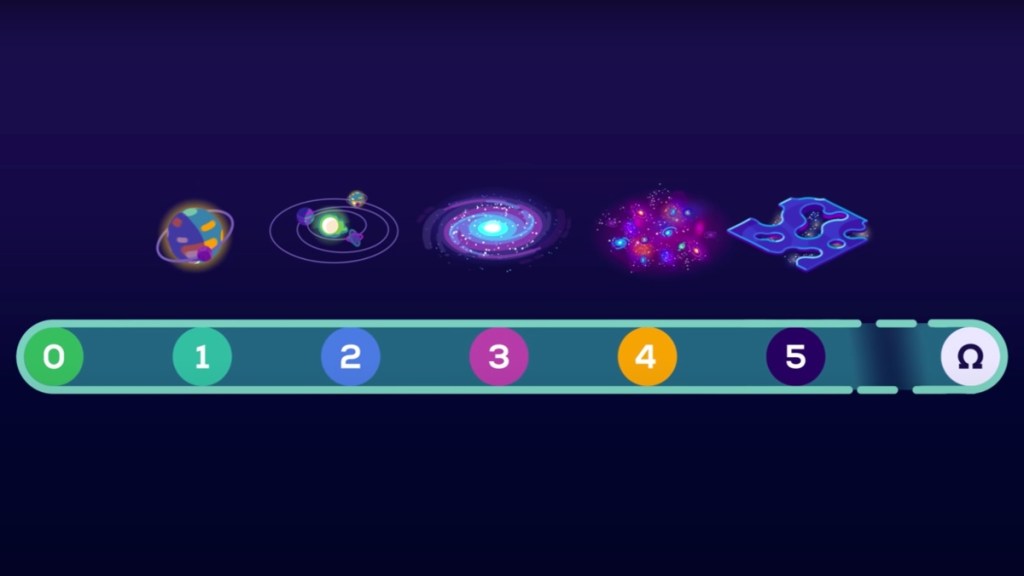
 Like this, the other alien civilizations also might have evolved. Human progress can be measured very precisely by how much energy we extracted from our environment. As our energy consumption grew exponentially, so did the abilities of our civilization. Between 1800 and 2015, population size had increased seven fold; while humanity was consuming 25 times more energy. It’s likely that this process will continue into the far future. Based on these facts, scientist Nikolai Kardashev developed a method for categorizing civilizations, from cave dwellers to gods ruling over galaxies into a scale called the Kardashev scale. It is a method of ranking civilizations by their energy use. It put civilizations into four categories. A type 1 civilization is able to use the available energy of their home planet. A type 2 civilization is able to use the available energy of their star and planetary system. A type 3 civilization is able to use the available energy of their galaxy. A type 4 civilization is able to use the available energy of multiple galaxies

. It’s like comparing an ant colony to a human metropolitan area. To ants we are so complex and powerful, we might as well be gods. On the lower end of the scale, there are type 0 to type 1 civilization. Anything from hunting, gatherers to something we could achieve in the next few hundred years. These might actually be abundant in the Milky Way. If that possible, why they are not sending any radio signals in space. But even if they transmitted radio signals like we do, it might not be very helpful. In such a vast universe, our signals may extend over 200 light years, but this is only a tiny fraction of the Milky Way. And even if someone were listening, after a few light years our signals decay into noise, impossible to identify as the source of an intelligent species. Today humanity ranks at about level 0.75. We created huge structures, changed the composition and temperature of the atmosphere. If progress continues, we will become a full type 1 civilization in the next few hundred years. The next step to type 2 is trying and mine other planets and bodies.

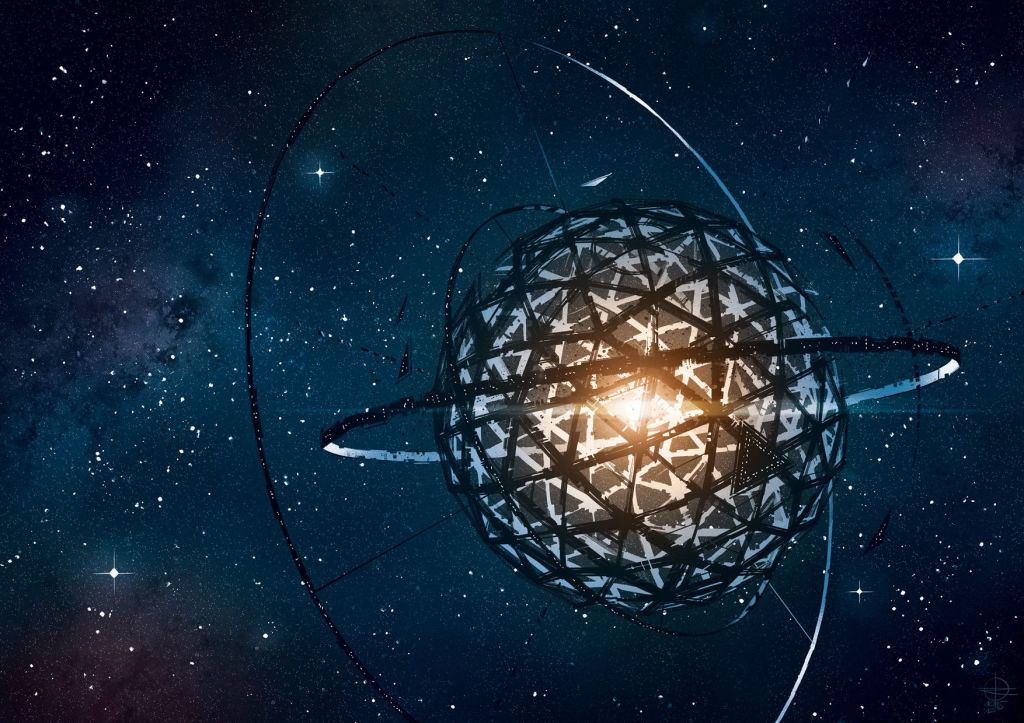
The Dyson sphere – mega-structures built around sun to draw energy

 As a civilization expands and uses more and more stuff and space, at some they may start a largest project that extracting the energy of their star by building a Dyson swarm. Once it finished, energy has become unlimited. The next frontier moves to other stars light years away. So the closer a species gets to type 3, they might discover new physics, may understand and control dark matter and energy, or be able to travel faster than light. For them, humans are the ants, trying to understand the galactic metropolitan area. A high type 2 civilization might already consider humanity too primitive. A type 3 civilization might consider us bacteria. But the scale doesn’t end here; some scientists suggest there might be type 4 and type 5 civilizations, whose influences stenches over galaxy clusters or super clusters. This complex scale is just a thought experiment but, still it gives interesting things. Who knows, there might be a type omega civilization, able to manipulate the entire universe, and they even might be the actual creators of our universe.

“Somewhere, something incredible is waiting to be known.” – Carl Sagan

Pollution a reality of today

Pollution has became a part of our life. It has became the reality whether we accepted or not. We have to now keep air purifier to purify the air inside our house. Just think of the level of destruction in has caused to just as well as to nature.

We have reduced the resources of nature or either we have misused the resources of nature for our own benefit. We youmans are so selfish that for our benefit we can even take away the things which are meant for everyone. Like we have polluted so many rivers which has caused death to so many aquatic animals that we can’t even imagine of.

We have polluted the air quality so much that we are now facing difficulty to breathe ourselves. We have caused pollution in air, water, soil, noise whatnot. Just think it yourself.

Now there are so many activist and NGOs are coming ahead for cleaning up the message that has been spread by us only. But it is not enough. To remove Facebook devil from our mother nature each and everyone have to contribute towards this.

We can take small steps like using public transport instead of personal one for travelling which will reduce the air pollution. There is no need of very much big-big steps to be taken a small step by each individual is enough for cutting this pollution into half.

It is our nature and we should use net sustainabily so that it is available for other animals and future generation as well.

College Life!

College Life is one of the maximum incredible and lovable times of an character’s lifestyles. Unlike School Life, College Life has a one of a kind experience, and someone wishes to have this experience in his/her lifestyles. College Life exposes us to complete new experiences which we always dream of experiencing after our college lifestyles. Lucky are folks who get the risk to revel in their university existence, as many people don’t get this chance due to their situations or economic problems. For all and sundry, College Life has a different which means. While a few people spend their university life via partying with buddies, others end up extra careful about their career and study difficult. Whatever the manner, each character experience their college lifestyles and constantly desire to relive that point as soon as it is over.

College existence is a big transition from college life. We go through a number of adjustments while we input university. Our faculties had been a secure location where we had grown up and spent half our lives. The transition to university is so surprising that you’re now not covered via your teachers and friends of your faculty time. In faculty lifestyles, we have been continually dependant on our buddies or teachers. College life teaches us to be independent. It makes us stronger and teaches us to combat our personal battles. It also makes us critical about our careers. We make selections so as to affect our destiny all through ourselves, as in faculty existence our parents did it for us.

College existence experience is certainly one of a kind. The most not unusual reminiscences people have of university existence are genuinely goofing around with buddies. They don’t forget how the group of buddies walked around the college in style and gambling stupid pranks on each other. I assume, university existence would be a combined bag of fun, freedom, experiments and obligations. It will incorporate new hopes and aspirations, new joys and disappointments and new pals. Those wiser than us say that college days are the first-rate days of 1’s life. The selections we make now form up our future.

Education a right of everyone but a gift for poor

Education the solution for every problem in this world. If you are educated you know how to manage difficult time in a better way then others. Education is not only provided in school but it also present all around you.

The context of education is very wide, you can’t say that education is only provided in schools and colleges. By education you’re mean that you learn from your surrounding not only bookcase knowledge. A person who never went to school doesn’t mean that he don’t have knowledge of anything.

At present to the covid-19 situation there are millions of children who had lost the access to education, because they are not having digital devices to have their online Classic in even their schools are shut off.

Today we are having so many excuses for online classes like we’re having strain in eyes, neck, headache etc. I don’t mean mad they are not genuine but, these are not as hard as you are not getting education. You are fortunate in now to continue your education even without going to school but many in this world a not so fortunate.

There are many example synthesis world who had sacrifice a lot just to get educated. One of them is Malala Yousafzai who was ready to get shot from gun just to get educated.

So whenever you feel like you don’t want to study just think about them and you automatically will get an inspiration and a sense of gratitude that you are having so many resources that your education is not getting any hindrance.

We and government together should take step that gift access of education to everyone in your country or in the world. We can donate our old book, pencils and other stationaries to them and that will be a small step from our side but will make a big difference for them.

Grand Parents

Grandparents our first friend since we are born. They are actually the blessing of God. Only summer fortunate enough to spend their childhood and life with them.

It is always said that Grand children are the last friend of their grandparents, and they are our first friend. There is always a strong and friendly bonding between grandchild and grandparents. Having grandparents with you is the best thing in the life.

Only some fortunate grandchild are able to see or live with their grandparents nowadays. They teach the values which help us to grow all over our life. Detail story which are meaningful and helps us to get connected to our culture.

It is our duty to not let them feel lonely if you are there with them. In our busy schedules we often forget that the old citizens actually feeling very lonely and are not happy from inside. They never tell you about their loneliness but you should understand it by looking at their faces.

Did don’t want much from anyone they just need love and care. And if you can’t do that then you probably are are not worth calling a grandchild. Just sit with them for sometime in a day and have normal talk with them they will definitely feel happy about. Being in the company you will also feel relax from your stressful life.

And please don’t ever send them to the old age home they had taken care of you when you didn’t know anything about this world and now it’s your time don’t betray them. Take care of them as if your own child because we know that old age is like the comeback of childhood.

Why the long face? The Scream

The Scream is one of the most famous artworks on the planet. Almost everyone of us must have seen it somewhere or the other. Either in memes or maybe on some educational TV channel but very little population knows the name of the artist or even the name of the painting itself. 

Figure on cliffside walkway holding head with hands

Edward Munch

The Scream is an artwork by the Norwegian artist Edward Munch completed in 1893.

Munch was a painter and printmaker born in Norway in 1863. His paintings were greatly inspired by the expressionism movement and symbolism. All his paintings  had a certain underlying psychological tone to it which is hard to miss. Munch had a miserable childhood, and that misery manifested itself later in his paintings. His mother and sister died of tuberculosis while he was very young and later, still at a young age he lost his father and his brother too. Death and gloom always meandered around him and followed him everywhere. Another sister of his suffered from mental illness too.

To understand a piece of art it is important to understand the artist, his experiences, his life to be able to get as close to meaning the artist was trying to show because there is no possible way that we can fully understand an artist’s psyche at the time of making it even though art is interpretive.Munch depicted raw and violent emotions in his work

The scream is an autobiographical work of art where while he was walking along a path one evening with a fjord below, feeling tired and ill, when looked over the fjord the scene looked to him as if blood was covering the sky. He felt a scream coursing through the clouds. Munch had a history of ill mental health in his family and during that evening it is possible that he heard the scream inside his own head.Soon after painting The Scream abandoned this style and barely went back to it.

Theft 

A work of art doesn’t become famous just because of the beauty or the skill behind it but a multitude of things influence it’s popularity like what it represents, political environment, controversies it was involved in.

Similarly this painting is not just famous for its artistic grandeur but it was in the news a lot due to the thefts.

In 1994 thieves broke into a museum in Oslo and stole the painting also leaving a note that read thanks for the poor security and demanded 1 million USD as ransom which was refused. About 3 months later the two men were caught as a result of the sting operation carried out by the Norwegian police.

In 2004, a 1910 version of The Scream was stolen from the Munch museum in broad daylight by two masked gunmen who stole The Scream and Madonna by Munch. The Munch museum was closed for 10 months after the incident for security reasons. It took about 2 years for the Norwegian government to recover the two paintings with some major damage to the paintings which were recovered later.

Changes in Education

It all started on the ending days of march 2020 when lockdown began in India, everyone was at home and there were no signs of going out. At that time many problems came out among students like stress, anxiety, frustration, and boredom and we missed going to school/college and hanging out with friends. 

Soon schools and colleges started the medium of education through the internet. First, we all thought it would be easy to cope up but it didn’t work out to be like that. Various methods were used for classes like reading material, assignments, communication via email, live chats or messages, and delivering content by live sessions, presentations, recorded videos, or lectures.

Picture credits: https://thedmonline.com/how-students-are-adjusting-to-online-classes/

 Both students and teachers faced a lot of problems in this medium.

Technical issues

Many students were not well equipped with devices and a high internet connection that is required for online learning. Due to this, they face problems in going live for virtual learning and other platforms that require an internet connection. And most of the teachers were not much familiar with technology as it was their first time teaching on this medium.

Distractions

Because online learners use their computers and the Internet to participate in online learning, they may be tempted by many distractions. Students working on an assignment may find themselves surfing the Web, checking social networking sites, or catching up with video games. 

Lack of In-Person Interaction

Despite of getting reading material, communication via email, live sessions, presentations, recorded videos, or lectures for the students. As compared to traditional ones, students find it difficult to communicate in person who struggles with understanding concepts. Many times these students do not even approach teachers to clear their doubts as they are shy to speak up in front of everyone.

 Evaluation

In online mode, the task of giving assignments is easier but it is difficult to evaluate the students on basis of their performance. There would be students who would be copying everything from the internet. In a recent survey, it was found that 73% of students cheat during online examinations via internet, and 27% were cheating through books. 

Time management

In many cases, both students and teachers find difficulty in managing their time with online learning and doing household work. Online learning is completely new for them and requires intensive work. Everyone needs a well-planned schedule to manage their time in an effective manner. Online learning provides flexible time unlike traditional classrooms, whereas in traditional classes the schedule is highly maintained.

Course

The course and its content is designed earlier with respect to traditional classrooms. But with the shift to online learning, it requires redesigning of course which can take a considerable amount of time. In most cases, these courses work well in traditional classrooms but go flat in online learning. It happens when there are no content-related activities, assignments, or projects that can be done online.

Covid 19 brought a very big change in Education. Well in the end from my own perspective I can say conclusively that both traditional and online methods are in need of much evolving in fulfilling the needs of both teachers and students.

Childhood

Childhood is the best time and significant time in anybody’s life. It’s the principal phase of life which we appreciate in the manner we like. Plus, this is the time that shapes up what’s to come. The guardians love and care for their youngsters and the kids to the equivalent as well. Additionally, it’s the brilliant time of life wherein we can show kids everything.

The recollections of childhood have their own place in any singular’s heart. As one grows up, one feels increasingly more connected with his youth, the best time frame in a singular’s life. Having no tensions, stresses or work, a kid is liberated from the grimy and dirty commotion of the common life. At the point when people recall the recollections of youth, they feel charmed as it is the most wonderful period which is liberated from any sort of stress or nervousness. Youth minutes are the best snapshot of life. Whenever lost, these never returned. This is the ideal opportunity for the youngsters to play, to be adored and taken care of their wellbeing. Many guardians attempt to experience their fantasies through their youngsters. However, guardians ought not do such incredible treachery towards their kids. They should look what their kids need, what are their likings. Guardians should not put presure on their kids for considers. It has been seen that now a days pressure is there on investigations and guardians put should weight on them, yet this does more mischief than anything to them.

At the point when we were kids, the littlest of things gave us colossal joy. Neither did we need materialistic stuff to be content, nor there was a spot for childishness in our souls. Since we’ve strolled past the most lovely period of our lives, the main way passed on to encounter it again is to esteem, recall and remember that load of sweet recollections sooner rather than later. Besides, they show everybody the illustration of mankind that they have forgotten in this chaotic way of life of this world. Furthermore, these youngsters are the eventual fate of the nation and on the off chance that they don’t develop as expected, in future how might they help in the development of the country.

As we develop we feel greater connection to our youth and we need to get back those days however we can’t. That is the reason many individuals say ‘time is neither a companion nor an enemy’. Since the time which is gone can’t return and neither do our adolescence. It is a period which numerous artists and essayist acclaims in their manifestations.

DATA COLLECTION METHOD’S

Data is a collection of facts, figures, objects, symbols, and events gathered from different sources. Organizations collect data to make better decisions. Without data, it would be difficult for organizations to make appropriate decisions, and so data is collected at various points in time from different audiences.

For instance, before launching a new product, an organization needs to collect data on product demand, customer preferences, competitors, etc. In case data is not collected beforehand, the organization’s newly launched product may lead to failure for many reasons, such as less demand and inability to meet customer needs. 

Although data is a valuable asset for every organization, it does not serve any purpose until analyzed or processed to get the desired results. 

You can categorize data collection methods into primary methods of data collection and secondary methods of data collection.

Primary Data Collection Methods

Primary data is collected from the first-hand experience and is not used in the past. The data gathered by primary data collection methods are specific to the research’s motive and highly accurate.

Primary data collection methods can be divided into two categories: Quantitative methods and qualitative methods

Quantitative Methods:

Quantitative techniques for market research and demand forecasting usually make use of statistical tools. In these techniques, demand is forecast based on historical data. These methods of primary data collection are generally used to make long-term forecasts. Statistical methods are highly reliable as the element of subjectivity is minimum in these methods.

Time Series Analysis

The term time series refers to a sequential order of values of a variable, known as a trend, at equal time intervals. Using patterns, an organization can predict the demand for its products and services for the projected time. 

Smoothing Techniques

In cases where the time series lacks significant trends, smoothing techniques can be used. They eliminate a random variation from the historical demand. It helps in identifying patterns and demand levels to estimate future demand. The most common methods used in smoothing demand forecasting techniques are the simple moving average method and the weighted moving average method. 

Barometric Method

Also known as the leading indicators approach, researchers use this method to speculate future trends based on current developments. When the past events are considered to predict future events, they act as leading indicators.

Qualitative Methods:

Qualitative methods are especially useful in situations when historical data is not available. Or there is no need of numbers or mathematical calculations. Qualitative research is closely associated with words, sounds, feeling, emotions, colors, and other elements that are non-quantifiable. These techniques are based on experience, judgment, intuition, conjecture, emotion, etc.

Quantitative methods do not provide the motive behind participants’ responses, often don’t reach underrepresented populations, and span long periods to collect the data. Hence, it is best to combine quantitative methods with qualitative methods.

Surveys

Surveys are used to collect data from the target audience and gather insights into their preferences, opinions, choices, and feedback related to their products and services. Most survey software often a wide range of question types to select.

You can also use a ready-made survey template to save on time and effort. Online survey can be customized as per the business’s brand by changing the theme, logo, etc. They can be distributed through several distribution channels such as email, website, offline app, QR code, social media, etc. Depending on the type and source of your audience, you can select the channel.

Once the data is collected, survey software can generate various reports and run analytics algorithms to discover hidden insights. A survey dashboard can give you the statistics related to response rate, completion rate, filters based on demographics, export and sharing options, etc. You can maximize the effort spent on online data collection by integrating survey builder with third-party apps.

Polls

Polls comprise of one single or multiple choice question. When it is required to have a quick pulse of the audience’s sentiments, you can go for polls. Because they are short in length, it is easier to get responses from the people.

TABULATION

Tabulation Meaning:

Tabulation is a systematic and logical representation of numeric data in rows and columns to facilitate comparison and statistical analysis. It facilitates comparison by bringing related information close to each other and helps in statistical analysis and interpretation.

In other words, the method of placing organised data into a tabular form is known as tabulation. It may be complex, double, or simple, depending upon the nature of categorisation.

Objectives Of Tabulation:

(1) To simplify complex data

  • It reduces the bulk of information, i.e., it reduces raw data in a simplified and meaningful form so that it can be easily interpreted by a common man in less time.

(2) To bring out essential features of data

  • It brings out the chief/main characteristics of data.
  • It presents facts clearly and precisely without textual explanation.

(3) To facilitate comparison

  • The representation of data in rows and columns is helpful in simultaneous detailed comparison on the basis of several parameters.

(4) To facilitate statistical analysis

  • Tables serve as the best source of organised data for statistical analysis.
  • The task of computing average, dispersion, correlation, etc., becomes easier if data is presented in the form of a table.

(5) To save space

  • A table presents facts in a better way than the textual form.
  • It saves space without sacrificing the quality and quantity of data.

HYPOTHESIS RESEARCH

What is Hypothesis in Research?

A Hypothesis is a tentative statement of a proposition which the researcher seeks to prove. It’s basically a concrete generalization. Of course, this generalization requires essential characteristics that pertain to an entire class of phenomena.

When a theory stated as a testable proposition formally and subject to empirical verification we can define it as a hypothesis. Researchers make a hypothesis on the basis of some earlier theories and some rationale that generally accepted as true. The hypothesis test finally will decide whether it is true or rejected.

So, to clarify a hypothesis is a statement about the relationship between two or more variables. The researcher set out the variables to prove or disprove. Hypothesis essentially includes three elements. For example-

  1. Variables
  2. Population
  3. Relationship between variables.

Example of Hypothesis

  1. Rewards increase reading achievements
  2. Rewards decrease reading achievements
  3. Or rewards have no effect on reading achievements

In the above examples- variables are- Rewards & Achievements.

Steps in Formulation of Hypothesis

A hypothesis is a tentative assumption drawn from practical knowledge or theory. A hypothesis is used as a guide in the inquiry of other facts or theories that a researcher does not know. However, the formulation of the hypothesis is one of the most difficult steps in the entire scientific research process.

Therefore, in this regard, we intend to point out the basic steps in the formulation of a hypothesis. We are pretty sure that this guideline will be helpful in your research works.

1. Define Variables

At first, with a view to formulating a hypothesis, you must define your variables. What do you want to test? Will you test that rewards increase reading achievement? Or rewards decrease reading achievement? Whatever your goals are, they need to be clearly defined, quantifiable, and measurable. This will provide you with a clear idea of what to follow to achieve results.

2. Study In-Depth the Variables

If we do think that your variables are Rewards & Achievements, then you need to intense study how rewards increase reading achievements? An in-depth study, rigorous questions, and data of rewards increase reading achievements will make you able to confirm your hypothesis. Specify dependent and independent variables.

3. Specify the Nature of Relationship

Then, identify what relationship there exist between the variables. What variable influences the other? That is what is the dependent variable and what is the independent variable? How Rewards impact achievements? If reward plays a key role in reading achievements, then reward is the independent variable.

4. Identify Study Population

The population in research we mean the entire group of individuals is going to study. If you want to test how rewards increase reading achievements in the United Kingdom, you need not study the whole population of the United Kingdom. Because the total population does not involve in reading achievements. Therefore, the researcher must identify the study population.

5. Make Sure Variables are Testable

Variables in your hypothesis must be testable. Otherwise, the hypothesis would be worthless. Because your research study must accept or reject a variable. So, variables you must need to test. Testable variables can only be accepted or rejected. Moreover, the sole aim of a research hypothesis is to test variables in the long run.

It is crucial for graduate students to search the thesis and dissertation literature to make sure that an idea or hypothesis has not already been tested, explored, and published.  An additional reason to search this literature is that it is rich with ideas and information not found elsewhere.  If graduate students do not continue on as academics or if students that came after them in their programs did not continue their research, this literature may be the end of the line for scholarship on a topic. Tesi Online is a good resource for scholars to try.

Photo by Andrea Piacquadio on Pexels.com

THE FOUR KINDS OF CHANGES

1. Mission Changes

Did you know that the team who made Instagram had previously developed a product called Burbn?  It was a check-in service similar to Foursquare except that it focused on hanging out with your friends.  Needless to say, it never took off.  The team performed something that is most visibly seen in the tech community: a company pivot.  They changed their business focus and created Instagram.

Sometimes companies need to change direction to survive.  For more on corporate culture and the role of the mission statement, check out this article on shaping an authentic corporate culture.

2. Strategic Changes

A strategic change is a change in how the company tackles a problem.  Going from print advertising for your business to online, for example, is a strategic change.  As is targeting a different demographic or selling a new type of product.  When Amazon launched the Kindle, that was a strategic change.  When Microsoft revealed that Windows 8 had changed how the company had approached operating systems, that was a strategic change.  Change management in this case means convincing your team of the new strategy’s value.

3. Operational Changes

An operational change is a change in the structure of your company.  That could be a reorganization, lay offs, or just a team change due to a strategic or mission statement change.

Operational changes are some of the roughest for your employees because they never quite know what to expect.  At least with a change in technology they aren’t likely to find themselves without a job.

4. Technological Changes

Technology is advancing inexorably, whether we like it or not.  That means we need to keep upgrading or fall behind.  Often operational and strategic changes are driven by a change in technology.  At the turn of the century, for example, it was rare to see a TV commercial direct you to a website.  Now it is commonplace.

A change in technology could mean a change that affects all your employees.  If an operating system upgrade breaks a proprietary piece of software, you are going to have to retrain your team with the new software.  Technological changes don’t have to be rough, though.  Switching to Intuit Quickbase is often quick and painless.

That said, people are stubborn.  Often technological changes cause the most trouble.  Make sure your team is trained for the software, though, and you should be able to avoid most of it.

TOTAL PROJECT MANAGEMENT

Total project management solutions (TPM solutions) will help a project-thinking organization to stabilize the business processes and begin leading employees towards achieving refined efficiency and accountability. Implementing TPM solutions requires a flexible infrastructure that lets respond to the dynamics of a project environment and rapid technological advances. In this article, I will briefly talk about what TPM concept means and will also outline a 5-step model for implementing total PM solutions. I guess my considerations will be helpful for management staff and executives in project-thinking organizations.

TPM Concept

The key idea behind total project management (TPM) consists in providing a project-thinking organization with an enterprise-wide approach to establishing an efficient project management system. Such a system paves the way for developing total project management solutions (TPM solutions) through creating a project-based culture in which every project is performed in line with the organization’s corporate strategy, and therefore every project participant and team member can get necessary support from managers at all levels. The system will be the foundation for implementing TPM effort and starting the project management process.

TPM solutions make it possible to build close collaboration and communication between project-thinking employees, technology and processes which are the key drivers in the total project integration environment. The implementation of total project management solutions depends on a selected management style that integrates accountability into the total project processes and serves as a convenient way for continuous improvement of both corporate and individual performance.

A 5-Step Model

A macro-level model of total project management includes 5 steps Taking each of the steps builds an infrastructure for implementing TPM solutions. Here are these steps:

  • Communication
  • Assessment
  • Recommendation
  • Implementation
  • Validation

Because a model of total project management encompasses all of the listed steps, a project-thinking organization needs to incorporate collaborative methods, tools, and appropriate technologies to create a synchronized and highly productive infrastructure that tends to be stable and flexible in a rapidly changing project environment.

Once the steps of TPM model are taken along with the standards of best practices (incl. communication protocols, employee competency assessments, project portfolio analysis, project methodology planning, process scheduling and mapping, application-based working environments, team training and development), the infrastructure for achieving efficient total project management solutions will be established.

The performance appraisal

Performance appraisal

Forming part of an organisation’s overall performance management system, the performance appraisal can be defined as the process of identifying, evaluating and developing the work performance of employees to help achieve the goals and objectives of the organisation. At the same time, appraisals benefit employees by providing them with recognition, feedback, career guidance and development.

Performance appraisal involves managers and their staff members meeting on a one-on-one basis at regular intervals (at least annually) to discuss work performance in relation to:

  • execution of roles and responsibilities
  • the requirements of the organisation and individuals’ contribution to the achievement of the organisation’s objectives.

Effective performance appraisal relies on clear performance standards being established and discussed with employees. Using these standards, appraisal involves:

  • observing the employee’s work behaviour and results, and comparing them against the agreed standards
  • evaluating job performance and the employee’s development potential
  • providing feedback to the employee
  • acting on the results of the appraisal process, for example through promotion, reward and recognition, counselling, training, or in some cases termination.

NEGOTIATION SKILLS

Negotiation is a dialogue between two parties to resolve conflicts or issues so that both parties find the solution acceptable. Usually, it is a compromise involving give and take. Negotiation results when each party compromises to resolve a conflict for everyone’s benefits. In the workplace, negotiations may take place between managers, departments, colleagues or between a team member and a manager. Even before you join the workplace, you may negotiate the job offer with the interviewer or HR manager.

In this article, we will discuss what negotiation skills are, its benefits, examples and tips for improving your negotiation skills.

What are negotiation skills?

Negotiation skills are inherent qualities that help two or more parties agree to a common logical solution. In the workplace, you may have to display your negotiating skills in various situations such as:

  • Negotiating a salary hike with the HR manager after promotion
  • Negotiating a project deadline with your team lead or manager
  • Negotiating few days off for a family holiday with your manager
  • Negotiating contract terms with a potential customer

Lack of negotiation skills affects the business bottom line and could ruin customer relationship. Negotiation skills are soft skills and essential to become a negotiator and resolve workplace conflicts.

However, this skill set depends on the work environment, the parties involved and outcome desired. Often, when one party is ready for reaching a compromise, the other party may be resistant. This makes negotiation difficult and you are likely to encounter such situations in the workplace. That is why you need to master your negotiation skills.

Why is knowledge management important?

Knowledge management

The knowledge management (KM) category represents solutions that streamline the process of capturing, distributing, and effectively using knowledge. When an organization is able to easily access, share, and update business knowledge, it can become more productive and cost-efficient. The ability to access the right knowledge at the right time, via a robust knowledge management system, informs accurate decision-making and stimulates collaboration and innovation.

A McKinsey Global institute reports indicates that a robust knowledge management system can reduce information search time by as much as 35 percent and raise organization-wide productivity by 20 to 25 percent. Findings culled from the International Data Corp also corroborates the value of a knowledge management system.

As your enterprise grows, so too will the need to access a reliable knowledge database in order to effectively run your business, serve your clients, and increase revenue. Without a knowledge management system in place, your employees will be forced to learn and relearn processes and information. That’s an inefficient and costly practice. Plus, you may also run the risk of losing those processes or information if a knowledge leader or legacy employee leaves your company.

APPROACHES TO THE STUDY OF ORGANIZATION BEHAVIOR

1. Human Resources Approach:

This approach recognizes that human resources in an organisation are the central force. Their development will contribute to the success of the organisation. Human resources approach provides for the changes in the managerial role. It requires that the managers, instead of controlling the employees, should provide active support to them by treating them as part of the group.

The superiors and managers should practice a style where workers are given the opportunities and encouragement to perform under loose supervision. By treating individuals as mature adults, organisations can increase productivity and at the same time meet the needs of individuals for independence and growth.

2. Contingency Approach:

The approach stresses that there is no single way to manage effectively under all circumstances. The methods of behaviours which work effectively in one situation may fail in another. The organisational structure and the processes of management are governed by the external environment and several aspects of the internal environment. Effective management processes will vary in different situations depending on the individuals and groups in the organisation, the nature of the job and technology, the environment facing the organisation and its structure.

The manager’s task therefore, is to identify which method will, in a particular situation, under particular circumstances and at a particular time, best contribute to the attainment of organization’s goals. Thus, the manager will have to analyze each situation prior to action and different managerial practices and styles are needed for effective management.

3. Productivity Approach:

Productivity means the numerical value of the ratio of output to input. Higher the value of this ratio, greater is the efficiency and effectiveness of the management. The traditional concept of productivity was concerned with economic inputs and output only. But nowadays human and social inputs and outputs are equally important. Productivity, a significant part of organisational behaviour decisions, is recognized and discussed extensively. These decisions relate to human, social and economic issues. For example if better organisational behaviour can reduce worker’s turnover or the number of absentees, a human output or benefit occurs.

4. System Approach

The systems approach is of the view that an organisation is a powerful system with several subsystems which are highly and closely interconnected. Any action taken to solve the problems in one subsystem will have its effect on the other subsystems as well; since all the parts of the organisation are closely connected. Thus, this approach gives the managers a way of looking at the organisation as a whole, whole group, and the whole social system. Systems approach has become an integral part of modern organisational theory. Organisations are termed as complex systems comprising of interrelated and interlocking systems.

According to this approach, an organisation receives several inputs from its environment such as material, human and financial. These inputs are then processed so as to produce the final output in terms of products or services.

ORGANIZATIONAL PROCESS

The Organizational Process

Organizing, like planning, must be a carefully worked out and applied process. This process involves determining what work is needed to accomplish the goal, assigning those tasks to individuals, and arranging those individuals in a decision‐making framework (organizational structure). The end result of the organizing process is an organization — a whole consisting of unified parts acting in harmony to execute tasks to achieve goals, both effectively and efficiently.

A properly implemented organizing process should result in a work environment where all team members are aware of their responsibilities. If the organizing process is not conducted well, the results may yield confusion, frustration, loss of efficiency, and limited effectiveness.

1.Review plans and objectives.

Objectives are the specific activities that must be completed to achieve goals. Plans shape the activities needed to reach those goals. Managers must examine plans initially and continue to do so as plans change and new goals are developed.

        2.Determine the work activities necessary to accomplish objectives.

Although this task may seem overwhelming to some managers, it doesn’t need to be. Managers simply list and analyze all the tasks that need to be accomplished in order to reach organizational goals.

     3.Classify and group the necessary work activities into manageable units.

A manager can group activities based on four models of departmentalization: functional, geographical, product, and customer.


    4.Assign activities and delegate authority.

Managers assign the defined work activities to specific individuals. Also, they give each individual the authority (right) to carry out the assigned tasks.


    5.Design a hierarchy of relationships.

A manager should determine the vertical (decision‐making) and horizontal (coordinating) relationships of the organization as a whole. Next, using the organizational chart, a manager should diagram the relationships.

SYSTEM APPROACH

Systems approach is based on the generalization that everything is inter-related and inter­dependent. A system is composed of related and dependent element which when in interaction, forms a unitary whole. A system is simply an assemblage or combination of things or parts forming a complex whole.

One its most important characteristic is that it is composed of hierarchy of sub-systems. That is the parts forming the major system and so on. For example, the world can be considered-to be a system in which various national economies are sub-systems.

In turn, each national economy is composed of its various industries, each industry is composed of firms’ and of course a firm can be considered a system composed of sub-systems sudi as production, marketing, finance, accounting and so on.

Features of Systems Approach:

(i) A system consists of interacting elements. It is set of inter-related and inter-dependent parts arranged in a manner that produces a unified whole.

(ii) The various sub-systems should be studied in their inter-relationships rather, than in isolation from each other.

(iii) An organisational system has a boundary that determines which parts are internal and which are external.

(iv) A system does not exist in a vacuum. It receives information, material and energy from other systems as inputs. These inputs undergo a transformation process within a system and leave the system as output to other systems.

(v) An organisation is a dynamic system as it is responsive to its environment. It is vulnerable to change in its environment.

In the systems approach, attention is paid towards the overall effectiveness of the system rather than the effectiveness of the sub-systems. The interdependence of the sub-systems is taken into account. The idea of systems can be applied at an organisational level. In Appling system concepts, organisations are taken into account and not only the objectives and performances of different departments (sub-systems).

The systems approach is considered both general and specialised systems. The general systems approach to management is mainly concerned with formal organisations and the concepts are relating to technique of sociology, psychology and philosophy. The specific management system includes the analysis of organisational structure, information, planning and control mechanism and job design, etc.

As discussed earlier, system approach has immense possibilities, “A system view point may provide the impetus to unify management theory. By definitions, it could treat the various approaches such as the process of quantitative and behavioural ones as sub-systems in an overall theory of management. Thus, the systems approach may succeed where the process approach has failed to lead management out of the theory of jungle.

Mother Tongue

Nowadays we are more on speaking in English rather than choosing our own mother tongue for communication, especially in India. This post is not discourage English language but encourage mother tongue

If you are an Indian then definitely your mother tongue is not English, and mind you here I am talking about those Indians who are living in India and I want to Indian parents, not of migrats. You might be speaking Hindi Tamil Punjabi Gujarati Asami Bengali etc. English has now become a language more of showing status rather than just being a medium of communication.

We use our mother tongue only while speaking to family members. All the other official work Arjan in English which is alright because India has very diverse population having different languages. But the problem is where we treat English as as a measurement tool for checking someone intelligence.

We prefer to speak in English in interviews as to give a better impression on the interviewer that you guess we know English and we are intelligent. A person who is living in a remote village can also be has equally qualified and intelligent as the person who knows English but, just because he don’t know how to speak English he is not getting that equal treatment while he goes for any job employment. And this is a reality.

We think in our mother tongue will our comfortable in speaking our mother tongue it’s just that we don’t use it because of the societal atmosphere around us. Through this post I just want to encourage people to be proud of their mother tongue and speak it with their heads up and not to treat english as a qualification of intelligence.

It is a fact that if you think in your own mother tongue then you are getting more effective and innovative ideas.

How we measure extreme distances in space – Light years

In the 1800s, scientists discovered the realm of light beyond what is visible. The 20th century saw dramatic improvements in observation technologies. Now we are probing distant planets, stars, galaxies and black holes where even light would take years to reach. So how we do that? Light is the fastest thing we know in the universe. It is so fast that we measure enormous distances by how long it takes for light to travel them. In one year, light travels about 6 trillion miles. It is the distance, we call one light year. The Apollo 11 had to travel four days to reach the moon but, it is one light second from earth. Meanwhile, the nearest star beyond our own sun is Proxima Centauri but, it is 4.24 light years away. Our Milky Way galaxy is on the order of 100,000 light years across. The nearest galaxy to our own, Andromeda is about 2.5 million light years away.

 The question is how do we know the distance of these stars and galaxies? For objects that are very close by, we can use a concept called trigonometric parallax. When you place your thumb and close your left eye and then, open your left eye and close your right eye. It will look like your thumb has moved, while more distant objects have remained in place. This same concept applies in measuring distant stars. But they are much farther than the length of your arm, and earth is not large enough, even if you had different telescopes across the equator, you would not see much of a shift in position. So we look at the change in the star’s apparent location over six months, when we measure the relative positions of the stars in summer, and then again in winter, nearby stars seem to have moved against the background of the more distant stars and galaxies.

 But this method only works for objects less than a few thousand light years away. So, for such distances, we use a different method using indicators called standard candles. Standard candles are objects whose intrinsic brightness, or luminosity that we know well. For example, if you know how bright your light bulb is, even when you move away from it, you can find the distance by comparing the amount of light you received to the intrinsic brightness. In astronomy, we consider this as a special type of star called a Cepheid variable. These stars will constantly contract and expand. Because of this, their brightness varies. We can calculate the luminosity by measuring the period of this cycle, with more luminous stars changing more slowly. By comparing the light that we received to the intrinsic brightness we can calculate the distance.

The Type 1a Supernovae – Death of a star

 But we can only observe individual stars up to about 40 million light years away. So we have to use another type of standard candle called type 1a supernova. Supernovae are giant stellar explosions which is one of the ways that stars die. These explosions are so bright, that they outshine the galaxies where they occur. So we can use the type 1 a supernovae as standard candles. Because, intrinsically bright ones fade slower than fainter ones. With the understanding of brightness and decline rate, we can use the supernovae to probe distances up to several billions of light years away. But is the importance of seeing distant objects? Well, the light emitted by the sun will take eight minutes to reach us, which means that the light we see now is a picture of the sun eight minutes ago. And the galaxies are million light years away. It has taken millions of years for that light to reach us. So the universe is in some kind of an inbuilt time machine. The further we can look back, the younger we are probing. Astrophysicists try to read the history of the universe, and understand how and where we come from.
“Dream in light years, challenge miles, walk step by step”William Shakespeare

Is Protecting Our Environment A Priority?

Look around yourself. Listen to the rustling of leaves, feel the bracing winds on your face, experience the trickling water slip through your fingers, hear the rumbling of clouds and the plashing patter of steady rain. Now imagine yourself in a place devoid of all this. Pretty hard to imagine, isn’t it? It may be difficult now to envision a world sans nature, but it is a dreadful reality looming over us. Probably a few years down the line, green spaces, clear water and fresh air would be the new El Dorado.

For over a century now, humans have been constantly capitalising on nature, an indispensable asset to extract monetary benefits. People treat nature simply as a warehouse of resources to serve human needs. ‘There is enough in nature for everybody’s need, but not enough for everybody’s greed’ is an apt statement made by Mahatma Gandhi that throws light on the avaricious temperament of mankind.

Humans are unappeasable creatures that can go on exploiting the environment without a second thought. They never think about the consequences of their actions and time and again they’ve paid the price for this.

In the United States when wheat cultivation had expanded dramatically in the early twentieth century, zealous farmers had recklessly uprooted all vegetation. This was followed by terrifying dust storms. Black blizzards rolled in, very often 7,000 feet high, rising like monstrous waves of muddy water. People were blinded and choked as the skies darkened, and the dust swept in.

They came year after year, throughout the 1930s.

In part, they came because the early 1930s were years of persistent drought. The temperatures soared owing to the falling rains. However, ordinary dust storms became black blizzards because the entire landscape had been stripped of all grass that held it together.

The American dream of a land of plenty had turned into a nightmare.

This is only one such incident that highlights the consequences of environmental degradation.

Now, a new problem has come to the fore — climate change.

We are facing a potentially staggering expansion of dangerous heat over the coming decades. Climate change poses a fundamental threat to flora and fauna. Due to global warming, sea levels are rising and oceans are becoming warmer. Longer, more intense droughts threaten crops and freshwater supplies. It might be possible that our grandchildren or great-grandchildren wouldn’t be fortunate enough to witness the beauty of the Andaman and Nicobar Islands as it would be submerged underwater.

Global warming is the direct outcome of high levels of pollution. Today, pollution is the most significant issue that concerns the health of our environment. Industrialisation and modernisation encouraged the widespread use of fossil fuels. Hundreds of factory chimneys spew black smoke into the skies and large quantities of refuse and waste products pollute the air and water.

We’re producing and consuming more than ever before, and generating more greenhouse gases as a result, as well as air pollutants in the form of chemicals and particulate matter. These activities have interfered with the Earth’s natural greenhouse effect. Too many of these gases result in the Earth’s atmosphere trapping additional heat.

A dangerous constituent of these gases is Chlorofluorocarbon, also known as Freon. It is a greenhouse gas that contributes to global warming. CFC’s lower the average concentration of ozone in the stratosphere. Discarded spray cans, leaking refrigerators and the burning of plastic products release the CFC’s into the atmosphere. Depending on the type, CFC’s stay in the atmosphere from 22 to 111 years.

Due to the depletion of the ozone layer, the earth is exposed to the harmful UV rays of the sun. Exposure to UV radiation is the main factor that causes skin cells to become cancer cells and is also responsible for sunburns and blindness.

Protecting the environment is the need of the hour. If we don’t take preventive actions now, we will have to face terrible consequences in the future. The air might become too toxic to breathe, the water too contaminated to drink, and the rainfall too acidic to harvest. Children might never enjoy the sun without getting sunburnt.

It’s time that we show some appreciation for all that nature has given us. The Bishnoi people were not a bunch of lunatics who sacrificed their lives to save trees and the villagers of Reni were not some crazy tree huggers. These people understood the value of nature and fought to preserve it.

We can all do our bit to conserve the environment, starting by switching off the electric appliances, not in use and not littering our surroundings. I can assure you that our great-grandchildren will certainly respect our efforts.

World of Social Media

Social media a word which is is now probably used by everyone. Social media maybe your WhatsApp, Instagram, snapchat, Facebook etc. These are some of the name of the apps which helps us to interact with whole world.

The power of social media in today’s world cannot be neglected, as there are many examples present where a small startup has grown into big business firm and because of a small post once put on some of the social media apps.

It not only help businesses to grow but it also helps your ideas to reach too many people around the world. It provides you a platform to give voice to your ideas and thoughts. Some of the other social media platforms like LinkedIn helps to create professional relationship.

It has helped each individual to showcase the talent. Earlier days the people who want to actually act in front of the audience were only limited to the film industry but, now even the common people can post their videos in any of the social media platforms like YouTube, Instagram, Facebook etc.

As we know everything has two sides so, it is also having its Dark Side as well. Today’s youth has now started misusing the social media platform for just waste of time. Day spend a lot of their valuable time just watching wasteful videos for chats. By this I don’t mean that you should not watch videos to refresh your mind you should watch but there should be a time fix for it.

We should always look at the positive thing in life to go ahead, so it similarly applies to the social media too. We should focus on using it positively so that it brings about a change in society in good manner and as well as in yourself as a person by gaining knowledge from other people.

Feelings

Do you have any idea what feelings actually are? There are people who know it, there might be people who don’t know. Feeling are actually your true personality.

Feelings actually represent your true personality. Like for instance we know many people around us cry by Justin emotional scene in the movie, what does it represent? It represents that they are soft hearted people it’s a part of the personality, they are emotional.

And in this world you cannot actually categorise feelings because in human there are so many types of feeling that we can’t even express many of them. We have sometimes very weird feelings that we can’t even express them. Just think it yourself you might be having such feelings at some point in your life.

A feeling of joy, a feeling of happiness, a feeling of sadness, a feeling of embarrassment etc. The list goes on and on and on. Here we meet categorised feeling in some of the specified sections, but the reality is that they are really very vast.

Sometime we have combinations of feelings together that we can’t give it a new name. And in reality your personality e is Defined by how you feel about each and everything around you. Feelings are a part of your thoughts. How we think of each and everything, ultimately develop feelings in everybody. That’s why everybody have different feelings in a same situation.

True Friends

Friend word which when you herd make you smile. Friends are the only one whom we choose ourselves. They are the ones with whom we share our feelings.

They are the ones with whom we spend our time by our own willingness. True friends are the ones who are always ready to help you at any point of time in your life. True friends are not made for benefits they are made for sharing feelings.

They are the ones with whom we fight a lot but never let another person dare to fight with them. They are the ones who understand your feelings in your weak times. No matter whatever happens they are always with you even if the whole world is against you.

True friends are like treasure you can’t easily find them but if you found them then and there always by you. That’s why everybody in this world says that finding a good friend is really very difficult in this world.

Friendship is also a relationship of respect, trust and gratitude. You play with them, have fun with them, play pranks on them and always help them. But choose your friends wisely as in today’s time everybody is two faces and you have to find the true face of a person with whom you want to be friends with.

Power of Time

You had heard of the film ‘No time to die’, you have heard of the phrase ‘no time to waste’, you had heard of people saying ‘time is money’. From all these examples you have understood that time has very much importance in our life.

Have you ever thought that something which is not even visible have so much importance in our life. Everybody says this one thing that the person who knows how to manage his time knows all the secret of success.

Time management has gained so much importance in today’s world that there are even courses to let people learn and understand how to manage their time. This is the one thing which we have to follow as we all know that time never follows anyone or stops for anyone.

This is the one thing which everybody has in eaqual amount, whether you are rich poor lives in America India anywhere in this world you all have a 24 hour in a day. The thing which make time different is how we utilise it.

We all know that the strongest thing in this world is time. We all should understand and utilise at a time in useful things. And by this way I am not saying that you should not have a relaxing time what time for your hobbies you should absolutely have those time. You should have time for everything in life. And you should do all the thing at the right time.

Women’s Safety In India

Women Safety in India is broadly talked about wherever these days. It has now turned into a significant issue. The crime percentage is on the spike. Women are neither protected outside nor at home. Women voyagers from different nations are likewise in a questionable state while contemplating coming to India. Notwithstanding, this dread can’t get them far from any sort of friendly action. There are laws however there ought to be appropriate security estimates which we need to follow stringently to shield the women from brutality.

Security of Women in India has turned into a significant issue in India now. The crime percentages against women in the nation have simply ascended generally. Women really reconsider getting out of their homes, particularly at the evening. This is, shockingly, the miserable truth of our country that lives in steady dread. Not a day passes by where you don’t know about the information on a wrongdoing against women in India. Truth be told, there are somewhere around five news stories that enlighten us concerning the horrendous subtleties of the different wrongdoings. It is very difficult to watch the situation with women security in India, particularly in a nation where women are given the height of goddesses.

To further develop women security in India the primary undertaking is to work on the quantity of ladies in each circle of society. Alongside that the adjustment of mentality of individuals is exceptionally fundamental for the wellbeing of women. From family to instructive organizations men ought to be educated about regarding females. Further, there ought to be quick track courts to hear the cases and they cases ought to be examined in a period bound way. Just severe laws can not tackle the issue of women wellbeing in India rather the execution of these laws in a period bound way can address the issue generally.

So, wrongdoings against women are halting the development of our country. We should not accuse ladies and request that they be extra cautious. All things considered, we should request that the men change their reasoning and work to make the world a more secure spot for women.

About that artist- pablo picasso 1

Pablo Picasso was a Spanish painter, sculptor, ceramist and printmaker born in 1881, in Malana, Spain. His impact on art is huge. He is one the most renowned artists in the world, who left a mark for himself in the history of art and founded a movement in that he most known for, cubism

Life

Pablo Picasso was born in malana in 1881. His father was a drawing professor, this could be one of the reasons why Picasso was inclined towards art at the young age of 10. In 1981, their family moved to A Coruna, in 1891, where his father began teaching fine arts. At the age of 13, his father saw one of his paintings and was so impressed that he thought his son had surpassed him.

Four years later the family moved to Barcelona, after the death of his younger sister. In Barcelona, Pablo joined a fine arts school where he excelled but his father knew that he won’t be able to fully reach his potential in Barcelona. Therefore, about 4 years later his father sent him to Madrid to pursue his art. 

Career 

Pablo was painting professionally from a very young age. The First Communion (1896), Portrait of Aunt Pepa (1896) are the paintings that he completed at the age of 14.

In Barcelona, he barely attended classes, he would wander in museums and admire the works of other artists like  Rossetti, Steinlen, El Greco. In 1900, he held his first exhibition in Barcelona, which featured around 50 of his artwork and was well appreciated for it.

The same year he made his first visit to Paris where he discovered some of the greatest things, some great colors, colors of Vincent van gogh rendering him extremely impressed.

The Blue Period 

This was a time during which Pablo Picasso used blue as the more prominent color in his paintings. This lasted between 1901-1904. This period in Picasso’s career can be attributed to the death of his friend Casagemas who had shot himself over a girl. He painted various portraits of Casagemas that had sort of a pang of grief and the observer could feel it.

Some of the paintings from the blue period include The Soup (1902), La Vie (1903), The Old Guitarist (1904). All these paintings possess a great deal of sorrow and the blue color makes it appear even more gloomy.

The Rose Period 

Even during the blue period, Picasso travelled between Barcelona and Paris, but in 1904 he moved permanently to paris. This and many other incidents in his life inspired this period. During this time he used lighter shades. Some of the rose period paintings include Two Nudes (1906), Woman with Loaves (1906), Garçon à la pipe (1905).

Cubism

Cubism is an art movement that became prominent during the 20th century. It represents reality in the form of cubes often making it appear distorted and fragmented. Picasso is considered one the founders of this movement and he truly made it his.

These are the types of paintings that Picasso is most known for. 

Sports

Sports happy way to stay fit. Sports has now change the way we live. Sports help us to stay fit while you are having fun. Playing sports also improve your personality and give few more skills.

Sports teaches us the sportsman spirit. It helps us to build a teen spirit among us. It’s such childhood pleasure. It’s time when we forgot our all worries and just focus on a happiness and on the sport.

It helps us to increase our concentration power as well. It helps us to stay fit, and from the word that I mean both mental as well as physical fitness. Value place port you doesn’t need to go to gym and all the stuff wish you don’t like to do.

It’s just not academic that is important being is sports is equally important. Being in sport doesn’t mean that you have to be a professional or a very good clay for it you can just played for your happiness your leisure time, just for fun.

It bills a healthy competition environment. It helps us to stay away from mental diseases like depression, anxiety, stress, etc. It teaches us some really important lessons in a life like how to be optimistic, there is always another way for any problem, there is always something good at the end, if you lose by one score that doesn’t mean you are not good it’s just the luck and you have to try for the next time.

PARENTING

Bringing up a cheerful, sound youngster is perhaps the most difficult job a parent can have – and furthermore one of the most fulfilling. However a considerable lot of us don’t approach nurturing with a similar center we would use for a task. We might follow up on our gut responses or simply utilize the equivalent nurturing strategies our own folks utilized, regardless of whether these were powerful nurturing abilities. Bringing up kids is one of the hardest and most satisfying positions on the planet — and the one for which you may feel the most un-arranged.

Guardians are among the main individuals in the existences of small kids. Guardians incorporate moms and fathers, just as different parental figures who go about as guardians. From birth, youngsters depend on guardians to give them the consideration they should be cheerful and solid, and to develop and foster well. However, guardians once in a while need data and the help that they need for great nurturing. Great nurturing helps encourage compassion, genuineness, independence, discretion, consideration, participation, and brightness, says Steinberg, a recognized educator of brain science at Temple University in Philadelphia. It additionally advances scholarly interest, inspiration, and urges a craving to accomplish. Great nurturing additionally shields youngsters from creating uneasiness, gloom, dietary problems, introverted conduct and liquor and substance addiction.

Kid raising tips that can assist you with feeling more satisfied as a parent :
• Boosting Your Child’s Self-Esteem
• Catch Kids Being Good
• Set Limits and Be Consistent With Your Discipline
• Make Time for Your Kid
• Be a Good Role Model
• Make Communication a Priority
• Be Flexible and Willing to Adjust Your Parenting Style
• Show That Your Love Is Unconditional
• Know Your Own Needs and Limitations as a Parent

Also, attempt to make nurturing a reasonable work. Zero in on the spaces that need the most consideration instead of attempting to address everything at the same time. Let it out when you’re worn out. Get some down time from nurturing to do things that will satisfy you personally or as a couple.

The parent-youngster relationship is significant in light of the fact that it establishes the framework for the kid’s character, life decisions, and generally conduct. It can likewise influence the strength of their social, physical, mental, and enthusiastic wellbeing. Kids who have a sound connection with their folks are bound to foster positive associations with others around them. They can set up secure bonds and fellowships with peers. The sound contribution of guardians in their kids’ everyday life guarantees that their children can perform better socially and scholastically.

Who is the girl with the pearl earring

The woman stands, a dark, ill-lit scene surrounds her, making it seem 3D, almost real; that is the girl with the pearl earring. 

Girl with the pearl earring is perhaps one of the most famous paintings to ever exist, also known as The “Mona Lisa of the North” this art piece by the dutch artist Johannes Vermeer is undoubtedly his most recognized work.

Vermeer and his style

Johannes Vermeer, a dutch painter born in 1632, in Delft, Netherlands is one of the most celebrated artists of all time. Although he was not very well known in his time, his work was posthumously recognized by critics.

Vermeer portrayed typical scenes in his art, ordinary everyday scenes. People doing everyday tasks, nothing out of the box,but these scenes were very skillfully painted. The perspective and the orientation of light was all very precise. For instance his painting The Music Lesson (1665), at first glance it seems a pretty simple painting of a teacher giving a piano lesson but there’s always more than meets the eye, the tiles show a perspective leading up to the student, the light coming through the window forces the observer to focus their attention right in the middle. The observer is not conscious of these things but influences them in some way.

What is so special about it?

A painting’s prevalence is not just determined by how good the painting itself is, but what the painting represents,the political environment during the time it was painted, and controversies it is involved in.

Girl with the pearl earring was painted in 1665, which shows a young woman looking directly at the observer. She can be seen wearing a turban, a mustard cardigan and a pearl earring. This painting is different from all of vermeer’s paintings, the lady is not doing any chore rather she just looks at the observer, this along with her inconspicuous eyebrows led to it’s comparison with the Mona Lisa. but it is not a portrait, it is a tronie.

Her lips are slightly parted, her gaze is at the observer. It looks almost 3D. Vermeer used a technique called sfumato for this painting, a technique that involves blending of colors to give a blurry or hazy appearance. Vermeer left out a lot of details,It is a tronie 

This was painted during a time when the church or the royals held power and depicted a working class girl. The pearl earring could be ironic. also the pearl is too big to be real, therefore the critics speculate that he could’ve intentionally painted it that way, to make it seem fake and also 17th century dutch women did not wear turbans.

Later assessment 

Vermeer ‘s work was assessed in the 19th century by a critic, which led to his recognition and became widely mainstream only in the 21st century.

A novel has also been written around this painting called  Girl with the Pearl Earring in 1999, written by Tracy Chevalier and later in 2003, a movie was also made, inspired from the book, with Scarlet Johansen playing the protagonist.

The painting sits Mauritshuis, The Hague, Netherlands

MUSIC

“We have a such a deep connection to music because it is ‘hardwired’ in our brains and bodies,” said Barbara Else.

We would all be able to consider somewhere around one tune that, when we hear it, triggers an enthusiastic reaction. It very well may be a tune that went with the principal dance at your wedding, for instance, or a melody that helps you to remember a troublesome separation or the passing of a friend or family member.

Music is one of the most widespread methods of articulation and correspondence for humanity and is available in the day to day existences of individuals, everything being equal, and from all societies all throughout the planet. Paying attention to music, singing, making, regardless of whether separately and by and large, are normal exercises for by far most of individuals. Music addresses a pleasant movement all by itself, yet its impact goes past basic delight. These exercises not just permit the declaration of individual internal states and sentiments, yet additionally can achieve numerous constructive outcomes in the people who participate in them.

Paying attention to music has been displayed to further develop memory working, increment pace of recuperating, work on your exercises and the sky is the limit from there. Music and its impact on memory has been a warmed discussion in the logical world, however scientists currently have proof that the preparing of music and language, explicitly remembering data, depend on a portion of a similar cerebrum frameworks. Music has an exceptional connection to our feelings, and exploration has discovered that it very well may be utilized as an amazingly viable pressure the board device.

Studies have shown that individuals who pay attention to music consistently score higher on knowledge tests than individuals who don’t. This is on the grounds that individuals can hold more data when feeling more joyful for longer timeframes, which is typically while paying attention to music. Presently with expanded innovation in things like PDAs and watches, music is versatile now and can be delighted in anyplace whenever.

Music is the substance of life. All that has mood has music. Our breathing likewise has a beat. Subsequently, we can say that there is music in each individual or a living animal. Music can pass on a wide range of feelings to individuals. Music is additionally an extremely incredible intends to interface with God. We can reason that Music is the most flawless type of love of God and to associate with our spirit.

What is your Personality Type?

Are you a person who often wonders about what their personality is like? If the answer to this question is yes, then the MBTI would be a good starting point.

The Myers-Briggs Type Indicator, popularly known as MBTI, is a psychometric test devised to give people a brief overview of their cognitive functions. Its structure is based on four major functions and is divided into 16 types. But, if we delve deeper, there are 8 functions in total. Most people won’t recognise the MMPI but would have some knowledge about the MBTI.

It is the most widely taken test with over 2 billion people taking it every year. This is the go-to test for schools, colleges and human resource departments for evaluating their candidates. The company that markets the test makes around 20 million dollars each year off the instrument.

History 

The test was originally constructed by Katharine Cook Briggs and her daughter, Isabel Briggs Myer. Briggs started her research of human behaviour quite early on in her life. In some accounts, the year has been documented as 1917, when she officially began her exploration of personalities.

Isabel, Briggs’ daughter also joined her in this investigation and it soon became her lifelong fascination as well. During the First World War, the test’s goal was to provide a measure for people’s personalities and help them find suitable careers. Job satisfaction was widely absent from many people’s life at that point. 

Construction of the test

The test is based on the mostly untested theories of Jungian personality theory. Carl Jung was a Swiss psychiatrist, who extensively studied personality archetypes and founded the field of analytical psychology. In present times, his work is renowned all over the world.

The Briggs’ mother-daughter duo expanded on his theories and came up with the MBTI.

Typology

Jung divided humans into two broad groups – perceivers and judgers. Further, the former group was subdivided into individuals who prefer using their intuitions and the others who prefer the senses, and the latter, into feelers and thinkers. The resulting four types were classified based on people’s attitudes i.e introverts and extroverts.

Functions

Myers propounded that humans use all four cognitive functions. However, one function is used more prominently than the others. This constitutes the dominant function. This function is supplemented by the secondary/auxiliary function. The tertiary function is used to an even lesser extent. , while the fourth, is the least consciously used function. Myers referred to this function as the shadow function as it is diametrically opposed to the dominant one.

Reliability 

In spite of the popularity of the test, many psychologists continue to criticize it, demanding that the test pass certain criteria to be called reliable and scientific. The validity of the instrument is dubious as the same person can get different results upon subsequent retakes. However, the MBTI instrument isn’t entirely useless as many people are drawn to the test. The desire to understand oneself is strong among many and in many cases, the MBTI can be a driving force behind personality development.

Conclusion 

Presently, the test has become a big part of popular culture apart from being relevant in professional realms. It’s being used even on dating sites to find out the character traits of potential matches. Fictional characters, ranging from Harry Potter to Disney princesses, all have been assigned an MBTI type. It is not uncommon to find a mention of MBTI on people’s social media descriptions. 

Mother Nature

Mother nature the word we often come across but we don’t give much importance. In this context nature has been given in the respect of a mother. But as we all know that a mother’s presence is so much in a life that at a point we start to ignore her little little things done for us. Similarly we have forgotten the importance of mother nature too.

Just think if we don’t have this nature what would happen of us. None of us would have been alive. We should not be so thankless towards nature who has always helped us in all aspects.

Instead of respecting nature as mother we have started exploiting it. We are taking the resources from nature but we are not giving anything bad to her free just want to full feel handbag letting hands empty.

This change we cannot bring all alone we need the support of all us, but everything starts with a single step if even one starts to respect or do something towards nature everyone else would join. The need of today’s just that one step.

Just take care for nature as if you are caring your own mother then you will start experiencing an aura of happiness. Nature is our everything and we are because of nature so please protect mother nature and mother earth.

The Atomic Bomb – How it changed the course of history?

During the World War II the united sates used an unprecedented $2 billion to feed an ultra-secret research and development program, the outcome of which would alter the relationships of nations forever. Known as the Manhattan project, it was the search by the United States and her closest allies to create a practical atomic bomb. It is a single device which capable of mass destruction, the threat of which alone could be powerful enough to end the war. The motivation was simple. Scientists escaping the Nazi regime had revealed that research in Germany had confirmed the theoretical viability of atomic bombs. In 1939, in support of their fears that the Nazis might now be developing such a weapon, Albert Einstein and others wrote to President Franklin D. Roosevelt (FDR) warning of the need for atomic research. By 1941 FDR had authorized formal, coordinated scientific research into such a device. Among those efforts would ultimately unleash the power of the atom was Robert Oppenheimer, who was appointed the project’s scientific director in 1942. Under his direction the famous laboratories at Los Alamos would be constructed and the scientific team assembled. On July 16 1945, in a small town called Alamogordo, New Mexico, the course of human history was changed; the first atomic bomb was detonated that day.

The Little Boy- The world’s first atomic bomb detonated at 5:30 A.M on July 16 1945, Los Alamos, New Mexico

Principle of an atomic bomb

An atom bomb works in the principle that when you break up a nucleus of an atom, a large amount of energy is released. Because it takes a large amount of energy to keep the nucleus bound together. When you split it apart, the energy is released. Scientists chose the biggest and heaviest nucleus that is found in nature to be the best object for splitting. It is uranium, it is unique in that one of its isotopes is the only naturally occurring element on that is capable of sustaining a nuclear fission reaction. A uranium atom has 92 protons and 146 neurons together to give an atomic mass of 238 or U238. A very small portion of uranium, when it is mine, is in the form of an isotope U235, this isotope  has the same 92 protons but only 143 neutrons, or three fewer than U238. U235 is highly unstable, which makes it highly fissionable. When uranium U235 is slammed by a neutron, it becomes uranium 236. In the process of splitting and creating two more stable atoms, a whole bunch of energy is released, along with three more neutrons. These three more neutrons fly out and slam more U235 atoms. And thus, a chain reaction occurs, causing more and more U235 to be split, and ultimately causes a huge explosion. The uranium contains only 0.7% of this U235 isotope, and a whole bunch of it is needed to make one atomic bomb.

Another engineering challenge is to create a vessel with the correct shape and material to contain the neutrons after fissioning, so that they do not escape, but rather cause more atoms to fission. And it is lined with a special mirror so that it forces neutrons back in to the fissionable material rather than escape the vessel. Then the correct amount of fissionable material has to be placed inside this vessel. This is called ‘super critical mass’. There has to be enough mass to sustain an uncontrollable chain reaction resulting in an explosion.  The super critical mass has to be kept apart until you are ready for an explosion. Otherwise an explosion can occur when you don’t want it. The reason is because these isotopes are unstable, and are throwing off neurons randomly. In an atomic bomb, two sub-critical masses are slammed together usually with a conventional bomb contained inside the outer bomb. This conventional explosive charge initiates the chain reaction. This project ultimately created the first, man-made nuclear explosion, which Robert Oppenheimer called “trinity” on July 16, 1945. The concept of an atom bomb is simple but, the process of actually creating a bomb is not so simple.

“Now I am became Death, the destroyer of worlds.” – J. Robert Oppenheimer

MENTAL HEALTH

Mental instabilities are sicknesses or conditions that influence how you think, feel, act, or identify with others or to your environmental elements. They are extremely normal. Many individuals have had one or know somebody who has. Mental problems are among the most well-known reasons for handicap. The subsequent sickness weight of psychological maladjustment is among the most elevated, all things considered. Psychological well-being and actual wellbeing are firmly associated. Emotional wellness assumes a significant part in individuals’ capacity to keep up with great actual wellbeing. Psychological instabilities, like melancholy and tension, influence individuals’ capacity to partake in wellbeing advancing practices. Thus, issues with actual wellbeing, like constant sicknesses, can genuinely affect psychological wellness and decline an individual’s capacity to take part in therapy and recuperation.

It is typical for youngsters and youth to encounter different sorts of enthusiastic misery as they create and mature. For instance, it is normal for youngsters to encounter tension with regards to school, or youth to encounter brief times of discouragement that are transient in nature. At the point when manifestations continue, it very well might be an ideal opportunity to look for proficient help. There is no single reason for emotional well-being messes; all things being equal, they can be brought about by a combination of natural, mental and ecological elements. Individuals who have a family background of emotional wellness problems might be more inclined to creating one eventually. Changes in cerebrum science from substance misuse or changes in diet can likewise cause mental problems. Mental components and natural factors, for example, childhood and social openness can shape the establishments for hurtful idea designs related with mental issues.

Signs and indications of psychological instability can fluctuate, contingent upon the issue, conditions and different components. Some common symptoms are :

  1. Excessive paranoia, worry, or anxiety
  2. Long-lasting sadness or irritability
  3. Extreme changes in moods
  4. Social withdrawal
  5. Dramatic changes in eating or sleeping pattern

Taking everything into account the central matters raised are that emotional well-being is all the more wide spread an affliction and that it is shown that it can show itself in a wide range of circumstances both mental and physical. Psychological wellness in some structure can happen to anybody both in its straightforward or its more mind boggling structure. Measurably gaining from the exploration I have acquired, psychological well-being is on the increment locally and at a disturbing rate. This is expected to some extent to the way world/way of life is advancing at an always quicker speed. With monetary foundations and environment control in the day by day news and apparently crazy it is no big surprise individuals are experiencing more psychological wellness issues than they used to do. In this mechanical very quick world that we possess people groups lives are placed in a great deal of pressure and tension accordingly prompting a condition of misery and other actual issues.

About that author- Pablo Neruda

Neftalí Ricardo Reyes Basoalto, more popularly known as Pablo Neruda, was one of the most prominent Latin poets of the 20th century. 

Pablo Neruda was born in 1904, in Chile. He started writing poetry at a very early age. He grew up in Temuco. His father did not approve of his poetry, and did not encourage him of it. His father discouraging him could be the reason why he started publishing under the pseudonym Pablo Neruda.

Even though Neruda did not get any support from his father, he wasn’t completely devoid of support. The major source of encouragement for him was Gabriela Mistral, a nobel prize laureate who won the nobel prize a few years before Neruda. Neruda published multiple poems in local newsletters and magazines.

Literary work

Pablo Neruda published his first work, an essay at the age of 13 in a local magazine. In 1921, he left Chile to move to Santiago to study at the University of Chile in order to become a French teacher. He adopted a different lifestyle in Santiago almost that of a bohemian and was able to complete during that time his first collection of poems entitled Crepusculario (book of twilights) in 1923. A year later, he published another book, Veinte poemas de amor y una canción desesperada which when translated into English means Twenty Love Poems and a Song of Despair published in 1924. Both of these books brought him recognition. For the next few years he dedicated himself fully to writing poetry and continued to publish poems.

But unfortunately, he was unable to make ends meet through just his poetry so he worked as a consul in Myanmar for about 5 years. After that he moved to Sri Lanka. By this time he was quite familiar with South Asian culture and wrote a book called Residencia en la tierra meaning Residence onEarth.  In 1932, after spending time as a consul in Indonesia he moved to Chile with a woman he had married, Maria Antonieta Hagenaar. In 1933, he worked in Buenos Aires, Argentina as a consul. The following years Neruda moved around the world and became involved with the communist parties, also during this time he separated from his wife in 1936. He published another edition of Residencia en la tierra in 1935.

Political career 

He moved back to Chile again in 1937 and became associated with the politics of his country. When he returned to his home country in 1943 from Mexico, he ran for senator and won in 1945 and joined th communist party. In  1948, he was exiled from the position of a senate for writing an open letter against the leader and he left the country so as to not get arrested. He spent his exile travelling around the world writing poems, he published Tercera residencia. 

In 1952, he returned to Chile, again and lived there for the rest of his life. There he campaigned for political leaders and wrote a lot more books.

In 1971, he was awarded the Nobel Prize. He was terminally ill and died in 1973 in his home country of Chile. 

PSYCHOLOGY

Humans are not born blank slates, which makes it incredibly difficult to discover the true nature of human behavior. European philosophers were the first to agree that our actions are not motivated by rationality because they’re blindly driven by emotions. The existence of these two opposing forces is what guided many thinkers toward the study of psychology. Are humans rational or emotional beings? The answer is neither-we are both but one cannot always control the other, so there’s always uncertainty when it comes to predicting future choices and reactions.


The theories which describe our behavior can vary based on the culture or culture in question. For example, North Americans see the world in terms of dualism, while Asians tend to develop holistic views because they believe in harmony and balance. The point is that what you believe is true for your culture or country cannot always be applied to other cultures or countries blindly because each one has its own unique history and society.


Psychology is an attempt at explaining human behavior within the framework of how the mind works, both yours and others’.
Psychology is a science that applies psychological knowledge to explain behavior. It has four main fields: cognition, emotion, motivation and development.
In the subject of psychology, the word “memory” is often used interchangeably with “memorizing”. In fact, they are not exactly the same thing. In psychology, the term memory refers to an event that has been experienced or observed in the past. It may involve all or part of a visual image as well as a sound or smell.

Malnutrition a growing problem

Malnutrition is one of the most dangerous growing problem in this modern world. Now when we are talking about malnutrition many people have misconception about what malnutrition actually means.

According to WHO Malnutrition, in all its forms, includes undernutrition (wasting, stunting, underweight), inadequate vitamins or minerals, overweight, obesity, and resulting diet-related noncommunicable diseases.

So in simple sense there are two types of malnutrition when is under-nourished and the other is over-nourished. Today actually there are more obese adults than undernourished one.ie., about 1.9 billion are obese and 462 million are under-nourished. And there are 45% of the death caused children under 5 years of age is due to malnutrition.

So we can actually see that how this situation has been worse for the children and for the adults and even for the senior citizens too. We need to focus on how to atleast give them two times meal a day which, actually will help them to survive at least.

Government should come up with policies and programs which could help them. And from our side we can give whatever surplus is with us or we can work with NGOs to provide these people at least one time of meal if we can.

This article is mainly written to to highlight this problem which is actually now been overshadowed due to the covid-19 situation. But we have to consider the fact that covid has make their condition more worse. From belonging to at least a middle class family we should do something from a site to help the needy. And the people those who are suffering from obesity should try

3 Great inventions with simple engineering techniques – Catseyes, Fountain pen, Safety pin

Cats eyes – Road Reflectors

When you are driving at night, you see reflective objects on road. These objects reflect the light and guide people to drive safely. It may seem so simple, but the idea of this invention came in an interesting way. One night in 1933 when the road mender Percy Shaw was driving home in Yorkshire, he saw the light of his car headlamps reflected in the eyes of a cat beside the road. This gave Shaw the inspiration that by replicating this effect he could produce a practical way of helping drivers navigate poorly lit roads. Shaw’s challenge was to create a device bright enough to illuminate roads at night, robust enough to cope with cars constantly driving across it, and that also required minimum maintenance. Shaw came up with a small device that could be inserted into the road as a marker. It consisted of fur glass beads placed in two pairs facing in opposite directions, embedded in a flexible rubber dome. When vehicles drove over the dome, the rubber contracted and the glass beads dropped safely beneath the road surface. The device was even self-cleaning. The cast-iron base collected rainwater and whenever the top of the dome was depressed, the rubber would wash the water across the glass beads to cleanse away any grime, just as the eye is cleaned by tears. The patent for the catseye was registered in 1934. And in 2001 the product was voted the greatest design of the twentieth century, ahead even of Concorde.

Percy Shaw – Catseyes in 1934

Fountain pen

The invention of the modern fountain pen is really more a story of perfection than invention. In 1883, more than fifty years after the fountain pen was first invented, a New York insurance broker, Lewis waterman, was set to sign an important contract and decided to honor the occasion by using the standard ink-filled pen of the day. However, fountain pens were notoriously unreliable, especially in their capacity to regulate their ink low, so that it could not be signed, waterman decided to do something about it. Within a year Lewis waterman had designed the world’s first practical, usable, and virtually leak proof fountain pen. To regulate the flow of ink he successfully applied the principle of capillary action, with the inclusion of a tiny air hole in the nib of the along with grooves in the feeder mechanism to control the flow of ink from his new leak proof reservoir to the rib.

As early as the beginning of the eighteenth century, the chief instrument-marker to the king of France, M.Bion, crafted fountain pens with nibs, five of which survive to this day. The first steel pen point was manufactured in 1828, thought to be invented by Petrache Poenaru, and in the 1830s the invented James Perry had several unsuccessful attempts at designing nibs that employed the principle of capillary action. But it was Lewis waterman who overcome every obstacle and crafted a successful pen. It was so successful that by 1901, two years after waterman’s death, more than 350,000 pens of his design were sold worldwide.

Safety pin

When it comes to simple engineering, we can’t avoid safety pin. This useful object is found in households across the globe, it even gained status as a fashion accessory, with the movement in 1970s. Walter Hunt was a New York mechanic who, in 1849, sat wondering how to pay off a $15 loan. He spent around three hours twisting a length of wire in his fingers before he created the answers to his problems, the humble safety pin. Pins were by no means a new idea, having existed for centuries before Walter’s twist on the design. However, his creation was unique as it provided a solution to the potential problem of pricking oneself with the old style variety. His pin has a clip at the top which locks the pin and keeps us safe from not pricking. At the bottom it has a spring like structure made by bending the same pin to maintain the tension of the pin. Hunts design was patented in April 1849, and he sold the rights to his creditor, clearing a $385 profit. Unfortunately hunt had no idea how popular his invention was set to become. Even after 150 years, we are using this safety pin which works on a very simple engineering.  He also designed America’s first sewing machine with an eye pointed needle. But fearing the loss of jobs his creation may cause, he did not patent the idea. It was left to a fellow American, Elias Howe, to claim the credit for this invention some twenty years later.

“A man who could invent a safety pin . .  . was truly a mechanical genius . . .” – New York Times