By – Supriya


THANKYOU !

By – Supriya
THANKYOU !
SHANTI SENA
* SHANTI SENA is a word derived from Sanskrit.
* SHANTI means peace and SENA Means army.
* SHANTI SENA is also called as peace army.
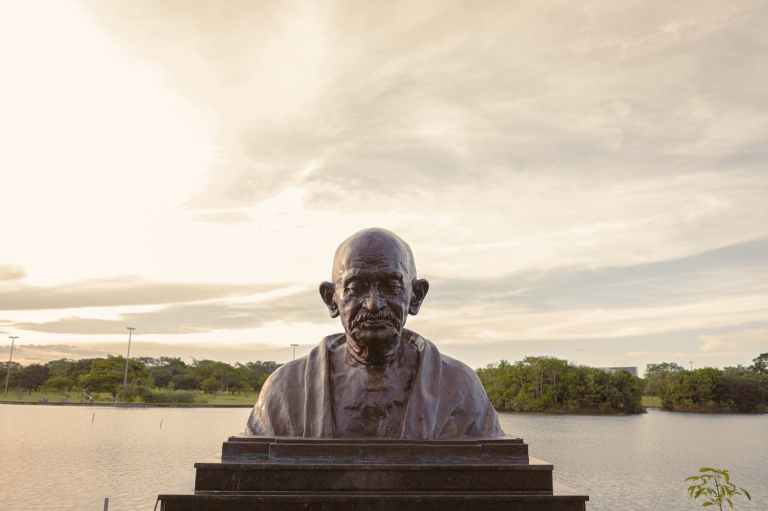
MAIN GOALS OF SHANTI SENA:
*. Service to peoples as a volunteer at any time.
*. Give to a cause close to your heart.
*. Most important goal is to bring the non-violence.
*. No religion diverse all religions must get equal rights and respect.

All are equal
QUOTES BY PEACE ARMY:-
“THE GREAT GOOD IS WHAT WE DO FOR ONE ANOTHER”.
” TREES NEED FOR SEED PEOPLE NEED FOR SHANTI SENA”.
NON – VIOLENT LIFE :-
* Non violent is a personal practice to not make harm to others.
* Gandhi introduced the concept of ahimsa ( Non-violence).
*. Non violence is powerful tool for the social protest.
*. To create non violent children.It is crucial to maintain the peaceful environment.
*. It is the active out pouring of one’s whole being of another.
*. Non violence love is active not passive.

IMPORTANT OF NON VIOLENT COMMUNICATION IN Society:-
* Non violent will bring peace among the people.
* Non violent communication help us to express our feelings.
* Non violent communication means complete lack of violence in the way we communicate with others.
* To respect our people.
MAIN COMPONENTS OF NON VIOLENT COMMUNICATION:-
* Observation.
* Feelings.
* Needs.
* Requests.

SHANTI SENA:-
* SHANTI SENA makes love and peace to the people.
* SHANTI SENA brings non violence to the people.
* SHANTI SENA is not only to maintain peace also good relationship.
* SHANTI SENA is the non weapon war of peace.
* If one should have shanti sena he should ignore annoyance.
* SHANTI SENA avoid us from the jealous and competition with the people.
* SHANTI SENA is one of the fundamental peace policy of people.
” soldiers army save country
Peace army save courtesy”.

The end…
All day all night we hear people talk how important it is to have a healthy body and heart. How companies market their products on the prospect of delivering a healthy and fit body, mind and heart. But all these advertisement, marketing etc, are they really about the healthy body? Or are they only about the perfect body? The body which is popularly accepted and appreciated view of a healthy body is taken as the perfect body. Ever since the beginning of the human life, individuals have been involved in various physical activities not just to feed them self but also to stay healthy and fit and in this light the GYM culture was born. But as time progressed and humans got an understanding of beauty and gorgeous body they started with the obsession of having and making other people know about their perfect body. This obsession could be more dangerous than any other addiction.
Bollywood Influence=
As beings grow up and realise that the bollywood culture is all about the body that could serve as the apt body for a dancer, a model, an actor, they start struggling for this body. The bollywood influences not only the perspective a person has about overall aspect of perfect body but also they serve as the base for the self complex that people face after they find out that getting the perfect body isn’t a true reality but sometimes rather a myth. The actors toil hard in getting their shape right for all the right reasons of portraying their best selves but as they devote their entire time for it, it might look effortless to achieve. But when individuals fail in getting near to that perfect body they start hating themselves and end up with their worst self, not physically but mentally.

Societal Pressures=
However blaming bollywood for every other thing isn’t the goal. But rather is to highlight the fact that bollywood gets its movies from the society around and hence, it is actually the society that manifests a type of body as the perfect body. We see older men and women commenting mercilessly on the younger generations’ body and eating habits. Though correcting them for their wrongs might be okay sometimes but completely rejecting their bodies for they do not serve rightly on their perception of perfect body is erroneous. They body shame not the ones who are overweight or underweight but even the one who discard their standard of beauty and perfectness. The uncles and aunties in the mask of wanting the welfare of the children of their ‘family’ stoop low to another level.
Self love=
Today with people coming out with their stories of distress and anxiety because of the kind of body they have, many organisations and individuals have been promoting the values of body positivity and self love. Body positivity is about accepting who you are and loving thee body as god made it. Though exercising might help in increasing stamina and keeping you happy and healthy but body positivity is about exercising with the love for the body and not the hate, it is about working out for own happiness and not because our body is flawed. Self love is actually the key to the perfect body- a body that is healthy, free of diseases, with a happy heart and liberated mind.
Way back in 1992, an immigrant from Ukraine came to the U.S. in search of some opportunity. This young teenager was accompanied by his mother and they’d barely had any money for their daily expenses. Due to the limited cash on hand, he used to save his old Soviet notebooks for schools and queued up with his mom for food stamps under government subsidy.
At the same time there was another guy who had lost a small fortune in the.com bubble and wasn’t close to finding something big. Now the friends have come together to disrupt the communication sector by merging a mobile messaging app that today has over 1.2 billion monthly active users with over 30 billion messages sent every day the friends. This journey is about Jan Koum and Brian Acton who founded the company together which is none other than the most popular mobile app currently in the world WhatsApp…
Jan is no stranger to failure and as a founder who had to go through his fair share of reductions by top tech companies including the one that eventually bought their servers only to become the most valuable messaging platform on the planet.
Jan was born in the rural areas of Ukraine this was during the Soviet era so being a Jewish and living in a rural area was definitely not easy. He lived in a house that did not even have electricity connection. Being in a country that mostly had a temperature below zero degrees, they didn’t even have hot water.
His parents also denied the usage of course because they were often tapped by the government. To worsen things more being financially unwell , they also had to go through a regularity of hardships as well. Hence, in an attempt to put an end to all the sufferings, Jan along with his mother and grandmothers decided to move to Mountain View, California in 1992. In the U.S. , they were helped by a social support program to get a small two-bedroom apartment.
During this time, Jan started learning computer network by reading manuals that he used to purchase from a used bookstore at the age of 16. He had also begun working as a cleaner at a grocery store while his mother worked as a babysitter. Just once, things began to look normal, another tragedy hit his life when his mother was diagnosed with cancer but he became more stronger and his adversities were only making him more resilient. In the next two years, he had fully trained himself all about computer networking and was all set to take the next step. This is when he gains a sudden interest in programming and got himself enrolled at San Jose State University along with that he also began working with Ernst & Young as a security tester.
After working there for roughly six Months, Jan got the biggest opportunity of his life where he got selected to work at Yahoo as an infrastructure engineer. Now this was when he was still studying at San Jose State University.
Yahoo Back then was just another start-up and was beginning to grow and since Jan loved what he was doing he dropped out of his college and moved ahead with Yahoo. However, the happiness was short-lived and his mother couldn’t out beat cancer for long and passed away in the year 2000. He was suddenly left all alone and that is when his friend from Ernst & young and Yahoo, Brian Acton helped him fight the loneliness by inviting Jan to his house for playing soccer. Together they went on to work with Yahoo for more than nine years. they got to intake numerous amounts of priceless knowledge and experience. Later in January 2009,
Jan bought an iPhone and realized that the seven-month-old App Store was in the process of launching a whole new range of apps. This gave him a brilliant idea although the idea itself was at very nascent stages. They were very clear about three rules:
Additionally it would also maintain to deliver the product without any gimmicks or signs with endless amount of readability and rich experience. Having said that, Jan quickly got the name WhatsApp incorporated on his birthday that is on 24th of February 2009 in California. Now, as the world progressed, they figured that WhatsApp kept crashing or getting stuck at a particular point, this went on for a long time. It built up a great amount of frustration. Jan at one point even lost hope and felt like giving up and started looking for a new job but Brian helped him to motivate and got his act together and asked him to invest a few more months. And finally a few months down the line, help came from Apple.
They launched their push notifications which used to pin their users whenever they were using the app. By August 2009, WhatsApp had no significant growth. This time Jan persuaded Brian Acton to join the in.
Later, on October 2009, Brian contacted several old Yahoo buddies and got together a 250,000 dollars in seed funding. This made Brian to earn the title of co-founder and since then there was no stopping to this Tech phenomena.
By the early 2014, WhatsApp has witnessed humongous growth In its user base with millions of people across the globe using its messaging service. WhatsApp had never publicized or promoted itself anywhere and at organically growing numbers. By this time, it only had 55 employees over serving millions of people each day. Later the very next month in February 2014, Facebook declared that they were acquiring WhatsApp. It was the deal which is known to be one of the biggest acquisitions in the tech history.
Facebook acquired WhatsApp at a whooping 19 billion dollars and also offered a board member position to Jan in Facebook. Jan signed the Facebook take over contract at an unused building in Silicon Valley where he and his mother once queued for food stands in the city of Mountain View where WhatsApp was located!
Well the story of WhatsApp is yet another live example of innovation in true terms for everyone out there waiting for motivation. The journey of Jan Koum and Brian Acton is a lesson for every entrepreneur that capital jumping and marketing will not reap benefits, it is ultimately the product and service that automatically drives customers’ attraction without any need for paid publicity.
Well with billions of users addicted to WhatsApp style, it is undoubtedly a tech marvel of this era!!
Application Form, Eligibility, Syllabus Updjated On – December 13 2021 by the School Of Fashion Technology Common Entrance Exam will be conducted by the MKSSS’s School of Fashion Technology to provide admission in various Undergraduate and Postgraduate Diploma Design courses.
SOFT CET 2021 Highlights Interested aspirants must go through the highlights of SOFT CET 2021 tabulated below:Conducting body School of Fashion Technology Exam Level University Exam Mode Online Stages of exam 3 – Online Test, Studio Test/ Group Discussion and Personal Interview Application Mode Online Courses B.Des, Diploma Course in Fashion Design, PG Course in FBDT and FBM
SOFT CET 2021 EligibilityThe eligibility criteria for SOFT CET 2021 will be set up by the School of Fashion Technology. Applicants must ensure that they meet the eligibility requirements before applying for the exam.The criteria for various courses are as stated below:B.DesApplicants should have passed or are appearing for class 12 exam from any stream, like Arts/ Commerce/ Science/ Home Science/ Minimum Competency Vocational Course (MCVC) including National Institute of Open Schooling (NIOS).Candidates who have Maharashtra State Board of Technical Education (MSBTE) or State Government Technical Education full time diploma of minimum 2 years after class 10 are also eligible for SOFT CET 2021.NRI and international aspirants can apply if they have an equivalent certificate from Association of Indian Universities (AIU), New Delhi.Fashion Design DiplomaStudents can apply for this course if they have passed class 12 exam in any stream including National Institute of Open Schooling (NIOS).PG aspirant should be a graduate from any stream (10+2+3 or equivalent) to be eligible to apply for admission.
SOFT CET 2021 Application form is expected to be available online from November 15, 2020. The last date to apply for SOFT CET 2021 will be in April, 2021. Candidates can apply for SOFT CET 2021 by online mode only which will be available on the official website of the institute.
Candidates can apply for more than 1 course by submitting 2 or more application forms. Candidates can choose the time and date suitable to them and apply accordingly. Candidates can apply via online mode by following the simple steps stated below:
SOFT CET 2021 Admit CardSOFT CET 2021 Admit Card will be issued to candidates who have successfully registered for the exam before the last date of registration i.e. April 2021. The admit card will be available on the official website of SOFT, Pune as the institute does not send any hardcopy of the admit card to any candidate by post.SOFT CET Hall ticket should be retained carefully as it has to be produced at the time of admission and it must be duly signed by the exam invigilator. It contains details about the individual such as the Name and Roll number, Date of SOFT CET 2021 and other details. It is an important document of the exam and no student will be allowed to enter into the exam hall without it. Follow these steps to download SOFT CET 2021 Admit CardLog on to the official website of SOFT.Go to the student’s login page. Enter username, password and security code given in the space provided. Click on ‘Login’.Admit card will appear. Save a soft copy and print it out.Participants must affix a recent, passport size photo on the admit card and carry a government issued photo ID (college ID card, PAN card, driving license, etc.) to the exam center for verification.
SOFT CET 2021 Exam PatternSOFT CET 2021 exam consists of 3 tiers – Online Test, Group Discussion/ Studio Test and Personal Interview. Candidates must note that all 3 stages of the entrance test are compulsory. The online test contains objective questions (MCQs) divided into 4 sections – Quantitative Aptitude, Verbal/ Non-verbal Reasoning, Analytical Ability and Creative Ability. Each section consists of 15 questions.Every question will be followed by 4 alternative options as answers, out of which participant will choose one that seems the most appropriate. The marking scheme is given below – Every correct answer will be awarded with +1 marks.No marks will be deducted if no response is indicated in the optical answer sheet against a question.Negative marking will not be applicable in the designing test.Mode of SOFT CET 2021 Online and OfflineNumber of questions 60Stages of exam 3Maximum marks 250 (Online Test- 60 marks, Studio Test/ Group Discussion- 140 marks and Personal Interview- 50 marks)Medium of language EnglishCheck SOFT CET 2021 Exam PatternSOFT CET 2021 SyllabusThe exam pattern will be similar to other state and national level exams for the particular courses. The exam will have questions which tests candidate’s creativity and design-related skills. The level of exam will be based on class 12th (10+2) or equivalent qualifying exam.
SOFT CET 2021 ResultSOFT CET 2021 Results will be declared on May 23, 2021(Tentative) at the official website of the institute. The result will be announced in the form of scorecard. Candidates will have to download their results by accessing their registered accounts.This can be done by following these few easy steps:Log on to the official website of SOFT, Pune.Click on the link related to ‘SOFT CET 2021 Result’.Aspirants will have to enter their username and password as given during registration. Click on ‘Submit’.The result will appear in the form of rank card. Download it and print it out for the further process of admission.SOFT, Pune will publish a merit list of candidates who qualify the exam on the website after the declaration of results. Applicants will have to send a scanned copy of their class 12 result or a screen-shot of the same and email it to admission@soft.ac.in as also cc it to admin@soft.ac.in.The candidature of the students will not be valid till the time the 12th Mark list is submitted and their name shall not appear in the merit list. The names of applicants will be enlisted in order of merit, according to ranks secured by them in SOFT CET 2021.NOTE: After declaration of the result candidate will be required to freeze their seat for admission within 4 days by sending e-mail to admission@soft.ac.in and cc it to admin@soft.ac.in. Failing to do this, may lead to losing of seat and will be allotted to waitlisted candidates.
What is social media marketing?
Social media marketing means selling or promoting the products of the company by using social media.For example social medias like Facebook Twitter Instagram Pinterest etc.
Uses of social media marketing:-
* It is used to sell or promote the products in the world level.
* With a strong social media strategy and the ability to create engaging content, marketers can engage their audience
* social media marketing allow people to get what they want.

EFFECTIVE TYPE OF SOCIAL MEDIA MARKETING:-
* Facebook advertising
* Twitter advertising
* Instagram advertising
* you tube advertising
* Pinterest advertising
* LinkedIn advertising.

BENEFITS OF SOCIAL MEDIA MARKETING:-
* Grow your sales and your fanbase.
* Use customer generated content for ads (which perform better, too!).
* Better target new and regular customers so the waste can be reduced.
DISADVANTAGES OF SOCIAL MEDIA MARKETING:-
* The main disadvantage of social media marketing is highly rely on ads.
* No direct interaction with the people to solve problems.
* One of main issue is security and privacy policy.Many of us can be faced.

CONCLUSION:-
There is no better marketing strategy for selling and promoting products than social media advertising. No other strategies can deliver consistent, scalable, quality leads and customers from day one that can supplement any promotional marketing.

Then end…
“They frame it as if the whole reason for making Facebook and building something was because I wanted to get girls or wanted to get into some kind of social institution they just can’t wrap their head around the idea that someone might build something because they like building things” – Mark Zuckerberg.
Mark Zuckerberg, the programming prodigy who turned to town for making cool things into social network dynasty the website he started in his dorm room when he was 19 years old is one of the most influential in the world with profiles for over a quarter of the world’s population. Zuckerberg became a self-made billionaire before his 24th birthday!! How is that possible that’s what we’re gonna find out…
Mark Zuckerberg was born on May 14th, 1984 in upper-middle class parents in the outskirts of New York. His father told him to go basic in the early teens and Mark really took to it. He created a program that allowed the computer at his dad’s dental office to communicate with the family computer in Colditz arcnet.
The program was an early form of messenger while in school he excelled a number of subjects from computer science to languages and literature, he transferred to Exeter prep school where he met his good friend Adam D’Angelo.
They created music software called synapse that learned what music people liked and made suggestions based on it as writer Jose Antonio Vargas said
“some kids played computer games…. Mark
created them”. It was clear he had an entrepreneur’s mindset from an early age. Synapse was treated as a high school project but drew the attention of big software companies including Microsoft who apparently offered Zuckerberg a rumored 1 million dollars for it as well as a job before college.
Despite the job offer Zuckerberg chose to attend Harvard doing computer science and philosophy his first year of college plus without any significant creations, probably love partying. It was in his sophomore year that he began to show signs of things to come.
He created a site called Coursematch at the beginning of his second year which had led his classmates to log in and see what courses their friends. It quickly became popular which prompted Zuckerberg to try a new idea he’d recently had that he’d go on to call face masters. Facemash was created October 2003 with the intention of finding the most attractive person on campus.
Slowly a ranking was formed that created the entire thing during a tipsy eight-hour coding session that ended at 4 a.m. Despite the drunken programming, Facemash was an instant hit, been used by 450 students in one day before the Harvard admin team shut it down to new plates of sexism things.
Zuckerberg was put under probation over the incident “I was thread with exclusion” although apparently didn’t faze him too much at the time as it’s written in David Carr Patras book the Facebook Effect “ it’s not the mark necessarily set set to break the rules… he just doesn’t pay much attention to them”.
Over the next few months, undeterred by his warning from Harvard’s, Mark worked more on computer programs simply because he enjoyed it, he created a web program that brought art images from his art in the time of Augustus class and encouraged his classmates to add comments beside them to create study aids. He then used these notes to cram for an exam far more quickly. He also created a program called six degrees of Harry Lewis, a program that created links between people and his favourite computer science professor. He also began to work on other people’s produce , setting up a website for the association of Harvard black women and significantly helping three Harvard seniors finish coding on their web site idea the Harvard connection.
Zuckerberg was sold for the project in November, 2003 after the founders heard about Facemash through the Harvard magazine. They asked him to finish programming their social network site Harvard connection since he didn’t have much coding experience themselves Zuckerberg agreed to do it soon lost interest in favour of his own site, the Facebook. He stalled the
Harvard connection team by coding his new site and may have borrowed some ideas which led to a lawsuit and even a movie down the line although the initial idea of sourcing process may not have been entirely on the up the execution and launch of
Facebook was close to flawless. Zuckerberg bought the domain the facebook.com on January 11th for $30 and officially launched the site. On February 4th , by emailing a few of his friends to check out just four days after it launched, 450 Harvard undergrads signed up and 300 joined the following day. As previously mentioned, he had a knack for building social websites that people wanted to use. The idea of
Facebook was to move the physical books the university issued with a picture of all the students called face books online and students to update them with more recent pictures. It also allowed students to see what other students were talking about, what their interests were and also their relationship status. Another two weeks later , Facebook had over 6,000 users which formed over three-quarters of the undergraduates as well as some alumni. Not only did thousands of students sign up but they also readily spent hours on it each day which made it unique to every other website. Zach put a team of his roommates and friends together to handle various aspects of the project as he didn’t yet consider a business.
Eduardo Saverin handled business ,Dustin Moskovitz was a programmer, Andrew McCollum was a graphic artist and Chris shoes as a spokesman all joined the team. With the team around him that complemented his strengths and weaknesses, Zuckerberg tried to span
Facebook into other colleges starting with the Yale, Stanford and Columbia. Facebook sweat the competition and the number of people signed up kept growing.
It took them a few weeks for 80% of each of the campuses to sign up for Facebook. The team decided to rent an apartment in Palo Alto for the summer as it was where all the big start-ups seemed to come from.
After many 16-hour days, in all-nighters Facebook reached a hundred thousand users in June 2004. Just four months after its launch, a venture capital firm offered ten million dollars to buy Facebook.
He apparently didn’t even consider the offer and often said to continue drawing it for themselves. For Zach, it was never really about the money but always about really a really cool product. Over the summer, the team continued to expand Facebook’s functionality and user base. They also met Sean Parker, a Silicon Valley veteran, who became their president and introduced him to investors including
Peter Thiel who put 500k into the venture for around ten percent of the Business. All in all, a pretty solid Investment. It took Mark and his friends all of two minutes to decide to postpone their Harvard return as the social network was all about timing and they didn’t want to screw this up.
“Well that’s unclear… I am 21 but I finished my sophomore year and came out to Palo Alto fully expecting that I’d actually go back to Harvard in the fall but didn’t quite make it after Peter put his money in but started building a company instead and I got a little side-tracked but fortunately Harvard lets you take indefinite periods of time off so you know if the sever falls through… I’m back at Harvard”, he said.
They’re dropouts. The team focused on expansion, they hit many road bumps and continued to work extremely hard but it paid off for them as they reached a million users in early 2005. They continued to add more features such as the ability to share photos and post on people’s walls and their valuation kept climbing.
If we fast forward seven years, Facebookwent public in the largest tech IPO to this date and become the company over a hundred billion dollars and made all the founders billionaires while still in their early to mid-20s. While there’s no doubt Mark’s a genius. There are so many things that we can learn about him and his story so far.
Facebook was an example of a great idea at the right time with fantastic execution. They made many mistakes along the way but it all paid off in the end. One thing we have to remember is that the multi-billion dollar company that we all use today was started by a handful of forward-thinking teams in a college dorm room. With that in mind, encourage yourself to keep hustling towards your own goals!!
Gandhi first proposed a flag to the Indian National Congress in 1921. The Indian flag was designed by Pingali Venkayya.In the flag the deep saffron colour is for courage and sacrifice white colour is for honesty, peace, and purity dark green colour is for faith and chivalry and the chakra in the middle is for vigilance, perseverance, and justice.This flag was accepted in 1947.Bhikaji Rustom Cama, the fiery lady who unfurled the first version of the Indian national flag a tricolour of green, saffron, and red stripes at the International Socialist Congress held at Stuttgart

The Indian flag was designed as
A horizontal triband of India saffron, white, and India green; charged with a navy blue wheel with 24 spokes in the centre.The flag was proposed by Nehru at the Constituent Assembly on 22 July 1947 as a horizontal tricolour of deep saffron, white and dark green in equal proportions, with the Ashoka wheel in blue in the centre of the white band. From 26 January 2002, allowing private citizens to hoist the flag on any day of the year, subject to their safeguarding the dignity, honour and respect of the flag.
The end…
WHAT IS GLOBAL WARMING:-
Global warming is defined as the global annual temperature has increased in total by a little more than 1 degree Celsius, or about 2 degrees Fahrenheit. Global warming is mainly because of the industrial revolution, burning plastics.

CAUSES OF GLOBAL WARMING:-
* Greenhouse Gases Are the Main Reasons for Global Warming.
* Another main reason for global warming is the industries.
* Deforestation is one of the reason for global warming.
* The smoke from vehicles.

EFFECTS OF GLOBAL WARMING:-
* Global warming cause increase in temperature that raises sea level can cause flood.
* Global warming raises temperature in the atmosphere.
* Melting of glaciers are one of the most threat for the earth
* If global warming cause increase in temperature then there is threat for availablity of water.
* It also cause some diseases like allergies,chest pain etc.

CONTROLLING MEASURES OF GLOBAL WARMING:-
* By decreasing deforestation and encouraging affrostration
* By making awareness programmes.
* By using natural products instead of plastics.
* By reducing burning of fossil fuels.
* By recycling the products.

The end…
By – Supriya

Political and bureaucratic corruption in India is the cause of major concern today. From brides to political maneuvering to misuse of authority to scandals – the average Indian daily finds himself struggling in the cobweb of political graft. The in – charge of the system, the so – called sarkari Babus, with whom the power lays, are spreading the venom of corruption , and abusing their political power at all levels. The 2G scandal scam worth ₹1.76 – lakh crore tops the list. At the heart of this scam is the former Telecom minister A Raja who evaded norms at every level as he dubiously, issued 2G licences to private telecom players in 2008 at throwaway prices of 2001. While issuing licences, rules and procedures were flouted for bribes and personal gains.


THANKYOU !
L
BLACK HOLE!!
Is black hole a pitch dark pit??
Want to know what a black hole is? But just give up everytime watching a typical definition soaked with physics on wikipedia about how even light can’t pass through it….Is black hole a big hole? But if it is a hole, how to get to know about its color? First of all I want to make sure it clear that a black hole is anything but empty space. Infact it is a place where huge matter is packed into a very small area…..what does that mean now??😦
Got confused🥴 okay then come with me to the wonderland of Alice where we see a magic✨ ‘gravity machine’ – a device with which we could control Earth’s gravity, by turning a dial. Initially it is at 1g, gravity that we are used to experience since childhood. Okay just turn the dial to 0g and you will see all your friends floating in the air even with the slightest motion. The tea☕ that you spilled on your beloved to make an old romantic movie scene, formed spherical globe in the air. Yes, balls of tea everywhere💦. But just to make a scene memorable I changed the dial to 1g and taadaa here you get the rain of tea🌧️ as earth got its gravity back….Now I again changed the dial to 3g to 4g…. everything becomes immoblised. Even if you want to have a normal walk under the sky with your crush, it requires enormous efforts. As kindness, I am removing you and your friend from the domain of gravity machine before I dial a higher gravity number. Okay, now I dialed 1000s, trees become squashed but beam of light is straight. Now at 1 lakh gs, rocks are crushed by their own weight but beam of light is still straight. When a gravity approaches a billion gs, something strange happens, the beam of light which was going straight to the sky starts bending. Now imagine a dial greater than billion gs, nothing, not even a beam of light can get out, it would bend back to the starting place. Such a place is called black hole. That is why it is called black: no light can escape from it. A place whose density and gravity is very high. But the question is from where it’s formed??……..(To be continued)
We have heard people telling us to read books for improving ourselves. There are a number of different books that people read so as to be in the habit of reading. Sometimes people read to entertain themselves and other time they read to pass their time and further some might read to improve their knowledge of certain language. There can be a lot of reasons of reading books and all of them are certainly justifiable. But very often it has been observed that people don’t actually read but they just put it in their resumes to look more apt for the jobs they apply for. But why do people insist on including the reading habit in their resumes even when they don’t really read? The answer is that people know the importance of reading but they hardly care to actually read. Some people believe it to be highly boring when they have to read and thereby completely ignoring the benefits of reading.
With reading our knowledge of a certain language improves. There are examples where people who are indulged in reading are better off in communicating their thoughts in a particular language as they read in that language. When people read in one language they usually start thinking and then conversing in that language. They get a hold of a certain language just by reading in that language. Reading not only improves their vocabulary but also help them enhance their overall knowledge. Reading just not mean reading novels, or books but it might also mean reading blogs, news etc, which enhances their knowledge and makes them smarter than they were before they started reading. Reading gives a person a sought of confidence that they get because of the knowledge which they achieve as they feel more comfortable in participating in intelligent conversation for they have their own say now.
The habit of reading as some might believe or some might not but teaches the art of patience. For to complete a thriller novel you cannot skip to the end or reach to the climax as some might do in movies and web series, for you need to follow the story word by word, sentence by sentence and page by page, so as to feel the euphoria of finally getting to the end. This euphoria can be achieved only by the art of patience as taught by reading. Reading improves our level of concentration for it is important to focus only on the story while reading it for we would be lost if we lose if slightest of our attention away from it. Reading improves our attention span and gives us some major focus goals. We see people reading while travelling in metro, while waiting for someone, just before going to sleep, all of this and more proves how entertaining reading could be. The best possible thrill, excitement, emotions of happiness, sadness, love, hate and others that reading make us feel are surely something we cannot even experience through some movie or other digital works.
Cadbury, one of the biggest chocolate brands in the world with operations in more than 60 countries and billions of dollars in revenues. It is not only a brand of mouth-watering chocolates liked by Consumers of all ages, but also one with a 200 year old history filled with wonderful achievements and depressing failures.
Let’s dive into the origins and rise of Cadbury and see how they got to where they are today coming from a wealthy family of Quaker Christians in Britain, John Cadbury, just like any other member of his community was not allowed to attend Universities and his non-violent beliefs and values Kept him out from Joining the military. So, starting a business was the only option for him to make a living. That is why, in 1824 he Opened A Grocery Store In Bull Street, located in the city of Birmingham, UK.
As Alcohol was considered bad For Society by quaker community Tea, Coffee, Cocoa and drinking Chocolate were seen as healthy alternatives by them including John himself. That’s why among other things he sold high quality Cocoa and drinking Chocolate in his store, which he used to prepare using a pestle And mortar.
Due to high demand in 1831 John moved to a four-story warehouse nearby and started producing Cocoa and drinking chocolate on a commercial-scale.
Thus, the Cadbury manufacturing business was born.
Because of the high cost of production these were sold mainly to the wealthy people. By, 1842 he was selling around 11 varieties of Cocoa and 16 varieties of chocolate.
In 1847, his brother Benjamin Cadbury became a partner in the business and the company came to be known As Cadbury Brothers. The same year they rented larger factory in Birmingham which had a private canal that connected to all the major ports in Britain.
In 1854, the Cadbury Brothers of Birmingham received an exclusive royal warrant as manufacturers of chocolate and Cocoa to Queen Victoria this was a great luck for them as businesses which used to have these warrants had a better and sophisticated image among general buyers. However, just six years later in 1860, they had dissolve their partnership due to John’s wife’s Death and his declining mental and physical health. In 1861, John handed over the complete control of the business to his sons Richard and George Cadbury who were 25 and 21 at that time. During this time the market was not doing well and most chocolate manufacturers in Britain were going out of business of which Cadbury was not an exception.
Richard and George invested 4000 pounds each from their inherited money and started to work long hours to keep the business alive. But their turning point came in 1966 when they decided to buy a new type of Cocoa press developed in the Netherlands which removed much of the unpalatable Cocoa butter from the Cocoa beans. Up until this point almost all Cocoa makers including Cadbury had a high level Of Cocoa butter in it, to which they had to add starches to mask its taste and texture. But with this press, that would not be necessary anymore. However, buying this machine was a massive risk for Cadbury as it was expensive, they had very little money to invest, and no one knew if there would be enough demand for the products that came out of it.
But they decided to go for it and were the first British manufacturers to do so. Thus they introduced the Cadbury Cocoa Essence as the UK’s first unadulterated, pure Cocoa. With its high quality and extensive marketing it became extremely popular leading to dramatic sales numbers and changed the future of British Cocoa industry.
In 1893, George Cadbury bought 120 acres of land surrounding the factory at his own expense to create a model village so that many more of their workforce could be given a healthy, pollution free And greener environment where they could thrive. By 1900, this was expanded to 330 acres with 313 cottages and houses along with other facilities like playgrounds, swimming pools and medical centres. Many more similar properties were built in.
The years leading up to the First World War, with smaller developments taking place later on in the 20th century. In 1897, Cadbury introduced their First Milk Chocolate bar. Although they were making milk chocolate drinks from 1849. This was a new recipe that they copied from contemporary Swiss Chocolate manufacturers.
But in terms of texture Swiss Chocolates were far superior as they added condensed milk instead of milk powder. Because of this, Swiss Companies dominated the British Market which Cadbury started to challenge. In 1904, Cadbury launched their Dairy milk bar. Developed by George Cadbury Junior, it was a production of exceptional quality with a higher proportion of milk than any previous chocolate in the market. On the suggestion of a customer, it was named Dairy Milk. With a distinctive and attractive purple wrapper, gradually it became, Cadbury’s best-selling product by 1914.
Due to the shortage of supply, the British Government banned manufacturers from using fresh milk. So, dried skimmed milk was used instead. Due to these issues with essential supplies, the Dairy Milk and many other Cadbury products came Off the shelves during The War. But once the war ended, the company worked hard to restore their business did a lot of promotions, kept competitors away with a direct distribution chain and continued launching new products like Milk Tray Bars, Fudge, Toffee Buttons and Picnic. In a few years they were back to the game like before.
In 1969 ,they merged with Swiss Drinks company Schweppes and demerged again in 2008.
Then in 2010, Kraft Foods bought the brand for an astounding $19 billion but they themselves split into two companies one of which was named Mondelez International which owns the Cadbury brand till date.
In 2019, Mondelez ranked 116 in the Fortune 500 list of largest corporations by total revenue.
As of today, Cadbury is the second largest confectionery brand in the world with products ranging from chocolates, ice cream and beverages to biscuits, desserts, spread and much more.
With operations in more than 60 countries including the UK, USA, Canada, South Africa, New Zealand, Australia and India, it continues to be one of the most favoured name in the segment of chocolates, confectionaries and most probably would continue to be so for a long time!!
The harsh winter weather will cause flakiness and dryness of the skin, creating it look dull. Therefore, it becomes extraordinarily necessary to produce the skin with the correct nourishment, and keep it hydrous and protected. When weather condition arrives, humidness levels drop drastically, says a dermatologist.
During winters we have a tendency to all notice the skin going dry, rough and flaky. it’s important to require correct skin care throughout winters therefore on build your skin healthy and glowing.

Moisturizers act as a barrier, holding wetness in and hydrating the skin’s outer layers. If you’ve got oily skin, water-based, non-comedogenic moisturizers are the simplest choice. Dry skin desires a heavier, oil-based moisturizer to rehydrate. Moisturize your skin frequently and don’t forget to wear a lip balm.

Hot water evaporates fast, stripping your skin of its essential moisture and damaging its natural protective barrier. Moisturize immediately after showering with a body lotion.

Harsh winter weather creates a challenge for the skin as humidity is low each inside and out. Employ a humidifier helps replenish the top layer of the epidermis by preventing the air from becoming too dry.
Humidifiers are generally safe for all skin types to use. However, it is important that you take the time to clean and maintain your appliance.

During winters opt for creamy or balm based cleansers and products. Look for mild skin cleansers labeled as “fragrance-free.” And should also contain mild ingredients. Using a transparent body bar made with glycerin will clean and moisturize the skin without causing irritation. Always wash gently without scrubbing to avoid skin irritation.

Never ever skip a sunscreen in your skincare routine. The most necessary factor you’ll do for your skin is to wear sun screen each single day, even once it’s winter. Sun exposure can result in pigmentation issues, wrinkles and skin cancer. Sunscreen always protects your skin from harmful UV rays.

Look for ingredients such as rosehip oil, soybean oil, and jojoba oil and vitamin E, which all possess highly hydrating and moisturizing properties.

These include ingredients such as mineral oils and aggressive acid peels, using scrubs or acid peels on dry may create patches and peel off the skin causing skin damage. It damages the cells and reduce skin –barrier function resulting in trans epidermal water loss.

Hyaluronic acid is an incredible acid needed to add in your skincare routine. Hyaluronic acid serum acts as a humectant a substance helps the skin hold on to water. It helps to hydrate the skin and lockup moisture content into the skin.

Always try to stay hydrated consuming adequate amount of water during winter season. If your skin is dehydrated, it becomes flaky, dull and dry. Hydrated skin is smooth and radiant so keep up the water consumption so that winters don’t let go your skin dehydrated.

The skin here is thinner and has little-to-no oil glands to shield itself. Use serums, under eye creams and oils around the eyes that soothe and protect the skin. On the lips, use balms to supply a barrier against the weather and to lock in the moisture.


Overview
Are you a glass half-empty or half-full sort of person? Studies have demonstrated that both can impact your physical and mental health and that being a positive thinker is the better of the two.
A recent study followed 70,000 women from 2004 to 2012 and found that those who were optimistic had a significantly lower risk of dying from several major causes of death, including:
* heart disease
* stroke
* cancer, including breast, ovarian, lung, and colorectal cancers
* infection
* respiratory diseases
Other proven benefits of thinking positively include:
* better quality of life
* higher energy levels
* better psychological and physical health
* faster recovery from injury or illness
fewer colds
* lower rates of depression
* better stress management and coping skills
* longer life span
Positive thinking isn’t magic and it won’t make all of your problems disappear. What it will do is make problems seem more manageable and help you approach hardships in a more positive and productive way.
How to think positive thoughts:
Positive thinking can be achieved through a few different techniques that have been proven effective, such as positive self-talk and positive imagery.
Here are some tips that to get you started that can help you train your brain how to think positively.
Focus on the good things:
Challenging situations and obstacles are a part of life. When you’re faced with one, focus on the good things no matter how small or seemingly insignificant they seem. If you look for it, you can always find the proverbial silver lining in every cloud — even if it’s not immediately obvious. For example, if someone cancels plans, focus on how it frees up time for you to catch up on a TV show or other activity you enjoy.
Practice gratitude:
Practicing gratitude has been shown to reduce stress, improve self-esteem, and foster resilience even in very difficult times. Think of people, moments, or things that bring you some kind of comfort or happiness and try to express your gratitude at least once a day. This can be thanking a co-worker for helping with a project, a loved one for washing the dishes, or your dog for the unconditional love they give you.
Keep a gratitude journal:
Studies Trusted Source have found that writing down the things you’re grateful for can improve your optimism and sense of well-being. You can do this by writing in a gratitude journal every day, or jotting down a list of things you’re grateful for on days you’re having a hard time.
Open yourself up to humor:
Studies have found that laughter lowers stress, anxiety, and depression. It also improves coping skills, mood, and self-esteem.
Be open to humor in all situations, especially the difficult ones, and give yourself permission to laugh. It instantly lightens the mood and makes things seem a little less difficult. Even if you’re not feeling it; pretending or forcing yourself to laugh can improve your mood and lower stress.
Spend time with positive people:
Negativity and positivity have been shown to be contagious. Consider the people with whom you’re spending time. Have you noticed how someone in a bad mood can bring down almost everyone in a room? A positive person has the opposite effect on others.
Being around positive people has been shown to improve self-esteem and increase your chances of reaching goals. Surround yourself with people who will lift you up and help you see the bright side.
Practice positive self-talk:
We tend to be the hardest on ourselves and be our own worst critic. Over time, this can cause you to form a negative opinion of yourself that can be hard to shake. To stop this, you’ll need to be mindful of the voice in your head and respond with positive messages, also known as positive self-talk.
Research shows that even a small shift in the way you talk to yourself can influence your ability to regulate your feelings, thoughts, and behavior under stress.
Here’s an example of positive self-talk: Instead of thinking “I really messed that up,” try “I’ll try it again a different way.”
Identify your areas of negativity:
Take a good look at the different areas of your life and identify the ones in which you tend to be the most negative. Not sure? Ask a trusted friend or colleague. Chances are, they’ll be able to offer some insight. A co-worker might notice that you tend to be negative at work. Your spouse may notice that you get especially negative while driving. Tackle one area at a time.
Start every day on a positive note:
Create a ritual in which you start off each day with something uplifting and positive. Here are a few ideas:
* Tell yourself that it’s going to be a great day or any other positive affirmation.
* Listen to a happy and positive song or playlist.
* Share some positivity by giving a compliment or doing something nice for someone.
How to think positive when everything is going wrong:
Trying to be positive when you’re grieving or experiencing other serious distress can seem impossible. During these times, it’s important to take the pressure off of yourself to find the silver lining. Instead, channel that energy into getting support from others.
Positive thinking isn’t about burying every negative thought or emotion you have or avoiding difficult feelings. The lowest points in our lives are often the ones that motivate us to move on and make positive changes.
When going through such a time, try to see yourself as if you were a good friend in need of comfort and sound advice. What would you say to her? You’d likely acknowledge her feelings and remind her she has every right to feel sad or angry in her situation, and then offer support with a gentle reminder that things will get better.
Side effects of negative thinking:
Negative thinking and the many feelings that can accompany it, such as pessimism, stress, and anger, can cause a number of physical symptoms and increase your risk of diseases and a shortened lifespan.
Stress and other negative emotions trigger several processes in our bodies, including stress hormone release, metabolism, and immune function. Long periods of stress increase inflammation in your body, which has also been implicated in a number or serious diseases.
Some of the symptoms of stress include:
* headache
* body aches
* nausea
* fatigue
* difficulty sleeping
Cynicism, stress, anger, and hostility have been linked to a higher risk of:
* heart disease
* heart attack
* stroke
* dementia
When to seek medical help:
If you’re feeling consumed by negative thoughts and are having trouble controlling your emotions, see a doctor. You may benefit from medical help, such as positive psychology or therapy. Persistent negative thoughts can be caused by an underlying psychiatric condition that requires treatment.
Takeaway:
You won’t be able to undo years of pessimism and negative thoughts overnight, but with some practice, you can learn how to approach things with a more positive outlook.
This works intends to analyse the elements of symbolism in Nissim Ezekiel’s poem ”In the country cottage”. Ezekiel is considered as a master in the use of symbols and images. Symbolism is the literary device that uses symbols, like words, locations and abstract ideas to represent something beyond literal meaning. Thus the use of symbolism add emotion, imagery, themes and sometimes it defines characters present in a literary work. Nissim Ezekiel is a poet who use highly evocative and suggestive symbols and images in his poetry. The images and symbols usually used by Ezekiel are women, natural elements like hill, river, sky, sun etc. These symbols give pictorial quality to his poems. Even though he uses simple language and less use of words, it makes the work impressive and sharpens the intended meaning.
In the poem In the Country Cottage the speaker talks about a particular night in a cottage when a lizard came out at night.All the other members of the house seemed lazy and decided to go to bed early as the saw the lizard. Then Nissim Ezekiel shows the image of the lizard through his description.The gray coloured stout lizard was laying without any movements. Poets says that the lizard seems to give a lesson of patience. As the poet says, “…he was more alive than us in silent energy..” the lizard was more alive than humans, in it’s silent energy. The lizard gave his full concentration in this act of waiting for the cockroaches. Its only intention was to kill the cockroaches and in silent energy it outed for them. The next morning the other family members woke and found that the lizard completed its job with utmost ‘cleanliness’ and left the place.
Even though the poem presents ordinary things and is shorter with lesser words, the symbol of lizard is significant. The lizard can be considered as the symbol of cleanliness, patience and dutifulness.Thus it shed light on the line of the achieves who both work hard and remains patient for achieving the goal. Thus it is a symbol of perseverance and will power. By the use of this symbol poet urges the people to save their energy for better purpose, instead of wasting time for futile activities. Thus Nissim Ezekiel places the ordinary lizard for superior to lazy humans. It can be said that he is a poet who make use of the ordinary situations and creatures and makes great poems from them. From the ordinariness of human life he emphasizes the philosophy of life. As said earlier, Ezekiel is considered as a master in the use of symbols and images. His major poems like Enterprise, Night of a Scorpion,The Professor, Philosophy and Marriage possess such symbolic and pictorial qualities. Examples from the poem Enterprise is the use of the symbol “pilgrimage”, which stands for life and “sun” stands for hostility between nature and human aspirations.
While analyzing these symbols in his poems it can be concluded that he is a great artist. The symbolism he used in his work had deep meaning which can encourage any reader to think further about the life from a fresh perspective. By the use of images or symbols of primitive simplicity, he shows the world that poetry does not have to deal with great philosophical truths to be impressive, and ordinary situations are more than enough.

The fact. English is not a pure language is accepted by everyone. It has borrowed many words from different foreign languages and it enriched the English vocabulary. The words borrowed from other languages are known as loan words. According to F T Wood a foreign languages influenced English in three ways. First is by the foreign invaders, who settled in England brought in their words like Scandinavian words after Scandinavian invasion. Next is by foreign contacts through trade, voyages, explorations etc. The example of words borrowed by trade are Italian and Spanish words.And the third one is through scholarship, learning and culture like the Latin and Greek words borrowed during Renaissance. Apart from these ways, various reasons like religious and political movements,colonial invasion also influenced English language. This paper deals with the influence of seven languages on English. They are Celtic, French, Latin, Greek, Norman, Dutch and Spanish. Celtic influence is the first one. The Celts are believed to have been arriving in 600 BC.
The Celtic people who invaded Britain are believed to have integrated with the people who previously inhabited the island. The land that remained dominantly Celtic are divided linguistically into two – Gaelic or Goidelic and Brythonic. The Goidelic languages are Irish, Highland Scottish and Manx. Brythonic is made up of Welsh, Cornish and Briton , of these Welsh is the one to survive most strongly in the present day. Words borrowed from Gaelic are “slogan” which was used in Gaelic as “slaugh- gharim” means “battle cry”. “Bog” is another example from Gaelic “bogach” meaning “soft” and “moist”. Some other examples are trousers, beat, clan, smashing, pet etc. Examples of words borrowed from Welsh vocabulary is “Penguin” from welsh “pen guyn” meaning white head. Celtic influence on English is apparent through the place names. The language of Celts was referred to as the British the language of the Brithons the native inhabitants of the land. Surviving names are Thames and Yare names of river and names of Roman town like
London, York and Lincoln.
The words borrowed from French constitutes twenty nine percentage of English language. The French influence can be categorized into lexical, morphological, orthographic and miscellaneous. According to Albert c Baugh and Thomas Cable the influence “. . . began slowly and continued with varying tempo for a long time”. The French influence began with the Norman conquest. There are different categories of borrowed words. They are related to Government and social class like “revenue”,”authority”, “duke”, words related to Church like “religion”, “sermon” “prayer” related to Law “justice”, “crime”, “jury”, “pardon” War related “army”, “battle”, Fashion related “gown”, “ frock”, etc Food related “feast” , “plate”, “fry” and Learning related “ paper”, “preface” “logic” etc. Next borrowing is the food pairs. In many cases French word might have existed with a German word. In this the two words use in different senses. In such pairs the first English word is about the living animal in a farm and the French word signifies the meat of the animal, as in the case of cow and beef, sheep and mutton. Next french influence in lexical level is doublets. Doublets are the same word borrowed twice, one from Norman dialect and another from Parisian dialect, like catch v/s chase, warranty v/s guarantee, etc. On a morphological level french influence had a great impact on English. The decline in the use of English singular pronouns like “thou’ and “ thee” and replacement with “ ye” and “you” have been linked to the parallel French use of “vous” in formal settings. The use of “s” to plurals in English is also attributed to French influence. Possessive phrases such as the use of “ ’s ” , constructions that places adjectives after the noun like “attorney general”, and use of certain prefixes and suffix morphemes like pre, -ous, -ily, -tion are also the result of french influence. In orthographic category the used of “qu” instead of “cw”, “gh” instead of “h”, “ou” instead of “u” are examples of french influence. The doubling of vowels tho represent long vowel sounds like “see” , doubling of consonants after short vowels like “sitting” amd more use of ‘k’, ‘z’, ‘y’ are in this category. Normans had a strong influence on English personal names. English names such as Alfred, Harold, Godwin and Athelstan largely fell out of fashion and replaced by names like John, Peter, Simon, William, Richard and Henry.
Latin influence is considered the earliest of all the influence on English. First Latin influence on English language was when England contacted with the Roman Civilization The Latin words borrowed during this phase belongs to agriculture, war and domestic life. The loan words are wine, mint, mill, kitchen, cup, dish, pepper, cheese, butter, milk etc. There are place names came during this phase like places ending with ceaster like Lancaster, Gloucester, Winchester, Manchester etc. Next phase of influence happened with the introduction of Christianity. The introduction of Christianity was on 59AD . The loan words came during this time is related to new conceptions, religion, and faith. Words related to education,plant, domestic life were also borrowed. The words are Angel, anthem, hymn, minister, monk, disciple, silk, pea, pine, poppy, beet, pine, grammar, master,grammar, lobster etc. In the middle English period Latin came through translation of holy bible. Words related to law (conspiracy, custody, legal, prosecute), theology (scripture, incarnate,limbo), literature (allegory, genius,intellect,prosody) and science (mechanical,solar,zenith) came during this phase. In the 15 th century during Renaissance great revival of learning influenced English immensely. The words borrowed during this phase are Nouns,Adjectives and verb. Examples for nouns are radius,allusion, circus, atmosphere, bonus etc, Adjectives are appropriate, domestic, perfect etc and Verbs are assassinate, benefit, affidavit, exit etc. As a result of Latin influence, native nouns had got Latin adjectives like paternal for father, maternal for mother, royal for king etc.
Greek language influenced English immensely. Even before Renaissance English language contained a few Greek words, like geography, theology, logic through Latin. But most of Greek words passed into English during Renaissance period. Revival of Greek learning in Western Europe at the beginning of sixteenth century was the reason for borrowing from Greek. Examples for such words are irony, alphabet, drama, elegy etc. The Greek words borrowed during seventeenth century are orchestra, pandemonium, museum,clinic etc. Bathos and philander are the examples of words borrowed during eighteenth century. During nineteenth and twentieth century scientific and technical terms came from German.Those words are psychology, neurology, oxygen, halogen, telephone, microscope etc.The modern medical science is full of Greek terms because of the works of Hypocrites. Greek also contributed some suffixes and prefixes like anti-, di-, hyper-, poly-.
Norman contribution is one of the major influences on English language. Normans came into England during 1066AD . The words borrowed from Norman French can be grouped into several types like legal terms( adultery, slander), military words( surrender, occupy), names of meats( bacon) royal court ( chivalry, majesty). The use of legal and military terms are because of the influence of William the Conquerors works. Other examples of Norman loan words are accuse, archer, assault, curfew, fashion, judge, marriage etc. Dutch had a great influence in English during renaissance period and through commerce. In the renaissance period many loan words from low German from which we have dutch, Flemish and the dialects of Northern Germany came to England. These regions had close commercial contacts with England ever since the Norman conquest and many of the loan words are related to sea faring and trade. Examples are skipper, clock, cruise, smuggle, trek, smack etc.
During the middle English period quite a number of words borrowed from Spanish. Most of the Spanish words came through trade, commerce and war. Examples for such words are armada, cargo, spade, siesta, cocoa, potato, cafeteria etc. The bulk of Spanish words came into English from the middle of sixteenth century to the middle seventeenth century. These are some examples of words borrowed to English from foreign language and their influences. While analyzing these contributions, it can be concluded that , these words and usages enriched the English vocabulary.
John S. Pemberton first produced a drink in 1866 and named it COCA-COLA.
It is a really astonishing fact that the beverage with 1.9 million daily servings was initially made as an alternative to morphine, a pain reliever.
Pemberton was working as a colonel in the confederate during the American Civil War as well as a pharmacist. He sustained a saber injury from the war in April 1865 and was prescribed morphine to relieve his pain.
He realised that gradually we was becoming addictive to morphine and decided to prepare an alternative that would not contain morphine in it. He then experimented with a lot of different pain relievers.
After a lot of trials, he finally came up with an alcoholic wine that he called Pemberton’s French Wine Coca. The drink was mixed up with cocaine extracted from coca leaves and caffeine from kola nut. Pemberton registered this French Wine in 1885. In 1886, Atlanta and Fulton County prohibited that wine,
This led to development of a non-alcoholic version of the wine.
Pemberton relied upon the Atlanta drugstore owner Wills E. Venable to help him perfect the product.
While trying to make the beverage, he accidently mixed the base syrup with carbonated water which eventually gave birth to the drink Coca- Cola.
Frank Mason Robinson, Pemberton’s bookkeeper and partner came up with the name Coca-Cola which is the hybrid of the coca in Cocaine and cola ad in kola nut spelled as ‘cola nut’ at that time. Robinson also hand wrote, using the standard writing script for business correspondence in the U.S. at that time; Spencerian script on the bottles and ads, which are still in use until today.
The Coca-Cola was first sold at Jacob’s Pharmacy in Atlanta, Georgia on the 8th of May, 1886 at 5 cents per glass at soda fountains, which were popular at that time in U.S. due to the belief that the carbonated water was good for the health.
Pemberton claimed Coca-Cola as a brain tonic which could cure many diseases such as morphine addictions, headaches, nerve disorders and impotence. It sold 25 US gallons the first year. By 1888, three versions of Coca- Cola were produced and sold by three separate businesses. Years later Asa Griggs Candler, an Atlanta Pharmacist and businessman stated in the testimony that he had acquired stakes for $2,300 in Pemberton’s company as early as 1887. Candler sold products called ‘yum yum’ and ‘koke’ which he prepared with the same formula while Charley Pemberton, the son of John Pemberton, kept selling cruder syrup under the name of Coca-Cola. After the death of Pemberton, Candler bought the name ‘ Coca-Cola’ for $300.
By 1888, Candler had the full control over the ‘Coca-Cola’ company. In 1889, Benjamin Thomas and Joseph Whitehead, two entrepreneurs from Chattanooga, Tennessee suggested bottling and offered to be in charge of the procedure. They were so compelling that Candler agreed to a contract of only one dollar granting
them exclusive rights to bottle and sell the Coca-Cola.
Candler never collected his one dollar.
The first bottling of Coca-Cola was done in Biedenharn Candy Company in Vicksburg, Mississippi
in 1894 with John Biedenharn as proprietor.
In 1899, the first Coca-Cola bottling company was set up in Chattanooga, Tennessee.
The contract came with many issues for the Coca-Cola Company.
It stated that each bottle was to be sold at 5 cents without stating a specific period.
As a result, a bottle of Coca-Cola was sold at 5 cents from 1886 to 1959.
The first outdoor wall advertisement of Coca-Cola was painted in Cartersville, Georgia in 1894.
Coca-Cola from 20th Century In 1910, the papers of the old Coca-Cola Company
were burned during a move to New Corporation offices and surprisingly in 1914, Margaret
Dozier, came out to profess that her signature on the Coca-Cola company bill of sale was
forged.
Analysis of certain similar transfer documents showed that John Pemberton’s signature was
forged and some accounts show that Charley Pemberton did it.
However, on September 12, 1919, a group of investors purchased the company for $25 million
and proceeded to release five hundred thousand shares to the public with each share costing
about $40.
In the same year, the company merged with Johnston Coca-Cola Bottling Group Inc. and
in 1986, the Coca-Cola company merged with two of its bottling companies, owned by HTL
corporation and BCI Holding company, to become Coca-Cola Enterprises Inc.
The longest running soda fountain that sold Coca-Cola was Fleeman’s pharmacy, established
in 1914 and existed for 81 years until 1995.
On July 12, 1944, the one-billionth gallon of Coca-Cola syrup was produced.
In 1955 the Coca-Cola cans were first introduced.
On April 23, 1985, Coca-Cola tried to change the formula of the syrup by preparing “New
Coke”.
Subsequent taste tests showed that people loved the taste of New coke better than Coke
or Pepsi and the company went on to produce more of it.
Soon after, the public wanted the old Coca-Cola soda back.
The Coca-Cola Company granted the wish of the public and produced the old drink with
a slight variation in the main sweetener; using high fructose corn syrup instead of
cane sugar.
This new drink was produced under the name Coca-Cola Classic on July 10, 1985.
Coca Cola in Recent Years On July 5, 2005, it was announced that Coca-Cola
would resume production in Iraq for the first time since the Arab league refused its use
in 1968.
By April 2007, Canada removed the “Classic” from the name, as New Coke was no longer in
production, so there was no need to differentiate between the two kinds of coke.
In 2009, Coca-Cola introduced the 7.5-ounce mini can.
Also in 2009, the “Classic” was removed from the 470 ml bottles of Coca-Cola sold in the
South Eastern United States and in 2011; “Classic” was removed from all Coca-Cola products.
In September 2011, the Coca Cola Company announced price reductions asking retailers to sell
eight packs at $2.99.
That same day, the company announced that the 12.5 ounces would sell at 89 cents and
the 16 ounces would sell at 99 cents.
In 2012, Coca-Cola resumed operations in Myanmar after 60 years of absence due to investment
sanction imposed on the US.
In 2013, the company announced that Coca-Cola Life would be introduced to Argentina and
other parts of the world.
This drink contained stevia and sugar but the production of Coca-Cola Life was discontinued
in Britain in June 2017.
Coca-Cola together with its investors is working to invest $5billion in their operations in
India by 2020.
Presently, The Coca-Cola Company owns several outlets around the world with the headquarters
situated as a 29 story; 403-foot tall building in Atlanta, Georgia called the One Coca-Cola
Plaza.
As of 2017, the company employed 61,800 members of staff with Muhtar Kent as the Chairman
of the Board and James Quincey as the President and Chief Executive Officer.
The net income in 2017 estimated around $1.4 billion with total assets worth $87.8 billion
and estimated net worth around $180 billion.
What is Education? The first thing that strikes in our minds when we think about education is gaining knowledge. Education is a tool which provides people with knowledge, skill, technique, information, enables them to know their rights and duties toward their family, society as well as the nation. It expands vision and outlook to see the world. It develops the capabilities to fight against injustice, violence, corruption and many other bad elements in the society.
Education gives us knodwledge of the world around us. It develops in us a perspective of looking at life. It is the most important element in the evolution of the nation. Without education, one will not explore new ideas. It means one will not able to develop the world because without ideas there is no creativity and without creativity, there is no development of the nation.
Importance of Education in Our Society
Education is an important aspect that plays a huge role in the modern, industrialized world. People need a good education to be able to survive in this competitive world. Modern society is based on people who have high living standards and knowledge which allows them to implement better solutions to their problems.
Features of Education
Education empowers everyone. Some of the areas where education helps are:
1. Removing Poverty
Education helps in removing poverty as if a person is educated, he can get a good job and fulfill all the basic needs & requirement of his family.
2. Safety and Security against Crime
If a person is well-educated, he will not be fooled by anyone easily. An educated person is less prone to involve in domestic violence & other social evils. They enjoy healthy relationships in life. This means people are less susceptible to being cheated or becoming a victim of violence.
3. Prevention of Wars and Terrorism
To lead a safe & secure life, one needs to understand the value of education in our daily life. One needs to take an active part in various educational activities. These types of productive activities provide knowledge to live a better life.
4. Commerce and Trade
A good education doesn’t simply mean going to school or college & getting a degree. Trade & commerce of the country will also be flourished easily if its citizens are well-educated. Education helps to become self-dependent and build great confidence among them to accomplish difficult tasks. On getting an education, their standard of life gets improved.
5. Law and Order
Education enables the process of the Nation’s Fast Development. If you have a good education, you can serve your country well. It develops a good political ideology.
6. Women Empowerment
Education also helps in empowering women. Certain old customs like Not Remarrying Widows, Sati Pratha, Child Marriage, Dowry System etc. can be demolished with the power of education. Women, if educated, can raise voice against the injustice done to her. This will bring a lot of development in society as well as in the nation. In short, Right to Freedom of speech & expression can be used in the right way if all women will become educated.
7. Upliftment of economically weaker sections of society
Education is the most important ingredient to change the world. Due to lack of education, many illiterate people suffer the hardships of discrimination, untouchability & injustices prevailing in the society but with the advancement of a good education. If all the people will be educated; this ultimately leads to the upliftment of economically weaker sections of society.
8. Communications
The relation between education & communication is apparent. Good education helps to communicate better with other people. It also improves our communication skills such as speech, body language etc. A person who is educated feels confident within him to confront or give a speech in front of a large public or can held a meeting or seminar.
One of the most important benefits of education is that it improves persnal lives and helps the society to run smoothly. By providing education, poverty can be removed and every person can provide their contribution to developing the country.

The first thing that strikes in our minds when we think about education is gaining knowledge. Education is a tool which provides people with knowledge, skill, technique, information, enables them to know their rights and duties toward their family, society as well as the nation. It expands vision and outlook to see the world. It develops the capabilities to fight against injustice, violence, corruption and many other bad elements in the society.
Education gives us knowledge of the world around us. It develops in us a perspective of looking at life. It is the most important element in the evolution of the nation. Without education, one will not explore new ideas. It means one will not able to develop the world because without ideas there is no creativity and without creativity, there is no development of the nation.
Importance of Education in Our Society
Education is an important aspect that plays a huge role in the modern, industrialized world. People need a good education to be able to survive in this competitive world. Modern society is based on people who have high living standards and knowledge which allows them to implement better solutions to their problems.
Features of Education
Education empowers everyone. Some of the areas where education helps are:
1. Removing Poverty
Education helps in removing poverty as if a person is educated, he can get a good job and fulfill all the basic needs & requirement of his family.
2. Safety and Security against Crime
If a person is well-educated, he will not be fooled by anyone easily. An educated person is less prone to involve in domestic violence & other social evils. They enjoy healthy relationships in life. This means people are less susceptible to being cheated or becoming a victim of violence.
3. Prevention of Wars and Terrorism
To lead a safe & secure life, one needs to understand the value of education in our daily life. One needs to take an active part in various educational activities. These types of productive activities provide knowledge to live a better life.
4. Commerce and Trade
A good education doesn’t simply mean going to school or college & getting a degree. Trade & commerce of the country will also be flourished easily if its citizens are well-educated. Education helps to become self-dependent and build great confidence among them to accomplish difficult tasks. On getting an education, their standard of life gets improved.
5. Law and Order
Education enables the process of the Nation’s Fast Development. If you have a good education, you can serve your country well. It develops a good political ideology.
6. Women Empowerment
Education also helps in empowering women. Certain old customs like Not Remarrying Widows, Sati Pratha, Child Marriage, Dowry System etc. can be demolished with the power of education. Women, if educated, can raise voice against the injustice done to her. This will bring a lot of development in society as well as in the nation. In short, Right to Freedom of speech & expression can be used in the right way if all women will become educated.
7. Upliftment of economically weaker sections of society
Education is the most important ingredient to change the world. Due to lack of education, many illiterate people suffer the hardships of discrimination, untouchability & injustices prevailing in the society but with the advancement of a good education. If all the people will be educated; this ultimately leads to the upliftment of economically weaker sections of society.
8. Communications
The relation between education & communication is apparent. Good education helps to communicate better with other people. It also improves our communication skills such as speech, body language etc. A person who is educated feels confident within him to confront or give a speech in front of a large public or can held a meeting or seminar.
One of the most important benefits of education is that it improves personal lives and helps the society to run smoothly. By providing education, poverty can be removed and every person can provide their contribution to developing the country.

The end…

Like Roosevelt before him, Woodrow Wilson regarded himself as the personal representative of the people. “No one but the President,” he said, “seems to be expected … to look out for the general interests of the country.” He developed a program of progressive reform and asserted international leadership in building a new world order. In 1917 he proclaimed American entrance into World War I a crusade to make the world “safe for democracy.”
Wilson had seen the frightfulness of war. He was born in Virginia in 1856, the son of a Presbyterian minister who during the Civil War was a pastor in Augusta, Georgia, and during Reconstruction a professor in the charred city of Columbia, South Carolina.
After graduation from Princeton (then the College of New Jersey) and the University of Virginia Law School, Wilson earned his doctorate at Johns Hopkins University and entered upon an academic career. In 1885 he married Ellen Louise Axson.
Wilson advanced rapidly as a conservative young professor of political science and became president of Princeton in 1902.
His growing national reputation led some conservative Democrats to consider him Presidential timber. First they persuaded him to run for Governor of New Jersey in 1910. In the campaign he asserted his independence of the conservatives and of the machine that had nominated him, endorsing a progressive platform, which he pursued as governor.
He was nominated for President at the 1912 Democratic Convention and campaigned on a program called the New Freedom, which stressed individualism and states’ rights. In the three-way election he received only 42 percent of the popular vote but an overwhelming electoral vote.
Wilson maneuvered through Congress three major pieces of legislation. The first was a lower tariff, the Underwood Act; attached to the measure was a graduated Federal income tax. The passage of the Federal Reserve Act provided the Nation with the more elastic money supply it badly needed. In 1914 antitrust legislation established a Federal Trade Commission to prohibit unfair business practices.
Another burst of legislation followed in 1916. One new law prohibited child labor; another limited railroad workers to an eight-hour day. By virtue of this legislation and the slogan “he kept us out of war,” Wilson narrowly won re-election.
But after the election Wilson concluded that America could not remain neutral in the World War. On April 2,1917, he asked Congress for a declaration of war on Germany.
Massive American effort slowly tipped the balance in favor of the Allies. Wilson went before Congress in January 1918, to enunciate American war aims–the Fourteen Points, the last of which would establish “A general association of nations…affording mutual guarantees of political independence and territorial integrity to great and small states alike.”
After the Germans signed the Armistice in November 1918, Wilson went to Paris to try to build an enduring peace. He later presented to the Senate the Versailles Treaty, containing the Covenant of the League of Nations, and asked, “Dare we reject it and break the heart of the world?”
Wilson never doubted the outcome. He mobilized a nation – its manpower, its industry, its commerce, its agriculture. He was himself the chief mover in the propaganda war. His speech to Congress on January 8, 1918, on the «Fourteen Points» was a decisive stroke in winning that war, for people everywhere saw in his peace aims the vision of a world in which freedom, justice, and peace could flourish.
Although at the apogee of his fame when the 1919 Peace Conference assembled in Versailles, Wilson failed to carry his total conception of an ideal peace, but he did secure the adoption of the Covenant of the League of Nations. His major failure, however, was suffered at home when the Senate declined to approve American acceptance of the League of Nations. This stunning defeat resulted from his losing control of Congress after he had made the congressional election of 1918 virtually a vote of confidence, from his failure to appoint to the American peace delegation those who could speak for the Republican Party or for the Senate, from his unwillingness to compromise when some minor compromises might well have carried the day, from his physical incapacity in the days just prior to the vote.
REFERENCES : The White House, NobelPrize.org

Who Was Karl Marx?
Karl Marx (1818-1883) was a philosopher, author, social theorist, and economist. He is famous for his theories about capitalism and communism. Marx, in conjunction with Friedrich Engels, published The Communist Manifesto in 1848; later in life, he wrote Das Kapital (the first volume was published in Berlin in 1867; the second and third volumes were published posthumously in 1885 and 1894, respectively), which discussed the labour theory of value.
Marx’s early writings are dominated by an understanding of alienation, a distinct type of social ill whose diagnosis looks to rest on a controversial account of human nature and its flourishing. He subsequently developed an influential theory of history—often called historical materialism—centred around the idea that forms of society rise and fall as they further and then impede the development of human productive power. Marx increasingly became preoccupied with an attempt to understand the contemporary capitalist mode of production, as driven by a remorseless pursuit of profit, whose origins are found in the extraction of surplus value from the exploited proletariat. The precise role of morality and moral criticism in Marx’s critique of contemporary capitalist society is much discussed, and there is no settled scholarly consensus on these issues. His understanding of morality may be related to his account of ideology, and his reflection on the extent to which certain widely-shared misunderstandings might help explain the stability of class-divided societies. In the context of his radical journalism, Marx also developed his controversial account of the character and role of the modern state, and more generally of the relation between political and economic life. Marx sees the historical process as proceeding through a series of modes of production, characterised by (more or less explicit) class struggle, and driving humankind towards communism.
However, Marx is famously reluctant to say much about the detailed arrangements of the communist alternative that he sought to bring into being, arguing that it would arise through historical processes, and was not the realisation of a pre-determined plan or blueprint.
Between late 1843 and early 1845, Marx lived in Paris, a cosmopolitan city full of émigrés and radical artisans. He was subsequently expelled by the French government following Prussian pressure. In his last months in Germany and during this Paris exile, Marx produced a series of “early writings”, many not intended for publication, which significantly altered interpretations of his thought when they were published collectively in the twentieth century. Papers that actually saw publication during this period include: “On the Jewish Question” (1843) in which Marx defends Jewish Emancipation against Bruno Bauer (1809–1882), but also emphasises the limitations of “political” as against “human” emancipation; and the “Critique of Hegel’s Philosophy of Right: Introduction” (1844) which contains a critical account of religion, together with some prescient remarks about the emancipatory potential of the proletariat. The most significant works that Marx wrote for self-clarification rather than publication in his Paris years are the so-called “1844 Manuscripts” (1844) which provide a suggestive account of alienation, especially of alienation in work; and the “Theses on Feuerbach” (1845), a set of epigrammatic but rich remarks including reflections on the nature of philosophy.

The importance of Public Administration in the modern state can hardly be overemphasised. Its importance and role has been steadily increasing with the expansion of state activity in the modern states. Public Administration is now on all-encompassing factor of the daily life of individual as well as the community, an integral part of the society, which has seen the emergence of what has aptly been called the Administrative State.
Public Administration is the field of service that maintains a civil society and provides for the needs of the public. It is the activities undertaken by the government to look after its people and manage its affairs.
One of the ways people working in public administration use their problem-solving skills is by helping during a crisis. Crisis management is necessary during a crisis and it’s important to limit the way that it impacts people.
Some elements of public administration include planning, organising, staffing, directing, coordinating, reporting and budgeting.
As an activity, it can be traceable to the Almighty God who planned the existence of man as a being. As an academic field of study, it can be largely traceable to Woodrow Wilson.
Woodrow Wilson, the father of Public Administration first recognised it in an article titled “The Study of Administration”. This he published in 1887.

Public administration has a very important place in the life of people. It is that branch of government which concerns more directly and more striking than any other with the lives of the human beings. The individual in the modern society is concerned with Public Administration at every turn of his life from cradle to the grave. It is the part of the social, cultural and economic life of a nation and is a part and parcel of its life.
Public Administration is the basis of government for monarchy, democracy, communist country like China, or in capitalist country. It is the instrument for executing the laws, policies and programmes formulated by the state. It is also an instrument of national integration particularly in the developing countries which are facing the challenges of sub nationalism, secessionism, class wars, and so on. It is a great stabilising force in the society as it provides continuity when government changes either due to revolution or by election or coups.

Let me introduce you all to the definition of law, in other words, what is law?
It is, by definition, the system of rules that a particular country or a community recognizes as regulating the actions of its members which it may enforce by the imposition of penalties.
Or, in the words of eminent Jurist Salmond, law is the body of principles recognised and applied by the state in the administration of justice.
Now why am I stating the facts you may think. Well, I am not giving weight to my part of the writings here, I am giving weight to the situation of the country. How conveniently we twist and turn mere facts in the grab of amendments. Some sure are in our favour but what about the others that are not?

I shall begin with the necessity of amending provisions in the constitution. Provision for amendment in the constitution is made with a view to overcome the difficulties which may encounter in the future in working of the constitution. No generation has the monopoly of wisdom nor has it any right to place fetters on future generations to mould the machinery of government according to their requirements. If no provisions were made for the amendment of the constitution, the people would have recourse to extra constitutional method like revolution to change the constitution, as held in Keshavananda v/s the state of Kerala All India Report 1973 Supreme Court page number 1461. The power of amending the law is exercised by the parliament under Article 368 of the Indian Constitution.
The framers of the Indian Constitution were keen to avoid excessive rigidity. They were anxious to have a document which could grow with a growing nation, adapt itself to the changing need and circumstances of growing people. the nature of the ‘amending process’ envisaged by the framers of the constitution can be best understood by referring the following observation of the late Prime Minister Pandit Nehru – “When we want this constitution to be solid and permanent as we can make it, there is no permanence in the constitution. There should be a certain flexibility. If you make anything rigid and permanent, you stop the nation’s growth.”
In any event, we could not make this constitution so rigid that it cannot be adopted to changing conditions. When the world is in a period of transition, what we may do today may not be wholly applicable tomorrow.

2021 Theme: Yoga for well-being
The Day will be marked at a time when COVID-19 pandemic continues to upend lives and livelihoods of people globally.
Beyond its immediate impact on physical health, the COVID-19 pandemic has also exacerbated psychological suffering and mental health problems, including depression and anxiety, as pandemic-related restrictions continue in various forms in many countries. This has highlighted the urgent need to address the mental health dimension of the pandemic, in addition to the physical health aspects.
The message of Yoga in promoting both the physical and mental well-being of humanity has never been more relevant. A growing trend of people around the world embracing Yoga to stay healthy and rejuvenated and to fight social isolation and depression has been witnessed during the pandemic. Yoga is also playing a significant role in the psycho-social care and rehabilitation of COVID-19 patients in quarantine and isolation. It is particularly helpful in allaying their fears and anxiety.
Recognizing this important role of Yoga, this year’s commemoration of the International Day of Yoga focuses on “Yoga for well-being” – how the practice of Yoga can promote the holistic health of every individual.
The United Nations offers yoga resources to its personnel and others on the COVID-19 portal’s section on Wellness.
The World Health Organization mentions yoga as a means to improve health in its Global action plan on physical activity 2018–2030: more active people for a healthier world.
UNICEF says kids can practice many yoga poses without any risk and get the same benefits that adults do. These benefits include increased flexibility and fitness, mindfulness and relaxation.
2021 virtual event
The Permanent Mission of India to the United Nations invites you to an online celebration of the 7th annual International Yoga Day on 21 June 2021, from 8:30 to 10:00 am EST, broadcast live on UN WebTV.
The event opened with messages from the President of the United Nations General Assembly and the Deputy Secretary-General of the United Nations, which was followed by demonstrations of Yoga exercises (asanas) to improve physical, mental, emotional and spiritual health and an interactive panel discussion on “Yoga for well-being.”
What is Yoga and why do we celebrate it?
Yoga is an ancient physical, mental and spiritual practice that originated in India. The word ‘yoga’ derives from Sanskrit and means to join or to unite, symbolizing the union of body and consciousness.
Today it is practiced in various forms around the world and continues to grow in popularity.
Recognizing its universal appeal, on 11 December 2014, the United Nations proclaimed 21 June as the International Day of Yoga by resolution 69/131.
The International Day of Yoga aims to raise awareness worldwide of the many benefits of practicing yoga.
The draft resolution establishing the International Day of Yoga was proposed by India and endorsed by a record 175 member states. The proposal was first introduced by Prime Minister Narendra Modi in his address during the opening of the 69th session of the General Assembly, in which he said: “Yoga is an invaluable gift from our ancient tradition. Yoga embodies unity of mind and body, thought and action … a holistic approach [that] is valuable to our health and our well-being. Yoga is not just about exercise; it is a way to discover the sense of oneness with yourself, the world and the nature.”
The resolution notes “the importance of individuals and populations making healthier choices and following lifestyle patterns that foster good health.” In this regard, the World Health Organization has also urged its member states to help their citizens reduce physical inactivity, which is among the top ten leading causes of death worldwide, and a key risk factor for non-communicable diseases, such as cardiovascular diseases, cancer and diabetes.
But yoga is more than a physical activity. In the words of one of its most famous practitioners, the late B. K. S. Iyengar, “Yoga cultivates the ways of maintaining a balanced attitude in day-to-day life and endows skill in the performance of one’s actions.”
REFERENCE : UNITED NATONS

The United Nations is the symbol of hope for mankind. This hope, as former UN Secretary-General Dag Hammerskjold said, is the hope that peace is possible. The United Nations is an organization of 193 sovereign states. It was set up in 1945 to replace the ill-fated League of Nations. The Allies, who were fighting the Axis Powers in the Second World War to destroy dictatorship and secure the ‘world for democracy, resolved to establish a new world organization rather than revive the League of Nations. It was in the London Declaration of 12 June 1941 that all nations then fighting against Hitler’s Germany announced their intention of working together, with other free peoples, to establish ‘a world in which, relieved of the menace of aggression, all may enjoy economic and social security.’ Earlier, President Roosevelt of the United States in a message to the Congress in January 1941, had spelt out four freedoms as being of universal importance.
These were: (a) Freedom of speech and expression; (b) Freedom to worship God in one’s own way; (c) Freedom from want; and (d) Freedom from fear.
At that time the United States was not at war. She was observing neutrality. As explained earlier, the United states joined the Second World War only in December 1941 when Japan bombarded Pearl Harbour. The Soviet Union had joined the Allies in June 1941 after Germany’s attack. Thus the Four Freedoms and the London Declaration were expressions of the desire of mankind to be free from ‘war’ and free from ‘want’. On 14 August 1941, Roosevelt and Churchill issued the famous Atlantic Charter which spoke of the establishment of a ‘peace which will afford to all nations the means of dwelling in safety within their own boundaries,’ of freedom from ear and want, and the creation of ‘a wider and permanent system of general security.’
The principles spelt out in the Atlantic Charter, and the London Declaration, were endorsed by the 26 countries who were then Allies, on 1 January 1942 in what came to be known as the United Nations Declaration. This declaration signed in Washington was mainly concerned with war, not peace. It was to emphasize cooperation in an all-out struggle against Axis and to give an assurance to each other not to make peace individually.

Objectives:
(i) to maintain international peace and security based on respect for the principle of equal human rights and self-determination of peoples.
(ii) to develop friendly relations among nations.
(iii) to cooperate in solving international problems of an economic, social, cultural or humanitarian character.
(iv) to be a centre for harmonizing the actions of nations in achieving these ends.
(v) to protect environment & to justify use of natural resource.
The United Nations act in accordance with the following Principals.
REFERENCES : V.N. KHANNA, English for students

Pt. Jawaharlal Nehru was born in Allahabad on November 14, 1889. He received his early education at home under private tutors. At the age of fifteen, he went to England and after two years at Harrow, joined Cambridge University where he took his tripos in Natural Sciences. He was later called to the Bar from Inner Temple. He returned to India in 1912 and plunged straight into politics. Even as a student, he had been interested in the struggle of all nations who suffered under foreign domination. He took keen interest in the Sinn Fein Movement in Ireland. In India, he was inevitably drawn into the struggle for independence.
In 1912, he attended the Bankipore Congress as a delegate, and became Secretary of the Home Rule League, Allahabad in 1919. In 1916 he had his first meeting with Mahatma Gandhi and felt immensely inspired by him. He organised the first Kisan March in Pratapgarh District of Uttar Pradesh in 1920. He was twice imprisoned in connection with the Non-Cooperation Movement of 1920-22.
Pt. Nehru became the General Secretary of the All India Congress Committee in September 1923. He toured Italy, Switzerland, England, Belgium, Germany and Russia in 1926. In Belgium, he attended the Congress of Oppressed Nationalities in Brussels as an official delegate of the Indian National Congress. He also attended the tenth anniversary celebrations of the October Socialist Revolution in Moscow in 1927. Earlier, in 1926, at the Madras Congress, Nehru had been instrumental in committing the Congress to the goal of Independence. While leading a procession against the Simon commission, he was lathi-charged in Lucknow in 1928. On August 29, 1928 he attended the All-Party Congress and was one of the signatories to the Nehru Report on Indian Constitutional Reform, named after his father Shri Motilal Nehru. The same year, he also founded the ‘Independence for India League’, which advocated complete severance of the British connection with India, and became its General Secretary.
In 1929, Pt. Nehru was elected President of the Lahore Session of the Indian National Congress, where complete independence for the country was adopted as the goal. He was imprisoned several times during 1930-35 in connection with the Salt Satyagraha and other movements launched by the Congress. He completed his ‘Autobiography’ in Almora Jail on February 14, 1935. After release, he flew to Switzerland to see his ailing wife and visited London in February-March, 1936. He also visited Spain in July 1938, when the country was in the throws of Civil War. Just before the court-break of the Second World War, he visited China too.
On October 31, 1940 Pt. Nehru was arrested for offering individual Satyagraha to protest against India’s forced participation in war. He was released along with the other leaders in December 1941. On August 7, 1942 Pt. Nehru moved the historic ‘Quit India’ resolution at the A.I.C.C. session in Bombay. On August 8,1942 he was arrested along with other leaders and taken to Ahmednagar Fort. This was his longest and also his last detention. In all, he suffered imprisonment nine times. After his release in January 1945, he organized legal defence for those officers and men of the INA charged with treason. In March 1946, Pt. Nehru toured South East Asia. He was elected President of the Congress for the fourth time on July 6, 1946 and again for three more terms from 1951 to 1954.

Nehru was born on Nov. 14, 1889, at Allahabad, India. His name Jawaharlal mea»s “red jewel,” a name he once said he found “odious.” His father, Motilal Nehru, was a wealthy lawyer from the state of Kashmir. Both he and Nehru’s mother, Swarup Bani Nehru, were Brahmans, the highest caste in India. Jawaharlal had two younger sisters: Swarup, born in 1900, and Krishna, born in 1907. They grew up in a palatial home called Anand Bhawan, meaning Abode of Happiness.
India was a part of the British Empire, and many of Motilal’s friends were English. Until Nehru was 15, he was educated at home by British tutors. He also studied the Hindi and Sanskrit languages with a Brahman teacher who, according to Nehru, managed to impart “extraordinarily little.” The only one of his tutors who impressed the boy was a French-Irish philosopher named Ferdinand T. Brooks. Brooks imbued Jawaharlal with an enthusiasm for reading and for science.
He introduced the youth to theosophy, a mystical system of thought that claims to explain the universe on the basis of direct revelations. The doctrine fascinated Nehru, and at the age of 13 he joined the theosophical society. But his interest in theosophy soon waned.
Student in England. In 1905, Nehru’s father took him to England to enroll at Harrow, a leading English public school. Nehru’s housemaster, the Bev. Edgar Stogdon, remembered him later as “a very nice boy, quiet and very refined. He was not demonstrative but one felt there was great strength of character. I should doubt if he told many boys what his opinions were. . . .”
Jawaharlal entered Trinity College at Cambridge University in 1907. There he studied chemistry, geology, and botany. He displayed little intellectual interest or ambition. He attended meetings of a debating society, but seldom found courage to speak himself. Nonetheless, the society’s political discussions stirred his interest in the growing Indian nationalist movement. He also became sensitive to discrimination against Indians. After completing his studies at Cambridge University, Nehru studied law in London, where he passed his bar examination in 1912.
REFERENCES : 8sa.net, pmindia.gov.in

In the previous chapter a reference was made to pretensions of peace and friendship on part of Hitler in the early years of the Third Reich. We have seen that realignment of powers had taken place during 1934-35. Meanwhile, Germany had pulled itself out of the Disarmament Conference and withdrawn from the League of Nations in October 1933 on the ground that other powers had failed to reduce their armaments although they had promised to do so, when they had signed the Covenant of the League of Nations in 1919. Hitler was vigorously but secretly carrying on rearmament of Germany, but did not want to disclose it before Saar was returned to Germany. As provided for in the Versailles Treaty, a plebiscite was held in Saar in January 1935 and about 90 per cent of the people voted for reunion with Germany.
Hitler personally went to Saar to see the reunification of Saar with the Reich on 1 March 1935. As analysis of Hitler’s approach to foreign policy shows that he was always pragmatic. According to Paul Johnson, ‘Like Lenin, he was a superb opportunist, always ready to seize openings and modify his theory accordingly.’ While some historians conclude that he had no master programme, others like Johnson feel that he was always adjusting his tactics to suit the moment. He was never tempted to relax by a surfeit of autocratic power.
Actually he was ‘always raising the stakes on the table and seeking to hasten the force of history.’ Hitler was now free to unfold his true foreign policy based on Mein Kampf, i.e. anti-Communism, anti-Semitism, and promotion of German imperialism. During 1935-37 Hitler evolved and acted upon the strategy of befriending not only fellow dictator Mussolini, but also a militant Japan and even Britain who wanted ‘peace almost at any price.’ During this period, Hitler unilaterally repudiated not only the dictated Treaty of Versailles but also freely negotiated Treaty of Locarno. This period also witnessed another repudiation of international commitment-Italian aggression on Abyssinia and eventual annexation of that country into Italian Empire. These developments led to the formations of Rome-Berlin-Tokyo-Axis.

In February 1935 (after the Saar plebiscite, but before its reunion with Germany) England and France made certain proposals to Germany. These included signing of Central Pact and Eastern Pact. The former, to ensure non-interference in each other’s internal affairs and to be signed by Austria and her neighbours and the latter to be signed by France, Germany and the Soviet Union, each assuring the other against aggression by the third country. It was also proposed that the seven Locarno powers, including Germany, should promise that in case of air attack upon any of them, the others would provide assistance to the victim of attack. These proposals came to be known as ‘Air Locarno’. Germany showed willingness only for Air Locarno as that would permit her to establish an Air Force. The other two pacts were to be discussed by Hitler with British representatives, but before British ministers could go to Germany, the British government announced a programme of strengthening its armed might, a move that annoyed Hitler.
Hitler suggested that he was willing to sign a fresh treaty with France and Belgium, whereby there could be demilitarization of equal distance on both sides of the border. This was, as expected, rejected by France. Now, therefore, Rhineland was once again remilitarized and German troops firmly based themselves in the region. Hitler ha achieved one more success.
REFERENCES : International relations by V.N. KHANNA
Most of the peace treaties signed before the First World War imposed ‘war indemnity’ on the defeated states. It was a fine imposed by the victor on the vanquished by way of penalty. The theory was that the victor must recover practically the entire cost of a war from the defeated enemy. The defeated powers used to indemnify the losses suffered by the victors during the wars. During the First World War, it was argued in many countries that in view of heavy losses involved in the war, it would be impossible for the victors to recover the entire cost. Purely from an economic viewpoint, as Gathorne-Hardy says, ‘…the immense scale of the war of 1914-18 rendered it obvious at the outset that a claim of this description would be beyond the power of any nation to satisfy…’ Besides, there was a moral aspect also. President Woodrow Wilson was against the imposition of war indemnity on the ground of such a fine being undemocratic. As Carr also admits, ‘…democratic opinion in many countries had expressed itself against the practice…’ of imposing war indemnity. Wilson personally was not in favour of any prize for the victors and any punishment for the vanquished. However, the US President had to yield to the pressure put upon him by his European allies, and he had to agree to the imposition of a limited amount of fine to be called reparation.
The Treaty of Versailles provided for payment of an unspecified amount of reparation by Germany to the victors of the Fist World War. The demands made on Germany were to be limited to the ‘compensation for all damage done to the civilian population for the Allied and Associated Powers and to their property.’ This was supposed to be a concession, as Germany was not required to pay to recover the ‘entire cost’ of the war. Unlike in previous wars, the civilian population and their properties were not spread. Heavy damages were caused to the civilians and their properties as a result of indiscriminate attacks by the German army, navy and army force. The Allies decided not to claim military losses. Nevertheless, their greed was reflected in the fact that reparation was to cover, besides civilian losses, the separation allowances and pensions to be paid to the widows and dependents of the officers and men killed in action. The concession, therefor, was not of much practical consequence.
Germany, as we have seen, was made to admit her sole responsibility for the war and and the consequent liability for payment of reparation. Article 231 of the Treaty said: ‘The Allied and Associated Powers affirm and Germany accepts the responsibility for causing all the loss and damage to which the Allied and Associated Governments and their nationals have been subjected to as a consequence of the war imposed on them by the aggression of Germany and her allies.’ Germany was called upon by the Allies to pay to them such amount of money as would be determined by a Commission to be appointed for this purpose. This money was required to enable the Allies to ‘repair’ the losses suffered by them as a result of the war ‘imposed’ upon them by Germany.

Contrary to German expectations the conference did not focus on the issue of war reparations but was initially dominated by the topic of disarmament, also part of the Treaty of Versailles. Due to current events the coal negotiations then moved to centre stage.
The issue of coal pertained to shipments from Germany to France, Belgium and Italy according to Art. 236 of Part VIII of the Versailles Treaty. In a protocol signed on 19 August 1919 Germany had agreed on these deliveries, but due to the uprisings of spring 1920 (Kapp Putsch, Red Ruhr Army) and associated strikes in the coal industry had been unable to comply.
Discussion of the coal issue, which began on 9 July, soon showed that the Allied side was unwilling to compromise. At the very beginning threats about sanctions were issued, with Millerand acting as the spokesman on the Allied side. After days of tough negotiations, the talks almost broke down on 14 July. On 16 July, Fehrenbach and foreign minister Walter Simons signed the Spa coal protocol as drawn up by the Allies. Germany promised to deliver 2 million tons of coal per month for six months. In exchange for the Allied right to insist on the delivery of specifics types or quality of coal, Germany was granted 5 Goldmark per ton to purchase food for the miners. In addition, the Allies agreed to monthly advance payments for the coal. The German side did not sign up to the Allied threat that missed deliveries would be answered by military occupation of the Ruhr or other German territories.
Despite Allied financial concessions the coal agreement dealt a heavy blow to the German economy. Supply of coal had been adequate before the conference, but now domestic bottlenecks emerged that damaged output of the iron and steel industry, the railways and coal conversion industry.
REFERENCES : V.N. Khanna, wiki

Plastic waste management is a collective term for various approaches and strategies used to recycle plastic materials that would otherwise be dumped into landfills, or bodies of water, or otherwise contaminate the environment. The idea behind this type of waste management is to utilize those discarded materials to manufacture new plastic products without the need to actually generate additional plastic materials. Doing so can help lower production costs as well as protect the environment.
Many different types of industries participate in some type of plastic waste management process. Some are specifically geared toward collecting plastic items for recycling. For example, many supermarkets encourage customers to contribute unwanted plastic bags into a recycling container located near the front of the store. The collected bags are then forwarded to recycling centres where the material is processed for use in the production of new products made from the recycled plastic.
Businesses that produce plastic products also engage in the task of plastic waste management. This often focuses on finding ways to recycle or reuse excess plastic that is discarded as units of different goods are produced. These plastic remnants can often be collected and ran through an internal recycling process to create additional products for sale. Not only does this approach prevent the disposal of the used materials into a landfill, it also allows the company to lower the actual cost associated with manufacturing each unit of its product line.

In some cases, businesses outsource the process of plastic waste management. Contracting with a waste management company makes it possible for unwanted plastic items to be collected and removed from the premises without expending additional company resources. Municipalities sometimes work with a waste management disposal company in creating plastic recycling programs that allow households to conveniently dispose of plastic milk jugs, broken plastic toys, and other plastic items without placing them into the trash. Depending on the nature of the arrangement with the plastic waste management company, the municipality may actually earn a small amount from the arrangement, creating another stream of revenue for the city or town that can be used to fund services offered to residents.
Any type of plastic waste management must be conducted in compliance with regulations set by local, state, and federal governments. This includes using recycling methods that are considered to be environmentally friendly, and that are not likely to create health risks for individuals living and working in the community. Since regulations regarding recycling vary somewhat from one jurisdiction to another, it is important to determine what is and is not allowed before establishing any type of ongoing program to deal with plastic waste.
References : infobloom

Climate change is a long-term shift in global or regional climate patterns. Often climate change refers specifically to the rise in global temperatures from the mid-20th century to present.
Climate is sometimes mistaken for weather. But climate is different from weather because it is measured over a long period of time, whereas weather can change from day to day, or from year to year. The climate of an area includes seasonal temperature and rainfall averages, and wind patterns. Different places have different climates. A desert, for example, is referred to as an arid climate because little water falls, as rain or snow, during the year. Other types of climate include tropical climates, which are hot and humid, and temperate climates, which have warm summers and cooler winters.

Climate change is the long-term alteration of temperature and typical weather patterns in a place. Climate change could refer to a particular location or the planet as a whole. Climate change may cause weather patterns to be less predictable. These unexpected weather patterns can make it difficult to maintain and grow crops in regions that rely on farming because expected temperature and rainfall levels can no longer be relied on. Climate change has also been connected with other damaging weather events such as more frequent and more intense hurricanes, floods, downpours, and winter storms.
In polar regions, the warming global temperatures associated with climate change have meant ice sheets and glaciers are melting at an accelerated rate from season to season. This contributes to sea levels rising in different regions of the planet. Together with expanding ocean waters due to rising temperatures, the resulting rise in sea level has begun to damage coastlines as a result of increased flooding and erosion.
The cause of current climate change is largely human activity, like burning fossil fuels, like natural gas, oil, and coal. Burning these materials releases what are called greenhouse gases into Earth’ atmosphere. There, these gases trap heat from the sun’s rays inside the atmosphere causing Earth’s average temperature to rise. This rise in the planet’s temperature is called global warming. The warming of the planet impacts local and regional climates. Throughout Earth’s history, climate has continually changed. When occurring naturally, this is a slow process that has taken place over hundreds and thousands of years. The human influenced climate change that is happening now is occurring at a much faster rate.
Climate change is impacting human lives and health in a variety of ways. It threatens the essential ingredients of good health – clean air, safe drinking water, nutritious food supply, and safe shelter – and has the potential to undermine decades of progress in global health. Between 2030 and 2050, climate change is expected to cause approximately 250 000 additional deaths per year, from malnutrition, malaria, diarrhoea and heat stress alone. The direct damage costs to health is estimated to be between USD 2-4 billion per year by 2030. Areas with weak health infrastructure – mostly in developing countries – will be the least able to cope without assistance to prepare and respond. WHO supports countries in building climate-resilient health systems and tracking national progress in protecting health from climate change. Reducing emissions of greenhouse gases through better transport, food and energy-use choices results in improved health, particularly through reduced air pollution. The Paris Agreement on climate change is therefore potentially the strongest health agreement of this century. WHO supports countries in assessing the health gains that would result from the implementation of the existing Nationally Determined Contributions to the Paris Agreement, and the potential for larger gains from more ambitious climate action.
REFERENCES : WHO, National Geographic Society
The First World War broke out with the declaration of war by Austria-Hungary upon Serbia on 28 July 1914. Many other countries joined the war within the next few days on one side or the other. The war was fought between the Allied and Associated powers (Allies) on one side and the Central Powers on the other. The principal allies were France, the British Empire and Russia. Italy joined them in 1915. There were many other smaller Allies also. The United States remained neutral for three years but was compelled to enter the war on the side of the Allies in April 1917.
Japan had joined earlier. Russia withdrew from the war after the Bolshevik Revolution in November 1917 (October, according to the old calendar followed in Russia). The Central Powers were Germany, Austria-Hungary and the Turkish Empire. The war ended in November 1918 with the unconditional surrender of Germany. Formal peace treaties were signed after several months.
The war between France and Prussia (the future German Empire) that lasted from 1870 to 1871 ended with a humiliating defeat for France. It lost the regions of Alsace and Lorraine, and was forced to pay a huge indemnity to Prussia. The Franco-Prussian War led to creation of a powerful German Empire with a military and industrial potential to further disrupt the European balance of power on the one hand and widespread resentment and desire for revenge among the French (revanchism) on the other.
With the accession of Wilhelm II to the German throne in 1888, the German foreign policy became more bellicose. The new German Emperor dismissed the skillful Otto von Bismarck as Chancellor. He also refused to renew the Reinsurance Treaty with Russia that maintained the fragile peace between Russia and Austria-Hungary as well as kept France isolated. That way Wilhelm II helped create an alliance between France and Russia (formed in 1892) that became the basis for the future Triple Entente.
Russo-Japanese rivalry over Manchuria and Korea reached its height with the Russo-Japanese War (1904-1905). The outcome of the war against the Japanese was a major blow for the Russians who lost almost entire Baltic and Pacific fleet. The defeat also provoked a serious political crisis that led to the Russian Revolution of 1905. But the Russo-Japanese War also made an end to the Russian ambitions in the Far East and as a result, the Tsarist government focused its attention to Europe, in the first place to the Balkans. This intensified the old rivalry with Austria-Hungary that also had a great interest in the Balkans.
German militarism and especially the build up of naval power convinced Great Britain that Germany may soon establish itself as a dominant power on the Continent. In order to create a counterweight to the German Empire, the British decided to enter into an alliance with France that came to be known as Entente Cordiale. In 1907, Britain also entered into an alliance with Russia that was already in alliance with France. This formed the Triple Entente which in turn became the core of the Allies during World War I.
The Moroccan Crises – the Tangler Crisis (1905-1906) and Agadir Crisis (1911) – brought the European powers on the brink of war. Both crises were provoked by the Germans with an aim to cause tensions between France and Britain that just concluded an alliance. The result, however, was right the opposite. Instead of ‘softening’ Britain and bring it closer to the Central Powers, the Moroccan Crises further reinforced the Entente Cordiale and increased the British hostility towards Germany.
In 1908, Austria-Hungary decided to annex Bosnia and Herzegovina that was formally an integral part of the Ottoman Empire. The annexation of the provinces that were occupied by the Dual Monarchy since 1878 was bitterly opposed by Serbia that was closely related to the provinces both ethically and geographically. Serbia was supported by the Tsarist government and the crisis persisted into 1909. Russia failed to win as firm support from France or Britain as Vienna enjoyed from Germany and accepted the annexation of the provinces. Serbia was forced to back down and the crisis ended. But it permanently damaged the relationship between Russia and Serbia on the one hand and Austria-Hungary on the other. The annexation of Bosnia and Herzegovina caused embitteredness in Serbia, while the way it was carried out humiliated the Russian government that could not afford a similar humiliation during the 1914 July Crisis.
The Italo-Turkish War that took place between 1911 and 1912 did not pose any major threat to peace in Europe. But the Turkish defeat revealed the weakness of the Ottoman army and disagreement between the European powers about the so-called Eastern Questions – the fate of the decaying Ottoman Empire. The war between the Kingdom of Italy and the Ottoman Empire was also a strong incentive for the Balkan League which would capture the Balkan peninsula from the Turks independently from the great powers.
In 1912, Serbia, Greece, Montenegro and Bulgaria formed the Balkan League, a military alliance against the Ottoman Empire. Within a few months, the Balkan allies stripped the Ottoman Empire of its possessions in the Balkans and divided the conquered territory among themselves. In June, Bulgaria turned against its allies of Serbia and Greece due to a dispute over partition of Macedonia. But the Bulgarians were defeated within a month and forced to give up their claims in Macedonia. The success of the Balkan League shocked most European powers including the Russian allies of France and Great Britain. But it especially disturbed Austria-Hungary that strongly opposed a strong Serbian state. Vienna saw Serbia both as a rival in the Balkans and as a direct threat because it feared that its small Balkan neighbor may become the core of a future South-Slavic state. The Balkan Wars made Austro-Hungarian statesmen even more determined to take concrete action to prevent further strengthening of Serbia.
On June 28, 1914, a group of conspirators from the revolutionary movement called Mlada Bosna (‘Young Bosnia’) carried out the assassination of the Austro-Hungarian heir presumptive, Archduke Franz Ferdinand and his wife while they were visiting Sarajevo. Since the assassin, Gavrilo Princip and his 5 accomplices were Bosnian Serbs, the Dual Monarchy accused Serbia to stand behind the assassination. The event triggered the course of events that directly led to the outbreak of World War I but it did not cause it. Austria-Hungary was determined to eliminate the ‘Serbian threat’ before the assassination of its heir presumptive and it only needed an excuse to declare war on its Balkan neighbour.
On July 23, Austria-Hungary presented an ultimatum to Serbia. Vienna, however, intentionally imposed impossible demands to Serbia in order to be able to declare war on its neighbour for ‘orchestrating’ the assassination of Archduke Franz Ferdinand of Austria. A few days later, the Austro-Hungarian troops invaded Serbia and started the devastating World War I.
The most keenly debated issue in international relations has been the pessimistic view of realism and the optimistic view of liberalism. Realism is regarded as the dominant theory of international relations, while liberalism has a strong claim to being the historic alternative. Comparing the two to the main political parties in a democracy, Timothy Dunne wrote, ‘Rather like political parties, realism is the natural party of the government, and the liberalism is the leader of the opposition.’
The liberal tradition in international relations in its is closely connected with the emergence of the modern liberal state. The focus of liberalism has been on freedom, cooperation, peace and progress. It has often been identified with individualism, as it insists on freedom of the individual, his rights and property. It is also closely associated, mainly by its critics, with capitalism. Liberalism is sometimes associated with the views of Mo Ti, who was a contemporary of realist Chinese scholar Sun Tzu. Both gave their opposing views more than 2,000 years ago.
Liberalism assumes instead portraying lust of power as the international conflict liberalism fights for the basic rights of the people. It insists on pursuing the political reforms establish democracies. It emphasizes on the value of the free trade on the basis that it will help in preventing the conflicts between nations as it reduces the national selfishness and enhances the communication.
Liberalism advocated the formation of the global institutions such as the United Nations which sees any threat to any individual nation as a threat to everyone. The institutions help in resolving the conflicts by mediating the conflicts in the event of any misunderstanding.
Basically liberals assume that states will act in a rational manner and they are a unitary actor.
The liberalists fell into three different groups as classified by the realists: The first group advocated league of the nations was formed with the objective to consider the attack on the nation as an attack on all. The second group formed the Permanent Court of International Justice that would lead to formation of judicial body capable of issuing justices to the disputes. The third group sort to avoid war by advocating “Disarmament“ in order to reduce the international tension.
Neoliberalism is a policy model that encompasses both politics and economics and seeks to transfer the control of economic factors from the public sector to the private sector. Many neoliberalism policies enhance the workings of free market capitalism and attempt to place limits on government spending, government regulation, and public ownership.https://a6c140989941be06481216af16f29a9b.safeframe.googlesyndication.com/safeframe/1-0-38/html/container.html
Neoliberalism is often associated with the leadership of Margaret Thatcher–the prime minister of the U.K. from 1979 to 1990 and leader of the Conservative Party from 1975 to 1990–and Ronald Reagan, the 40th president of the U.S. (from 1981 to 1989). More recently, neoliberalism has been associated with policies of austerity and attempts to cut government spending on social programs.
At its core, liberalism is a broad political philosophy; it holds liberty to a high standard and defines all social, economic, and political aspects of society, including–but not limited to–the role of government. The policies of neoliberalism, on the other hand, are more narrowly focused. They are primarily concerned with markets and the policies and measures that influence the economy.

Realism has been the most important approach of international relations over the years. It has been the dominant way of explaining international behaviour. Realism emphasizes relations among nations, as they have been and as they are. It is not concerned with the ideal world. It is the international interpretation of human behaviour. Individuals are essentially selfish, and they seek power to serve their interests and to prevail over others. As Morgenthau wrote in the 20th century, power is the control of men over the minds and actions of other men. And, there is constant strife leading to conflicts and clashes between individuals having divergent interests and seeking to acquire power. Thus, there is an ever-present struggle for power in the society. The same is the tone of nations that are guided by the same considerations as individuals.
Realism, or political realism, as an approach of international relations has evolved over the centuries. Prominent among its earlier advocates were Indian scholar Kautilya, Chinese strategist Sun Tzu, and Greek scholar Thucydides. Much later, Italian scholar Nicolo Machiavelli and English philosopher Thomas Hobbes also contributed to the evolution of realism. Their ideas may be called classical realism, though Morgenthau is now considered the principal classical realist. However, according to the view expressed by Robert Jackson and George Sorensen (1999) and many others, Morgenthau’s theory may be described as neo-classical realism. But, Morgenthau was the most systematic advocate of realism. However, British Professor E.H. Carr, who wrote The Twenty Years’ Crisis (1919-39) had prepared the ground on which Morgenthau developed his theory of realism.
Carr criticized democracies like the UK and France for their failure in defeating the designs of dictators. He blamed the democratic countries for failing to recognize the power realities in the world. Carr divided the scholars of international relations into two groups. These were ‘utopians’, or ‘idealists’, and the ‘realists’. He described the utopians as optimists- children of enlightenment and liberalism. The liberals held the view that reason and morality could structure international behaviour of the states towards peace. Wilson and (his) League of Nations were cited as main examples of utopians. Carr, who himself was a a realist, described realists as pessimists, or children of darkness, who emphasize power and national interest. Commenting on Carr’s views on power, Michael G Roskin and Nicholas O Berry wrote, ‘This does not necessarily mean perpetual war, for if statesmen are clever and willing to build and apply power, both economic and military, they can make the aggressors back down…’
Political realism is a significant theory in the field of international relations that seeks to explain state behavior under a set of specific and rigid assumptions. At its core, political realism is guided by three S’s: statism, survival, and self-help.
Statism asserts that states are the only entity on the international stage that matter and that they are unitary (acting alone) and rational (acting in its best interests) actors. Survival identifies the state’s primary goal is to survive in an international system characterized by anarchy. The final S, self-help, conveys the assumption that states cannot trust others in their pursuit of survival and must secure their security.
Political realism is further delineated into sub-theoretical frameworks, including:
While each sub-framework has its own nuance within the broader political realist theory, all forms of political realism fundamentally believe world politics is a field of conflict among states pursuing power.
Structural realism, also referred to as neorealism in the academic community, is a major branch of political realism derived from classical realism. While the latter incorporates analysis of human behavior within state decision-making, structural realism focuses predominantly on the anarchic structure of the international system. In other words, structural realists see global conflict as inevitable because there is no supranational body that could prevent or mediate conflict between individual states. Therefore, structural realists assume that states must always be preparing for conflict because war could break out at any time.
Structural realists believe that understanding the international system is guided by the three S’s of political realism. However, they do incorporate analysis of inter-relationships between distinct state entities, particularly regarding power relationships. A key concept in structural realism is polarity, the balance of power within the international system. Today, international theorists often describe the world as unipolar, with the United States acting as the sole superpower endowed with the ability to dominate international relations via their economic, political, and military supremacy.
REFERENCES : International Relations By V.N. Khanna
Human rights day celebrated in 10th December.The National Human Rights Commission of India defines human rights as provided under the Protection of Human Rights Act (PHRA), 1993, as Rights Relating To Life, liberty, equality and dignity of the individual guaranteed by the constitution or embodied in the international covenants and enforceable by courts in India.Human Rights Day is observed on December 10 every year, since it was on this very day in 1948 that the United Nations General Assembly (UNGA) adopted the Universal Declaration of Human Rights, a milestone document that enshrines the rights and freedoms of all human beings.The international document also commits nations to recognise all humans as being “born free and equal in dignity and rights” regardless of “nationality, place of residence, gender, national or ethnic origin, colour, religion, language, or any other status

7 human rights in India:-
* Origins.
* Significance and characteristics.
* Right to equality.
* Right to freedom.
* Right against exploitation.
* Right to freedom of religion.
* Right to life.
* Cultural and educational rights.
An Act to provide for the constitution of a National Human Rights Commission, State Human Rights Commissions in States and Human Rights Courts for better protection of human rights and for matters connected therewith or incidental thereto. Ministry: Ministry of Home Affairs. Department: Department of States.Protection of human rights is essential for the development of the people of the country, which ultimately leads to development of the national as a whole. The Constitution of India guarantees basic human rights to each and every citizen of the country.The Constitution of India guarantees to all Indian women equality (Article 14), no discrimination by the State (Article 15(1)), equality of opportunity (Article 16), equal pay for equal work (Article 39(d)) and Article 42.
Human rights are important because no one should be abused or discriminated against, and because everyone should have the chance to develop their talents. Unfortunately, many people around the world don’t have these basic rights and freedoms.It is constitutional mandate of judiciary to protect human rights of the citizens. Supreme Court and High Courts are empowered to take action to enforce these rights. Machinery for redress is provided under Articles 32 and 226 of the constitution.
The most significant human rights issues included police and security force abuses, such as extrajudicial killings, disappearances, torture, arbitrary arrest and detention, rape, harsh and life-threatening prison conditions, and lengthy pretrial detention.
In India, a child has the right to be protected from neglect, exploitation, and abuse at home and elsewhere. Children have the right to be protected from the incidence of abuse, exploitation, violence, neglect, commercial sexual exploitation, trafficking, child labour, and harmful traditional practices.
With more than 30,000 cafes around the globe, Starbucks has become a well known name across the world. From its iconic and popular cups with espresso inside them, Starbucks evolved from on coffee bean shop in Seattle to a brand with $80 billion business over 48 years. Starbucks cover total of 57% sales in the cafe market.
You heard it right!!
57% is not a small number. Nearly 2/3 of the coffee sold in the U.S. comes from Starbucks. But this itself has come with real pains. With 14,000 locations in U.S. alone, Starbucks has spread itself too thin.
Having too many stores out there led to fewer transactions in individual stores. To compensate the loss of fewer transactions, the company tried to increase the prices of their products. Doing this frequently can drive the customers away.
So, what strategy did Starbucks use to attract its customers ?
This was the time of 1970. Three college friends Zev Siegl, Jerry Baldwin and Gordon Bowker decided to go for a coffee business. They found a mentor in Alfred Peet, founder of Peet’s coffee and the man behind the custom coffee roasting to the U.S. So, with the help of Peet, the three friends founded Starbucks , a coffee bean shop and roastery at Seattle’s famous Pike Place Market in 1971. Peet helped those young entrepreneurs with coffee beans and helped them to connect with coffee brokers to provide the source to get their own roasted coffee beans until they could set up their own roastery. For the first decade, the founders opened the branches of Starbucks at 5 locations. At that time, the conventions coffee consumers found out a glaring absence that was actual coffee drinks or the actual cups made especially for coffee. There was no actual bars and no such demand for espresso based drink at that period of time. People usually take coffee beans their homes and just with simple method, they used to brew the coffee. No one had the thought of getting a beverage at a Starbucks coffee shop until 1980. Initial focus of Starbucks was the high quality coffee as customers were more focused on the canned coffee. The company hired its first Director of Marketing and Sales, Howard Schultz. That man was very professional to the level where he became the CEO of Starbucks later.
In 1983, Schultz went To Italy and returns with an idea that was turning the coffee bean stores into cafes. Starbucks launched its first latte the next year. That experiment was a success and four years later Schultz partnered with the investors and bought Starbucks with $3.8 million. Schultz proposed a strategy of aggressive expansion.
By 1996, the company had opened the cafes in the more than thousand locations including the international cafes in Japan and Singapore.
Growth was too rapid in the case of Starbucks that in just three years later, the company opened the café in 2000th location as well.
Schultz switched from CEO to Executive Chairman at 2000. Between 2000 and 2007, Starbucks witnessed the extreme growth that the number of its cafes got more than quadrupled like 3,500 to 15,000 cafes directly.
Sales hot up from $2 billion to $9.4 billion in that period. But then Starbucks hit a wall.
The 2007 financial crash:
The growth from that year remained constant. The stock price fell by 50 percent. So Starbucks brought back Howard Schultz.
This news alone raised the Starbucks stock by 9 percent. He laid off 6,700 baristas in the café. He wanted customers to remember his brand. Schultz ordered all the cafes in the U.S. locations to call off in the afternoon so that he could show the baristas how to make the signature espresso. He wanted to make the customers to experience real life coffee in the stores to let it remember fresh in their minds. Schultz even ordered to remove automatic espresso machines.
Schultz’s strategy worked and the company stock price soared up by 149 percent in 2009. The company has been gaining positive reviews since then.
Starbucks took the big step of opening the new kind of stores that are Starbucks Reserve Roasteries. These massive foot stores are designed to be a tourist destination. Here, Starbucks baristas experiment new and different brewing methods to come up with delicious beverages. With this , Starbucks decided to come up with something new for the customers every now and then.
Wireless PANs (WPANs) have caused the latest revolution in wireless technology. WPAN’s are short to very short-range (from a couple of centimeters to a couple of meters) wireless networks that can use to exchange information between devices within reach of an individual. WPANs can be used to replace cables between computers and peripherals; share multimedia content amongst devices; build an infrastructure for sensor networking applications, or establish various location-aware services. The best example represents Wireless Personal Area Networks in the industry-standard Bluetooth found in many consumer electronics such as cell phones, PDAs, wireless headsets, wireless mouse, and wireless keyboards.

Personal Area Networks(PAN’s) was first demonstrated by IBM researchers in 1996 that utilized the human body to exchange digital information. Engineers use picoamp currents through the body at very low frequencies of around 1MHz. The low power and frequencies prevented eavesdropping and interference to neighboring PAN’s. In this way, they created a new way to communicate between body-borne appliances by using the human body as a channel. The only Limitation was that some form of human contact between devices is required, which may not always be desirable or possible. To get around this problem of human contact, other alternatives such as IR(Infrared) or Far-field (radio) communications have been considered. Using wireless methods such as IR or radio frequency (RF) for PAN’s is known as WPAN, which are typically smaller, operate on battery power, and either worn on a human body or carried personally. The main design goal of WPANs is to allow either stationary or moving devices that are close to communicating and exchanging information without wires. WPANs should allow devices to create or provide data/voice access points is within a Personal Operating Space(POS) of up to 10 meters in all directions and envelops a stationary or a mobile person.
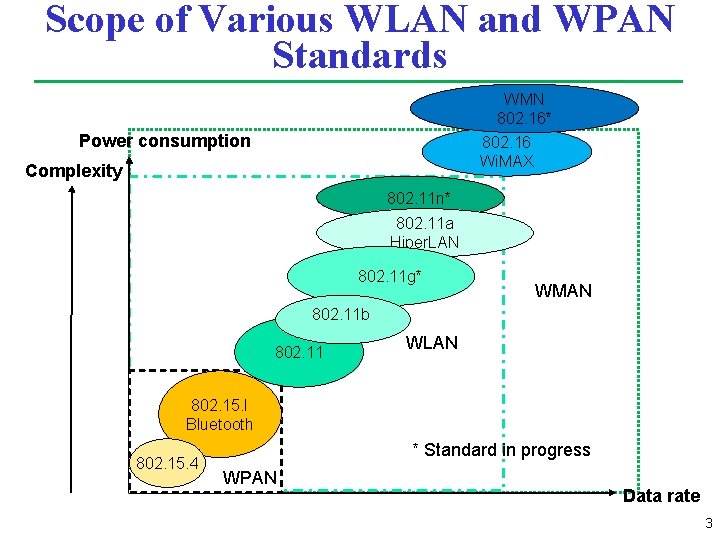
The WPANs systems are currently expected to provide secure modes of operation, allowing groups of personal devices to interconnect while excluding connectivity to other non-essentials. They should not affect the primary function, the form factor, and power consumption of the devices in which they are embedded. As WPANs primarily use the license-free radio frequencies (e.g., ISM band), they have to coexist with other RF technologies that make of these frequencies. A WPAN is functionally similar to a WLAN while it differs in power consumption, coverage range rate, and cost.
As history has shown, India’s approach to development always remains contextual. This is evident when the nationalist leaders opted for a Soviet type centralized planning as perhaps an effective means for development. The idea was widely acclaimed regardless of the ideological differences among those who presided over India’s destiny following decolonization. The Planning Commission which was constituted in 1950 was hailed as an instrument to bring about quick development in India. India’s trajectory of development however proved otherwise : instead of being instrumental in contributing to a uniform development in the country, the Planning Commission failed to accomplish the goal; it was felt that centralized planning did not appear to be effective in attaining the goal that the nationalist leadership sought to attain.
The impact of the Planning Commission on India’s development cannot be easily ignored since it had been in place for more than six decades following the withdrawal of colonisation in India in 1947 while the NITI Aayog is too new to have any sway on the trajectory of growth in the country.
What is striking is the fact that while the Planning Commission was considered to be a piece of ideological baggage borrowed from the former Soviet Union, the NITI Aayog represents an effort toward articulating India’s neoliberal endeavour for sustainable economic growth. Ideologically drawn, both the planned development of the erstwhile era and its opposite, as conceptualized by the NITI Aayog, remain important pillars of India’s growth trajectory since independence. Centralized planning may have become futile though it undoubtedly had its role in the state directed development era.
With the formation of the Planning Commission in 1950, India was ushered in the state-led development era in which the state became a critical economic actor. Despite its historical antecedents, the idea of the state directed planned economic development gained significant salience in independent India, especially with Jawaharlal Nehru, India’s first prime minister, at the helm of affairs. Given his staunch opposition to the Gandhian model of democratic decentralization, Nehru always preferred the state-driven economy as perhaps the only driving force for India’s rapid socioeconomic regeneration in the aftermath of colonial rule.
There are two fundamental questions that need to be addressed: first, has the idea of the state-driven economic development lost its relevance just because of its failure to accomplish the stated goals or due to its vacuous claim in contrast with the rising importance of a market-driven counter ideology providing an alternative to the erstwhile strategy of the state-directed economic development? There is a connected second question: whether the market – driven strategy shall be useful for peripheral societies, including India, where the proportion of the people living below the poverty line is staggeringly alarming.
The following were the original objectives of economic planning in India:
REFERENCES : Public Administration By Bidyut Chakrabarty and Prakash Chan Kandpal
Public Administration is a continuous process and, in the sense, it is always an undergoing reform. So, in public administration, ‘reform is a journey rather than a destination’. Reforms are an obvious response to the new challenges confronting state institutions managing public affairs. At the root of such an exercise lies the effort at enhancing administrative capability in the changed scenario. The problem of administrative reform has received continuing attention in India, both at the centre and in the states.
Since Independence, there have been a large number of changes in the structure, work methods, and procedures of the administrative organisations. Although these changes have been gradual, at times not too perceptible, they do indicate the efforts made by the government to affect procedural and policy innovation in the administrative system and to keep pace with the changed situations, growing needs, and exigencies of the government. With this background, the present chapter makes an attempt to understand the concept of administrative reform, to analyze the initiatives of reforms after Independence, and understand the changing patterns of administrative reforms in India in the post – liberalization era.
Public administration as an academic discipline was born with a bias toward change and reform. The term ‘reform’ literally means forming again. The Oxford English Dictionary defines ‘reform’ as ‘to convert into another and better form, to amend or improve by some change of form, arrangement or composition; to free from previous faults or imperfection.’ Following this definition, ‘administrative reform’ is to convert public administration into a better, improved form.
The Public Management and Administration field, in essence, is broad, necessitating a
specific study of theoretical frameworks. A review of conceptual literature and
contemporary case studies material on structural transformation and policy reform was
conducted to enlighten the research question and the statement of research. The existing
knowledge was highlighted in terms of its relevancy to this research, thus enabling the
incorporation of valid citation on previous experiences with civil service reform.
Conceptual definitions by proponents usually do not provide generic approaches on
administrative reform process, hence, the need for a focussed review of literature.
The objective is to consult the theoretical material relevant to public service reform.
For any research, it is important to establish a relationship between theoretical and
research perspectives (Procter, 2002) and identify gaps in the literature (Johnson, J.
1991). Varying views of different schools of thought cited must be contrasted so that
what has happened over time helps to show how others handled similar problems in the
past (Gerstenfeld, 2004). Philosophical or metaphysical nature of the phenomena being
investigated, whether observable or unobservable, has to be proved early before the
scientific knowledge of the object that is theory informed and the paradigms position
used in the research is established, appropriately in the concept definition section.
Research in the Public Administration field must not overlook or underlook the societal
imperatives – dynamics, which are underpinning public service reform. Political, social
and economic imperatives of a given society determine the type of public administration adopted for a particular developmental state. Each societal imperative would obviously contribute differently to the internal environment. This pattern is not common in every country as developed and developing societies likewise experience their unique situation where peace and stability enhance the conditions for reform.
Pluto (minor-planet designation: 134340 Pluto) is a dwarf planet in the Kuiper belt, a ring of bodies beyond the orbit of Neptune. It was the first and the largest Kuiper belt object to be discovered. After Pluto was discovered in 1930, it was declared to be the ninth planet from the Sun. Beginning in the 1990s, its status as a planet was questioned following the discovery of several objects of similar size in the Kuiper belt and the scattered disc, including the dwarf planet Eris. This led the International Astronomical Union (IAU) in 2006 to formally define the term planet excluding Pluto and reclassifying it as a dwarf planet.
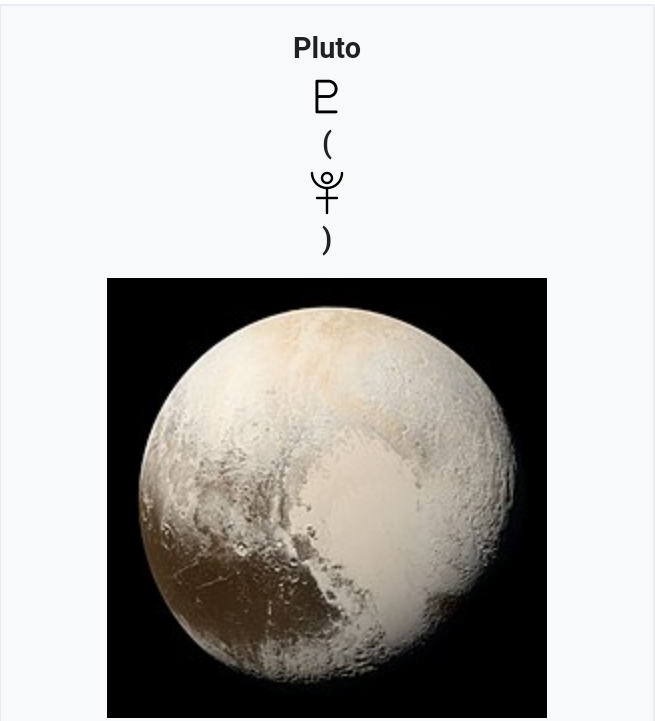
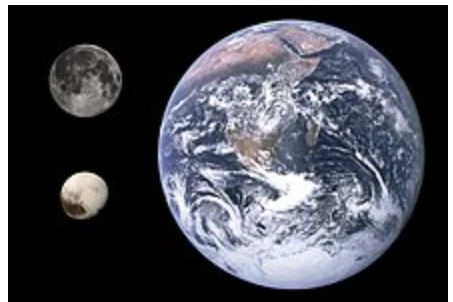
Pluto is the ninth-largest and tenth-most-massive known object directly orbiting the Sun. It is the largest known trans-Neptunian object by volume but is less massive than Eris. Like other Kuiper belt objects, Pluto is primarily made of ice and rock and is relatively small—one-sixth the mass of the Moon and one-third its volume. It has a moderately eccentric and inclined orbit during which it ranges from 30 to 49 astronomical units or AU (4.4–7.4 billion km) from the Sun. This means that Pluto periodically comes closer to the Sun than Neptune, but a stable orbital resonance with Neptune prevents them from colliding. Light from the Sun takes 5.5 hours to reach Pluto at its average distance (39.5 AU).
Pluto has five known moons: Charon (the largest, with a diameter just over half that of Pluto), Styx, Nix, Kerberos, and Hydra. Pluto and Charon are sometimes considered a binary system because the barycenter of their orbits does not lie within either body.
The New Horizons spacecraft performed a flyby of Pluto on July 14, 2015, becoming the first and, to date, only spacecraft to do so. During its brief flyby, New Horizons made detailed measurements and observations of Pluto and its moons. In September 2016, astronomers announced that the reddish-brown cap of the north pole of Charon is composed of tholins, organic macromolecules that may be ingredients for the emergence of life, and produced from methane, nitrogen and other gases released from the atmosphere of Pluto and transferred 19,000 km (12,000 mi) to the orbiting moon.
Orbit :
Pluto was discovered in 1930 near the star δ Geminorum, and merely coincidentally crossing the ecliptic at this time of discovery. Pluto moves about 7 degrees east per decade with small apparent retrograde motion as seen from Earth. Pluto was closer to the Sun than Neptune between 1979 and 1999.
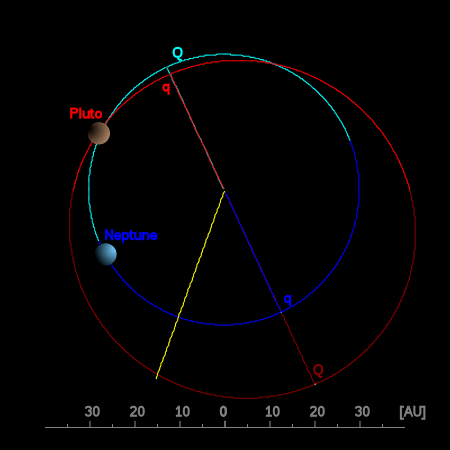
Pluto’s orbital period is currently about 248 years. Its orbital characteristics are substantially different from those of the planets, which follow nearly circular orbits around the Sun close to a flat reference plane called the ecliptic. In contrast, Pluto’s orbit is moderately inclined relative to the ecliptic (over 17°) and moderately eccentric (elliptical). This eccentricity means a small region of Pluto’s orbit lies closer to the Sun than Neptune’s. The Pluto–Charon barycenter came to perihelion on September 5, 1989, and was last closer to the Sun than Neptune between February 7, 1979, and February 11, 1999.
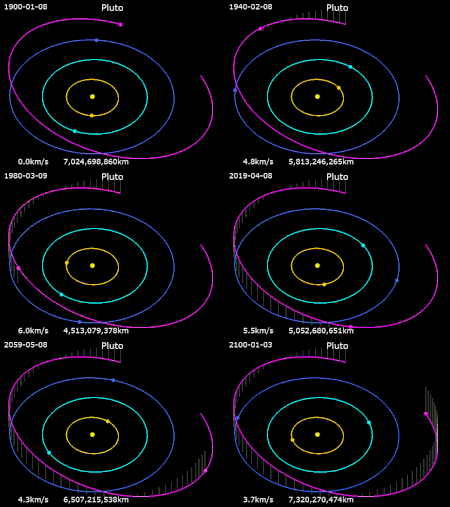
Although the 3:2 resonance with Neptune (see below) is maintained, Pluto’s inclination and eccentricity behave in a chaotic manner. Computer simulations can be used to predict its position for several million years (both forward and backward in time), but after intervals much longer than the Lyapunov time of 10–20 million years, calculations become unreliable: Pluto is sensitive to immeasurably small details of the Solar System, hard-to-predict factors that will gradually change Pluto’s position in its orbit.
Rotation:
Pluto’s rotation period, its day, is equal to 6.387 Earth days. Like Uranus, Pluto rotates on its “side” in its orbital plane, with an axial tilt of 120°, and so its seasonal variation is extreme; at its solstices, one-fourth of its surface is in continuous daylight, whereas another fourth is in continuous darkness.The reason for this unusual orientation has been debated. Research from the University of Arizona has suggested that it may be due to the way that a body’s spin will always adjust to minimise energy. This could mean a body reorienting itself to put extraneous mass near the equator and regions lacking mass tend towards the poles. This is called polar wander. According to a paper released from the University of Arizona, this could be caused by masses of frozen nitrogen building up in shadowed areas of the dwarf planet. These masses would cause the body to reorient itself, leading to its unusual axial tilt of 120°. The buildup of nitrogen is due to Pluto’s vast distance from the Sun. At the equator, temperatures can drop to −240 °C (−400.0 °F; 33.1 K), causing nitrogen to freeze as water would freeze on Earth. The same effect seen on Pluto would be observed on Earth were the Antarctic ice sheet several times larger.
Atmosphere:

Pluto has a tenuous atmosphere consisting of nitrogen (N2), methane (CH4), and carbon monoxide (CO), which are in equilibrium with their ices on Pluto’s surface. According to the measurements by New Horizons, the surface pressure is about 1 Pa (10 μbar),roughly one million to 100,000 times less than Earth’s atmospheric pressure.
It was initially thought that, as Pluto moves away from the Sun, its atmosphere should gradually freeze onto the surface; studies of New Horizons data and ground-based occultations show that Pluto’s atmospheric density increases, and that it likely remains gaseous throughout Pluto’s orbit. New Horizons observations showed that atmospheric escape of nitrogen to be 10,000 times less than expected.Alan Stern has contended that even a small increase in Pluto’s surface temperature can lead to exponential increases in Pluto’s atmospheric density; from 18 hPa to as much as 280 hPa (three times that of Mars to a quarter that of the Earth). At such densities, nitrogen could flow across the surface as liquid.Just like sweat cools the body as it evaporates from the skin, the sublimation of Pluto’s atmosphere cools its surface.The presence of atmospheric gases was traced up to 1670 kilometers high; the atmosphere does not have a sharp upper boundary.
Satellites:

Pluto has five known natural satellites. The closest to Pluto is Charon. First identified in 1978 by astronomer James Christy, Charon is the only moon of Pluto that may be in hydrostatic equilibrium. Charon’s mass is sufficient to cause the barycenter of the Pluto–Charon system to be outside Pluto. Beyond Charon there are four much smaller circumbinary moons. In order of distance from Pluto they are Styx, Nix, Kerberos, and Hydra. Nix and Hydra were both discovered in 2005, Kerberos was discovered in 2011,and Styx was discovered in 2012.The satellites’ orbits are circular (eccentricity < 0.006) and coplanar with Pluto’s equator (inclination < 1°),and therefore tilted approximately 120° relative to Pluto’s orbit. The Plutonian system is highly compact: the five known satellites orbit within the inner 3% of the region where prograde orbits would be stable.
Origin:

Pluto’s origin and identity had long puzzled astronomers. One early hypothesis was that Pluto was an escaped moon of Neptune knocked out of orbit by Neptune’s largest current moon, Triton. This idea was eventually rejected after dynamical studies showed it to be impossible because Pluto never approaches Neptune in its orbit.
Pluto’s true place in the Solar System began to reveal itself only in 1992, when astronomers began to find small icy objects beyond Neptune that were similar to Pluto not only in orbit but also in size and composition. This trans-Neptunian population is thought to be the source of many short-period comets. Pluto is now known to be the largest member of the Kuiper belt,a stable belt of objects located between 30 and 50 AU from the Sun. As of 2011, surveys of the Kuiper belt to magnitude 21 were nearly complete and any remaining Pluto-sized objects are expected to be beyond 100 AU from the Sun. Like other Kuiper-belt objects (KBOs), Pluto shares features with comets; for example, the solar wind is gradually blowing Pluto’s surface into space.It has been claimed that if Pluto were placed as near to the Sun as Earth, it would develop a tail, as comets do.This claim has been disputed with the argument that Pluto’s escape velocity is too high for this to happen. It has been proposed that Pluto may have formed as a result of the agglomeration of numerous comets and Kuiper-belt objects.
The end….
In early 1953, there was a change in the leadership of both the superpowers- the US and USSR. In the US, President Truman’s tenure ended in January 1953. He was succeeded by Dwight Eisenhower. an ex-army general who had commanded the Allied forces in Europe during the Second World War. Meanwhile. Soviet leader Stalin died in March 1953. He was succeeded as party chief by Nikita Khrushchev and by Georgy Malenkov as prime minister. The two Soviet leaders were not very comfortable with each other. Malenkov was replaced by Nikolai Bulganin in 1955. He was more acceptable to the party chief.
But in 1958 even Bulganin was dropped and Khrushchev assumed the prime ministership as well. President Eisenhower led US for eight years till he was succeeded by John F Kennedy in January 1961. Khrushchev remained at the helm of affairs till he was overthrown in 1964 by the troika of Leonid Brezhnev, Nikolai Podgorny and Alexei Kosygin. After the Truman-Stalin era, the US-Soviet relations eased considerably, but the Cold war showed no signs of ending. During 1953-64 several steps were taken by both the sides to improve relations, but at the same time tension got accelerated on different occasions.

Poland was the first to ignite. In June 1956, riots in the industrial city of Poznam were brutally suppressed, leaving dozens of people dead and hundreds wounded. A conflict occurred in the Polish Communist Party between two factions – one owing allegiance to Boleslaw Bierut, who had died earlier the same year, and the other led by Gomulka, who was a Nationalist Titoist communist, and had remained in jail since 1949, and was recently released. Gomulka faction succeeded.
In October, Polish Communist Party issued a proclamation that Poland would henceforth pursue a ‘national road to socialism’, and Gomulka was elected Secretary of the Polish Communist Party. The Soviet leaders decided not to use force against Gomulka. This was second set-back to USSR after Yugoslav decision in 1948 to follow Nationalist Communism.

Since the end of Second World War, Hungary was governed by an orthodox Communist leader, Matyas Rakosi, a nominee of Stalin. (He had been freed from jail before the War on Stalin’s initiative after the Soviet Union returned old Hungarian flags captured by the Czar in 1849.) The Rakosi regime was severe ‘even by Stalinist standards.’ In 1953, he was summoned to Moscow, reprimanded and replaced by a reformist communist Imre Nagy.
A more intangible effect of 1956 arises with the spread of its talented diaspora. Many thousands of gifted Hungarians left their country and settled as far afield as Australia, the United States, and across Western Europe. The contributions they made to their adopted countries were incalculably beneficial. Nowhere have I heard the kind of objections to Hungarian refugees that one regularly encounters in relation to other refugee and asylum-seeking groups. To some degree this is because everyone knew what the Hungarians had fled from; they received instinctive sympathy. But it also reflects the performance of the Hungarians in their adopted countries. They assimilated well and quickly, and were soon more than repaying their hosts.
Even though assimilated, however, they were eloquent voices critical of communism and the Soviet empire. The eminence many soon achieved in their fields of scholarship and enterprise added weight to their criticisms. And in the United States especially, they formed the influential “captive nations” lobby with other émigré groups, to press for a realistic foreign policy and, in time, to provide Reagan with intellectual heft.
REFERENCES : International Relations By V.N. Khanna
China has undergone a massive transformation in the last four decades. It has emerged as a major world power within a short span of time and is set to challenge the hegemony of the United States in the coming years. China’s spectacular rise is predominantly due to its unprecedented economic growth which averages nearly 10 per cent for the last forty years. It has to be noted that this achievement has no precedence in recorded human history and even critics of China have acknowledged this grand success. Even the World Bank has noted that China has ‘experienced the fastest sustained expansion by a major economy in history – and has lifted more than 800 million people out of poverty.’
This transformation began in 1979 with the introduction of economic reforms and today China ranks first in the world in terms of economic size on Purchasing Power Poverty (PPP) basis. Many economists are predicting that China is set to emerge as the world’s largest economy in a couple of decades or even sooner. It is notable that when this happens, it will be for the first time in more than a hundred years a non- European country will hold the mantle of being the foremost economic power. This will be a seismic shift in international politics.
Economist Angus Maddison’s work which studies Chinese economy through centuries notes that China had the world’s largest economy as late as 1820. It is often forgotten that China was one of world’s foremost economic powers before the negative impact of colonialism. By the beginning of the 19th century, the Qing dynasty which was ruling China has serious internal weakness which left the country vulnerable to Western and later Japanese imperialist ambitions. China lost the First Opium War with Britain in 1839 and subsequently signed the Treaty of Nanking in 1842 which was the first of many humiliating unequal treaties which the country would sign. It was a part of this treaty that Hong Kong was ceded o Britain and ports like Shanghai and Guangzhou were opened for British trade.
China also lost the Second Opium War in 1856 which was jointly fought by British and the French with the support of the United States. China was forced to sign the Treaty of Tientsin in 1858. This opened more ports for foreign trade and also granted more rights for foreigners to travel and trade within Chinese territory. By this time, China had already signed the Treaty of Wanghia with the United States in 1844 granting certain privileges to the country. During this phase of Chinese weakness, several European countries including France and Russia signed unequal treaties with China to gain trade privileges.
With a rising economy, increasing military strength and growing ambitions, there is no doubt that China is set to dominate international politics in the century. This will however have major ramifications on the international system which needs to be discussed.
China’s rise has already caused concerns about whether the post Second World War liberal international political order will be threatened by the emergence of an authoritarian country as a systemic power. Since the end of the Second World War, the United States and its Western allies have set up international institutions like the United Nations, International Monetary Fund, World Bank and the WTO to construct a rule based international order.
Strategically, interdependence amidst economic globalization has eroded the foundation for a “new Cold War”, which would require four conditions. First, policymaking in both countries would have to be ideologically driven so that, second, the world can be politically divided into two camps against each other. Third, their economies would be independent of each other upon which, fourth, both sides could form alliances to sanction against each other.
However, like most countries today, policymaking in both the US and China are essentially interest oriented, not ideologically determined. Hence it is virtually impossible that the world could retreat to Cold War dynamics, where nations are divided into two camps politically hostile and economically independent of each other. Moreover, although a US-led security system has survived the end of the Cold War, the US allies would be reluctant to join the fight should confrontation take place between the two superpowers. As for China, Xi Jinping made it clear in his speech at the Belt and Road Initiative summit in May 2017 that China would not pursue any alliance but strives to foster partnerships with other countries.
Thus, despite Trump’s high-profile measures against China, it is hard to imagine that either the US or China would go to war against each other. This is not necessarily because they would give up the competition and even rivalry, but because it will be extremely difficult for both Beijing and Washington to achieve a policy consensus at home and form alliance abroad, which are necessary for a confrontation between the two global powers.
However, the US “tough approach” against China will have a far-reaching negative impact on world order and stability, not only because Trump’s anti-China measures are an essential part of his “America first” unilateralism and his anti-establishment impulse in international affairs, but also because China has already become a deep-rooted stakeholder in all the three layers of today’s international order, i.e., the political order centered on the United Nations and its affiliated organizations, the economic and trade order based on WTO and other multilateral trade agreements, and the financial order maintained by the World Bank, IMF and other institutions like the ADB and AIIB. Thus, it is not surprising that even America’s closest allies in Europe and Asia – despite their substantial differences with China in terms of value and political systems – are reluctant to join the US in its effort to roll back on China. This does not mean they support China at all. But like China, they are also deep-rooted stakeholders of the existing international order that based on multilateral arrangements. After all, the essential purpose of reckless unilateralist behavior by the Trump Administration (e.g., withdrawals from the Paris Agreement, the Iranian Nuclear Deal, the UN Human Right Council, levying heavy tariff taxes on almost all important trade partners, and demanding allies to pay more for the US security commitments) is to rewrite the rules of game in America’s term at the expense of the entire international order. It is in this regard that Trump’s “America first” has turned into “America isolated” because such an approach hurts all the stakeholders of the existing international order, including the US allies.
By contrast, China’s response to the US pressure sounds rational and positive. Xi Jinping made it clear in his speeches at the Bo’ao Forum for Asia in April 2018 that China will resolutely continue its reform and openness policy. Meanwhile, Beijing will firmly defend the free trade system based on multilateral arrangements on the one hand, and carry on its “peaceful development” strategy on the other hand. While it remains to be seen whether, and to what extent, China can turn the rhetoric into credible actions, how, and by what means, China can manage the volatile relationship with the US under a highly self-centered and unpredictable Trump Administration will indeed have a far reaching impact on peace and development of the world. The good news is that Trump’s ego-driven and unilateral behaviour can actually strengthen China’s hand, only if Beijing can handle it appropriately. The bad news is that the US still is the strongest power on earth.
REFERENCE : Russia in Global Affairs, International Relations by V.N. KHANNA

Public policy is a frequently used term in our daily lives. We often read in newspapers about a public health policy, education policy, environmental policy, agricultural policy, industrial policy, and so on. Public policies are primarily framed by the government to satisfy public needs and demands. They are the means by which ends of a collective community are served. Without a policy, government and administration are rudderless. Successful policies make for successful government and administration, and hence there is a saying that when a policy fails, the government fails.
Public policy is a relatively new subfield in political science. Its development as an area of study emerged out of the recognition that traditional analyses of government decisions were incomplete descriptions of political activities. As the relationships between society and its various public institutions became more complex and more interdependent, the need developed for more institutions became more complex and more interdependent, the need developed for more comprehensive assessments of what governments do – how and why they pursue some policy alternatives over others.
The focus on the public policy process has developed with the emergence of modern society and industrialization. During the nineteenth century, representative governments began to evolve in some parts of the world. With increased political participation by larger portions of the public, government decisions assumed greater importance and legitimacy.

The term “public policy” refers to a set of actions the government takes to address issues within society. For example, public policy addresses problems over the long-term, such as issues with healthcare or gun control, and as such, it can take years to develop. Public policy addresses issues that affect a wider swath of society, rather than those pertaining to smaller groups. To explore this concept, consider the following public policy definition.
For example, public policy might tackle the problem of student loans by creating a student loan forgiveness program that affects several students at once, rather than paying off the loan of one student. Something important to remember about public policy is that it does not just refer to the government’s actions, but also to the behaviours and actions that result from those actions.
It is evident that the public policy is the significant factor in the democratic government and it
emphasizes on the public and its problems, in fact it is a discipline which is branded as
public. The concept of public policy assumes that there is an area of life which is totally
individual but said in public. Likewise, public policies have a significant purposes to work in
the society where the democracy is prevails.
The important role of the public policy is to make the society to lead a better life and to maintain the delivery of the goods and services are significant, it is regarded as the mechanism for developing economic-social system, a
procedure for determining the future and so on.
REFERENCES : Public Administration by Bidyut Chakrabarty and Prakash Chand Kandpal
Bitcoin is basically a computer file which is stored in a digital wallet app on a smartphone or computer. People can send Bitcoins or part of one to your digital wallet, and you can send Bitcoins to other people.You can buy Bitcoins using real money. You can sell things and let people pay you with Bitcoins.The money you put into Bitcoin is not safe from value fluctuations. Bitcoin is a volatile investment. If you’re looking for a “safe” investment with guaranteed returns, then don’t invest in Bitcoin

Bitcoin is the oldest cryptocurrency in the world. It is a digital currency that is often used to exchange value for goods and services. Bitcoins work on the principle of blockchain technology. Bitcoins can also be mined or produced using a massive computing system, complex technical process, and an active internet connection.People have traded in Bitcoin for over a decade now. Many companies have even started accepting Bitcoins as a payment method. The price of the coins has gone up substantially over the years.

In April 2018, the RBI had effectively banned cryptocurrency transactions via banks and e-wallets in the country. It was initially supported by the Supreme Court, though the top court later quashed the ban in March last year.Earlier this week, the government listed a bill titled The Cryptocurrency and Regulation of Official Digital Currency Bill, 2021 that is aimed to provide a framework for creation of an official digital currency to be issued by the RBI and prohibit all existing private cryptocurrencies. Experts, however, believe that it would take some time for the country to bring any changes.

Bitcoin held at exchanges are vulnerable to theft through phishing, scamming, and hacking. As of December 2017, around 980,000 bitcoins have been stolen from cryptocurrency exchanges.The use of bitcoin by criminals has attracted the attention of financial regulators, legislative bodies, law enforcement, and the media.Bitcoin gained early notoriety for its use on the Silk Road.
sensor is a device that produces an output signal for the purpose of sensing of a physical phenomenon.
In the broadest definition, a sensor is a device, module, machine, or subsystem that detects events or changes in its environment and sends the information to other electronics, frequently a computer processor. Sensors are always used with other electronics.
Sensors are used in everyday objects such as touch-sensitive elevator buttons (tactile sensor) and lamps which dim or brighten by touching the base, and in innumerable applications of which most people are never aware. With advances in micromachinery and easy-to-use microcontroller platforms, the uses of sensors have expanded beyond the traditional fields of temperature, pressure and flow measurement, for example into MARG sensors.
Analog sensors such as potentiometers and force-sensing resistors are still widely used. Their applications include manufacturing and machinery, airplanes and aerospace, cars, medicine, robotics and many other aspects of our day-to-day life. There is a wide range of other sensors that measure chemical and physical properties of materials, including optical sensors for refractive index measurement, vibrational sensors for fluid viscosity measurement, and electro-chemical sensors for monitoring pH of fluids.
A sensor’s sensitivity indicates how much its output changes when the input quantity it measures changes. For instance, if the mercury in a thermometer moves 1 cm when the temperature changes by 1 °C, its sensitivity is 1 cm/°C (it is basically the slope dy/dx assuming a linear characteristic). Some sensors can also affect what they measure; for instance, a room temperature thermometer inserted into a hot cup of liquid cools the liquid while the liquid heats the thermometer. Sensors are usually designed to have a small effect on what is measured; making the sensor smaller often improves this and may introduce other advantages.
Technological progress allows more and more sensors to be manufactured on a microscopic scale as microsensors using MEMS technology. In most cases, a microsensor reaches a significantly faster measurement time and higher sensitivity compared with macroscopic approaches. Due to the increasing demand for rapid, affordable and reliable information in today’s world, disposable sensors low-cost and easy‐to‐use devices for short‐term monitoring or single‐shot measurements have recently gained growing importance. Using this class of sensors, critical analytical information can be obtained by anyone, anywhere and at any time, without the need for recalibration and worrying about contamination.
Classification of measurement errors:

A good sensor obeys the following rules:
* it is sensitive to the measured property
* it is insensitive to any other property likely to be encountered in its application, and
* it does not influence the measured property.
Most sensors have a linear transfer function. The sensitivity is then defined as the ratio between the output signal and measured property. For example, if a sensor measures temperature and has a voltage output, the sensitivity is a constant with the units [V/K]. The sensitivity is the slope of the transfer function. Converting the sensor’s electrical output (for example V) to the measured units (for example K) requires dividing the electrical output by the slope (or multiplying by its reciprocal). In addition, an offset is frequently added or subtracted. For example, −40 must be added to the output if 0 V output corresponds to −40 C input.
For an analog sensor signal to be processed, or used in digital equipment, it needs to be converted to a digital signal, using an analog-to-digital converter.
Sensor deviations :
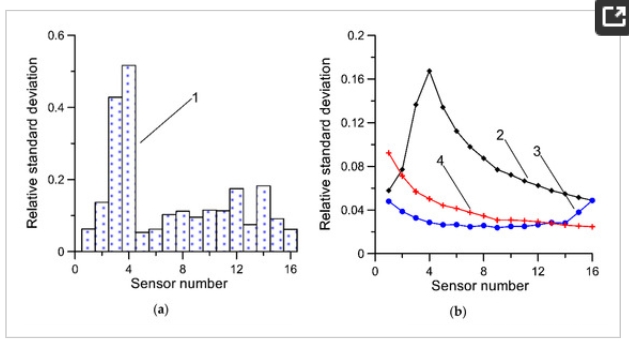
Since sensors cannot replicate an ideal transfer function, several types of deviations can occur which limit sensor accuracy:
* Since the range of the output signal is always limited, the output signal will eventually reach a minimum or maximum when the measured property exceeds the limits. The full scale range defines the maximum and minimum values of the measured property.[citation needed]
* The sensitivity may in practice differ from the value specified. This is called a sensitivity error. This is an error in the slope of a linear transfer function.
* If the output signal differs from the correct value by a constant, the sensor has an offset error or bias. This is an error in the y-intercept of a linear transfer function.
* Nonlinearity is deviation of a sensor’s transfer function from a straight line transfer function. Usually, this is defined by the amount the output differs from ideal behavior over the full range of the sensor, often noted as a percentage of the full range.
* Deviation caused by rapid changes of the measured property over time is a dynamic error. Often, this behavior is described with a bode plot showing sensitivity error and phase shift as a function of the frequency of a periodic input signal.
* If the output signal slowly changes independent of the measured property, this is defined as drift. Long term drift over months or years is caused by physical changes in the sensor.
* Noise is a random deviation of the signal that varies in time.
* A hysteresis error causes the output value to vary depending on the previous input values. If a sensor’s output is different depending on whether a specific input value was reached by increasing vs. decreasing the input, then the sensor has a hysteresis error.
Resolution:
The sensor resolution or measurement resolution is the smallest change that can be detected in the quantity that it is being measured. The resolution of a sensor with a digital output is usually the numerical resolution of the digital output. The resolution is related to the precision with which the measurement is made, but they are not the same thing. A sensor’s accuracy may be considerably worse than its resolution.
For example, the distance resolution is the minimum distance that can be accurately measured by any distance measuring devices. In a time-of-flight camera, the distance resolution is usually equal to the standard deviation (total noise) of the signal expressed in unit of length.
The sensor may to some extent be sensitive to properties other than the property being measured. For example, most sensors are influenced by the temperature of their environment.
Chemical sensor:
A chemical sensor is a self-contained analytical device that can provide information about the chemical composition of its environment, that is, a liquid or a gas phase. The information is provided in the form of a measurable physical signal that is correlated with the concentration of a certain chemical species (termed as analyte). Two main steps are involved in the functioning of a chemical sensor, namely, recognition and transduction. In the recognition step, analyte molecules interact selectively with receptor molecules or sites included in the structure of the recognition element of the sensor. Consequently, a characteristic physical parameter varies and this variation is reported by means of an integrated transducer that generates the output signal. A chemical sensor based on recognition material of biological nature is a biosensor. However, as synthetic biomimetic materials are going to substitute to some extent recognition biomaterials, a sharp distinction between a biosensor and a standard chemical sensor is superfluous. Typical biomimetic materials used in sensor development are molecularly imprinted polymers and aptamers.
Biosensor:
In biomedicine and biotechnology, sensors which detect analytes thanks to a biological component, such as cells, protein, nucleic acid or biomimetic polymers, are called biosensors. Whereas a non-biological sensor, even organic (carbon chemistry), for biological analytes is referred to as sensor or nanosensor. This terminology applies for both in-vitro and in vivo applications. The encapsulation of the biological component in biosensors, presents a slightly different problem that ordinary sensors; this can either be done by means of a semipermeable barrier, such as a dialysis membrane or a hydrogel, or a 3D polymer matrix, which either physically constrains the sensing macromolecule or chemically constrains the macromolecule by bounding it to the scaffold.
Neuromorphic sensors :
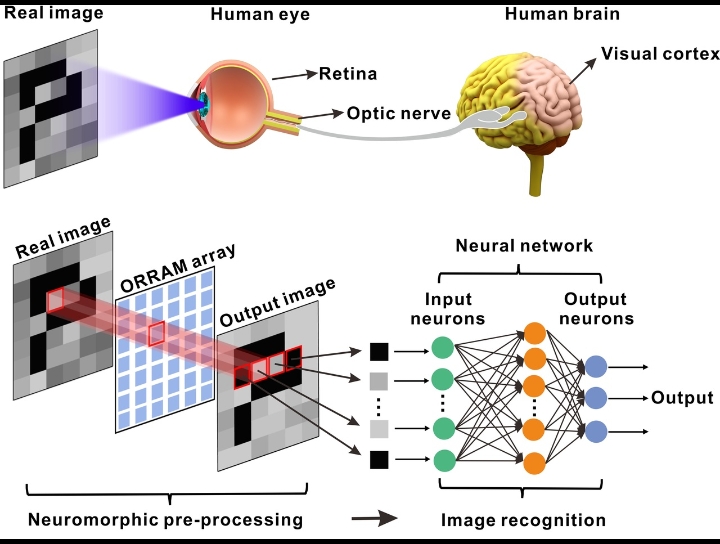
Neuromorphic sensors are sensors that physically mimic structures and functions of biological neural entities.[8] One example of this is the event camera.
MOS sensors :
Metal-oxide-semiconductor (MOS) technology originates from the MOSFET (MOS field-effect transistor, or MOS transistor) invented by Mohamed M. Atalla and Dawon Kahng in 1959, and demonstrated in 1960. MOSFET sensors (MOS sensors) were later developed, and they have since been widely used to measure physical, chemical, biological and environmental parameters.
Biochemical sensors:

A number of MOSFET sensors have been developed, for measuring physical, chemical, biological and environmental parameters. The earliest MOSFET sensors include the open-gate field-effect transistor (OGFET) introduced by Johannessen in 1970, the ion-sensitive field-effect transistor (ISFET) invented by Piet Bergveld in 1970, the adsorption FET (ADFET) patented by P.F. Cox in 1974, and a hydrogen-sensitive MOSFET demonstrated by I. Lundstrom, M.S. Shivaraman, C.S. Svenson and L. Lundkvist in 1975. The ISFET is a special type of MOSFET with a gate at a certain distance, and where the metal gate is replaced by an ion-sensitive membrane, electrolyte solution and reference electrode. The ISFET is widely used in biomedical applications, such as the detection of DNA hybridization, biomarker detection from blood, antibody detection, glucose measurement, pH sensing, and genetic technology.
Image sensors:
MOS technology is the basis for modern image sensors, including the charge-coupled device (CCD) and the CMOS active-pixel sensor (CMOS sensor), used in digital imaging and digital cameras. Willard Boyle and George E. Smith developed the CCD in 1969. While researching the MOS process, they realized that an electric charge was the analogy of the magnetic bubble and that it could be stored on a tiny MOS capacitor. As it was fairly straightforward to fabricate a series of MOS capacitors in a row, they connected a suitable voltage to them so that the charge could be stepped along from one to the next. The CCD is a semiconductor circuit that was later used in the first digital video cameras for television broadcasting.
The MOS active-pixel sensor (APS) was developed by Tsutomu Nakamura at Olympus in 1985.The CMOS active-pixel sensor was later developed by Eric Fossum and his team in the early 1990s.
Monitoring sensors:

MOS monitoring sensors are used for house monitoring, office and agriculture monitoring, traffic monitoring (including car speed, traffic jams, and traffic accidents), weather monitoring (such as for rain, wind, lightning and storms), defense monitoring, and monitoring temperature, humidity, air pollution, fire, health, security and lighting.MOS gas detector sensors are used to detect carbon monoxide, sulfur dioxide, hydrogen sulfide, ammonia, and other gas substances.Other MOS sensors include intelligent sensors and wireless sensor network (WSN) technology
The end…
The Kaveri is an Indian river flowing through the states of Karnataka and Tamil Nadu. The Cauvery River rises in the Western Ghats and flows in eastwardly direction passing through the states of Karnataka, Tamil Nadu, Kerala and Pondicherry before it drains into Bay of Bengal.The total length of the river from source to its outfall into Bay of Bengal is about 800 km.The Cauvery basin extends over states of Tamil Nadu, Karnataka, Kerala and Union Territory of Puducherry draining an area of 81,155 Sq.km which is nearly 2.7% of the total geographical area of the country with a maximum length and width of about 560 km and 245 km.

Cauvery river is the largest river in tamil nadu occupying 765 km.The Kaveri is a sacred river to the people of South India and is worshipped as the Goddess Kaveriamma. The primary uses of the Kaveri is providing water for irrigation, water for household consumption and the generation of electricity.In February 2020, Tamil Nadu assembly passed bill to declare Cauvery Delta as Protected Agricultural Zone, includes Thanjavur, Thirvarur, Nagapattinam and five blocks in Cuddalore and Pudukottai. The bill fails to include Tiruchirappalli, Ariyalur and Karur which are geographically included in the Cauvery Delta.The cauvery river is the main source for the delta region for irrigation.It ends in the bay of Bengal.
On 22 June 2018, despite opposition from Karnataka, the Central government constituted the Cauvery Water Regulation Committee (CWRC) as per the provisions in the Kaveri Management Scheme laid down by the Supreme Court.
Acting on the Supreme Court’s direction, the Centre constituted a Cauvery Water Management Authority (CWMA) on 1 June 2018 to address the dispute over sharing of river water among Tamil Nadu, Karnataka, Kerala and Puducherry.The central government failed to adhere with the top court’s deadline of within six weeks of deliverance of judgement.
You got your pay-check in the end of the month. Congrats!! But now what? Either spend it or save it. Now, you know the things on which you want to spend the money. But a lot of people don’t know how to save money in such a way where the money they saved does not lose its value but in reality let it increase. Now, you must have this in your mind – How?
Simple, through investing it. There are four different areas where people usually invest in our country. First is Savings Account, second is Fixed Deposit, third is Gold or Jewellery and the last is real estate. Another way is investing in the stock market where the risk is comparatively higher.
Every investment contains three aspects viz. Return, Time and Risk.
Return is basically the profit you actually get through your investment and make sure that the profit percentage is higher than the inflation rate in your area otherwise the investment that you make would not make any sense.
Risk is about the chance of how much money can you lose through your investment. What are the chances of going in loss after investing in certain area , this mainly come under the risk aspect.
Time is about for how long are you planning to invest.
Savings account has the minimum risk with no restriction. You can take or save your money at any time. But the return is something in savings account which you have to compromise. In simply words, ROI ( Return In Investment ) in this case is low.
Fixed deposit is also another less risky option but there is a time limit here in which you can not take your money out. But the return here is slightly higher than that of savings account.
There is no risk in investing in Gold and Jewellery but ROI is not confirmed as their prices fluctuate a lot.
Investing in real estate depends on a lot of factors especially the area. There is a low to moderate risk in investing it. As the fluctuation of prices prevail here as well. You need a lot of capital as well in order to invest in the real estate.
Investment into the stocks may lead to higher return and higher loss as well. It depends on the stock in which you are investing.
It is advised to invest in multiple arenas in order to avoid higher risks.
What are Mutual Funds?
It is a special kind of investment through which you can invest on different types together. It is a better way of diversifying your investments by investing in a one place.
An asset management company collects money from different investors. Afterwards, it invests that money in different places. The collectively return that it gets is given to you after deducting small percent of it for the company itself. A lot of organisations have their own asset management companies. The risk and return all depends on which kind of mutual funds you are investing in.
Types of mutual funds:
There can be different types of mutual funds according to the places on which asset management company is investing.
Equity Mutual funds:
In equity mutual funds, money is invested in the stock market. In this category, generally risks and return both are high. If the investment in big company then it is called large cap equity fund and so on.
Diversified Equity Fund:
Here the investment is done in the large cap, medium cap and small cap companies simultaneously or it is done in different companies.
Equity Linked Saving Scheme (ELSS):
In this scheme you can save your tax that you get in the profit. The fund manager purposedly invests in the places where there is large return and large risks.
Index Funds:
Index funds are passively managed fund where no agent of asset management company looks for the places to invest. The return on these funds depend on the market price.
Debt Investment:
These are mutual funds which are invested in debt instruments like bonds, debentures and certificate of deposits.
What are bonds?
When government borrows money from people as loans then that is called a bond. The government will return the money to you with a fixed interest.
Hybrid Mutual funds:
In this type, the money is invested in both equity and debt mutual funds.
For investing the money, you should gather the complete information about the type of investment you want to make first. Afterwards, make the right decision. But don’t let your money to sit idle in the banks.

While analyzing the themes of Charles Dickens’s 1859 historical fiction, A Tale of Two Cities it is apparent that the author has incorporated variety of themes in the novel. Through the beginning lines “It was the best of times, it was the worst of times. . .” the chaotic society of eighteenth society is well depicted by Dickens. Even though the characters in the novel do not engage in many conversations, their actions strengthens the themes of this work.
Resurrection or rebirth is the major theme of the novel, which is presented from the beginning to the end of the novel. The first important resurrection is that of Sydney Carton’s. Sydney Carton’s resurrection and sacrifice gives new life to Lucie and her family. Carton is portrayed as a Christ like figure who dies to save the lives of the people he loves and reborn in their minds. The theme of resurrection comes again with respect to Dr Alexandre Manette, who is reborn into his previous life, from imprisonment and mental illness, with the love of his daughter Lucie. In Jerry Cruncher’s life also we can see the resurrection, who leaves the job of grave digging for his loved ones. These are the resurrection in
personal level. In the societal level, we can see the old status of France appears to give way to New France with the sacrifice of many revolutionaries. The revival of peace and a better society echoes throughout the novel. Sacrifice is the next dominant theme in A Tale of Two Cities . On a personal level sacrifice of Sydney Carton is most strongly visible. He gives importance to the happiness of Lucie and family and this encourages him to sacrifice his life. Carton does not have a family of his own and he lead an unproductive life throughout, so he haven’t offered much to the world. So he believes this act of sacrifice will redeem everything and make his life meaningful. Next factor which strengthens the theme of sacrifice is the revolution. Revolutionaries sacrifice their life to give a new society.
Violence and oppression is the next major theme. Even though Dickens’s seems to support the revolution, he emphasizes the sufferings caused by violence. Dickens sympathizes with the peasantry and emphasizes the need for liberation. But the strategy of peasants for overcoming this situation causes more violence and death of many innocent humans. The scenes of people sharpening their weapons in the grindstone, senseless killings of people and dance with weapons emphasizes the theme of violence and oppression.
Since the background of the novel is eighteenth century society Social Inequality and Class conflict are the next important theme. There are two classes in France, the peasants and the aristocrats. The aristocrats are portrayed as lazy, irresponsible, spoiled and heartless who does not have any regard for the peasants or lower section of the society. The social inequality is evident in the incident of the rape of the peasant woman by Marquis. And when the Marquis killed the son of Gaspard he is not subjected to any legal proceedings because he is from the aristocracy. The storming of Marquis’s castle is the symbol of the fall of aristocracy. Towards the end the situation reverse. The violent measures by the peasants arises as a result of long suffering. Even though Dickens supported revolution he portrayed both social class as equally violent and oppressive.
The theme of justice is intertwined with discrimination and injustice. Justice is presented literally by trails and imprisonments in the plot. The imprisonments of Darnay and Dr Manette are example of innocent people being subjected. As said earlier after the death of the son of Gaspard Marquis is not subjected to any legal proceedings. At this occasion justice is taken by individuals, like murder of Marquis by Madame Defarge as a revenge against Everemonde family.
Apart from these major themes Dickens focuses on themes of duality like light v/s darkness love v/s hatred with the comparison of two countries and the actions of the people there. While England remained as peaceful country, France goes through intense revolution. The contrast between these countries is progressed through the novel which intensifies the theme of light v/s darkness. Dr. Manette has been locked away in a dark prison for many years and lost his mind. Charles Darnay is struggling to right the wrongs done by Evremonde family. Sydney Carton is living his life unproductive and feels he has no purpose. So Lucie is the person who is considered as the light in their lives, who lead them to recovery and bring them out of darkness.
Revolution is the next major theme which is clearly apparent throughout the novel. The revolution and it’s impact on lives of many people is clearly portrayed. The sinners and innocent people, both are equally affected by revolution. The reversal of roles are the next theme. Towards the end of the novel the peasants who were poor in the beginning become more barbaric and cruel. And as a result of this the aristocrats suffer at the end. So this is an example of reversal of roles among peasants and aristocrats. On another level the replacement of Darnay by Carton in the prison is also an example for the reversal of roles. Apart from these, themes like family preservation, fate, love and hate are also included by Dickens. Through these themes author clearly reflects the society of eighteenth century.

Structural approaches of international relations, also known as ‘neo-radical approaches’, are of recent origin. Theories in support of these approaches were advocated by leftist writers who were deeply influenced by Marxism-Leninisim. The structural approaches, including the ‘World System Approach’ and the ‘Dependency Theory’, consider the world structure from the class point of view, based largely on the level of development and accumulation of capital. Western capitalist countries, having huge accumulation of capital, are termed as the centre or core of the world system, while third world countries, lacking development and capital, are called the periphery. We shall examine the concept of development and underdevelopment with reference to the centre versus periphery.
A reference may be made here to neo-realists, who also examine the international structure, but from the political angle. They describe the international structure as chaotic or anarchic because there is no all powerful central authority to discipline the nation states, and to resolve their disputes and maintain world peace. The leftists, on the other hand, largely concentrate on economic relations between the rich industrialized nations of the capitalist world on the one hand and the poor developing third world countries on the other. This chapter will discuss the centre-periphery aspect of development as advocated by the neo-radicals.

There is enormous gap today between income levels in the world’s industrialized regions and those in the third world. The rich industrialized countries generally lie in the northern parts of the world, while the poor developing countries are in the south. This difference in the income levels has caused differences in the overall prosperity between the rich North and the poor South. How can this gap be explained? This may be done with the help of the liberal view and also with reference to the revolutionary or radical world view.
The liberal view explains the problem by stressing that the capitalist countries have overall efficiency in maximizing economic growth. This view holds that the poor countries are merely lagging behind the industrial north. The liberals would make us believe that more wealth creation in the North is a good thing, as is wealth creation in the South. According to this view, there is no conflict between the two, as eventually the South will also acquire more wealth.
The leftist, or socialist, view is that the divide may be viewed not only in terms of creation of wealth but also with regard to its distribution. According to this view, the creation of wealth in the North often comes at the expense of the South.
The system of regional class divisions has been viewed by scholars of international relations with Marxist orientation as the ‘ world system’ or ‘capitalist world economy.’ The world system approach is a leftist theory and it relies on global system of analysis. Marx himself had limited his theory to domestic class conflict only, but Marxist scholars apply the same logic in their world system approach. In this system, class divisions are regionalized. The third world countries (exceptions apart) generally produce raw materials, including agricultural products.
These activities need large manpower but not much of capital. The peasants working in agriculture, mining and other sectors are paid low wages. The industrialized countries, on the other hand, mostly produce manufactured goods. This requires large amount of capital, and needs more skilled workers who are paid high wages. The industrialized manufacturing regions are called ‘centre’ of the world system; and the extraction regions (producing raw materials and agricultural items) are known as ‘periphery’.
Reference : International relations by V.N Khanna
Introduction:-
Data science is an interdisciplinary field that uses scientific methods, processes, algorithms and systems to extract knowledge and insights from noisy, structured and unstructured data, and apply knowledge and actionable insights from data across a broad range of application domains. Data science is related to data mining, machine learning and big data.

Data science is a “concept to unify statistics, data analysis, informatics, and their related methods” in order to “understand and analyze actual phenomena” with data. It uses techniques and theories drawn from many fields within the context of mathematics, statistics, computer science, information science, and domain knowledge. However, data science is different from computer science and information science. Turing Award winner Jim Gray imagined data science as a “fourth paradigm” of science (empirical, theoretical, computational, and now data-driven) and asserted that “everything about science is changing because of the impact of information technology” and the data deluge.
A data scientist is someone who creates programming code, and combines it with statistical knowledge to create insights from data.
Foundations:
Data science is an interdisciplinary field focused on extracting knowledge from data sets, which are typically large (see big data), and applying the knowledge and actionable insights from data to solve problems in a wide range of application domains.The field encompasses preparing data for analysis, formulating data science problems, analyzing data, developing data-driven solutions, and presenting findings to inform high-level decisions in a broad range of application domains. As such, it incorporates skills from computer science, statistics, information science, mathematics, information visualization, data integration, graphic design, complex systems, communication and business.Statistician Nathan Yau, drawing on Ben Fry, also links data science to human-computer interaction: users should be able to intuitively control and explore data.In 2015, the American Statistical Association identified database management, statistics and machine learning, and distributed and parallel systems as the three emerging foundational professional communities.
Relationship to statistics :
Many statisticians, including Nate Silver, have argued that data science is not a new field, but rather another name for statistics. Others argue that data science is distinct from statistics because it focuses on problems and techniques unique to digital data.Vasant Dhar writes that statistics emphasizes quantitative data and description. In contrast, data science deals with quantitative and qualitative data (e.g. images) and emphasizes prediction and action.Andrew Gelman of Columbia University has described statistics as a nonessential part of data science. Stanford professor David Donoho writes that data science is not distinguished from statistics by the size of datasets or use of computing, and that many graduate programs misleadingly advertise their analytics and statistics training as the essence of a data science program. He describes data science as an applied field growing out of traditional statistics.In summary, data science can be therefore described as an applied branch of statistics.
Etymology:
In 1962, John Tukey described a field he called “data analysis“, which resembles modern data science. In 1985, in a lecture given to the Chinese Academy of Sciences in Beijing, C.F. Jeff Wu used the term Data Science for the first time as an alternative name for statistics.Later, attendees at a 1992 statistics symposium at the University of Montpellier II acknowledged the emergence of a new discipline focused on data of various origins and forms, combining established concepts and principles of statistics and data analysis with computing.
The term “data science” has been traced back to 1974, when Peter Naur proposed it as an alternative name for computer science.In 1996, the International Federation of Classification Societies became the first conference to specifically feature data science as a topic. However, the definition was still in flux. After the 1985 lecture in the Chinese Academy of Sciences in Beijing, in 1997 C.F. Jeff Wu again suggested that statistics should be renamed data science. He reasoned that a new name would help statistics shed inaccurate stereotypes, such as being synonymous with accounting, or limited to describing data.In 1998, Hayashi Chikio argued for data science as a new, interdisciplinary concept, with three aspects: data design, collection, and analysis.
During the 1990s, popular terms for the process of finding patterns in datasets (which were increasingly large) included “knowledge discovery” and “data mining”.
Modern usage:
The modern conception of data science as an independent discipline is sometimes attributed to William S. Cleveland. In a 2001 paper, he advocated an expansion of statistics beyond theory into technical areas; because this would significantly change the field, it warranted a new name.”Data science” became more widely used in the next few years: in 2002, the Committee on Data for Science and Technology launched Data Science Journal. In 2003, Columbia University launched The Journal of Data Science. In 2014, the American Statistical Association’s Section on Statistical Learning and Data Mining changed its name to the Section on Statistical Learning and Data Science, reflecting the ascendant popularity of data science.
The professional title of “data scientist” has been attributed to DJ Patil and Jeff Hammerbacher in 2008. Though it was used by the National Science Board in their 2005 report, “Long-Lived Digital Data Collections: Enabling Research and Education in the 21st Century,” it referred broadly to any key role in managing a digital data collection.
Market:
Big data is becoming a tool for businesses and companies of all sizes. The availability and interpretation of big data has altered the business models of old industries and enabled the creation of new ones.Data scientists are responsible for breaking down big data into usable information and creating software and algorithms that help companies and organizations determine optimal operations.
The end…

Margaret Atwood is a well known feminist author who writes about the oppression of women in a patriarchal society. Her poem This is a Photograph of Me also shares this idea symbolically through the image of a photograph. The title of the poem itself shows the passive role of women in society. In a society which is regulated by men the role of women is passive. But without them the society will not survive. Atwood begins the poem by describing the photograph. It is a blurred photograph which was taken some time ago. And throughout the lines she continues the description of the photograph’s each element. There is the branch or part of a tree in the left hand side of the photograph, which has emerged to the right hand side. This branch without any roots can be considered as the role of women in a society who is placed on the left side or weaker side. But on the right hand side of the photograph a frame house is visible which is associated with men. The background of the photograph is a lake which represents the society. And beyond that lake there is low hills. The hills and lakes keep the women in shadow. Margaret Atwood is trying to show that the society and men exploits the true potential of women. The narrator says that I’m in the lake, in the center of the picture. But it is difficult to say precisely where she is. This shows the nature of a patriarchal society. The place of womanhood in a society is mandatory. However the world tries, the women’s place cannot be underwritten. Atwood focuses on this truth by saying that her place in the photograph is not clear. But when we look long enough everyone will be able to see her place in the photograph or the society itself. Through the image of a photograph Atwood strongly presents the oppression faced by women. Photograph stands for history which is not clear. The contribution of women to the society is necessary but the history created by men does not praise of give importance to them. Women are always hidden or drowned as Atwood says. This truth is underlined by Atwood in this feministic poem, This is a Photograph of Me.
Written in the socio-political background of Polish- Cossack war and the Khemelnsky massacre, the novel The Slave unfolds many layers of religion, philosophy, vulnerabilities and guilt of man. The novel also portrays the critical or unbiased representation of the jew community. Isaac Bashevis Singer is a Jewish immigrant writer, and he is known for his unbiased representation of the Judaism. In this novel also Singer portrays this criticism of religion and Judaism and he questions the aim or meaning of the religion if it only serves for the separation of humans. The novel carries various religious allusions, symbols and philosophical truths.
The protagonist Jacob is a religious Jew, with extreme beliefs. He is described as ” he resembles the men in the holy pictures that hung in the chapel in the valley”. He upholds his Jewish identity. At the same time he is in a religious conflict and dilemma. Being an ardent believer , sexual relations and marriage with an “outsider” or non Jew is not allowed in Judaism. But his intense love for Wanda is in conflict with this. Here, a juxtaposition between free will and determinism is evident. The question that does God control his destiny or does Jacob controls his destiny is always in juxtaposition in his mind. In the relationship between Jacob and Wanda the novel questions the religion and the customs by giving the notion that, why do we follow certain rituals if it intends the seperatedness of individuals rather than their union. Apart from this internal dilemma, one external dilemma is there, that is the thought of discrimination or exclusion in the village. And this made him to tell that Wanda is deaf and mute to hide her ethnic Identity.
Another question of choice, righteousness comes in the instance where Teresa tries to seduce Jacob. But Jacob refuses and Teresa feels guilt and she laments.
There are several biblical allusions present in the novel. When Jacob changes Wanda’s name to Sarah, he is alluded to Abraham who changes his wife’s name to Sarah. The name of their son Benjamin also carry biblical allusion. And he takes him to Jerusalem for pilgrimage. Towards the end novelist presents the ultimate philosophy of life by the growing cemetery, which included the remains of Sarah, which was not accepted by the community because of Sarah not being a Jew. So here Singer portrays the ultimate philosophy and truth of life, the death. Death is the leveller, which is equal for everyone irrespective of race and religion. And everyone gets equality through death.
ELON Musk is one of the greatest entrepreneurs in the world.He is ceo,founder and chief engineer in space X.His net worth is 29,700 crores.He is the richest man in the world currently.Musk was born to a Canadian mother and South African father, and raised in Pretoria, South Africa. He briefly attended the University of Pretoria before moving to Canada at age 17 to avoid conscription.Elon Reeve Musk was born on June 28, 1971 in Pretoria, South Africa.He is now 50 years old.He attended the University of Pretoria for five months Musk arrived in Canada in June 1989, and lived with a second-cousin in Saskatchewan for a year, working odd jobs at a farm and lumber-mill.In 1990, Musk entered Queen’s University in Kingston, Ontario.

In 2001, Musk became involved with the nonprofit Mars Society. He was inspired by plans to place a growth-chamber for plants on Mars and discussed funding the project himself.SpaceX attempted their first launch of the Falcon 1 rocket in 2006,[69] and although the rocket failed to reach Earth orbit, they were awarded a Commercial Orbital Transportation Services program contract from NASA later that year.After two more failed attempts, which reportedly caused Musk so much stress.SpaceX received a $1.6 billion Commercial Resupply Services program contract from NASA for 12 flights of its Falcon 9 rocket and Dragon spacecraft to the International Space Station, replacing the Space Shuttle after its 2011 retirement. In 2012, the Dragon vehicle berthed with the ISS, a first for a private enterprise.Working towards its goal of reusable rockets, in 2015, SpaceX successfully landed the first stage of a Falcon 9. In 2015, SpaceX successfully landed the first stage of a Falcon 9. Landings were later achieved on an autonomous spaceport drone ship, an ocean-based recovery platform. In 2018, SpaceX launched the Falcon Heavy; the inaugural mission carried Musk’s personal Tesla Roadster as a dummy payload. In 2017, SpaceX unveiled its next-generation launch vehicle and spacecraft system
There are people in the world who are having high income but are still living petty lives as they don’t know how to manage their finances.
Can you be financially secure even if you are not making a lot of money?
Can ordinary people invest in the stock market with manageable risks?
Answers to these questions are YES if you are well versed with Financial literacy.
Today managing money in a beneficial way has become a skill. It all starts with the income or money you are making in present. It can be through your salary or investments.
INCOME-
Your first step towards becoming a financial literate is to have enough money to manage. How can you make money now? For making money, you have to create your own value in the market. Employers would never hire YOU but they will hire your SKILLS. When you are imparting skills in yourself then you are creating your value. The more and better skills you have the more the value you would have.
EXPENSES-
When you get your income then what is the first thing you do?
Of course you either save it or spend it. In most of the times, you spend your income first. Now, how, when and on what to spend your income are the important aspects of financial literacy. Do you even know where your all money goes?
There is a 50:30:20 rule where 50% of your income goes to your urgent costs that can’t be delayed for example monthly bills including housing or rent other 30% of your income goes to Debt or savings and the rest 20% goes to your entertainment or the things you like to do or buy. If you don’t manage your expenses carefully then the repercussions only contain the regrets. People should note down their financial priorities every month then spend the income accordingly.
ASSETS-
Assets are the things on which you have the ownership. Everything from your house and saving accounts to your car are regarded as your assets. It is advised to develop the habit of saving from as earlier as possible while earning. Even if you save a very little amount then also this is not the problem. The thing is you should save and get into the practice of saving. Save regularly for any upcoming unexpected expenditures. Save as much to build more and more assets. After saving, make a diverse financial plan through which you can efficiently use your income.
STOCKS-
Investment nowadays has become a necessity. Your one portion of your income ought to be used to buy a stock as to open multiple ways to earn money. There is always some amount of risk while buying a stock as the company in which you are investing may get profits in future or maybe not. So, you have to choose the company wisely in which you are investing. For a beginner, it is advised to invest in index funds or mutual funds. A mutual fund is a professionally managed portfolio for investment that pulls money from all sorts of investors especially for those who are looking for diversifying their investments. Index funds are which are able to manage the performance for a group of companies like a group of tech companies or group of consumer goods company etc. An index basically consists of a basket of companies related to a particular niche. There are a lot of indices out there which can grab your attention. There comes the role of financial literacy which helps you to understand the tools required for achieving the short- term goals, intermediate goals or long-term goals.
LIABILITIES –
Liability is basically the debt you owe to a person or a business. Buying something with credit that is an asset and consuming something with credit has a vast difference. Using your student loan to go for a trip or investing your student loan to build assets and to hone your skills create a big impact in your life. Whether you use your money to invest on yourself or spend it on having fun, it all depends on you and your mindset. The worse repercussions of more debt than your income have all been emotional. They suck all the joy of one’s life. Try to limit your expenses and liabilities. In the end, it all depends on you whether you make right choices or wrong. These choices can be related to money , education and relationships etc. Every choice you make has an impact in your life. It does not matter whether the impact is large or small. So, choose wisely!

A podcast is an episode of series of spoken digital audio file. Podcasting is one of the most significant tools accessible to build your brand and your audience. when it comes to creating a podcast, the real magic happens when you’re recording.
Here are few ways to make your podcast sound more professional are enlisted below:
1.Start with an introduction:
Always start with an intro. It’s nice for stigmatization functions, however there are alternative ways to approach it. this is your show. You can do whatever it is that you want to do with it. You have a lot of freedom here. Now, like any podcast, video, or perhaps a live presentation, the simplest factor you’ll do at the start is to inform your listeners or readers what they’re about to experience. This helps them perceive what to expect, and provides them one thing to seem forward to. Then I pay a couple of minute going over about what I’m reaching to observe and who I actually have on the show as a guest that episode.Intro is an important step taken into consideration.
2. Attract the audience with an outro:
Always keep this one quick and sweet. In addition, in your intro, your outro could be very essential. And frankly, I see a variety of podcasters lacking in this one. your outro is the closing component humans pay attention and bear in mind whilst they are paying attention to you. So placed it to precise use.
3. Remove Interruptions during podcasting:
Ambient noises have an area in suggests however must be deliberate and now no longer left to chance. You don’t need your listener to listen a baby within side the subsequent room, a truck noise outside, or a noisy air conditioner.
It makes the whole listening enjoy unpleasant, and also you need to keep away from it in any respect costs. Customer enjoy is one of the primary elements whilst Clients purchase and pay, so that you need to take note of how does your podcast sound.
Podcasts are regularly listened to in cars, perks or gym, in the course of a commute, etc. Those aren’t ideal listening situations and are complete of noises. you must make your audio crystal clean to assure your podcast sound more professional. Another simple way is to record in a better condition simply is to observe patterns in the neighborhood whenever you are recording. In most places, it is the quietest during morning hours.
4. Adjust your tone:
There are many ways for podcasters, you ought to put in force to make your podcast sound professionally.
5.Submit Social Proofs:
If you have clients, submit their genuine testimonials. The people you have helped submit their positive testimonials if your product resolved their issues. Simply raise and share it.
When you don’t have customers yet, present the benefits of your product in a larger context. Build your credibility on the basis of years of unique work, knowledge, certifications, qualifications and experience.
Over 50 to 70 % of audiences read reviews before making a buying decision.
And nearly 63% of consumers are more likely to buy from a site that has ratings and reviews.
For instance, if you have a podcast about electric vehicles and not be an engineer. always make sure your podcast sounds professional, it shows how reputable companies are implementing the technologies. Proving that someone with authority did what you are talking about shows that you know your topic. When you teach something, try to show how it works for others.
Sarees have established a permanent status of being the official bearer of magnificence and are climbing up the style ladder to prove it is a true blue member of the ethnic style. Sarees and katrina kaif a perfect match made in heaven.
Here are 4 saree looks of Katrina kaif enlisted below:
Look #1
Katrina kaif looks Breathtaking in pretty pink saree. Katrina Kaif looked lovely in a exceedingly peach saree which she wore for the Diwali celebrations. The saree featured a significant rose gold border with intricate design. Katrina Kaif looked beautiful with simple makeup. Katrina kept her hair simple. The beautiful saree is from Manish Malhotra label collection. The embroidered saree was adorned with many signature style.

The blush pink sheer saree was decked in gold and silver sequined borders in an exceedingly triangular pattern and floral style. The actress had carried the saree of elegance with a sleeveless blouse embellished in gold and silver sequins matching the saree’s borders and that includes neckline.
Katrina was last seen in the recently released, which marks her onscreen reunion with Akshay Kumar after a decade.
Look #2
Katrina kaif was spotted wearing this gorgeous number from Sabyasachi Mukherjee collection during the promotion of her latest movie Sooryavanshi which marks her onscreen reunion with Akshay kumar.

The actress was styled by celebrity fashion stylist Ami Patel in a rusted orange drape that featured multi-coloured embroidered border and gold sequins. It also entailed patches of gold floral embroidery. Katrina’s saree was teamed with a full-sleeved blouse with Teardrop earrings. She looked stunning with soft, shimmer makeup and light jewellery. Katrina is a desi vision and looks beautiful as the colour beautifully complements her.
Look # 3
This recent saree inspiration was delivered by Katrina Kaif was in Dubai attending the HSBC Global Indian Pulse Survey at Expo 2020 Dubai. The saree with floral embroidery, this Aaina saree came with the loveliest work peppered with multiple hues. The scalloped hem, mini chaandbaalis, and gold bangles aren’t one thing to be incomprehensible.

Look – 4
Katrina wore a plain pastel blue chiffon saree for the promotion of sooryavanshi promotion at Bigg Boss and teamed with the semi-sheer six yards with an embroidered blouse of the identical color. The spaghetti-strapped blouse came adorned with floral sequined embroidery and a plunging neck. Katrina accessorized her saree with a pair of floral drop matching earrings, and silver stacked bracelets. Her make-up featured metallic blue eye shadow, glowing skin, center-parted wavy locks, a dainty bindi, and nude pink lips.

In a recent interview to Cosmopolitan India,
“Katrina said, “I grew up thinking that there is just one kind of beauty—it was what you saw in the magazines, and if you didn’t conform to that, then you didn’t cut it. I used to be rather conscious about the way I looked because I felt like I didn’t quite fit in. Today, people might find that admission a little strange, but back then, I felt that there were things about my features that were not ‘perfect’. I realize now that I was the one putting this pressure on myself ”. said the actress.
A computer is a programmable device that stores, retrieves, and processes data. … The term was later given to mechanical devices as they began replacing human computers. Today’s computers are electronic devices that accept data (input), process that data, produce output, and store storage the results.A computer is a machine that can store and process information. Most computers rely on a binary system, which uses two variables, 0 and 1, to complete tasks such as storing data, calculating algorithms, and displaying information.Computer has become very important nowadays because it is very much accurate, fast and can accomplish many tasks easily.

TYPES OF COMPUTER:-
* ANALOG COMPUTER.
* DIGITAL COMPUTER.
* MAINFRAME COMPUTER.
ANALOG COMPUTER:-
An analog computer or analogue computer is a type of computer that uses the continuously variable aspects of physical phenomena such as electrical, mechanical, or hydraulic quantities to model the problem being solved planimeters, nomograms, operational amplifiers, mechanical integrators, slide rules, tide pool predators, electric integrators are some examples for analog computers.
DIGITAL COMPUTER:-
Digital computer, any of a class of devices capable of solving problems by processing information in discrete form. It operates on data, including magnitudes, letters, and symbols, that are expressed in binary codes using only the two digits 0 and 1.smartphones, calculators, tablets, personal computer are some examples for Digital computers.
MAINFRAME COMPUTER:-
A mainframe computer, informally called a mainframe or big iron, is a computer used primarily by large organizations for critical applications like bulk data processing for tasks such as censuses, industry and consumer statistics, enterprise resource planning, and large-scale transaction processing. IBM zSeries, System z9 and System z10 servers are some examples for Mainframe computers.
An aircraft is a vehicle or machine that is able to fly by gaining support from the air. It counters the force of gravity by using either static lift or by using the dynamic lift of an airfoil, or in a few cases the downward thrust from jet engines. Common examples of aircraft include airplanes, helicopters, airships (including blimps), gliders, paramotors, and hot air balloons.
The human activity that surrounds aircraft is called aviation. The science of aviation, including designing and building aircraft, is called aeronautics. Crewed aircraft are flown by an onboard pilot, but unmanned aerial vehicles may be remotely controlled or self-controlled by onboard computers. Aircraft may be classified by different criteria, such as lift type, aircraft propulsion, usage and others.

History :
Flying model craft and stories of manned flight go back many centuries; however, the first manned ascent and safe descent in modern times took place by larger hot-air balloons developed in the 18th century. Each of the two World Wars led to great technical advances. Consequently, the history of aircraft can be divided into five eras:
* Pioneers of flight, from the earliest experiments to 1914.
* First World War, 1914 to 1918.
Aviation between the World Wars, 1918 to 1939.
* Second World War, 1939 to 1945.
* Postwar era, also called the Jet Age, 1945 to the present day.
Methods of lift
Lighter than air – aerostats

Aerostats use buoyancy to float in the air in much the same way that ships float on the water. They are characterized by one or more large cells or canopies, filled with a relatively low-density gas such as helium, hydrogen, or hot air, which is less dense than the surrounding air. When the weight of this is added to the weight of the aircraft structure, it adds up to the same weight as the air that the craft displaces.
Small hot-air balloons, called sky lanterns, were first invented in ancient China prior to the 3rd century BC and used primarily in cultural celebrations, and were only the second type of aircraft to fly, the first being kites, which were first invented in ancient China over two thousand years ago.
During World War II, this shape was widely adopted for tethered balloons; in windy weather, this both reduces the strain on the tether and stabilizes the balloon. The nickname blimp was adopted along with the shape. In modern times, any small dirigible or airship is called a blimp, though a blimp may be unpowered as well as powered.
Heavier-than-air – aerodynes :

Heavier-than-air aircraft, such as airplanes, must find some way to push air or gas downwards so that a reaction occurs (by Newton’s laws of motion) to push the aircraft upwards. This dynamic movement through the air is the origin of the term. There are two ways to produce dynamic upthrust aerodynamic lift, and powered lift in the form of engine thrust.
Aerodynamic lift involving wings is the most common, with fixed-wing aircraft being kept in the air by the forward movement of wings, and rotorcraft by spinning wing-shaped rotors sometimes called rotary wings. A wing is a flat, horizontal surface, usually shaped in cross-section as an aerofoil. To fly, air must flow over the wing and generate lift. A flexible wing is a wing made of fabric or thin sheet material, often stretched over a rigid frame. A kite is tethered to the ground and relies on the speed of the wind over its wings, which may be flexible or rigid, fixed, or rotary.
Fixed-wing:
The forerunner of the fixed-wing aircraft is the kite. Whereas a fixed-wing aircraft relies on its forward speed to create airflow over the wings, a kite is tethered to the ground and relies on the wind blowing over its wings to provide lift. Kites were the first kind of aircraft to fly and were invented in China around 500 BC. Much aerodynamic research was done with kites before test aircraft, wind tunnels, and computer modelling programs became available.
The first heavier-than-air craft capable of controlled free-flight were gliders. A glider designed by George Cayley carried out the first true manned, controlled flight in 1853.
The practical, powered, fixed-wing aircraft (the airplane or aeroplane) was invented by Wilbur and Orville Wright
Rotorcraft:
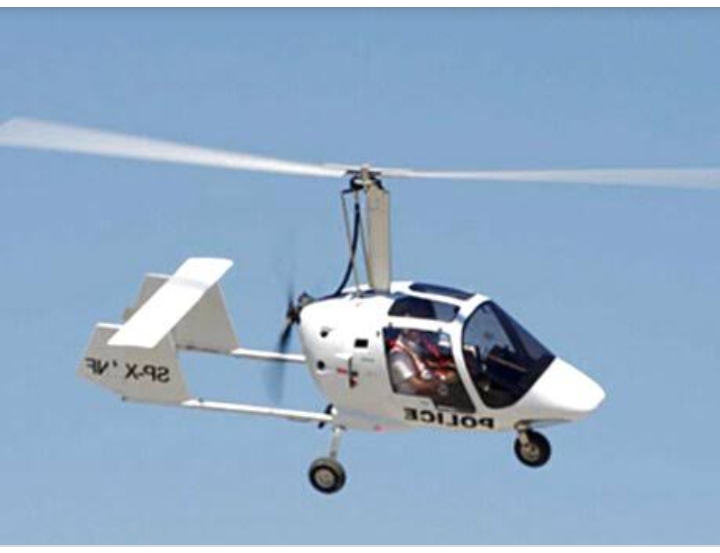
Rotorcraft, or rotary-wing aircraft, use a spinning rotor with aerofoil section blades (a rotary wing) to provide lift. Types include helicopters, autogyros, and various hybrids such as gyrodynes and compound rotorcraft.
Helicopters have a rotor turned by an engine-driven shaft. The rotor pushes air downward to create lift. By tilting the rotor forward, the downward flow is tilted backward, producing thrust for forward flight. Some helicopters have more than one rotor and a few have rotors turned by gas jets at the tips.
Autogyros have unpowered rotors, with a separate power plant to provide thrust. The rotor is tilted backward. As the autogyro moves forward, air blows upward across the rotor, making it spin. This spinning increases the speed of airflow over the rotor, to provide lift. Rotor kites are unpowered autogyros, which are towed to give them forward speed or tethered to a static anchor in high-wind for kited flight.
Other methods of lift:

A lifting body is an aircraft body shaped to produce lift. If there are any wings, they are too small to provide significant lift and are used only for stability and control. Lifting bodies are not efficient: they suffer from high drag, and must also travel at high speed to generate enough lift to fly. Many of the research prototypes, such as the Martin Marietta X-24, which led up to the Space Shuttle, were lifting bodies, though the Space Shuttle is not, and some supersonic missiles obtain lift from the airflow over a tubular body.
Powered lift types rely on engine-derived lift for vertical takeoff and landing (VTOL). Most types transition to fixed-wing lift for horizontal flight. Classes of powered lift types include VTOL jet aircraft (such as the Harrier Jump Jet) and tiltrotors, such as the Bell Boeing V-22 Osprey, among others.
Size :
The smallest aircraft are toys/recreational items, and nano aircraft.
The largest aircraft by dimensions and volume (as of 2016) is the 302 ft (92 m) long British Airlander 10, a hybrid blimp, with helicopter and fixed-wing features, and reportedly capable of speeds up to 90 mph (140 km/h; 78 kn), and an airborne endurance of two weeks with a payload of up to 22,050 lb (10,000 kg).
The largest aircraft by weight and largest regular fixed-wing aircraft ever built, as of 2016, is the Antonov An-225 Mriya. That Ukrainian-built six-engine Russian transport of the 1980s is 84 m (276 ft) long, with an 88 m (289 ft) wingspan. It holds the world payload record, after transporting 428,834 lb (194,516 kg) of goods, and has recently flown 100 t (220,000 lb) loads commercially. With a maximum loaded weight of 550–700 t (1,210,000–1,540,000 lb), it is also the heaviest aircraft built to date. It can cruise at 500 mph (800 km/h; 430 kn).
The largest military airplanes are the Ukrainian Antonov An-124 Ruslan (world’s second-largest airplane, also used as a civilian transport), and American Lockheed C-5 Galaxy transport, weighing, loaded, over 380 t (840,000 lb). The 8-engine, piston/propeller Hughes H-4 Hercules “Spruce Goose” an American World War II wooden flying boat transport with a greater wingspan (94m/260ft) than any current aircraft and a tail height equal to the tallest (Airbus A380-800 at 24.1m/78ft) — flew only one short hop in the late 1940s and never flew out of ground effect.
The largest civilian airplanes, apart from the above-noted An-225 and An-124, are the Airbus Beluga cargo transport derivative of the Airbus A300 jet airliner, the Boeing Dreamlifter cargo transport derivative of the Boeing 747 jet airliner/transport (the 747-200B was, at its creation in the 1960s, the heaviest aircraft ever built, with a maximum weight of over 400 t (880,000 lb)),and the double-decker Airbus A380 “super-jumbo” jet airliner
Size and speed extremes:
Speeds :
The fastest recorded powered aircraft flight and fastest recorded aircraft flight of an air-breathing powered aircraft was of the NASA X-43A Pegasus, a scramjet-powered, hypersonic, lifting body experimental research aircraft, at Mach 9.6, exactly 3,292.8 m/s (11,854 km/h; 6,400.7 kn; 7,366 mph). The X-43A set that new mark, and broke its own world record of Mach 6.3, exactly 2,160.9 m/s (7,779 km/h; 4,200.5 kn; 4,834 mph), set in March 2004, on its third and final flight on 16 November 2004.
Prior to the X-43A, the fastest recorded powered airplane flight (and still the record for the fastest manned, powered airplane / fastest manned, non-spacecraft aircraft) was of the North American X-15A-2, rocket-powered airplane at Mach 6.72, or 2,304.96 m/s (8,297.9 km/h; 4,480.48 kn; 5,156.0 mph), on 3 October 1967. On one flight it reached an altitude of 354,300 ft (108,000 m).
The fastest known, production aircraft (other than rockets and missiles) currently or formerly operational (as of 2016) are:
The fastest fixed-wing aircraft, and fastest glider, is the Space Shuttle, a rocket-glider hybrid, which has re-entered the atmosphere as a fixed-wing glider at more than Mach 25, equal to 8,575 m/s (30,870 km/h; 16,668 kn; 19,180 mph).
The fastest military airplane ever built: Lockheed SR-71 Blackbird, a U.S. reconnaissance jet fixed-wing aircraft, known to fly beyond Mach 3.3, equal to 1,131.9 m/s (4,075 km/h; 2,200.2 kn; 2,532 mph). On 28 July 1976, an SR-71 set the record for the fastest and highest-flying operational aircraft with an absolute speed record of 2,193 mph (3,529 km/h; 1,906 kn; 980 m/s) and an absolute altitude record of 85,068 ft (25,929 m).
Uses for aircraft:
Aircraft are produced in several different types optimized for various uses; military aircraft, which includes not just combat types but many types of supporting aircraft, and civil aircraft, which include all non-military types, experimental and model.
Military:

A military aircraft is any aircraft that is operated by a legal or insurrectionary armed service of any type.] Military aircraft can be either combat or non-combat:
Combat aircraft are aircraft designed to destroy enemy equipment using its own armament.Combat aircraft divide broadly into fighters and bombers, with several in-between types, such as fighter-bombers and attack aircraft, including attack helicopters.
Non-combat aircraft are not designed for combat as their primary function, but may carry weapons for self-defense. Non-combat roles include search and rescue, reconnaissance, observation, transport, training, and aerial refueling. These aircraft are often variants of civil aircraft.
Civil:
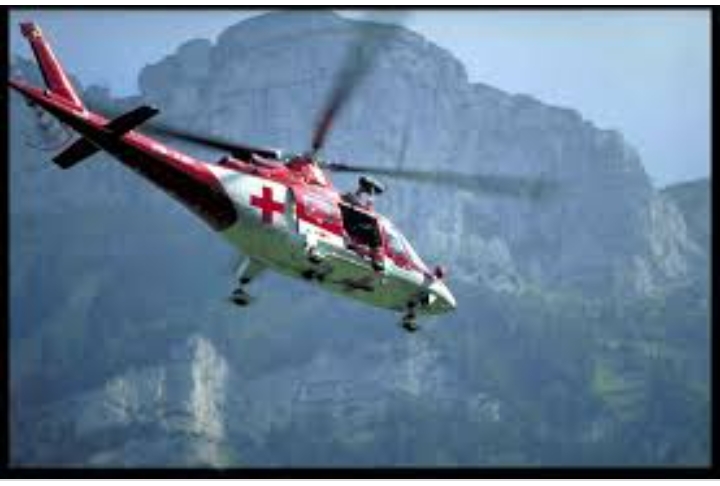
Civil aircraft divide into commercial and general types, however there are some overlaps.
Commercial aircraft include types designed for scheduled and charter airline flights, carrying passengers, mail and other cargo. The larger passenger-carrying types are the airliners, the largest of which are wide-body aircraft. Some of the smaller types are also used in general aviation, and some of the larger types are used as VIP aircraft.
General aviation is a catch-all covering other kinds of private (where the pilot is not paid for time or expenses) and commercial use, and involving a wide range of aircraft types such as business jets (bizjets), trainers, homebuilt, gliders, warbirds and hot air balloons to name a few. The vast majority of aircraft today are general aviation types.
Model:
A model aircraft is a small unmanned type made to fly for fun, for static display, for aerodynamic research or for other purposes. A scale model is a replica of some larger design.
The end…
A technical skills screening tool is software that contains a rich library of technical assessment tests, including questions and answers for recruiters to screen and evaluate candidates.
The assessments created on these platforms are used to evaluate candidates before employment by technical recruiters and/or hiring managers.
Skill assessments are not the only type of evaluation used by the hiring teams – job simulation resumes, and reference checks are all common screening methods. The trouble with resumes and reference checks is that they don’t reveal the whole picture. A candidate and often their references will attempt to present the applicant in the best positive light. Unfortunately, this may not be the most accurate portrayal of the candidate’s skills and abilities.

Job simulations, also known as work simulations, require candidates to perform tasks that the role requires in the workplace. These simulations are an effective evaluation tactic to understand how the candidate will perform in the real work environment.
Structured interviews are also an effective evaluation method, and they include a scoring system similar to that of skill assessments. The common denominator between the two methods is that they are both quantitative and can thus be reliably compared and contrasted. Moreover, recruiters can extract useful insights from the collected data.
Screen developers at scale with accurate, custom programming tests that evaluate technical skills hyper-relevant to the role.
Skill assessments have the added benefit of providing recruiters with the opportunity to reliably screen out candidates pre-interview. Thus, when it comes to tech hiring, skill tests take the cake to justify reliability, efficiency, and cost-effectiveness.
While skill tests are great, we mentioned earlier that you need the right kind of assessment to guarantee fair evaluation and the best results. Therefore, the ideal technical screening tool should offer:
Of course, not every tool will have all these features. So let’s take a look at the best technical screening tools for tech recruiters and hiring managers and see which one wins out.
WeCreateProblems has the largest repository of technical interview questions & tests. Where other platforms average a few thousand to generously over 10,000 questions, WeCP has over 0.2 million+ technical questions in the bank. The question bank contains skill test questions for every tech role, whether it’s frontend or full-stack development, data science, DevOps, or something else.
Tech recruiters can generate custom tests on-demand with WeCP to evaluate over 2000 different technical skills. Need morecustomization with the test questions and design? WeCP’s team is on standby to help you out there too.
Aside from the impressive size of the question bank and the high quality of the questions themselves, WeCP sets itself apart from the competition in another big way – the evaluation process. WeCP uses SkillMaps for scientifically evaluating candidates, guaranteeing accuracy, and all the tests in the repository have been thoroughly vetted. Moreover, WeCP’s technical screening is made cheat-proof through:
WeCP’s questions are thoroughly scrutinized for difficulty, guaranteeing candidates can’t just Google the answers or prepare for them beforehand. Whether you design a custom test or use a pre-built one, WeCP guarantees unique, challenging, skill-mapped assessments to help you track down the best candidate.
Codility is a powerful tech screening solution and remote hiring tool tailored for engineering teams. The recruitment platform has been around since 2009 and provides employers with powerful screening and interviewing tools.
Codility has a diverse knowledge base and includes skill tests for various roles – you can use the tool to evaluate potential candidates for frontend and backend developer positions, data science, language skills, and more. However, one drawback of using this tool is that it lacks AI-powered video proctoring and web proctoring features, which may lead to cheating.
One of Codility’s most appreciated features is its ‘candidate feedback’ option. If you enable this feature, Codility provides candidates with a breakdown of their score immediately after submission of the skill test. Enabling automated candidate feedback helps recruiters be more transparent about the hiring process.
CodeSignal is a popular technical screening tool for tech recruiters with a decent repository of questions, web proctoring, on-demand custom questions, and even video interviews.
CodeSignal is a relatively young recruitment platform, having popped up in 2015, but it has since made a good name for itself. The tool helps recruiters generate custom tests for a wide variety of programming languages and developer skills.
Pedigree is a poor proxy for programming skills. Broaden your candidate pool and qualify individuals based on their coding skills. Measuring developer skills accurately and at scale is easy with CodeSignal.
Some candidates have expressed concern regarding CodeSignal’s existing questions, citing them to be verbose and difficult to comprehend. On the whole, though, CodeSignal is a reliable tool. It has helped many tech companies evolve past using resumes for evaluation into the more reliable realm of coding skill tests.
HackerRank is a popular developer screening tool. The platform offers assessment tests for a variety of skills, including tests for full-stack development skills and database skills.
From simple coding challenges to full-stack engineering scenarios, allow developers to demonstrate their design, development, and communication skills in a real-time pair programming environment, complete with a virtual whiteboard. Add projects that provide insight into the quality of work candidates will perform at your company.
HackerRank has been around since 2012 and has since grown its client list to over 2000. The tool provides framework support and helps recruiters assess up to 44 skills with its rich repository of questions. After designing your custom assessment with HackerRank, you can opt for the automated scoring system or manually score the tests.
HackerEarth has the makings of a solid technical screening tool – it has a decent question bank (sporting over 15000 questions), has tests for all relevant skills, and has features like video interviews that some of its competitors lack. However, it does miss out on the whiteboarding features that WeCP offers.
HackerEarth lets you engage or source top developers with hackathons, while also enabling you to assess, interview and upskill them with ease.
Like HackerRank, HackerEarth was founded in 2012 and has since catered to over a thousand clients. The platform supports proctoring and helps recruiters screen and short-list top-performing candidates thanks to reliable coding assessments and an integrated scoring system.
The field of electronics is a branch of physics and electrical engineering that deals with the emission, behaviour and effects of electrons using electronic devices. Electronics uses active devices to control electron flow by amplification and rectification, which distinguishes it from classical electrical engineering, which only uses passive effects such as resistance, capacitance and inductance to control electric current flow.
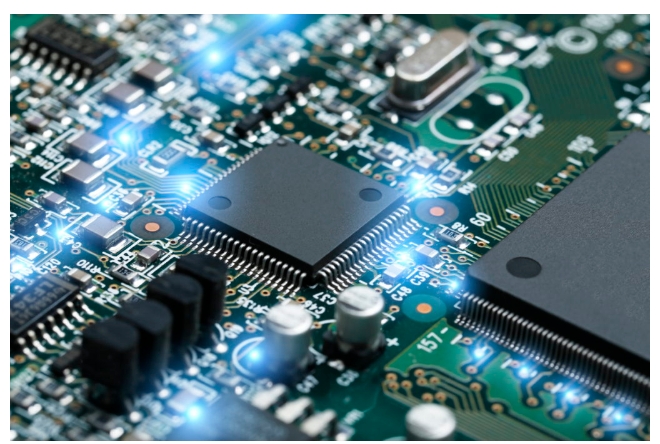
Electronics has hugely influenced the development of modern society. The identification of the electron in 1897, along with the subsequent invention of the vacuum tube which could amplify and rectify small electrical signals, inaugurated the field of electronics and the electron age.Practical applications started with the invention of the diode by Ambrose Fleming and the triode by Lee De Forest in the early 1900s, which made the detection of small electrical voltages such as radio signals from an radio antenna possible with a non-mechanical device. The growth of electronics was rapid, and by the early 1920s commercial radio broadcasting and communications were becoming widespread, and electronic amplifiers were being used in such diverse applications as long distance telephony and the music recording industry.
The next big technological step took several decades to appear, when Solid-state electronics emerged with the first working semiconductor transistor which was invented by William Shockley, Walter Houser Brattain and John Bardeen in 1947. The vacuum tube was no longer the only means of controlling electron flow. The MOSFET (MOS transistor) was subsequently invented in 1959, and was the first compact transistor that could be miniaturised and mass-produced. This played a key role in the emergence of microelectronics and the Digital Revolution. Today, electronic devices are universally used in Computers, telecommunications and signal processing employing Integrated circuits with sometimes millions of transistors on a single chip.
Electronic devices and components:
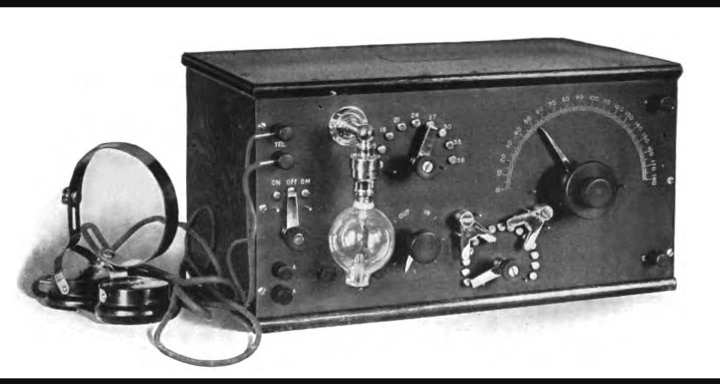
An electronic component is any physical entity in an electronic system used to affect the electrons or their associated fields in a manner consistent with the intended function of the electronic system. Components are generally intended to be connected together, usually by being soldered to a printed circuit board (PCB), to create an electronic circuit with a particular function (for example an amplifier, radio receiver, or oscillator). Components may be packaged singly, or in more complex groups as integrated circuits. Some common electronic components are capacitors, inductors, resistors, diodes, transistors, etc. Components are often categorized as active (e.g. transistors and thyristors) or passive (e.g. resistors, diodes, inductors and capacitors).
History of electronic components :
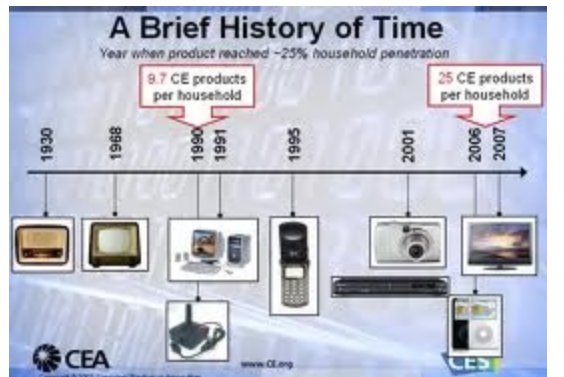
Vacuum tubes (Thermionic valves) were among the earliest electronic components. They were almost solely responsible for the electronics revolution of the first half of the twentieth century. They allowed for vastly more complicated systems and gave us radio, television, phonographs, radar, long-distance telephony and much more. They played a leading role in the field of microwave and high power transmission as well as television receivers until the middle of the 1980s. Since that time, solid-state devices have all but completely taken over. Vacuum tubes are still used in some specialist applications such as high power RF amplifiers, cathode ray tubes, specialist audio equipment, guitar amplifiers and some microwave devices.
The first working point-contact transistor was invented by John Bardeen and Walter Houser Brattain at Bell Labs in 1947. In April 1955, the IBM 608 was the first IBM product to use transistor circuits without any vacuum tubes and is believed to be the first all-transistorized calculator to be manufactured for the commercial market. The 608 contained more than 3,000 germanium transistors. Thomas J. Watson Jr. ordered all future IBM products to use transistors in their design. From that time on transistors were almost exclusively used for computer logic and peripherals. However, early junction transistors were relatively bulky devices that were difficult to manufacture on a mass-production basis, which limited them to a number of specialised applications.
Types of circuits:
Circuits and components can be divided into two groups: analog and digital. A particular device may consist of circuitry that has one or the other or a mix of the two types. An important electronic technique in both analog and digital electronics involves the use of feedback. Among many other things this allows very linear amplifiers to be made with high gain, and digital circuits such as registers, computers and oscillators.
Analog circuits:
Most analog electronic appliances, such as radio receivers, are constructed from combinations of a few types of basic circuits. Analog circuits use a continuous range of voltage or current as opposed to discrete levels as in digital circuits.

The number of different analog circuits so far devised is huge, especially because a ‘circuit’ can be defined as anything from a single component, to systems containing thousands of components.
Analog circuits are sometimes called linear circuits although many non-linear effects are used in analog circuits such as mixers, modulators, etc. Good examples of analog circuits include vacuum tube and transistor amplifiers, operational amplifiers and oscillators.
Digital circuits:
Digital circuits are electric circuits based on a number of discrete voltage levels. Digital circuits are the most common physical representation of Boolean algebra, and are the basis of all digital computers. To most engineers, the terms “digital circuit”, “digital system” and “logic” are interchangeable in the context of digital circuits. Most digital circuits use a binary system with two voltage levels labeled “0” and “1“. Often logic “0” will be a lower voltage and referred to as “Low” while logic “1” is referred to as “High“. However, some systems use the reverse definition (“0” is “High”) or are current based. Quite often the logic designer may reverse these definitions from one circuit to the next as he sees fit to facilitate his design. The definition of the levels as “0” or “1” is arbitrary.
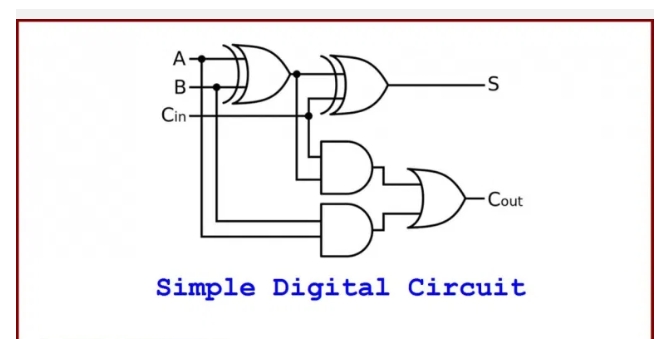
Electronics theory :
Mathematical methods are integral to the study of electronics. To become proficient in electronics it is also necessary to become proficient in the mathematics of circuit analysis.
Circuit analysis is the study of methods of solving generally linear systems for unknown variables such as the voltage at a certain node or the current through a certain branch of a network. A common analytical tool for this is the SPICE circuit simulator.
Also important to electronics is the study and understanding of electromagnetic field theory.
Electronics lab:
Due to the complex nature of electronics theory, laboratory experimentation is an important part of the development of electronic devices. These experiments are used to test or verify the engineer’s design and detect errors. Historically, electronics labs have consisted of electronics devices and equipment located in a physical space, although in more recent years the trend has been towards electronics lab simulation software, such as CircuitLogix, Multisim, and PSpice.
Electronic systems design:

Electronic systems design deals with the multi-disciplinary design issues of complex electronic devices and systems, such as mobile phones and computers. The subject covers a broad spectrum, from the design and development of an electronic system (new product development) to assuring its proper function, service life and disposal. Electronic systems design is therefore the process of defining and developing complex electronic devices to satisfy specified requirements of the user.
Electronics industry :

The electronics industry consists of various sectors. The central driving force behind the entire electronics industry is the semiconductor industry sector, which has annual sales of over $481 billion as of 2018. The largest industry sector is e-commerce, which generated over $29 trillion in 2017. The most widely manufactured electronic device is the metal-oxide-semiconductor field-effect transistor (MOSFET), with an estimated 13 sextillion MOSFETs having been manufactured between 1960 and 2018. In the 1960s, U.S. manufacturers were unable to compete with Japanese companies such as Sony and Hitachi who could produce high-quality goods at lower prices. By the 1980s, however, U.S. manufacturers became the world leaders in semiconductor development and assembly.
The end….
Social media are interactive technologies that facilitate the creation and sharing of information, ideas, interests, and other forms of expression through virtual communities and networks. While challenges to the definition of social media arise due to the variety of stand-alone and built-in social media services currently available, there are some common features:
* Social media are interactive Web 2.0 Internet-based applications.
* User-generated content such as text posts or comments, digital photos or videos, and data generated through all online interactions is the lifeblood of social media.
* Users create service-specific profiles for the website or app that are designed and maintained by the social media organization.
* Social media helps the development of online social networks by connecting a user’s profile with those of other individuals or groups

Users usually access social media services through web-based apps on desktops or download services that offer social media functionality to their mobile devices (e.g., smartphones and tablets). As users engage with these electronic services, they create highly interactive platforms which individuals, communities, and organizations can share, co-create, discuss, participate, and modify user-generated or self-curated content posted online. Additionally, social media are used to document memories; learn about and explore things; advertise oneself; and form friendships along with the growth of ideas from the creation of blogs, podcasts, videos, and gaming sites.This changing relationship between humans and technology is the focus of the emerging field of technological self-studies.Some of the most popular social media websites, with more than 100 million registered users, include Facebook (and its associated Facebook Messenger), TikTok, WeChat, Instagram, QZone, Weibo, Twitter, Tumblr, Baidu Tieba, and LinkedIn. Depending on interpretation, other popular platforms that are sometimes referred to as social media services include YouTube, QQ, Quora, Telegram, WhatsApp, Signal, LINE, Snapchat, Pinterest, Viber, Reddit, Discord, VK, Microsoft Teams, and more. Wikis are examples of collaborative content creation.
Many social media outlets differ from traditional media (e.g., print magazines and newspapers, TV, and radio broadcasting) in many ways, including quality,reach, frequency, usability, relevancy, and permanence. Additionally, social media outlets operate in a dialogic transmission system, i.e., many sources to many receivers, while traditional media outlets operate under a monologic transmission model (i.e., one source to many receivers). For instance, a newspaper is delivered to many subscribers and a radio station broadcasts the same programs to an entire city.
Since the dramatic expansion of the Internet, digital media or digital rhetoric can be used to represent or identify a culture. Studying how the rhetoric that exists in the digital environment has become a crucial new process for many scholars.
Observers have noted a wide range of positive and negative impacts when it comes to the use of social media. Social media can help to improve an individual’s sense of connectedness with real or online communities and can be an effective communication (or marketing) tool for corporations, entrepreneurs, non-profit organizations, advocacy groups, political parties, and governments. Observers have also seen that there has been a rise in social movements using social media as a tool for communicating and organizing in times of political unrest.
History of social media :
Early computing:

The PLATO system was launched in 1960, after being developed at the University of Illinois and subsequently commercially marketed by Control Data Corporation. It offered early forms of social media features with 1973-era innovations such as Notes, PLATO’s message-forum application; TERM-talk, its instant-messaging feature; Talkomatic, perhaps the first online chat room; News Report, a crowdsourced online newspaper, and blog; and Access Lists, enabling the owner of a note file or other application to limit access to a certain set of users, for example, only friends, classmates, or co-workers.
ARPANET, which first came online in 1967, had by the late-1970s developed a rich cultural exchange of non-government/business ideas and communication, as evidenced by the network etiquette (or ‘netiquette’) described in a 1982 handbook on computing at MIT’s Artificial Intelligence Laboratory.ARPANET evolved into the Internet following the publication of the first Transmission Control Protocol (TCP) specification, RFC 675 (Specification of Internet Transmission Control Program), written by Vint Cerf, Yogen Dalal and Carl Sunshine in 1974. This became the foundation of Usenet, conceived by Tom Truscott and Jim Ellis in 1979 at the University of North Carolina at Chapel Hill and Duke University, and established in 1980.
A precursor of the electronic bulletin board system (BBS), known as Community Memory, appeared by 1973. True electronic BBSs arrived with the Computer Bulletin Board System in Chicago, which first came online on February 16, 1978. Before long, most major cities had more than one BBS running on TRS-80, Apple II, Atari, IBM PC, Commodore 64, Sinclair, and similar personal computers. The IBM PC was introduced in 1981, and subsequent models of both Mac computers and PCs were used throughout the 1980s. Multiple modems, followed by specialized telecommunication hardware, allowed many users to be online simultaneously. Compuserve, Prodigy and AOL were three of the largest BBS companies and were the first to migrate to the Internet in the 1990s. Between the mid-1980s and the mid-1990s, BBSes numbered in the tens of thousands in North America alone. Message forums (a specific structure of social media) arose with the BBS phenomenon throughout the 1980s and early 1990s. When the World Wide Web (WWW, or ‘the web’) was added to the Internet in the mid-1990s, message forums migrated to the web, becoming Internet forums, primarily due to cheaper per-person access as well as the ability to handle far more people simultaneously than telco modem banks.
Digital imaging and semiconductor image sensor technology facilitated the development and rise of social media. Advances in metal-oxide-semiconductor (MOS) semiconductor device fabrication, reaching smaller micron and then sub-micron levels during the 1980s–1990s, led to the development of the NMOS (n-type MOS) active-pixel sensor (APS) at Olympus in 1985, and then the complementary MOS (CMOS) active-pixel sensor (CMOS sensor) at NASA’s Jet Propulsion Laboratory (JPL) in 1993.CMOS sensors enabled the mass proliferation of digital cameras and camera phones, which bolstered the rise of social media.
Social impacts
Disparity
The digital divide is a measure of disparity in the level of access to technology between households, socioeconomic levels or other demographic categories.People who are homeless, living in poverty, elderly people and those living in rural or remote communities may have little or no access to computers and the Internet; in contrast, middle class and upper-class people in urban areas have very high rates of computer and Internet access. Other models argue that within a modern information society, some individuals produce Internet content while others only consume it, which could be a result of disparities in the education system where only some teachers integrate technology into the classroom and teach critical thinking. While social media has differences among age groups, a 2010 study in the United States found no racial divide. Some zero-rating programs offer subsidized data access to certain websites on low-cost plans. Critics say that this is an anti-competitive program that undermines net neutrality and creates a “walled garden”for platforms like Facebook Zero. A 2015 study found that 65% of Nigerians, 61% of Indonesians, and 58% of Indians agree with the statement that “Facebook is the Internet” compared with only 5% in the US.
Political polarization:
According to the Pew Research Center, a majority of Americans at least occasionally receive news from social media. Because of algorithms on social media which filter and display news content which are likely to match their users’ political preferences, a potential impact of receiving news from social media includes an increase in political polarization due to selective exposure. Political polarization refers to when an individual’s stance on a topic is more likely to be strictly defined by their identification with a specific political party or ideology than on other factors. Selective exposure occurs when an individual favors information that supports their beliefs and avoids information that conflicts with their beliefs. A study by Hayat and Samuel-Azran conducted during the 2016 U.S. presidential election observed an “echo chamber” effect of selective exposure among 27,811 Twitter users following the content of cable news shows.The Twitter users observed in the study were found to have little interaction with users and content whose beliefs were different from their own, possibly heightening polarization effects. Another study using U.S. elections, conducted by Evans and Clark, revealed gender differences in the political use of Twitter between candidates.Whilst politics is a male dominated arena, on social media the situation appears to be the opposite, with women discussing policy issues at a higher rate than their male counter-parts. The study concluded that an increase in female candidates directly correlates to an increase in the amount of attention paid to policy issues, potentially heightening political polarization.
Stereotyping :
Recent research has demonstrated that social media, and media in general, have the power to increase the scope of stereotypes not only in children but people of all ages.Three researchers at Blanquerna University, Spain, examined how adolescents interact with social media and specifically Facebook. They suggest that interactions on the website encourage representing oneself in the traditional gender constructs, which helps maintain gender stereotypes. The authors noted that girls generally show more emotion in their posts and more frequently change their profile pictures, which according to some psychologists can lead to self-objectification. On the other hand, the researchers found that boys prefer to portray themselves as strong, independent, and powerful. For example, men often post pictures of objects and not themselves, and rarely change their profile pictures; using the pages more for entertainment and pragmatic reasons. In contrast, girls generally post more images that include themselves, friends and things they have emotional ties to, which the researchers attributed that to the higher emotional intelligence of girls at a younger age. The authors sampled over 632 girls and boys from the ages of 12–16 from Spain in an effort to confirm their beliefs. The researchers concluded that masculinity is more commonly associated with positive psychological well-being, while femininity displays less psychological well-being. Furthermore, the researchers discovered that people tend not to completely conform to either stereotype, and encompass desirable parts of both. Users of Facebook generally use their profiles to reflect that they are a “normal” person. Social media was found to uphold gender stereotypes both feminine and masculine. The researchers also noted that traditional stereotypes are often upheld by boys more so than girls. The authors described how neither stereotype was entirely positive, but most people viewed masculine values as more positive.
Effects on youth communication:
Social media has allowed for mass cultural exchange and intercultural communication. As different cultures have different value systems, cultural themes, grammar, and world views, they also communicate differently.The emergence of social media platforms fused together different cultures and their communication methods, blending together various cultural thinking patterns and expression styles
Social media has affected the way youth communicate, by introducing new forms of language. Abbreviations have been introduced to cut down on the time it takes to respond online. The commonly known “LOL” has become globally recognized as the abbreviation for “laugh out loud” thanks to social media.
Social media has offered a new platform for peer pressure with both positive and negative communication. From Facebook comments to likes on Instagram, how the youth communicate, and what is socially acceptable is now heavily based on social media.Social media does make kids and young adults more susceptible to peer pressure. The American Academy of Pediatrics has also shown that bullying, the making of non-inclusive friend groups, and sexual experimentation have increased situations related to cyberbullying, issues with privacy, and the act of sending sexual images or messages to someone’s mobile device. On the other hand, social media also benefits the youth and how they communicate. Adolescents can learn basic social and technical skills that are essential in society. Through the use of social media, kids and young adults are able to strengthen relationships by keeping in touch with friends and family, make more friends, and participate in community engagement activities and services.
Deceased users:
Social media content, like most content on the web, will continue to persist unless the user deletes it. This brings up the inevitable question of what to do once a social media user dies, and no longer has access to their content.As it is a topic that is often left undiscussed, it is important to note that each social media platform, e.g., Twitter, Facebook, Instagram, LinkedIn, and Pinterest, has created its own guidelines for users who have died.In most cases on social media, the platforms require a next-of-kin to prove that the user is deceased, and then give them the option of closing the account or maintaining it in a ‘legacy’ status. Ultimately, social media users should make decisions about what happens to their social media accounts before they pass, and make sure their instructions are passed on to their next-of-kin
The end….







 Track2Training
You must be logged in to post a comment.