10 Days ICSSR Sponsored Research Methodology Course

Daily writing prompt
What was the last live performance you saw?

📢 Exciting Opportunity for Scholars and Researchers!
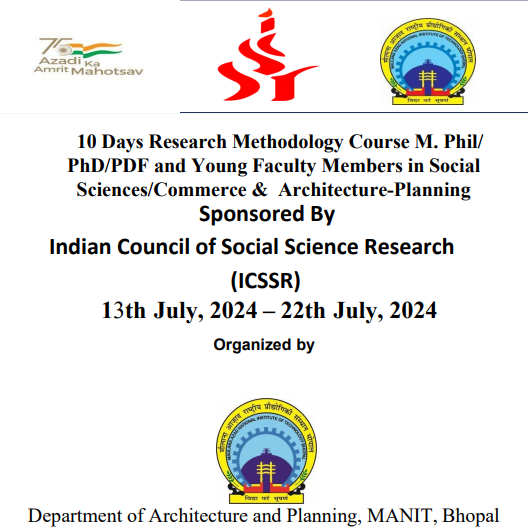

We are thrilled to announce the ICSSR Sponsored 10 Days Research Methodology Workshop, scheduled for 13-22 July 2024. This comprehensive workshop is designed to enhance your skills in research methodology, academic writing, and publication.
* No Registration Fee
* 10 Days free Accommodation and Food during the course
* Free Study materials
* Compulsory to bring your own laptop
* Limited Seats Available

🔗 Register Now:
Registration Form https://lnkd.in/duA4szjt
Key Highlights:
Engage with expert researchers and academics.
Hands-on sessions on qualitative, quantitative, and mixed research methods.
Insights into effective writing and publication strategies.
Don’t miss this chance to advance your research capabilities and network with peers from various disciplines.
📄 For more details, download our brochure:
Workshop Brochure https://lnkd.in/dymRVYPb
📍 Location:
Maulana Azad National Institute of Technology (MANIT), Bhopal
📅 Dates:
13-22 July 2024
Spread the word and bring your research journey to the next level! Let’s make a significant impact together. Looking forward to seeing you there!
hashtag#ResearchMethodology hashtag#AcademicWriting hashtag#ScholarlyPublication hashtag#ICSSR hashtag#Workshop hashtag#Education hashtag#Networking hashtag#MANITBhopal For more details, visit us at https://lnkd.in/gmiRQPiX

Guidelines for Writing Articles on Track2Training Portal

By Track2Traing Editorial Team

Photo by Lisa Fotios on Pexels.com

Introduction: Writing articles for the Track2Training portal is an excellent opportunity to share your knowledge and expertise with a broader audience. To ensure a smooth and efficient publication process, please follow these guidelines.

1. Length and Format: Articles should be comprehensive, with a minimum length of 500 words. Ensure that your article is well-organized, using headings and sub-headings for clarity and improved readability.

2. Author Information: Include your full name in bold italics just below the article title. Additionally, provide your affiliation to give readers context about your background.

3. Submission and Review Process: Submission of quality articles will be followed by a review process. If the reviewer approves the article, it will be published within 7 days of submission.

4. Originality and Plagiarism: All submissions must be original work. Avoid plagiarism by properly citing sources. Use your own words to convey information and cite any external content appropriately.

5. Theme or Topic: Stick to one theme or topic per article. This ensures clarity and allows readers to focus on a specific subject. Each author is allowed a maximum of four articles per month.

6. Use of Images: Enhance the attractiveness of your article by including royalty-free images. Images should be relevant to the content and sourced appropriately.

7. References: Include at least five references at the end of your article. Use APA or MLA format for citations. This adds credibility to your work and allows readers to explore further.

Sample References (APA Format):

  1. Last Name, F. M. (Year). Title of the Article. Title of the Journal, Volume(Issue), Page Range. DOI or URL
  2. Last Name, F. M., & Last Name, F. M. (Year). Book Title. Publisher.
  3. Last Name, F. M., Author, A. A., & Author, B. B. (Year). Title of the Chapter. In Book Title (pp. Pages). Publisher.
  4. Author, A. A. (Year). Title of the Report. Publisher. URL
  5. Last Name, F. M. (Year). Title of the Conference Paper. In Proceedings of the Conference Name (pp. Pages). DOI or URL

Conclusion: Writing for Track2Training is an opportunity to contribute valuable insights to the community. By adhering to these guidelines, you can ensure a smooth submission and publication process, ultimately sharing your expertise with a wider audience. We look forward to your contributions!

Send your write-up to contact@track2training.com

Taoism- finding your own “way”

Taoism is an ancient Chinese philosophy. This philosophy was supposedly written by Lao Tzu during 500 B.C.E. We don’t know if Lao Tzu existed. We have no living proof of his presence. Taoism is a philosophy that is based on non-doing. Not getting in your way. Respecting the natural flow of this universe. For example, if the force of the river is on the right side then you’d be a fool to swim towards the left side. Taoism is about going with the force of life or with the TAO. Tao is not a god but it’s us all, every living being is a part of the tao.

One of the key things about Taoism is yin & yang. It talks about the balancing force of this universe. Action and non-action, dark and light, hot and cold. Every example has meaning because their opposites exist. There is no action without non-action or no light without dark. This teaches us to accept all things for what they are. Taoism finds power in the natural truths of life. It promotes harmony. When we accept the natural form of this universe, we become one and attain harmony. The tao can’t be explained or held. It can only be felt by letting go.

“Look, but you can’t see it.

Listen, but you can’t hear it.

Reach out, but you can’t touch it.

Invisible,inaudible,intangible.

Elusive.

The one, the tao”.

• Lao Tzu.

What does getting in your way mean? We often second guess our instincts and in some situations that is necessary. Taoism is all about making things simpler rather than complex. Living in the now, acknowledging everything but still detached from it. Creating your own “way”. Inculcating meditation in your life is one way to do it. I can’t stress how much meditation helps in finding yourself. Taoist meditation is a little different from the normal one. It’s more about communicating with your own body.

Like stoicism, Taoism believes in a modest approach to life. If I were to give a personal example, my mind automatically dived toward the future and I wouldn’t even know that it did. It was an automatic reaction that kept happening. But since I’ve come across Taoism, this situation has gotten much better. It has made me more accepting of my habits and given me a “way” to deal with them. You can’t change everything about who you are, you can accept it and get better at dealing with it. Taoism helped me do that. The teachings of Lao Tzu make you go into a state of Nirvana. That state can’t be explained because it is something beyond words. The tao cannot be held or explained. It can only be felt.

What is Tao? It is just this. It cannot be rendered into speech. If you insist on an explanation, This means exactly this.

• Yuan mei

PORTRAYAL OF FADING PASSION IN THE POEM “ONE FLESH”

“One Flesh” written by Elizabeth Jennings is a poem which shows the narrator’s reaction towards the passionless marriage of her parents. She explores their never in a melancholic tone. The title can be related to Bible in the Book of Genesis, in the creation of Adam and Eve. There the two individuals were ‘one flesh’ and could not be divided. This concept also extends to marriage where two individuals become one entity. Here the parents of the narrator were also ‘one flesh’ as mentioned in the title. They are the remnants of a former passion. Speaker says that she has rarely seen her parents touch or when they did that was fake or an act of necessity. Their relationship does not seem genuine. Poet describes the relation as ‘flotsam’ which shows their relationship growing colder. Poet also says that “whose fire from which I came, has now grown cold?”. The poet views her parents behaviour as chaste, or they are preparing themselves for the lives of chastity. During those times chastity was of utmost importance. So the narrator ends the poem by saying that all people, including her parents’ final destination is chastity.

Even though at an age they engage in passionate relationship they ultimately return to abstinence. Poet also questions whether the parents know they are old. The parents lie close but, they are not speaking to one another. They are mentally apart, their minds drifts to different places. The poet says that they are wasting precious moments they are together. For the speaker time seems to be a feather, which is withering away. Even though poet is able to find the feather parents are not realising that time is not left.

” In Response to Executive Order 9066″ : Analysis

Dwight Okita’s poem “In Response to Executive Order 9066” addresses issues such as identity, and discrimination as a result of cultural hybridity. The narrator of the poem is a fourteen year old Japanese girl who writes a letter to the government in response to Executive Order 9066. As the title of the poem implies the historical context of the poem is the time when president Franklin D Roosevelt signed the Executive Order 9066. After two months of the Japanese attack on the Pearl Harbour Roosevelt signed the order, which orders the removal of over 12000 people of Japanese descent from the West Coast. This resulted in their loss of home, job and all other possessions including human rights.

Okita uses the form letter to represent the innocence as well as the horrors in the mind of the young people who were forced to leave to the camps. The narrator presents the the people in her life, from father to best friend in the letter. The relevance of racial identity among children is presented by the best friend. Through the first person narrative, poet presents the contrast between two cultures, one she came from and the other she grew up.

tje narrator is a normal, naive American girl even though she is of Japanese origin. She says to the government that it is obvious that I will be coming to the camp and I have packed. Her innocence is visible when she mentions about the tomato seeds. Her father warns her that they don’t grow there. The cultural dilemma faced by the girl can be find when she mentions about her inability to use chopsticks and her love for hotdogs.

The following lines after this shows the horrors of migration, war and racial identity among children. Denise and the narrator were best friends. But after being aware that narrator is of Japanese origin her friend has started to discriminate her. She said “you are going to start a war”. Denise also told her to keep their mouth shut, and not to give secrets to the enemies. Thus these lines suggest that even innocent people were considered as enemies or “other” as a result of war. Even being a young naive girl, the narrator is discriminated.But she looks upon this discrimination with hope and love and gives Denise tomato seeds and tells her that “she would miss her”.

Through this poem Okita presents themes like discrimination, innocence and ignorance. Both the characters are ignorant. The narrator is ignorant about her being discriminated, and it’s reason, about her future in the camps. The friend is ignorant about war and considers and stereotypes every Japanese as enemies. This shows her ignorance. Innocence is the primary theme of the poem through which the narrator is unfolding her feelings and hope. Poet shows how war and relocation affect the common people and children who are not even part of that.

An Analysis of Philip Larkin’s poem “Church Going”

Philip Larkin is a British poet of twentieth century. His poem “Church Going” deals with the issues regarding the declining religious beliefs and spirituality of the twentieth century. The title of the poem carries multiple connotations. In a primary analysis the title may refer to going to the church for participating in the sermons or for praying. Another meaning is just visiting the church for the sake of visiting. And in a deeper analysis it can be said that the title may refer to going away from the church which means an escape from religion and spirituality.

The poem is filled with various rhetorical questions through which poet brings a sense of sarcasm. Poet is at the church in the beginning. As he enters he thuds close the door. But he refuses to enter first, because he doesn’t want to disturb the practices. Then there are several instances in the poem which reflects the lack of faith in the poetic persona’s mind.

He has seen many pillars, bible, altar and he doesn’t feel any respect towards them. He reads from the Bible in a sarcastic way and exits. He feels a kind of uncle or irreverence towards the church and religion. The poetic persona wonders that what will happen to the church if the people completely stop the visit. He says that some will be tourist attractions with their documents and ceremonial plate wares. Others will decay and take over by sheeps and cows. Or some women with superstitious beliefs would visit.

The narrator also wonders who will be the last person to visit the church as a church. One may be a history buff, or an antique lover. Someone who loves the Christmas will also be a visiter. But the last person may be a poet like the narrator, bored and ignorant about religion. Even though the poetic persona is ignorant and having irreverence, says that the church held everything together from the shattered form. It is the place of marriage, birth and death and gives meaning to all human action. The church, which is a serious and meaningful place in a meaningful ground combine all human instinct and humans seek wisdom from here. Through the poem Philip Larkin presents a contrast between shattering beliefs and the spirituality of the twentieth century and the role of church and religion in giving meanings to human life.

NEGATIVE CAPABILITY IN “ODE TO A NIGHTINGALE”

John Keats introduced the term Negative Capability in a letter written in December 1817. In his own terms that is, “when a man is capable of being in uncertainties, mysteries, doubts without lany irritable reaching after fact and reasons”. According to M H Abrahams this can be taken to characterize an impersonal or objective author who maintains aesthetic distance as opposed to a subjective author who personally involved with the characters and actions represented in a work
of literature, and as opposed to an author who uses a literary work to present and to make persuasive his or her personal beliefs. John Keats himself characterized this quality of writing between Shakespeare and Coleridge. In simple terms negative capability is against the pursuit of logic and reason in favor of a sense of beauty and wonder.
In Keats’ poem Ode to a Nightingale an example of negative capability is visible. The poem deals with the poet’s musings on morality in a pessimistic manner. In the beginning the poet is being mesmerized by the nightingale’s song and he is in a state of intoxication. Later poet intends to join the bird by forgetting all the worldly difficulties by having high quality vine. But then the poet rejects this idea and by his “viewless wings of poesy” he can leave the sense. He believes his imagination will help him to forget all the pains of life. And he is already with the bird with his imagination. Towards the end poet believes that this is the most appropriate time to die because he can leave the world by listening to the immortal song of nightingale. When Keats concludes the poem he is in a state of confusion and says “was it a vision or dream?” He is in a state of internal conflict and never reaching for facts or reasons. In this instance we can find
element of negative capability in Ode to a Nightingale.

WHAT IS POETRY?

   No definition of poetry can be comprehensive. Poetry is that kind of literature in which imagination, emotion, and fancy predominate. It may be generally in verse form. Metre, rhythm, rhyme, and measure are the attributes of poetry though all of them need not be present in every poem. Dr.Jonson calls poetry a ‘metrical composition’ and points out four elements of poetry- pleasure, truth, imagination, and reason. It is defined by another critic as the art of employing words to produce an illusion on the imagination. For Carlyle poetry was ‘musical thought’ and Shelley defined it as ‘The expression of imagination’.   Coleridge thought poetry was the antithesis of science and Wordsworth defined it as ‘the breath and finer spirit of all knowledge’. According to Arnold poetry is ‘simply the most delightful and perfect form of utterance that human words can reach’. Edgar Allen Poe calls it ‘the rhythmic creation of beauty. T.S. Eliot calls poetry ‘the vehicle of feeling’ and insists that ‘poetry has to give pleasure’. All these definitions refer to the main elements of poetry- imagination, emotion, feeling, truth. Only when these qualities are embodied in a proper form of expression is poetry. The form is regularly rhythmic language or meter, so versification is a part of poetry.

   Another aspect of poetry is that it is an interpretation of life. By the exercise of imagination, transfigures the existing reality and gives to airy nothings a local habitation and a name. Critics like Coleridge and Leigh Hunt thought that meter is not an essential element in poetry. Even prose can be a good medium if poetry can be conveyed through it. However, rhythm has significance in poetry because it gives musical and aesthetic pleasure which are among the chief functions of poetry. Science provides us with a complete rationale of things in the universe, but it is poetry that can suggest to us its beauty and mystery. This poetry is at once antithesis and complement of science. Arnold held that poetry has the power to awaken in us a wonderfully intense and complete sense of things in the universe that science cannot do. Another element is the revealing power of poetry. It opens our eyes to the beauties and spiritual meanings of the universe and nature to which, otherwise, we remain blind. It educates us to look at life for ourselves with more insight. Thus poetry is an interpretation of life through imagination and feeling.

SUBJECTIVE POETRY:

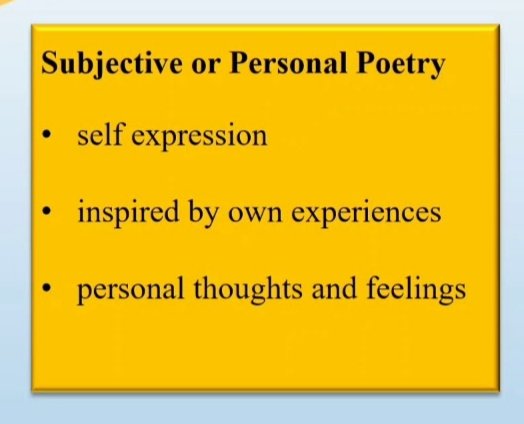
Subjective poetry or Personal poetry is the poetry of self- delineation and self-expression. In this kind of poetry, we find most, the poet’s feelings and thoughts given expression in a lyrical manner. The poet is moved by his own experience as Wordsworth in ‘The Solitary Reaper’. The essence of the subjective poetry is the personality of the poet.

OBJECTIVE POETRY:

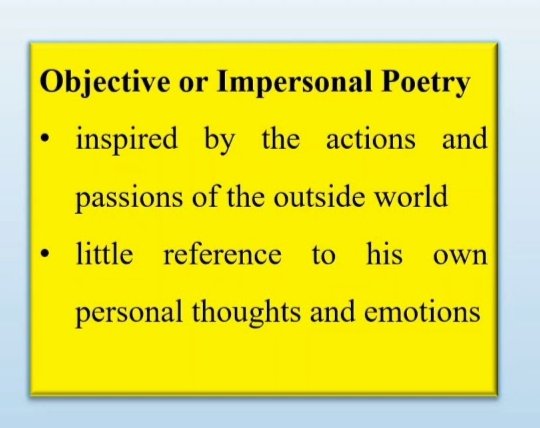
Objective poetry is poetry that expresses the world outside the poet. In this kind of poetry, the poet goes out of himself, mingles with the action and passion of the world, and expresses what he observed there. This is an older type of poetry than subjective poetry. Subjectivism came only later. The communal ballad, the epic, and the drama were the earliest form of objective poetry. In this poetry, the experiences of the eye and the ear are given more importance than those of the mind and the soul.

Published by Ayisha Shabana….

The Princess who Chased the Butterflies

A princess in a castle,

A castle, as beautiful as paradise,

But it’s beauty clutched by the shadows of the forest.

Darkness smiled inside the castle,

The princess fought bravely in the battle.

On one side were the ugly butterflies,

On the other were her two beautiful guardian angels.

The butterflies scanned the princess’ body from top to bottom,

The angels, whom she loved the most,

Lectured her the lessons from the book- “How to be a Princess?”

The angels breathed in the young princess’ heart,

So she took the notes of the lecture with her beautiful pen,

Whose red ink was supplied from her own veins.

She was shrinking and all her blood became letters on the paper,

But her love blindfolded her eyes and she still took the notes.

As she filled two notebooks with the important quotes,

She realized that she could not write ’cause the twilight no more touched the castle,

But the darkness now failed to conceal the evil

Inside the butterflies fluttering around the mansion.

The princess opened her eyes,

And with her sword, she tore the butterflies into two halves.

She was proud of herself and returned to her lessons,

But she saw the butterflies of the same colour and size inside her guardian angels’ soul.

She didn’t knew how to kill the evil inside her beloved angels,

But she tried and managed to flew them away from the castle.

Now the path of the sunlight was clear and the shadows disappeared,

But the two butterflies, were still alive and watching the princess from far away.

The princess was happy because her lovely angels tore the book of lessons into two halves,

And started a new chapter, whose notes she took with love and smiles and laughter.

Even the trees in the forest were proud of the little princess,

And cherished her victory by holding the waters from the heavens in the petals.

The princess of the beautiful castle,

Indeed fought bravely in the battle!

BYZANTIUM : A SYMBOLIC ANALYSIS

Among the 20th century poets, Yeats is considered as the craftsman in the use of symbols and images. His poems are filled with complex system of symbols. The poem Byzantium is also rich with various symbols and images. The poem consists of five stanzas and each stanza carries a key image and symbols. Through this key image Yeats portrays the theme of the poem. The title of the poem itself do not stand for the real Byzantine Empire. It is the country or Empire of the mind which is a transcendental place out of the constraints of Time and Space. Here the empire stands for Purgation and Paradise. The poem focuses on the eternity of art and is contrasted with the sensual elements of the physical world. Through the use of complex symbols Yeats successfully presented this idea.

The poem begins with the unpurged images of the natural world. The starlit and moonlit dome of the cathedral looks down with disdain on the complexities of man.The dome is the powerful symbol used by the poetic personae. The dome is symbolic of the perfection and eternity which is opposed to the natural world of passion. The dome can also be considered as the symbol for the permanence of art. As Keats used the ‘grecian urn’ as a symbol for the eternity of art, the dome stands for the same and it scorns the complexities of man.

On another level this dome has another symbolic significance. This can also be relate to the creation of poem or art. According to Richard Ellmann Byzantium is a description of th act of making a poem. While analyzing on the basis of this, the poet is the Emperor and Byzantium is the ideal place for the poet, where all the unpurged realities disappear. The church gong is the premonition of death. As the gong sounds the realities disappear and the poet begins writing the poem. And the dome is the tower of the poetfrom where he is looking as a spectator to the world. The conflict between the real and the ideal is powerfully portrayed through the symbol of dome.

The next key symbol of the poem is the superhuman figure. This is the soul of the dead and is unwinding the memories of earthly existence. Actually the dead is the living. After death the soul liberates from the constraints of body and is living forever. So the dead is the actual living and living is really the death. The superhuman figure signifies imagination. As said before the poem can also be analyzed on the basis of creation and process of making a poem. The superhuman figure is the poet’s imagination. This purified soul will teach the poet wisdom and take him to heaven, Byzantium. In the process of creation of the poem poet attains perfect bliss. This imagination gives coherence to things and resolve all differences. What the poet saying is that the artist has to exploit the tension between the physical and spiritual worlds.

Among all the symbols used in the poem, golden bird is the most important one. Like the dome, the golden bird sitting in the golden bough also symbolizes perfection in the creative process. Through this symbol poet celebrates artificiality and changelessness of art. The golden bird is opposed to the living things and it scorns the common birds. So the perfected art looks down the nature which is subjected to time and emotions.

The flames represents spiritual realization. They are purgatorial fire. On the emperor’s pavement, fire fed by no fuel is burning and the souls of the dead purify themselves by dancing. They are ideal flames. Apart from spiritual realization the flames and purgatorial dance als represents the process of making poem. As Richard Ellmann says this poem is about the creation of art and each stanza depicts the image of imagination and art. So here the emperor’s pavement is the poet’s tower and the flames are the imagination of the poet. The blood begotten spirits are the raw material for the poem and dance is the process of creation. The raw materials gets purified and the imagination cannot be disturbed because it is independent. So here also the symbol stands for the creative genius. The golden smithies, dolphins and sea are the symbols presented in the final stanza. Dolphins are the images for resurrection and it guides to enlightenment. The poet describes the shore of ocean of life in the last lines. On the level of creation the dolphin and goldensmithies represents duality and craftsmanship of the poet respectively and it gives order to flesh and passion. Marble of the dancing floor is the imagination of the poet and it breaks the chaos.

Apart from these major symbols, Yeats presents certain images. The moon presented in the beginning stands for cycle of time and different phases in the man’s life. Mire is the cycle of birth and death. The “mummy cloth” which is unwinding clearly signifies what is inside beyond the question of life and death.Yeats used four elements of creation as symbols in the poem. The empire stands for earth, heaven for air, sea for water and flames for fire. Here Yeats attempted to bring together spiritualism, symbolism, aesthetics and mysticism. Thus he powerfully brought the themes of battle between immortality and creation, nature v/s art, human imperfection and perfected form of art and tension between life of senses and soulful life. Through the symbolic analysis of the poem it can be understood that Yeats is a craftsman in the use of symbols and images.

The Fear of the Unknown

You woke up and you decided to choose fear. A fear that overcame you every time you decided on doing something exceptional or exiting or different from the usual. That fear even scared your shadow in doing something uncanny and that fear was so strong that you didn’t even get the time to regret what you just did. That fear made you take stupid decisions like, rejecting the people who love you or not being able to perform even the simplest of tasks or just loosing contact with everything that was beautiful in the world including the human beings you wanted to be yours. And finally when you got hold of your surroundings, of your real self again it was too late.

It was too late to say sorry, to say that you were out of your senses because you were not, you were under the spell of your own fear and that made you go for a wrong life decision. You fought well for yourself, with yourself, but you never recognised that the need was to fight the devil called unknown fear. You lost in your game, in your own life and you thought that fear of uncertainty will leave you once you could make things better or normal again but you were wrong all along. For you were not to make things okay but you were to get rid of the fear but you failed. This failure in leaving the fear behind, got you to the failure in life and even when you tried you just lost the sparkle you once owned.

It must have been disheartening for you losing it to the fear of the unknown but did that fear actually broke your heart? Or did it just get you an ache that you could not forget? You tried getting busy in the worldly pleasures only to come home to an empty room or rather a room full of despair, disappointment and rejection. That room you wished for to be filled with fragrance of flowers of your honesty, fruits of your true nature but rather there was just fear that smelled delicious to you then. You attempted and looked outside of the window seeking any light, some light of hope or optimism to teach you how to live without fear but in that moment you rather accepted defeat for you didn’t see any beam of positivity.

When your world came to a standstill for the ills you had performed or all the actions you had been proud of you believed it to be the new normal. You accepted that you had lost at life and just then, you saw what you had been waiting to see. You saw the end of the tunnel, it was not close, not near enough to even have a clear view but you knew it was there. You felt it. You finally felt the pressure being dropped off your chest, you felt lighter, much lighter than you had ever been in your life, you felt free. You assumed it to be the new beginning, a fresh start without the baggage of the past, of the fear but you were proven wrong, again, by the witch of words. The words you had hoped would clear your sky for you, didn’t tidy up even the slightest of your discomfort but rather brought you back to the starting of the tunnel, for this time the fear was even stronger than before and you were losing it all again.

You believed you stood an opportunity to make things right, but it was a thorny path to follow. The path where you knew everything, where there was no uncertainty but rather you were well versed with every inch of it. There you saw your beam again and you thought you were just in time to grab it, that finally you would be free and liberated from all the struggles you faced, from the sense of regret that hit you once in a while, but just when you were about to catch it, its tail slipped your hand and you saw it going away from you, this time forever, for you were again in the same pothole, where even if you try hard you fell again and again for you knew it was the hole of the fear of the unknown and no matter how hard you tried you were not able to leave it all behind, leave it all in the past and that’s the reason why you still live without what you asked for but with the fear of the unknown.

SYMBOLIC ANALYSIS OF NISSIM EZEKIEL’S POEM “IN THE COUNTRY COTTAGE”

This works intends to analyse the elements of symbolism in Nissim Ezekiel’s poem ”In the country cottage”. Ezekiel is considered as a master in the use of symbols and images. Symbolism is the literary device that uses symbols, like words, locations and abstract ideas to represent something beyond literal meaning. Thus the use of symbolism add emotion, imagery, themes and sometimes it defines characters present in a literary work. Nissim Ezekiel is a poet who use highly evocative and suggestive symbols and images in his poetry. The images and symbols usually used by Ezekiel are women, natural elements like hill, river, sky, sun etc. These symbols give pictorial quality to his poems. Even though he uses simple language and less use of words, it makes the work impressive and sharpens the intended meaning.

In the poem In the Country Cottage the speaker talks about a particular night in a cottage when a lizard came out at night.All the other members of the house seemed lazy and decided to go to bed early as the saw the lizard. Then Nissim Ezekiel shows the image of the lizard through his description.The gray coloured stout lizard was laying without any movements. Poets says that the lizard seems to give a lesson of patience. As the poet says, “…he was more alive than us in silent energy..” the lizard was more alive than humans, in it’s silent energy. The lizard gave his full concentration in this act of waiting for the cockroaches. Its only intention was to kill the cockroaches and in silent energy it outed for them. The next morning the other family members woke and found that the lizard completed its job with utmost ‘cleanliness’ and left the place.

Even though the poem presents ordinary things and is shorter with lesser words, the symbol of lizard is significant. The lizard can be considered as the symbol of cleanliness, patience and dutifulness.Thus it shed light on the line of the achieves who both work hard and remains patient for achieving the goal. Thus it is a symbol of perseverance and will power. By the use of this symbol poet urges the people to save their energy for better purpose, instead of wasting time for futile activities. Thus Nissim Ezekiel places the ordinary lizard for superior to lazy humans. It can be said that he is a poet who make use of the ordinary situations and creatures and makes great poems from them. From the ordinariness of human life he emphasizes the philosophy of life. As said earlier, Ezekiel is considered as a master in the use of symbols and images. His major poems like Enterprise, Night of a Scorpion,The Professor, Philosophy and Marriage possess such symbolic and pictorial qualities. Examples from the poem Enterprise is the use of the symbol “pilgrimage”, which stands for life and “sun” stands for hostility between nature and human aspirations.

While analyzing these symbols in his poems it can be concluded that he is a great artist. The symbolism he used in his work had deep meaning which can encourage any reader to think further about the life from a fresh perspective. By the use of images or symbols of primitive simplicity, he shows the world that poetry does not have to deal with great philosophical truths to be impressive, and ordinary situations are more than enough.

Feminism in Margaret Atwood’s poem “This is a Photograph of Me”

Margaret Atwood is a well known feminist author who writes about the oppression of women in a patriarchal society. Her poem This is a Photograph of Me also shares this idea symbolically through the image of a photograph. The title of the poem itself shows the passive role of women in society. In a society which is regulated by men the role of women is passive. But without them the society will not survive. Atwood begins the poem by describing the photograph. It is a blurred photograph which was taken some time ago. And throughout the lines she continues the description of the photograph’s each element. There is the branch or part of a tree in the left hand side of the photograph, which has emerged to the right hand side. This branch without any roots can be considered as the role of women in a society who is placed on the left side or weaker side. But on the right hand side of the photograph a frame house is visible which is associated with men. The background of the photograph is a lake which represents the society. And beyond that lake there is low hills. The hills and lakes keep the women in shadow. Margaret Atwood is trying to show that the society and men exploits the true potential of women. The narrator says that I’m in the lake, in the center of the picture. But it is difficult to say precisely where she is. This shows the nature of a patriarchal society. The place of womanhood in a society is mandatory. However the world tries, the women’s place cannot be underwritten. Atwood focuses on this truth by saying that her place in the photograph is not clear. But when we look long enough everyone will be able to see her place in the photograph or the society itself. Through the image of a photograph Atwood strongly presents the oppression faced by women. Photograph stands for history which is not clear. The contribution of women to the society is necessary but the history created by men does not praise of give importance to them. Women are always hidden or drowned as Atwood says. This truth is underlined by Atwood in this feministic poem, This is a Photograph of Me.

The Omnipotence of Death

We glorify power, fame and strength when they don’t even stand a chance before the most powerful force, death. In life, there are ups and downs, the powerful and the powerless, rich and poor. But death ultimately levels all these differences and makes everything equal.

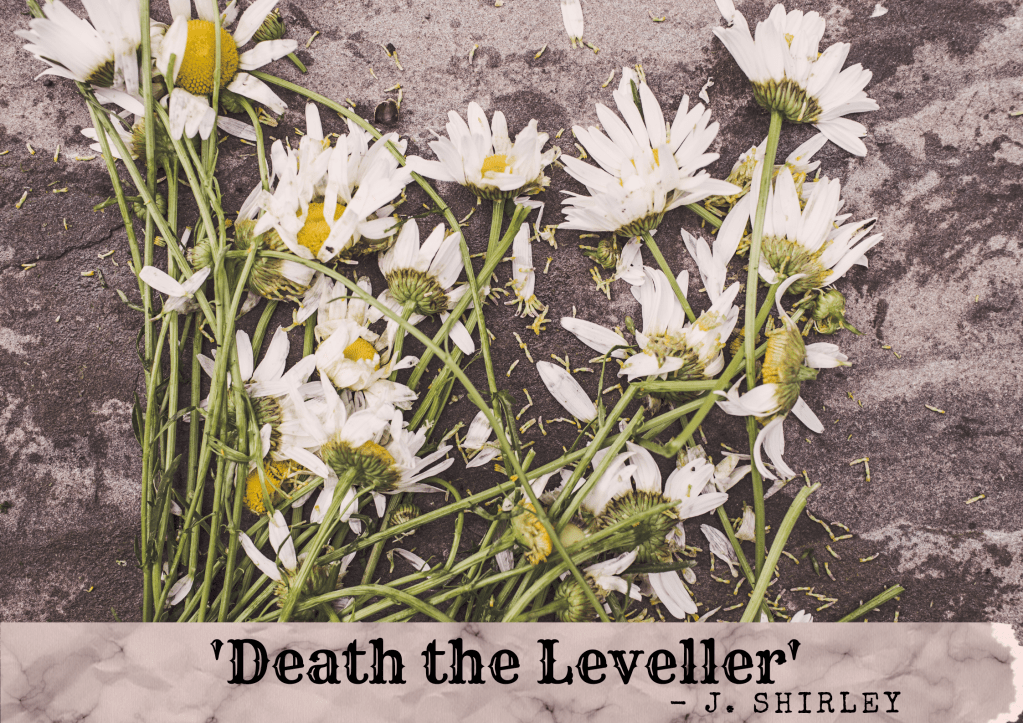
The poem ‘Death The Leveller’ by J. Shirley starts with stating that all the glories of humans are mere shadows which appear and disappear after some time. They do not make up an essential part of human life.  This is because there is nothing that can defend us from our fate. We can’t fight against it. When Death lays his cold hand on Kings, they can’t protect themselves and their sceptre and crown are ought to tumble down. The most powerful of all the kings is turned to dust and made equal with the poorest peasant on death. The sceptre and crown are as powerless as scythe and spade.

The glories of our blood and state

Are shadows, not substantial things;

There is no armour against Fate;

Death lays his icy hand on kings:

Sceptre and Crown

Must tumble down,

And in the dust be equal made

With the poor crooked scythe and spade.

The second stanza gives the picture of men in armour. Men fight battles and rejoice fame from killing their foes. Such battles boast bravery, chivalry, and courage. But even the strongest soldier must yield to death. No matter how brave he fights death, sooner or later, he must surrender to fate. He ceases breathing as death slowly creeps up to this captive of fate. Thus, even the strongest soldier is also rendered powerless by death.

Some men with swords may reap the field,

And plant fresh laurels where they kill:

But their strong nerves at last must yield;

They tame but one another still:

Early or late

They stoop to fate,

And must give up their murmuring breath

When they, pale captives, creep to death.

The flowers sing no more of the celebrated deeds once the garland withers. We witness everyone and everything coming to stillness in Death’s kingdom. The word ‘victor-victim’ refers to all the conquerors, emperors, and victors who are victims of Death. The victor-victims bleed and finally lie dead in their cold tomb. Though all turns to nothing, the only thing, which can bloom and spread fragrance, is the actions and good deeds of people who had led a just life. 

The garlands wither on your brow,

Then boast no more your mighty deeds!

Upon Death’s purple altar now

See where the victor-victim bleeds.

Your heads must come

To the cold tomb:

Only the actions of the just

Smell sweet and blossom in their dust.

The only thing which stands the test  of time is the deeds of selflessness and service to fellow beings. Thus, this poem has a moralising tone and shows the omnipotence of death.

Kindness Comes at a Cost

Naomi Shihab Nye’s poem ‘Kindness’ portrays the abstract feeling in a different light. We live our lives by being kind and by receiving kindness. But, is kindness all elegant, brighter and a beautiful emotion? Brighter the light is, the darker the shadow will be. In the same way, the journey to appreciate kindness is painful.

The first stanza of the poem starts by stating that unless we go through hardships, difficulties and excruciating pain, we can never feel kindness. We should feel our future melting away and dissolving like salt in a broth. We should feel every single block we had built falling apart one by one and should see things go crazy and beyond control. We should be wrecked and hopeless to feel and see kindness between the regions of dreary and forsaken landscape. When life feels needlessly long and dull, when everyone seems to be busy and no one really cares about what happens to us, the relief that rushes over by one extending hand causes kindness.  

How you ride and ride

thinking the bus will never stop,

the passengers eating maize and chicken

will stare out the window forever.

To understand how valuable and serious the emotion of kindness is, we must see a man lying dead on the road. We must realise that such a death can occur to us too and we can also be abandoned like that man. We must see how the man was the same breathing living thing with plans and dreams before he could die.  

You must see how this could be you,

how he too was someone

who journeyed through the night with plans

and the simple breath that kept him alive.

Just as the lines below say, we must wake up everyday heavy with sorrow and talk with it to understand what kindness really is. We should confront our sadness and separate each of its strings and weave it into a sorrowful clothing to see how big our sorrow really is. 

Before you know kindness as the deepest thing inside,

you must know sorrow as the other deepest thing. 

If we do so, then we will see only kindness in every little thing and every little action. It will be kindness which ties our shoes and gives us strength to step into the outside world and do our work. Even among the ocean of bodies and faces, we will spot kindness rising its head and calling to us, “It is I you have been looking for” and following us everywhere “like a shadow or a friend”.

Then it is only kindness that makes sense anymore,
only kindness that ties your shoes
and sends you out into the day to gaze at bread,

These lines make us realize how we take kindness for granted most of the time. The kindness of the mother hidden in the packed lunch box, the kindness of the friend embedded in a lent pen, the kindness of a stranger who says ‘Have a beautiful day’ are slept on by us. Our mother might have lost her good sleep to pack lunch, our friend might have not even had a pen to lend or the stranger would have had a really bad morning. Thus kindness comes at a cost. When it comes, learn to appreciate it and give it back.  

‘Still I Rise’ by Maya Angelou

When we aren’t confident about ourselves, we definitely can’t win anything in our life. Are you scorned, oppressed, and belittled? Want a little bit of confidence boost? Then the poem ‘Still I Rise’ by Maya Angelou is for you. 

People may picture you however they want. They may lie about you, spread rumors, and pull you down to gutters but you should never give in to such slanders. Even if they make you look dirty, like a dust which never settles down, you ought to rise. 

You may trod me in the very dirt

But still, like dust, I’ll rise.

People, who talk ill about you, do so because they are blinded by petty emotions like jealousy and insecurity. They may not like you when you differ from the crowd and when you are being yourself while they cannot. You may find your happiness in small things and this might irritate them. So, they might try to bring down your confidence, even then you must rise. 

Why are you beset with gloom?

’Cause I walk like I’ve got oil wells

Pumping in my living room.

And, when you rise, rise like the sun or the moon, which rises everyday without fail with its fullest radiance. Like the tides which hit the shore with certainty and hope which springs higher in the darkest times, you too should rise. You know why you should rise? Simply because everyone is watching. They want to see you broken, shoulders fallen, heads down, kneeling and desperately crying at misfortunes. So, rise beyond expectations.

They may label you haughty when you differ and might be offended when you laugh happily. Even though they slander you, belittle, treat you indifferently and hatefully, you must rise like air which sees no confines. 

You may shoot me with your words,

You may cut me with your eyes,

You may kill me with your hatefulness,

But still, like air, I’ll rise.

They will be jealous and afraid of you rising, and so they will try to pull you down. But you must rise. People oppress others based on economic conditions, race, ancestry, and color. Even then you must rise. 

Out of the huts of history’s shame

I rise

Up from a past that’s rooted in pain

I rise

I’m a black ocean, leaping and wide,

Welling and swelling I bear in the tide.

The poetess was strongly fighting against the oppression of black people and women. People of her race were ill treated and subjugated. She, the black ocean, is resolute to send tides of opposition against such oppressions. Though she had suffered and lived painfully, she will march into daybreak, proud of her identity that her ancestors had given her, and will rise and rise and rise. 

Leaving behind nights of terror and fear

I rise

Into a daybreak that’s wondrously clear

I rise

Bringing the gifts that my ancestors gave,

I am the dream and the hope of the slave.

I rise

I rise

I rise.

Hence, never let yourself be held back by restraints and limitations. You are you and be confident about yourself. If you do so, you shall also rise. 

‘How Did You Die?’ by Edmund Vance Cooke

Why do I have to be born like this? Why can’t I get anything without trouble? Why? Just why? Let’s be true, we have always tried to blame something other than ourselves when we fail. Not everyone is born with silver spoons in their mouths and we shouldn’t excuse ourselves from challenging ourselves to great heights. Maybe we cannot determine our birth, but we can always determine how we are going to live.

Edmund Vance Cooke’s ‘How Did You Die?’ is a motivational poem telling us to go head-on with our challenges in life. Life throws challenges at everyone of us. And when it does, how we react to it is all that matters. Are we going to accept the challenges with a cheerful mindset and strong heart? Or are we going to cower and hide from the outer world? The decision is ours. Where there are challenges, there are troubles. But how we perceive these troubles is up to us. It is our mindset which decides if our troubles are a ton or an ounce. When we challenge ourselves, we are not always going to win. We may fall many times. So, it doesn’t matter how many times we fall, but how many times we pull ourselves up.

Oh, a trouble’s a ton, or a trouble’s an ounce,
Or a trouble is what you make it,
And it isn’t the fact that you’re hurt that counts,
But only how did you take it?

So, what if we fall and get hurt. It isn’t embarrassing. If we had thought so as a child, we wouldn’t be here walking. What is really embarrassing is when we don’t get up after falling down and give up without even seeing the end. All we have to do is put on a smile and get up. A ball bounces up as hard as it hits the floor. Hence, we should be proud of our failures. It doesn’t matter if we fail as long as we have fought well. We should try our best so that we don’t regret it even when we fail. 

The harder you’re thrown, why the higher you bounce;
Be proud of your blackened eye!
It isn’t the fact that you’re licked that counts,
It’s how did you fight —  and why?

If we had fought well and had done our best in whatever role we are given in this mortal world, then the Critic will conclude that we did well. The Critic who will judge us is not the society or family or acquaintances but the Creator, the supreme power. Death comes to everyone. Death doesn’t look at our age, gender, status or power. It treats everyone equally and may come to anyone at any time. Whether we die early or late, whether we die in a moment or experience a slow death, it isn’t our death that matters but how we died. 

Death comes with a crawl, or comes with a pounce,
And whether he’s slow or spry,
It isn’t the fact that you’re dead that counts,
But only how did you die?

We can equalize the phrase ‘how did you die’ to how we lived. Life is full of choices and we may regret some. But we have to make sure that we turn such regrets into life lessons. Maybe we will die today or tomorrow, but would death matter if we live well?    

A Poem in Appreciation of Defeat.

Failures and defeats are what everyone of us meets throughout life. But how we react to them is that which decides how successful we can be. Kahlil Gibran’s poem ‘Defeat’ gives a lesson on learning from our failures and appreciating them.

The poet calls defeat his solitude and aloofness. As said in one of the previous posts, we need to differentiate solitude from loneliness. Solitude is our time and it helps us reflect on yourselves. When defeat gives us our solitude, we reflect on what went wrong and what needs to be done to improve ourselves. This, we cannot get from success. So, failure is dearer than all the victories and sweeter to the heart than all the fame and respect which success gives.

Also, the poet calls defeat his self-knowledge and defiance. Through defeat, we learn that we are still young and prone to mistakes. Through it, we know that we have a long way to go and that we shouldn’t be trapped by the fleeting fame. When we fail, we receive criticisms and are censured. Some of these criticisms help us to grow and through defeat only, we learn more about ourselves and become strong.

Defeat, my Defeat, my self-knowledge and my defiance,

Through you I know that I am yet young and swift of foot

And not to be trapped by withering laurels.

In the third stanza, the poet calls defeat his ‘shining sword and shield’ because it protects him from falling prey to ignorance and false knowledge. Through it, the poet learnt that to succeed and labelled as a winner is to be enslaved. This is because when we succeed in something, we think we have mastered that thing and think no more. To think that we have understood everything is to level down ourselves and to be grasped by the ecstatic emotions caused by success is to be in an illusion. Hence, through defeat we learn about our weaknesses and though we fall, we are to cherish the defeat just like how a fallen ripe fruit is relished.

That to be enthroned is to be enslaved,
And to be understood is to be leveled down,
And to be grasped is but to reach one’s fullness
And like a ripe fruit to fall and be consumed.

Now, the poet calls defeat his companion with whom he can be himself.  When alone with defeat, he can talk openly about his worries and hardships. People console us when we fail but there is no greater consolation than defeat itself. Only defeat can truly tell us about what we need to work on, how to overcome hardships and challenges and how hard we should work to reach the goal. Only defeat can break into our insecurities and soul and show a way out. 

And none but you shall speak to me of the beating of wings,
And urging of seas,
And of mountains that burn in the night,
And you alone shall climb my steep and rocky soul.

Lastly, the poet calls defeat his ‘deathless courage’. He imagines himself laughing with defeat when undergoing challenges and together digging graves for everything that they shall leave behind. Finally, both the poet and defeat will see the sun and stand victoriously for all the dark times are gone. And this will be dangerous because there is no one more powerful than a person who has learnt to embrace his defeat.

Defeat, my Defeat, my deathless courage,
You and I shall laugh together with the storm,
And together we shall dig graves for all that die in us,
And we shall stand in the sun with a will,
And we shall be dangerous.

When we rightly learn to appreciate our defeat, there can be no greater strength than our defeat itself. Defeat shapes us stronger and wiser and brings us close to fullness. To succeed, we should befriend defeat and it shall be our greatest motivation.

“Your children are not your children”

Parents often try to steer the life of their children. They decide for their children and make them live according to their wishes. Kahlil Gibran’s poem ‘On Children’ talks about such issues and on proper parenting.

The poem starts with a woman asking a person to talk about children. So the unknown narrator starts of by saying,

  Your children are not your children.

Most of the parents think of their children as belonging to them or think that they own them. But this is a toxic mentality. One can never own a person because people aren’t objects. Every child has his/her own life and it belongs to him/her and no one else. They did come from the wombs of their mothers but that doesn’t mean they are owned by their parents. So, every child has the right to decide and live his/her own life in the way they like.  

They are the sons and daughters of Life’s longing for itself.

Because children tend to make mistakes and don’t know the world, they require guidance from their parents. But parents should not use this as an opportunity to impose their preferences and opinions. They should rather support and guide instead of making choices for their children.

You may house their bodies but not their souls,

 For their souls dwell in the house of tomorrow, which you cannot visit, not even in your dreams. 

Parents may shelter their human bodies and not their souls. Their souls move freely and live in tomorrow. Many parents try to realize their dreams through their children without knowing that it was a past they failed to live and that it is already today, which the children wish to live in. 

 For life goes not backward nor tarries with yesterday.

The poet brings in the comparison parents as bows and children as ‘living arrows’ in the hands of our Creator. The archer, our Creator, sees the mark at an infinite distance. The mark is our death. He bends a bow (a parent) to launch an arrow (a child). When the arrow is shot, the trajectory it takes is defined by the arrow itself. The bow just lends its strength to the arrow to travel. Hence, the parents should make sure that the bow in the hands of the Archer is properly used. The Archer loves both the bow and arrow that serve the purpose properly. 

  The archer sees the mark upon the path of the infinite, and He bends you with His might that His arrows may go swift and far.

Let your bending in the archer’s hand be for gladness;

  For even as He loves the arrow that flies, so He loves also the bow that is stable.

Thus, the poem provides a valuable lesson on parenting.

‘Life is Fine’ by Langston Hughes.

Sometimes, when people ask us how we are, we would want to bawl our eyes out and say “I am not fine”. But there are also days when we can happily say that we are fine. Such is life with all its ups and downs. 

In the poem ‘Life is Fine’, Langston Hughes deals with a darker theme of taking one’s own life. The first stanza starts with the narrator sitting down by a river bank and trying to figure out something. It  is clear that the poet is worried and is trying to think about it. When he can’t find answers for his problems, he throws himself into the river. This comes as a surprise to a reader at first when one doesn’t know the theme of the poem. 

But instead of drowning, the narrator comes up. He hollers and cries for help. The narrator reasons out that he didn’t die because it was too cold to bear. He seems to have backed out at the last moment. He repeatedly says it was because the water was cold as if trying to console himself. 

I came up once and hollered!

I came up twice and cried!

If that water hadn’t a-been so cold

I might’ve sunk and died. 

  But it was      Cold in that water!      It was cold!

The narrator tries to kill himself for the second time when he is going up in an elevator. He plans to throw himself out of the elevator. Also, readers come to know the reason for his suicide attempts. He is missing someone to whom he refers as ‘baby’.

But he doesn’t jump off the elevator because it is too high. It is quite ironic how the narrator is more concerned about the physical pain caused by death. Readers also come to understand the vulnerable mindset of the narrator. It is obvious the narrator is suffering and is in pain.

I stood there and I hollered!

I stood there and I cried!

If it hadn’t a-been so high

I might’ve jumped and died.

In the concluding stanzas, the narrator complies with reality and decides to go on living. He decides to live simply because he was born to live. He could have died in place of his beloved, but he can’t because he was destined to live his life.   

So since I’m still here livin’,

I guess I will live on.

I could’ve died for love—

But for livin’ I was born

While he continues to live on, he might suffer and cry. He may have more painful experiences, but he is resolute to live. He is earnest to live. He assures his beloved that he will live and not die.   

Though you may hear me holler,

And you may see me cry—

I’ll be dogged, sweet baby,

If you gonna see me die.

He ends the poem with the line,

Life with all its pain and suffering may appear fine when we are resolute to live on. We may go through hard times, but it may not appear hard when we live on. When we grow old, we understand what to cling onto in life and what to leave behind. Thus, this poem which starts with a gloomy theme ends with an optimistic message that life is fine as long as we continue to live. So, let’s live.

    Life is fine!      Fine as wine!      Life is fine!

‘No Man is an Island’ by John Donne.

Have you ever been ostracized by your peer group or have you ostracized someone? The world we are living doesn’t want a person to be different from them and so for various reasons such individuals are isolated. But no matter how different an individual may be, he is still a part of the bigger community, the human kind. Dealing with this theme is John Donne’s poem ‘No Man is an Island.’ 

 No man is an island, entire of itself;

 every man is a piece of the continent, 

 a part of the main. 

We shouldn’t think of ourselves as belonging to no community and we should also not label someone as belonging to no community. Though we have different labels identifying based on our gender, nationality, and race, we all live on the same earth. We look at the same sky and breathe the same air. 

If a clod be washed away by the sea,

Europe is the less, 

as well as if a promontory were, 

as well as if a manor of thy friend’s

or of thine own were. 

John Donne emphasizes the importance of every individual on the earth. When a clod is washed away by the sea, we may not feel concerned much. Even the clod is as important as a promontory.  This comparison is used to convey the message that even the most insignificant individual is as important as our friend. We should love and respect every other individual just as we love and respect our closed ones.    

Any man’s death diminishes me, 

because I am involved in mankind;

and therefore never send to know 

for whom the bell tolls;

it tolls for thee.

Donne concludes the poem with an appeal to universal love and companionship. Even a stranger’s death would make the poet sad because the stranger belongs to humankind. When the church bell tolls announcing the death of the stranger, it is not only for their acquaintances but also for us. We needn’t know the person personally to share their sorrow. 

Today, we have so much going on in our earth. People are suffering and dying because of the pandemic and war all over the world. It is only natural for us to feel sad when we watch such news. Due to the pandemic, many are quarantined and isolated. While they fight the virus, they have to fight loneliness too. So, even if we can’t help them physically, we should at least support them emotionally by sending prayers, kind words and positive thoughts. Thus, this poem is apt even after many centuries.

A Poem in Appreciation of Solitude.

Did you know solitude is different from loneliness? Though many think the words mean the same, it is not the case. Loneliness refers to a state of feeling lonely. It is possible to feel lonely even when you are with people. But solitude refers to being alone. It means being by yourself and spending time with yourself. Many philosophers have appreciated solitude. In fact, the Chinese philosopher, Lao Tzu, once said, ‘Ordinary men hate solitude. But the Master makes use of it, embracing his aloneness, realising he is one with the whole universe.’ 

The English poet, Alexander Pope, sings in praise of solitude in his poem ‘Ode on Solitude’, just as the title says. Though a man lives secluded, he can be happy if he has a small land to take care of. He wouldn’t have big ambitions and would feel content just by breathing the fresh air of his native. He surrenders to nature and enjoys being by himself. He does so because he feels tranquility.

Happy the man, whose wish and care

   A few paternal acres bound,

Content to breathe his native air,

                         In his own ground.

He feels happy even when he is all by himself because he has enough of everything for him. His cattle provide him milk, his fields food, his congregation clothes, and his trees give him shade during summer and firewood during winter. He doesn’t need to worry about making ends and spends time for himself. 

Blessed is he who doesn’t need to worry about running out of time. He enjoys the drifting time and passing days because he can take care of himself. He is healthy and peaceful, so he is calm doing his routine in daytime and sleeps well at night.

Blest, who can unconcernedly find

   Hours, days, and years slide soft away,

In health of body, peace of mind,

                         Quiet by day,

When he has enough time for himself, he learns many things and does everything with ease. When this happens, he reflects on his deeds, his memories, and on himself. He recalls his past and re-lives those happy moments. He understands about himself and can reveal his true self without fearing to be judged. 

Sound sleep by night; study and ease,

   Together mixed; sweet recreation;

And innocence, which most does please,

                         With meditation.

The last stanza ends with the poet asking to be granted such a life where he can live   unnoticed by people and unknown to them. He doesn’t want people to mourn his death for he wants to leave this earth without regrets. When he dies, he doesn’t want to take anything from the world, not even a stone which marks his grave and let people know where he lays dead.

Thus let me live, unseen, unknown;

   Thus unlamented let me die;

Steal from the world, and not a stone

                         Tell where I lie.

This poem shows us how self satisfying solitude can be. We keep running and running without ever knowing what we are after. So, by being alone and spending time with ourselves, we can know what we need and what we want to do. Thus, when you enjoy loneliness, it becomes solitude.

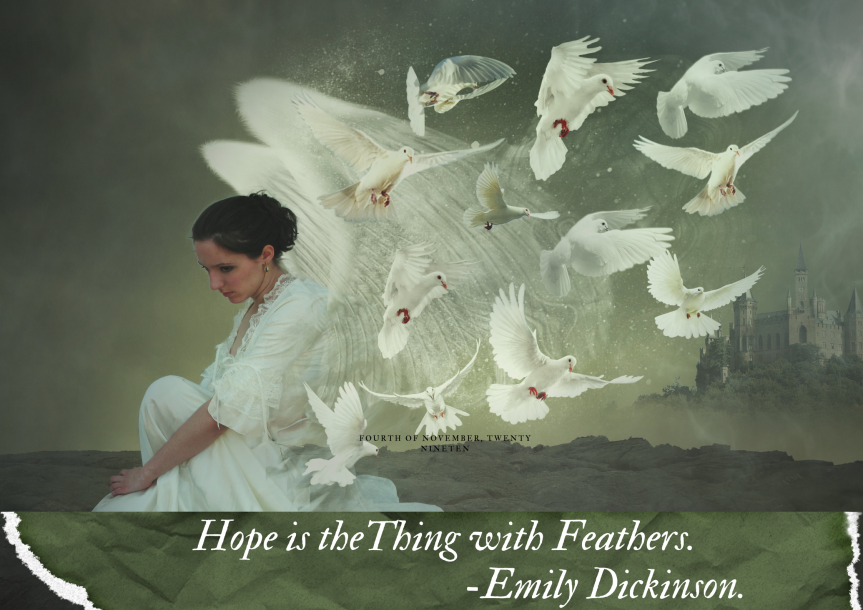
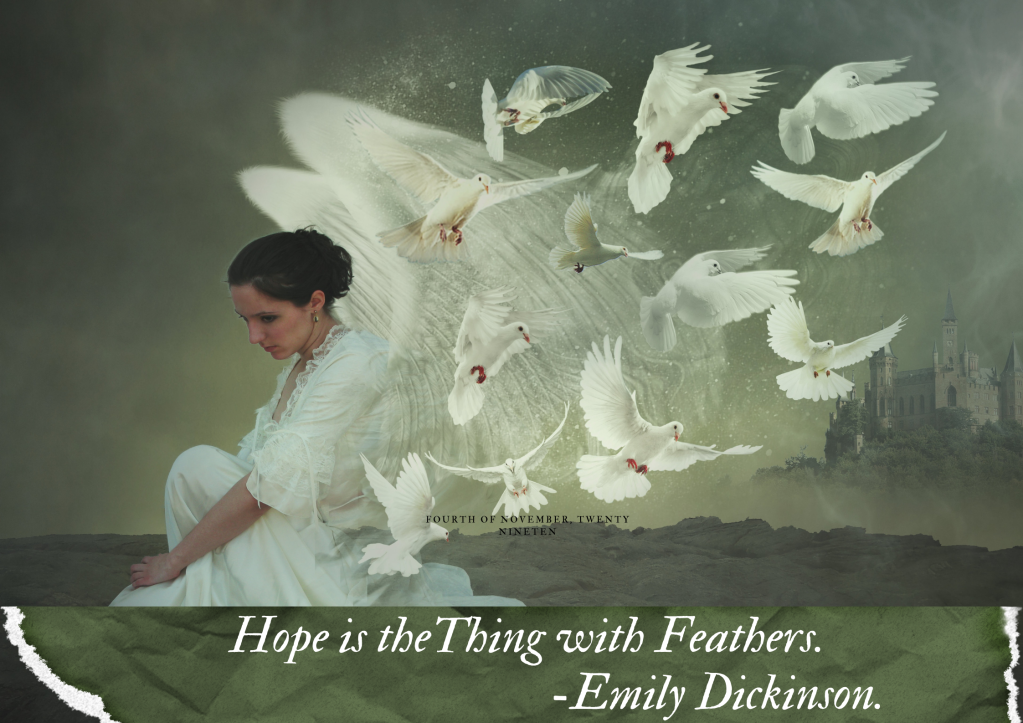
‘Hope is the Thing with Feathers’ by Emily Dickinson.

What do you call that which assures you that everything will be fine? What is that makes us believe in a better tomorrow? What is that which lifts us out of our difficulties? The answer is hope. In this poem ‘Hope is the Thing with Feathers’, the poet Emily Dickinson praises hope and brings out its importance.

Hope is an abstract feeling and the poet gives this abstract feeling a shape of a bird. It sits on our soul and belts out tunes. These wordless tunes never cease. Hope doesn’t utter words of consolation and promises. It stands there supporting us, lending us strength by its tunes and ceaselessly does this routine.  

“Hope” is the thing with feathers –

That perches in the soul –

And sings the tune without the words –

And never stops – at all –

Of all the Gales present in the world, hope sings the sweetest tunes. Their sweet tunes make us forget our bitter experiences. They remind us of happy moments awaiting us.  Though the storm (our hardships and hurdles) snubs this little bird, it never leaves. During the hours of storms, hope gives us the warmth to survive the bitter coldness. It is really a wonder how this little bird (hope) keeps us together. 

And sweetest – in the Gale – is heard –

And sore must be the storm –

That could abash the little Bird

That kept so many warm –

Hope never leaves us even in our hardships. The ‘chillest land’ and ‘strangest Sea’ refer to our struggles in life. Even at this stage, hope gives everything it can to us and asks nothing in return. Hope pours itself into its songs and lends us a will to challenge our problems. It is to be noted that ‘ “Hope” is the thing with feathers-’. The hope which can fly away anytime leaving us to our problems never does so. Rather it stands by our side and guides us through our darkest hours.

I’ve heard it in the chillest land –

And on the strangest Sea –

Yet – never – in Extremity,

It asked a crumb – of me.

The poetess uses a poetic technique called enjambment in this poem. Enjambment is used to carry an idea from one stanza to another without any pause. Here, the poetess carries the idea of Hope singing to the next stanza by saying it sings sweet. 

It is an interesting study to know how this poem contrasts the poem ‘Hope’ by Charlotte Bronte. She considers hope as a ‘timid friend’ and as being indifferent to the poet’s struggle. Thus, the two poetesses view hope in a different light.  

‘The Sleep’ by Elizabeth Barrett Browning.

Have you ever appreciated your ability to sleep? Now, you will wonder if being able to sleep is something to be praised. Yes, give yourself an applause for you have been given the best gift ever and you will have to cherish this gift. The poem ‘The Sleep’ by Elizabeth Barrett Browning brings out the importance of sleep and why it is to be cherished.

Of everything we have known about God from psalms and hymns, the poet asks if there is any gift which surpasses His gift – the sleep. As humans, what can we give to our loved ones? We can give the hero’s courage and determined heart to confront all the troubles; we can give them a poet’s lyrical verse to move them to ecstasy; we can give them a patriot’s voice to guide them through hurdles and motivate them; we can give them a ruler’s consolation to ease their burdens. But of everything we can give them, there is nothing that will surpass God’s gift to His beloved – the Sleep. 

“He giveth His beloved, sleep”

Sometimes we give our beloved words of consolation and sometimes we add to their difficulties, making their whole world burdened. But God’s gift – Sleep – puts an end to all such sufferings. No matter what words of consolation we say, we can’t solve the problems of our beloved. When things get hard and we have no words of consolation, all we can say to our beloved is to sleep.

“ ‘Sleep soft, beloved!’ we sometimes say,”

We say so, hoping that no bitter memories of hardships shall disturb their ‘happy slumber’. When we sleep, we forget our bad experiences and experience eternal peace. So, this peace gives us hope and when we wake up the next morning, we are prepared for the day. Now is there any gift which surpasses sleep?

Our earth is full of dreary noises and wailing voices of despair. We chase after money, wealth and other material prospects which might leave us anytime. So, God silences these wailings by putting everyone to sleep. God has created this earth and all natural elements and we humans sow and reap. Thus, Sleep is more delicate than the dew drops and clouds. It makes us feel as if we are on a delightful journey and makes us feel lighter.

We go on living, thinking, and feeling without even realizing what keeps us going everyday. It is the sleep which keeps us going everyday. When we sleep, we forget the hardships of today, and hope for a better tomorrow.

“Aye, men may wonder while they scan  

A living, thinking, feeling man  

Confirmed in such a rest to keep;”

Our world is a stage and we are like a tired child watching the performance of the mummers on the stage. So when our eyelids droop, we rest like a child on God’s lap. So, no matter how exhausted we are, it is the sleep which rejuvenates us at the end of the day.

The last stanza ends with the poet asking her friends not to mourn or weep when she dies, for she is just going to an eternal sleep and a state of peace after all. 

“Let One, most loving of you all,  

Say, ‘Not a tear must o’er her fall;  

He giveth His beloved, sleep.’“

The poem makes us understand how blessed we are to be able to sleep. We should no longer take our sleep for granted. Sleep improves both our mental and physical health. So, sleeping is the best thing ever. Finally, think if there is a greater gift than sleep.

“He giveth His beloved, sleep.”

Read the poem at https://poets.org/poem/sleep

‘Fear No More the Heat o’ the Sun’ by William Shakespeare.

Will you believe if someone says death can bring happiness and peace? Even the words ‘death’, ’happiness’ and ‘peace’ seem to not fit together. But when we read the extract “Fear No More the Heat o’ the Sun”, we probe into what death really is. Is it only capable of giving sadness and heartbreaks?

Starting with, this poem is an extract from Shakespeare’s play ‘Cymbeline’. It is sung by two characters Guiderius and Arviragus to the dead in the play. The characters take turns to sing the stanzas and lines of the poem.

The first stanza addresses the dead and it tells the dead not to dread the summer’s heat and winter’s harshness. The dead are set free from all the worldly responsibilities that weigh down the living. The dead needn’t worry about making ends and other materialistic needs. Only death treats all humans equally. Be it the children of high born stations or the ones who work as chimney sweepers, all return to ashes on their death. 

“Golden lads and girls all must,

As chimney-sweepers, come to dust.”

The dead needn’t fear the anger of the crown (a ruler by differing from him/her) and are free from the clutches of the tyrant. The dead needn’t worry about opposing and are free from all restraints. They needn’t worry about having proper clothes to wear and a proper meal to eat. And to them everything looks equal, be it big or small. All men powerful, intelligent, strong and valiant will meet the same end – they all return to dust. As the dead cannot bring anything along with them that can distinguish them from others, all are treated the same.

“The sceptre, learning, physic, must

All follow this, and come to dust.”

The dead needn’t fear ‘the lightning flash’ and ‘all-dreaded thunder stones’. They needn’t fear such natural elements and can rest in peace. When living are prone to be talked at by the society, the dead can sleep well without fearing to meet the society’s standards. They needn’t heed to the slanders and other harsh criticisms. The dead have completed all laughing and crying. They have nothing more to cry about and so they can rest well after their tiresome journey on the earth. Death doesn’t look at the age of the person it takes with it. Young or old all return to dust.

“All lovers young, all lovers must

Consign to thee, and come to dust.”

Now, the singers wish that no exorciser disturb the dead from their sleep and no sorcery to enchant them. The singers hope that ghosts will restrain themselves from approaching the dead and that no evil shall come near them. Nothing will dare to approach, for death has come and they pray that the grave should be known by all.

“Nothing ill come near thee!

Quiet consummation have;

And renowned be thy grave!”

When we die, we will be relieved of our burdens and worry. We experience a peace we have never experienced. Death comes with heartbreaks but also with relief. Hence, death may need not always be associated with negative feelings.

The repetition of the phrase, “and come to dust” in all the three stanzas, shows the temporal nature of human life. Everything that is material has no value on death. So, instead of running after material prospects, we should focus on eternal prospects. We can take nothing with us on our death but we can always leave something for the world. Thus, we should be kind and happy while living, and so we can leave happy memories for others on leaving.

‘A Poison Tree’ by William Blake.

“I don’t like her. I hate him. She makes me angry. He is fake. It is all an act.” 

Let us all confess that, at some point, we had hated someone. We harbor the hard feelings in our hearts and wear a façade to hide them. We act all elegant and nice outside but curse from inside. We are all hypocrites. 

So, William Blake explores this hypocrisy in his poem “A Poison Tree”. If we are angry with the other person, our anger will disappear when we talk it out. And we do so only with our friends and not our foes. When we don’t express ourselves, we let our anger grow into something ominous. 

In the second stanza, the poet illustrates how we nurture anger into a tree. 

“And I watered it in fears,

Night and morning with my tears;

And I sunned it with smiles,

And with soft deceitful wiles.”

Fear and hate are connected to each other. Where there is fear, there is hate. This can be simply explained with an example. If a person fears bugs, then they start hating bugs. This is because they fear that bugs might bite and so they kill the bugs out of hatred arising from fear. Similarly, when we fear that our anger will be exposed, we naturally start hating. We feel wronged and shed our tears. Then wearing a façade of goodness, we fake a smile and we start manipulating. Thus, the fears, tears, smiles and wiles together nurtures the tree healthy and strong.

“And it grew both day and night,

Till it bore an apple bright;”

As we constantly dwell on such hard feelings, the tree grows big ‘day and night’. The tree grows until it bears ‘an apple bright’. This is an allusion to the forbidden fruit which grows in the garden of Eden. Like the forbidden tree which brings the fall of Adam and Eve, we await for the apple to cause the ruin of our foe. 

One silent night, our foe trespasses into our garden and consumes the apple even after knowing it is poisoned. When we visit our poison tree in the morning, we are happy to see our foe dead. 

“In the morning glad I see

My foe outstretched beneath the tree.”

The last lines show us that we are glad to witness the success of our trap for the foe. We grow the whole tree aiming for a ruin and it happens. But what is our mental state on achieving such a success? Can we really be happy at others’ downfall? If so, what kind of person are we? Are we good? or are we bad? These questions arise in our minds. 

We all get angry and it is a normal human emotion. But we have to confront our anger and hold its reins before it controls us. There should be moral bounds for our anger. If not, it ruins ourselves and others. In our life, we keep dwelling on such negative emotions and keep hurting ourselves. So, let us not nurture poison trees anymore. Let’s nurture the love which the world is in need of.

‘The Darkling Thrush’ by Thomas Hardy.

Times are bad. Everything around us seems doleful and gloomy. Of the disasters we had only read in fiction, are now crawling out of the pages. At this time, all we want to find is hope. Hope , which consoles us that things will get better, expectations of the long nightmare ending and a belief that we too can resurrect ourselves like phoenix are those to which we dearly cling to.  

Similarly, the poem ‘The Darkling Thrush’ is also set in a sombre mood. When the poem starts, we find the poet looking at everything as disconsolate. He is at his gate looking at the frost covered surroundings. The frost has made everything look pale like a ghost. The sun is setting and the day is coming to an end. Even the bine-stems are lifeless this winter. The lanes which would usually be bustling with humans are now forlorn. Winter has shut men into their houses and men huddle around the hearth to feel the warmth.

“And all mankind that haunted nigh

Had sought their household fires.” 

These lines made me think that no matter how cold the outer world is, we feel warmth once inside our home. This warmth comes from our loved ones and it makes us not give up yet. 

When we learn the fact that this poem was written on the 29th of December in 1900, we understand the context of the second stanza better. It wasn’t just the end of the year but also of the century. It may even be considered as a dirge to the ending century. The land is referred to as the corpse of the century with the clouds forming its crypt and wind lamenting the death of the century. There is no trace of life. Even the germs and microorganisms from which we were born are also lying frozen beneath the frozen ground. Everything the poet sees looks as passionless as him.

“And every spirit upon earth

Seemed fervourless as I.”

In the third stanza, the poet finds the most extraordinary thing happening. A sweet singing voice vibrates through the air. It is full of happiness and uncontrollable joy. It is a thrush. It’s appearance isn’t so grand. It is old, weak, small and scruffy. But it pours its soul into the song as the day is darkening.

“An aged thrush, frail, gaunt, and small,

In blast-beruffled plume,

Had chosen thus to fling his soul

Upon the growing gloom.”

It is interesting to note the description of the thrush. It is almost battered out of life yet it sings full of life and energy. Though we are worn out, though we are exhausted, we should never give up for we don’t know what lies ahead and for we haven’t opened all the doors.

 There is nothing notable in the surrounding which would inspire the thrush to sing. There is nothing so full of life like that ‘ecstatic sound’ near and far. The thrush singing is out of place and odd. But it carried with it something that was unknown to the poet. The bird knew of the ‘Hope’ that the poet failed to see. 

“That I could think there trembled through

His happy good-night air

Some blessed Hope, whereof he knew

And I was unaware.”

Though the surrounding is dreary and dull, the thrush knew that it wouldn’t be the same forever. The winter will eventually end; new things will spring from the ground; the lanes will once again be bustling with life. This the poet did not understand. The last lines of this poem also reminded me of the last line of Shelley’s ‘Ode to the West Wind’.

“If Winter comes, can Spring be far behind?”

We all should be like the little thrush. Finding hope and giving hope. All I want to say is – this too will pass away, and when tomorrow comes, it will be brighter than today.

Types of Poetry.

If you like to read poetry, you may as well like to know more about it. Poetry can either be subjective or objective. In subjective poetry, the poet expresses his own feelings and reflects his thoughts. Whereas in objective poetry, the poet talks about other things other than himself – like external objects, sceneries, events and so on. Though poetry is classified as above, it doesn’t completely belong to one type. This is to say that even the most objective poetry may contain some of the poet’s feelings. Poetry is further divided into several types as follows.

LYRIC:

This is of Greek origin and is a song often sung by a single person backed by a lyre in the ancient times. It carries a single emotion and is musical in composition. Later ages found that this form of poetry can be made musical just by the use of words without any music to back it. Vowels and consonants were arranged musically for this purpose. A lyric tends to be quite short for its effect is weakened by huge length. 

ODE:

 It is also of Greek origin. The subject and treatment is serious and exalted. It often addresses something or someone. The opening lines either contain apostrophe appeal. Eg: Shelley’s ‘Ode to the west wind’ starts with ‘O wild west wind…”. There are two types of odes namely the Dorian or Pindaric ode and the Lesbian or Horatian ode. 

SONNET:

As everyone knows, sonnet is a short poem. It is divided into two – the Italian Sonnet and the English sonnet. The Italian or Petrarchan sonnet contains fourteen lines concerning one single feeling or idea. It is divided into two parts – the Octave (contains eight lines) and the Setset (contains six lines). At the end of the eight line, there is a Caesura (a pause) followed by a Volta (a turn in thought). When this form was adopted by the English, it was altered. The fourteen lines were divided into three quatrains (stanzas of four lines) with a couplet to end. This is the form practiced by Shakespeare. 

ELEGY:

 Though this form bore a different meaning in older times, in modern connotation, it refers to a poem which takes up grim and doleful themes. It is often written in the memory of the dead but it can also take up other sorrowful subjects. There is another form called the Pastoral elegy in which the poet represents himself as a shepherd mourning the death of his friend. As the word ‘pastoral’ indicates, the setting and language are borrowed from countryside and country people.

EPIC:

 It is a long story told in verse with all the character, language, setting and treatment exalted. It often has a lofty theme and has divine interventions for most parts. The classical examples are Homer’s ‘Iliad’ and ‘Odyssey’. Mock Epic, as the name suggests, treats the most trivial theme in an epic manner. 

BALLAD:

It can be considered as one of the oldest forms of poetry as it developed during the early stages of civilization. The ballad is a short story in verse containing simplest subjects and themes. It takes its subject from the external world and nothing of the poet is known through the ballad. It is an objective poetry.

SATIRE:

It is a composition intending to attack a folly or vice. It attacks the sin and not the sinner. It is to create a light atmosphere even when it is scornful.  Some of the best English satirists were Dryden, Pope, and Byron.

This is just a basic introduction to the types of poetry. The study of poetry is exciting and engrossing. The book referred for the purpose of the article is ‘A Background to the Study of English Literature’ by B. Prasad.