Administrative Reforms In India

Public Administration is a continuous process and, in the sense, it is always an undergoing reform. So, in public administration, ‘reform is a journey rather than a destination’. Reforms are an obvious response to the new challenges confronting state institutions managing public affairs. At the root of such an exercise lies the effort at enhancing administrative capability in the changed scenario. The problem of administrative reform has received continuing attention in India, both at the centre and in the states.

Since Independence, there have been a large number of changes in the structure, work methods, and procedures of the administrative organisations. Although these changes have been gradual, at times not too perceptible, they do indicate the efforts made by the government to affect procedural and policy innovation in the administrative system and to keep pace with the changed situations, growing needs, and exigencies of the government. With this background, the present chapter makes an attempt to understand the concept of administrative reform, to analyze the initiatives of reforms after Independence, and understand the changing patterns of administrative reforms in India in the post – liberalization era.

Theoretical Underpinning Of Administrative Reforms

Public administration as an academic discipline was born with a bias toward change and reform. The term ‘reform’ literally means forming again. The Oxford English Dictionary defines ‘reform’ as ‘to convert into another and better form, to amend or improve by some change of form, arrangement or composition; to free from previous faults or imperfection.’ Following this definition, ‘administrative reform’ is to convert public administration into a better, improved form.

As An Academic Discipline

The Public Management and Administration field, in essence, is broad, necessitating a
specific study of theoretical frameworks. A review of conceptual literature and
contemporary case studies material on structural transformation and policy reform was
conducted to enlighten the research question and the statement of research. The existing
knowledge was highlighted in terms of its relevancy to this research, thus enabling the
incorporation of valid citation on previous experiences with civil service reform.
Conceptual definitions by proponents usually do not provide generic approaches on
administrative reform process, hence, the need for a focussed review of literature.

The objective is to consult the theoretical material relevant to public service reform.
For any research, it is important to establish a relationship between theoretical and
research perspectives (Procter, 2002) and identify gaps in the literature (Johnson, J.
1991). Varying views of different schools of thought cited must be contrasted so that
what has happened over time helps to show how others handled similar problems in the
past (Gerstenfeld, 2004). Philosophical or metaphysical nature of the phenomena being
investigated, whether observable or unobservable, has to be proved early before the
scientific knowledge of the object that is theory informed and the paradigms position
used in the research is established, appropriately in the concept definition section.
Research in the Public Administration field must not overlook or underlook the societal
imperatives – dynamics, which are underpinning public service reform. Political, social
and economic imperatives of a given society determine the type of public administration adopted for a particular developmental state. Each societal imperative would obviously contribute differently to the internal environment. This pattern is not common in every country as developed and developing societies likewise experience their unique situation where peace and stability enhance the conditions for reform.

Evolution Of The Cold War

Cold War After The Truman-Stalin Era

In early 1953, there was a change in the leadership of both the superpowers- the US and USSR. In the US, President Truman’s tenure ended in January 1953. He was succeeded by Dwight Eisenhower. an ex-army general who had commanded the Allied forces in Europe during the Second World War. Meanwhile. Soviet leader Stalin died in March 1953. He was succeeded as party chief by Nikita Khrushchev and by Georgy Malenkov as prime minister. The two Soviet leaders were not very comfortable with each other. Malenkov was replaced by Nikolai Bulganin in 1955. He was more acceptable to the party chief.

But in 1958 even Bulganin was dropped and Khrushchev assumed the prime ministership as well. President Eisenhower led US for eight years till he was succeeded by John F Kennedy in January 1961. Khrushchev remained at the helm of affairs till he was overthrown in 1964 by the troika of Leonid Brezhnev, Nikolai Podgorny and Alexei Kosygin. After the Truman-Stalin era, the US-Soviet relations eased considerably, but the Cold war showed no signs of ending. During 1953-64 several steps were taken by both the sides to improve relations, but at the same time tension got accelerated on different occasions.

CRISIS IN POLAND

Poland was the first to ignite. In June 1956, riots in the industrial city of Poznam were brutally suppressed, leaving dozens of people dead and hundreds wounded. A conflict occurred in the Polish Communist Party between two factions – one owing allegiance to Boleslaw Bierut, who had died earlier the same year, and the other led by Gomulka, who was a Nationalist Titoist communist, and had remained in jail since 1949, and was recently released. Gomulka faction succeeded.

In October, Polish Communist Party issued a proclamation that Poland would henceforth pursue a ‘national road to socialism’, and Gomulka was elected Secretary of the Polish Communist Party. The Soviet leaders decided not to use force against Gomulka. This was second set-back to USSR after Yugoslav decision in 1948 to follow Nationalist Communism.

REVOLT IN HUNGARY

Since the end of Second World War, Hungary was governed by an orthodox Communist leader, Matyas Rakosi, a nominee of Stalin. (He had been freed from jail before the War on Stalin’s initiative after the Soviet Union returned old Hungarian flags captured by the Czar in 1849.) The Rakosi regime was severe ‘even by Stalinist standards.’ In 1953, he was summoned to Moscow, reprimanded and replaced by a reformist communist Imre Nagy.

A more intangible effect of 1956 arises with the spread of its talented diaspora. Many thousands of gifted Hungarians left their country and settled as far afield as Australia, the United States, and across Western Europe. The contributions they made to their adopted countries were incalculably beneficial. Nowhere have I heard the kind of objections to Hungarian refugees that one regularly encounters in relation to other refugee and asylum-seeking groups. To some degree this is because everyone knew what the Hungarians had fled from; they received instinctive sympathy. But it also reflects the performance of the Hungarians in their adopted countries. They assimilated well and quickly, and were soon more than repaying their hosts.

Even though assimilated, however, they were eloquent voices critical of communism and the Soviet empire. The eminence many soon achieved in their fields of scholarship and enterprise added weight to their criticisms. And in the United States especially, they formed the influential ā€œcaptive nationsā€ lobby with other Ć©migrĆ© groups, to press for a realistic foreign policy and, in time, to provide Reagan with intellectual heft.

REFERENCES : International Relations By V.N. Khanna

Rise Of China And The International System

Introduction

China has undergone a massive transformation in the last four decades. It has emerged as a major world power within a short span of time and is set to challenge the hegemony of the United States in the coming years. China’s spectacular rise is predominantly due to its unprecedented economic growth which averages nearly 10 per cent for the last forty years. It has to be noted that this achievement has no precedence in recorded human history and even critics of China have acknowledged this grand success. Even the World Bank has noted that China has ‘experienced the fastest sustained expansion by a major economy in history – and has lifted more than 800 million people out of poverty.’

This transformation began in 1979 with the introduction of economic reforms and today China ranks first in the world in terms of economic size on Purchasing Power Poverty (PPP) basis. Many economists are predicting that China is set to emerge as the world’s largest economy in a couple of decades or even sooner. It is notable that when this happens, it will be for the first time in more than a hundred years a non- European country will hold the mantle of being the foremost economic power. This will be a seismic shift in international politics.

History Of China’s Economic Growth

Economist Angus Maddison’s work which studies Chinese economy through centuries notes that China had the world’s largest economy as late as 1820. It is often forgotten that China was one of world’s foremost economic powers before the negative impact of colonialism. By the beginning of the 19th century, the Qing dynasty which was ruling China has serious internal weakness which left the country vulnerable to Western and later Japanese imperialist ambitions. China lost the First Opium War with Britain in 1839 and subsequently signed the Treaty of Nanking in 1842 which was the first of many humiliating unequal treaties which the country would sign. It was a part of this treaty that Hong Kong was ceded o Britain and ports like Shanghai and Guangzhou were opened for British trade.

China also lost the Second Opium War in 1856 which was jointly fought by British and the French with the support of the United States. China was forced to sign the Treaty of Tientsin in 1858. This opened more ports for foreign trade and also granted more rights for foreigners to travel and trade within Chinese territory. By this time, China had already signed the Treaty of Wanghia with the United States in 1844 granting certain privileges to the country. During this phase of Chinese weakness, several European countries including France and Russia signed unequal treaties with China to gain trade privileges.

Implications Of The Rise Of China

With a rising economy, increasing military strength and growing ambitions, there is no doubt that China is set to dominate international politics in the century. This will however have major ramifications on the international system which needs to be discussed.

China’s rise has already caused concerns about whether the post Second World War liberal international political order will be threatened by the emergence of an authoritarian country as a systemic power. Since the end of the Second World War, the United States and its Western allies have set up international institutions like the United Nations, International Monetary Fund, World Bank and the WTO to construct a rule based international order.

Strategically, interdependence amidst economic globalization has eroded the foundation for a ā€œnew Cold Warā€, which would require four conditions.  First, policymaking in both countries would have to be ideologically driven so that, second, the world can be politically divided into two camps against each other. Third, their economies would be independent of each other upon which, fourth, both sides could form alliances to sanction against each other.

However, like most countries today, policymaking in both the US and China are essentially interest oriented, not ideologically determined. Hence it is virtually impossible that the world could retreat to Cold War dynamics, where nations are divided into two camps politically hostile and economically independent of each other. Moreover, although a US-led security system has survived the end of the Cold War, the US allies would be reluctant to join the fight should confrontation take place between the two superpowers. As for China, Xi Jinping made it clear in his speech at the Belt and Road Initiative summit in May 2017 that China would not pursue any alliance but strives to foster partnerships with other countries.

Thus, despite Trump’s high-profile measures against China, it is hard to imagine that either the US or China would go to war against each other. This is not necessarily because they would give up the competition and even rivalry, but because it will be extremely difficult for both Beijing and Washington to achieve a policy consensus at home and form alliance abroad, which are necessary for a confrontation between the two global powers.

However, the US ā€œtough approachā€ against China will have a far-reaching negative impact on world order and stability, not only because Trump’s anti-China measures are an essential part of his ā€œAmerica firstā€ unilateralism and his anti-establishment impulse in international affairs, but also because China has already become a deep-rooted stakeholder in all the three layers of today’s international order, i.e., the political order centered on the United Nations and its affiliated organizations, the economic and trade order based on WTO and other multilateral trade agreements, and the financial order maintained by the World Bank, IMF and other institutions like the ADB and AIIB.  Thus, it is not surprising that even America’s closest allies in Europe and Asia – despite their substantial differences with China in terms of value and political systems – are reluctant to join the US in its effort to roll back on China.  This does not mean they support China at all.  But like China, they are also deep-rooted stakeholders of the existing international order that based on multilateral arrangements. After all, the essential purpose of reckless unilateralist behavior by the Trump Administration (e.g., withdrawals from the Paris Agreement, the Iranian Nuclear Deal, the UN Human Right Council, levying heavy tariff taxes on almost all important trade partners, and demanding allies to pay more for the US security commitments) is to rewrite the rules of game in America’s term at the expense of the entire international order. It is in this regard that Trump’s ā€œAmerica firstā€ has turned into ā€œAmerica isolatedā€ because such an approach hurts all the stakeholders of the existing international order, including the US allies.

By contrast, China’s response to the US pressure sounds rational and positive.Ā  Xi Jinping made it clear in his speeches at the Bo’ao Forum for Asia in April 2018 that China will resolutely continue its reform and openness policy.Ā  Meanwhile, Beijing will firmly defend the free trade system based on multilateral arrangements on the one hand, and carry on its ā€œpeaceful developmentā€ strategy on the other hand.Ā  While it remains to be seen whether, and to what extent, China can turn the rhetoric into credible actions, how, and by what means, China can manage the volatile relationship with the US under a highly self-centered and unpredictable Trump Administration will indeed have a far reaching impact on peace and development of the world.Ā  The good news is that Trump’s ego-driven and unilateral behaviour can actually strengthen China’s hand, only if Beijing can handle it appropriately.Ā  The bad news is that the US still is the strongest power on earth.

REFERENCE : Russia in Global Affairs, International Relations by V.N. KHANNA

Public Policy

Public policy is a frequently used term in our daily lives. We often read in newspapers about a public health policy, education policy, environmental policy, agricultural policy, industrial policy, and so on. Public policies are primarily framed by the government to satisfy public needs and demands. They are the means by which ends of a collective community are served. Without a policy, government and administration are rudderless. Successful policies make for successful government and administration, and hence there is a saying that when a policy fails, the government fails.

Theoretical Dimensions : The Context

Public policy is a relatively new subfield in political science. Its development as an area of study emerged out of the recognition that traditional analyses of government decisions were incomplete descriptions of political activities. As the relationships between society and its various public institutions became more complex and more interdependent, the need developed for more institutions became more complex and more interdependent, the need developed for more comprehensive assessments of what governments do – how and why they pursue some policy alternatives over others.

The focus on the public policy process has developed with the emergence of modern society and industrialization. During the nineteenth century, representative governments began to evolve in some parts of the world. With increased political participation by larger portions of the public, government decisions assumed greater importance and legitimacy.

What Is A Public Policy?

The term ā€œpublic policyā€ refers to a set of actions the government takes to address issues within society. For example, public policy addresses problems over the long-term, such as issues with healthcare or gun control, and as such, it can take years to develop. Public policy addresses issues that affect a wider swath of society, rather than those pertaining to smaller groups. To explore this concept, consider the following public policy definition.

For example, public policy might tackle the problem of student loans by creating a student loan forgiveness program that affects several students at once, rather than paying off the loan of one student. Something important to remember about public policy is that it does not just refer to the government’s actions, but also to the behaviours and actions that result from those actions.

Significance Of Public Policy

It is evident that the public policy is the significant factor in the democratic government and it
emphasizes on the public and its problems, in fact it is a discipline which is branded as
public. The concept of public policy assumes that there is an area of life which is totally
individual but said in public. Likewise, public policies have a significant purposes to work in
the society where the democracy is prevails.

The important role of the public policy is to make the society to lead a better life and to maintain the delivery of the goods and services are significant, it is regarded as the mechanism for developing economic-social system, a
procedure for determining the future and so on.

REFERENCES : Public Administration by Bidyut Chakrabarty and Prakash Chand Kandpal

BITCOIN

Bitcoin is basically a computer file which is stored in a digital wallet app on a smartphone or computer. People can send Bitcoins or part of one to your digital wallet, and you can send Bitcoins to other people.You can buy Bitcoins using real money. You can sell things and let people pay you with Bitcoins.The money you put into Bitcoin is not safe from value fluctuations. Bitcoin is a volatile investment. If you’re looking for a ā€œsafeā€ investment with guaranteed returns, then don’t invest in Bitcoin

Bitcoin is the oldest cryptocurrency in the world. It is a digital currency that is often used to exchange value for goods and services. Bitcoins work on the principle of blockchain technology. Bitcoins can also be mined or produced using a massive computing system, complex technical process, and an active internet connection.People have traded in Bitcoin for over a decade now. Many companies have even started accepting Bitcoins as a payment method. The price of the coins has gone up substantially over the years.

In April 2018, the RBI had effectively banned cryptocurrency transactions via banks and e-wallets in the country. It was initially supported by the Supreme Court, though the top court later quashed the ban in March last year.Earlier this week, the government listed a bill titled The Cryptocurrency and Regulation of Official Digital Currency Bill, 2021 that is aimed to provide a framework for creation of an official digital currency to be issued by the RBI and prohibit all existing private cryptocurrencies. Experts, however, believe that it would take some time for the country to bring any changes.

Bitcoin held at exchanges are vulnerable to theft through phishing, scamming, and hacking. As of December 2017, around 980,000 bitcoins have been stolen from cryptocurrency exchanges.The use of bitcoin by criminals has attracted the attention of financial regulators, legislative bodies, law enforcement, and the media.Bitcoin gained early notoriety for its use on the Silk Road.

CAUVERY RIVER

The Kaveri is an Indian river flowing through the states of Karnataka and Tamil Nadu. The Cauvery River rises in the Western Ghats and flows in eastwardly direction passing through the states of Karnataka, Tamil Nadu, Kerala and Pondicherry before it drains into Bay of Bengal.The total length of the river from source to its outfall into Bay of Bengal is about 800 km.The Cauvery basin extends over states of Tamil Nadu, Karnataka, Kerala and Union Territory of Puducherry draining an area of 81,155 Sq.km which is nearly 2.7% of the total geographical area of the country with a maximum length and width of about 560 km and 245 km.

Cauvery river is the largest river in tamil nadu occupying 765 km.The Kaveri is a sacred river to the people of South India and is worshipped as the Goddess Kaveriamma. The primary uses of the Kaveri is providing water for irrigation, water for household consumption and the generation of electricity.In February 2020, Tamil Nadu assembly passed bill to declare Cauvery Delta as Protected Agricultural Zone, includes Thanjavur, Thirvarur, Nagapattinam and five blocks in Cuddalore and Pudukottai. The bill fails to include Tiruchirappalli, Ariyalur and Karur which are geographically included in the Cauvery Delta.The cauvery river is the main source for the delta region for irrigation.It ends in the bay of Bengal.

On 22 June 2018, despite opposition from Karnataka, the Central government constituted the Cauvery Water Regulation Committee (CWRC) as per the provisions in the Kaveri Management Scheme laid down by the Supreme Court.

Acting on the Supreme Court’s direction, the Centre constituted a Cauvery Water Management Authority (CWMA) on 1 June 2018 to address the dispute over sharing of river water among Tamil Nadu, Karnataka, Kerala and Puducherry.The central government failed to adhere with the top court’s deadline of within six weeks of deliverance of judgement.

THEMES OF THE NOVEL “A TALE OF THE TWO CITIES” BY CHARLES DICKENS

While analyzing the themes of Charles Dickens’s 1859 historical fiction, A Tale of Two Cities it is apparent that the author has incorporated variety of themes in the novel. Through the beginning lines “It was the best of times, it was the worst of times. . .” the chaotic society of eighteenth society is well depicted by Dickens. Even though the characters in the novel do not engage in many conversations, their actions strengthens the themes of this work.
Resurrection or rebirth is the major theme of the novel, which is presented from the beginning to the end of the novel. The first important resurrection is that of Sydney Carton’s. Sydney Carton’s resurrection and sacrifice gives new life to Lucie and her family. Carton is portrayed as a Christ like figure who dies to save the lives of the people he loves and reborn in their minds. The theme of resurrection comes again with respect to Dr Alexandre Manette, who is reborn into his previous life, from imprisonment and mental illness, with the love of his daughter Lucie. In Jerry Cruncher’s life also we can see the resurrection, who leaves the job of grave digging for his loved ones. These are the resurrection in
personal level. In the societal level, we can see the old status of France appears to give way to New France with the sacrifice of many revolutionaries. The revival of peace and a better society echoes throughout the novel. Sacrifice is the next dominant theme in A Tale of Two Cities . On a personal level sacrifice of Sydney Carton is most strongly visible. He gives importance to the happiness of Lucie and family and this encourages him to sacrifice his life. Carton does not have a family of his own and he lead an unproductive life throughout, so he haven’t offered much to the world. So he believes this act of sacrifice will redeem everything and make his life meaningful. Next factor which strengthens the theme of sacrifice is the revolution. Revolutionaries sacrifice their life to give a new society.
Violence and oppression is the next major theme. Even though Dickens’s seems to support the revolution, he emphasizes the sufferings caused by violence. Dickens sympathizes with the peasantry and emphasizes the need for liberation. But the strategy of peasants for overcoming this situation causes more violence and death of many innocent humans. The scenes of people sharpening their weapons in the grindstone, senseless killings of people and dance with weapons emphasizes the theme of violence and oppression.

Since the background of the novel is eighteenth century society Social Inequality and Class conflict are the next important theme. There are two classes in France, the peasants and the aristocrats. The aristocrats are portrayed as lazy, irresponsible, spoiled and heartless who does not have any regard for the peasants or lower section of the society. The social inequality is evident in the incident of the rape of the peasant woman by Marquis. And when the Marquis killed the son of Gaspard he is not subjected to any legal proceedings because he is from the aristocracy. The storming of Marquis’s castle is the symbol of the fall of aristocracy. Towards the end the situation reverse. The violent measures by the peasants arises as a result of long suffering. Even though Dickens supported revolution he portrayed both social class as equally violent and oppressive.
The theme of justice is intertwined with discrimination and injustice. Justice is presented literally by trails and imprisonments in the plot. The imprisonments of Darnay and Dr Manette are example of innocent people being subjected. As said earlier after the death of the son of Gaspard Marquis is not subjected to any legal proceedings. At this occasion justice is taken by individuals, like murder of Marquis by Madame Defarge as a revenge against Everemonde family.


Apart from these major themes Dickens focuses on themes of duality like light v/s darkness love v/s hatred with the comparison of two countries and the actions of the people there. While England remained as peaceful country, France goes through intense revolution. The contrast between these countries is progressed through the novel which intensifies the theme of light v/s darkness. Dr. Manette has been locked away in a dark prison for many years and lost his mind. Charles Darnay is struggling to right the wrongs done by Evremonde family. Sydney Carton is living his life unproductive and feels he has no purpose. So Lucie is the person who is considered as the light in their lives, who lead them to recovery and bring them out of darkness.

Revolution is the next major theme which is clearly apparent throughout the novel. The revolution and it’s impact on lives of many people is clearly portrayed. The sinners and innocent people, both are equally affected by revolution. The reversal of roles are the next theme. Towards the end of the novel the peasants who were poor in the beginning become more barbaric and cruel. And as a result of this the aristocrats suffer at the end. So this is an example of reversal of roles among peasants and aristocrats. On another level the replacement of Darnay by Carton in the prison is also an example for the reversal of roles. Apart from these, themes like family preservation, fate, love and hate are also included by Dickens. Through these themes author clearly reflects the society of eighteenth century.

World System And Dependency

Structural approaches of international relations, also known as ‘neo-radical approaches’, are of recent origin. Theories in support of these approaches were advocated by leftist writers who were deeply influenced by Marxism-Leninisim. The structural approaches, including the ‘World System Approach’ and the ‘Dependency Theory’, consider the world structure from the class point of view, based largely on the level of development and accumulation of capital. Western capitalist countries, having huge accumulation of capital, are termed as the centre or core of the world system, while third world countries, lacking development and capital, are called the periphery. We shall examine the concept of development and underdevelopment with reference to the centre versus periphery.

A reference may be made here to neo-realists, who also examine the international structure, but from the political angle. They describe the international structure as chaotic or anarchic because there is no all powerful central authority to discipline the nation states, and to resolve their disputes and maintain world peace. The leftists, on the other hand, largely concentrate on economic relations between the rich industrialized nations of the capitalist world on the one hand and the poor developing third world countries on the other. This chapter will discuss the centre-periphery aspect of development as advocated by the neo-radicals.

Economic Accumulation : The North-South Divide

There is enormous gap today between income levels in the world’s industrialized regions and those in the third world. The rich industrialized countries generally lie in the northern parts of the world, while the poor developing countries are in the south. This difference in the income levels has caused differences in the overall prosperity between the rich North and the poor South. How can this gap be explained? This may be done with the help of the liberal view and also with reference to the revolutionary or radical world view.

The liberal view explains the problem by stressing that the capitalist countries have overall efficiency in maximizing economic growth. This view holds that the poor countries are merely lagging behind the industrial north. The liberals would make us believe that more wealth creation in the North is a good thing, as is wealth creation in the South. According to this view, there is no conflict between the two, as eventually the South will also acquire more wealth.

The leftist, or socialist, view is that the divide may be viewed not only in terms of creation of wealth but also with regard to its distribution. According to this view, the creation of wealth in the North often comes at the expense of the South.

The World System Approach – Centre And Periphery

The system of regional class divisions has been viewed by scholars of international relations with Marxist orientation as the ‘ world system’ or ‘capitalist world economy.’ The world system approach is a leftist theory and it relies on global system of analysis. Marx himself had limited his theory to domestic class conflict only, but Marxist scholars apply the same logic in their world system approach. In this system, class divisions are regionalized. The third world countries (exceptions apart) generally produce raw materials, including agricultural products.

These activities need large manpower but not much of capital. The peasants working in agriculture, mining and other sectors are paid low wages. The industrialized countries, on the other hand, mostly produce manufactured goods. This requires large amount of capital, and needs more skilled workers who are paid high wages. The industrialized manufacturing regions are called ‘centre’ of the world system; and the extraction regions (producing raw materials and agricultural items) are known as ‘periphery’.

Reference : International relations by V.N Khanna

Feminism in Margaret Atwood’s poem “This is a Photograph of Me”

Margaret Atwood is a well known feminist author who writes about the oppression of women in a patriarchal society. Her poem This is a Photograph of Me also shares this idea symbolically through the image of a photograph. The title of the poem itself shows the passive role of women in society. In a society which is regulated by men the role of women is passive. But without them the society will not survive. Atwood begins the poem by describing the photograph. It is a blurred photograph which was taken some time ago. And throughout the lines she continues the description of the photograph’s each element. There is the branch or part of a tree in the left hand side of the photograph, which has emerged to the right hand side. This branch without any roots can be considered as the role of women in a society who is placed on the left side or weaker side. But on the right hand side of the photograph a frame house is visible which is associated with men. The background of the photograph is a lake which represents the society. And beyond that lake there is low hills. The hills and lakes keep the women in shadow. Margaret Atwood is trying to show that the society and men exploits the true potential of women. The narrator says that I’m in the lake, in the center of the picture. But it is difficult to say precisely where she is. This shows the nature of a patriarchal society. The place of womanhood in a society is mandatory. However the world tries, the women’s place cannot be underwritten. Atwood focuses on this truth by saying that her place in the photograph is not clear. But when we look long enough everyone will be able to see her place in the photograph or the society itself. Through the image of a photograph Atwood strongly presents the oppression faced by women. Photograph stands for history which is not clear. The contribution of women to the society is necessary but the history created by men does not praise of give importance to them. Women are always hidden or drowned as Atwood says. This truth is underlined by Atwood in this feministic poem, This is a Photograph of Me.

RELIGIOUS AND PHILOSOPHICAL ELEMENTS IN THE NOVEL ‘THE SLAVE’ BY ISAAC BASHEVIS SINGER

Written in the socio-political background of Polish- Cossack war and the Khemelnsky massacre, the novel The Slave unfolds many layers of religion, philosophy, vulnerabilities and guilt of man. The novel also portrays the critical or unbiased representation of the jew community. Isaac Bashevis Singer is a Jewish immigrant writer, and he is known for his unbiased representation of the Judaism. In this novel also Singer portrays this criticism of religion and Judaism and he questions the aim or meaning of the religion if it only serves for the separation of humans. The novel carries various religious allusions, symbols and philosophical truths.

The protagonist Jacob is a religious Jew, with extreme beliefs. He is described as ” he resembles the men in the holy pictures that hung in the chapel in the valley”. He upholds his Jewish identity. At the same time he is in a religious conflict and dilemma. Being an ardent believer , sexual relations and marriage with an “outsider” or non Jew is not allowed in Judaism. But his intense love for Wanda is in conflict with this. Here, a juxtaposition between free will and determinism is evident. The question that does God control his destiny or does Jacob controls his destiny is always in juxtaposition in his mind. In the relationship between Jacob and Wanda the novel questions the religion and the customs by giving the notion that, why do we follow certain rituals if it intends the seperatedness of individuals rather than their union. Apart from this internal dilemma, one external dilemma is there, that is the thought of discrimination or exclusion in the village. And this made him to tell that Wanda is deaf and mute to hide her ethnic Identity.

Another question of choice, righteousness comes in the instance where Teresa tries to seduce Jacob. But Jacob refuses and Teresa feels guilt and she laments.

There are several biblical allusions present in the novel. When Jacob changes Wanda’s name to Sarah, he is alluded to Abraham who changes his wife’s name to Sarah. The name of their son Benjamin also carry biblical allusion. And he takes him to Jerusalem for pilgrimage. Towards the end novelist presents the ultimate philosophy of life by the growing cemetery, which included the remains of Sarah, which was not accepted by the community because of Sarah not being a Jew. So here Singer portrays the ultimate philosophy and truth of life, the death. Death is the leveller, which is equal for everyone irrespective of race and religion. And everyone gets equality through death.

ELON MUSK:-

ELON Musk is one of the greatest entrepreneurs in the world.He is ceo,founder and chief engineer in space X.His net worth is 29,700 crores.He is the richest man in the world currently.Musk was born to a Canadian mother and South African father, and raised in Pretoria, South Africa. He briefly attended the University of Pretoria before moving to Canada at age 17 to avoid conscription.Elon Reeve Musk was born on June 28, 1971 in Pretoria, South Africa.He is now 50 years old.He attended the University of Pretoria for five months Musk arrived in Canada in June 1989, and lived with a second-cousin in Saskatchewan for a year, working odd jobs at a farm and lumber-mill.In 1990, Musk entered Queen’s University in Kingston, Ontario.


In 2001, Musk became involved with the nonprofit Mars Society. He was inspired by plans to place a growth-chamber for plants on Mars and discussed funding the project himself.SpaceX attempted their first launch of the Falcon 1 rocket in 2006,[69] and although the rocket failed to reach Earth orbit, they were awarded a Commercial Orbital Transportation Services program contract from NASA later that year.After two more failed attempts, which reportedly caused Musk so much stress.SpaceX received a $1.6 billion Commercial Resupply Services program contract from NASA for 12 flights of its Falcon 9 rocket and Dragon spacecraft to the International Space Station, replacing the Space Shuttle after its 2011 retirement. In 2012, the Dragon vehicle berthed with the ISS, a first for a private enterprise.Working towards its goal of reusable rockets, in 2015, SpaceX successfully landed the first stage of a Falcon 9. In 2015, SpaceX successfully landed the first stage of a Falcon 9. Landings were later achieved on an autonomous spaceport drone ship, an ocean-based recovery platform. In 2018, SpaceX launched the Falcon Heavy; the inaugural mission carried Musk’s personal Tesla Roadster as a dummy payload. In 2017, SpaceX unveiled its next-generation launch vehicle and spacecraft system

COMPUTER AND IT’S TYPES:-

A computer is a programmable device that stores, retrieves, and processes data. … The term was later given to mechanical devices as they began replacing human computers. Today’s computers are electronic devices that accept data (input), process that data, produce output, and store storage the results.A computer is a machine that can store and process information. Most computers rely on a binary system, which uses two variables, 0 and 1, to complete tasks such as storing data, calculating algorithms, and displaying information.Computer has become very important nowadays because it is very much accurate, fast and can accomplish many tasks easily.

TYPES OF COMPUTER:-

* ANALOG COMPUTER.

* DIGITAL COMPUTER.

* MAINFRAME COMPUTER.

ANALOG COMPUTER:-

An analog computer or analogue computer is a type of computer that uses the continuously variable aspects of physical phenomena such as electrical, mechanical, or hydraulic quantities to model the problem being solved planimeters, nomograms, operational amplifiers, mechanical integrators, slide rules, tide pool predators, electric integrators are some examples for analog computers.

DIGITAL COMPUTER:-

Digital computer, any of a class of devices capable of solving problems by processing information in discrete form. It operates on data, including magnitudes, letters, and symbols, that are expressed in binary codes using only the two digits 0 and 1.smartphones, calculators, tablets, personal computer are some examples for Digital computers.

MAINFRAME COMPUTER:-

A mainframe computer, informally called a mainframe or big iron, is a computer used primarily by large organizations for critical applications like bulk data processing for tasks such as censuses, industry and consumer statistics, enterprise resource planning, and large-scale transaction processing. IBM zSeries, System z9 and System z10 servers are some examples for Mainframe computers.

ANALYSIS OF THE STYLE AND STRUCTURE OF THE NOVEL THE STONE ANGEL BY MARGARET LAURENCE

Margaret Laurence’s 1964 novel The Stone Angel depicts the story of Hagar Shipley, whose life was filled with chaos and sorrows. Hagar Shipley the protagonist of the novel is a ninety year old woman who outlived her husband and younger son John. Hagar is the daughter of a wealthy shop owner, Jason Currie. As a young woman she marries Brampton Shipley against the wishes of her parents. After marriage she gave birth to two sons Marvin and John, among which Hagar shows favoritism towards younger son John. Hagar and Brampton’s marriage become unsuccessful and they become separated. Hagar takes John along with her, but finally he returns to his father. Hagar visits her hometown Manawaka, after hearing the news of Brampton’s poor health, and he dies soon. Then John too dies soon in a car accident. Upon hearing the news of John’s death, Hagar doesn’t show any emotions. From these incidents she becomes a strong, emotionless person, the stone angel, as the title suggests. Then, she lives with her elder son Marvin and his wife Doris. Hagar runs off from them, when they planned to send her to nursing home, and wanders around at Shadow point. Towards the end Marvin and Doris takes her back home, brings to the hospital. Aware that she is dying Hagar finally apologizes to Marvin.
This life story of Hagar is presented in the first person point of view by the author. The narrator itself is Hagar, who presents the events in the form of fragmented memories and images. The novel is divided into ten chapters and they shifts back and forth between the present and the past. At the present Hagar is a ninety year old woman, whose physical breakdown made her dependent. As Hagar narrates her own story, the narrative arc goes back to her early ages, where the events are presented in a chronological order. But these memories and images of the past occur in a fragmented way, which represents the present, helpless, ill condition of Hagar. Margaret Laurence has incorporated the technique of stream of consciousness in the narration. This made the mental and emotional state of narrator transparent. And by this the readers will also be able to perceive the intensity of her feelings and experiences and they can feel with her. The shift from present state to past memories can also be analysed as the attempt of Hagar to
suppress her fear of mortality. The use of Hagar as narrator to tell her own story makes the work more special. Even though Hagar tells her past in the form of monologues, whose tragic flaw is excessive pride, they can also be considered as biased. By the structure it can also be considered as a kind of autobiography of Hagar. The shift from present to past somehow resembles the narrative part of Benjamin in the novel The Sound and the Fury. Margaret Laurence made the novel rich with various symbols and images which strengthens the narrative. The title itself, identifies with Hagar. The stone angel represents the rigid, unbending, proud self of Hagar. But at the same time she is not completely without emotions. Towards the end she feels guilt, sorrow and regret. So, the symbol of stone angel
clearly depicts Hagar. As an angel she considered herself as superior to others, whose tragic flaw was excessive pride. The symbol of eggs, used by author represents nurture and compassion for others, which lacks in Hagar. While analyzing the images used by the author, the biblical image is superior. The name Hagar, came from Bible, Abraham’s concubine and mother of Ishmael. As Hagar was banished from heaven, Hagar in the novel also left her home. The nursing home and hospital imagery can be related to death which Hagar fears. The narration, images and symbols makes the novel greatest Canadian novels ever written by Margaret Laurence. The two narrative arcs, narration through fragmented images and stream of consciousness technique, first person perspective etc make the structure and style of the novel different.

PROCRASTINATION AND PRODUCTIVITY


Since the global pandemic, covid 19 had made a lot of changes in our ways of life, we are facing a lot of problems also. Nowadays, as most people and students work and study from home, their procrastination also increased. The habit of procrastination was present in most people, but this change to work from home increased this habit to a certain level. Procrastination is the habit of delaying an important task, usually focusing on less urgent, more enjoyable, and easier activities instead. The biggest challenge these procrastinators feel is the inability to start. The word procrastination originated from Latin “procrastinatus“, which itself evolved from the prefix “pro” meaning and “crastinus” which means “of tomorrow”. This can lead to make us feel guilty or ashamed and it leads to reduced productivity and makes a chance to not achieve our goals.

So it is important to stop the habit or reduce the habit of procrastination for achieving our goals. The first step to reduce procrastination is to realize that one is procrastinating. This understanding is important to tackle to this. If one is doing low priority tasks instead of high priority ones, and waiting for “right time”are the signs of procrastination. So realizing that you are procrastinating is necessary. The next step to tackle this habit is to understand why you are procrastinating. Lack of organization can sometimes lead to procrastination. The use of to – do lists to schedule tasks, can reduce this problem to a certain extend. Even a to do list user can still procrastinate. The fear of failure and poor decision making can lead to procrastination. So, after understanding that one is a procrastinator, and why you are procrastinating the final step is to adopt procrastination strategies. Various anti procrastination strategies are making to do list, organized tasks, prioritizing tasks, write down the tasks etc. Promising a reward after completing a task is also another method to avoid procrastination. Minimizing distractions like turning off social media notifications and television are another method to avoid procrastination. There are various mobile applications for users to avoid procrastination, and to stay focused for doing tasks. So by following these steps one can avoid the habit of procrastination and achieve their goals.

WOMEN SAFETY

Top 100 Motivational Quotes on Women Safety in 2021

India is a country known for its rich beautiful culture and tradition. Women are given the place of goddess Lakshmi in the Indian culture.Women in India have been given equal rights as men; however, people do not follow this rule. They contribute to the growth and development of our country; still, they are living in fear. Women are now on respected positions in the country, but if we take a look behind the curtains, we see even then they are being exploited. Each day we read about horrific crimes being committed against women in our country like it’s a norm.

CRIMES

The list of crimes against women is quite long, to say the least. Acid attack is becoming very normal is various parts of the country. The criminal throws acid on the face of the victim to destroy their lives completely. Nonetheless, India has a lot of strong acid attack survivors who are battling for their lives and trying to lead their lives independently.

Domestic violenceĀ Ā and honor killings are very common. The wife stays in an abusive relationship because of the fear of society. The family kills their daughters in the name of honor to keep up with the reputation of their family. Similarly, female foeticide is yet another common crime. Due to the regressive thinking, people kill daughters before they are born.

In India domestic abuse, sexual assault and murder are common forms of violence against women. Dowry death is an ultimate form of murder. Indians are still with the psychology that dowry is tradition and girls’ father loses everything to pay it. Domestic violence or domestic abuse is done by one partner with the other partner in a relationship. The rate of domestic violence is increasing in India. 70% of women are victims of domestic violence. It leads to depression and suicides. It’s not a direct murder but it is a cause of murder for sure. Moreover, girls are forced into marriage at a young age. This child bride is not even mature enough to understand her responsibility. Acid throwing is a form of violent assault which ruins the beautiful girl’s life. ā€˜Cheat in a relationship’ is the other commonly found crime against women. A man easily breaks up with his wife and starts a new life with another bride.Ā 

The list continues as crimes against women are on the rise. Other crimes also include child marriages, child abuse, rape, trafficking and many more.

WAY TO ENSURE WOMAN SAFETY

Quotes about Protect Women (59 quotes)

Although the list of crimes is very long, we can take measures to ensure women’s safety in our country. Firstly, the government must make stringent laws that ensure the punishment of criminals immediately. Fast track courts must be set so the victim gets justice instantly. This will serve as a great example for other men to not commit crimes against women.

Most importantly, men must be taught to respect women from an early age. They must consider women as equals so they don’t even think of harming them. When you consider someone inferior, you tend to oppress them. If this thinking goes away, half of the crimes will automatically end.

In short, crimes against women are stopping the growth of our country. We must not put the blame on women and ask them to be extra careful. Instead, we must ask the men to change their thinking and work to make the world a safer place for women.

FIGHT BACK ! BE ALERT!

INTERNET

The Internet is a vast network that connects computers all over the world. Through the Internet, people can share information and communicate from anywhere with an Internet connection.In the present world without internet nothing will happen.INTERNET is a short form of Interconnected Network of all the Web Servers Worldwide. It is also called the World Wide Web or simply the Web.The Internet is used for many things, such as electronic mail, online chat, file transfer, and the interlinked web pages and other documents of the World Wide Web. The most used service on the Internet is the World Wide Web.Internet is a system that interconnects the different computer systems across the world. … The Internet system carries an extensive range of information resources and services including World Wide Web (WWW), telephony, electronic mail, etc. It uses standard internet protocols, such as TCP/IP and HTTP, etc.

Internet is a global network that connects billions of computers across the world with each other and to the World Wide Web. It uses standard internet protocol suite to connect billions of computer users worldwide. It is set up by using cables such as optical fibers and other wireless and networking technologies. At present, internet is the fastest mean of sending or exchanging information and data between computers across the world.

Advantages of the Internet:


Instant Messaging: You can send messages or communicate to anyone using internet, such as email, voice chat, video conferencing, etc.


Get directions: Using GPS technology, you can get directions to almost every place in a city, country, etc. You can find restaurants, malls, or any other service near your location.


Online Shopping: It allows you to shop online such as you can be clothes, shoes, book movie tickets, railway tickets, flight tickets, and more.


Pay Bills: You can pay your bills online, such as electricity bills, gas bills, college fees, etc.


Online Banking: It allows you to use internet banking in which you can check your balance, receive or transfer money, get a statement, request cheque-book, etc.


Online Selling: You can sell your products or services online. It helps you reach more customers and thus increases your sales and profit.


Work from Home: In case you need to work from home, you can do it using a system with internet access. Today, many companies allow their employees to work from home.


Entertainment: You can listen to online music, watch videos or movies, play online games.


Cloud computing: It enables you to connect your computers and internet-enabled devices to cloud services such as cloud storage, cloud computing, etc.


Career building: You can search for jobs online on different job portals and send you CV through email if required.

Types of internet connections include:-

* DSL (digital subscriber line).


* cable broadband.


* fibre optic broadband.


* wireless or Wi-Fi broadband.


* satellite and mobile broadband.
dedicated leased line.

Disadvantages of the Internet:-

* Addiction, time-waster, and cause distraction.


* Bullying, trolls, stalkers, and crime.


* Spam and advertising.


* Pornographic and violent images.


* Never being able to disconnect from work.


* Identity theft, hacking, viruses, and cheating.


* Affects focus and patience.

PANCHAYAT – A REVIEW

The 2020 comedy – drama, Hindi web series Panchayat is a social commentary on the prevailing system in most part of rural India. As the title, the plot revolves around a Pnnchayat office in a remote village called Phulera. Abhishek Tripathi is a fresh engineering graduate who didn’t got placement in his final year. As he got this job opportunity as the panchayat secretary, he decides to give an attempt, as there are no other options left after his graduation. The series opens with his arrival at Phulera and meets former village Sarpanch who is the husband of current village Sarpanch, the deputy sarpanch and his assistant. Through a series of funny episodes, the director shows the present condition of the panchayat office, the people and the ruling system. Jitendra is working to crack CAT so that he can switch his job. The first season of Panchayt consists of eight episodes named “Gram Panchayat Phulera”, “Bhootha ped”, “Chakke wali Kursi”, “Hamara Neta Kaisa Ho?”, “Computer Nahi Monitor”, “Bahot Hua Samman”, “Ladka Tez Hai Lekin”, and “Jab Jago Tabhi Seva”. Each episodes carry sarcastic portrayal of the Panchayat, such as the issue of solar plantation and the revolving chair. Sarpanch feels diminished in the eyes of villageres, because of not possessing a revolving chair like that of the secretary. A poorly phrased slogan for the family planning leads to a chain of events later.

The script, actors, characters and situations are well connected. The system of village politics, the low level corruption, simple lifestyle, the role of women in politics, kindheartedness of villagers are presented in a realistic manner. The present woman Panchayat secretary is the perfect example for the role of women in Indian politics. Even though she is a representative , as part of women reservation, the power is still in the hands of her husband. The performance of Jitendra Kumar, Neena Gupta, Raghubir Yadav and other artists made the series more realistic and gained many critical acclamation.

SOCIAL MEDIA AND IT’S ROLE IN SOCIETY

Social media plays vital role in present society.It become one of the daily necessary activity.Social media is typically used for social interaction and access to news and information, and decision making. It is a valuable communication tool with locally and worldwide, as well as to share, create, and spread information.Social media enables its users to stay in contact by making communication easier. Sharing pictures, videos, expressing thoughts, ideas, and documents are just one click away. Exchanging messages and data from one corner of world to other is made easiest with the help of social media.The term social media refers to a computer-based technology that facilitates the sharing of ideas, thoughts, and information through virtual networks and communities. Social media is internet-based and gives users quick electronic communication of content, such as personal information, documents, videos, and photos.

The negative effects of mass media on society can lead people towards poverty, crime, nudity, violence, bad mental and physical health disorders and others as such severe outcomes. For example mob hitting innocents by getting carried away from the rumors spread on the internet has been common.Social media, or more specifically news media- plays an important role in democratic societies because they allow for participation among citizens.when it comes to healthy democratic networks, it is crucial that that news remains true so it doesn’t affect citizens levels of trust.Eighty-six percent (86%) of people use social media at least once per day, including 72% who use it multiple times per day. Social media is so popular because it allows people to manage and accomplish their everyday activities. Social media is a great way to connect with people who you may not see all the time. It’s also great for making friends. Social media helps you build connections with kids who have the same interests. It is a quick way for people to get to know each other, even if they’re living across the world from one another.

“Don’t use social media to impress people use it to impact people”.

The Upper Paleolithic World

Introduction

After about 40,000 years ago, we see many significant changes in the archaeological record, reflecting important changes in cultural and social life. We see art, many new inventions, and considerable increases in the population. This period of cultural history in Europe, the Near East, and Asia is known as the Upper Paleolithic and dates from about 40,000 years ago to the period known as the Neolithic (beginning about 10,000 years ago, depending on the area). In Africa, the cultural period comparable to the Upper Paleolithic is known as the Later Stone Age and many have begun much earlier.

In many respects, lifestyles during the Upper Paleolithic were similar to lifestyles before. People were still mainly hunters, gatherers, and fishers who probably lived in small mobile bands. They made their camps out in the open in skin-covered huts and in caves and rock shelters. And they continued to produce smaller and smaller stone tools.

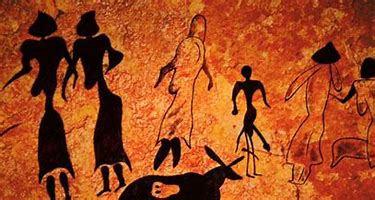
But the Upper Paleolithic is also characterized by a variety of new developments. One of the most striking developments is the emergence of art – painting on cave walls and stone slabs, and carving tools, decorative objects, and personal ornaments out of bone, antler, shell and stone. (Perhaps for this, as well as other purposes, people began to obtain materials from distant sources.) Because more archaeological sites date from the Upper Paleolithic than from any previous period and some Upper Paleolithic sites seem larger than any before, many archaeologists think that the human population increased considerably during the Upper Paleolithic. And the new inventions, such as the bow and arrow, the spear thrower, and tiny replaceable blades that could be fitted into handles, appear for the first time.

The Last Ice Age

The Upper Paleolithic world had an environment very different from today’s. The earth was gripped by the last ice age, with glaciers covering Europe as far south as Berlin and Warsaw, and North America as far south as Chicago. To the south of these glacial fronts was a tundra zone extending in Europe to the Alps and in North America to the Ozarks, Appalachians, and well out onto the Great Plains. Environmentally, both Europe and North America probably resembled contemporary Siberia and northern Canada. Elsewhere in the world conditions were not as extreme but were still different from conditions today.

For one thing, the climate was different. Annual temperatures were as much as 50 °F below today’s, and changes in ocean currents would have made temperature contrasts (i.e., the differences between summer and winter months) more extreme. The changing ocean currents also changed weather patterns, and Europe experienced heavy annual snowfall. Not all the world was cold, however; still, the presence of huge ice sheets in the north changed the climate throughout the world. North Africa, for example, appears to have been much wetter than today, and South Asia was apparently drier. And everywhere the climate seems to have been highly variable.

Upper Paleolithic Europe

With the vast supplies of meat available from megafauna, it is not surprising that many Upper Paleolithic cultures relied on hunting, and this was particularly true of the Upper Paleolithic people of Europe, on whom we focus here. Their way of life represents a small pattern throughout the Old World. But as people began to use more diverse resources in their environments, the use of local resources allowed Upper Paleolithic groups in much of the Old World to become more sedentary than their predecessors. They also began to trade with neighbouring groups to obtain resources not available in their local territories.

Reference : Anthropology by Ember and Ember

Proper Nutrition for Growing Children

By – Supriya

Growing child needs a complete mix of balanced diet for proper growth of body and mind. As children grow, there is an increased interest and participation in other activities , which compete with mealtimes . Healthy children with proper nutrition exude more self confidence , have higher energy levels and are more alert than malnourished children. Growing child requires proteins and carbohydrates for developing muscles and bones, and vitamins and minerals to build the immune system to facilitate proper growth. Proteins help build muscles and strength of the body. Calcium is required for developing bones, in absence of which a child will have weak bones. Active children burn a lot of calories every day because they play more; for these children adequate proportion of carbohydrates is also required on daily basis. Vitamins are essential to the growing body; they help with digestion , energy, immunity, alertness, cell division and growth. Vitamin A is good for eyes , Vitamin C helps boost the immune system, fight stress, and keep skin, hair and nails healthy and Vitamin D is important for strong bones, and teeth. Iodine helps prevent developmental delays and iron is essential because it is a carrier of oxygen throughout the body and gives mental alertness. The Recommendation Dietary Allowance ( RDAs) represent levels of intake of essential nutrients that , on the basis of scientific knowledge ,are judged by the Food and Nutrition Board of the National Academy of Sciences, to be adequate to meet the nutrient needs of practically all healthy persons . Normally a child between 15-18 years needs around 2500 calories every day for his energy requirement on daily basis, depending on his age and activity level. While a girl requires 44 grams of protein per day, dietary requirements of proteins for a school going boy is around 56 grams. Even fats should be included in the diet but unsaturated fats instead of saturated fats should be preferred. In addition , consumption of Vital vitamins, minerals, dietary fibre and water is also essential . In fact , school going children between 14- 18 years old require more calcium and iron than adults to meet skeletal growth demand and adequate blood volume.

Since no single food group can nourish the body with all the vital ingredients it requires, it is important to consume a veriety of healthy foods to derive the nutrition the body needs . Food groups that can be consumed to fulfill nutritional requirement are fruits , vegetables ,cereals and pulses, dairy products , poultry, fish and meat products. The best sources of carbohydrates – whole grains , rice and brown bread – promote good health and also provide vitamins , minerals , fiber , and a host of other important nutrients. Protein is abundantly found in milk , fish, meat and pulses. Milk is also required for supplementing calcium requirements of the body. Green vegetables and fruits are prime sources of vitamin A, vitamin C , iron , vitamin E and fibres. Instead of butter , biscuits or fried foods , fatty fish, walnuts , and canola oil can be tried ,as apart from fats they are also good source of omega -3 fatty acids.

Breakfast gives an opportunity to refuel the body after sleep , and benefits of healthy breakfast cannot be ignored , especially for students . A good healthy breakfast should have enough protein to keep one feeling full and to support muscle . Oat meal, fruit juice, soya milk , papaya , almonds, bananas, and sandwiches with stuffing of vegetables are all healthy and tasty options. A cup of dry cereal – whole grain and not overly sweetened – is also a good alternative. Lunch is also important for children as it gives them the stamina for problem solving and better memory during learning hours at school. Carbohydrates rich lunch comprising of chapattis ,rice,curd, vegetables like turnip green, sea vegetables , sweet potatoes , animal lever, fish, pumpkin, soya, pulses or salad can be given. Dinner should include less carbohydrates and more protein and roughage. Soups, grilled chicken breast, brown rice , broccoli, spinach , beans, peas, cabbage,carrots,tomatoes, pulses or similar such things would make for a great low – calorie dinner. It is important to encourage healthy habits in children so that their intake of nutrients for energy and development is optimum. A healthy balanced diet comprising all essential nutrients – carbohydrates , proteins, vitamins, minerals, dietary fiber and water will ensure that the child grows to full potential.

THANKYOU! .. ..

NANOTECHNOLOGY

Nanotechnology, also shortened to nanotech, is the use of matter on an atomic, molecular, and supramolecular scale for industrial purposes.

WHAT IS NANOTECHNOLOGY?

Nanotechnology is the manipulation of matter on a near-atomic scale to produce new structures, materials and devices. Nanotechnology is generally defined as engineered structures, devices, and systems. Nanomaterials are defined as those things that have a length scale between 1 and 100 nanometers.

NANOTECHNOLOGY USED IN:-

* Food security. Nanosensors in packaging can detect salmonella and other contaminants in food.


* Medicine.


* Energy.


* Automotive.


* Environment.


* Electronics.


* Textiles.


* Cosmetics.

IS NANOTECHNOLOGY THE FUTURE:-

Nanotechnology is an emerging science which is expected to have rapid and strong future developments. It is predicted to contribute significantly to economic growth and job creation in the EU in the coming decades. According to scientists, nanotechnology is predicted to have four distinct generations of advancement.

NANO MEDICENE:-

Nanomedicine — the application of nanomaterials and devices for addressing medical problems — has demonstrated great potential for enabling improved diagnosis, treatment, and monitoring of many serious illnesses, including cancer, cardiovascular and neurological disorders, HIV/AIDS, and diabetes.

C.V.RAMAM

Sir Chandrasekhara Venkata Raman FRS was an Indian physicist known for his work in the field of light scattering. Using a spectrograph that he developed, he and his student K. S. Krishnan discovered that when light traverses a transparent material, the deflected light changes its wavelength and frequency.He was born in 7th November 1888 in Thiruvanaikoil, Tiruchirappalli His parents was R. Chandrasekhar Iyer, Parvathi Ammal.He did his education in st Aloysius Anglo Indian High school, presidency College.

C.V.Raman Theory proposed a theory that when light that shines through a material is scattered and its wavelength changes from that of the original incident light because of its interactions with the molecules in the material.This is also called as Raman effect.C.V. Raman is also known as Chandrashekhara Venkata Raman. He was a man of brilliant mind who has done his matriculation at the age of 11 and 12th class at the age of 13. Let us solve an interesting quiz on Dr. C.V. Raman which throws light on his life and inventions done by him.07-Nov-2019

He received many awards,

* 1928-Matteucci medal.

* 1930-Hughes medal.

* 1930-Nobel prize in physics.

* 1941-Franklin medal.

* 1954-Bhart ratna.

* 1957-Lenin peace prize.

TOP FIVE CITIES IN INDIA

There are some most important cities in India,

* Mumbai.

* Delhi.

* Banglore.

* Kolkata.

* Chennai.

MUMBAI:-

Mumbai formerly called Bombay is a densely populated city on India’s west coast. A financial center, it’s India’s largest city. On the Mumbai Harbour waterfront stands the iconic Gateway of India stone arch, built by the British Raj in 1924.India’s share market is also in mumbai.Mumbai is also called as city of dreams.Mumbai is the seventh cheapest city in the world Mumbai is a huge and populous city, the level of crime is high. Travelers can easily become victims so they need to avoid traveling alone on public transport or in taxis, especially at night. There have been reports of British tourists becoming the victims of a scam by taxi drivers.

DELHI:-

New Delhi is the capital of India and an administrative district of the National Capital Territory of Delhi. New Delhi is the seat of all three branches of the government of India, hosting the Rashtrapati Bhavan, Parliament House, and the Supreme Court of India.New delhi is a union territory.It is situated alongside River Yamuna and bordered by Haryana state on three sides and by Uttar Pradesh state to the east.Delhi is relatively safe in terms of petty crime, though pickpocketing can be a problem in crowded areas so keep your valuables safe. Roads are notoriously congested.New Delhi is best known as the location of India’s national government. New Delhi has great historical significance as it was home to powerful people, such as the PÄį¹‡įøavas and the Mughals. The city has many historical monuments and tourist attractions as well as lively marketplaces and great food, such as chaat.The world wonder taj mahal also present in a New delhi.

BANGLORE:-

Bengaluru also called Bangalore is the capital of India’s southern Karnataka state. The center of India’s high-tech industry, the city is also known for its parks and nightlife. By Cubbon Park, Vidhana Soudha is a Neo-Dravidian legislative building.It has a population of more than 8 million and a metropolitan population of around 11 million, making it the third most populous city and fifth most populous urban agglomeration in India.The current estimation of economy of Bangalore and its metropolitan area is US$ 110 billion making it India’s fourth richest metropolitan area.

KOLKATA:-

Kolkata formerly Calcutta is the capital of India’s West Bengal state. Founded as an East India Company trading post, it was India’s capital under the British Raj from 1773–1911. It is known for its grand colonial architecture, art galleries and cultural festivals. It’s also home to Mother House, headquarters of the Missionaries of Charity, founded by Mother Teresa, whose tomb is on site.Kolkata has gained the top spot in the list of the country’s safest cities for the year 2020.Kolkata is also known as the Black City.

CHENNAI:-

Chennai, on the Bay of Bengal in eastern India, is the capital of the state of Tamil Nadu. It is also called Madras.The Chennai Metropolitan Area is one of the largest municipal economies of India. More than one-third of India’s automobile industry being based in the city. Home to the Tamil film industry, Chennai is also known as a major film production centre. It is one of the 100 Indian cities to be developed as a smart city under the Smart Cities Mission.The world second largest beach is in Chennai and The zoological park.There is many place to visit in Chennai.

Thinking out of the box

This is an image of Thinking out of the box.
Photo by Ivan Bertolazzi on Pexels.com

No one remains a stranger to this phrase, But there is nothing more vague and inarticulate than this phrase. From the moment we are born into this world, we are being directed to behave and do things in a certain way. When we reach adolescence, we no longer have to be told to behave in a certain way as we begin to realise what the society expects from us and behave in accordance to their expectations. Finally, when we enter adulthood, we become champions in complying to societal expectations.Ā 

After going through all these stages in life, while in a group discussion or a meeting, a team leader or a manager asks us to think outside the box. That’s unfair. Nobody taught us to think for ourselves, even if we did, it fell in the societal pattern of studying, marrying, rearing kids, and retiring. 

What is thinking out of the box?

In a professional terminology, thinking out of the box basically means coming up with a new idea (because the contemporary ones didn’t work) that would reap huge benefits for the company. In terms of life, thinking out of the box means being indifferent to societal norms and expectations as you do things your own way. Although my monologue above is defensive towards societal expectations, it is often impractical as not all of us can afford to waste our time and resources on carving a new path, when we can comply with our society and become financially stable and independent.   

How to think outside the box?

Nevertheless, we can still incorporate the habit of thinking outside the box to make a difference in our lives when needed. Thinking out of the box does not require racking your brains till you come up with a feasible idea.Ā 

Take up a new course

Enrolling yourself for a new course will open doors to learning about new and unfamiliar things. Learning new things will influence your thinking in different areas and aspects of your life. Thereafter when you are confronted with a problem, you will be equipped with knowledge from the specialisation in a certain field that can aid you with thinking out of the box. 

Daydream

Although it sounds counter intuitive, daydreaming is an important factor that influences your thinking out of the box. While daydreaming, your brain is led astray from the logical aspects and helps you make connections and co-relations that you couldn’t come up with while racking your brain. So, turn your attention away from the problem you are facing and let your imagination go wild!

Read a book from a new genre

Thinking out of the box would require you to do things differently or try new things. So how about reading from a different genre than the one you usually prefer? Try nonfiction or didactical if you have always preferred fiction. Fiction might have accustomed you to think in a certain manner. To break that monotony in thinking, reading from a different genre might just do the trick. 

Pen a poem

The motive behind doing this relatively weird stuff during a serious confrontation is to break free from rational and logical thinking and invite new possibilities and ideas into the situation. Try writing a poem on the basis of your problems. As your mind begins wandering to support your efforts in poetry, you expand your horizon of thinking, leading to thinking outside the box. 

So there you go, a vague article on an equally vague topic. Thinking out of the box. Do drop in your thoughts in the comment box. Now that’s a rhyme scheme created which can be considered as the first two lines of a poem. I was wondering how to end this article so I made a rhyme scheme, a.k.a a poem. 

Habits of successful people that you can take up.Ā 

Getting ahead or wealthy in life can be challenging. There are certain daily habits one must follow to achieve success. These habits enable people to use their potential and get things done on time. Many successful and wealthy people are said to have followed or maintained these habits to get to where they are today. So let us do ourselves a favor today by learning about some of these habits. 

1.Positive Attitude

This is an image for positive attitude.
Photo by Andres Ayrton on Pexels.com

Everyday isn’t going to be a bliss in our lives. Instead, each day brings with it a challenge and problem of its own. But we don’t have to be upset or defeated by them. A positive attitude is one of the key habits of successful people that you can adopt. It is the habit of finding positive attributes in every challenge you face. 

You might be overwhelmed and swamped with problems in your lives, but the idea that one day you will emerge as a resilient and a strong person after going through them can be relatively less draining.

After all, we can only control our reactions and not our circumstances. 

2. Sharing

This is an image of sharing.
Photo by cottonbro on Pexels.com

The path to success is not always about solitude. It requires you to share your ideas with others and even help others. One doesn’t have to be super rich to help or share with people around them. You can share your ideas with people that can benefit you as well as them. Volunteering for a cause is also a great idea of helping and sharing with your community. 

3. Reading

This is an image of reading.
Photo by Dayan Rodio on Pexels.com

J.K. Rowling says that she used to read anything that comes her way as a child. She states that one must read as much as possible as nothing is as rewarding as reading. Today there are books, e-books and blogs being written on every possible field. You can read from a wide range of reading materials based on your fields of interest. 

Reading also helps you develop your vocabulary. You can post or publish your own writings based on the knowledge and vocabulary you have gained by your readings. 

4. Being frugal

This is an image of being frugal.
Photo by Katie Harp on Pexels.com

Frugality is the habit of being cautious with expenditures. Successful people are very thrifty with their money and resources. They draw comparisons while making deals or purchases and find ways to save money. It is also known as being economical. Economically spending can result in reduction of wastage on resources and money. Thus leading to efficiency. 

5. Rising Early

This is an image for rising early.
Photo by Josh Hild on Pexels.com

Success and wealth has often been associated with the habit of rising early. Early risers can devote more time to their work and get more things done. It is again one of the key habits of successful people that you can adapt. There are several benefits of rising early in the morning such as:

  1. Enhancement of organisation skills as you plan your day ahead under a peaceful and calm environment in the mornings. 
  2. Rising early gives you enough time to prepare a healthy breakfast which is important to carry on the following tasks of the day. 
  3. Rising early puts you at the advantage of being on time. You get the following tasks of the day done without any delay. 
  4. Finally, early rising also helps you sleep early without leaving you watching your phone during midnight. 

These are some of the habits of successful people you can adopt to be successful yourself. 

5 Best cities to live in India.Ā 

This is an image of 5 best cities to live in india.
Photo by Asif Methar on Pexels.com

The cities mentioned in this list belong to different states in India. Each city showcases the distinct culture and beauty of their state. Many companies and factories have been set up in these cities since the beginning of globalisation. This has led to people migrating from different parts of the country in search of a livelihood. 

Today these cities are commonly rich in manpower and resources which increases its scope of development. Although they are overpopulated, residents and visitors alike benefit from modern facilities and technological advancements that are introduced on a regular basis. 

So, welcome to some of the best cities to live in India.

1.Bangalore- The start-up city

This is an image of Bangalore- the start-up city.
Photo by Keith Lobo on Pexels.com

Ever came across the news about people quitting their 9 to 5 jobs and starting their own businesses? It might probably have occurred in the city of Bangalore. It is an IT hub for people doing their 9 to 5 jobs, and a start-up city for people starting their own businesses. Bangalore is located in one of the southern states of India. It also bags the title of the third largest city in India. 

It has everything you can expect from a tier one city. Shopping hubs, entertainment opportunities, buzzing nightlife, art, culture and so on. Thanks to its rapid industrialisation. The city also has lakes, gardens and generous spaces for recreation. However, the goodness it reeks of also becomes the reason for overpopulation, it is infamously known for its hour long traffic jams! 

2. Pune- The cultural capital of Maharashtra

This is an image of Pune- The cultural capital of Maharashtra.
Photo by Aniket Dhakate on Pexels.com

Pune houses some of the best educational centres and IT companies that attract youngsters who are yearning for a livelihood. Housing, transport and food are affordable if spent wisely. Thus, making it one of the best cities to live in India. It is indeed known as the cultural capital of Maharashtra, due to its historical sites, museums and heritage. It is an ideal city for tourism as it has many sightseeing options such as Sinhagad Fort, Khadakwasla Dam, Tulsibaug, Shaniwar Wada, etc. 

3. Ahmedabad

This is an image of Ahmedabad.
Photo by NAUSHIL ANSARI on Pexels.com

Ahmedabad, the city in Gujarat, is famous for its Sabarmati Ashram, which carries the pride of once being Mahatma Gandhi’s residence. Today it has been established into a museum which is visited by millions of tourists every year. Ahmedabad is one of the best cities to live in India due to its affordability and ideal places to stay. 

Manek Chowk, Lal Darwaja Market, and the famous shopping centre at Dhalgarwad are some of weekend getaways and visual treats for the explorers of Ahmedabad. 

4. Chennai

This is an image of Chennai
Photo by VARAN NM on Pexels.com

Chennai is not only the best, but also one of the cheapest cities to live in india. It is the capital city of Tamil Nadu

which is well known for its extravagant temples, beautiful churches, passion for classical music and popular beaches. Like Bangalore, it also comprises factories and industries of the elites that support the economy of the city and its residents. 

Chennai boasts awesome connectivity with its expansive transport system of buses, rickshaws and cabs. It also acts as a host of several start-ups and unique initiatives in an effort to suffice development in the city. 

5. Navi Mumbai

This is an image of Navi Mumbai
Photo by Darshak Pandya on Pexels.com

Navi Mumbai is a booming town, nearer to Mumbai, the city of dreams. It holds the title of the largest planned city in the entire world that boasts of tourist attractions such as Golf courses, waterfalls, wonderful parks, etc. Plans of establishing an international airport and metro train connectivity are being carried on with great enthusiasm.  

What makes it one of the best cities to live in India is it’s relatively calmer, less polluted and populated environment in comparison to Mumbai. But it’s relatively higher cost of living and rent can be a turnoff for many. 

Want to experience the city lifestyle or planning on settling in a new city? Do check out at least four of the cities mentioned in the list. 

COMPUTER SECURITY DAY

National Computer Security Day demands our attention every November 30 because cyber security affects everything from where we bank and how we spend our money to who we elect to public office.Ā We certainly don’t want a replay of MyDoom, the worst email virus in history, which caused $38.5 billion in damage, so let’s get educated on staying safe online!

National Computer Security Day 2021 - Eventuff

HISTORY OF COMPUTER SECURITY

National Computer Security Day began in 1988, around the time that computers were becoming commonplace, even if they were yet to become ubiquitous in homes. The 1980s saw not only increasedĀ usageĀ of computers, especially in business and government, and the internet was in its early stages.

While hacking and viruses have virtually been around since the early days of modern computing, evolving and increasingly sophisticated technologies began to see more applications, and therefore more security risks due to the simple fact that more data was at risk as computers found their way into banks, government offices, and businesses.

More important data stored on computers and servers meant more valuable information for hackers, and this meant higher profile cases of security breaches. As such, online security became an important concern by the end of the decade, and so National Computer Security Day was created to raise awareness about computer security.

WHAT WE DO IN COMPUTER SECURITY DAY

The most obvious way to celebrate Computer Security day would be to focus on ensuring that your computer, your devices, and the data you have in the cloud are all secure. One very important thing to do for your online security is to have strong passwords and keep them updated regularly, as this reduces the chances of your personal data falling into the wrong hands. If you aren’t the sort of person who’s good at coming up with strong passwords (and let’s be honest, some of us aren’t), then there are a number of password managers which you can choose from to generate random passwords and also save them so you don’t have to remember.

One strategy is to mix upper and lowercase letters with symbols, as this can be harder to guess and also difficult to hack – and passwords increase in difficulty the longer they are. Surprisingly, it doesn’t seem that everyone would think to do this, because ā€œ123456ā€ and ā€œpasswordā€ have remained the two most popular passwords for years now. And don’t use the same password over and over for every online account you have – this ensures that if someone manages to get into one of your accounts, then they can access all of your accounts. Bad idea. So make strong passwords, don’t recycle them, and update them regularly.

Another thing that you can do to celebrate Computer Awareness Day is to update all of your spyware and malware protection software. Follow up with thorough scans, and you should have a more secure computer or device as an end result. While you may be aware that computers require such protection, you should also remember that your other devices such as tablets and smartphones are also vulnerable to malware and spyware – so take the necessary measures to keep them secure.

And if you still have a computer running the outdated Windows XP or Vista, you should be aware that this creates huge security vulnerabilities for you. So upgrade your OS or your device. For the rest of us with more contemporary operating systems, it’s still important to install the regular security updates in order to stay safe.

You can also observe National Computer Security Day by encrypting all of your files and backing them up. Your device should give you the option to encrypt all of your files (this is typically found amongst the settings), and then it’s your choice whether to go for a physical device such as an external hard drive or USB drive or for any of the numerous online cloud storage options. Many of these offer encrypted storage, and while Google’s Drive is probably the best-known, it’s far from the only player in the field. And most of the cloud storage options are free up to a certain limit.

So remember National Computer Security Day, and observe it in whatever way you can because online safety and security are important things.

“RATHER THEN FEARING OR IGNORING CYBER ATTACKS,DO ENSURE YOUR CYBER RESILIENCE TO THEM”

HUMAN BRAIN

The human brain is the central organ of the human nervous system, and with the spinal cord makes up the central nervous system. The brain consists of the cerebrum, the brainstem and the cerebellum. The cerebrum, the largest part of the human brain, consists of two cerebral hemispheres.It controls most of the activities of the body, processing, integrating, and coordinating the information it receives from the sense organs, and making decisions as to the instructions sent to the rest of the body. The brain is contained in, and protected by, the skull bones of the head.

There are three types of brain fore brain, midbrain,hindbrain.The hindbrain includes the upper part of the spinal cord, the brain stem, and a wrinkled ball of tissue called the cerebellum.Brains are made of soft tissue, which includes gray and white matter, containing the nerve cells, non-neuronal cells which help to maintain neurons and brain health, and small blood vessels. They have a high water content as well as a large amount nearly 60 percent of fat.

FUNCTION OF BRAIN:-

* Attention and concentration.


* Self-monitoring.


* Organization.


* Speaking (expressive language).

* planning and initiation.


* Awareness of abilities and limitations.


* Personality.


* Mental flexibility.


* Inhibition of behavior.

The human brain color physically appears to be white, black, and red-pinkish while it is alive and pulsating. The brain itself does not feel pain because there are no nociceptors located in brain tissue itself. This feature explains why neurosurgeons can operate on brain tissue without causing a patient discomfort, and, in some cases, can even perform surgery while the patient is awake.Brain controls vital functions such as breathing, swallowing, digestion, eye movement and heartbeat, there can be no life without it. But the rest of the brain is obviously capable of some remarkable feats, with one part able to compensate for deficiencies in another.

5 Ways you can help the uderprivileged folks this winter

The chilly weather indicates that winter has arrived. Therefore, we will all be home, wrapped up in our comfy blankets spending some quality time with our friends and family. But there are people out there who are not as blessed as us. These people spend the nights shivering and waiting for the cold winters to end. A little generosity and help from people like us can make them happy and contended. Doing a generous deed for them will not only make them feel happy but it will also make you fulfilled and satisfied.

Here are a few ways you can help the needy ones out there this winter:

Create some tiny beds for the street animals:

IMAGE: ISTOCK

Winters can be really harsh for the animals out there. They suffer a lot due to such cold nights on the streets. These animals cannot express the problems faced by them during winters. Hence, people like us can give them the comfort that they require during winters. You can make a tiny bed from your old ragged clothes which are of no use anymore and place it outside your home.

Donate blankets:

While blankets may be easily available to many of us, some people can’t afford them. They pass their time shivering on the footpaths wishing for the cold nights to end. Some of such people also have a family to feed and hence, they cannot afford to get sick due to such situations. Offering blankets to such people will not only help them, but it’ll also make you feel contended.

Donate warm clothes:

Warm clothes are a necessity for most us but for some unfortunate people it is a luxury. Such people are used to wearing old worn out clothes for the rest of the year. However, during winters they somehow manage to get some newspapers to cover themselves up during winters. Offering your old, warm clothes to the needy people will protect them from the cold winters and make them feel comfortable. You will also make it easier for them to survive the nights.

Donate food:

Another way to help the disadvantaged people this winter is to donate them some food. We often see such hungry people on the streets. Giving them a bowl of hot soup or a hot cup of tea will make them feel pleasant and warm. The look of satisfaction on their faces after having a small hot cup of tea will motivate you do this more frequently.

Spread awareness:

The last thing you can do spread awareness about the issues faced by the needy people through social media and encourage more people to do their bit for the society. You can also volunteer with an NGO or form a group with your friends and family and help the needy people cope with the cold and windy nights.

You can also do something that you feel for their happiness and comfort. After all, spreading joy and positivity is a beautiful way to make yourself feel calm and peaceful.

Digital And Text Based Literacy

Meaning And Introduction

The field of literacy studies has made many of us take a deeper look into the similarities and differences between text based and digital literacy. It seems not only through the literature but also by observation as a classroom practitioner that there are certain elements and conflicts between digital literacy and text based literacy that need to be combed through by educators in the field.

One of the most powerful lessons we’ve learned through our work with schools is the importance of doing the work we ask our students to do. Nothing helps us anticipate misunderstandings or understand the strategic support our students will need as much as stepping into their shoes, and doing the reading, writing, and thinking they will do as part of upcoming instruction. The approach to these said instructions is what one may categorize into digital literacy and text based literacy.

Similarities And Dissimilarities

There are a number of similarities between digital and text based literacy, one of them being, both have a common goal, which is, to gather information and communicate effectively. Digital literacy means having the skills you need to live, learn, and work in a society where communication and access to information is increasingly through digital technologies like internet platforms, social media, and mobile devices. While, text literacy is the ability to gather information to communicate using text. The common goal in both the cases is clearly somewhat similar, just the catalyst is different.

From school to the workforce, digital literacy is vital in many areas of life — but simply, having it is an absolute necessity for anyone who uses the internet. Sometimes forms and applications are only available online, so you’ll need to be comfortable accessing and using them. In short, digital literacy is a necessary skill for navigating in our modern, digital world.

Advantages And Disadvantages

Text based literacy has many advantaged over digital literacy. Text based materials are available all the time, regardless of not being in a good internet zone. Text based materials are not as expensive, But its limitation says, they are not as interactive as digital literacy might be. Also, text based literacy works merely on facts and memorization and has zero scope of innovations and ideas, unlike digital literacy.

Importance Of Effective Communication Skills

Contemporary World

People feel generally competent and confident when discussing matters of communication. Some perceive communication as one of the fundamental differences between human and other animal species, and as the very element that led to human change, development, adaptation, and domination. But to try and define such a broad term is a difficult task – one that many scholars have undertaken. The essence of communication though can be expressed in simple words: communication is the transfer of thoughts, feelings, ideas, and opinions from one person to another (or to a group of others) through specific channels.

The Virtual Scenario

Virtual communication clearly has many advantages including increased productivity, reduced business costs and a better work/life balance of the workforce. However, virtual communication also entails numerous challenges and obstacles which are often neglected in light of the benefits.

When communication is effective, it leaves all parties involved satisfied and feeling accomplished. By delivering messages clearly, there is no room for misunderstanding or alteration of messages, which decreases the potential for conflict. In situations where conflict does arise, effective communication is a key factor to ensure that the situation is resolved in a respectful manner. How one communicates can be a make or break factor in securing a job, maintaining a healthy relationship, and healthy self-expression.

In contemporary virtualĀ  scenario, effective communication Ā fosters trust with others. Your ability to listen attentively and embrace different points of view helps others trust that you are making optimal decisions for everyone in the group. The ability to communicate effectively plays a large role in resolving conflicts and preventing potential ones from arising. The key is to remain calm, make sure all parties are heard and find a solution that is ideal for everyone involved. With people feeling more confident in their work and in their understanding of what they need to do, they become more engaged with their work as a whole. To cite a day-to-day example, video-conference with clients on another continent or even replying to a flood of emails for that matter, can be two of the very prominent instances, one may come across quite frequently.

A video-conference with clients on another continent, can be best accomplished only with one’s spontaneous communication skills, virtually. It is definitely not as easy as it may seem in an authentic face-to-face scenario.

The same holds true for online classes as well. Communicating with teachers, and students, virtually, isn’t as fun as it used to be in the past in a non-virtual scenario. To make situations like these more welcoming. One must have good communication skills and must know the right way to make use of it too. Being able to communicate effectively is one of the most important life skills to learn.

DEFORESTATION

Deforestation is the process of removal of trees from forest for the human purposes.Deforestation has greatly altered landscapes around the world.Deforestion is one of the major threats to the environment.Deforestation refers to the decrease in forest areas across the world that are lost for other uses such as agricultural croplands, urbanization, or mining activities.Deforestration cause landfall,soil erosion and drought.

The loss of forest is an issue that predominantly affects tropical areas, regions with the highest biodiversity on Earth. In 2018 alone, 30 million acres of tropical rainforest were destroyed, with more than a third of the Earth’s land now being used for agriculture, a process that involves the clearing of woodland to create pasture.Most of this loss has been focussed around the Amazon, a rate of destruction that has only increased in recent years with policy shifts in Brazilian government – 3,769 square miles of Amazonian forest cover was lost between 2018 and 2019.Southeast Asia that has seen the greatest rate of forest loss of anywhere in the world, losing 30% of its forest surface in the last 40 years.

Coupled with huge population growth – with the region’s population forecast to rise by almost 250 million by 2030 – human settlements are increasingly coming into contact with animals that had previously been naturally contained in woodland habitats.The increase of disease linked to deforestation and increased contact between humans and tropical animals speaks to the risks involved when ancient natural ecosystems are disrupted.The loss of trees and other vegetation can cause climate change, desertification, soil erosion, fewer crops, flooding, increased greenhouse gases in the atmosphere, and a host of problems for indigenous people.

MISSILE MAN – DR.A.P.J.ABDUL KALAM

Abdul Kalam is the Indian aerospace scientist.He was born in Rameswaram in Tamil Nadu at 15 October 1931.His full name was Avul Pakir Jainulabdeen Abdul Kalam.He studied schooling in manadapam panchayat union middle school and Schwartz higher secondary school.He did college in st. Joseph,Trichy and Madras institute of technology, chennai.He was also the President of India in 2002-2007.

He played a leading role in the development of India’s missile and nuclear weapons programs. He called as missile man of india for the development of ballistic missile and launch vehicle technology.He lived a simple living and high thinking. He was a true patriot, a man who believed in the empowerment of students and made missiles but talked of peace. He firmly believed that educational opportunities should be provided to all children as that was the only way to remove poverty.

HONORS FOR DR.A.P.J.ABDUL KALAM:-

* 2014- Honorary professor.

* 2014 Honorary professor Beijing University, China.


2014 Doctor of Science Edinburgh University, Uk.


2013 Von Braun Award National Space Society.


2012 Doctor of Laws (Honoris Causa) Simon Fraser University.


2011 IEEE Honorary Membership IEEE.


2010 Doctor of Engineering University of Waterloo.


2009 Honorary Doctorate Oakland University.


2009 Hoover Medal ASME Foundation, USA.


2009 International von KƔrmƔn Wings Award California Institute of Technology, USA.


2008 Doctor of Engineering (Honoris Causa) Nanyang Technological University, Singapore.


2008 Doctor of Science (Honoris Causa) Aligarh Muslim University, Aligarh.


2007 Honorary Doctorate of Science and Technology Carnegie Mellon University.


2007 King Charles II Medal Royal Society, UK.


2007 Honorary Doctorate of Science University of Wolverhampton, UK.


2000 Ramanujan Award Alwars Research Centre, Chennai.


1998 Veer Savarkar Award Government of India.


1997 Indira Gandhi Award for National Integration Indian National Congress.


1997 Bharat Ratna Government of India.


1995 Honorary Fellow National Academy of Medical Sciences.


1994 Distinguished Fellow Institute of Directors (India).


1990 Padma Vibhushan Government of India.


1981 Padma Bhushan Government of India.

HIS GOAL:-

* Planting trees.

* Educating students.

” Dream comes in sleep is not a Dream Dream which not let you to sleep is a dream”.

– DR.A.P.J.ABDUL KALAM

TAJ MAHAL

15,936 Taj Mahal Photos - Free & Royalty-Free Stock Photos from Dreamstime
TAJ MAHAL

The Taj Mahal is not merely an architectural marvel. Moreover, it also portrays an emperor’s heartfelt passion for the memories of his beloved, embodied in living stone. The grand mausoleum was built between 1631 and 1648 under the orders of the great Mughal Emperor Shah Jahan. This architectural wonder, one of UNESCO’S World Heritage Sites, is situated on the right bank of the Yamuna River in the Agra District of Uttar Pradesh. It is surrounded by expansive Mughal gardens, and occupies an area of almost 17 hectares of land. The Taj Mahal is perhaps the finest example of Indo-Islamic Architecture, and is world renowned for its aesthetic appeal and architectonic beauty. The structure of the Taj Mahal comprises a complex complementary interplay of domes and arches, concave and convex surfaces, solids and voids, and light and shadow. Externally, the lush green gardens, brick red pathway, and the azure canopy garland the pristinely shimmering whiteness of the Taj Mahal, augmenting its halo to a divine level.

HISTORY

About 20,000 workers, including architects, masons, horticulture planners, artists, and carvers, each excelling in their respective fields of work, were employed by the Emperor Shah Jahan in building the Taj Mahal. The cenotaphs of Shah Jahan and his beloved wife, Mumtaz Mahal, lie side by side. The cenotaphs are richly decorated with inlay work and a marble lattice framework, which exhibit the expert workmanship and skill of the craftsmen who put their best into this historical monument. The cenotaphs are primarily for ornamental purposes, as the real graves lie in the crypt at a level lower than them. Decorations with inlaid semiprecious stones, the life-like bas reliefs, calligraphical representations of Koranic verses on the walls, the arch and dome profile of the marble building, and the perfect architectural symmetry of the entire monument are all listed among the features that make the Taj Mahal one of the most unique examples of architectural genius in the history of mankind. The Taj Mahal truly has earned its position among the greatest man-made wonders of our world.

Uniqueness

The Taj Mahal is located in the heart of the busy and densely populated historical city of Agra. Agra lies at one corner of the famous Golden Triangle of tourist destinations in India, which includes Jaipur and Delhi as its other two points. Besides the Taj, Agra has a lot more to offer to its visitors. The city also hosts two other UNESCO World Heritage Sites, namely the breathtaking Agra Fort and Fatehpur Sikri, as well a number of other historical sites. Visitors to the Taj Mahal can enjoy an enriching and unique experience when they visit this destination, both historically and culturally. Shopping is a popular activity among the tourists to Taj Mahal, as the streets leading to this picturesque monument are dotted with souvenir shops selling vibrant and unique north Indian handicrafts, jewelry, sarees, and other items. One must also not forget to try out the delectable local cuisine of the area, especially the Mughlai dishes and north indian sweets

THREATS

Taj Mahal, being one of India’s greatest prides, is afforded great precaution. Especially stringent protective measures were taken during World War II and the India-Pakistan wars in 1965 and 1971 by enclosing the building in scaffolding to protect it against the potential attacks of rival forces. Currently, however, even greater threats to this picturesque monument arise from environmental pollution. The effects of acid rain, caused by emissions from nearby factories, threaten to damage the marble of the building, yellowing it in the process. Recently, the Indian government set up the Taj Trapezium Zone to limit air pollution in the area in and around the Taj Mahal. The decline in the water levels of the Yamuna River also spells bad news for this historical monument, as the lack of moisture has led to the development of cracks and crevices in many parts of the building. The danger persists to this date, and protective measures are continuously being undertaken to improve the structural integrity of this marvellous building. Tourist footfall to the Taj Mahal has also declined in the recent years due to a rise in criminal activities in the area, and the constant hassles faced by the tourists at the hands of touts and hawkers in the streets are real concerns as well. It is thus important that tourists to the Taj Mahal remain cautious and aware of their surroundings, and avoid falling into local sellers’ traps of any kind.

TOURISM

The Taj Mahal has attracted millions of tourists for many years, due to its enchanting beauty and intriguing historical significance. According to recent statistics, about 6.9 million tourists visited this World Heritage Site in 2014 alone. The Taj Mahal is easily accessible via a variety of conveyance services, such as buses, trains, and cars. Air service to nearby Agra is limited, but tourists usually arrive at the Delhi airport in India and then travel to Agra by road or rail. Most travel itineraries of northern India include Taj Mahal on their listed agenda items, and numerous tour operators offer visitors attractive packages to this historical monument. The best time to visit the Taj Mahal is during the months stretching from October through March. Access to the site remains partially restricted on Fridays, when only Muslims are allowed to enter for attending prayer ceremonies. Most people recommend visiting the Taj during sunrise and full moon nights, as these times are when the beauty of the white marble mausoleum is said to be most fascinating, in all of its spectacular appearance.

“THERE ARE TWO KINDS PEOPLE IN THE WORLD.THOSE WHO SEEN THE TAJ MAHAL AND LOVE IT AND THOSE WHO NOT SEEN THE TAJ MAHAL AND LOVE IT”

GLOBAL WARMING

WHAT IS GLOBAL WARMING:-

Global warming is defined as the global annual temperature has increased in total by a little more than 1 degree Celsius, or about 2 degrees Fahrenheit. Global warming is mainly because of the industrial revolution, burning plastics.

CAUSES OF GLOBAL WARMING:-

* Greenhouse Gases Are the Main Reasons for Global Warming.

* Another main reason for global warming is the industries.

* Deforestation is one of the reason for global warming.

* The smoke from vehicles.

EFFECTS OF GLOBAL WARMING:-

* Global warming cause increase in temperature that raises sea level can cause flood.

* Global warming raises temperature in the atmosphere.

* Melting of glaciers are one of the most threat for the earth

* If global warming cause increase in temperature then there is threat for availablity of water.

* It also cause some diseases like allergies,chest pain etc.

CONTROLLING MEASURES OF GLOBAL WARMING:-

* By decreasing deforestation and encouraging affrostration

* By making awareness programmes.

* By using natural products instead of plastics.

* By reducing burning of fossil fuels.

* By recycling the products.

DR. A. B. J. ABDUL KALAM

Ā Dr. APJ Abdul Kalam is a motivation for the individuals of India. Individuals regarded him with great respect and used to call him Sir APJ Abdul Kalam. Indeed, even a child younger than ten knows who APJ Abdul Kalam is. He was an Indian aerospace researcher who filled in as the eleventh president of India.People consider him the ā€˜Rocket Man of India’. Dr APJ Abdul Kalam was a significant believer of ā€˜Simple Living High Thinking’.Sir Abdul Kalam has faced numerous problems throughout his life. His youth was full of struggles, and he wanted to become a fighter pilot. He was firm on his hard work and commitment and he, at last, turned into a famous scientist of India. His life is a motivation for us.

A.P.J. Abdul Kalam, scientist and former president of India, dies at 83 -  The Washington Post
MISSILE MAN OF INDIA

ACHIEVEMENTS

1.HE HELPED TO BUILD A FIRST INDIGENOUS HOVERCRAFT

Abdul Kalam joined theĀ Aeronautical Development EstablishmentĀ of theĀ Defense Research and Development OrganizationĀ (DRDO), right after graduating from theĀ Madras Institute of TechnologyĀ inĀ 1960. As a young scientist, he was assigned his first project to design and develop aĀ hovercraftĀ for the country’sĀ defenceĀ applications.Ā A hovercraftĀ is anĀ amphibious craftĀ capable ofĀ travellingĀ over land, water, mud, ice and other surfaces. After days of hard-work,Ā KalamĀ and his team were successful in developingĀ India’s first indigenous hovercraftĀ which was namedĀ Nandi, the impressive white bull who acts as theĀ vehicleĀ of the HinduĀ deity Lord Shiva. Project Nandi receivedĀ massive applauseĀ from the then Defense Minister,Ā V.K Krishna Menon,Ā and encouraged KalamĀ for his futureĀ endeavours.Ā However, Project Nandi was shelved as the new government in power didn’t show any interest inĀ theĀ invention.

2.HE WAS A PART OF TEAM WHICH SET UP TERLS

ThoughĀ Project Nandi was put in cold storage,Ā due to it Kalam got a call from theĀ Indian Committee for Space Research (INCOSPAR)Ā to attend an interview at theĀ Tata Institute of Fundamental Research (TIFR). At the time, INCOSPAR was formed out of the TIFR talent pool. Among the members of the selection panel who interviewed Kalam wasĀ Dr. Vikram Sarabhai, the father of the Indian Space Programme and the founder of Indian Space Research Organisation (ISRO).Ā Dr. SarabhaiĀ took a deep interest in Kalam and selected him as aĀ rocket engineerĀ in INCOSPAR. The team of rocket engineers of which Kalam was a part, set up theĀ Thumba Equatorial Rocket Launching Station (TERLS)Ā inĀ 1963.Ā TERLSĀ isĀ used by ISRO to launch sounding rockets even today.

3.HE WAS PROJECT DIRECTOR FOR INDIA’S FIRST SLV

In 1969, when INCOSPAR led to the birth of the ISRO, Kalam was transferred there and was initially involved in researchĀ about building rockets. In the early 1970s, ISRO introduced its ownĀ Satellite Launch Vehicle programĀ owing to geopolitical and economic considerations.Ā It was a programĀ toĀ develop the technology needed to launch satellites. Dr. A. P. J. Abdul Kalam was made theĀ project directorĀ of the program. Beginning withĀ mechanical designingĀ toĀ electrical integration, KalamĀ single-handedly supervised every aspect of the project,Ā which was aĀ massive success. OnĀ July 18, 1980,Ā Satellite Launch Vehicle-3 (SLV-3)Ā wasĀ successfully launchedĀ fromĀ SriharikotaĀ range in theĀ NelloreĀ district ofĀ Andhra Pradesh.Ā ItĀ deployed theĀ Rohini satelliteĀ inĀ near-earth orbit. It was theĀ firstĀ successfulĀ satellite launch that took place on Indian soilĀ and thereby made India theĀ seventhĀ member of an exclusive club of space-faring nations in international society.

4.HE WAS RESPONSIBLE FOR THE SUCCESSFUL LAUNCH AGNI AND PRITHIV MISSILES

After the huge triumph of SLV-III and dedicating the paramount years of his life to ISRO, Dr. Kalam was issued transfer orders to DRDO,Ā where he was given the responsibility to leadĀ theĀ Integrated Guided Missile Development Program (IGMDP). According to the instructions of thenĀ DefenceĀ MinisterĀ R. Venkataraman, four missiles were to be developed simultaneously as part of the program. After years of consistent hard work and immense dedication, India got herĀ first range of ballistic missiles, theĀ Prithvi, theĀ Agni, theĀ Aakash, and theĀ Nag. Out of the four, two missiles, namely,Ā Prithvi, the tactical surface-to-surface missile;Ā andĀ Agni, an intermediate-range ballistic missile;Ā wereĀ launched successfully. Due to this mammoth achievementĀ under hisĀ leadership, India becameĀ a major military powerĀ and Dr KalamĀ becameĀ popularlyĀ known asĀ the ā€œMissile Man of Indiaā€ .

5.HE SERVED AS A FIRST PRINCIPAL SCIENTIFIC ADVISOR TO THE GOVERNMENT OF INDIA

After his retirement from DRDO,Ā KalamĀ was appointed as theĀ first-ever Principal Scientific Advisor (PSA)Ā to theĀ Government Of IndiaĀ fromĀ November 1999Ā toĀ November 2001. Principal Scientific Advisor was aĀ Cabinet rank positionĀ at the time and was largely created toĀ assist scientific cross-sectoral synergy across ministries, institutions and the industry. During his service period, Dr. Kalam supervised committees making master plans regardingĀ defence, agriculture, healthcareĀ andĀ information technology. Under this esteemed post, heĀ was also responsible forĀ evolving policies, strategies and missions for many developmental applications.

6.DR. A. P. J. ABDUL KALAM SERVED AS THE 11th PRESIDENT OF INDIA

President APJ Abdul Kalam
DR. A. P. J. ABDUL KALAM

On June 10, 2002, theĀ National Democratic Alliance (NDA), the then ruling party expressed their will to nominate Dr. Kalam for the post of President. OnĀ June 18, Kalam filed his nomination papers in the Indian Parliament.Ā He went on toĀ winĀ theĀ 2002 Indian presidential electionĀ with an electoral vote ofĀ 922,884Ā as compared toĀ 107,366Ā votes won byĀ Lakshmi Sahgal.Ā KalamĀ was theĀ first scientistĀ to become the president of India. During his term as president, he was fondly called theĀ People’s PresidentĀ because of his humility, integrity, vision; and his immense contributionĀ toĀ inspire and nurture the young minds of theĀ nation. Dr. Kalam’s guidelines under the scheme ofĀ ā€œVision of 2020ā€Ā toĀ make India a developed countryĀ has beenĀ incorporated under plans of theĀ IndianĀ Government. After the expiry of his term and his unwillingness to contest the election for the second term, Pratibha Patil became his successor as the 12th presidentĀ of India.Ā Dr. A. P. J. Abdul KalamĀ served as theĀ 11th President of IndiaĀ fromĀ July 25, 2002Ā toĀ July 25, 2007.

Dr.APJ.Abdulkalam Official Website | Dr.Kalam Speeches | Dr.Kalam Thoughts

AWARDS

Dr KalamĀ was awarded theĀ Padma BhushanĀ inĀ 1981Ā and theĀ Padma VibhushanĀ inĀ 1990Ā by theĀ Government of India. These are theĀ third highestĀ and theĀ second highestĀ civilian awards in India respectively.Ā He received theĀ Padma BhushanĀ after theĀ successful launch ofĀ SLV-III;Ā while he received theĀ Padma VibhushanĀ after theĀ successful completion of the Integrated Guided Missile Development Programme.Ā InĀ 1997,Ā Dr. A. P. J. Abdul KalamĀ receivedĀ India’s highest civilian honour, the Bharat Ratna,Ā for hisĀ contribution to the scientific research and modernization ofĀ defenceĀ technology in India. Kalam has received numerous otherĀ honoursĀ includingĀ Veer Savarkar Award (1998); Ramanujan Award (2000); King Charles II Medal (2007); International von KĆ”rmĆ”n Wings Award (2009); Hoover Medal (2009);Ā andĀ Von Braun Award (2013).Ā Moreover, he has receivedĀ 7 honorary doctoratesĀ fromĀ 40 universities. Apart from these prestigious accolades, in 2010,Ā the United Nations declared October 15 as World Students’ Day to commemorate the birthday Dr. Kalam.

MS DHONI

Mahendra Singh Dhoni or MS Dhoni is an Indian International Cricketer who has retired from International Cricket. MS Dhoni is the only captain in the history of Cricket to win all the ICC trophies.Ā An everyday man who went on to be popularly known as the ā€˜Captain Cool’ is none other than our very own Indian Men’s (ODI & T20Is) Cricket Team Captain,Ā Mahendra Singh DhoniĀ or simply known asĀ Dhoni.

12 Ms dhoni wallpapers ideas in 2021 | ms dhoni wallpapers, dhoni  wallpapers, dhoni quotes

MS DHONI ACHIEVEMENTS

IN TEST CRICKET

1- In 2009, under Dhoni’s captaincy, India topped the ICC Test Cricket rankings for the first time. 

2- He is the most celebrated Indian Test Captain with 27 Test wins. 

3- He has 15 overseas Test defeats, the most by an Indian captain. 

4- He became the first Indian wicket-keeper to complete 4,000 test runs.

5- Dhoni scored 224 against Australia. This is the highest score by a wicket-keeper–captain and the third-highest score by an Indian Captain. 

6- His maiden century against Pakistan is the fastest century to date scored by an Indian wicket-keeper and fourth overall. 

7- Dhoni completed 50 sixes as a captain. 

8- With 294 dismissals in his entire career, he tops the list in all-time dismissals list by Indian wicket-keepers.

IN ODI CRICKET

1- Third and First Indian Captain to win 100 games. 

2- Fourth Indian Cricketer to reach 10,000 ODI runs after Sachin Tendulkar, Sourav Ganguly & Rahul Dravid. He is also the second wicket-keeper to reach this milestone. 

3- With a career average of over 50, he is the first player to achieve 10,000 runs. 

4- Among cricketers with more than 5,000 runs, he has the 5th highest batting average and the 2nd highest batting average among players with an aggregate of over 10,000 runs– 51.09. 

5- With 4031 runs in his entire career, he scores the most runs in ODI history at number 6. 

6- While batting at number 7, only cricketer to score centuries in ODI history– 2 centuries at number 7. 

7- He has 82 Not Outs in ODIs. 

8- He scored 183* against Sri Lanka– the highest score by a wicket-keeper.Ā 

IN T20 CRICKET

1- He holds the record of most wins as a Captain– 41. 

2- He played most matches as a captain and wicket-keeper– 72.

3- He played most consecutive T20I innings without a duck– 84. 

4- Dhoni played the most T20I innings– 76. 

5- He holds the record of most dismissals as wicket-keeper in T20Is– 87. 

6- He holds the record of most catches by a wicket-keeper in T20Is– 54. 

7- He holds the record of most stumpings as a wicket-keeper in T20Is– 33.

8- He holds the record of most catches as wicketkeeper in a T20I inning– 5.Ā 

AWARDS

1- In 2018, he received India’s third-highest civilian award– Padma Bhushan. 

2- In 2009, he received India’s fourth-highest civilian award– Padma Shri. 

3- For 2007-2008, he received  India’s highest honour given for achievement in sports– Rajiv Gandhi Khel Ratna. 

4- In 2008, 2009, he was awarded the ICC ODI Player of the Year. 

5- In  2006, 2008, 2009, 2010, 2011, 2012, 2013, 2014; he was awarded the ICC Wolrd ODI XI. 

6- In 2009, 2010 and 2013; he was awarded the ICC World Test XI. 

7- In 2011, he was awarded Castrol Indian Cricketer of the Year. 

8- In 2006, he received the title of MTV Youth Icon of the Year. 

9- In 2013, he received the LG People’s Choice Award. 

10- In August 2011, he received an honorary doctorate from De Montfort University.Ā 

“SUCCESSFUL ARE NOT GIFTED; THEY JUST WORK HARD THEN SUCCEED ON PURPOSE”

“FIELD IS NOT A MATTER,YOU GIVE YOUR EFFORT YOU WILL DEFINITELY GET REWARD”

Anthropology And Its Relation With Allied Disciplines

Anthropology And Social Sciences

1. Sociology

Sociology is a science of society that studies human behaviour in groups. Anthropology is a science of man and studies human behaviour in social surroundings. Thus it is clear that the subject matter of sociology and social anthropology is common to a great extent. Anthropologists and sociologists share an interest in
issues of race, ethnicity, social class, gender, and power relations in
modern nations.

2. Psychology

For the psychologists the focus of study is upon all aspects of human behaviour: and its personal, social and cultural dimensions which will never be complete without having the knowledge of social anthropology. Therefore, for understanding the social processes and
meanings in the world around us one has to study social anthropology.
Both Psychology and Anthropology deals with the manifold relations between individuals on the one hand and groups, communities, societies and cultures on the other hand.

3. History

History may be important to social anthropologists in the sense, that is, not only as an account of past events leading up to and explaining the present, but also as the body of contemporary ideas which
people have about these events, people’s ideas about the past are an intrinsic part of the contemporary situation which is the anthropologists immediate concern and often they have important implications for existing social relationships.

4. Folklore

Folklore has an important place in every primitive culture. It
is through the medium of folklores that the culture of a primitive society is
transmitted from one generation to the next generation. Folklores contain
the philosophy of the primitive people. How the world was evolved is a
theme of many folklores of existing tribes. In most of the folklores, a reference to the mutual relation of the people and their gods is given.

Anthropology And Biological Sciences

1. Zoology

In terms of the relationship to other animals and the overall places of the human species in the process of evolutions.
Anthropology has a sort of specialization or sharpening of certain aspects of general biology, more specifically, zoology.

2. Botany

No matter what the time period or geographical area, plants played an important role in human culture. Plant remains enable us to assess human impact on the environment. As direct, site-specific
evidence of agricultural and culinary activities, they enrich our understanding of how people lived.

3. Genetics

Genetic anthropology is the branch of scientific study which deals with combining genetic data with available physical evidence and past history. Genetic anthropology is an important branch
of anthropology. The relevance of genetics in anthropology has slowly been reinforcing the importance of nature (biology) in culture, and also
emphasises on the phenomena of variation. To study evolution, understanding genetics and variation in the anthropological context is
highly vital.

4. Medical Sciences

Quite a few things are common in
anthropology and medicine. In the proper study of mankind, anthropology aims at discovering man as a human being, so it should be the case with a physician. Anthropology can assist more clearly and
satisfactorily in identifying the health needs, and in clarifying factors influencing acceptability and utilisation of health services, and can also assist in showing how these health needs can be most appropriately
solved.

THANJAVUR-BIG TEMPLE

This Temple is situated in Thanjavur Tamil Nadu.It is constructed by Raja Raja chola in 1003 and 1010 A.D. This temple is originally known as Peruvudaiyar Kovil locally known as Thanjai Periya Kovil, and also called Rajarajeswaram, is a Hindu temple dedicated to Shiva located in South bank of Cauvery river in Thanjavur, Tamil Nadu, India. It is one of the largest Hindu temples and an exemplary example of a fully realized Tamil architecture.[4] It is called as Dakshina Meru.In top of the temple they built the vimana which is one of the highest in South India.

The main temple along with its gopurams is from the early 11th century. The temple also saw additions, renovations, and repairs over the next 1,000 years. Because the kings who made wars caused damaged to the temple And it is renovated by the Hindu dynasty.The main temple-related monuments and the great tower is in the middle of this courtyard Around the main temple that is dedicated to Shiva, are smaller shrines, most of which are aligned axially. These are dedicated to his consort Parvati, his sons Subrahmanya and Ganesha, Nandi, Varahi, Karvur deva As a world heritage monument, the temple and the premises comes under the Archaeological Survey of India (ASI) which falls under the Ministry of Culture of the Government of India, to ensure safety, preservation and restoration.The lighting of the monument is designed to enhance the natural color of the stone along with the sculptural forms adorning all corners of the temple. The restoration has been undertaken by the Archaeological Survey of India.

Throne of Glass Novellas: The assassin’s blade

The first book in the 8-booked series of Throne of glass novellas, it is epic. Way beyond epic. It tells us a story of a mere 16-year old, yeah! you probably are thinking, “what a bore”. NOT. This 16- year old, believe it or not, is WAAYYY cooler than us, she’s an assassin. Well, you ask me what’s new? for there are one or two assassins in every fantasy book, I’ll tell ya what’s new, that girl is nothing like it. She is kind, generous, lovable, likable, and most of all gorgeous. Do you remember that 1 girl in school who had it all? good looks, good personality, good brains? yeah, she’s that. And much much more. She is a bibliophile, which shows the ability of Sarah to relate with all her readers as she knows we are massive bibliophiles if we chose to read such a long string of novels as entertainment.

It all starts, with Celeana Sardothien, That 16-year old have-it-all I told you about. Well, it seems she is NOT the have it all right now, for she trying to solve every problem happening in the Assasin’s guild, starting with beating Sam Cortland. Then the news of ben, and then the scene in skull’s bay. that’s where the actual story begins.

A LOT happens in this fairly thin book, but I am not giving you any spoilers, you have to read it yourself. Give it time, and it will be your paradise. Published in 2014, 2 years after the publish of Throne of Glass, the first book which gave its name to the series, It is phenomenal. You can’t get enough of it. ever.

The story is not of this world, not even of the FANTASY world. It is something you’ve never read before. Something you’re not familiar with, and still, somehow, you find a home in it.

What is Employment Screening and How to Do Employment Screening

Admin's avatarTrack2Training

Employment screening enables you to verify the skills, experience and qualifications of a candidate to assist you in making your hiring and recruitment decisions. This provides you with all of the available information about a candidate to make the most accurate decision and safeguard your hiring process. Employment screening also helps to protect your company’s reputation and ensure that your financial and people risk is minimised.

Photo by Edmond Dantu00e8s on Pexels.com

Many employers will conduct pre-employment screenings before they send you a job offer. Potential employers will typically perform a screening sometime during the interview process to assist in their hiring decision. There are a variety of screenings potential employers can use to get a thorough understanding of your background. In this article, we will explain what pre-employment screening is and how you can prepare for it.

What is pre-employment screening?

Also sometimes called a ā€œbackground check,ā€ a pre-employment…

View original post 1,687 more words

CHANDRAYAN-II

CHANDRAYAN-II is one of the successful satellite in CHANDRAYAN-II is the second lunar exploration mission developed by the Indian Space Research Organisation (ISRO), after Chandrayaan-1. It consists of a lunar orbiter, and also included the Vikram lander, and the Pragyan lunar rover, all of which were developed in India. CHANDRAYAN-II launched in 22 July 2019 in GSLV Mark III M1 rocket launched from Satish Dhawan Space Centre Second Launch Pad.

Isro chief K Sivan said that the spacecraft has completed 9,000 revolutions of the Moon during a workshop. Two years after its lander, rover combination crash-landed on the far side of the moon, the Chandrayaan-2 mission is still delivering critical observations to India as it completes 9,000 orbits around the Moon.06-Sept-2021.

Chandrayaan-2 Orbiter continues to orbit the Moon in an orbit of 96 km x 125 km and both the Orbiter and Lander are healthy. The first de-orbiting maneuver for Chandrayaan-2 spacecraft was performed successfully today (September 03, 2019) beginning at 0850 hrs IST as planned, using the onboard propulsion system.

Six Reasons Why You Should Start Using A To-Do List

In a world full of distractions, with beeps and pop-ups rulingĀ  most parts of your day and dozens of thoughts floating in your head, staying focused is a herculean task. Amidst all the chaos, one thing that can help you stay sane is the good old productivity tool – To-Do List.

Having said that, you should also know that it is a double edged sword. This age-old technique has a reputation of hurting productivity. The key however is in knowing how to use it effectively

With a lot of speculation and confusion doing the rounds about this tool, it’s natural that you may end up being double minded about whether or not to use it. Listed below are 6 points which can aid you in your decision making process.

Frees up a hell lot of space in your brain

Whether it’s the list of items you need to buy, the ideas that popped up while you were doing laundry or the schedule of the meetings you need to attend, cramming your brain with a hundred thoughts is definitely not something it would appreciate. By doing so, you are not only overwhelming the brain but also using up the energy and space that could otherwise have been used for more productive stuff. So please do yourself and your brain a favour – get it all out of your head, put it on a list and thank me later !

Photo by Monstera on Pexels.com

Throws the ā€˜Oops ! I Forgot’ excuse out of the window

As much as we all would like to remember every single detail about everything, let’s face it, not many of us have that extraordinary memory power. So if you don’t have it written down somewhere, it’s only natural that you may forget some of the things that you really wanted to remember. To-Do lists are visual reminders of all the tasks that you wanted the brain to remember and when you have it right in front of you, it’s impossible to miss any.

Helps you to organise and prioritise the tasks

Prioritising the tasks and focusing on the most important ones can be challenging when you have a lot going inside your head. Without that clarity, instead of sending out that important email to your client, you may end up decluttering your closet. When you have all the tasks listed out right in front of you, it becomes much easier to analyse and sort out what needs to be done right away and what can wait.

Photo by Sajith R on Pexels.com

Acts as a roadmap to your long term goals

Suppose you are travelling from Chennai to Kolkata.You know your starting point and also your destination. But without knowing how to proceed and which route to take do you think you’ll ever reach Kolkata ? In the same way your long term goals are the end results that you want to achieve and the tasks act as your milestones which give you an idea about the route that you need to take in order to reach your end goal. By breaking down the long term goals into tiny actionable steps and putting them on your list, you get a clear idea on the course of action you are supposed to take.

Helps calm your monkey mind

There may be times when your mind suddenly decides to remind you about the gift that you need to order for your friend’s birthday while you are trying hard to focus and complete the article due for the day. It now becomes the responsibility of the brain to remember this and in an attempt to do so it loses focus on the task at hand. Putting this newly popped up task on your list takes the weight off the brain and gives your restless mind an assurance that it will eventually be taken care of.

Checking off an item on your list gives you that daily dose of dopamine

When you finish a task and check it off your list, your brain feels a certain sense of success. And as a reaction to it, it releases a small amount of dopamine which in turn makes you feel happy and good about yourself. Crossing out an item from your list is something that can instantly make you feel good and motivates you to take action on the remaining tasks.

Bottom Line

Your To-Do List should be something that motivates you to get up each day and work hard to crush those goals that you have set for yourself.It is supposed to elevate your overall happiness and not pull you down. Instead, if you find your list giving you nightmares or panic attacks, chances are that you might not be using it the right way. Figure out strategies on how to effectively make and use a To-Do List and try incorporating them in your process and I’m sure with the right strategies and complete dedication to the process you will definitely see the results. Good luck !

CRICKET IN INDIA

Cricket is the most popular sport in india.Every part of the country they will play cricket Indian National cricket team also known as men in blue represent in world tournament like Odi, T20,Test.The Indian cricket team is governed by BCCI(Board of control of cricket in india).

Indian team started cricket in 1721 long ago.There are 38 first class clubs and 10 ipl clubs from 2022.There are many form of cricket first class,ipl,clubs etc.

List of cricket:-

First Class Cricket:-

Ranji Trophy
Duleep Trophy
Irani Trophy

List A Cricket:-

Vijay Hazare Trophy
Deodhar Trophy

T20 Cricket:-

Syed Mushtaq Ali trophy

Club competitions:-

Indian premier league

International competitions:-

ICC World Test Championship
ICC Cricket World Cup
ICC World Twenty20
ICC Champions Trophy
Asia Cup
Women’s Cricket World Cup
ICC Women’s World Twenty20
Under 19 Cricket World Cup

In 2007 first time T20 started india gone with a young team under ms dhoni without any star players and they won T20 world cup.

In ODI world cup india 2 times won the championship First in 1983 against West Indies under kapil dev And second time won in 2011 against Sri Lanka under ms dhoni.India has provided many legends in cricket.From children to youngster all will play cricket in india.

ļæ¼5 Ways to Continuously Attract New Audiences on Instagram

Admin's avatarInternational Journal of Research (IJR)

Now, more people use Instagram than Facebook or Snapchat combined. People of a younger age are attracted to Instagram’s stories feature, while others like the ability to post long-form material that gives a clear picture of their identity and the goals they have for the future of the platform.

In this post, we will share 5 ways that you can use right now to continuously attract more users to follow your account on Instagram. Of course, you can?buy Instagram followers?if you want to quick growth. But if you are looking for organic ways, you can not miss out on the following content.

Posting Regularly and Consistently

Even if you just update once or twice a week, you should maintain a consistent posting schedule. Decide on a time when you’ll have lots of possibilities to interact with your listeners and share your thoughts. Make every effort to publish on…

View original post 984 more words

Assertiveness – An Essential Life Skill Everyone Should Master

Have you ever wondered how some people have a natural ability to express their opinions and views confidently, politely turn down the things that they don’t want to do and still manage to maintain a good rapport with people ? Do you think it is some superpower that they are born with ? Well, this superpower that they possess is called Assertiveness. And the good news is that with the help of the right strategies and dedicated practice, you too can develop this superpower.

What is assertiveness ?

Assertiveness is a healthy behaviour that helps you  express your views, feelings, needs and desires  in a calm, clear and reasonable way without  disrespecting the other person.It is a crucial life skill that enables you to stand up for your rights without undermining those of others’. Assertiveness doesn’t come naturally to most people. Often, they tend to respond passively or end up responding aggressively. At times people may also choose to respond in a passive-aggressive manner, which can be considered as a combination of these two types.

Photo by Rebrand Cities on Pexels.com

Why do you need to be assertive ?

Passive people often end up doing things that they really don’t want to do in an attempt to please others and eventually it takes a toll on their self esteem and confidence. On the other hand, the aggressive ones, though most of the time manage to get their ways, often find their insecurities getting worse due to their behaviour and end up being lonely and dissatisfied in life. In the case of passive aggressive responses, it may work well initially, but in the long run, the guilt of not being open and honest with people starts weighing them down and affects their relationships with people adversely.

By being assertive, you are honest in your thoughts and words and express yourself clearly, while remaining empathetic and fair. An assertive person knows how to strike a balance between speaking up for himself and respecting the rights and beliefs of the other person. They are firm without being rude and also adept at handling their emotions. 

Well, it all sounds good in theory, but putting it into practice requires a lot of effort. Be prepared for the numerous sighs, eye rolls, I-Can’t-Believe-You-Said-No lectures, rants on how disrespectful and rude you are etc., that are bound to come your way during this journey of being assertive. But trust me once you have passed the initial phase of discomfort, you will find that it’s way less stressful and a lot easier to express yourself effectively.

How to be assertive ?

Have a clear idea about your core values and beliefs

Only if you have a clear understanding about yourself and your core values, will you be able to express yourself clearly and confidently. A good place to start is by assessing your behaviour, style and thought pattern. Identify those beliefs that prevent you from standing up for yourself. Look out for the triggers that blow your fuse. Dig deeper into your mind and identify your core values. Ask yourself  whether your actions and responses align with your core values. This understanding of yourself and your values is the foundation of self confidence which in turn is the cornerstone of assertiveness.

Speak up even if your voice shakes

Whenever you find yourself in a situation where you don’t particularly agree on the thing that the majority agrees with, instead of nodding along or yelling at them, try putting across your views honestly in a clear and composed tone. It might be difficult in the beginning and you might have a hard time controlling your emotions and tone. But with practice you’ll find your confidence and ability to articulate your thoughts gradually improving. Trust the process and keep practicing.

Accept both the bricks and bouquets gracefully

Whenever you are starting out on something new, you are bound to face criticisms and if you are lucky you might end up winning a few compliments as well. Accept both with an open mind. Graciously accept the compliments and train yourself to handle criticisms positively.

I.Wish.I.Could.But.I.Don’t.Want.To 

If you were to ask a people pleaser what scares him the most – dealing with Dracula or saying No – chances are high that his answer would be the latter. Well, saying No can be hard not just for people pleasers but for everyone. But it is one of the crucial skills to master on your journey of becoming an assertive person. Acknowledge the request and then give a short but clear and honest reply. Remember that neither do you owe anybody a justification nor an apology for your decision. In any relationship, people generally appreciate transparency and by being open and honest about your feelings you are doing yourself as well as the other person a favour.

Practice Active Listening

Active listening is a skill that helps you better understand the other person’s perspective. While being assertive, respecting and considering the other person’s opinions and views is as important as articulating your thoughts. So it is important that you pay attention to what the other person says. Don’t shy away from asking questions if you need further information or clarification. By giving the other person room to explain himself, you are laying the basis for a constructive discussion and by attentively listening to him you are giving yourself a chance to view things from his perspective.

Watch your tone and body language

To have the desired impact, it’s not enough that you express yourself respectfully and honestly but you also need to maintain an assertive body language and tone while you speak. A relaxed open posture, good eye contact and the perfect mix of firmness and composure in the tone play a vital role in projecting your confidence. And this applies both when you are speaking as well as listening. 

ā€˜I’ vs ā€˜You’

While expressing yourself, one thing that you need to keep remaining yourself is that your focus should be on the issue and not on pulling the other person down. To get your points across firmly and respectfully, use phrases like ā€˜I feel’, ā€˜In my opinion’, ā€˜I would like’  etc . The impact the expression  ā€˜I feel that my choice would be better in this case’  makes is way different from the one  the expression ā€˜Your choice is terrible’ makes . The latter points fingers at the other person and ridicules his choice whereas the former gets your point across without engaging in the blame game. 

Take a moment to reflect on your progress

Every time, after you’ve faced a situation where you acted assertively or at least tried to do so,  take a moment to reflect on what went well and what did not. Remember not to be too hard on yourself. Taking time out to review your progress helps you in understanding how far you have come in this journey of being assertive. It also gives you an opportunity to identify your weak points and the areas you need to work on. Also, helps you in identifying your behavioural patterns and thought process better. Consistent practice, along with periodic reflection, makes sure that your ride ahead is safe and smooth

Final Thoughts

Assertiveness may be a natural trait for a lucky few, but for most people it is a skill that needs practice and time to develop. During this journey, if you find yourself slipping to aggressive or passive modes, at times, just keep in mind that even the person who has won the ā€˜The Most Assertive Person of the Year’ award may not respond assertively 100% of the time. Instead of beating yourself up for such occasional goof ups, focus your attention on learning from them and fine tuning your assertiveness skills. Good Luck !

HISTORY OF INDIAN FLAG

Gandhi first proposed a flag to the Indian National Congress in 1921. The Indian flag was designed by Pingali Venkayya.In the flag the deep saffron colour is for courage and sacrifice white colour is for honesty, peace, and purity dark green colour is for faith and chivalry and the chakra in the middle is for vigilance, perseverance, and justice.This flag was accepted in 1947.Bhikaji Rustom Cama, the fiery lady who unfurled the first version of the Indian national flag—a tricolour of green, saffron, and red stripes—at the International Socialist Congress held at Stuttgart

The Indian flag was designed as
A horizontal triband of India saffron, white, and India green; charged with a navy blue wheel with 24 spokes in the centre.The flag was proposed by Nehru at the Constituent Assembly on 22 July 1947 as a horizontal tricolour of deep saffron, white and dark green in equal proportions, with the Ashoka wheel in blue in the centre of the white band. From 26 January 2002, allowing private citizens to hoist the flag on any day of the year, subject to their safeguarding the dignity, honour and respect of the flag.

International Relations

Introduction

The term ‘international relations’ was first used by Jeremy Bentham in the 18th century, although its Latin equivalent, ‘intergentes‘, was used a century earlier by Rijehare Zouche. Both of them had used the term in the context of what later came to be known as international law. Today, nation states have become highly interdependent, and relations between them, political or economic, have developed into an essential area of knowledge.

The term ‘international relations’ (IR) may be used both for a ‘condition’ and a ‘discipline’ Quincy Wright, for example, makes such a distinction. The official relations between sovereign countries are described as international relations, though according to Wright, ‘… the word “interstate” would have been more accurate because in political science, the state came to be the term applied to such societies’. Viewed thus, international relations, as a condition, refers to the facts of international life, that is to say, the actual conduct of relations among nations through diplomacy based on foreign policy. It also includes actual areas of cooperation, conflict and war. According to Quincy Wright, IR should tell the ‘truth about the subject’, i.e., how such relations are conducted and, as a discipline, IR should treat them in a systematic and scientific manner.

Meaning Of International Relations

International relations as a subject is concerned with the relationships among the governments of various sovereign states. Many people may think that relations among nations are regulated and conducted by presidents, prime ministers, foreign ministers, officials of the foreign offices and diplomats. This is partially true. The scope of international relations is not merely political. Today, economic activities such as international trade, role of multinational corporations, terrorist activities and impact of environment are all embraced in the fold of relations among nations.

Most scholars agree that the term ‘international politics’ is used to describe official political relations between governments acting on behalf of their states. The term ‘international relations’ is broader. According to Stanley Hoffman, ‘The discipline of international relations is concerned with the factors and activities which affect the external policies and power of the basic units into which the world is divided.’

International Relations As A Field Of Study

As a field of study, international relations analyses a wide range of political activities. These include war, peace, diplomacy, trade relations, treaties, alliances, cultural, exchanges, participation in international organizations, etc. Each of these activities makes up distinct issue areas on which scholars and foreign policy makers focus attention.

The scope of international relations is often defined by subtitles, like ‘questions of war and peace’ as a subtitle of international security. Joshua S Goldstein wrote, ‘the movements of armies and of diplomats, the crafting of treaties and alliances, the development and deployment of military capabilities – these are the subjects that dominated the study of IR in the past… and they continue to hold central position in the field.’

Besides these, religious groups and movements working in two or more countries also act as non-state actors in the international relations. These may include large followers as the Catholic Church has, or a spread out population as sought to be represented by the Vishwa Hindu Parishad.

References

International Relations By V N KHANNA and LESLIE K KUMAR

Global Warming

Global warming’ is the term used to describe the rise in global surface temperatures. The term is often used interchangeably with ā€˜climate change’. The phenomenon revolves around the rise in surface temperatures – over land and oceans – that have led to an accelerated increase in temperatures. This has in turn led to the progressive shrinkage of the glaciers and polar ice caps, leading to rise in sea level. Another observed effect has been the disruption of cyclical weather patterns and the rising number of freak natural disasters.

The rise in temperatures has been attributed to the build-up of greenhouse gases, such as carbon dioxide and methane, at especially accelerated levels as a result of the industrialisation of the past 100 years. A concerted global effort to counter and mitigate the effects of this phenomenon has been elusive, with developed nations and developing countries facing off over the respective levels of emission cuts they would have to effect domestically.

However, there is also a considerable minority, especially in the US, that holds the assumption that global warming as a hoax perpetrated by certain countries for their own benefit.

Dhamaka’ movie review: Sound of social implosion

The disturbing thoughts swim in the conscience as one could clearly hear the sound of social implosion in Ram Madhvani’s compelling thriller, lined with commentary on media ethics


In the week of big public apology, comes a film where a common man seeks repentance from a powerful minister for not being able to do his duty. A gutsy idea that fills you with nervous energy, the film is an official remake of a Korean flick but, closer home, it reminds you of the angry common man of ā€˜A Wednesday’.

In the Neeraj Pandey film, the desperate everyman threatened to bomb Mumbai, here the despairing migrant crosses the line. The film makes you wonder what has changed in the last decade. Perhaps, the trust of the marginalised has been breached. Perhaps, it was reflected during the mass exodus from big cities to villages during the pandemic. It is not that the last man standing in the row was getting attention earlier but he was not being fed hope by a section of rapacious media. His trust was not being played with 24×7.

What seems like a ā€˜usual’ terror attack/ hostage situation to him that he intends to milk, quickly turns personal as his estranged wife (Mrunal Thakur) is reporting from ground zero. Even as the threat lurks into the newsroom, the remnant of journalism left in his system is smoked out by a hard-nosed producer Ankita Malaskar (Amruta Subhash). For her, truth and news are two different things.

In the ensuing moral battle, it becomes increasingly clear who is the bigger villain of the piece. But, at the same time, the narrative also becomes increasingly predictable. As the taut thriller starts getting flaccid, you start picking up faults in the plot. When a film takes a high moral ground, the margin to slip also reduces. When a film that seeks to expose the artifice of prime-time news starts looking staged, it pains.


The set design and cinematography are top-notch but the functioning of the newsroom, the motivations of the ā€˜villain’, and the actions of the officer of the anti-terror unit (Vikas Kumar) leave you unsated. After taking you to the edge of the seat, the climax is a tad disappointing. A few more drafts, a little more sharpness would have helped. No such issue with Amruta who excels in a minutely observed character that exemplifies the state of a section of electronic news media.


Karthik has been astutely cast in the role of the hollow television anchor fattened by opportunism, teleprompter, and TRPs. Like in ā€˜Love Aaj Kal’, he plays the ā€˜straying’ part well but when it comes to the transformation, he fumbles. Thankfully, that portion is short here.

Dhamaka is currently streaming on Netflix.

Human-wildlife conflict has Climate Change as an emerging Factor

In 2015, the largest marine heat wave in the U.S. hit the Pacific Coast. Whales moved closer to shore to find prey, but they came across something dangerous—they were getting entangled in crab fishing gear.

Crab fishermen and women wouldn’t usually be out at that time of year. But the change in climate was also causing an algal bloom, toxic to crabs. So the fisheries delayed their timing by several months—the same time migrating whales were on the coast.


ā€œIt was this double-whammy,ā€ said Briana Abrahms, an assistant professor in the Department of Biology and Center for Ecosystems Sentinels at the University of Washington.

This was one of the topics Abrahms was studying when she realized there hadn’t been much published research on how climate change is exacerbating human-wildlife conflicts. Looking at scientific literature and government reports, she came across only a few dozen. And many of those were either buried in obscure journals or just anecdotal mentions.


In a paper published in Science, she delved deeper into this area and wrote a call to action for managers and researchers to focus on this issue.Abrahms was working on another project at the same time as her whale research that was on completely different species in a completely different area, but seemed to have some similarities when it came to climate and conflict.

In Botswana, a government report cited some of the highest numbers of human-wild conflicts on record, mostly large carnivores preying on livestock. That happened to be during an extreme drought in 2018. ā€œIt struck me how different these systems were, but the story was the same,ā€ she said. ā€œI felt like it was really important to tell this story and draw attention since these climate changes and conflicts are likely to increase in the future.ā€


As part of her paper, Abrahms applauded a new, proactive risk assessment developed by the state of California to help managers figure out when and where to close fisheries under different climate and ocean conditions. ā€œIf you understand what the underlying driver is, in this case climate is a factor in these dynamics, you can better prepare to make management decisions and reduce conflict—or avoid it in the first place,ā€ she said.


Abrahms also pushes for more research in these areas, especially where there are geographic and taxonomic gaps. ā€œWe definitely need more research and also need to be synthesizing research across everything already out there to understand how much we should be more worried about long-term changes,ā€ she said.

Wildlife crimes rise by 100% in a year in Kerala

KOCHI: Wildlife-related crimes have increased dramatically in the state and there has been a 100% rise in the number of cases registered in 2020 compared to the previous year.

According to data obtained under the Right to Information (RTI) Act, the state registered 303 cases in 2020 as against 151 in 2019 and 61 in 2018. As many as 156 cases were recorded in the state in 2021 till August 26 this year.


Most cases pertained to poaching of endangered animals and reptiles, hunting for meat and illegal trading and possession of horns, tusks, nails, and teeth. Removing tusks or nails and collecting meat from animals that died naturally is also an offence. More than 80% of the total cases registered each year are in connection with poaching of wild animals other than wild boars that cause extensive damage to standing crops.

Besides wild boars, sambar deer, spotted deer, porcupines, monitor lizards, pythons, civets and turtles are among those that fall prey to poaching. Occasionally, elephants, leopard, tigers and wild gaurs are also hunted down, say the data.


ā€œSince movements were restricted during the Covid period, people living adjacent to forests got more opportunities to engage in poaching. Poachers have also improved their intelligence gathering. The presence of wild animals also increased in the fringe areas, leading to the rise in poaching incidents,ā€ said a member of a flying squad of the forest department.


People also lay electric wires to electrocute the animals, besides using poisoning too.
Besides killing the animals, depriving them of food is also an offence, as the data show. Among the registered cases, two are in connection with freeing chickens from the mouth of a python forcefully.

How to Live a Healthier Lifestyle

The phrase ‘healthy lifestyle’ is an abbreviated definition of what it looks like to live a vibrant, active life with a healthy body and healthy mind. Creating a healthy lifestyle doesn’t have to mean drastic changes. Making gradual small changes to your daily routine can have a big impact.

What Is a Healthy Lifestyle?
You know the obvious behaviors that describe someone who is healthy and takes care of themselves. A healthy person doesn’t smoke, tries to maintain a healthy weight, eats healthy foods with plenty of fruits, vegetables and fiber and, of course, exercises on a regular basis.

Then there are other elements to add to the list. A healthy person also knows how to manage stress, gets good quality sleep each night, doesn’t drink too much, doesn’t sit too much—basically, does everything in moderation all the time. When you look at everything that could possibly go into a healthy lifestyle, you can see just how hard all of those things are in our current world.


The good news is, you don’t have to change everything at the same time. In fact, the trick to healthy living is making small changes—taking more steps each day,1 adding fruit to your cereal, having an extra glass of water, or saying no to that second helping of buttery mashed potatoes. One thing you can do right now to make your lifestyle healthier is to move more.


Benefits of Physical Activity
You know you need to exercise, but there are many excuses not to do it. You’re too busy, don’t know where to start, you’re not motivated or you’re afraid you’ll injure yourself. Maybe you think exercise has to be really hard or it isn’t good enough.

Whatever definition you have about what exercise is or isn’t, the bottom line is that exercise is movement. Whether it’s walking around the block or running a marathon, that movement is exercise and every time you move more than you normally do, it counts.


Healthy Weight Loss or Maintenance
Even if you opt for small changes, the benefits are still pretty amazing. For example, increasing your activity level can help you to reach and maintain a healthy weight. If you are currently overweight, small steps toward that goal can have an impact.

Climate change: Everyone Focused on saving lives till now, time to save livelihood as well:

According to a Climate Central map, hundreds of cities on India’s eastern coast will be under water by 2050. CEEW says more than 80% of India’s population is vulnerable to ā€œextreme climate risksā€

According to a map created by Climate Central, hundreds of cities on the eastern coast of India will be under water by the year 2050. Over 27 states and union territories in India and more than 80% of the country’s population are vulnerable to ā€œextreme climate risksā€, says a report by the Council on Energy, Environment and Water.

These statistics show that the lives of many communities are put in danger due to climate change, and that a significant number of them lose their livelihood to it as well. Ritayan Mukherjee, a photojournalist, shares that while covering the pastoral nomads in the Himalayas, he came across the Changpa community who take their yak and sheep to grazing grounds that are 10,000-11,000 feet above the sea level. ā€œThe livelihood of these people is directly dependent on nature, because they move with their herd from one place to another,ā€ says he.


Mukherjee shares that because of global warming, rising temperatures and the winter months getting shorter, the pastoralists have to take their herds to even higher grazing grounds. A report that Mukherjee worked on for the People’s Archive of Rural India said that the yak population in Leh fell about 57% between 1991-2010, according to the Department of Animal Husbandry and Dairying. A lot of these pastoralists don’t just depend on yak for their economic incomes, but they also use the yak-wool to build traditional tents, called Rebos. However, Mukherjee shares that these residential tents have disappeared over the past few years for reasons that can be attributed to climate change.

According to a Climate Central map, hundreds of cities on India’s eastern coast will be under water by 2050. CEEW says more than 80% of India’s population is vulnerable to ā€œextreme climate risksā€.

How many headlines and news articles did you come across in the last month that told you the condition of the climate is deteriorating? That a big chunk of our lives will be lost battling global warming in the next few decades? It’s no secret that climate change is impacting lives every single day, but let’s take a look at how it has been affecting us and what we can do to change its course.

Summary of Union Budget 2021-22


The Union Minister for Finance & Corporate Affairs, Smt Nirmala Sitharaman presented the Union Budget 2021-22 in Parliament today, which is the first budget of this new decade and also a digital one in the backdrop of unprecedented COVID-19 crisis.

This year’s Budget lays focus on the seven pillars for reviving the economy – Health and Wellbeing, Physical and Financial Capital and Infrastructure, Inclusive Development for Aspirational India, Reinvigorating Human Capital, Innovation and R&D, and Minimum Government Maximum Governance. Several regulations around the securities market are proposed to be merged as a single code. Several direct taxes and indirect taxes amendments were also proposed.


Our FM starts the budget2021 announcement by mentioning the challenges during the pandemic and the vision of the Pradhan Mantri Garib Kalyan Yojana.
FM says that India has two #COVID19 vaccines made available and two more will be made accessible soon.
FM reiterated that the government is fully prepared to support the economy’s reset.
FM says the Budget2021 is based on 6 pillars.
Starting with healthcare & wellbeing:
Spending’s been increased
New scheme with an outlay of Rs.64K crore to be spread over 6 yrs
The above is in addition to the National Health Mission.


Support to rural & urban health centres
FM announces the Jal Jeevan Mission with an outlay of 2.87 lakh crores aiming to provide full-fledged water supply to all urban local bodies with household tap connections.
The FM proposed Rs1.41 lakh crores over a period of 5 Years for the Urban Swacch Bharath 2.0.


An amount of Rs.1.47 lakh crores, over a 5-year-period, from 2021 has been assigned for initiatives such as wastewater treatment, reduction in plastic waster, reduction in pollution and the like.
The Scrapping Policy has been announced in the Budget2021. The voluntary vehicle scrapping policy aims to remove inefficient vehicles so as to reduce vehicular pollution and oil import bills.
FM proposes an amount of Rs.35000 crore to manufacture and make accessible the COVID19 vaccine.


To strengthen nutritional content, delivery, outreach, and outcome, Government will merge the Supplementary Nutrition Programme and the PoshanAbhiyan and launch the Mission Poshan 2.0. Government will adopt an intensified strategy to improve nutritional outcomes across 112 Aspirational Districts.


Universal Coverage of Water Supply and Swachch Bharat Mission:

The Finance Minister announced that the JalJeevan Mission (Urban), will be launched for universal water supply in all 4,378 Urban Local Bodies with 2.86 crore household tap connections, as well as liquid waste management in 500 AMRUT cities. It will be implemented over 5 years, with an outlay of Rs. 2,87,000 crore. Moreover, the Urban Swachh Bharat Mission will be implemented with a total financial allocation of Rs 1,41,678 crore over a period of 5 years from 2021-2026. Also to tackle the burgeoning problem of air pollution, government proposed to provide an amount of Rs. 2,217 crore for 42 urban centres with a million-plus population in this budget. A voluntary vehicle scrapping policy to phase out old and unfit vehicles was also announced. Fitness tests have been proposed in automated fitness centres after 20 years in case of personal vehicles, and after 15 years in case of commercial vehicles.


Physical and Financial Capital and Infrastructure:

AatmaNirbhar Bharat-Production Linked Incentive Scheme

Finance Minister said that for a USD 5 trillion economy, our manufacturing sector has to grow in double digits on a sustained basis. Our manufacturing companies need to become an integral part of global supply chains, possess core competence and cutting-edge technology. To achieve all of the above, PLI schemes to create manufacturing global champions for an AatmaNirbhar Bharat have been announced for 13 sectors. For this, the government has committed nearly Rs.1.97 lakh crore in the next 5 years starting FY 2021-22. This initiative will help bring scale and size in key sectors, create and nurture global champions and provide jobs to our youth.


Textiles:

Similarly, to enable the textile industry to become globally competitive, attract large investments and boost employment generation, a scheme of Mega Investment Textiles Parks (MITRA) will be launched in addition to the PLI scheme. This will create world class infrastructure with plug and play facilities to enable create global champions in exports. 7 Textile Parks will be established over 3 years.

Thus, the budget was widely acclaimed and appreciated.

TIGER-THE NATIONAL ANIMAL

Tiger is the national animal of india.It is declared in April 1973 Tiger is choosed as the national animal of india because of its elegance, strength, agility, and colossal power. Government was launched project to save tigers on April 1973.It was launched from the Jim Corbett National Park in Uttarakhand.There was of declaring national animal whether it is lion or tiger.But in 1972, the Bengal tiger was adopted as the national animal in a meeting of the Indian Board for Wildlife. The main reason given was that the tiger was important worldwide and was distributed across 16 states of the country, while the Asiatic lion was found only in Gir in Gujarat.

The Bengal Tiger is a highly adaptable animal and lives in a wide range of different habitats. These include forests, mangroves and wetlands. Tigers can cope with hot or cold temperature areas.Due to the size and power of the Bengal tiger, it has no natural predators in its native environment. Humans that hunt the Bengal tiger and habitat loss are the only threats to the Bengal tiger. It is now estimated that less than 2,000 Bengal Tigers are left in theareas.Tiger population in india is decreasing day by day Government has taken steps to save tigers.Hunting and human population growth are the main threats to Bengal Tigers. … Due to habitat destruction and fragmentation, as well as hunting, three of the nine sub-species of tiger that have existed in modern times are now extinct.

As per 2016 census India has 2500 Tiger it is not a big number.Karnataka in india has highest number of tiger which has 408 in number followed by 340 tigers in Uttarakhand and 304 in the state of Madhya Pradesh.

We have to take responsibility and want to save tiger.Now it is in endangered species if we do not take steps it will be extinct.

Indian spirituality

In India there is a discipline prescribed for the gradual evolution of the human individual by stages of

(1) education,

(2) adjustment of oneself with the demands of natural and social living and,

(3) an austere detachment from the usual entanglements in life and

(4) final rootedness of oneself in God. This last mentioned stage is known as Sannyasa and the first two stages are the religious disciplines preparing a person for the third and the fourth stages.


Religion has its various restrictions imposed on a person, keeping all human activity confined to specific areas of living with its several do’s and don’ts – ‘do this’ and ‘do not do that’. There cannot be any religion without these two mandates imposed on man. People in the first two stages of life mentioned above are placed under an obligation to follow these dos and don’ts of religion in social behaviour, in personal conduct and dealings with people in any manner whatsoever. Every religion has these ordinances defining the duties, which are religious, whether in the form of ritual, worship, or pilgrimage and even in diet, daily ablution, and an exclusive literal devotion to the word of the scripture of the religion. These restrictions are lifted in the third stage where the life of a person is mainly an internal operation of thought, feeling and understanding and not connected with human society in any way.

Spirituality

Spirituality is a broad concept with room for many perspectives. In general, it includes a sense of connection to something bigger than ourselves, and it typically involves a search for meaning in life. As such, it is a universal human experience—something that touches us all. People may describe a spiritual experience as sacred or transcendent or simply a deep sense of aliveness and interconnectedness.

Some may find that their spiritual life is intricately linked to their association with a church, temple, mosque, or synagogue. Others may pray or find comfort in a personal relationship with God or a higher power. Still others seek meaning through their connections to nature or art. Like your sense of purpose, your personal definition of spirituality may change throughout your life, adapting to your own experiences and relationships.

Environmental Crisis From Oil Spills

Environmental pollution is increasing with each passing year and inflicting grave and irreparable injury to the world. Environmental pollution is of different types namely air, water, soil, noise and light-weight. These cause damage to the living system. How pollution interacts with public health, environmental medicine and the environment has undergone dramatic change.

Recent oil spills in the Yellowstone River, Alaska tundra and Enbridge (Wisconsin) demonstrate how pollution can directly and indirectly impact man’s health environmental pollution was not a medical/public health issue nor was it discussed in clinical settings. Since the 1950s, environmental medicine has been discussed more frequently through a greater awareness in public health and preventive medicine; although today, there is now a focus on occupational medicine.

Environmental and occupational medicine are however more commonly viewed as an integrated subject, with emphasis given to industrial issues. Certainly, pollution problems have been recognized in the distant past but were more easily mitigated by nature due to the limited complexity of the pollutant, its degradability (e.g. biodegradable organics) and lower industrialization. Health-related effects from environmental pollution have been well known, but were not fully realized until highly notable events like the Donora (Pennsylvania) smog occurrence in 1948 resulting in later public health programs including in their training a discussion of environmental medicine.

There has been an increased awareness of how pollution is observed regarding its health impact and attitudes toward public health and environmental medicine. Damage from oil spills will not only influence public health but overall disease rates for years to come. As environmental pollution increases so will the importance of environmental medicine in managing its consequences.

New NASA Earth System Observatory to Help Address, Mitigate Climate Change

May 24, 2021

NASA will design a new set of Earth-focused missions to provide key information to guide efforts related to climate change, disaster mitigation, fighting forest fires, and improving real-time agricultural processes. With the Earth System Observatory, each satellite will be uniquely designed to complement the others, working in tandem to create a 3D, holistic view of Earth, from bedrock to atmosphere.


ā€œI’ve seen firsthand the impact of hurricanes made more intense and destructive by climate change, like Maria and Irma. The Biden-Harris Administration’s response to climate change matches the magnitude of the threat: a whole of government, all hands-on-deck approach to meet this moment,ā€ said NASA Administrator Sen. Bill Nelson. ā€œOver the past three decades, much of what we’ve learned about the Earth’s changing climate is built on NASA satellite observations and research. NASA’s new Earth System Observatory will expand that work, providing the world with an unprecedented understanding of our Earth’s climate system, arming us with next-generation data critical to mitigating climate change, and protecting our communities in the face of natural disasters