Online education in Below poverty line students.

The available options for those who can’t afford, or otherwise lack access to, on-campus and online courses. 

It is defined as the beliefs and attitudes that explain or justify unequal distribution of rights, opportunities or wealth among individuals or groups within a society. And as such, such inequalities continue to exist despite the increasing globalization of information technology.

It is a system of providing education in which an institution provides its curriculum and learning resources to students who may not be on-campus. They can be provided in digital or print format. 

Access to such an educational facility varies by country and institution, but generally may be available for a larger base of people than on-campus education. It is provided either through public or private schools, schools are at the time are able to meet the demand to engage in education with affordable costs.

The micro, small and medium enterprises (MSMEs) sectors are found to be the major source of revenue for the under-privileged citizens especially in rural areas, hence it is vital on behalf of these sectors to come up with innovative product design. 

There are more than 650 million people employed by micro, small and medium enterprises in India today. This sector has been largely dominated by young Indians from highly disadvantaged backgrounds. In these informal sectors, where women dominate the workforce, gender equality is a significant social issue. Women face a variety of disadvantages which include lack of access to education and employment opportunities as well as limited access to public spaces.

The Micro, small and medium enterprises sector has become one of the most effective tools for poverty eradication in India. The sector, however, has lagged behind in terms of receiving support from the State. The absence of infrastructure services is one of the major barriers to growth. The Government can directly intervene in this sector through public spending on infrastructure services to facilitate micro, small and medium enterprises (MSME) growth by providing them basic infrastructural services such as electricity supply and roads for transportation.

The budget proposals need to be analysed taking into account that there is a huge demand for low-cost education across India which is keenly felt by our youth, especially in urban areas.

Habits of successful people that you can take up. 

Getting ahead or wealthy in life can be challenging. There are certain daily habits one must follow to achieve success. These habits enable people to use their potential and get things done on time. Many successful and wealthy people are said to have followed or maintained these habits to get to where they are today. So let us do ourselves a favor today by learning about some of these habits. 

1.Positive Attitude

This is an image for positive attitude.
Photo by Andres Ayrton on Pexels.com

Everyday isn’t going to be a bliss in our lives. Instead, each day brings with it a challenge and problem of its own. But we don’t have to be upset or defeated by them. A positive attitude is one of the key habits of successful people that you can adopt. It is the habit of finding positive attributes in every challenge you face. 

You might be overwhelmed and swamped with problems in your lives, but the idea that one day you will emerge as a resilient and a strong person after going through them can be relatively less draining.

After all, we can only control our reactions and not our circumstances. 

2. Sharing

This is an image of sharing.
Photo by cottonbro on Pexels.com

The path to success is not always about solitude. It requires you to share your ideas with others and even help others. One doesn’t have to be super rich to help or share with people around them. You can share your ideas with people that can benefit you as well as them. Volunteering for a cause is also a great idea of helping and sharing with your community. 

3. Reading

This is an image of reading.
Photo by Dayan Rodio on Pexels.com

J.K. Rowling says that she used to read anything that comes her way as a child. She states that one must read as much as possible as nothing is as rewarding as reading. Today there are books, e-books and blogs being written on every possible field. You can read from a wide range of reading materials based on your fields of interest. 

Reading also helps you develop your vocabulary. You can post or publish your own writings based on the knowledge and vocabulary you have gained by your readings. 

4. Being frugal

This is an image of being frugal.
Photo by Katie Harp on Pexels.com

Frugality is the habit of being cautious with expenditures. Successful people are very thrifty with their money and resources. They draw comparisons while making deals or purchases and find ways to save money. It is also known as being economical. Economically spending can result in reduction of wastage on resources and money. Thus leading to efficiency. 

5. Rising Early

This is an image for rising early.
Photo by Josh Hild on Pexels.com

Success and wealth has often been associated with the habit of rising early. Early risers can devote more time to their work and get more things done. It is again one of the key habits of successful people that you can adapt. There are several benefits of rising early in the morning such as:

  1. Enhancement of organisation skills as you plan your day ahead under a peaceful and calm environment in the mornings. 
  2. Rising early gives you enough time to prepare a healthy breakfast which is important to carry on the following tasks of the day. 
  3. Rising early puts you at the advantage of being on time. You get the following tasks of the day done without any delay. 
  4. Finally, early rising also helps you sleep early without leaving you watching your phone during midnight. 

These are some of the habits of successful people you can adopt to be successful yourself. 

HUMAN BRAIN

The human brain is the central organ of the human nervous system, and with the spinal cord makes up the central nervous system. The brain consists of the cerebrum, the brainstem and the cerebellum. The cerebrum, the largest part of the human brain, consists of two cerebral hemispheres.It controls most of the activities of the body, processing, integrating, and coordinating the information it receives from the sense organs, and making decisions as to the instructions sent to the rest of the body. The brain is contained in, and protected by, the skull bones of the head.

There are three types of brain fore brain, midbrain,hindbrain.The hindbrain includes the upper part of the spinal cord, the brain stem, and a wrinkled ball of tissue called the cerebellum.Brains are made of soft tissue, which includes gray and white matter, containing the nerve cells, non-neuronal cells which help to maintain neurons and brain health, and small blood vessels. They have a high water content as well as a large amount nearly 60 percent of fat.

FUNCTION OF BRAIN:-

* Attention and concentration.


* Self-monitoring.


* Organization.


* Speaking (expressive language).

* planning and initiation.


* Awareness of abilities and limitations.


* Personality.


* Mental flexibility.


* Inhibition of behavior.

The human brain color physically appears to be white, black, and red-pinkish while it is alive and pulsating. The brain itself does not feel pain because there are no nociceptors located in brain tissue itself. This feature explains why neurosurgeons can operate on brain tissue without causing a patient discomfort, and, in some cases, can even perform surgery while the patient is awake.Brain controls vital functions such as breathing, swallowing, digestion, eye movement and heartbeat, there can be no life without it. But the rest of the brain is obviously capable of some remarkable feats, with one part able to compensate for deficiencies in another.

Ozone — Its Formation and Impacts on People and Plants

Ozone is a highly reactive form of oxygen. An ozone molecule is composed of three oxygen atoms (O3), instead of the two oxygen atoms in the molecular oxygen (O2) that we need in order to survive. In the upper atmosphere (stratosphere), the protective ozone layer is beneficial to people because it shields us from the harmful effects of ultra-violet radiation. However, ozone in the lower atmosphere (troposphere) is a powerful oxidizing agent that can damage human lung tissue and the tissue found in the leaves of plants. For more information about ozone’s effects on humans, refer to the EPA brochure Ozone and Your Health.

Ozone Sources :


Ozone is formed in the lower atmosphere primarily by nitrogen oxides (NOx) reacting with volatile organic compounds (VOCs) on warm, sunny days. Nitrogen oxides are released into the atmosphere as a by-product of any combustion.

For example, nitrogen oxides are released from the burning of vegetation during a fire. However, internal combustion engines (especially automobiles) and coal-fired power plants are the main sources of nitrogen oxides in the eastern United States. VOCs, or hydrocarbons, also come from man-made sources such as cars, service stations, dry cleaners, and factories and from natural sources such as trees and other vegetation. In fact, the main source of VOCs, in the southeastern United States, is from gases released by trees and other vegetation.

Patterns of Ozone Concentrations and Exposure:

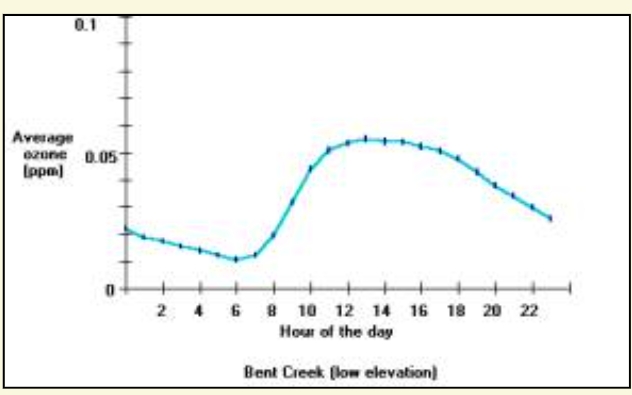
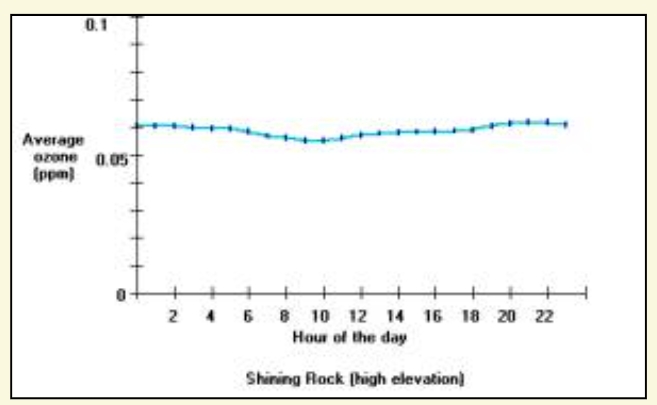
Ozone exposures are usually greatest close to large urban areas like Dallas, Texas; or Atlanta, Georgia. Ozone exposures are higher in these major cities because there are more cars, industry and other nitrogen oxide emissions sources then rural areas. Ozone concentrations can increase considerably on hot-sunny days when there is a stagnant air mass (i.e. little to no winds) present. Therefore, ozone is primarily a problem during the summer months, when heat and sunlight are more intense. Furthermore, the ozone formed in cities, or the nitrogen oxides originating in cities can be transported long distances into the rural areas. For example, in western North Carolina, the high elevations above 4000 feet have greater ozone exposures than nearby low-elevation areas. For example, the figure below shows the average ozone concentration for each hour of the day for a low elevation and a high elevation ozone-monitoring site. The low elevation site is adjacent to Asheville, North Carolina (called Bent Creek), and the high elevation site is near Shining Rock Wilderness. It is noteworthy that these two sites are about 15 miles apart, and separated by about 3000 feet in elevation.

Average ozone concentrations :
Average ozone concentrations for each hour of the day (April through October 1998) for a low elevation (top) and high elevation (bottom) sites. The low elevation site has a diurnal pattern in the ozone exposure and also shows that at lower elevations the ozone exposures are less than the ozone exposures found at high elevations. Results were produced using the Ozone Calculator.

The Bent Creek data shows a typical pattern (called a diurnal pattern) of ozone concentrations throughout the day (Berry, C.R., 1964). Ozone concentrations begin to rise in the morning and then decrease after the sun sets in the evening. Remember the recipe to form ozone is on warm sunny days, nitrogen oxides react with the VOCs. One pattern the Bent Creek data shows (right) is the ozone concentrations increase as the solar radiation and temperatures increase during the day. The Bent Creek data also reflects people’s daily activities. Typically, electrical generation (a major source of nitrogen oxides) increases in the morning as people get ready for work, and remains high on hot days in order to provide electricity to cool people’s homes and businesses. Also, when people drive to work each day they release nitrogen oxides from the tailpipes of their automobiles. The large amount of nitrogen oxides released early in the day contributes to recipe that forms ozone. The combination of a favorable environment and high nitrogen oxide emissions makes high ozone concentrations during the day.

Conversely, later in the day, many people drive home from work and electrical demand remains high on the hot days – thus there are still large amounts of nitrogen oxides released into the atmosphere. Solar radiation declines until sunset and the temperature also decreases. As nightfall approaches there is a lower likelihood that ozone will form because there is not enough sunlight (ultraviolet radiation) to cause the reactions necessary to form ozone. The nitrogen oxide emissions then serve an interesting role due to their abundance. Instead of contributing to ozone formation, the nitrogen oxides react with the ozone present in the atmosphere and cause a reduction of ozone concentrations during the nighttime. This occurs because nitrogen oxide molecules, in the absence of heat and strong sunlight, remove the third oxygen atom from the unstable ozone molecule.

In mountain valleys, such as occur near Bent Creek, ozone-forming pollution comes from both local and out-of-state sources. Winds can carry ozone formed in urban areas long distances to surrounding rural areas. Much of the ozone pollution at high elevations in the mountains of Western North Carolina is transported by winds from other states. The results from the high elevation ozone monitoring site near Shining Rock Wilderness (figure above) show ozone concentrations do not change throughout the day and that average concentrations are greater than at the Bent Creek site. Consequently, people and vegetation at higher elevations are exposed to more ozone then people and vegetation at low elevations.


Effect on Plants:

These blackberry plants near Shining Rock Wilderness had severe ozone symptoms present in mid-August 1997.Ozone effects on plants are most pronounced when soil moisture and nutrients are adequate and ozone concentrations are high. Under good soil moisture and nutrient conditions the ozone will enter through openings into the leaf and damage the cells that produce the food for the plants. Once the ozone is absorbed into the leaf, some plants spend energy to produce bio-chemicals that can neutralize a toxic effect from the ozone. Other plants will suffer from a toxic effect, and growth loss and/or visible symptoms may occur. The presence of ozone in an area can be detected when consistent and known symptoms are observed on the upper-leaf surface of a sensitive plant species.

For example, some air specialists use blackberry plants as a “bio-indicator” of ground level ozone. The photograph to the right shows the severe reddening of the blackberry foliage near Shining Rock Wilderness in western North Carolina when both adequate soil moisture and high ozone concentrations were present.

The presence of ozone symptoms is not an accurate indicator of how much growth loss has occurred to a sensitive plant from ozone exposure. Therefore, some air resource specialists rely upon measurements taken with ozone monitoring equipment in order to predict if growth loss has occurred. Ozone monitors provides over 4000 ozone readings from April through October. Researchers and technical specialists have examined ways to summarize and use this extensive information. The Ozone Calculator is one tool that has been developed to estimate if ozone exposures recorded at a monitoring site could cause a growth loss to the vegetation.

Exposure Indices :

There are two important statistics used to estimate the growth loss to vegetation when summarizing data from an ozone monitor. The N100 statistic is the number of hours when the measured ozone concentration is greater than or equal to 0.100 parts per million (ppm). Experimental trials with a frequent number of peaks (hourly averages greater than or equal to 0.100 ppm) have been demonstrated to cause greater growth loss to vegetation than trials with no peaks in the exposure regime (Hogsett et al., 1985; Musselman et al., 1983; and Musselman et al., 1986). For this reason, the W126 (Lefohn and Runeckles, 1987) was developed as a biologically meaningful way to summarize hourly average ozone data. The W126 places a greater weight on the measured values as the concentrations increase. Thus, it is possible for a high W126 value to occur with few to no hours above 0.100 ppm. Therefore, it is also necessary to determine the number of hours the ozone concentrations are greater than or equal to 0.100 ppm. It should also be noted the lack of N100 values does not mean ozone symptoms will not be present when field surveys are conducted.

The end….

DEFORESTATION

Deforestation is the process of removal of trees from forest for the human purposes.Deforestation has greatly altered landscapes around the world.Deforestion is one of the major threats to the environment.Deforestation refers to the decrease in forest areas across the world that are lost for other uses such as agricultural croplands, urbanization, or mining activities.Deforestration cause landfall,soil erosion and drought.

The loss of forest is an issue that predominantly affects tropical areas, regions with the highest biodiversity on Earth. In 2018 alone, 30 million acres of tropical rainforest were destroyed, with more than a third of the Earth’s land now being used for agriculture, a process that involves the clearing of woodland to create pasture.Most of this loss has been focussed around the Amazon, a rate of destruction that has only increased in recent years with policy shifts in Brazilian government – 3,769 square miles of Amazonian forest cover was lost between 2018 and 2019.Southeast Asia that has seen the greatest rate of forest loss of anywhere in the world, losing 30% of its forest surface in the last 40 years.

Coupled with huge population growth – with the region’s population forecast to rise by almost 250 million by 2030 – human settlements are increasingly coming into contact with animals that had previously been naturally contained in woodland habitats.The increase of disease linked to deforestation and increased contact between humans and tropical animals speaks to the risks involved when ancient natural ecosystems are disrupted.The loss of trees and other vegetation can cause climate change, desertification, soil erosion, fewer crops, flooding, increased greenhouse gases in the atmosphere, and a host of problems for indigenous people.

Runoff: Surface and Overland Water Runoff

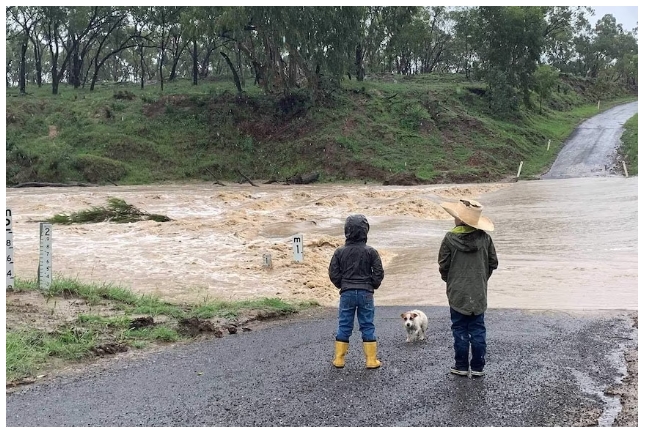
When rain falls onto the earth, it just doesn’t sit there, it starts moving according to the laws of gravity. A portion of the precipitation seeps into the ground to replenish Earth’s groundwater. Most of it flows downhill as runoff. Runoff is extremely important in that not only does it keep rivers and lakes full of water, but it also changes the landscape by the action of erosion. Flowing water has tremendous power it can move boulders and carve out canyons; check out the Grand Canyon!

Runoff of course occurs during storms, and much more water flows in rivers (and as runoff) during storms. For example, in 2001 during a major storm at Peachtree Creek in Atlanta, Georgia, the amount of water that flowed in the river in one day was 7 percent of all the streamflow for the year.

Some definitions of runoff:.                               

1. That part of the precipitation, snow melt, or irrigation water that appears in uncontrolled (not regulated by a dam upstream) surface streams, rivers, drains or sewers. Runoff may be classified according to speed of appearance after rainfall or melting snow as direct runoff or base runoff, and according to source as surface runoff, storm interflow, or groundwater runoff.

2. The sum of total discharges described in (1), above, during a specified period of time.

3. The depth to which a watershed (drainage area) would be covered if all of the runoff for a given period of time were uniformly distributed over it.

Meteorological factors affecting runoff:

Type of precipitation (rain, snow, sleet, etc.)
* Rainfall intensity
* Rainfall amount
* Rainfall duration
* Distribution of rainfall over the watersheds
* Direction of storm movement
Antecedent precipitation and resulting soil moisture
*Other meteorological and climatic conditions that affect evapotranspiration, such as temperature, wind, relative humidity, and season.


Physical characteristics affecting runoff:

* Land use
* Vegetation
* Soil type
* Drainage area
* Basin shape
* Elevation
* Slope
* Topography
* Direction of orientation
* Drainage network patterns
* Ponds, lakes, reservoirs, sinks, etc. in the basin, which prevent or alter runoff from continuing downstream


Runoff and water quality :

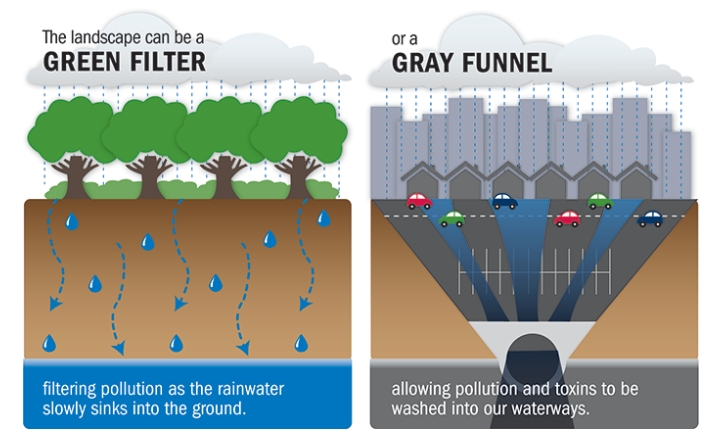
A significant portion of rainfall in forested watersheds is absorbed into soils (infiltration), is stored as groundwater, and is slowly discharged to streams through seeps and springs. Flooding is less significant in these more natural conditions because some of the runoff during a storm is absorbed into the ground, thus lessening the amount of runoff into a stream during the storm.

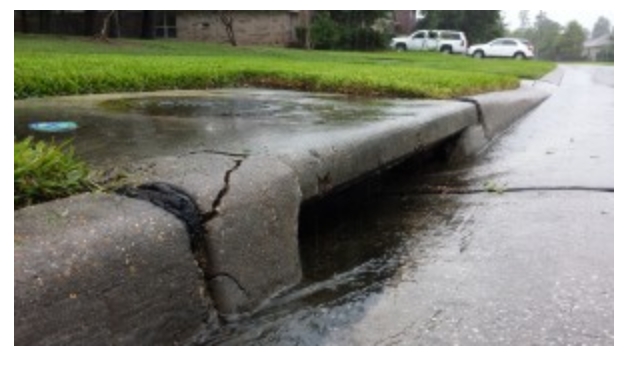
As watersheds are urbanized, much of the vegetation is replaced by impervious surfaces, thus reducing the area where infiltration to groundwater can occur. Thus, more stormwater runoff occurs—runoff that must be collected by extensive drainage systems that combine curbs, storm sewers (as shown in this picture), and ditches to carry stormwater runoff directly to streams. More simply, in a developed watershed, much more water arrives into a stream much more quickly, resulting in an increased likelihood of more frequent and more severe flooding.

What if the street you live on had only a curb built around it, with no stormwater intake such as the one pictured here. Any low points in your street would collect water when it rained. And if your street was surrounded by houses with yards sloping uphill, then all the runoff from those yards and driveways would collect in a lake at the bottom of the street.

A storm sewer intake such as the one in this picture is a common site on almost all streets. Rainfall runoff, and sometimes small kids’ toys left out in the rain, are collected by these drains and the water is delivered via the street curb or drainage ditch alongside the street to the storm-sewer drain to pipes that help to move runoff to nearby creeks and streams. ; storm sewers help to prevent flooding on neighborhood streets.

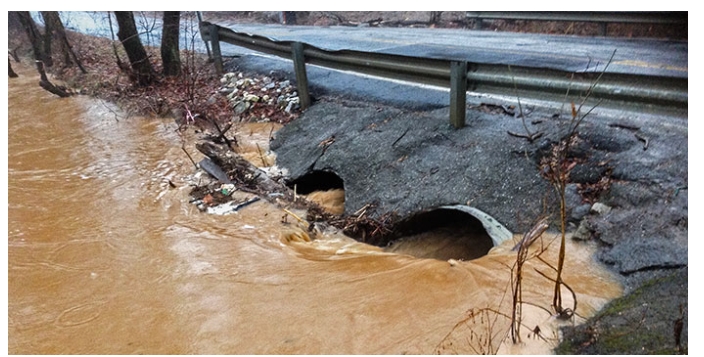
Drainage ditches to carry stormwater runoff to storage ponds are often built to hold runoff and collect excess sediment in order to keep it out of streams.

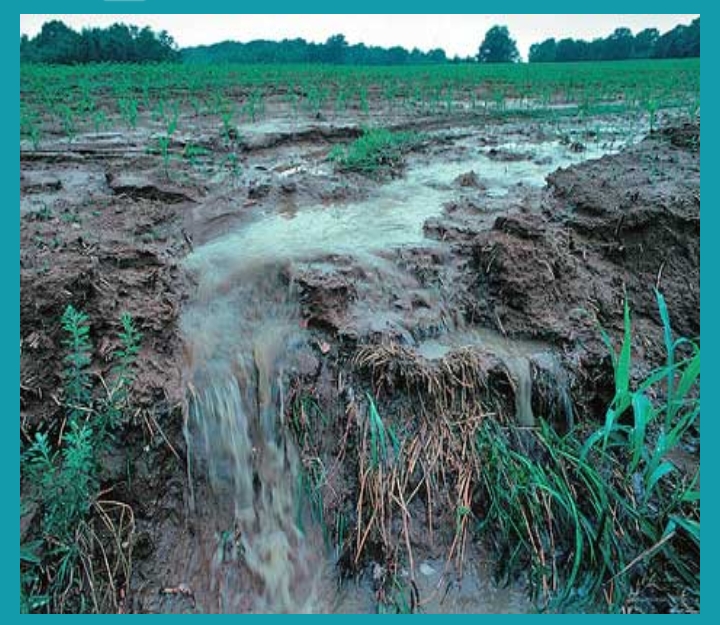
Runoff from agricultural land (and even our own yards) can carry excess nutrients, such as nitrogen and phosphorus into streams, lakes, and groundwater supplies. These excess nutrients have the potential to degrade water quality.

Why might stormwater runoff be a problem?

As it flows over the land surface, stormwater picks up potential pollutants that may include sediment, nutrients (from lawn fertilizers), bacteria (from animal and human waste), pesticides (from lawn and garden chemicals), metals (from rooftops and roadways), and petroleum by-products (from leaking vehicles). Pollution originating over a large land area without a single point of origin and generally carried by stormwater is considered non-point pollution. In contrast, point sources of pollution originate from a single point, such as a municipal or industrial discharge pipe. Polluted stormwater runoff can be harmful to plants, animals, and people.

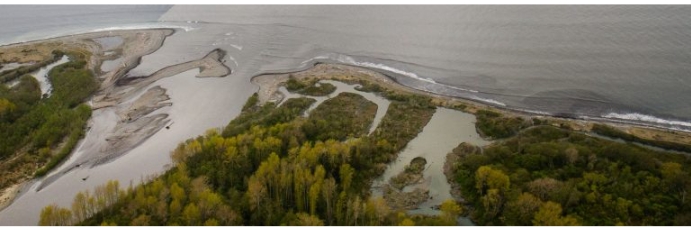
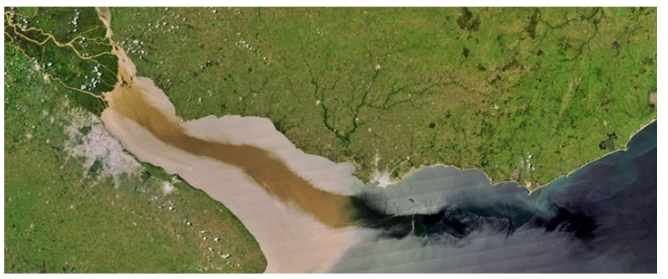
Runoff can carry a lot of sediment

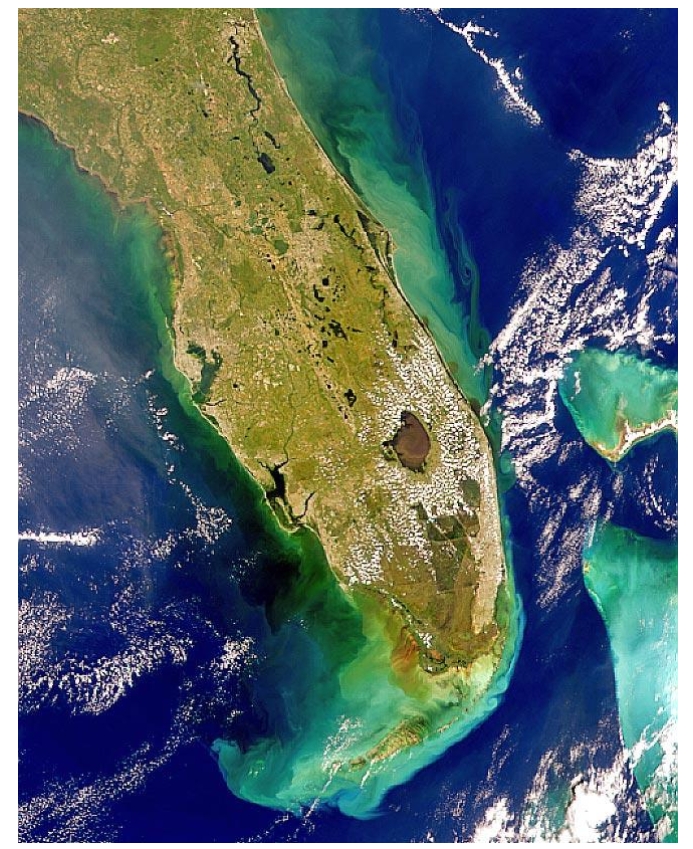
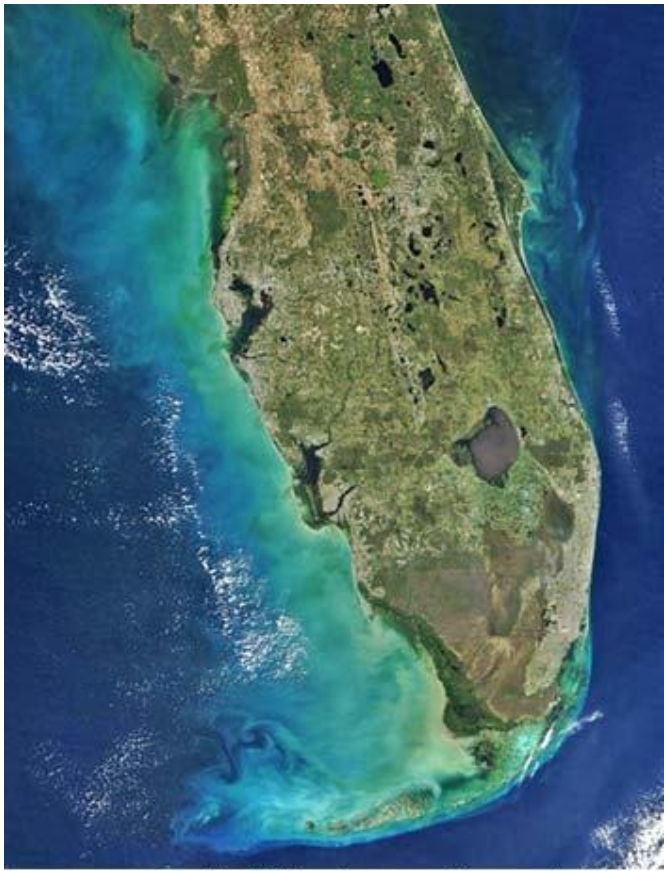
When storms hit and streamflows increase, the sediment moved into the river by runoff can end up being seen from hundreds of miles up by satellites. The right-side pictures shows the aftermath of Hurricane Irene in Florida in October 1999. Sediment-filled rivers are dumping tremendous amounts of suspended sediment into the Atlantic Ocean. The sediment being dumped into the oceans has an effect on the ecology of the oceans, both in a good and bad way. And, this is one of the ways that the oceans have become what they are: salty.

Florida, Oct. 14, 1999. When Hurricane Irene passed over Florida in 1999, the heavy rainfall over land caused extensive amounts of runoff that first entered Florida’s rivers which then dumped the runoff water, containing lots of sediment, into the Atlantic Ocean.

Florida, Dec. 16, 2002. The east coast of Florida is mostly clear of sediment from runoff. The shallow coastal waters to the west of Florida are very turbid (sediment-filled), perhaps from a storm that passed over a few days earlier.

The end.….

MISSILE MAN – DR.A.P.J.ABDUL KALAM

Abdul Kalam is the Indian aerospace scientist.He was born in Rameswaram in Tamil Nadu at 15 October 1931.His full name was Avul Pakir Jainulabdeen Abdul Kalam.He studied schooling in manadapam panchayat union middle school and Schwartz higher secondary school.He did college in st. Joseph,Trichy and Madras institute of technology, chennai.He was also the President of India in 2002-2007.

He played a leading role in the development of India’s missile and nuclear weapons programs. He called as missile man of india for the development of ballistic missile and launch vehicle technology.He lived a simple living and high thinking. He was a true patriot, a man who believed in the empowerment of students and made missiles but talked of peace. He firmly believed that educational opportunities should be provided to all children as that was the only way to remove poverty.

HONORS FOR DR.A.P.J.ABDUL KALAM:-

* 2014- Honorary professor.

* 2014 Honorary professor Beijing University, China.


2014 Doctor of Science Edinburgh University, Uk.


2013 Von Braun Award National Space Society.


2012 Doctor of Laws (Honoris Causa) Simon Fraser University.


2011 IEEE Honorary Membership IEEE.


2010 Doctor of Engineering University of Waterloo.


2009 Honorary Doctorate Oakland University.


2009 Hoover Medal ASME Foundation, USA.


2009 International von Kármán Wings Award California Institute of Technology, USA.


2008 Doctor of Engineering (Honoris Causa) Nanyang Technological University, Singapore.


2008 Doctor of Science (Honoris Causa) Aligarh Muslim University, Aligarh.


2007 Honorary Doctorate of Science and Technology Carnegie Mellon University.


2007 King Charles II Medal Royal Society, UK.


2007 Honorary Doctorate of Science University of Wolverhampton, UK.


2000 Ramanujan Award Alwars Research Centre, Chennai.


1998 Veer Savarkar Award Government of India.


1997 Indira Gandhi Award for National Integration Indian National Congress.


1997 Bharat Ratna Government of India.


1995 Honorary Fellow National Academy of Medical Sciences.


1994 Distinguished Fellow Institute of Directors (India).


1990 Padma Vibhushan Government of India.


1981 Padma Bhushan Government of India.

HIS GOAL:-

* Planting trees.

* Educating students.

” Dream comes in sleep is not a Dream Dream which not let you to sleep is a dream”.

– DR.A.P.J.ABDUL KALAM

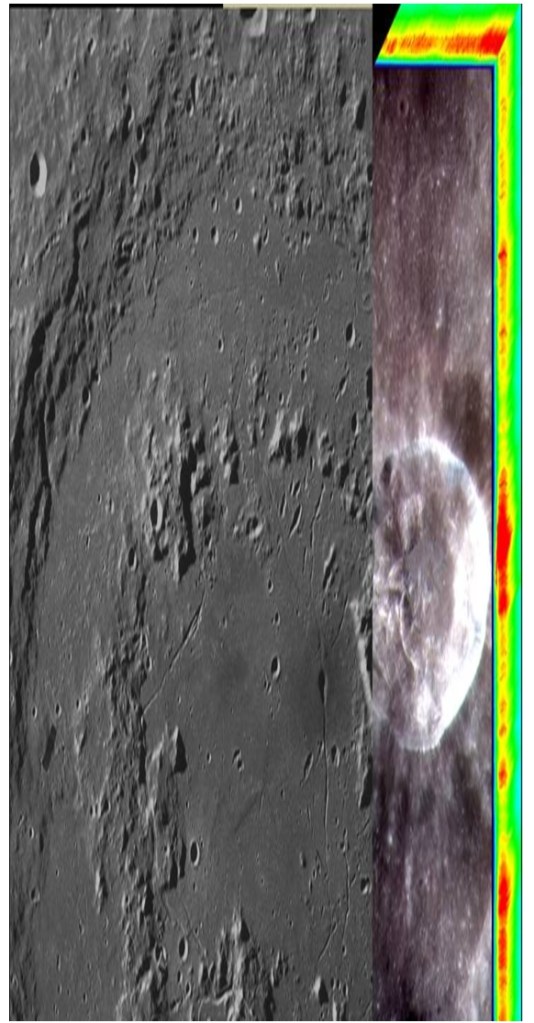
CHANDRAYAAN-1India’s First Lunar Exploration Mission. Moon Mineralogy Mapper observations point to possibility of water on the Moon!

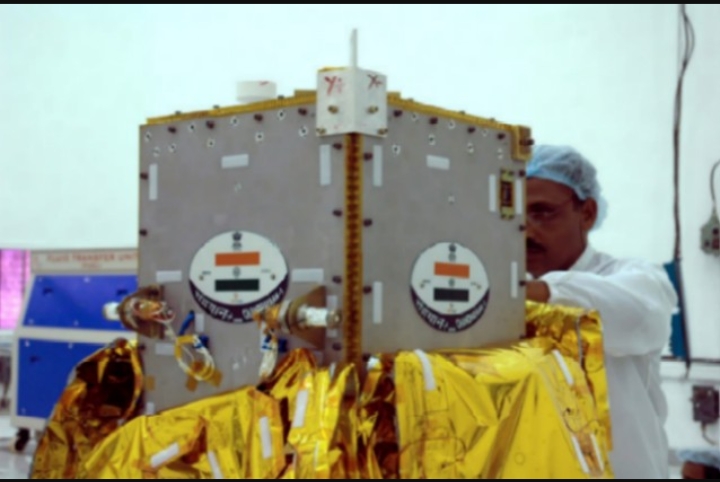
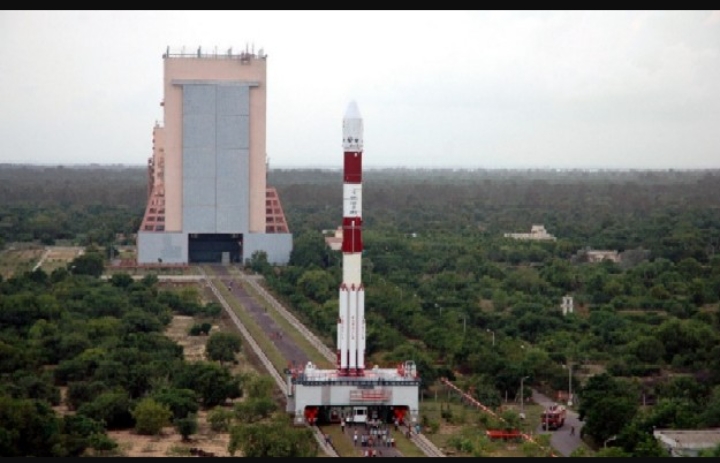
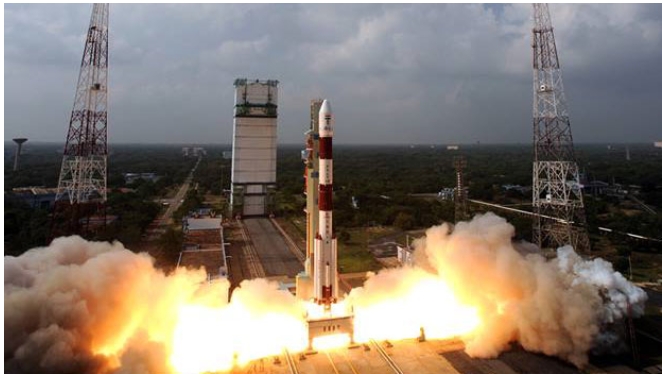
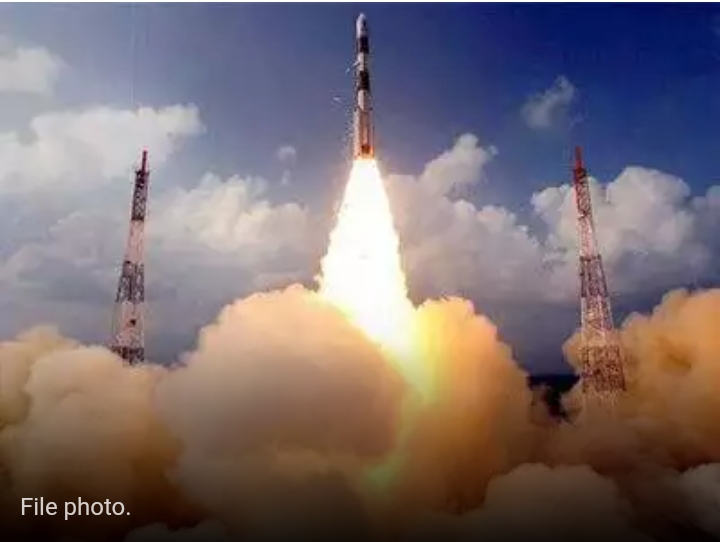
Chandrayaan-1, India’s first mission to Moon, was launched successfully on October 22, 2008 from SDSC SHAR, Sriharikota. The spacecraft was orbiting around the Moon at a height of 100 km from the lunar surface for chemical, mineralogical and photo-geologic mapping of the Moon. The spacecraft carried 11 scientific instruments built in India, USA, UK, Germany, Sweden and Bulgaria.


After the successful completion of all the major mission objectives, the orbit has been raised to 200 km during May 2009. The satellite made more than 3400 orbits around the moon and the mission was concluded when the communication with the spacecraft was lost on August 29, 2009.

The idea of undertaking an Indian scientific mission to Moon was initially mooted in a meeting of the Indian Academy of Sciences in 1999 that was followed up by discussions in the Astronautical Society of India in 2000.

Based on the recommendations made by the learned members of these forums, a National Lunar Mission Task Force was constituted by the Indian Space Research Organisation (ISRO). Leading Indian scientists and technologists participated in the deliberations of the Task Force that provided an assessment on the feasibility of an Indian Mission to the Moon as well as dwelt on the focus of such a mission and its possible configuration.

After detailed discussions, it was unanimously recommended that India should undertake the Mission to Moon, particularly in view of the renewed international interest in moon with several exciting missions planned for the new millennium. In addition, such a mission could provide the needed thrust to basic science and engineering research in the country including new challenges to ISRO to go beyond the Geostationary Orbit. Further, such a project could also help bringing in young talents to the arena of fundamental research. The academia would also find participation in such a project intellectually rewarding.

Subsequently, Government of India approved ISRO’s proposal for the first Indian Moon Mission, called Chandrayaan-1 in November 2003.

The Chandrayaan-1 mission performed high-resolution remote sensing of the moon in visible, near infrared (NIR), low energy X-rays and high-energy X-ray regions. One of the objectives was to prepare a three-dimensional atlas (with high spatial and altitude resolution) of both near and far side of the moon. It aimed at conducting chemical and mineralogical mapping of the entire lunar surface for distribution of mineral and chemical elements such as Magnesium, Aluminium, Silicon, Calcium, Iron and Titanium as well as high atomic number elements such as Radon, Uranium & Thorium with high spatial resolution.

Various mission planning and management objectives were also met. The mission goal of harnessing the science payloads, lunar craft and the launch vehicle with suitable ground support systems including Deep Space Network (DSN) station were realised, which were helpful for future explorations like the Mars Orbiter Mission. Mission goals like spacecraft integration and testing, launching and achieving lunar polar orbit of about 100 km, in-orbit operation of experiments, communication/ telecommand, telemetry data reception, quick look data and archival for scientific utilisation by scientists were also met.

PSLV-C11
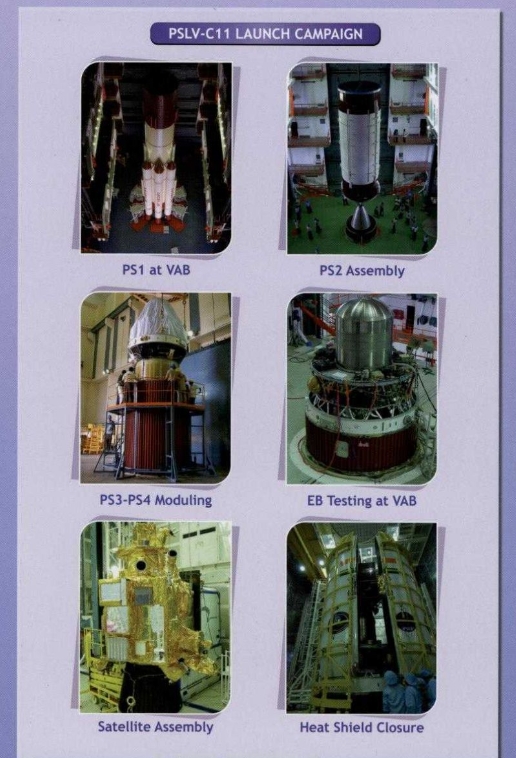
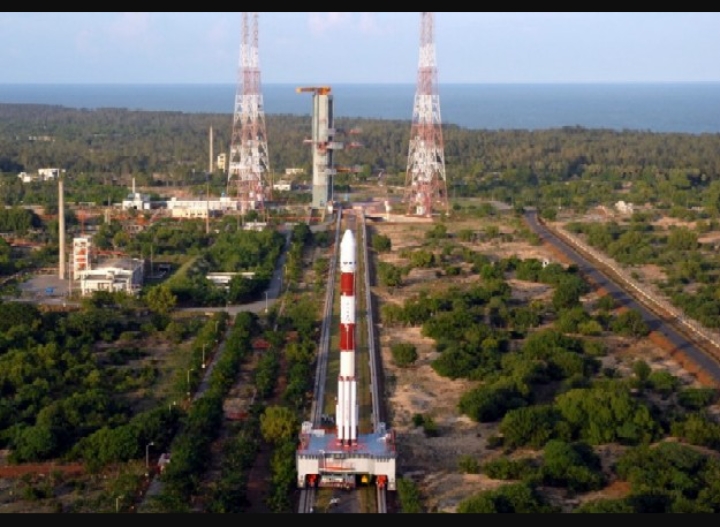
PSLV-C11, chosen to launch Chandrayaan-1 spacecraft, was an updated version of ISRO’s Polar Satellite Launch Vehicle standard configuration. Weighing 320 tonne at lift-off, the vehicle used larger strap-on motors (PSOM-XL) to achieve higher payload capability.

PSLV is the trusted workhorse launch Vehicle of ISRO. During September 1993- April 2008 period, PSLV had twelve consecutively successful launches carrying satellites to Sun Synchronous, Low Earth and Geosynchronous Transfer Orbits. On October 22, 2008, its fourteenth flight launched Chandrayaan-1 spacecraft.

By mid 2008, PSLV had repeatedly proved its reliability and versatility by launching 29 satellites into a variety of orbits. Of these, ten remote sensing satellites of India, an Indian satellite for amateur radio communications, a recoverable Space Capsule (SRE-1) and fourteen satellites from abroad were put into polar Sun Synchronous Orbits (SSO) of 550-820 km heights. Besides, PSLV has launched two satellites from abroad into Low Earth Orbits of low or medium inclinations. This apart, PSLV has launched KALPANA-1, a weather satellite of India, into Geosynchronous Transfer Orbit (GTO).

PSLV was initially designed by ISRO to place 1,000 kg class Indian Remote Sensing (IRS) satellites into 900 km polar SunSynchronous Orbits. Since the first successful flight in October 1994, the capability of PSLV was successively enhanced from 850 kg to 1,600 kg. In its ninth flight on May 5, 2005 from the Second Launch Pad (SLP), PSLV launched ISRO’s remote sensing satellite,1,560 kg CARTOSAT-1 and the 42 kg Amateur Radio satellite, HAMSAT, into a 620 km polar Sun Synchronous Orbit. The improvement in the capability over successive flights has been achieved through several means. They include increased propellant loading in the stage motors, employing composite material for the satellite mounting structure and changing the sequence of firing of the strap-on motors.

Vikram Sarabhai Space Centre (VSSC), Thiruvananthapuram, designed and developed PSLV-C11. ISRO Inertial Systems Unit (IISU) at Thiruvananthapuram developed the inertial systems for the vehicle. Liquid Propulsion Systems Centre (LPSC), also at Thiruvananthapuram, developed the liquid propulsion stages for the second and fourth stages of PSLV-C11 as well as reaction control systems. SDSC SHAR processed the solid motors and carries out launch operations. ISRO Telemetry, Tracking and Command Network (ISTRAC) provide telemetry, tracking and command support during PSLV-C11’s flight

Who can submit a Proposal?

Proposals could be submitted by individuals or a group of scientists and academicians belonging to recognized institutions, universities, planetaria and government organisations of India. Only those having at least a minimum remaining service of four years before superannuation are eligible to lead the project as PI/Co-PI. The proposals must be forwarded through the Head of the Institution, with appropriate assurance for providing necessary facilities for carrying out the projects under this AO programme. The end….

GLOBAL WARMING

WHAT IS GLOBAL WARMING:-

Global warming is defined as the global annual temperature has increased in total by a little more than 1 degree Celsius, or about 2 degrees Fahrenheit. Global warming is mainly because of the industrial revolution, burning plastics.

CAUSES OF GLOBAL WARMING:-

* Greenhouse Gases Are the Main Reasons for Global Warming.

* Another main reason for global warming is the industries.

* Deforestation is one of the reason for global warming.

* The smoke from vehicles.

EFFECTS OF GLOBAL WARMING:-

* Global warming cause increase in temperature that raises sea level can cause flood.

* Global warming raises temperature in the atmosphere.

* Melting of glaciers are one of the most threat for the earth

* If global warming cause increase in temperature then there is threat for availablity of water.

* It also cause some diseases like allergies,chest pain etc.

CONTROLLING MEASURES OF GLOBAL WARMING:-

* By decreasing deforestation and encouraging affrostration

* By making awareness programmes.

* By using natural products instead of plastics.

* By reducing burning of fossil fuels.

* By recycling the products.

LUNAR ECLIPSE

A lunar eclipse occurs when the Moon moves into the Earth’s shadow.This can occur only when the Sun, Earth, and Moon are exactly or very closely aligned (in syzygy) with Earth between the other two, and only on the night of a full moon. The type and length of a lunar eclipse depend on the Moon’s proximity to either node of its orbit.

Totality during the lunar eclipse of 21 January 2019. Direct sunlight is being blocked by the Earth, and the only light reaching it is sunlight refracted by Earth’s atmosphere, producing a reddish color.

Latter phases of the partial lunar eclipse on 17 July 2019 taken from GloucestershireUnited Kingdom.

A totally eclipsed Moon is sometimes called a blood moon for its reddish color, which is caused by Earth completely blocking direct sunlight from reaching the Moon. The only light reflected from the lunar surface has been refracted by Earth’s atmosphere. This light appears reddish for the same reason that a sunset or sunrise does: the Rayleigh scattering of bluer light.

Unlike a solar eclipse, which can only be viewed from a relatively small area of the world, a lunar eclipse may be viewed from anywhere on the night side of Earth. A total lunar eclipse can last up to nearly 2 hours, while a total solar eclipse lasts only up to a few minutes at any given place, because the Moon’s shadow is smaller. Also unlike solar eclipses, lunar eclipses are safe to view without any eye protection or special precautions, as they are dimmer than the full Moon.

Types of Lunar Eclipse:

A schematic diagram of the shadow cast by Earth. Within the umbra, the central region, the planet totally shields direct sunlight. In contrast, within the penumbra, the outer portion, the sunlight is only partially blocked. (Neither the Sun, Moon, and Earth sizes nor the distances between the bodies are to scale.)

A total penumbral lunar eclipse dims the Moon in direct proportion to the area of the Sun’s disk covered by Earth. This comparison of the Moon (within the southern part of Earth’s shadow) during the penumbral lunar eclipse of January 1999 (left) and the Moon outside the shadow (right) shows this slight darkening.

Penumbral Lunar Eclipse

This occurs when the Moon passes through Earth’s penumbra. The penumbra causes a subtle dimming of the lunar surface, which is only visible to the naked eye when about 70% of the Moon’s diameter has immersed into Earth’s penumbra.A special type of penumbral eclipse is a total penumbral lunar eclipse, during which the Moon lies exclusively within Earth’s penumbra. Total penumbral eclipses are rare, and when these occur, the portion of the Moon closest to the umbra may appear slightly darker than the rest of the lunar disk.

Partial lunar eclipse

This occurs when only a portion of the Moon enters Earth’s umbra, while a total lunar eclipse occurs when the entire Moon enters the planet’s umbra. The Moon’s average orbital speed is about 1.03 km/s (2,300 mph), or a little more than its diameter per hour, so totality may last up to nearly 107 minutes. Nevertheless, the total time between the first and the last contacts of the Moon’s limb with Earth’s shadow is much longer and could last up to 236 minutes.

Total lunar eclipse

This occurs when the moon falls entirely within the earth’s umbra. Just prior to complete entry, the brightness of the lunar limb– the curved edge of the moon still being hit by direct sunlight– will cause the rest of the moon to appear comparatively dim. The moment the moon enters a complete eclipse, the entire surface will become more or less uniformly bright. Later, as the moon’s opposite limb is struck by sunlight, the overall disk will again become obscured.

This is because as viewed from the Earth, the brightness of a lunar limb is generally greater than that of the rest of the surface due to reflections from the many surface irregularities within the limb: sunlight striking these irregularities is always reflected back in greater quantities than that striking more central parts, and is why the edges of full moons generally appear brighter than the rest of the lunar surface.

Central lunar eclipse

This is a total lunar eclipse during which the Moon passes through the centre of Earth’s shadow, contacting the antisolar point. This type of lunar eclipse is relatively rare.

The relative distance of the Moon from Earth at the time of an eclipse can affect the eclipse’s duration. In particular, when the Moon is near apogee, the farthest point from Earth in its orbit, its orbital speed is the slowest. The diameter of Earth’s umbra does not decrease appreciably within the changes in the Moon’s orbital distance. Thus, the concurrence of a totally eclipsed Moon near apogee will lengthen the duration of totality.

Selenelion

A selenelion or selenehelion, also called a horizontal eclipse, occurs where and when both the Sun and an eclipsed Moon can be observed at the same time. The event can only be observed just before sunset or just after sunrise, when both bodies will appear just above opposite horizons at nearly opposite points in the sky. A selenelion occurs during every total lunar eclipse it is an experience of the observer, not a planetary event separate from the lunar eclipse itself. Typically, observers on Earth located on high mountain ridges undergoing false sunrise or false sunset at the same moment of a total lunar eclipse will be able to experience it. Although during selenelion the Moon is completely within the Earth’s umbra, both it and the Sun can be observed in the sky because atmospheric refraction causes each body to appear higher (i.e., more central) in the sky than its true geometric planetary position.

Timing

The timing of total lunar eclipses is determined by what are known as its “contacts” (moments of contact with Earth’s shadow)

P1 (First contact): Beginning of the penumbral eclipse. Earth’s penumbra touches the Moon’s outer limb.
U1 (Second contact): Beginning of the partial eclipse. Earth’s umbra touches the Moon’s outer limb.
U2 (Third contact): Beginning of the total eclipse. The Moon’s surface is entirely within Earth’s umbra.
Greatest eclipse: The peak stage of the total eclipse. The Moon is at its closest to the center of Earth’s umbra.
U3 (Fourth contact): End of the total eclipse. The Moon’s outer limb exits Earth’s umbra.
U4 (Fifth contact): End of the partial eclipse. Earth’s umbra leaves the Moon’s surface.
P4 (Sixth contact): End of the penumbral eclipse. Earth’s penumbra no longer makes contact with the Moon.

Danjon scale:

L = 0: Very dark eclipse. Moon almost invisible, especially at mid-totality.
L = 1: Dark eclipse, gray or brownish in coloration. Details distinguishable only with difficulty.
L = 2: Deep red or rust-colored eclipse. Very dark central shadow, while outer edge of umbra is relatively bright.
L = 3: Brick-red eclipse. Umbral shadow usually has a bright or yellow rim.
L = 4: Very bright copper-red or orange eclipse. Umbral shadow is bluish and has a very bright rim.

Anthropology And Its Relation With Allied Disciplines

Anthropology And Social Sciences

1. Sociology

Sociology is a science of society that studies human behaviour in groups. Anthropology is a science of man and studies human behaviour in social surroundings. Thus it is clear that the subject matter of sociology and social anthropology is common to a great extent. Anthropologists and sociologists share an interest in
issues of race, ethnicity, social class, gender, and power relations in
modern nations.

2. Psychology

For the psychologists the focus of study is upon all aspects of human behaviour: and its personal, social and cultural dimensions which will never be complete without having the knowledge of social anthropology. Therefore, for understanding the social processes and
meanings in the world around us one has to study social anthropology.
Both Psychology and Anthropology deals with the manifold relations between individuals on the one hand and groups, communities, societies and cultures on the other hand.

3. History

History may be important to social anthropologists in the sense, that is, not only as an account of past events leading up to and explaining the present, but also as the body of contemporary ideas which
people have about these events, people’s ideas about the past are an intrinsic part of the contemporary situation which is the anthropologists immediate concern and often they have important implications for existing social relationships.

4. Folklore

Folklore has an important place in every primitive culture. It
is through the medium of folklores that the culture of a primitive society is
transmitted from one generation to the next generation. Folklores contain
the philosophy of the primitive people. How the world was evolved is a
theme of many folklores of existing tribes. In most of the folklores, a reference to the mutual relation of the people and their gods is given.

Anthropology And Biological Sciences

1. Zoology

In terms of the relationship to other animals and the overall places of the human species in the process of evolutions.
Anthropology has a sort of specialization or sharpening of certain aspects of general biology, more specifically, zoology.

2. Botany

No matter what the time period or geographical area, plants played an important role in human culture. Plant remains enable us to assess human impact on the environment. As direct, site-specific
evidence of agricultural and culinary activities, they enrich our understanding of how people lived.

3. Genetics

Genetic anthropology is the branch of scientific study which deals with combining genetic data with available physical evidence and past history. Genetic anthropology is an important branch
of anthropology. The relevance of genetics in anthropology has slowly been reinforcing the importance of nature (biology) in culture, and also
emphasises on the phenomena of variation. To study evolution, understanding genetics and variation in the anthropological context is
highly vital.

4. Medical Sciences

Quite a few things are common in
anthropology and medicine. In the proper study of mankind, anthropology aims at discovering man as a human being, so it should be the case with a physician. Anthropology can assist more clearly and
satisfactorily in identifying the health needs, and in clarifying factors influencing acceptability and utilisation of health services, and can also assist in showing how these health needs can be most appropriately
solved.

THANJAVUR-BIG TEMPLE

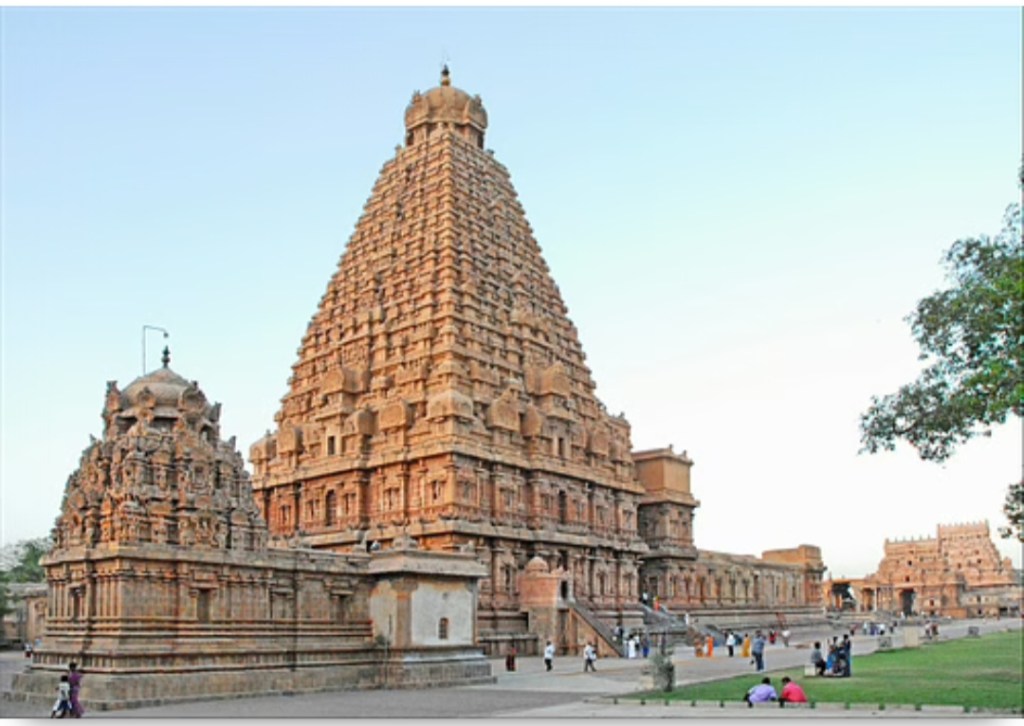
This Temple is situated in Thanjavur Tamil Nadu.It is constructed by Raja Raja chola in 1003 and 1010 A.D. This temple is originally known as Peruvudaiyar Kovil locally known as Thanjai Periya Kovil, and also called Rajarajeswaram, is a Hindu temple dedicated to Shiva located in South bank of Cauvery river in Thanjavur, Tamil Nadu, India. It is one of the largest Hindu temples and an exemplary example of a fully realized Tamil architecture.[4] It is called as Dakshina Meru.In top of the temple they built the vimana which is one of the highest in South India.

The main temple along with its gopurams is from the early 11th century. The temple also saw additions, renovations, and repairs over the next 1,000 years. Because the kings who made wars caused damaged to the temple And it is renovated by the Hindu dynasty.The main temple-related monuments and the great tower is in the middle of this courtyard Around the main temple that is dedicated to Shiva, are smaller shrines, most of which are aligned axially. These are dedicated to his consort Parvati, his sons Subrahmanya and Ganesha, Nandi, Varahi, Karvur deva As a world heritage monument, the temple and the premises comes under the Archaeological Survey of India (ASI) which falls under the Ministry of Culture of the Government of India, to ensure safety, preservation and restoration.The lighting of the monument is designed to enhance the natural color of the stone along with the sculptural forms adorning all corners of the temple. The restoration has been undertaken by the Archaeological Survey of India.

CHANDRAYAAN -2

Chandrayaan2 is India’s second lunar probe, and its first attempt to make a soft landing on the Moon. It has an Orbiter, which will go around the Moon for a year in an orbit of 100 km from the surface, and a Lander and a Rover that will land on the Moon. Once there, the Rover will separate from the Lander, and will move around on the lunar surface. Both the Lander and the Rover are expected to be active for one month.

CHANDRAYAAN BEGUN ITS JOURNEY: Chandrayaan-2 satellite had begun its journey towards the moon leaving the earth’s orbit in the dark hours on August 14, after a crucial maneuver called Trans Lunar Insertion (TLI) that was carried out by Isro to place the spacecraft on “Lunar Transfer Trajectory”

India’s Moon mission: Chandrayaan-2 will be a ground-breaking mission to the south pole of the moon and should land on a high plain between two craters, Manzinus C and Simpelius N, which are around 70° south.

India’s Geosynchronous Satellite Launch Vehicle, GSLV MkIII-M1 had successfully launched the 3,840-kg Chandrayaan-2 spacecraft into the earth’s orbit on July 22.

In a major milestone for India’s second Moon mission, the Chandrayaan-2 spacecraft had successfully entered the lunar orbit on August 20 by performing Lunar Orbit Insertion (LOI) maneuver. On August 22, Isro released the first image of the moon captured by Chandrayaan-2. On September 2,Vikram’ successfully separated from the orbiter, following which two de-orbiting manoeuvres were performed to bring the lander closer to the Moon.

Vikram’ and ‘Pragyan’

As India attempted a soft landing on the lunar surface on September 7, all eyes were on the lander ‘Vikram’ and rover ‘Pragyan’.

The 1,471-kg ‘Vikram‘, named after Vikram Sarabhai, father of the Indian space programme, was designed to execute a soft landing on the lunar surface, and to function for one lunar day, which is equivalent to about 14 earth days.

Chandrayaan, which means “moon vehicle” in Sanskrit, exemplifies the resurgence of international interest in space. The US, China and private corporations are among those racing to explore everything from resource mining to extraterrestrial colonies on the moon and even Mars.

LAUNCHED IN: India’s second mission to the Moon, Chandrayaan-2 was launched on 22nd July 2019 from Satish Dhawan Space Center, Sriharikota. The Orbiter which was injected into a lunar orbit on 2nd Sept 2019, carries 8 experiments to address many open questions on lunar science.

India’s ambitious mission to land on the Moon failed. The Vikram lander, of the Chandrayaan 2 mission, crashed on the lunar surface on September 7, 2019, but it was only in December that scientists found it. Why did it take so long to find the lander?

There are quite a few technical reasons for that. Let’s start with a quick recap of what happened on the landing day.

who said three days after the landing day that they had spotted the lander. ISRO failed to show any pictures or provide location coordinates to the public despite the claims.

The statement is in fact only the third and the last time ISRO publicly spoke of the lander’s condition. However, it didn’t stop ISRO from coming out of the slumber and boasting that they found the lander first, i.e. before NASA did with help from Subramanian.

Going by the publicly available evidence, NASA found the Vikram lander on the Moon’s surface, not ISRO. And what does Chandrayaan 2’s landing failure mean for ISRO? Go back to the launch pad.

The end ..

Poverty in India

Poverty is the state of not having enough material possessions or income for a person basic needs. Poverty may include social, economic, and political elements. Absolute poverty is the complete lack of the means necessary to meet basic personal needs, such as food, clothing, and shelter. Poverty is linked with negative conditions such as substandard housing, homelessness, inadequate nutrition and food insecurity, inadequate child care, lack of access to health care, unsafe neighborhoods, and under resourced schools which adversely impact our nation’s children.

There are several definitions of poverty, and scholars disagree as to which definition is appropriate for India. Inside India, both income-based poverty definition and consumption-based poverty statistics are in use. Outside India, the World Bank and institutions of the United Nations use a broader definition to compare poverty among nations, including India, based on purchasing power parity (PPP), as well as a nominal relative basis. Each state in India has its poverty threshold to determine how many people are below its poverty line and to reflect regional economic conditions. These differences in definitions yield a complex and conflicting picture about poverty in India, both internally and when compared to other developing countries of the world. 

More than 800 million people in India are considered poor. Most of them live in the countryside and keep afloat with odd jobs. The lack of employment which provides a livable wage in rural areas is driving many Indians into rapidly growing metropolitan areas such as Bombay, Delhi, Bangalore or Calcutta. There, most of them expect a life of poverty and despair in the mega-slums, made up of millions of corrugated ironworks, without sufficient drinking water supply, without garbage disposal and in many cases without electricity. Poor hygiene conditions cause diseases such as cholera, typhus and dysentery, which affects children more. 

Poverty in India impacts children, families and individuals in a variety of different ways through:

  • High infant mortality
  • Malnutrition
  • Child labour
  • Lack of education
  • Child marriage
  • HIV / AIDS

Since the 1950s, the Indian government and non-governmental organisations have initiated several programs to alleviate poverty, including subsidising food and other necessities, increased access to loans, improving agricultural techniques and price supports, promoting education and family planning. These measures have helped eliminate famines, cut absolute poverty levels by more than half, and reduce illiteracy and malnutrition.

Around 75 million more people in India fell into poverty last year because of the pandemic-induced economic recession, compared with what it would have been without the outbreak, an analysis by Pew Research Center showed on Thursday. That number in India accounts for nearly 60% of the global increase in poverty in 2020, the analysis showed. It defined the poor as people who live on $2 or less daily.

India has achieved annual growth exceeding 7 per cent over the last 15 years and continues to pull millions of people out of poverty, according to the World Bank. The country has halved its poverty rate over the past three decades and has seen strong improvements in most human development outcomes, a report by the international financial institution has found. Growth is expected to continue and, the elimination of extreme poverty in the next decade is within reach, said the bank, which warned that the country’s development trajectory faces considerable challenges. 

Rail Transport in India

Rail transport is the most commonly used mode of long-distance transportation in India. Indian Railways (IR) is the primary operator of rail operations throughout the country, a state-owned organization of the Ministry of Railways, which historically had its government budget. The rail network traverses the length and width of the country, covering a total of 63,140 km (39,200 miles).

It is one of the world’s largest and busiest rail networks, transporting over 5 billion passengers and over 350 million tonnes of freight annually. Its operations cover 28 states and 3 Union territories and link the neighbouring countries of Nepal, Bangladesh and Pakistan. In March 2020, the national rail network comprised 126,366 km (78,520 mi) of track over a route of 67,368 km (41,861 mi) and 7,325 stations. It is the fourth-largest national railway network in the world (after those of the United States, Russia, and China).

Indian Railways is headed by a Four-member Railway Board whose chairman reports to the Ministry of Railways. The Railway Board also acts as the Ministry of Railways. The officers manning the office of Railway Board are mostly from organised Group A Railway Services and Railway Board Secretariat Service. IR is divided into 18 zones, headed by general managers who report to the Railway Board. The zones are further subdivided into 71 operating divisions headed by divisional railways managers (DRM).

A plan for a rail system in India was first put forward in 1832, but no further steps were taken for more than a decade. In 1844, the Governor-General of India Lord Hardinge allowed private entrepreneurs to set up a rail system in India. Two new railway companies were created and the East India Company was asked to assist them. Interest from a lot of investors in the UK led to the rapid creation of a rail system over the next few years.

Railways were first introduced to India in 1853, and by 1947, the year of India’s independence, they had grown to forty-two rail systems. In 1951 the systems were nationalised as one unit to become one of the largest networks in the world. India’s first passenger train, operated by the Great Indian Peninsula Railway and hauled by three steam locomotives (SahibSindh and Sultan), ran for 34 kilometres (21 mi) with 400 people in 14 carriages on 1,676 mm (5 ft 6 in) broad gauge track between Bori Bunder (Mumbai) and Thane on 16 April 1853.

It was as late as 1895 that India saw the birth of its first locomotive. The locomotive, an F class 0-6-0 metre gauge numbered F-734, was built at Ajmer for the Rajputana Malwa Railway. It weighed 38 tonnes. The locomotive, to be used for hauling mixed trains, was built at a cost of Rs 15,869. This locomotive has outside connecting rods and side rods. It was also used on the Bombay Baroda and Central India Railway (BB&CI) network. Today, the locomotive has been stored as one of the outdoor exhibits at the National Railway Museum, New Delhi.

In June 1950, the Railway Board put forward a plan to divide the railways in India into six zones to get things organized. However, after some formalities, the actual plan was implemented a year later, by April 1951.

On April 14, 1951, the Southern Railway was formed by merging the Madras Railway, the South Marhatta Railway, the South Indian Railway and the Mysore Railway. On November 5, 1951, the Central Railway was constituted by bringing together the Great Indian Peninsula Railway (GIPR), the Nizam Railway, the ScindiaRailway and the Dholpur Railway.

On the same day, the Western Railway was constituted by merging the Bombay Baroda and Central India Railway (BB&CI), the Sourashtra Railway, the Rajasthan Railway and Jaipur Railway. The merger of Eastern Punjab Railway, the Jodhpur Railway, the Bikaner Railway and some upper divisions of the East India Railway led to the formation of the Northern Railway on April 14, 1952.  Oudh Railway, Tirhut Railway and the Assam Railway formed the North Eastern Railway and the remaining divisions of the East India Railway and the Bengal Nagpur Railway constituted the Eastern Railway on the same day. These were the first six zones of Indian Railways.

On March 31, 1978, the railways were split into nine zones. The Northern zone with its headquarters at Delhi (Delhi junction), the North Eastern zone with its headquarters at Gorakhpur, the North East Frontier with its headquarters at Maligaon (Guwahati), the eastern zone with its headquarters at Kolkatta (Howrah junction), the south eastern zone with its headquarters at Kolkatta again (Howrah junction), the south central zone with its head offices at Secunderabad, the southern zone at Chennai (Chennai Central) and the Central and Western Railways with their administrative headquarters at CST and Churchgate respectively.

In 1977, the country’s first railway museum was set up at Chanakyapuri, New Delhi. The first of its kind in the country, this unique museum covers a land area of over 10 acres, comprising an elegantly designed octagonal building housing nine display galleries and a large open area laid out to simulate a Railway Yard. With constant emphasis on improvements and additions, the museum can now boast of being one of the finest rail museums in the world and a very popular tourist attraction of the country’s capital. On an average, this museum has around 1,000 visitors daily.

Marine Pollution

INTRODUCTION

Pollution in ocean is a major problem that is affecting the ocean and the rest of the Earth, too.Pollution in the ocean directly affects ocean organisms and indirectly affects human health and resources.Oil spills, toxic wastes, and dumping of other harmful materials are all major sources of pollution in the ocean.

Marine Pollution:

Marine pollution is a combination of chemicals and trash,most of which comes from land sources and is washed
or blown into the ocean.

CAUSES:

Some of the main causes for the marine pollution is as follows

• Ocean dumping

Land runoff

• Oil spills

• Littering

• Ocean mining

• Noise pollution

Ocean dumping:

Deliberate disposal of hazardous wastes at sea from vessels, aircraft, platforms or other human-made structures.

Land runoff:

Eighty percent of marine pollution comes from land run off.

Oil spills:

Contamination of seawater due to an oil pour, as a result of an accident or human error, is termed an oil spill.

Littering:

Marine litter is not only ugly it can harm ocean ecosystems wildlife, and humans. It can gure coral reels and bottom dwelling species and entangle or drown ocean wildlife. Some marine animals ingest smaller plastic particles and choke or starve

Ocean Mining (Deep Sea Mining):

Mining under the ocean for gold, silver, copper, cobalt,etc is another source for ocean pollution.Deep sea mining could even make climate change worse. The disruption caused by the machines may release carbon stored in deep sea sediments.

Noise Pollution in the ocean:

Ocean noise refers to sounds made by human activities that can interfere with or obscure the ability of marine animals to hear natural sounds in the ocean.

Devastating Effects of Ocean Pollution:

1. Effect of Toxic Wastes on Marine Animals:

The oil spilled in the ocean could get on to the gills and feathers of marine animals, which makes it difficult for them to move or fly properly or feed their children.

2. Disruption to the Cycle of Coral

Reefs:

Oil spill floats on the surface of the water and prevents sunlight from reaching to marine plants and affects the process of photosynthesis.

3. Depletes Oxygen Content in Water:

When oxygen levels go down, the chances of survival of marine animals like whales, turtles, sharks, dolphins, penguins for a long time also goes down.

4. Failure in the Reproductive System of Sea Animals

Chemicals from pesticides can accumulate in the fatty tissue of animals, leading to failure in their reproductive system.

5. Effect on Food Chain:

Chemicals used in industries are ingested into small animals in the ocean and are later eaten by large animals, which then affects the whole food chain.

6. Affects Human Health:

Animals from impacted food chain are then eaten by humans, which affects their health as toxins from these contaminated animals get deposited in the tissues of people and can lead to cancer, birth defects or long term health problems.

Solutions to Ocean Pollution:

1. Reducing the Use of Plastic Products

2. Use Reusable Bottles and Cutlery

3. Recycle Whatever You Can

REDUCE DISCHARGE OF SEWA IN THE OCEAN

4. Stop Littering the Beach, and Start

Cleaning It

5. Reducing the Use of Chemical Fertilize

6. Reducing the Energy Use

Conclusion

• We must help to stop ocean pollution, by recycling, using decomposable materials instead of plastic or glass to decrease our accumulating waste. Marine animals are suffering due to our actions, and if we do not put a halt to pollution soon, we too will suffer the consequences.

Six Reasons Why You Should Start Using A To-Do List

In a world full of distractions, with beeps and pop-ups ruling  most parts of your day and dozens of thoughts floating in your head, staying focused is a herculean task. Amidst all the chaos, one thing that can help you stay sane is the good old productivity tool – To-Do List.

Having said that, you should also know that it is a double edged sword. This age-old technique has a reputation of hurting productivity. The key however is in knowing how to use it effectively

With a lot of speculation and confusion doing the rounds about this tool, it’s natural that you may end up being double minded about whether or not to use it. Listed below are 6 points which can aid you in your decision making process.

Frees up a hell lot of space in your brain

Whether it’s the list of items you need to buy, the ideas that popped up while you were doing laundry or the schedule of the meetings you need to attend, cramming your brain with a hundred thoughts is definitely not something it would appreciate. By doing so, you are not only overwhelming the brain but also using up the energy and space that could otherwise have been used for more productive stuff. So please do yourself and your brain a favour – get it all out of your head, put it on a list and thank me later !

Photo by Monstera on Pexels.com

Throws the ‘Oops ! I Forgot’ excuse out of the window

As much as we all would like to remember every single detail about everything, let’s face it, not many of us have that extraordinary memory power. So if you don’t have it written down somewhere, it’s only natural that you may forget some of the things that you really wanted to remember. To-Do lists are visual reminders of all the tasks that you wanted the brain to remember and when you have it right in front of you, it’s impossible to miss any.

Helps you to organise and prioritise the tasks

Prioritising the tasks and focusing on the most important ones can be challenging when you have a lot going inside your head. Without that clarity, instead of sending out that important email to your client, you may end up decluttering your closet. When you have all the tasks listed out right in front of you, it becomes much easier to analyse and sort out what needs to be done right away and what can wait.

Photo by Sajith R on Pexels.com

Acts as a roadmap to your long term goals

Suppose you are travelling from Chennai to Kolkata.You know your starting point and also your destination. But without knowing how to proceed and which route to take do you think you’ll ever reach Kolkata ? In the same way your long term goals are the end results that you want to achieve and the tasks act as your milestones which give you an idea about the route that you need to take in order to reach your end goal. By breaking down the long term goals into tiny actionable steps and putting them on your list, you get a clear idea on the course of action you are supposed to take.

Helps calm your monkey mind

There may be times when your mind suddenly decides to remind you about the gift that you need to order for your friend’s birthday while you are trying hard to focus and complete the article due for the day. It now becomes the responsibility of the brain to remember this and in an attempt to do so it loses focus on the task at hand. Putting this newly popped up task on your list takes the weight off the brain and gives your restless mind an assurance that it will eventually be taken care of.

Checking off an item on your list gives you that daily dose of dopamine

When you finish a task and check it off your list, your brain feels a certain sense of success. And as a reaction to it, it releases a small amount of dopamine which in turn makes you feel happy and good about yourself. Crossing out an item from your list is something that can instantly make you feel good and motivates you to take action on the remaining tasks.

Bottom Line

Your To-Do List should be something that motivates you to get up each day and work hard to crush those goals that you have set for yourself.It is supposed to elevate your overall happiness and not pull you down. Instead, if you find your list giving you nightmares or panic attacks, chances are that you might not be using it the right way. Figure out strategies on how to effectively make and use a To-Do List and try incorporating them in your process and I’m sure with the right strategies and complete dedication to the process you will definitely see the results. Good luck !

Code of Ethics

A code of ethics sets out an organization’s ethical guidelines and best practices to follow for honesty, integrity, and professionalism. It is a document that outlines the core values and ethics of business that professionals must follow. The codes of ethics are determined by the professional body, company management or the association. The main types of codes of ethics include a compliance-based code of ethics, a value-based code of ethics, and a code of ethics among professionals.

A code of ethics will start by setting out the values that underpin the code and will describe an organization’s obligation to its stakeholders. The code is publicly available and addressed to anyone with an interest in that organization’s activities and the way it operates. It will include details of how the organization plans to implement its values and vision, as well as guidance to staff on ethical standards and how to achieve them.

Types of Codes of Ethics

A code of ethics can take a variety of forms, but the general goal is to ensure that a business and its employees are following state and federal laws, conducting themselves with an idea that can be exemplary, and ensuring that the business being conducted is beneficial for all stakeholders. The following are three types of codes of ethics found in the business.

Compliance-Based Code of Ethics

For all businesses, laws regulate issues such as hiring and safety standards. Compliance-based codes of ethics not only set guidelines for conduct but also determine penalties for violations. In some industries, including banking, specific laws govern business conduct. These industries formulate compliance-based codes of ethics to enforce laws and regulations. Employees usually undergo formal training to learn the rules of conduct. Because noncompliance can create legal issues for the company as a whole, individual workers within a firm may face penalties for failing to follow guidelines.

To ensure that the aims and principles of the code of ethics are followed, some companies appoint a compliance officer. This individual is tasked with keeping up to date on changes in regulation codes and monitoring employee conduct to encourage conformity.

This type of code of ethics is based on clear-cut rules and well-defined consequences rather than individual monitoring of personal behaviour. Despite strict adherence to the law, some compliance-based codes of conduct do not thus promote a climate of moral responsibility within the company.

Value-Based Code of Ethics

A value-based code of ethics addresses a company’s core value system. It may outline standards of responsible conduct as they relate to the larger public good and the environment. Value-based ethical codes may require a greater degree of self-regulation than compliance-based codes.

Some codes of conduct contain language that addresses both compliance and values. For example, a grocery store chain might create a code of conduct that espouses the company’s commitment to health and safety regulations above financial gain. That grocery chain might also include a statement about refusing to contract with suppliers that feed hormones to livestock or raise animals in inhumane living conditions.

Code of Ethics Among Professionals

Financial advisers registered with the Securities and Exchange Commission (SEC) or a state regulator are bound by a code of ethics known as a fiduciary duty. This is a legal requirement and also a code of loyalty that requires them to act in the best interest of their clients.

Certified public accountants, who are not typically considered fiduciaries to their clients, still are expected to follow similar ethical standards, such as integrity, objectivity, truthfulness, and avoidance of conflicts of interest, according to the American Institute of Certified Public Accountants (AICPA).

E-Technology in Agriculture

Photo by Quang Nguyen Vinh on Pexels.com

E-Agriculture is a new area of knowledge emerging out of the convergence of IT and farming techniques. It enhances the agricultural value chain through the application of the Internet and related technologies. IT helps farmers to have better access to information which increases productivity. It also enables him to get better prices through the information of changes in price in different markets.

The information related to policies and programs of the government, schemes for farmers, institutions through which these schemes are implemented, innovations in agriculture, Good Agricultural Practices (GAPs), Institutions providing new agricultural inputs(high yielding seeds, new fertilizers etc) and training in new techniques are disseminated to farmers through the use of Information technology to ensure inclusiveness and to avoid digital divide.

The advantages of E-Agriculture are –

  1. Better and spontaneous agricultural practices.
  2. Better marketing exposure and pricing.
  3. Lessening of agricultural risks and enhanced incomes.
  4. Better awareness and information.
  5. Enhanced networking and communication.
  6. Facility of online trading and e-commerce.
  7. Better representation at various forums, authorities and platform.
  8. E-agriculture can play vital role in the increased food production and productivity in India.

Access to price information, access to agriculture information, access to national and international markets, increasing production efficiency and creating a ‘conducive policy environment’ are the beneficial outcomes of e-Agriculture which enhances the quality of life of farmers.

Soil Management, Water Management, Seed Management, Fertilizer Management, Pest Management, Harvest Management and Post-Harvest Management are the important components of e-Agriculture where technology aids farmers with better information and alternatives. It uses a host of technologies like Remote Sensing, Computer Simulation, Assessment of speed and direction of Wind, Soil quality assays, Crop Yield predictions and Marketing using IT.

In India, there have been several initiatives by State and Central Governments to meet the various challenges facing the agriculture sector in the country. The E-Agriculture is part of the Mission Mode Project, which has been included in NeGP (under National E-governance Plan) to consolidate the various learnings from the past, integrate all the diverse and disparate efforts currently underway, and upscale them to cover the entire country.

In the framework of agriculture, the impact of information technology can be evaluated broadly under two categories. First, Information technology is a tool for direct contribution to agricultural productivity and secondly, it is an indirect tool for empowering agriculturalists to make informed and quality decisions that will have a positive impact on the agriculture and allied activities conducted. Precision agriculture which is popular in developed countries broadly uses information technology to make a direct contribution to agricultural efficiency.

It is well recognized that E-Agriculture is a developing field focusing on the augmentation of agricultural and rural development through better information and communication processes. More precisely, e-Agriculture involves the conceptualization, design, development, evaluation and application of innovative ways to use information and communication technologies in the rural area, with a primary focus on agriculture.

Information technology can aid Indian farmers to get significant information regarding agro-inputs, crop production technologies, agro-processing, market support, agro-finance and management of farm agri-business. The agricultural extension tool is becoming dependent on Information technology to provide appropriate and location-specific technologies for the farmers to provide timely and proficient advice to the farmers. Information technology can be the best means not only to develop agricultural extension but also to expand agriculture research and education system.

Information and communication technologies can enhance the agricultural sector in developing countries by functioning as pioneering solutions to agricultural challenges. Information technology is drastically changing the lives of humans in all areas including the agriculture sector. Information technology use computers along with telecommunication equipment for the retrieval, storage, transmission and manipulation of data, which are aimed to improve competence in the agriculture sector. 

Assertiveness – An Essential Life Skill Everyone Should Master

Have you ever wondered how some people have a natural ability to express their opinions and views confidently, politely turn down the things that they don’t want to do and still manage to maintain a good rapport with people ? Do you think it is some superpower that they are born with ? Well, this superpower that they possess is called Assertiveness. And the good news is that with the help of the right strategies and dedicated practice, you too can develop this superpower.

What is assertiveness ?

Assertiveness is a healthy behaviour that helps you  express your views, feelings, needs and desires  in a calm, clear and reasonable way without  disrespecting the other person.It is a crucial life skill that enables you to stand up for your rights without undermining those of others’. Assertiveness doesn’t come naturally to most people. Often, they tend to respond passively or end up responding aggressively. At times people may also choose to respond in a passive-aggressive manner, which can be considered as a combination of these two types.

Photo by Rebrand Cities on Pexels.com

Why do you need to be assertive ?

Passive people often end up doing things that they really don’t want to do in an attempt to please others and eventually it takes a toll on their self esteem and confidence. On the other hand, the aggressive ones, though most of the time manage to get their ways, often find their insecurities getting worse due to their behaviour and end up being lonely and dissatisfied in life. In the case of passive aggressive responses, it may work well initially, but in the long run, the guilt of not being open and honest with people starts weighing them down and affects their relationships with people adversely.

By being assertive, you are honest in your thoughts and words and express yourself clearly, while remaining empathetic and fair. An assertive person knows how to strike a balance between speaking up for himself and respecting the rights and beliefs of the other person. They are firm without being rude and also adept at handling their emotions. 

Well, it all sounds good in theory, but putting it into practice requires a lot of effort. Be prepared for the numerous sighs, eye rolls, I-Can’t-Believe-You-Said-No lectures, rants on how disrespectful and rude you are etc., that are bound to come your way during this journey of being assertive. But trust me once you have passed the initial phase of discomfort, you will find that it’s way less stressful and a lot easier to express yourself effectively.

How to be assertive ?

Have a clear idea about your core values and beliefs

Only if you have a clear understanding about yourself and your core values, will you be able to express yourself clearly and confidently. A good place to start is by assessing your behaviour, style and thought pattern. Identify those beliefs that prevent you from standing up for yourself. Look out for the triggers that blow your fuse. Dig deeper into your mind and identify your core values. Ask yourself  whether your actions and responses align with your core values. This understanding of yourself and your values is the foundation of self confidence which in turn is the cornerstone of assertiveness.

Speak up even if your voice shakes

Whenever you find yourself in a situation where you don’t particularly agree on the thing that the majority agrees with, instead of nodding along or yelling at them, try putting across your views honestly in a clear and composed tone. It might be difficult in the beginning and you might have a hard time controlling your emotions and tone. But with practice you’ll find your confidence and ability to articulate your thoughts gradually improving. Trust the process and keep practicing.

Accept both the bricks and bouquets gracefully

Whenever you are starting out on something new, you are bound to face criticisms and if you are lucky you might end up winning a few compliments as well. Accept both with an open mind. Graciously accept the compliments and train yourself to handle criticisms positively.

I.Wish.I.Could.But.I.Don’t.Want.To 

If you were to ask a people pleaser what scares him the most – dealing with Dracula or saying No – chances are high that his answer would be the latter. Well, saying No can be hard not just for people pleasers but for everyone. But it is one of the crucial skills to master on your journey of becoming an assertive person. Acknowledge the request and then give a short but clear and honest reply. Remember that neither do you owe anybody a justification nor an apology for your decision. In any relationship, people generally appreciate transparency and by being open and honest about your feelings you are doing yourself as well as the other person a favour.

Practice Active Listening

Active listening is a skill that helps you better understand the other person’s perspective. While being assertive, respecting and considering the other person’s opinions and views is as important as articulating your thoughts. So it is important that you pay attention to what the other person says. Don’t shy away from asking questions if you need further information or clarification. By giving the other person room to explain himself, you are laying the basis for a constructive discussion and by attentively listening to him you are giving yourself a chance to view things from his perspective.

Watch your tone and body language

To have the desired impact, it’s not enough that you express yourself respectfully and honestly but you also need to maintain an assertive body language and tone while you speak. A relaxed open posture, good eye contact and the perfect mix of firmness and composure in the tone play a vital role in projecting your confidence. And this applies both when you are speaking as well as listening. 

‘I’ vs ‘You’

While expressing yourself, one thing that you need to keep remaining yourself is that your focus should be on the issue and not on pulling the other person down. To get your points across firmly and respectfully, use phrases like ‘I feel’, ‘In my opinion’, ‘I would like’  etc . The impact the expression  ‘I feel that my choice would be better in this case’  makes is way different from the one  the expression ‘Your choice is terrible’ makes . The latter points fingers at the other person and ridicules his choice whereas the former gets your point across without engaging in the blame game. 

Take a moment to reflect on your progress

Every time, after you’ve faced a situation where you acted assertively or at least tried to do so,  take a moment to reflect on what went well and what did not. Remember not to be too hard on yourself. Taking time out to review your progress helps you in understanding how far you have come in this journey of being assertive. It also gives you an opportunity to identify your weak points and the areas you need to work on. Also, helps you in identifying your behavioural patterns and thought process better. Consistent practice, along with periodic reflection, makes sure that your ride ahead is safe and smooth

Final Thoughts

Assertiveness may be a natural trait for a lucky few, but for most people it is a skill that needs practice and time to develop. During this journey, if you find yourself slipping to aggressive or passive modes, at times, just keep in mind that even the person who has won the ‘The Most Assertive Person of the Year’ award may not respond assertively 100% of the time. Instead of beating yourself up for such occasional goof ups, focus your attention on learning from them and fine tuning your assertiveness skills. Good Luck !

The Bhagavad Gita

The Bhagavad Gita (“The Song of the Lord”) is is among the most important religious texts of Hinduism. The Gita is the sixth book of the Mahabharata, one of India’s most famous epic poems. The work is also known as the Shrimad Bhagavad Gita, Iswara Gita, the Ananta Gita, the Hari Gita, the Vyasa Gita, or simply the Gita. The Gita is a dialogue between Krishna and Arjuna, right before the start of the climactic Kurukshetra War in the Hindu epic Mahabharata

The Bhagavad Gita is a poem written in the Sanskrit language. It has a total of 700 verses which are structured into several ancient Indian poetic meters, with the principal being the shloka. It has 18 chapters in total. Each shloka consists of a couplet, thus the entire text consists of 1,400 lines. It’s unclear exactly when the Gita was composed as estimates vary widely, but several scholars suggest it was completed around 200 CE and then inserted into the larger work; many see it as the first fully realized yogic scripture. 

In the Indian tradition, the Bhagavad Gita, as well as the epic Mahabharata of which it is a part, is attributed to the sage Vyasa, whose full name was Krishna Dvaipayana, also called Veda-Vyasa. Another Hindu legend states that Vyasa narrated it while the elephant-headed deity Ganesha broke one of his tusks and wrote down the Mahabharata along with the Bhagavad Gita.

The Gita is a dialogue between the warrior-prince Arjuna and the god Krishna who is serving as his charioteer at the Battle of Kurukshetra fought between Arjuna’s family and allies (the Pandavas) and those of the prince Duryodhana and his family (the Kauravas) and their allies. Arjuna and his brothers have been exiled from the kingdom of Kurukshetra for 13 years and cut off from their rightful heritage by another faction of the family; the Gita takes up their struggle to reclaim the throne, which requires that Arjuna wage war against his kinsmen, bringing his considerable military skills to bear. This dialogue is recited by the Kauravan counselor Sanjaya to his blind king Dhritarashtra (both far from the battleground) as Krishna has given Sanjaya mystical sight so he will be able to see and report the battle to the king.

On the battlefield, the armies of the Pandavas and the Kauravas have gathered, ready to fight. The Pandava prince Arjuna asks his charioteer Krishna to drive to the center of the battlefield so that he can get a good look at both the armies and all those who are going to fight on both sides. He sees that some among his enemies are his own relatives, beloved friends, and revered teachers. He does not want to fight to kill them and is thus filled with doubt and despair on the battlefield. He drops his bow, wonders if he should renounce and just leave the battlefield. He turns to his charioteer and guide Krishna, for advice on the rationale for war, his choices and the right thing to do. 

The Bhagavad Gita is the compilation of Arjuna’s questions and moral dilemma, Krishna’s answers and insights that elaborate on a variety of philosophical concepts. The compiled dialogue goes far beyond the “a rationale for war”; it touches on many human ethical dilemmas, philosophical issues and life’s choices. The Gita has three major themes: knowledge, action and love. The setting of the Gita on a battlefield has been interpreted as an allegory for the ethical and moral struggles of human life. 

The Gita combines the concepts expressed in the central texts of Hinduism – the Vedas and Upanishads – which are here synthesized into a single, coherent vision of belief in one God and the underlying unity of all existence. The text instructs on how one must elevate the mind and soul to look beyond appearances – which fool one into believing in duality and multiplicity – and recognize these are illusions; all humans and aspects of existence are a unified extension of the Divine which one will recognize once the trappings of illusion have been discarded.

The Gita inspired the Bhakti (“devotion”) Movement which then influenced the development of Buddhism, Jainism, and Sikhism. Krishna explains the path of selfless devotion as one of the paths toward self-actualization, recognition of the truth of existence, and liberation from the cycle of rebirth and death; the other two being jnana (“knowledge”) and karma (“action”). The Hare Krishna Movement of the present day is an expression of Bhakti, and the Gita remains their principal text.

According to Flood and Martin, although the Gita is set in the context of a war epic, the narrative is structured to apply to all situations; it wrestles with questions about “who we are, how we should live our lives, and how should we act in the world”.

Home Automation System

Home automation or domotics is building automation for a home, called a smart home or a smart house. The word “domotics” is a contraction of the Latin word for a home (Domus) and the word robotics. The word “smart” in “smart home” refers to the system being aware of the state of its devices, which is done through the information and communication technologies (ICT) protocol and the Internet of Things (IoT).

A home automation system will monitor and control home attributes such as lighting, climate, entertainment systems, and appliances. It may also include home security such as access control and alarm systems. Home automation allows you to control almost every aspect of your home through the Internet of Things. 

A home automation system typically connects controlled devices to a central smart home hub (also called a “gateway”). The user interface for controls of the system uses either wall-mounted terminals, tablet or desktop computers, a mobile phone application, or a Web interface that may also be accessible off-site through the Internet. Home automation has a high potential for sharing data between family members or trusted individuals for personal security and leads to energy-saving measures with a positive environmental impact in the future.

Applications and technologies:

Home automation is prevalent in a variety of different realms, including:

Heating, ventilation and air conditioning (HVAC): it is possible to have remote control of all home energy monitors over the internet incorporating a simple and friendly user interface.

Lighting control system: a “smart” network that incorporates communication between various lighting system inputs and outputs, using one or more central computing devices.

Occupancy-aware control system: it is possible to sense the occupancy of the home using smart meters and environmental sensors like CO2 sensors, which can be integrated into the building automation system to trigger automatic responses for energy efficiency and building comfort applications.

Appliance control and integration with the smart grid and a smart meter, taking advantage, for instance, of high solar panel output in the middle of the day to run washing machines.

Home robots and security: a household security system integrated with a home automation system can provide additional services such as remote surveillance of security cameras over the Internet, or access control and central locking of all perimeter doors and windows. 

Leak detection, smoke and CO detectors 

Laundry-folding machine

Indoor positioning systems (IPS). Home automation for the elderly and disabled.

Pet and baby care, for example, tracking the pets and babies’ movements and controlling pet access rights. 

Air quality control (inside and outside). For example, Air Quality Egg is used by people at home to monitor the air quality and pollution level in the city and create a map of the pollution. 

Smart kitchen, with refrigerator inventory, premade cooking programs, cooking surveillance, etc.

Voice control devices like Amazon Alexa or Google Home are used to control home appliances or systems.

Advantages:

1. Energy Savings

Home automation systems have proven themselves in the arena of energy efficiency. Automated thermostats allow you to pre-program temperatures based on the time of day and the day of the week. And some even adjust to your behaviours, learning and adapting to your temperature preferences without your ever inputting a pre-selected schedule. Traditional or behaviour-based automation can also be applied to virtually every gadget that can be remotely controlled – from sprinkler systems to coffee makers. Actual energy savings ultimately depend on the type of device you select and its automation capabilities. But on average, product manufacturers estimate the systems can help consumers save anywhere from 10 to 15 per cent off of heating and cooling bills.

2. Convenience

In today’s fast-paced society, the less you have to worry about, the better. Right? Convenience is another primary selling point of home automation devices, which virtually eliminate small hassles such as turning the lights off before you go to bed or adjusting the thermostat when you wake up in the morning.

Many systems come with remote dashboard capabilities, so forgetting to turn off that coffee pot before you leave no longer requires a trip back to the house. Simply pull up the dashboard on a smart device or computer, and turn the coffee pot off in a matter of seconds.

3. Security

Remote monitoring can put your mind at ease while you’re away from the house. With remote dashboards, lights and lamps can be turned on and off, and automated blinds can be raised and lowered. These capabilities – combined with automated security systems – can help you mitigate the risks of intrusions: you will be alerted immediately if something uncharacteristic happens.

The Disadvantages

1. Installation

Depending on the complexity of the system, installing a home automation device can be a significant burden on the homeowner. It can either cost you money if you hire an outside contractor or cost you time if you venture to do it yourself.

2. Complex Technology

Automating everything in life may sound extremely appealing, but sometimes a good old-fashioned flip of the switch is a lot easier than reaching for your smartphone to turn lights on and off. Before you decide which system is right for you, think about how far you want to take home automation in your household.

3. System Compatibility

Controlling all aspects of home automation from one centralized platform is important, but not all systems are compatible with one another. Your security system, for example, may require you to log in to one location to manage settings, while your smart thermostat may require you to log in to another platform to turn the air conditioner on and off. To truly leverage the convenience of home automation, you may need to invest in centralized platform technology to control all systems and devices from one location.

4. Cost

Even though the price of home automation systems has become much more affordable in recent years, the cost to purchase and install a device can still add up. Consumer Reports offers a wide range of information and insights – including costs – on the best home automation systems on the market.

Main purpose of home automation system is to provide ease to people to control different home appliances with the help of the android application present in their mobile phones and to save electricity, time and money. The sheer quantity of consumer attention generated by home automation technology means the biggest technology businesses and innovators have entered a race to overtake one another. That means better smart house technology is continually improved to coincide with our technological requirements. 

International Relations

Introduction

The term ‘international relations’ was first used by Jeremy Bentham in the 18th century, although its Latin equivalent, ‘intergentes‘, was used a century earlier by Rijehare Zouche. Both of them had used the term in the context of what later came to be known as international law. Today, nation states have become highly interdependent, and relations between them, political or economic, have developed into an essential area of knowledge.

The term ‘international relations’ (IR) may be used both for a ‘condition’ and a ‘discipline’ Quincy Wright, for example, makes such a distinction. The official relations between sovereign countries are described as international relations, though according to Wright, ‘… the word “interstate” would have been more accurate because in political science, the state came to be the term applied to such societies’. Viewed thus, international relations, as a condition, refers to the facts of international life, that is to say, the actual conduct of relations among nations through diplomacy based on foreign policy. It also includes actual areas of cooperation, conflict and war. According to Quincy Wright, IR should tell the ‘truth about the subject’, i.e., how such relations are conducted and, as a discipline, IR should treat them in a systematic and scientific manner.

Meaning Of International Relations

International relations as a subject is concerned with the relationships among the governments of various sovereign states. Many people may think that relations among nations are regulated and conducted by presidents, prime ministers, foreign ministers, officials of the foreign offices and diplomats. This is partially true. The scope of international relations is not merely political. Today, economic activities such as international trade, role of multinational corporations, terrorist activities and impact of environment are all embraced in the fold of relations among nations.

Most scholars agree that the term ‘international politics’ is used to describe official political relations between governments acting on behalf of their states. The term ‘international relations’ is broader. According to Stanley Hoffman, ‘The discipline of international relations is concerned with the factors and activities which affect the external policies and power of the basic units into which the world is divided.’

International Relations As A Field Of Study

As a field of study, international relations analyses a wide range of political activities. These include war, peace, diplomacy, trade relations, treaties, alliances, cultural, exchanges, participation in international organizations, etc. Each of these activities makes up distinct issue areas on which scholars and foreign policy makers focus attention.

The scope of international relations is often defined by subtitles, like ‘questions of war and peace’ as a subtitle of international security. Joshua S Goldstein wrote, ‘the movements of armies and of diplomats, the crafting of treaties and alliances, the development and deployment of military capabilities – these are the subjects that dominated the study of IR in the past… and they continue to hold central position in the field.’

Besides these, religious groups and movements working in two or more countries also act as non-state actors in the international relations. These may include large followers as the Catholic Church has, or a spread out population as sought to be represented by the Vishwa Hindu Parishad.

References

International Relations By V N KHANNA and LESLIE K KUMAR

Human-wildlife conflict has Climate Change as an emerging Factor

In 2015, the largest marine heat wave in the U.S. hit the Pacific Coast. Whales moved closer to shore to find prey, but they came across something dangerous—they were getting entangled in crab fishing gear.

Crab fishermen and women wouldn’t usually be out at that time of year. But the change in climate was also causing an algal bloom, toxic to crabs. So the fisheries delayed their timing by several months—the same time migrating whales were on the coast.


“It was this double-whammy,” said Briana Abrahms, an assistant professor in the Department of Biology and Center for Ecosystems Sentinels at the University of Washington.

This was one of the topics Abrahms was studying when she realized there hadn’t been much published research on how climate change is exacerbating human-wildlife conflicts. Looking at scientific literature and government reports, she came across only a few dozen. And many of those were either buried in obscure journals or just anecdotal mentions.


In a paper published in Science, she delved deeper into this area and wrote a call to action for managers and researchers to focus on this issue.Abrahms was working on another project at the same time as her whale research that was on completely different species in a completely different area, but seemed to have some similarities when it came to climate and conflict.

In Botswana, a government report cited some of the highest numbers of human-wild conflicts on record, mostly large carnivores preying on livestock. That happened to be during an extreme drought in 2018. “It struck me how different these systems were, but the story was the same,” she said. “I felt like it was really important to tell this story and draw attention since these climate changes and conflicts are likely to increase in the future.”


As part of her paper, Abrahms applauded a new, proactive risk assessment developed by the state of California to help managers figure out when and where to close fisheries under different climate and ocean conditions. “If you understand what the underlying driver is, in this case climate is a factor in these dynamics, you can better prepare to make management decisions and reduce conflict—or avoid it in the first place,” she said.


Abrahms also pushes for more research in these areas, especially where there are geographic and taxonomic gaps. “We definitely need more research and also need to be synthesizing research across everything already out there to understand how much we should be more worried about long-term changes,” she said.

TIGER-THE NATIONAL ANIMAL

Tiger is the national animal of india.It is declared in April 1973 Tiger is choosed as the national animal of india because of its elegance, strength, agility, and colossal power. Government was launched project to save tigers on April 1973.It was launched from the Jim Corbett National Park in Uttarakhand.There was of declaring national animal whether it is lion or tiger.But in 1972, the Bengal tiger was adopted as the national animal in a meeting of the Indian Board for Wildlife. The main reason given was that the tiger was important worldwide and was distributed across 16 states of the country, while the Asiatic lion was found only in Gir in Gujarat.

The Bengal Tiger is a highly adaptable animal and lives in a wide range of different habitats. These include forests, mangroves and wetlands. Tigers can cope with hot or cold temperature areas.Due to the size and power of the Bengal tiger, it has no natural predators in its native environment. Humans that hunt the Bengal tiger and habitat loss are the only threats to the Bengal tiger. It is now estimated that less than 2,000 Bengal Tigers are left in theareas.Tiger population in india is decreasing day by day Government has taken steps to save tigers.Hunting and human population growth are the main threats to Bengal Tigers. … Due to habitat destruction and fragmentation, as well as hunting, three of the nine sub-species of tiger that have existed in modern times are now extinct.

As per 2016 census India has 2500 Tiger it is not a big number.Karnataka in india has highest number of tiger which has 408 in number followed by 340 tigers in Uttarakhand and 304 in the state of Madhya Pradesh.

We have to take responsibility and want to save tiger.Now it is in endangered species if we do not take steps it will be extinct.

Get More Done : Strategies for an Effective To-Do List

The term ‘To-Do List’ evokes different images for different people. For some it is that of a never-ending-ever-growing scroll of magic paper that gives them nightmares. For others it might come across as something only the boring folks, who schedule even their loo breaks, do. And then there is another bunch who considers it to be their life saviour which keeps them sane through the madness of their daily chores and tasks. 

Whatever be the image that you have conjured up, a fact that one cannot deny is that an effective to-do list is one of the simplest yet powerful productivity tools that can work wonders in increasing your overall productivity. 

Though it is one of the best and most efficient productivity techniques around, the success of it depends on how effectively it is being used. Moreover, if not used in the correct way, it can do more harm than good. 

Photo by Breakingpic on Pexels.com

So, let’s now see some of the strategies to help you kick-start your art-of-making-the-perfect-list journey 

Pick a suitable medium

Choosing a medium that you are comfortable with is the first and foremost thing to be considered while making a list. It may differ according to the personal preferences of people. It doesn’t matter whether you choose an app or the good old pen and paper, what is important is to stick to the one that you have chosen.Having your tasks scattered across different mediums makes managing and tracking the tasks difficult.

Dump all those tasks eating up your brain to the list

Transfer all those ideas, goals and tasks to the medium that you have chosen. Don’t bother assessing its value or prioritising it (yet). For now, just dig out every single thing from your brain and dump it onto your list.

Identify the ones which align with your purpose

It’s important that you need to have a clear idea about what you want to accomplish in life and accordingly pick tasks that’ll help you realise your goals. Write down clearly why you need to do the task and how it adds value to your life. Identifying your whys gives the brain the much needed motivation and energy to tackle the task.

Break the list into multiple lists

So now you have a big list of all the items that aligns with your long-term goals listed right in front of you. This list will contain all your goals listed out together. Let’s now split them into separate lists . Three basic lists that you can use are : 

  • The Master List , where you keep a list of your long term goals .For eg: Write a novel. Here, you could categorise the goals as personal, professional, finance, health etc. 
  • The Weekly List contains all those items that need to be ticked off by the end of the week. This would essentially contain tasks which would help in achieving your long term goals, plus other things that need your attention during the week. 
  • High Impact List is the one that contains the tasks which are of the highest priority and needs your immediate attention. These might or might not be related to the other two lists. 

Apart from these you could also keep a separate list for the daily activities that you need to track. For eg : If Doing exercise is something that you want to track on a daily basis, then instead of adding this item to your high impact list, add it to a separate list which is meant solely for daily activities. 

You can come up with as many lists as you want. But I would suggest not to overdo it (then you might end up having to come up with another list to track the list of lists ! ). 

List down tasks, not goals on your list

Your master list is the one where you have all the goals listed and when it comes to creating weekly lists, you need to make sure that you break your goals down into actionable items and put those on the list. In this way, you get clarity on how to go about with achieving the long term goals. Make it as specific as possible.

Prioritize 

From the weekly list, identify the items that are of the highest priority and move them to the High Impact List. This is the list that you need to follow to keep track of the items that need to be completed by the end of the day. Sit with your list and identify the ones that are urgent and important and rank them accordingly. Setting priorities makes sure that you don’t end up cleaning your kitchen drawer when you have an important assignment due for the day.

Photo by Suzy Hazelwood on Pexels.com

The shorter the better

One of the mistakes people make while creating a list is to cram up the list with as many items as they can think of. By doing so chances are high that you may end up not finishing most of the tasks on your list. And, there is nothing more depressing than staring at a long list of pending tasks at the end of the day. So keep it short. There is no hard and fast rule as to the maximum number of items that you can put on your list. Start with as low as three and experiment and find out the number that works for you. 

Set a time limit for each task and measure the time taken

Each person has a different pace at which he works. To find out yours, roughly estimate the time you think you would need to complete a task and once you are done with the task, compare it with the actual time taken. This way, you will have a realistic idea about how many tasks you can complete in a day and can accordingly decide the length of your list. 

Break bigger tasks into a set of smaller tasks

While you time your tasks, you might come across some tasks which need more time.Say for example, writing a blog post might not fit into the two hour window that has been allotted to it. In such cases, break the task down into a number of smaller tasks – research the topic, write, edit, select pictures etc. By breaking it down, you will have a clear step-by-step strategy listed right in front of you.Also, instead of waiting to check off that one big monstrous item, you can now check off 3-4 small items. That’s a pleasure in itself, isn’t it ?

Create a May-Be-Later-If-I-Feel-Like list

This is one of my personal favourites. All those items that you want to do but which are neither urgent nor important go on this list. Say for eg: learn to knit, may be something you might want to do but definitely not when you have a project release coming up the following week. 

Always expect the unexpected

As much as we all want everything to go as planned, in reality that’s not always possible. At times, unexpected events may pop up. So, it’s always a good idea to leave a bit of cushion time between your tasks. Not just that it leaves you with some wiggle room in case of emergencies but also provides you that much needed breather from the tasks on normal days.

Block time for yourself

Always always always make sure to take some time out of your schedule to relax. Burnout is real ! So it’s really important that you find time to pause, breathe and relax. Adding break time to your list is essential to help the brain maintain its focus and energy levels. 

Revisit and Re-evaluate your list periodically

Constant evaluations and reevaluations are needed for this productivity tool to work effectively. At the end of each day set aside some time to sit with your list and reflect on what worked and what didn’t. Move those items which you feel are of low priority to your may-be list. Re-prioritise the list, play around with it and you will eventually figure out a strategy that works best for you. It’s all about experimenting, buddy !

 Make the list the day before

Though it is not a rule that you should make the list on the previous day, it is always better if you can do so. At the end of each day, after you evaluate your list for that day, you would already be in a state of mind where it is easier for you to figure out what items need to go on the list for the next day. Also, if you have a list of tasks ready right in front of you in the morning, you know exactly what’s on your plate for the day and hence you can use your morning energy on productive stuff rather than wasting it on planning your day.

Create a Done List

Even if you hate every other list mentioned above, this is one list that you are gonna love. It is a list of all the tasks that you have accomplished. Once you complete a task, along with crossing it off from the main list, add it to your Done List. That’s double the euphoria, you see ! This list is a reminder to yourself of how close you have come to your end goal and is an instant mood booster on days you feel low. Also, do not forget to celebrate even the smallest of your milestones.

Bottom line

Learning to make an effective to do list is not something that you can master overnight. It takes a lot of experimenting to figure out the strategies that work for you. There are no hard and fast rules here. Remember not to obsess too much with the idea of making that perfect list in the first go. Have patience and keep experimenting until you figure out a strategy that best suits your needs. Good Luck !

IMPORTANCE OF EDUCATION:-

Education is one of the important thing in this world.Without education we cannot lead a good life.Education is the key to success in life.

Education plays the significant role in the human race.Educated people are responsible for the better future for Society and country.An educated person has the ability to decision making.Education teaches us writing and reading.Reading and writing is the first step in education.Education improves the person mentally to handle the difficult situation.

Education improve the humans personality.Educated person is brave, confident to face any situation.Most of the well known persons are educated.Education helps in the development and innovation of technology.

The technology,science, millitary all are improved because of the education.Without education nothing happened in this world.Education help us to acquire knowledge.knowledge can be used to make better living.Education is the weapon which cannot be break by anyone.

Education teaches us to be honest and polite.Educated peoples are always respected in the society.

Education teaches us to be civilized. Education helps us to understand the feelings.It provides the manpower like police, doctor and millitary.Education improves us mentally strong to face the hard situation in both outer and inner life.Education brings peace in the world.

Corporate Social Responsibility

Corporate social responsibility (CSR) is a form of international private business self-regulation which aims to contribute to societal goals of a philanthropic, activist, or charitable nature by engaging in or supporting volunteering or ethically-oriented practices.

According to the World Business Council of Sustainable Development, corporate social responsibility is the “continuing commitment by business to contribute to economic development while improving the quality of life of the workforce and their families as well as of the community and society at large.” It is also called corporate sustainability, sustainable business, corporate conscience, corporate citizenship, conscious capitalism, or responsible business.

CSR is generally understood as being the way through which a company achieves a balance of economic, environmental and social imperatives (“Triple-Bottom-Line-Approach”), while at the same time addressing the expectations of  shareholders and stakeholders. It is a management concept that helps companies be socially accountable to themselves, their stakeholders, and the public. Corporate social responsibility is now a familiar metric of how well a brand interacts with stakeholders and communities, both locally and globally. 

On April 1, 2014, India became the first country to legally mandate corporate social responsibility. The new rules in Section 135 of India’s Companies Act make it mandatory for companies of a certain turnover and profitability to spend two percent of their average net profit for the past three years on CSR.

Some examples of CSR in action include:

  • Reducing carbon footprint
  • Engaging in charity work 
  • Purchasing fair trade products 
  • Investing in environmentally conscious businesses
  • Getting involved in volunteer work
  • Improving labour policies

Types of Corporate Social Responsibility

Corporate social responsibility is divided into four categories: environmental, philanthropic, ethical, and economic responsibility.

Environmental Responsibility: Environmental responsibility refers to the belief that organizations should behave as environmentally friendly as possible. It’s one of the most common forms of corporate social responsibility. Some companies use the term “environmental stewardship” to refer to such initiatives.

Companies that seek to embrace environmental responsibility can do so in several ways: Reducing pollution, greenhouse gas emissions, the use of single-use plastics, water consumption, and general waste; Increasing reliance on renewable energy, sustainable resources, and recycled or partially recycled materials; Offsetting negative environmental impact; for example, by planting trees, funding research, and donating to related causes.

Ethical Responsibility: Ethical responsibility is concerned with ensuring an organization is operating fairly and ethically. Organizations that embrace ethical responsibility aim to achieve fair treatment of all stakeholders, including leadership, investors, employees, suppliers, and customers.

Firms can embrace ethical responsibility in different ways. For example, a business might set its own, higher minimum wage if the one mandated by the state or federal government doesn’t constitute a “livable wage.” Likewise, a business might require that products, ingredients, materials, or components be sourced according to free trade standards. In this regard, many firms have processes to ensure they’re not purchasing products resulting from slavery or child labour.

Philanthropic Responsibility: Philanthropic responsibility refers to a business’s aim to actively make the world and society a better place. In addition to acting as ethically and environmentally friendly as possible, organizations are driven by philanthropic responsibility often dedicate a portion of their earnings. While many firms donate to charities and nonprofits that align with their guiding missions, others donate to worthy causes that don’t directly relate to their business. Others go so far as to create their charitable trust or organization to give back.

Economic responsibility: Economic Responsibility is the practice of a firm backing all of its financial decisions in its commitment to do good in the areas listed above. The end goal is not to simply maximize profits, but positively impact the environment, people, and society.

Examples of CSR Companies

  1. Lego: The toy company has invested millions of dollars into addressing climate change and reducing waste. Lego’s environmentally conscious efforts include reduced packaging, using sustainable materials and investing in alternative energy.
  2. TOMS: TOMS donates one-third of its net profits to various charities that support physical and mental health as well as educational opportunities. As of April 1, 2020, the brand is directing all charitable donations to the TOMS COVID-19 Global Giving Fund.
  3. Johnson & Johnson: The brand focuses on reducing its environmental impact by investing in various alternative energy sources. Globally, Johnson & Johnson also works to provide clean, safe water to communities.
  4. Starbucks: The global coffee chain has implemented a socially responsible hiring process to diversify their workforce. Their efforts are focused on hiring more veterans, young people looking to start their careers, and refugees.
  5. Google: Google has demonstrated its commitment to the environment by investing in renewable energy sources and sustainable offices. The company’s CEO, Sundar Pichai, is also known to take stands on certain social issues.
  6. Pfizer: The pharmaceutical company’s focus on “corporate citizenship” is reflected in its healthcare initiatives. Some of the company’s initiatives include spreading awareness about noninfectious diseases and providing accessible health services to women and children in need. 

A properly implemented CSR concept can bring along a variety of competitive advantages, such as enhanced access to capital and markets, increased sales and profits, operational cost savings, improved productivity and quality, efficient human resource base, improved brand image and reputation, enhanced customer loyalty, better decision making and risk management processes.

While the goal of CSR is to push businesses to act responsibly and ethically toward the environment and community, there are some disadvantages. Engaging in CSR is not always cheap. It can rely on expensive structures and strategies to plan, execute and measure. A poorly planned CSR strategy that doesn’t deliver what it says it can quickly become a failure and business liability. The impact on a business’s reputation can be detrimental, and the community will be quick to scrutinise its actions.

H&M’s Greenwashing campaign is an example of a misleading or disingenuous CSR – Swedish fast-fashion chain H&M has been called out recently for supplying insufficient information about the sustainability of their “sustainable style” collection. This is known as greenwashing (the act of giving a false impression that a company and its products are more environmentally friendly than they truly are). The internationally renowned fashion company has marked some of its products as ethical and environmentally friendly, yet they still produce materials at a non-environmentally friendly rate. The Norwegian Consumer Authority called out the chain for failing to produce sufficient information on how their products have “environmental benefits”. As a result, H&M have received criticism in the media.

The movement toward CSR has had an impact in several domains. For example, many companies have taken steps to improve the environmental sustainability of their operations, through measures such as installing renewable energy sources or purchasing carbon offsets. In managing supply chains, efforts have also been taken to eliminate reliance on unethical labour practices, such as child labour and slavery.

As the use of corporate responsibility expands, it is becoming increasingly important to have a socially conscious image. Consumers, employees and stakeholders prioritize CSR when choosing a brand or company, and they are holding corporations accountable for effecting social change with their business beliefs, practices and profits. In today’s socially conscious environment, employees and customers place a premium on working for and spending their money with businesses that prioritize CSR. 

DATA SCIENCE

Introduction:-

Data scientists combine mathematics, statistics and the use of computer science to extract,analyze data from thousands of data sources in order to build creative and innovative business solutions.Data Scientist’s job involves solving the problems of his or her client by providing solutions using real time data and tools and algorithms.

Industries and Departments in which Data Scientist are hired:-

Data scientists and analysts are largely employed by IT companies, marketing, finance and retail sectors.
Companies use Data Scientists to give them a report on what their clients demands and needs and give them innovative solutions on how to cater to them. Oil, gas and telecommunication companies also have started employing data scientists to better cater to their clients.
Other sectors and departments that employ data scientists are
● NHS
● Government offices
● Research institutions and universities.

The roles and responsibilities of a data scientist:-

● To handle vast amounts of data and choose reliable sources.

● Developing prediction models and advanced machine learning algorithms

● Verifying data using data investigation and data analysis.

● Using data visualization techniques to present findings.

● Finding solutions to business problems by working with data engineers and data analysts.

Educational qualification For data scientist:-

● Should have a BSc/BA degree in the field of Computer Science/ Software Engineering/Information Science/Mathematics.


● Should have a postgraduate degree/diploma certification in Data Science/Machine Learning.

Career growth of a Data Scientist:-

The life of a Data Scientist starts from an associate data analyst and can go up to the role of Chief Data Scientist.Promotion can take two to five years it is based on the performance.After some experience they get into some higher position.

CONCLUSION:-

Data Scientists are one of the most in demand people in the world. They can skyrocket companies’ shares and make them reach new heights.Data Science is a very high paying industry thus finding a job with a seven-figure salary won’t be a problem. Data Science as an industry has a very bright future.Data Scientists have the ability to change the world’s future.

A Brief Introduction to Constellations

Constellations are a group of stars that form patterns in the sky. Constellations played a significant role in navigation for explorers of the Earth; these navigators created extensive star charts to help them find their way around the planet. The word “constellation” comes from the Late Latin term cōnstellātiō, which can be translated as “set of stars”; it came into use in Middle English during the 14th century.

Ancient humans spent a lot of time observing star patterns in the sky. They identified clusters of stars as gods, goddesses, heroes, animals, and objects. They also created stories to go along with these star patterns, which became the basis for many of the myths passed through centuries by the Greeks, Romans, Polynesians, Indigenous Americans, and members of various African tribes and Asian cultures. Most of the constellation names we know came from the ancient Middle Eastern, Greek, and Roman culture. In some cases, the constellations may have had ceremonial or religious significance. In other cases, the star groupings helped to mark the passage of time between planting and harvesting.

In 1930 the International Astronomical Union (IAU) officially listed 88 modern and ancient constellations in the Northern and Southern Hemispheres of the sky. In 1928 adopted official constellation boundaries that together cover the entire celestial sphere. It is roughly based on the traditional Greek constellations listed by Ptolemy in his Almagest in the 2nd century and Aratus’ work Phenomena, with early modern modifications and additions by Petrus Plancius (1592, 1597/98 and 1613), Johannes Hevelius (1690) and Nicolas Louis de Lacaille (1763), who named fourteen constellations and renamed a fifteenth one.

36 modern constellations predominantly lie in the northern sky, while 52 are found in the southern celestial hemisphere. Most constellations (more than 40) represent animals. Many were named after humans or figures from mythology, while some depict inanimate objects.

Constellations are typically grouped around asterisms, which are patterns formed by bright stars that appear close to each other in the night sky. These asterisms are often the most conspicuous parts of constellations, which is why the term constellation is still colloquially (and incorrectly) used synonymously with asterism. The constellations themselves are much larger than asterisms and occupy considerably larger areas. For example, the Big Dipper, Little Dipper and Southern Cross are not constellations. They are asterisms formed by the brightest stars of the constellations Ursa Major, Ursa Minor, and Crux.

Zodiac Constellations are constellations that lie along the plane of the ecliptic. The ecliptic, or the apparent path of the Sun, is defined by the circular path of the Sun across the sky, as seen from Earth. In other words, the Sun appears to pass through these constellations over the course of a year.

There are 12 constellations in the zodiac family. They are: Aries, Taurus, Gemini, Cancer, Leo, Virgo, Libra, Scorpius, Sagittarius, Capricornus, Aquarius and Pisces.

The northern zodiac constellations – Pisces, Aries, Taurus, Gemini, Cancer and Leo – are located in the eastern celestial hemisphere, while the southern – Virgo, Libra, Scorpius, Sagittarius, Capricornus and Aquarius – are found in the west.

Some prominent constellations include:

Ursa Major constellation lies in the northern sky. Its name means “the great bear,” or “the larger bear,” in Latin. The smaller bear is represented by Ursa Minor. Ursa Major is the largest northern constellation and third largest constellation in the sky. Its brightest stars form the Big Dipper asterism, one of the most recognizable shapes in the sky, also known as the Plough. Ursa Major is well-known in most world cultures and associated with a number of myths. It was one of the constellations catalogued by the Greek astronomer Ptolemy in the 2nd century. In Greek mythology, it is associated with Callisto, a nymph who was turned into a bear by Zeus’ jealous wife Hera.

Cassiopeia is one of the most easily recognizable constellations in the northern night sky. Nicknamed the W constellation, Cassiopeia is easily recognizable for the prominent W asterism formed by its five brightest stars. The constellation is named after the vain queen Cassiopeia in Greek Mythology, wife of the King Cepheus of Aethiopia. Cassiopeia can be found high in the northeastern sky on October evenings, not far from Polaris, the North Star.

Andromeda constellation is located in the northern sky, between Cassiopeia’s W asterism and the Great Square of Pegasus. The constellation was named after the mythical princess Andromeda, the daughter of Queen Cassiopeia and wife of the Greek hero Perseus. It is also known as the Chained Maiden, Persea (wife of Perseus), or Cepheis (daughter of Cepheus).

Pegasus is one of the most prominent constellations in the northern sky. It was listed by the astronomer Ptolemy during the 2nd century and was named after a winged horse in Greek mythology. The brightest star in the constellation is Epsilon Pegasi, which forms the creature’s nose. Pegasus belonged to Poseidon, the god of the sea, earthquakes, and storms. In a battle between Perseus and Medusa, Perseus decapitated her and the winged horse “sprang” from her blood. In the Northern Hemisphere, the Pegasus constellation can be found high in the sky from the end of summer through autumn.

Orion is one of the brightest and best known constellations in the night sky and lies on the celestial equator. It is named after Orion the hunter in Greek mythology. In mythology, Orion was a supernaturally gifted hunter, and the son of Poseidon. He proclaimed himself as the greatest hunter in the world. This angered Zeus’s wife Hera, who had a scorpion kill him. Out of compassion, Zeus put Orion into the sky. Located on the celestial equator and made up of bright young blue giants or supergiants, it is one of the most prominent and recognizable constellations in the sky and can be seen throughout the world. Orion’s Belt includes the three most prominent stars in the constellation: Alnilam, Mintaka, and Alnitak. Orion is clearly visible in the night sky from November to February.

Each Latin constellation name has two forms: the nominative, for use, when talking about the constellation itself, and the genitive, or possessive, used in star names. For instance: Hamal, the brightest star in the constellation Aries (nominative form), is also called Alpha Arietis (genitive form), meaning literally “the alpha of Aries”. 

The 88 officially recognized constellations are visible at different times throughout the year. Each season has distinctive star patterns because the visibility of stars in the sky change as the Earth orbits the Sun. The Northern and Southern Hemisphere skies are very different from each other, and there are some patterns in each that cannot be viewed between hemispheres. In general, most people can see about 40-50 constellations over a year.

Most people can see more than half of them throughout the year, though it can depend on where they live. The best way to learn them all is to observe throughout the year and study the individual stars in each constellation. To identify the constellations, most observers use star charts found online and in astronomy books. Others use planetarium software such as Stellarium or an astronomy app. 

The Inspiring Journey of CHM Piru Singh

The credo of Indian Military Academy – ‘ The safety, honour, and welfare of your country comes first, always and every time. The honour, comfort and safety of the man you command comes next. Your own ease, comfort & safety comes last, always and every time.’ – is a mantra that every Indian soldier lives by. The commitment of a soldier to his duty and his sheer determination to fulfill it is something that sets him apart from the rest of the crowd. Company Havildar Major Piru Singh, the hero of battle of Darapari,  was no different.

Early Life

Piru Singh was born on 20th May 1918, in Rampura village, Churu, Rajasthan.He came from an agricultural family of the warrior clan of the Rajputs. His father Lal Singh and mother Tarawati Kanwar (Jarav Devi) had seven children – three boys and four girls – with Singh being the youngest. Even as a young boy, he loved outdoor life and had an aversion to restricted environments. Singh discontinued schooling at a young age. The rest of his childhood was spent helping his father in his farm. Right from his younger days he had an inclination to join the army. Despite being rejected twice, Singh never gave up and eventually got selected on his third attempt. He joined the British Indian Army coincidentally on his 18th birthday on 20th May 1936.

Military Life

On joining, Singh was initially assigned to the 10th Battalion of the 1st Punjab Regiment at Jhelum. After completion of his training, he was transferred to the 5th Battalion of the same regiment on 1st May 1937. Surprisingly, the boy who despised school and had no interest in studies had transformed into a committed soldier who took serious interest in education. He cleared the Indian Army Class Certificate of Education and a series of other army examinations and got promoted to the rank of lance Naik within a brief span. He served on the North-West Frontier during his tenure with the 5th Battalion of the 1st Punjab regiment. It took less than a year before he was promoted from Lance Naik to the rank of Naik. In September 1941, he was posted to the Punjab Regiment Centre at Jhelum, as an instructor.

Singh was also a wonderful sportsman and represented his regiment in basketball, hockey and cross-country running at the inter-regimental and national level championships. In February 1942, he was promoted to Havildar and later to the rank of Company Havildar Major in May 1945. Until October 1945, he served the army as an instructor. He was deployed to Japan as part of the British Commonwealth Occupation Force after the Second World War, where he served until September 1947. By the time he returned from Japan, India had been partitioned and therefore the Indian army had undergone reorganization. Consequently CHM Piru Singh was transferred to the 6th Battalion of the Rajputana Rifles Regiment.

Battle of Darapari : Background

It was during this time around that the tensions between India and Pakistan were escalating, over the control of the princely state of Jammu & Kashmir. Eventually in October 1947, war broke out between the two countries.The Spring of 1948 was utilised, by the Indian Army, to rid the Kashmir valley of the infiltrators. General Thimayya, General Officer commanding Sri division, decided to launch the offensive with the main thrust along the Uri-Domel road by 161 Infantry Brigade under Brigadier L.P Sen. 163 Infantry Brigade under Brigadier  Harbaksh Singh was detailed to carry out a divisionary  operation towards Tithwal from Handwara. To deal with the enemy forces around the Bagh area, the Poonch Brigade was assigned to carry out a battalion operation towards Bagh. In the third week of May, Dogarpur, Trehagam and Chokibal were captured and on 22nd May, Tithwal sector was captured by the Indian forces.

Source: Wikimedia Commons

Pakistan, enraged by the setback in the Tithwal sector, launched repeated counter attacks and recaptured the village of Tithwal in the hills of Jammu and Kashmir. The Pakistani raiders launched offensive strikes in this region and captured a ring contour on the 8th of July 1948. The enemy pushed to seize control over the positions across the river Kishanganga and the Indian Army was forced to vacate their forward positions across the river. In the wake of this setback , in order to strengthen the advance on the Tithwal sector, Piru Singh’s unit – the 6th Battalion of Rajputana Rifles – was moved from Uri to Tithwal and was assigned to the 163rd Brigade. The unit took position on the Tithwal bridge. 

The attacks commenced on the 11th of July. The operation went on for four days till the 15th of July. However, according to the reconnaissance report, the Pakistanis were still in command of two strategically important positions. The capture of these two positions was essential for making any further advancement. The task of securing these two features was assigned to the 6th Rajputana Rifles. Two companies – Charlie ( C ) and Delta ( D ) – were assigned to the operation. The C company was in charge of securing the second position after the D company had captured the first.

Battle of Darapari : The Day of Action

The D Company, of which CHM Piru Singh was a part, was sent to capture the Darapari feature in Tithwal sector. Darapari is a hill feature located at an altitude of over 11000 feet. The path leading to the position held by the Pakistanis had deep ravines on either side and was just about one meter wide. According to the intelligence reports received, the battalion was told that the enemy had not had enough time to dig-in intensively and hence could be dislodged without much struggle. This however proved to be inaccurate. The narrow path through which the battalion was advancing was overlooked by five hidden Pakistani bunkers ,which gave the defending troops a clear advantage in terms of position. The time constraints restricted the battalion from having a proper reconnaissance of the enemy position. In order to take advantage of the darkness, the attack to secure Darapari was planned to take place after the moon had set and was launched at 01.30 a.m on the 18th of July. As the attack advanced, the company was subjected to heavy shelling and within a matter of about half an hour, the casualty count had reached to a whooping 51. The platoon commander Subedar Bhika Singh was hit. A sinking feeling of panic had swept over them and there was absolute chaos amidst the rest of the team. It was then that Piru Singh rose to the occasion and took charge of the team and led his platoon with a determination that not even the raging bullets from the rival MMG posts could waver. 

The enemy medium machine guns had been sited to cover all possible approaches. The platoon led by Singh was met with heavy firing from both flanks and a volley of grenades from the bunkers. Neither the murderous firing nor the fact that half of his platoon was either dead or wounded, could falter him. With the battle cry of ‘Raja Ramachandra ki Jai’, he rushed forward to crush the MMG post which was playing havoc with his troops. His exceptional leadership motivated the rest of the crew to follow their leader ferociously. With the curtain of grenades tearing through him, wounding him at several places, he continued to advance. He rushed to the MMG which was causing the maximum destruction and bayoneted the men on guard and occupied the post. 

By this time the rest of his men were either dead or wounded and he was the sole survivor of his company. Alone and injured, but with a never-say-die attitude, Singh inched forward to achieve the objective assigned. While advancing towards the second MMG post, a grenade was thrown at him, which wounded him in the face. Neither the blood dripping from his face nor an empty reserve of ammunition could kill his spirits. He crawled out of the trench, hurling grenades at the next enemy post and then jumped to the next trench bayonetting two Pakistani soldiers to death. As Singh emerged out of the trench to attack the third bunker, he was hit in the head by a bullet. Just before he succumbed to his injuries, he had managed to throw a grenade into the enemy trench, which did a perfect job of wiping off the enemies. CHM Piru Singh had thus bravely and selflessly completed his mission before he closed his eyes for the final time.

Source: Wikimedia Commons

Param Vir Chakra

His act of bravery was witnessed by the commander of the C company, who was directing fire in support of the D company. Inspired by Singh’s actions the rest of the company put up a ferocious fight and Darapari was captured against death defying odds. 

CHM Piru Singh was awarded the Param Vir Chakra for his single-handed bravery, exceptional leadership and extreme devotion to duty, posthumously. In remembrance of this brave soldier, his unit – 6 Rajputana Rifles – commemorates the Battle of Darapari every year. 

Every soldier has a story buried under his gravestone and Piru Singh’s is that of his extreme courage, supreme sacrifice, exemplary leadership and above all his unconditional love for his motherland.

Is India Ready For Cashless Economy?

For India, right now, the victory of cashless economy is as far as the eyes see. India is becoming a large middle income country, too complex, and varied to be controlled centrally. The government will need to withdraw from occupying the commanding heights of the economy, confining itself to providing public goods and the governing framework and, leaving economic activity to the people.

To harness their collective energy, India will need many such reforms in the years o come if it is to grow rapidly in a sustainable and equitable way. These were the words of our former RBI Chief Mr. Raghuram Rajan.

GST and Demonetisation

If our country’s people are still under the influence of the infamous twin-shock of GST and demonetisation, then how can we consider the thought of cashless economy at such a tender stage. This is not just a rhetoric, it is the fuming question with only one answer, NO.

Why is India not ready yet?

Enough of the statements from the philosophical jar, lets talk facts.

India is an economy where 98 per cent of all transactions are in cash. This is due to the large informal sector, which employs 90 per cent of the workforce. The overwhelming majority of them are not hoarders of black money. And yet, India cannot become a cashless society unless its mammoth informal sector transitions to digital payments.

Lack Of Cyber Security

And right now with hackers giving proofs of how one can misuse Aadhar details by stealing a real life example of none other than the TRAI Chief, I am saying that India will be ready for a cashless economy but definitely it is not now.

We need to built homogenous network of digital security to take the baby steps for a walk which has a long road.

“A cashless economy needs robust cyber security capabilities and India isn’t ready” – KPMG INDIA CHIEF, Arun M. Kumar.

ENGLISH AS A GLOBAL LANGUAGE

The English language is generally considered as the global language. There are various reasons for the spread of English and its worldwide acceptance. David Crystal in his work titled “English as a Global Language” analyzes the major reasons behind this global status. 

According to David Crystal “ a language achieves a genuinely global status when it develops a special role that is recognized in every country.” This special role is achieved mainly by the use of language in speaking as a mother tongue.As in the case of English in Britain, Canada, U S, Ireland, New zeleand etc. This status is also achieved by other two ways even though it is not used as a mother tongue.Firstly the acceptance of a language as the official language of a country and secondly attaining priority in foreign language teaching even though it has no official status. As in the case of India, the acceptance of English as the official language is an example for this special role. And it can be used as the medium for communication in certain domains such as government, education, law courts, media etc. Other countries like Singapore, Nigeria, Vanuatu and Ghana also accepted English as their official language. It can also be a semi official language by using only in certain domains. The second way for attaining a special role is in the priority in foreign language teaching. The political expediency, desire for commerce, cultural historical contact etc can be considered for choosing foreign language. 

Then arises the question: why do we need a global language? In earlier times translation played a major role in international meetings and conversations. But later it is solved by finding a “lingua- franca” or common language. But there was a geographical limitation for the use of this “lingua – franca” . It can be used only on certain ethnic group of the part of a country as in the case of West Africa. Towards the 1950s various international meetings increased and this led to the need for a single lingua franca. The U N was established in 1945 and other political bodies like UNESCO, UNICEF,WHO established during the second half of the twentieth century. There was a great expense for translation and this strengthened the need for a global language. Apart from these international meetings and travel, with the advancement of technology and the internet people started to communicate to people of various countries simply sitting in their home. This also benefited the growth of the global language. There was a huge development in the second half of the twentieth century in technical, political, social and international domains. The number of countries in the UN increased during this period. So all these are the criteria for the need of a global language.

The use of a global language provides a lot of advantages. This reduces the gap between countries as there is no language or communication barrier. And it forms a strong relationship with nations. Through these relations international trades such as exporting and importing increases and benefits in growth of economy. It also helps in the tourism departments by the communication between people from various countries and natives. Even though there are advantages of having a global language it    has some dangers too. One is Linguistic power. Those who speak a global language as a mother tongue will be automatically in a position of power compared with those who learned this as a second language or official language and this prevents them from carrying out their creative works. Linguistic complacency is the next disadvantage. It happens when a global language threatens to potentially eliminate the motivation for adults to learn other languages. The Linguistic death also happens as a result of a global language. With the emergence of a global language, the disappearance of minority languages occurs and this may cause linguistic death. This mostly occurs when an ethnic community comes to be assimilated within a more dominated society and adopting its language. But nowadays a lot of protests happen for the protection of minority languages and its literature.

English possesses all these qualities to be a global language and it is widely considered as a global language.The cultural and historical factors of English language is the reason behind this. In the history of England we can see that many conquerors came to England and played a significant role in the making of the English language. While other countries invaded neighbouring countries for expanding their power, England being an island began to find new lands and expanded its power. Thus became the biggest empire. This power is the major reason behind the acceptance of English as a global language. They made colonies all over the globe and influenced the culture of these colonies.By the 17th century industrial revolution happened and this paved the way for the spread of the English language. Most of the innovations of the industrial revolution were of English origin. With the advancements in technology , new words have been added to the English lexicon. By the 19th century England also became an economical power. Towards the twentieth century most of the inventions of the society was by England. Pop culture also affected this. This can be the answer to the question of why English is the global language. 

While discussing the future of English as a global language David Crystal says that there are a lot of possibilities for a change in the future of the English language. A significant change in the balance of power can occur and this could affect the standing of other languages. Thus that language becomes more attractive and takes over the position of English. Political factors also make a group of people in a country antagonistic to English. It is evident in the post colonial era. Another factor which may lead to the diminishing of English is the need for expressing the community identity. David Crystal says that the power of English is related to America as it became the dominant element in many of the domains. The US is more involved with international developments and new industrial revolution. Thus the US has more influence in the English language.

So English has played a vital role in many domains all over the globe. Its position and power as the global language is noteworthy. 

Disaster and disaster management

Catastrophe (Disasters) are classified into three types: naturals, man‐made, and hybrid disasters. A natural disaster is a major adverse event resulting from natural processes of the Earth; examples include firestorms, dust storms, floods, hurricanes, tornadoes, volcanic eruptions, earthquakes, tsunamis, storms, and other geologic processes. A normal calamity can cause misfortune of life or harm property, and ordinarily clears out a few financial harm in its wake, the seriousness of which depends on the influenced population’s versatility and on the framework accessible.

A landslide is depicted as an outward and descending slant development of an wealth of slope-forming materials counting shake, soil, manufactured materials, or a combination of these. An seismic tremor is the result of a sudden discharge of vitality within the Earth’s hull that makes seismic waves. At the Earth’s surface, seismic tremors show themselves by vibration, shaking, and in some cases relocation of the ground. Volcanoes can cause far reaching pulverization and resulting catastrophe in a few ways. One danger is the volcanic emission itself, with the constrain of the blast and falling rocks able to cause hurt. Dust storm may be a spread of tidy in dry regions. A manmade disaster is more cascading than a natural disaster an example of natural disaster is Bhopal Gas Tragedy.

Bhopal Gas Tragedy, India : Imagine waking up in the middle of the night in agonizing pain with your eyes and lungs burning. You wonder if you’re going to make it. Many don’t. That was the experience countless residents of Bhopal, India had on December 2, 1984 when the Union Carbide India Limited pesticide plant sprang a gas leak. Over 500,000 people were exposed to methyl isocyanine gas and other chemicals. Thousands of people died within the first hours of the leak, but estimates between 5,000 to upwards of 16,000 deaths resulted from the leak overall.

Deepwater Skyline Oil Spill, Inlet of Mexico It’s difficult to disregard the most noticeably awful and biggest oil spill in human history since it as it were happened less than three a long time prior. It begun on April 20, 2010 when an blast on BP’s Deepwater Skyline oilrig murdered 11 specialists, harmed 17 others, and cleared out the well spouting oil. Initially, BP claimed the spill was fair 1,000 barrels per day, concealing the reality that the well was spilling anyplace from 40,000 to 162,000 barrels a day.

Worldwide Warming, Third Planet from the Sun: Global warming is one of the foremost neglected and continuous man-made fiascos — one that will have the most noteworthy long-term affect on humankind. Over the top sums of nursery gasses, especially CO2, presented into the air have expanded normal worldwide temperatures determining a number of desperate results. Impacts from rising ocean levels, desertification, and harm from strongly super storms like Typhoon Katrina have already created a few of the primary bunches of climate-change outcasts and a few appraise that number to rise to 150 million by 2050.

Hybrid disaster is the third type of disaster. A crossover catastrophe may be a artificial one, when powers of nature are unleashed as a result of specialized disappointment or disrupt. There are disasters that result from both human mistake and normal strengths. These are crossover catastrophes. An case of a crossover disaster is the broad clearing of wildernesses causing soil disintegration, and hence overwhelming rain causing avalanches.

Disaster management is how we deal with the human, material, economic or environmental impacts of said disaster, it is the process of how we “prepare for, respond to and learn from the effects of major failures”

Disaster management has three stages which include disaster prevention, disaster preparedness, and disaster response/relief UNISDR sees Calamity Anticipation as the concept of locks in in exercises which proposed to anticipate or dodge potential unfavorable impacts through activity taken in development, exercises planned to supply security from the event of catastrophes. WCPT so also highlight that whereas not all catastrophes can be avoided, great hazard administration, clearing plans, natural arranging and plan benchmarks can decrease chance of misfortune of life and harm relief. The HYOGO System was one such Worldwide Arrange for common Calamity Hazard Decrease, which was received in 2005 as a 10 year Worldwide Arrange, marked by understanding with 168 Governments which advertised directing standards, needs for activity and viable implies for accomplishing fiasco versatility for defenseless communities.

“The information and capacities created by governments, proficient reaction and recuperation organizations, communities and people to successfully expect, react to, and recoup from, the impacts of likely, inescapable or current danger occasions or conditions” “The provision of emergency services and public assistance during or immediately after a disaster in order to save lives, reduce health impacts, ensure public safety and meet the basic subsistence needs of the people affected”

The lingering effects of unexpected emergencies and disasters are different for everyone. Knowing what to do after an emergency can help reduce stress and aid in a quicker recovery. Recovery is a process the process to repair and restore your life after an emergency or disaster is not easy and takes time, flexibility and patience. Examples of recovery include: removing waste and debris, contacting your insurance company, replacing lost or destroyed documentation, finding a new home, getting mental health support etc.

The Life of John Keats

John Keats was an English Romantic poet. He was one of the main figures of the second generation of Romantic poets, along with Lord Byron and P B Shelley. Although his poems were not generally well-received by critics during his lifetime, his reputation grew after his death, and by the end of the 19th century, he had become one of the most beloved of all English poets. Today his poems and letters are some of the most popular and most analyzed in English literature.

John Keats was born in Moorgate, London on 31 October 1795 to Thomas Keats and his wife, Frances Jennings, and was the oldest of 5 siblings. He lost both his parents at a young age. Keats attended the Clarke school at Enfield, two miles away, that was run by John Clarke, whose son Charles Cowden Clarke did much to encourage Keats’s literary aspirations.

After the death of Keats’s mother in 1810, his grandmother made Richard Abbey their guardian. In 1811, John Keats was apprenticed to a surgeon at Edmonton. He broke off his apprenticeship in 1814 and went to London, where he worked as a dresser, or junior house surgeon, at Guy’s and St. Thomas’ hospitals. In 1816 Keats became a licensed apothecary, but he never practiced his profession, deciding instead to write poetry. His literary interests had crystallized by this time, and after 1817 he devoted himself entirely to poetry.

Charles Cowden Clarke had introduced the young Keats to the poetry of Edmund Spenser and the Elizabethans, and these were his earliest models. His first mature poem is the sonnet “On First Looking into Chapman’s Homer” (1816), which was inspired by his reading of George Chapman’s classic 17th-century translation of the Iliad and the Odyssey. Clarke also introduced Keats to the journalist, contemporary poet, and editor of the Examiner – Leigh Hunt, and Keats made friends in Hunt’s circle of literary men, including poets Percy Bysshe Shelley, William Wordsworth, and John Hamilton Reynolds. The group’s influence enabled Keats to see his first volume, Poems by John Keats, published in March 1817.

In 1817 Keats left London briefly for a trip to the Isle of Wight and Canterbury and began work on Endymion, his first long poem. On his return to London, he moved into lodgings in Hampstead with his brothers. Endymion appeared in 1818. This work is a long poem divided into four 1,000-line sections and composed in loose rhymed couplets. The poem narrates a version of the Greek legend of the love of the moon goddess Diana for Endymion, a mortal shepherd, but Keats emphasizes Endymion’s love for the goddess rather than on hers for him.

Soon after the completion of Endymion, Keats wrote “Isabella or the Pot of Basil” in 1818 which was a narrative poem based on a grotesque and tragic tale from Boccaccio’s Decameron. It was during the year 1819 that all his greatest poetry was written, which included: The Eve of St. Agnes, a romantic love story amid a family feud and Lamia, the story of a witch who is transformed by Hermes from a serpent into a beautiful maiden and then into a serpent again, and the two versions of Hyperion.

During the same year, he also wrote the great odes (“On Indolence,” “On a Grecian Urn,” “To Psyche,” “To a Nightingale,” “On Melancholy,” and “To Autumn”). All the odes were composed between March and June 1819 except “To Autumn,” which is from September. These odes are Keats’s most distinctive poetic achievement. They are essentially lyrical meditations on some object or quality that prompts the poet to confront the conflicting impulses of his inner being and to reflect upon his longings and their relations to the wider world around him. This subject was forced upon Keats by the painful death of his brother and his failing health, and the odes highlight his struggle for self-awareness and certainty through the liberating powers of his imagination.

Keats’ central theme of all his poetry is imagination mainly concerned with beauty because it was the only consolation he found in a life full of sadness and misunderstanding. The memory of beauty was to him a source of pure joy. For Keats, beauty is intrinsically tied to life as it should be, where humans and nature are in complete harmony with one another, where beauty is dynamic, changeable, in process, and includes its fulfillment. He loved nature just for its own sake and for the glory and loveliness’ which he everywhere found in it, and no modern poet has even been nearer than he was to the simple ‘poetry of earth’.

Keats’ letters were first published in 1848 and 1878. During the 19th century, critics disregarded them as distractions from his poetic works. During the 20th century, they became almost as admired and studied as his poetry, and are highly regarded within the canon of English literary correspondence. T. S. Eliot described them as, “certainly the most notable and most important ever written by any English poet.”

He had been increasingly ill throughout 1819, and by the beginning of 1820, he was diagnosed with tuberculosis, a disease that had afflicted many of his family members, Keats traveled along with Joseph Severn to Italy in hopes of finding treatment. Keats died in Rome on 23 February 1821 at the age of 25.

ONLINE EDUCATION:-

WHAT IS ONLINE EDUCATION:-

A classroom is method of using cell phones and computers to make teacher and student in connection.This method of education is popularized during the corona.

ONLINE EDUCATION IS EFFECTIVE:-

In my perception online education is not that much effective when compare to the offline classes.Because we started schooling in offline class,Immediate change in method is not acceptable.In offline class we can ask doubts.But in online classes some not get good network.

ADVANTAGES OF ONLINE EDUCATION:-

* It reduce financial costs for students in transportation,meals.

* we can feel more comfortable than offline class.

* Another advantage of online education is that it allows students to attend classes from any location of their choice.

* online lectures can be recorded, archived, and shared for future reference.

DISADVANTAGES OF ONLINE EDUCATION:-

* Little or no face-to-face interaction.

* In online education we have to see screen more time cause headache,damage eyes.

* Another disadvantage is some have network issues unable to ask questions.

* Online courses require more time than on-campus classes.

* Online courses may create a sense of isolation.

HOW WE CAN MAKE ONLINE EDUCATION EFFECTIVE:-

* By Creating shorter content.

* Assign group and pair work.

* Take care in setting up your home environment.

* By giving break or reducing time of class.

* By creating individual learning plans.

IMPORTANCE OF SEX EDUCATION

Sex education is the most important factor which lacks in every individual, especially in India. In India, sex education was considered as some taboo and people were shameful to speak openly about it. But nowadays there is a shift from this norm and now people are free to discuss about sex, sexuality and other related things. Many schools have started teaching students and they give an orientation to children even from a very young age, which include some topics like good touch, bad touch etc.

Sex education involves topics related to human development, relationships, orientation about reproduction sexuality, puberty, gender identity, sexual behavior, sexual health which include knowledge of sexually transmitted diseases, contraception and pregnancy. Sex education also includes the discussion on sexuality in society and culture which include gender roles, diversity etc. WHO defines sex education as “broad program that aims to build a strong foundation for lifelong sexual health by acquiring information and attitude, beliefs and values about one’s identity, relationships and intimacy”.

The importance of sex education increases in this scenario, as the teachers are not willing to take up topics related to sexuality, even though these topics are present in the curriculum and adolescents gather information about sexuality from other ways. This is harmful for them. To tackle this misinformation and ignorance, young students need to get an awareness about sexuality and sexual orientation. They should also be aware about different gender minorities, LGBTQIA, like trans- sexual people, homosexual communities like gay, lesbians etc. They should also respect every gender. Sex education also provides the knowledge to differentiate between ‘sex’ and ‘gender’, as one is the biological aspect and another one is socio cultural to oneself. Gender is the identity one perceives apart from the biological aspect. Sex education is important to know diverse communities and also it enables one to understand about one’s own body. In this way sex education also helps to decrease crimes related to sex.

So sex education is a very important factor in the development of a society. It helps citizens to understand about themselves and others and provides knowledge which helps to decrease many crimes related to sex. As sex is the vital factor in the development of a society, sex education is also vital.

Globalization and Public Administration

There is no denying that globalization has brought about a paradigm shift in the nature and scope of public administration. It has virtually unshackled the discipline from the classical bondage of structure and paved the way for a more flexible, less hierarchical, and accommodative kind of discipline and encouraged a few sceptics and self-styled analysts to proclaim an imminent death of public administration.

However, more than two decades down the line, ever since globalization was first thrust upon nation-states, public administration has not shown absolutely any signs of receding.

On the contrary, rendering those doomsday predictions wrong, public administration has reincarnated in a readjusted form to cope with the new set of challenges.

Traditional notion of public administration

In fact, globalization had increased the urgency of having a more proactive public administration. However, the traditional notion of public administration with a sheltered bureaucracy, rigid hierarchy, and organizational principle no longer exists today. Both structurally and functionally, public administration has experienced a metamorphosis of sorts. Structurally speaking, thanks to the sweeping social – economic – political transformation under globalization, the rigid, hierarchical, and bureaucratic form of governance has given way to a more flexible, dehierarchal, and post – bureaucratic form of governance based on networks and partnership. Similarly, at the functional level, public administration has witnessed a profound transformation in the form of delivery of public goods and services. Until recently, the delivery of goods and services was considered as one of the important functions of public administration. But the onset of globalisation and the eventual rolling back the welfare state ushered in a new collaborative form of public administration, where state administration has had to readjust itself to deliver public goods and services in collaboration with the innumerable other players and NGOs functioning at the societal level.

Hence, public administration in the era of globalisation has been donning a new robe of the ‘enabler’ or ‘facilitator’ by privatizing the substantial part of welfare delivery, namely, contracting out, encouraging private provision, introducing quasimarkets, mobilizing voluntary sectors, and the like.

Reference :
Public Administration in a Globalizing world by Chakrabarty and Kandpal

Remembering R K Narayan, The Creator of Malgudi

R K Narayan is arguably one of the brilliant storytellers who could create stories and characters that were relatable yet intriguing. He was one among the few writers of his era, who could weave magic with simple words and effortlessly spin a tale out of the mundane everyday events.

Born as Rasipuram Krishnaswami Iyyer NarayanaSwami in Madras, R K Narayan spent a part of his childhood in Madras with his grandmother and later moved to Mysore when his father, a school headmaster, was posted to the Maharajah’s College High School. An avid reader, he devoured the works of Dickens, Wodehouse, Thomas Hardy and Arthur Conan Doyle during his boyhood. 

If you were to observe the trajectory of R K Narayan’s life, you would find that he wasn’t someone who has had a smooth ride. From failing his university entrance exam, taking an extra year to complete his bachelor’s degree, quitting his rather short stint  as a school teacher, remaining jobless for a very long time to being ridiculed for his writing and facing a series of initial rejections, setbacks were a part and parcel of his life. Through all these, what kept him going was his intense passion for writing. 

During his initial days as a writer, he wrote occasionally  for local publications. His first short story Dodo – about a boy who wanted to earn pocket money to roam about and buy peanuts – was published by The Merry magazine. Thereafter he managed to get several other of his works printed by the magazine and by the Hindu. Later, he had also worked as a reporter for The Justice, a Madras-based paper, after his marriage to the love of his life, Rajam.

When he wrote his first book, Swami and Friends, it went through a string of rejections that, after a point, Narayan lost hope and asked his friend Kittu Purna in Oxford (whose address he had given as return address for the manuscript), to weigh manuscript  down with rocks and  drown it in the Thames if it were to be rejected again. Well, the novel did get rejected but his friend had a better idea than drowning it. He took it to Graham Greene, a writer who he had met in Oxford, who ended up loving it and even found a publisher for the book. The literary world would forever be indebted to Kittu Purna for not complying to his friend’s request or else the magical town of Malgudi would have forever remained hidden in the depths of the Thames. 

Around the time when he was gradually making a mark as a writer, life was not being particularly kind to him on the personal front. He lost his father and his wife within a gap of merely a couple of years, which left him devastated. In the face of losses, it was the world of words that held his hands and he managed to channel his grief into creating masterpieces in literature. The English Teacher, as he later acknowledged, was a reflection of his emotions during the time of his wife’s death.He went on to write several other novels and short stories during his career and most of them were set in Narayan’s very own Malgudi.

Image Credit: Farnaz Fever

Narayan was a brilliant storyteller who could capture the essence of the mundane everyday life and turn it into a literary masterpiece.Through simple words, punctuated cleverly by just the right amount of humour, he found his way into the hearts of millions of readers.

During the course of his literary career, he won various awards including the Sahitya Akademi Award for The Guide and the AC Benson Medal by the British Royal Society of Literature. He was also awarded Padma Bhushan and Padma Vibhushan  for his contributions to the country. 

He was a man of simple needs (well,  except for that coffee, which he needed exactly the way he liked it ! ) and just like his characters lived a rather simple life. He always made sure to keep himself rooted in reality.Even during his later years, he never missed the chance to have a chat with the people who he used to meet during his afternoon strolls. He treated these walks as his office hours for that is where he often met his characters. 

Narayan was a person who valued friendships more than anything else. Much of his later years were spent in having warm conversations and the perfect Narayan-style coffees with the people he treasured the most. Perhaps those were the things that kept him going after he lost his daughter to cancer.  His final novel, Grandmother’s Tale was dedicated to his daughter Hema. He was a writer who was so invested in his craft that he used to write around 1000 words daily, even while travelling (aspiring writers please make a note !). Even a few hours before he was shifted to the ventilator, all he wanted was for his friend, N. Ram, to get him a notebook for the next novel that he was planning to write. Unfortunately for the readers, that novel never got materialised as he passed away soon after, at the age of 94.

R K Narayan will always be remembered as one of the finest storytellers who inspired many generations of writers to discover the beauty of their own backyards and his legacy will live on through every reader, who secretly wish to pack their bags and move to Malgudi.

ENVIRONMENTAL ISSUES

Environmental issues harmful to human beings, animals and plants.They are environmental issues like pollution, deforestation, climate change, Ozone depletion, waste management.

MAJOR TYPES OF ENVIRONMENTAL ISSUES:-

* Climate change

* Deforestation

* Ozone depletion

* Biodiversity Loss

* Acid rain

* Human overpopulation

* Global warming

CLIMATE CHANGE:-

Climate change is the long-term alteration of temperature and typical weather patterns in a place. It is both natural or artificial.But most of the it is because of humans.By burning of fossil fuels and natural gases like oil,coal which causes the release of green house gases leads to the alternation of climate.

DEFORESTATION:-

Deforestation is defined as removal of large amount of trees from forest and destroying agricultural lands for human deforestation is one of the major problem causes soil erosion,no rain, disturb water cycle and natural habitats.

OZONE DEPLETION:-

ozone depletion, gradual thinning of Earth’s ozone layer in the upper atmosphere caused by the release of chemical compounds containing gaseous chlorine or bromine from industry and other human activities.ozone depletion cause increase in uv radiation leads to skin cancer,eye cataracts,immune defeciency.It also affect plants growth and reduce agricultural productivity.In survey of 2020 17 percentage of ozone is destroyed.

BIODIVERSITY LOSS:-

Biodiversity loss includes the extinction of species worldwide, as well as the local reduction of species in a certain habitat, resulting in a loss of biological biodiversity loss is caused by habitat loss, invasive species,ove exploitation, climate change and global warming.some example for biodiversity loss is extinction of plants and animals.Redicing rate of amphibians are some examples.

ACID RAIN:-

Acid rain, or acid deposition, is a broad term that includes any form of precipitation with acidic components, such as sulfuric or nitric acid that fall to the ground from the atmosphere in wet or dry forms.Acid rain is caused due to the chemical reaction with sulphur dioxide and nitrogen oxides introduced in air.It pollutes air and soil.It have impact on soil, freshwater cause killing aquatic life forms.It cause corrosion of steel structures.

HUMAN OVERPOPULATION:-

Human overpopulation means that human population becoming very large.It is mainly in developing countries like India,china . Human overpopulation is because of birth rate is higher than that of death rate.Human overpopulation leads toenvironmental issues, silently aggravating the forces behind global warming, environmental pollution, habitat loss, the sixth mass extinction, intensive farming practices and the consumption of finite natural resources.

GLOBAL WARMING:-

The excess heat in the atmosphere which causes the rise in temperature is called global warming.Global warming is mainly caused by climate change, industries and the green house gases.It is serious threat to life on earth in the forms of widespread flooding and extreme weather.Reduce water supply, Decrease agricultural yields , rise in temperature and drought.It is harmful to all living organisms in the earth.

“Earth is like a pressure cooker it controls itself only to limit If it exceeds everything is destroyed”.

The United Nations

The United Nations (UN) is one of the largest and most familiar international organizations. It is an intergovernmental organization responsible for maintaining international peace and security and international cooperation among nations. The organization’s objectives include maintaining international peace and security, protecting human rights, delivering humanitarian aid, promoting sustainable development, and upholding international law.

The UN succeeded the ineffective League of Nations, the first worldwide intergovernmental organization whose mission was to maintain world peace. The League of Nations was created by the Treaty of Versailles in 1919 and disbanded in 1946. The League lasted for 26 years; after which the United Nations (UN) replaced it in 1946 and inherited several agencies and organizations founded by the League. The UN was established after WWII to prevent future wars.

At its founding, the UN had 51 member states; with the addition of South Sudan in 2011, membership is now 193, representing almost all of the world’s sovereign states.  UN is headquartered in New York City and has other main offices in Geneva, Nairobi, Vienna, and The Hague.

Charter of the United Nations:

The Charter of the United Nations, also known as the UN Charter, is the founding document of the United Nations. The Charter establishes the purposes, governing structure, and the overall framework of the UN system. It was signed on 26 June 1945, in San Francisco, after the United Nations Conference on International Organization, and came into force on 24 October 1945. The United Nations can take action on many issues due to its unique international character and the powers vested in its Charter, which is considered an international treaty. As a charter, its rules and obligations are binding on all members. 

The UN has four main purposes:

  • To maintain peace throughout the world.
  • To develop friendly relations among nations.
  • To help countries work together to improve people’s lives, to conquer hunger, disease and illiteracy. 
  • To be a centre for harmonizing the actions of nations to achieve these goals.

The Main Bodies of the United Nations:

The United Nations is part of a broader framework called the UN System, which includes many institutions and entities. It has six principal organs – 

The General Assembly:

The United Nations General Assembly (UNGA) is the main deliberative, policymaking and representative organ. All 193 Member States of the UN are represented in the General Assembly, making it the only UN body with universal representation. 

The six committees of the general assembly include: (1) Disarmament and International Security, (2) Economic and Financial, (3) Social, Humanitarian, and Cultural, (4) Special Political and Decolonization, (5) Administrative and Budgetary, and (6) Legal.

The Security Council:

The United Nations Security Council (UNSC) has primary responsibility for maintaining international peace and security. It is responsible for establishing peacekeeping operations, international sanctions and authorization of military action. It has 15 Members (5 permanent and 10 non-permanent members) with each member having one vote.

The Economic and Social Council:  

The United Nations Economic and Social Council (ECOSOC) is a central forum responsible for discussing and coordinating international economic and social issues and formulating policy recommendations. It is the central platform for reflection, debate, and innovative thinking on sustainable development. It has 54 member states, and over 1,600 NGOs have consultative status with the council to participate in the works of the UN. 

The International Court of Justice (ICJ): 

The International Court of Justice (ICJ), sometimes known as the World Court, is the primary judicial organ of the UN. It is a universal court for international law; its functions are to settle legal disputes between states following international law and gives advisory opinions on legal issues. The ICJ consists of a panel of 15 judges elected by the UN General Assembly and Security Council for nine-year terms. 

The UN Secretariat: 

 The United Nations Secretariat is the administrative organ of the UN, headed by the United Nations Secretary-General and assisted by a staff of international civil servants worldwide. It provides studies, information, and facilities needed by United Nations bodies for their meetings. It also carries out tasks as directed by the Security Council, the General Assembly, the Economic and Social Council, and other bodies.

The Trusteeship Council: 

The Trusteeship Council was established in 1945 to provide international supervision for 11 Trust Territories under the administration of seven Member States. It also aimed to prepare the Territories for self-government and independence. By 1994, all Trust Territories had attained self-government or independence. The Trusteeship Council suspended operation on 1 November 1994.

Specialized Agencies of the UN:

The UN specialized agencies are autonomous organizations working with the United Nations. All were brought into relationship with the UN through negotiated agreement, some of which include –

United Nations Educational, Scientific and Cultural Organization (UNESCO)

The International Monetary Fund (IMF)

World Health Organization (WHO)

The World Bank Group (WBG)

International Bank for Reconstruction and Development (IBRD)

Food and Agriculture Organization (FAO)

World Tourism Organization (UNWTO)

World Intellectual Property Organization (WIPO)

World Meteorological Organization (WMO)

United Nations Industrial Development Organization (UNIDO)

Programmes and Funds of the UN:

The United Nations Development Programme (UNDP)

The United Nations Children’s Fund (UNICEF)

The United Nations High Commissioner for Refugees (UNHCR)

The World Food Programme (WFP)

The United Nations Office on Drugs and Crime (UNODC)

The United Nations Population Fund (UNFPA)

The United Nations Conference on Trade and Development (UNCTAD)

The United Nations Environment Programme  (UNEP)

The United Nations Relief and Works Agency for Palestine Refugees (UNRWA)

UN Women 

UN-Habitat

Successes and Failures of the United Nations:

The U.N. is credited with helping negotiate 172 peaceful settlements and helping more than 30 million refugees. It has provided safe drinking water to more than a billion people and food to millions of people across 80 nations. It has assisted countries with their elections, provided vaccinations for children, helped millions of women with maternal health and protected human rights through some 80 treatise and declarations.

Currently, approximately 100,000 peacekeepers from 120 countries are serving in 13 missions. The U.N. and its agencies have had success in coordinating global efforts against diseases such as HIV/AIDS, Ebola, cholera, influenza, yellow fever, meningitis and COVID-19, and has helped eradicate smallpox and polio from most of the world. Ten U.N. agencies and U.N. personnel have received Nobel prizes for peace.

UN inaction is responsible for a number of ongoing crisis, including Russia’s takeover of part of Ukraine; China occupying disputed territories in South China Sea; the Iraq War; the Israel-Palestine conflict; civil wars in Syria, Yemen, Libya and the Democratic Republic of Congo; and the treatment of Rohingyas in Myanmar, Ughyurs in China and Kashmiris in India.

Despite having many short-comings, the United Nations plays a crucial role in the world. The work of the United Nations reaches every corner of the globe. Although it is best known for peacekeeping, peacebuilding, conflict prevention and humanitarian assistance, there are many other ways the United Nations and its System (specialized agencies, funds and programmes) affect our lives and make a change in the world. 

E-Commerce

E-commerce, also known as electronic commerce, refers to the buying and selling of goods and services, or the transmitting of funds or data, over an electronic network, primarily the internet. Electronic commerce draws on such technologies as electronic funds transfer, supply chain management, Internet marketing, online transaction processing, Electronic Data Interchange (EDI), inventory management systems, and automated data collection systems. In the emerging global economy, e-commerce and e-business have increasingly become a necessary component of a business strategy and a strong catalyst for economic development.

For example preveri-podjetje.si

Photo Credits: Grace Kim, The Balance

Business-to-Consumer (B2C):

Business-to-Consumer (B2C), also called B-to-C, refers to the transaction of goods and services that take place directly between a business and a consumer, who is the end-users of its products or services. This type of ecommerce is among the most popular and widely known sales models. B2C traditionally referred to mall shopping, eating out at restaurants, pay-per-view movies, and infomercials. However, the rise of the internet created a whole new B2C business channel in the form of e-commerce or selling goods and services over the internet. Amazon is an example of B2C e-commerce.

Business-to-Business (B2B):

Business-to-business (B2B), also called B-to-B, is a form of transaction between businesses, such as one involving a manufacturer and wholesaler, or a wholesaler and a retailer. Simply put, it refers to business transactions between two companies. These transactions commonly happen in the supply chain, where one company will purchase raw materials from another to be used in the manufacturing process.

Consumer-to-Consumer (C2C):

Customer-to-customer (C2C), also called C2C, is a form of business model whereby customers can trade with each other, typically in an online environment. C2C transactions actually represent a form of bartering. It represents a market environment where one customer purchases goods from another customer using a third-party business or platform to facilitate the transaction. Two implementations of C2C markets are auctions and classified advertisements. eBay and Etsy are examples of C2C companies.

M-Commerce:

M-commerce, also called Mobile Commerce refers to the buying and selling of goods and services, paying bills, mobile ticketing and doing transactions through wireless handheld devices such as smartphones and tablets. Many choose to think of mobile commerce as “a retail outlet in your customer’s pocket.” M-commerce can be used by businesses to improve their customer base and increase their revenue. Some types of m commerce include online shopping, mobile banking, mobile app payments through PayPal and Google Pay, and booking tickets online.

F-Commerce:

F-commerce, also called Facebook Commerce, refers to the selling of goods and services on Facebook. It has become a major online trading vehicle. Facebook being a popular social media site provides a captive audience to transact business. Many small businesses rely more on their social media presence than they do on traditional websites. This is one of the newest forms of e-commerce, that has become popular with young entrepreneurs which makes shopping on Facebook pages convenient for the young generation.

Positive Psychology

Photo by Julia Avamotive on Pexels.com

Positive psychology is the scientific study of what makes life most worth living, focusing on both individual and societal well-being. It is a field of study that has been growing steadily throughout the years as individuals and researchers look for common ground on better well-being. As a field, positive psychology deals with topics like character strengths, optimism, life satisfaction, happiness, well-being, gratitude, compassion, self-esteem and self-confidence, hope, and elevation. Positive psychology focuses on eudaimonia, an Ancient Greek term for “the good life” and the concept for reflection on the factors that contribute the most to a well-lived and fulfilling life.

Positive psychology began as a new domain of psychology in 1998. It became popular when Martin Seligman, who is known as the ‘father of positive psychology’, chose it as the theme for his term as president of the American Psychological Association. He was of the belief that past practices of psychology weren’t helpful and the new ones should instead focus on the enhancement of positive human attributes. From this point in time, theories and research examined positive psychology interventions that help make life worth living and how to define, quantify, and create wellbeing. Positive psychology can have a range of real-world applications in areas including education, therapy, self-help, stress management, and workplace issues.

Positive psychology focuses on the positive events and influences in life, which includes:
Positive experiences (happiness, joy, inspiration, and love).
Positive states and traits (gratitude, resilience, and compassion).
Positive institutions (applying positive principles within entire organizations and institutions).

Three Levels of Positive Psychology:

Subjective level: focuses on feelings of happiness, well-being, and optimism and how these feelings transform your daily experience.
Individual-level: a combination of the feelings in the subjective level along with virtues such as forgiveness, love, and courage.
Group level: positive interaction with your community, including virtues like altruism and social responsibility that strengthen social bonds.

The PERMA Model of Well-Being:

The PERMA Model is a well-being theory developed by positive psychologist Martin Seligman. It identifies five essential elements to well-being. PERMA is an acronym for the five elements of well-being – Positive Emotions, Engagement, Relationships, Meaning, and Accomplishments.

Positive Emotions: Positive Emotions is much more than just happiness. It includes other emotions such as hope, joy, compassion, pride, and gratitude. Positive emotions are prime indicators of flourishing and can help improve well being. Increasing positive emotions helps individuals build physical, intellectual, psychological, and social resources that lead to this resilience and overall well-being.

Engagement: Engagement is something that an individual becomes engrossed in and is in line with the ‘flow’ concept, which includes the loss of self-consciousness and full involvement in an activity. This concept of engagement occurs when there is a perfect combination of skill and challenge involved. The concept of engagement is something much more powerful than simply “being happy,” but happiness is one of the many byproducts of engagement.

Relationships: Relationships include all the various interactions individuals have with partners, friends, family members, colleagues, and their community at large. Relationships in this model refer to feeling supported, loved, and valued by others. It is based on the idea that humans are inherently social creatures.

Meaning: Having a purpose in life helps individuals focus on what is important in the face of significant challenges or adversity. Having meaning or purpose in life is different for everyone. A sense of meaning is guided by personal values, and people who have a purpose in life live longer, have greater life satisfaction and have fewer health problems.

Accomplishments: A sense of accomplishment is the result of working toward and reaching goals, mastering an endeavour, and having self-motivation to finish what you set out to do. This contributes to well-being because individuals can look at their lives with a sense of pride. Accomplishment includes having a passion to attain goals. But flourishing and well-being come when accomplishment is tied to striving toward things with an internal motivation or working toward something just for the sake of the pursuit and improvement.

Bio-diversity and climate change (Nature’s cries for assistance)

Bio diversity is the biological variability of life on earth. It is the variation of animal, plants, fungi and microorganisms like bacteria. Biodiversity is a variation in the genetic, species, and ecosystem level. Terrestrial biodiversity is usually greater near to the equator. Biodiversity is not equally distributed on earth. There are only 10% of tropical evergreen forests on earth but they contain about 90% of world species. Marine Biodiversity is greater is usually higher along the coast in western pacific where the sea temperature is highest. Biodiversity generally tends to cluster in hotspots and has been increasing through time. Biodiversity supports everything in nature that we need to survive: food, clean water, medicine, and shelter.

But as people put expanding weight on the planet, utilizing and devouring more assets than ever some time recently, we hazard disquieting the adjust of biological systems and losing biodiversity. Quick natural changes regularly cause mass terminations. More than 99.9 percent of all species that ever lived on Soil, producing to over five billion species, are evaluated to be terminated. In 2006, numerous species were formally classified as uncommon or imperiled or undermined; in addition, researchers have assessed that millions more species are at chance which have not been formally recognized. Approximately 40 percent of the 40,177 species surveyed utilizing the IUCN Ruddy List criteria are presently recorded as undermined with extinction—a add up to of 16,119.

The factors affecting the biodiversity are Residential & commercial development, Farming activities, Energy production & mining, Transportation & service corridors and human activities. Pollution is an another major cause of loss of biodiversity causing habitat destruction. Territory devastation has played a key part in terminations, particularly in connection to tropical woodland pulverization. Components contributing to living space misfortune incorporate: overconsumption, overpopulation, arrive utilize alter, deforestation, contamination (discuss contamination, water contamination, soil defilement) and worldwide warming or climate alter.

Climate change is the long-term alteration of temperature and normal climate designs in short. Climate alter might allude to a specific area or the planet as a entire. Climate alter may cause climate designs to be less unsurprising. These unforeseen climate designs can make it troublesome to preserve and develop crops in districts that depend on cultivating since anticipated temperature and rainfall levels can now not be depended on. Climate alter has too been associated with other harming climate occasions such as more visit and more seriously tropical storms, surges, deluges, and winter storms.

Effects of climate change are Hotter temperatures Nearly all land areas are seeing more hot days and heat waves; 2020 was one of the hottest years on record. Higher temperatures increase heat-related illnesses and can make it more difficult to work and move around. Wildfires start more easily and spread more rapidly when conditions are hotter. More extreme storms Changes in temperature cause changes in precipitation. This comes about in more extreme and visit storms. They cause flooding and avalanches, pulverizing homes and communities, and costing billions of dollars. Many more effects like Droughts, Rise in the level of oceans, shortage of food and more health problems.

Securing biodiversity could be a exceptionally complex errand since most of human’s activities have a negative impact on biological systems by overexploiting them. For occurrence, human exercises create contamination that influences living species. Deforestation crushes the living space of numerous animals, reptiles, and plants. Limiting deforestation Reducing the artificialization of natural environments and preserve natural areas as much as possible Reduce air pollution (by limiting our use of transport and our energy consumption, by switching to renewable energies) Fighting global warming by creating regulations for activities that contribute to the greenhouse effect. Making changes in the way industrial agriculture works and using more agroecology methods.

What is HR – Human Resource

Human Resources (HR)

What Is Human Resources (HR)?

Human resources (HR) is the division of a business that is charged with finding, screening, recruiting, and training job applicants, as well as administering employee-benefit programs. HR plays a key role in helping companies deal with a fast-changing business environment and a greater demand for quality employees in the 21st century. John R. Commons, an American institutional economist, first coined the term “human resource” in his book “The Distribution of Wealth,” published in 1893. However, it was not until the 19th century that HR departments were formerly developed and tasked with addressing misunderstandings between employees and their employers.

Photo by Edmond Dantu00e8s on Pexels.com

KEY TAKEAWAYS

Human resources (HR) is the division of a business that is charged with finding, screening, recruiting, and training job applicants, and administering employee-benefit programs. Additional human resources responsibilities include compensation and benefits, recruitment, firing, and keeping up to date with any laws that may affect the company and its employees. Many companies have moved away from traditional in-house human resources (HR) administrative duties and outsourced tasks like payroll and benefits to outside vendors. Understanding Human Resources The presence of an HR department is an essential component of any business, regardless of the organization’s size. An HR department is tasked with maximizing employee productivity and protecting the company from any issues that may arise within the workforce. HR responsibilities include compensation and benefits, recruitment, firing, and keeping up to date with any laws that may affect the company and its employees. Research conducted by The Conference Board, a member-driven economic think tank, has found six key people-related activities that HR must effectively do to add value to a company. These include: Managing and using people effectively Tying performance appraisal and compensation to competencies Developing competencies that enhance individual and organizational performance Increasing the innovation, creativity, and flexibility necessary to enhance competitiveness Applying new approaches to work process design, succession planning, career development, and inter-organizational mobility

Managing the implementation and integration of technology through improved staffing, training, and communication with employees1 Beginning in the 1980s, there was a push for strategic initiatives within HR departments. This movement was based on research related to the impact of employee-related issues on a firm’s long-term business success. Collectively, these strategies are sometimes referred to as human resource management (HRM) strategies. HRM is a comprehensive approach to managing employees and an organization’s culture and environment. It focuses on the recruitment, management, and general direction of the people who work in an organization. An HR department that adopts HRM strategies typically plays a more active role in improving an organization’s workforce. They may recommend processes, approaches, and business solutions to management. Google is one example of an organization that has adopted a more active approach to employee relations through their HR department. The company offers tons of employee perks, and the company headquarters have a wide range of facilities for employees, including wellness centers, roller hockey rinks, and horseshoe pits. For Google, happy employees are equivalent to productive employees.

There are many online portal where you can search for HR professionals and get your Human Resources executive search completed with ease.

Special Considerations

Since the start of the 20th century, some companies have started outsourcing some of the more traditional administrative, transactional HR functions in an effort to free the department to recommend and implement more meaningful, value-adding programs that impact the business in positive ways. Functions that may be outsourced in this process include payroll administration, employee benefits, recruitment, background checks, exit interviews, risk management, dispute resolution, safety inspection, and office policies. The use of more moderns tools, such as the best recruitment software, can also afford HR departments more leeway by improving their efficiency. Compete Risk Free with $100,000 in Virtual Cash Put your trading skills to the test with our FREE Stock Simulator. Compete with thousands of Investopedia traders and trade your way to the top! Submit trades in a virtual environment before you start risking your own money. Practice trading strategies so that when you’re ready to enter the real market, you’ve had the practice you need.

Public Administration: Meaning And Scope

Administration is a part and parcel of our daily lives. The food we eat, the clothes we wear, the goods we buy, the streets and highways on which we travel, the automobiles in which we ride, and the many services we enjoy – education, medical care, housing, facility, entertainment, protection of our lives and property, and many others – are made possible by administration.

Public administration, at least in its embryonic form, was born primarily and principally to regulate group action and behaviour. When a group of people started living together and emerged as a community some common problems made themselves felt which needed collective resolution. One such concern has been the maintenance of peace and prevention of crime. It was in this category of needs that for the first time public administration was born.

Regulation of group action was as inescapable a necessity as was the need for group living. It was only at a much later stage in the course of its evolution that it found itself engaged in carrying out positive functions intended to promote happiness and welfare of the people.

Origin Of Public Administration

Public administration in the beginning was necessarily measly in size, its functions being absolutely minimal. We do not have figures of the government employees in India when the crown took over the East India Company in 1858. What we know is that the Government of India employed nearly 11 lakh just prior to the year 1947, when the country had not become partitioned and divided. The United States of America could perhaps be an apt example.

Public Administration is as old as our ancient civilization. But as an independent discipline Public Administration cannot claim for a long history.

Public Administration as an academic discipline is barely 131 years old but as an aspect of governmental activity, public administration has been co-existing with every political system as the action part of government for the fulfillment of the objectives set by the political decision makers.

Meaning And Definitions

L.D. White defines Public Administration in the broader terms. He said, “Public Administration consists of all those operations having for their purpose the fulfillment or enforcement of public policy.”

Luther Gulick, on the other hand, views Public Administration as embracing the executive branch of government only. “Public Administration”, he writes, “is that part of the science of administration which has to do with government and, thus, concerns itself primarily with the executive branch, where the work of government is done though there are obviously administrative problems also in connection with the legislative and judicial branches.”

John M. Pfiffner defines it as “Public Administration consists of doing the work of government, whether it be running X-Ray machine in a health laboratory or coming money in the mint.”

Woodrow Wilson, the father of Public Administration defines, “Public Administration is the detailed and systematic application of law. Every particular application of law is an act of administration.”

Significance of Public Administration

Public Administration plays an important role in the modern society. First of all, it is an instrument for providing services. It protects the life and property of people by maintaining law and order. It provides a number of services for people such as public health, education, housing, and social security, among others.

The various services provided by public administration affect the life of every citizen from birth to death.

Public Administration is also responsible for implementing laws and policies of the government. It is an instrument of socioeconomic change and national integration. It is the public administration that translates the decisions of the government into reality.

To sum up, public administration plays an important role in modern society.

It is an instrument to formulate and implement public policies. It maintains law and order. It is an instrument of social change and economic development.

In the era of liberalization and privatization, there is a change in the role and scope of public administration. Now it has to promote and encourage as well as regulate the private sector in order to protect public interest.

In Public Administration, good sense would seem to require that public expectation be kept at the lowest possible level in order to minimize eventual disappointment.

John Kenneth Galbraith

Reference
1. Public Administration In A Globalizing World By Chakrabarty and Kandpal
2. Public Administration By Avasthi and Maheshwari

Yoga

Photo by Lucas Pezeta on Pexels.com

Yoga is a group of physical, mental, and spiritual practices or disciplines that has its origins in ancient India. The word Yoga first appeared in the oldest sacred texts, the Rig Veda and is derived from the Sanskrit root “Yuj” which means to join or unite.

According to the Yogic scriptures, the practice of Yoga leads an individual to the union of consciousness with that of universal Consciousness. It eventually leads to a great harmony between the human mind and body, man & nature. The prime objective of Yoga is Self-realization, to overcome all types of sufferings prompting ‘the state of salvation’ (Moksha) or ‘freedom’ (Kaivalya).

Yoga in the Bhagavad Gita:

The Bhagavad Gita (‘Song of the Lord’) is part of the Mahabharata and contains extensive teachings on the discipline of yoga. In addition to an entire chapter (chapter. 6) dedicated to traditional yoga practice, including meditation, it introduces three prominent types of yoga: 

Karma yoga: The yoga of action.

Bhakti yoga: The yoga of devotion.

Jnana yoga: The yoga of knowledge.

The Gita consists of 18 chapters and 700 shlokas (verses), with each chapter named as a different yoga, thus delineating eighteen different yogas. Some scholars divide the Gita into three sections: the first six chapters with 280 shlokas dealing with Karma yoga, the middle six containing 209 shlokas with Bhakti yoga, and the last six chapters with 211 shlokas as Jnana yoga; however, this is rough because elements of karma, bhakti and jnana are found in all the chapters.

Branches of Yoga:

Raja Yoga: Raja yoga is also known as ‘Classical Yoga’ and this approach is closely linked to Patanjali’s Eight Fold Path of Yoga. Raja refers to ‘royal’, ‘chief’ or ‘king’, and alludes to being the best or highest form of yoga. The focal point of this branch is meditation, aiming to ‘control’ the intellect and thoughts through meditation. A connection with ‘God’ or ‘consciousness’ is worked towards by un-identifying with the ego-based self and identifying with the universal true Self.

Karma Yoga: Karma Yoga (Religion of Love), also known as the ‘yoga of action’ is based on the teachings of the Bhagavad Gita. Karma Yoga is an intrinsic part of many types of yoga. The word ‘Karma’ is derived from the sanskrit Kri, meaning ‘to do’. Karma yoga suggests that we relinquish attachment to the consequences of our actions and instead focus on the moment in action. Awareness of each thought, word and deed and mindfulness are an important part of Karma yoga, which allows the practitioner to truly experience that moment-in-action. Karma yoga is based upon selfless service and acting without any expectation of benefitting from the service. It occupies a large part of Indian thought and through this practice, union with ‘the divine’ is achieved through making any action an offering to God. 

Hatha Yoga: Hatha yoga is also known as ‘the yoga of force’. Many teachers equate Ha to mean ‘Sun’ and Tha to the moon, and reason that the physical yoga practice is intended to ‘balance’ the Sun and Moon energies within us. Whilst the physical yoga practice is intended to bring about a state of equilibrium within the human organism, the real meaning and essence of Hatha yoga is to change the physical body and mind by way of experimentation, movement and physical ‘force’. Hatha yoga is anything that uses the physical body. First mentioned and practised around 1100AD, it is the most ‘modern’ branch of yoga.

Bhakti Yoga: Bhakti yoga is also known as the ‘yoga of devotion’ and describes the path of devotion. The word Bhakti comes from the word ‘Bhaj’, of which the essence is ‘to share’. This form of yoga is based upon the heart, love and devotion towards a chosen deity. Much like Karma yoga, dedicating all actions towards a deity or ‘God’ is an intrinsic part of Bhakti yoga. Seeing the divine in all of creation, bhakti yoga is a positive way to channel the emotions. The path of bhakti provides us with an opportunity to cultivate acceptance and tolerance for everyone we come into contact with. Bhakti yogis express the devotional nature of their path in their every thought, word, and deed.

Jnana Yoga: Jnana yoga, also known as the ‘yoga of knowledge’ is the yoga of the mind, of wisdom, the path of the sage or scholar. This is the yoga of ‘knowing’, of realizing the truth of oneself. This path requires development of the intellect through the study of the scriptures and texts of the yogic tradition. The jnana yoga approach is considered the most difficult and at the same time the most direct. It involves serious study and will appeal to those who are more intellectually inclined.

Mantra Yoga: Mantra yoga is the yoga of sound. Considered sacred utterances, mantras are syllables, words, or phrases representing a particular attribute of the Divine. Mantra yoga is the practice of becoming centered through the repetition of mantras.

Yoga as a Physical Practice:

Yoga as an exercise is a physical activity consisting of asanas, often connected by flowing sequences called vinyasas, sometimes accompanied by the breathing exercises of pranayama, and usually ending with a period of relaxation or meditation. Yoga as exercise was created in what has been called the Modern Yoga Renaissance by the blending of Western styles of gymnastics with postures from Haṭha yoga in India in the 20th century, pioneered by Shri Yogendra and Swami Kuvalayananda.

Today, yoga has developed into a worldwide multi-billion dollar business, involving classes, certification of teachers, clothing, books, videos, equipment, and holidays. In 2015, The United Nations General Assembly established 21 June as “International Day of Yoga” and celebrated annually. On 1 December 2016, UNESCO listed yoga as an intangible cultural heritage.

Benefits of Yoga:

Building muscle strength
Enhancing flexibility
Promoting better breathing
Supporting heart health
Helping with treatment for addiction
Reducing stress, anxiety, depression, and chronic pain
Improving sleep
Enhancing overall well-being and quality of life

Yoga is the medicine for nearly every problem. As you practice yoga, it does not only help you to improve your physical body but also helps in maintaining your inner peace and relaxing your mind. Yoga is not just a one-day practice; it’s a lifelong commitment.

Animal Husbandry And Veterinary Science

Agriculture is our wisest pursuit, because it will in the end contribute most to real wealth, good morals, and happiness.
Animal husbandry is the branch of agriculture where animals are reared, bred and raised for meat, fiber, eggs, milk and other food essentials. It refers to livestock raising and selective breeding. A large number of farmers rely on animal husbandry for their livelihood.

Food is necessary for the development and survival of all the organisms. To deal with the need of food with the increasing population, it is necessary to increase food production. There are many technologies which increase yield such as plant breeding, animal husbandry and modern technologies like tissue culture, genetic engineering, embryo transfer.

Types Of Animal Husbandry

Out of many methodologies, there are four major types of animal husbandry practiced in the world today. An elaborated description of the same has been stated under:
Dairy Farming – It is mostly concerned with the long term production of milk, which is then processed to obtain dairy products such as curd, cheese, yoghurt, butter, cream and so on and so forth.
Poultry farming – It is concerned with raising and breeding of birds for commercial purposes. The eggs and meat hence produced are a rich source of protein.
Fish farming – It is the process of raising fish in closed tanks or ponds for commercial purposes. Another name one can call it is pisciculture.
Fish farming or pisciculture is of two types, namely:
Extensive aquaculture, based on the local photosynthetic production.
Intensive aquaculture, based on the external food supply given to fishes.
Bee farming – Also known as apiculture, is the practice of maintaining bee colonies by humans in man-made hives.

Role Of Animal Husbandry In Human Welfare

• Animal husbandry is beneficial to human beings in a decent number of ways, one of which is production of dairy products.
• Animals such as cows, goats, sheep are the major source of milk and milk products such as yoghurt, cheese, butter, etc.
• Meat is another very important product yielding via husbandry of animals such as pigs and goats.
• Animals also produce fibres or textiles such as wool and leather. Just as sheep are reared for wool whereas leather can be obtained from camel.

Strategies For Enhancement Of Food Production

An improved variety can be produced by induced mutation and by selecting improved mutants. Genetic engineering is also an option.

Main Steps Required For Developing New Varieties

The first involves collection of variability, genetic variability, being the main reason behind breeding.
Akin to this fact, evaluation and selection of parents certainly becomes equally as essential.


Hybridisation, which is the process of making cross between two genetically diverse parents to obtain a progeny with desired superior traits, is the third and a very important step for developing new varieties.
The fourth step involves selection and testing of superior recombination, which is more or less as the term suggests. It comprises selecting, among the progeny of the hybrids, to be specific, those plants that have the desired character combination.
This is the crucial step for the success of breeding objectives and requires careful scientific evaluation of progeny.

Plant breeding is one of the shortest and most effective routes to improve global health through better nutrition.

The Role of Civil Services in a Democracy

In a democracy, civil services play an important role in the administration, policy formulation and implementation, and in taking the country forward towards progress and development

Democracy is an egalitarian principle in which the governed elect the people who govern over them. There are three pillars of modern democracy: Legislature, Executive, and the Judiciary.
The civil services form a part of the executive. While the ministers, who are part of the executive, are temporary and are reelected or replaced by the people by their will (through elections), the civil servants are the permanent part of the executive.

The civil servants are accountable to the political executive, the ministers. The civil services are thus a subdivision under the government. The officers in the civil services form the permanent staff of the various governmental departments. They are expert administrators. They are sometimes referred to as the bureaucracy or also as the public service.

Importance of the Civil Services:

  • The civil service is present all over India and thus has a binding character.
  • It plays a vital role in effective policy-making and regulation.
  • It offers non-partisan advice to the political leadership of the country.
  • The service results in coordination between the various institutions of governance.
  • It offers service delivery and leadership at different levels of administration.

Functions of the Civil Services:

  • Civil services are the basis of governments. No government can function without an administrative machinery, which is necessary for implementing policies.
  • Civil services are responsible for implementing laws and executing policies framed by the government. The role of Civil Servants across the domains of policy making and policy implementation is critical to the development process.
  • The civil service is chiefly responsible for policy formulation as well. The civil service officers advise ministers in this regard and also provide them with facts and ideas.
  • Amidst political instability, the civil service offers a sense of stability and permanence. Civil services carry on the governance when governments change due to elections etc. While governments and ministers can come and go, civil service is a permanent fixture giving the administrative set-up continuity.
  • Successful policy implementation will lead to positive changes in the lives of ordinary people. The task of actualizing schemes and policies fall with the officers of the civil services.
  • Civil services are also managing public enterprises and public utilities in the interest of socio-economic justice. Public utilities are either publicly owned or strictly regulated in most countries. Government also imposes controls over private economic and business activities in the public interest.
  • The services offer welfare schemes such as providing social security, the welfare of weaker and vulnerable sections of society, old-age pensions, poverty alleviation, etc.
  • The services perform varied developmental functions like promoting modern techniques in agriculture, promoting the industry, trade, banking functions, bridging the digital divide, etc.
  • The civil services also perform quasi-judicial services by settling disputes between the State and the citizens, in the form of tribunals, etc.
  • Assisting ministers in fulfilling their responsibilities towards the parliament and its committees.
  • Handling financial operations of the state

Problems Affecting the Civil Services Today:

It is widely recognized that the civil services have contributed to stability in terms of maintenance of peace, the conduct of fair elections, managing disasters and the preservation of the unity of the nation, providing stability and maintaining order in a vast country prone to various conflicts – ethnic, communal, regional etc. Nonetheless, various committees including the Second Administrative Reforms Commission (ARC II) have pointed out that, there are certain criticisms with respect to the performance of the civil services, towards realizing a results-oriented government. Some of them are:

  • Lack of professionalism and poor capacity building.
  • The incentive system is ineffective and does not reward laudable and upright civil servants.
  • The rules and procedures are rigid, which doesn’t allow civil servants to exercise individual judgement and perform efficiently.
  • There is a lack of accountability and transparency procedure, with no adequate protection for whistle-blowers.
  • Political interference causes arbitrary transfers and insecurity in tenures. There has been regular political interference in the functioning of civil servants to further narrow political agenda, which undermines the public welfare at large. Fear of transfer and lure of promotion sometimes impairs judgement of civil servants making them politically compliant.
  • Rampant corruption and nepotism is common due to an erosion in ethics and values.
  • Patrimonialism (a form of governance in which all power flows directly from the leader) is prevalent.
  • Resistance to change from the civil servants themselves.

Things to do after BA in English Literature

Photo by Pixabay on Pexels.com

BA in English Literature is an undergraduate course that is opted for following the completion of the 10+2 formal schooling. Do you have a knack for analysing poetry or writing one? Are you keen about learning the history and evolution of different forms of arts and literature? Then a BA in English Literature was an ideal choice for your graduation. Many great inventions today across different fields such as astronomy, engineering and medicine are influenced by ancient literature and several art forms. 

For example, Nicolaus Copernicus’ book “The revolutions of the celestial spheres” popularised the heliocentric theory that proposed the sun as the centre of the universe. With the majority of students opting for medical, engineering or legal degrees, Bachelor of Arts as a degree course is often undermined. There are a lot of common misconceptions and stigmas surrounding this graduation course. 

  • Students studying BA in English Literature are assumed to lackluster in studies. 
  • It is a course often idealised as suitable for women. 
  • Students opting for BA in English LIterature can only become a teacher or professor. 

Many students graduate in English Literature as they are passionate about what the course has to offer. Although women are the majority among English Literature graduates, Men also specialise in this field and go on to pursue post graduation alongside women. 

As we have debunked some of the misconceptions and stigmas surrounding BA in English Literature, let us look at the doors of opportunities this course leads us to. 

Courses to take up after BA In English Literature

BA in English Literature is a three year graduation course that familiarises you with the evolution of English language and its literature through plays, different forms of poems, novels and theatre. Its curriculum consists of literary analysis, literary criticism and communication skills. Graduating in English Literature qualifies you for several job opportunities and higher studies. 

For further specialisation or better job opportunities, doing a Masters course following BA in English Literature might be an ideal choice. 

Here are the following courses you can consider following your graduation in English Literature. 

Master of Arts in Communication

Photo by Terje Sollie on Pexels.com

MA in Communication is a postgraduate program for the duration of 2 years which equips students with information regarding transmitting messages and principles of communication. 

This masters course prepares its candidates for professions such as film directors, producers, screenwriters, journalists, public relations officers, and other professional careers. 

Eligibility

  • Minimum requirement for admission to MA in Communication is a Bachelor’s degree in any stream from a recognized university. 
  • Students must have secured 50% in their bachelor’s degree course. 
  • Candidates may be required to pass entrance exams conducted by specific colleges or universities. 

Employment Opportunities

Choosing MA in Communication following BA in English Literature can set you up for the following employment roles. 

  1. Television or Film Director 
  2. Content Writer
  3. Event Management
  4. Digital Marketing Expert
  5. Journalist
  6. Public Relations Professionals

Master of Arts in Sociology

Photo by Element5 Digital on Pexels.com

MA in Sociology is a postgraduate program like MA in Communication. Students keen about social studies, politics and economics can pursue this masters course following BA in English Literature. The MA Sociology curriculum consists of the study of religion and society, political society, Indian society, economy and society, social development, and research in sociology. 

Eligibility

  • Interested candidates must be graduated in any stream of education from a reputed university.
  • Candidates must have scored a minimum of 50% in the undergraduate level. 
  • Some colleges expect students to be a graduate in psychology while the others accept candidates across different streams. 
  • Colleges conduct entrance exams that need to be cleared by the admission seeking candidates. 

Employment Opportunities

MA in Sociology opens doors to an expansive range of career opportunities after your graduation in English Literature. Following are some of the job profiles that might get you interested. 

  1. Counselors
  2. PR Executives
  3. Administrators
  4. Educators
  5. Sociologist
  6. Researcher

Master of Arts in English Literature

Photo by Janko Ferlic on Pexels.com

Nothing seems more appropriate than studying for MA in English Literature post your graduation from BA in English Literature. This post graduation course in English Literature is the study of ancient and modern English literature, consisting of poetry, drama and fiction. Literature in the English language is not only written by English authors from England but also writers from across the world. 

Post graduation in English Literature sets you up for job profiles such as a teacher or a journalist. Candidates interested in writing and translating for agencies can also benefit from this masters course. 

Eligibility

  • Already being a graduate in English Literature, one needs to make sure that he or she has earned upto 50% marks to be qualified for admission. 
  • Your graduation course should be from a recognized university.
  • Admissions can be provided on both merit basis as well as clearance of entrance exams. 

Employment Opportunities

Upon completion of your post graduation course, you will be qualified for the following job profiles. 

  1. English Language Specialist
  2. Translator / Interpreter
  3. English Teacher
  4. English Editor
  5. Junior Parliamentary Reporter

Bachelor of Law (LLB)

Photo by Sora Shimazaki on Pexels.com

Bachelor of Law is a popular choice for higher studies among graduates of English Literature. A degree in LLB familiarises students with environmental law, consumer protection act, arbitration, and insurance law including others. Following the completion of Bachelor in Law, candidates can opt to study LLM (Masters of Law) for further specialisation, practice law after registering with certain agencies or take up careers as legal professionals in public or private sectors. 

Eligibility

  • Students aspiring to study Bachelor of Law must have graduated from a recognized university with an aggregate of 45% in any stream. 
  • Selection for the course is based on the results from entrance exams such as SLAT, CUET, and CLAT. 

Employment Opportunities

Careers after a Bachelor of Law are not confined to courtroom duties involving defending clients. Law graduates today have scope for job profiles in corporate firms, legal agencies, IT firms, and administrative services. Following are some of the job profiles mentioned below.

  1. HR Manager
  2. Legal Advisor
  3. Lawyer
  4. Attorney
  5. Legal Manager

Bachelor of Education

Photo by Pixabay on Pexels.com

Graduates who want to begin a career in the field of teaching can further study Bachelor of Education. This post graduation course acquaints the candidates with different learning methods and Pedagogy of a school subject. The course lasts for a duration of 3 to 4 years. 

After the completion of B.Ed, clearing aptitude tests such as TET and CTET will qualify you for teaching in primary and secondary schools. 

Eligibility

  • A bachelor’s degree from a recognized university with 50% aggregate marks.
  • A master’s degree from a recognized university with 50% aggregate marks. 
  • Aspirants for B.Ed must be at least 21 years old, irrespective of their graduation or post graduation. 

Job Profiles

Job profiles for B.Ed graduates are usually related to the field of teaching. One can become a teacher with specialisation in a particular subject or head teacher in a primary or secondary school. 

Happy Learning!

References

Vinayak Kashyap, mycourseguru.in/courses after ba english/

Team Careers360 | Updated on Sep 29, 2021 – 3:32 p.m. IST career360.com/10 best career options to progress with after llb degree/

What is digital marketing?

What is digital marketing?

Digital marketing is the component of marketing that utilizes internet and online based digital technologies such as desktop computers, mobile phones and other digital media and platforms to promote products and services.

              At a high level, digital marketing refers to advertising delivered through digital channels such as search engines, websites, social media, email, and mobile apps. Using these online media channels, digital marketing is the method by which companies endorse goods, services, and brands. Consumers heavily rely on digital means to research products.

Digital Marketing in 2021:

1.Voice Search Optimization:

  • According to research on voice search, they found that 55% of teenagers use voice search every day. This massive adoption by the entire generation shows how popular voice search is going to get in the future.
  • Google claims that they have achieved 95% accuracy with their Voice Search. With higher precision of search, the ease of use factor for voice search has jumped up. Now with better accuracy to match what you ask for, and the ease of using your voice to get results makes the process personalized and attractive.

2. Programmatic Advertising:

  • Programmatic Ad Buying is the use of software to purchase digital advertising. While the traditional method includes human negotiation, requests for proposals, and quotes, programmatic buying makes use of algorithms and machines to buy ads.
  • Programmatic Advertising is when AI is used to automate so that advertisers can target more specific audiences. 
  • Programmatic Advertising is rapidly increasing every year and is predicted to be used for a huge majority of display advertising in the next couple of years.

3. Chatbots:

  • Chatbots are considered one of the top digital marketing trends in 2021,the AI-based technology makes use of instant messaging to chat with customers, and with site visitors. It is designed to communicate with customers by textual or auditory methods. 
  • Businesses can leverage the use of chatbots to engage with customers. Since there are plenty of users visiting the website at once, it advantageous to have a technology that answers hundreds of users at once.  The benefits of having chatbots are 24/7 customer service, instant responses to inquiries, and answers to simple questions. 

4. Personalization:

  • If you want to outperform your competitors and want to stand out in the market, you must focus on personalizing content, products, emails, etc. Personalization is the next big trend that will soon become an industry standard.
  • The best example to understand the power of personalization are Amazon and Netflix, they have personalized recommended movies for each user. Here are some other examples of brands that are progressively using personalization at present.

5. Video Marketing:

  • Video Marketing is also one of the top digital marketing trends in 2021 and is likely to be at the top for more years to come. Here are some stats that will demonstrate the importance of including a video in your digital marketing current trends list.
  • One of the issues faced by marketers in recent years was to showcase long-form texts on mobile screens, as it becomes too difficult and tedious for users to read them. 

6. Instagram Reels:

  • The Instagram Reels was great news for marketers & content creators. Especially since Tik Tok was banned in a few countries, reels have served as the best replacement. 
  • The great news for digital marketers is that Reels are providing more than double engagement rates when compared to posting a normal video.
  • video can present the same information in a much better way regardless of the device. 
  • As a marketer, you can use this feature to showcase many kinds of content such as informative content, behind the scenes of the organization, product reviews, etc.

Disasters and Disaster Management

Photo by Denniz Futalan on Pexels.com

A disaster is a sudden event that results in massive damage, loss, and destruction of life and property beyond a community’s capacity to cope. It can be either natural or human-made and leads to disruption of the daily life of the community. The damage caused by disasters is immeasurable and varies with the geographical location, climate and the type of earth surface/degree of vulnerability. It causes human, material, and economic or environmental losses. 

Disasters are classified as per origin, into natural and man-made disasters. Natural disasters include earthquakes, volcanoes, hurricanes, floods, and fires. Man-made disasters can include hazardous material spills, fires, groundwater contamination, transportation accidents, structure failures, mining accidents, explosions and acts of terrorism.

No country is immune from disaster, though vulnerability to disaster varies from country to country. There are four main types of disaster:

Natural disasters. These disasters include floods, hurricanes, earthquakes and volcano eruptions that can have immediate impacts on human health, as well as seconday impacts causing further death and suffering from floods causing landslides, earthquakes resulting in fires, tsunamis causing widespread flooding and typhoons sinking ferries

Environmental emergencies. These emergencies include technological or industrial accidents, usually involving hazardous material, and occur where these materials are produced, used or transported. Large forest fires are generally included in this definition because they tend to be caused by humans.

Complex emergencies. These emergencies involve a breakdown of authority, looting and attacks on strategic installations. Complex emergencies include conflict situations and war.

Pandemic emergencies. These emergencies involve a sudden onset of a contagious disease that affects health and disrupts services and businesses, bringing economic and social costs.

Worst Disasters of India:

A few of the worst disasters India has faced:

The Bengal Famine (1943): The Bengal famine of 1943 affected the Bengal province of British during World War II. An estimated 2.1–3 million died of starvation, malaria, and other diseases aggravated by malnutrition, population displacement, unsanitary conditions and lack of health care. 

Bhopal Gas Tragedy (1984): The Bhopal Disaster is considered among the world’s worst industrial disasters. It occurred due to a gas leak incident on the night of 2–3 December 1984 at the Union Carbide India Limited (UCIL) pesticide plant in Bhopal, Madhya Pradesh, India. At least 30 tonnes of methyl isocyanate gas killed more than 15,000 people and affected over 600,000 workers.

Gujarat Earthquake (2001): The Gujarat earthquake, also known as the Bhuj earthquake, occurred on 26 January, 2001. Bhuj, Ahmedabad, Gandhinagar, Kutch, Surat, Surendranagar, Rajkot district, Jamnagar and Jodia districts of Gujarat. The earthquake killed between 13,805 and 20,023 people, injured another 167,000 and destroyed nearly 340,000 buildings.

Indian Ocean earthquake and tsunami (2004): The Indian Ocean tsunami occurred on December 26, 2004 affected parts of southern India and Andaman Nicobar Islands, Sri Lanka, Indonesia etc., and resulted in the death of more than 2 lakh people.

Uttarakhand Flash Floods (2013): The Uttarakhand Flash Floods of 2013 caused devastating floods and landslides, becoming the country’s worst natural disaster since the 2004 tsunami. It affected 12 out of 13 districts of the state. Four districts were worst affected namely; Rudraprayag, Uttarkashi, Pithoragarh, and Chamoli.

Disaster Management:

Photo by Pixabay on Pexels.com

Disaster management refers to the conservation of lives and property during natural or human-made disasters. Disaster management plans are multi-layered and help tackle catastrophes such as floods, hurricanes, fires, mass failure of utilities, and the rapid spread of disease and droughts. Disaster management includes seven administrative decisions and operational activities: Prevention, Mitigation, Preparedness, Response, Recovery, and Rehabilitation.

There are three key stages of activities in disaster management:

  1. Before a disaster: to reduce the potential for human, material, or environmental losses caused by hazards and to ensure that these losses are minimized when disaster strikes;
  2. During a disaster: to ensure that the needs and provisions of victims are met to alleviate and minimize suffering; and
  3. After a disaster: to achieve rapid and durable recovery which does not reproduce the original vulnerable conditions.

National Disaster Management Authority:

The Government of India set up a High-Powered Committee (HPC) in August 1999 in recognition of the importance of Disaster Management as a national priority, and a nation committee after the Gujarat earthquake, for making recommendations on the preparation of Disaster Management plans and suggestion effective mitigation mechanisms. 

The National Disaster Management Authority (NDMA) is the apex body for Disaster Management in India, headed by the Prime Minister. The NDMA was established through the Disaster Management Act 2005 enacted by the Government of India. NDMA is responsible for framing policies, laying down guidelines and best practices for coordinating with the State Disaster Management Authorities (SDMAs) to ensure a holistic and distributed approach to disaster management. The vision of the National Disaster Management Authority is “to build a safer and disaster resilient India by a holistic, pro-active, technology driven and sustainable development strategy that involves all stakeholders and fosters a culture of prevention, preparedness and mitigation.”

Functions and Responsibilities:

  • Lay down policies on disaster management
  • Approve the National Plan
  • Approve plans prepared by the Ministries or Departments of the Government of India in accordance with the National Plan
  • Lay down guidelines to be followed by the State Authorities in drawing up the State Plan
  • Lay down guidelines to be followed by the different Ministries or Departments of the Government of India for the Purpose of integrating the measures for prevention of disaster or the mitigation of its effects in their development plans and projects
  • Coordinate the enforcement and implementation of the policy and plans for disaster management
  • Recommend provision of funds for the purpose of mitigation
  • Provide such support to other countries affected by major disasters as may be determined by the Central Government
  • Take such other measures for the prevention of disaster, or the mitigation, or preparedness and capacity building for dealing with threatening disaster situations or disasters as it may consider necessary
  • Lay down broad policies and guidelines for the functioning of the National Institute of Disaster Management.

Disasters are inevitable. Countries need to be prepared to survive unforeseeable impending disasters. It is necessary to stay watchful, and a structured and preplanned preparedness and a healthy response to the disaster will help save lives. 

Environmental Pollution

Pollution is the introduction of contaminants into the natural environment that causes harm to plants, animals and human beings. Pollution can take the form of chemical substances or energy, such as noise, heat, or light. Pollutants, the components of pollution, can be either foreign substances/energies or naturally occurring contaminants. Pollution is the largest environmental cause of disease and premature death.  Pollution causes more than 9 million premature deaths (16% of all deaths worldwide). Major forms of pollution include air pollution, light pollution, noise pollution, plastic pollution, soil contamination, radioactive contamination, thermal pollution, and water pollution. The following are a few types of pollution:

Air Pollution:

Air pollution is the presence of undesirable substances in the air that are harmful to human health and the environment. It is the contamination of the air by any chemical, physical or biological agent that modifies the natural characteristics of the atmosphere. Vehicle emissions, fuel oils and natural gas to heat homes, by-products of manufacturing and power generation, particularly coal-fueled power plants, and fumes from chemical products are the primary sources of human-made air pollution. Pollutants include particulate matter, carbon monoxide, ozone, nitrogen dioxide and sulfur dioxide. 

Air pollution has various health effects. Short-term exposure to air pollutants is closely related to COPD (Chronic Obstructive Pulmonary Disease), cough, shortness of breath, wheezing, asthma, respiratory disease, and high rates of hospitalization (a measurement of morbidity).The long-term effects associated with air pollution are chronic asthma, pulmonary insufficiency, cardiovascular diseases, and cardiovascular mortality.

Water Pollution:

Water pollution occurs when harmful substances—often chemicals or microorganisms—contaminate a stream, river, lake, ocean, aquifer, or other body of water, degrading water quality and rendering it toxic to humans or the environment. Water pollution reduces the ability of the body of water to provide the ecosystem services that it would otherwise provide. Water pollution traditionally is attributed to four sources: sewage, industry, agriculture, and urban runoff. The main water pollutants include bacteria, viruses, parasites, fertilisers, pesticides, pharmaceutical products, nitrates, phosphates, plastics, faecal waste and even radioactive substances.

Water pollutants may cause disease or act as poisons. Bacteria and parasites in poorly treated sewage may enter drinking water supplies and cause digestive problems such as cholera and diarrhoea. Hazardous chemicals, pesticides, and herbicides from industries, farms, homes and golf courses can cause acute toxicity and immediate death, or chronic toxicity that can lead to neurological problems or cancers.

Light Pollution:

Light pollution refers to the excessive and unwanted use of poorly implemented artificial light by urban and other heavily-populated areas. This light is from artificial sources, mainly electricity from houses, offices, streetlamps, billboards or car headlights. It disrupts the natural patterns of wildlife, contributes to the increase in carbon dioxide (CO2) in the atmosphere, disrupts human sleep and the activities of nocturnal animals, and obscures the stars in the night sky. 

There are three other kinds of light pollution: glare, clutter, and light trespass. Glare is excessive brightness that can cause visual discomfort (when driving). Clutter is bright, confusing, and excessive groups of light sources (Times Square in New York City). Light trespass is when light extends into an area where it is not wanted or needed (like a streetlight illuminating a nearby bedroom window). 

Noise Pollution:

Noise pollution, also known as environmental noise, refers to the unwanted or excessive sound that can impact human health, wildlife, and environmental quality. The World Health Organization (WHO) defines noise above 65 decibels (dB) as noise pollution. To be precise, noise becomes harmful when it exceeds 75 decibels (dB) and is painful above 120 dB.

The sources of noise include loud music, transportation, lawn care maintenance, construction, electrical generators, wind turbines, explosions, and people. Poor urban planning may give rise to noise disintegration or pollution, side-by-side industrial and residential buildings can result in noise pollution in the residential areas. This type of pollution can contribute to cardiovascular effects in humans and an increased incidence of coronary artery disease. In animals, noise can increase the risk of death by altering predator or prey detection and avoidance, interfering with reproduction and navigation, and contributing to permanent hearing loss.

Soil Pollution:

Soil pollution or soil contamination refers to the toxic chemicals (pollutants or contaminants) in the soil in high concentrations that poses a risk to human health and the ecosystem. Soil pollution consists of pollutants and contaminants. The major pollutants are biological agents and human activities. Soil pollution is mainly caused by deforestation, soil erosion, mining activities, industrialization, construction activities, sewage treatment, and overcrowded landfills.

Soil pollution affects plants, animals and humans alike. While anyone is susceptible to soil pollution, soil pollution effects may vary based on age, general health status and other factors, such as the type of pollutant or contaminant inhaled or ingested. Soil pollution may cause a variety of health problems, starting with headaches, nausea, fatigue, skin rash, eye irritation and potentially resulting in more serious conditions like neuromuscular blockage, kidney and liver damage and various forms of cancer.

The Awe-Inspiring Journey of Captain Lakshmi

The era of Indian Independence Struggle is one of the most painful and shattering phases in the country’s history. But it was also a period which saw the emergence of some of the finest leaders of the country.

Captain Lakshmi Sehgal is one such leader who ardently fought for the freedom of India. At a time when most Indian women rarely stepped outside of their society approved roles, here was a woman who not only broke all the social conventions but also aced her roles as a firebrand revolutionary and a medical practitioner.

Source: thetalentedindian.com

Early Life

Born to a progressive family in Madras, to S.Swaminathan, a criminal lawyer at Madras High Court and A.V Ammukutty, a renowned social worker and activist, Lakshmi Sehgal aka Captain Lakshmi was an iron lady who dedicated her entire life to public service in various capacities. She wore many hats: she was the commander of Rani of Jhansi regiment – the all-women regiment of the Indian National Army, a doctor,  social activist and a member of the Communist Party of India (Marxist).

Right from her childhood, she never missed a chance to voice her opinions or rebel against the social evils. She came from a family of active Gandhi supporters who had strong nationalist leanings, so it was only natural that she was drawn into the ongoing freedom struggle.

Lakshmi Swaminathan to Captain Lakshmi – The Journey

In 1940, she left for Singapore, where she set up a clinic with a focus on making medical treatment and facilities available for people from all walks of life. Meanwhile, she also joined the Indian Independence League, formed by Rashbehari Bose. It was around this time, in 1942, that an army for Indian independence was formed by Captain Mohan Singh and a few other Indian war prisoners in Singapore. The army was slowly losing its initial momentum due to the lack of a firm commitment from the Japanese side regarding their participation in the war. It was the arrival of Subhash Chandra Bose which proved to be a real game changer for the Indian independence movement in Singapore.

Captain Lakshmi was one among the many who had gathered to listen to Bose while he addressed the crowd in 1943 at Singapore. He was keen on forming an army not only composed of Indian war prisoners but also of civilian Indians settled in Malaysia, Singapore and Thailand. He also wanted to create an all-women regiment.

Rani of Jhansi Regiment

The turning point in Lakshmi Sehgal’s life came when she was asked by Netaji to form and lead the all-women regiment. Whether it was healing wounds or holding firearms, she always put her heart and soul into whatever she did. This young woman took charge and managed to mobilise around 25-30 women for the regiment. These were mostly second or third generation Indian women who had grown up in South East Asia, who were fighting for the freedom of their motherland that they hadn’t even seen. Her ability to galvanize such a group of civilians, train them and form a regiment speaks volumes about her determination and charisma.That was the beginning of the Rani of Jhansi regiment and her life as Captain Lakshmi.

Source:edtimes.in

The INA marched to Burma in 1944, but before they could enter Imphal they had to beat a retreat and she, along with others, was captured by the British army. She was placed under house arrest in Burma and was later sent to India in 1946. 

She was a woman of mettle and nothing could ever dampen her spirits. She continued to fight for the freedom of the country once she was back in India and actively campaigned for the release and rehabilitation of the imprisoned INA personnel. Her fight for freedom continued even after the release of the war prisoners, including Col.Prem Kumar Sehgal, in March 1947. Later she got married to Col.Prem Kumar Sehgal and moved to Kanpur.

Later Life 

For a person as enthusiastic and passionate as her, every day was a new opportunity to serve her country and its people. She continued her medical practice in Kanpur and was actively involved in providing aid for the refugees pouring into the country following the partition.

In the early 1970s, through her daughter Subhashini who had joined CPI(M), it was brought to her attention the need for doctors and medical supplies for the refugees from  Bangladesh. She didn’t have to think twice before packing up enough supplies, clothes and medicines and leaving for Calcutta to provide her service in the Bangladesh refugee camps along the border areas.Her ideologies were inherently communist, and hence, she joined the Communist Party of India (Marxist) in 1971 and represented the party in Rajya Sabha.

Source: penbugs.com

She never shied away from going out onto the streets of Kanpur during the anti-Sikh riots of 1984,  to confront the anti-Sikh mobs and to ensure the safety of the Sikhs and Sikh establishments near her clinic. She participated actively in the restoration of peace during the riots.

She was rightly called Captain Lakshmi for she was a born leader. Be it leading the campaigns and activities of the All India Democratic Women’s Association or the medical camps in Bhopal  following the Gas Tragedy, she conducted it all with ardent passion and dedication. 

Her charisma, dedication and undying spirit to fight for what she believes in were a few of the many reasons why she was selected jointly by all four leftist parties as the sole opponent of Dr. APJ Abdul Kalam in the 2002 Presidential elections. In spite of knowing that her chances of winning are slim, she took that as a golden opportunity to scrutinise a political system that allowed the weeds of poverty and injustice to grow by feeding divisive and irrational thoughts to the society.

At an age when most people retired to the comforts of their homes,  she regularly treated patients at her clinic. Service to humanity was the motto of her life and she never let her age get in the way of service.

She was honoured with Padma Vibhushan in 1998 and was also bestowed with an honorary doctorate by Calicut University.

source:thebetterindia.com

Captain Lakshmi was one such person who was hard to box in by the conventions of the society. During the course of her entire life, which was only a couple of years short of a century, she had seen it all – the colonial rule, India’s struggle for independence and the post-independence nation building and transformation of the country. And through it all, she had been an active contributor to the society, who always positioned herself firmly on the side of the oppressed and needy. 

Captain Lakshmi passed away on 23rd July 2012 following a cardiac arrest, but not before leaving behind her a legacy of sheer will, compassion and valour, which continues to inspire thousands of people across the country.

Digital Marketing Strategies

Digital marketing refers to advertising delivered through digital channels such as search engines, websites, social media, email, and mobile apps. Companies use digital marketing to endorse their goods, services, and brands, using online media channels. In the past decade, digital marketing has become a vital component in organizations’ overall marketing strategy. It allows companies to tailor messages to reach a specific audience, making it possible to market directly to people who are likely to be interested in their product. Digital marketing encompasses a wide variety of marketing tactics and technologies used to reach consumers online.

Search Engine Optimization (SEO): 

Search Engine Optimization (SEO) is a process used to optimize a website’s technical configuration, content relevance and link popularity so its pages can become easily findable, more relevant and popular towards user search queries. Search engines recommend SEO efforts that benefit both the user search experience and the website ranking by featuring content that fulfils user search needs. SEO targets unpaid traffic, organic results rather than direct traffic or paid traffic. Unpaid traffic may originate from different types of searches, including image search, video search, academic search, news search, and industry-specific vertical search engines.

Search Engine Marketing (SEM):

Search engine marketing refers to marketing a business using paid advertisements that appear on search engine results pages (or SERPs). Advertisers bid on keywords that users of services such as Google and Bing might enter when looking for certain products or services, which gives the advertiser the opportunity for their ads to appear alongside results for those search queries. Search engine marketing’s greatest strength is that it offers advertisers the opportunity to put their ads in front of motivated customers who are ready to buy at the precise moment they’re ready to make a purchase. No other advertising medium can do this, which is why search engine marketing is so effective way to grow your business.

Pay-per-Click (PPC):

Pay per click advertising is an umbrella term for online paid ads where you pay each time someone clicks on your ad. Paid search ads are the ones that show up in the search results. Most of the time (except for some home services queries), those ads are search ads triggered when someone searches for a particular set of keywords. Within pay per click, there are a few different types of ad strategies: Paid search campaigns, Social media campaigns, Google Local Services ads, YouTube ads, Display ads, Immersive ads (VR and AR), Shopping ads (e-commerce), and Nextdoor ads.

Social Media Marketing (SMM):

Social media marketing refers to the marketing activity done via social media profiles and platforms to build a brand, increase engagement and promote the business. Social media is an ideal place for brands looking to gain insights into their audience’s interests and tastes. The way experts see it, smart companies will continue to invest in social media to achieve sustainable business growth. Seven out of ten consumers expect a business to have a well-maintained social media presence, and 17% of consumers actively use social networks to know more about the business. The top platforms for social media marketing are Facebook, LinkedIn, Twitter, Pinterest, and Instagram.
Content Marketing:

Content marketing is a long-term strategy that focuses on building a good relationship with the target audience by giving them high-quality content that is relevant to them consistently. Content marketing uses storytelling and information sharing to increase brand awareness. Ultimately, the goal is to have the reader take action in becoming a customer, such as requesting more information, signing up for an email list, or making a purchase. Content can mean blog posts, resources like white papers and e-books, digital videos, podcasts, etc.

Email Marketing:

Email marketing is the act of sending a commercial message to a group of people using email. Every email sent to a potential / a current customer could be considered email marketing. It involves using email to send advertisements, request business, or solicit sales or donations. Email marketing helps you connect with your audience to promote your brand and increase sales. 
Mobile Marketing:

Mobile marketing is a multi-channel strategy that aims at reaching a target audience on their smartphones, tablets, and other mobile devices, via websites, email, SMS, social media, and apps. In recent years, customers have started to shift their attention to mobile. Because of this, marketers are doing the same to create engagement. Mobile marketing is an indispensable tool for companies large and small. To earn and maintain the attention of potential buyers, content must be strategic and highly personalized. Some types of mobile marketing are mobile app marketing, in-game advertisements, quick-response barcode, mobile banner ads, proximity or bluetooth marketing, and voice marketing.

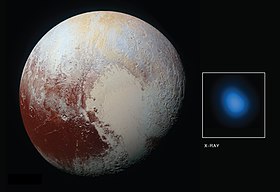
Google honors Dr. Kamal Ranadive with a Google doodle on her birthday

IMAGE: GOOGLE

On the occasion of the 104th birth anniversary of Dr Kamal Ranadive, an Indian biomedical researcher, Google dedicated a Google doodle to her where she can be seen holding a microscope. She is well-known for her revolutionary cancer research and her commitment towards promoting social justice through education and science.

Dr. Kamal Ranadive was born in Pune on November 8, 1917. Her father, who was a biologist, encouraged her to study medicine but she had different aspirations. She decided to study botany and zoology as her main subjects and got her Bachelor of Science (B.Sc) in the same field from Fergusson College in Pune. She then moved to the Agriculture College in Pune for her post-graduation.

She successfully won a doctorate in Cytology (also known as cell studies) in the same year as working as a researcher at the Indian Cancer Research Center (ICRC), and thereafter, was qualified to gain a fellowship at Johns Hopkins University in Baltimore, USA. She thereafter returned to India and established the first tissue culture laboratory in the country in Mumbai.

She closely examined the links between cancer and different viruses, and also the link between breast cancer and heredity. She also studied Mycobacterium leprae (a type of bacterium that causes leprosy) and gave her contribution in the development of a leprosy vaccine.

Dr. Kamal Ranadive and a few of her workmates initiated the establishment of the Indian Women Scientists’ Association (IWSA) in the year 1973 to promote women in the scientific field. The organization as of now has 11 branches across the country. It provides scholarships and childcare to women in working or researching in the scientific area.

Ranadive received the Padma Bhushan, the third highest civilian award, in 1982 for her contributions to medicine. In 1964, the Medical Council of India presented her with the first Silver Jubilee Research Award. This award comprised of a gold medal and an amount of Rs. 15000. Another award that she received was the G. J. Watumal Foundation Prize in 1964 for her work in leprosy.

Dr Kamal Ranadive was loved and admired by many of her students and colleagues. They fondly called her ‘bai’. She always encouraged her colleagues and students to work and do various scientific researches in their own country. She also worked in rural Maharashtra after her retirement, training women as healthcare professionals and teaching them about health and nutrition.

Dr. Kamal Ranadive passed away in the year 2001 but she still continues to inspire the youth especially the women of this country to work hard and be an inspiration for many.

Remembering Savitri Khanolkar, The Designer of Param Vir Chakra

Param Vir Chakra is India’s highest gallantry award.From Major Somnath Sharma to Captain Vikram Batra, 21 brave hearts of the Indian Armed Forces have so far received the prestigious Param Vir Chakra award. When Major Somnath Sharma, the first recipient of this award, laid down his life while defending his motherland, this award actually did not exist. It was later, when India became a republic in 1950, that the award was introduced, but with effect from 15th August 1947.

I’m sure most of you might have heard about this award, but what many are unaware of is that India’s highest military decoration was designed by a Swiss-born woman Eve Yvonne Maday de Maros aka Savitri Bhai Khanolkar. 

Image source: dnaindia.com

Life as Eve Yvonne Maday de Maros

Eve was born in Neuchatel, Switzerland, to a Hungarian father Andre de Maday and a Russian mother Marthe Hentzelt, on the 20th of July 1913. She was raised by her father, after her mother’s death. She spent her early childhood in Geneva. As a child, she loved nature and liked being outdoors. 

A turning point in her life was when in the winter of 1929, on a skiing holiday, she met Vikram Ramji Khanolkar, a young Indian Army cadet. Vikram, at that time was undergoing training at the Royal Military Academy, Sandhurst and was holidaying in  Switzerland during a team break. The meeting was just the beginning of what later blossomed into a cross country love story. Neither Vikram’s age nor her father’s disapproval stopped her from pursuing her love. She moved to India a few years later and got married to the love of her life in 1932. She converted to Hinduism and adopted the name Savitri Bhai Khanolkar after moving to India.

Life as Savitri Khanolkar

Savitri Khanolkar was a European lady with an Indian soul. She loved everything about India and its culture, which made her cross-cultural transition rather smooth and comfortable. She picked up Hindi, Marathi and Sanskrit within a couple of years and could converse fluently in all the three. She was keenly interested in India’s history and culture and devoted herself to learning more about the country’s mythology, traditions and religious scriptures. She was a talented artist and made a series of paintings depicting the various ideals and principles of Vedanta and Hindu philosophy. She also wrote two books – ‘Sanskrit Dictionary of Names’ and ‘Saints of Maharashtra.’ Those who knew her personally described her as a warm and compassionate person with a great passion for the Hindu philosophy.

Maj General Vikram Khanolkar and Savitri Khanolkar | Image Source: indiatimes.com

Designer of Param Vir Chakra

After India became independent in 1947, especially in the light of the Indo-Pak war that had broken out, there was a pressing need to create new military honours and awards for independent India. Adjutant General Major General Hira Lal Atal had been assigned this responsibility. Major Atal hardly needed to think twice before choosing Savitri Bhai for the task. Her passion for Indian culture and Vedanta philosophy, talent as an artist  and her in-depth knowledge of the country’s ancient history and traditions made her an ideal candidate for the job. Her military association as an army wife was an added bonus. She was asked to design the Indian equivalent of the British Victoria Cross – the Param Vir Chakra.

Param Vir Chakra : Design Inspiration

Savitri Bhai took inspiration from India’s ancient puranic literature and legends to design the Param Vir Chakra medal.She selected Indra’s weapon, the Vajra, which was made from the bones of Maharshi Dadhichi for the design. Maharshi Dadhichi was known for the ultimate sacrifice that he had made by giving up his body and thereby enabling the Gods to fashion the deadly weapon Vajra from his bones. The presence of Vajra in the medal is symbolic of the power and the selfless sacrifices of our legendary war heroes. 

The final design consisted of the National emblem embossed in the centre, surrounded by four replicas of the double Vajra imprinted on the medal face and the rear side had the words ‘Param Vir Chakra’ inscribed both in English and Hindi, separated by Lotus flowers.The medal was cast in bronze and held by a purple ribbon.

Apart from the Param Vir Chakra, she also designed other gallantry medals including Ashok Chakra, Maha Vir Chakra, Kirti Chakra, Vir Chakra and Shaurya Chakra.

Coincidentally, the first PVC recipient turned out to be Savitri Bhai’s future son-in-law’s brother, Major Somnath Sharma.

Image Source : twitter

Later life 

During the course of her life, Savitri Bhai always found time to engage in social work. She was a follower of Sri Ramakrishna and she immersed herself in numerous social activities through Ramakrishna Mission. She also worked for the welfare of Jawans and their families and refugees who had been displaced during partition. She lost her husband to a heart attack in 1952, after which she found solace in spirituality and retired to Ramakrishna Math.

The life of Savitri Bhai Khanolkar was truly a remarkable one. Be it joining the North India Flying Club or learning Indian classical dance and music or attending Patna university, she enjoyed every bit of her life as an Indian woman. She passed away on 26th November 1990, after leading a full life.

Things to know before taking up Mass Media and Communication courses.

Photo by Caleb Oquendo on Pexels.com

Let’s begin by knowing what Mass Media or Mass Communication is. Mass media refers to the media technologies such as movies, songs, news, podcasts, advertisements and photos, that are utilized to carry information to the masses. 

Importance of Mass Media

This blog you are reading is helping you gain knowledge about Mass Media and communication. Hence this blog becomes a media technology and educating you in the field of Mass Media defines its importance. From applying for a job to reaching out to a friend on your phone, everything becomes a portion of Mass Media as they help users pass on information from one place to another or one person to another. 

Here are some advantages of Mass Media to highlight its importance. 

  • It becomes a voice for the voiceless: Mass Media provides every individual with an opportunity to practice their freedom of speech and spread their ideas among the world. YouTube is a great example of Mass Media. As a platform in this 21st century it helps both small and large creators publish their videos for everybody to watch. 
  • Enables widespread communication: Today, the world is often referred to as a global village. This is made possible due to several types of mass media technologies such as social media, internet, and other digital content. It helps governments, businesses and organizations to communicate with each other and stay connected. 
  • Diversifying culture: Mass Media helps in diversifying languages and cultures beyond its place of origin. A good internet connection and a mobile phone or a computer is all you need to learn a new language or gain knowledge about a new culture. You can even take a peek around the world without leaving your home. 

The Evolution of Mass Media

Mass Media can be traced back to the 800 AD which consisted of prehistoric arts, writings and some basic printing technology. The introduction of Gutenberg’s printing press in the 1450s helped art and literature gain a wider reach among the people.The year 1605 witnessed the publishing of the first weekly newspaper in Antwerp, known as ‘Relation’. This was followed by the inventions of radio and television in 1895 and 1925 respectively. Finally in 1990, the world wide web was introduced by Tim Berners Lee. 

The number of people benefiting from these media technologies witnessed a steady growth from a handful, to thousands, and millions with the introduction of newspapers, radios and televisions. Today, due to the internet, these numbers are reaching billions. In 2018, the number of  World Wide Web’s users was estimated to be 4 billion. 

The 21st century has introduced the ability for even individuals to broadcast a customised message for thousands across the globe. You no longer need to be a part of some huge networking channel to do so. A good internet connection and a hand held device can do the job. 

The functions of Mass Media

Mass Media, in the form of writing, podcasting, and publishing, has a significant effect on the masses. Commercials on television, billboards and social media influence the audience into buying a product or availing a service. Hence companies across the world look for suitable mediums such as social media, blogs, forums, or video streaming platforms to convey their messages based on their businesses. Once they find the right mass media technology, they conduct campaigns to communicate their ideas. 

Majority of the companies today create and maintain their social media pages, maintain blog posts on their websites, and run advertisements on video streaming platforms to educate viewers about their products or to entertain them. These define the functionality of Mass Media. 

Courses in the field of Mass Media and communication

Photo by Redrecords u00a9ufe0f on Pexels.com

After addressing the ‘Wh’ questions of Mass Media, let us dive into the courses one can opt for in the field of Mass Media and communication. There are three kinds of courses available for aspiring students in the field of Mass Media and communication. Courses at undergraduate, postgraduate and diploma levels.

Both the course levels familiarise students both practically and theoretically in the field of Mass Media and Communication. 

Eligibility for courses in Mass Media and communication (UG PG) 

A student aspiring to seek admission in a Bachelor of Arts in Mass Communication course, he or she must fulfil some eligibility criterias. 

  • The applicant should have completed senior secondary schooling (10+2) from a recognized university. 
  • The applicant must have scored a minimum of 50% from the aggregate in their senior secondary schooling. 

Similarly, students aspiring for seeking admission in the Master of Arts in Mass Communication course must fulfil the following eligibility criterias. 

  • The applicant must have a Bachelor’s degree in any stream from a recognized university. 
  • The applicant must have scored a minimum of 50% from the aggregates in their Bachelor’s degree. 

Institutes may also require you to give an entrance exam to fulfil the admission process.

Here’s what you will learn from Mass Media and Communication courses

Courses in Mass Media helps you get acquainted with subjects such as Public Relations, Design and Graphics, Digital Media, Reporting and Editing for Print Media, Data Journalism, Photojournalism, Event Management, and Media Law and Ethics. The courses are inclusive of Computer based learning, Guest Lectures, Seminars, Workshops, Massive Open Online Courses, Individual and Group projects, and community based projects. 

Scope for Mass Media courses under employment prospect.

Photo by Pixabay on Pexels.com

With an increase in media technologies following new inventions and establishments such as Television Channels, Radio Stations, Advertising Agencies, PR Agencies, etc. Scope in this field is also parallely increasing. Here are some of the job profiles candidates can look out for upon completion of the course. 

  • Journalism
  • Public Relations
  • Advertising
  • Media Planner
  • Broadcasting and Production
  • Event Manager

Conclusion

Mass Media and Communication as a field in academics has a great scope in India and overseas. Freshers with expertise in specific areas and sufficient experience will be hired by prominent media companies for different job profiles. Individuals with good communication skills, writing proficiency, and passion for learning can pursue an undergraduate or a postgraduate course in Mass Media and Communication. 

References

Ritika Shrivastava, May 17, 2021 09:36 IST, shiksha.com

Akanksha Sirohi, July 15 2020, collegedekho.com

https://www.careers360.com/courses/mass-communication-course

What does your taste in music reveal about you?

pink headphone isolates on blue background.

Music plays an important role in the lives of people all over the world, which is why many wonder what individual factors might influence musical preferences. Ever thought, Could the contents of your playlist, for example, reveal something about your personality?

Personality Traits Linked to Musical Styles

One large-scale study conducted by researchers at Heriot-Watt University looked at more than 36,000 participants from all over the world. Participants were asked to rate more than 104 different musical styles in addition to offering information about aspects of their personalities.

According to the researcher, Adrian North, the reason people sometimes feel defensive about their taste in music might be related to how much it relates to attitudes and personality. 

North suggests that people define themselves through music and use it to relate to other people. His research points to the connection that people often make between who they are as an individual and their musical tastes.

Keep in mind that these are the results published in only one study rather than being replicated and validated by a variety of researchers and different study designs. The following are some of the personality traits the study linked to certain musical styles.

Pop Music

Fans of the top 40 pop hits tend to be extroverted, honest, and conventional. While pop music lovers are hardworking and have high self-esteem, researchers suggest that they tend to be less creative and more uneasy.

Rap and Hip/Hop Music

Despite the stereotype that rap lovers are more aggressive or violent, researchers have found no such link. Rap fans do tend to have high self-esteem and are usually outgoing.

Country Music

Country music fans are typically hardworking, conventional, and outgoing. While country songs are often centered on heartbreak, people who gravitate towards this genre tend to be very emotionally stable. They also tend to be more conservative and rank lower on the trait of openness to experience.

Rock/Heavy Metal Music

Despite the sometimes aggressive image that rock and heavy metal music project, researchers found that fans of this style of music are usually quite gentle. They tend to be creative, but are often introverted and may suffer from low self-esteem.

Indie Music

Fans of the indie genre are typically introverted, intellectual, and creative. According to researchers, they also tend to be less hardworking and less gentle. Passivity, anxiousness, and low self-esteem are other common personality characteristics.

Dance Music

According to researchers, people who prefer dance music are usually outgoing and assertive. They also tend to rank high on the trait of openness to experience, one of the five major personality traits. People who prefer fast-paced electronic music also tend to rank low on gentleness.
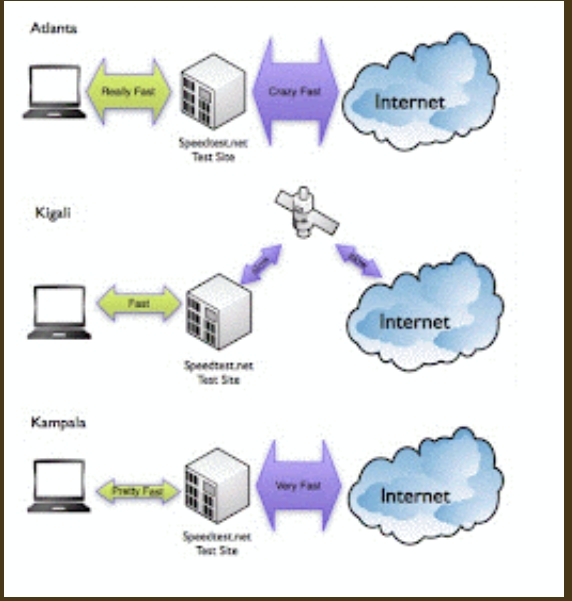
Classical Music

Classical music lovers are typically more introverted but are also at ease with themselves and the world around them. They are creative and have a good sense of self-esteem.

Jazz, Blues, and Soul Music

People who enjoy jazz, blues, or soul music were found to be more extroverted with high self-esteem. They also tend to be very creative, intelligent, and at ease.

Capitalism

Capitalism is an economic system in which a country’s trade, industry, and profits, are controlled by private companies instead of the people who contribute their time and labour to the company. In this system, private entities own the factors of production such as entrepreneurship, capital goods, natural resources, and workforce. Individual capitalists are typically wealthy people who have a large amount of capital invested into the business and benefit from the capitalistic system by making increased profits and thereby accumulating more wealth.

Capitalism requires a free market economy to succeed. It distributes goods and services according to the laws of supply and demand. The law of demand says that when demand increases for a particular product, its price rises. When competitors realize they can make a higher profit, they increase production. The greater the supply reduces prices to a level where only the best competitors remain.

Capitalism results in the best products for the best prices because consumers will pay more for what they want the most. Businesses provide what customers want at the highest prices, but the prices are limited by business competition, making their products as efficiently as possible to maximize profit. Most important for economic growth is the reward of capitalism for innovation, including new products and more efficient production methods.

Capitalism does not provide for those who lack competitive skills, including the elderly, children, the developmentally disabled, and caretakers. To keep society functioning, capitalism requires government policies that value the family unit. Despite the idea of a level playing field, capitalism does not promote equality of opportunity. Those without good nutrition, support, and education may never even make it, and society will never benefit from their valuable skills. People who can find work may face low wages, limited possibilities for advancement, and potentially unsafe working conditions. In the short term, this inequality may seem to be in the best interest of capitalism’s winners. They have fewer competitive threats and may use their power to rig the system by creating barriers to entry. Capitalism also ignores external costs, such as pollution and climate change, in its pursuit of increasing levels of consumption and growth. The system makes goods cheaper and more accessible in the short run, but over time, it depletes natural resources, lowers the quality of life in the affected areas, and increases costs for everyone.