
“Oh, Allah! Possessor of Kingdom, You give the Kingdom to whom you will and take the kingdom from whom you will”
                                                                                                                                                                  - Isami
The diverse natural wealth in Delhi has attracted a diverse body of settlers and rich archaeological excavations in the areas such as Indrapat and confirmed the continued existence of settlements in the area for centuries. The excavations in Delhi revealed remnants of an unusual rubble fortification, dating to Tomaras and Chauhans of the pre-Sultanate period. The pre-Sultanate records of the 12th and 13th centuries discuss Delhi as a city located in the south-western ridge of the Aravallis. The Tomara capital of Lalkot and Qila Rai Pithora of the Chauhans emerged as the Delhi-i-Kuhna of the 13th century.
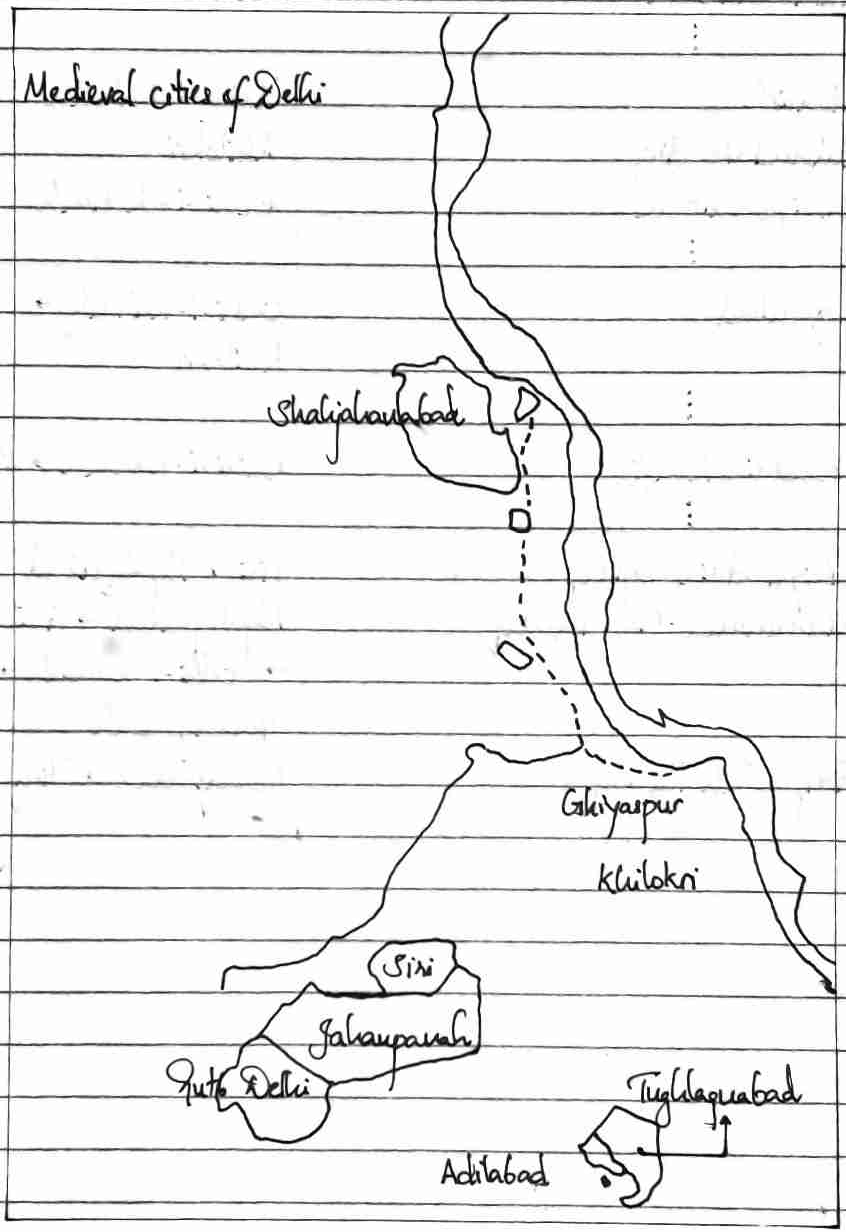
This article emphasises major shifts in the transformation of the cityscape of Delhi in the thirteenth and fourteenth centuries. The reasons attributed to the same are many beginning with the thick forest lands and large resources that acted as a natural defence. Juzzani described these forests as natural agents ‘separating the path of the invading army’. The 1883-84 Gazzetter of Delhi described the importance of the bhangar and the khadar lands known for sustaining agriculture and produce for the city residents. The settlement along the Indrapat region might’ve especially profited from its association with the Mahabharata epic. Moreover, the settling of Khwaja Nizamuddin Auliya in Ghiyaspur contributed to the development of the city. Political turmoil, factional warfare and the quest for independence of the new Sultans from the entrenched elites and orthodox power-groups of the earlier Sultans gave rise to frequent shifting of residence/capitals. Consequently, the cyclical rise and fall of dynasties. Overpopulation also contributed to the same. As Narayani Gupta famously remarked, the city of Delhi has many gates to come in and not even a single gate to move out. Moreover, the large-scale construction activities, as dictated by Sunil Kumar, was a necessity dictated by the ways in which society and politics were structured at that time. The threat of invasion from the Mongols also contributed to the development of suburbs and cantonment towns adjacent to or in the city of Delhi. One of the cardinal aspects for the evolution of the cityscape was the scarcity of water, owing to which the settlements were shifting towards the East nearer to the river Yamuna. The cityscape got new ease of life with developing trade, commerce and technology. Also, changing population composition with new groups coming to power and subsequent change in culture and traditions also contributed to the same.

Delhi-i-Kuhna was a prosperous city with a currency called Dhilliwala that had a wide circulation. It was a strategically located area with forests offering natural security. Prithviraj Chauhan was defeated in 1192 at Terrain and Qutubuddin Aibak occupied Qila Rai Pithora and developed Delhi-i-Kuhna with Jami Masjid, Qutb Minar and a new fort. Adjacent to the fort were madrasas and there were markets for cloth merchants outside its gates.
To gain independence from the entrenched elite groups, Rukunuddin Firoz shifted his capital to Khilokri. The Shamsi commanders executed him and placed Razzia Sultana on the throne followed by three more Shamsi puppets. Shamsi manipulation ended with Balban and his son, Kaiqubad shifted to Khilokri. Juzzani described the city as sher-i-nau or the new city. After Kaiqubad, Jalaluddin Khalji assumed the throne and chose to live in Khilokri. Also, Sheikh Nizamuddin Auliya built his hospice at Ghiyaspur which became a suburb of Khilokri with its northward extension.
Delhi-i-Kuhna witnessed a large-scale construction activity at the time of Alauddin Khalji. Barani mentions that he didn’t like to stay in Qutb Delhi, exasperated by the resistance of the entrenched elites, he chose to reside in the garrison town, Siri. Siri was critical in preserving his authority and served as a cantonment to deploy a standing army to counter Mongol invasions under Qaidu. Mubarak Shah Khalji succeeded Alauddin Kahlji and developed Siri further. Siri was then known as the ‘residence of the Caliph’ as Mubarak Shah assumed the grandiose title of ‘Khalifa’. Furthermore, Khusraw Khan Bawari and his successor, Ghiyasuddin Tughlaq continued to reside in Siri.
The increasing population in Delhi and Siri made Ghiyasuddin Tughlaq build Tughlaqabad. The advantage of this site was in the stone quarries present that translate as a valuable building material. Muhammad Bin Tughlaq constructed the fort of Adilabad and Qutb Delhi with Siri and Tughlaqabad were enclosed by a fortification and the region was named as Jahanpanah. A reservoir for ensuring hassle-free water supply was also built. Owing to the population explosion in Delhi, Tughlaq moved to Daulatabad in Deccan. Firuz Shah Tughlaq built Ferozabad upon the banks of the river Yamuna to shift his capital to an economically prudent location that would reduce the cost of water supply.
“The waters of Euphrates and Nile would’ve been insufficient to meet the needs of the increasing population of Qutb Delhi”.
To respond to this evergreen problem of water supply, Iltumish laid out a large tank known as Hauz-i-Shamsi or Hauz-i-Sultani that eventually dried up. Firuz Shah Tughlaq revived this tank while he built Ferozabad. In Siri, the alluvial soil made it easier to dig wells. To supplement well-water, Alauddin Khalji built Hauz-i-Alai or Hauz-i-Khas, a square tank about two miles to the North of Qutb Delhi. Muhammad Bin Tughlaq further built the Satpula dam to the Southern wall of Jahanpanah. The problem of water supply also had shifted settlements to the North, nearer to the river Yamuna.
By the 1220s and 1230s, Muslim urban civilization from Khurasan, Transoxiana, Sistan, Afghanistan, etc. sought refuge in Delhi. However, by the 1240s and 1250s, the major share of them was replaced by Mongols and their auxiliaries. The changing population composition had also resulted in the diffusion of cultures and the creation of a composite culture.
Coming to the economy, Alauddin Khalji attempted to remove the intermediaries and to establish a direct relationship with the producers. Peter Jackson suggests that these attempts were to create a cantonment city that depended on the taxes and supplies from the producers. The period of the 13th and the 14th centuries witnessed the growth in size and population of the towns. Also, there was a significant expansion in craft production and commerce. Ibn Battuta described Delhi as the largest city of the Islamic East. The arrival of the spinning wheel from Iran in the 13th century and the use of the carder’s bow and weaver’s treadles pointed to the larger use of clothes by the ordinary people. Sericulture and manufacture of silk clothes were boosted and carpet weaving on vertical loom and paper manufacture developed. By the 14th century, sweet sellers of Delhi could pack their preparations in papers. Architecture gained considerable momentum with the use of cementing lime, vaulted roofing with the use of the true arch and dome. Also, immigration and enslavement made the growth of urban crafts possible. The growth of commerce at this time can be explained with the larger coinage.
The residence of some Delhi Sultans are as follows:
| Monarch | Capital/ Residence of the Monarch |
| Qutubuddin Aibak: | Lahore |
| Iltumish | Delhi-i-Kuhna |
| Ruknuddin Firoz | Khilokri |
| Razzia Sultana: | Delhi-i-Kuhna |
| Kaiqubad: | Delhi-i-Kuhna → Khilokri |
| Alauddin Khalji: | Delhi-i-Kuhna → Siri |
| Ghiyasuddin Tughlaq | Siri → Tughlaqabad |
| Muhammad Bin Tughlaq: | Tughlaqabad → Adilabad → Delhi-i-Kuhna → Jahanpanah |
| Firuz Shah Tughlaq | Jahanpanah → Firuzabad |
References:
References:
- Ali, Athar. (1985). “Capital of the Sultans: Delhi through the 13th and 14th Centuries”, in R.E. Frykenberg, ed., Delhi Through the Age: Essays in Urban History, Culture and Society, Delhi: Oxford University Press, pp. 34-44
- Habib, Irfan. (1978). ‘Economic History of the Delhi Sultanate — an Essay in Interpretation’, Indian Historical Review vol. 4, pp. 287-303.
- Kumar, Sunil. (2011). “Courts, Capitals and Kingship: Delhi and its Sultans in the Thirteenth and Fourteenth Centuries CE” in Albrecht Fuess and Jan Peter Hartung. (eds.).Court Cultures in the Muslim World: Seventh to Nineteenth Centuries, London: Routledge, pp. 123-148
- Kumar, Sunil. (2019) ”The Tyranny of Meta-Narratives; Re-reading a History of Sultanate Delhi”, in Kumkum Roy and NainaDayal.(Ed.).Questioning Paradigms, Constructing Histories: A Festschrift for Romila Thapar, Aleph Book Company, pp 222-235.
- Jackson, Peter. (1986). ‘Delhi: The Problem of a Vast Military Encampment’, in R.E. Frykenberg (ed.). Delhi Through the Ages: Essays in Urban History, Culture, and Society, New Delhi: Oxford University Press, 1986), pp.18-33.
- Haidar, Najaf. (2014). ‘Persian Histories and a Lost City of Delhi’, Studies in People’s History, vol. 1, pp. 163–171
- Welch, Anthony and Howard Crane. (1983). “The Tughluqs: Master Builders of the Delhi Sultanate“: Muqarnas, vol. 1 pp. 123-166.










You must be logged in to post a comment.