A microphone is a device that translates sound vibrations in the air into electronic signals and scribes them to a recording medium or over a loudspeaker. Microphones enable many types of audio recording devices for purposes including communications of many kinds, as well as music vocals, speech and sound recording.
Types Of Microphone
There are three main types microphones based on construction -:
A microphone in which the sound waves cause a movable wire or coil to vibrate in a magnetic field and thus induce a current.
Key Advantages -:
1. Rugged and able to handle high sound pressure levels, like those delivered by a kick drum. 2. Provide good sound quality in all areas of microphone performance. 3. They do not require a power source to run 4. They are relatively cheap
Key disadvantages -:
Heavy microphone diaphragm and wire coil limits the movement of the assembly, which in turn restricts the frequency and transient response of the microphone Generally not as suitable as condenser microphones for recording instruments with higher frequencies and harmonics, such as a violin.
Dynamic microphones can be used for many applications, produce an excellent sound and are suitably rugged – great for traveling on the road. They are best avoided when recording high-frequency content on an important recording.
For reliable, everyday tasks you will not find a more multifaceted, trustworthy device than a good quality dynamic microphone.
Ribbon -:
A ribbon microphone, also known as a ribbon velocity microphone, is a type of microphone that uses a thin aluminum, duraluminum or nanofilm of electrically conductive ribbon placed between the poles of a magnet to produce a voltage by electromagnetic induction. Ribbon microphones are typically bidirectional, meaning that they pick up sounds equally well from either side of the microphone
Key Adavantages -:
1. Ribbon Microphones are very sensitive and accurate 2. Ribbon microphones have a very low noise 3. Ribbon microphones tend not to pick up lots of background noise 4. Ribbon microphones can be very expensive 5. Ribbon microphones are good to produce a thin and tinny sound
Key disadvantages -:
1. Ribbon microphones can be very large and heavy 2. Ribbon microphones are very sensitive to air movements 3. It is very difficult to achieve a tight polar pattern 4. The ribbon is fragile and susceptible to damage 5. Ribbon microphones are not as popular as dynamic microphones Ribbon microphones require more maintenance
Ribbon microphones are often described as the most natural-sounding microphones available, and for good reason: they condenser microphones that use a thin ribbon of aluminum foil to pick up sound (instead of a solid diaphragm).
Condenser/ Capacitor Microphones -:
A Condenser capsule is constructed similarly. It consists of a thin membrane in close proximity to a solid metal plate. The membrane or diaphragm, as it is often called, must be electrically conductive, at least on its surface. The most common material is gold-sputtered mylar, but some (mostly older) models employ an extremely thin metal foil.
When sound waves hit the diaphragm, it moves back and forth relative to the solid backplate. In other words, the distance between the two capacitor plates changes. As a result, the capacitance changes to the rhythm of the sound waves. Thus, converted sound into an electrical signal.
Key Adavantages -:
1. They have a Greater Dynamic Range than Ribbon or Dynamic Mics. 2. They Have a Better Frequency Response than Dynamic Mics. 3.They Have a Better Noise Floor than Dynamic or Ribbon Mics. 4. When Hit with Loud Transients, They Generally Sound Snappier than Dynamic or Ribbon Mics.
Key Disadvantages -:
1. The limited number of operating microphones at the same time and place. 2. The limited number of radio channels. Sound files can use up a lot of computer memory in a device. 3. Voice recognition system software is not as accurate as typing manually.
Condenser microphones are best used to capture vocals and high frequencies. They are also the preferred type of microphone for most studio applications.
Conclusion -:
Microphones are used everywhere, from stage performances, broadcasting, and even talking on the phone. The microphone is a transducer, a machine that changes one form energy to another form of energy. Microphones are an essential part of any audio recording system.
The history of the camera began even before the introduction of photography. Cameras evolved from the camera obscura through many generations of photographic technology – daguerreotypes, calotypes, dry plates, film – to the modern day with digital cameras and camera phones.
Camera obscura (Before the 17th century) -:
The forerunner to the photographic camera was the camera obscura. Camera obscura (Latin for “dark room”) is the natural optical phenomenon that occurs when an image of a scene on the other side of a screen (or for instance a wall) is projected through a small hole in that screen and forms an inverted image (left to right and upside down) on a surface opposite to the opening. The oldest known record of this principle is a description by the Han Chinese philosopher Mozi (c. 470 to c. 391 BC). Mozi correctly asserted that the camera obscura image is inverted because light travels in straight lines from its source. In the 11th century, Arab physicist Ibn al-Haytham (Alhazen) wrote very influential books about optics, including experiments with light through a small opening in a darkened room. It was wildly successful after debuting to the public in 1839 when both it and the calotype began introducing photography to the masses. Normally, having portraits taken was an activity exclusive to the upper classes. The cost and amount of time needed to produce such works were unreasonable for most working-class people. The speed of the camera, which only increased as time went on, made it possible for anybody to have quality portraits.
Early photographic camera (18th–19th centuries) -:
The development of the photographic camera, it had been known for hundreds of years that some substances, such as silver salts, darkened when exposed to sunlight.[9]: 4 In a series of experiments, published in 1727, the German scientist Johann Heinrich Schulze demonstrated that the darkening of the salts was due to light alone, and not influenced by heat or exposure to air.[10]: 7 The Swedish chemist Carl Wilhelm Scheele showed in 1777 that silver chloride was especially susceptible to darkening from light exposure and that once darkened, it becomes insoluble in an ammonia solution.[10] The first person to use this chemistry to create images was Thomas Wedgwood.
The first permanent photograph of a camera image was made in 1825 by Joseph Nicéphore Niépce using a sliding wooden box camera made by Charles and Vincent Chevalier in Paris.[10]: 9–11 Niépce had been experimenting with ways to fix the images of a camera obscura since 1816. The first photographic camera developed for commercial manufacture was a daguerreotype camera, built by Alphonse Giroux in 1839. Giroux signed a contract with Daguerre and Isidore Niépce to produce the cameras in France,[9]: 8–9 with each device and accessories costing 400 francs.[13]: 38 The camera was a double-box design, with a landscape lens fitted to the outer box, and a holder for the ground glass focusing screen and image plate on the inner box. By sliding the inner box, objects at various distances could be brought to as sharp a focus as desired. After a satisfactory image had been focused on the screen, the screen was replaced with a sensitized plate. A knurled wheel controlled a copper flap in front of the lens, which functioned as a shutter. The early daguerreotype cameras required long exposure times, which in 1839 could be from 5 to 30 minutes.
Within a decade of being introduced in America, 3 general forms of the camera were in popular use: the American- or chamfered-box camera, the Robert’s-type camera or “Boston box”, and the Lewis-type camera. The American-box camera had beveled edges at the front and rear, and an opening in the rear where the formed image could be viewed on the ground glass. The top of the camera had hinged doors for placing photographic plates. Inside there was one available slot for distant objects, and another slot in the back for close-ups. The lens was focused either by sliding or with a rack and pinion mechanism. The Robert’s-type cameras were similar to the American box, except for having a knob-fronted worm gear on the front of the camera, which moved the back box for focusing.
Early fixed images -:
The first partially successful photograph of a camera image was made in approximately 1816 by Nicéphore Niépce,[18][19] using a very small camera of his own making and a piece of paper coated with silver chloride, which darkened where it was exposed to light. His unhardened bitumen was then dissolved away. One of those photographs has survived.
Daguerreotypes and calotypes -:
After Niépce died in 1833, his partner Louis Daguerre continued to experiment and by 1837 had created the first practical photographic process, which he named the daguerreotype and publicly unveiled in 1839.[21] Daguerre treated a silver-plated sheet of copper with iodine vapor to give it a coating of light-sensitive silver iodide. After exposure to the camera, the image was developed by mercury vapor and fixed with a strong solution of ordinary salt (sodium chloride). Henry Fox Talbot perfected a different process, the calotype, in 1840. As commercialized, both processes used very simple cameras consisting of two nested boxes. The rear box had a removable ground glass screen and could slide in and out to adjust the focus. After focusing, the ground glass was replaced with a light-tight holder containing the sensitized plate or paper and the lens was capped.
Dry plates -:
Collodion dry plates had been available since 1857, thanks to the work of Désiré van Monckhoven, but it was not until the invention of the gelatin dry plate in 1871 by Richard Leach Maddox that the wet plate process could be rivaled in quality and speed. The 1878 discovery that heat-ripening a gelatin emulsion greatly increased its sensitivity finally made so-called “instantaneous” snapshot exposures practical.
The invention of photographic film -:
The use of photographic film was pioneered by George Eastman, who started manufacturing paper film in 1885 before switching to celluloid in 1888–1889. His first camera, which he called the “Kodak”, was first offered for sale in 1888. It was a very simple box camera with a fixed-focus lens and single shutter speed, which along with its relatively low price appealed to the average consumer.
35 mm -:
Some manufacturers started to use 35 mm film for still photography between 1905 and 1913. The first 35 mm cameras available to the public, and reaching significant numbers in sales were the Tourist Multiple, in 1913, and the Simplex, in 1914.
TLRs and SLRs -:
The first practical reflex camera was the Franke & Heidecke Rolleiflex medium format TLR of 1928. Though both single- and twin-lens reflex cameras had been available for decades, they were too bulky to achieve much popularity. The Rolleiflex, however, was sufficiently compact to achieve widespread popularity and the medium-format TLR design became popular for both high- and low-end cameras.
Instant cameras -:
Polaroid Model 430, 1971
While conventional cameras were becoming more refined and sophisticated, an entirely new type of camera appeared on the market in 1948. This was the Polaroid Model 95, the world’s first viable instant-picture camera. Known as a Land Camera after its inventor, Edwin Land, the Model 95 used a patented chemical process to produce finished positive prints from the exposed negatives in under a minute.
Automation -:
The first camera to feature automatic exposure was the selenium light meter-equipped, fully automatic Super Kodak Six-20 pack of 1938, but its extremely high price (for the time) of $225 (equivalent to $4,331 in 2021)[23] kept it from achieving any degree of success.
Digital cameras -:
Digital cameras differ from their analog predecessors primarily in that they do not use film but capture and save photographs on digital memory cards or internal storage instead. Their low operating costs have relegated chemical cameras to niche markets.
Digital imaging technology -:
The first semiconductor image sensor was the CCD, invented by Willard S. Boyle and George E. Smith at Bell Labs in 1969.[24] While researching MOS technology, they realized that an electric charge was the analogy of the magnetic bubble and that it could be stored on a tiny MOS capacitor.
Early digital camera prototypes -:
The concept of digitizing images on scanners, and the concept of digitizing video signals, predate the concept of making still pictures by digitizing signals from an array of discrete sensor elements. Early spy satellites used the extremely complex and expensive method of de-orbit and airborne retrieval of film canisters. Technology was pushed to skip these steps through the use of in-satellite development and electronic scanning of the film for direct transmission to the ground. The amount of film was still a major limitation, and this was overcome and greatly simplified by the push to develop an electronic image-capturing array that could be used instead of film.
Analog electronic cameras -:
Handheld electronic cameras, in the sense of a device meant to be carried and used as a handheld film camera, appeared in 1981 with the demonstration of the Sony Mavica (Magnetic Video Camera). This is not to be confused with the later cameras by Sony that also bore the Mavica name.
Early true digital cameras -:
In the late 1980s, the technology required to produce truly commercial digital cameras existed. The first true portable digital camera that recorded images as a computerized file was likely the Fuji DS-1P of 1988, which recorded to a 2 MB SRAM (static RAM) memory card that used a battery to keep the data in memory. This camera was never marketed to the public.
Digital SLRs (DSLRs) -:
Nikon was interested in digital photography since the mid-1980s. In 1986, while presenting to Photokina, Nikon introduced an operational prototype of the first SLR-type digital camera (Still Video Camera), manufactured by Panasonic.[48] The Nikon SVC was built around a sensor 2/3 ” charge-coupled device of 300,000 pixels. Storage media, a magnetic floppy inside the camera allows recording of 25 or 50 B&W images, depending on the definition.
Camera phones -:
The first commercial camera phone was the Kyocera Visual Phone VP-210, released in Japan in May 1999.[54] It was called a “mobile videophone” at the time,[55] and had a 110,000-pixel front-facing camera.[54] It stored up to 20 JPEG digital images, which could be sent over e-mail, or the phone could send up to two images per second over Japan’s Personal Handy-phone System (PHS) cellular network.
YouTube Marketing is the practice of promoting businesses and products on YouTube’s platform, by uploading valuable videos on a company’s YouTube channel or using YouTube ads. more and more companies are including YouTube as part of their digital marketing strategy.
That’s partly because YouTube as a platform is growing insanely fast. But it’s also because the video is an extremely powerful medium.
The truth about youtube marketing -:
YouTube is an opportunity to get more traffic and customers. YouTube can be a very competitive place. This means you can’t just start uploading videos and expect to see results. Countless “big brands” have jumped into YouTube marketing head-first… with only a handful of views and subscribers to show for it.
The truth is, to succeed on YouTube, you need to have a winning strategy, the ability to create great videos, and the SEO know-how to optimize those videos around keywords and topics that people on YouTube care about.
Why youtube is considered a major market for advertising – :
1. YouTube is the 2nd most-visited website in the world.
2. 2 billion people log in to YouTube every month.
3. 68% of YouTube users state that videos help them make a “purchasing decision”.
4. The number of SMBs advertising on YouTube has doubled over the last 2 years.
What is the main goal of YouTube marketing?
One of your objectives for your YouTube marketing should be to help your customer find you. A catchy slogan or prominent company name throughout the video can keep you on people’s minds long after they’ve seen your message online. They can then do an online search and find you.
Objectives of Youtube marketing –:
YouTube videos should have clear objectives that align with your company goals. focus all of your efforts on gimmicks that will get the attention of viewers and help your video go viral, you may overlook the reason you market on YouTube to get more business. Make sure your attention-getting videos help you move toward your company objectives.
1. Reaching Your Target Customer -:
If your target demographic is women between the ages of 35 and 45, and your video catches on with teenagers, you may be popular, but you won’t be effective. Think about the kinds of images and messages that would appeal to your customer, and make it one of your objectives to use as many of those images as possible.
2. Making It Easy to Find You -:
One of your objectives for your YouTube marketing should be to help your customer find you. A catchy slogan or prominent company name throughout the video can keep you on people’s minds long after they’ve seen your message online. They can then do an online search and find you. You should include a link to your website, along with any other contact information, such as an email address, business address, or phone number. Don’t lose sight of your objective of helping customers contact you.
3. Establishing a Relationship -:
You should evaluate the relationship you want with your customers, and create a video that helps them feel you are one of them. You can convey a sense of trust, lightheartedness, sophistication, down-to-earth values, or even anger, to name a few relationship starters.
4. Keeping Your Product in Mind -:
Don’t get so involved with making an interesting video that you lose sight of your number-one objective: letting people know about your product or service. Feature your product prominently and clearly, so that viewers won’t have to wonder what you are marketing.
Importance of YouTube to Business -:
1. Advertising -: the largest video-sharing website on the Internet, according to NBC, YouTube also doubles as one of the largest video search engines in the world
2. Customer Communication -: YouTube provides an array of channels for businesses to communicate with customers and prospects.
3. Internal Communication -: YouTube provides a convenient and easy-to-use video hosting service, it can serve as an inexpensive way to post instructional videos, announcements, and other internal communications.
4. Complaints –: As a business owner, you should carefully monitor YouTube for customer feedback and complaints.
5. Considerations -: YouTube can offer numerous important benefits to businesses, but you should keep some considerations in mind when using this resource.
Advantages of YouTube Marketing –:
1. Heavy Traffic
2. Higher Visibility on Google
3. Build Your Email List on YouTube
4. Higher Conversion Rates
5. Multiple Video Types
6. Massive Media Library
Disadvantages of Youtube Marketing –:
1. Control
2. Targeting
3. Ad Bypass
4. Auctions
5. Sales Conversion
YouTube provides every business with an insane opportunity to get more traffic and customers. However, it is also a very competitive place as well. This means that you can’t just start uploading videos and expect to see results overnight. Many big businesses jump into YouTube marketing with no strategy – their lack of views and subscribers show for it. The truth is that to succeed on YouTube is not just about creating great videos. It’s knowing how to optimize those videos around keywords that people on YouTube are searching for.
No one remains a stranger to this phrase, But there is nothing more vague and inarticulate than this phrase. From the moment we are born into this world, we are being directed to behave and do things in a certain way. When we reach adolescence, we no longer have to be told to behave in a certain way as we begin to realise what the society expects from us and behave in accordance to their expectations. Finally, when we enter adulthood, we become champions in complying to societal expectations.
After going through all these stages in life, while in a group discussion or a meeting, a team leader or a manager asks us to think outside the box. That’s unfair. Nobody taught us to think for ourselves, even if we did, it fell in the societal pattern of studying, marrying, rearing kids, and retiring.
What is thinking out of the box?
In a professional terminology, thinking out of the box basically means coming up with a new idea (because the contemporary ones didn’t work) that would reap huge benefits for the company. In terms of life, thinking out of the box means being indifferent to societal norms and expectations as you do things your own way. Although my monologue above is defensive towards societal expectations, it is often impractical as not all of us can afford to waste our time and resources on carving a new path, when we can comply with our society and become financially stable and independent.
How to think outside the box?
Nevertheless, we can still incorporate the habit of thinking outside the box to make a difference in our lives when needed. Thinking out of the box does not require racking your brains till you come up with a feasible idea.
Take up a new course
Enrolling yourself for a new course will open doors to learning about new and unfamiliar things. Learning new things will influence your thinking in different areas and aspects of your life. Thereafter when you are confronted with a problem, you will be equipped with knowledge from the specialisation in a certain field that can aid you with thinking out of the box.
Daydream
Although it sounds counter intuitive, daydreaming is an important factor that influences your thinking out of the box. While daydreaming, your brain is led astray from the logical aspects and helps you make connections and co-relations that you couldn’t come up with while racking your brain. So, turn your attention away from the problem you are facing and let your imagination go wild!
Read a book from a new genre
Thinking out of the box would require you to do things differently or try new things. So how about reading from a different genre than the one you usually prefer? Try nonfiction or didactical if you have always preferred fiction. Fiction might have accustomed you to think in a certain manner. To break that monotony in thinking, reading from a different genre might just do the trick.
Pen a poem
The motive behind doing this relatively weird stuff during a serious confrontation is to break free from rational and logical thinking and invite new possibilities and ideas into the situation. Try writing a poem on the basis of your problems. As your mind begins wandering to support your efforts in poetry, you expand your horizon of thinking, leading to thinking outside the box.
So there you go, a vague article on an equally vague topic. Thinking out of the box. Do drop in your thoughts in the comment box. Now that’s a rhyme scheme created which can be considered as the first two lines of a poem. I was wondering how to end this article so I made a rhyme scheme, a.k.a a poem.
Global Citizen Live is a charity concert organized by the Global Citizen Organization founded in 2008. It hosts an annual music festival, one of the main objectives of the event is to raise awareness of global poverty and climate change.
Broadcasting from sites on six continents, including New York’s Central Park and in front of the Eiffel Tower in Paris, Global Citizen also secured pledges from France for 60 million COVID-19 vaccine doses for developing countries and corporate pledges for planting 157 million trees around the world.
This year’s festival held across six continents, was the largest, part of global citizen’s 2021 Recovery Plan For The World Program. Added to the festival mission was an aim to help bring an end to the COVID-19 pandemic. The main focus was on equity.
Artists and politicians alike from around the world had converged for the cause of the festival. International artists like Shawn and Camilla Mendes, Ed Sheeran, Doja Cat, Billie Eilish, BTS, Metallika, Coldplay, Lizzo, One Republic, Jennifer Lopez, Paul Simon, Demi Lovato, H.E.R., among many others.
Personalities from India included Priyanka Chopra as the host. Others like Amitabh Bacchan, Anil Kapoor, Amit Trivedi, Farhan Akhtar, Badshah, Tanishk Bagchi, Ayushmann Khuranna, Dia Mirza, Hritik Roshan, Sonakshi Sinha also played their considerable part in the event.
Vaccine pledges, which also came from the governments of Croatia and Ireland, followed numerous pleas, including from Prince Harry and Meghan, the Duke and Duchess of Sussex, onstage at Central Park on Saturday afternoon.
“This year, the world is expected to produce enough doses to meet the target of vaccinating 70per cent of people in every single country,” Meghan, the Duchess of Sussex, said to cheers from the Central Park crowd. “But it is wrong that so much of the vaccine supply has only gone to just 10 wealthy nations so far, and not everyone else.”
Imagination is our creation, we have always followed this streak of points of view that being creative is drawing characters and theories in the world of imagination where they live as long as we keep believing in them right?
In every field either its arts and relation or its commerce and markets strategy, everywhere we go we are asked to imagine the next step or the reaction or the situation or the condition which could happen and we can be prepared for everything that is going to happen and hence adding in the constant growth.
But most of the time they ask us to think out of the box and come up with different things, reactions, and situations but does it ever occurred to anyone that what kind of box we are required to think beyond and what if there is any box to even start with I mean if we are telling ourselves we have to think out of the box that does mean that we are saying there was a range and limit beyond which we couldn’t think but there isn’t any limit to even start with.
Keep thinking and you might come up with something that actually is out of every range and limits we drew even in our imagination, though imagination is our own free will and just our own.
But there are many interesting facts about the power of imagination and why creating one takes a lot more than just thinking out of the box. Horsing the mind in the limitless area of our brain and aimless thoughts and even the traumatic events though it all might seem bad and it is but it does have some of the positive impacts on the creative side of our brain.
Solitary Activity
Morning hot showers or walking alone where there is no one to disturb and just in all the standing beneath the hot shower head relaxing your mind does the number on our creative mind as well which can be confirmed by 72% of our population.
A survey showed that taking a bath in the morning confirms that people do get some insightful thoughts and ideas while they are really relaxed and calm there, bathing away the dirt as well as any blockage which could stop the horse of their thoughts.
Hunching Thrives
Hunch, whenever our intuitions tell us something most of us feels the need to ignore it or just consider it as the feeling that arrives when we are in a certain situation and that is just our reaction though most of the time it could be right but doing with the hunch has been proved the right thing to let your imagination thrive So hunch the way out of the box.
Trying New Things
Thinking out the box is common but knowing first where your box lies and what kind of restraint you have imposed could help you get a better outcome and to do so always be ready to try out the new things as whenever we learn something our brain gets one more topic or thing to continuously wander about without any restraint.
Before thinking about how to be more creative, let me begin point out some real barriers that some people seem to have when wanting to enhance creativity, have a think if any of these things are applicable to you and your life;
1. Lack of time. This is not as major as you may think. Linking thoughts and ideas only takes seconds. It can happen anytime, anywhere. Provided you are in the right state and pay attention to your own experience.
Creativity in my opinion is more about the quality of the time you have and being receptive to yourself. Though this does take some time.
2. Fear of being judged. When I worked for a national newspaper and we had brainstorming sessions, individuals were often scared of expressing ideas. Creativity results in unusual ideas and perhaps even being different in some way. They can be thought of as strange, odd or challenging. Fear of being considered weird, stupid or just different often kills creativity. If I feared people thinking any of those things about me, I would not bother getting out of bed in the mornings; I love the fact that people think I am all of those things!!
3. Lack of self-esteem. When you do something creative, you go beyond the bounds of what has been safe and familiar in the past, to yourself and maybe even others. When you are not sure about yourself, being different in any way can feel risky or make you feel vulnerable. The danger is that you give up your new insight to just blend in. Smash out of those shackles!
4. Fear of failure. This inhibits us. If you are making a new connection in your brain there can be no inherent “right” or “wrong” about it. Failure can only have two meanings really; firstly, that it didn’t work in the way you wanted it to. Secondly, Someone else did not like it. But so what??!! I have to tell you all that I get many comments on how I generate so many successful projects and am often asked how I do it. I always point out that these projects are actually only about 10% of what I have imagined. The other 90% didn’t work or didn’t get out of my brain.
Creativity is not reserved for genius only. Einstein was brilliant but he is not necessarily the best model of creativity for us. You do not need specialist expertise to be creative. The fruits of your creativity may manifest in many, many differing ways, in fact I expect so.
If at any time you doubt your ability to be creative, remind yourself that several times every night you create an entirely new dream, which you script, act in and watch, which involves all your senses and has effects that can last long after they are over. This creation is so very effortless most people don’t even recognise it as such.
How to be more creative.
Ok, so how does one actually go about getting more creative. Let me give you some ideas;
1. Find the right frame of mind. Explore what states you associate with being creative. Discover properly what it is that triggers and maintains you being creative. What’s your best time of day? The best environment? Do you need to be alone or with others or alone in the midst of others? Do you need sounds or silence or background sounds? Build a profile of your creativity state, then make time and space for it on a regular basis instead of waiting for some divine intervention and for it to just happen on its own.
2. Cultivate dreaming. Pay attention to your experience of life and attention to your existing creativity rather than dismissing day-dreams and dreams. Don’t allow yourself to waste what you may already be discovering by ignoring it.
3. Ask yourself “What if?” and “What else?” and “How else?” Always go beyond what you fist thought, find more and more different ideas.
4. When and/or if you hit a problem, pretend your usual solution is not available. This can work in many different ways. If your PC crashes today, how else might you do your work? If you usually argue face to face, what would happen if you wrote your feelings down instead? Some solutions may be no better than the ones you’re used to: others may offer you brilliant new opportunities. Do something different. I wrote about that idea in an earlier article entitled Do something Different, go check it out.
5. See how many different results you can get with the same ingredients. I am sure many of you know that there is a cookbook called “Recipes 1-2-3″ by Rozanne Gold, in which every recipe is made out of only three ingredients.
Some recipes use the same three ingredients but different processes or quantities come up with different results.
You can have some great fun by taking an every day object and imagine or think about how many other uses it can have, you can even think about how to combine them with other objects.
6. Think of different ways to do the familiar. Change the order in which you do things, use different things, use your less favoured hand; as soon as we break routine, we move from a state where we are on auto-pilot to one where we are alive and alert. You exercise unfamiliar brain connections and help build new links in your brain. A glorious feeling!
7. Look out for the difference that makes the difference. When you encounter something that strikes you as different, ask yourself what it is about it that is so different or new or unusual. Where does the key difference actually lie?
I want to mention a strategy that is well talked about in NLP circles and that I have used for many years and that is the Disney Creativity Strategy.
The Disney creativity strategy is for developing your dreams and giving them the best possible chance of becoming reality. It is named after Walt Disney, who often took on three different roles when his team was developing an idea; the dreamer, the realist and the critic. Robert Dilts, an NLP pioneer, modelled and developed this strategy as an NLP tools. Some of Robert’s articles that he kindly donated can be found at my website.
The strategy separates out these three vital roles involved in the process of translating creative ideas into reality so that they can be explored separately for maximum clarity and effect.
Many companies have specialists in each of the three fields and I have done consultancy work with companies myself whereby I have asked different team members to take on one of the roles. You can also play all three roles yourself as I often do in coaching or business consultancy, with your own wants, needs and goals.
However, the usual way to use it is to allocate three roles to different people (realist, dreamer and critic) to assess plans or tasks. Ask someone to act as the dreamer and tell you all the possibilities of the idea. Ask someone else to examine exactly what would be involved in putting it into practice (realist), and someone to take a hard look at it and really evaluate its strengths and weaknesses (critic). You may want to rotate the roles. If doing it on your own, be sure to keep the roles very separate and write them down. I do this with lots of my own ideas and with changes I want to make in my life.
You can even use this in a meeting broken down into three stages; Each role as a separate stage. Get everyone brainstorming and being creative first; then get them thinking about what would actually have to happen in practical terms; then get them critically evaluating the possibilities.
I suggest that you have some fun being creative and doing things differently to generate more creativity. It feels wonderful and if you have found that your progress to success or the outcomes you desire has been blocked or gone stagnant, then think about being more creative in how and what you are doing.
These days we hear music all the time, it wakes us up, motivates our workouts, keeps us company on our commutes. It doesn’t matter what kind of music it is, it itself has the ability to affect our moods and our bodies in all sorts of ways. It can give us chills even can make us cry.
Effects on Brain
Music activates every area of the brain that scientists have mapped so far. In fact, there is no area of the brain that music doesn’t touching some ways.
25 years ago there was an idea which said that language is in left side of the brain and music is in right side of the brain but now with better quality tools, higher resolution, neuroimaging and better experimental methods, it is discovered that thats not at all right so how does it effects our brain?
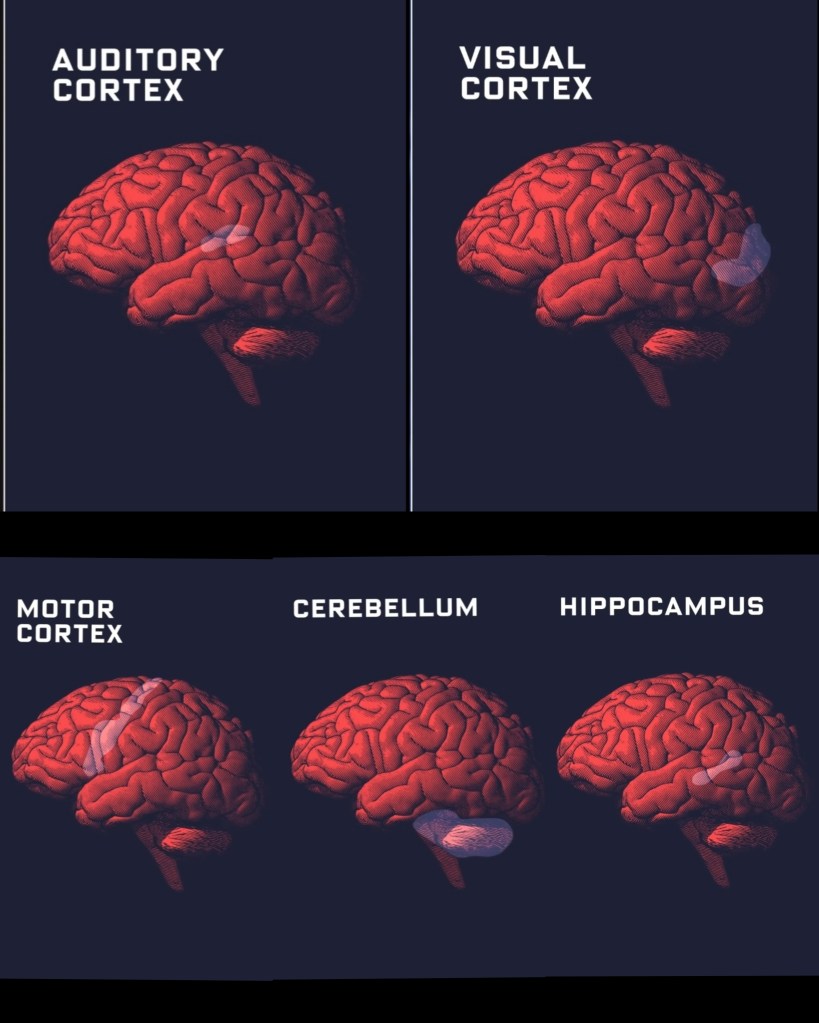
When music enters and then gets shuttled off to different parts of the brain:-
It stops at specialise processing units in auditory cortex, they track loudness, pitch, rhythm, etc.
The visual cortex activates when you’re reading notes as a musician or watching music.
Motor cortex activates when you move or dance or tap your feet, snap fingers, clapping your hands.
The Cerebellum activates and immediate the emotional responses.
The memory system in the Hippocampus will activate and will help you to recognise any familiar music or lines that you listen
Hence, music is going on in both halves of the brain, left and right, the front, back, the inside, and the outside.
How playing Instruments helps?
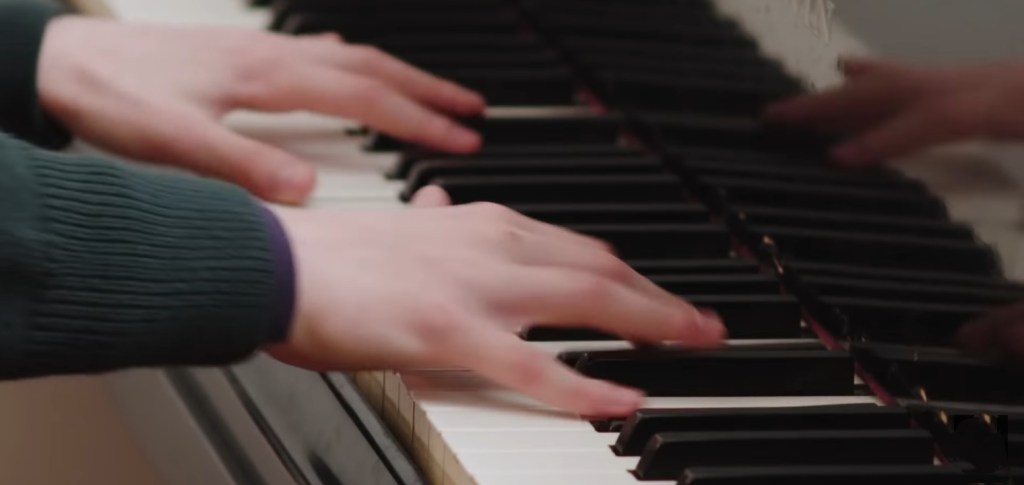
We can start learning to play instrument at any age. Picking up an instrument can provide some huge benefits for Intelligence, Physical well-being, Brain.
Playing an instrument requires:-
Auditory motor
Sensory
Visual system to work together
This inner system cooperation has some incredible outcomes that can affect many areas of life.
Different intensities of training produce different outcomes, even the most minimal practice can make a difference. Starting to play an instrument just one hour a week for few months can cause growth and increased activity in the parts of the brain responsible for memory, hearing, and motor. Researchers have found that this kind of activities can even increase IQ by 7 point or more.
Its also known that people who play musical instrument are better at other practical things too such as:-
Practical emotions
Learning new things/tasks
Creative problem solving
Musicians brain have better communication between left and right hemisphere which allows for more cooperation and out of the box thinking. Playing an instrument can also has benefits for brain and body.
boosting immune system function
Increase in resilience to hearing lose
Helps stroke patients regain motor skills
It’s been found that just listening to music can prompt the repair and regeneration of damage nerves in the brain.
Music is so much more than notes on a page, it can change the way we think, speak and feel. Music making and listen is really complex it’s not demystified till now it’s more mysterious than ever.
The sages loved their music. It gave them the same spiritual boost as the sun did. Music made them laugh, it made them dance and it made them sing. It will do the same for you. Never forget the power of music. Spend a little time with it every day, even if it is listening to a soft piece on a cassette while you drive to work. When you feel down or weary, play some music. It is one of the finest motivators I know of.
ROBIN SHARMA, Author of ‘The Monk who sold his Ferrari’
The above words are found in the Internationally famous book ‘The Monk who sold his Ferrari’. These words endow us with a message of how important it is to always remember the power of music and even on our busiest day we must not forget to listen to it.
Every person has their taste in music, some like Soft and Sufi songs while others may enjoy listening to Jazz and Trance. Whatever their taste may be the function of music in everybody’s life is the same; Relieve the person of his daily-life tensity. Music is one of the greatest forms of art derived from Nature. Let us know why is Music so much important in our day-to-day life.
MUSIC: A UNIVERSAL LANGUAGE:
We all have heard this at one or the other time in our life. But what does it exactly mean? Let’s understand this with a simple example. Some songs like Despacito or Bella Ciao, in that case, are not understood by everyone but every other person enjoys these songs without even being able to sing them correctly. These songs bring people together. Similarly, the language of music is universal. It doesn’t matter from which corner of the world a person belongs, you can communicate with them easily through the language of Music. This is the only language which even if not understood but is enjoyed by all.
MUSIC AS A CREATIVE FUEL TO THE MIND:
As a form of art, music brings out the creativity of a person. Listening to instrumental music challenges one to listen and tell a story about what one hears. In the same sense, playing a musical instrument gives you the ability to tell the story without words. Both require maximum right brain usage which not only exercises one’s creativity but also one’s intellect. This is also one of the reasons why people turn to music whenever they feel worn out or out of ideas to recollect their minds.
MUSIC HAS SPIRITUAL POWERS:
Many theories are suggesting the presence of Music dating back even before the existence of mankind. Music is believed to be derived from nature and one of the most common uses is found at religious and sacred events. Many civilizations mark their triumph at war and the cremation of influential figures with Music. Some people believe Music to be a key to God leading to the holy path, this also signifies the presence of prayers at religious places.
AN EMOTIONAL HEALER- MUSIC:
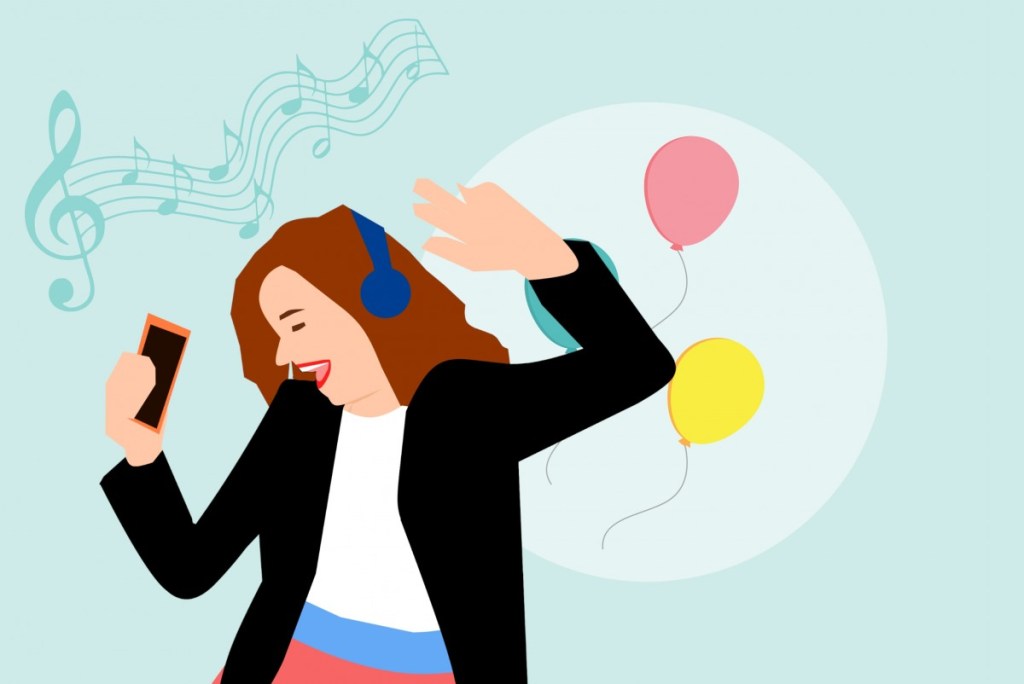
Many studies have shown the connection between the human mind and the type of music a person listens to. There are times in every person’s life when he turns to music for achieving an emotional balance. This is because music stimulates the release of happiness hormone in our brain. It reduces the stress of a person and makes the person dance to its beat. Thus Music is known as one of the best therapies for dealing with emotions. So next time when you feel low; put on the headphones-play a song-turn the volume up-exit from reality.
MUSIC BRINGS PEOPLE TOGETHER:
Let’s first see the following video:
As we saw in the video that every person enjoys himself on the tune of the music. This is the reason music is seen as the key ingredient to bring people together.
When Music is so much important then why are we still not ready with our headphones? Let’s Go and enjoy our day listening to our favorite music.
India has a very rich and diverse cultural heritage. If you study India’s history, you will see the lavish lifestyle of the people back in the days. But it is not limited to recent few centuries only. This richness goes way back to the times of gods and goddesses. All this is recorded in the books of literature of the Indian heritage.
India also has a wide range of books and scriptures one can read if they are into Indian mythological genre or simply mythological genre.
It is a country famous for its wars and folklores and hundreds of things that make Indian history quite an interesting subject. Most of us have grown up listening to these stories by our grandparents.
Some of the authors have revamped these stories in their creative imagination. Some characters are taken from the most famous stories of Indian history and represent a different aspect of those stories. These have been widely appreciated and loved. Here’s a list of top 5 Indian Mythological fictions one must read at least once:
The Pandavas series by Roshan Chokshi:
An amazing book for the youngsters that tells the story of a young 12-year-old girl named Aru Shah. Her family runs the Museum of Ancient Indian Art and Culture in America. Things turn around for Aru when her friends force her to rub an ancient lamp which releases a sleeping demon. Next thing you see is Aru on an unexpected adventure to set thighs straight by finding the reincarnations of the Pandavas and her journey through the kingdom of death. The series has not yet been completed. But is humorous and full of adventure. The author subtlety and cleverly connects the ancient world to the modern world.
The Palace of Illusions by Chitra Banerjee Divakaruni:
You might have heard the epic of Mahabharata many times. But have you heard it from the perspective of the one major cause behind the war, Draupadi? The Palace of Illusions tells this epic from the perspective of Draupadi, her feelings, how she struggled to find a loving home all her life and how she felt when she might have felt when she was gambled away in a game of chess by her five husbands. The book sums the story in 360 pages and tells her side of the story.
Shiva Trilogy by Amish Tripathi:
One of the most beloved books of people, the Shiva trilogy is a must on this list. Amish Tripathi is known for his storytelling and lucid writing. He intertwines the story of Lord Shiva with a fictional background. He beautifully narrates how a common man because of deeds and karma become a God for people. The first part is The Immortals of Meluha, the second The Secret of Nagas and the third is The Oath of Vayuputras. This is a must-read for all the Shiva as well as mythological lovers.
The Ramchandra series by Amis Tripathi:
Another brilliantly written series by the author Amish Tripathi is his second expression into the world of mythic-fiction. Like his previous work, The Shiva Trilogy, The Ramchandra series is also a bestseller. This time Amish explores the epic of Ramayana, each book from the perspective of the three main characters the epic revolved around. The series consists of two books Scion of Ikshavaku and Sita: Warrior of Mithila. This series is much better than the Shiva Trilogy in terms of storytelling and plot. The first part, i.e., Scion of Ikshavaku is from the perspective of Lord Ram, the second part, Sita: Warrior of Mithila is from the perspective of Sita, Lord Ram’s wife. Now the third book of the series is awaited which will be from the perspective of Ravana.
Asura: Tale of the Vanquished by Anand Neelakantan:
Anand Neelakantan is famous for his books on the two most famous epics of Indian history, Mahabharata and Ramayana. The story follows the original storyline of the original Ramayana but what is different about this book is that it tells you the story from the perspective of Ravana. It gives you the story of the other side, the side which is never told while telling the Ramayana. It is a fresh approach towards the epic of Ramayana and is a page-turner.
There are several other books which are worth giving a read. The list could go on and on. These Indian authors have brought a different perspective of the stories we have heard like a hundred times before.
These books are worth your time. After all who wouldn’t love to divide into the royal, fantasy land even if you only get to experience it through a book and your imagination.
Most of us have had a childhood interest or a hobby which was our favourite pastime. With not much to do all day, we would spend our time engaging in different unique and creative activities. Not only saving us from boredom, these hobbies have provided us with lot of benefits and shaped us into becoming what we are today.
Almost everyone had a favourite pastime activity which would keep us busy in our childhood. Starting from painting, doodling to collecting stamps, pebbles, train tickets and what not. When asked about their hobbies many people were found to narrate happy tales of their childhood. In today’s busy world where it is difficult to even take a day off from work, we tend to lose touch with our creative sides. Thinking about our childhood days makes us realise how long it had been since these hobbies were a part of our lives. Sports, music, crafts have all been pushed aside in adulthood by our busy schedules and responsibilities. In the midst of all these we have not realised how important these had been in shaping us and how amazing it would be to revisit these days by going back to those hobbies.
As children we had many different ways to spend our times. Some of us were into painting and crafts, some were into musical instruments, while some had the interesting habit of collecting stuffs. All these hobbies seem simple but studies show that there is a lot more to it.
There’s a lot of factual information about the importance of art in a child’s development. Researches show that individuals who have been into art and crafts in their childhood are found to be more expressive and have better communication skills. Experimenting with art makes children open to broader ideas and help them handle unexpected situations with ease.
Collecting is believed to be a psychological impulse. Collection is a historical practice and it ranges from stamps, books, tickets, coins to leaves and pebbles. People maintain the habit of collecting due to various reasons. Some collect due to an interest in the things that the collections represent, while others view collection as a pleasurable form of owning something. The different aspects attached with it makes the psychology behind it so interesting. It has been known that individuals who had the habit of collecting grow up to be careerist individuals in future. As the saying goes “An individual’s childhood is reflection of their life”. Collectors are also known to make better social connections and more friendships.
Individuals engaging with music from a very young age tend to enjoy musical instruments. Engaging with music makes us happy and lifts our spirits. Studies show that music improve our brain functions and it keeps the brain active. It has also been known that music helps in retaining information and develops memory. Children who have had such hobbies grow up to be smart individuals.
Google had encouraged its employees to devote 20 percent of their time to side projects of their interest. It was a very innovative decision on the part of the company and it yielded amazing results. It has been known that following this, employees have performed more productively in their work and have achieved more. There are innumerable ways in which hobbies help in one’s overall growth and development. Most of us have lost touch with these but we can surely try and revive those habits. In fact, discovering childhood hobbies can make our lives better and make us happier. It feels amazing to revive those countless memories we have with an instrument or a habit. This will also help us become more productive in our work. Investing one’s time in areas of interest alongside their career can yield incredible results and, in the process, will make us better individuals with a more holistic outlook towards life.
“Acting is behaving truthfully under imaginary circumstances.”
Acting is basically an art of imitation or reflection or representation. It is the quality of utilizing your own spirit body and mind in being someone else. Actors on the stage do not show themselves up there, but they show the character they get into to people.” Acting is equivalent to forgetting the original self.
Acting is not about being someone different. It’s finding the similarity in what is apparently different, then finding myself in there.
Benefits of acting
There are many benefits of acting :
It is a self-cleansing art.
It helps us to forget ourselves, our worries, or goals, our life pressure, etc for the same time.
It helps us to “be present”. Through acting, we enjoy “the moment”. We are at “the moment”.
It helps us to understand the small little worlds as well as the big worlds of various people around us.
Every act gives us a different perception that adds to build our character.
Methods of acting
Stanislavski/Strasberg/Method: It uses affective memory considering our past. We need to relate to our past events. It draws situations from real life and there is an “emotional recall” as we get in touch with your emotional self.
Meisner Method: It is the method based on the usage of imagination only. We need to enforce us to ask questions to ourselves. We ask the questions “what if”. We need time to contemplate under what situation will I be like this and considers the hypothetical future.
Voice Acting
Our emotions come out of our voices. Talking to a person over a voice call, we can immediately interpret if he is happy, sad, angry, guilty, lonely, or anything else. The Voice of a person gives a strong sense of the feelings of a person. Therefore, in addition to bringing the character by our body movements, we also need to bring out the character through our voice. Indeed, the voice acting is so powerful that it has opened up a separate domain for artists. Voice acting by podcasts are becoming popular day by day. It is easy to access and very interesting helping listeners to create a world of their own by listening to the voice artists. In addition, in these difficult times of pandemic, where shooting is difficult due to the rules of social distancing, podcasts are the way for artists.
Irrespective of the form of acting, the main trick is to make your character your best friend. We need to study up on character traits; read testimonials, interviews, or watch videos. Then, we need to try to bring the traits through voice. Traits, in general, depending on age, geographical location, any distinct characteristic, or disability. There is a need to develops a culture of responsive acting. It is also important to tackles self-consciousness. It is an effective way of creating the world around us. An actor is an energy bank, always excited about his character and his story.
“Acting is a sport. On stage you must be ready to move like a tennis player on his toes. Your concentration must be keen, your reflexes sharp; your body and mind are in top gear, the chase is on. Acting is energy. In the theatre people pay to see energy.”
India produces more engineers than the total population of Switzerland, even after that Switzerland is number one when it comes to research and innovation. Since our independence, India has not produced a Nobel laureate in science, whereas the USA has produced a hundred plus. According to the National Employability Report of 2019, 80% of the engineers in India are unemployable. And if we want to look for the root cause of this problem then we have to go back to the time Britishers were ruling us and The East India Company was facing 2 major challenges- 1. Communication with Indians. 2. They needed more workers; then Thomas Babington Macaulay gave us the “English Education Act of 1835”. It fulfilled both their purposes- of finding people who would sit behind desks and work for them without asking questions, and the other was communication in English. English is not a widely spoken language, even then it has become an attribute that defines your education. Russia, China, France, and many other countries are not as obsessed with English as we are. In India, a person is said to have “Poor Communication Skills” if his/her English is not good. Even a 2-3 years old iOS is considered outdated but a system which is as important as our education system is almost 185 years old, with just minor changes here and there. Our education system is a rat race, churning out robots who are proficient only in mugging up. A simple example of the incompetence of the system is that even after scoring 95 out of 100 in a Sanskrit exam a person is unable to speak the language. Instead of having a precise basic history syllabus, the students are made to learn a wide syllabus which is mostly just mugging up date(that could easily be looked up on the Internet now). Every class has English as a compulsory subject, but even after being taught English for 12 years most of the people are not able to speak the language properly, even a 5-year-old kid learns his/her mother tongue without cramming books. The techniques used in kindergarten to teach kids is better than the “fill out the sheets” technique to score marks taught in colleges. Everyone is taught the same subjects, the same syllabus regardless of the person’s capabilities, caliber, or creativity. Even Dronacharya taught his pupils according to their capabilities and specialties he did not force everyone to learn the same thing. We do not have many options, to begin with. We have Science stream on top, then comes Commerce and then comes the least dignified stream Humanities or Arts. Every parent wants their child to be either a doctor or an engineer. Your training begins early, you are taught from an early age that marks matter the most if you don’t get good marks you won’t get a good job and you’ll end up being a failure. Just think about the person whom you admire and who’s success story inspires you, be it anyone I am sure that they succeeded because they didn’t get trapped into this education system. If you ask the CEO of any company to appear for an interview in all the departments of his firm, there is no chance that he would succeed in all of them and there is a high chance that he won’t be qualified educationally enough to even appear for half of the posts. We spend 25% of our lives getting educated to work for someone who is most probably less educationally qualified than them. If the education system of India is so good then why do the kids of elites, politicians, actors, etc. go abroad to complete their education? Graduates and post-graduates are preparing for 5-6 years just to get a government job, just because a government job provides security. We look for a job with security because we don’t have confidence in our skills that we are capable of landing a job where we will stay purely based on our skills and creativity.
With the rapid growth in technology, I believe that we will reach a point, within not more than 5 years, where technology will make what we teach in schools irrelevant. Jobs in Digital Marketing, SEO, Cloud Computing, etc. didn’t even exist a few years back. We need to be open towards change, towards learning new things, towards being creative.
The term imagination is a hard word to describe. It can have a range of meanings, but creativity refers in its sense to the act of creating something original, creative or special through the use of thought. Creative thinking is often seen as the opposite of functions or disciplines requiring logic or being constrained by facts. Of course this is not necessarily true. But creative fields are widely believed to require creativity, while scientific fields do not. People often think that creativity is a chaotic, unforeseen, man-made phenomenon, while scientific research, math and machinery are bound by a set of substantive rules.
This has led to people sharing the paranoia that increasing society’s reliance on technology will limit creative thinking. When the question is presented, ‘Technology is limiting creativity,’ many people agree – yes, it is. In a recent report, Is Technology Killing Creativity, the author asserts that the point of the argument is often that we sacrifice original thinking to keep oneself constantly captivated. Then the writer goes on to say, if we can find anything online anywhere, we don’t give ourselves opportunity to solve problems and invent on our own.
Although it’s undeniably true that most people use smartphones and the Internet to flood their lives with idle time, the other side of an argument, though, is that technology actually redefines innovation. Of course, the concern is that adolescents have replaced conventionally imaginative hobbies such as painting, creating, and playing with passive computer behaviours such as gaming. Yet, given the fact that contemporary children do have higher media consumption levels than any previous generation, it is not necessarily true that imagination is lacking in their computer activities. Many kids use the internet to write blogs, create websites or dabbling in coding.
The emergence of technology and smartphones in particular has led to many specific recommendations that our dependency on these tools is killing creativity. This is not a new thought-people suggested that technology had long ago extinguished creative impulses. This was television and video games when I was a kid that were to bring down imaginations everywhere.
What’s the deal, then? Back in 1932, Aldous Huxley wrote Brave New World, where he proposed a future in which living beings sat a constant desire for technological distraction. Thought could be kept at bay, because by trying to distract ourselves with our electronic gadgets we would simply zap any boredom. Often this is the crux of the argument – that we’re sacrificing original thinking to keep ourselves constantly captivated. It’s also argued that if we can find everything online somewhere, then we don’t give ourselves room to solve the problems and foster an innovative solution on our own.
Scientific research tells us that daydreaming requires time, as daydreaming enhances our imagination. When we fill some downtime with scrolling through screens, is the daydream time being inhibited? Creativity is often called a discipline of “use it or lose it.” You may be employed in a creative job position, but you can also strangle your creativity by being constantly fastened to a computer.
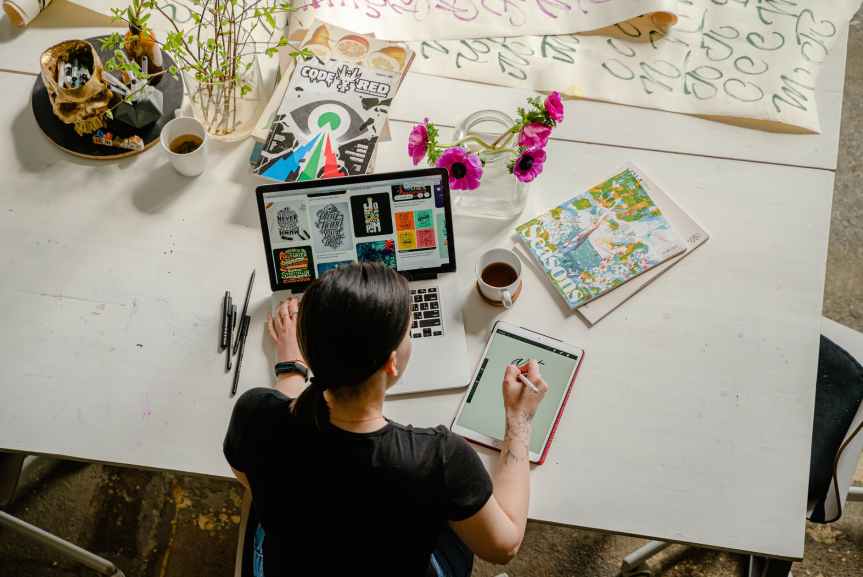
Technology has broadened the limits of what is possible with artistic practices like animation, music and graphic design. This has given creativity more definition, possibly even enabling more participants to join in. Taking a look at YouTube videos or even content present on Instagram-these are open platforms that allow everyone to participate and develop content.
Take the example like CGI in movies or platforms created to make graphic design more available for practitioners, the online outlets to promote the content. The openness extends the spectrum of artistic activities. On the Internet, only those considered by “experts” to possess artistic talent would have been revealed to the public. The curtain is lifted with the internet, and more people are noticed online every day. Artists like Bach and Van Gogh were not known in their own lives, though they would be well known if they were alive today.
Conclusion:
You can have a fair discussion free for both sides to disagree, but where does that leave us? Technology is here to stay and just continues to advance, and maybe one of the more rational reasons is for a healthy use of technology and knowledge, just like how we interpret our diets. There is the idea that our ancient ancestors benefitted from having as much information as possible – it would have been important for survival to know anything about their environment. The challenge now is that our brains need to be conditioned in an age of information overload to minimize the excess and just filter what is needed. It ties in with what we think the right climate requires to be nurtured












 Track2Training
You must be logged in to post a comment.