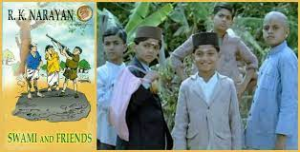
Swami
Swami is the ten-year-old protagonist of the novel. Swami is a schoolboy living in 1930, in the fictional town of Malgudi in the South of India under British colonial rule. At the start of the novel, Swami is a typical child who seems outwardly innocent, with only trivial concerns such as homework, impressing his classmates, and avoiding disappointing his father. Swami is considered average among his friends, neither especially clever nor stupid, brave nor cowardly. He is generally good-natured and gets along well with his peers and family, although he can be arrogant or deceitful at times, and is easily swept up in the plans and enthusiasms of others. As the novel progresses, Swami becomes more aware of his own identity and political consciousness and begins to define himself more in terms of his friendships and national identity than his family relationships. Swami is also a naturally good cricket bowler and prides himself on being nicknamed “Tate,” after a famous cricket player.
Swami is the central character of the plot. He is also the protagonist of the play. As a child, he goes to school where he does not like studies and gets bored easily. He is an honest boy of seven but, on the other hand, he also does not hesitate telling lies to his father. He loves his granny’s stories. He is good at cricket and is nicknamed “Tate.” He saw the revolution phase of Indian independence. Later in the course of the novel, he became bolder and socially prominent.
The protagonist of the novel Swaminathan (Swami) is a school going boy. He belongs to a South Indian middle-class family. His family comprises of his grandmother, mother, father, and mother. In the initial trenches of the story, his younger brother was born. He epitomizes the innocence of a youth mischievousness that childhood necessitates.
The plot of Swami and Friends revolves around Swaminathan, the central protagonist, who initially typifies the innocence of youth and all the mischievousness that childhood entails. He prefers cricket to school, takes his family for granted, and attempts to play out childhood fantasies in the often reckless games and stunts he pursues with his shifting group of friends. Initially coming across as passive and timid–more likely to follow than to lead the crowd (as we witness in the mob scene of Chapter 12)–and overshadowed amongst his peers by the more self-assured Mani and Rajam, Swaminathan, however, becomes bolder and more socially prominent over the course of the novel. The most vital player on the cricket team, it is ultimately, Swaminathan, and not Rajam or Mani that holds the key to M.C.C.’s victory. And though his rebellion against the headmaster results in childish flight, he openly and boldly defies the central authority figure of his school without waiting for Rajam’s support, and without the support of an angry mob to fuel his courage. While the novel centers on a brief period in Swaminathan’s life, in this brief journey, we witness the revolutionary change happening in India, and the subtle revolution of character and understanding that takes place within Swaminathan…
Rajam
Rajam is the son of the Police Superintendent and one of Swami’s closest friends. Rajam is new to Swami’s school at the start of the novel, and initially Swami and Mani view him as an enemy due to his quick wits, fine clothes, and fearless nature. However, Rajam quickly becomes friends with Rajam and Swami and acts as their ringleader for the remainder of the novel. Rajam does well in school and is liked by most of his classmates, and he draws confidence from his father’s prominent position (Rajam’s father is the Police Superintendent), although it also causes him to oppose the political activity that his friends support. Rajam sometimes bullies his friends and acquaintances, but more often he unites them and urges them toward new goals, most notably the formation of a cricket team. Swami loves and admires Rajam but comes into conflict with him, first because Swami supports political action that opposes Rajam’s father, and later because he doesn’t live up to his promise on Rajam’s cricket team. Rajam is so angry at Swami for missing the cricket match that he stops speaking to him, and it is unclear at the novel’s end whether the two friends have reconciled.
Rajam is the new kid at the Albert Mission School and is Swami’s rival turned best friend. Rajam is good at studies, speaks English “like a European,” and is the son of the police superintendent, which gives him more attention and status at school. He is witty and fearless in nature and naturally assumes authority in social settings. It is his idea to start a cricket team. The character of Rajam: Rajam was the guy with an endearing personality. He is smarter and grown-up than Mani. He believes in self-respect. Rajam is very sincere in academics. He likes assisting or helping his friends in academics. Mani possesses a propensity for domination amongst every one of his age but Rajat didn’t feel that within him. In fact, Rajam tries to put forward a hand for friendship with Mani. He wanted to settle the enmity with Mani and this signify the nobility Rajam has got with him.
Mani
Known as “the Mighty Good-For-Nothing,” Mani is Swami’s other closest friend. Mani is a fearless troublemaker who never does his homework, sleeps in class, and frequently resorts to violence to solve his problems. However, he is also a loyal and affectionate friend, and Swami is proud to be allied with him. Mani often plays a supporting role in Swami and Rajam’s friendship, though at the end of the novel it is Mani, rather than Swami, who takes on the role of Rajam’s best friend. Mani lives with a frightening uncle, but little else is known about his family or background.
Another close friend of Swami, Mani is described as the “Mighty Good-For-Nothing.” He is a bold and strong figure in his class. He is not good at studies and purposefully slacks off, but he likes fighting and no one dares to challenges him, even the teachers. Mani likes to dominate the whole class and also bully some of his classmates.
Swami’s Father
Swami’s father, W.T. Srinivasan, is an imposing figure who works at the courts and is usually strict with Swami. Swami sometimes feels afraid of his father, but at other times he turns to him for help and support. Swami’s father encourages Swami to study hard and helps him with homework and, notably, provides Swami with a study space within his own room. Late in the novel, Swami’s father reveals that his concern for Swami’s wellbeing outweighs his frustrations with his son, as shown when he searches for Swami all night and welcomes him home without punishment.
Swaminathan’s father is a lawyer by profession. He is stern and authoritarian, but caring. He worries about his son’s studies and encourages him to study hard. Sometimes he is overly strict, but later in the novel he also shows his concern for the well-being of his son.
Swami’s Mother
Swami’s mother appears in the novel only occasionally, usually in the context of providing Swami with something he wants or backing him up in an argument with his father. She is presented as a mild woman who is mostly concerned with her family and managing the household. She loves Swami deeply and also gives birth to a baby boy, Swami’s brother, who occupies her attention for much of the novel.
Swaminathan’s mother is in charge of the house and cares for Swami both materially and emotionally. She defends Swami in his arguments with his father. However, her appearances are occasional. She is the character that Swami misses the most when he runs away from the house.
Swami’s Grandmother / Granny Quotes in Swami and Friends
Swami’s paternal grandmother, whom he calls Granny, is an old woman who lives with Swami and his mother and father. Swami views Granny as ancient and sometimes embarrassing, but she is also a source of comfort and security during times of change, particularly when Swami’s brother is born. Granny sometimes tries to tell Swami stories about the family’s past, but he usually refuses to listen, indicating his preoccupation with his own present concerns. Swami grows more concerned with Granny’s needs over the course of the story, beginning to see himself as a caretaker for her and making more of an effort to meet her needs.
Granny is described as a sweet and sleepy lady whom Swami will often go to and tell stories about his day. She is a religious woman. She tells Swami the stories of her past. Her relationship with Swami changes throughout the novel.
Swami’s grandmother was a short and fat and a slightly bent woman. She was a notably a religious woman. She had inner beauty intact with her rather than physical. She was not an attractive woman as she herself says she wasn’t pretty. He lived with her in his childhood days. He describes her as a good friend of his. She used to wake him up during the school days and prepare breakfast for him. After the breakfast is being done his grandmother hand over the pen, wooden slate, and earthen ink-pot to him. While Swami attended school his grandmother would study the scriptures in the temple which his nearby his school
Swami’s Brother
Swami’s unnamed baby brother is born midway through the novel. While Swami at first thinks little of his brother, he soon grows fond of him and admires how quickly he learns and grows. Swami’s brother also presents a unique challenge to Swami, in that he occupies the family’s attention and makes it so that Swami is no longer the sole focus of his parents’ and grandmother’s affection.
He is the only sibling to Swami. He is born midway through the novel. He captures the prime attention of his family. Swami too cares for his little brother. However, this character has no major role as he remains a child throughout the novel.
Rajam’s Father
Rajam’s father is the Police Superintendent and acts as a powerful figure in the community. Swami and Mani are initially very excited to be associated with the Police Superintendent through their new friend Rajam, and Swami is impressed with the luxury of his household. Later, Rajam’s father becomes a symbol of political conflict when Swami witnesses him ordering the police force to violently break up the crowd of protesters. However, Rajam’s father remains kind in person to Rajam and his friends, and plays an important role in rescuing Swami at the novel’s conclusion.
Somu
Somu is one of Swami’s friends from the Mission School. He is the class monitor and gets along well with everyone, students and teachers, although he does not excel academically. Swami thinks of Somu as the “uncle of the class.” When Somu treats Swami unkindly, the experience is one of the first times that Swami is forced to admit that the people around him are more complex than he might have guessed. Later in the novel, Somu disappears from the group of friends after failing an exam, and thus not being promoted to the next grade.
Somu is Swami’s school friend from the Albert Mission School. He is the monitor of Swami’s class and carries himself with an easy and confident air. Swami calls him the “uncle of the class.”
Sankar
Sankar is one of Swami’s friends from the Mission School, known as “the most brilliant boy of the class.” Swami admires Sankar’s intelligence and relies on him for guidance at school. Sankar eventually leaves Malgudi when his father is transferred to a new town, and although he writes to Rajam and his friends intend to reply, they fall out of touch after realizing that they don’t have Sankar’s new address.
A classmate of Swami, Sankar is known as the “the most brilliant boy of the class.” Swami admires Sankar’s intellect and takes his guidance. Later, he leaves Malgudi as his father is transferred to another town.
Mission School Headmaster
The Mission School Headmaster is a primary antagonist for Swami in the novel’s early chapters. Although he confronts Ebenezar about his mistreatment of Swami, he also calls Swami foolish for telling his father what happened in scripture class and asks Swami to rely only on him in the future. Later, the headmaster’s intimidating interrogation of the students who participated in the protest goads Swami into renouncing the Mission School and ultimately transferring to the Board School. However, in comparison to the abhorrent Board School Headmaster, Swami eventually comes to think of the Mission School Headmaster as dignified and respectable.
Mr. Ebenezar
Mr. Ebenezar is the fanatical Christian scripture teacher at the Mission School. Although Swami and his friends sometimes finds his classes amusing, he uses his lectures to degrade Hinduism and argue for the superiority of Christianity. After Swami reports Ebenezar’s behavior, the Mission School Headmaster scolds the teacher, but ultimately it seems that Ebenezar is allowed to carry on teaching as before. Later, Ebenezar appears only as a benign figure in the school crowd, one who Swami even comes to view fondly after his troubles at the Board School.
He is Swami’s scripture teacher at the Albert Mission School. He is a Christian fanatic and degrades Swami’s religion, Hinduism, and considers Christianity superior to other religions. Later, he is scolded by the headmaster of the school.
The Coachman
The unnamed coachman is an acquaintance of Swami’s who promises to help him acquire a toy hoop in exchange for money. He claims to be able to turn copper coins into silver, but it becomes clear that he is lying to Swami in order to get his coins. The coachman’s son also becomes a menacing presence to Swami after this episode. Swami’s experiences with the coachman are an early example of his increasing acquaintance with the evils and dangers of the world.
The Coachman’s Son
The coachman’s son is a young boy who begins to taunt and threaten Swami after his father successfully scams Swami out of his money. Rajam forms a plan in which Mani will kidnap the son with Swami’s help, but the plan goes awry when the son tricks Mani and runs away with his toy top. Soon thereafter, Swami discovers during a visit to his father’s club that the coachman’s son works at the club, and Swami is overcome with fear that the son will attack him. This episode is one of the first instances in which Swami feels that his father is not able to protect him from harm.
Karrupan
Karrupan is a young boy who is bullied by Rajam, Mani, and Swami while out driving his cart. The three friends harass Karrupan and pretend to be government agents, frightening the boy before sending him on his way. The behavior of Swami and his friends toward Karrupan demonstrates their internalization of the colonized state’s brutal power structures.
Samuel (or The Pea)
Also nicknamed “The Pea,” Samuel is Swami’s classmate and friend. Both Swami and the Pea are close friends until the Pea changes his school. Both remain friends as they both play cricket together. He is the only Christian friend of Swami.
Dr. Kesavan
Dr. Kesavan is a physician whom Swami goes to in an effort to get a medical certificate saying he can miss school drill practice in order to go to cricket. Dr. Kesavan laughs at Swami’s self-diagnosis of delirium and pronounces him healthy, but says that he will talk to the Board School Headmaster to get Swami excused from drill practice. However, Dr. Kesavan does not talk to the headmaster at all, which leads to Swami’s punishment and eventual departure from school. Swami curses Dr. Kesavan for lying, and this episode is another of Swami’s formative experiences of betrayal.
Ranga
Ranga is the cart man who finds Swami unconscious after his night wandering lost in the wilderness. He rescues Swami by bringing him to Mr. Nair, thinking himself too simple to know what to do. Ranga is one of few peasant characters in the novel, and notably, Swami knows little of his role in the rescue and does not think to thank him later.
Mr. Nair
Mr. Nair is the District Forest Officer who helps Swami return home after being lost. Swami initially confuses him with his own father, indicating the sense of loss and disorientation that Swami undergoes as he matures. Later, Swami feels guilty for forgetting to say goodbye to Mr. Nair and worries that he did not show appropriate gratitude for his role, again drawing a parallel between Mr. Nair and Swami’s actual father. However, Mr. Nair also lies to Swami about the day of the week, presumably to keep him calm, and causes him not to realize he is missing the cricket match until it is already over.






























 Track2Training
You must be logged in to post a comment.