Insanity As A Defence In A Crime

The defence of insanity is mainly used in criminal prosecutions. For an offence to be called as a crime two essentials have to be satisfied i.e. actus rea and mens rea. โ€œActus Reaโ€ is the physical act and โ€œmens reaโ€ is the mental intention to do the crime, only if both are present it constitutes a crime. Therefore the โ€œInsanity Defenceโ€ is used by the defendants to get away with the โ€œmens reaโ€ part of a crime by assuming that the person who committed the crime was having a mental illness or was mentally incapable of understanding their actions during the time of commission of the crime or was of an unsound mind. The defence of insanity in the Indian judicial system is stated under the section 84 of the Indian Penal Code (IPC), 1860. It is given under the heading โ€œAct of a person of unsound mindโ€ and this can be used as a defence only if three conditions are fulfilled, they are:

  • That the person was incapable of knowing the nature of the act,
  • That the person was incapable of knowing that his/her act was wrong,
  • That the person did not know that what he/she was doing is contrary to law.

There are two legal maxims which make us understand the fundamental principle stated in section 84 of the IPC and they are: 

Actus non facit reum nisi mens sit rea which means that nothing is a wrong unless it is done with a guilty intention.

Furiosi nulla voluntas est which means that a person with mental illness has no free will and therefore they can do no wrong.

There is no liability formed on the person who is said to have no โ€œmens reaโ€ or a guilty intention, hence they are declared innocent, but this is not as easy as it seems to prove it. Cause one may prove medical insanity but proving legal insanity is quite difficult. Know you may ask what is the difference between the both, in simple terms medical insanity is simply a person suffering from a mental illness so itโ€™s more of a psychological aspect but legal insanity is when a person is very mentally ill that he /she could not understand their actions during commission of the crime, so if the person was knowing what they were doing during the crime but was mentally ill in other times still he will charged for the crime and be held liable (Anosognosia). There are different types of insanity they are permanent insanity and temporary insanity. In the first one they are considered insane at all times but in the second one the person is not always insane; they are sane at times. The โ€œburden of proofโ€ always lies on the accused and they have to prove beyond reasonable doubt that during commission of the crime they were โ€œlegally insaneโ€.

The psychiatrist opinion also plays an important role in the decision given by the court. Hence, punishing a person who is not responsible is a violation of basic human rights under the Constitution of India. There is a saying that โ€œRather leave the crime of the guilty unpunished than condemn the innocent.โ€ Some positive effects of this defence are death penalty is not given to the insane person as they cannot understand the gravity of the situation, this acts as a relief to the mentally challenged people as this defence moreover save their life as they are considered to have a childโ€™s state of mind and punishing a child is against our ethics and morals.

On the other side is the defence of insanity acting like a loophole in law or being misused by the โ€œadvantagedโ€ people, say people who are really wealthy enough to bribe the authorities in getting a fake medical certificate or getting false proof, or people who take the help of people who have big backgrounds like politicians or celebrities and so on, or if the lawyer is very intelligent enough to prove it even though the accused is of sane mind. Anything can happen in the present world of misbelief and in the โ€œnothing is impossible in this worldโ€. Seeing the loopholes of this defences it is abolished in some jurisdictions.Some other negative aspects of this defence are that it is very difficult to prove, and it can lead to high and increased trial costs. The insanity defence is a loophole for criminals as it is one of the popular used weapons which is used a defence to escape from any crime, as it is almost next to impossible to prove the mental state of the person during the commission of the crime. 

At a conclusion my opinion is  is that โ€œNO CRIMINAL SHALL BE LEFT UNPUNISHEDโ€, to achieve that we have to make our laws stricter and more specific and make sure such matters are governed in a very clean and transparent manner without scope for misuse or misleading the eyes of law. There is always good and bad to everything, but we should be capable and efficient enough to  make the bad perspects good.
The Problem with Online Activism Today

We live in times of great political and economic turmoil. Questions that have been pushed back till now are being asked on public platforms and many are unable to answer. There is also the rise of alternate ideologies, identities, and other categories which are challenging traditions and cultures, and rightly so.ย  An intrinsic part of our current culture is activism and social media engagement with issues in the world. Problems such as discrimination, violence, and abuse are talked about greatly and much needed debates held, often in the comments section of posts. While there is meaningful engagement, many activist pages on Facebook, Instagram, and Twitter are littered with comments of vitriolic language, multiple opinions, and yelling. While discussions are useful, one has to stop and wonder whether this is the best to go about bringing change.

Most of the social media today is usually seen protesting or talking about an issue. Posts are shared and people are called out. But we have to be mindful that it does not lead to a kind of elitism where only those who are educated in the โ€˜wokeโ€™ culture can speak. There has to be respectful space for dissent and dialogue that is inclusive of even opposing views. It is saddening that there is an increasing group of people who limit their activism to what they do online. We tend to become comfortable once we have posted something on a public platform and wait for approval from others. We shape our words in such a way that it will have a lot of impact or even invite debate. Once we have a debate going, it is often the sensational value of it rather than what is being said that is the focus. And this approach might be detrimental to true engagement. Such online activism also allows many to feel like they are actually doing something to change the status of things in the real world. This doesnโ€™t mean that raising awareness online or speaking about it is unnecessary or useless but also shows that if our activism ends after posting something and ranting about it, we have changed nothing. It is a mechanism to gain emotional satisfaction especially in a culture that is oriented towards getting things done quickly and seeking instant gratification. Actually engaging on the ground is a messy affair and requires patience, perseverance, ability to listen, and also to accommodate. But we do not like those things and it is much more convenient to talk about discrimination sitting on our couches typing on our high-end laptop while watching Netflix. This is to be expected with the virtual world indulgence that we have but we need to realize that just because we enjoy something or think something is good does not mean that it is good.

A desire to change things is necessary and essential. But when we live in a culture geared towards justice but often becoming hateful in the process, unless we are able to see beyond our own opinions, look for objective frames of reference, and listen to those who have been systemically discriminated against, and then get onto practicing what we say in real life, no amount of sharing posts or shouting will change much. We have to learn to respond intelligently, with love and concern, rather than react spontaneously with anger and then stop with that. Unless we learn to do that, no matter how wronged we feel, the ultimate result of our campaign wouldnโ€™t be effecting change but creating another kind of exclusivity which might not solve the problem at all.

India- Nepal relationship in the diplomatic level.

Recently, Nepal has banned all the TV news channels of India except the Doordarshan stating that it will not allow any foreign TV channels that assassin the character of its leaders.We have seen how the kalapani dispute has soften the relation between the two neighbor countries in the diplomatic level. India enjoys the civilizational and cultural relation with Nepal from many years. Any Bilateral relation set on the foundation of soft power treats both the partners as equal irrespective of their size and the influence. India has given soft power higher priority , so setting up strong trade and economic relations.

Over the last 30 year’s India’s soft power influence in Nepal has come under threat due to internal political instability and by the external players such as Pakistan and China.India’s relation is primarily built on three main pillars – Religious connect built by Hinduism and Buddhism , Link of Madhesi – Terai belt with UP and Bihar , Influence of Bollywood and Indian Television. But over the past 30 years there has been rising Anti-India sentiments .Nepal has always alleged that India has excessively interfered in the internal affairs right from the days of Nepal Monarchy.In civil war ,India was accused of taking Maoists sides and interfered in the transition of democracy through taking a political side at the time of Constitution framing.There has always been few political elements who have opposed in the India’s involvement in Nepal and these sentiments have been exploited by external players such as Pakistan and China leading to the significant surge in anti India sentiments.This sentiments has led to the decrease in soft power influence in Nepal take for Example Lumbini project which India was looking to develop was handed over to the chinese .

Since Buddhism has share a strong cultural connection between South Asia, Southeast Asia and East Asia , Indian diplomacy has always tried to exploit this connection by developing all the buddhism sites under the Buddhist circuit project but the project was taken over by china .China’s interest in Nepal can be explained to counter Indian influence in Nepal and also to monitor the Tibetian refugees who are present in large number in Nepal. Over the last few years China has bought massive investment in construction of Nepal’s -Road, Rail, Hydro power plant, Internet and Telecom sector. Apart from these hard investments, China is also looking for soft power influence by promoting the Mandarian language in Nepali schools. So overall a combination of Indian mistakes, Political instability and External players have contributed to the decline in soft power influence of India in Nepal.

The Joy of Writing

Writing isn’t always about publishing. For many, the pure joy of putting words and thoughts on paper is achievement enough. Here are tips on how to findโ€”or find your way back toโ€”the joy of writing.There is a pleasure and a power in the art of practicing writing, rather than simply producing it. And as more and more people discover this, personal writing is becoming its own distinct form of artistic expression. It’s no longer just the writing you do before you can get published.

If you want to put pen to paper and see what unfolds, it’s time to awaken to your identity as a writer. By rediscovering, or perhaps discovering for the first time, that the simple act of writing is a transformational process, you can alleviate the pressures that stifle creativity and open up to what you are truly meant to say. You might find that the greatest rewards of writing do not exist in the future with publication and public validation, but evolve during the process of bringing your ideas to the page. Consequently, you will begin to enjoy the freedom of your own creative voice, have a new, more compassionate understanding of yourself and reap rewards that are within your reach right now, just as you are.

Unearth your voice
Each of us is born with a unique way of looking at the world and an unlimited potential for creative thought. But as we grow up, we’re forced to stifle much of our creativity in order to “fit in.” Through personal writing, you can uncover your creative voice again.

Whether you write in a journal or on a computer, you can create a safe, nurturing space where your voice feels free to emerge. Simply by acknowledging your unique thoughts, even though you don’t share them with anyone, you can rediscover your natural creativity and paint a picture of your psychological and spiritual landscape.

As you reveal more of yourself on the page, you might notice patterns in the way you think, behave or react to situations or people in your life. This kind of self-awareness can help you make better decisions, understand difficult situations and sort through your feelings. It is a powerful way to find answers to some of your most difficult questions. And at other times, it can remind you that there are no easy answers, which is the root of wisdom.

Discover your writing style
As you discover your voice, you will also tap into your personal writing style. Writers often ask about “style,” a term used by teachers and literary critics in sentences like “She writes in a style reminiscent of Hemingway.” It is something that great writers have, yet even the best teachers cannot tell you exactly how to develop it.

Writing style is an expression of your unique voice and emerges through the act of writing itself. Your style can surface most easily when you write without concern for how you might be perceived by others. This does more than just encourage your writing style to reveal itself. It can also help you understand how important it is to not repress your “uniqueness” just becauseit does not sound like your favorite writer or does not match your conception of what a “good” writer would write.

Personal writing gives you a safe place to let your style emerge, and a valuable tool to help you embrace this style as an honest reflection of yourself and what you have to say to the world.

As you begin to welcome your personal voice and style onto the page, you will notice your writing becoming more vivid. At the same time, you may find that your life away from the page becomes richer and your observations and senses become sharper.

For example, “I went to the zoo today” might become “The polar bear looked sad and the smell of monkey pee was overwhelming.” You will naturally begin to absorb your environment in a new way so that everyday details become interesting, and everywhere you look, you find inspiring material for your writing.

Look East for answers
It seems miraculous that so much creativity, self-understanding and wisdom can come from an act as simple as personal writing. Then again, writing is not always simple. It is a challenge to find the time and conditions necessary to get into “writer’s mind,” that place where words flow freely and you can be yourself. In this, the practice of writing presents the same challenges as Eastern meditation, which is especially difficult for Western minds. The first time you sit in a meditation class, you are told to shut your eyes and just listen. You might squirm, worry about what everyone else in the class is doing or think about what to make for dinner.

Then, after a few classes, it will become easier. You will begin to hear the quiet breathing of your classmates, their squirming on their cushions, a cough, a sniffle. And you will hear the noise of your own racing mind. When you learn to slow down, to notice, it tunes you into the moment, with all of its life, noises and peculiarities, including all of your bare emotions and thoughts. This is the same “tuning in” you can achieve by letting yourself write freely on the pages of your journal. And it is wrought with the same challenge you face with meditationโ€”you have to take the time to slow down from the activities of your life to practice it. But fortunately, you don’t have to get stiff-legged on a beanbag cushion for 20 minutes to experience this “tuning in.” You can write anywhere, anytime. As Alice Walker once said about writing, “You can even do it in bed.”

Slow down
Personal writing, like children and meditation and traffic jams, slows you down and makes you aware of the only thing that is certain in lifeโ€”this very moment. This is not an easy thing to do. There is little encouragement to pay attention to this moment. Instead, you are taught to focus on achieving and moving ahead. By writing down what your life is in this moment, you are facing the aspect of what you expect your life to be like.

Sometimes it is frightening to accept that this is where you are right now. Other times it can be exhilarating as you realize that you are doing something you have always wanted to do, or that you have carved out a satisfying life that you never could have imagined. As you get accustomed to seeing your own life in words, you can gain an even greater appreciation and understanding of how your life is unfolding.

I’ve talked to published writers who are nostalgic about the days when all of their writing was just for them, before editors, agents and readers were influencing their craft. A friend who has published several short story collections told me he spent three years writing just for himself before considering publication and that he wishes he had spent 10. He said the time before the pressures of the market bear down on your creative spirit are often the best times of your writing career. You might think it is easy for published writers to lament their exit from the bliss of “pre-publication.” But this hindsight is an indication that, published or not, you already have access to the most rewarding gifts that writing has to offer.

Whether or not you dream of publication, you can use personal writing as a way to accept where you are right now on your writing path. Because in writing, as in life, enjoying the journey is the ultimate destination.

Water: The Elixir of Life

Did you know that your body weight is approximately 60 percent water? Your body uses water in all its cells, organs, and tissues to help regulate its temperature and maintain other bodily functions. Because your body loses water through breathing, sweating, and digestion, it’s important to rehydrate by drinking fluids and eating foods that contain water. The amount of water you need depends on a variety of factors, including the climate you live in, how physically active you are, and whether you’re experiencing an illness or have any other health problems.


Water Protects Your Tissues, Spinal Cord, and Joints

Water does more than just quench your thirst and regulate your body’s temperature; it also keeps the tissues in your body moist. You know how it feels when your eyes, nose, or mouth gets dry? Keeping your body hydrated helps it retain optimum levels of moisture in these sensitive areas, as well as in the blood, bones, and the brain. In addition, water helps protect the spinal cord, and it acts as a lubricant and cushion for your joints.

Water Helps Your Body Remove Waste

Adequate water intake enables your body to excrete waste through perspiration, urination, and defecation. The kidneys and liver use it to help flush out waste, as do your intestines. Water can also keep you from getting constipated by softening your stools and helping move the food you’ve eaten through your intestinal tract. However, it should be noted that there is no evidence to prove that increasing your fluid intake will cure constipation

Water Aids in Digestion

Digestion starts with saliva, the basis of which is water. Digestion relies on enzymes that are found in saliva to help break down food and liquid and to dissolve minerals and other nutrients. Proper digestion makes minerals and nutrients more accessible to the body. Water is also necessary to help you digest soluble fiber. With the help of water, this fiber dissolves easily and benefits your bowel health by making well-formed, soft stools that are easy to pass.

Water Prevents You From Becoming Dehydrated

Your body loses fluids when you engage in vigorous exercise, sweat in high heat, or come down with a fever or contract an illness that causes vomiting or diarrhea. If you’re losing fluids for any of these reasons, it’s important to increase your fluid intake so that you can restore your body’s natural hydration levels. Your doctor may also recommend that you drink more fluids to help treat other health conditions, like bladder infections and urinary tract stones. If you’re pregnant or nursing, you may want to consult with your physician about your fluid intake because your body will be using more fluids than usual, especially if you’re breastfeeding.

How Much Water Do You Need?

There’s no hard and fast rule, and many individuals meet their daily hydration needs by simply drinking water when they’re thirsty, according to a report on nutrient recommendations from the Institute of Medicine of the National Academies. In fact, most people who are in good physical health get enough fluids by drinking water and other beverages when they’re thirsty, and also by drinking a beverage with each of their meals, according to the Centers for Disease Control and Prevention. If you’re not sure about your hydration level, look at your urine. If it’s clear, you’re in good shape. If it’s dark, you’re probably dehydrated.

How To Create Your “Social Bubble” And Interact Safely Amid The Pandemic!

Social Bubbles offer an opportunity to socialize in close proximity with a small group of people. Keeping your social bubble to 10 or fewer can help reduce exposure to Covid -19 outdoor activities are a great way to with your social bubble. Summer time screams spending time with family and friends at celebrations inside and out. But with the pandemic still underway, the more people we interact with at a gathering and the longer that interaction lasts, the higher the potential risk of getting Covid -19.

We can still get our social fix, though. One way people are safely interacting with others is by embracing social bubbles or social pods.
In order to make your play pod as safe as possible, itโ€™s important that you put some boundaries in place. First, the more people who are in your pod, the greater your Covid exposure risk. Ideally, keep your overall pod size to 10 people or fewer. Keep your circle small if you or anyone in your family is at an increased risk for Covid -19 due to age, asthma, it other medical conditions. Once your social bubble is established and youโ€™re ready to interact, the following ideas can help bring some fun to your pod amid these stressful times.


โ€ข Embrace Your Backyard
Stepping out can increase the risk of getting Covid -19, use the backyard of your house as an escape.
The beauty of a social pod or bubble โ€” at least one where everybody follows the rules โ€” is that when you spend time together (as long as youโ€™re away from other people) you can interact pretty freely. Meetups where youโ€™re all contained to one personโ€™s home, backyard, or stoop are fair game.

โ€ข Catching A Movie
Due to the pandemic, outdoor movie theatres are shut to curb the spread. Catching up for a movie indoors along your social bubble will help reduce the risk of getting Covid -19.

โ€ข Look for Look Out Points
Itโ€™s hard for kids to stay at home idly. Plan games indoors, arrange dinner at the terrace, to get them moving and having fun.

Interacting with others by embracing social bubbles is one way you can get your social fix more safely by avoiding any physical contact.

Initial Public Offering (IPO)

Initial Public Offering (IPO) means company will be listed for the first time in the stock exchange. Public can purchase the share of the company by investing in the IPO of the company. In IPO campany may sell its existing share or can freshly issue new share. By IPO company can get funds which is needed to run the business which company may use that fund for the working capital or Purchase new assets. For the IPO company will appoint the merchant bankers to look the process of IPO. If the more people bid for the IPO it will be called as oversubscribed and if less people bid it will be under subscribed. A ipo should not to be under subscribed. A ipo need to raise more than 90% of total issue. So to get rid of this risk company will appoint underwriters, who will purchase the share if if the ipo was under subscribed. Company will give time to subscribe for bid for share, people need bid for share from their demat account. Within few days share will come to demat account later it will be listed in stock exchange where it can publically purchased and sold.

Mental Health: during Covid-19

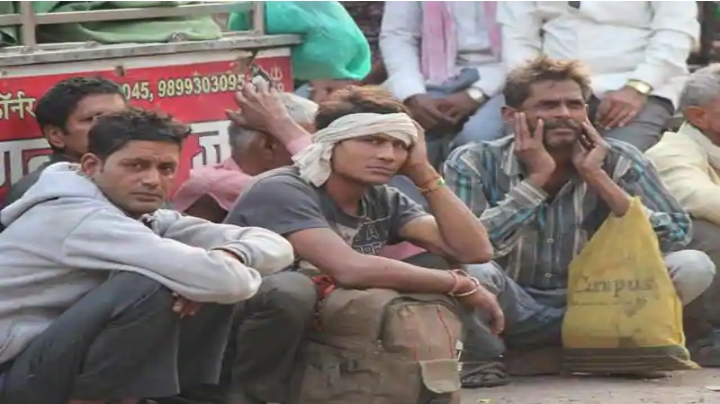
As we all are aware about the current situation, dealing with this pandemic is the biggest challenge for all the Nations. Corona virus causing death to thousands of people. So many people are suffering from this decease and large number of infected persons are increasing day by day. Due to Nation-wide Lockdown people are locked in thier houses only can go out for essential services, watching News channel, reading articles about Covid-19 causing anxiety, fear and stress among the people, India and other countries facing economic instability and many losing their jobs increasing unemployment and daily wage workers are facing difficulties for living and worried about getting work and how to feed thier families. Doctors are working overtime to provide treatment to more and more patients, people are running hospitals to hospital to admit patients.

Number of Corona infected patients increasing day by day
Daily wage workers worried about thier future

The environment around us is very stressful and negative, but people should try to fill themselves with positivity and hope for better future. Take breaks from news and information related to Covid-19 excercise and meditate. Let’s foucus on building our immunity stronger and eat healthy. listening music or pursue some hobbies all should try to be happy and stress-free.

The UN has urged the governments around the world to take the mental health consequences very seriously, and ensure widespread availability of mental health support. WHO has published guidelines for the communities regarding this issue, because mental health matters. In this difficult time do not lose hope,We will fight, we will win.

One Nation One Law

India is an ancient civilization governed by customs and traditions. Sometimes, it is called the museum of various religions, castes, cultures and ethnic groups. If we go down the ancient period we find that India was governed only geographically and not politically. Religion played an important role in the political life of the nation and it also acted as a guide for the ruler and the ruled. Hence the law enacted at that time formed part and parcel of the religion. However, with the advent of the British rule, our nation entered the phase of modern history. The British brought new thoughts like, western education, idea of secularism, a constitution containing the rules and regulations for the people and the government, political institutions like parliament and the political thoughts like Democracy; Supremacy of the Constitution, Liberty, Equality, Justice Rule of law, etc. They formulated Indian Penal Code, i.e., codifying criminal laws in 1860. Thus, it was the first attempt to cover all the citizens of India under one law. But the civil sphere of life of all the people was left untouched. As a result of these developments a wave of nationalism arose in the minds of the people of India and with the enactment of various legislation like Government of India Act, 1935, India for the first time became a nation politically. With freedom in 1947 and enactment of the Constitution in 1950, India was born as a nation and the Constitution, the supreme law, occupied a supreme position in the political life of this nation.

Based on the ideals like Equality, Rule of law, Justice, Liberty, etc., our Constitution made enough provisions to uphold these ideals. It is the duty of the government to enact legislation based on these principles. By keeping this in mind criminal law is made applicable to all citizens of India irrespective of race, religion, caste or sex. But considering the vast diversities in India and the ambiguous condition prevailing at the time of Independence and the communal tension rife in our country, no Uniform Civil Code for all the citizens was made.

Uniform Civil Code

Article 44, makes it an obligation on the State to promote a uniform civil code to all citizens throughout the territory of India. Uniform civil code is a set of law proposal which will replace all the lawsโ€”personal laws governing institutions like marriage, divorce, inheritance of property, etc., based on religious faith.

M.C. Chagla former Chief Justice of Bombay High Court observed that, โ€œArticle 44 is a mandatory provision binding on the government. The Constitution was enacted for the whole country, it is binding on the whole country and every section and community must accept its provisions and directives.โ€

The Supreme Court suggested in favour of Uniform Civil Code through many judicial precedence. Some of them are:

Mohammad Ahmed Khan v. Shah Bano Begum mainly known as Shah Bano Case. In this case in 1985, Shah Bano moved to Supreme Court for seeking maintenance under section 125 of the Code of Criminal Procedure when her husband divorced her after 40 years of marriage by giving triple talaq and denied her regular maintenance. The Supreme Court gave verdict in favour of Shah Bano by applying section 125 of Indian Criminal Code and it is applied to all citizens irrespective of religion. Then Chief Justice, Y.V Chandrachud, observed that a Common Civil Code would help the cause of national integration by removing disparate loyalties to law. And so, the court directed Parliament to frame a UCC.

The second instance in which the Supreme Court again directed the government under Article 44 was Sarla Mudgal case. In this case Sarla Mudgal v Union of India, the question was whether a Hindu husband, married under the Hindu law, by embracing Islam can solemnize second marriage. The Supreme Court held that adopting Islam for a second marriage is an abuse of Personal laws. Further said that Hindu marriage can be dissolved under Hindu Marriage Act, 1955 i.e. mere by converting itself in to Islam and marry again does not dissolve the marriage under Hindu Marriage Law and thus will be an offence under Section 494[5] of the Indian Penal Code.

In John Vallamattom v. Union of India, the Priest from Kerala, John Vallamatton filed a writ petition in the year 1997 stating that Section 118 of the Indian Succession Act was discriminatory against the Christians as it imposes unreasonable restrictions on their donation of property for religious or charitable purpose by will. The bench comprising of Chief Justice of India V.V Khare, Justice S.B Sinha and Justice A.R. Lakshamanan struck down the Section declaring it to be unconstitutional. Further Khare stated that;

โ€œArticle 44 provides that the State shall endeavour to secure for all citizens a Uniform Civil Code throughout the territory of India. It is a matter of great regrets that Article 44 of the Constitution has not been given effect to. Parliament is still to step in for framing a common civil code in the country. A Common Civil Code will help the cause of national integration by removing the contradictions based on ideologiesโ€.

Need for a Uniform Civil Code

The need for a uniform civil code is promoted on the following reasons mentioned below:

  •  Firstly, India being a secular republic needs to progressive and must have a common law for all citizens. To have different rules based on religion is against the principle of equality. In fact, the fundamental rights have sought to reform many religious practices that were found to against the progress of the nation.
  • Secondly, a uniform civil code helps to check the caste and religion-based politics. India has shown remarkable progress in the economic front but the social progress is hampered by the anachronistic religion-based traditions and personal laws. In the social-cultural respect, Indian society remains at a midpointโ€”neither a modern nor a traditional society.
  • Thirdly, the existence of the personal laws keeps the nation divided in many respects and retards the nation-building activity.
  • Fourthly, the promotion of gender justice demands a uniform civil code. Indian society is primarily a patriarchal society ridden by age-old traditions that promotes unfair unequal treatment of women. The constitution declares the resolve of the people to guarantee equal rights to women, which accelerates the need for a uniform civil code.
  • Fifthly, the existence of various personal laws has been a loophole which is effectively exploited by the dominant and elite social class. For instance, the alternate judicial systems in rural India and the practices like honour killings are supported by the absence of the uniform civil code.
  • Sixth, vote bank politics can be reduced by a uniform civil code. When all religions are brought under a single set of laws, the opportunity to offer benefits to certain religious denominations, especially the minorities, for garnering their vote will be reduced.

On the above grounds, there have been demands to make uniform civil code and implement in the past. At present, Goa is the only State in India to have a common civil code, also known as the Goa Family Law. The demand had always resulted in heated arguments for and against having the code. This had been a most debated provision even in the constituent assembly. However, the founding fathers have deliberately provided it as an unenforceable directive.

Uniform Civil Code: Why an Unenforceable Directive?

Uniform civil code aims at securing โ€˜harmony through uniformityโ€™ is an undeniable truth. But making it a compulsory provision would result in a sort of regimentation of the civil code which will result in โ€˜discontent or dissatisfactionโ€™.

Similarly, the Supreme Court has also ruled that although uniform civil code for all persons may be desirable, its enactment in one go may be counterproductive to the unity and integrity of the nation. Progressive changes must be brought gradually because social change is a slow process. The legislature must make or amend the existing law where there is an acute necessity.

To make all laws to be uniformly applicable to all people in one go would be inexpedient and incorrect.

India being a pluralist society, people have different faiths and the tenets propounded by their religious faiths are multifarious. It is indeed a challenge to achieve unity among the people professing different religious faiths, born in different castes, creeds or sub-sections in the society, speaking different languages and dialects in different regions and provided a secular constitution. Supreme Court, in Pannalal Bansilal versus state of Andhra Pradesh, observed that,

“The directive principles of the constitution themselves visualize diversity and attempt to foster uniformity among people of different faiths.”

The orthodox section among the minorities such as Muslims feels that the Uniform civil code will adversely affect their identity. The issue has been sensationalized by the media which brought the debate from the need for uniform civil code to the divinity of personal law. Consequently, the demand for Uniform Civil Code is regarded as identity politics and viewed negatively.

Staffing

Staffing is the process where organisation need deicide it’s required manpower for the work, Selection of the candidates,Placing the selected candidate for work, Introduction of candidate to the organisation and organisations to him, Giving relevant trading to the candidate in different way and giving compansation for the work done by the employee. For any organisation human resources is very important to get them and to give proper training company need proper staffing method. Firstly organisation will plans the member of employees needed to for the work then company will select the candidate by recruitment process then selected candidates will be introduced to organisation and training will be given to them. According to their work the organisation will give the remuneration.As organisation need employees according to their demand in the organisation they select candidates accordingly.

When the Police take matters into their hands…

Police Cars in India (List of all Indian Cop Cars)

On July 10, the Vikas Dubey was killed in an encounter while he was being taken to Kanpur in the custody of UP Special Task Force. The gangster was arrested at a temple in Ujjain just a day before for murder of as many as 8 policemen. To describe the incident, the car which was taking the accused to Kanpur got overturned and Dubey seized the opportunity by snatching the gun from a policeman who was injured in the accident. Afterwards, the man tried to flee but he was killed from the shots fired by the police in retaliation.

The whole story sounds a scene from the movie Singham in which a group of cops canโ€™t stand the injustice anymore and take matters into their hands to bring a politically powerful organisation of gangsters down with the aid of fake encounters. When a person with a criminal record or a terrorist is killed by the police or armed forces without any trial but in self-defence, it is known as encounter killing. Such killing can also be part of a set up in which the police makes it seem like they were helpless and the life of the criminal was compromised in turn.

Something similar happened in Hyderabad in December 2019. Four men who were suspected of raping and killing a female vet were shot dead when they were being taken to the crime scene. The narrative goes like this – the four men had made an attempt to escape by attacking the ten officers that they were in the custody of and not only did they throw stones and sticks but also stole the officersโ€™ gun. The police tried to make them surrender until they were finally killed in retaliatory firing. Justice was served and the police were appreciated for doing their job by the public.

But is it actually the policeโ€™s job to do justice or the courtโ€™s? The police are only supposed to catch the criminals and present them in court for trial. It is the courtโ€™s job to decide whether a criminal gets imprisoned for life, hanged or even figure out whether the accused is guilty and not the policeโ€™s. There have been several cases in which the police picks up the wrong person and sometimes they do it deliberately in order to calm the public rage or hide its very incompetence. Innocent people, usually from poor or minority section of the society, are dragged into jail so that the police can protect their image and become a hero in the publicโ€™s eyes.

Are the stories of police acting out and killing the suspects or murderers in defense even plausible? The fact that people were even able to get away from the police, let alone steal their guns and the police were not able to stop them. Law enforcement in this country has become more about revenge than justice. It is strange how the accused in so many major cases manage to escape from a large group of policeman and firearms always end up in the hands of arrested persons. An Encounter happens and whether it is real or staged, is subjective. How does police expect people to believe that such encounters are not fake? Because if it wasnโ€™t, then it really says a lot about the competency of the officers assigned to such cases.

Section 73A of Indian Evidence Act

This section comes under Part II of Chapter V of documentary evidence, here how execution of proof is done is to be shown. If a document is required by law to be attested, it shall not be used as evidence until one attesting witness at least has been called for the purpose of proving its execution, if there be an attesting witness alive, and subject to the process of the Court and capable of giving evidence: Provided that it shall not be necessary to call an attesting witness in proof of the execution of any document, not being a Will, which has been registered in accordance with the provisions of the Indian Registration Act, 1908 (16 of 1908), unless its execution by the person by whom it purports to have been executed is specifically denied[1].

Now in section 73 of Indian Evidence Act it is stated โ€“

Comparison of signature, writing or seal with others admitted or proved.

 In order to ascertain whether a signature, writing or seal is that of the person by whom it purports to have been written or made, any signature, writing, or seal admitted or proved to the satisfaction of the Court to have been written or made by that person may be compared with the one which is to be proved, although that signature, writing, or seal has not been produced or proved for any other purpose. The Court may direct any person present in Court to write any words or figures for the purpose of enabling the Court to compare the words or figures so written with any words or figures alleged to have been written by such person

73A. Proof as to verification of digital signature:

In order to ascertain whether a digital signature is that of the person by whom it purports to have been affixed, the Court may directโ€”

(a) That person or the Controller or the Certifying Authority to produce the Digital Signature Certificate;

(b) Any other person to apply the public key listed in the Digital Signature Certificate and verify the digital signature purported to have been affixed by that person.

For the purposes of this section, โ€œControllerโ€ means the Controller appointed under sub-section (1) of Section 17 of the Information Technology Act, 2000.

Comments:

Whenever there is doubt of signature, seal or writing before the court this section 73 of Indian Evidence Act will be applicable. According to this this, court can match or compare the disputed signature, seal or writing with undisputed signature, seal or writing which have been submitted to the satisfaction of court. In this it provides for a straight method of comparison of disputed writing, signature or finger impression, in deciding unresolved matter whether a particular signature, writing or seal of a particular person by whom it purports to have been written or made, the court can compare the same with other signatures, seal or writing which have been already submitted or proved to be the same ( i.e. writing or signature or seal) of that person. โ€œIt is necessary that the writing to be used as a standard should be properly proved to the satisfaction of the judge to be the handwriting of the person concernedโ€. In this situation the rule of prudence is that the comparison of signature by courts as a mode of ascertaining the truth should be used with great care and caution.

This section contains two parts. The first one provides with the comparison of writing, signature, figure etc. purporting to have been written or made by a person with other admitted or proved signature, writing, figure etc. by the court to have been written signed or made by the same person. Second part here empowers the court to order the person to appear before it and to give his specimen signature or writing for the purpose of evaluating the disputed signature, writing, figure etc. and to see that it matches or not.

Here according to Supreme court it is clear that such comparison made by a handwriting expert or by one with the handwriting of the person concerned or by the courts direction. Here the court should not be in hurry it should slowdown in making comparison itself. It should take the proper aid of any writing expert. As both plaintiff defendant has not taken steps to secure the opinion of handwriting expert as such the court has the discretionary power to compare disputed signature with the undisputed signature.

It is equally important to take note of the sentence โ€œfor the purpose of enabling the court to compareโ€ found in the second part of Section 73. In this regard the Supreme Court held that the language of Section 73 does not permit a court to give a direction to the accused to give specimen writings for anticipated necessity for comparison in a proceeding which may later be instituted in the court. Section 73 cannot be made use of for collecting specimen writing during investigation and recourse to it can be had only when the court before which the enquiry or trial of proceeding is pending requires the writings for the purpose of enabling it for comparison.

In case of determination of finger impression the court is required to make a thorough study, if necessary with the assistance of counsel, to ascertain the characteristic, similarities and dissimilarities of such finger impression. The court should avoid reaching conclusions based on a mere casual or routing glance or perusal. There are methods of proving writing such as, with the help of expert who can prove handwriting and signature under section 45 of the Evidence Act, With the help of other person who is acquainted with the handwriting of the person alleged to have signed or written the document and by calling and examining the writer himself and his admission.

In 73A again to proof the digital signature the court will tell certifying authority to produce its digital signature certificate in court or else, apply by other method and then compare it accordingly. Here is digital signature certificate comes under IT Act.


[1] Section 73A of Indian Evidence Act

Whatโ€™s Going to Happen Next: Speculations and Rumours about MS Dhoni

The most successful captain, finisher and wicket keeper, all said, and very well said. MS Dhoni has been on the forefront of Indian cricket for quite sometime now. The legendary keeper batsman is one of the few captains to achieve such success at international level or letโ€™s say he is the only one till now. What not the Indian legend has won, the 50 over world cup, T20 world cup as well as the Champions Trophy. He was the one who even took India to the number 1 ranking in the test format. But as the game goes on, so does the players form and their age. Mahi has turned 39 this year and many believe this might be the last year of his international career. And the rumours are getting stronger and stronger since Mahi hasnโ€™t appeared in any international game since the 2019 World Cup semifinal game against the Kiwis.

Mahi was all set to return to playing competitive cricket as the IPL was scheduled from 29th March, 2020. But as is very well said, everything doesnโ€™t go according to plan. Thatโ€™s what happened in the case of Mahi, as his planned return to competitive cricket was stopped by the outbreak of coronavirus in the world. All sporting events from across disciplines have been cancelled and the IPL has been postponed till any further notice. Also, the coronavirus threat is looming upon the scheduled World T20, 2020 to be held in Australia which supposedly was going to be Mahiโ€™s last world cup event in his illustrious career.

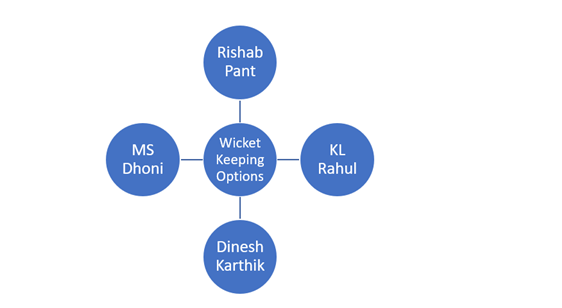
But with the sporting calendar most likely to be postponed for the rest of the year, future of Indiaโ€™s most successful captain is under scanner again. So, now we would analyse various aspects which would help us know if Mahi could be part of Indiaโ€™s world T20 squad if it is postponed for 1 year. Mahi hasnโ€™t played competitive cricket for almost 1 year now. And his replacement still hasnโ€™t been found in the Indian team. The Indian team gave chances to Rishab Pant but the young dasher from Delhi hasnโ€™t performed up to the standard expected from him. But when KL Rahul was given the role of a keeper batsman in the team, the youngster from Karnataka has impressed one and all with his performances in India as well as overseas. So, if India go with youth over experience for the T20 World Cup, looking at the next 2023 World Cup to be held in India. So, below I would be listing the possible wicket keeping options for India ahead of the T20 World Cup:

The above fig. clearly points out the fact that India would be having around 4 wicket keeping choices to go with. Looking at the type of format, wicket keeper is an essential part of the team as he provides the balance needed to the team. As of now, the most likely to go for the world cup is KL Rahul but he can play in the team as a specialist batsman also. So, there is a three-way race for the remaining spot. The selectors now have to choose whom to go with, be it the experience of MS Dhoni or the youngster from Delhi. Dinesh Karthik comes into the picture only if he has a good IPL with KKR as he has helped India always with his batting as well as his wicket keeping skills. Remember the Nidhas trophy final, how can any Indian forget that innings. So, will the Indian management go for Dhoni or not?

Dhoniโ€™s fitness level isnโ€™t a question at all, the Indian legend is fit as ever and not even a youngster can challenge him at this moment in relation to his fitness. The concerning point is his form with the bat which has dipped a little bit over the years. But it canโ€™t be the only factor dependent upon his selection. If Mahi performs extremely well in the IPL if it happens, then the doors are clearly open for him in the T20 World cup team. But the problem is if the IPL is cancelled this year and the T20 World Cup goes on as scheduled, will the Indian team management take the risk of including Mahi in the team as he hasnโ€™t played professional cricket for over a year now. This is the question the team management has to answer and answer fast as the T20 World Cup is approaching.

No doubt that MS Dhoni is a legend of the game but has the time come that MS Dhoni bids farewell to the game or is cricket still left in him? This is the question everybody is waiting to get an answer and only MSD has the answer to all these questions but the speculations would continue on and on.

No child left behind

Theย No Child Left Behind Act of 2002ย (NCLB) was a U.S.ย Act of Congressย that reauthorized theย Elementary and Secondary Education Act; it includedย Title Iย provisions applying to disadvantaged students. It supportedย standards-based education reformย based on the premise that setting high standards and establishing measurable goals could improve individual outcomes in education. The Act required states to develop assessments in basic skills. To receive federal school funding, states had to give these assessments to all students at select grade levels.


Legislative history

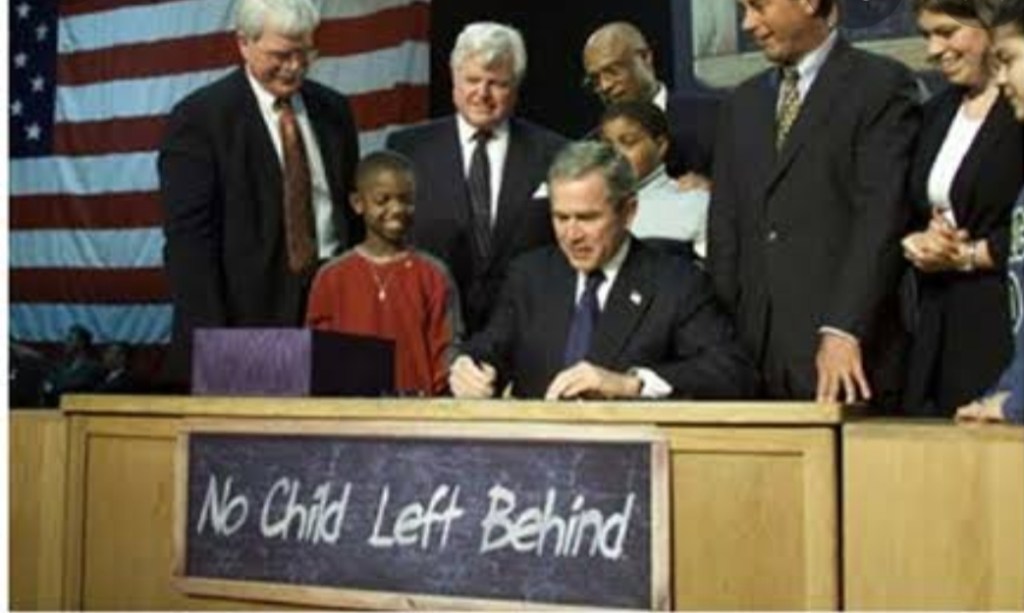
It was coauthored by Representativesย JohnBoehnerย (R-OH),ย George Millerย (D-CA), and Senatorsย Ted Kennedyย (D-MA) andย Judd Greggย (R-NH). Theย United States House of Representativesย passed the bill on December 13, 2001 (voting 381โ€“41), and theย United States Senateย passed it on December 18, 2001 (voting 87โ€“10).ย President Bush signed it into law on January 8, 2002.

Replacement

On April 30, 2015, a bill was introduced to Congress to replace the No Child Left Behind Act, theย Every Student Succeeds Act, which was passed by the House on December 2 and the Senate on December 9, before being signed into law by President Obama on December 10, 2015. This bill affords states more flexibility in regards to setting their own respective standards for measuring school as well as student performance.

The major focus of No Child Left Behind is to close student achievement gaps by providing all children with a fair, equal, and significant opportunity to obtain a high-quality education. The U.S. Department of Education emphasizes four pillars within the bill:

  • Accountability: to ensure those students who are disadvantaged, achieve academic proficiency.
  • Flexibility: Allows school districts flexibility in how they use federal education funds to improve student achievement.
  • Research-based education: Emphasizes educational programs and practices that have been proven effective through scientific research.
  • Parent options: Increases the choices available to the parents of students attending Title I schools.

Pros and Cons of NCLB for Students With Learning and Thinking Differences

On the positive side, NCLB led to inclusion. Before NCLB, many schools didnโ€™t measure the progress of students with learning and thinking differences. These students were often shut out of the general education curriculum and left out of state tests.

NCLB also set the expectation that struggling students learn alongside their peers. By making schools report their results by subgroup, NCLB shined a light on students receiving special education services. Schools were pushed to give struggling students more attention, support and help.

And they did. The graduation rate for students with specific learning disabilities increased from 57 percent in 2002 to 68 percent in 2011.

On the negative side, some say that NCLB focused too much on standardized testing. Some schools end up โ€œteaching to the testโ€โ€”focusing only on what students were tested on. This left little time for anything else the kids may have needed or wanted to learn.

Certain penalties, such as requiring school improvement plans, were reasonable, critics said. Others could be very harsh, such as firing school staff or closing a school thatโ€™s struggling. Critics linked several cheating scandals to NCLB, citing the pressure on teachers and educators to perform.

Some argued that NCLBโ€™s standards-based accountability was inconsistent with special education, which focuses on meeting a childโ€™s individual needs.

Despite the controversy, most people supported parts of NCLBโ€”especially requirements for highly qualified teachers, research-based instruction and basic reporting on school results.

#nochildleftbehind #EDUperk #thinkingdifferent

Types of Interview

  1. Face to Face interview : in this type of interview the interviewer will be there infront of candidate where he will ask questions and get the information about the candidate.
  2. Telephone Interview: In this type of interview interviewer will make interview in telephone.
  3. Video call interview: In this type Internet platform will be used to make video call where interviewer and candidate are connected through the internet. If the destination of the interviewer is far then this type of interview is preferable.
  4. Panel Interview: here interview taking people will be 2 or more where candidate will be one. Questions will be asked by the different interviewers but one person need to answer all of their questions.
  5. Group Interview: Group interview is the interview where many Candidates will be interviewed in single time. In this one Topic will be given based on that candidate need to talk. Here the communication and confidence will be considered more.

CARE OF THE AGED

Now we are living in a world with developed science and technology. Society has undergone a number of changes owing to the advancement of technology. A significant effect of technological developments is felt on institutions like family and religion. It is generally in the economic field that the effect is felt more.

A family is generally defined as an association of a man and woman with or without children, when their association is a legal one. Joint family system is one of the important forms of the family. When different generations of the same family live together it is known as joint family. Here all the members live together, the affairs of the family being in the hands of one member, generally the oldest. Even today there are a number of places where the joint family system exists. But with the increase in technology and science there begins a split in this system. Joint families are replaced by single unit families. The reasons for this are obvious.

A member of a joint family may have to go to a long distance to be in time for his work. To avoid the waste of time, money and energy he may prefer to live near the work spot and so may set up a separate household. This divides the family. Again, during these days women also come out to seek employment, because there is a realisation that with spiraling costs it would not be possible to run a family with only the earnings of one member. So when women also get employed and when both the husband and the wife begin to earn, there is an improvement in the family income. But the same advantage is also combined with a shortcoming. The older members of the family have to fend for themselves, since the assistance of the young members is not available, even if the parents live with the children. But if the sons or daughters live away from their parents who live alone they feel helpless in their old age.

In some families parents also live with their married sons or daughters. In such cases there may be clashes of temperaments and differences of opinion. The younger generation may feel that parents are a hindrance and obstacles in the way of their happy life. They, therefore, develop a tendency to ignore or neglect their parents. In such circumstances the old people feel the intensity of their loneliness and unhappiness. They feel that they are unwanted and suffer great humiliation thereby.

In addition to such old parents neglected by their children, there are others who, in their old age, suffer the pangs of poverty and penury because they do not have any one to look after them. They might have lost their children and may be at the mercy of other people on whom they rely for their support. The condition of these people would be miserable, without money, without people and without friends.

The life of old people is so miserable that they yearn for company and help. It is such cases they should be pitied. Today, society has come forward to assist them. The government has formulated a number of schemes to help the helpless old people. Old age pensions are given to all people who pass a certain age and who are destitute. Here also some unscrupulous people take advantage of the old people’s condition. In some families, the sons make their parents apply for these pensions and then taking away that money make the parents suffer. But such cases are not many.

Governments and some private charitable institutions also conduct homes for the old and helpless. Helpage Homes are meant to offer protection of the old and helpless. At these places, old people are not merely taken care of, but also are offered means of recreation. In some of the institutions, the inmates are induced to take up some occupation or other according to their aptitude and ability. They are encouraged to perform some work or other and in some places they are even paid small sums for the work done. This helps them spend their time happily and profitably.

The care of the aged has now become the responsibility of the Government and the Society. Yet, there are many old people who are ignorant of the existence of such places, or they do not have anyone to help them to get into such institutions. It is, therefore necessary that more people, especially wealthy people and social service Organisations should come forward to take care of the old and aged. The aged deserve such help. While young and active they would have done their best in their own way to serve the society of which they were parts. But since they are neglected in their old age, something should be acknowledged and in their helpless state they should be given the consolation and peace that would make them reasonably happy.

Chromo Therapy

All of us are enchanted by colours. None of us can discount how a bright colourful painting or a vibrant coloured room has uplifted our mood at some point or the other. Just try to recall how mesmerized you were to see a beautiful flower bloom or the sudden bliss you felt on seeing a pretty butterfly in your garden. The one thing which is common between the flowers and butterflies is that both are colourful.
Colours are all around us. Whether or not we pay attention to it, but colours have a profound impact on us. Colours can have a major impact on our physical and mental health. Different colours have different affect and understanding that can help to deal with various mental and physical conditions.

What is chromo therapy or colour therapy?
Colour Therapy is an idea which believes that, the colour one is surrounded by has direct impact on their physical as well as mental health. Different colours have different impact on the person. According to the colour theory, every colour hue ranging from white to black has different affects on how an individual thinks, behaves and interacts with the world around them.
Researches has showed that different colours have different healing power. This is the major reason why we usually find a pattern of colours in hospitals and health care centres. White and green are used in common ward because of their calming effect, whereas children ward has bright colours to give them a moral boast.
Colour Therapy is also known as chromo therapy. It is the use of different shades and hues to affect the wellbeing. Since each colour has unique light and wavelength, colour therapy principal uses the energy of each shade to improve your mental and physical wellbeing.

Common colours and impact
โ€ข White is a colour which is mostly associated with purity and clarity. This colour helps the body by purifying it and the mind by providing it much needed clarity.
โ€ข Red: The colour red stands for passion. Red helps strengthen, stimulates and adds passion to your work. Adding red in your outfit can improve your confidence level on a daily basis.
โ€ข Yellow: Surrounding yourself with the colour yellow can help you boast your inner power, positive and level of happiness. For physical health, the colour yellow has positive impacts on nervous and digestive system.
โ€ข Blue: Blue is a colour which has a great impact on physical and mental wellbeing. It is a colour which is associated with intelligence, trust and ability to find tranquillity in life. Blue also helps people who suffer from hiccups, sores and even asthma.
โ€ข Green: The colour we usually associate with nature, green is highly effective to restore a sense of balance, harmony, security and safety. It helps in reducing our anxiety level and at the same time has positive effect on heart health.
โ€ข Orange: The colour orange is extremely helpful in boasting confidence and energy. It is a colour that encourages. It helps to improve the condition of your liver. It also has antidepressant qualities. It also help in pumping up our creativity level.
โ€ข Purple: Purple can give a sense of power, increase peace of mind and strengthen spirituality. This colour is also related to relaxation and creativity.
Every colour has a great impact on your lives and we need to incorporate each effectively.

Role of perception in the discrimination against people with COVID-19

I am not a virus.' How this artist is illustrating coronavirus ...

The on-going COVID-19 pandemic crisis has had severe implications on the economic and social landscapes of the world. It has caused a substantial amount of deaths and has disrupted the workings of the entire world. This has impacted the way we perceive our world and everyday lives. The pandemic has also brought out a whole range of attitudes, prejudices, beliefs, perceptions and stereotypes. The pandemic is extremely infectious and is dangerously quick in spreading. In addition to this, it is a new virus and no vaccine or medical procedure guarantees recovery. This is critical as people are fearful and uncertain about their own safety around corona patients or otherwise. A general perception has been formed and shared amongst several people against people suffering from COVID-19. This has caused several instances of discriminatory behaviour against these patients. There could be many factors in play that might have influenced the perceptions of the masses. Perceptions are instrumental to personal characteristics of the individual as well as the target. The personal characteristics include personality, past experiences, interests, motives and expectations. The target factors include novelty, motion, sounds, size, background, proximity and similarity. The role of perception in the discriminatory behaviour exhibited by the masses can be analysed using these factors as well as common errors in perception.

The perceptual process begins with the environment and leads to perception of a stimulus which eventually results in a behavioural reaction. The uncertainty around infections and their cures causes fear. People do not have the most rational responses under an environment where they are fearful. They associate this fear to โ€œothersโ€ in order to reduce the uncertainty. This phenomenon is likely to be responsible for the mass perception developed with regards to corona patients. Consequently, a stigma has been associated with these patients. This causes negative association towards the patients or anyone who is perceived to be a patient. Discriminatory behaviour, stereotyping, differential treatment are all reactions to this stigma. Even people who are not infected with the virus and are merely exhibiting some common symptoms such as coughing are being treated unfairly. There have been many instances where people thought that an individual was infected and instead of aiding, they reacted in an unpleasant manner.

COVID-19 originated in Wuhan, China. This fact caused people to form negative perceptions towards the Chinese. In Italy, the rampant pandemic spread was initiated due to two carrier of the virus who were from China. There were several cases of discrimination against the Chinese people living in many countries across the world. They were shunned at and treated unfairly. However, the main question is if this is due to people inherently being racist or if there is some other explanation. The psychological factors should not be ignored in this circumstance as in a pandemic situation, emotional responses are bound to occur. It is important to realize that the perception formed by the masses needs to be exposed to objective reality. The government of India has tried to do the same by using social media, mass media as well as caller ringtones to disseminate information about discrimination of corona patients. They have clearly said that corona patients are not the enemy, corona is. This shows the importance of mass perception as it can be dangerous if it is formed based on irrational and untrue facts. Stigma can undermine social cohesion and prompt possible social isolation of groups, which might contribute to a situation where the virus is more, not less, likely to spread. This can result in more severe health problems and difficulties controlling a disease outbreak.

Past experiences of the people also play an important role in forming their perception. Viruses are known to be extremely dangerous and have caused significant death. When exposed to this fact, people are much more fearful of the pandemic. This causes chaos and confusion. Under this psychological framework, errors in perception are bound to happen. Assigning group guilt, isolating and blaming groups are some of the behavioural responses made under the influence of this erroneous perception. This has severe implications. Such negative perception associated to patients and potential patients drive people to hide the illness just to avoid discrimination. This reduces testing and increases the potential spread of the virus. It prevents them from seeking appropriate medical assistance and adopting essential healthy behaviours.

The Horn effect is a perceptual error which resembles the current situation quite appropriately. The horn effect is when an individual is completely judged and treated based on his negative aspect. The corona patients are perceived as โ€œnegativeโ€ or โ€œbadโ€ or โ€œdangerousโ€ based purely on the fact that have been infected by the virus. It is not considered that they are fighting for their lives and they are in the situation that they are in just because they were unlucky. Another perceptual error is stereotyping which is currently rampant.

Chinese and Asian races are being discriminated all over the world. This is purely due to the negative perception formed which identifies Chinese and Asian races as โ€œdangerousโ€ and blames them for the misery caused in the world. This stigma and perception associated with patients and races is extremely serious as it escalates and gets out of hand quickly. It starts with differential treatment and ends with extreme racism and associating group guilt to individuals.

Negative perception has also caused segregation of people. This further facilitates stigmatisation and normalises routine differential behaviours. Stigmatization causes resentment. As the number of patients rise, if the perception does not change there could be dire consequences. Just like HIV and leprosy patients demanded rights and concessions, COVID-19 patients could walk the same path. Protests and riots are potential consequences. This was seen in Indore, where a group of patients protested and attacked a peaceful contingent of doctors who just wanted to provide medical assistance. However, due to constant discrimination, resentment exceeded the level of tolerance and violent demonstrations were made. When the importance of mass perception as well as the consequences are realised, precise steps to avoid the development of negative perception can be taken.

Erroneous perception has not only facilitated stigmatization towards covid-19 patients but also influenced behaviour to anyone and anything perceived to be associated to covid-19. There have been numerous instances where healthcare workers and police officers have been subjected to differential treatment. The famous beer named Corona had been boycotted. A rumour which said that covid-19 spread rampantly due to the 5G towers caused people to try and burn down these towers. Normally these reactions seem extremely irrational and could be cases of blatant ignorance. However, in this case it could be explained by the mass perception of stigma and hatred towards anything associated to the pandemic. There is no doubt that perception plays a significant role in the discriminatory behaviours exhibited by several people against covid-19 patients.

It is important to inculcate the right attitude in people towards the pandemic situation as it will strengthen the fight against coronavirus. In order to accomplish this, the perception towards the same must be modified. Misconceptions, rumours and misinformation are contributing to stigma and discrimination which hamper response efforts. Correcting

misconceptions, at the same time as acknowledging that peopleโ€™s feelings and subsequent behaviour are very real, even if the underlying assumption is false is vital. Another way to modify perception could be to promote the importance of prevention, lifesaving actions, early screening and treatment. Collective solidarity and global cooperation are needed to prevent further transmission and alleviate the concerns of communities. Share sympathetic narratives, or stories that humanize the experiences and struggles of individuals or groups affected by the new coronavirus. Communicating support and encouragement for those who are on the frontlines of response to this outbreak (health care workers, volunteers, community leaders etc) is necessary. Facts and not fear will stop the spread of novel coronavirus (COVID-19).

Objectivity is facilitated when accurate facts are revealed, and hoaxes and myths are debunked. We need to Share facts and accurate information about the disease. Challenging myth and stereotype is another important step. Choose words carefully and precisely when addressing anything related to the pandemic. Words have enormous power and influential abilities. The way we communicate can affect the attitudes of others. The government leaders need to use the power of speech to influence and steer the perception of the masses in t a direction where it is productive and does not hamper the ongoing fight against the pandemic. The mass media should ensure that accurate information and facts are being disseminated to the masses. People should be enlightened to the fact that solidarity and unity is the way to go forward and not discriminatory behaviour. These steps could be critical as they could influence perception and bring about change in attitudes and behaviours in the society.

โ€œIn a time of universal deceit – telling the truth is a revolutionary actโ€

George orwell

Anurans Vocal Communications

In the scientific book, sounds of frogs and toads is often said to be ‘croaking’. Whatever their musical qualities, vocalizations are conspicuous features of behaviour of most frogs and toads. Acoustic signalling has a great importance in the breeding ecology of most frogs. Acoustic data are used in taxonomic studies of frogs. Thus, researchers today are very interested in studying sounds produced by anurans to know about their behaviour, study their evolution, monitoring population, comparison of species and find ways for their conservation.

Students-PTI-2-2-580x395

In anurans, generally males are involved in bioacoustic signalling. Only a very few female and at very few times are found producing signals. Anuran vocal repertoires can be into various calls namely advertisement calls( mate calls), courtship calls( responsive calls), aggressive calls, release calls, defensive calls. These are useful in male-male and male- female communications. These sounds are also used by them to protect them from predators too. They can estimate distance between opponent and get warned.ย  Further, the produced sound defines the species, itโ€™s size, itโ€™s habitat , itโ€™s dominance, etc in some way or other.

Advertisement calls are often referred to as mating calls and are principal signals given by males during breading season. Experiments have shown that females approach conspecific calls. Advertisement calls are often found to stimulate hormone production in females. It also expertises maleโ€™s position to other males.

The vocal behavior of male frogs often changes when females are nearby or are approaching. Courtship call are a sort of continuous trill( unlike two-note advertisement calls). These are simply increased call rates. Female courtship calls also exists. These are given in response to the calls of male, which tends to be at low intensity and therefore, are hard to hear. It enhances the ability of males and females to find each other.

Aggressive calls are produced as a sign of defence for their calling sites against conspecifics. These are often called territorial calls. Then there are release calls given when male anurans are clasped by other males. Further exists distress calls, which are generally loud screams to describe vocalisations given by frogs being attacked by predators. Alarm calls and defensive calls are to warn neighbours of danger or startle the predator, to allow victim to escape.

The pitch(determined by frequency) of sound is an indicator of anuran’s body size. The frogs with higher pitch are found to be small in size while the frogs having low-pitched calls are large and heavy. Call structure is an indicator of habitat of frogs( whether near waterfall or near sream or in forest or in open habitat). For ex: frogs living in dense forest are large in size and produce low pitched calls and vice versa. Thus, there also exists preference in calling site for different species. If male and female, both are at the same level, then high frequency components will suffer greater attenuation than low frequency components. But, if either caller or receiver is elevated, then differential loss of higher frequencies is reduced.

images

Comparison of frogs living in Amazonian forests with those in ๏ฌ‚oating meadow habitats revealed that forest species have signi๏ฌcantly lower-pitched calls. The forest species generally are larger than those in open areas, and call frequency decreases with increasing body size. Calls of many species probably are not adapted for long range propagation, but for ease of localization at short distances. Phylogenetic differences probably are important as well. Forest frogs have very different call structure than open-habitat frogs. They tend to have more narrowly tuned calls with lower pulse repetition rates than open habitat frogs. Call intensity is related to factors other than habitat structure. For ex: frogs that call in open habitats tend to call in much denser choruses than those in forested habitats, and competition among males should favor the evolution of very loud calls.

Thus, understanding sounds of anurans is a very interesting part of study and researchers are working on it, striving to discover more, finding ways to conserve some endangered species( like N. sahyadrensis).

Upcycling Household Items

Hacks everyone should know

When it comes to upcycling household goods and items, it can involve creative and innovative thinking. Instead of letting item you no longer use pile up, gather dust, occupy unnecessary space or throwing them out in the garbage, which is definitely not recommend, give them new life.

To get yourย DIYย routine warmed up, Iโ€™m sharing some ways toย upcycleย household items that are present in every home which arenโ€™t in use anymore. Use these green hacks and shift your home to a more sustainable and waste free home.ย 

Hacks to Upcycle Household Items:

Before you toss your over used rubber gloves, that have seen better days, in the bin, cut the fingers off and then cut them further into small rings and use them as elastic rubber bands to keep miscellaneous items in place. 

Only a single sock left? Take the solo sock and turn it into a reusable and washable face mask by cutting the top section off, and then cut two slits in the heel portion for your ears. 

Turn your broken belt or any belt that you no longer style into a rustic shelf in a few easy steps. First, remove the buckle part, then cut your belt in half. Form a loop out of each half of the belt and then nail them into the wall. Then gently slide a piece of sleek board or an old piece of wood between the loops.

Upcycle your household and beauty products like candles in glass containers, glass bottles, old jewellery boxes, containers that you no longer use. First, properly cleaning them out, then use them as decorative storage- story your pins, makeup brushes, pens, use these to store spices in the kitchen or use them to store flowers in the bathroom. 

Do you have too many mason jars laying around? Create your own homemade scented candles- fill the jar with oil, lemon, and add a wick. Or just YouTube the procedure. 

A run in your favourite tights and you canโ€™t wear them anymore? Get yourself nice beachy waves, watch this viral no-heat curls hack using a pair of tights.

Want to go grocery shopping in your shoes but fear them contacting any corona surface? Use on old shower cap to cover the sole. Throw them out before entering back. 

Want to read more such hacks? Check my favourites ones out: 

  1. 22 genius ways to upcycle everyday objects

2. How to Repurpose or Upcycle 38 Common Household Items

3. Reuse Everyday Objects! 10 DIY Home Decor Ideas and More Upcycling Hacks

4. Upcycling Household Items Quick Make

5. 11 Genius Ways To Upcycle Loads Of Household Items!

It Took A Pandemic…

Remember the pre-COVID times when going out was not counted as a privilege, we could go out and enjoy with the scare of a deadly virus. All the long drives, eating out, the office runs, and whatnot. But what I do not miss is the pollution, long traffic jams, all the noise, and unnecessary honking. The lockdown made us realize that going out unnecessarily could be avoided and we can stay home on weekends as well, that we can work from home too without contributing to the traffic by going to the office. But the only thing which shakes my head is that it took a pandemic for us to realize that we can control pollution and contribute to saving the environment.

Photo by Anna Shvets from Pexels

Pre-COVID we brought home groceries and placed them in the selves without hesitation, purchased different goods, and used them with ease, but now after bringing in stuff we thoroughly sterilize them as soon as we get them home and only then we use or store them. But now things have changed we clean and sterilize everything as soon as we bring anything home. Isn’t it something which we should have been doing always? Making sure anything that we bring home from outside to be sanitized thoroughly before using? Well, it took a pandemic to make us realize that everything carries germs and should be sanitized properly before use.

Oh and remember how earlier we used to just casually wash our hands and it took a pandemic to teach people how to wash hands properly, that a proper handwash is an 11 step process, and should take at least 20 seconds.

How do I wash my hands properly?

Washing your hands properly takes about as long as singing “Happy Birthday” twice,
using the images below.

Steps of washing hand-Courtesy WHO

There is no doubt that Corona times are crazy and COVID-19 has changed our lives in a way that we wouldn’t have ever imagined, there is no doubt that we are more cautious and disciplined now and the only question that we need to ask ourselves is why it took a pandemic to teach us discipline, to teach us proper sanitization, and a simple habit of proper handwash.

COVID-19

Faced with an ongoing lack of protective equipment and testing supplies, medical professionals have been seeking alternatives to accurately diagnose cases of COVID-19, a pandemic that has caused more than 11 million cases and more than 530,000 deaths worldwide. Supplies of nasopharyngeal swabs were some of the first testing materials to run low in mid-March, prompting a pivot to nasal swabs. More recently, saliva-based testing has come forward as an attractive, low-cost alternative.

The first spit tests are already being sold to consumers, with more poised to apply for emergency use authorization from the US Food and Drug Administration soon. While saliva can be a crude sample for diagnosing disease using traditional PCR, it pairs well with a cheap PCR alternative known as loop-mediated isothermal amplification (LAMP), previously used to detect outbreaks of Zika and Ebola in resource-poor countries. Propelled by a global pandemic, researchers in the US and the UK are now modifying LAMP and assessing its utility as a diagnostic tool for COVID-19.

โ€œBy diversifying the possible choice of assay, you diversify the supply chain as well,โ€ says Robert Meagher, a chemical engineer at the Sandia National Laboratories who develops tools for diagnosing emerging diseases. Making additional testing options available to healthcare workers will help mitigate backlogs if one reagent or material runs low. 

Saliva-based testing also offers an improvement over the standard nasopharyngeal swab because people can collect their own samples with minimal discomfortโ€”simply spit into a sterile tube and mail it to a lab for processing. And due to an emergency use authorization given to Rutgers University in May, some tests can now be carried out by patients in their own homes, allowing personnel and protective equipment to be saved for when they are most needed. Andrew Brooks, the director of technology development at RUCDR Infinite Biologics, the Rutgers-affiliated biorepository that developed the test, says the use of in-home testing โ€œcompletely mitigates the risk of contracting the disease while youโ€™re getting a test,โ€ and requires only gloves. 

Several companies are selling Rutgersโ€™s kits directly to consumers through online orders, although all tests must be sent back to its lab in New Jersey for processing. Positive results are reported to local health officials, and individuals are advised on how to respond.

Universities and clinicians alike are now planning to incorporate saliva-based sampling into their workflow for diagnosing COVID-19. The UK government recently partnered with the molecular diagnostics company Optigene to develop a pilot study involving more than 14,000 people to test the efficacy of its saliva test. In the US, the University of Chicago will use spit tests to clear patients prior to elective surgeries in its hospital for the next several years, Evgeny Izumchenko, a UChicago oncologist who helped develop the universityโ€™s test, tells The Scientist.

In another screening application, University of Illinois chemist Martin Burke laid out plans to use a new test designed by himself and colleagues on more than 50,000 students as they return to campus in the fall. โ€œWe imagine this will be just part of their orientation,โ€ Burke said during a webinar on June 16. โ€œSo you get your housing information, your dining card, your ID card, and you also submit your saliva sample.โ€ 

Despite the ease of sampling, saliva is not without its challenges. For PCR, the virusโ€™s RNA must first be reverse transcribed into DNA, and saliva contains enzymes that chew up nucleic acids and inhibitors that interfere with the DNA amplification process used to detect the virus. As a result, saliva must often be purified before the DNA can be amplified. โ€œItโ€™s kind of a dogma . . . that you have to start with absolutely pure DNA or RNA,โ€ Meagher says.

LAMP in the spotlight

While quantitative reverse transcription PCR remains the most-used method to diagnose COVID-19 regardless of how the sample is collected, many of the bottlenecks in the pipeline stem from the high cost and low scalability of the approach, says Meagher. A single benchtop thermal cycler, the machine that controls the temperature changes during the PCR, typically costs around $25,000 and can usually only run between 96 and 384 samples at a time.

To address these challenges, a team of researchers at Columbia University recently modified a LAMP protocol used by their fertility clinic to identify abnormalities in chromosome numbers in human embryos. Rather than count chromosomes, the tool now detects the presence of SARS-CoV-2 RNA in saliva in as little as half an hour, changing the color of the sample from red to yellow when the virus is present.The teamโ€™s new test is one of several using LAMP. Unlike PCR, which creates new copies of DNA through cyclical temperature changes, LAMP reactions take place at a consistent 63ยฐC, eliminating the need for complex machinery. The chemicals used in the reaction are also more robust against the enzymes and inhibitors in saliva, doing away with the need to purify each sample.LAMP has traditionally been deployed in resource poor countries because it requires less power and equipment than PCR. But under the current pandemic, the whole world has become somewhat resource limited, and Meagher stresses that LAMP can be just as useful in diagnosing emerging diseases in first-world nations such as the US.

The plague

the plague is an a ancient diseases that was occurring in North Africa and the middle East. and this diseases is behind several historic pandemic,Pestis of the teeth of the Neolithic farmers in sweden dated to roughly 4,900 year ago. The plague of the London of the 1664-66 caused between of the 75000 and 100,000 deaths in a populations is established at 460,000.

During of the 18th and the early part of the 19th century, plague continues to prevail in Turkey, North Africa, Egypt, Syria and the Greece. But during of the 19th century it the afflicted more than that the one district of the India, in 1815 Gujarat, in 1815 Sind, in the 1823 the Himalayan foothills, and in 1836 Rajasthan.

What year his plague start – The bubonic plague was active in the Europe from 1347 the beginning of black death of the black death, until 1750. A devasating global epidemic of bubonic that struck that Europe and Asia in the mid – 1300 s. When 12 of ships from the black sea docked at the sicilian port of the Messina.

how did has the plague? It has the caused bacteria, yersinia pestis. Humans usually get by the plague after being the bitten by flea that is carrying out the plague bacterium or by the handling and the It isย causedย by the bacterium an handling an animal infected with plague. and the plague is infamous for the killing millions of the people in Europe of during the middle ages of peoples. ย 

As this plague has been responsiblities are the widespread pandemic throughout history, include the so called black death that was caused by the over 50 million peoples are death, The Europe countries for the fourteen century, it can be easily treated with antibiotics and use of the standard measure. the plague was found by the all continents except by the Oceania but the human cases

Although plague has been responsible for widespread pandemics throughout history, including the so-called Black Death that caused over 50 million deaths in Europe during the fourteenth century, today it can be easily treated with antibiotics and the use of standard preventative measures.

Plague is found on all continents except Oceania but most human cases since the 1990 s have occurred in Africa. Democratic Republic of Congo, Madagascar and Peru are the three most endemic countries.And the in India their was the 693 suspected cases and 56 deaths were from the affected by the Indian sates as well as the Union Territory of the Delhi. These cases were from of Maharashtra which is 488 cases, Gujarat in 77 cases, Karnataka 46 cases, Uttar Pradesh which is 10 cases, Madhya Pradesh 4 cases and the New Delhi their are 68 cases. There are no reported of cases being exported to other countries.

The plague is transmitted between animals and human by the bite of infected fleas, and it directly contact to the eyes and with the infected tissues, inhalation of respiratory droplets. The plague case is fatality ratio of the 30% to the 60% for the bubonic types and it is always for the pneumonic kind of left untreated. The antibiotic treatment is effective plague bacteria, so early diagnosis treatment can be save the lives. From the 2010 to the 2015 their will be 3248 cases reported of worldwide, including by the 584 deaths in India.

‘Oxford of the East’

Indiaโ€™s first Prime Minister, the late Pandit Jawaharlal Nehru, gave Pune the sobriquet of โ€˜Oxford of the Eastโ€™ during a visit to the city in the late 1950s. So impressed was Nehru with the wide array of fine educational and research institutes in Pune that he felt compelled to give the city this label.

More than six decades later, Pune continues to live up to its rich legacy. The high quality educational institutions in Pune attract thousands of students from across India and even abroad every year.

Just to give you a sense of exactly how popular Pune is as an education destination, the current enrollment at the University of Pune, which is the mainstay of higher education in the city, stands at a whopping five lakhs students .

With 811 affiliated colleges covering more than 400 course programs in different disciplines, it has emerged as the second largest varsity in the country surpassing the much older Mumbai University.

Itโ€™s not just the University of Pune (now referred to as Savitribai Phule Pune University) that attracts students to its fold. The city has a number of other deemed varsities and private institutions of higher education that are extremely popular among Indian as well as international students.

Why Pune?

The question is โ€˜Why not Pune?โ€™ Pune has everything that a prospective student would want when looking for higher education. Here are some reasons that make Pune the major student hub that it is:

1. Options galore: From undergraduate to postgraduate colleges; from research institutes to interdisciplinary centers; from language training to vocational courses โ€“ there is no dearth of educational options in the city. Pune is home to some of the leading institutions in the country that offer a whole gamut of academic options between them.  Whether you want to pursue engineering or film and television studies, whether its astrophysics you want to learn or Japanese โ€“ Puneโ€™s topnotch educational institutions will not disappoint.

2. Affordable education: One of the unique things about higher education in India, true even more so for Pune, is its affordability. Students in Pune donโ€™t have to worry about spending pots of money or taking out huge educational loans for their academic pursuits. What makes education in Pune more affordable is the relatively lower associated costs like boarding and lodging when compared to metros like Delhi and Mumbai.

3. Steeped in culture, yet modern: Pune has always been the cultural capital of Maharashtra. The city is steeped in tradition and has a strong connect with local music, theater, art, and literature. Yet, it has embraced modernity with open arms and has chosen to move forward with times. It has been more than receptive to global influences and provides the right mix of tradition and modernity that offers students an enriched environment to flourish.

4. Academic fervor: As established earlier on in the post, the city of Pune has always been at the forefront of education and academic research in the country. The city has an undeniable academic vibe and an educational culture that promotes open thought and debate. Itโ€™s safe to say that the educational environment in Pune is among the most conducive in the country for intellectual development of students.

5. Safety: Children in India spend a good part of their life in extremely protected environment. Making the switch from living with their family to moving to another city for higher education can be tough on both parents and their children. The fact that Pune is regarded as one of the safest cities in the country goes a long way in making the transition somewhat easier.

6. Cosmopolitan nature: In spite of being rooted in culture and tradition, Pune is unmistakably cosmopolitan in its outlook. People from different parts of the country have made the city their home and you will see a healthy mix of demographics anywhere you go. A cosmopolitan environment encourages people from outside to come to Pune for academic and professional pursuits. Such is the vibe in Pune that the city attracts more global students than anywhere else in India.

7. Facilities for students: Last, but not the least, easy access to facilities for students makes Pune the jewel in the crown of higher education in India. From accommodation specifically designed for students to student-centric eateries, from shopping malls to open spaces; from libraries to museums โ€“ Pune offers all this and more to its young population.

Top Educational Institutions in Pune

Now that we know what makes Pune the epicenter of higher education, letโ€™s take a look at some of the cityโ€™s esteemed institutions:

1. University of Pune: Established in 1949, the varsity is home to 46 academic departments and 811 affiliated colleges. Prominent affiliated colleges include the College of Engineering, Pune, established in 1854.

2. Fergusson College: Founded in 1885 by the Deccan Education Society, FC was the first privately governed college in India.

3. Bharati Vidyapeeth University: Established in 1996, this university offers more than 250 courses and covers all major streams of education.

4. Symbiosis International University: A private co-educational, multi-institutional university with 19 academic institutions spread over 9 campuses in Pune, Nashik, and Bengaluru.

5. Indian Institute for Science Education and Research: Established in 2006 to promote excellence in research and teaching in the basic sciences.

6. National Defence Academy: Located at Khadakwasla, just outside the city, the NDA is a joint services institution for training young cadets as future officers of the Defence Services.

7. Armed Forces Medical College: Set up in 1948 in the immediate post-world war period, AFMC is responsible for training of medical undergraduates and post-graduates, dental postgraduates, nursing cadets and paramedical staff.

8. Inter-University Centre for Astronomy and Astrophysics: An autonomous institution set up by the University Grants Commission to promote nucleation and growth of active groups in astronomy and astrophysics in Indian universities.

9. Film and Television Institute of India:An autonomous institute set up under the Ministry of Information and Broadcasting of the Government of India in 1960, FTII is Indiaโ€™s premier film and television institute offering post-graduate courses in film direction, editing, cinematography and audiography, acting, art direction, computer graphics and animation, feature film scriptwriting, etc.

10. Centre for Development of Advanced Computing: C-DAC operates Indiaโ€™s most powerful supercomputers PARAM and Padma.

Turning unhappiness into happiness

People struggle to find happiness in life. They usually search for happiness in the outside world and thus causing major unhappiness. However it is worth noting that real happiness is internal.

Reason that cause unhappiness

โ€ข Lack of self-confidence in yourself: Happiness comes with self confidence. Unless an individual is confident of their own self, they cannot be in a happy place. People usually lack the ability to believe in themselves and what they can do. Unless an individual has the courage and confidence to quit the job or relationship that they are not satisfied with, they can never be happy in true sense. Though it is not true for everyone, but majority of the people’s happiness is hindered by their inability to say โ€œI can do itโ€.

โ€ข Focusing on negativity: We have a natural tendency to lean more towards negativity. We focus more on the worst possible outcomes of a situation, than thinking about the best. We tend to be over critical about ourselves. We tend to focus more on your negative traits, rather than focusing on the positivity within us. All this negative thinking weakens our self esteem, thus leading to long term unhappiness.

โ€ข Inability to cut off toxic people: Toxicity of an individual can show in their actions or words. If the action and words of someone hurt you physically or psychologically and thus hindering you from attaining your happiness, at the same time make you think negatively of yourself, then chances are you are dealing with individuals who are toxic for you. Cutting off such people from life is of utmost importance, or else your happiness would never be achieved.

Approach towards happiness

Though there is no rules or guide to be happy, but certain tips and approaches can help you be more happier in life .

โ€ข Self Acceptance: The key to happiness is acceptance. We usually crib about the things or traits that we do not possess, rather than accepting it. Though we might not be in our best versions, but we do have to accept our current state. Unless we accept ourselves, we cannot be happy in the truest sense. Unless we acknowledge what we do not have, we cannot work towards achieving it and will never be happy.

โ€ข Practice Gratitude: Happiness is usually related to how meaningful we think our life is. It is extremely important to generate genuine meaning and appreciation each day. We usually take people, things and opportunities for granted. Appreciation of good things in life is a way to achieving happiness. Take out a few minutes each day and pen down the things you are blessed to have. Practicing gratitude gives you a happiness from within and helps you to be sane.

โ€ข Pamper yourself: Cater to your needs the way you cater to others. Taking out time for a nice massage, hot bath or beauty session at a local salon every ones in a while is important. Pampering yourself every now and then is important for being happy.

โ€ข Calm your mind: Though it is quite difficult to calm your mind in this hectic schedule, but it is very important. Meditation is a good way to calm the mind and connect to your inner self and discover itโ€™s desires. Taking out time to practice meditation regularly is highly recommended.

โ€ข Show love: One of the most positive emotion is love. Doing small acts of kindness without expecting anything in return, making someone smile, forgiving are some acts that foster positivity. By creating positive atmosphere around you, you create happy momentum for yourself too.

โ€ข Surrounding yourself with uplifting people: Surrounding yourself with a good social support network always helps. Being around people who see and inspire the best in you does help your well-being. Optimistic, like minded and supportive social circle are key for a happy and contented life.

Interesting Psychological facts you wouldn’t want to miss

Psychology is the science of mind that includes the study of conscious and unconscious phenomena, as well as thoughts and feelings. It helps to understand the role of mental functions in individual and social behavior.

Here are some interesting psychology facts that you wouldn’t want to miss:

  • The type of music you listen to affects the way one perceives the world.
  • Convincing yourself that you have slept well tricks your brain into believing it.
  • While it is true that money can buy happiness, studies show that after 49 lakhs per anum, the income does little in one’s happiness.
  • Being with happy and positive people keeps you happy.
  • 90% of people say things in the text that they can’t say face-to-face.
  • Decisions of a person are more rational when thought in other languages.
  • Smarter people tend to underestimate themselves while ignorant people think they are brilliant.
  • People from 18 to 33 are the most stressed out. After 33 years, stress reduces.
  • Singing reduces the feeling of anxiety and depression.
  • The feeling of ignored by someone causes the same pain as that of an injury.
  • Some of us are too scared to be happy as they believe something tragic might happen after that.
  • Psychology says it only takes 4 minutes to fall in love with someone.
  • The more you hide your feelings for someone, the more you fall for them.
  • 90% of times when someone says they have to ask you a question, you recall all the bad things that you have recently done.
  • No one born blind has ever developed the schizophrenic disorder.
  • Funny people or comedians are more depressed than others.
  • Whenever you cry in pain, the first tear always comes from the left eye, and in happiness, from the right.
  • People who oversleep tend to crave for it more.
  • When you’re single, all you’ll see are happy couples, and when in a relationship, all you’ll see are happy singles.
  • Closing eyes helps to remember things faster.
  • 70% of your dreams carry secret messages that have more meaning and weight than our conscious thoughts
  • People who understand sarcasm well are good at reading people’s minds.
  • The way one dresses up often links to someone’s mood. Dressing well keeps a person happy and stable.
  • Pretending to not care is generally the habit of someone who cares the most.
  • Women with higher IQs have a hard time finding a partner.
  • A person with low self-esteem is the one more likely to criticize others.
  • Acting as you own something makes you more probable to buy it.
  • Good liars are better than detecting the lies of other people.
  • People who swear a lot are better friends, loyal, and upfront.
  • The more you spend on others, the more you feel happy.
  • Men are not funnier than women, they simply joke more than women.
  • An intelligent person tends to have fewer friends than the average person. The smarter the person, the more selective they are.

Aren’t these facts interesting and enlightening? These facts are a clear indication of why things happen to us, why we behave a certain way, and justify our reactions for the same.


Whole Brain Teaching

WBT Basics provides a simple starting point for teachers new to Whole Brain Teaching. Whole Brain Teaching is a type of teaching that uses the whole brain to engage students in learning.ย 

Whole brain teaching is a philosophy of teaching and learning that aims to activate students’ brains for maximal involvement in the learning process. Whole brain teaching relies on precepts fromย neuroscience, or the study of brain anatomy in order to understand how best to reach children over the course of the school day. Overall, whole brain teaching asks that students and teachers work in synch and very actively all the time. The classroom that uses whole brain teaching is an engaged, synchronized, collaborative classroom. It might initially appear more structured than other contemporary classrooms because each aspect of structure and routine is aimed at appealing to a neurological, cognitive need. Whole brain teaching can reach difficult students as well as those who are already strong.

First developed in 1999, Whole Brain Teaching promotes a high-energy, hyper-focused method where teachers use game-like challenges, key words, and motivational methods, while eliciting continuous spoken responses from their students to keep them fully engaged every minute.

The Pros of Whole Brain Teaching Strategies

WBT classes are fast-paced. Students donโ€™t know when the Class-Yes, Teach-OK, Mirror, or Scoreboard Game activities will require them to engage actively, so they constantly pay attention.

When you enter a class, youโ€™ll feel the energy and enthusiasm as students become active participants in instruction. You might even think theyโ€™re playing games and having fun at the expense of learning. They are having fun, and itโ€™s building a love of learning.

In a study that sought to evaluate the impact of Whole Brain Teaching on the behaviours of challenging students, nine types of student behaviours were evaluated with fifth grade students. The results of this study indicated a 50 percent decrease in student negative behaviours from the pre-observationsย to the post-observations after implementing Whole Brain Teaching (Palasigue, 2009). These results support student engagement theories that state that the more a student is engaged in the lesson, the less likely the student will engage in disruptive behaviours (Scott, Hirn, & Alter, 2014).

The Cons of Whole Brain Teaching Strategies

If you watch a WBT video and donโ€™t recognize the WBT strategy, you could confuse the parroting with old-school memorization. Itโ€™s not, but teachers must know how to make that differentiation for this approach to work in their classes. In truth, if WBT is not delivered correctly, it seems like it could become rote drills. Teacher training, personal attitude, and direction to students can fix this.

Students are encouraged to respond in preprogrammed phrases and words rather than independently thinking out responses. The teacher must make it clear when responses are required and when higher-order thinking is whatโ€™s called for.

Shy students or those who are more reserved may be uncomfortable with so many hand and body gestures and the need to interact so often with classmates. Mostly this passes, but be aware of those students who have difficulty.

There are excellent training programs in Whole Brain Teaching. Take advantage of these to get teachers excited about this effective, unique learning strategy. Donโ€™t be afraid to unpack WBT slowly if youโ€™d like, as students get used to it.

Quenching wanderlust during quarantine

This lockdown has put a halt on many people’s travel plans. Pro-travellers are suffering the most. These people may have been so accustomed to spending their lives travelling that they may not have a clue about how to deal with the situation anymore. The only travel they may be able to experience is from one room to another within their houses.

Not getting a chance to travel can be inconvenient but there are activities that can be done to make up for one’s long lost love.

Reading books:

People generally resort to travel guides while planning when they go out but since the option is not available for a certain period, a good alternative will be to switch to storybooks. The different genres of books that one comes across is unlimited. The biggest advantages attached is that most of the books are easily accessible on the internet. Kindle becomes a bundle of joy in these times. Books that narrate a travel journey carries you along with them to new lands. Audio versions are also available if one doesn’t like reading a lot.

Movie time

Documentaries, movies or even TV shows can be a great pass-time activity. They do a great job in making the viewer travel the world along with the characters. This is an activity that has something for everyone. One need not be a movie buff to enjoy them. Documentaries can even be informative. You may find various interesting topics about nature. People who like to spend their time interacting with the mother planet can benefit a lot. Netflix has a lot of content to offer in this case. The number of TV series canโ€™t be forgotten either. Netflix originals have got everyone hooked to them. Binge-watching has become everyoneโ€™s favourite hobby now and all they believe in is โ€œNetflix and chill.โ€ 

Social media/ travel blogs

There are many bloggers on social media who post photos or blog about their travel experiences. Following such travellers can provide you with fresh photos of many otherworldly locations that you have yet to visit. One advantage is to have your feed filled with photos of the most beautiful locations on the planet. You can even search up your favourite destination and read various articles about those places.

Document your own experiences

If you get inspired, you can create your travel blog. As a traveller, one may tend to have a collection of many untold stories waiting to be spread around. If one is a writer, photographer and a blogger along with being a traveller, they can be a great storyteller to do. Maybe they can connect their experiences with their other interests and put out something worth reading. Relive your travel videos. Nothing can be more peaceful than remembering your own time in the blanket of wilderness. 

Learning languages of the countries you want to visit

Whenever you travel across countries, you will be exposed to a plethora of cultures, some of them being very different from your own. The language also constitutes an important part of the culture. You will find yourself trying to pick up new words from the places you visit. Maybe you can prepare for this well in advance. This can make your experience easier as it will help you in connecting well with the people there.

You can turn to YouTube to take you on a virtual tour with the millions of videos it has to offer on travelling. Vloggers put out eye-catching content and make the experience interactive as well as fun.

Virtual tours

For a virtual 4-D experience, there may be some technology that can make the experience better. But since everyone canโ€™t resort to spending money on it, it is best to make use of the resources at hand. There is nothing that can amount to the same level of excitement or adventure that travelling on your foot provides but having a personalized experience for yourself sitting within the walls of your home does not lag behind either.

This doesnโ€™t mean that people give up on their dreams of travelling. Itโ€™s just basically putting them on hold till this global pandemic comes to an end. Meanwhile, you can start planning your future trips. Start journaling the name of the cities you want to visit in future and make a bucket list for yourself. You can also read about travel hacks to make your next experiences better than your past ones. This time can be put to good use if you engage yourself in learning many activities that can eventually help you with your future experiences.

Child Labour

An innocent child, whose age is to enjoy the best days of his childhood, He/she should see big dreams about his/her future, should be learning new things and grow freely and play carefreely, should be going to school everyday. Is going to work everyday whose shoulders should be carrying a School bag but instead of carrying school bag carrying heavy burden of responsibility. That burden is spoiling his mental and physical health and opportunity to build a better future.

Child labours are exploited, exposed to hazardous work conditions and paid a pittance for their long hours of work. Child labour is very common in many developing countries due to severe poverty and poor schooling. High rate of child labour is still more than 50 percent in which children of 5 to 14 years are working in developing countries. Child lobour are cheap and easily available in developing countries, that’s why they are preferable which is an offence, under Child labour (prohibition and regulation) Act 1986.

The Constitution says that :- a) No child below the age of 14 shall be employed to work in any hazardous employment (Article 24) b) Childhood and youth are to be protected against exploitation and against moral and material abandonment (Article 39 (f)) c) The State shall endeavour to provide within a period of 10 year from the commencement of Constitution free and compulsory education for all children until they have completed the age of 14 years (Article 45)

Child labour is becoming a big social issue in India which should be resolved on regular basis. This is not only the responsibility of the government, but it also be reconciled by all the social organizations, bosses and guardians. This issue is for everyone which needs to be sorted out personally because it can be with any child of anybody.

How To Get Rid Of Negative Emotions

We know emotions play an important role in our lives. You might have noticed that sometimes for some or no reason, you just don’t enjoy doing the daily activities, you are sad and might even cry. Even the things you usually find interesting, don’t pump up your mood. This is when you feel, ‘depressed’. It doesn’t necessarily mean that you are actually depressed. We call them the bad days.

There are a lot of negative emotions that we experience. Sadness, jealousy, anger, frustration, and hate are few to name some. One negative event can bring down our entire enthusiasm for the day. For example, even though you have been in the company for more time, one day, you get to know that the person who is junior to you got the promotion that you thought you were going to get. Now because of this event, you will be frustrated the entire day, and might even take out this frustration on your family and friends.

Now instead of doing this, let’s analyse why your junior got the promotion that you thought you deserved. Yes, you have been in the company for a longer time. But isn’t it possible that your junior made a leap by bringing more profit than ever? Or maybe he was more sincere and hardworking than you were? I am not saying that you didn’t put in any efforts for the sake of your company. What I am saying is that maybe, s/he went two steps ahead and worked twice as hard than anyone else.

Negative emotions not only affect you but also those who are generally around you. For example, maybe because of the frustration, you get into a fight at home with your spouse or your sibling. They won’t know why you were in such a bad mood, but now they are frustrated. This is a classic example of displacement. Displacement is a defense mechanism according to which you direct strong emotions and frustrations toward a person or object that doesnโ€™t feel threatening. In this case, your family member.

Now it is quite clear that this behavior is toxic and harms not only your mental peace but also those around you. Before such kind of behavior becomes a common occurrence in your life, it is important to learn to get negative emotions out of your system in a healthy and positive way. And even if you are stuck in this cycle, there is always a way out.

Ways to Cope with Negative Emotions

1. Acceptance. Accepting that you are going through negative emotions and that this is affecting everbody around you is the first step. Yes, I am frustrated. Yes, I am sad. Yes, I feel jealous. Yes, I feel angry. Yes, I am having a bad day.

2. Finding the cause. Sometimes, we get into a bad mood for ‘no reason’. I say, there is always a reason for you to feel negative emotions. This may not be something that happened to you just now. It can be something that happened to you a long time ago. You just haven’t realized that. The thing is, our mind naturally tries to protect us from negative emotions. These are our natural defenses. One of these, is repression. When we feel threatened by a situation, we try to repress it. You put the painful memories or a trauma in the very back of your mind, in hopes of completely forgetting that it ever happened. We must become brave and face the negative emotions head on. If we don’t sort our emotions then and there, we suddenly one day feel sad for ‘no reason’.

3. Talk. Talking about your emotions with someone you trust helps to a huge extent. Sometimes, hearing someone else’s opinion helps us to sort out our own emotions. They help us look through another perspective. Talking is majorly underrated. Parents, friends, siblings, and sometimes even strangers play an important role in making us feel healthy and positive again. If there is no one who you trust or feel like you need professional help never think twice before approaching a therapist. They will definitely help you to sort things out.

4. Developing a hobby. Get a hobby. Or if you have one, cherish it. Writing, singing, dancing, painting, drawing, exercising and many more; can help us to take our negative energy and convert it into a positive one.

Just remember, nothing is permanent. All the pain, sadness, and negativity can go away if you want it to go away. No matter what your situation is, there is always a positive manner to deal with it!

How to Be Happy

Behavioral scientists have spent a lot of time studying what makes us happy (and what doesnโ€™t). We know happiness can predict health and longevity, and happiness scales can be used to measure social progress and the success of public policies. But happiness isnโ€™t something that just happens to you. Everyone has the power to make small changes in our behavior, our surroundings and our relationships that can help set us on course for a happier life.

Mind

Happiness often comes from within. Learn how to tame negative thoughts and approach every day with optimism.

Conquer Negative Thinking

All humans have a tendency to be a bit more like Eeyore than Tigger, to ruminate more on bad experiences than positive ones. Itโ€™s an evolutionary adaptation โ€” over-learning from the dangerous or hurtful situations we encounter through life (bullying, trauma, betrayal) helps us avoid them in the future and react quickly in a crisis.

But that means you have to work a little harder to train your brain to conquer negative thoughts. Hereโ€™s how:

Donโ€™t try to stop negative thoughts. Telling yourself โ€œI have to stop thinking about this,โ€ only makes you think about it more. Instead, own your worries. When you are in a negative cycle, acknowledge it. โ€œIโ€™m worrying about money.โ€ โ€œIโ€™m obsessing about problems at work.โ€

Treat yourself like a friend. When you are feeling negative about yourself, ask yourself what advice would you give a friend who was down on herself. Now try to apply that advice to you.

Challenge your negative thoughts. Socratic questioning is the process of challenging and changing irrational thoughts. Studies show that this method can reduce depression symptoms. The goal is to get you from a negative mindset (โ€œIโ€™m a failure.โ€) to a more positive one (โ€œIโ€™ve had a lot of success in my career. This is just one setback that doesnโ€™t reflect on me. I can learn from it and be better.โ€) Here are some examples of questions you can ask yourself to challenge negative thinking.

First, write down your negative thought, such as โ€œIโ€™m having problems at work and am questioning my abilities.โ€

  • Then ask yourself: โ€œWhat is the evidence for this thought?โ€
  • โ€œAm I basing this on facts? Or feelings?โ€
  • โ€œCould I be misinterpreting the situation?โ€
  • โ€œHow might other people view the situation differently?
  • โ€œHow might I view this situation if it happened to someone else?โ€

The bottom line: Negative thinking happens to all of us, but if we recognize it and challenge that thinking, we are taking a big step toward a happier life.

Controlled Breathing

Science is just beginning to provide evidence that the benefits of this ancient practice are real. Studies have found, for example, that breathing practices can help reduce symptoms associated with anxiety, insomnia, post-traumatic stress disorder, depression and attention deficit disorder. For centuries yogis have used breath control, or pranayama, to promote concentration and improve vitality. Buddha advocated breath-meditation as a way to reach enlightenment.

Imposter syndrome : Is it real?

Have you ever felt that you donโ€™t deserve an award youโ€™ve won ? Like you donโ€™t belong somewhere? Like people might discover that you are a fraud , and that you donโ€™t deserve the position youโ€™re in ? Then this is called โ€˜ THE IMPOSTER SYNDROMEโ€™. Itโ€™s a psychological pattern in which a person doubts [โ€ฆ]

Imposter syndrome : Is it real?

Communication

“Communication – the human connection – is the key to personal and career success.”. – Paul J. Meyer

The above quote is very true. Communication is the basic thing which is required for existence and survival of humans as well as an organisation. Really personal and organisational and career oriented goals cannot be achieved without communication. Communication means conveying or exchanging of ideas, knowledge, information or opinions from one place, person or group to another by speech, writing or signs. Business Communication is exchanging or conveying of information or opinions to promote an organisation’s goals and objectives. Communication helps people to have access to knowledge, experience and expertise as these are the essential things which are necessary for achieving growth and development. Communication takes place in all living things. It is a part of our life without which we can’t survive. Communication involves sending messages and being more precise, sending meaningful messages from one person to another. The messages may be in the form of oral or written. The communication can be by means of seeing, hearing, touching, etc. The purpose of communication is to obtain some results, response or feedback. One single person can’t communicate so communication involves plurality of person which means at least two persons are involved in every communication. In which one will be a sender. A sender is a person who sends his ideas, information or opinions. And the second person will be a receiver. A receiver is a person who receives the ideas, information or opinions send by the sender and give back some response or feedback. Communication is a continuous and a two-way process. The primary purpose of communication is to motivate a response. Communication can motivate employees by clarifying to them what is to be done and if they do the things correctly and his superiors appreciate him for the same it will motivate them to work more harder. Communication is always existing and an unavoidable phenomenon. It is a universal and a social process. As we all are a social animals and we can satisfy our basic needs and desires through written, spoken or non-verbal message. And all the living beings whether it is humans, animals, insects or birds communicate through their own symbols and signs. So, the importance of communication are –

  • Smooth Running of the Enterprise- Communication helps in smooth and unrestricted running of an enterprise. Whether the organisation is big or small, public or private sector communication plays a major role in each and every organisation.
  • Quick Decisions and Implementation- Communication helps the organisation to take vital decision. So an effective communication can help in taking quick and systematic implementation of the management decision.
  • Proper Planning and Coordination- Communication helps a lot in proper planning and coordination. The widest possible participation in planning is a pre-condition for getting the task done and this can be done only through a media of communication.
  • Morale Building- Communication helps in resolving grievances and problems that are faced by employees and thus this helps in increasing the morale of the employees.
  • Improve Public Relation- A good communication system helps in ensuring free-flow of information between the organisation and various other components of the society like customers, suppliers, bankers and public at large. Communication also helps in building a good image in the mind of the public.

Last But Not the Least

Communication is important not only in professional life but in personal life too. As it is a tool which either makes or breaks any relation. So think hundred times before saying anything.

IS PROCRASTINATION POISONOUS TO HUMANS?

Did you ever involve yourself in something very trivial , when you had an important assignment submission or work? Did you ever regret not doing the job right?. If yes , then thatโ€™s what we call procrastination. Procrastination is the act of delaying or postponing something that needs to be accomplished within a given period [โ€ฆ]

IS PROCRASTINATION POISONOUS TO HUMANS?

Education and Success

Education and success are two parameters of life that typically distinguish an individual. Being successful and being educated are two determinants that might be identified with each other.

There is a good percentage of the population that believes that success only comes to the ones who are well educated, who have attained their degrees from prestigious institutes, while the uneducated or he less educated ones can not succeed in their lives. These people fail to understand one fact about life that success has no boundaries and it comes without the obligation of getting a degree from IITs, IIMs, Ivy leagues or Harvard, success requires hard work and passion about your field of work.

One can become successful if they are well informed and passionate about the field of their choice. Being educated one becomes more intellectual and hence accepted by various firms and organizations regarding jobs of their choices. But education is a label to a person’s intellect.

We have examples like Steve Jobs, who just attended one semester of college and with Steve Wozniak founded Apple Inc.; Bill Gates, who dropped out after two years of attending the prestigious Harvard University to work on his passion which turns out to be the giant company Microsoft; Mark Zuckerburg, who after his second year at Harvard dropped out and worked hard for the giant company we have today: Facebook; Michael Dell, who dropped out of the University of Texas in his very first year there to work for his passion and formed the company, Dell. There are many more examples of such extra-ordinary people who did not complete a college degree but followed their passion and worked hard on it to succeed in what they felt was good for them.

Success is all about attaining your aim and achieving your goals. Education is no doubt important but education is not the only factor that leads to success, you can succeed if you set achievable goals for yourself and are focused enough to get what you want.

The Rwandan genocide

The year 1994 marks the occurrence of one of the most horrifying incidents to ever happen to humanity.ย  The Rwandan genocide was a systematic killing of the people of Tutsi ethnic minority by the members of the Hutu ethnic majority in Rwanda.ย  The main agenda of the mass killings that were instigated by the Hutu government was to kill all of the members of the Tutsi community in the country… About 800,000 to 1 million Tutsi were massacred by the Hutu government, their militia and ordinary citizens who were trained by the government. The genocide was halted when the RPF (Rwandan Patriotic Front) took control of the country through military tactics.

 Racial tensions in the country between the Tutsis and the Hutus served as fuel to the genocide. During the colonization of Rwanda by the Belgians and the Germans, the Tutsis ethnic minority was favored and the Hutus ethnic majority was discriminated against. The Belgians and the Germans supported the Tutsi monarchy and decreed that all local chiefs must be Tutsis. A Hutu revolution in 1959 forced more the 300,000 Tutsis to leave the country in fear of their lives and 1662 the Hutus captured and exiled the Tutsi monarch and declared that Rwanda is a republic country. Belgium granted Rwanda independence in July 1962. Post-independence with the majority of the population being Hutu, a resolutely Hutu government came to power. The leader of the new Hutu government was Habyarimana who founded a new party and the only party in the country called the national revolutionary movement for development. Now with the Hutu government violence against the Tutsis became the new normal.

In 1990- 1993, the Hutu government fought wars with the RPF (Rwandan Patriotic Front).ย  The RPF was mainly Rwandan refugees from Uganda. These actions of the government and the RPF started the civil war in Rwanda. Seeing, how both parties were running a loss, the Arusha accords were signed. The Arusha accords were the peace agreement between the government of the Republic of Rwanda and the Rwandan patriotic front to end the three-year-long civil war that battered the country in 1993. But the Rwandan genocide was not an ordinary war crime, it was predetermined and a carefully planned massacre of the Tutsi people. The Hutu ruling government had members of the party who were against Habyarimana and believed that a final killing of all the Tutsi people will solve the problem of the country. The Hutu power wing trained and armed youth militia groups such as the Interahamwe and the impuzamugambi. The youth militia youth had already been actively killing Tutsi people across the country. In 1990, the government armed civilians and trained them with the pretense of self-defense against the RPF. But the peace agreement fell through when presidents Habyarimana plane was shot down. Who was responsible for the shooting down the plane is still unclear but this incident catalyzed the genocide. On April 7th, the genocide started with the murder of moderate Hutu the Prime Minister Agathe Uwilingiyimana. This created a power vacuum in the country where the country had no clear leader. An intermediate government was formed with Hutu power leaders was formed.

The genocide started on 7th April of 1994, mass killings in Kigali started with the killing of moderate leaders and liberal journalists in the capital. The extremely efficient militia and the trained ordinary citizens proceeded to slaughter all Tutsi insight. In the capital city of Kigali, the military set up roadblocks where they would check a personโ€™s identity card, if the card classified them as Tutsi then they were murdered. Ordinary citizens were prompted to kill the neighboring Tutsi. In the rural areas where everyone knew each other, it was relatively easier to identify and kill Tutsi people.  Within months 800โ€™00 to 1 million people had been killed. The Hutu military also used other disgraceful methods in the genocide.  The military supported group Interahamwe used rape as an instrument to hurt the moderate Hutu and Tutsi women. Not only did the Interahamwe but the soldiers of the army of the liberation of Rwanda, the presidential guard, and Hutu civilians also engaged in sexual violence against Tutsi women. The Interahamwe used men who were HIV positive and formed them into rape squads. Every day around 800 Tutsis were killed.  Only in July of 1994 did the genocide end. The genocide ended when the RPF took control of the country and the capital. The remaining Hutu population fled to the country of Zaire (now the democratic republic of Congo) in fear that the army would retaliate for the genocide.

The genocide had many repercussions, due to sexual violation; many female survivors had a long list of sexually transmitted diseases, unwanted pregnancies, and self-isolation. The genocide had left many buildings inhabitable and the economy of the country was in a deplorable state. The country since then has bounced back. The country has adopted a new constitution, the ethnic classification on the Rwandan identity cards were removed. The economy of the country has grown at a rate of 8 percent making Rwanda one of the most invest able countries in Africa.

A.I.B.E EXAM (XV) – LETโ€™S CRACK IT

All Indian Bar Examination is the National Level Examination conducted twice in every year by the Bar Council of India. The objective of conducting this exam is to examine the advocates basic knowledge of law, analytical thinking, understanding the concept of law from those who are willing to practice in this profession. AIBE exam is an open book exam. The candidate who pass the exam will receive โ€˜Certificate of Practiceโ€™ by the Bar Council of India. AIBE exam will be conducted across 40 cities in India. Candidate can choose the medium of language from 11 different languages.

Who are eligible?

Eligible persons having a recognized law degree (3 years or 5 years) and they should be admitted as advocates on State Bar Council. In simple language the eligible person should have โ€˜Sanadโ€™ which is the ID card given by State Bar Council. The Advocates Act 1961 empowers State Bar Council to frame their own rules for on enrolments of advocates.

AIBE Exam

AIBE exam forms are available on the official website of AIBE i.e www.allindiabarexamination.com. The candidate should carry their own study material in the exam hall. The exam will be in offline mode. The questions will be in MCQ format. The candidate had cleared his LL.B exam then to some candidate gets difficulty in clearing this exam. But, if the candidate have had studied all the subjects well during his/her law school days then this exam can be cleared easily.

Who are eligible?

Eligible persons having a recognized law degree (3 years or 5 years) and they should be admitted as advocates on State Bar Council. In simple language the eligible person should have โ€˜Sanadโ€™ which is the ID card given by State Bar Council. The Advocates Act 1961 empowers State Bar Council to frame their own rules for on enrolments of advocates.

AIBE Exam

AIBE exam forms are available on the official website of AIBE i.e www.allindiabarexamination.com. The candidate should carry their own study material in the exam hall. The exam will be in offline mode. The questions will be in MCQ format. The candidate had cleared his LL.B exam then to some candidate gets difficulty in clearing this exam. But, if the candidate have had studied all the subjects well during his/her law school days then this exam can be cleared easily.

Syllabus

These subjects below cover the high weightage if the candidate studied these subjects thoroughly then the chances of passing of that candidate is higher :

1.  Constitutional Law                                             10 marks

2.ย  I.P.C (Indian Penal Code)ย ย ย ย ย ย ย ย ย ย ย ย ย ย ย ย ย ย ย ย ย ย ย ย ย ย ย ย  ย ย ย ย  8 marks

3.ย  Cr.P.C (Criminal Procedure Code)ย ย ย ย ย ย ย ย ย ย ย ย  ย ย ย ย ย  10 marks

4.ย  C.P.C (Code of Civil Procedure)ย ย ย ย ย ย ย ย ย ย ย ย ย ย ย ย ย  ย ย ย  10 marks

5.ย  Evidence Actย ย ย ย ย ย ย ย ย ย ย ย ย ย ย ย ย ย ย ย ย ย ย ย ย ย ย ย ย ย ย ย ย ย ย ย ย ย ย ย ย ย ย ย ย ย ย ย ย ย  ย  8 marks

6. Law of Contract, Specific Relief,

Property Laws, Negotiable Instrument Actย ย ย  ย ย ย ย ย ย  ย 8 marks

7. Family Lawย ย ย ย ย ย ย ย ย ย ย ย ย ย ย ย ย ย ย ย ย ย ย ย ย ย ย ย ย ย ย ย ย ย ย ย ย ย ย ย ย ย ย ย ย ย ย ย ย ย ย ย ย ย ย  8 marks

Whereas, these subjects are low in weightage which are mentioned below :

8.  Alternative Dispute Redressal

including Arbitration Act ย ย ย ย ย ย ย ย ย ย ย ย ย ย ย ย ย ย ย ย ย ย ย ย ย ย ย ย ย ย ย ย ย ย ย ย ย  4 marks

9. Public Interest Litigation                                    4 marks

10. Administrative Law                                           3 marks

11. Professional Ethics &

Cases of Professional Misconduct

under BCI rules                                                        4 marks

12.  Company Law                                                   2 marks

13. Environmental Law                                           2 marks

14. Cyber Law ย ย ย ย ย ย ย ย ย ย ย ย ย ย ย ย ย ย ย ย ย ย ย ย ย ย ย ย ย ย ย ย ย ย ย ย ย ย ย ย ย ย ย ย ย ย ย ย ย ย ย ย ย  2 marks

15. Labour & Industrial Lawsย ย ย ย ย ย ย ย ย ย ย ย ย ย ย ย ย ย ย ย ย ย ย ย ย ย  ย ย ย  4 marks

16. Law of Tort, including

Motor Vehicle Act and

Consumer Protection Lawย ย ย ย ย ย ย ย ย ย ย ย ย ย ย ย ย ย ย ย ย ย ย ย ย ย ย ย ย ย  ย ย ย ย ย ย  ย  5 marks

17. Law related to Taxation ย ย ย ย ย ย ย ย ย ย ย ย ย ย ย ย ย ย ย ย ย ย ย ย ย ย ย ย ย ย ย ย ย ย  ย  4 marks

18. Land Acquisition Actย ย ย ย ย ย ย ย ย ย ย ย ย ย ย ย ย ย ย ย ย ย ย ย ย ย ย ย ย ย ย ย ย ย  ย ย ย ย  ย  2 marks

19. Intellectual Property Laws ย ย ย ย ย ย ย ย ย ย ย ย ย ย ย ย ย ย ย ย ย ย ย ย ย ย ย ย ย  2 marks

How to prepare for the AIBE Exam

  • Bare Acts

The candidate should go through the Bare acts of all the Subjects. Reading the Index is very important the candidate can stick sticky notes on the important sections and definitions. The candidate should avoid mugging up the sections and should focus on reading it as much you could as it an open book exam

  • Question Papers

The candidate should solve the last years question papers which is available in book stores or online stores too. Reading the question paper the candidate will get an idea about what type of question was asked in earlier exams. It is a time based examination where the candidate will get 3hr 30 min to answer 100 questions. The candidate should practice to solve the questions in the same time span. 

  • Legal Maxims/One Liners

The candidate can get a printout of all the important Legal maxims and one liners and can carry with themselves on the examination day. The candidate can get some of the legal maxims in Legal Language subject book. 

  • Commentary Books

The candidate can carry commentary book of the respective subjects for Judgements. There is a case index in every commentary book so it will be very helpful to find a case and answer the questions related to it.

  • All India Bar Examination Books

There are books available in the book stores or online website where there are subject wise MCQs given and also last year question papers with answers.

  • Strategy of Cracking the Exam

The candidate should read the question paper thoroughly the candidate can divide the question paper in three category they are as follows :

  1. Solvable
  2. Confusion
  3. Unsolvable

When a candidate read the question paper he/she can understand in which category he/she can place the given question if the category choose by the candidate is solvable then he/she should mark the answer of the question in the OMR sheet. If the candidate is confused regarding the answer what the answer is, he/she can mark the answer with certain symbol which indicate it is in confusion category. Later on, when he/she finished up answering all the solvable question then he/she can search the correct answer of the confusable question from the books he/she has got. Last but not the least the candidate should try to find the answer of the questions which he/she kept in unsolvable category. The candidate should use the time very effectively. The candidate should keep in mind there is no negative marking so the candidate must answer all the questions.

THE LEGALITY AND VALIDITY OF LOCKDOWN

Lockdown is not a legal term but it has been framed by the society and government as a situation where there is restriction in movement, only with a single exception that basic necessities should operate. Some law enthusiasts may say that the lockdown is unconstitutional, violating our fundamental right of movement stated under article 19(1), but they tend to forget that as per article 19 (2) the government has the right to put reasonable restrictions on the above stated right. The government also supported the action of the lockdown by the following legislations:

Provisions from the constitution i.e., article 256 and 257 which gave the central government power over the laws implemented by the parliament, it states that the Centre can direct on how to implement the laws, and it can use it in a manner it doesnโ€™t impede the power of the executive. Article 39 (Directive principle Of State policy) which puts a duty on the state to look after the survival and livelihood of its people in the situation.

Section 2, 3, 4 of Epidemics Diseases Act, 1897, S.2 and 2A gives the government  power to make rules and regulations to stop the spread of a disease for the welfare of the people and the nation, S.3 states the penalties for disobeying the rules that are made by the government (Under S.2 and 2A).

Section 2(d) of the Disaster Management Act defines a disaster as โ€œA catastrophe, mishap, calamity or grave occurrence in any area, arising from natural or man-made causes, or by accident or negligence which results in substantial loss of life or human suffering or damage to, and destruction of, property, or damage to, or degradation of, environment, and is of such a nature or magnitude as to be beyond the coping capacity of the community of the affected area.โ€ The Ministry of Home Affairs declared the spread of COVID-19 as a โ€œnotified disasterโ€ .Section 8 and 9 of Disaster Management Act, 2005 were also followed  and accordingly a lockdown was initiated with an official public notification.

Other provisions in the Indian Penal Code, like S.188 which states punishment if one disobeys the order that is passed by the public servant.  Section 269 of Indian Penal Code which states โ€œNegligent act likely to spread infection of disease dangerous to life.โ€ The term of imprisonment can extend up to six months. Section 270 of Indian Penal Code which states  โ€œMalignant act likely to spread infection of disease dangerous to life. The term of imprisonment can extend up to two years.โ€ Section 271 of Indian Penal Code stating โ€œDisobedience to quarantine rule. The term of imprisonment can extend up to six months.โ€ All the above provisions can be invokes so that the cromes specified are not committed

Keeping in mind the situation of Covid-19 and the ways it can spread, S.144 of Criminal Procedural Code was followed, which imposes a curfew on everyone either restricting individuals from moving out of their houses or prohibiting people from going in crowds. The restrictions are usually imposed as per the order that is passed by the magistrate. The provisions stated under the CrPC and IPC are general provisions which have to be followed.

Now, after understanding the legality and validity, a question may arise that why is the lockdown useful, its utility and importance, to answer this there is a theory which was proposed by Jeremy Bentham, he states that we humans give more importance to self happiness and personal gain than anything else, therefore, the thought of the pain that is caused by the virus becomes more important than the thought of restriction on movement. Hence, the lockdown becomes a vital step taken to control the pandemic and to stop the spread of pain caused due to it.

At a conclusion we can understand that the Centre and the government used a combination of all laws as only a mixture of all can lead to a lockdown and this can lead to a relaxation in the current situation prevailing in India. Law is always the same in every case but it reveals its true colors only if it is interpreted and analyzed in the right manner. I believe that โ€œNecessity needs no law”, we have seen many such situations in the past where all these were tackled even when there was no legislation, necessity brings everyone together and make them collectively think for solutions, so even in the present situation the government played an important role in analyzing the laws properly, and this will eventually lead to the welfare and well-being of the nation. Everyone should keep the societal interest in mind in order to gain individual happiness and success.

COVID-19 and domestic abuse and violence

Movement restrictions aimed to stop the spread of the corona virus may be making violence in homes more frequent, more severe and more dangerous.

Domestic violence has been defined as encompassing any behaviour within an intimate relationship that causes physical, psychological or sexual harm to those in the relationships. It is a major social and public health problem with significant costs on individuals, families, communities and the society.

The World Health Organisation (WHO) defines violence as โ€˜the intentional use of physical force or power, threatened or actual against oneself, another person, or against a group or community that either results in or has a high likelihood of resulting in injury, death, psychological harm, maldevelopment, or deprivationโ€™.

Under the Protection of Women from Domestic Violence Act (2005) of India, domestic violence is defined as โ€˜any act, omission or commission or conduct of the respondent in case itโ€”(a) harms or injures or endangers the health, safety, life, limb or well-being, whether mental or physical, of the aggrieved person or tends to do so and includes causing physical abuse, sexual abuse, verbal and emotional abuse and economic abuse; or (b) harasses, harms, injures or endangers the aggrieved person with a view to coerce her or any other person related to her to meet any unlawful demand for any dowry or other property or valuable security; or (c) has the effect of threatening the aggrieved person or any person related to her by any conduct mentioned in clause (a) or clause (b); or (d) otherwise injures or causes harm, whether physical or mental, to the aggrieved person.

According to the Crime in India Report 2018, published by the National Crimes Research Bureau (NCRB), every 1.7 minutes a crime was recorded against women in India, every 16 minutes a rape was committed and every 4.4 minutes a girl is subjected to domestic violence.

Factors influencing domestic violence

It is quite apparent that domestic violence does not constitute an occasional, rare incident. In fact, it is a regular, systemic and structural manifestation of social control. No single factor can alone explain the reasons of domestic violence. Rather, there are several complex and interrelated factors such as institutionalized social and cultural factors, family institution, including fear of and control over female sexuality, belief in the inherent superiority of males, and independent legal and social status. According to the World Health Organisation, one in every three women across the globe experience physical and/or sexual violence by an intimate partner or sexual violence by any perpetrators in their lifetime: at least 30% of all women who have been in a relationship have experienced physical and/or sexual violence by their intimate partner.

Factors Outcomes
Socioculturalย Gender-specific socialization
 Cultural definitions of appropriate sex roles
 Expectations of roles within relationships
 Belief in the inherent superiority of males
 Values that give men proprietary rights over women and girls
 Notion of the family as the private sphere and being under male dominance
 Customs of marriage (bride price/dowry)
 Acceptability of violence as a means to resolve conflict
EconomicWomenโ€™s economic dependence on men
 Limited access to cash and credit
 Discriminatory laws regarding inheritance, property rights, use of communal lands and maintenance after divorce or widowhood
 Limited access to employment in formal and informal sectors
 Limited access to education and training for women
LegalLesser legal status of women either by written law and/or by practice
 Laws regarding divorce, child custody, maintenance and inheritance
 Legal definitions of rape and domestic abuse
 Low levels of legal literacy among women
 Insensitive treatment of women and girls by police and the judiciary
PoliticalUnderrepresentation of women in power, politics, media, and legal and medical professions
 Domestic violence not taken seriously
 Notions of family being private and beyond control of the state
 Risk of challenge to status quo/religious laws
 Limited organization of women as a political force
 Limited participation of women in organized political system

Increase in domestic violence cases

Domestic abuse is being reported all over the world such as China, Argentina, Germany Turkey, South Africa, UK, USA, France, Malaysia, Lebanon to name a few. UN chief Antonio Guterres has called for global `ceasefireโ€™ because of horrific global surge violence directed towards women and girls linked to lockdown imposed globally in response to the pandemic. It is expected that millions of cases of violence, child marriage, female genital mutilation and unintended pregnancies may occur during crisis causing devastation

Before COVID-19 broke-out the statistics reveal that every third woman in the world has faced violence at least once in her lifetime. The mandatory lockdown being imposed in wake of COVID-19 is leading to increase in number of incidents of domestic violence. In 2020, between March 25 and May 31, 1,477 complaints of domestic violence were made by women. This 68-day period recorded more complaints than those received between March and May in the previous 10 years. The National Commission for Women has reported a rise of 94 percent in complaint cases where women have been abused in their homes during lockdown.

Laws on domestic violence in India

Although women may be victims of any of the crimes such as โ€˜murderโ€™, โ€˜rapeโ€™, โ€˜robberyโ€™, โ€˜cheatingโ€™, etc., the crimes that are directed specifically against women are characterized as โ€˜Crimes Against Womenโ€™. These are broadly classified under two categories:

  1. Crimes identified under the Indian Penal Code (IPC) and
  2. Crimes identified under the Special Laws.

The crimes identified under the IPC include: rape (Sec. 376); kidnapping and abduction for different purposes (Sec. 363/373); homicide for dowry, dowry deaths or their attempts (Sec. 302/304-B); tortureโ€”both mental and physical (Sec. 498-A); molestation (Sec. 354); sexual harassmentโ€”referred to in the past as eve-teasing (IPC Sec. 509); and importation of girls (up to 21 years of age) (Sec. 366-B).

The crimes identified under the Special Laws include those specified under the Immoral Traffic (Prevention) Act, 1956; the Dowry Prohibition Act, 1961; the Child Labour (Prohibition and Regulation) Act, 1986; the Indecent Representation of Women (Prohibition) Act, 1986; the Commission of Sati (Prevention) Act, 1987; the National Commission for Women Act, 1990; the PC & PNDT Act, 1994; the Protection of Women from Domestic Violence Act, 2005; the Prohibition of Child Marriage Act, 2006; the Protection of Children from Sexual Offences Act, 2012; and the Sexual Harassment of Women at Workplace (Prevention, Prohibition and Redressal) Act, 2013.

Key Constitutional Rights conferred to women in India

Article14Confers on men and women equal rights and opportunities in the political, economic and social spheres
Article15Prohibits discrimination against any citizen on the grounds of religion, race, caste, sex, etc.
Article15(3)Makes a special provision enabling the State to make affirmative discrimination in favour of women Article 16 Provides for equality of opportunities in matter of public appointments for all citizens
Article 21Protection of life and personal libertyโ€”No person shall be deprived of his life or personal liberty except according to procedure established by law
Article39(a)State shall direct its policy towards securing to all citizens, men and women, equally, the right to means of livelihood
Article39(c)Ensures equal pay for equal work
Article 42State shall make provision for securing just and humane conditions of work and for maternity relief
Article 47Duty of the State to raise the level of nutrition and the standard of living and to improve public health
Article51(A)(e)Imposes a fundamental duty on every citizen to renounce practices derogatory to dignity of women

The National Family Health Survey (NFHS-4), 2015-16 highlighted that 30% women in India in the age group of 15-49 experienced physical violence since the age of 15. The report suggested that among married women experiencing physical, sexual or emotional violence, an alarming 83% claimed that their husbands were the main perpetrators of such forms of abuse, followed by abuse from the mothers (56%), fathers 33% and siblings 27% of the husbands. The major crimes reported by women in India are โ€” cruelty by husband or relatives 32.6%, assault on women with intent to outrage her modesty โ€” 25%, kidnapping and abductions 19% and rape 11.5%.

Therefore it is necessary to protect oppressed women in India with the help of stringent laws, appropriate schemes, rules and regulations. Such protection shall be provided not only on the grounds of fundamental rights violations but also on humanitarian, social and economic grounds.

Benefits of Apple Cider Vinegar

What is apple cider vinegar?  

Apple cider vinegar, also known as ACV is produced during fermentation of apple cider. The sugar present in the apple is fermented by yeast/bacteria which first turns it into alcohol. Further the alcohol is fermented to turn into acetic acid. Apple cider vinegar contains 4-5% of acetic acid, to which many health benefits can be attributed to.ย Notย allย apple cider vinegarย is created the same, the key is to look for organic, unfiltered, rawย apple cider vinegarย with “mother” which indicates that it contains probiotics.ย 

What are the health benefits of apple cider vinegar?

It is almost magical what apple cider vinegar can do for your health.  Letโ€™s start with a list of benefits first and then get into details. 

  1. It can improve digestion
  2. It lowers blood sugar levels
  3. It improves insulin sensitivity
  4. It reduces belly fat
  5. It helps lowers cholesterol
  6. It helps sooth sore throat
  7. It lowers blood pressure and improves heart health
  8. It prevents and decreases the risk of getting cancer and slows down the growth of cancer cells
  9. It helps people to lose weight and increases satiety

Apple cider vinegar is also packed with nutrition. Letโ€™s take a look at its nutritional composition to see what makes apple cider vinegar so special. Apple cider vinegar contains:

  • Magnesium
  • amino acids
  • antioxidants
  • iron
  • manganese
  • phosphorus
  • only three (3) calories per tablespoon

1. Improves Digestionโ€“ Drinking apple cider vinegar everyday can help regulate the amount of acid present in your stomach, which will lead to easier digestion. Like any other fermented food, unfiltered apple cider vinegar contains healthy bacteria that helps to keep your digestive system functioning properly. 

2. Lowers blood sugar levels and helps fight Diabetesโ€“ Apple cider vinegar has the ability to improve insulin sensitivity and it also helps lower the blood sugar levels. According to a research published by American Diabetes Association, taking two tablespoons of apple cider vinegar before going to bed can reduce fasting blood sugars. 

3. Detoxifies the Liver– Apple cider vinegar increasing energy levels and improves its natural blood filtration processes by flushing the liver.                                                                                                                                                                                                    

4. Helps You Lose Weightโ€“ Apple cider vinegar also helps with weight loss as it increases satiety, feeling of being full, which can help prevent cravings.

5. Inhibits the growth of Cancer Cells.  Many studies show that apple cider vinegar has some anti-cancer benefits to it as it is an alkalizing food that restores the acid balance of the body which is important because cancer cells thrive in an acidic environment.

6.) Strengthens the bones โ€“ Apple cider vinegar aids in the process of  absorption of calcium, which is essential to building strong bones.

8.)ย Lowers Cholesterolโ€“ Studies show that apple cider vinegar reduces the bad cholesterol- LDL and in turn increases the good cholesterol- HDL due to the natural antioxidants present in it.

How to incorporate apple cider vinegar into your diet?  

The best wayย to incorporateย apple cider vinegarย into your dietย is to use it for salad dressings or dilute it in water and drink it as a beverage. 1โ€“2 tablespoons (15โ€“30 ml) mixed in a large glass of water and consumed daily.

Refer to this article for detailed consumption patterns for different uses-ย Apple Cider Vinegar Dosage: How Much Should You Drink per Day?

Itโ€™s best to start with small doses of apple cider, avoid taking large amounts because too much of vinegar can causeย harmful side effects.

Does patriarchy impact men?

When we talk about patriarchy, we usually mean male superiority. Most of us relate ill effects of patriarchy to the way it treats women and rightly so. However, patriarchy does effect the so called superior gender too.

Patriarchy sets definitions of masculinity and femininity, and gives each gender rigid rules to follow. It enforces the idea that gender exists in binary. Needless to say patriarchy effects the entire spectrum of sexuality.

Though in lay men’s term patriarchy only impacts women, but if we dive a little deeper we would understand that it does impact the one holding power, that is, straight cis-men. Patriarchy puts men in a box. Thus men too need feminism to break the flawed structure of patriarchy.

Refusing emotional literacy to men
P

Patriarchy in its very essence sets certain stereotypes for men. Men should be physically strong, should not show emotions when sad, should be sex- hungry, they should be the bread earners of their family and so much more. This puts an excessive amount of pressure on men to satisfy their norms and abide by these stereotypes.

A million times young boys are told to โ€œman upโ€ , โ€œbe a manโ€, โ€œman do not cryโ€, thus enforcing in their minds that they must behave in a particular way to be a man. It wrongly portrait that men are stronger and showing emotion is a sign of weakness.

Over time it has lead to lack of emotional literacy in men, as well as, lack of support to show their true emotions. This in long term creates a great vulnerability to mental health issues, ranging from anxiety, depression to even suicidal tendencies.

Restricts men’s choices

Patriarchy restricts almost every choice that a man makes, be it a serious career choice or a much simpler clothing choice. There are unsaid rules that men should choose manly stuffs. If they make choices that are even slightly feminine according to the traditional patriarchal notion then are often ridiculed and are subjected to a lot of bullying.

We as a society have set norms which restricts men from making certain dressing choices, certain career decisions and even having certain hobbies. โ€œMan donโ€™t wear pinkโ€, โ€œno floral prints for menโ€ are some common sentences each and every man has heard in some point of their life.

Patriarchy usually do not welcome straight cis-man in certain professions, such as fashion designing or makeup artist. It also looks down upon men who takes interest in activities like cooking, clearing, grooming, applying makeup and so much more. Such patriarchy narrows down the playing field of men too.

Men getting raped

Patriarchy turns a blind eye towards men’s issues, such as men being subjected to physical or sexual assault. Patriarchy explicitly asserts that it is men’s right to dominate women. However men exposing weak and vulnerability is highly condemned by patriarchal norms.

It is clearly portrait by mass media and literary works that women are damsels in distress and men have to be the macho saviours. A lot of times we totally discount the fact that men too can be raped. Our pre- established notion that men are some kind of sexual predators who are always up for action stops us from believing that men too can be victims.

In fact media often usually the serious issues of men being subjected to assault as a comical instance. Which is not only wrong but also extremely gross. Maximum men donโ€™t even come out with their assault stories in the fear of being ridiculed and consider less manly.

The nuances of patriarchy is so ingrained in each one of us that we donโ€™t even realise the ways we ourselves promote the stereotypes. We have started considering all this as normal, though it is not.
We as a society should take a step towards gender equality. Yes patriarchy has direct impact on women, but itโ€™s effect on men can not be discounted. We should collectively promote feminism and realise that feminism is not only about women, but it includes the entire spectrum. Equality is what we should strive for.

MENOPAUSE

Menopause occurs when a woman hasnโ€™t menstruated in 12 consecutive months and can no longer become pregnant naturally. It usually begins between the ages of 45 and 55, but can develop before or after this range. Menopause can cause uncomfortable symptoms such as hot flashes and weight gain.

When does Menopause begin and how long does it last?
Most women first begin developing menopause symptoms about four years before their last period. Symptoms often continue until about four years after a womanโ€™s last period. There are many factors that help determine when a woman will begin menopause, including genetics and ovary health. Perimenopause occurs before menopause. Perimenopause is a time when hormones begin to change in preparation for menopause. It can last anywhere from a few months to several years. Many women begin perimenopause after their mid 40s. Other women skip perimenopause and enter menopause suddenly.

Perimenopause Vs. Menopause Vs. Post menopause
During perimenopause, menstrual periods become irregular. Periods may occur late or may complete vanish for about two months. Menstrual flow may also become heavier or lighter. Menopause is defined as a lack of menstruation for one whole year.
Post menopause refers to the years after menopause has occurred.

What are the symptoms of menopause?
Every womanโ€™s menopause experience is unique. Symptoms are usually more severe when menopause occurs suddenly or over a shorter period of time.
Conditions that impact the health of the ovary, like cancer, or certain lifestyle choices, like smoking, tend to increase the severity and duration of symptoms.

Aside from menstruation changes, the symptoms of perimenopause, menopause, and post menopause are generally the same. The most common early signs of perimenopause are:
โ€ข less frequent menstruation
โ€ข heavier or lighter periods than normally experienced
โ€ข vasomotor symptoms, including hot flashes , night sweats, and flushing

Why does menopause occur?
Menopause is a natural process that occurs as the ovaries age and produce less reproductive hormones. The body begins to undergo several changes in response to lower levels of :
โ€ข Estrogen
โ€ข Progesterone
One of the most notable changes is the loss of active ovarian follicles. Ovarian follicles are the structures that produce and release eggs from the ovary wall, allowing menstruation and fertility. Most women first notice the frequency of their period becoming less consistent, as the flow becomes heavier and longer. This usually occurs at some point in the mid-to-late 40s.


Treatment
Some women undergo treatment if symptoms of menopause are severe or affecting the quality of life. Hormone therapy may be an effective treatment in women under the age of 60, or within 10 years of menopause onset, for the reduction or management of:
โ€ข hot flashes
โ€ข night sweats
โ€ข flushing
โ€ข vaginal atrophy
โ€ข osteoporosis
Other medications may be used to treat more specific menopause symptoms, like hair loss and vaginal dryness.

PlayerUnknowns Battleground

We canโ€™t negate the reality of PUBG being a sensation or a phenomenon in the history of games. Based on the Data analysis firm Sensor Tower, the report says in May 2020 that PUBG became the highest revenue grossing mobile game worldwide. This new graphic is a monetary advantage for the companyโ€™s progress but what about the โ€œplayerโ€™s grown addictionโ€. After its release in 2017, irrefutably it became the supreme (king) of all popular games in the world. Today we are in 2020, two years are gone still the goosebumps which it creates in the gaming market is astonishing. The game isnโ€™t confirming any premonitions of dropping its player base in the coming year, and PUBG obsession is mounting high.

There are numerous cases that come across our minds when we think of the addiction carried by PUBG. Recently, in news, there was a 15-year-old boy who stole $700 from his fatherโ€™s account for unlocking the โ€œloot boxesโ€. This is not new, there is much news flooded with suicide, thieve and etc. World Health Organization (WHO) had many times reflected their views over these accidents. They have correspondingly established undeniable conditions as cautionary signals for custodians and parents.

Impaired control- When the player has become so obsessed that he/she is unable to control his/her cravings of playing. Unable to limit their gameplay.

Loss of interest- Player showing disinterest in doing other things and his/her mind is always getting diverted. It generates a lack of concentration in other activities.

Continuing to play despite negative impact- Gaming is instigating noteworthy destruction to their school results, employment activities, or any relationships.

What do you think of banning and restriction? Do you think restricting players after 6 hours of usage will put a stoppage to their obsession? Seeing the rising cases, Company took a necessary step and made a move to safeguard players. The game has begun to apparently lock the players who play the game for too long. The modification, primarily noticed by a few users on Twitter discloses that the game now displays a โ€˜health reminderโ€™ that locks users out of the game after a certain hour played on the app. The move is good but itโ€™s not still applied to every user.

Another news of suicide during Lockdown came in which a wife hanged herself to death because her husband continued to play PUBG regularly for ten hours and started neglecting her and their daughter. She also blamed him for turning aggressive and violent entirely. Many scholars believe PUBG has the ability to produce โ€œProblematic Mental Disorderโ€ in the users. โ€œItโ€™s a user in a shrinking battlefieldโ€.

CBSE Class 10, 12 results 2020: Timeline of what has happened so far

CBSE Class 10, 12 results 2020: The COVID-19ย outbreak not only hampered this year’s academic schedule of the board, but also of the coming year as the board was compelled to reduce the syllabus.

CBSE Class 10, 12 results 2020:ย In what seems to be a first, theย Central Board of Secondary Education (CBSE)ย recently cancelled the board examinations, taking note of the situation prevailing due to theย coronavirusย pandemic. The CBSE class 10, 12 studentsย will now get their results by July 15, under a special scheme.

Theย COVID-19ย outbreak not only hampered this yearโ€™s academic schedule but also had an impact on the coming academic year. With schools shut and lesser instructional hours for teachers, the board has reduced the syllabus for the 2021 batch.

June: CBSE cancels pending 10th, 12th exams

Deviating slightly from its earlier stance, CBSEย decided against conducting the class 10 board exams, while class 12 students were to have an option to appear for the pending exams later. The students who thought they were disadvantaged by the internal assessment system were given a chance to opt for improvement exams at a later date. The date is yet to be announced.

HRD minister Ramesh Pokhriyal discusses CBSE exam result

HRD Minister Ramesh Pokhriyal Nishank on Tuesday, July 7 held a meeting with officials of the ministry and Delhi University regarding a synchronised calendar for varsity admission and board exam results.

Bilingual Education: Dual Language immersion

Bilingual education involves teaching academic content in two languages, in a native and secondary language with varying amounts of each language used in accordance with the program model.

Need for Bilingual Education

At the beginning of the twenty-first century, proficiency in only one language is not enough for economic, societal, and educational success. Global interdependence and mass communication often require the ability to function in more than one language. According to the 2000 U.S. Census, more than 9.7 million children ages five to seventeenโ€“one of every six school-age childrenโ€“spoke a language other than English at home. These language-minority children are the fastest-growing segment of the U.S. school-age population. Between 1990 and 2000, the population of language-minority children increased by 55 percent, while the population of children living in homes where only English is spoken grew by only 11 percent.

Language-minority students in U.S. schools speak virtually all of the world’s languages, including more than a hundred that are indigenous to the United States. Language-minority students may be monolingual in their native language, bilingual in their native language and English, or monolingual in English but from a home where a language other than English is spoken. Those who have not yet developed sufficient proficiency in English to learn content material in all-English-medium classrooms are known as limited English proficient (LEP) or English language learners (ELLs). Reliable estimates place the number of LEP students in American schools at close to four million.

5 WAYS CHILDREN BENEFIT FROM A BILINGUAL EDUCATION

A large amount of research is being done to discover how being exposed to a bilingual education benefits individuals as they grow up.

COGNITIVE BENEFITS

Evidence from recent research is beginning to show that if you are exposed to a bilingual education and grow up with a high degree of literacy in both languages, you are more likely to develop better cognitive skills that provide advantages for learning and progress in later life. Although many parents worry about their child ending up with weaker skills in both languages and feeling confused, according to theย New York Times, the conflict caused by learning two languages early on is actually a good thing:

โ€œThis interference, researchers are finding out, isnโ€™t so much a handicap as a blessing in disguise. It forces the brain to resolve internal conflict, giving the mind a workout that strengthens its cognitive muscles.โ€

Pre-school children learning in a bilingual environment tend to be more flexible in their cognitive behaviour and begin to understand more deeply at an early age the subtleties of how language works. This is thought to be one of the reasons why those exposed to a bilingual education develop better mental acuity early on, growing the tools to solve complex mental puzzles. Other research suggests that bilingual students are better at processing sound and therefore are much more likely to pay attention in class, whatever the subject.

CULTURAL BENEFITS

There are, of course, many cultural benefits to having a bilingual education. Moving between two different worlds means children come into contact and identify with the traditions and identities of each one. This is particularly the case with immigrant families and expat communities, where children may grow up with dual cultural identities.
The added level of communication skills and the necessity of developing keen listening skills can also lead to improved social competence that can help bilinguals to adapt more easily to different multi-cultural environments, as well as making them more attuned to subtle cultural sensitivities.

FINANCIAL AND CARER-RELATED BENEFITS

Being able to speak proficiently in two or more languages has always been hugely beneficial across different professions, but is increasingly so in the modern, โ€œglobalisedโ€ world that we hear so much about.
The ability to adapt to and absorb different cultures is in itself a precious commodity to companies operating across multiple countries, with clients in different locations. Within these global companies, employees with multiple languages are likely to be valued more, and often paid more. In these huge companies, there are often opportunities to work in their offices in around the world, usually an incredibly rewarding experience.
Even if the corporate world is not for them, with two languages, they will rarely be out of a job. From the creative industries to the charity world, companies want employees with an innate sensitivity to cultural trends, to be comfortable interacting with a variety of people, and to have great communication skills. They can also feel safe in the knowledge that they can always support themselves through translation work.

ACADEMIC BENEFITS

You would expect those with a bilingual education to be higher academic achievers than their monolingual peers, on average. Research atย Cambridge Universityย adds to the evidence that bilinguals have the edge in cognitive ability, social interaction and communication skills. It is no wonder then, that universities themselves prize language skills highly in those applying.

LONG-TERM HEALTH BENEFITS

There is a growing body of research into how the cognitive benefits of bilingualism extend to fighting off neurological diseases. For example,ย researchers in Walesย are looking at whether being educated in both English and Welsh can help delay dementia and even Parkinsonโ€™s disease in later life.
Wales is not the only place where research into bilingualism and long-term mental health is of interest. Researchย in Californiaย found that, as well as earning more money, on average.

Collaborative Learning: Learn something Together

Collaborative learning is a situation in which two or more people learn or attempt to learn something together. Unlike individual learning, people engaged in collaborative learning capitalise on one another’s resources and skills.

Collaborative learning can occur peer-to-peer or in larger groups. Peer learning, or peer instruction, is a type of collaborative learning that involves students working in pairs or small groups to discuss concepts or find solutions to problems. Similar to the idea that two or three heads are better than one, educational researchers have found that through peer instruction, students teach each other by addressing misunderstandings and clarifying misconceptions.

The organisational benefits of collaborative learning:

1. Develops self-management and leadership skills

When individuals are tasked with working together to achieve a common goal, they are being given the opportunity to develop high-level skills.

While having to organize, assign, and teach, they are learning how to manage both themselves and others while leading in a productive fashion.

2. Increases employee skills and knowledge

When employees participate in collaborative learning, they are developing a wide range of skills and knowledge. Not only will they strengthen their existing skills by having to teach others, they in turn will learn new skills from other employees.

This reduces the need for formal training while encouraging employees to continually upskill in known concepts and engage with new concepts.

3. Improves relationships across teams and departments

When individuals have limited contact across teams, it is difficult to foster connections and teamwork. Collaborative learning across teams forces individuals to develop new connections and find ways to work together.

This can be especially beneficial for organisations that depend on remote workers, as fostering strong connections among distant workers can be difficult.

4. Improves knowledge acquisition and retention

Studiesย have shown that utilizing collaborative learning may lead to increased involvement and better retention of knowledge.

The process of collaborative learning allows participants to achieve higher levels of thought and the information is retained much longer than when learned in a non-collaborative setting.

5. Improves employee retention and promotes workplace engagement

Employees that are given the opportunity to learn new skills tend to be more satisfied in their work, and are less likely to seek out other opportunities.

Satisfied employees are more productive and will engage in their work, leading to increased efficiency and output.

Virtual Education: New face of Learning

Itโ€™s always been a tough time for parents when they have to decide what education they should choose for their children; education that is both right and appealing to them as well. Each child has different kind of educational needs and preferences and depending on that, education should be imparted to them. One of the most highly remarkable innovation of the age is the virtual education, the best alternative to traditional educational module. This kind of education through the world of internet is especially helpful to kids who find it difficult to cope with the concept of actual school. In fact, virtual school has been hailed as the next big solution in education that is surely going to change the way education is delivered to its recipients. Read this article to know why virtual education is such a great beginning in theย world of education.

Virtual educationย refers to instruction in aย learningย environment where teacher and student are separated by time or space, or both, and the teacher provides course content through course management applications, multimedia resources, the Internet, videoconferencing, etc.

Virtual education is not similar to the kind of education available in traditional classes. The best part about this kind of education is that it allows students and parents to go through proper counseling to know what will work best for each student, based on his strength and weaknesses. Customized education can bring out the best in each student as it helps to ignite the willingness to learn. Besides, the flexibility that is allowed to students in virtual schooling is what attracts more and more parents. The reason is the fact that it facilitates students to learn and not mere learning that is forced at a particular time. It has been proved through research that students tend to learn more when it is convenient to them, rather than making studies a mere everyday fixed routine.

Likewise, the rising cost of attending courses in colleges and other educational institutions has already forced many students to go for virtual education. The education costs involved in virtual schooling is pretty less as it does not include the immense course fees and resource expenses among a whole lot of others that just go unnoticed sometimes. But with virtual schools, the education delivered does not require such high investments and it is an advantage to students with fewer privileges who are unable to attend well known campuses. The cost involved in this kind of education via internet is way less than the face-to-face method.

Now, if we think beyond the studentโ€™s point view, we can also find how virtual education is a great boon to the environment as well. Just think how many trees you are saving by reducing the use of paper. The amount of paper you need while attending a classroom lecture is huge and most of the paper used always end up in the dustbin. While virtual education does help you save the environment and keep your data safe in your computer.

The advantages of virtual education are great in number and these are just few of them. We must always remember one thing that the benefits of virtual education vary from person to person depending on individual needs and requirements. The huge number of students enrolling for virtual schools itself stands as a witness to the ever increasing demand ofย virtual education.

INCEPTION OF JURISPRUDENCE

Jurisprudence is the philosophy of law. In other words, it seeks to explain what law is about in the most general way. Etymologically, the word โ€˜jurisprudenceโ€™ is the English derivation of the Latin word โ€˜jurisprudentiaโ€™ which means the study, knowledge or skill with regards to the law. It discusses law in the most general way e.g. what is law, what is its purpose, how it originated, how does it develop, what are its basic concepts and structure, what is its relation with other social phenomena like the economy, the social system, etc. 

The study of jurisprudence as separate branch of knowledge started with the Romans. For them, jurisprudence meant โ€˜knowledge of lawโ€™. But in modern sense this meaning is too vague and general. Though the Romans in practice never confused law with morality or religion, in theory this distinction is hardly found to be in existence in earlier times. The definition and concept of jurisprudence by Roman jurists may appear to be vague and inadequate in the modern sense of the term, but the credit of recognizing jurisprudence as an independent branch of legal science for the first time goes to the Roman legal philosophers, which eventually paved way to development of the subject in the present form.

The Indian jurisprudence is as old as humanity itself; there is no founder of it other than the Creator itself. It owes its origin to ancient concept of Dharma which was considered to be best way to discipline oneโ€™s mind. The practice of Dharma enabled citizens to inculcate the sense of discipline in conducting themselves in the society. This eventually brought about peace and prosperity in the society. According to Dr. Kane, the concept of dharma passed through several transitions over the years and in the modern context it signifies privileges, duties and obligations of a man, his standard of conduct as a member of the society.

However, with the passage of time and changes in the socio-political conditions of India due to the influence of Mughals and later British rule, โ€œthe ancient Hindu law which at one time governed the entire gamut of human activity-civil, criminal and miscellaneous, was modified, supplemented and finally superseded by various legislative enactmentsโ€. Thus the Hindu law which was at one time revealed to have a divine origin being a part of dharma, has now become โ€œman-madeโ€ law and therefore has lost its divinity which the religion still retains, though the distortions therein have reduced it to a mere farce and tool for hoodwinking and playing with the sentiments of the masses by those who are the helm of the religious affairs. It is an irony of fate that dharma, which is as old as humanity itself and of which law proper has been only a part and parcel, has lost all its credence and glory and its is now being increasingly used as a means to accomplish the selfish ends of those who are in power rather than as an instrument to secure even-handed justice to the people of India.

However, with the march of time and progress of Indian society, concept of law and therefore, of jurisprudence has changed radically. India is now a sovereign socialist secular democratic republic. Democracy presupposes government of the people, by the people and for the people, and therefore, citizens are expected to be self restrained and self disciplined. They should also be conscious of their rights and duties. Law played a significant role in sustaining a stable social order. India being a welfare state, a new Indian jurisprudence needs to be developed so as to ensure that law becomes an effective instrument of social change in various facet of Indian life. It has to play the functional role of harmonizing the conflicting interest if individuals in the society by maintaining equilibrium between the freedoms of individuals on the one hand and social welfare on the other.

The modern law and legal philosophy does not touch the morality or the religion. But the dharma of the ancient Indian legal system comprised all the three, namely law, morality and religion within its ambit. This is evinced by the fact Sadachar laid greater stress on morality then law. The element of religion was conspicuously present in the dharma because of its emphasis not only in noble feeling or intentions but in both noble motive and action. Thus religion as a part of dharma meant by what is approved by conscience of virtuous men who are free from hatred and worldly temptations. Religion therefore, consisted in both noble motive and action because noble feeling precedes noble action. In other words, former is the cause and the latter is the effect. For example, to help the poor and needy or attending to the sick and diseased persons are no doubt noble but that should be achieved in a noble way either by sacrifice of personal comforts or personal money but if it is done by robbing others or exploiting others, it would be contrary to dharma.  

The modern conception of Indian law is based on the notion of reasonableness. Though morality and reasonableness appear to be identical concepts, all that are reasonable need to be necessarily moral. For example, in the Bearer Bondโ€™s case, the law in question, namely, the Special Bearer Bonds (Immunities & Exemptions) Act, 1981 was challenged on the ground of immortality as it extended immunity to tax-evaders and hoarders of black money but the Supreme Court by majority of 4: 1 upheld the validity of the Act on the ground of reasonability because it was enacted to unearth black money which was an โ€˜obstinate economic problemโ€™ and other efforts having failed. The Apex court took a positivist view and observed that โ€˜Law is Lawโ€™ and, therefore, immunity to black-money hoarders by itself could not be ground of constitutional challenges under Article 14 of the Constitution.

The study of the evolution of ancient Indian law and jurisprudential philosophy would reveal the conception of justice in the form of Dharma governed the communal life with a view to safeguarding the common interests of the people. As rightly pointed out by S. Vardhachariar, there appears to have been a logical order in the historical evolution of the ancient legal system in which desire for justice and respect for law were greatly influenced by the public opinion. Kohler also believed that the essential element of law in ancient Indian was not that it should lead to objectively right results, but that society should recognize the domain of the law in administration of justice.

As the time advanced, there was a radical change in social conditions and human behavior which resulted in shift of trend and jurisprudence come to be envisaged in a broader perspective.

Dividend

Dividend is the part of companies profit which is paid to shareholders of company. Dividend is the return which shareholder gets for investing in the company. The dividend amount will be decided by the Management of the company. The company announce dividend Quarterly or Annually according to their practice. Dividend will be calculated on the basis of face value of the share.

Types of Dividend

  1. Divident in form of Cash : company will pay dividend in the form of cash to its shareholders.
  2. Dividend in the form of Share : The company may give additional share on which the shareholder already holds.
  3. Dividend in the form of Property: The company will pay the dividend in the form of Property or assets to its shareholders.
  4. Liquidating dividend: If the company closes it’s operations then company will return the money invested by the shareholder.

CLONING :A BOON OR CURSE?

Cloning is a process of asexual reproduction by which genetically identical individuals may be produced. The successful cloning of a sheep (Dolly) was reported by scientists from the Roslin Institute, Edinburgh, UK. But, the world’s first cloning of a dog has raised concerns that scientists are one step closer to replicating human beings, despite the breakthrough pointing to treatments per currently – incurable human diseases. A group of scientists from Seol National University has unveiled their furry creation, a black and white Afghan hound name Snuppy that is genetically identical to its three – year old father. undefined

Cloning, which is thought to beย one of the latest technological developmentsย as most of the people think,ย is actually an age-old scientific technique. Humans have knowledge of cloning from before at least 2000 years. Most of the plants we see today are cloned. Unlike animal cloning, plant cloning doesnโ€™t involve any sophistication. Just grafting the cut plant does the job where as animal cloning involves mitosis.

Recombinant DNA technology is important for learning about other related technology such as gene therapy, genetic engineering of organisms, and sequencing genomes. Gene therapy can be used to treat certain genetic conditions by introducing virus vectors that carry corrected copies of faulty genes into the cells of a host organism. Genes from different organisms that improves taste and nutritional value or provide resistance to particular type of disease can be used to genetically engineer food crops.

Scientists hope that one day therapeutic cloning can be used to generate tissues and organs for transplants. To do this, DNA would be extracted from the person in need of a transplant and inserted into an enucleated egg. After the egg containing the patient ‘s DNA starts to divide, the embryonic stem cells that can be transformed into any type of tissue would be harvested. The stem cells would be used to generate an organ or tissue that is a genetic match to the recipient. In theory, the cloned organ could then be transplanted into the patient without the risk of tissue rejection.undefined

There are some risks of cloning too. Reproductive cloning is expensive and highly inefficient. More than 90% of cloning attempts fail to produce viable offspring. In addition to low success rates, cloned animals tend to have more compromised immune function and higher rates of infection, tumor growth, and other disorders.

‘Should humans be cloned?’ is the new question of many scientists and physicians. Due to the inefficiency of animal cloning and the lack of understanding about reproductive cloning, many scientists and physicians strongly believe that it would be unethical to attempt to clone humans. Several cloned animals have died prematurely. The same problems would be expected in human cloning too. In addition, scientists do not know how cloning impact mental development. With so many unknown concerning reproductive cloning, the attempt to clone humans at this time is considered potentially dangerous and ethically irresponsible.

Video Games: The Good Side

The State of Online Video Games throughout the World in 2019 ...

A new trend in our society is the issue of how frequent mass shootings are becoming. These events are awful and atrocious, but the ones that truly shock us are the ones that affect our youth. School is the one place where our youth should be allowed to learn in safety and without fear. However, these events are happening more frequently and without a proper solution and our society has started to place blame on things that are not related to the real issue. One main scapegoat for the issue is video games, many sources claiming that they are making younger people unsensitized and violent. However, this claim is simply based on fear and in reality, the use of video games is seen to play a highly positive role in the lives of children and adolescents. Video games can be a learning tool to improve essential skills in children, they can help improve intergroup relationships especially in struggling groups of youth, and they can also help improve grades for students. Video games are an engaging and interactive tool that should be used and integrated into the lives of children and adolescents so that they can gain the skills associated with them.

The use of technology such as video games has been increasing in the last few years as access to technology and electronics also increases. One main fear that people have with this increased use is that children and adolescents are going to become increasingly violent as they age. This is an understandable fear as school shootings are becoming more frequent in our current society. Articles have even been published, appealing to the fear that everyday citizens have. Katherine Kealty, a researcher who conducted a study into the connection between violence and video games, said that โ€œIn 2005, the APA issued a statement called the Resolution on Violence in Video Games and Interactive Media that stated that violent media was linked with feelings of aggression and feelings of hostilityโ€ (Kealty, 2013). However, in her article she told us that this idea was very misleading, especially for those who did not have the background knowledge on the topic. The same study by Katherine Kealty discovered that โ€œvideo games caused no increase in aggressive behaviour and in children with ADHD, the video games actually had a decrease in aggressive behaviourโ€ (Kealty, 2013). This study displayed that this fear of children and adolescents becoming violent because of video games was simply a myth and an idea that was appealing to the fear of those who do not have the background knowledge on the topic. Therefore, we should look past the false idea that video games make youth violent and instead focus on the proven results that cause positive change in youth.

Society has also become more and more competitive and the younger generations are needing to become more educated in order to succeed. As the worldโ€™s demand for skills and talents become greater, it is important that we change the way we look at learning tools. One main way to engage younger students in their learning process is by including the use of video games. A study completed by Ru-Lan Hsieh, Wen-Chung Lee, Jui-Hsiang L was completed over a four-week period where children with developmental delays played video games. This study showed that the brain released a chemical called endogenous dopamine which is involved in โ€œlearning, attention, sensory-motor integration, and behaviour reinforcementโ€ (Hsieh, Lee & Lin, 2016, p. 10). The use of video games in this study showed increases in skills that help boost the abilities that are needed in order to learn new things in the classroom. Therefore, if video games are used with traditional methods of teaching then it could help children and adolescents succeed in school, especially those who struggle with the current educational system.

Overall, video games have been proven to have many positive benefits. They are shown not to increase aggression in younger individuals but to actually decrease aggression in children who have behaviours that tend to be more aggressive than the average child of their age. Video games have also been proven to release chemicals in the brain that promote learning, attention, sensory-motor integration, and behaviour reinforcement within adolescents. Both of these points show exactly how the use of video games in schools and younger individuals could have a major positive impact on the development of skills for children and adolescents. 

References:

Adachi, P.J.C., & Willoughby, T. (2017). The Link Between Playing Video Games and Positive Youth Outcomes. Children Development Perspectives, 11(3), 202-206. doi: https://doi-org.library.sheridanc.on.ca/10.1111/cdep.12232

Gonzalez-Bueso, V., Santamarรญa, J. J., Fernandez, D., Merino, L., Montero, E., & Ribas, J. (2018). Association between internet gaming disorder or pathological video-game use and comorbid psychopathology: A comprehensive review.International Journal of Environmental Research and Public Health, 15(4), 668. doi:http://dx.doi.org.library.sheridanc.on.ca/10.3390/ijerph15040668

Hsieh, R.L., Lee, W.C., & Lin, J.H. (2016). The Impact of Short-Term Video Games on Performance among Children with Developmental Delays: A Randomized Controlled Trial. PLoS ONE 11(3), 1-16. doi: 10.1371/journal.pone.0149714

Kealty, K. (2013, October 16). Study: Video games, gun violence not related. University Wire.  Retrieved from Sheridan Library Database


Page, Z. E., Barrington, S., Edwards, J., & Barnett, L. M. (2017). Do active video games benefit the motor skill development of non-typically developing children and adolescents: A systematic review. Journal of Science and Medicine in Sport, 20(12), 1087-1100. doi:http://dx.doi.org.library.sheridanc.on.ca/10.1016/j.jsams.2017.05.001

Role of Teachers

Teachers play important roles in the students ‘ lives in their classrooms. Teachers are best known for their role in educating the students who are brought into their care. Beyond that, teachers serve a lot of other classroom roles. Teachers set the tone of their classes, creating a comfortable atmosphere, mentoring and encouraging students, becoming role models and listening and watching for signs of trouble. Teachers play an important role in the life of everyone. They not only teach us in classrooms, but we also learn other useful things such as moral principles, social etiquette, how to treat others and be polite to our classmates. Granted that technology has opened the doors to new learning & to have also changed the direction of education. But a decent leader has the ability to change our lives, to set us on fire in the perfect way.

Importance of Teachers in Our Society | Why are teachers so important?

Providing Knowledge

Throughout the classroom, the most important role a teacher performs is to teach the children awareness. Teachers are given a curriculum that meets state guidelines that they must follow. Teachers teach in a range of forms including seminars, small group exercises and hand-on learning.

Creating classroom environment

As for the community, teachers often play an important role in the classroom. Students often mimic actions taken by a teacher. Students are more likely to be successful if the instructor provides a dry, happy atmosphere. Teacher creating an environment may either be positive or negative. If students feel the teacher is angry, students may react negatively to this and learning can be impaired as a result. The teachers in their classrooms are responsible for the social conduct. This conduct is largely a result of the actions of the instructor and of her setting environment.

Ideal Role Models:

Usually, teachers should not think of themselves as role models but they are unwittingly. Students spend a lot of time with their instructor, making the instructor a role model for them. Depending on the teacher, this can be a positive or negative influence.   There are educators not only to teach the kids but also to love and care about them. Teachers are usually highly valued in the community by individuals, and thereby are a role model for students and parents.

Tutoring

Teachers take on a natural role of mentoring, whether it is intentional or not. This can have positive or negative effects on kids, again. Mentoring is a way students are motivated to aspire to be the best they can. This involves inspiring learners to enjoy learning too. Part of the mentoring includes listening to the students. Teachers give students a sense of control in the classroom by taking the time to listen to what the students say. This helps build their trust and helps them to wish success.

Signs of Trouble

Another role which teachers play is a role of guardian. Teachers are taught to look to the students for sign of problems. When the characteristics of the students change or physical signs of abuse are noticed, teachers need to look into the problem. Teachers must follow the procedures of the faculty when all signs of trouble are to be followed.

How NGOs can help in improving the lives of Poor

Introduction:

While a country’s government can advance economically by improving the infrastructure and industrial development, accomplishing socio-economic development warrants Civil Society active engagement. Non-governmental organizations play a significant role in filling the void in the various government-executed socio-economic development schemes. Moving right in the centre of communities and through informative research, NGOs will ensure that India ‘s poorest people experience sustained growth and access to education and employment and critical services. This helps to ensure that economic growth benefits reach the tiniest denominator.

10 NGOs rejuvenating education in India - GiveIndia's Blog

Non-governmental organizations or NGOs have now become an increasingly relevant motif in countries of the third world as well as in the social business world. India denotes no exception. The NGOs have popped up as the messiah of countless people without food, clothing, education and basic facilities for health care. India is one of the top 13 least-favoured countries. With history of being the most heavily populated nation on earth and poor expertise in manpower, India faces a monumental task in meeting her ever-increasing population ‘s demand. Consequently, NGOs in India can continue to play the role of precursor in achieving sustainable growth and development provided that there is a lasting, comfortable and reliable relationship between the government and NGOs where both work for the benefit of people with different activities. Their main responsibilities are to organize these people, to raise public awareness within them and to make them oriented towards development. These organizations work on the basis of the needs and demand adjudicated by the farmers and women at the grass root level.

NGOs can help in ensuring that India sees poverty eradication, sustained development and the downtrodden empowerment in several ways.

  1. Leading the Fight for Sustainable Development

NGOs continuously campaigned for sustainable development. They provide government organizations with data-driven support, and they also empower local communities to move towards a sustainable way of living. The aim is to help the present communities evolve and succeed, without compromising the growth opportunities of future generations. By donating to NGOs you empower them to take up the cause of the Indian society’s most marginalized sections. Civil society leverages the support earned to push social movements and place pressure on businesses and governments and work sustainably.

  • Poverty Attenuation:

While the country has experienced substantial economic progression over the past two and a half decades, access to clean drinking water, sanitation , quality education , health care, housing, and nutrition are essential to allow India’s 260 million people to leave a life of poverty behind. To end the factors that cause poverty, NGOs run major research, awareness-raising, and growth programmes. Beyond that, they carry out projects on-ground to empower societies. Many children centric NGOs such as Child Rights and You, Teach for India, Save the Children etc. for example, works to provide education for the most vulnerable children in India with the goal of helping them to march forward in life. Similarly, poor toddlers are undergoing health and nutrition projects so they can lead a happy and healthy childhood.

  • Empowering children:

In any nation, children are the future. Healthy and peaceful children of today have grown up to become tomorrow’s mature, held accountable and educated adults, and can contribute much better to the process of nation building. Prominent Children centric NGOs carries out campaigns and projects across India to ensure for the safety, and health of the poorest and most deprived children and make provisions for them to get quality and holistic education.

Organizations such as CRY,TFI etc. are also doing some cutting-edge grassroots research in slums, tribal areas and remote villages when they go to help children in the midst of India’s most marginalized communities. It is absolutely essential that our society gives children their share, respects their rights and supports them and gives them a satisfying childhood. This will go a long way towards achieving genuine development.

Conclusion:

Scholars now think of NGOs as non-state actors in the field of international relations (a category that may also include multinational corporations). This concept reflects the growing presence of NGOs in the foreign policy arena where only States had previously played a significant role. The former Secretary-General of the United Nations, Mr. Kofi Annan, has called them “the conscience of humanity” and the World Bank and other UN agencies have consulted professional NGOs on related issues before adopting policies and drafting treaties. Its role will surely expand as global governance becomes more multicultural and less confined to state-based structures. It will continue to be a beacon enlightening the way forward as the world emerges to confront fresh problems.

NGOs can play a significant role in shaping the society for future generations. They may be the force that directs the political discussion to achieving equity and sustainable growth. Over the past 2 decades. NGOs can help bring about a systemic shift in India’s socioeconomic landscape with their rich knowledge in bringing about a change in the lives of backward communities and an experience in campaigning for their (backward communities’) cause. Donate today to charity to play your part in Indiaโ€™s development.

Women suffers at every phase of her life!

Introduction:

Right from the birth till death, we as ‘Women’s’ have to go through some or the other pain. Be it killing of a girl child after her birth, family abuses, menstrual pains,forceful marriages, domestic violences, molestations, pregnancy pains, emotional pains or sufferings, and many more. The list doesn’t stops.

Killing of a Girl born Child:

Women still have to go through a lot of things which they don’t talk about it openly. Although its illegal today, killing the girl child in the womb itself or right after the birth are not been practised from several years. But what about the days when such sins used to take place? It all started from there. Getting born as a girl child was earlier known as a sin. Thanks to the law and the changes in the mentality of the people that it has stopped now.

Family abuse or emotional torture:

Even after getting born as a girl child, some families still try to emotionally and at times physically abuse or torture them. Some orthodox families still compare their girls with the male members of their family. Some girls even today do not have the freedom to speak and even the rights to do something they wish to. Narrowminded people still follows a gender stereotype mentality that a women is made only for the kitchen and education and working or maybe chasing their dreams is worthless.

Yes, you read it right! There are people who still have such thinkings maybe not in cities but if you go and look around in the small districts or villages; such type of mentalites still do exist.

Menstruation:

Educated or not, every women suffer during their menstrual days. Menstruation is normal still even today it is known as a taboo in ‘India’.Menstruation is associated with impurity in India.They are often kept out of communal cooking and eating places on days when they are menstruating, and are barred from entering temples. Menstruation comes with severe cramps, back pains, mood swings, and sometimes heavy bleeding. Women silently suffer the pains while menstruating. Working womens on their menstruation days never complained. However, now mandatory first two days of leaves have been issued by the law during the menstruation days which brings relief to the working women for atleast the first two days. Even while menstruating, a women does all her work, household chores,in that pain. Imagine working when you are bleeding for continous 5 to 7 days. Only womens can do that. She bleeds every month for 5 to 7 days and handles all the pain by herself.

Molestation or Harassments:

We do live in a democratic country. But yet ‘Womens’ are still not safe here. And its the fact. Even today, womens are not safe and to be honest I really don’t know when we would feel safe here.

Each and every girl or a women in the society has been through molestation or harrasments atleast once or twice or maybe more in her life. Sad but the truth. Some experience this through a family member while some experience this in their school. Some might experience in their college , some might in their classes. Work spaces, empty roads, bus stops, buses, trains, empty railway stations, restaurants, entertainment field, hospitals, etc. Where are the womens safe?

Actually, no where. Womens always live in the fear of getting molested or getting harassed by someone. Womens can never be relaxed if they are out of their houses. They have to be extra cautious and protect themselves from any happenings on their own. Womens everyday deals with the uncomfortable stares that are passed by mens to them. It is like a daily routine. Womens are not free and safe yet where they can openly roam anywhere and at anytime without having any fear.

Forceful Marriages:

Earlier, child marriages were been practiced in India. Today, the legal age of marrying for womens is above 18 years of age. Families who haven’t developed their minds force their daughters to get married as soon as they are above 18 years. Womens are forced to marry to strangers by their families and are led to suffer for lifelong. Forceful marriages are done where womens are emotionally blackmailed. Families stop their daughters education to just get her married. Womens are not only born for marriages. Today, Womens have created histories. But sadly, forceful marriages still takes place.

Domestic Violences:

Womens do suffer domestic violences in silence without raising their voices or asking for help. Womens suffer domestic violences for their childrens if any. Due to the society, womens tolerate domestic violences and do not seek help. Few womens are afraid to take steps against their husbands. Womens who do not work are afraid to leave their husbands. The fear of being alone, the fear of raising their childrens alone, the fear of not accepted in the society, the fear of getting a ‘divorce tag’ all this makes a women to suffer domestic violences alone.

Pregnancy Pains:

The biggest gift is to give birth to a child which womens are blessed with. The pregnancy phase every women deals with is unbelievable. A women while pregnant makes her whole body goes through drastic changes. A woman goes through frequent urination, dizziness, headaches, changes in breasts, fatigue, nausea, Her appetite changes, her moods, her body, and many more. The amount of pain while delivering a baby every women goes through is unimaginable. A women suffers all the pain for her baby.

Even after all this, Womens are not treated with the respect she deserves. Womens are made feel less superior than mens. Womens are compared every day with the mens of the society.

A woman compromises her dreams, her ambitions, her wishes, all for her family and still never complaints.

A woman has to face challenges at every aspects of her life be it through emotionally or physically. Women sufferings do not end. According to me, I listed out some of the common sufferings but it doesn’t ends here.

Till the death of a women, she has to go through something or the other. Womens are so powerful that they suffer in silence and still get up daily and fight back against the world. Womens pains are endless. Some choose to compromise with their life. Some get up and change their lives.

A basic guide to land in a dream job in Game industry


With the myriads of electronic gadgets , the genres of games available are immense. The strength of players ( getting addicted to PC games, online games through browsers, mobile games, video game consoles etc) increases multi-fold. Henceforth , the game industry is thriving and reaching its heights.
Definitely a decent job in Game industry with good expertise will be a lucrative one.
Intro to Game Development โ€ฆ
Some of the real world events are not in our control. Hence, changing the reality is always not possible. Creating a new reality is an interesting aspect of Game development.
Games are produced through the software development process , as a video game is software with art, audio, and game play. Game development is a process that starts from an idea or concept . Creativity and an open mind is vital for the completion of a successful video game.
Independent games or indie games are produced by individuals and small teams with no large-scale developer .Most modern PC or console games take from three to five years to complete.], where as a mobile game can be developed in a few months.
Components involved
The different elements involved in Game Development can either be handled by a single developer who is individually creating a game or normally by a team of multiple people.

  1. Story: Everything has a story and that is equally true for video games!!! Your story may be relatively easy. The main point is that there should be an interesting story to captivate your players!!!
  2. Characters: After the story, the characters are a fundamental part of any video game. You have to decide the looks and personalities of the characters, what should be manners and characteristics etc.
  3. Audio: It is the backbone of video games!!! There are various sounds in the game world like player sounds, background music, etc. that together create a realistic situation effect ( being in a forest , ocean etc) .
  4. Art: It is very important as it decides the feel of the game. Normally art in video games can include various things like the game texture, 3D modeling of characters and objects, particle systems to create fire, fog, snow, etc.
  5. Lighting or rendering: All the lighting in video games is obviously artificial and very important for mood setting. Less lighting can be used in association with horror or thriller games while increased lighting can denote more adventure or fun games.
  6. Levels: All good video games have various levels that increase the difficulty as time goes on. Levels can be denoted in games by multiple floors, different buildings etc.

undefined

How to Start Learning Game Development?
Game development involves bringing games from the conceptual phase, through development, and into reality. Initially , the beginner shall try to develop a new concept or idea , modify it and get a final draft as high concept .Then, he can develop its summary and later, the detailed game description ( feature list, setting and story, target audience, hardware and software requirements , time schedule, and finally staff and budget estimates ) at the conceptual level. Prototypes (miniature model of a game) are often meant only to act as a proof of concept or to test ideas, by modifying some of the features. Below are the steps given to start learning Game development.

  1. Learn Computer Programming: The final game is all created using Computer programming. You need to know programming in case you want to enter this world! Most commonly used languages here are C++, C#, HTML 5 , Java, JavaScript etc.
  2. Choose a known Game Engine: As you are a beginner in Game Development, it is best to start with a known Game Engine. They are quite useful in general as they provide 3D and 2D graphics rendering, audio support, animation etc.

UNITY
โ€ข The most popular Game Engine is Unity as it is quite easy to learn, and also has the personal edition which is free!
โ€ข It is a game development platform first and foremost with a user-friendly drag-and-drop interface.
โ€ข It is possible to make 2D, 3D and VR (virtual reality)games with it
โ€ข It has an extensive asset store with a lot of assets and plugins
o There are also a lot of assets available for free
โ€ข A big community that can help you with the development issues
โ€ข Many tutorials provided by Unity and the community
โ€ข Supports export to every relevant platform (and more)
Unreal Engine

Another popular Game Engine is the Unreal Engine . You donโ€™t need to write any code to make a game . It has a system called Blueprints. Instead of writing code, you can use their visual scripting system to build the logic of your game. It is easier to learn compared to learning a new scripting language. However, you still need to learn the logic behind it to understand what is going on. You can quickly come up with own features and mechanics. It can be used to create games for the system Windows, Android, Linux, Mac OS and iOS.
Godot Engine
This open-source engine is completely free to use. It supports 2D, 3D, and VR games. There is an active community that contributes to the engine and also provides tutorials.
CryEngine
The CryEngine a powerful platform for making games. It is free to use until you start to ship a game, similar to Unity and Unreal.
Construct 2
A powerful visual environment for developing 2D games. It has wide capabilities and several settings for events and behavior. It is simple and games for Android and iOS can be created quickly using this game engine.
Android Studio
Android Studio is the โ€œofficialโ€ tool for Android game development. This tool comes directly from Google and supports Java and Kotlin as the primary programming languages.
Unlike Unity , Android Studio is much more of a traditional IDE and coding knowledge or experience is needed for game development.

  1. Create a Basic Game: With this basic idea ,you can create a basic game. Try to keep your project around a week or so because the most important thing now is that you understand the basics and make sure that the game has a clear objective and endpoint.
  2. Learn 3D Graphics and high Math skills: And most of the famous games today require 3D graphics which provides a realistic feeling to the game. So if you want to become a Professional highly skilled Game Programmer, you should know computer graphics and also the mathematics behind it (linear algebra,matrices etc).

Different Job roles in Game development
There are different kind of roles in Game development.
Designer
A game designer is a person who designs game mechanics , user interface, characters, graphics , rules and structure of a game. They are the main visionary of the game. One of the roles of a designer is being a writer, often employed part-time to conceive game’s narrative, dialogue, video game packaging content, hint system, etc.
Artist
A game artist is a visual artist who creates video game art. The artist’s job may be 2D oriented or 3D oriented. 2D artists may produce concept art, sprites, textures, environmental backdrops and user interface. 3D artists may produce models, animation, 3D environment, and cinematics.
Programmer
A game programmer is a software engineer who primarily develops video games or related software (such as game development tools). The game’s code base development is handled by programmers. Individual programming disciplines roles include: (i).Physics including simulating collision, object movement, etc.; (ii).AI โ€“ such as rule-based decisions, etc. (iii).Graphics – the production of graphics engine, integration of models etc.(iv).Sound โ€“ integration of music, speech, effect sounds into the proper locations and times. (v).Scripting โ€“ development of high-level command system for various in-game tasks, such as level editor triggers, etc.(vi).UI โ€“ production of user interface elements, like option menus, help and feedback systems, etc.(vii).Network communications โ€“ the managing of data inputs and outputs for local and internet game play.
Level designer
A level designer is a person who creates levels, challenges or missions for computer and/or video games using a specific set of programs.
Sound engineer
Sound engineers are technical professionals responsible for sound effects and sound positioning.
Tester
The quality assurance is carried out by game testers.
The testers ensure that the game falls within the proposed design: it both works and is entertaining. This involves testing of all features, compatibility etc.
Summing upโ€ฆ.
Game industry is a promising field and it has a lot of scope for growth and sustain. Game playing is not mandatory for game development. Using Game engines, mobile games can be developed within months ( without much programming experience) compared to games for wider screens .Online courses and tutorials are extensively available in the Internet to master it.

To know further details about this topic, please check the following links.

https://en.wikipedia.org/wiki/Video_game_development

The Beginners Guide to Video Game Development

work life with balance life.

Those who feel satisfied with in personal lives are more satisfied with their careers and them problems better to. The work life balance is commonly used by the balance of working individually between time allocated by the work and other aspects life. the family life with the professional life are equal. working is balancing but a limitations. but now days advance technology have made foe easy to work from home or anywhere task to accomplished to the via smartphones like for ex – video conferencing, mails etc. theses facilitate have a advance without 9 to 5 work day.

Why work life balance is important – Because of it helps to reduce mental stress burn – don physically consequences, physically problems etc to helps to discard through mind in the work. it aspects a healthy work environment is balance. It was maintaining is must important for the working life because it help you for the future working life experience, investment. their are different types of the balancing the working life.

  1. play to your strengths – Don’t try the all things of people.and focus on your strength and others. The outsource is the wasting time of the instead.
  2. Give priorities of your time – first of all you make have to do for the task then you should need for the priorities to accomplished the tasks on many categories like – Important, urgent but not important, neither important nor urgent.
  3. plot some personal time – Whenever the your personal problems are arises, it can tempting to your work. If your personal life in do not make for you personal then you don’t do it that work – your time like your family and your health.
  4. Find time for your Finance – Whenever your work for yourself is not , then it should be important to feel the confident about your finance. In order to this, then you need to get accounting software and use it from the day. The cash flow is the huge challenges facing the small small business. The it is must important for starting the accounting as early from the day dot.
  5. Manage your time for long term – Create a timeline of the activities or you can customize own excel spreadsheet or word tables. The top and down activities are the across the sides. Include the family – like holidays, birthdays, parties, and so on, as you not forget that are unavailable for workdays.
  6. Make exercise a must be do, a should do – It is easy to cancel the gym and the run or the yoga class because a client wants something done by the yesterday. And the ensure is given by the much priorities as your client and making money. A healthy body means a fresh mind, complete tasks n less time.

The employee Benefits Template 7 – The first one is the employee discount at various restaurants, lounges, shopping hours. Enabling Learning in the house library kiosks. Insurance medical and term life personal accidents. Parenting leaves 84 days maternity 5 days paternity. Vacation holidays 26 business days 12 festivals holidays. Work life balance pleasant shift timings.

Why is Shiva so popular among millennials?

Shiva is known as being both the destroyer and a mediator. He breaks all stereotypes of that one expects from being a typical God-like figure. From his long dreadlocks that holds the holy river Ganga to a snake around his neck. To wrapping himself with a tiger skin and wears a garland of skulls. He is fearless, minds his own business, and meditates most of the time in the Himalayas. This three-eyed god is the one who lives with reptiles, demons, goblins, and demi-gods without any prejudice of race or creed. It is probably his unique and mysterious ways that make his personality even more alluring.

The kind of world we live in now, one can learn a lot from Shiva. He never discriminated between good and bad, positive and negative, or god and demon. He was never biased. Karma is what he ardently believed in. He isย Mahadevย for a reason.

It isnโ€™t much of a surprise that in the last few years, Shiva has become a rave among the millennials, especially in India. One canโ€™t deny the fact that people get attracted to strong personalities. Isnโ€™t it? At times he seems to be an epitome of all things good, at other times he is so frightening that you would not want to be around him. He is a quintessential god who breaks all the barriers, lives by his terms, dances in the forest โ€“ย taandavย (his dance of destruction). No doubt he is considered the โ€˜Millennial God.’

Shiva is very unconventional that makes and breaks all social customs and codes to reach his state of freedom. This means one doesn’t need to worry about how you live, eat, what lifestyle you follow, which caste and creed you belong to, and what norms you practice.

It is easy to worship him. You don’t require a priest, one can simply walk to a shiv temple and offers prayer directly, or pray in your own heart.ย 

He has immense powers that can destroy our sufferings, removes impurities such an ignorance, delusion, egoism, pride, and attachment to facilitate our personal growth. That means if you are looking for a change of direction in life, he is the right god to worship.

Mahadev is the source of all arts, science, and creations. He is himself a good musician, singer, and dancer. There is no better guru than him in this whole universe. All knowledge flows from him, in the form of Ganga.

He loves his family as dearly as he loves his devotees. One can learn from Shiv about family values and the importance of caring and compassionate relations.

Lord Shiva is one of the most powerful, strongest, and the fascinating Hindu deities ever. He is omnipresent, omnipotent, and omniscient. Despite him being considered as God of destruction one has to understand he is the reason for rebirth as well. He possesses both the generative and destructive powers of nature.

Whenever you feel life is unfair, just remember this ultimate power and youโ€™re good to go!

ย 

Adaptive Physical Education

Adaptive Physical Education (APE) is a direct service that can be provided to a special needs child, should the Committee on Preschool Special Education (CPSE) or the Committee on Special Education (CSE) determine that the child is in need of such service. In many cases, if a child is identified as visually impaired, physically handicapped, severely multiply impaired, or other health impaired, he or she will be warranted APE services.

Adaptive Physical Education (APE) is an adapted, or modified, physical education program designed to meet the individualized gross motor needs, or other disability-related challenges, of an identified student. The program can be provided one-on-one, in a small group, or within the general physical education setting. The APE instructor needs to be trained in assessing and working with special needs children. Lesson plans, rubrics, and worksheets need to be adapted for the needs of the children.

The need for Adaptive Physical Education (APE) is determined by the CPSE or CSE. The APE instructor assesses the child and presents the information to the committee. The assessment must include diagnostic and curriculum-based data, observations, and input by the child’s general physical education teacher. If the child is receiving OT, PT or Vision Therapy (VT), then input should be obtained by these providers as well.

Based on the assessment and any other information provided by committee members, the committee determines whether or not APE services are needed. If the committee recommends such services, then APE becomes a part of the child’s Individualized Education Plan (IEP). The plan must include the assessment information, the amount of APE to be received, whether or not the child will be in the general physical education setting, and goals with measurable objectives/benchmarks.

It’s important to note that APE should not be viewed as a related service. Because physical education is federally mandated for all students, the APE teacher is a direct service provider. The APE teacher is to provide adaptations or modifications that will allow the special needs child to participate in age-appropriate physical educational activities. Adaptations or modifications can be made in four areas:

1. Instruction. Rules, lesson plans, strategies, etc. can be modified or included to help the child be successful in physical education. For example, a down’s syndrome child may respond to one word signs as reminders for doing a summersault correctly.

2. Rules. A rule can be adapted or changed if it allows the special needs child to be successful. For example, if the students are working on volley ball skills, a wheelchair bound student is allowed to serve the volley ball from four feet ahead of the serving line.

3. Equipment. Standard gym equipment can be replaced with other objects that vary in shape, color, size, etc. For example, when playing kickball, provide a large bright orange ball for a visually impaired child to kick.

4. Environment. If need be, change the size of the playing area or use tape to define the area. For example, if the general education students are pitching softballs back and forth, work with a severely mentally handicapped child on rolling a ball back and forth by starting out being two feet apart and gradually increasing the space.

For some special needs students, Adaptive Physical Education may be needed every school year. For other students, as they continue to make gains with their gross motor skills, APE services might be tapered back and at some point no longer needed. APE students need to be encouraged to do their best. Programs, such as the Special Olympics, have provided a wonderful and positive opportunity for APE students to experience competing just like their non-disabled peers.

Adapted games for disabilities

The adaptation and development of games for children with disabilities is fundamental for the progression and stimulation of children with disabilities. Apart from adapting the games and toys design according to certain standards to comply with the needs of children with disabilities, we should not forget, that adapting them to the universal standards will benefit, not only children with disabilities, put also children without them, so they can share moments together while playing, favouring social inclusion.  

Games and toys for children with disability: inclusion, encouragement and development

Games for children are a synonym with psychomotor activity, development and stimulation. They are a source of assertiveness, motivation, satisfaction and social interaction.

In the case of children with disability, games are more than that. All these benefits mentioned above are duplicated when disabilities are present, so that the game turns to be an occupational area which is a very basic element for their social, cognitive, sensory, prescriptive, affective and communicative development.

We need to take into account that games for children with disabilities are also essential tools to accomplish educational objectives. Nevertheless, children with disabilities usually find obstacles in the game, not only if toys are not adapted to their own needs, but also when interacting with other children.

Furthermore, since there is not only a type of disability (there could be motor, cognitive, sensory, perceptive, relational disabilities), it is hard to set global patterns to define games for every kind of disability. Professionals (doctors and specialists) and family members are the ones who need to be in charge of spotting the features each child needs.

adapted toys

Some of the esential things we need to take into account when choosing a toy or a game for children with disabilities are the age and type of disability. For instance, in cases of motor disability, adaptations in toys for babies is quite high per se. This is due to the fact that at an early age the mobility of babies with or without disabilities is practically the same, but the differences in motor activity are more notable as children grow.

But not only the age and the type of disability are key when choosing any toy or game, children (not only the ones with disabilities), usually have different learning rhythms, so it is important to call certain specifications into question with regard to the age, depending on the case.

Even so, when talking about games for children with disabilities, we can establish the following general guidelines.

  • Look for toys with different visual designs, use and play (characteristics of toys with universal design)
  • Choose those that allow you to change the rules so you can easily adapt them.
  • Encourage them to explore and participate so that they realise what they are or not able to do, and get to know their preferences too
  • Donโ€™t forget that stimulation through games for the disabled is both an individual and group experience. The former reinforces personal autonomy while the latter promotes communication and teamwork.
  • Adapted toys are those that, in a group of children with and without disabilities, all of them can play with it and none feels excluded.
  • “Dirty game” (using sand, water, finger paints, play dough, kneading, wax, modelling clay…) stimulates sensory and motor development.
  • If you suggest games for disabled children, try to mix tradition and innovation together. Traditional games (clapping games, songs, etc.) promote the sensorimotor development and enhance social relations. On the contrary, innovative toys use interesting and useful programmes and technological adjustments for children with disabilities.

Games for children with physical disabilities: challenges and basic modifications

Children with motor disabilities usually start their physical therapy when their first months of life are taking place and their parents moving their efforts and eagerness into it. In this phase, play is presented as a major element for physical development.

Among the main obstacles that children with physical disabilities may find when playing, are problems with moving certain parts of their body, reaching the elements, and the precision of movement and coordination.

One of the usual elements for adapting games for children with disabilities is the use of push buttons. They, apart from stimulating the game, are used in some day-to-day devices such as computers, controls, switches or keys. Getting to have autonomy with push buttons, will make easier for them the fact of controlling those devices in the future.

Some other basic elements to take into account when choosing accessible games for children with phisical disabilities are:

  • Children can handle them without needing the help from others.
  • Push buttons (and other elements which they need to interact with)ย are adapted, distinguishable and easy to run.
  • Large structures like kitchen sets, little tables, etc. need to beย large enough to allow the entrance of a wheelchair. In the absence of this possibility, the structure should be detachable.
  • The need to perform multiple actions at the same time isย excluded (for example, the need of pressing two buttons simultaneously).

Technology Integration

Technology integration is the use of technology resources — computers, mobile devices like smartphones and tablets, digital cameras, social media platforms and networks, software applications, the Internet, etc. — in daily classroom practices, and in the management of a school. Successful technology integration is achieved when the use of technology is:

  • Routine and transparent
  • Accessible and readily available for the task at hand
  • Supporting the curricular goals, and helping the students to effectively reach their goals

When technology integration is at its best, a child or a teacher doesn’t stop to think that he or she is using a technology tool — it is second nature. And students are often more actively engaged in projects when technology tools are a seamless part of the learning process.

Defining Technology Integration

“Effective integration of technology is achieved when students are able to select technology tools to help them obtain information in a timely manner, analyse and synthesize the information, and present it professionally. The technology should become an integral part of how the classroom functions — as accessible as all other classroom tools.”ย — National Educational Technology Standards for Students, International Society for Technology in Education.

The success behind technology integration in education

There are two keys to successfully integrating technology in the classroom. The first lies in understanding the role of technology in the classroom. Keeping students โ€” not the technology โ€” at the center of instruction is the second.

Authentic and meaningful technology integration is a relationship between the teacher, the student, and the curriculum. Technology is the vehicle that makes it happen.

In Ms. Hartโ€™s classroom, students used technology as an appropriate medium for completing their assignment. Their focus remained on the learning objectives and project goals โ€” the tech was just a tool. Learning how to use the available technology also supplemented their learning experience and helped them work more efficiently.

Digital automation and machinery alone will never make school a better place. Technology integration in education doesnโ€™t shift the focus from instruction. Instead, it enhances an existing educational program by serving as a learning device.

Benefits of technology integration

First, technology meets students where they are in the learning continuum by assessing their strength and weaknesses. Then, the programs identify appropriate learning objectives and establish learning pathways for each student.

Second, instructional software allows students to access their classwork anytime. Students may extend their learning by working on programs outside of class: before school, during lunch time, or from home if they have access to the apps from their own devices.

Third, learners find technology responsive and engaging. In the classroom,ย students with access to technologyย have useful tools that assist withย active learningย and problem-solving. Integrated technology encourages engagement and exploration in a way that traditional textbooks can never fill. Classroom lessons are less about the technology itself and more about deep learning. Students use technology toย achieve the task at hand: understanding content.

Additionally, software and digital voice assistants provide alternative, reliable sources of information or fact-checking. These programs patiently repeat directions and lessons, customizing instruction through differentiation.

Finally, as learners engage with software and other technology, certain algorithms can collect data about student achievement for teachers to analyze. This data allows them to better plan future lessons and attend to their studentsโ€™ needs