The Menace of Radicals

We all know that we need oxygen to live. But research has now established an astounding fact. The very thing which promotes life is killing us. Shocked? Relax.. research has now proved that oxidation in the body cells ( the process by which we are continuously burning our calories to get energy) releases dangerous, very active molecules known as free radicals. These damaging fellows attack other (neighborhood) cells, the cells walls, and the genetic material (DNA) within the cells and over a long time period, such damage can become irreversible (like mutation) and cause disease (e.g. cancer). Even if it doesn’t lead to cancer, the old age symptoms (lack of energy, poor memory, loss of hearing, falling hair) are definitely associated with damaged or weak cells. In addition, free radicals contribute to alcohal-induced liver damage, perhaps more than alcohal itself. Radicals in cigarette smoke have been implicated in inactivation of alpha 1 trypsin in the lung, which promotes the development of emphysema and it is now proved that these free radicals are the main culprit. While nature has created this problem, it has provided the solution as well.

What happens in oxidation (burning)?

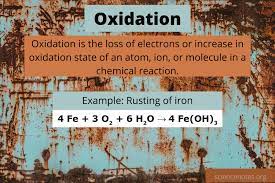
Burning is quite aptly associated with loss. Things loose their colour, taste or odour when they are burnt. How does an apple retain its fresh red colour even when there’s so much oxygen and sunlight in the nature? It’s the antioxidant. But if it is cut open, it turns brown after a while. That’s oxidation. the presence of every easily oxidisable compounds, called Antioxidants,in the system can “mop up” free radicals before they damage other essential molecules. Therefore, Antioxidants play a key role in these defense mechanisms. An Antioxidants is a chemical that prevents the oxidation of other chemicals. Consuming more antioxidants helps provide the body with tools to neutralise harmful free radicals. It’s estimated that there are more than 4,000 compounds in foods that acts as antioxidants. The most studied include Vitamin C & E, beta-carotene and the mineral selenium. Besides antioxidants, there are several enzyme systems within the body that scavenge free radicals, the principal micronutrient (vitamin) antioxidants are Vitamin E, beta carotene, & Vitamin C. Additionally, selenium, a trace metal that is required for proper function of one of the body’s antioxidant enzyme systems, is sometimes included in this category. The body cannot manufacture these micronutrient so they must be supplied in the diet.
The following vitamins have shown positive antioxidants effects:

Vitamin A or Retinol,or beta-carotene. It has been discovered that beta-carotene protects dark green, yellow and orange vegetables and fruits from solar radiation damage and it is thought that it plays a similar role in human body. Carrots, Squash, Sweet Potatoes, Tomatoes,Peaches and apricots are particularly rich sources of beta-carotene. (NOTE: Vitamin A has no antioxidant properties and can be quite toxic when taken in excess).

Vitamin C: also called Ascorbic acid, is a water-soluble vitamin found in all body fluids, so it may be one of our first lines of defense. This powerful antioxidant cannot be stored by the body, so it’s important to get some regularly-not a difficult task if fruits and vegetable are regularly consumed. Important sources include Citrus Fruits (like Oranges, sweet lime,etc.), green peppers, green leafy vegetables, strawberries, raw cabbage, tomatoes and potatoes.

Vitamin E: A fat soluble vitamin that can be stored with fat in the liver and other tissues, vitamin E is promoted for a range of purposes- from delaying aging to healing sunburn. While it’s not a miracle worker, it’s another powerful antioxidant. Important sources include wheat germ, nuts, seeds, whole grains, green leafy vegetable, vegetable oil and fish-liver oil.

Beta-Carotene: the most studied of more than 600 different carotenoids that have been discovered, beta-carotene protects dark green, yellow and orange vegetables and fruits from solar radiation damage. It is thought that it plays a similar role in the body. Carrots, Squash, Sweet potatoes, peaches and apricots are particularly rich sources of beta-carotene.


Beta Carotene rich foods

Selenium: This mineral is thought to help fight cell damage by oxygen-derived compounds and thus may help protect against cancer. It is best to get selenium through foods foods, as large doses of the supplement from can be toxic. Good food sources include fish, shellfish,red meat, grains, eggs chicken and garlic. Vegetables can also be a good source if grown in selenium rich soils.

Natural Sources of Antioxidants

The colorful stuff: carrots, apples, oranges, tomatoes (cooked), beetroot, brinjal, dark green vegetables, olives, strawberries, honey (the darker the better) and so on. The tasty stuff: garlic, ginger, onion, nutmeg. The smelly stuff: tea,green tea, spinach, tulsi and other herbs etc. Research says multi vitamin pills may slow the advance of HIV, as it appears to cut the levels of the virus and boost the number of immune cells.

Even though a tomato is rich in antioxidants, most of them can’t be absorbed by humans because they are too complex. Slow cooking brakes them down into simpler compounds that are easily observed. This antioxidant value of a tomato is said to be increase 5 times when it is cooked.

Preventing Cancer and Heart disease – Do Antioxidants help?

Epidemiologic observations shows lower cancer rates in people whose diets are rich in fruits & vegetables. This has led to the theory that these diets contain substances, possibly antioxidants, which protect against the development of cancer. There is currently intense scientific investigation into this topic. thus far, none of the large, well designed studies have shown dietary supplementation with extra antioxidants reduces the risk of development of cancer. in fact one study demonstrated an increased risk of lung cancer in male smokers who took antioxidants vs,. male smokers who did not supplement. Whether this effect was from the antioxidants is unknown but it does raise the issue that antioxidants may be harmful under certain conditions.

Recommendations

Follow a balanced training program that emphasize regular exercise and eat 5 servings of fruits & Vegetables per day. This will ensure that you are developing your inherent antioxidant systems and that your diet is providing the necessary components.

No Boundaries

Today, as soon as the sun comes up the only hot topic that people could pick from the news sections that could give some respite to the evil, gossip loving person inside them is the update about humans living in the b-town. Right from the first cup of tea of the day, people want their dose of rumors, some true other false about the celebrities working in the movie industry of India specifically and others in general, to the last meal of the day, all these gossip sharing beings care about is the latest scandal that happened even a second ago. Indians have been so passionate about the tiniest of the details about every big or small event taking place in the lives of the actors specially working in the Hindi film industry that they sometimes even take offence when an actor is not that public about their personal lives. They become so indulged the lives of the bollywood stars that they hardly have any track of their own lives.

With the new paparazzi culture developing ever so fast in India, the curiosity of next move of these stars have risen to another level. With paparazzi capturing them in the local city just as they move, it has become easier for people to track them and go all gala over them. Each passing day the craze for the knowledge about the movie actors increase. Every new project of their favorite celebrity works like an energy drink for their gossip loving minds. A slightest of fire of affair of two celebrities is enough to burn the house of reality to ashes and believe the rumor. The information about whose dating whom, whose getting married to whom, who is having kids with whom, who is getting most approval on their auditions, whose been rejected most often, who is into drugs and who follows which god or religion, serves as the chilly-flakes on their freshly ordered pizza only to burn their tongues later.

This toxic behavior of following every detail in their beloved celebrity life which eventually turns into obsession is harmful for both the celebrity and the people obsessed with them. These followers become so involved into the lives of these big town stars that they are affected to the extreme levels when they learn the reality about one or other of these actors which is definitely different from what they had expected it to be. They literally worship these actors to the extent that they even become ready to give up their lives just so to have a selfie with them. With the deaths of some famous and really admired stars this year the deaths of their fans in their remembrance has lead to the shocking and unexpected toxicity that this following to the nook culture has developed. People need to back out from this over involvement, fascination, passion for the celebrity they follow so as to give them and themselves the space for breathing into the healthy culture of loving and admiring someone but not getting so engrossed that they turn into some maniac follower who knows no boundaries.

Picture Credits: https://bit.ly/2ZbrY4j

Myths about Covid19

Coronavirus disease (COVID-19) is an infectious disease caused by the SARS-CoV-2 virus.
Most people infected with the virus will experience mild to moderate respiratory illness and recover without requiring special treatment. However, some will become seriously ill and require medical attention. Older people and those with underlying medical conditions like cardiovascular disease, diabetes, chronic respiratory disease, or cancer are more likely to develop serious illnesses. Anyone can get sick with COVID-19 and become seriously ill or die at any age.

Myths about Covid19

  • Can Covid-19 be transmitted through goods produced in countries where there is ongoing transmission?

Although it can last on surfaces for many hours, the environment, transportation, and varying temperatures during shipment make it difficult for the virus to remain active. If you feel the surface may be contaminated, clean it with a disinfectant and wash your hands after touching it.

  • Can Covid-19 be transmitted through mosquitoes?

There is no evidence that the novel coronavirus can be transmitted through mosquitoes. The virus can be spread through droplets from coughing, sneezing or a patient’s saliva.

  • How can we be sure that our clothes don’t spread coronavirus 2019?

Besides showering every day, you should wash your clothes using detergent or soap in 60-90 ํC water or add bleach. Dry the clothes in a high-temperature dryer or the sun.

  • Can drinking alcohol help prevent Covid-19?

Drinking alcohol, such as beer, liquor, wine doesn’t help prevent coronavirus. You should wash your hands often, wear masks, and avoid being close to those with a fever and cough.

  • Is it true that Covid-19 is transmitted in a cold climate and not in a hot and humid climate?

Coronavirus 2019 can be transmitted in any kind of climate. Wherever you are, no matter what kind of climate, you have to practice personal hygiene, i.e. wash your hands often, cover your mouth when you sneeze or cough, and wear masks.

  • Can digital thermometers be 100% effective in detecting Covid-19 patients?

It may take the virus 1-14 days to incubate and cause symptoms like fever, so it cannot be used to identify asymptomatic patients.
  • Can UV bulbs use for disinfecting be used to kill Covid-19 on our body?

Don’t use UV bulbs on your hands or any part of the body because UV light can irritate your skin.

  • Can spraying alcohol or chlorine on your body kill the virus inside?

Besides not being able to kill the virus inside your body, it could damage clothes and other tissues like eyes and lips.

  • Can eating garlic prevent covid-19?

Though garlic has some anti-microbial properties, there is no evidence that it can prevent Covid-19.

  • Can Pneumonia vaccine prevent Covid-19?

This virus is new and different from other strains. We need a vaccine that is developed specifically. The research team is working on this through the support of the WHO.

  • Can rinsing your nose regularly with saline solution prevent Covid-19?

Evidence has indicated that rinsing your nose with saline solution can help us recover faster from the common cold, but cannot prevent infectious respiratory diseases or Covid-19.

  • Is there any drug that can prevent and treat Covid-19?

At present, no drug can prevent and treat the disease. Patients should receive proper and supportive care to alleviate the symptoms. WHO is accelerating research with all the partners to actively study the treatment for the disease.

References: WHO(World Health Organisation) 

Telemedicine

Telemedicine is an emerging field of convergence of medicine, technology and communication. It promises the best of medicinal facilities to people in rural or far flung areas. Telemedicine provides local medical staff the guidance of an expert physician far from the site of emergency. Such timely diagnosis and treatment increases the chances of patient survival. Information and communication technologies (ICTs) are expanding the availability and affordability of healthcare services. These technologies integrate electronic electronic medical information, clinical assessment tools and laboratory data to bring state of the art medical expertise to undeserved areas. Seamless sharing of information between healthcare providers has enabled the concept of hospitals without walls.

Patient data,both clinical and non-clinical, is crucial for accurate diagnosis and appropriate treatment. Clinical information includes history of illness, associated signs and symptoms, clinical observations and interventions, diagnosis and treatment, etc non-clinical information includes information about the patients’s environment , demographic information, lifestyle and occupation and any other relevant information for providing daycare. In most of the situations, early diagnosis and initiation of treatment can save patients’s life. For hard-pressed local medical staff with a serious or unusual medical condition, the ability to consult specialists elsewhere can mean the difference between life and death of the patient. With advances in telecommunication in formation processing capability and miniaturization of health diagnostic equipment, it has become possible to deliver immediate and effective healthcare to the masses.

Teleconsultation

Voice, video and data are electronically communicated for consultation between geographically separated clinicians. This involves:

a) Telemonitoring: Use of Audio-visuals, electronic signal/information processing and telecommunication technologies to monitor the patient’s such details as measurements taken from devices such as blood pressure cuff, blood oxygen, thermometer, stethoscope, weigh scale, blood glucose, meter, etc.

b) Telediagnosis: Detection of a disease by observation and evaluation of the patient data acquired and transmitted from the equipment/devices monitoring the remote patient.

c) Telementoring: Using telemonitoring an expert consultant guides a distant clinician in a new medical procedure.

Data acquisition and transfer

Data can be transferred in two ways: store-and-forward and real-time interactive video. The choice depends on the clinical setting, purpose of the consultation, infrastructure and economic considerations. Emerging rends in remote monitoring and diagnosis Electronic patient record. An Electronic patient record (EPR) are the electronically stored health information about any individual uniquely identified by an identifier which entails capturing, storing, retrieving, transmitting and manipulating patient specific healthcare data (including clinical, administrative and biographical data).

Home Telecare: The home telecare solution allows visual assessment of the patient, tracking of vital signs and review of the medications remotely,eliminating the need for the physician to be the physically present or the patients who may otherwise be unable to receive them due to geographic distance barriers. thus it holds a great promise in managing the health needs of individuals living in rural and remote areas. The home telecare system comprises a home care unit serving as the video interface, a camera and a gateway.

Emergency care: These devices have the ability to telematically “bring in” an expert emergency, allowing him to review the vital signs and issue directions on patient managements and treatment procedures to the emergency personnel until the patient is administered first aid and the hospital. This results in effective patient management, as the patient and initiate the treatment immediately. Medical Images and waveform can even be downloaded, stored, displayed and exchanged on personnel digital assistants (PDAs) and mobile phones, so these can be accessed at any time, anywhere to aid remote diagnosis and referrals.

Smart cards: Smart cards act as a portable, comprehensive and accurate source of up-to-date patient information. These can provide basic medical information about the patients, such as lists of drug sensitivities, current conditions being treated, name and phone number of the patients’s doctor and other information vital in an emergency. These can also carry vital medical history and details about insurance coverage. Remote diagnostics and related decision-making process can be integrated efficiently as the patients could carry the repository of information wherever he/she goes to receive treatment.

Telesurgery: Telesurgery is the provision of surgical care over a distance, with direct, real-time visualization of the operative field. it may be categorized into telepresence surgery and telerobotics. telepresence surgery uses a computerized interface to transmit a surgeon’s actions at the surgical workstations to the operative site at the remote surgical unit, with haptic feedback about the tactic environment of the operative fields to the surgeon. Telerobotics is remote control with a robotic arm, usually in conjunction with a laparoscope, without haptic feedback. In the future, though telemedicine will take some time to be available to ordinary people, it will have the greatest impact in the area of home healthcare, since the efficiencies realized are unimaginable.

The Solar System

Solar System means system of the sun. All bodies under the gravitational influence of our local star, the Sun, together with the Sun, forms the solar system. The largest bodies, including Earth revolving around the sun are called planets. Often smaller cool bodies, called satellites and moons, orbit a planet. Bodies smaller than planets that orbit the sun are classifieds as Asteroids if they are rocky or metallic from the region between Mars & Jupiter, Comets if they are mostly ice & dust, and Meteoroids if they are very small.

Our Solar System

How Big is Our Solar system ?

To think about the large distances, we use a cosmic ruler based on the astronomical unit(AU). 1 AU is the distance from Earth to the Sun, which is about 150 million kilometres. the area of the Sun’s influence stretches far beyond the the planets, forming a giant bubble called the heliosphere. The enormous bubble of the heliosphere is created by the solar wind, a stream of charged gas blowing outward from the Sun. As the Sun orbits the center of the milky way, the bubble of heliosphere also moves ahead of itself in interstellar space through the interstellar gases. The area where the solar wind is abruptly slowed by pressure from gas between the stars is called the termination shock. That was observed when Voyager 1 began sending unusual data to Earth in late 2003. In December 2004, thats how scientists confirmed that Voyager 1 had crossed the termination shock at about 94 AU, approximately 13 billion kms from the sun,venturing into the vast, turbulent expanse where the Sun’s influence diminishes. Voyager 2, 16 billion kilometres from Voyager 1, crossed the termination shock in August 2007. Voyager 1 may reach in interstellar space sometime between 2014 & 2017; when voyagers exit the enormous Oort Cloud, a vast spherical shell of icy bodies surrounding the solar system.

Galaxies

Solar System: As we know it

A Solar system refers to a star and all the objects that travel in orbit around it. Our Solar system consists of the sun – our Star – Eight planets and their natural satellites (such as our moon); dwarf planets; asteroids and comets. Our solar system is locally in an outward spiral of the Milky Way galaxy.

Like early explorers mapping the continents of our globe, astronomers are busy charting the spiral structure of our galaxy, the Milky Way. Using infrared images from NASA’s Spitzer Space Telescope, scientists have discovered that the Milky Way’s elegant spiral structure is dominated by just two arms wrapping off the ends of a central bar of stars. Previously, our galaxy was thought to possess four major arms. This annotated artist’s concept illustrates the new view of the Milky Way, along with other findings presented at the 212th American Astronomical Society meeting in St. Louis, Mo. The galaxy’s two major arms (Scutum-Centaurus and Perseus) can be seen attached to the ends of a thick central bar, while the two now-demoted minor arms (Norma and Sagittarius) are less distinct and located between the major arms. The major arms consist of the highest densities of both young and old stars; the minor arms are primarily filled with gas and pockets of star-forming activity. The artist’s concept also includes a new spiral arm, called the “Far-3 kilo-parsec arm,” discovered via a radio-telescope survey of gas in the Milky Way. This arm is shorter than the two major arms and lies along the bar of the galaxy. Our sun lies near a small, partial arm called the Orion Arm, or Orion Spur, located between the Sagittarius and Perseus arms.

Our Solar System Consists of-

  • Planets:8 – The planet count in our solar system has gone as high as 15 before new discoveries prompted a fine tuning of the definition of a planet.
  • Dwarf planets:6 – This new class of worlds helps us categorize objects that orbit the Sun but aren’t quite the same as the rocky planets and gas giants of our solar system. There could be hundreds more of these small worlds far out there waiting to be discovered.
  • Moons:173 – This Counts includes only the moons orbiting the eight planets in our solar system. it is likely there are more moons orbiting the giant planets of our solar system and there are moons orbiting around dwarf planets and asteroids.
  • Asteroids:645,118 – New asteroids are discovered on an almost daily basis. it is estimated that the mineral wealth of the asteroid in the main belt between Mars and Jupiter is about $100,000,000 for every person on Earth.
  • Comets:3,279 – orbiting spacecraft such as SOHO have raised this tally in recent years by catching the comets as they plunge towards the Sun – and sometimes vaporize. Scientists estimated there could be as many as 1,000,000,000 comets held in the gravitational grip of the Sun.

Universe or Multiverse

A number of scientific enquirers suggest our universe may be one in a collection of other universes, possibly an infinite number of universes spreading through other dimensions of time and space. Although these ideas are speculative at the moment, the large Hadron Collider in Switzerland is searching for evidence of multiple dimensions. And ESA’s Planck satellite will be looking for the evidence of inflation. if either finds it is looking for, the possibility of multiple universes will become stronger. The new theory postulates that, just after the creation of the universe, space expanded hugely, driven by fluctuations in energy that once they began were rather had to stop. Not only did our universe grow, but so did countless others in a chain reaction that continues to this day. These other universes would bud off from our own and be completely observable to us. they would bud new ones, creating an endless cascade. The idea of multiple universes crops us again in theoretical efforts to understand why we exist. It also points to how the forces of nature are related to one another, suggesting that reality may consists of 11 dimensions, not just the three that are familiar.

How old is the Universe?

According to the best measurements ever taken of the radiation left over from just after the Big Bang, the universe is a little older and perhaps a bit stronger than previously thought.the data from the Planck satellite combined a map of the remnant glow that largely affirms scientists theories about the universe’s early history. but the results also reveal a few quirks. Launched by the European Space Agency in 2009, the Planck satellite scans the sky for the cosmic microwave background, radiation that dates back to about 380,000 years after the Big Bang. That radiation was originally about 2,700 degree Celsius but has cooled to a mere 2.7 degrees above absolute zero. Planck is essentially a supersentitive thermometer that can probe the temperature of this radiation to millionths of a degree. that extraordinary precision allowed researchers to map tiny temperature fluctuations in the radiations across the entire sky. Now, that cosmologists do have access to the map, they can make many conclusions about how the universe has evolved

The yellow spots in the map are about one part in 100,000 hotter than the average temperature, while the blue spots are slightly colder. These subtle perturbations in the early universe eventually grew into stars and galaxies.

Dark Matter Mystery

Most of the universe is made up of dark energy, a mysterious force that drives the accelerating expansion of he universe. the next largest ingredient is dark matter, which only interacts with the rest of the universe through its gravity. normal matter, including all the visible stars, planets and galaxies, makes up less than 5% of the total mass of the universe. Astronomers cannot see dark mater directly, but can study its effects. They cans see lights bent from the gravity of invisible objects (called gravitational lensing). they can also measure that stars are orbiting around in their galaxies faster than they should be. This can all be accounted for if there were a large amount of invisible matter tied upon each galaxy, contributing to its overall mass and rotation rate.

The Make-up of the Universe

What Exactly it is ?

Astronomers know more about what dark matter is not than what is is. Dark matter is dark: It emits no light and cannot be seen directly, so it cannot be stars or planets. Dark matter is not clouds of normal matter , normal matter particles are called baryon. If dark matter were composed of baryons. it would be detectable through reflected light. Dark matter is not antimatter: Antimatter annihilates matter on contact, producing gamma rays. Astronomers do not detect them. Dark matter is not black holes : Black holes are gravity lenses that bend light. Astronomers do not see enough lensing events to accounts of dark matter that must exist. Particle colliders such as the large Hadron Collider. Cosmology instruments such as WMAP and Planck. Direct detection experiments including CDMS, XENON, Zeplin, WARP, ArDM and others. Indirect detection experiments including; Gama ray detectors (Fermi from space and Cherenkov telescopes from the ground ); neutrino telescopes (IceCubes, Antares); antimatter detectors( Pamela, AMS-02) and X-ray and radio facilities.

.

India – The National Insignia

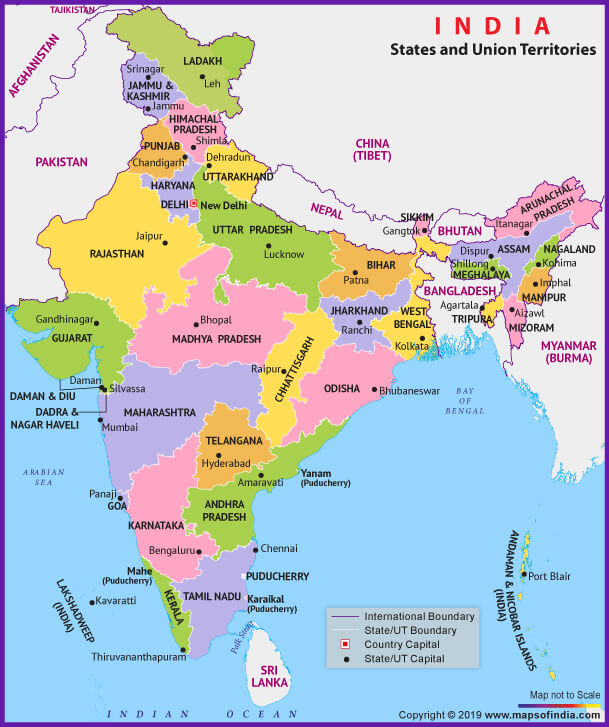
India measures 3214 km from north to south and 2933 from east to west with a total land area of 3,287,263 sq. km. It has a land frontier of 15.200 km and a coastline of 7516.5 km. Andaman and Nicobar Islands in the Bay of Bengal and lakshadweep in the Arabian sea are parts of India. the Country shares its political borders with Pakistan & Afghanistan on the west and Bangladesh and Burma on the east. the Northern boundary is made up of the Sinkiang province of China, Tibet, Nepal and Bhutan. India is separated from Sri Lanka by a narrow channel of sea formed by the Palk Strait and the Gulf of Mannar.

National Emblem

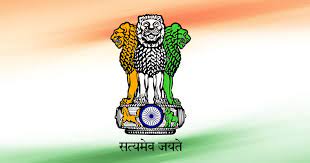
The state emblem of India is an adaptation from the Sarnath lion, at the capital of Ashoka the Emperor, as preserved in the Sarnath Museum. The Government of India adopted the emblem on 26th January 1950, the day when India became a republic. In the State emblem adopted by the government, only three lions are visible, the fourth been hidden from the view. The wheel appears in the relief in the center of the abacus with a bull on the right and a horse on the left and the outlines of the other wheel on the extreme right and left.the bell shaped lotus has been omitted. the words “Satyameva Jayate” from the Mundaka Upanishads meaning “Truth alone triumphs” inscribed below,the abacus of the emblem in Devanagari script is also referred to as the National Motto.

National Emblem of India

The National Flag

The National Flag is a horizontal tri-colour of deep saffron (Kesari) (Representing Courage and Sacrifice) at the top, White (peace and truth) in the middle and Dark green (Faith and Chivalry) at the bottom at equal proportion. The ratio of the width of the flag to its length is 2:3. In the center of white band is a wheel, in navy blue. Its design is that of the wheel (Chakra) which appears on the abacus of the Sarnath Lion Capital of Asoka. Its Diameter approximates the width of the white band, it has 24 spokes. The Design of the national flag was adopted by the constituent assembly of India on 22nd July, 1947. Its use and display are regulated by a code.

National Anthem

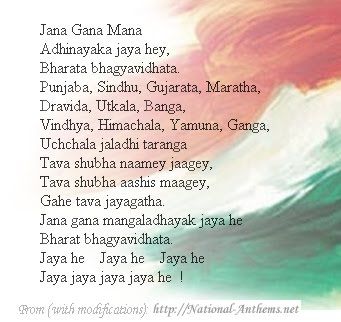
Jana Gana Mana is the national anthem of India. It was originally composed as Bharoto Bhagyo Bidhata in Bengali by polymath Rabindranath Tagore. The first stanza of the song Bharoto Bhagyo Bidhata was adopted by the Constituent Assembly of India as the National Anthem on 24 January 1950. A formal rendition of the national anthem takes approximately 52 seconds. It was first publicly sung on 27 December 1911 at the Calcutta (now Kolkata) Session of the Indian National Congress. The National Anthem of India is played or sung on various occasions. Instructions have been issued from time to time about the correct versions of the Anthem, the occasions on which these are to be played or sung, and about the need for paying respect to the anthem by observance of proper decorum on such occasions. The substance of these instructions has been embodied in the information sheet issued by the government of India for general information and guidance. The approximate duration of the Full Version of National Anthem of India is 52 seconds and 20 seconds for shorter version.

National Anthem of India

National Song

The song Vande Mataram composed by Bankim Chandra Chatterjee has an equal status with Jana Gana Mana. The first political occasion when it was sung was the 1896 session of the INC.

National Song of India

National Calendar

At the time of Independence , the govt, of the India followed the Gregorian calendar based on the christian era. The National Government adopted the recommendation of the Calendar Reform Committee that the Saka era be adopted as the basis of the National Calendar. The Saka year has the normal 365 days and begins with Chaitra as its first month. The days of the Saka Calendar have a permanent correspondence with the dates of the Gregorian Calender, Chaitra 1 falling on March 22 in a normal year and on March 21 in a leap year. The national Calender commenced on Chaitra 1 Saka, 1879 corresponding to to March 22, 1957 AD.

National Flower

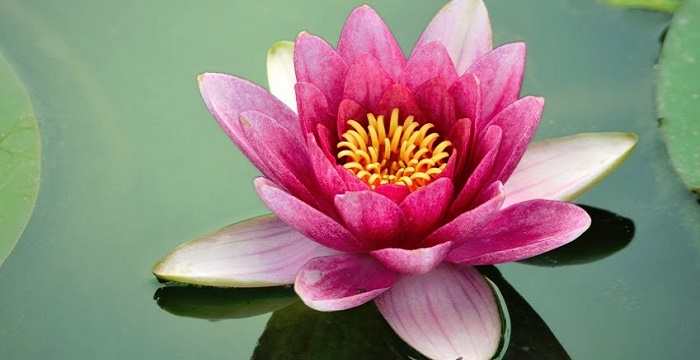
Lotus (Nelumbo Nucifera Gaertn) is the national Flower of India. It is sacred flower and occupies a unique position in the art and mythology of ancient India and has been an auspicious symbol of Indian Culture since time immemorial. India is rich in Flora. Currently available data places India in the 10th position in the world and 4th in Asia in plant diversity. From about 70% geographical area surveyed so far, 47,000 species of plant have been described by the Botanical Survey of India(BSI).

Lotus – National Flower of India

National Animal

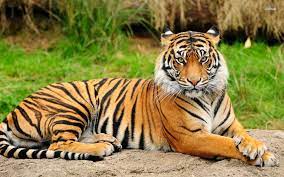
The Combination of grace, strength, agility and enormous power has earned Tiger, (Panthera tigris), its pride of place as the national animal of India. Out of eight species known, The Royal Bengal Tiger, is rare.

Royal Bengal Tiger

National River

the Ganga or Ganges is the longest river of India flowing over 2510 kms of mountains Valleys and plains. It originates in the snowfields of the Gangotri Glacier in the Himalaya as the Bhagirathi River. It is later joined by Alakananda, Yamuna, Son, Gomti, Kosi and Ghagra. The Ganga river basin is one of the most fertile and densely populated areas of the world and covers an entire area of 1.000.000 sq.km The Ganga is revered by Hindu as the most sacred river on earth.

River Ganga

National Tree

Indian fig tree, (Ficus bengalensis) whose branches root themselves like new trees over a large areas. The roots then gives rise to more trunks and branches. Because of this characteristics and its longevity, this tree is considered immortal and is a n integral part of the myths and legends of India. Even today, the banyan tree is the focal point of village life and thevillage counil meets under the shade of this tree.

Banyan Tree

National Fruit

Magnifera indica, The mango tree is one of the most important and widely cultivated fruit trees pf the tropical world. its juicy fruit is the rich source of Vitamin A, C & D. In India there are over 100 varieties of mangoes, in different sizes, shapes and colours. Mangoes have been cultivated in India from time immemorial.

Mango

National Bird

The Indian Peacock, (Pavo cristatus), the national bird of India, is a colorful bird, with beautiful velvet feathers and slender neck. The male of the species more colorful than the female, with a glistening blue breast and neck and spectacular bronze-green tail of around 200 elongated feathers. The female is brownish and slightly smaller than the male and lacks the tail, The dance of the male fanning out the tail and preening its feathers is a gorgeous sight.

Peacock

National Sport

Hockey is India’s national game. India won the first Olympic history gold in 1928, in Amsterdam, beating the Netherlands 3-0 India’s hockey team is the most successful team ever in the Olympics, having won eight gold medals in 1928, 1932, 1936, 1948, 1952, 1956, 1964 and 1980. India also has the best overall performance in Olympic history with 83 victories out of the 134 matches played.

Hockey

Indian Standard Time (IST)

India has only one standard time, India is 5.5 hours ahead of GMT/UTC, 4.5 hours behind Australian eastern Standard time and 10.5 hours of American Eastern Standard time.

National Monument

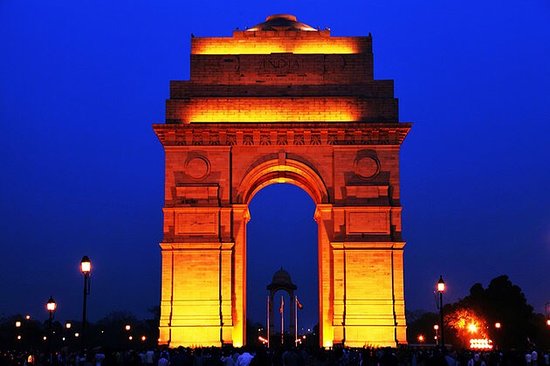
India gate, one of the largest war memorials, situated in the heart of New Delhi, is the national monument of India. It was erected in memory of 90,000 soldiers who lost their lives fighting in the world war 1 and Afghan war for the British army. It was designed by Sir Edwin Lutyebs. Earlier it was called All India War Memorial.

India Gate

National Aquatic animal

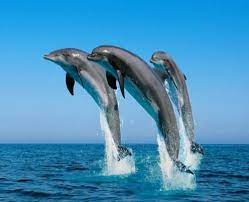
River Dolphin (Platanista gangetica) is an endangered species in India. River Dolphin is critically endangered species in India. It has been put in Schedule 1 of the Wildlife protection Act, 1972. Poaching., degradation of its habitat, siltation, pollution and reduced flow of river water are said to be the reasons for its depletion.

River Dolphins

National Currency

The symbol is a combination of both Devanagari letter ”Ra” and Roan letter “R” with a stripe cutting at the middle to represent the tricolor. it also means equality.

National Heritage Animal

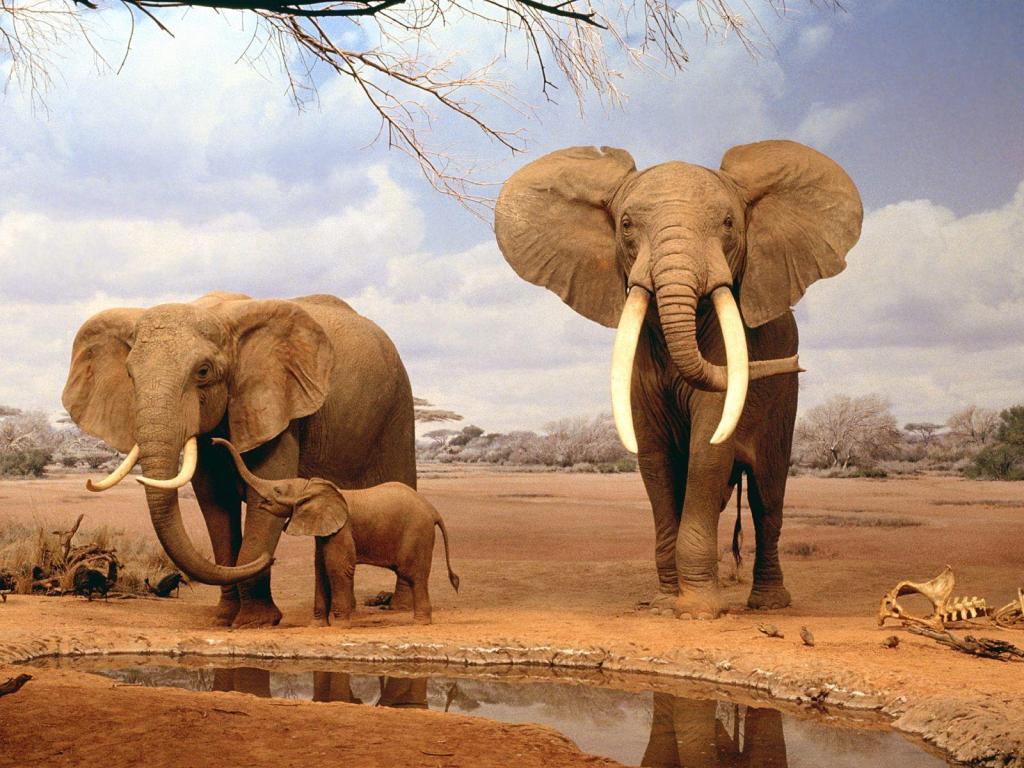
In order to enhance the population of this mammalian species the Ministry of the Environment has declared Asiatic Elephants as the National heritage Animal.

Elephants
India

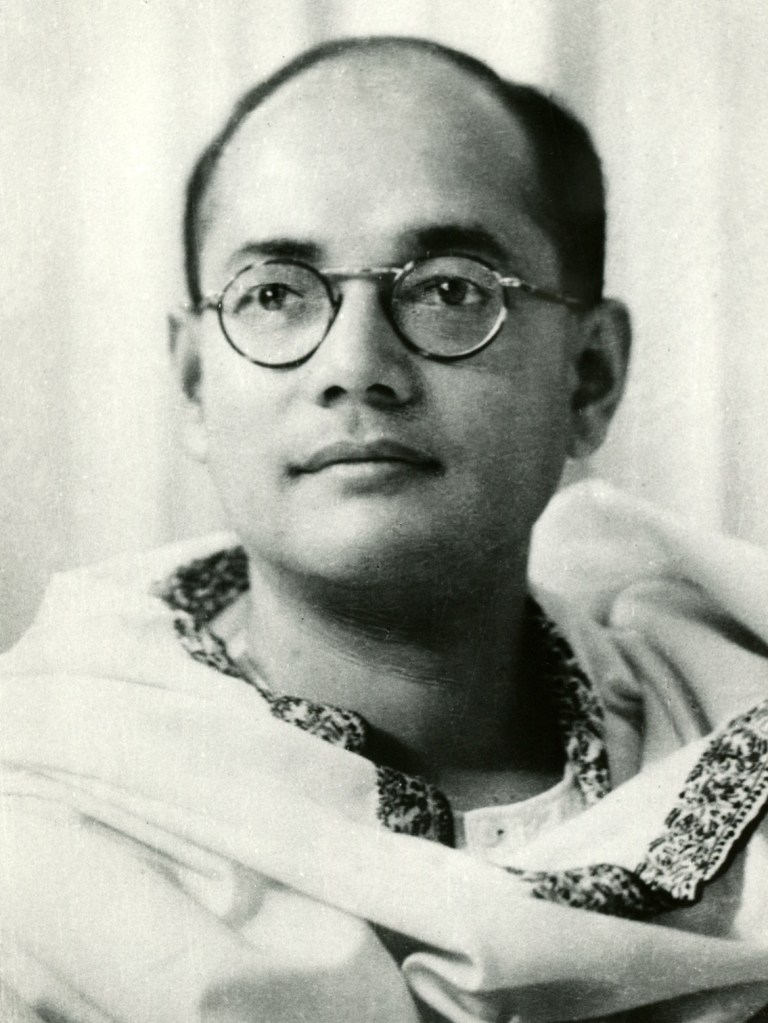
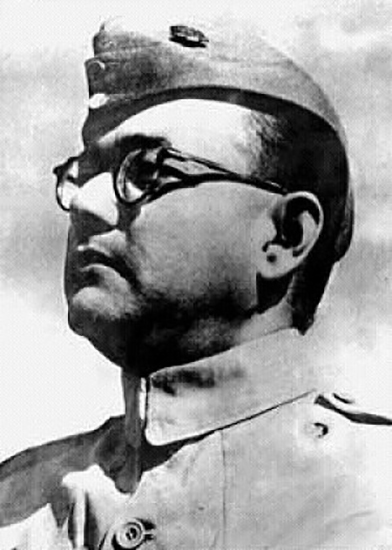
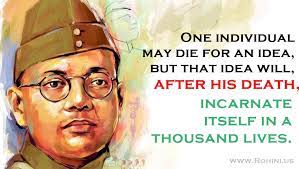
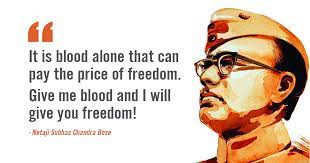
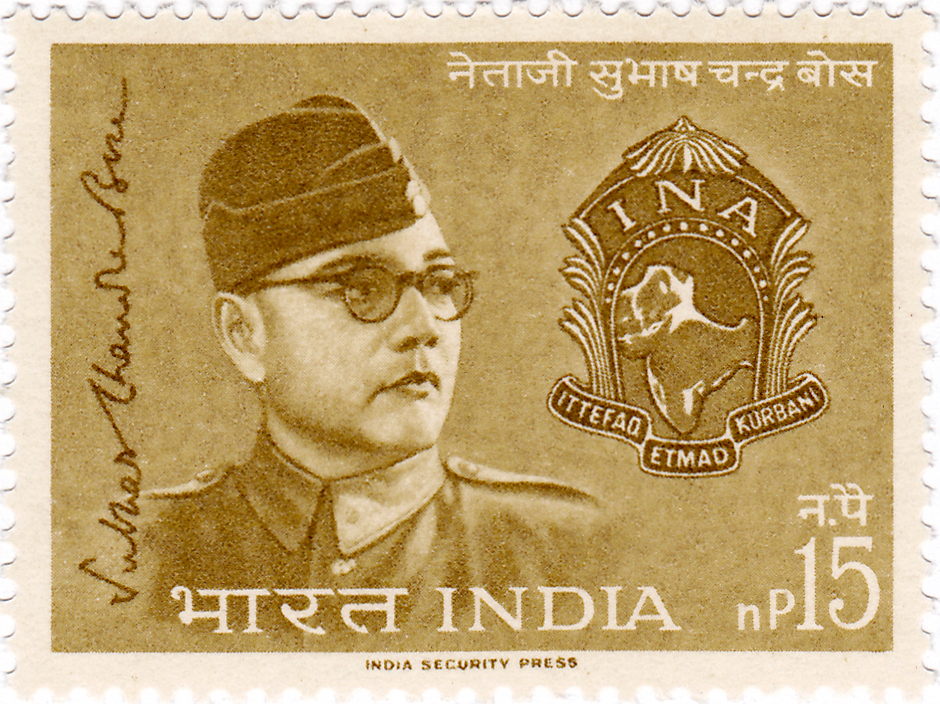
Netaji Subhash Chandra Bose – A Born Leader

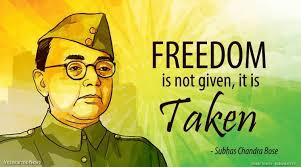
It is the story of a young dreamer that tells the saga of consciousness, struggle and success in every eye; one who has the power to rip the ground with his arms; one who talks about making a hole in the sky; one who is anxious to achieve his goals; one who does not accept anything for free; and if he wants freedom, he is ready to spill his blood.


Subhash Chandra Bose, popularly known as “Netaji”, a great militant, freedom fighter and patriot was born at Cuttack, Orissa on January 23, 1897 to Janakinath Bose and Prabhavati Devi. Janakinath was a well- known lawyer. Prabhavati Devi was a religious and God-fearing woman.He was strongly influenced by Swami Vivekananda’s teachings and was known for his patriotic zeal as a student. Subhash Chandra was a brilliant student from the very beginning and was first in the merit list of successful students in the matriculation examination.Bose did his graduation from Presidency College, Kolkata. He went to England in September 1919 for higher studies. He was selected for the Indian Civil Service but returned to India without completing his training to take part in the freedom struggle.

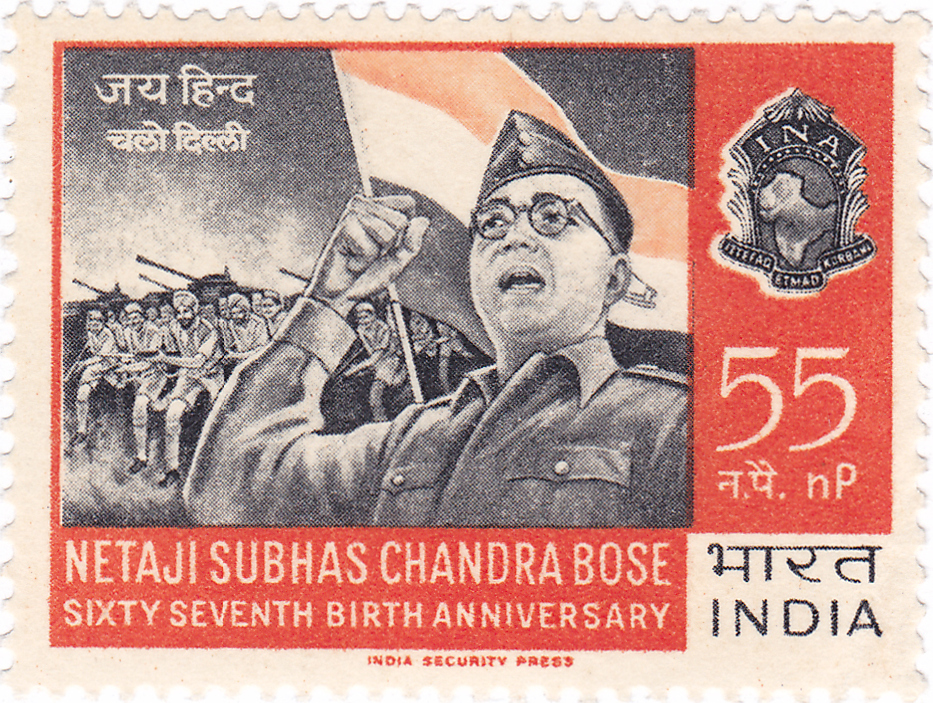
Bose’s selfless contribution to India’s Independence Movement and organizing and leading the Indian National Army is indispensable. His struggle of Independence was highlighted during the Civil Disobedience Movement for which he had even been arrested. In fact, he was imprisoned 11 times for his ideologies and the use of force against the British. Bose was elected the president of the Indian National Congress twice but he resigned from the post as he was against the congress internal and foreign policy.  Subhash Chandra favored complete freedom of India at the earliest while the Congress was in favor of freedom in phases in the beginning. He was also against India’s joining the Second World War as an ally of the British. This led to differences with Gandhiji, and so he resigned from the President-ship of the Congress and set up the Forward Block.Soon, he left the party and went out of the country seeking an alliance with other countries to fight against British forces. He earned the support of the Japanese and they agreed to help him in forming the Indian national army in Southeast Asia. Later on, he became the commander of the INA. The Indian National Army attacked the North-eastern parts of India. This attack took place under the leadership of Subhash Chandra Bose and he was even successful in acquiring a few portions of the north-eastern parts of India. Unfortunately, the surrender of the Japanese forced him to withdraw and call off the war.

Subhash Chandra launched an all-India anti-British Campaign in September, 1939. He was arrested in July, 1940. Later he was put under house-arrest, but then he disappeared in the guise of a Pa than and reached Berlin, Germany in November, 1941.He reached Malaya and established Indian National Army (INA) or Azad Hind Fauz by recruiting Indian prisoners of war. In June, 1943, he visited Japan to have support of the Japanese government in the freedom struggle of India. On October 21, 1943, he became the commander of the Indian National Army in Singapore and began his military struggle against the British. He also established the Provisional Government of Free India there. In December, 1943 he occupied Andaman and Nicobar Islands. In December 1944 the Indian National Army crossed the Burma-India Border and reached Kohima and then Imphal. But the surrender of the Japanese forced him to withdraw and call off the war. It is believed that he lost his life in a plane-crash on August 18, 1945 at the Taihoku airport, Formosa. Subhash Chandra was one of the greatest freedom-fighters and patriots and the Pride of Bengal. He became a legend in his life-time as a great leader, fiery orator and organizer. He was sent to prison eleven times during 1920-1941.

After his mysterious disappearance from his house, where he was under arrest, he appeared in Kabul and again disappeared until he surfaced in Germany. From there he started publishing and broadcasting on air to help the struggle for freedom.He was promised help in his armed struggle by Germany. Then he traveled to Japan facing all the dangers posed by the Second World War. He became the commander of the Indian National Army and freed the islands of Andaman and Nicobar and renamed them as Swaraj and Saheed Islands.”Delhi Chalo” (March Delhi) becomes the battle cry of the Indian National Army and they were soon across the Indian border in Manipur but then the bombing of Hiroshima and Nagasaki and the surrender of the Japanese army changed the whole course of events. Therefore, he decided to return to Tokyo to decide his further course of action, but unfortunately, his plane crashed near Taipei and he achieved martyrdom at the young age of 48 years. But the country took the news of his death with disbelief and still there are thousands and thousands of Indians who believe that he is alive.
In popular Media,

  • In 2004, Shyam Benegal directed the biographical film, Netaji Subhas Chandra Bose: The Forgotten Hero depicting his life in Nazi Germany (1941–1943), in Japanese-occupied Asia (1943–1945) and the events leading to the formation of Azad Hind Fauj. The film received critical acclaim at the BFI London Film Festival, and has garnered the National Film Award for Best Feature Film on National Integration, and the National Film Award for Best Production Design for that year .
  • In 2017, ALTBalaji and BIG Synergy Media, released a 9-episode web series, Bose: Dead/Alive, created by Ekta Kapoor, a dramatized version of the book India’s Biggest Cover-up written by Anuj Dhar, which starred Bollywood actor Rajkummar Rao as Subhas Chandra Bose and Anna Ador as Emilie Schenkl. The series was praised by both audience and critics, for its plot, performance and production design.
  • Gumnaami is an 2019 Indian Bengali mystery film directed by Srijit Mukherji, which deals with Netaji’s death mystery, based on the Mukherjee Commission.

The Ministry of railways of India renamed one of the oldest running trains of India, Kalka Mail as Netaji Express from 23 January 2021.

Netaji was a great adventurer as well. His military exploits, unmatched patriotism and exemplary bravery have made him a role model for the young men and women of India. He still lives within our hearts and minds and works as a leading light and source of inspiration.

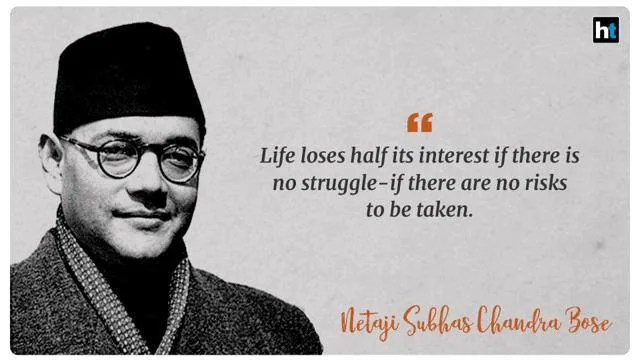
“By freedom I mean all-round freedom, i.e. freedom for the individual as well as for the society; freedom for the rich as well as for the poor; freedom for men as well as for women; freedom for all individuals and for all classes.” -Netaji Subhash Chandra Bose

“We should have but one desire today – the desire to die so that India may live – the desire to face a martyr’s death, so that the path to freedom may be paved with the martyr’s blood”. -Netaji Subhash Chandra Bose

Netaji was a true Inspiration and has enlighten our world with his Ideologies & Beliefs. He is a Forever Legend and we all are eternally in debt to him for his sacrifice towards our motherland. He will remain in our hearts and thus will lead an immortal life forever.

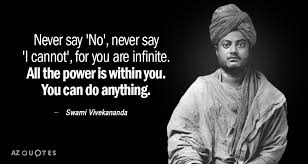
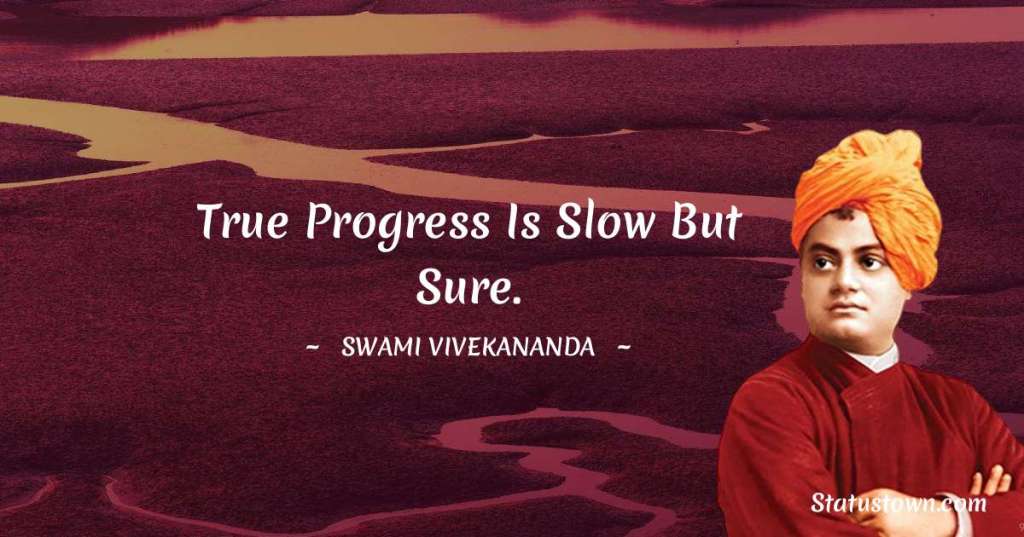
Swami Vivekananda – An Eternal Youth

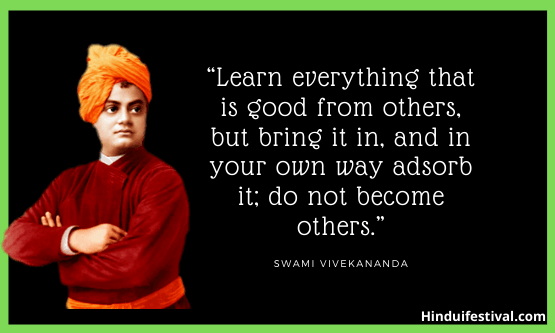
A western admirer once described Swami Vivekananda as being ‘young in years but eternal in wisdom’. if you accept this ecstatic statement at this face value, it establishes the relevance of Swami Vivekananda’s philosophy today.

Vivekananda, original name Narendranath Datta, Datta also spelled Dutt, (born January 12, 1863, Calcutta (now Kolkata) died July 4, 1902, near Calcutta), is a Hindu spiritual leader and reformer in India who attempted to combine Indian spirituality with Western material progress, maintaining that the two supplemented and complemented one another. At the age of eight in 1871, Vivekananda was enrolled at Ishwar Chandra Vidyasagar’s Institution and later at the Presidency College in Calcutta. He was exposed to Western philosophy, Christianity, and science. He had an interest in music both instrumental as well as vocal. He was active in sports, gymnastics, wrestling, and bodybuilding. He was also fond of reading and till the time he had completed his graduation from the college he had acquired a vast knowledge of various subjects

Swami Vivekananda’s inspiring personality was well known both in India and in America during the last decade of the nineteenth century and the first decade of the twentieth. The unknown monk of India suddenly leapt into fame at the Parliament of Religions held in Chicago in 1893, at which he represented Hinduism. His vast knowledge of Eastern and Western culture as well as his deep spiritual insight, fervid eloquence, brilliant conversation, broad human sympathy, colorful personality, and handsome figure made an irresistible appeal to the many types of Americans who came in contact with him. People who saw or heard Vivekananda even once still cherish his memory after a lapse of more than half a century.

Man-making — His mission

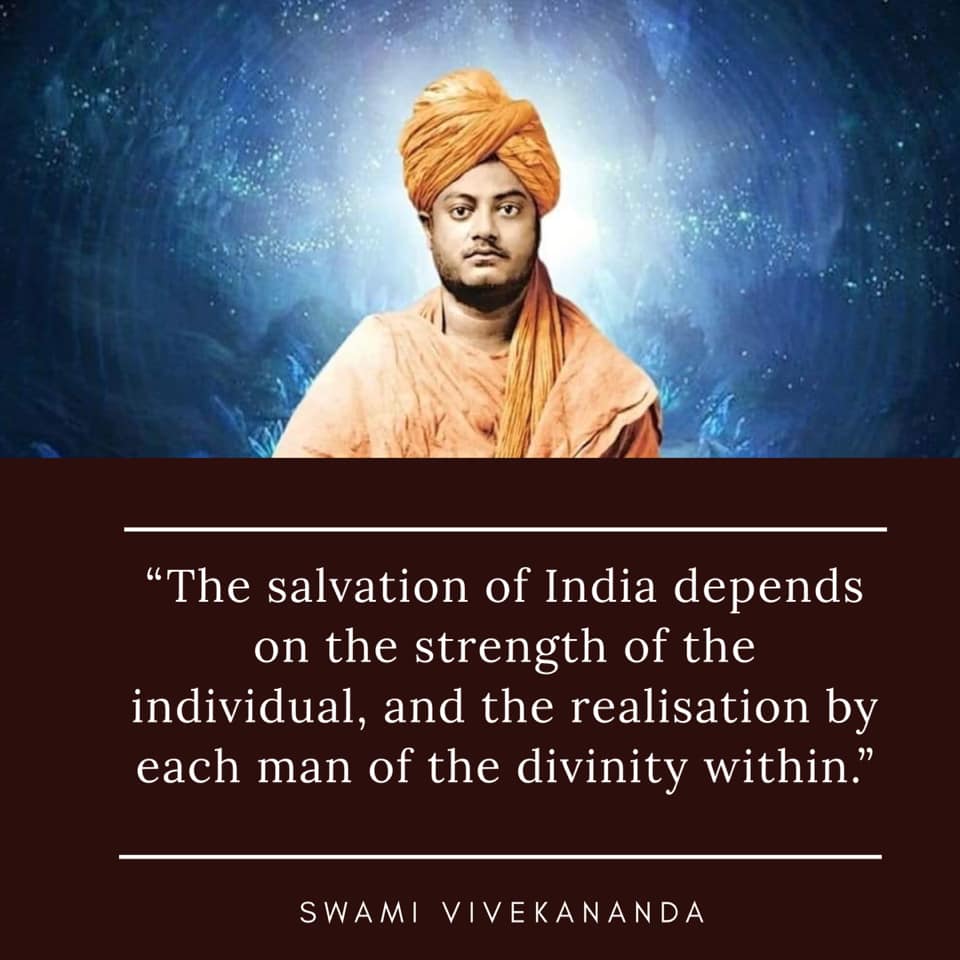
Swami Vivekananda’s relevance depends not on the nature of the problems we face but on the spirit with those problems have to be tackled. his stress on man himself, for, given the right kind of man, no problem need be daunting. ‘Man-making is my mission’, he used to say. Indeed, a country’s future depends upon its people-how good, intelligent and capable they are.

Character-building through Education

Character building is one of the main and fundamental objectives of education. In ancient times, education was for the formation of character.He considered character building to be the most important objective of education. He believed that religious, character and moral qualities should be inculcated in the students through education. It was his academic opinion and plan to develop the characteristic qualities in the students from the Upanayan Adi Sanskars at the beginning of the education and to reach the full
level through the entire code of conduct of Brahmacharyashram. To him, Man Acharya means a Guru whose conduct remains to be followed by all the disciples. Acharya means a living embodiment of the code of ethics. The Acharya teaches the children the rituals of Sandhya, Upasana, Snan, Achaman, Pranayama etc. The life and thoughts of the Acharya in the Gurukul remain a great source of character building of the disciples. The working people, who had long been neglected and had no access to education, should now receive special attention so that they could quickly overcome their initial drawbacks. He wanted education to reach out to them rather than they come to education. Swamiji believes that the contribution of parents in shaping the character of a child is
especially important. The work of the Acharya proceeds on its foundation. Parents as well as principals have a major role to play in the character building of the disciple – in the training of body, mind and soul.

The natural tendency of Vivekananda’s mind, like that of his Master, Ramakrishna, was to soar above the world and forget itself in contemplation of the Absolute. But another part of his personality bled at the sight of human suffering in East and West alike. It might appear that his mind seldom found a point of rest in its oscillation between contemplation of God and service to man. Be that as it may, he chose, in obedience to a higher call, service to man as his mission on earth; and this choice has endeared him to people in the West, Americans in particular.

In the course of a short life of thirty-nine years (1863-1902), of which only ten were devoted to public activities-and those, too, in the midst of acute physical suffering-he left for posterity his four classics: Jnana-Yoga, Bhaji-Yoga, Karma-Yoga, and Raja-Yoga, all of which are outstanding treatises on Hindu philosophy. Swami Vivekananda founded Ramakrishna Mission on 1 May 1897 for one’s own salvation and for the welfare of the world. In addition, he delivered innumerable lectures, wrote inspired letters in his own hand to his many friends and disciples, composed numerous poems, and acted as spiritual guide to the many seekers, who came to him for instruction. He also organized the Ramakrishna Order of monks, which is the most outstanding religious organization of modern India. It is devoted to the propagation of the Hindu spiritual culture not only in the Swami’s native land, but also in America and in other parts of the world.

Swami Vivekananda thus gave a spiritual basis to Indian nationalism. Vivekananda was an avatara , a divinely inspired and God-appointed leader, not only for Man in India, but also for the whole of humanity in the present age. In conclusion, Vivekananda was the most eminent figure among the democratic patriots of India.

About that Artist – Jan van Eyck

Jan Van Eyck was one of the earliest Netherlandish painters, most renowned for his religious and naturalistic oil paintings in the 1400s and is also believed to be the inventor of oil paintings. His work includes portraits, single panels, triptychs and polyptychs, most of them are speculated to be painted in the 1430s. He paid special attention to the religious subjects and realism. 

Even though the exact year and place of Jan van Eyck’s birth is unknown but is believed to be born in the 1390s in Maaseik, a territory that belonged to the Holy Roman Empire, a city now known as Belgium. He is classified under the Flemish painters (artists who were active during the 15th and 16th centuries in Flanders). He was working in Hague somewhere between the years 1422 and 1424. Van Eyck, was the official painter to John of Bavaria, Count of Holland and continued to to work in the palace of Hague until 1325, the year in which the Count died.

After the Count’s death, he began working for Philip the Good, duke of Burgundy and worked for the duke until his death. Under Philip the Good, he did not just work as a painter but was also given political and diplomatic tasks, for which Van Eyck travelled all around Europe.

He took a lot of trips around the continent on Philip the Good’s behalf working on projects that were kept a secret and was given a salary for the same and his income did not depend solely on commissions.

It is believed that Van Eyck came from a family of painters. His brother Hubert van Eyck and he collaborated on perhaps one of Jan’s famous works Ghent Altarpiece, a polyptych altarpiece in St Bavo’s Cathedral, Ghent, Belgium which is considered as one of the most profound oil paintings. It began in 1420 and was completed about 12 years later in 1432. 

In around 1431 Jan Van Eyck, bought a house in Burges and married a lady, Margaret with whom he had 2 children. The prime of his career began in the mid 1430s, a time during which he painted Madonna of Chancellor Rolin, Lucca Madonna and Virgin and Child with Canon van der Paele.

Madonna of Chancellor Rolin, in which Virgin Mary is being crowned by an angel while holding Jesus in her lap and presenting him to Rolin. This painting was kept in a church in  Notre-Dame-du-Chastel in Autun until a fire burnt the church down in 1793 and then later, it was moved to Musée du Louvre, Paris.

Lucca Madonna, an oil painting depicting Mary sitting on a throne with Jesus Christ sitting on her lap.

In July, 1441, Van Eyck passed away and was buried in the Church of St Donatian’s graveyard. After the artist’s death, his widow was paid Van Eyck’s annual salary by Philip as a sign of utmost respect towards the artist. His reputation continued to grow after his death and many of his unfinished works were completed after his death. His brother Lambert van Eyck conducted a workshop after his death as well. 

About 20 paintings are known to be made by him in the 21st century and all of them are still waiting for the mystery that encompasses them to unwind itself.

Rabi & Kharif Crops

Definition of Rabi Crop

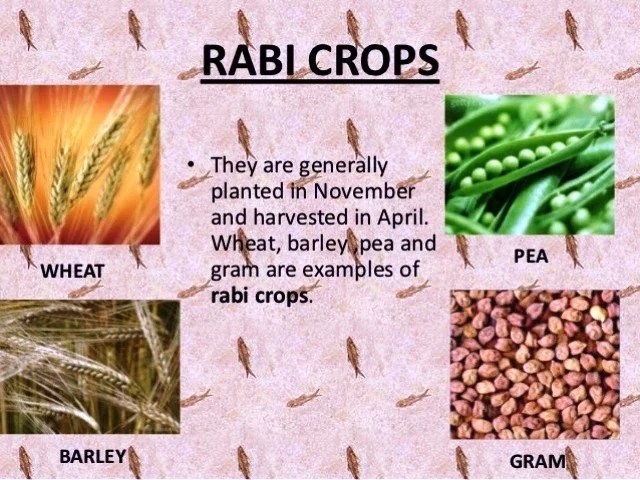
Rabi crops are also referred to as Winter crops. They grow during the winter season which is between October and March. The term ‘Rabi’ means spring. Thus, as you know, the harvesting time for Rabi crops happens during the spring season. Unlike Kharif crops, Rabi crops do not need a lot of water. Thus, they make do with routine water irrigation in order to flourish.

 For instance, they include Wheat, Barley, Pulses, Gram, and more. In addition, farmers also sow seeds of Mustard, Cumin, Sunflower, Rapeseed, and more during this season.

Rabi Crops

Definition of Kharif Crop

Kharif Crops grow during the rainy season which is between June and October. Thus, we also refer to them as Monsoon crops. Unlike Rabi crops, these crops require water in abundance in order to grow. That is why the farmers sow them during the onset of monsoon. Consequently, they harvest them at the end of September or in October. However, these crops are totally dependent on the rainfall’s pattern and timing. Thus, some states sow them a bit early than other states depending on the arrival of monsoon.

For instance, Rice, Sugarcane, Cotton, Pulses, Bajra, and more are examples of these crops.

Kharif Crop

Water Requirements of Rabi & Kharif crops in Different Seasons of India

Water is one of the most important inputs essential for the production of crops. Hence crop planning should be done considering as per (Water requirement and Availability of water).

Water Requirements – The water requirement of crops is that quantity of water required by the crops within a given period of time for their maturity and it includes losses due to evapotranspiration plus the unavoidable losses during the application of water and water required for special operations such as land preparation, and leaching. The quantity of water needed for irrigation on different soil types per meter depth of soil profile at 50% of soil moisture availability is as follows – Sandy soils (25-50 mm), Sandy-loam (45-80 mm), Loam (70-110 mm), Clay-loam (80-120 mm) and Heavy clay (100-140 mm).

The water requirement of different crops is given below-

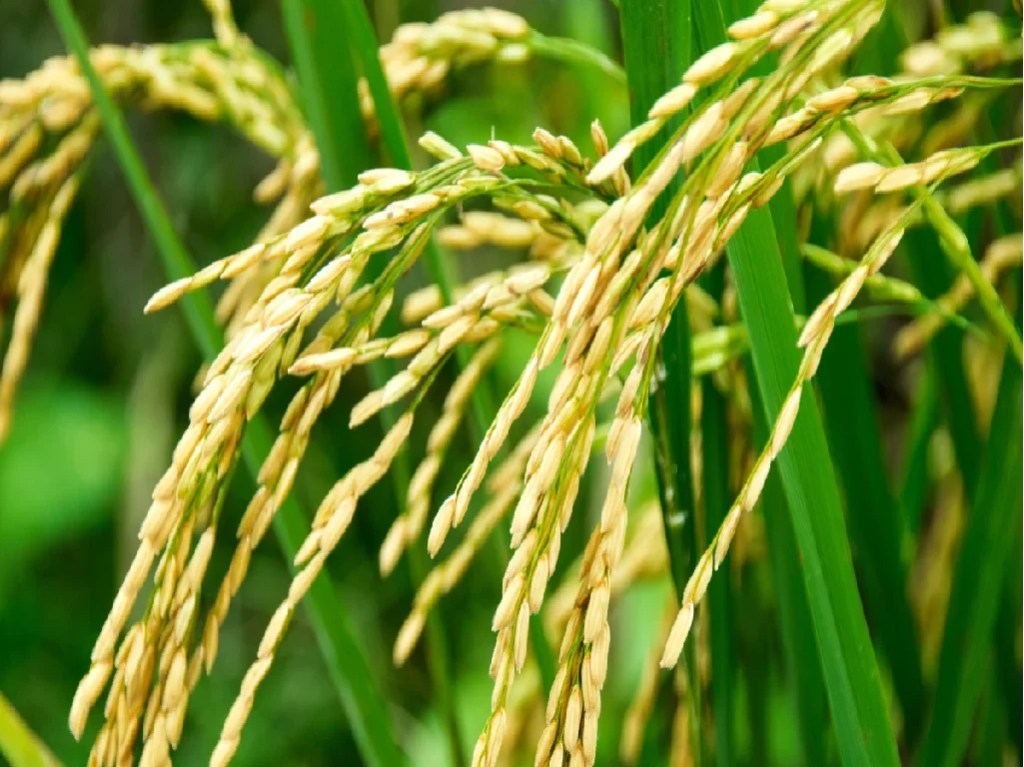
Rice – The amount of water required for growing rice is varies widely under different conditions:-

[1000 – 1500 mm – Heavy soils high water table, Short duration variety, Kharif season].

[1500 – 2000 mm – Medium soils, Kharif or early spring season].

[2000 – 2500 mm – Light soils, Long duration varieties during Kharif, Medium duration varieties during summer].

Rice

Wheat – It requires about 4-5 times irrigation. The dwarf wheat needs more wetness and the optimum moisture range is from 100-60% of availability. For tall wheat the optimum-moisture range is from the field capacity to 50% of availability.

Wheat

Barley – About 2-3 times irrigation are adequate and the optimum soil moisture ranges from the field capacity to 40% of availability.

Barley

Maize – The optimum soil moisture range is from 100-60% of availability in the maximum root-zone, which extends from 40-60 cm on different soil types. In the northern parts 2-3 times irrigation are required before the onset of the monsoon. In Karnataka 2-5 times irrigation are necessary during Kharif and Rabi respectively. At Rajasthan 4 times irrigation (500 mm of water) are required during Kharif.

Maize

Sorghum and Other Millets – The optimum moisture range is from the field capacity to 40% of the availability. At boot stage and grain development, the water requirement is very important.

Sorghum
Types Of Millets

Pulses or Grain Legumes – When grown alone, 1 or 2 times irrigation would be beneficial. The grain legumes (gram, lentil, pea and Indian bean) are irrigated for 2 or 3 times during their growth.

Pulses

Oilseeds – The crops are generally grown under rain fed conditions. Groundnut – 8 to 10 times irrigation of about 50mm each are applied at 10-15 days interval during its growth period. Sunflower, Mustard and Linseeds are grown alone are mixed with cereals should receive 3 or 4 times irrigation during their growth.

Cotton – The optimum moisture range of soil moisture for the crop is from the field capacity to 20% of availability in 0-75 cm of the root-zone. Water requirements varied from 400-800 mm under different conditions and about 4-7 irrigation are required for cotton.

Cotton Plant

Jute – The optimum moisture regime is from the field capacity to 70% of availability in the maximum root-zone of the crop which can extend to about 45 cm of soil depth.

Carpets made of Jute

Sugarcane – The optimum soil moisture for sugarcane has been found to be 100-50% range of availability in the maximum root-zone, extending upto 50-75 cm in depth. In the north, the crop is planted during February-March and irrigated till the commencement of the monsoon.

Fresh sugarcane in garden.

Tobacco – For cigar, hookah and bidi, tobacco the optimum moisture regimes are from the field capacity to 70, 60 and 50% of the availability respectively. Cigar tobacco needs light and frequent irrigation during 4 months. For hookah tobacco, 12-13 times irrigation of 50 mm of water is required.

Tobacco Plants

Forage Crops – The optimum moisture range is from field capacity to about 75% of availability. Berseem requires about 20 times irrigation during its growth at intervals of about 20 days (December-January), 15 days (November-February-March) & 10 days (September-October-April). For Lucerne 1800 to 2000 mm of water require during the first year of growth.

Vegetables – The soil moisture should range between 70-80% of availability in the maximum root-zone. Potato needs water at intervals of 10-12 days. Onion and Garlic need very frequent irrigation about 3 weeks before maturity the irrigation is delayed to enhance the keeping quality of the bulb. Tomato needs irrigation at intervals of 10-12 days during summer and 15-20 days during winter. The optimum moisture regime is from 100-50% of the availability in case of cabbage and cauliflower. Water-melon and musk-melon need water at intervals of 8-10 days. Other crop of cucurbitaceae family needs irrigation at intervals of 10-12 days during summer.

Different types of Vegetables

Spices and Condiments – Important crops are turmeric, ginger, chillies, ajwan, cumin and coriander. Turmeric and ginger should be irrigated to maintain 100-60% of the available moisture in the maximum root-zone, the top 50 cm of the soil. Chillies should be irrigated to maintain 100-50% of the available moisture to about 60 cm in the soil. Coriander, cumin and ajwan need irrigation at intervals of 10-12 days on light soil and 15-20 days on heavy soils

Different types of Spices

Fruit-trees – For fruit trees soil moisture should be maintain in the range of 100-75% of availability. On the full development of the root-zone down to 75-90 cm, the crops may be irrigated when 2/3 times of the available moisture is depleted during blossoming, fruit settings are fruit enlargement. Papaya and banana needs irrigation at intervals of 8-10 days in a tropical climate. The date palm needs regular irrigation during flowering and fruiting to produce good yields.

Different Types of Fruits

Coffee – To irrigate coffee after the cessation of the monsoon rains during flowering to avoid flower shedding is of profitable.

Coffee & Coffee Beans

When the land does not receive any irrigation, the cultivator takes single crop in Kharif season on the available moisture in the soil. If the soil is heavy, a second crop in Rabi season after a short duration crop in Kharif season, but two seasonal or perennial crops is not beneficial. When irrigation becomes available the cropping plan can include heavy perennials like sugarcane and banana, light perennials like guava or orange, two seasonal crops like long staple cotton, chillies, turmeric etc. besides Kharif and Rabi seasonal crops and also follow double cropping such as groundnut green gram, black gram etc. Followed by wheat or rabbi Jowar, Kharif Jowar or cotton followed by wheat, gram or some vegetable to seasonal crop followed by summer groundnut or some vegetable crop.

Stephen Hawking’s final theory of black holes -The Hawking radiation

When a massive star dies, it leaves a small but dense remnant core in its wake. If the mass of the core is more than 3 times the mass of the sun, the force of gravity overwhelms all other forces and a black hole is formed. Imagine the size of a star is 10 times more massive than our sun being squeezed into a sphere with a diameter equal to the size of New York City. The result is a celestial object whose gravitational field is so strong that nothing, not even light can escape it. The history of black holes was started with the father of all physics, Isaac Newton. In 1687, Newton gave the first description of gravity in his publication, Principia mathematica, that would change the world.

Then 100 years later, John Michelle proposed the idea that there could exist a structure that would be massive enough and not even light would be able to escape its gravitational pull. In 1796, the famous French scientist Pierre-Simon Laplace made an important prediction about the nature of black holes. He suggested that because even the speed of light was slower than the escape velocity of black hole, the massive objects would be invisible. In 1915, Albert Einstein changed physics forever by publishing his theory of general relativity. In this theory, he explained space time curvature and gave a mathematical description of a black hole. And in 1964, john wheeler gave these objects the name, the black hole.

The Gargantua in Interstellar is an incredibly close representation of an actual black hole

In classical physics, the mass of a black hole cannot decrease; it can either stay the same or get larger, because nothing can escape a black hole. If mass and energy are added to a black hole, then its radius and surface area also should get bigger. For a black hole, the radius is called the Schwarzschild radius. The second law of thermodynamics states that, an entropy of a closed system is always increases or remains the same. In 1974, Stephen hawking– an English theoretical physicists and cosmologist, proposed a groundbreaking theory regarding a special kind of radiation, which later became known as hawking radiation. So hawking postulated an analogous theorem for black holes called the second law of black hole mechanics that in any natural process, the surface area of the event horizon of a black hole always increase, or remains constant. It never decreases. In thermodynamics, black bodies doesn’t transmit or reflect any radiation, it only absorbs radiation.

When Stephen hawking saw these ideas, he found the idea of shining black holes to be preposterous.  But when he applied the laws of quantum mechanics to general relativity, he found the opposite to be true. He realized that stuff can come out near the event horizon. In 1974, he published a paper where outlined a mechanism for this shine. This is based on the Heisenberg uncertainty Principe. According to the principle of quantum mechanisms, for every particle throughout the universe, there exists an antiparticle. These particles always exist in pairs, and continually pop in and out of existence everywhere in the universe. Typically, these particles don’t last long because as soon as possible and its antiparticle pop into existence, they annihilate each other and cease to exist almost immediately after their creation.

In the event horizon that the point which nothing can escape its gravity. If a virtual particle pair blip into existence very close to the event horizon of a black hole, one of the particles could fall into the black hole while the other escapes. The one that falls into the black hole effectively has negative energy, which is, in Layman’s terms, akin to subtracting energy from the black hole, or taking mass away from the black hole. The other particle of the pair that escapes the black hole has positive energy, and is referred to as hawking radiation.

The first-ever image of a black hole by the Event Horizon Telescope (EHT), 2019

Due to the presence of hawking radiation, a black hole continues to loss mass and continues shrinking until the point where it loses all its mass and evaporates. It is not clearly established what an evaporating black hole would actually look like. The hawking radiation itself would contain highly energetic particles, antiparticles and gamma rays. Such radiation is invisible to the naked eye, so an evaporating black hole might not look like anything at all. It also possible that hawking radiation might power a hadronic fireball, which could degrade the radiation into gamma rays and particles of less extreme energy, which would make an evaporating black hoe visible. Scientists and cosmologists still don’t completely understand how quantum mechanics explains gravity, but hawking radiation continues to inspire research and provide clues into the nature of gravity and how it relates to other forces of nature.

The Railways

Rail transport (also known as train transport) is a means of transferring passengers and goods on wheeled vehicles running on rails, which are located on tracks. In contrast to road transport, where the vehicles run on a prepared flat surface, rail vehicles (rolling stock) are directionally guided by the tracks on which they run. Tracks usually consist of steel rails, installed on sleepers (ties) set in ballast, on which the rolling stock, usually fitted with metal wheels, moves. Other variations are also possible, such as “slab track”, in which the rails are fastened to a concrete foundation resting on a prepared subsurface.

Rolling stock in a rail transport system generally encounters lower frictional resistance than rubber-tired road vehicles, so passenger and freight cars (carriages and wagons) can be coupled into longer trains. The operation is carried out by a railway company, providing transport between train stations or freight customer facilities. Power is provided by locomotives that either draw electric power from a railway electrification system or produce their power, usually by diesel engines or, historically, steam engines. Most tracks are accompanied by a signaling system. Railways are a safe land transport system when compared to other forms of transport. Railway transport is capable of high levels of passenger and cargo utilization and energy efficiency but is often less flexible and more capital-intensive than road transport when lower traffic levels are considered.

Picture source: https://scroll.in/article/669579/the-long-history-of-indian-railways-told-through-images

Indian Railways

Indian Railways (IR) is a statutory body under the jurisdiction of the Ministry of Railways, Government of India that operates India’s national railway system. It manages the fourth-largest railway network in the world by size, with a route length of 67,956 km (42,226 mi) as of 31 March 2020. 45,881 km (28,509 mi) or 71% of all the broad-gauge routes are electrified with 25 kV 50 Hz AC electric traction as of 1 April 2021.

In the fiscal year ending March 2020, Indian Railways carried 808.6 crores (8.086 billion) passengers and transported 121.23 crores (1.2123 billion) tonnes of freight. It runs 1 lakh (100,000) passenger trains daily, on both long-distance and suburban routes, covering 7,325 stations across India. Mail or Express trains, the most common types of trains, run at an average speed of 50.6 km/h (31.4 mph). Suburban EMUs run at an average speed of 37.5 km/h (23.3 mph). Ordinary passenger trains (incl. mixed) run at an average speed of 33.5 km/h (20.8 mph). The maximum speed of passenger trains varies, with the Gatimaan Express running at a peak speed of 160 km/h (99 mph).

In the freight segment, IR runs 8,479 trains daily. The average speed of freight trains is around 24 km/h (15 mph). The maximum speed of freight trains varies from 60–75 km/h (37–47 mph) depending on their axle load with ‘container special’ trains running at a peak speed of 100 km/h (62 mph).

The first railway proposals for India were made in Madras in 1832.

  • The country’s first transport train, Red Hill Railway (built by Arthur Cotton to transport granite for road-building), ran from Red Hills to the Chintadripet bridge in Madras in 1837. In 1845, the Godavari Dam Construction Railway was built by Cotton at Dowleswaram in Rajahmundry, to supply stone for the construction of a dam over the Godavari River. In 1851, the Solani Aqueduct Railway was built by Proby Cautley in Roorkee to transport construction materials for an aqueduct over the Solani River.
  • India’s first passenger train, operated by the Great Indian Peninsula Railway and hauled by three steam locomotives (SahibSindh, and Sultan), ran for 34 kilometers (21 mi) with 400 people in 14 carriages on 1,676 mm (5 ft 6 in) broad gauge track between Bori Bunder (Mumbai) and Thane on 16 April 1853. The Thane viaducts, India’s first railway bridges, were built over the Thane creek when the Mumbai-Thane line was extended to Kalyan in May 1854. Eastern India’s first passenger train ran 39 km (24 mi) from Howrah, near Kolkata, to Hoogly on 15 August 1854. The first passenger train in South India ran 97 km (60 mi) from Royapuram-Veyasarapady (Madras) to Wallajabad (Arcot) on 1 July 1856.

Rivers of India

The rivers of India play an important role in the lives of the Indian people. The river systems provide irrigation, potable water, cheap transportation, electricity, as well as provide livelihoods for a large number of people all over the country.

Seven major rivers (Indus, Brahmaputra, Narmada, Tapi, Godavari, Krishna and Mahanadi) along with their numerous tributaries make up the river system of India.

All major rivers of India originate from one of the three main watersheds;

  • The Himalaya and the Karakoram ranges
  • Vindhya and Satpura ranges and Chotanagpur plateau in central India
  • Sahyadri or Western Ghats in western India

Based on the topography, the river systems of India can be classified into four groups.

  • Himalayan Rivers
  • Deccan Rivers
  • Coastal Rivers
  • Rivers of the Inland Drainage Basin

The Himalayan Rivers – The Himalayan Rivers receive input from rain as well as snowmelt and glacier melt and, therefore, have continuous flow throughout the year. The main river systems in Himalayas are those of the Indus and the Ganga-Brahmaputra-Meghna. The Indus rises near Mansarovar in Tibet. Flowing through Kashmir, it enters Pakistan and finally falls in the Arabian Sea near Karachi. Bhagirathi and Alakhnanda are two important rivers that originate in Garhwal Himalayas. . These join at Devprayag to form Ganga which is the most sacred river of India. This river traverses through Uttaranchal, Uttar Pradesh, Bihar, and West Bengal and thereafter enters Bangladesh. Yamuna River is an important tributary of Ganga and its own important tributaries are Chambal and Betwa. The Brahmaputra rises in Tibet where it is known by the name Tsangpo. It enters India in Arunachal Pradesh and after traversing through Assam, enters Bangladesh. The combined Ganga-Brahmaputra River meets Meghna in Bangladesh and their huge volume of water flows into the Bay of Bengal.

The Deccan Rivers – The Rivers of Deccan can be further classified in two groups: west flowing rivers and east flowing rivers. The Narmada and the Tapi rivers flow westwards into Arabian Sea. The important east flowing rivers are the Brahmani, the Mahanadi, the Godavari, the Krishna, the Pennar, and the Cauvery. These rivers fall into the Bay of Bengal. The Mahanadi, rising in the state of Madhya Pradesh, is an important river in the state of Orissa. The Krishna rises in the Western Ghats and flows east into the Bay of Bengal. The Krishna is the third longest river in India. The source of the Cauvery is in the state of Karnataka and the river flows south eastward. The Narmada and the Tapi are the only major rivers that flow eastward into the Arabian Sea.

The Narmada rises in Madhya Pradesh and crosses the state, passing swiftly through a narrow valley between the Vindhya Range and spurs of the Satpura Range. It flows into the Gulf of Khambhat (or Cambay).

The Coastal RiversThere are numerous coastal rivers which are comparatively small. While only handful of such rivers drains into the sea near the deltas of east coast, there are as many as 600 such rivers on the west coast. The West Coast Rivers are important as they contain as much as 14% of the country’s water resources while draining only 3% of the land.

Rivers of the Inland Drainage Basin – The Rivers of the inland system, centred in western Rajasthan state, are few and frequently disappear in years of scant rainfall. A few rivers in Rajasthan do not drain into the sea. They drain into salt lakes or get lost in sands with no outlet to sea.

The rivers of India can be classified on the basis of origin and on the type of basin that they form.

On the basis of Origin: Himalayan Rivers and Peninsular Rivers.

Himalayan Rivers -The main Himalayan river systems are the Ganga, the Indus and the Brahmaputra river systems. The Himalayan Rivers form large basins. Many rivers pass through the Himalayas. These deep valleys with steep rock sides were formed by the down – cutting of the river during the period of the Himalayan uplift. They perform intense erosional activity up the streams and carry huge load of sand and silt. In the plains, they form large meanders and a variety of depositional features like flood plains, river cliffs and levees. These rivers are perennial as they get water from the rainfall as well as the melting of ice. Nearly all of them create huge plains and are navigable over long distances of their course. These rivers are also harnessed in their upstream catchment area to generate hydroelectricity.

Peninsular Rivers – The main peninsular river systems include the Narmada, the Tapi, the Godavari, the Krishna, the Kaveri and the Mahanadi river systems. The Peninsular Rivers flow through shallow valleys. A large number of them are seasonal as their flow is dependent on rainfall. The intensity of erosional activities is also comparatively low because of the gentler slope. The hard rock bed and lack of silt and sand does not allow any significant meandering. Many rivers therefore have straight and linear courses. These rivers provide huge opportunities for hydro-electric power.

The Indus River System – The Indus originates in the northern slopes of the Kailas range in Tibet near Lake Mansarovar. It follows a north-westerly course through Tibet. It enters Indian Territory in Jammu and Kashmir.

The main tributaries of the Indus in India are Jhelum, Chenab, Ravi, Beas and Sutlej

  • Jhelum – The Jhelum originates in the south-eastern part of Kashmir, in a spring at Verinag.. It follows the Indo-Pakistan border flowing into the plains of Punjab, finally joining the Chenab at Trimmu.
  • Chenab – The Chenab originates from the confluence of two rivers, the Chandra and the Bhaga, which themselves originate from either side of the Bara Lacha Pass in Lahul. It is also known as the Chandrabhaga in Himachal Pradesh. It is further joined by the Ravi and the Sutlej in Pakistan.
  • Ravi – The Ravi originates near the Rohtang pass in the Kangra Himalayas and follows a north-westerly course. It flows as a part of the Indo-Pakistan border for some distance before entering Pakistan and joining the Chenab River. The total length of the river is about 720 km.
  • Beas – The Beas originates in Beas Kund, lying near the Rohtang pass. It runs past Manali and Kulu, where its beautiful valley is known as the Kulu valley. It joins the Sutlej river near Harika, after being joined by a few tributaries. The total length of the river is 615 km.
  • Sutlej – The Sutlej originates from the Rakas Lake, which is connected to the Mansarovar Lake by a stream, in Tibet. Its flows in a north-westerly direction and enters Himachal Pradesh at the Shipki Pass, where it is joined by the Spiti river.  It turns west below Rupar and is later joined by the Beas. It enters Pakistan near Sulemanki, and is later joined by the Chenab. It has a total length of almost 1500 km.

The Narmada River SystemThe Narmada or Nerbudda is a river in central India. It forms the traditional boundary between North India and South India, and is a total of 1,289 km long. Its total length through the states of Madhya Pradesh, Maharashtra, and Gujarat amounts to 1312 kilometres (815 miles), and it empties into the Arabian Sea in the Bharuch district of Gujarat.

The Tapi River System – The Tapi is a river of central India. It is one of the major rivers of peninsular India with the length of around 724 km, and only the Tapi River along with the Narmada River, and the Mahi River run from east to west. It rises in the eastern Satpura Range of southern Madhya Pradesh state emptying into the Gulf of Cambay of the Arabian Sea, in the State of Gujarat.

The Godavari River System – The river with second longest course within India, Godavari is often referred to as the Vriddh (Old) Ganga or the Dakshin (South) Ganga. The river is about 1,450 km (900 miles) long. It rises at Trimbakeshwar, near Nasik and Mumbai (formerly Bombay) in Maharashtra around 380 km distance from the Arabian Sea and empties into the Bay of Bengal. It is a seasonal river, widened during the monsoons and dried during the summers

The Krishna River System – The Krishna is one of the longest rivers of India (about 1300 km in length). It originates at Mahabaleswar in Maharashtra, passes through Sangli and meets the sea in the Bay of Bengal at Hamasaladeevi in Andhra Pradesh. The Krishna River flows through the states of Maharashtra, Karnataka and Andhra Pradesh. Its most important tributary is the Tungabhadra River, which itself is formed by the Tunga and Bhadra rivers that originate in the Western Ghats.
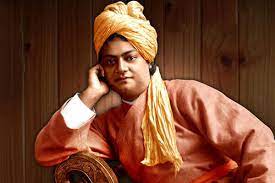
The Kaveri River System – The Kaveri (also spelled Cauvery or Kaveri) is one of the great rivers of India and is considered sacred by the Hindus. This river is also called Dakshin Ganga. It flows generally south and east for around 765 km, emptying into the Bay of Bengal through two principal mouths. Its basin is estimated to be 27,700 square miles (71,700 km²), and it has many tributaries including Shimsha, Hemavati, Arkavathy, Kapila, Honnuhole, Lakshmana Tirtha, Kabini, Lokapavani, Bhavani, Noyyal and famous Amaravati.
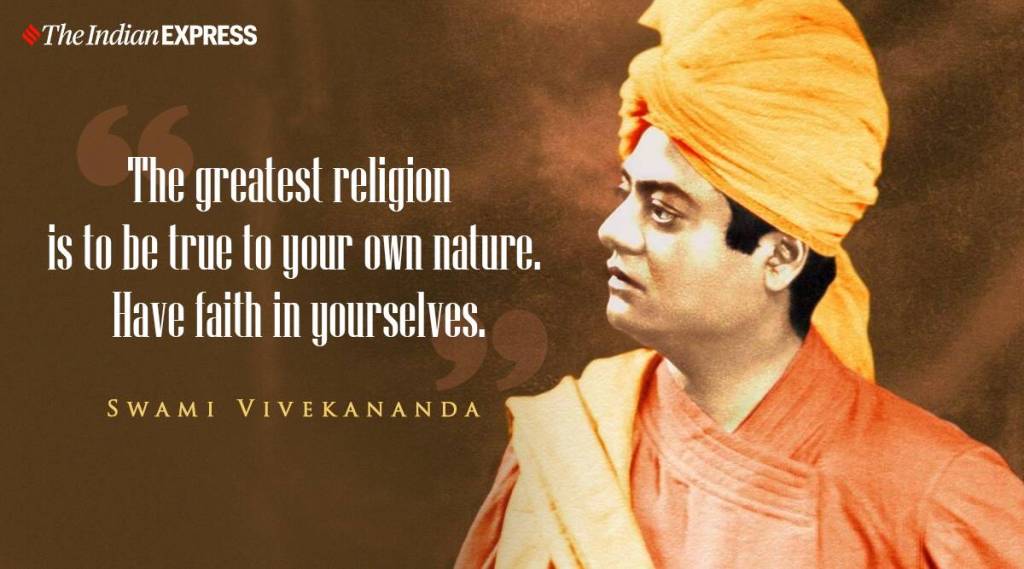
The Mahanadi River System – The Mahanadi is a river of eastern India. The Mahanadi rises in the Satpura Range of central India, and flows east to the Bay of Bengal. The Mahanadi drains most of the state of Chhattisgarh and much of Orissa and also Jharkhand and Maharashtra. It has a length of about 860 km. Near the city of Sambalpur; a large dam – the Hirakud Dam – is built on the river.

RIVERS OF INDIA

CYBER CRIME CASE STUDY IN INDIA

Computer Crime Cyber crime encompasses any criminal act dealing with computers and networks (called hacking).Additionally, cyber crime also includes traditional crimes conducted through the internet. For example; The computer may be used as a tool in the following kinds of activity- financial crimes, sale of illegal articles, pornography, online gambling, intellectual property crime, e-mail spoofing, forgery, cyber defamation, cyber stalking.The computer may however be target for unlawful acts in the following cases- unauthorized access to computer/ computer system/ computer networks, theft of information contained in the electronic form, e-mail bombing, Trojan attacks, internet time thefts, theft of computer system, physically damaging the computer system

Cyber Law is the law governing cyberspace. Cyberspace is a wide term and includes computers, networks,software, data storage devices (such as hard disks, USB disks), the Internet, websites, emails and even electronic devices such as cell phones, ATM machines etc.

Computer crimes encompass a broad range of potentially illegal activities. Generally, however, it may be divided into one of two types of categories

(1) Crimes that target computer networks or devices directly; Examples – Malware and malicious code, Denial-of-service attacks and Computing viruses.

(2) Crimes facilitated by computer networks or devices, the primary target of which is independent of the computer network or device. Examples – Cyber stalking, Fraud and identity theft, Phishing scams and Information warfare.

CASE STUDIES

Case no:1 Hosting Obscene Profiles (Tamil Nadu)

The case is about the hosting obscene profiles. This case has solved by the investigation team in Tamil Nadu. The complainant was a girl and the suspect was her college mate. In this case the suspect will create some fake profile of the complainant and put in some dating website. He did this as a revenge for not accepting his marriage proposal. So this is the background of the case.

Investigation Process

Let’s get into the investigation process. As per the complaint of the girls the investigators started investigation and analyze the webpage where her profile and details. And they log in to that fake profile by determining its credentials, and they find out from where these profiles were created by using access log. They identified 2 IP addresses, and also identified the ISP. From that ISP detail they determine that those details are uploaded from a café. So the investigators went to that café and from the register and determine suspect name. Then he got arrested and examining his SIM the investigators found number of the complainant.

Conclusion

The suspect was convicted of the crime, and he sentenced to two years of imprisonment as well as fine.

Case no:2 Illegal money transfer (Maharashtra)

ThIS case is about an illegal money transfer. This case is happened in Maharashtra. The accused in this case is a person who is worked in a BPO. He is handling the business of a multinational bank. So, he had used some confidential information of the banks customers and transferred huge sum of money from the accounts.

Investigation Process

Let’s see the investigation process of the case. As per the complaint received from the frim they analysed and studied the systems of the firm to determine the source of data theft. During the investigation the system server logs of BPO were collected, and they find that the illegal transfer were made by tracing the IP address to the internet service provider and it is ultimately through cyber café and they also found that they made illegal transfer by using swift codes. Almost has been  The registers made in cyber café assisted in identifying the accused in the case. Almost 17 accused were arrested.

Conclusion

Trail for this case is not completed, its pending trial in the court.

Case no:3 Creating Fake Profile (Andhra Pradesh)

The next case is of creating fake profile. This case is happened in Andhra Pradesh. The complainant received obscene email from unknown email IDs. The suspect also noticed that obscene profiles and pictures are posted in matrimonial sites.

Investigation Process

The investigators collect the original email of the suspect and determine its IP address. From the IP address he could confirm the internet service provider, and its leads the investigating officer to the accused house. Then they search the accused house and seized a desktop computer and a handicam. By analysing and examining the desktop computer and handicam they find the obscene email and they find an identical copy of the uploaded photos from the handicam. The accused was the divorced husband of the suspect.

Conclusion

Based on the evidence collected from the handicam and desktop computer charge sheet has been filed against accused and case is currently pending trial.

Hacking is a widespread crime nowadays due to the rapid development of the computer technologies. In order to protect from hacking there are numerous brand new technologies which are updated every day, but very often it is difficult to stand the hacker’s attack effectively. With some of these case studies, one is expected to learn about the cause and effect of hacking and then evaluate the whole impact of the hacker on the individual or the organization.

Shillong

Wards Lake

Shillong is a hill station in the northeastern part of India and the capital of Meghalaya, which means “The Abode of Clouds”. It is the headquarters of the East Khasi Hills district. Shillong is the 330th most populous city in India with a population of 143,229 according to the 2011 census. It is said that the rolling hills around the town reminded the British of Scotland. Hence, they would also refer to it as the “Scotland of the East”.

Shillong has steadily grown in size since it was made the civil station of the Khasi and Jaintia Hills in 1864 by the British. In 1874, on the formation of Assam as the Chief Commissioner’s Province, it was chosen as the headquarters of the new administration because of its convenient location between the Brahmaputra and Surma valleys and more so because the climate of Shillong was much cooler than tropical India. Shillong remained the capital of undivided Assam until the creation of the new state of Meghalaya on 21 January 1972, when Shillong became the capital of Meghalaya, and Assam moved its capital to Dispur in Guwahati.

Shillong was capital for composite Assam during the British regime and later till a separate State of Meghalaya was formed. David Scott, the British civil servant of the East India Company, was the Agent of the Governor-General North East Frontier. During the First Anglo-Burmese War the British authorities felt the need for a road to connect Sylhet and Assam. The route was to traverse across the Khasi and Jaintia Hills. David Scott overcame the difficulties his administration faced from the opposition of the Khasi Syiems – their chiefs and people. Impressed by the favourable cool climate of Khasi Hills, they negotiated with the Syiem of Sohra in 1829 for a sanatorium for the British. 

Places to visit

SHILLONG PEAK

At a distance of 10 km from the city and at a height of 6449 ft (1965 m) above sea level, this is the highest point of Shillong. It offers a breathtaking panoramic view of the entire city, the Himalayas, its waterfalls as well as of the Bangladesh plains. A beautiful place to spend a day.

LADY HYDARI PARK

A very popular tourist spot in Shillong, the park is dedicated to the first lady of the province – Lady Hydari. This sprawling park, located in the heart of the city encompasses a wide variety of flora along with a mini zoo housing 73 species of birds and over 100 reptiles. The beautiful bed of flowers is the highlight of the park.

DAINTHLEN FALLS

Just before reaching Sohra, a road to the right leads one to the falls which are 5 km away. The waterfall derives its name from a Then or a snake of gigantic size which dwelt in a cave. Legend has it that the people destroyed the snake to rid themselves of its reign of terror. Adjacent to the very spot where the Thlen was slaughtered lies the Dainthlen Waterfalls. Natural rock carvings of the episode draw visitors to see the image of the Thlen, the symbol of greed, corruption, and evil.

Elephant Falls

Named after an Elephant like stone at its base, the Elephant Falls are amongst the most popular falls in the North-East, situated close to Shillong. It is a tourist attraction with three layers of the falls accessible from different vantage points.

The Genius of da Vinci- 3

Leonardo and Science                                                                       

Leonardo’s genius went beyond art and paintings, he shared just as much of a connection with science as he did with his art if not more. His contribution to science and scientific inventions were most probably a result of his artistic abilities.             

Leonardo studied anatomy, botany, light, chemistry, astronomy, mathematics, to name a few without receiving any sort of formal education.                                                    

Leonardo kept a log of his ideas, observations, and scientific drawings. According to him science and art shared a resemblance with each other which is quite evident from his journals that seem to blend art and science together.

FACTOID  Leonardo sometimes wrote from right to left because he was a lefty. Therefore most of his writing is in mirror image.

Leonardo learned the basics of anatomy and the human body when he was working for Verrocchio. Leonardo dissected about 30 human corpses in his lifetime. The hospitals in Italy let him continue his studies for research purposes after he established himself as a great artist.

In his dissection studies, he would pull on different muscles to see the effect it would have on the movement of other muscles. His anatomy research also included his studies of facial features. He studied the changes that different emotions caused in the facial features and those of people with a facial deformity or a sickness as well. He studied the human skeleton and pointed out that the sacrum (a bony structure in the vertebral column) is a fusion of 5 bones, which now holds to be true. He did all of this back then, when relatively close to no resources existed.

He studied the human heart and figured out how the valves of the heart work but couldn’t figure out the whole circulation system. In 2005, a heart surgeon in The UK took aid from Leonardo’s journals of the human heart. His studies are being used by top surgeons in the 21st century, over 500 years later.

Leonardo da Vinci was granted the permission to perform his experiments and do all this research after establishing himself as a profound artist during that time. The hospital gave him corpses to dissect and so he did.

Leonardo’s journals contain drawings of some flying machines that he was working on at that time. One such machine had wings that resembled the wings of a bat. Though his drawings were not fully correct and would not have worked in practicality, it is still exceptional that a man like him without major resources could do so much. 

His journals contain much more than whatever has been mentioned so far and will probably remain alien to the world or even if someone is able to somehow get their hands on said journal will also need the intellect to understand it.

Leonardo was much more than an artist but sadly that’s exactly what most people know him as. His ability to blend art and science made him extremely special. Imagine the things he could have achieved if he were born in today’s time. We would know so much more about the things unknown to mankind. He was an artist ahead of his time and needs to be recognized not just for his art but his true genius.

The Genius of da Vinci – 2

Adoration of the Magi 

One of the many paintings that Leonardo left unfinished, that is a skill all artists possess. The painting portrays the Virgin Mary with her chid and the Magi (the three wise men who paid homage to Jesus as the king of Jews) kneeling in adoration in front of them. Behind them, some ruins along with a few horsemen that appear to be fighting and a palm tree which holds a significance in the Bible.

This unfinished masterpiece now resides at the Uffizi Gallery in Florence, Italy.

The Last Supper                                                                               

The Last Supper is a mural painting that depicts Jesus having his last supper (the last meal of Jesus with his disciples in Jerusalem before he was arrested and crucified). In the painting, Jesus’ Apostles can be seen reacting to him saying “one of you will betray me”, “one of you”, referring to one of his apostles.                                                          This was painted by Leonardo in the late 15th century and started to deteriorate quite quickly, due to humidity and the painting techniques used by the artist. It took a long time to restore this painting with the final restoration being done in 1999 and was then returned back to where it belongs- Convent of Santa Maria Delle Grazie in Milan, Italy.

Salvator Mundi                                                                                    

In this painting, Leonardo shows Jesus wearing a robe, with the fingers of his right hand forming a cross pointing upwards while holding a crystal ball in his left.                        

This painting was sold for $450 million to Badr Bin Abdullah, a Saudi minister, in 2017.   What makes it worth $450 million?                                                                                

Well, you see no piece of art is only famous for its artistic grandeur, most pieces of art involved in some sort of controversy have a tendency to embark themselves in textbooks. Salvator Mundi went through it’s fair share of controversies. There were multiple times since the birth of this painting when it was thought to be destroyed. The painting vanished from the public eye in the year 1763 and was found in the 1900s in a rather impaired condition. Then in 2005, a group of individuals bought this painting for about $10,000 and was densely overpainted which made it look like a knock-off. Dianne Dwyer Modestini was given the job to restore this painting and the process came to an end around 2010.                                                                                                       

Even now, theories exist about the whereabouts of this piece which adds to the fascination.

Mona Lisa                                                                                          

One of the greatest paintings to ever be painted. Mona Lisa is a portrait painting of an Italian woman Lisa Gherardini painted in the early 1500s. The painting shows the woman looking directly at the observer. The woman in the painting possesses a certain amount of poise and grace. The landscape shown by Leonardo looks very surreal making the painting all the more captivating. The lady’s smile has been a subject of discussion among art lovers but a 2003 study suggested that the smile vanishes when you look directly at her mouth and reappears when you observe the face as a whole.  Leonardo used a technique called ‘sfumato’ with this one which is a technique involving the blending of colors into one another making the transition between different tones easier and giving life to the painting.                           Mona Lisa is housed by the Louvre museum in France

Indian Culture

India is a country that gloats of a rich culture. The way of life of India alludes to an assortment of minor one of a kind societies. The way of life of India contains clothing, celebrations, dialects, religions, music, dance, food, and workmanship in India. Generally significant, Indian culture has been affected by a few unfamiliar societies since its commencement. Additionally, the historical backdrop of India’s way of life is a few centuries old.

As a matter of first importance, Indian beginning religions are Hinduism, Buddhism, Jainism, and Sikhism. These religions depend on karma and dharma. Besides, these four are called as Indian religions. Indian religions are a significant class of world religions alongside Abrahamic religions. Additionally, numerous unfamiliar religions are available in India also. These unfamiliar religions incorporate Abrahamic religions. The Abrahamic religions in India unquestionably are Judaism, Christianity, and Islam. Other than Abrahamic religions, Zoroastrianism and Bahá’í Faith are the other unfamiliar religions which exist in India. Subsequently, the presence of such countless assorted religions has brought about resilience and secularism in Indian culture.

Indian culture has been a motivation to numerous essayists. India is unquestionably an image of solidarity all throughout the planet. Indian culture is unquestionably exceptionally complicated. Moreover, the origination of Indian personality represents specific challenges. In any case, regardless of this, a normal Indian culture exists. The production of this average Indian culture results from some inside powers. Most importantly, these powers are a strong Constitution, general grown-up establishment, mainstream strategy, adaptable government structure, and so on Indian culture is portrayed by a severe social progression. Besides, Indian kids are shown their jobs and spot in the public eye since the beginning. Presumably, numerous Indians accept that divine beings and spirits play a part in deciding their life. Prior, customary Hindus were separated into dirtying and non-contaminating occupations. Presently, this distinction is declining. Indian culture is surely exceptionally different. Likewise, Indian kids learn and acclimatize in the distinctions. In ongoing many years, enormous changes have occurred in Indian culture. Most importantly, these progressions are female strengthening, westernization, a decay of odd notion, higher proficiency, further developed instruction, and so on

To summarize it, the way of life of India is probably the most established culture in the World. Most importantly, numerous Indians till adhere to the conventional Indian culture regardless of quick westernization. Indians have exhibited solid solidarity regardless of the variety among them. Solidarity in Diversity is a definitive mantra of Indian culture.

Happiness:)

Happiness is something which we can’t portray in words it must be felt from somebody’s demeanor of a grin. Moreover, bliss is a sign or distinguishing proof of good and prosperous life. Satisfaction is exceptionally easy to feel and hard to portray. In addition, joy comes from the inside and nobody can take your satisfaction.

Consistently we see and meet individuals who look glad from the outside yet where it counts they are broken and are dismal from within. For some individuals, cash is the fundamental driver of satisfaction or sadness. In any case, this isn’t right. Cash can purchase you food, sumptuous house, sound way of life workers, and a lot more offices however cash can’t purchase you bliss. What’s more, in the event that cash can purchase satisfaction, the rich would be the most joyful individual on the earth. However, we see an opposite picture of the rich as they are pitiful, unfortunate, restless, pushed, and experiencing different issues. Also, they have cash still they need public activity with their family particularly their spouses and this is the fundamental driver of separation among them. Additionally, because of cash, they feel uncertainty that everybody is after their cash so to protect their cash and them they employ security. While the state of the poor is the exact inverse. They don’t have cash however they are content with and tranquil from these issues.

As we presently realize that we can’t accepting bliss with cash and there could be no other easy route to satisfaction. It is something that you feel from the inside. Likewise, genuine satisfaction comes from inside yourself. Satisfaction is fundamentally a perspective. Besides, it must be accomplished by being positive and staying away from any bad idea as a main priority. Also, assuming we check out the splendid side of ourselves no one but, we can be glad.

To finish up, we can say that bliss must be accomplished by having positive reasoning and appreciating life. Additionally, for being cheerful and keeping individuals around us glad we need to foster a sound connection with them. Moreover, we additionally need to give them the appropriate time.

The genius of da Vinci 1

Leonardo da Vinci, a Renaissance man born in Italy in 1452, considered as one of the greatest painters the world has ever witnessed, was not just a painter but a man of great intellect. His scientific journals and studies way ahead of their time are to this date used by scientists to get a better understanding of them . In addition to being a painter, a sculptor, he was an anatomist and was well known in the field of engineering, architecture and astronomy as well. da Vinci was unmatched, the only artist who was able to get close to his art was the sculptor of the statue David Michelangelo. The fascinating thing is that he was able to do all this without being exposed to a speck of formal education or training in any field except in painting. He was taught how to read and do basic mathematics all the rest was his own creation.

Leonardo was a genius to say the least, he possessed curiosity ever so great. Maybe, this is what made him so great, his desire for knowledge.                                                                   

His scientific evaluations and anatomic studies are very much evident in his paintings. He used his scientific knowledge to better himself as an artist, and so he did.                                     

Here, we are going to take a look at a few of his paintings and some of his contributions in the milieu of science.

Leonardo da Vinci was born in a town in Vinci, Florence. His father was a Florence based legal notary and his mother belonged to a lower class. Not much is known about his family.

PAINTINGS

Leonardo is undoubtedly one of the greatest artists to have ever lived, but where did he start his artistic journey from?

Leonardo worked as an apprentice under Andrea del Verrocchio, an Italian painter, and sculptor of the 15th century. Leonardo first got introduced to Verrocchio at one of his workshops. He learned a plethora of skills by working for Verrocchio and later also collaborated with him for a painting called The Baptism of Christ around 1475.

Baptism of Christ was a collaborative effort of Andrea del Verrocchio and his student Leonardo da Vinci. This painting depicts Jesus being baptized (the Christian act of sprinkling water on someone, symbolizing purification), with two angels beside him, kneeling. The one performing Jesus’ baptism is John the Baptist, who can be seen with a golden cross and a halo over his head. The pair of hands shown above Jesus’ head is God’s representing approval and acceptance. A dove can also be seen above Jesus’ head as well, symbolizing the Holy Spirit.

Saint Jerome in the Wilderness Another unfinished yet wonderful piece by da Vinci portrays Saint Jerome, a Latin priest in the Christian Church, in the middle of the desert, kneeling, looking fixedly upwards with his arm extending outwards. A lion can be seen resting on the ground looking at the Saint. The lion’s presence can be accounted for by the fact that Saint Jerome helped a lion that entered the monastery where he stayed once, by removing a thorn from the lion’s paw.                                                                                                              

Leonardo used a method called tempera for this painting, which involves mixing of painting pigments with water-soluble emulsions, along with classic oil painting techniques.                                                                                     

This painting is currently present at the Vatican museum in Rome.

The beginning of Art: Visual arts history

Expressing oneself through art seems a universal human impulse, while the style of that expression is one of the distinguishing marks of a culture. As difficult as it to define, art typically involves a skilled, imaginative creator, whose creation is pleasing to the senses and often symbolically significant or useful. Art can be verbal, as in poetry, storytelling or literature or can take the form of music and dance. The oldest stories, passed down orally may be lost to us now, but thanks to writing, tales such as the epic of Gilgamesh or the Lliad entered the record and still hold meaning today. Visual art dates back 30,000 years, when Paleolithic humans decorated themselves with beads and shells. Then as now, skilled artisans often mixed aesthetic effect with symbolic meaning.

A masterpiece of Johannes Vermeer, 1665 –“Girl with a Pearl Earring”.

In an existence that centered on hunting, ancient Australians carved animal and bird tracks into their rocks. Early cave artists in Lascaux, France, painted or engraved more than 2,000 real and mythical animals. Ancient Africans created stirring masks, highly stylized depictions of animals and spirits that allow the wearer to embody the spiritual power of those beings. Even when creating tools or kitchen items, people seem unable to resist decorating or shaping them for beauty. Ancient hunters carved the ivory handles of their knives. Ming dynasty ceramists embellished plates with graceful dragons. Modern pueblo Indians incorporates traditional motifs in to their carved and painted pots. The western fine arts tradition values beauty and message. Once heavily influenced by Christianity and classical mythology, painting and sculptures has more recently moved toward personal expression and abstraction.

Humans have probably been molding clay- one of the most widely available materials in the world- since the earliest times. The era of ceramics began, however, only after the discovery of that very high heat renders clay hard enough to be impervious to water. As societies grew more complex and settled, the need for ways to store water, food, and other commodities increased. In Japan, the Jomon people were making ceramics as early as 11,000 B.C. by about the seventh millennium B.C.; kilns were in use in the Middle East and china, achieving temperatures above 1832°F. Mesopotamians were the first to develop true glazes, through the art of glazing arguably reached its highest expression in the celadon and three color glazes of the medieval china. In the new world, although potters never reached the heights of technology seen elsewhere, Moche, Maya, Aztec, and Puebloan artists created a diversity of expressive figurines and glazed vessels.

The prehistoric cave paintings of El Castillo, Spain were almost 40,800 years old 

When Spanish nobleman Marcelino Sanz de Sautuola described the paintings he discovered in a cave in Altamira, contemporizes declared the whole thing a modern fraud. Subsequent finds confirmed the validity of his claims and proved that Paleolithic people were skilled artists. Early artists used stone tools to engrave shapes into walls. They used pigments from hematite, manganese dioxide, and evergreens to achieve red, yelled, brown, and black colors. Brushes were made from feathers, leaves, and animal hair. Artists also used blowpipes to spray paint around hands and stencils.

“History is remembered by its art, not its war machines”James Rosenquist

The Incredible Growth of eSports

The eSports industry has seen tremendous growth over the years, both in terms of viewership and revenue. The increasing viewership is what mainly contributed to the revenue growth – and it’s not just because those viewers are generating revenue. Seeing the potential of reaching a large and engaged audience, brands are, investing in esports marketing both directly and indirectly. This has contributed to rapid revenue growth in the industry, only slowed down by COVID limiting large public eSports events.
eSports has also experienced growth in several other aspects, with many of them interrelated in one way or another. In this post, you will learn more about just how much the eSports industry is growing so you can understand how to leverage it.
We define eSports as being “professional or semi-professional competitive gaming in an organized format (tournament or league) with a specific goal/prize, such as winning a championship title or prize money).” The eSports stats we include here relate to professional competitive gaming content only and don’t include amateur competitions or live streaming around non-organized competitive gaming. Newzoo separates the eSports market from the live-streaming market (aka gaming market). For these stats, Newzoo separates eSports enthusiasts from occasional viewers. They define eSports enthusiasts as people who watch professional eSports content more than once a month and occasional viewers as those who watch professional content less regularly than that. Note that some of the statistics we report here differ from what we wrote in an earlier version of this article due to a change in Newzoo’s definitions and recognition of what they consider professional eSports.

Picture source : https://www.kioskmarketplace.com/blogs/esports-popping-up-worldwide-will-you-be-ready/

Earnings in eSports Tournaments

There’s little doubt that with so much growth in many of these statistics, there would also be growth in eSports tournament prize money and player earnings – at least until COVID arrived. 

In 2019, the total prize money for 5591 tournaments was $236,221,114. So, the mean tournament prize pool was $42,250. With 28,336 active players at these tournaments, each player’s mean earnings were $8,336, and their median earnings were $666.67 per player.

With the arrival of COVID-19 in 2020, the overall total prize money fell to $119,457,468 from just 4478 tournaments. The mean tournament prize pool was $26,677. With 24,231 active players at these tournaments, each player’s mean earnings were $4,930, and their median earnings were $582.08 per player.

Esports Teams and Advertising

Just like traditional professional sports, esports teams have owners, franchises, endorsement deals, cash prizes from tournament winnings, and more—all contributing to their annual revenue and total valuation. When the pandemic subsides, esports leagues will likely resume their efforts to expand their audiences by hosting live gameplay with regional esports teams in a way that will more closely mimic traditional sports leagues. 

As of 2020, the top five most valuable esports teams according to Forbes are:

TSM – Value: $410 million

Estimated Revenue: $45 million

Revenue from Esports: 50%

Owner: Andy Dinh

Cloud9 – Value: $350 million

Estimated Revenue: $30

Revenue from Esports: 70%

Owners: Jack and Paullie Etienne

Team Liquid – Value: $310 million

Estimated Revenue: $28 million

Revenue from Esports: 89%

Owners: aXiomatic Gaming, Victor Goossens, Steve Arhancet

FaZe Clan – Value: $305 million

Estimated Revenue: $40 million

Revenue from Esports: 20%

Owners: Lee Trink, Richard Bengston (FaZe Banks), Thomas Oliveira (FaZe Temperrr), Yousef Abdelfattah (FaZe Apex), Nordan Shat (FaZe Rain)

100 Thieves – Value: $190 million

Estimated Revenue: $16 million

Revenue from Esports: 35%

Owners: Matthew Haag, Drake, Scooter Braun, Dan Gilbert

About that author – Robert Frost 

Robert Frost, most famous among us for his poem The Road not Taken which a lot of us might remember reading in school is one considered as one of the most famous poets in the world.  

Early Life 

Robert Lee Frost was born in 1874, in San Francisco, California and later moved to Lawrence, Massachusetts in 1885 after his father’s death. Frost’s father was a journalist and he died in 1885 due to tuberculosis. Frost’s mother took him and his sibling to their grandparents in Massachusetts.

Frost graduated from high school in 1892 and was at the top of his class. He showed an interest in poetry from an early age which he continued to pursue even after his graduation. 

Robert got into Dartmouth College and in 1894, his first piece of work was published “My Butterfly: An Elegy” in a weekly newsletter named The Independent. Frost dropped out of college in less than a year because the routine was too monotonous for him and he had grown tired of it. In 1895, he married his high school sweetheart Elinor Miriam White who shared the interest of poetry with frost. 

Adult Life 

In 1897, Frost went to Harvard University but was forced to leave 2 years later in 1898 due to illness. Between 1900 and 1909 Frost worked on a farm  near Derry, New Hampshire, which his grandmother had left for him before he died. He also worked as an english teacher in Pinkerton Academy while working on the farm and raising poultry there. During this time Frost wrote a lot of poems which were published later on and later became famous for as well. 

In 1912, Frost and his family set sail for England and settled there. The very next year he published his first book of poetry titled “A Boy’s Will” which included poems such as Storm Fear,“”The Tuft of Flowers”. The next year he published another book of poetry  North of Boston which included  “Mending Wall,” “The Death of the Hired Man,” “Home Burial” and a lot more famous poems of his. 

Publications and Success 

During  World War I the family had to move back to America where an edition of  A Boy’s Will which went on to become the best seller. 

Frost was awarded 4 Pulitzer Prizes throughout his career for  New Hampshire in 1924,  Collected Poems in 1931, A Further Range in 1937 and A Witness Tree in 1943. Frost served as a resident poet in multiple colleges and universities between 1939 and 1963. 

After having an extremely successful career and making a profound impact in the world of poetry he died in 1963 at the age of 88 due to some complications from a surgery. He is survived by his eternal multitude of work. 

Frost’s work revolved around despair that follows existence. His poems are described as poems that are a reflection of common people. He used poetic vocabulary and beautiful metaphors to describe some of the most common yet stark things of human life. He could write about one of the most abject experiences in one of the most beautiful of ways. 

Human Rights

Human rights are a hard and fast of rights which every human is entitled to. Every human being is inherited with those rights regardless of what caste, creed, gender, the financial repute they belong to. Human rights are very crucial for ensuring that all human beings get handled similarly. They are in fact critical for a great wellknown of living in the international. Moreover, human rights shield the interests of the citizens of a country. You are liable to have human rights if you’re a individual. They will assist in providing you with a very good lifestyles full of happiness and prosperity.

Human rights are extremely critical for the general improvement of a country and people on a non-public level. If we take a look at the fundamental human rights, we see how there are right to existence, the proper to practice any religion, freedom of movement, freedom from motion and greater. Each proper performs a first-rate position in the well-being of any human. Right to life protects the lives of human beings. It guarantees no person can kill you and as a result safeguards your peace of thoughts. Subsequently, the liberty of notion and faith allows citizens to observe any religion they want to. Moreover, it also way absolutely everyone can assume freely. Further, freedom of motion is helpful in people’s mobilization. It ensures no person is restrained from traveling and dwelling in any kingdom of their preference. It permits you to seize opportunities wherever you desire to.

Next up, human rights also come up with the proper to a honest trial. Every human being has the proper to move to the court in which there may be unbiased decision making. They can accept as true with the courtroom to present them justice while the whole thing else fails. Most importantly, humans at the moment are unfastened from any shape of slavery. No other individual can take pleasure in slavery and make them their slaves. Further, human beings are also loose to speak and specific their opinion.

In brief, human rights are very important for a glad dwelling of humans. However, nowadays they may be violated endlessly and we want to return collectively to address this problem. The governments and residents need to take efforts to guard each different and development for the higher. In other words, this may make certain happiness and prosperity all around the international.

Motivation

Presumably, an individual goes through many sorts of challenges throughout everyday life. Certain individuals lose trust and consider stopping. Yet, is this the right advance? By no means. Bombing once doesn’t mean there isn’t anything left throughout everyday life. There is consistently a way of retaliating the tough situations to accomplish what you want. Regardless of whether you’re a school-going child or an entrepreneur, you lose the track and feel demotivated some place throughout everyday life. Yet, never lose trust, you can run after your advancement by recapturing your inspiration.

Motivation is a fundamental factor that changes positive idea into moment activity. It switches a good thought right into it and can without a doubt influence your general surroundings. Nonetheless, not all are brought into the world with inspiration. Individuals now and again have skepticism in themselves; they frequently say, “I can’t do that” or “the circumstance isn’t right.” Being demotivated implies carrying on with a daily existence as an exhausted machine. Your life will become dull with practically no flash. In this way, to acquire internal harmony and fulfillment throughout everyday life, you should consistently remain roused.

You need to find the right inspiration for you to get your sparkle back. You can discover inspiration from a wide scope of powerful sources, for instance, from quotes, books, recordings, guardians, instructors, and even nature. Eventually, you’ll learn judicious speculation to beat negative feelings when you are persuaded throughout everyday life. Motivation additionally helps in making you dynamic throughout everyday life. You will battle more to satisfy your objectives. A self-persuaded individual consistently finds a way of understanding the issues preventing the way to do a responsibility. Also, they don’t need others’ help to achieve a difficult assignment near them.

To finish up, motivation is one of the key components that assist an individual with being fruitful. A propelled individual attempts to stretch his boundaries and consistently attempts to further develop his presentation step by step. Additionally, the individual consistently gives her/his best regardless the assignment is. In addition, the individual consistently attempts to stay reformist and devoted to her/his objectives.

Dussehra

Dussehra is a festival celebrated in the Hindu religion. It is one of the most important festivals in India. In addition, it is also one of the longest ones. People celebrated Dussehra with great enthusiasm and love, throughout the country. It is time for rejoicing for everyone. The students get ten-day-long holidays from their schools and colleges to thoroughly enjoy this festival. In this Dussehra Essay, we will see how and why people celebrate Dussehra. Dussehra falls two or three weeks prior to Diwali. Thus, it falls usually around September to October. Everyone waits for this festival eagerly. It brings great reasons to rejoice by all. The ladies prep for their pujas while the men buy crackers and more to celebrate it heartily.

Dussehra is also known as Vijayadashami in some regions of India. If we set aside the regional differences, the main events of this festival have one motto i.e. the victory of good over evil. In other words, this festival signifies the victory of the power of good over that of the power of evil. If we look at the Hindu mythology, it says that on this day Goddess Durga removed the demon called Mahishasura from the earth. Similarly, other traditions believe that Lord Rama fought and eliminated the Demon King Ravana on this very day. Thus, we see how both events have the same outcome. The outcome that is of light over dark, truth over lies and good over evil. Therefore, we see that while people’s belief may differ, they celebrate the very same essence throughout the country.
People all over India celebrate Dussehra with immense enthusiasm, pomp, and show. The different cultures do not affect the celebrations of the festival. The spirit and zeal remain the same throughout the festival.

In conclusion, Dussehra carries a lot of importance in the Hindu religion. However, people from all religions witness the marvelous act of burning Ravana. It unites people as the audience is filled with people from all walks of life, and not just the Hindu religion. Most importantly, Dussehra teaches us that good always trumps evil and that light will always conquer darkness.

The origin of Glass- Why they are transparent?

Archaeological findings suggest that glass was first created during the Bronze Age in the Middle East. To the southeast, in Egypt, glass beads have seen found dating back to about 2500 B.C.E. Glass is made from a mixture of silica sand, calcium oxide, soda, and magnesium, which is melted in a furnace at 2,730°F (1,500°C). Most early furnaces produced insufficient heat to melt the glass properly, so glass was a luxury item that few people could afford. This situation changed in the first century B.C.E. when the blowpipe was discovered. Glass manufacturing spread throughout the Roman Empire in such quantities that glass was no longer a luxury. It flourished in Venice in the fifteenth century, where soda lime glass, known as ‘cristallo’, was developed. Venetian glass objects were said to be the most delicate and graceful in the world.

How glass was made?

It all begins in the earth’s crust, where the two most common elements are silicon and oxygen. These react together to form silicon dioxide, whose molecules arrange themselves into a regular crystalline form known as quartz. Quartz is commonly found in sand, where it often makes up most of the grains and is the main ingredient in most types of glass. You probably noticed that glass isn’t made of multiple tiny bits of quartz and for good reason. The edges of the rigidly formed grains and smaller defects within the crystal structure reflect and disperse light that hits them. But when the quartz is heated high enough, the extra energy makes the molecules vibrate until they break the bonds holding them together and become a flowing liquid, the same way that ice melts into water. Unlike water, though, liquid silicon dioxide does not reform into a crystal solid when it cools. Instead, as the molecules lose energy, they are less and less able to move into an ordered position, and the result is what is called an amorphous solid. A solid material with the chaotic structure of a liquid, which allows the molecules to freely fill in any gaps, this makes the surface of lass uniform on a microscopic level, allowing light to strike it without being scattered in different directions.

How glass is transparent?

Ancient glass materials found in Rome.

Why light is able to pass through glass rather than being absorbed as with most solids? You may know that an atom consists of a nucleus with electrons orbiting around it, but you may not know that an atom has a lot of empty space. So, light passes through these atoms easily without hitting any of these particles. Then why aren’t all materials transparent? This is because, the different energy levels those electrons in an atom can have. Consider an atom of an iron, an electron in it initially assigned to move in a certain orbit. But if it had the enough energy; it could reach the exited state and jump to a closer orbit. So, one of the light photons passing through can provide the needed energy. But there is one thing; the energy from the photon has to be the right amount to get an electron to the next orbit. Otherwise, it will just let the photon pass by, and it just so happens that in glass, the electrons are placed so far from each other, that the photons of visible light can’t provide enough energy for an electron. Photons from ultra violet light give just the right amount of energy, and are absorbed. That’s why you can’t get a suntan through glass. This amazing property of being both solid and transparent has given glass many uses throughout the centuries.

 In the 1950s Sir Alastair Pilkington introduced ‘float glass production”, a revolutionary method still used to make glass. Other developments have included safety glass, heat resistant glass, and fiber optics, where light pulses are sent along thin fibers of glass. Fiber optic devices are used in telecommunications and in medicine for viewing inaccessible parts of the human body.

Impact of Covid-19 on the Corporate Sector in India


The impact of coronavirus pandemic on India has been largely disruptive in terms of economic activity as well as a loss of human lives. Almost all the sectors have been adversely affected as domestic demand and exports sharply plummeted with some notable exceptions where high growth was observed. An attempt is made to analyze the impact and possible solutions for some key sectors.


Food & Agriculture

Since agriculture is the backbone of the country and a part of the government announced essential category, the impact is likely to be low on both primary agricultural production and usage of agro-inputs. Several state governments have already allowed free movement of fruits, vegetables, milk etc. Online food grocery platforms are heavily impacted due to unclear restrictions on movements and stoppage of logistics vehicles. RBI and Finance Minister announced measures will help the industry and the employees in the short term. Insulating the rural food production areas in the coming weeks will hold a great answer to the macro impact of COVID-19 on Indian food sector as well as larger economy.


Aviation & Tourism

The contribution of the Aviation Sector and Tourism to our GDP stands at about 2.4% and 9.2% respectively. The Tourism sector served approximately 43 million people in FY 18-19. Aviation and Tourism were the first industries that were hit significantly by the pandemic. The common consensus seems to be that COVID will hit these industries harder than 9/11 and the Financial Crisis of 2008. These two industries have been dealing with severe cash flow issues since the start of the pandemic and are staring at a potential 38 million lay-offs, which translates to 70 per cent of the total workforce. The impact is going to fall on both, White and Blue collar jobs. According to IATO estimates, these industries may incur losses of about 85 billion Rupees due to travel restrictions. The Pandemic has also brought about a wave of innovation in the fields of contactless boarding and travel technologies.


Telecom

There has been a significant amount of changes in the telecom sector of India even before the Covid-19 due to brief price wars between the service providers. Most essential services and sectors have continued to run during the pandemic thanks to the implementation of the ‘work from home’ due to restrictions. With over 1 billion connections as of 2019, the telecom sector contributes about 6.5 per cent of GDP and employs almost 4 million people. Increased broadband usage had a direct impact and resulted in pressure on the network. Demand has been increased by about 10%. However, the Telco’s are bracing for a sharp drop in adding new subscribers. As a policy recommendation, the government can aid the sector by relaxing the regulatory compliances and provide moratorium for spectrum dues, which can be used for network expansions by the companies.


Pharmaceuticals

The pharmaceutical industry has been on the rise since the start of the Covid-19 pandemic, especially in India, the largest producer of generic drugs globally. With a market size of $55 billion during the beginning of 2020, it has been surging in India, exporting Hydroxychloroquine to the world, esp. to the US, UK, Canada, and the Middle-East.

There has been a recent rise in the prices of raw materials imported from China due to the pandemic. Generic drugs are the most impacted due to heavy reliance on imports, disrupted supply-chain, and labour unavailability in the industry, caused by social distancing. Simultaneously, the pharmaceutical industry is struggling because of the government-imposed bans on the export of critical drugs, equipment, and PPE kits to ensure sufficient quantities for the country. The increasing demand for these drugs, coupled with hindered accessibility is making things harder. Easing the financial stress on the pharmaceutical companies, tax-relaxations, and addressing the labour force shortage could be the differentiating factors in such a desperate time.


Oil and Gas

The Indian Oil & Gas industry is quite significant in the global context – it is the third-largest energy consumer only behind USA and Chine and contributes to 5.2% of the global oil demand. The complete lockdown across the country slowed down the demand of transport fuels (accounting for 2/3rd demand in oil & gas sector) as auto & industrial manufacturing declined and goods & passenger movement (both bulk & personal) fell. Though the crude prices dipped in this period, the government increased the excise and special excise duty to make up for the revenue loss, additionally, road cess was raised too. As a policy recommendation, the government may think of passing on the benefits of decreased crude prices to end consumers at retail outlets to stimulate demand.


Beyond Covid: The new normal

In view of the scale of disruption caused by the pandemic, it is evident that the current downturn is fundamentally different from recessions. The sudden shrinkage in demand & increased unemployment is going to alter the business landscape. Adopting new principles like ‘shift towards localization, cash conservation, supply chain resilience and innovation’ will help businesses in treading a new path in this uncertain environment.

Coronavirus (COVID-19), a virus that grew stealthily has become one of the deadliest viruses that are killing people worldwide. This virus took birth in Wuhan city of China and since then have traveled to more than 160 countries. The World Health Organization (WHO) has declared Coronavirus as a pandemic. It has become a mass scare and is leading to the deaths of thousands of people in numerous countries including China, Italy, Iran, Spain, the US, and many more. In India, this pandemic started on 30 January 2020 by affecting an individual who had a travel history from Wuhan, China.


The world economy is seeing its greatest fall ever. Coronavirus has largely impacted the growth of almost every country and is responsible for the slump in GDP worldwide. Like other countries, India is also impacted by this virus but not largely. Almost every industry sector has seen a fall in their sales and revenue. India’s GDP growth has fallen to 4.7% in the third quarter of 2020.


Inflation and Affected Industry:

China is one of the largest exporters of many raw materials to India. Shutting down of factories has damaged the supply chain resulting in a drastic surge in the prices of raw materials. Some of the other products that have seen a rise in their prices are gold, masks, sanitizers, smartphones, medicines, consumer durables, etc. The aviation sector and automobile companies are the hardest hit among the rest. With no airplane landings or take-offs globally and restricted travel has brought the aviation and travel industry to a halt.


Slump in Share market:
Share markets that include Sensex and Nifty are on nose dive since the occurrence of this pandemic (COVID-19). Sensex has declined close to 8000 points in a month. As of 12 March 2020, share market investors have lost approximately Rs. 33 lakh crore rupees in a month. This could be the beginning of a recession that the Indian market will never want to witness. Investors are advised to stay safe and invested in this virus-infected stock market. Few industries that can benefit from novel coronavirus during the time of the market crash are pharmaceuticals, healthcare, and Fast Moving Consumer Goods (FMCG).


Cash flow Issue:
Due to this outbreak, almost 80% of Indian companies have witnessed cash flow difficulty and over 50% of companies are facing operations issues. As per the Federation of Indian Chambers of Commerce and Industry (FICCI), 53% of companies are impacted by COVID-19. Slow economic activity is resulting in cash flow problems eventually impacting repayments, interest, taxes, etc.


Coronavirus (COVID-19), a virus that grew stealthily has become one of the deadliest viruses that are killing people worldwide. This virus took birth in Wuhan city of China and since then have traveled to more than 160 countries. The World Health Organization (WHO) has declared Coronavirus as a pandemic. It has become a mass scare and is leading to the deaths of thousands of people in numerous countries including China, Italy, Iran, Spain, the US, and many more. In India, this pandemic started on 30 January 2020 by affecting an individual who had a travel history from Wuhan, China.


The world economy is seeing its greatest fall ever. Coronavirus has largely impacted the growth of almost every country and is responsible for the slump in GDP worldwide. Like other countries, India is also impacted by this virus but not largely. Almost every industry sector has seen a fall in their sales and revenue. India’s GDP growth has fallen to 4.7% in the third quarter of 2020.


Efforts from CII and Govt. of India:
Confederation of Indian Industry (CII) has suggested the RBI reduce repo rate up to 50 basis points and also asked for a reduction of 50 basis points on the cash reserve ratio. The government is planning to set up an amount to support MSMEs to overcome the crisis during this phase of shut down, cash flow difficulty, and working capital issues.

Written by: Ananya Kaushal

Science & Technology

Developments and their Applications and effects in everyday life

Science is a systematic enterprise that builds and organizes knowledge in the form of explanations and predictions about nature and the universe. It is the study of nature and behavior of the physical and natural world through the scientific method. It is also defined as the observation, identification, description, experimental, investigation, and theoretical explanation of natural phenomena. Whereas, Technology is the collection of techniques and processes used in the production of goods or services or the accomplishment of objectives such as scientific investigation. It includes methods, systems, and devices which are the result of scientific knowledge being used for practical purposes. The world around us behaves according to scientific laws. Scientists have discovered many of these laws, and are making new discoveries all the time. We develop technology using our understanding of science and the forces, such as magnetism, gravity and electricity, which shape our lives. Whenever we turn on a light, log on to internet or speak with our friends or relatives on a mobile phone, it has all been made possible by science.
Technology for Mankind

The World Around us

Everything, from water or air to a whale or a mobile phone, is made of tiny particles called atoms. There are over 100 different kinds of atoms. There are over 100 different kinds of atoms, which are in turn made of smaller parts called subatomic particles. Two or more atoms join together to make a molecule. The things around us are solids, liquids or gases depending on the arrangement of the atoms and molecules inside them.

Structure of an atom

Forces and movement

Things move only when a force is applied to them. Forces are pushes or pulls in a particular direction. A flag blows when the wind pushes it. A door opens when you pull it. Animals move when their feet push against the ground, their wings push against the air or their fins push against the water around them. Forces always work in pairs. They push and pull in opposite directions. When pairs of forces are equal they are said to be balanced. Tug of war teams remains still when each pulls with the same strength. A team falls when one side is stronger and the forces are unbalanced. Forces are also balanced when things move at one speed in the same direction. Things slow down and stop because of an opposing force. One of these forces is friction. Friction happens when tiny bumps on two surfaces rub against each other. Rough surfaces, such as concrete, create more friction than smooth surfaces, such as glass. People use high-friction materials like rubber on shoe soles to stop people slipping when they walk.
A rocket takes off when the force from the engine pushing it up is greater than the force of gravity pulling it down.
Boy kicking a football
A bicycles’ brakes use high-friction rubber to slow the wheels down

Light and Dark

The earth’s biggest source of light is the sun. Heat and light energy created by the sun travels through space in straight lines called rays at almost 300,000 kilometres per second. The Earth spins right around once a day, changing which parts of globe get sunlight. This creates day & night. Other things that radiate, or give off, light include electric light bulbs, candles and television series. Shadows happen in places where an object stops light from getting through. Materials that light shines through fully are said to be transparent. Translucent materials let only a little light through. Opaque materials do not let any light through at all.  The shape of a shadow depends on the shape of the object blocking the light. If an object is moved closer to light source, its shadow gets bigger because it blocks more light rays. All surfaces reflect light but, if they are bumpy, the light rays are reflected in all directions.Mirrors are made from very smooth surfaces that reflect the rays back in the same pattern as they hit it, creating a clear image of object. Words reflected in a mirror appear back to front, as if they were facing away from us and we were looking through the page.
Mirrors reflecting images
We make our own light in cities when the Sun goes down at night.
Shadow

Colours

There are seven colours in a rainbow and they always come in the same order: red, orange, yellow, green, blue, indigo and violet. Light from the sun may look white, but it is actually a combination of many colours. When tiny drops of water in the air split white sunlight into its different colours, we see a rainbow. Gases and dust in the atmosphere make the different colours in sunlight scatter so the sky changes colour. By day, the atmosphere scatters blue light towards earth so the sky looks blue. At sunset, when sunlight has more atmospheres to travel through before it reaches the surface of the earth, red light is scattered so the sky looks orangey red. People print colour images and words on paper using just four coloured inks: yellow, cyan (blue), magenta (red) and black. Paper is printed with tiny dots of different amounts of each ink. Our brain cannot distinguish that dots we see separately, but instead, blends them together to make different blocks of different colours

A glass prism splits bright sunlight into all the colours of a rainbow
Orange Skies

Sound

Sound is a disturbance of the air made when something, such as a string, vibrates, or moves back and forwards quickly. The vibration makes the air moves in waves. Our ears detect the moving air and our brains distinguish it as a sound. High sounds, such as notes from a flute, are made by short sound waves. Low sounds, such as a tuba’s notes, are made by long ones. Sound vibrations travel way from the thing that makes them. The vibrations spread out in all directions like the ripples in a pond after you throw in pebble. The wider the vibrations spread, the smaller they become and the quieter the sound. Big vibrations, on the other hand, makes lots of energy that pushes lots of air, creating loud sounds. Sounds are measured in units called decibels. The quietest sounds, such as a leaf falling, are around 0-10 decibels. The loudest sounds, such as a rocket launch, are just less than 200 decibels. Noises above 90 decibels are dangerous to listen to because the strong waves of air can damage the sensitive insides of your ears. Echoes are the repeated noise we hear when sound waves bounce off solid objects, such as a cliff or the inside of a tunnel. If the object is close by, the waves reflect so quickly we cannot hear the echo as a separate sound. Bats use echoes to get around in the dark. They make squeaks and listen to the echoes to work out how far away things are and how big they are.

Bats use echoes to find their prey in the dark
The skin on a drum vibrates when it is banged, producing a sound
We can only just hear leaves falling, but an aeroplane taking off makes a sound that is so loud it can damage our ears.

Electricity

Electricity is a type of energy formed from tiny particles inside atoms called electrons. These electrons can move from one atom to another and this movement is electrical energy. Electricity powers many machines, from torches and mobile phones to television and computers. It moves, or flows, into machines through materials called conductors, which include metal wires. Mains electricity is produced in power stations by machines called generators. Fuel, such as coal, is burned in the power station to turn water into steam. The steam turns a turbine (a set of large circular blades), which rotates magnets inside the generator, producing electricity. The electricity flows through wires to sockets in our homes. Batteries are useful for supplying small amounts of power to portable or mobile machines without the need to plug into wall sockets. Batteries are stores of chemicals that create a flow of electrical energy. Some batteries run out when the chemicals are used up, but rechargeable batteries regain their stored electrical when plugged into a socket. Switches work by controlling the flow, or current, of electricity through machines.Electricity can only flow through a circuit, which is a continues loop of wire. A switch is rather a gate that can open or close to break or complete the circuit.

Digital Technology

It includes computer, digital cameras, MP3 players and mobiles. These records, store, send and process electronic signals as digital information. Digital means that the electrical signals are either ‘on’, ‘1’, or ‘off’, ‘0’. The 1s and 0s form a code that can represent any type of information. Microchips work using tiny electrical circuits. The circuits are built on paper-thin chips of silicon, a material that is very good at conducting electricity (allowing electricity to pass through it). A single microchip a contain thousands of circuits, allowing it to process lots of digital information. Microchips mean that computers and other digital devices can be small and light. 

Fashion

Fashion alludes to whatever turns into a fury among the majority. Fashion is a well known tasteful articulation. Generally Noteworthy, it is something stylish. Fashion shows up in apparel, footwear, adornments, cosmetics, hairdos, way of life, and body extents. Besides, Fashion is an industry-upheld articulation. In the contemporary world, individuals approach style exceptionally in a serious way. Fashion is something that has penetrated each part of human culture.

The beginning of Fashion is from the year 1826. Most likely everybody trusts Charles Frederick to be the primary style architect of the world. He likewise settled the primary Fashion house in Paris. Therefore, he started the custom of Fashion houses. Besides, he offered guidance to clients on what attire would suit them. He was conspicuous structure 1826 to 1895. During this period, many plan houses employed craftsmen. Moreover, the work of these craftsmen was to foster creative plans for pieces of clothing. The customers would look at a wide range of examples. Then, at that point, they would pick the one they like. Thus, a practice started of introducing examples to clients and afterward sewing them.

During the twentieth century, a change occurred. Presently Fashion pieces of clothing went through large scale manufacturing. There was a huge expansion in the pace of creation of Fashion pieces of clothing. Therefore, an ever increasing number of individuals became engaged with Fashion articles of clothing. Before the finish of the twentieth century, a feeling of Fashion mindfulness was exceptionally solid. Presently individuals started to pick garments dependent on their own style inclination. Thus, individuals started to make their own patterns as opposed to depending on existing patterns.

Social impacts are most likely the most grounded effects on the Fashion pattern. Numerous music stars unequivocally impact Fashion decision. For instance, wearing hoodies became popular because of rap performers. Moreover, film and TV entertainers make a major effect on Fashion. Numerous youths love to imitate the Fashion feeling of their number one superstar.

To summarize it, Fashion absolutely has turned into a vital part of human existence. It absolutely is a power that is setting down deep roots. Generally critical, Fashion has submerged each put on Earth.

Discipline

Discipline is something that keeps every individual in charge. It propels an individual to advance throughout everyday life and make progress. Everybody follow discipline in his/her life in an alternate structure. In addition, everybody has his own possibility of discipline. Certain individuals think of it as a piece of their life and some don’t. It is the aide that accessibility coordinates an individual on the correct way.

Without discipline, the existence of an individual will become dull and latent. Likewise, a restrained individual can handle and deal with the circumstance of living in a complex manner than the people who don’t. In addition, in the event that you have an arrangement and you need to carry out it in your life then you need discipline. It makes things simple for you to deal with and at last carry accomplishment to your life. In the event that discussion about the kinds of discipline, they are for the most part of two sorts. Initial one is initiated discipline and the subsequent one is self-restraint. Incited discipline is something that others showed us or we learn by seeing others. While self-control comes from the inside and we learn it on our own self. Self-control requires a ton of inspiration and backing from others. Most importantly, following your day by day plan with no misstep is likewise essential for being focused.

We need discipline in wherever throughout everyday life. Along these lines, it is ideal to rehearse discipline from the beginning phases of our life. Self-restraint implies various things to various individuals. For understudies, its importance is distinctive for a representative its significance is unique, and for youngsters its significance is unique. In addition, the significance of discipline changes with the phases of life and need. Not every person can be focused in light of the fact that it requires a great deal of difficult work and devotion. Additionally, it needs a positive psyche and a sound body. One must be severe to teach with the goal that she/he can effectively finish the street of accomplishment.

The supporter is a flight of stairs by which the individual make progress. It assists an individual with zeroing in on his/her objectives throughout everyday life. Likewise, it doesn’t let him/her derivate from the objective. Plus, it gets flawlessness an individual life via preparing and teaching the brain and body of the individual to react to the guidelines and guideline, which will assist him with being an optimal resident of the general public.

An important step towards enhancing space technology

Space technology is a significant aspect of a society’s development. It has greatly benefitted us in various fields such as education, research, communication, management of natural disasters and overall, in improving the quality of human life. With economical progress, India has been striving towards executing such space missions which not only aid the national development but establish our position in the international space exploration movement that has been rapidly expanding.

Another such progress was made recently when the Indian Space Association or ISpa was launched. It aims to privatize the space sector by allowing private firms to collaborate with the government for achieving the objective of self-reliant space technology as well as providing India with a lead role as the global space hub. Policies to achieve the same would be framed in consultation with the stakeholders.

Who are the members?

Larson & Toubro, OneWeb, Mapmyindia, Bharti Airtel, Ananth Technology Ltd and the like constitute the founding members. Other key members are Centum Electronics, Maxar India, Godrej and many more. These members will work in line with the shared vision of the government and coordinate with the shareholders.

The association’s Director-General is Lt Gen Anil Bhatt (Retd) who also served as the Director-General of Military Operations previously. Mr. Rahul Vatts who is the Director and Chief Regulatory Officer of Bharti Airtel will serve as the association’s Vice Chairman. The association’s first appointed chairman is Mr. Jayant Patil, Director of Defence and Space technologies, L&T-NxT.

What is it based on?

According to the government, four pillars comprise the shared idea of promoting this space reform.

  • Innovation freedom in the private sector– The government wishes to encourage private sector participation in the development of strategies that would shape the future of India in the space sector. Drafting legislation, engaging in research to develop efficient and high-quality devices that cater to the needs of clients across the globe so that India can become a major manufacturer of space-related equipment are some of the aspects which would be handled in a much better manner if many firms work mutually.
  • Government’s enabling role– The government would play an important role in the creation of an environment that is optimal for coordination and cooperation between the members and shareholders. Experts from the government would not only share their ideas but also promote much-needed innovation while keeping national interests at the forefront.
  • Preparing youth for the future- With extensive research and innovation emerges a brilliant opportunity to develop academia which would make the youth enthusiastic to learn more about the industry and contribute towards its expansion. Young minds would get a chance to explore more career options in this field which would enhance India’s global performance.
  • Using the space sector as a developmental source- This reform would aid India’s progress in multiple aspects such as better resource management, interplanetary explosion, more successful space missions, better weather forecasting, country’s imaging and mapping.

Overall, the launch of the Indian Space Association is a very positive step to benefit various sections of society, ranging from entrepreneurs to youth. It has the potential to transform India into a global leader of the space sector backed by expert interventions from the government and various agencies. Pushing for policies and legislations to enhance India’s growth in terms of critical technology would bring in employment and better wages.

The participation of national and international agencies would bring in more innovation and cooperation. It has the strength to make India a preferred destination for future international investments and which can transform it into a commercial hub. It would also assist in easing the workload of ISRO which has been at the center of India’s space hub developments.

International news flow after the end of colonialism


The mass media are seen today as playing a key role in enhancing globalization, facilitating culture exchange and multiple flows of information and image between countries through international news broadcasts, television programming, new technologies, film and music. If before the 1990’s mainstream media systems in most countries of the world were relatively national in scope, since then most communication media have become increasingly global, extending their reach beyond the nation-state to conquer audiences worldwide.

International flows of information have been largely
assisted by the development of global capitalism, new technologies and the increasing commercialisation of global television, which has occurred as a consequence of the deregulation policies adopted by various countries in Europe and the US in order to permit the proliferation of cable and satellite channels. Globalization theorists have discussed how the cultural dimension of globalization has exercised a profound impact on the whole globalization process.

The rapid expansion of global communications in the 21st century can be traced back to the mechanical advancements of technologies during the course of the 18th and 19th centuries, which started mainly with the invention of the telegraph in 1837, and included the growth in postal services, cross-border telephone and radio communications and the creation of a modern mass circulation press in Europe. It was however the evolution of technologies capable of transmitting messages via electromagnetic waves that marked a turning point in advancing the globalization of
communications.

The emergence of international news agencies in the 19th century, such as Reuters, paved the way for the beginnings of a global system of codification. Nonetheless, it was not until the 1960’s, with the launch of the first geo-stationary communication satellites, that communication by electromagnetic transmission became fully global, thus
making the globalization of communications a distinctive phenomena of the 20th century.

Key theories in international communications grew out of international relation studies. The “modernization” or development” theory in the area of communication research
emerged in the Cold War context and were largely preoccupied with the ways in which the media could help transform traditional societies to include them into the capitalism orbit. Among the key theorists in this tradition was Wilbur Schramm with his sponsored UNESCO work, Mass Media and national development – the role of information in the developing countries.

The idea was that international communication media could be used
as a tool to transfer the political-economic model of the West to the growing independent societies of the South. Schramm’s views was that the mass media could be used by elites to
raise the ambitions of the populations in developing countries, who would cease to be narrow-minded and conformist and would be active in their own self-development. The dependency theories the 1960’s and 1970’s were perceived as an alternative approach grounded in neo-Marxism, and which adopted a theoretical framework that saw
capitalism and inequality as a key perspective in understanding the impact of power relations on global communications. According to the argument, transnational corporations based in the North engaged in a web of interdependency with the economies of the South, setting the terms of global trade, dominating markets, production and labour.

Dependency theorists and Latin American scholars argued that these economic relations worked within an exploitative dependency model that promoted American capitalist mentality in developing countries (Mattelart, 1979). Development was thus shaped in a way that benefitted largely the developed nations, maintaining the peripheral countries in a continuous position of dependence. Latin American scholars stressed that it was Western
media companies that were reaping the rewards of the modernization programmes, and that they were actually reaching out to the South in order to conquer new markets for their
products.

Globalization is thus seen as having consequences for the distribution of power and wealth both within and between countries. Cultural imperialism theories of the 1970’s and 1980’s highlighted how the media in developing countries imported foreign news, cultural and television genre formats (i.e. talk-shows, sitcoms) and also values of capitalist consumerism and individualism. The core critique of the imperialism thesis was that the
developing countries had established a relationship of subordination.

Written by : Ananya Kaushal

Cryptocurrency simplified

In the simplest of terms cryptocurrency is a digital currency used to make transactions. It is currently not being used to make transactions but can be potentially used to do so. Before jumping to cryptocurrency let’s clear our basics.

Understanding currency 

Think of cryptocurrency as any other currency, we use currency to fulfil our needs and we exchange currency because we are aware that we will be provided with goods and services in return. Now, this currency is not limited to just notes or coins but can be anything. Like in olden times barter system existed where people would exchange goods and services for other goods and services in return but this concept had a lot of limitations so currency started evolving. We moved to commodity money i.e., gold, silver then to metal money then paper money then plastic money(cards) and now we are moving towards crypto. These currencies evolved because the previous methods of transaction had their own drawbacks.

Like any other method, the method of transaction that the world operates on now also has drawbacks like centralisation, elasticity, the ease with which it can be issued to name a few.

Need for Crypto

Now, this is where cryptocurrency comes into play. It is a virtual form of currency that uses blockchain technology. Blockchain technology is a virtual decentralised ledger that keeps a record of transactions. Cryptocurrency is secured by cryptography which is a secure communication technique.

Now, keep in mind that it does not physically exist, one can’t hold up a bitcoin because it is based on a network distributed across computers. So you don’t have to carry it around, kind of like net banking or online transactions but online transactions are made through banks and can be monitored by any authority. Now, imagine you want to transfer your friends 5 bitcoins. You can do it without a bank or an intermediary interfering. It can be done anonymously with your privacy being protected. And since no authority controls it, that currency cannot be altered either. 

With paper currency, the government can print as much money as they want because they control it and printing a lot of money causes inflation but that is not the case with cryptocurrency because  only a limited number exists. 

For example, only 21 million bitcoins exist on the web. Bitcoin is a form of cryptocurrency created allegedly by a Japanese fellow Satoshi Nakamoto. Now , this could be a pseudonym or perhaps more than one person was involved in the development of said currency. However, for the most part that person’s identity still remains anonymous.  

Now,  this number of 21 million cannot be changed, it is constant. There will always exist 21 million bitcoins and can be found out through miing. This is done by solving puzzles. The more puzzles you solve, the more bitcoin you get. As more and more bitcoins are mined, the puzzles get tougher. These bitcoins are not easy to find and it is definitely not easy to solve the puzzles. Perhaps, that is why Bitcoin is so valuable. 

It is possible that somewhere in the not so far future we would not be using paper currency but crypto. For now, cryptocurrency is highly volatile and is used only for investing money.

About that artist- Claude Monet

Claude Monet is considered as the initiator of impressionism along with Pierre-Auguste Renoir, Alfred Sisley, and Frédéric Bazille, who he met while studying under Charles Gleyre.

Early Life

Oscar Claude Monet was a French painter born in 1840 in France. Monet was the eldest kid in his family. He grew up around the coast, which plays a significant role in some of his works. In 1851, Monet got into  Le Havre secondary school of the arts. In his early years Monet started to show inclination towards art and would draw caricatures, which brought him initial success at the age of 15.

In 1858, he met Eugène Boudin through whom he was introduced to multiple techniques namely “en plein air” or painting in open air which he would go on to use in most of his paintings throughout his painting career .

Introduction to Art 

In 1858, Monet started studying in Paris where he was introduced to artists like  Charles Daubigny and Constant Troyon. Monet was called for military service under  Chasseurs d’Afrique

In Algeria. Every experience, every scene for an artist has the potential to serve as an inspiration for an artist and his time in Algeria did exactly that. The colors of Northern Africa were an inspiration for his later research. He was forced to return to Le Havre in 1862 due to illness. He met Johan Barthold Jongkind, who also played an important role and shaped his artistic perception along with Boudin.

In 1867 Monet had a child whom he named Jean with Camille Pissarro. 

A lot of his success comes from the work that he produced between 1865-75. One of those works include Le Déjeuner sur l’herbe which he finished in 1866 which shows a group of well dressed people enjoying a picnic. His paintings from this period portrayed very trivial, domestic scenes.

Some of his paintings from this period include The Beach at Sainte-Adresse(1867), The Woman in the Green Dress (1866), Portrait of Claude Monet, Carolus-Duran (1867).

In 1972, Monet came across Japanese paintings  which influenced his later paintings. Since then, his paintings revolved around nature. Monet is most known for his series of motifs that he started creating in the 1880s, these were impressionist paintings.

Later Years 

In 1883, Monet moved to Giverny with his family. Here he started working on a series of paintings mostly inspired by his surroundings. These paintings represented the River Thames, Charing Cross. During this time Monet frequently traveled to Lomdon and Venice. In 1893, Monet started to assemble a water lily garden and soon this garden became a subject of his later paintings. Most of his work in the 1900s remained unknown to a large population till the mid 20th century. In the later years of his life, his eyesight began to deteriorate despite that he did not stop painting, he painted almost all his life. In 1923, he went through a cataract surgery which improved his sense of sight a bit and went back to some of his older unfinished paintings. In 1926, Monet passed away. Hw spent most of his later years grieving for his friends who he had lost in World War I and perhaps this grief resulted in a series he called Weeping Willow which is regarded as one of his most beautiful series that he painted  

Leadership Skills

Leadership refers back to the nice of main humans. Probably, it is one of the most essential components of lifestyles. Above all, Leadership has brought about the development of human civilization. Without exact Leadership, no corporation or institution can succeed. Furthermore, no longer everybody has this best. This is because powerful Leadership calls for sure important traits.

First of all, self assurance is the maximum fine. A leader must have sturdy self-self assurance. A person missing in self belief can never be a very good leader. A person must be assured sufficient to make sure others observe him. The chief should trust in his choices and actions. If he’s uncertain, then how can humans have the choice to comply with him.

A desirable chief ought to clearly encourage others. A leader ought to be a function model for his fans. Furthermore, he must encourage them every time feasible. Also, in hard conditions, a frontrunner ought to not lose wish. How can a leader encourage human beings if he himself is hopeless?

Honesty is some other extremely good excellent of a frontrunner. Honesty and Integrity are essential to earn the love of followers. Above all, honesty is essential to win the trust of the human beings. Probably, every Leadership which loses trust is sure to fail. People will no longer paintings with complete effort due to an immoral leader.

Good verbal exchange is a ought to for a terrific chief. This is due to the fact poor verbal exchange manner the wrong message to followers. Furthermore, appropriate communique will growth the price of labor. Also, the probabilities of errors via followers will lessen.
Another important fine is choice making. Above all, if a leader makes bad decisions then other features will no longer be counted. Furthermore, excellent choice making ensures the achievement of the whole group. If the chief makes negative choices, then the efforts of fans received’t matter.

A exact chief should be an extraordinary innovator. He should show a innovative mindset in his paintings. Most noteworthy, innovation is a assure of survival of a group or innovation. Without innovative wondering, development isn’t always possible.

Are perpetual motion machines possible or not? Free energy?

Most of us might have had this idea, that magnets attract each other in opposite poles, so why can’t we use this to create free energy. Like placing a magnet or a metal in a car and attach the other magnet with a rod or something and place it in front of the car that keeps them attract each other. With this idea, we can move the car without any energy, forever. A perpetual motion machine is a device that is supposed to work indefinitely without any external energy source. Imagine a windmill that produced the breeze it needed to keep rotating or a light bulb whose glow provided its own electricity. These devices have captured many inventers’ imaginations because they could transform our relationship with energy. It sounds cool right? But there is only one problem, it won’t work.

Bhaskara’s wheel -The oldest perpetual motion machine

In countless instances in history, people have claimed that they have made a perpetual motion machine. Around 1159 A.D. a mathematician called Bhaskara the learned sketched a design for a wheel containing curved reservoirs of mercury. He reasoned that as the wheels spun, the mercury would flow to the bottom of each reservoir, leaving one side of the wheel perpetually heavier than the other. The imbalance would keep the wheel turning forever. Bhaskara’s drawing was one of the earliest designs for a perpetual motion machine. And more people have claimed that they made a perpetual motion machine, like Zimara’s self blowing windmill in the1500s, the capillary bowl where capillary action forces the water upwards, the oxford electric bell, which takes back and forth due to charge repulsion, and so on. In fact the US patent office stopped granting patents for perpetual motion machines without a working prototype.

Why perpetual motion machines won’t work?

Ideas of perpetual motion machine all violate one or more fundamental laws of thermodynamics. These laws describe the relationship between different forms of energy. The first law of thermodynamics says that “Energy neither be created nor be destroyed”. You can’t get out more energy than you put in. that rules out a useful perpetual motion machine right away because a machine could only ever produce as much as it consumed. There wouldn’t be any leftover energy to power a car or charge a phone. But what if you just wanted the machine to keep itself moving? Let’s take the Bhaskara’s wheel, the moving parts that make one side of the wheel heavier also shift its center of mass downward below the axle. With a low center of mass, the wheel just swings back and forth like a pendulum and will stop. In the 17th century, Robert Boyle came up with an idea for a self watering pot. He theorized that capillary action, the attraction between liquids and surfaces that pulls water through thin tubes, might keep the water cycling around the bowl. But if the capillary action is strong enough to overcome gravity and draw the water up, it would also prevent it from falling back into the bowl.

John Keely’s perpetual motion machine

For each of these machines to keep moving, they had to create some extra energy to nudge the system past its stopping point, breaking the first law of thermodynamics. There are ones that seems to keep moving, but in reality, they invariably turn out to be drawing energy from some external source. Even if engineers could design a machine that didn’t violate the first law of thermodynamics, it still wouldn’t work in the real world because of the second law. The second law of thermodynamics tells us that energy tends to spread out through processes like friction, heating. Any real machine would have moving parts or interactions with air or liquid molecules that would generate tiny amount of friction and heat, even in a vacuum. That heat is energy escaping, and it would keep leeching out, reducing the energy available to move the system itself until the machine inevitably stopped. Like I said about the idea of a car with magnets, the magnets in it won’t able to move the car. Even if the magnet is so powerful to move the car, the friction came into action and will eventually stops the car. So these two laws of thermodynamics will destroy every idea for perpetual motion. With these, we can conclude that perpetual motion machines are impossible.

  YOU  CAN’T  GET  SOMETHING  FOR  NOTHING.

Chhatrapati Shivaji Maharaj

Shivaji Bhonsle was brought into the world in the imperial group of Shahaji Bhonsle. He was a conceived pioneer and proceeded to set up the Maratha Empire that even unnerved the strong Mughals. Brought into the world on sixteenth February 1627 in Shivneri, Shivaji was the pleased child of Shahji. This Shivaji Maharaj exposition in English will inform you concerning the magnificence and bravery of individuals’ above all else.

Shivaji’s mom Jijabai was likewise extremely impressive in character. She was temperate and gave the appropriate instruction to her child to make him dauntless. He grew up paying attention to the boldness and greatness of the Ramayana and Mahabharata. He additionally followed the lessons of these two sagas yet additionally soaked up the solid strong provisions of an ideal Hindu’s person. He never figured out how to show homage any power. In this Shivaji Maharaj article, his life and accomplishments will be spread out.

He was urged by Dada Konadev to acquire diverse fighting abilities applicable in the contemporary time. His master needed him to endure any assorted condition by utilizing such abilities. Aside from his endurance and fighting abilities, he turned into a patriot and the man of his words. Being an undeniable hero, he followed the lessons of Saint Ramdev and comprehended the significance of religion. This schooling incorporated the significance, all things considered, governmental issues, and culture. From the proof of Shivaji Maharaj’s article in English of students of history, you will see that his abilities and life examples assisted him with becoming perhaps the best head of India.

He immediately became capable at various life and fighting abilities and went into the truth of the world. He began to assault the foes encompassing his realm and catching them consistently to make a greater and more grounded domain. The second his banner was lifted in the fortifications of Toran and Purandar, the accounts of his boldness and strength arrived at Delhi and Agra. The rulers, regardless of whether they are dictators or subject-cherishing, began to fear his name.

Adil Shah, the ruler of Bijapur, feared his developing force. He then, at that point, caught his dad Shahji and detained him. Finding out with regards to his dad’s detainment, he was enraged however didn’t fly off the handle. He arranged well and liberated his dad. This made Adil Shah much more angry. He requested his administrator Afzal Khan to design a murder and kill Shivaji. Afzal went about as a companion to acquire his certainty and kill him. Shivaji was one stride ahead. He killed Afzal Khan by concealing a lethal knife inside his shroud and escaped.

Under his strength and bravery, the Maratha Empire developed further each day. He was referred to as a political dissident as he calmed average people from the despots. He was viewed as hostile to Muslim by numerous yet it isn’t in reality obvious. His two commanders were Siddi and Daulat Khan. History specialists recommend that his military comprised of troopers from various races and religions. He never figured out how to separate between individuals as far as position, religion, or shading.

He zeroed in his energy on killing the dictators of the contemporary time. A large portion of them were Muslim rulers. He never incited any strict conflict or thought process to remove a realm. Everything he did was to comprehend ordinary citizens’ aggravation under the holiday Aurangzeb and different rulers. He liberated many individuals and in this way was given the name Chhatrapati Shivaji by his admirers.

He managed the Maratha Empire for a long time and made a guide to follow. He then, at that point, fell debilitated and experienced an obscure fever for a long time. He then, at that point, surrendered to his sickness and kicked the bucket on third April 1680 in Raigad Fort.

Social media outage: A glitch turned fatal

The dependency of societies on technology is undebatable. Social media has emerged as a saviour amidst the pandemic which made it very challenging to stay connected in terms of our personal and professional life. However, the recent social media outages have revealed a scary fact: we cannot afford them. They cause damages to as many sectors of society as technology benefits.

Effects on economy

Facebook, home to one of the largest social media networks across the globe, upon recently facing a major outage and disruption in its services like WhatsApp and Instagram, took entrepreneurs by shock as their sales dipped dramatically and they scrambled to cater to the increasingly impatient customers. From beauty and clothing to food delivery, many industries were simultaneously affected. The services were completely stalled for hours which created a lot of stress and panic.

Facebook itself suffered revenue losses of billions and the world economy had to pay the price. The small-scale advertisers, influencers, and content creators were forced into helplessness as their only methods of interacting with the audience and making ends meet suffered a blow. Such financial dependence on social media continues to prove itself a major cause of concern.

Effects on education

Social media has been a boon for the education sector, providing students and educators around the world with ample opportunities to enhance knowledge sharing, despite the uncertainties of a global pandemic. But the outages on educational platforms have proved to be costly. Zoom, for example, suffered major glitches which were very inconvenient and caused communication problems between students and educators, which, in turn, is detrimental for their academic growth.

Moreover, educators also feel the pressure to rush through the materials since these technical issues take much time to be fixed. Many other platforms such as WhatsApp, Facebook and YouTube, which are also used by educators to keep the students updated, upon facing such issues, create a lot of panic and confusion.

Effects on mental health

Social media is constantly used by many as a way of entertainment and recreation. It allows us to relieve stress and cope with day-to-day life. But many people also use it as a form of escapism and eventually become addicted. Outages expose them to periods where they experience extreme withdrawal symptoms. When their mental health and happiness are dependent upon an external source such as social media in the form of validation received through likes and comments, feelings of anxiety, stress and emptiness creep in when those services are stalled for hours.

Not only are they unable to connect with others to reduce loneliness but they also get stuck with their negative thoughts which have a very poor effect on their overall well-being. Research shows that social media is one of the leading causes of depression as it is designed in such a way that people automatically fall into the trap of comparison and information overload.

Is there a way out?

While social media outages are abrupt and often uncontrollable, as individuals, we can educate others and take steps towards reducing our dependence on it in some ways-

  • Limiting screen time – Instead of scrolling endlessly for hours, social media can be used mindfully by delegating certain hours of the day to it while engaging in other activities and hobbies during the day. This would ensure that our well-being is not compromised and we can successfully achieve our goals.
  • Spending time with others – Be it a family member, friend or even a pet, we must make sure that we have some company so that we do not slip into loneliness or other destructive habits which can worsen social media addiction. Participating in volunteering work or joining local communities that align with our interests is also a great way to be more active physically and mentally.
  • Social media detox – Refraining from using technology and social media for a fixed amount of time is also a good method to overcome social media dependency. Taking help from family members and friends, identifying triggers which guide the over-consumption and making a planner to track its effects on daily mood are some helpful ways that can make this process easier.
  • Choosing alternatives – In the case of finance, we must make sure that social media is never the only source of making ends meet. We must always be prepared and have enough skills to tackle the challenges of a physical workspace in case our social media business comes to a halt. Multiple courses can be easily found, online or offline, which can aid us in the process.

Social media outages serve as a reminder that although it is a great source of education, entertainment and much more, it has an unpredictable aspect to it which can prove to be damaging if we do not gain control over our online consumption. Hence, we must learn to strike a balance between our online and offline worlds.

“Like all technology, social media is neutral but is best put to work in the service of building a better world.”

Simon Mainwaring

Why there is need for mental health awareness among young adults?

To begin with , mental health is an important yet underrated aspect . It’s a very crucial aspect considering the age we live in where success is defined by how many cars you own , how lavish your lifestyle is and how good you look. Generation to generation , people have constantly neglected the importance of healthy mind.

Young adults are full of life and energy . They are ready to explore the world and are in hurry to get independent and live a life they dream . In a era where there is competition in whichever field you choose, these adults are already facing some serious heat from their peers. To cope up with competition , they use whichever getaway suitable for them. For some it may be surfing through social media , for others it might be use of alcohol and toxic substance. According to the reports of National institute of mental health ,Young adults aged 18-25 years had the highest prevalence of mental illness (29.4%) compared to adults aged 26-49 years (25.0%) and aged 50 and older (14.1%). Social media can be boon or bane . People nowadays live a fake lifestyle on social media which makes youth think they are inferior. Youth are attracted to alcohol thinking it helps to reduce problems but studies suggest latter. Each year approximately 5000 young adults under the age of 21 die , due to excessive drinking habits. Drinking excessive increase the chances of higher depression.

Ways to improve your mental health

Medications

There are medical drugs which helps to treat mental illness. Youth should feel free to approach or to ask for help . Youth should consult doctors and tell them situation they are going through.

Psychotherapy

Pyschotherapy helps a lot to cure mental illness. This therapy has shown a lot of improvement in many individuals. Talk therapy helps in reducing a lot of stress, improves their lifestyle and helps them to approach life with positive attitude.

Regular exercise and diet

Physical activities help a lot to make mind healthy. Regular exercise acts as a natural boost of energy . It provides mind with sense of achievement. It helps to focus more and gives more motivation to individual.

There are many mental health illness and this article covers few of the mental illness and how to deal with them. For more information, feel free to consult to doctor .

Never hesitate to ask help and be helpful for those in need by encouraging them to consult and support them. Together we can overcome this.

About that author- Oscar Wilde

Oscar Wilde, a writer and a dramatist, this name noticeably sits on the plays that he wrote in the last decade of his life. 

Oscar Fingal O’Flahertie Wills Wilde, was an Irish poet and a playwright born in 1854 in Dublin, Ireland. Oscar’s father, William Wilde was Ireland’s foremost ear and eye surgeon, his mother was an Irish poet who wrote under the pseudonym Speranza which is “hope” in Italian. Wilde was homeschooled till he was 9 and learnt German and French. Later he went to the  Portora Royal School with his brother Willie. At school, Wilde was exceptional, academically and was also popular among his peers for his funny stories.

After attending the Portora School Wilde got into Trinity College, Dublin through multiple scholarships and later to Magdalen College, Oxford.

During his time in Magdalen College he wrote a poem Ravenna which won the Newdigate Prize.

Here is an excerpt from Ravenna

“Taken from life where life and love were new,

He lies beneath God’s seamless veil of blue;

Tall lance-like reeds wave sadly o’er his head,

And oleanders bloom to deeper red,

Where his bright youth flowed crimson on the ground”

He was highly inspired by the likes of John Ruskin, a writer and philosopher of the Victorian era  and Walter Pater, who was a writer and an art critic, just like many others in his time. 

Wilde had established himself in the world of literature in the early 1880s.

In 1881, he published his first book “Poems” , which received quite jumbled reviews. A periodical called “Punch” was at the forefront of this criticism and made him out to be a caricature. 

After a few years of the release of “Poems’ ‘, he went to America to deliver a few lectures and was more accepted by the American readers.

Wilde got married in 1884, to Constance Lloyd and gave birth to two children Cyril and Vyvyan.

He became the editor of Woman’s World,  a fashion magazine in 1887. During his time as an editor he published The Happy Prince and Other Tales (1888), which is a collection of stories for children though it consists of some stories that do not pertain to the young readers. The Happy Prince and Other Tales received positive reviews overall and Wilde was even validated by Walter Pater, who wrote to him praising the book.

In 1889, after giving up the editorship at the Woman’s World Wilde started working on The Picture of Dorian Gray, which is a philosophical novel with witty dialogues, wilde was able to blend gothic themes with French decadence. Despite all his great, articulately written novels his success is attributed to his dramas. He wrote over 10 plays in his lifetime, some of the most famous being Lady Windermere’s Fan (1893), A Woman of No Importance (1893), An Ideal Husband (1899). These plays were all societal comedies, most of them but one Salomé , which offended a lot of people for it’s violent acts and the representation of biblical characters.

After the essay “The Decay of Lying” was published in 1889 , Wilde was accused of indulging in sodomy and was found guilty 4 years later. He was released in 1897, and had gone bankrupt. A year after his release, he died due to acute meningitis followed by an ear infection.

Asima Chatterjee- First Indian Woman to Earn a Doctorate in Science

India has always put a feather on the cap when it comes to its contribution to the field of science and development. Throughout history, it is evident that along with men, Indian women too have been prominent contributors to science. One such great personality in the field of science was Ms. Asima Chatterjee

Prof. Asima Chatterjee was born in 1917 in Calcutta, British India. In spite of the regressive ideologies people possessed for women back then, Chatterjee’s family was extremely supportive of her education and encouraged her to be an academic. Her father was very interested in botany and Chatterjee shared in his interest. She graduated with honors in chemistry from the Scottish Church College of the University of Calcutta in 1936.

Asima Chatterjee received a master’s degree (1938) and a doctorate (1944) in organic chemistry from the University of Calcutta’s Raja bazar Science College campus, making her the first Indian woman to earn a doctoral degree in the field of science. She was acknowledged as the Doyenne of Chemistry. She specialized in synthetic organic chemistry and plant products as part of her doctoral research. Her research was directed by Professor Prafulla Kumar Bose, one of the pioneers in natural product chemistry in India. she was also inspired by the doyens of Indian science, like Acharya Prafulla Chandra Ray, Professor Prafulla Chandra Mitra, and Professor Janendra Nath Mukherjee, who influenced her career as a natural product scientist. In addition, she had research experience from the University of Wisconsin, Madison, and Caltech with László Zechmeister. Chatterjee’s research focused on natural products chemistry and led to the development of anti-convulsive, anti-malarial, and chemotherapy drugs. She made significant contributions in the field of medicinal chemistry with special reference to alkaloids, coumarins and terpenoids, analytical chemistry, and mechanistic organic chemistry over a period of 40 years. Her work led to the development of an epilepsy drug called Ayush-56 and several anti-malarial drugs.

She published around 400 papers in national and international journals and more than a score of review articles in reputed serial volumes. In addition to many citations in her work, much of it has been included in several textbooks.

She has won several prestigious awards such as the S S Bhatnagar award, the C V Raman award, and the P C Ray award; and is the recipient of the Padma Bhushan, the third-highest civilian award, in recognition of her contributions to the field of science. In addition to these accolades, she was also the first woman to be elected as the General President of the Indian Science Congress, a premier institution that oversees research in science. She was also nominated by the President of India as a Member of the Rajya Sabha from February 1982 to May 1990.

On the request of the late Professor Satyendra Nath Bose, FRS, she wrote Sarai Madhyamic Rasayan, a book in Bengali on chemistry for secondary school students, published by Bangiya Bijnan Parishad, an Institute for the Popularisation of Science founded by SN Bose himself.

In an era where people saw women as mere “property” that belonged to her husband, she rose to earn a name for herself. Due to her impeccable contribution to the field of science, she is truly an inspiration to many young girls. Being one of a kind, her achievements will be lauded for many more years to come.

Vivad se Vishwas scheme 2020

Photo by Nataliya Vaitkevich on Pexels.com

The tax system is the government’s largest source of income. Tax revenue is used for various projects for the development of the nation by the government. Taxation in India is well structured and consists of different levels.

The Indian tax system is well structured and has a three-tier federal structure. The tax structure consists of the central government, state governments, and local municipal bodies.

India’s central government imposes several taxes such as customs duties, central excise duties, income taxes, and service taxes. The state government collects several types of taxes, including farm income taxes, state excise taxes, professional tax, land revenue tax, and stamp duty. On services such as water and drainage supply, local governments are allowed to collect octroi and property tax.

An income tax is a tax imposed on individuals or entities on the basis of their income or profits. Generally, income tax is computed by multiplying the tax rate by the taxable income. There may be variations in tax rates according to the taxpayer’s characteristics and the income being received. 

Income tax in India is governed by Entry 82 of the Union List of the Seventh Schedule to the Constitution of India, empowering the central government to tax non-agricultural income; agricultural income is defined in Section 10(1) of the Income-tax Act, 1961. The Income Tax Department is the central government’s largest revenue generator; total tax revenue increased from ₹1,392.26 billion (US$20 billion) in 1997–98 to ₹5,889.09 billion (US$83 billion) in 2007–08. In 2018–19, direct tax collections reported by the CBDT were about 11.17 lakh crore (₹1.117 trillion).

Income tax dispute resolution in India is multi-layered and time-consuming, which negatively affects doing business in India. Tax appeals in India are handled by the Supreme Court of India, which has an extensive jurisdiction. The system, however, can be abused. In the present dispute resolution procedure, tax appeals filed by the income tax department are the most common.

The Indian Government, to clear the backlog of appeals, has launched a direct tax litigation settlement scheme named the ‘Direct Tax Vivad Se Viswas Scheme’ (VSV scheme) on March 17, 2020. The ‘VSV scheme’ provides taxpayers with an option to put a full stop to the entire litigation process and achieve finality merely by paying the tax component of the dispute. The Indian Government shall waive penalty and interest, and is offering a 50 percent discount to settle revenue appeals and appeals where the taxpayer has a favourable precedent by a higher court. An important aspect is that the ‘VSV scheme’ is not an amnesty scheme and explicitly clarifies that availing this option shall have no precedence value qua the principal issues. Thus, taxpayers can decide to settle their appeals based on an objective comparison of future litigation costs with the cost of availing the settlement option.“The last date of payment under ‘Vivad se Vishwas Direct Tax 2020 (without additional amount) was extended to 30th September 2021 and with the additional amount the due date is 31st October 2021.”

With respect to the matters covered in the declaration, the taxpayer is immune from interest, penalties, and prosecution for any offence under the Income-tax Act.

Swiggy – An Inspirational Start-Up

When Swiggy launched in 2014, it was seen as a late entrant in an overcrowded market. Back then, the online ordering and delivery of food was not considered attractive, and Zomato, the leader in food-tech, didn’t expand its delivery service, which was deemed messy and unviable. In less than four years, Swiggy has become one of the much-talked-about unicorn startups. The company has also forced Zomato to rethink its decision to invest hundreds of crores of rupees to compete with Swiggy, which dominates online food ordering.

To put it in perspective, India’s most successful startup, Flipkart, entered the billion-dollar club a little more than six years ago. Swiggy, which was launched in Koramangala in Bengaluru by Sriharsha Majety, Nandan Reddy, and Rahul Jaimini, surpassed that mark in less than four years, becoming the fastest startup to become a unicorn.

Despite being part of the 2014-2015 wave of hyper-funding, Swiggy continues to thrive. There were supposed to be dozens of successful companies and a few unicorns as a result of that wave. When all was said and done, only Swiggy emerged victorious. The company has beaten hundreds of companies along the way, including Zomato and Foodpanda, as well as peers, such as Tinyowl, which eventually collapsed. Here’s how

  1. Logistics are a key focus

In the startup ecosystem, Swiggy’s success fits in with a trend: companies that have control over the entire customer experience have triumphed over purely marketplaces. Swiggy did a lot of things right, but the driving force behind its success is its excellent logistics operation.

Startups preferred to not build their own supply chains when they started Swiggy rather than focus on building a cool app. Marketplaces such as Zomato, TinyOwl, and Foodpanda connect customers with restaurants, but “outsource” delivery to third parties. Even Flipkart cut its logistics operations in 2015, a mistake it would later correct. The company was convinced that the only way to break into the food delivery market was to build an extensive logistics network. Many food-technology companies are now operating their own fleets for delivery.

  • Don’t let the trend pass you by

Majety and Reddy, two of Swiggy’s founders, weren’t embarking on their first project together. Mid-2013, the two BITS-Pilani graduates came together to develop an idea that would take full advantage of the Indian e-commerce boom. In India, shipping goods across the country is a massive pain point for e-commerce, which is why the duo developed Bundl, a technology product.

  • Create a complementary team

The company decided to incorporate Swiggy as Bundl Technologies Pvt. as a tribute to their earlier efforts. Ltd in August 2014. Furthermore, Swiggy was successful because each of the three co-founders had a unique skill set. Majety first found his calling as a trader at Nomura in London in 2011. A few months later, however, he became disillusioned by corporate life. The man had been working well for a year, but after a year he decided to travel and take time off work. The trip took him through Europe and Asia, and during that time he grew to realize that he wanted to pursue his own interests.

Tobacco Smoking in India

Photo by Aphiwat chuangchoem on Pexels.com

Smoking is already a major health problem in India, one that will worsen if we do not take action. Nearly ten lakh deaths are attributed to smoking alone in India each year. About one-third of Indian men now smoke; as many women as men do. The risks for both are the same. The majority of tobacco-related deaths occur in middle age and not just in old age.

In India, it is common to chew tobacco products such as gutka. Over half of all oral cancer deaths result from chewing, and women are particularly hard hit. Younger people are chewing more, and precancerous conditions such as mouth lesions are on the rise.

Chewing is common among both men and women all over the world. The percentage of people chewing tobacco products in India is 31% for men and 19% for women, but the number is much higher in Bihar at 69% and 22% for men and women, respectively. Pregnant women who smoke lead to low-birth-weight babies, stillbirths, and birth defects.

According to the Global Adult Tobacco Survey India 2010, chewing is more prevalent among the poorest. The poorest 30 percent of people chew tobacco products. The middle income is 25 percent, and the highest income is 15 percent. Oral cancer is more likely to kill women who chew tobacco. In the 30-69 age group, three percent of women and one percent of men are at the relative risk of dying from chewing. Oral cancer has a higher relative risk of death among women, but men have a higher background death rate, so the absolute risks are more equal.

Kishanganj has 1,00,000 men ages 15-69, of whom 50,000 will die from smoking. Seventy percent of people will die between the ages of 15 and 69, while thirty percent will die in old age. In 2015, there were 59% more men who smoked in Bihar than in previous years. 612 lakh men who smoke cigarettes lose 10 years of life whereas 687 lakh men who smoke bidis lose 6 years of life. The use of tobacco is not only a public health threat, but also an economic burden on our country’s health care systems, forcing them to spend a lot of money treating diseases that are largely preventable. In addition to the cost of treating serious diseases like cancer or stroke, tobacco use also affects individual families.

28,000 Kishanganj residents are forced into poverty by tobacco use each year. Almost Rs. 11 crores are spent each year on tobacco in the district. Tobacco control laws are implemented in part by the police. A staggering 350 police officers will be killed by tobacco at ages 15-69 out of 1000 who smoke. Stopping smoking is one of the most important things smokers can do to extend their lives and improve their health. Nonetheless, India has very low quit rates of 5%. Nearly all the risks can be avoided by quitting by 40 and preferably earlier. The amount of carbon dioxide in the air decreases and oxygen levels increase after quitting within 12 hours. The risk of heart attacks drops and lung functions improve within three months. With 1 year, the risk of sudden heart attack is cut in half, and with 5 years, the risk of cancers of the mouth, throat, esophagus, and bladder is halved. According to Section 4 of the Cigarettes and other Tobacco Products Act (COTPA), smoking in public places is prohibited wherever the general public has access, whether by right or otherwise, but does not include open spaces. Additionally, smoking is prohibited in open areas that are visited by the public such as auditoriums, stadiums, stations, and bus stops. The fine for smoking in public places can range from Rs 200 to Rs 500.

Origin Of Yoga In India

Photo by Lucas Pezeta on Pexels.com

As Yoga’s sacred texts are passed down orally and its teachings are regarded as secretive, the history of Yoga is obscure and uncertain in many places. Yoga was originally written on fragile palm leaves that were easily damaged, destroyed, or lost. Over 5,000 years ago, yoga was developed, but some researchers believe that yoga may be as old as 10,000 years. There are four main periods of innovation, practice, and development in the history of yoga.

  • A Preclassical Yoga practices

Yoga originated in Northern India over 5,000 years ago with the Indus-Sarasvati civilization. Yoga was first mentioned in the oldest sacred text, the Rig Veda. Vedas were a collection of texts containing songs, mantras, and rituals that were used by Brahmans, the Vedic priests. The Brahmans and Rishis (mystic seers) refined and developed yoga gradually, recording their practices and beliefs in upanishads, a huge work containing over 200 scriptures. In the Upanishads, the concept of ritual sacrifice was internalized, teaching the sacrifice of the ego through self-knowledge, action (karma yoga), and wisdom (jnana yoga).

  • The Classical Stage of Yoga

During the pre-classical stage, yoga was a mishmash of ideas, beliefs, and practices that often contradicted one another. Yoga-Sûtras, Patanjali’s first systematic presentation of yoga, mark the end of the Classical period. RAJA YOGA, sometimes called classical yoga, was described in this text around the second century. Many stages and steps lead to enlightenment in Patanjali’s “eight-limbed path” of yoga. He is often considered the father of yoga and his Yoga-Sûtras still influence most styles of modern yoga.

  • Post-Classical Yoga

Yogic practices were created following Patanjali’s teachings a few centuries after Patanjali’s. The ancient Vedas were rejected in favor of embracing the physical body as the means of attaining enlightenment. To break the knots that bind us to our physical existence, Tantric Yoga, with its radical techniques, was developed. Exploring these physical-spiritual connections and body-centered practices led to the creation of what we primarily think of as yoga in the West: Hatha Yoga.

  • Modern Period

The western world began to receive yoga masters’ attention and followers during the late 1800s and early 1900s. A turning point for this occurred when Swami Vivekananda lectured on yoga and the universality of the world’s religions during the 1893 Parliament of Religions in Chicago. Hatha Yoga was strongly promoted in India during the 1920s and 1930s by T. Kumaramacharya and Swami Sivananda, among others. On the banks of the holy Ganges on the banks of Mysore, Krishnamacharya opened his first Hatha Yoga school in 1924, and Sivananda founded the Divine Life Society in 1936. Sri Krishnamacharya produced three students who would continue his legacy and increase the popularity of Hatha Yoga: B.K.S. Iyengar, T.K.V. Desikachar, and Pattabhi Jois. Among Sivananda’s accomplishments, he wrote more than 200 books and built numerous ashrams and yoga centers worldwide. Until Indra Devi opened her yoga studio in Hollywood in 1947, yoga importation to the West continued at a trickle. Since then, many more western and Indian teachers have popularized hatha yoga and gained millions of followers. Now, there are many different styles of Hatha Yoga, all emphasizing different aspects of the practice.

Top Medical Colleges in India

Photo by u041fu0430u0432u0435u043b u0421u043eu0440u043eu043au0438u043d on Pexels.com

India is known for its contribution to medicine. Since the ancient times, traditional medicines like Ayurveda, Unani, and homeopathy have been prevalent. Apart from this, the status of allopathy has been equivalented as well. Every year, India graduates millions of well-qualified doctors. As an ode to the exceptional quality of medical education in India, here are a few top medical colleges in India –

  1. All India Institute of Medical Sciences (AIIMS), New Delhi

All India Institute of Medical Sciences, New Delhi is a public hospital and medical research university based in New Delhi, India. The institute is governed by the AIIMS Act, 1956 and operates autonomously under the Ministry of Health and Family Welfare. AIIMS is considered the best institution of India in the field of medicine. A few undergraduate programs offered by AIIMS are Bachelor of Medicine, Bachelor of Surgery (MBBS), Bachelor of Science, Nursing, Allied Sciences. Post graduate programs are – Doctor of Medicine (MD), Master of Surgery (MS), Master of Dental surgery (MDS), Doctorate of Medicine (DM). All undergraduate admissions would be taken up only through a single national level examination NEET-UG conducted by NTA (National Testing Agency).

  • Armed forces medical college, Pune

The Armed Forces Medical College is a leading medical training institute in Pune, India, in the state of Maharashtra. The college is managed by the Indian Armed Forces, ranked among the best medical colleges in India throughout and 34th best globally by CEO World Magazine: 2021. The Armed Force Medical College doesn’t conduct any separate entrance exam for the admission; Candidates must qualify the NEET examination to get admission. The courses offered are MBBS, post graduate courses, super-speciality, and para-medical courses. It is also a premier institute for research.

  • King George’s Medical University, Lucknow.

King George’s Medical University is a medical school, hospital, and medical university located in Lucknow, Uttar Pradesh, India. The medical school was raised to a medical university by an act passed by the government of Uttar Pradesh on 16 September 2002. Apart from the top-notch quality of education that they provide, they have one of the most beautiful campus in India. Situated in a majestic white building, the college looks nothing less than a palace. With a green lush lawn in the centre, it offers a relaxing place for the already exhausted medical students. King George V, then the Prince of Wales, laid the foundation stone of King George’s Medical College in 1906. It has four main faculties – Faculty of Medical Sciences, Faculty of Dental Sciences, Institute of Paramedical Sciences, and Institute of Nursing. The University has about 1250 undergraduate students (including 280 dental students) and 450 postgraduate students.

  • Madras Medical College, Chennai

It was established on 2 February 1835 during British Raj. It is the third oldest medical college in India, established after Jawaharlal Institute of Postgraduate Medical Education & Research and Calcutta Medical College. Madras Medical College was ninth among medical colleges in India by The Week in 2019. The College of Pharmacy was ranked 57 in India by the National Institutional Ranking Framework (NIRF) pharmacy ranking in 2020. Rajiv Gandhi Government General Hospital (RGGGH)Park Town, Chennai, Tamil Nadu Government Dental CollegePark Town, Chennai, Barnard Institute of Radiology, Park Town, Chennai, are a few notable institutes attached to this college.

Udaan- A Phenomenal Start-Up Inspiration

In the field of tech startups, Udaan has added another feather to India’s cap. Providing small entrepreneurs with the benefits of online commerce, it is one of the fastest-growing unicorns in India. Udaan offers a platform and an opportunity for all retailers, wholesalers, distributors, and manufacturing companies in smaller towns and villages to grow as entrepreneurs.

Udaan, founded in June 2016, is a startup company based in Bangalore. The founding members of the company were Amol Malviya, Vaibhav Gupta, and Sujeet Kumar, who previously worked for Flipkart. During their time working at Flipkart, they observed how despite having a strong distribution network, the company was still unable to reach these locations. Their main aim of starting this business was to make the goods reach the remotest areas of the country like Bhabua in Bihar. Udaan targets the back-end of a market. This is the part or process that takes place behind the scenes in an exchange or an e-commerce website.

Udaan portrays the axiomatic example of a B2B (business to business) model. Business-to-business is a situation where one business makes a commercial transaction with another, such as wholesalers and online retailers. It is a type of electronic commerce (e-commerce) which involves exchange of products, services or information between businesses, rather than between businesses and consumers (B2C). There are two B2B models to be considered- a vertical model and a horizontal model. The vertical model can further be divided into two categories- upstream and downstream. Upstream suppliers, including manufacturers, can supply producers and commercial retailers and form a sales relationship. Horizontal B2B is the transaction pattern for the intermediate trading market. It concentrates similar transactions of various industries into one place, as it provides a trading opportunity for the purchaser and supplier, typically involving companies that do not own the products and do not sell the products.

Udaan is an example of vertical model. The company operates primarily in 3 verticals- food (staples, fruits, and vegetables), non-food (electronics and fashion), and pharmaceuticals. The manufacturers can present their product on this platform, and interested traders have the freedom to select and buy it. Retailers and wholesalers also have the same freedom to advertise and buy a product.  Even the Kirana(groceries) stores and chemists have started registering for the platform. The platform facilitates secure payments and gives logistics support as well.

The company also offers accounting, order management and payment management solutions to merchants on their platform. Apart from that, it also provides the business owners with the option of borrowing at much more reasonable rates, which helps them avoid being exploited.

An interesting element about this unique start-up is that the company doesn’t have a CEO. The three founders decided to keep it this way, which truly sets this company apart.

In 2020, Udaan claimed itself to be valued at $7.5 billion, as per its valuation report, becoming the fourth-highest valued start up in India. Depending on the category, Udaan charges a commission based on a percentage of sales. As part of its logistics package, Udaan also charges the buyer for delivery fees. Likewise, this fee varies with the product and its quality. Udaan offers a credit limit to verified buyers.
At first, they will provide Rs. 10000/- credit with no interest charges then the credit limit will be increased to a maximum of Rs. 250000/-.

Udaan became the fastest unicorn in 2018. Since its inception in 2016, the company is now operating in a total of 900 cities. Having grown exponentially in just 5 years, the company plans to expand even further.

Social Status of Teachers in India

Photo by Pixabay on Pexels.com

Globally, teaching is considered one of the most respected professions. Since ancient times, teachers have held the highest social status in India. Recently, however, the situation and social status of Teachers in India this problem has worsened. There are only two professions in rural India that attract the most people: teaching and police/army. The reason for the first one is because of massive vacancy, and another one is because of receiving respect in society. Teachers are highly respected by the general public. However, the social standing of teachers in India is declining day by day. A new challenge awaits them every day.

  1. A lack of exposure to the Internet and technology

Is it possible to imagine a life without the Internet today? Indian government schools, however, lack adequate internet facilities and teachers aren’t adequately prepared to utilize them. Sitting in our AC rooms, we can blame the teachers for their inefficiency, but we need to see things from their perspective. Their current teaching method, consisting of a blackboard, pen, and paper, is the conventional method. In the absence of proper training in the latest tech, these teachers can’t become qualified to use the Internet for teaching.

  • Lack of access to basic resources

There are very few resources available to Indian teachers so that they can do their jobs. Despite the fact that books, copies, and other stationery are not provided, they are expected to teach effectively. Regardless of that scarcity, they must still prove their worth by delivering exceptional results. There is no justification for this at all.

  • Infrastructure in a bad state

Perhaps you are wondering how infrastructure has anything to do with teaching, but it does. Software engineers cannot work without computers, and doctors cannot work without stethoscopes; similarly, teachers cannot teach without classrooms. In India, you’ll be surprised to learn that there are many schools where classes of different types are held simultaneously. Imagine a 4th grader studying alongside an 8th grader, one after the other, not to mention together? That scenario alone is chaotic and difficult to comprehend. In that environment, teachers are under pressure both to manage the classes and to achieve good results from their students. The situation facing female teachers is so horrendous that it can’t even be addressed. The act seems inhuman. The toilets don’t exist, and even if they are (for name’s sake), they are in very poor condition.

  • Growing disbelief in government-run education

There is widespread disbelief in the nation’s public schools and in their teachers. They are treated as substandard (which they are). However, students and teachers suffer the most. It is their right to get a quality education, but they do not get it. Teachers no longer get the appreciation and respect they used to get in previous decades.

  • Appointments and selections that are not uniform

In India, the process of selecting teachers is not uniform. There are Ad Hoc teachers, temporary teachers, teachers under contract, regular teachers, and many more. With such disparity in the selection of teachers, how can anyone imagine a uniform and robust education system? Just knowing the selection process and the teaching process according to that can be so confusing.

  • Inequitable Payment Structure

Linked to the first issue mentioned above, this one is also somewhat related. It is not surprising that there are huge differences in salaries at the time of appointing a teacher. The government fixes an amount for contract teachers, which is less than what regular teachers make. A different rule applies to Ad-hoc teachers.

PERSONALITY DEVELOPMENT

Photo by Pixabay on Pexels.com

A personality is a collection of traits, behaviours and attitudes that define a person. The word personality comes from the Latin word persona which refers to a theatrical mask worn by performers for different roles. Every individual has a unique skill set. Everyone’s potential is multi-faceted, and investing in personality development enables one to harness one’s inner strengths. Focusing on individual personality development adds to your capabilities and helps your dreams and aspirations turn into a reality. To be a more charismatic person, you have to develop your inner self as well as your outer self. The importance of personality development is undisputed in personal and professional life. Personality also influences what we think, our beliefs, values and expectations. 

Following are the factors which help in shaping one’s personality:

  1. Heredity – Heredity refers to factors that are determined once an individual is born. An individual’s physique, attractiveness, body type, complexion, body weight depends on his/her parents’ biological makeup.
  2. Environment – The environment to which an individual is subjected to during his growing years plays an important role in determining his/her personality. The varied cultures in which we are brought up and our family backgrounds have a crucial role in shaping our personalities.
  3. Situation – An individual’s personality also changes with current circumstances and situations. An individual would behave in a different way when he has enough savings with him and his behaviour would automatically change when he is bankrupt.
  4. Positive outlook

“When life hands you lemons, make lemonade” Is a saying that has been around for centuries. It means that we should focus on the good part in any given situation and come up with something positive. This is called the act of being sanguine. Having an optimistic outlook goes a long way in developing your personality.  In terms of career, decisions, relationships, and much more, positivity stands out as a notable characteristic of a good personality from the fact that it makes it easier to cope with changes like ups and downs in life. Some attributes of being a positive thinker are-

  • Optimism– By maintaining an optimistic outlook, you can handle difficult situations more effectively. Optimism manifests itself as a willingness to make an effort and take a chance, rather than assuming that your efforts will be unsuccessful or that your circumstances will never improve.
  • Acceptance- It is not always possible to control the outcomes of circumstances. For those situations, acceptance can help you learn from your mistakes. Acceptance can also help you maintain perspective, rather than exaggerating the situation. It helps you move on for better rather than keep sulking over a failure.
  • Resilience– Having resilience means you have the ability to bounce back when faced with adversity without relying on unhealthy coping mechanisms. It is the ability to handle major setbacks while maintaining daily routines.
  • Gratitude– it is the quality of being thankful and readiness to show appreciation for and to return kindness. To be grateful implies a state of self-contentment and acceptance of life as it flows. This helps to feel satisfied with whatever you already have.
  • Be a conversationalist-

A conversationalist is a person who is good at or fond of engaging in conversation. As ironic as it is, being a good conversationalist does not only mean being a good speaker but also a good listener. Be it in one’s personal life or professional life, the ability to engage in a good conversation is always impressive. When you participate in a sincere conversation it feels like you are genuinely interested in the person or the topic and leaves a great impression. It makes the other party feel you are not only imposing your own opinions on them but are also willing to listen to their part. Discussing your ideas and thoughts openly is a great way to hold the conversation. Having a humorous side always helps.

  • Dress well-

It is rightly said that “a man is known by his dress and address”.  An individual’s dressing sense speaks volumes of his character and personality. A person’s dressing sense reflects their character, body language, character, and style. Dressing well can help you to build self–confidence and it perceives to others that how confident you feel about yourself. Your attires should change according to the occasion. For an interview, it is better to wear classy formals. For an outing one can wear casuals. It can make one look more outgoing and approachable. Thus, dressing well plays an important role in personality development.

  • Be yourself-

You need to know all about your own personality before trying to develop it. One of the simplest ways to improve your personality is to maintain honesty. Each one of us is different, we have our own sets of skills and flaws and trying to be somebody else gets you nowhere and just simply backfires. Honesty is the best policy at all times. Therefore, being honest to our self and to our surroundings is imperative to live a blissful lifestyle. 

EXOTIC FRUITS OF INDIA

Fruits that are not native and are cultivated at their place of origin are known as exotic fruits, simply they are unusual or different. There are several fruits around the world that are found in a particular place, collected from the wild and usually eaten by the locals. nowadays, exotic fruits have found their way to the international audience. India too is an abode to some fruits that are different from the usual fruits like mango, banana and are rare, found in particular places.

Photo by Geraud pfeiffer on Pexels.com

Carambola (star fruit)

Thanks to social media star fruit has become a known fruit among indian locals and is quite popular. Also known as five fingers, carambola is the native to southeast asia and is consumed in many parts of the world. The whole fruits is edible, and is fleshy, crunchy and firm. It is consumed when the fruit leaves all traces of green and turns yellow, it tastes sweet and sour. It is a source of a good number of nutrients, especially vitamin C and fiber. despite being anutritiuos fruit star fruit can have negative effects on some poeple due to availability of high oxalate content.

Buddha’s Hands (fingered citron)

An unusual hand like fruit which is given as an offering in buddhist temples, and it is believed that buddha prefers fingers that are closed rather than open as they resemble praying hands. In chinese religion it is a symbol of happiness, longitivity and good fortune. It is a very fragrant fruit an is used to add fragnance to rooms and clothes, specifically in china japan and malaysia. although citrus fruits are juicy but most variety of buddha’s hands contain no pulp and usually known for their aroma and texture. It is used as a flavouring agent in dishes, desserts and beverages. It is also a part of traditional medicine.

Phalsa (Indian sherbet berries)

Phalsa is a small dark purple fruit and is helpful in balancing sweet and sour flavors. It is a good cooling agent and perfect for hot weather. It is a good source of calcium, magnesium, potassium, iron, phosphorus and vitamin C. It cures diarrhea, stomachache, builds immunity and supports smooth digestion. It is also consumed in the form of squash or sugar syrup and despite numerous benefits it is a very less known fruit in India.

Bael (wood apple)

One of the most popular summer fruit, bael is a highly effective against the scorching heat of the sun. The outer covering of the fruit is hard but the inner part is sweet and soft. Every part of the plant is good for human body, high in fibre, vitamins and other essential nutrients, it cures ulcers and piles, prevents constipation, is a good source of energy and equally effective against respiratory issues. The number of benefits it provides are uncountable.

Chalta (elephant apple)

Large sized shrub that is native to southeastern asia and the fruit of this plant is loved by the local elephants hence the fruit is known as elephant apple. It is consumed in both ripe and unripe form and is usually used is usually used for making jam, chutney or pickled dishes. The fruit has a large greenish-yellow shape and consists of 15-20 carpels, the fruit pulp is bitter-sour. It consists of numerous health benefits, like lowering blood pressure, fighting flu,cold and other infections, it is also good for eyes, has vitmin C and also cures stomach related problems.

4 Must Read Historical Fiction Novels

Photo by Ivo Rainha on Pexels.com

Historical fiction is a literary genre in which the story is set in the past. Authentic historical novels portray the details of the time period as accurately as possible, including social norms, manners, customs, and traditions.  Common characteristics of this writing genre are the inclusion of historical events or historical people, invented scenes and dialogue, as well as true and plausible details. There are seven crucial elements in this genre: character, dialogue, setting, theme, plot, conflict, and world building. The characters could be based off of real or imaginary individuals.

If you want a break from the present and are looking for a book to transform you to a different era, here are a few great historical fiction novels that you shouldn’t miss!

  1. The Stationary Shop of Tehran-

If you’re a fan of historical romantic novels, this book is perfect for you. It follows the lives of two youngsters, Roya and Bahman, and their nascent love blossoming in a Persian stationary shop. This book by  Marjan Kamali is an eclectic mix of initial infatuation, first eye lock, the first touch, first love, betrayal, reunion and closure.

  • Hindu Refugee Camp Lahore-

This book by Sachin Garg is set in the difficult times just after India Pakistan partition in 1947. This is a story of Havildar Ghulam Ali Limb-Fitter, who was stuck in a Hindu refugee camp in Lahore. His wife waits for him in Lucknow, India. India wouldn’t accept him because he had served in the Pakistani army. This book is a heart-aching story of him trying to find a place in his motherland, India. This book comprises of several letters written by him to his wife Zahira, ministers, bureaucrats and other officials, begging them to help him return to his life in India. If you want to read about the real-life hardships faced by innocent people, as an aftermath of the partition, this book is truly a must read.

  • The Kite Runner-

The Kite Runner is the first novel by Afghan-American author Khaled Hosseini. Published in 2003, it tells the story of Amir, a young boy from the Wazir Akbar Khan district of Kabul.  It is a beautifully crafted novel set in Afghanistan, a country that is on the verge of being ruined. It is an unforgettable, heart-breaking story of the unlikely friendship between a wealthy boy and the son of his father’s servant. It is a one-of-a-kind classic.

  • Train To Pakistan

This novel by Khushwant Singh is another historical fiction novel based on the repercussions of India Pakistan partition in 1947. This book is narrated from the perspective of Mano Majra, an idyllic fictional border resorted to love and harmony even at the face of all odds till external forces come and disrupted all the harmony. This village has Muslim and Sikh population that suddenly becomes a part of the border between Indian and Pakistan. Published in 1956, this book captures the essential human trauma and suffering in the face of such a terror and crisis. Train to Pakistan is an ideal novel for those who wishes to learn more about India’s past and is looking for more than the socio-political scenario behind the partition.

IMPORTANCE OF SELF-HELP AND WAYS TO DO SO

Photo by Prasanth Inturi on Pexels.com

Self-help is the art of focusing on betterment of oneself. Sticking to a daily routine can be overwhelming and take a toll on your mental well-being. It is absolutely normal to feel worn out, exhausted, and at times incompetent even while carrying out your daily duties. Eventually, everyone reaches a point in their lives where they need to step back and just be with themselves, analyze, reflect and try to find peace. Each of us should leave ourselves some space for self-improvement and self-help without being too hard on oneself. Self-help, self-improvement and self-love go hand in hand. Once you recognize a difficulty, examine it and find the will to improve that aspect of your life, it is called at self-help. Taking an action that would aid in fixing the problem is known as self-improvement. A few ways which may help in your journey of self-improvement are:

  1. Surround yourself with right people-

Positivity and happiness are contagious. A person’s company matters a lot as it statistically influences the person’s success or failure. Having people who inspire you, motivate you, and guide you is a blessing. Thus, one should always make a conscious effort surround themselves with positive people. A supportive and uplifting environment will instill empowering beliefs in you. This will, in turn, induce a positive mindset and a positive mindset manifests success faster.  

  • Turn off social media-

Your environment has an incredible ability to shape your behaviour. Today, social media is full of “influencers” and other personalities who showcase their life a certain way. There are some who set extremely unrealistic and aberrant expectations that are difficult to live up to for a common man. Subjecting oneself to such a culture can be harmful. Hence, one should make a mindful effort to stay away from such posts if it is proving to affect them in a negative way. One may instead follow people or accounts that inspire them or simply make them feel better. Having a healthy and uplifting social media environment is as important as surrounding yourself with positive people.

  • Have a healthy lifestyle-

The famous saying “You are what you eat” has been around for centuries. What it implies is that everything you eat becomes a part of your inner being. Today junk food and fast foods have been carving their ways into our lives.it is far more convenient for a working person to grab a burger and rush to work than take out time to cook a healthy breakfast. These fast foods have little to no nutritional value and only make us obese and lethargic. This sequentially affects our mindset and we feel less productive. The health of the gut affects the overall health of the body. A healthy gut contains healthy bacteria and immune cells that ward off infectious agents like bacteria, viruses and fungi. A healthy gut also communicates with the brain through nerves and hormones, which helps maintain general health and well-being. Thus, it is important to have a nutritious meal to keep your brain and soul healthy and young.

Apart from eating healthy, it is equally important for your body to keep moving. Exercising stimulates brain chemicals called endorphins that leave you feeling happier and more relaxed, providing an emotional lift and reducing stress. Physical activity also stimulates the release of dopamine, norepinephrine, and serotonin that trigger a positive feeling in the body, and can be especially helpful in alleviating symptoms of depression and anxiety.

  • Meditation-

Along with eating healthy and exercising, another advocate for mental and physical well being is meditation. Meditation helps you introspect and find inner peace.  It is in meditation that you can do the most self-discovery and get direction from your own inner self or soul. Biochemical studies also show that meditation can significantly affect hormones and neurotransmitters such as cortisol, dehydroepi- androstrone, serotonin, melatonin, and epinephrine which help elevate one’s mood. A simple habit of meditating for 10 minutes every day can change your life drastically. You can sit or lie comfortably and close your eyes. You can put on an audio for guided meditation to help you go through with it or just focus your attention on your breath and on how the body moves with each inhalation and exhalation; making no effort to control the breath; simply breathe naturally. Just 10 minutes are enough to overcome stress, anxiety, and give you other mental and physical benefits.

Strengthening The Education System in India 

Photo by Pixabay on Pexels.com

We are entering a new decade as India celebrates the 10th anniversary of its Right to Education Act (RTE), which was passed in April 2010. While the RTE has been criticized for its limited focus on governance and learning outcomes, it has been successful in improving access to schooling. The report has also served as a rallying point for a wide range of stakeholders to intervene in the sector.

The country’s learning outcomes remain low, however, as has been well-established by now. In politics, quality concerns around education are rarely a priority. It isn’t possible to ignore these concerns forever, especially when the country is experiencing a human capital crisis, as can be seen from its unemployment statistics. Furthermore, more educated individuals have lower employment rates than those with less valuable degrees. Global Business Coalition for Education’s 2030 Skills Scorecard confirms these concerns – in 2030, India will be the most educated nation in South Asia, but nearly half of them will not have the skills to get a job.

So far, the band-aid response to such crises has been to establish a Ministry of Skilling instead of making more fundamental reforms in school education. To move forward, India must break out of this unstable equilibrium and view education within a broader human capital framework. India’s education sector must take both scale and substance into account in the upcoming decade, addressing the learning problem system-wide while also recalibrating the system’s raison d’être.

  1. Enhancing administration

Even the most sophisticated education policies and curriculum frameworks have failed to live up to their promise in the past due to weak administration. It is imperative to strengthen the pillars of governance in the education sector. According to Julia Gillard, former Australian prime minister and chair of the Global Partnership on Education, “governments must be able to gather a diverse collection of instruments, each playing its own notes, to produce a sound of coherent splendour.” Many states have taken ownership of bringing about large-scale changes in the way education is administered in recent years, including Haryana, Rajasthan, and Himachal Pradesh. A common starting point has been the integration of schools in many of these states. Government schools often emerged organically without a coherent strategy, serving just a handful of students, resulting in a large, unwieldy system of schools. With inadequate frontline administration, information gaps, and many faculty vacancies, the state’s ability to manage such a system is limited.

  • Evaluation system

It is still the marks that determine children’s future and students are often burdened as a result. Students often underperform due to the pressure of marks. Students should be evaluated on more than just a three-hour exam; they should be evaluated on their classroom participation, their projects, their communication and leadership abilities, and their extracurricular activities. Then and only then will the students give their best and will be evaluated accordingly.

  • Introduction of technology

We are living in the era of the fourth industrial revolution. Technology is undergoing a renaissance today, and in an era like this, education and technology cannot be separated. In order for students to not feel alienated by technology in the future, it must be introduced in the early stages of their education. The Indian schools must embrace technology and education with an open heart and pass on the same to the students since it is there, where their future lies.

Work From Home – An Effective Method

Photo by MART PRODUCTION on Pexels.com

When you have always conducted business in an office or other type of environment, working from home may take some getting used to. Being close to home comforts can be great, but it can also be easy to become distracted. The following tips will help you stay productive and focused while working from home.

  1. Create a routine

You may only commute for seconds rather than hours now, but keep your routine the same as before. Make sure you do all your washing and breakfast tasks and that you are at your workplace on time. Identify your desired break times and make sure you follow them. It is important to take regular breaks to maintain productivity and wellbeing. It is often easier to solve problems when you step away from them for a while.

  • Find a place to call your own

Do not work from a sofa, kitchen table, or similar space that may be shared by others. Establishing a work area promotes discipline. Be sure that everyone in your household understands that these are now your workspaces and set guidelines on how and when these will be used between you. 

  • Communicate with your colleagues

Use video conferencing apps or the telephone to communicate regularly with your colleagues and clients. Take advantage of the wide array of communications tools available to us – don’t just hibernate at home. Share ideas with others and get their feedback by calling them. Collaboration and staying in touch are key.  

  • Set deadlines for yourself

Create a list of things you need to do and when you will do them. When you plan your day hour by hour, you can check off your completed tasks as you finish them. You may have deadlines set by your company or clients, so it is then a matter of planning your day to achieve these deadlines.

  • Working from home should be comfortable

You will be working here all day, so make sure you have a decent chair and that your desk and PC are set up so that you can work with a straight back posture. Put effort into making your surroundings attractive. It can be relaxing to have some house plants around to help you feel connected to nature.  

  • Exercise, stretch, and eat well

Keep your eating habits disciplined and follow a healthy diet. By eating a healthy breakfast, you will be less tempted to snack later on. While working at your desk, you can perform many exercises and stretches. When you exercise, you release endorphins that increase happiness and boost productivity.

  • Take care of yourself

You should find what works for you in a workspace and a routine. Since each of us responds to environmental pressures differently, be honest with yourself and stick to what works for you if you work from home.

  • The benefits of flexible work 

Flexibility can mean a better work-life balance as well as a healthier and fulfilling lifestyle. However, these arrangements also impact positively on productivity. The benefits of flexible working are well established, from increased employee engagement to better performance. 

4 Motivational Books Everyone Should Read! 

Photo by Pixabay on Pexels.com

A book can provide inspiration in many different ways. The characters in fiction can inspire us to grow in the same way. A steady stream of non-fiction guides readers on everything from how to write poetry to how not to manage a career. However, inspirational books go a little further, especially for those of us in need of some extra hygge – the Danish word that refers to a feeling of contentment and cosiness. In essence, Hygge is just another way of saying: let’s read a book by the fire that will calm and relax our spirits. Various genres, tastes, and viewpoints are represented in these inspirational books. All of them strive to improve your life despite their differences. Check out the books that will help you become a better person.

  1. Awaken the Giant Within: How to Take Immediate Control of Your Mental, Emotional, Physical and Financial

Written by Anthony Robbins in 1991, this novel teaches people how to master their emotions, their bodies, their relationships, their finances, and their lives. Known as a leader in peak performance science, he has a deep understanding of the psychology of change. With help from this book, you will discover your true purpose, learn how to take control of your life, and become master self-mastery in a step-by-step program.

  • Rich Dad Poor Dad

This 1997 book called Rich Dad Poor Dad was written by Robert Kiyosaki and Sharon Lechter. It emphasizes the importance of financial literacy, financial independence, and building wealth through real estate investing, starting and owning a business, as well as increasing financial intelligence.

  • The Power of Habit: Why We Do What We Do in Life and Business

The Power of Habit: Why We Do What We Do in Life and Business is a book by Charles Duhigg. He was a reporter for the New York Times. Originally published in February 2012 by Random House, the book is now available on Amazon. An in-depth look at habits, their creation, and reformation is explored in this book. Charles Duhigg takes us to the cutting edge of scientific discoveries that explain why habits exist and how they can be changed. Duhigg brings to life a whole new understanding of human nature and its capacity for transformation through his insightful intelligence and ability to distill vast amounts of information into engaging narratives.

  • How to win friends and influence people. How to stop worrying and start living

Published in 1936, this is a self-help book by Dale Carnegie. Using this book, you can improve how you appear to the world. Changing your own behavior can alter how you are seen and treated by the world. You can change the energy you emit so that what comes back to you, changes as well. This book is an important guide to communication and business skills. It teaches you about marketing yourself and attracting more clients which is why many world-renowned figures have praised this book. By reading this book, you will be able to overcome mental woes and achieve goals. Having a positive attitude allows you to appear to others as a friendlier, more personable person, and in terms of your business, enables you to generate new clients. It helps you accomplish your goals by using your potential fully and by becoming an effective speaker in front of a large audience. If you deal with issues like self-confidence, this book is a must-read!

Migrant Crisis In Covid 19 Pandemic

Photo by Yogendra Singh on Pexels.com

In the context of immigration, the COVID-19 economic crisis could be long, deep, and pervasive. Across the globe, economic activities have been slowed by travel bans, lockdowns, and social strife. There are additional challenges for the host countries in many sectors such as health and agriculture that depend on the availability of migrant workers. In addition to the risk of contagion, migrants may lose their employment, wages, and health insurance coverage.

Despite all forms of transportation being suspended and interstate borders being sealed, migrant workers across India made their way back home during the Covid-19 lockdown announced in March. During the lockdown, migrant workers’ greatest suffering resulted from their inability to manage their finances. The critical role of wages is evident in the lives of migrants and their families during this period – without wages, they could not meet basic needs such as food, water, shelter, or healthcare, or send remittances to their rural households who depend on immigration income. It is important to note that wages played an important socioeconomic role during the crisis, determining the ability of workers and their households to survive. Over 139 million Indians are migrant workers, which constitutes nearly half of the nation’s 470 million workforce. Despite the extreme desperation facing the vast mobile workforce during the shutdown, the issue of migrant workers’ access to protected wages has remained unaddressed. A strict nationwide lockdown was rather viewed as an outcome of poor planning by governments, which failed to account for the large numbers of undocumented, rural-urban migrants.

Migrant workers’ plight was attributed solely to their mobility between states, without taking into account the nature of their employment in urban labor markets, including low wages and insecure jobs. India’s wage-dependent workforce is vexed by an ongoing debate about the state’s protection of living wages. Despite substantial evidence to the contrary, some have argued that raising wages will lead to the closure of businesses and the loss of jobs. Even government reports, such as the Economic Survey (2019), by the State Bank of India (2019), and by the Reserve Bank of India (2018), highlight the fact that stagnation in real wages has hurt the consumption capacity of the poor, causing the economy to slow down. However, the neo-liberal economic policy that encouraged economic growth by slashing the labor protection framework, especially that protecting workers’ wages, weakened labor regulations and grievance redress mechanisms, leaving them unable to handle the widespread wage violations experienced by workers.

Due to the economic crisis due to the Covid-19 pandemic, experts suggest that measures to create disposable income, including raising wages, are a top priority in order to create economic revival. The post-lockdown period in India, however, has been marked by the dilution of the labor protection regime through the labor reform process, in order to facilitate economic revival rather than ensuring wage security for its migrant workers. Due to their alienation from the state machinery where they work, migrant workers cannot demand wages from their employers, and due to their lack of integration into trade unions at their destinations, in addition to their fragmentation by caste and region, they lack any collective bargaining platforms. It is critical that economic revival is imagined alternatively, and executed through a strong institutional framework, in order to prevent that economic expansion post-pandemic deepens the exploitation of and inequality faced by the country’s poorest wage, dependent populations.

Under such a framework, the state plays a crucial role in keeping wages protected by setting minimum wages at the level of living wages, allowing workers and their households to eat adequately to live a dignified life.

Media in the 21st century: The Global Village

Photo by Redrecords u00a9ufe0f on Pexels.com

Marshall McLuhan coined the term “The Global Village” to describe the mass production and consumption of media images and content around the globe. The term refers to the coming together of the countries of the world into one gigantic world of media landscapes. As an example, CNN, the popular U.S. news channel, and BBC, the venerable British channel, are available everywhere. A similar phenomenon in entertainment is the Star Group, televised worldwide.

There are two online information and knowledge channels, National Geographic and Discovery, that are available globally. There is a sense of oneness and shared media consumption throughout the world due to the ready availability of the same content everywhere. The term Global Village refers to this phenomenon. With the liberalization of many countries in the world in the 1990s, global broadcasters entered countries like India in a big way. The opening up of the Indian media landscape to foreign channels was a revolution in how media is consumed and produced in the country, despite the fact that China had, and still has, restrictions on what kind of content can be viewed in that country. Media consumption in India has led to a liberalization of the Indian mindset, according to expertise. The West was introduced to many Indians for the first time, and the consumption of western lifestyle imagery and consumer choices led to an increase in Indian aspirational values. The result was an emergence of a burgeoning consumer culture that marked the Indian consumer arena since the late 1990s. This means that Indians are no longer monochromatic television viewers who had to watch only one channel, but are instead consuming media images from around the world.

Around the same time, many African countries were exposed to satellite television for the first time. Consequently, the Africans learned about the western situation and the relatively comfortable lifestyles that Westerners enjoy. There is a widening of political, economic, and social discourse in many countries due to the explosion of media choices. There was a demand for greater freedom and a better standard of living, which manifested itself in the way the people in these countries began using the media to voice their concerns. It can be said that TV, in particular, and satellite television in particular, were game-changers for many countries that were throwing off their old habits and attitudes and embracing the Western way of life. There is no need to elaborate on the role that Satellite TV played in emancipating women, providing entertainment, and exposing the young to a western way of life that eventually led to the MTV Generation that started voting with their feet about the kind of products they wanted to buy and consume.

Ultimately, the Global Village has made the vision of “One Market Under God” a reality, which has benefited both marketers who were able to market their products globally, as well as consumers who had a variety of options to choose from. Last but not least, the youth also gained a greater understanding of politics and a liberated attitude.

Innovative Schools in India

Photo by Agung Pandit Wiguna on Pexels.com

Kids are like clay; they take up any shape you mould them into. Schools play an important role in the lives of all students. For every kid, school is their first introduction to social interaction. We learn most of our morals and values in school and we cherish for them for the rest of our life.

Many of us reminisce about our school days with nostalgia, but we can all agree that school wasn’t the happiest place to be. There were heavy bags filled with books, hundreds of students wearing uniforms, every hour accounted for, punishments, us. As children, many of us definitely thought that there was no choice but to attend school no matter how much I disliked it. I pondered, then, whether I would feel any different about going to school if mine was in a train carriage or in an open garden?

Perhaps that would have been too much to wish for, but my feeling is that it would have been much more exciting. Let’s take a look at a few unique schools in India that will inspire you to return to school!

  1. Bihar’s Platform School

Many of us probably read the classic story of Toto Chan. Toto Chan studied in a very unique school where the classrooms were designed like old railway carriages. This school probably comes closest to the school model from that story. Inderjit Khurana started the platform school near Patna to educate poor orphaned kids who sold tea on railway platforms. About 100 kids joined shortly after he opened the school. Soon, however, he realized that merely teaching them lessons wouldn’t help much. Having basic life skills, such as medical aid, was of the utmost importance to these kids because they came from an underprivileged background. Counselling would also need to be provided, and the entire process would have to be fun and engaging for the students. The syllabus gradually began to incorporate these concepts. Trying to give the children a life of dignity is what I am trying to do as a teacher at the school, Ajith Kumar said. Unless they are educated, most of them will turn to criminal activity.”

  • SECMOL, Ladakh

Ladakh’s Students’ Educational and Cultural Movement (SECMOL), has gained appreciation from millions across the country. Among its main features are focus on practical instruction, eco-friendly living, and a complete departure from the traditional educational system. Following its success, Sonam Wangchuk, its founder, embarked on a variety of other programs.

  • School without books or tests- Ananya

Children who grow up in underprivileged homes and in abusive households face a variety of obstacles to attending school, including a lack of support from their parents. Dr. Shashi Rao found this deeply troubling. After seeing the need, Dr. Rao joined forces with other people who also thought it was important to impart education in a creative and unique way to these children. First, they interacted with the children at Dr. Rao’s home and in public parks, discussing everything from cricket to the weather. After covering everyday topics, they moved on to mathematics and geography. Over the years, Ananya Trust, the trust started by Dr. Rao, developed into a school of a unique kind. It offers education to children from underprivileged backgrounds. 

  • Karnataka’s Aurinko Academy

As a youngster, Vivek was less intrigued by formal education than by an offbeat trade – carpentry! In search of a school that would not only encourage skills but also polishes them, his parents came across the Aurinko Academy in Bengaluru, which defines itself as a progressive learning environment, and they decided that this was the school for their son. The change in him was evident to his mother almost immediately. Following just a few months at the institute, Vivek found himself intrigued by the subject of carpentry, which was one of the many genres offered in their unique curriculum.

My Academy is a good educational resource to learn new skills and get benefits.My Academy

Photo by Max Fischer on Pexels.com