EFFECTS OF POVERTY IN INDIA

INRODUCTION:-
The situation in which a person remains underprivileged from the basic necessities of life is called poverty. The person does not have an adequate supply of food to eat, shelter to stay, and clothes to wear. Most of the people in India are suffering from poverty. They cannot afford to pay even for a single meal a day. They sleep on the roadside and wear dirty clothes. They do not get healthy and nutritious food. They donโ€™t get any medicine and other necessary things either.

POVERTY IN INDIA:-
CAUSES OF POVERTY
The rate of poverty in India is increasing because urbanisation is increasing everyday. The people from rural areas are migrating to cities to find better employment. To provide the necessary needs of the family these people end up getting an underpaid job or an activity that pays only for their food. Most importantly, around crores of urban people are below the poverty line and many of the people are on the borderline of poverty.

Maximum people who are suffering in these poverty live in low-lying areas or slums. Most of the people are illiterate and for this reason in spite of efforts their condition remains the same and there is no satisfactory result.

There are many more reasons which can be said as the major causes of poverty in India. These causes include corruption, growing population, poor agriculture, the wide gap between rich and poor, old customs, illiteracy, unemployment and many more. Many people are engaged in an agricultural activity but in comparison to the earnings of other employees they get paid very less.

The more the population is, the more need of food ,houses and money. The deficiency in these needs results in the high growth of poverty. Thus as a result the difference and gaps between the extra rich and extra poor keeps on increasing.

The rich are growing richer and the poor are getting poorer resulting in the formation of an economic gap that is difficult to fill up.
EFFECTS Of POVERTY:-
Poverty affects the lives of people in many ways. It has various effects like illiteracy, reduced nutrition and diet, poor housing, child labor, unemployment, poor hygiene and lifestyle, and feminization of poverty, etc. These poor people are unable to afford a healthy and balanced diet, nice clothes, proper education, a stable and clean house, etc. because all these facilities require money and they donโ€™t even have money to feed two meals a day.

EFFECTS OF POVERTY ON CHILDREN:-
Poverty in India impacts children, families and individuals in a variety of different ways through:

High infant mortality
Malnutrition
Child labour
Lack of education
High infant mortality
Every year at least 1.4 million children die in India before their fifth birthday. In addition to Nigeria, Pakistan, the Democratic Republic of the Congo and China, India is one of the countries with the highest child mortality rates. Most frequent causes of death of children are Pneumonia, malaria and diarrheal diseases as well as chronic malnutrition.

Malnutrition
India is one of the worldโ€™s top countries when it comes to malnutrition. In India most of the people cannot afford to pay for even one meal. More than 200 million people donโ€™t get adequate quantities of food among which 61million are children. 7.8 million infants were found to have a birth weight of less than 2.5 kilograms.

Child labour โ€“ no time to play and learn
As we all know, in India child labour for children under the age of 14 is prohibited by law, 12.5 million children between the ages of 5 and 14 are working. In reality, there are more than 65 million children between 6 and 14 years old who do not go to school. Instead, for the sake of their family and to secure survival it is believed that Indian children contribute to the livelihood of their families; they work in the field, in factories, in quarries, in private households and in prostitution.


Lack of education โ€“ no opportunities without education
According to UNICEF, about 25% of children in India cannot afford education. The number of children excluded from school is higher among girls than boys. Under Indian law, women and men are treated equally but in the lower social caste girls and women are considered inferior. They are dominated by their fathers, brothers and husbands. The chances of finding a living wage from employment in India is virtually hopeless without education.

Due to poverty, many parents encourage early marriages for their daughters in hopes of better lives for them.

THE SOLUTIONS FOR ENDING POVERTY:-
For solving the problem of poverty it is necessary for us to act quickly and correctly. Some of the ways of solving these problems are to provide proper facilities to farmers. So that they can make profit from agriculture and do not have to migrate to urban cities in search of employment.

Illiterate people can live a better life if they are provided with required training. Everyone should follow family planning to check the rise in population.
We should take measures to end corruption, so that we can deal with the gap between rich and poor.

CONCLUSION:-
Poverty is not the problem of a single person but also of the whole nation.. We should deal with it on an urgent basis by taking effective measures. Eradication of poverty has become necessary for the sustainable and inclusive growth of people, society, country, and economy.

@track2trainings @track2trainingseminar @track2trainingngo @eduindexnewseditor @track2trainingservice

Effects of plastic bags on environment

Introduction

Plastic bags are the main cause of plastic pollution. The pollution which is destroying our environment. To reduce pollution plastic bags must be banned. Humans try to decompose them but it does not decompose instead it leads to air, water as well as soil pollution. It is said that plastic bags are the leading causes of increasing pollution.
For this reason plastic bags are banned in various countries. In spite of knowing the consequences, plastic bags are still used widely in most parts of the world making it harmful for the environment.

Plastic bags are readily available in the market and are used widely.These are popular at the grocery stores, markets, etc because they are handy and are comfortable to carry the grocery items like rice, wheat flour, pulses. Apart from grocery items it is used to carry veggies, fruits etc.

It is available in various sizes; these are quite economical and also easy to carry or use. But the cost for using these bags -is overlooked. These bags are costing us our beautiful environment. The plastic bags that we use in our everyday life are very much harmful to the environment. The actual problem is much more severe than it appears to us.

Plastic bags are destroying the soil making our agricultural lands infertile. It also causes several other serious problems. To ensure a cleaner and greener environment many countries have banned the use of plastic bags. Among those countries, India is one of them.

Our country has banned the use of plastic bags in many states. However, the implementation of this rule hasnโ€™t been proper.

These are still available in the market. The retailers provide goods in these bags, and the shoppers gladly take their stuff in these easy to carry bags. And another reason for this does not have a proper option to replace them.

It is time for each one of us to understand the severity of the issue and stop the use of plastic bags.

Plastic Bags โ€“ A Boon or A Bane /A Curse?

Plastic bags are lightweight and can be carried anywhere without much effort.

This may sound like a blessing to us, but in reality it is much more harmful than its uses. They get carried away by the wind and water because of its light weight. They end up landing on the seas and water and pollute them. They get stuck in fences and pollute the environment while getting carried away with the wind.

The material used to make plastic bags is polypropylene. This material makes them durable thus making them last for a longer time. This polypropylene is prepared from natural gas and petroleum. They are non biodegradable in nature.
Green-house gases like Methane Carbon, Monoxide, and Carbon Dioxide are released during the production of various plastics products including plastic bags. This is a significant cause of global warming in the world today.

There is a misconception that recycling is an alternative to the misuse of plastic bags but recycling of plastic products cannot be a good choice because only 5% of the plastic bags can be recycled and the remaining 95% find their way in soil, water and landscape causing pollution. Only 35-40 percent of plastic bags are being recycled and the remaining 60% is not even known where it is gone.

As 60% of the plastic bags are not being traced, the producers are forced to produce more products to meet the needs of people. Everyone considers plastic bags as the most convenient bags to carry loads but it has the most harmful effects on human health.
Synthetic substances present in the polythene bags can disturb the typical working of hormones in the body.Most plastic pieces in the seas, like plastic bags, have a few contaminations, for example, PCBs (polychlorinated biphenyl) together with PAHs (Polycyclic fragrant hydrocarbons), which disturbs the normal function of our hormones.

When the marine creatures eat these synthetic substances, they travel through the food web then later into the people who consume sea animals, especially the fish.

How can we minimize their use?
In many countries across the world plastic bags have been restricted in several nations all over the world.

In many states the Government of India has already restricted the utilization of plastic bags.

Strict measures must be taken to ensure that the use of these bags is stopped. There must be curbs on the production of plastic bags altogether.
Retailers for selling as well as those who are carrying and using plastic bags must be fined.
Good quality plastic available in the market must be made chargeable. This is a good strategy to minimise the use of plastic bags.
To provide a proper alternative of polythene bags is another good strategy. The alternative must be cost efficient and have to be similar in use.

Conclusion
We had often overlooked and underestimated the harmful consequences caused due to plastic bags because we don’t notice the long term effect of these small, easy to carry bags used in our daily life.

People keep on using these bags owing to their convenience. They completely ignore the real fact about these bags that they are harmful for the environment and are a threat to life on earth.

@track2traininginstitution @track2trainingngo @track2trainingworkshop

Science

As we look again in our ancient instances we see so much improvement inside the world. The world is complete of devices and machinery. Machinery does everything in our environment. How did it get viable? How did we come to be so modern? It was all viable with the help of technology. Technological know-how has performed a chief role inside the improvement of our society.

As i have mentioned earlier science has got many adjustments in our lives. First of all, transportation is less complicated now. With the help of technological know-how it now less complicated to journey long distances. Moreover, the time of touring is likewise reduced. Various high-pace automobiles are to be had these days. These motors have completely changed. The phase of our society. Technology upgraded steam engines to electric powered engines. In earlier times humans have been touring with cycles. But now all of us travels on motorcycles and cars. This saves time and effort. And that is all possible with the assist of science.

Secondly, technology made us attain to the moon. But we by no means stopped there. It additionally gave us a look at mars. This is one of the finest achievements. This became most effective possible with science. These days scientists make many satellites. Because of which we’re the use of excessive-velocity net. Those satellites revolve around the earth each day and night time. Even with out making us aware of it.
Science is the spine of our society: Technology gave us so much in our gift time. Because of this, the instructor in our schools teaches science from an early age.

Technological know-how as a topic
Technology taught us approximately our solar system. The solar system includes 9 planets and the sun. Most noteworthy was that it also tells us about the starting place of our planet. Chiefly, we can’t deny that technology facilitates us in shaping our destiny. However now not only it tells us approximately our future, however it also tells us approximately our past.

When the student reaches magnificence 6, science receives divided into 3 extra subcategories. These subcategories had been physics, chemistry, and biology. First of all, physics taught us approximately the machines. Physics is an thrilling concern. It’s miles a logical challenge.

Moreover, the second situation changed into chemistry. Chemistry is a subject that offers with an detail observed inside the earth. Even extra, it enables in making diverse merchandise. Products like medicinal drug and cosmetics etc. Bring about human advantages.

Ultimate however now not least, the problem of biology. Biology tells us about its various elements. Furthermore, it even teaches the scholars about cells. Cells are found in human blood. Technological know-how is so superior that it did let us recognise even that.

Main scientists inside the discipline of science
Sooner or later, many scientists like thomas edison, sir isaac newton had been born in this global. They’ve accomplished remarkable innovations. Thomas edison invented the mild bulb. If he did no longer invent that we would live in darkish. Because of this thomas edisonโ€™s call marks in records.

Any other famous scientist was sir isaac newton. Sir isaac newton informed us approximately gravity. With the help of this, we were capable of discover many different theories.

In India scientists like A.P.J Abdul Kalam turned was there. He contributed lots towards our area studies and defense forces. He made many advanced missiles. These scientists did super work and we will always do not forget them.

Rain

The rain has spoiled the World Cup Finals of cricket which is being played at the birth place of cricket . Hope there will be no rain in the upcoming days of the finals . All the cricket fans were anxiously waiting for the finals but now when it it being played the rain has destroyed the entire match . However the match isย  going in the favor of the New Zealand side .ย  As most of the experts predicted earlier that the conditions were in the favor of the Kiwis side so what happened . Hope India could make a comeback soon if they do not want to loose the final test .


THE EVOLUTION OF TATA GROUP

Jamsetji Tata (1868-1904):ย The founder of the Tata group began with a textile mill in central India in the 1870s. His powerful vision inspired the steel and power industries in India, set the foundation for technical educaton, and helped the country leapfrog from backwardness to the ranks of industrialised nations.

Sir Dorab Tata (1904-1932):ย Through his endeavours in setting up Tata Steel and Tata Power, this elder son of Jamsetji Tata was instrumental in transforming his father’s grand vision into reality. It was also under his leadership that the Sir Dorabji Tata Trust, the premier charitable endowment of the Tatas, was created, propelling the Tata tradition of philanthropy.

Nowroji Saklatwala (1932-1938):ย Sir Dorab was succeeded as chairman of the Group by Sir Nowroji Saklatwala. In 1938, following Sir Nowroji’s demise, 34-year-old JRD Tata was appointed as the new chairman.

JRD Tata (1932-1991):ย The late chairman of the Tata Group pioneered civil aviation on the subcontinent in 1932 by launching the airline now known as Air India. That was the first of many path-breaking achievements that JRD, who guided the destiny of the Group for more than half a century, came to be remembered for.

Ratan Tata (1991-2012):ย Ratan N Tata was the Chairman of Tata Sons, the promoter holding company of the Tata group, since 1991. He was also the Chairman of the major Tata companies, including Tata Motors, Tata Steel, Tata Consultancy Services, Tata Power, Tata Global Beverages, Tata Chemicals, Indian Hotels and Tata Teleservices. During his tenure, the group’s revenues grew manifold, totalling over $83 billion in 2010-11. Tata also serves on the board of directors of Fiat SpA and Alcoa. He is also on the international advisory boards of Mitsubishi Corporation, the American International Group, JP Morgan Chase, Rolls Royce, Temasek Holdings and the Monetary Authority of Singapore.

The importance of menstrual cups

Many girls of the rural areas don’t attend school during their menstruation because of the stigma attached to it and the unavailability of proper supplies. The issue of affordability and privacy in the rural areas can be resolved through availability of better alternatives to sanitary pads. One very good option for the latter is using menstrual cups. The pros of using such a cup are as follows โ€“

  1. ย These cups are reusable and can be used for 3-4 years if maintained with good hygiene.
  2. ย Menstrual cups are also very environment friendly unlike pads as they are mostly made of silicon, rubber or latex , unlike sanitary pads, which are made of plastic and can only be used once. On an average, a woman utilizes 3,500 sanitary pads throughout her lifetime. That, alone, is enough to suggest how much of money and resources we would be saving if we shifted to using menstrual cups.
  3. They prevent discomfort and leakage while walking and sitting as well. ย If placed righteously, menstrual cups can be a safer options for school going girls as it would provide them will ease while doing activities and resolve their fear of leakage in school.
  4. Menstrual cups also prove out to be the best alternative because they are a one-time investment. In rural areas, regular supply of sanitary pads is a big issue. In this scenario, menstrual cups can persist for a much longer time.
  1. Although India is a progressive country, the mentality of some people of the rural area refuses to change. In some households, it is a myth that wearing a menstrual cup can lead to the breakage of the โ€œhymenโ€ of a girl. Hymen is a tissue while surrounds the entrance of the uterus of a girl. The condition of the hymen is heavily linked to the honor of the family since they consider it as a proof of her โ€œpurityโ€.
  2. Menstrual cups are still not available in almost any of the chemist shops in India in the urban areas only, let alone the rural areas. As of now, menstrual cups can only be ordered online, which the people from the rural area donโ€™t have the access to.
  3. There are still a lot of myths in the society surrounding the usage of menstrual cups with regards to safety and health which need to be debunked as soon as possible!
  4. Menstrual cups and other period supplies are still not a part of the period education which is imparted in schools. The girls need to be made aware of the mere existence of these products firsthand.

If more awareness is raised about the affordable alternatives to sanitary pads and about periods in general, we can succeed in finishing the problem of period poverty and the stigma that periods make you impure, in this country. The education of the girls of our country shouldn’t continue to pay the price of this mindset and belief system !

Ancient History

India’s history and culture is dynamic, spanning back to the beginning of human civilization. It begins with a mysterious culture along the Indus River and in farming communities in the southern lands of India. The history of India is punctuated by constant integration of migrating people with the diverse cultures that surround India. Available evidence suggests that the use of iron, copper and other metals was widely prevalent in the Indian sub-continent at a fairly early period, which is indicative of the progress that this part of the world had made. By the end of the fourth millennium BC, India had emerged as a region of highly developed civilization.

The Indus Valley Civilization

The History of India begins with the birth of the Indus Valley Civilization, more precisely known as Harappan Civilization. It flourished around 2,500 BC, in the western part of South Asia, what today is Pakistan and Western India. The Indus Valley was home to the largest of the four ancient urban civilizations of Egypt, Mesopotamia, India and China. Nothing was known about this civilization till 1920s when the Archaeological Department of India carried out excavations in the Indus valley wherein the ruins of the two old cities, viz. Mohenjodaro and Harappa were unearthed. The ruins of buildings and other things like household articles, weapons of war, gold and silver ornaments, seals, toys, pottery wares, etc., show that some four to five thousand years ago a highly developed Civilization flourished in this region.

The Indus valley civilization was basically an urban civilization and the people lived in well-planned and well-built towns, which were also the centers for trade. The ruins of Mohenjodaro and Harappa show that these were magnificent merchant cities-well planned, scientifically laid, and well looked after. They had wide roads and a well-developed drainage system. The houses were made of baked bricks and had two or more storeys.

The highly civilized Harappans knew the art of growing cereals, and wheat and barley constituted their staple food. They consumed vegetables and fruits and ate mutton, pork and eggs as well. Evidences also show that they wore cotton as well as woolen garments. By 1500 BC, the Harappan culture came to an end. Among various causes ascribed to the decay of Indus Valley Civilization are the recurrent floods and other natural causes like earthquake, etc.

Vedic Civilization

The Vedic civilization is the earliest civilization in the history of ancient India. It is named after the Vedas, the early literature of the Hindu people. The Vedic Civilization flourished along the river Saraswati, in a region that now consists of the modern Indian states of Haryana and Punjab. Vedic is synonymous with Hinduism, which is another name for religious and spiritual thought that has evolved from the Vedas.

The Ramayana and Mahabharata were the two great epics of this period.

The Buddhist Era

During the life time of Lord Gautam Buddha, sixteen great powers (Mahajanpadas) existed in the 7th and early 6th centuries BC. Among the more important republics were the Sakyas of Kapilavastu and the Licchavis of Vaishali.

Alexander’s Invasion

In 326 BC, Alexander invaded India, after crossing the river Indus he advanced towards Taxila. He then challenged king Porus , ruler of the kingdom between the rivers Jhelum and Chenab. The Indians were defeated in the fierce battle, even though they fought with elephants, which the Macedonians had never before seen. Alexander captured Porus and, like the other local rulers he had defeated, allowed him to continue to govern his territory.

Gupta Dynasty

After the Kushanas, the Guptas were the most important dynasty. The Gupta period has been described as the Golden Age of Indian history. The first famous king of the Gupta dynasty was Ghatotkacha’s son Chandragupta I. He married Kumaradevi, the daughter of the chief of the Licchavis. This marriage was a turning point in the life of Chandragupta I. He got Pataliputra in dowry from the Lichhavis. From Pataliputra, he laid the foundation of his empire and started conquering many neighbouring states with the help of the Licchavis. He ruled over Magadha (Bihar), Prayaga and Saketa (east Uttar Pradesh). His kingdom extended from the river Ganges to Allahabad. Chandragupta I also got the title of Maharajadhiraja (King of Kings) and ruled for about fifteen years.

Harshavardhana

With the commencement of the 7th century, Harshavardhana (606-647 A.D.) ascended the throne of Thaneshwar and Kannauj on the death of his brother, Rajyavardhana. By 612 Harshavardhana consolidated his kingdom in northern India.

In 620 A.D. Harshavardhana invaded the Chalukya kingdom in the Deccan, which was then ruled by Pulakesin II. But the Chalukya resistance proved tough for Harshavardhana and he was defeated. Harshavardhana is well known for his religious toleration, able administration and diplomatic relations. He maintained diplomatic relations with China and sent envoys, who exchanged ideas of the Chinese rulers and developed their knowledge about each other.

Importance of Education

Education is a powerful weapon that will help the person to survive the difficulties of life, and to overcome the social stigma such as poverty, fear, and status, in order to be successful. Education is the hope for the development of the Third World, and the world of dominion lands. Compulsory education creates the right conditions for the proper growth and development.

The role of the education system in India

The education sector has the potential to be a revolution for the people, of course, with a skilled and well-educated young people. The nation provides a higher rate of achievement of the objectives of economic growth, and the competition is known as a developed nation. The well-trained people reject all the obstacles that are holding back the growth, and strive hard in order to achieve sustainable development.

The education system in India refers to the process of education, training of human resources in colleges and universities. The government of india reflects some of its economic policies, with an emphasis on the importance of education in India.


The factors that contribute to the significance of education in India:

It is designed to eliminate the volatility of the unemployment rate

An important consequence of the presence is the “unemployment rate”. The unemployment rate is impeding the progress of the nation, which in turn leads to a decrease in the standard of living, and an increase in the crime rate.

In India, it is to be stuck in a critical situation, with almost 58 percent of the jobless graduates, and 77 per cent of the households are deprived of a permanent income tax. About 67% to receive an annual income of about 1.2 lakhs per anum.

In these circumstances people will not be able to afford a good quality of life aand it will take them to a life of poverty and unemployment.

Eliminates Poverty

India is one of the world’s fastest-growing economies in the year 2020, the poverty rate in the country is high and it is one of the greatest evils of illiteracy.

In India, nearly 70.6 million people still live in extreme poverty, and a way to break out of the vicious cycle of poverty is through Education. Education provides high level of skills, resulting in greater access to the labour market, which, in turn, allows for better living.

To eliminate the cabinets

The caste-system is the longest in the social hierarchy in the world and has remained in India. Caste discrimination has been tearing up the path, the path of sustainable development in India. As a company that discriminates on the basis of caste, religion, race, religion, color, continue to be entangled in the bonds of hatred, poverty, and lack of resources.

Education changes a person’s view of caste discrimination. This is what makes it a distinct caste-neutral, with a progressive mindset, which aims to make a constructive contribution to the nation.

Economic stability and growth

Education is an important tool that helps in the achievement of economic growth and stability. Providing education to young people and adults to reveal the hidden potential that could put India on the path of development.

Improvisation is in the health & hygiene

In countries with a high level of illiteracy is associated with poor health and hygiene conditions. India has gone through decades, millions of lives have been lost as a result of diseases caused by a lack of medical supplies and poor sanitation.

In order to improvise, the country’s health-and the health of the sector programmes, such as the “Mission Swah Bharat”, “Rashtriya Bal Swasthya Instagram, etc. are the attraction to the people to be secure under the state university. With the right person, you will get the knowledge about health and hygiene products.


Conclusion
Education is very important for every person in the country as it helps them to increase their knowledge and skill and develops their ability to compete with other people. Thus, it helps to provide them with good quality of life and higher standard of living and at a wider scale contributes in the growth and development of the country.

GREEN REVOLUTION AND ITS IMPACT ON INDIA’S RURAL SOCIETY, ECONOMY AND ECOLOGY.

The episode of โ€˜Green Revolutionโ€™ has often been identified with the โ€˜New Agricultural Strategyโ€™, extended under the premiership of the then Prime Minister Lal Bahadur Shastri, Mrs. Indira Gandhi, and Food Minister C. Subramanyam, particularly from the mid 1960s, which highly elevated
the โ€˜begging bowlโ€™ image of India and transformed the import-dependent country to one which is self-reliant and self-sufficient with surplus food. The Green Revolution has been regarded as a political and technological achievement; unprecedented in the human history, since the output generated by these strategically programmed reforms was remarkable leading to the overall economic and agricultural
growth. The salient features of these newborn systematic efforts and developments included the introduction of High Yielding Variety seeds (HYVs), use of chemical fertilizers and pesticides, use of agricultural machineries such as tractors, pump-sets, etc, introduction of soil testing facilities, provisions
of institutional credit to be advanced to the small-farmers for assistance and initiation of Agricultural Education Programs to make the farmers aware of the modern techniques and its efficient utilization. All these reconstructive measures, arising out of the wedlock of scientific and technological advancement
with that of the contemporary political and economic necessities, culminated into extraordinary results and an extensive economic growth.


Although, these new strategic remodeling measures contributed to the economic advancement of India โ€“ at a critical juncture when prolonged economic stagnation had compelled the nation to become dependent on imports of food grains โ€“ their impact and long-term consequences on the nature of agricultural growth, rural society, marginal and small-farmers, and the environment and ecology have generated heated debates and controversies. This article attempts to present an in-depth and comprehensive evaluation of these revolutionary measures along with its impressions and repercussions on Indian economy, rural-social scenario, and ecology. In order to investigate the advantages and judge the hidden and hitherto unknown socio-economic and ecological costs of the โ€˜Green Revolutionโ€™, it is necessary to attain an insight of the contemporary Indian politico-economic scenario.


India was in the โ€˜throes of a crisisโ€™ during the mid-1960s, facing acute food shortages along with stagnant agricultural growth. On one hand, the population growth rates increased from about 1% to about 2.2% after independence, on the other hand, growing approach towards planned industrialization had put enormous pressures on Indian agriculture. The stagnant growth in per capita income and agricultural production consequently resulted in the price rise of food grains. India was forced to import increasing amounts of food in order to meet the crisis. Nearly 4.5 million tons of food grains were imported under
the PL-480 scheme from The United States in 1963. In addition to these came the two wars with China (1962) and Pakistan (1965) and the two successive drought years in 1965-66 leading to a fall in agricultural output by 17%. Food prices shot up, rising at the rate of nearly 20% per annum between 1965 and 1968. India had to import more than 10 million tons of food grains in 1966. With famine conditions emerging in various parts of the country, the US threatened to repudiate commitments of food exports to India. Therefore, it was in this background that economic self-reliance and food self- sufficiency were of the utmost priority in the Indian Economic Policies, which brought about the extensive implementation of the new strategy throughout the country.


Initially these were introduced in particularly selected areas where supplies of assured water created “fair prospects of achieving rapid increases in production”. A total of about 32 million acres of land, nearly 10% of the total cultivable area, was chosen for the distribution of this package. By 1965, the
Food Ministry was ready with a full-fledged version of the โ€˜New Strategyโ€™, which called for the implementation of a High Yielding Varieties Program in districts that had already been selected for intensive development under the Intensive Agricultural Areas Program (I.A.A.P) and Intensive Agricultural Development Program (I.A.D.P). The New Strategy attained spectacular economic gains and assumed crucial importance in the Planning Commission’s agricultural development strategy. With the introduction of the strategy, production reached a record high of 16.6 million tons in 1967-68, Government investment in agriculture rose significantly and Institutional finance to agriculture doubled between 1968 and 1973. Prospects for such a breakthrough seemed even brighter in 1969-70, when estimates of total food grains output indicated an achievement of nearly 100 million tons. The Agricultural Prices Commission was set up in 1965 and efforts were made to ensure that farmers were assured a profitable market. Even the new technology was attempted to be made available at low prices which raised the profitability of private investment by farmers and as a result of all these factors, the Total Gross Capital Formation in Agriculture increased profoundly.


Thus in the realm of economy, the โ€œmajor impact of the Green Revolution strategy was that through increases in agricultural yields India was able to maintain, once again, the high rate of agricultural growth achieved since independence.โ€ Food availability kept increasing sharply to 110.25 million tons in 1978 and 128.8 million tons in 1984, putting an end to Indiaโ€™s โ€˜begging bowlโ€™ image, making the country self-sufficient in food with buffer stocks of over 30 million tons and even capable of exporting food to pay back its earlier loans and advance food loans to other food-deficit countries.5 Apart from increasing agricultural output, the Green Revolution generated a rapid increase in the marketable surplus of food grains. โ€œIt was the marketed surpluses as a result of the Green Revolutionโ€ฆwhich
enabled internal procurement of food by the government and the building up of large food stocks.โ€ Thus, the food requirements could now be met internally and India was finally liberated from its dependence on PL-480 or other imports inaugurating a self-reliant development.


Even though the new strategy proved to be profitable at the economic front, many arguments regarding its impact on society and ecology are extensively debated. In the words of Vandana Shiva, โ€œInstead of stabilizing and pacifying the countryside, it [Green Revolution] fueled a new pattern of conflict and violence.โ€ It is generally held that the strategy was โ€œaccentuating regional inequalityโ€, where the gains of these new techniques have been very unevenly distributed. In Ludhiana, the majorities of cultivators have economic holdings of 15 or 20 acres or more, and could accumulate surpluses, the benefits of the new technology have been most widely unevenly shared, while presumably only the farmers, with holdings of 10 acres or less, have experienced a serious deterioration in their economic position. In the case of Bihar and Uttar Pradesh, where over 80 percent of cultivating households operate farms of less than 8 acres or are pure tenants, have actually led to an absolute deterioration in the economic condition. As an opponent of this view, G.S Bhalla has shown that instead of promoting regional inequalities, the Green Revolution has over time actually spread to large parts of the country bringing prosperity to these regions. In the first stage (1962-65 to 1970-73) of the Green Revolution, the North-Western region of Punjab, Haryana and western Uttar Pradesh achieved the increase in yields. In the second phase (1970-73 to 1980-83), the Green Revolution spread to the other parts of the country such as eastern Uttar Pradesh, Andhra Pradesh, Tamil Nadu, etc. The third phase of Green Revolution showed very significant results and spread to the eastern regions of West Bengal, Bihar, Assam, etc. โ€œThis period saw not only a marked overall (all-India) acceleration of the growth of agricultural outputโ€ฆbut also witnessed a much more diversified growth pattern, considerably reducing regional inequality by increasing the spread of rural prosperity.โ€

Another view is that the Green Revolution was leading to โ€œclass polarizationโ€ in the countryside. It is said that the Green Revolution encouraged and strengthened the large farmers who could afford the capital intensive techniques and the small farmers and the tenants were left alienated as they were unable to access modern inputs and were consequently unable to retain their lands. โ€œThe Green Revolution thus started the process of depeasantization of peasantry, through increasing cost of cultivationโ€. Further, the mechanization of agriculture was displacing labour leading to increasing unemployment and a fall in wages of agricultural labour, which ultimately gave way to rural-social conflicts throughout the country. The destabilizing impact of rapid modernization within an agro-economic context that favors the large farmers was highlighted by the Home Ministry’s 1969 report on “The Causes and Nature of the Current Agrarian Tension.” Justifying an increase from 19 to 43 reported cases of agrarian conflict in one year; it found that over 80 % of the agitations were led by the landless against landowners. The “predisposing” factors responsible for these agrarian tensions were the failure of land reforms to provide tenants with security of tenure or fair rents, or to correct inequalities in landownership through redistribution of surplus land. However, the “proximate” causes which converted discontent into open conflict were rooted in the new agricultural strategy and Green Revolution.

However, the classic work, โ€˜India since Independenceโ€™, has put forward that from the very beginning of the New Agricultural Strategy, there was an awareness in regards to ensure that the poor farmers could access the new technology and the agricultural labourersโ€™ interests were protected. Efforts were made in the late sixties and seventies as a part of โ€˜garibi hataoโ€™ campaign launched by Mrs. Indira Gandhi. A series of programs such as Rural Works Programme (RWP), SFDA, Crash Scheme for Rural Employment (CSRE), etc. were launched to assist small-farmers. Regarding the fall of the small farmers to the ranks of the landless, it depicts that with the adoption of the new technology, improved seeds and other agricultural inputs, the small farmers became more feasible and were not compelled to sell their land. This view is confirmed by the studies of G.S Bhalla and G.K Chadha. The rise in rural
unemployment because of labour-displacing mechanization has been rather said as, โ€œThe net impact of tractorization, taking into account increase in cropping intensity etc., was an increased demand for labour.โ€ However, all the employment generated were not sufficient to meet the employment
requirements of the growing population and that the programs initiated for the assistance of the small farmers were very slow in their progress for which, Vandana Shiva commented, the โ€œโ€ฆexperiment of Green Revolutionโ€ฆhave pushed society to the verge of social breakdown.โ€


At the ecological level, the question of environmental degradation and its sustainability has become a hard pressed issue. The advancement of the technology and the Revolution had a negative impact on the already depleting natural resources and the environment. The excessive use of fertilizers and pesticides, the large scale deforestation in order to increase land under cultivation and the withdrawal of ground-water without adequate recharge of the same have contributed to the loss of fertility of the land, breed new pests and diseases and hampered the ecological balance at a great height. The transformation from multiple cropping patterns to monoculture has significantly deprived the soil from its fertility. The โ€˜miracleโ€™ seeds, as the high yielding seeds were labeled, have put new demands on scarce resources, generated severe ecological destruction and created new kinds of scarcity and vulnerability. Vandana Shiva has thus pointed out that, โ€œInstead of transcending the limits put by natural endowments of land and water, the Green Revolution introduced new constraints on agriculture by wasting and destroying land, water resources, and crop diversity.โ€

Thus in order to conclude, it can be said that the Green Revolution had a great impact on rural India with the gains of food availability, decline in relative prices of food, generating of agricultural and non-agricultural employment, rise in wage, most importantly the economic and agrarian growth at a critical period. The โ€˜miracleโ€™ seeds have handsomely contributed to the rural and agricultural development of India making it self-reliant and self-sufficient in regards to food. In spite of the direct criticism of Vandana Shiva that โ€œthe experiment [Green Revolution] has failedโ€, the contribution of the Revolution to make India independent from the shackles of dependency on other countries for food, should not be neglected. Therefore, even though the Green Revolution generated conflicts and instability at the political level; rural disparities and inequalities at the social level; and scarcity and vulnerability of resources at the ecological level, the economic gains of this new strategy of Green Revolution should not be overlooked.

GROUND WATER DEPLETION IN INDIA

Groundwater is a critical resource for food security, providing 40% of the worldโ€™s irrigation . Millions of farmers depend on groundwater irrigation to help produce 40% of the worldโ€™s agricultural production, including a large proportion of staple crops like rice and wheat . Yet, groundwater reserves are becoming rapidly depleted in many important agricultural regions across the globe . While the extent of current and projected groundwater depletion is well documented , the potential impact of this depletion on food production remains poorly quantified. Furthermore, it is unclear whether there are any adaptation strategies that may reduce the projected negative impacts of groundwater depletion on agricultural production. Yet, such information could help identify which adaptation strategies should be prioritized in which regions to ameliorate and avoid large production losses in the areas most at risk for groundwater depletion.
It is especially critical to quantify the impacts of groundwater depletion on crop production in Indiaโ€”the worldโ€™s largest consumer of groundwaterโ€”where groundwater provides 60% of the nationโ€™s irrigation supply.ย Tube well construction has rapidly increased since the 1960s across India, allowing farmers to increase cropping intensity, or the number of seasons when crops are planted in a given year, by expanding production into the largely dry winter and summer seasons . This increase in cropping intensity is credited for much of the food production gains achieved over the past 50 years across India. However, because of high rates of extraction, aquifers are rapidly becoming depleted across much of India, with the northwest and south predicted to have critically low groundwater availability by 2025 This is of concern given that India produces 10% of global agricultural production and is the second largest producer of wheat and rice. Furthermore, a majority of Indiaโ€™s rural population, approximately 8% of the worldโ€™s population, depends on agriculture as a primary livelihood, and a reduction in agricultural production will negatively affect household welfare .

Very few studies have attempted to quantify the potential impacts of groundwater depletion on agricultural production in India. To date, efforts have largely relied on modeling approaches , which necessarily make assumptions about the relationship between groundwater use and crop productivity. With such an approach, it is difficult to account for real-world constraints that may reduce the efficiency of groundwater use, such as inefficient pumps and the inability of some farmers to irrigate at full capacity. Accounting for these limitations is particularly critical in regions like India, where water use efficiency is low and extremely heterogeneous across the country . Only one previous study ย has incorporated empirical data on the relationship between irrigation use, crop production, and groundwater depletion. However, because of data limitations, this study relied on coarse district-level agricultural census statistics that do not distinguish between whether a crop is irrigated by groundwater or other sources, like canals. Thus, to date, it has not been possible to empirically estimate the association between groundwater use, crop production, and groundwater depletion, which is critical for accurately estimating the potential production losses that may occur when overexploited groundwater is lost.

Foreign Direct Investment (FDI)

What is Foreign Direct Investment (FDI)?

A Foreign Direct Investment (FDI) is a form of investment to get controlling ownership in a business in one country by a business or entity based in another country. Generally, Foreign Direct Investment (FDI) takes place when an investor is establishing business operations or is acquiring assets in a foreign company. The investment can be of two types:
1) Organically- by expanding the operations of the existing business in another country.
2) Inorganically- by buying the company in another or target country.
It refers to building a new facility and the investing business or entity should have control over 10 percent or more of the voting rights of the business or firm in which it has invested. However, this definition is flexible, as there are instances where the control can be less than 10 percent of the business or firmโ€™s voting shares.
Foreign Direct Investment (FDI) is the summation of the following:
1) Sum of equity capital
2) long-term capital
3) and short-term capital as reflected in the Balance of Payments (BOP).

History of Foreign Direct Investment (FDI)

Three quarters of the new Foreign Direct Investment (FDI) was acquired by the United States during the period of 1945 to 1960. Since then Foreign Direct Investment (FDI) has grown a great importance as a global phenomenon. It no longer remained the exclusive preserve of OECD countries.
After 1945, global FDI flows recovered from depression and war, but there was a transformation in the geographical pattern of Foreign Direct Investment (FDI). In 1945-80 most of the investment flow took place within and between the developed countries.
Foreign Direct Investment (FDI) has grown its importance in the global economy and it accounts a great share in the global GDP. In the early 1900s two third of the world FDI was flowing into present developed countries (which were developing countries at that time). But now FDI is flowing more in the developing countries.
Foreign Direct Investment (FDI) to developing countries in the early twentieth century was mainly for the exploitation of the natural resources present in the host country. But now government is opening up more areas for the private sector for the development of their country.
Economic liberalization started in India after the 1991 economic crisis and since then Foreign Direct Investment (FDI) has gradually increased, which subsequently generated more than one crore (10 million) jobs. Since then many changes are made in FDI policies to attract more foreign investors to invest in India. The new FDI policy does not restrict markets.

Foreign Direct Investment (FDI) by direction

Inward FDI
Inward Foreign Direct Investment (FDI) is encouraged by different economic factors. These include loans, tax breaks, subsidies and the removal of restrictions and limitations. These factors determine the growth of FDI in the country.
Outward FDI
The outward Foreign Direct Investment (FDI) is backed by the government for all types of associated risks. This form of Foreign Direct Investment (FDI) involves tax incentives, subsidies and risk coverage provided to the domestic industries.

Foreign Direct Investment (FDI) by target

Greenfield Investment
In Greenfield investments a company operates in other countries by investing n sites, plants, offices, etc. and acquires control over its activities.
Horizontal FDI
It means when a business or fir duplicates its home country based activities at the same value in a host country through Foreign Direct Investment (FDI).
Vertical FDI
It takes place when a business or firm through Foreign Direct Investment (FDI) moves upstream or downstream in different value chains.

Benefits of Foreign Direct Investment (FDI)

Advantages to the investor:
1) Market diversification

The diversification strategies are developed in order to reduce the risks perceived by investors. The investors can diversify their business by investing in various stocks of foreign companies, mergers and acquisitions, investing in already established companies or firms, etc. This helps them to diversify their business and their market in various foreign companies.

2) Tax incentives

Foreign Direct Investment (FDI) provided by the foreign company helps the company which it has invested in to provide them with expertise, technology and products. Therefore, the foreign investor gets tax incentives that are useful for their select area of business.

3) Low labour costs

The foreign investor gets skilled labour in developing countries like India at very cheap rates which results in increasing their profits by cutting down their costs.

Advantages to the host country:
1) FDI leads to economic development

It results in opening of factories and businesses in the host country for which labor and other sources are utilized. It also increases employment rate in the host country because of the large scale employment that takes place in a newly established business or firm.

2) FDI increases employment opportunities

The service and manufacturing sectors of the host country receive a boost which results in a large scale creation of jobs. People are employed for these jobs created and now they have a source of income.

3) FDI helps in development of human resources

The employees are known as human resources. They are provided with adequate training and skills required for the respective jobs, which help to boost their knowledge. As more and more people are trained, they can train others also which will be beneficial for the economy.

4) FDI helps in development of backward areas

Foreign Direct Investment (FDI) enables the transformation of backward areas of the host country into industrial centers. The people employed in the industrial sectors get job which increases their standard of living.

5) FDI leads to creation of a competitive market

Foreign Direct Investment (FDI) creates a competitive environment in the host country for the already existing domestic firms. A healthy competition pushes these domestic industries or firms to continuously enhance their products and services.

Investment Risks

1. Economic Risk

This type of risk refers to the countryโ€™s ability to pay back its debts. The economies which are stronger and have stable finances provide more reliability for investments than the economy which is weaker and has unstable finances.

2. Political Risk

This type of risk refers to the political decisions made in a country that might lead to unanticipated loss for the investors. Political risk is associated with the willingness of a country to pay off its debts.

3. Sovereign Risk

This is the risk that a foreign central bank will change its foreign exchange regulations which could result in nullifying or reducing the value of its foreign exchange contracts.

Market Size

According to the Department of Promotion of Industry and International Trade (DPIIT), Foreign Direct Investment (FDI) equity flow in India stood at US$ 521.47 billion between April 2020 and December 2020, which indicates that the governmentโ€™s efforts to improve the ease of doing business in India and relaxing FDI norms lead to very good results.
Foreign Direct Investment (FDI) equity flow in India stood at US$ 521.47 billion in 2020-21 (between April 2020 and December 2020). The data for 2020-21 indicates that the top four sectors which attracted the highest FDI inflows were:
โ€ข computer hardware and software sector – US$ 24.39 billion
โ€ข construction (infrastructure activities) – US$ 7.15 billion
โ€ข Service sector – US$ 3.86 billion
โ€ข Trading sector – US$ 2.14 billion
Highest Foreign Direct Investment (FDI) equity inflows from other countries in India in 2020-21 (between April 2020 and December 2020):
โ€ข Singapore – US$ 15.72 billion
โ€ข United States (US) โ€“ 12.83 billion
โ€ข United Arab Emirates (UAE) – US$ 3.92 billion
โ€ข Mauritius – US$ 3.48 billion
โ€ข Cayman Islands – US$ 2.53 billion
โ€ข Netherlands – US$ 2.44 billion
โ€ข United Kingdom (UK) – US$ 1.83 billion
States that received highest Foreign Direct Investment (FDI) equity inflows in 2020-21 (between April 2020 and December 2020):
โ€ข Gujarat โ€“ US$ 21.24 billion
โ€ข Maharashtra – US$ 13.64 billion
โ€ข Karnataka – US$ 6.37 billion
โ€ข Delhi – US$ 4.22 billion

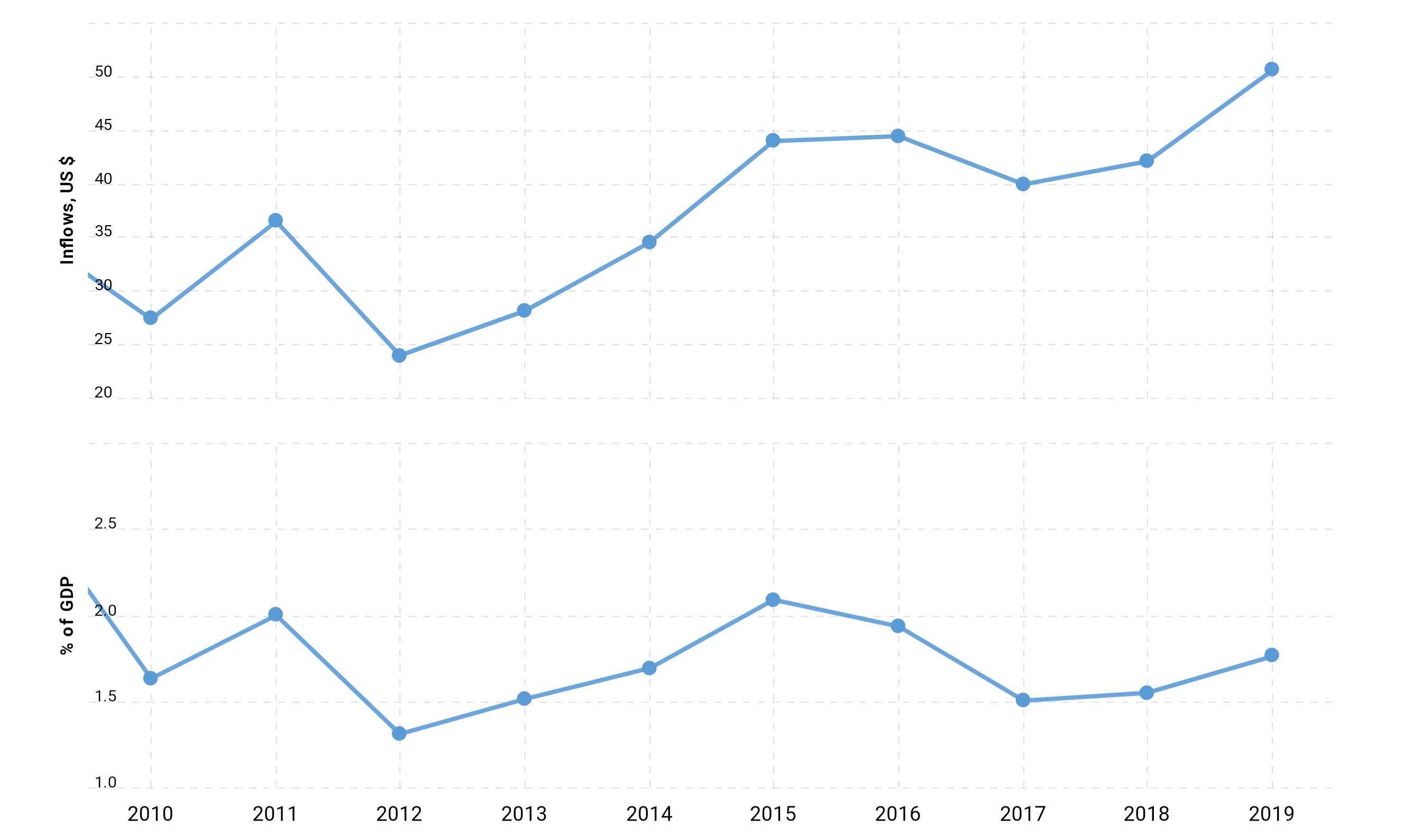
Flow of FDI in India over the years (2010-2019)

From the graph it is visible that the FDI inflows from 2010-2019 kept varying year after year.

โ€ข Indiaโ€™s Foreign Direct Investment (FDI) for 2019 was $50.61 billion, a 20.17% increase from 2018.
โ€ข Indiaโ€™s Foreign Direct Investment (FDI) for 2018 was $42.12 billion, a 5.38% increase from 2017.
โ€ข Indiaโ€™s Foreign Direct Investment (FDI) for 2017 was $39.97 billion, a 10.01% decline from 2016.
โ€ข Indiaโ€™s Foreign Direct Investment (FDI) for 2016 was $44.46 billion, a 1.02% increase from 2015.

Conclusion

FDI flow into an economy benefits the economy in terms of investment capital, technology transfer, management skills, and job creation. It also improves the standard of living of the people and encourages domestic firms to improve themselves in product specialization and have the ability to withstand competition from other firms.
We have seen in the report that in many sectors flow of FDI has increased over the period of time, but there are still some sectors in which 100% FDI is not allowed. We saw the performance of various sectors over the years. In recent years, FDI inflows have increased in the Education, Non-Conventional Energy, Hospital and Diagnostics sectors. Like them many other sectors are also performing very well. However, Hotel and Tourism, Construction, Drugs and Pharmaceuticals are among the sectors receiving inconsistent FDIs annually.
We also saw a consistent increase in annual FDI inflows over the decades. This was only possible because of the measures taken by the government on the fronts of FDI policy reforms, investment facilitation and ease of doing business have resulted in increased FDI inflows into the country over the years due to which India is getting very high FDI inflows as compared to previous years and we hope the same to continue for a long period of time.
FDI is not only an alternative to domestic investment, but can also improve the host countryโ€™s balance of payments. It is one of the major stimuli to economic development of the developing countries, like India.

India’s Vaccine Shortage

India’s Vaccine Shortage

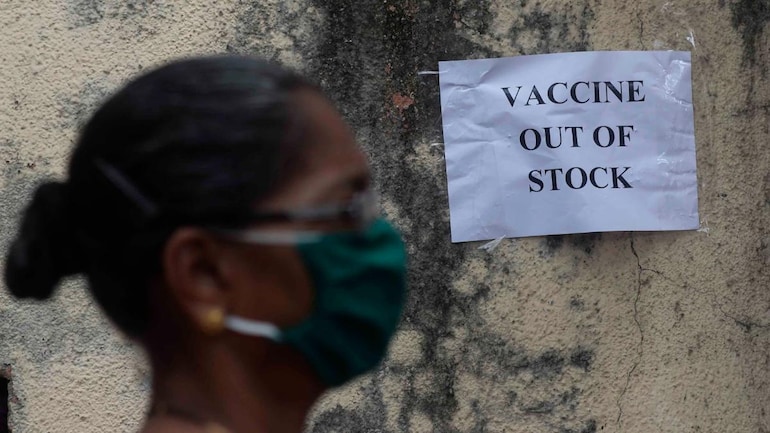
India’s Prime Minister announced ‘Teeka Utsav’ to promote covid-vaccination as well as to counter the second wave of infection. But on the contrary vaccinations have been declining afterwards.

Experts believe that herd immunity stage needs to be achieved to counter the spread of any infection i.e., more than 70 per cent of the population needs to be vaccinated. According to some studies, it can take almost 16 months to vaccinate 70 per cent of India’s population with first dose and almost 9 years to vaccinate them with both first and second doses.

A popular science journal and the Indian Medical Association itself has criticized India’s vaccination program. India, popular as ‘Vaccine factory of the world’ has been running short of vaccine supply which ultimately led to a situation where many Indian states are unable to achieve their vaccination targets. Odisha had to shut 60 per cent of it’s vaccination centers due to shortage of vaccines in the month of May.

As people are unable to find vaccines at their nearest centers, they are going to other cities to get vaccinated. For example some people residing at Gurgaon had to go to Manesar whereas some Delhites are going to Rohtak and residents of Rohtak are visiting villages to get vaccinated. Thus villagers have complained of not having enough vaccines left for the residents.


Causes

The first reason of the shortage is the insufficient capacity of the manufacturers. According to the targets of the central government of India, almost 10 crore doses of vaccines need to be manufactured every month but the current capacity of the manufacturing companies combined together lies at 7.5 crores which would increase to 11 crores by July. Another fact to be kept in mind is Serum Institute manufactured vaccines are not solely for the Indian population. SII needs to supply 40 per cent of its vaccines to Covax which is an initiative of several organizations including WHO to supply vaccines to more than 90 economically backward countries.

Sputnik V, the Russian vaccine approved by India can’t really help either as the manufacturer’s capacity lies at 500k only. However the initiative to manufacture Sputnik V in India might prove helpful.

Another reason is the lack of orders by the Indian government to the manufacturers. Under Operation Warp Speed the USA placed advanced orders with many vaccine companies even before their vaccines were approved and even though some vaccines didn’t get approved still USA had guaranteed supplies of vaccines for its population. Whereas the Indian government did not place any such advanced orders. Reasons behind this might be the lack of funds to place advanced orders. Poonawala from SII said in an interview that they couldn’t improve their capacities as there were no orders from the government of India. The statement was justified afterwards but if there lies truth in such statement, its the failure of the government of India. Another reason of not placing advanced orders might be the assumption that the infection was over at the end of the first wave of infection.

Under ‘Vaccine Maitri’ program India exported large quantities of vaccines to other countries. From January to April 2021 more vaccine doses were exported than vaccinated Indian residents.

First order placed for vaccines by the Indian government was 1.65 crore doses in the month of January 2021 and 1.5 crore doses in February. The government of India placed the first huge order of 12 crore doses in March 2021 when the country was already struck by the second wave of infection.

Adar Poonawala of SII said the vaccine shortage may go on till July 2021. Several experts have also warned about third and fourth wave of infection in the country as the infection continues to spread within the population alongside the slow vaccination.

The situation got even more complicated when the central government ordered states to arrange vaccine supplies for themselves. Many states released global tenders. Many companies whereas were not ready to deal only with central governments of countries. The chaos was ended with the central government of India announcing vaccinations free of cost for all its adult population and supplies being sent to states by the center after Supreme Court intervened the matter.


Possible Solutions

  1. Government may help the manufacturers with funds and supplies to increase their capacity. Other new manufacturers may also be looked forward to maximize the vaccine production.
  2. We should also start preparing for upcoming challenges of the pandemic. In the current situation the problem may lie with vaccine supplies but soon when the supplies would be sufficient the awareness about vaccines would prove to be the main issue.

For example many rural residents of Tamil Nadu are reluctant to vaccines after a famous actor Vivek died following inoculation. And if such problems prevail for longer, herd immunity stage would be harder to achieve.

3. As epidemiologist Giridhara Babu said the authorities should go for detailed district plans and social mobilization strategies to reach vulnerable communities.

Mumbai is in Trouble

Mumbai is in a huge trouble . The reason is that the governance of the financial capital of the country is in wrong hands . It is a great matter of sorrow and a matter which needs our attention . We have to choose our leader properly and be unbiased which choosing the leader . This is the need of the hour . The video of a car drowning in a hole was seen and went viral . The authority lies in our hands .

Dogs

Dogs are the most faithful animal on this planet . If you want a friend buy a dog , if you are bored buy a dog , if you want a partner that will never leave you buy a dog . But the deal is buy aย  dog only if you can afford their medicines , their food . There is no need of buying a dog when you cannot afford its well being . I see a lot of people whose dogs suffer from hunger and diseases . This is wrong as well as a serious concern which needs our attention .

Sir Jadeja The Key Player

Sir Jadeja who is probably the best all rounder in the world can be a great match winner in the World Test Championship . He can take wickets at crucial time , is currently one of the best fielder in the world ( May be the best ). And can score runs when the team is in need the most . What he has done recently ? He single handedly destroyed the mighty RCB . He scored an astonishing half century against the mighty New Zealandย  in the Semi Finals against The mighty New Zealand . He scored more than 36 runs in an over against the most wicket taking bowler of the IPL 2021 Harshal Patel . It does not matter how fast you are but you cannot steal runs if the ball is in the hands of Sir Jadeja . There is a reason why even the best players in the world bow down in front of him and even MS Dhoni calls him Sir Jadeja . When nothing goes in your way call him and boy he will deliver every time the team is in need .

Rishab Pant ” The New Dhoni “

Well Well Well How can this guy compare the Great MS Dhoni with this young lad ? What he has done in such a short span of time is really credible and deserves appreciation . He single handedly defeated The Mighty Australia and brought it on its knees . Not just one test but also scored massive runs against England The Best T20 team in the world . These are signs that Indian Cricket is in safe hands for the upcoming years . He is still is great form as he scored a century in the practice match which is a great sign . He can be the key key if India is able to defeat the Mighty New Zealand team in the World Test Championship . He is most probably in the best form of his entire career .ย ย 

SELF RELIANT INDIA

INTRODUCTION

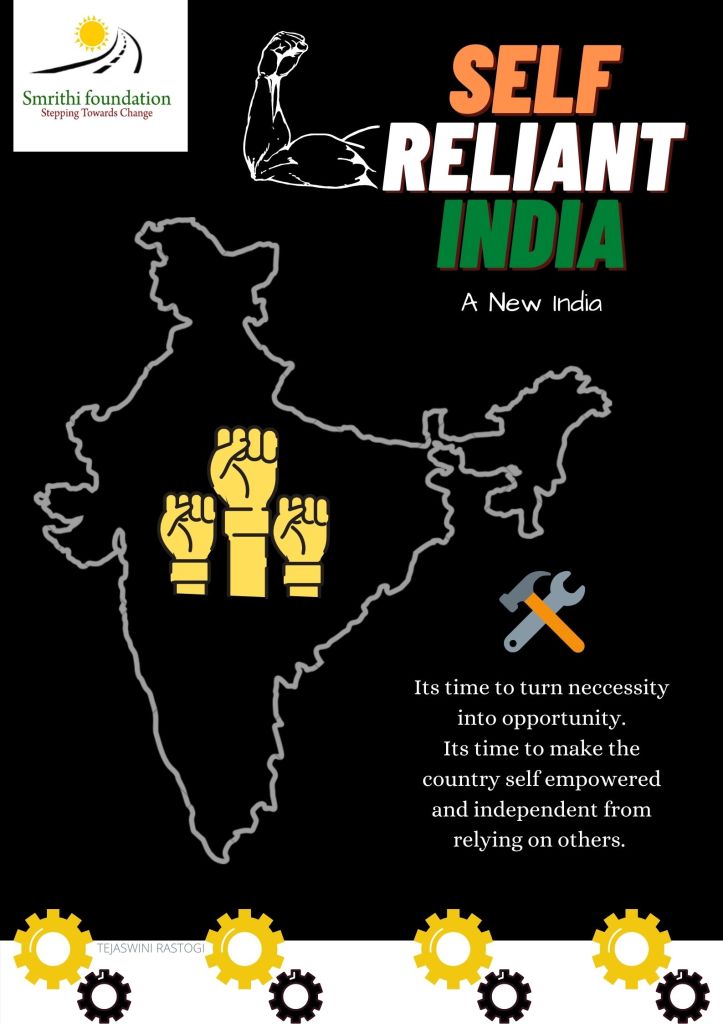
As the covid 19 pandemic affected the whole world including India, Narendra Modi the prime minister of India has addressed the nation with the necessity of being Self-reliant. He emphasized that self-reliance was need of the hour. Modi coined the term on 12 May, 2020 in his address to nation with regard to the covid 19 pandemic. His focus was mainly on the absence of domestic production and that there is a need to improve the quality and supply of domestic production. Thus, he started the wave of Atma Nirbhar Abhiyaan (Self Reliant India Movement). In the long term race, this decision is seen as a very beneficial one but for a short term, it can be a slight pain for the country. The difficulties arise as the nation aims to boycott economic relations with China, when India imports $75 billion worth of goods every year from there. The mission has already taken pace with banning 59 apps from Chinese developers. But it doesnโ€™t just stop here; the centre has put 250 more applications under watch. The relations between the nations are sour since the Galwan Valley skirmish on 15 June, 2020 in which 20 brave soldiers sacrificed their lives. Many are of the view that the movement is a repackaged version of the Make in India launched by the Modi government in 2014.

The concept of being a self reliant nation does not mean that India will cut ties from rest of the world, says the Finance minister. โ€˜It doesnโ€™t mean isolating away from the world but playing a bigger role on the global economy.โ€™ says Ravi Shankar Prasad, the Law and IT minister.

WHAT DOES SELF RELIANT MEAN?

Self reliant India indicates the need to recognize the value of production at domestic level. The concept might seem similar to make in India but it has a vast horizon. It includes the slogan Vocal for Local which refers to be more attracted to local products. India is a developing country but there are many things which India lacks, like it has the second largest market for smartphones but produces a very little amount of the same. The movement aims to make India a bigger and more essential part of the economy. This is a great opportunity, especially after a brutal pandemic which left the people helpless. It will boost the economy and would help the country to reach new heights of development. The move has special importance as America a home to many companies seeks to shift business out of China, India can become home to Industries and MNCs. Many states have also eased the labour laws in order to give companies an exemption from them and attract investments. The prime minister also announced an economic package of Rs. 20 lakh crores focusing on cottage industries, MSMEs labourers, middle class and industries among others. Package of amount Rs. 20 lakh crores amounts to 10% of Indiaโ€™s GDP.

PMโ€™s 5 PILLARS OF ATMA NIRBHAR BHARAT

Modi has introduced 5 pillars to Atma Nirbhar Bharat, they are; Economy, Infrastructure, System, Demography and Demand. He focused on essence of local markets and supply. In the pandemic phase, the import and export of major supplies is not possible and so it is an important time for India to utilize this opportunity for the benefit of Nation. Modi has asked the nation turn this crisis into opportunity, giving an example of domestic production of PPE kits and N-95 masks. He believes that the vision of India of turning crisis into opportunity will be equally effective for our resolution of self-reliant India. He also explained that the decision is not self centered but will improve the dynamic performance of India before the world, โ€œThe culture and tradition of India speaks of self-reliance and the soul is Vasudhaiva Kutumbakam. India does not advocate self-centric arrangements when it comes to self-reliance. India’s self-reliance is ingrained in the happiness, cooperation and peace of the world.โ€

Initiatives regarding Atmanirbhar Bharat:

  • India’s personal protective equipment (PPE) sector grew from zero before March, to around 1, 50,000 pieces a day by May. It is considered an inspiring example of a self-reliant India. The PPE industry of India became worth โ‚น7,000 crore (US$980 million) in two months, the second largest after industry in China.
  • IIT Alumni Council setup the largest fund in the country worth โ‚น21,000 crore (US$2.9 billion) with the aim of supporting the mission towards self-reliance.
  • Reliance Jio announced the India’s own ‘Made in India’ 5G networks in July 2020. Mukesh Ambani announced in mid-July “Jio has created a complete 5G solution from scratch that will enable us to launch a world-class 5G service in India, using 100 per cent homegrown technologies and solutions”.
  • For the first time, it was announced that Apple would manufacturer one of their premium I-Phone models in India itself in July 2020, Chinese media also debunked misinformation related to Apple entirely shifting out of China.

CONCLUSION

Even in the phase of a virus outbreak, India cannot stop building itself. A crisis led to the birth of a new opportunity to India. This will not only help the country but the citizens to grow by reducing unemployment and poverty. It will help the health sector, agriculture sector, infrastructure and many more to grow and reach the world. The road to the same will not be easy but still with full determination the country can achieve its aim to become self reliant. After a total shutdown of the economy, a revival of the same is important and can be achieved by growing even more. The government hopes for the better and have set an aim of gasification of 100 million tons of coal by 2030 with an investment of Rs 20,000 crore. This will help our country to reach a new level in the world economy. This cannot be only fulfilled by the government but requires a great role of the citizens.

Hockey vs. Cricket

Hockey is the national sport of our country India . Still people love to watch Cricketย  far more than cricket . Hence the cricketers are paid 10 times more than even the highest paidย  hockey players . Even the highest paid sports are cricketers . So Cricket should be declared the National Sport of our country India . The importance that the game Hockey deserves is not given to it . So we should not only watch Cricket but also watch Hockey and other sports . That is all we can do on our part . We can not do more than this .

Sports

Sports are an integral part of ones life . It is rightly said that ” All work and no play makes Jack a dull boy “. These cannot be excluded from our lives . But during the Covid 19 pandemic we are not able to play outdoor games .ย  We all are scared to go outside our homes . So what we do is that during our free time we play online games like PUBG , Free fire , FIFA , Call Of Dutyย  etc . So that is what we can do before every thing becomes normal .

Sunil Chhetri

Sunil Chhetri , the captain of the Indian Football team never ever fails to deliver and scores goals when his team is in need the most . The Indian footballer did it again by scoring two goals against Bangladesh which enabled India to win that match . He also recently broke the World record of Messi and became the second highest International goal scorer in the game . This guy is taking Indian football to next limits . Hope he play more number of matches before his retirement .ย 

India vs New Zealand

The World test Championship is about to get started in just 9 days . And our wait is to get over very soon . Lets see who will will this time . The good news for India is that the New Zealand Captain has been ruled out from England Test Championship . But they still have Devon Conway the batsman with an astonishing debut . Lets see if Virat Kohli can win at least one ICC Championship in his entire career or not . Pant will be the key player for the Indian side .ย 

Poverty

Poverty refers to a situation in which a person remain underprivileged from the basic necessities of life. In addition, the person does not have an inadequate supply of food, shelter, and clothes. In India, most of the people who are suffering from poverty cannot afford to pay for a single meal a day.ย Also, they sleep on the roadside; wear dirty old clothes. In addition, they do not get proper healthy and nutritious food, neither medicine nor any other necessary thing.

The rate of poverty in India is increasing because of the increase in the urban population. The rural people are migrating to cities to find better employment. Most of these people find an underpaid job or an activity that pays only for their food. Most importantly, around crores of urban people are below the poverty line and many of the people are on the borderline of poverty.

Furthermore, there are many reasons that we can say are the major cause of poverty in India. These causes include corruption, growing population, poor agriculture,the wide gap of rich and poor, old customs, illiteracy, unemployment and few more.

the rich are growing richer and the poor are getting poorer creating an economic gap that is difficult to fill up.

Poverty has various effects that include illiteracy, reduced nutrition and diet, poor housing, child labor, unemployment, poor hygiene and lifestyle, and feminization of poverty, etc. Besides, this poor people cannot afford a healthy and balanced diet, nice clothes, proper education, a stable and clean house, etc. because all these facilities require money and they donโ€™t even have money to feed two meals a day then how can they afford to pay for these facilities.

illiterate people should be given the required training so that they can live a better life. To check the rising population, family planning should be followed, providing proper facilities to farmers.

Besides, measures should be taken to end corruption, so that we can deal with the gap between rich and poor.

it is necessary for us to act quickly and correctly. Poverty is a major problem in the World and it have to be solved on a serious note. Our government is taking a large number of steps to reduce poverty. Eradication of poverty would ensure a sustainable and inclusive growth of economy and society. We all should do our best to help alleviate poverty from our country.

Corruption:Big issue

Corruption can be found everywhere: corporate, government, courts, media, and civil society, as well as in all sectors, from health and education, infrastructure, and sports.

Corruption can affect all of the politicians, government officials, civil servants, business people, and members of the general public.
Political corruption, all of the bad in India. It is the main cause of concern is that corruption is weakening the political body and damaging the special importance of the society’s management team. Currently, the policy is only intended to be used for the criminals, and the criminals should be in the policy.

The punishment for corruption:

The prevention of Corruption Act, the Public Servants Act of 1988, or the Impact of the civil Servants Act be punishable by imprisonment of a minimum of six months and a maximum fine of five years of age and over.

Causes of Corruption in India
โ€ข * None Of The Instructions And Timely Punishment
* The lack of unity in the community
* Insufficient knowledge of the fundamental rights of the
* Lack of transparency in the activities and operations of the
โ€ข Lack of accommodations
* The lack of adequate education, and the justice system
* Unhealthy Relationships, in order to Encourage competition, India
* A lack of effective management and implementation of the
* The Lack Of Financial Stability, And India
* Lack of effective leadership

The treatment of corruption in the country

please call for Political parties under the RTI
To Create A Right To Take Part In The Indian Politics
Improving the information technology and E-government
A Transparent tax system with a clean and clear execution
Reforms in the police department, and the full force of the Justice system
The list of corrupt businessmen
More Than Insight Into The Number Of Government Jobs
To keep inflation at a low level
Speed up your decision-making, and to increase the number of courts

Casual racism in India

Racism against Indians living in the northeastern region has been increasing day by day and is an issue of concern. States like Assam, Nagaland, Mizoram, and others surrounding it are the main ones to be part of the northeast.

 Recently, a Youtuber even got arrested for allegedly โ€œdefamingโ€ the people of Andhra Pradesh and accusing them of being Chinese. While this was a good step and start, we are all aware of how casually the people of northeast India are called slangs like โ€œCh*nkiโ€, โ€œmomoโ€ etc. and no action is taken against them because it is so very engraved in our society now, that practicing this is not an offense. We must not forget how many spectacular pieces of art the north Indian part has contributed to India and continues to do so even now.

The simple answer to this is- The mentality. Itโ€™s not a big revelation that casual racism is not faced only by the northeastern people but by all the people belonging to different and seemingly “unconventional” parts of India. It comes out that our Indian society likes to put people into boxes and parts according to their skin color and way of living.

When I look around myself, I usually have this realization that most people are not even aware of the fact that using slangs and treating them differently is, in fact, wrong, which pilots us to our first point –

  1. Awareness- This is the most obvious but crucial point. People need to know that THIS is wrong in the first place. And I know that it is better said than done, but, at this point of time, even the so-called “progressive youth” of India is simply not ready to take up this topic into talks. “Black lives matter” was in the news rigorously for so long, as it should have been. But in my opinion, we should focus on making things right in our country first.
  2. Better representation in the media and government- This is absolutely no diversity when it comes to people from differing communities being recruited in the mainstream media and the parliament. This will even be a catalyst in achieving a society and country where decisions are made equally in the favor of all communities.
  3. Highlighting the achievements- The media plays a very big role in this one. We need to show our people that people from the northeast contribute a lot to the potency of India as a country.
  4. Better job opportunities and laws for all Although it’s nice to see that small steps have started to be taken by our government now, we all know that we still have a very long way to go to attain utter equality in all the fields.
  5. Speaking up -This point is valid for any kind of prejudice you witness in your life and can make the biggest change ever. Don’t be a standbyer when someone is being mistreated in this world because hashtags can’t save the world, only we can.

Ultimately, We are the change that we seek in this world.

Today, China is trying its best to gradually break India apart and snatch it’s parts little by little. And will Indians be able to survive this if they make it easier for China to tear us apart by disintegrating themselves on the basis of their race and language and whatnot? I wish I could say ‘yes’ to this question right now.

MY HEART: MY INDIA

India:

India is not just a country its the heart of more than 13 cr.peoples. India is a country in South Asia It is the most populous country,The seventh largest country by land and area and ofcourse The most populous democracy in the world.

Indiaโ€™s GDP in 2019 was (2.87)lakh cr.
Indiaโ€™s history is very popular in the world.

Surprising facts about india:
โ€ข The first ever rocket launched from India.
โ€ข India introduced shampoo to the world.
โ€ข India was the first country to mine diamonds.
โ€ข India Has 22 recognised languages.

Speciality About India:
โ€ข There is a village in India โ€œshaniโ€ in singapore Famous for not having Doors and locks on any house in 400 years.
โ€ข India is also popular for the โ€œBollywoodโ€.
โ€ข India is very famous for the classical dance and classical music.

Indiaโ€™s famous things:
โ€ข Indian culture,
โ€ข Indian food varieties and indian street food,
โ€ข Indian clothes,
โ€ข Indian jewelery,
โ€ข Indian language,
โ€ข Indian monuments,
โ€ข Indian spices,
โ€ข Indian ayurvedic medicines,
โ€ข Indian festivals,
โ€ข Indian universities,
โ€ข Different regions,
โ€ข Indian meditation.

One indian philosophy is very famous and that is โ€œAtithi Devo Bhavaโ€
Which means the guest is equal to god.

Foreign tourists visit indiaย  for heritage tourism, ecotourism, adventure tourism, cultural tourism, medical tourism and business tourism.

More than 10 million foreign tourists visit india every year.


INDIA’S CRIPPLING TROPICAL FORESTS EPITOMIZE CARBON SINKS

By the year 2050, the world’s tropical forest supply may be severely depleted. Scientists expect that by 2050, sea levels will have risen to the point where most major cities will be flooded. In the last two decades, neglecting our biodiversity has resulted in four disease outbreaks. Can the human race afford another global epidemic that makes it impossible to breathe?

Carbon sinks are natural processes that absorb and store carbon dioxide from the atmosphere; the oceans and forests are the two largest carbon sinks on the planet. Oceans are the world’s main carbon sinks. Plants and soil are the two carbon sinks found in forests. Plants absorb carbon dioxide from the atmosphere for photosynthesis, and some carbon dioxide is released by the soil as plants die and decompose. In the event of a forest fire, forests will change from carbon sink to carbon source. If forests remain intact, with no leakages such as erosion and deforestation, this trade-off between sink and source can be balanced. Forests’ ability to function as a carbon sink or source is dependent on the balance of photosynthesis and respiration. If you believe it or not, forest soil has sequestered a significant amount of carbon.

When a tree dies and the microbes finish the decomposition process, some of the accumulated carbon is released back into the atmosphere. This method does not result in the complete loss of carbon. A sizable portion of it has remained in the soil. A large area of forest is an excellent example of a carbon sink. โ€œBasically half of the carbon dioxide emissions are consumed by the Earth’s land and ocean,โ€ says Paul Fraser of the Commonwealth Scientific and Research Organization.

The titan Amazon basin, which predominantly serves as the largest carbon sink of all of the forests, and benefits us by generating over 20% of the total oxygen production for the earth, is an example of the world’s largest tropical forest, holding up to 40 thousand plant species, 2.5 million insect species, and a myriad variety of wildlife. The Amazon is used to demonstrate how tropical forests can function as a carbon sink. โ€œWe have already lost 20% of the Amazon in 2019, and scientists worry that if we lose yet another 5%, the Amazon will hit its tipping point,โ€ says Mike Barrett, WWF Director of Science and Conservation.

India is ranked 9th among the world’s megadiverse countries, with nearly 40,000 plant species and 90,000 animal species living through diverse geographical environments in all four directions. The Northeast (NE), once one of India’s greenest areas, has been slowly losing forest cover for the past 20 years.

According to data mapped by the Global Forest Watch, a repository for global forest data, the rate has doubled. According to a report published by the Deccan Herald in 2018, over 70 percent of the forest cover in the Northeastern states was lost due to deforestation between 2001 and 2018. Infrastructure is essential for the economy, but not at the expense of our aid recipients. The Northeast has been facing a significant threat to its forests for the past two decades as a result of deforestation for coal mining, cement manufacturing, and illegal logging. Deforestation has already wreaked havoc on the Garo Hills of Meghalaya and the Karbi Anglong Hills of Assam. As a result of the Etalin Hydroelectricity Project, the Dibang valley in Arunachal Pradesh is on the verge of losing 2.7 lakh trees. The Northeast is already feeling the heat of forest depletion, with some states experiencing the highest temperature increase in the last two decades. In Karnataka, a similar incident occurred when the long-delayed Hubballi-Ankola railway line was finally approved. This 164-kilometer railway line would cut through the Kali Tiger Reserve and the Bedti Conservation Reserve, destroying more than 80% of the forest cover in the Western Ghats, one of India’s most ecologically sensitive areas. There are fears that the Bannerghatta National Park, which is located in the ESZ (eco-sensitive zone), Bangalore’s only remaining lung space, would lose about 100 square kilometres. The loss of trees would increase carbon emissions, and these forests are home to more than 250 species of plants, birds, animals, and insects that are listed on the IUCN Red List of Threatened Species and protected by the Wildlife Protection Act of 197.

Mining and various agricultural and commercial growth projects in India generate at least 1,000 million tonnes of carbon. With the pace at which trees are being cut down, India will experience many stages of ecological cancer. India’s average reported temperature has already increased. Even Antarctica experienced the hottest temperature increase in 141 years, not to mention the July 2019 Heat Wave. According to the World Bank, nearly 1.3 million sq/km of land cover was destroyed between 1990 and 2016, an area greater than South Africa. What are the warning signs if these aren’t them? Tropical woods, unlike the Notre Dame Cathedral, cannot be rebuilt.

As a result, I implore everyone to take responsibility for raising consciousness about these issues and not allowing them to go unnoticed. Begin to shoulder some of the world’s responsibilities. It has been far too long since we have felt a sense of awe for the natural world. In this sense, President John F. Kennedy said, “If not us, who?” When, if not now, would it be?โ€

India’s Favorite Beverage – Chai

Every Indian household has one thing in common – a tea in the morning, a tea in the evening. But how much do we know about our Chai ?

Origin of Tea

Tea was first drunk in China as far back as 2700 B.C.! In fact words such as tea, โ€˜chaiโ€™ and โ€˜chiniโ€™ are from Chinese. There are various legends about the origin of Tea. There is one about the Chinese emperor Shen Nung who always boiled water before drinking it. One day a few leaves of the twigs burning under the pot fell into the water giving it a delicious flavour. It is said they were tea leaves. There is also an Indian legend about the origin of tea. Bodhidharma, an ancient Buddhist ascetic, cut off his eyelids because he felt sleepy during meditations. Ten tea plants grew out of the eyelids. The leaves of these plants when put in hot water and drunk banished sleep.

Masala Chai

Masala Chai originated in India. In India, many herbs and spices are added to the tea. Each family has their own version of making tea. It is a tea beverage made by boiling black tea in milk and water with a mixture of aromatic herbs and spices. Tea plants have grown wild in the Assam region since antiquity, but historically, Indians viewed tea as an herbal medicine rather than as a recreational beverage.

In the 1830s, the East India Company became concerned about the Chinese monopoly on tea, which constituted most of its trade and supported the enormous consumption of tea in Great Britain. Then, british colonists noticed the existence of the Assamese tea plants, and began to cultivate tea plantations locally. However, consumption of black tea within India remained low until the promotional campaign by the Indian Tea Association in the early 20th century, which encouraged factories, mines, and textile mills to provide tea breaks for their workers. It also supported many independent chaiwalas throughout the growing railway system. The official promotion of tea was as served in the Indian mode, with small added amounts of milk and sugar.

Indian varieties of Tea

  • Masala chai – It is the most popular beverage in India
  • Noon chai – The pink tea is a traditional tea beverage from Kashmir and also served in many parts of Rajasthan and Nepal.
  • Green tea – it has been used in Ayurveda and it has also become a part of the modern India lifestyle.
  • Black tea – Black Tea is stronger in flavour and produced by all tea producing regions of India. Large leaved Assamese plants are mainly used for black tea.
  • White tea – White Tea harvested in India, Sri Lanka and China, Itโ€™s one of the styles of tea made from the buds and immature tea leaves.
  • Herbal tea – Herbal Tea made from hot water and served hot with varieties of plant material such as hibiscus, rose, etc.
  • Iced tea – It is a common drink in India, mostly available as ginger lemon iced tea or lemon iced tea. Lipton and Nestle brand of tea are two most popular brands of iced tea in India.
  • Irani chai – Irani Chai are masala chai with some spices and a popular quick weekend breakfast.
  • Tandoori chai – It is made in tandoor where clay pots also known as kullhads are preheated in tandoor and again served in fresh and clean kulhads.

Indians and their Chai can never be separated from one another. Now,  I am also going to drink a refreshing cup of chai with tasty and crispy pakoras.

Indian Army Day

When people think about heroes of India, they only and only remember the Indian Army. Let us celebrate Indian Army Day by saluting all the army men and women for their bravery, dedication and patriotism.

Army Day is celebrated on 15 January every year in India, in recognition of Field Marshal Kodandera M. Cariappa taking over as the first Commander-in-Chief of the Indian Army from General Sir Francis Butcher, the last British Commander-in-Chief of India, on 15 January 1949. Today, India will celebrate its 73rd Indian Army Day. The day is celebrated in the form of parades and other military shows in the national capital New Delhi as well as in all headquarters. Army Day marks a day to salute the valiant soldiers who sacrificed their lives to protect the country and its citizens. Army Day strives to motivate people to build a great Nation by knowing about how an Army officer provides his/her full life for the betterment and safety of the people. While celebrations take place across the country, the main Army Day parade is conducted in Cariappa Parade ground in Delhi cantonment. Gallantry awards and Sena medals are also awarded on this day.

K. M. Cariappa

Kodandera Madappa Cariappa was the first Indian Commander-in-Chief of the Indian Army. He led Indian forces on the Western Front during the Indo-Pakistani War of 1947. He was appointed Commander-in-Chief of the Indian Army in 1949. He is one of only two Indian Army officers to hold the Five-star rank of Field Marshal; the other being Field Marshal Sam Manekshaw.

His distinguished military career spanned almost three decades. Born on 28 January 1898, in Madikeri, Kodagu, Cariappa joined the British Indian Army shortly after the end of World War I. He was transferred between multiple regiments early in his career before settling on 1/7 Rajputs, which became his permanent regiment. He was the first Indian military officer to attend the Staff College, Quetta, the first Indian to command a battalion. Several measures taken by Cariappa, such as his refusal to induct former Indian National Army personnel into the Army, kept the organisation out of political affairs and maintained its autonomy.  He died in his sleep on 15 May 1993. India remembers him as a true patriot and a son of the country. 

The primary mission of the Indian Army is to ensure national security and national unity, to defend the nation from external aggression and internal threats, and to maintain peace and security within its borders. It conducts humanitarian rescue operations during natural calamities and other disturbances. The army comprises more than 80% of the country’s active defence personnel. It is the largest standing army in the world, with 12,37,117 active troops and 9,60,000 reserve troops. In 1992, the Indian Army began inducting women officers in non-medical roles. In 2014, India’s army had 3 per cent women and in 2015, India opened new combat air force roles for women as fighter pilots, adding to their role as helicopter pilots in the Indian Air Force. We all have love, respect and admiration for our soldiers and the Indian army as a whole.

Happy Indian Army Day!

Eco Friendly Tourism

It is often seen that tourist spots are very dirty, plastic bags and packets are thrown everywhere. In short, tourism is polluting the environment. We can stop this by promoting eco-friendly tourism. Here are three such types of tourism.

Eco Tourism

Ecotourism is defined as โ€œresponsible travel to natural areas that conserves the environment, sustains the well-being of the local people, and involves interpretation and educationโ€ (TIES, 2015).ย Ecotourism is about uniting conservation, communities, and sustainable travel.

This means that those who implement, participate in and market ecotourism activities should adopt the following ecotourism principles:

  • Minimize physical, social, behavioral, and psychological impacts.
  • Build environmental and cultural awareness and respect.
  • Provide positive experiences for both visitors and hosts.
  • Provide direct financial benefits for conservation.
  • Generate financial benefits for both local people and private industry.
  • Deliver memorable interpretative experiences to visitors that help raise sensitivity to host countriesโ€™ political, environmental, and social climates.
  • Design, construct and operate low-impact facilities.
  • Recognize the rights and spiritual beliefs of the Indigenous People in your community and work in partnership with them to create empowerment.

Some Eco tourism places in India are –

  1. Coorg, Karnataka
  2. Munnar, Kerala
  3. Kodaikanal, Tamil Nadu
  4. Jim Corbett National Park, Uttarakhand
  5. Kaziranga National Park, Assam

Sustainable Tourism

The World Tourism Organization defines sustainable tourism in the following manner: โ€œSustainable tourism development meets the needs of present tourists and host regions while protecting and enhancing opportunities for the future. It is envisaged as leading to management of all resources in such a way that economic, social and aesthetic needs can be fulfilled while maintaining cultural integrity, essential ecological processes, biological diversity, and life support systems.โ€

According to The World Tourism Organization (WTO), sustainable tourism should:

  •  Make optimal use of environmental resources that constitute a key element in tourism development, maintaining essential ecological processes and helping to conserve natural heritage and biodiversity.
  •  Respect the socio-cultural authenticity of host communities, conserve their built and living cultural heritage and traditional values, and contribute to inter-cultural understanding and tolerance.
  • Ensure viable, long-term economic operations, providing socio-economic benefits to all stakeholders that are fairly distributed including stable employment and income-earning opportunities and social services to host communities, and contributing to poverty alleviation.

Some companies that promotes sustainable tourism in India are –ย 

  1. Kipepeo
  2. Evolve Back
  3. Spiti Ecosphere
  4. India Untravelled
  5. Green People

Geo Tourism

Geotourism is defined as tourism that sustains or enhances the distinctive geographical character of a place – its environment, heritage, aesthetics, culture, and the well-being of its residents.

Principles of geo tourism are –ย 

  • Integrity of place: Enhance geographical character by developing and improving it in ways distinctive to the local, reflective of its natural and cultural heritage.
  • Market diversity: Encourage a full range of appropriate food and lodging facilities
  • Community involvement: Base tourism on community resources to the extent possible, encouraging local small businesses and civic groups 
  • Protection and enhancement of destination appeal: Encourage businesses to sustain natural habitats, heritage sites, aesthetic appeal, and local culture. 
  • Land use: Anticipate development pressures and apply techniques to prevent undesired overdevelopment and degradation. 
  • Conservation of resources: Encourage businesses to minimize water pollution, solid waste, energy consumption, water usage, landscaping chemicals, and overly bright nighttime lighting. Advertise these measures in a way that attracts

Some geo tourism places in India are –

  1. Akal Fossil Wood Park, Jaisalmer
  2. Saketi, Sirmur District, Himachal Pradesh
  3. Peninsular Gneiss National Monument at Lalbagh, Bengaluru
  4. Columnar Basaltic Lava, Coconut Island (St. Mary’s Islands), Udupi District, Karnataka
  5. Ramgarh Crater, Baran district, Rajasthan.

National Youth Day

Youths are the future of our nation. Letโ€™s celebrate the national youth day by learning about the significance of this day and also learning about how the youth population contributes to our nation.

National youth day is celebrated every year on 12th of january to commemorate Swami  Vivekanandaโ€™s birthday. Youth all over the world are inspired by his teachings about life, success and learning. He is a perfect role model for each and every student of India. This day was first observed in 1985 throughout India. This day is celebrated in schools and colleges by organising various competitions, speeches, seminars, debates, essays, quizzes, etc. On this day the youth population, which is about one-fifth of Indiaโ€™s total population understand their importance in the country. They also learn about Swami Vivekanada and his life principles. During the coronavirus pandemic, it will be difficult for schools and colleges to  conduct these programmes and so I think that this article will embolden them and encourage them to spread their โ€˜Wings of Fireโ€™.

Swami Vivekananda was born on 12th january, 1863 in Calcutta, Bengal Presidency (present day- Kolkata, West Bengal). He was one of the greatest spiritual leaders in India. He introduced the concept Yoga and Vedanta in the western world. He was the student of Shree Ramakrishna Paramhansa. He travelled to the United States and represented India at the 1893 Parliament of the World’s Religions. He also conducted numerous public and private lectures and classes. He circulated Hinduism philosophies in Europe, Britain and the USA. โ€˜Karma Yogaโ€™ and โ€˜Raja Yogaโ€™ are some of his most celebrated publications. He worked for humanity and the betterment of our society.

The original uploader was Dziewa at English Wikipedia. – Transferred from en.wikipedia to Commons., Public Domain, https://commons.wikimedia.org/w/index.php?curid=4310553

What can the youth learn from Swami Vivekananda?

The teachings of Swami Vivekananda motivated the students to โ€œArise, awake, and stop not till the goal is reached.โ€ These teachings tell us about the uncommon and remarkable personality of Swami Vivekananda. These teachings are based on his life situations 

  1. Be honest to everyone. Lying is a good way to get away with your mistakes but only in the short run. A lie leads to a thousand more lies. On the other hand speaking the truth is always best. The blame will come on you but people will always believe you. Honesty is the best policy. 
  2. You should always stick with the truth. Often, many people will stop you from telling the truth. They may repress you by using force or blackmailing you. But even in such times you should remember that truth is the small lamp that lightens the world.
  3. To achieve success, focus on your goals. Many-a-times people ultimately give up on their dreams, this is because they don’t focus on their goals. We become successful only when we work hard on our goals.
  4. Swami Vivekananda also taught everyone to face all the problems with courage and never run away from them. Every problem in life teaches us something new. Running away never really solves your problems, it just makes the problems an invisible weight on you.

Swami Vivekananda was a great person. We should remember him and follow his teachings. 

Happy National Youth Day to you.

Olympiad Examinations In India

Olympiad exams are different from regular school examinations. Every student should participate in Olympiads but most parents and students do not know the importance of these examinations.

What are Olympiad Exams?

Olympiad exams are competitive exams conducted by various organizations across India and abroad. These examinations are conducted on the basis of the school curriculum of CBSE, ICSE, and other major state boards. These exams help to compare student’s performance with their peers across the country and also around the world. The question paper for these exams is objective-type with multiple-choice questions. There may be negative marking for wrong answers. There may be 50 to 100 questions in an examination and a strict time limit. Olympiad exams focus on concept-based learning and logical thinking. This in turn enhances the abilities of the student which is an important tool to face the future competition coming in their lives.

What is the importance of Olympiad Exams?

Olympiad exams evaluate the conceptual learning and strengthen the reasoning, analytical and problem solving skills of a student from an early age. This way the student becomes ready for the upcoming challenges of the competitive world. Many people feel that competition at such an early age will not be beneficial for students, but these examinations build a strong base for students. Hence it is necessary for a student to take part in these examinations. 

Main benefits of Olympiad exams

  • They are perfect to test a student’s conceptual understanding of the subject.
  • Improves the studentโ€™s problem solving ability and challenges them to think analytically.
  • Prepares them for future competitive exams by testing a studentโ€™s aptitude as well as the knowledge of a particular subject. 
  • Provides exposure to students at the national as well as international platforms.
  • Instills the quality of hard work in the students by pushing them to prepare hard for the exam and improve their result.
  • Studentsโ€™ performance in school is also improved as Olympiads sharpen their thinking and learning process which helps them to grasp the concepts taught in schools better.

Who conducts Olympiad exams?

There are independent private organizations who conduct the Olympiad Exams. Some of the major Olympiad Exam conducting bodies are as follows:

SOF (Science Olympiad Foundation), CREST Olympiads (Online Olympiad Exams), Unicus Olympiads (Summer Olympiad Exams), Educational Initiatives (ASSET), Indian Talent Olympiad, Humming Bird Education, Eduheal Foundation, Silver Zone Foundation, Unified Council

Almost all the Olympiads consider participation from school only. Only CREST Olympiads and NSTSE (organized by Unified Council) accept individual registrations.

Subjects 

Subjects in which these examinations are conducted:

Mathematics, Science, English, Cyber, General Knowledge, French, Reasoning and Spell Bee.

Preparation for Olympiad exams

Most of the Olympiad exams are conducted on the similar syllabus that is taught at school. No additional reference books are required for the preparation of these exams. But still, there are some special books and guides to prepare for Olympiads. Students are only required to be clear with all the concepts and basics. The questions asked in the Olympiad exams are quite different from what kids learn in the school. Questions are trickier and conceptual which require the students to have a wide thought process to solve the variety of problems based on logics and concepts. 

My Favorite Indian Dance Forms

Alan Watts once said โ€˜life’s a dance of energyโ€™. In the same way dance is also a way to express the energy of emotions and feelings. So here are my favourite dance forms.

Bihu Dance

By Rohan Gautam 002 – Own work, CC BY-SA 4.0, https://commons.wikimedia.org/w/index.php?curid=86530098

Bihu is a popular folk dance associated with the state of Assam in India and it is performed generally during the Bihu festival. It is generally performed during the springtime. The energetic dance steps and quick hand movements define the Bihu dance of Assam. A lot of vibrancy can be seen in the dance outfit of Bihu, the male performers of Bihu are dressed in dhotis and gamocha. The women who perform Bihu usually wear traditional Assamese attire for the performance. Women team up their outfits with gaudy and heavy jewelry and they also decorate their braids with pretty flowers that perfectly match the color of the dress worn by them.There are many instruments that are utilized during a Bihu performance namely a Dhol, Pepa, Taal, Toka, Xutuli, Gogona and Baanhi. Watching the Bihu dance is mesmerising, the music enchants the atmosphere while the women and men of Assam joyfully dance.

Samai Dance

https://udaipurblog.com/wp-content/uploads/2011/12/shilp331.jpg

The word samayi means brass. It is called Samai dance because men and women dance with brass lamps or deepak put on their heads. Samai dance is performed by people of Goa during Holi and Shigmo festival. During the Samai dance, the women wear bright and colourful sarees and men wear kurta with pajamas. The men have a head ribbon tied to their heads while taking part in the lamp dance. Women wear gajra in their hair along with other traditional jewelry such as bangles, bindi, earrings, nose pins, and necklaces.The brass lamp used in the Samayi dance is one foot long with burning wicks which dancers need to balance while dancing. Samayi dance consists of very slow dance movements as dancers need to balance lamps on their heads. Dancers dance to traditional folk songs while making exquisite movements.The main instruments used in samai dance are Harmonium, Shehnai, Ghumat, Samel, Surt, and Zanj.

Chhau Dance

The Chhau Dance is a popular form of tribal dance in India that also integrates elements of martial arts into its movements. It is generally performed in in the states of Odisha, West Bengal and Jharkhand.The dance form has three subtypes; namely Purulia Chhau, Mayurbanj Chhau and Seraikella Chhau, named differently because of the place of their origin.The dance developed a means to portray stories to the audience. The fables revolve around Ramayana and Mahabharata, Puranas and other India Literature with religious themes. Indian instruments – Dhol, Shehnai and Dhamsa make the recital come to life. The male dancers wear brightly colored dhotis with a matching kurta on top. A vast amount of costume jewelry is worn in the form of necklaces. Female dancers, or male dancers depicting female characters, are known to wear colorful sarees.The style and variety of the costume of the dancers largely depends on the characters being portrayed by them. The dancers also use different objects to display weapons. 

Role of Biodiversity and Agriculture in making of Atmanirbhar Bharat

While flipping pages of my Geography textbook, a fact caught my eye – two third of the population of India is engaged in agricultural activities. We are blessed to have diverse climatic conditions because of which we see a variety of flora and fauna, and grow so many veggies, fruits and other crops. But India still imports a lot of harvested produce from other countries.

Atmanirbhar Bharat

Atmanirbhar Bharat, which translates to ‘self-reliant India’ or ‘self-sufficient India’, is a policy formulated by Prime minister of India Narendra Modi for making India a bigger and more important part of the global economy. It was launched on 12 May 2020  during the announcement of India’s COVID-19 pandemic related economic package. Not only should products be ‘made in India’, but the promotion of those products should take place so as to make those products competitive.  We should appreciate our local products, if we don’t do this then our products will not get the opportunity to do better and will not get encouraged. The agriculture and biodiversity sector were also given a lot of importance in it. This scheme helps farmers by providing better financial help, good prices of crops and a lot of new schemes are introduced which will help to support farmers and other people who are dependent on the agricultural sector for their livelihood. The improvement in PDS (Public Distribution System) has also started. Sustainable fishing practices and organic farming practices are encouraged, beekeeping shelters are increased and Rs 1500 crore is specified for animal husbandry. Many medicinal herbs are to be grown by the shore of river Ganga. Minister of Chemicals and Fertilisers, D V Sadananda Goda, in September 2020, said that “India will be self-reliant in fertiliser production by 2023”. Three Farm Bills passed in September 2020 provide the legal framework to give the farmers the right to choose the price and people to whom they want to sell. Coir Udyami Yojana aims to develop the coir-related industryโ€™s sustainable development.

Role of Agriculture and Biodiversity

From my point of view, the making of New India does not mean cutting the forests to make big buildings, industries or exploiting the natural resources without limit. When I think about a new Bharat, I imagine a country with minimum degradation of natural resources while still sustaining the agricultural demand of our country. 

Important focus on agricultural exports should also be given so as to improve the quality of exports rather than just quantity, thereby fetching more price for the farmer. Exports of medicinal herbs and oils, agricultural produce and raw materials like cotton and jute will increase drastically; also aiding the economy. Correspondingly, many people will start to prefer Indian exported products.

Great biodiversity will help to maintain ecological balance for ecosystem stability and support ecotourism. We can use resources and conserve them due to eco-friendly practices in farming, fishing, etc. 

At school level, a new subject โ€“ Agriculture should be introduced with hands-on experience and interaction with farmers. This will inspire many students to study agriculture and forestry streams. 

I think that biodiversity and agricultural prosperity will highly assist in the making of New India. Our new Bharat will be more sustainable and more developed. India will promote eco friendly practices, biodiversity, organic farming, quality produce and build a strong economy. From a developing country, it will turn into a super-power.

India’s Great Comeback.


Comebacks are always special more so when you’ve back against the wall and no one expects you to fight back. Similar was the situation for Indian cricket team as they were demolished when Australian bowlers ran over them for just 36 runs lowest score for India ever. It infamously known as “Summer of 36” (because its summer season in Australia). To make situation worse Indian captain and superstar batsman Virat Kohli went on parental leave, ace pace bowler Mohammad Shami was ruled out due to fractured arm, another star batsman Rohit Sharma placed in mandatory quarantine for 14 days and Indian bowler Umesh Yadav injured during the second test match. Despite all the odds and challenges India defy the great odds to claim victory in second test match of the series by 8 wicket at MCG and level the series 1-1.

Day 1

The second test began with a lot of questions after all Indian team were demolished for just 36 and lost the first match of 4 match test series. This was evident when Indian team announced 4 changes including 2 debutant on the eve of 2nd test match to be played on Boxing Day at the MCG (Melbourne Cricket Ground). Mohammad Siraj for Mohammad Shami, Ravindra Jadeja for Virat Kohli, Shubman Gill for Prithvi Shaw and Rishabh Pant for Wriddhiman Shaha.

The first day of 2nd test match began with Australia winning the toss and opting to bat. An inspired Indian bowling unit, led by the menacing Jasprit Bumrah (4/56) Ravichandran Ashwin (3/35), steam-rolled Australia for a meagre 195. The debutant for India, Mohammed Siraj (2/40 in 15 overs) also repaid the faith shown in him. While Marnus Labuschagne (48) top-scored for Australia, Travis Head and Matthew Wade made 48 and 30 runs respectively.

India was 36 for one in its first innings in reply to Australia’s 195-10 at stumps on day 1 of the second Test at the MCG, Melbourne on Saturday. Debutant Shubman Gill batting on 28 in the company off Cheteshwar Pujara on 7.

Day 2

Stand-in skipper Ajinkya Rahane scored a fine century as India reached 277 for five against Australia before rain forced an early stumps on the second day of the second Test at Melbourne Cricket Ground (MCG) on Sunday. Rahane showed great determination as he made an unbeaten 200-ball 104, studded with 12 hits to the fence

Rahane (104) and Ravindra Jadeja 40 were at the crease when the stumps were drawn with India leading by 82 runs. In the third session, Rahane and Jadeja added 104 runs without losing a wicket. Australia were all out for 195 in their first innings on the opening day.

Day 3

India is well within distance of levelling the four-match Test series after reducing Australia to 133 for 6 in the second innings at stumps on the third day of the second Test at Melbourne Cricket Ground on Monday. Ajinkya Rahane’s 112 and Ravindra Jadeja’s 57 took India to a decent first innings score of 326 and a handy 131 run lead. India will now look to wrap up the proceedings on the fourth day as Australia has a slender lead of two runs with only four wickets in hand.

For India, Jasprit Bumrah bowled brilliantly to end the day with 1/34 while Ravindra Jadeja got 2/25. Ravichandran Ashwin and Mohammed Siraj also got a wicket each. The only worry for India is Umesh Yadav’s (1/5 in 3.3 overs) calf muscle injury after removing opener Joe Burns with a peach of delivery.

Day 4

India restricted Australia for 200 and required another 70 runs to win. Which India achieved with a loss 2 wicket and levelled the series 1-1 in what was incredible comeback story.

As the saying goes “Only darkness can make the stars shine” similarly in the most challenging times the stars of Indian cricket teams shine like brightest stars. Well whole series has not ended there are still two test matches to be played but this victory will be etched as among the most memorable victory of Indian cricket team as they defied great odds to clinched victory.

INDIA

ABOUT INDIA:

India is the largest country in the south Asia Region, located primarily in the center of the subcontinent. It is an extremely diverse country, with vast differences in geography, climate, culture, languages. India remains to be one of the world’s fastest-growing economies and one of the fastest developing countries. Diversity of India in terms of geography, religion, races, food, and living habits of her people.

POPULATION OF INDIA:

India population in 2020 is estimated to be 1.38 Billion (138 crores). India is the second most populous country, afterย Chinaย andย USย is the third populous country in theย world. ย India’s population is young and more than half of the population is under the age of 35.

WHAT IS INDIA KNOWN FOR:

India is known for so many and is famous for its hundreds of things. Firstly, TAJ MAHAL is one of the seven wonders in the world. Taj Mahal was build in the 17th century by Mughal Emperor Shah Jahan for his wife Mumtaz in Agra. It is also known for its diversity, its spirituality, its population, its sporting culture, and also Indian foods.

INDIAN CULTURE:

India has a diverse and distinct culture that has been developing for thousands of years and varies from region to region. Indian culture is one o f the milestones in the history of Indian literature. Culture is like a living organism, which can sustain and progress only when it shows adaptability in full abundance. Indian culture is as many-sided as life. It includes the intellectual and social aspects of any human being. It also takes account of the aesthetic instinct as well as the spiritual impulses of human beings.

STATES OF INDIA:

There are a total of 28 states and 8 union territories in India. Every state is ruled by a Chief Minister. The 28 states of India are,

  • Andhra Pradesh
  • Arunachal Pradesh
  • Assam
  • Bihar
  • Chhattisgarh
  • Goa
  • Gujarat
  • Haryana
  • Himachal Pradesh
  • Jharkhand
  • Karnataka
  • Kerala
  • Madhya Pradesh
  • Maharashtra
  • Manipur
  • Meghalaya
  • Mizoram
  • Nagaland
  • Odisha
  • Punjab
  • Rajasthan
  • Sikkim
  • Tamil Nadu
  • Telangana
  • Tripura
  • Uttar Pradesh
  • Uttarakhand
  • West Bengal

SPORTS IN INDIA:

Sports are good for any nation. Various games are played in India. Sports in India are badminton, football, shooting, wrestling, boxing, tennis, squash, weightlifting, gymnastics, athletics, table tennis, basketball, volleyball, and cycling. Popular indigenous sports include chess, kho-kho, kite-fighting, leg cricket, polo, snooker, and Gilli danda. India’s sporting icons such as chess wizard VISWANATH ANAND, cricket legend SACHIN TENDULKAR, billiards maestro GEETSETHI, tennis duo LEANDER PAES and MASHESH BOOPATHY are currently rated among the world’s best.

INTERESTING INDIAN FACTS:

  • There is an underwater waterfall in the Indian ocean
  • India is the second-largest producer of wheat, rice, sugar, groundnut, and inland fish.
  • There is a place in Bongaigaon Assam where River Champawati meets Brahmaputra and the scene represents our India map
  • Maysynram in India is noted as being the wettest place on earth is with over 11 meters of rain falling every year.
  • The steel wires used to make Bandra Worli sea link is equal to the earth’s circumference.

NEW EDUCATION POLICY 2020, THE FUTURE OF EDUCATION SYSTEM

“The object of education is to prepare the young to educate themselves throughout their lives.”

Following a long 34-year era, On July 28, 2020, the Union Cabinet of India approved the National Education Policy (NEP), implementing drastic reforms in schooling and higher education. Through more than 50 months of consultations and seminars, the Indian government consolidated input from 2.5 lakh village-level stakeholders to two national parliamentary level committees. Let’s have a glance at how these alterations will impact the learners and learning institutions:

Sketch of What the NEP Covers

The four-part National Education Policy covers school education in addition to higher education. Other primary areas of focus’ are adult education, the promotion of Indian languages and online education; and ‘Making it happen‘, which addresses the implementation of the policy. The policy focuses on the revision of the curriculum in school education, a decrease in the syllabus to maintain “core fundamentals” and a focus on “experiential learning and critical reasoning. For example, for different kinds of enrichment events involving arts, sports, and vocational crafts, bag less days will be promoted during the year.

Digital and Comprehensive, Futuristic and Indigenous

Under NEP 2020, there will be no rigid separations between arts and sciences, between curricular and extra-curricular activities, between vocational and academic streams. Students can select subjects of their liking across the streams. Vocational education will start in schools from the 6th grade and will include internships. NRF will be set up soon and will look after the support, mentoring and building of ‘research quality’ in India.

The NRF seeks to support researchers in India who work across streams. NRF will finance research projects across four major disciplines: science; technology; social sciences; and arts and humanities, in order to incorporate non-scientific research disciplines into its area.

How Different it is from The Past?

Some of the NEP 2020’s main highlights are a single authority for institutions of higher education, various entrances and exits choices for degree courses, cessation of M.Phil courses, low-stakes board exams, general university entrance exams. The New Education Policy would bring a range of significant changes, including the establishment of campuses in India by top international universities, a higher percentage of students receiving vocational education and a step towards institutions such as IITs turning multi-disciplinary This policy represents a breakthrough for India’s education system, which will undoubtedly make India an enticing higher education destination worldwide.

Subtle Misfires

A long-term idea of far-reaching effect is spelt out by the Current Education Policy (NEP) and will turn potential problems into opportunities by developing a quality education system. Of-courses, with changes, there come a few hits and misses. For instance, the formation of Academic Bank of Credit to store academic credits received from various HEIs digitally so that they can be counted for the final degree earned is welcomed but how will it bridge the current glaring digital divide prior? Furthermore, funding linked to states’ performance will result in low-income and low-performing states being strapped for potential central funding, resulting in more stratification.

Call for Efficient Execution

In view of the current educational regime, the NEP is a significant and progressive shift in the growth of India’s educational landscape. The NEP is more student-centred, allowing students the freedom to follow their passion and developing their skills so that they can become more employable. All in all, for its efficient and time-bound implementation, a holistic approach is needed from all stakeholders.

Unlock 4 : New Covid Rules

The Government of India had announced a lockdown over the last few months due to the Coronavirus pandemic. A lockdown was imposed on the whole country from the month of April. The lockdowns were imposed as a preventive measure for the pandemic. Since rates of infection have still not gone down, these measures are being continued. Recently there has been a change in the guidelines and a new system of โ€œUnlockโ€ is being introduced in the country. Today, a new set of guidelines were announced regarding the unlock. The Ministry of Home Affairs has issued a new guideline about the opening up of more institutions and activities. Metro train services and open air theatres are to be allowed in areas other than Containment Zones. A new set of lockdowns is being extended in the country and the rules will apply to zones where there are active cases and places labelled as containment zones. Other zones will have less strict Unlock rules. These guidelines will be extended in the country till 30 September.

Photo by Miguel Montejano on Pexels.com

The Centre has said,”The new guidelines, issued today, are based on feedback received from States and UTs, and extensive consultations held with related Central Ministries and Departments.” After issuing the guidelines, the Home ministry also announced opening up of more activities, like the resumption of Metro train services and open air theatres. Closed theatres have not been permitted to be kept open. Until further notice they will be closed. The re-opening of activities rule will only be applicable in areas outside the Containment Zones, said the Ministry. The Centre has allowed the states and Union Territories to permit up to 50 per cent of its teaching and non-teaching staff to be allowed to go to the schools for online teaching and other official and related work. States will also be allowed to permit students of classes 9 to 12 to visit their schools, but only in areas which are not included under the containment zones, said the government order. The Centre, however, has allowed reopening of higher education institutions. But this is only for research scholars and post-graduate students of technical and professional programmes which require necessary laboratory or experimental works in labs or other institutions. The previous Unlock 3 guidelines which were issued on July 29 had allowed the opening up of yoga institutes and gymnasiums. It had also removed restrictions on movement of individuals during night curfew.

School, colleges and other educational institutions will continue to remain closed for students, said the Centre on Saturday as it issued guidelines for the fourth phase of easing down the COVID-19 restrictions – “Unlock 4” – beginning September 1. This will be continuing for a month. The Home Ministry, issuing the guidelines, announced opening up of more activities, such as restarting of Metro train services and open air theatres. According to the Ministry, the re-opening of activities will only be allowed in areas outside the Containment Zones.

The Unlock3 guidelines issued on July 29 had allowed opening of yoga institutes and gymnasiums and removed restrictions on movement of individuals during night curfew. In its latest order, the States have also been asked not to impose any local lockdown restrictions in places outside Containment Zones. According to the government data, India’s COVID-19 numbers rose to 34,63,972 with a single-day spike of 76,472 new infections, while the death count climbed to 62,550 in 24 hours.

Free Press?

Democracy is a system of the government in which the people of the state or the citizens have the power to directly select their representatives amongst themselves and form a governing body such as a parliament, senate, or a body that can be called by other names. It is a system where eligible members of the state elect the government. Although it is flawed still it is the most preferred form of government because it assures that government caters to every person’s need unlike autocracy and if the government fails to do so, it can be changed after completing its tenure or even before if people would like to. India, the world’s largest democracy adopted it in 1947 after gaining independence from the British regime. Like every other thing, democracy lies on some foundation namely, ย legislative, executive, judiciary, and most importantly media. But media is independent unlike the rest of the three pillars. It functions outside the government ensuring the ruling body has no control over it. ย Because the Press is the voice of people, it is considered to be the voice of the voiceless. The Press existed even before independence and it certainly proves that any sort of media or press is by the people of the state not by the ruling body. ย Democracy may be very powerful in its own terms and conditions but is not fully efficient in working without media, especially the free press. The media acts as a bridge between the government and the people as it tends to inform people about the functions performed by the government. It also informs the government officials about the problems faced by people in their respective constituencies. Hence, the democratic system is only fully efficient when the state enjoys a free press. It stands for the civic rights, political rights, and religious rights of the people. Media plays a vital role in forming opinions and influencing decision making by the people, comparing present and past experiences, actions, works, etc. done by different governing bodies. It also helps in giving feedback, exposure, and conduit mechanisms by the people to the government, so that the representatives can work according to their needs and requirements. Citizens receive the information about the new policies, projects, schemes, laws, amendments, etc. through media, by which they can assess the working of the government and analyze if the deeds are beneficial for them or not. The Press also acts as a crucial instrument for accounting. A person can forget the promises made by their leaders but a printed newspaper, video, or audio recording will act as a piece of reminding evidence for both citizens and the government after allย the elected government is accountable to the citizens of the state. The people who work in the press must be unafraid. Some brave journalists do perform string operations, do investigations, and find out the reality. It tends to fight against corruption, unfulfilled promises, disloyal behavior, or misuse of power in public or private life. But due to its immense power several times it was hindered from functioning. History tells about many circumstances when the press was not allowed to function smoothly. Indira Gandhi during emergency choked the print media by not giving them advertisements cutting off their revenue. Also, electronic media was controlled by the government and therefore it easily hid that emergency has been declared. Even the British did not spare the Indian media. Press worked so vigorously during the regime in promoting the idea of freedom that they had to bring the Indian Press Act 1910. Today Indian Press has been ranked 140 out of 180 countries which participated in the index. This is extremely saddening and frightening since India being the world’s largest “democracy” is now trying to undermine its own foundation. The audacity with which many Indian news channels spread hate is deeply terrifying, people should gain consciousness because a lie told a hundred times becomes the truth. We should ask ourselves, “Is our Press really free?”

Cultural Heritage Sites in India

India is a country which has a host of spectacular sites, ranging from glorious historical monuments to diverse natural heritage sites. UNESCO World Heritage Convention has recognised many sites across the world for their cultural heritage. India has the 6th largest number of world heritage sites with 38 such sites. Here are some sites among those, which one shouldnโ€™t miss while exploring the country.

Photo by Victor Lavaud on Pexels.com

Taj Mahal, Agra

The Taj Mahal is a funerary mosque, built by Emperor Shah Jahan in memory of his third wife Begum Mumtaz Mahal. Set against the Mughal Gardens, it is a pristine architectural monument made of white marble. It was built in 16 years by thousands of artisans under the Chief Architect Ustad Ahmad Lahauri and is considered as a masterpiece.

Khajurao, Madhya Pradesh

The Khajurao is a group of monuments located in Madhya Pradesh and is attributed to the Chandela dynasty. It is known for its unique artistic architecture which has survived since the 10th century. Out of the 85 temples built originally, only 22 temples are there at present.

The PInk City, Jaipur

Jaipur is a fort city in Rajasthan, built according to grid plans of Vedic architecture. The urban planning of the city shows influence of ancient Hindu, modern Mughal and western cultures. Originally built as a commercial capital, the city is an intersection of commercial, artisanal and traditional center.

Elephanta Caves, Maharashtra

The Elephanta Caves is a group of sculpted caves on Elephanta island, located in Mumbai harbour. It is dated to 5th century and it consists of 5 Hindu caves and 2 Buddhist caves. The architecture is characterised by rock cut stone sculptures.

Sundarbans, West Bengal

The Sundarbans are the largest mangrove forests in the world and is both a national park and a tiger reserve. It is situated in the Sundarbans Ganges river delta and is formed by the deposition of sediments from 3 rivers โ€“ the Ganges, Brahmaputra and Meghna. It consists of dense mangrove forests which is the home to the Bengal tiger, the salt water crocodile and various birds.

Fatehpur Sikri

Also known as the City of Victory, the Fatehpur Sikri was built by the Emperor Akbar. It includes a set of mosques, monuments and temples built in Mughal architectural style. It was built as a city which had several monuments, buildings, palaces, public spaces and courts. The site has monuments like – the Jama Masjid, the Buland Darwaza, the Panch Mahal, and the Tomb of Salim Chishti which are popular tourist attractions.

Monuments at Hampi, Karnataka

These are a group of monuments in the Hampi town in Karnataka. Located on the banks of the river Tungabhadra, it consists of Dravidian temples and palaces. It has been admired by travelers of the 14th and 16th century and is still a very important cultural and religious center for Hindus and Jains.

Sun Temple, Konark, Odisha

The Konark Sun temple is a renowned temple, located on the coast of the Bay of Bengal and built in the form of the chariot of Surya, the sun god. It is constructed with sandstone and decorated with beautiful stone carvings. It was constructed under the rule of King Narasimhadeva I of the Eastern Ganga Dynasty.

CAPTAIN COOL SIGNING OFF – part 2

His life is indeed the desi version of the โ€˜American Dreamโ€™ or itโ€™d be apter to call it the โ€˜Indian Dream.โ€™ Growing up in a cricket fanatic country like ours, almost every other person wouldโ€™ve wanted to be a cricketer. The ones that get there are not by luck, but by sheer sacrifice, hard-work and belief in oneโ€™s abilities.

Against all odds!

In the coming years the future of the Indian cricket is uncertain, But whatโ€™s certain is that there will never be a replacement for this Wk batsman from Ranchi.

His stand apart from others, is what dragged him closest to us. From his hairstyles over the years to his strategies, for a well orchestrated win. Putting the luck factor on the back seat.

This fierce finisherโ€™s batting pattern made him land milestones, like over 10,000 runs in the limited overs format. Being the explosive batsman he is, Dhoni valued singles and doubles more; rotating the strike and making the scoreboard ticking. His humongous shots are often preyed upon weaker balls from the opposition.

A lesson that smaller steps can conquer mammoth scores. Teaches us that consistency is key.

MSDโ€™s focus for the game will never be paralleled.

He stood by his principles and never let anything shake him. He did the unthinkable, and the success was certain.

He was a visionary above all, which explains how coolly he shook the wrath of the fans when he benched the legends, to pave the way for the youngsters.

This helped the lad to bag all the golds for the nation. From winning the โ€˜07 T20 WC within a few years after being assigned captain, to bagging theโ€™13 WC and the champions trophy and also bagging the World number 1 rankings in the tests.

โ€œHeโ€™s my hero,โ€ said Kapil Dev. One WC winning captain, legend, to another, what better credentials does Dhoni need to be the best.

Dhoni broke into the side because of his perseverance and grit.

Dhoni is a natural leader. He leads by example and has inspired people on the field and beyond it. His calmness and composure singing multitudes of life lessons to adhere to.

Most younger players look upto him for his in-depth knowledge and ability to read the game like a wizard.

Virat even after taking over the captaincy stated that โ€˜Dhoni will always be his captain.โ€™

Itโ€™s no new news that Dhoni has a great eye for things, if put on the right chair, captain cool might end up making Indian cricket a force to reckon with.

As people bust their knuckles claiming that Dhoni should play a farewell match or coach India, no one really knows what will play out in the end. Surprise factor is what had made Captain cool, the king of cool.

this sheer unpredictability had set Mahendra Singh Dhoni a level apart. The whole world cheers on, as the captain walks off.

Above his game, the gentlemanโ€™s attitude has played a grave job in robbing the hearts of many. He served the side with utmost respect and professionalism.

Win or loss, champions or at the bottom of the table, nothing shook him.

Now the wait continues, to see thala put on the jersey in โ€˜Yellow,โ€™ to take this IPL season by storm.

โ€˜Whistle podu.โ€™

Final Year Exams: Supreme Court to Announce Its Verdict Tomorrow

University Grants Commission’s (UGC) had passed on a circular on July 6, regarding the conduction of the final term university examinations during the novel covid 19 pandemic. The Supreme Court will pronounce its verdict on the pleas challenging the UGC circular.

UGC had earlier approached universities to view and get the status about the exams. It received responses from about 818 universities (121 deemed universities, 291 private universities, 51 central universities, and 355 state universities). Out of the 818 universities, 603 have either conducted the examination or are planning to conduct it in some time. While 209 others have already conducted examination on either on-line or off-line mode and 394 are planning to conduct examination in on-line or off-line or in a blended hybrid mode towards August or September.

Photo by Burst on Pexels.com

A bench headed by Justice Ashok Bhushan, R Subshash Reddy and MR Shah, had reserved its judgment for the matter on August 18. They will be pronouncing their judgement after a detailed hearing continuing for 2 days.

Last week, four states and Union territories โ€“ Maharashtra, Delhi, West Bengal and Odisha โ€“ had urged the apex court to give directions to the UGC to not impose examinations on lakhs of final year university students during the present condition. The court had concluded the hearing but deferred a judgement on the issue. Some states said they were not consulted before taking the decision regarding examinations and selecting the UGC guidelines. They have also said that the state governments have the power to take health related decisions in the interest of the people. The UGC Guidelines did not make sure of this and the opinion of the states were not taken into consideration while the guidelines were constructed.

A group of as many as 31 students from different universities across the country had approached the Supreme court and opposed the UGC circular dated 6 July. In that plea, the students have opposed the direction given to all universities in the country to finish taking the final year examinations before 30 September. The students have made a petition and requested for the examinations to be cancelled. They have suggested that the results of students could be calculated on the basis of their internal assessment or mid-term exams and past performance in previous years/semesters. In the petition it was requested that mark sheets of students should be issued before July 31. The petition was filed by students from across 13 states and one union territory. One of the students, among the 31 petitioners, who had tested positive for coronavirus have asked for directions from the UGC about the examinations. He has asked the UGC to adopt the CBSE model and conduct an examination at a later date. This is specially for the students who are not satisfied with their marks and the assessment of the papers. The plea suggested that previously planned examinations should be cancelled, keeping in mind the interests and health of the students in such a situation of the country, when the number of cases were rising every day. All educational educations across India were closed for the past few months due to the pandemic situation and the lockdowns. Most institutions have however started taking classes for intermediate students in the form of online classes/ lectures.

The Supreme Court will give its judgement and provide a verdict for the students, in a batch of petitions submitted for challenging the revised guidelines of the University Grants Commission (UGC) to conduct final year exams by September 30 of this year.

CAPTAIN COOL : signing off (part 1)

โ€œDhoni finishes off in style! A magnificent strike into the crowd. India lift the world Cup after 28 years. The party has started in the dressing room and itโ€™s an Indian captain who has played an amazing innings on the night of the final,โ€ this commentary by Ravi Shastri is bound to never leave us, even on our deathbeds; MSD winning us the WC with a six. One of the best moments that captured the finesse of our former Indian Captain.

Itโ€™s Saddening to say former, There was more to Mahi, than just being an Indian captain. He was the human embodiment of the hopes, aspirations and dreams of many. An emotion to the masses across the world.

โ€˜Whistle podu,โ€™ to the superstar. Thaliva, indeed!

The news of Dhoniโ€™s retirement from the International level was a shocker. Throwing many a fans and even cricket enthusiasts in different parts of the world into an emotional dilemma.

The only words that one could gather was โ€˜did he have to hang his boots this early?โ€™ A testament of the perception, that people had of Dhoni wearing the jersey in blue at least for the next few years.

Like always, he left us all awestruck and taken aback. Accustomed to putting us by the end of our seats, Mysterious like always, Dhoni bowed out from the major leagues. For old times sake right?

What could be adding to the trauma would be the fact that it marks the end of an era. The end of the dream team of India. Dhoni was the last one to leave, after legends like Viru, Zak, Yuvi, Bhaji and many more.

He was the man, the myth, the legend. Finding someone with true hate towards him would be something unattainable. He was committed to the game and nothing else, true gentleman who excelled in all his cricketing spectrums.

His on-field focus was impeccable.

He was the best finisher, wk and captain India has ever produced. The manโ€™s focus to his is impeccable. He always looked deep in thought, always a couple of steps ahead the rest.

Captain cool was mostly a man of few words, if you think about it now, we never got much glimpses of him talking away on the telly.

Just like his words, he kept his emotions to himself too. Never letting them clouding over his judgements. Those piercing glances from within the helmet and charging down the 22 yards will never be forgotten.

Dhoniโ€™s methods were unorthodox, but super efficient. From his batting style to just wearing one glove in tense situations to game changing bowler spell choices. A playmaker who steered the game of 22.

The story of a small time boy making upto the big leagues was beautifully portrayed in his biopic by the late star Sushant (RIP). I believe the movie just thickened our relationship with the man.

To be continued…

2000 Rupees Notes Not Printed By RBI In 2019-20, Currency is Still Valid

Rs. 2000 notes were introduced by the Government of India after the announcement of the demonetization of 500 and 1000 rupees notes in November, 2016. Currently, it is the highest denomination currency note of the country. According to the annual report of the RBI, the Rs 2000 denomination note was not printed at all during 2019-2020.

These notes were introduced after the government announced demonetisation of old Rs 500 and Rs 1,000 notes 4 years back. At that time, those two denominations had accounted for 86% of the then total currency in circulation.

The number of Rs 2,000 denomination notes had peaked at 3.36 billion units in 2017-18. This number had dropped to 3.29 billion in the years 2018-19. It has again fallen to 2.73 billion in 2019-20. The currency note presses of the Reserve Bank of India (RBI) did not print even one Rs 2,000 note in the last year. This happened because the presses did not receive any order for printing those. This seems to indicate a conscious decision for starting the trend of decreasing the number of notes which are circulated. The 2000 notes under circulation was 50% in 2016-17 and it has come down to almost 22% in 2019-20. These figures are based on RBIโ€™s Annual Report for 2019-20, which was released on August 25 2020.

It is also known that RBI has also disposed a disproportionate share of Rs 2,000 notes in the soiled category. This has raised many questions on the governmentโ€™s plan about the 2000 denomination note. In January, 2019 the was an indication that the Rs. 2000 notes were not being printed any further because there was adequate supply.

A total of 176.8 million pieces, which is quite a high number, of Rs 2,000 notes under the category of soiled notes were disposed of in 2019-20 by the RBI. While in 2018-19, just 1 million Rs 2,000 notes were disposed of and in 2016-17 or 2017-18, no Rs 2,000 notes were disposed of. Both the 2000 and 500 denomination notes were introduced after demonetisation. In 2019-20, the share of Rs 2000 notes which were disposed of was 6.5% while that of Rs.500 notes was 0.6%. Out of the 22 billion currency notes printed in 2019-20, more than 50% of those were of the Rs 500 denomination. Due to these changes in currency composition, the Rs 500 notes has reached a very high share in the total currency under circulation.

The Minister of State for Finance Anurag Singh Thakur had told the Lok Sabha on March 16, 2020 that, โ€œPrinting of bank notes of particular denomination is decided by the government in consultation with RBI to maintain the desired denomination mix for facilitating transactional demand of public. No indent was placed with the presses for printing of Rs 2,000 denomination notes for 2019-20. However, there is no decision to discontinue the printing of Rs 2,000 bank notes.โ€

A government official said that, โ€œThe Rs 2,000 notes were introduced in 2016 to quickly fill the gap created by demonetisation of Rs 500 and Rs 1,000 notes. It was the need of the hour. Gradually, with increased supply of smaller notes, including new notes of Rs 100 and Rs 200, and with growing popularity of digital transactions, the urgency to issue new Rs 2,000 notes is no longer there. But this does not mean that there is any move to discontinue Rs 2,000 notes. Increasingly, commercial banks are also using more and more smaller notes because their customers often find difficulties in getting change for Rs 2,000 notes.โ€

Hitmanโ€™s Khel Ratna

A man known for his humungous sixes and stepping down the pitch for taking charge at the bowlers, one after the other. Itโ€™d have been a far bigger injustice if the โ€˜hitmanโ€™ was not named โ€˜hitmanโ€™.

His cricketing career was reincarnated at the โ€˜13 ICC Champions trophy, when the middle order batsman was asked to open alongside his long time, still standing opening partner Shikhar Dhawan. This time he didnโ€™t need much time to prove his salt; marked off his return by scoring an amazing Ton.

A cricketing genius, in whose capable hands lies the powers to get the nation of the mark. One guy for the aspirations of 136 crores. Setting the blood pressure levels at pleasant levels when he strolls off to the 22 yards to give the bowling side a beating. His story is one which draws similarities with that of the โ€˜God of Cricket.โ€™

This Mumbaikarโ€™s journey from humble beginnings teaches us a grave lesson, that if we put our heart to it, anything under the sky is doable, period.

Rohit was called upto the National team in โ€˜07 as a middle order batsman who also knew his way around at the bowlerโ€™s end.

After debuting for the Nation, the first few years of his career went under a bit of turbulence.

With 4 IPL titlesโ€™ and a champions trophy under his belt for Mi, is superfluous accolades to prove his capabilities to adorn the Captainโ€™s cap. Proving that luck without execution is just a whopping โ€˜duckโ€™. (in cricketing terms.)

The Hitman being awarded the Rajiv Gandhi Khel Retna award on 22nd August came no shock to the rest of the countrymen. His stats in all 3 formats brought home the prestigious award as the 4th Cricketer after The God, Captain cool and VK47.

Heโ€™s the only cricketer in the world to have 3 double tons in limited over cricket against his name. With the mammoth (264 vs SL) being the highest runs scored by a batsman in an ODI innings. The hitman is also the Second Indian cricketer to score centuries in all three formats and also bagged โ€˜19 ICC WC โ€˜Golden Batโ€™ award for hitting 5 centuries in that WC. These are just a few feathers of his colourful blue cap.

Rohit Sharma attained a hat-trick of the most number of sixes internationally for 3 consecutive years, across 3 formats, which aided him to cross the milestone of 400 sixes last year. Making him the first Indian and fastest to cross the milestone.

Heโ€™s one of the best players of the Modern cricketing world and plays the game effortlessly, making it seem like childโ€™s play.

A wholesome mixture of calmness and aggressiveness; composed like Captain cool and an angry young man with the bat like none other than Viru.

Rohit Sharma once got into trouble with the cops, while hitting one of his huge sixes in gully cricket, which ended up smashing the neighborโ€™s window. A couple of decades later, the very folks, who taunted him back then might be sitting in some corner, reciting his tales and cheering him on to hit one of those world class โ€˜sixes.โ€™

Books on Indian History which You Must Read

Indian History has been the theme for many books. Whether its fiction or non-fiction, there are plenty of books which deserve to be on the list of must-read books written on the topic of history. These books give one a detailed understanding of Indiaโ€™s history.

Be it comprehensive historical books or fictional accounts of a historical incident, there are many options for you to choose from. If you are a person who loves both reading and history then the following 5 books are just the right choice for you.

The Argumentative Indian by Amartya Sen

Amartya Sen is an Indian Economist and writer who had won the Nobel Prize in 1998. This book is a collection of essays and it will help one understand the Indian polity. It focusses on the importance of public debate, argument and intellectual diversity in the Indian civilization of the past. Sen writes about his view on how and what will lead to the success of democracy in India.

India After Gandhi by Ramachandra Guha

Ramachandra Guha is an Indian writer and researcher whose areas of interest include society, politics and history. India After Gandhi is a book describing the journey of modern India, from post-independence from the British in 1947 until the 1990s. The book will provide one with a thorough understanding of India’s social and economic spheres. It covers the countryโ€™s political history over the later part of the 20th century.

The Last Mughal by William Dalrymple

William Dalrymple is a Scottish historian, writer, critic, art historian and curator. He has won several awards and prizes for his writings. The book is a comprehensive description of the time period when the Mughal empire started declining in India. It will be a treat for people who love reading history. It is about the last Mughal ruler, Bahadur Shah Zafar II, and it provides an account of 19th century India with the tale of the emergence of the British Raj.

Another famous book by him is White Mughals which is his fifth major book, it tells the story of the love affair between James Achilles Kirkpatrick and Khair-un-Nissa Begum at the backdrop of nineteenth century Hyderabad.

The Discovery of India by Jawaharlal Nehru

Jawaharlal Nehru was Indiaโ€™s first prime minister and he wrote this from 1942 – 1946. This book was written by Nehru when he was imprisoned by the British. It is a tribute to the rich cultural heritage and legacy of the country. It provides an account of all major developments in the subcontinent from the period of Indus Valley Civilization to the last years of the British rule.

The Palace of Illusions by Chitra Banerjee Divakaruni

Chitra Banerjee Divakaruni is an award-winning writer, novelist and poet. The book is about the tale of the epic Mahabharata, written from the perspective of Draupadi (Panchaali). It tells the story of the woman who fights, endures a lot living in a patriarchal world. It is a historical fiction which traces the historical tale and the life of Panchaali.

College and University Admissions 2020

Students are very worried about their careers as all admission procedures have been delayed due to the Coronavirus pandemic. Many have expressed concerns over the delay and cancellation of exams for they might lose an academic year. Final year students are suffering the worst. Many students of intermediate years in have started their classes in online mode for now.  

Delhi University has scheduled its entrance tests for admission to 10 undergraduate and 86 masters and MPhil/PhD programmes from the 6th of September. The exams will be computer based and will be conducted by the National Testing Agency. They will take place from September 6 to 11 in three slots from 8 am. There will be 24 centers across the country. 1.47 lakh students have applied to the masters courses, and 21,699 students have applied for MPhil and PhD programmes. The undergraduate course entrance tests will be held for 3 management courses, journalism, education and a few specialised disciplines. 

Students are also worried about sitting for exams in this condition. There is the issue of social distancing and also wearing a mask, gloves and shield for 2 hours while appearing for an exam is quite taxing. The centres are located in specific cities so there is also an issue about travel restrictions and hotel accomodation. Some exam dates have also coincided with others as DUโ€™s joint admission test for management courses and Common Law Admission Test (CLAT) is supposed to take place on the same day that is September 7. There is another problem about the masters aspirants as most of them have still not finished with their final year exams and yet to receive the degree. Students are waiting for the University to make an announcement and provide some clarification regarding the issue. JNUSU president Aishee Ghosh has expressed concern over the issue of students who are badly affected by floods and the pandemic. Many of them might not be in a position to appear for these exams in a specific centre.  

Jamia Milia Islamia has extended the dates of application for admission. The last date to fill the online application form has been extended to September 14. Students seeking admissions in any undergraduate course at the university can apply at the official website, jmi.ac.in or jmicoe.in.  

The applications for admissions under the sports category will end on September 16. This is applicable for students who play aports at the national, state, regional or university levels. Under the sports quota, students will be enrolled in both undergraduate and postgraduate courses. Sports including boxing, badminton, athletics, cricket, hockey, shooting, football, tennis, table tennis, volleyball, and wrestling will be accepted for the courses. 

The Jamia Milia Islamia University has been ranked amonf the top universities across india. Over 21,000 students are enrolled across 270 programmes in Jamia. This year, it has introduced 19 new courses including two MTech programmes, two MSc, and one MLib course. Among the undergraduate courses BSc aeronautics, four BVov courses, diploma in hospitality management, and three postgraduate diploma courses including entrepreneurship, innovation and design thinking.  

New sessions across colleges and universities have all been postponed due to the pandemic. The application deadline has been extended for almost all courses including free UPSC tutoring classes that are made to support candidates belonging to minorities, SC, ST community, and women as well as NRI admissions.  

Economic turmoil : corona courtesy

The corona effect on the economy in a nutshell.

As the country went into lockdown mode by the end of march, there were hopes that the country would beat the virus in a matter of few weeks. Almost 6 months down the line, weโ€™re yet awaiting the silver lining; with the ever limbing economy, crippled.

Indefinitely blurring, the promise of a better tomorrow. Like a picture by an amateur photographer.

It is difficult times weโ€™re living through, our tales would be recited someday, on how the world lived through a pandemic in the first quarter of the twenty first century.

As always, US leading from the front, with the highest toll of covid casualties. A testament that no superpower is indeed that โ€˜superโ€™ a power. Uncle Sam bowing to a virus with Communist roots.

India on the third spot on the chart, showing little hope on cutting down the numbers whilst reviving from a stringent lockdown.

Following the trend of lockdowns to curb the novel coronavirus by the end of march, slowed down the pandemic by a few months rather than preventing.

Prevention would have been ideal.

As the end of the day, millions hope that the the worst has passed, with reviving the economy being a priority and curbing the pandemic being the top priority.

The lack of health infrastructure ever apparent. โ€˜Events being the greatest teachers of fools,โ€™ hoping the future game-plan would be proficient in this aspect.

The sudden surge of covid clusters in certain localities, pushes the authorities to impose further lockdowns, affecting such local economies evidently. Throwing the business owners into a frenzy.

I believe it goes without saying that the worse hit by the lockdown was the daily wage earners and the poorer households. About 50,00,000 people have lost their jobs till date.

The loss of jobs would constrain the purchasing power and consumption for good. Further derailing the economy.

Basic economics I learned in grade 11th taught me that, โ€˜Productionโ€™, โ€˜Consumptionโ€™ and โ€˜Investmentโ€™ constitutes the major economic activities in an economy.

With the former two limited, economy revival any time soon seems like a far fetched dream. Investment fell to the lowest in the last two decades during the past year. With the new highly criticised policy reforms promised by the Union with regards to Investments and education; makes one wonder whether covid is really at the heart of all our problems. Strange.

Donโ€™t get me wrong, โ€˜Recovery does require reforms.โ€™ Provided it addresses all the socioeconomic factors. Equality and freedom requested by popular demand.

The relief package of โ‚น20,00,000 crores promised by the Central Government fed the hopeless hope. But closer introspection made clear that such a generous financial aid can do nothing to crank up the economy. The relief sought after, delayed for the time being.

The current trends have shown us that the union does redress grievances; Mostly of industrialists and the people of a certain religion.

As the country is heading into the worst recession post independence, with the ones in power tolerating zero accountability and on the verge of striking down โ€˜the freedom of expressionโ€™. A โ€˜happily ever afterโ€™ seems like a far fetched dream than the reality

The Casteless Collective

ย The Casteless Collective is a Chennai-based Tamil indie band. The band currently consists of nineteen members including Tenma (leader and music producer), singers Muthu, Bala Chandar, Isaivani, Arivu and Chellamuthu, Dharani (Dholak), Sarath (Satti), Gautham (Katta molam), Nandan (Parai and Tavil), Manu Krishnan (drums) and Sahib Singh (guitar).

ย Formed in the year 2017, the band was started by Pa. Ranjith and Tamil Indie Musician and Composer, Tenma, founder of Madras Records. The bandโ€™s name originated from the phrase โ€˜Jaathi Illadha Tamizhargalโ€™ translating to Casteless Tamils which was coined by the 19th-century anti-caste activist C. Iyothee Thass. He was a social activist who urged Dalits across Tamil Nadu to register themselves as Tamils without caste in the first census in 1871. The band makes music to protest and rebel against the age-old caste system resulting in caste-based discrimination and violence. Their songs are political and speak against the inequalities of the caste system and the oppression of women and minorities in Tamil Nadu.

The leader and music producer of the band, Tenma was preparing to put together a group of indie musical artists for the Madras Indie Collective in 2017 when he got the idea from Pa. Ranjith, of training Gaana musicians for it. They prepared auditions for over 150 applicants and looked for artists who had a socio-political motivation in their lives as well as musical strengths. A mixture of Gaana, hip-hop, rap and folk musicians were brought together. About 19 singers were selected for the initial ensemble.

It has broken caste boundaries by engaging with the current social and political issues in the state. Instead of making music for entertainment alone the band has tried to eradicate discrimination through its music. Their main intention is โ€œto create political awareness through music and artโ€ because “art which makes us question discomfort is beautiful”. The band is a collective without caste which aims to eradicate caste-based and religious discrimination through music.

Jai Bhim Anthem (2018), Quota (2018), Magizhchi (2018), Vada Chennai (2018), Thalaiva (2019), Dabba Dabba (2019) are popular singles of the band.

The Casteless Collective had their very first concert in January 2018 in Chennai. It was their first performance in front of more than 4000 people. The 19 members including one female artist, all dressed in identical grey suits gave a wonderful performance. Their cries of โ€œJai Bhim!โ€ were greeted with thunderous applause. They had not expected such a bigย enthusiasticย crowd and it was a very emotional experience for all of them. This was also because most of the artists came from rural backgrounds and they had mostly performed in one or two funeral processions. Theย instrumentalistsย who playedย katteย andย chattiย were really overwhelmed as theseย instrumentsย were restricted to only funeral events.ย 

ย It was not a concert that had people head-banging or jumping to the beat of drums. Instead, the audience listened to the songs with rapt attention. They broke into applause and shouts of agreement whenever the lyrics hit home. The โ€œBhim Rapโ€, a song on BR Ambedkarโ€™s life and work, was met with a very enthusiastic reception. So was the rap song that condemned honour killings in the name of caste pride which was a major social evil in Tamil Nadu. Another popular track is โ€œMadrasin Magizhchiโ€ which speaks about the small joys of living in Madras, despite being poor.

They say that people often ask them about the song lyrics and the stories about their experiences. This has led to the beginning of a conversation around caste. The band believes that social problems cannot be solved unless they are spoken about. Without discussions around caste-based discrimination, one cannot attempt to eradicate this evil of society. Their songs have already fulfilled their aim and created a stir among people. Hereโ€™s hoping that the band achieves greater heights and reaches out to everyone out there who has been a victim of caste discrimination and that it becomes successful in eradicating the malpractices of the system.

National Handloom Day to be celebrated on August 7th

National Handloom Day is celebrated on the 7th of August annually in India. It is observed to create awareness about the importance of the textile industry in the economy. It began as an initiative to honour and provide work to handloom weavers and artisans. 7th August was declared as National Handloom Day by the Union Government in 2015 to generate awareness about the industry and its social importance. The day is celebrated through different functions and events across the country. Workshops are conducted to spread information about work opportunities among weavers and their families. Handloom fairs, exhibitions, parades, panels take place during various events.Through the celebrations of this day, handloom products get a wide recognition.

Handlooms have gradually emerged as the largest cottage industry. Almost 95% of the world’s handicrafts are from India. Weavers create from different natural fibres like cotton, silk and wool.While we celebrate the diversity of India’s art and crafts, its also important to address the problems and needs of the artisans. They should be provided with the knowledge of techniques, prices, and modern technology.

Photo by Skitterphoto on Pexels.com

Different schemes like Reservation of Articles for Production Act of 1985 and Handloom Census have been introduced so that artisans can benefit from them. Social media campaigns like #iwearhandloom have popularized the craft in recent times to an extent. These crafts should be included in contemporary industries so that younger generations can know about them and start supporting the cottage industries.

Historical Significance

Photo by Wallace Chuck on Pexels.com

August 7 was declared as the Handloom day in 2015 to revive the roots of handloom and to commemorate the Swadeshi Movement which began on the same day 115 years back. The first National Handloom Day was inaugurated on 7 August 2015 at the Centenary Hall of Madras University in Chennai. The movement was launched in Calcutta Town Hall on August 7, 1905 as a protest against the Bengal Partition by the British Government. The movement was started to facilitate the use of domestic products and production of goods within the country for boycotting British goods. There were also instances of burning British goods. When Lord Curzon announced the partition of Bengal in July 1905, the Indian National Congress started the movement. It led to the spread of revolutionary anti colonial and anti British movements across the country. Further movements like the Non Cooperation movement and the Satyagraha movement developed from the Swadeshi movement.

In recent times, the day is celebrated to spread awareness and develop consciousness of the public regarding textiles and the handloom industry which is extremely important for the socio economic development of the country. Handlooms and crafts empower artisans and represent the diverse cultural identities present in the country. They are eco-friendly and sustainable crafts which also function as the livelihood of so many people.

Celebrations this year

This year is the 6th National Handloom Day and the day will be celebrated through a virtual programme which will be conducted by the Union Ministry of Textiles. The textile minister Smriti Irani will be the chief guest for the event. The event will be observed with all the handloom clusters across India, 16 NIFT (National Institute of Fashion Technology) campuses, 24 Weaver Service Centres of different states and National Handloom Development Corporation.

Environment Scan

The world is a greener place today than it was 20 years ago. NASA used Moderate Resolution Imaging Spectroradiometer(MODIS) to get a detailed picture of Earth’s global vegetation through time. The technique provided up to 500 meter resolution for the past two decades.

According to NASA, in contrast to the perception that China and India are over exploiting land, water and resources for economic gain, the countries are responsible for the largest greening of the planet in the past two decades. China and India implemented besides infusion of technology around agriculture. India broke world records in tree planting, with 800000 Indians planting 50 million trees in just 24 hours.

The NASA’s high resolution imagery published in the journal Nature Sustainability, allowed comparison of satellite data :mid-1990s-2019.Initially,the researchers wondered about the significant greening around the planet. Was it due to a warming planet, increased CO2 or a wetter climate that could have caused more plants to grow. Further investigation of the satellite imagery, helped find the disproportionate greening in China and India. If the greening was primarily a response from climate change and a warming planet, the increase vegetation wouldn’t be limited to country borders. Besides, higher latitude regions should also become greener faster than lower latitudes as permafrost melts and areas like Northern Russia become more habitable.

The United States stands 7th in the total change in vegetation percent by decade. It is encouraging to see swift and rapid change in governance and land use.

Electronic waste comprises waste electronics/electrical goods that are not fit for their originally intended use or have reached their end of life. This may include items such as mobile phones, computers, monitors, calculators, CDs, printers, scanners, copiers, battery cells, Radio, TVs, medical apara and electronic components besides white goods such as refrigerators and air conditioners which contain hazardous constituents, although e-waste itself is not harmful. E – waste also contains recoverable value materials like copper, silver, gold and platinum. The harmful materials contained in electronic products are heavy metals such as lead, barium and cadmium which are harmful to health if they enter the water bodies. These materials can cause damage to the human nervous and respiratory systems.

India is among the world’s largest consumers of mobile phones and produces more than 1.5 million tonnes of e-waste each year. Most consumers are still unaware of how to dispose of their e-waste. E-waste Rules, 2016,was enacted on 1 oct 2017,further strengthening the existing rules.

India- post Corona

The world has felt a devastating shockwave of the coronavirus, COVID19 a mild and heavily contagious disease has been spreading out in the world and humans have faced their first pandemic. COVID19 is a mild disease for all except for people with comorbiditiesย and the elderly. Thereforeย to prevent the spread of the disease, nationwide lockdowns had been imposed across the globe, but the poor is like Jon Snow, whoย knows nothing except for hunger. They have been deprived of their daily bread and not only that, but the nation’s GDP has also registered a steep decline. The developing nations have been affected devastatingly, the pandemic coupledย with already present crippling health infrastructureย has left nations with no other options than lockdown. Amid pandemic huge numbers of jobs were lost with many shops closed, many economies sank has left a deep emotional impact on the minds. A 10% negative growth for any developing or underdevelopedย country like Benin is far worse than a 10% negative growth for any developed country like the USA or UK. But yet as the saying goes “It may be stormy now, but rain doesn’t last forever”, many western countries and China have started their daily chores trying to keep afloat the economy. India also has an opportunity to re-imagine and re-architect the archaic systems. The volatile geopolitics of today’s world could prove to be a goldenย opportunity for India. This pandemic has caused a lot of troubles for China and it means a golden opportunity for India to bag. With the US playing US and allies vs China and allies, India needs to haveย a long term strategy that determines its long term goals. Being a gofer for any of the power would not prove conducive for strong stature. Also as the recession is being predicted for 2020, a steep recovery follows it. Statisticians believe that projected growth would be much higher than that of 2019 for any country if policy taken around the world are effective. Work from home has become the new normal and therefore it would irrefutablyย continue post-pandemic. With most office spaces left empty could be used to settle in the growing population. But as digital technologyย advances many can cope up with the advancements but many are left behind. A new inequality has come into existence, technically it has not come into existence, it was there since the start of the digital age but now it is more telling, as more and more peopleย have to rely on digital sources. Also, the aviation and tourism industries being among the worst affected would travel back in time to 2011-12, with little chance s of revival because of the skepticism within the population. Pandemic has boosted the demand for online streaming platforms and thus most multiplexes, cinema halls are going to say goodbye. As the constructionย sector has taken a huge toll, the revival of the industryย could be bolstered through green constructions. Governmentsย should incentivize more and more green buildings, as during the lockdown world has seen a cleaner and eco-friendly environment. COVID-19 has provided a moment to pause and introspect, it has shown the advantage of living harmoniouslyย with nature. We need to adapt to the situation as COVID-19 is going to stay with us for some time. During this time altruist in most of the people has come into existence, thus it could be said that human relations will increase. Also, people now know how little they need to survive, the importance of familial relations, hygiene. Although not sure of human relations, since humans are way unpredictable, but just hope for the best. Above all most of the international organizations that have failed us in the pandemic would be restructured. Woodrow Wilson emerged as the first world leader after WWI, afterward Franklin D Roosevelt and post-pandemic would be the time to choose another world leader. Whether India would emerge as one is a question that still needs an answer. Till you find it out, stay safe, use sanitizers and masks.

8 Amazing places to visit in India

India – a land of diverse landscape, language and culture, offers a variety of destinations for travellers to add to their bucket list. Whether its heavenly mountains, historical forts or peaceful beaches, every nook and corner has something beautiful to offer. These exotic places will surely take your breath away.

Dal Lake, Kashmir

Being one of the most prominent lakes in India, Dal Lake is also known as Srinagar’s Jewel. Pristine clear water with the backdrop of heavenly hills and mountains is sure to take your breath away. A Shikara ride in the Dal Lake is a must to explore in Kashmir. Shikaras are beautiful houseboats which are used to travel across the lake. The lake also has a travelling market. With an old world charm, the lake gives you a breathtaking experience.

The Rann of Kutch, gujarat

The Rann of Kutch is a salt marsh in the Thar desert located in the border between India and Pakistan. It is one of the largest salt deserts in the world. It is a really popular exotic travel location. The Rann festival is the best time to visit when the region celebrates with crafts, handwork, cultural and musical performances. It is famous for its colourful and intricate crafts. On a full moon night, the sparkling salt desert looks spectacular and is a treat to the eyes.

Andaman and Nicobar Islands

The Andaman Islands is an Indian archipelago of about 300 islands scattered in the Bay of Bengal. Its palm lined beaches and coral reefs is sure to give you a wonderful experience. The islands are known for its popular tourist sights like Havelock Island, Neill Island, and Wilson Island. You can also enjoy exotic sports like Parasailing, Snorkeling, and Scuba Diving.

Pangong Lake, Ladakh

Also known as Pangong Tso, it is a beautiful lake situated in the Himalayas. The beautiful lake situated on a height of 4350 m, attracts tourists from all over the world. The alluring blue waters is a sight to soothe sore eyes. The best time to visit the lake is summer because in winter the whole lake freezes into ice. It is also a great place for bird lovers as it is home to different birds like cranes, seagulls and rodents.

Backwaters, Kerala

The Kerala backwaters are a network of lagoons and lakes on the Arabian sea coast. With its rivers and inlets it is connected with almost 900 kilometres of waterways. The picturesque site with its lush green landscapes and diverse wildlife is a popular tourist attraction of South India. You can visit the backwaters by boat or shikara from Alleppey. Watching the sunset from a shikara in the midst of green landscapes and serene waters will give an experience of a lifetime.

Valley of flowers, Uttarakhand

Valley of Flowers is an Indian national park, located in North Chamoli and Pithoragarh in Uttarakhand. With rare and exotic Himalayan flora it is located in the dense forests close to the Pushpawati river. The beautiful meadows with blossoms of Alpine flowers is a treat to any nature lover. The best time to go on a trek to the Valley of Flowers is March to October as during this time the valley is also known to change colours due to its colourful blossoms.

Loktak Lake, Manipur

Loktak is the largest freshwater lake in Northeastern India. It is mostly known for the unique sight of floating phumdis which are heterogeneous mass of soil and organic matter at various stages of decomposition. It is the most popular tourist attraction around Imphal. Being almost like a miniature inland sea, the lake mesmerises all visitors.

Living root bridge, Meghalaya

Located in the Khasi and Jaintia hills, the suspended root bridge is made up of a species of the Indian rubber tree with a very strong root system. These are estimated to be around 500 years old and attract tourists all around the year. There are dozens of these root bridges near Cherrapunjee. Since they are located in very remote places you may need a guide to reach there. The spectacular bridges in the Meghalayan villages will be a treat to any traveller.

So happy travelling!

MALNUTRITION IN INDIA

Nutrition plays an important role in determining a personโ€™s health. Foundation of a good life is laid down in childhood where the food we eat plays an important role. Proper nutrition sets us up a good immune system and proper growth in us. This is the ideal condition but not the reality in most parts in India More than half of the deaths of children under the age of 5 in India are due to malnutrition. India has more than 46.6 million stunted children according to the Global Nutrition Report 2018. More than one-third of the worldโ€™s malnourished children live in India. Malnutrition is a poor condition of health of a person caused due to lack of food or a restrictive diet, it includes deficiencies, excess and imbalance intake of a personโ€™s diet.
Malnutrition is divided into two broad classifications, undernutrition and over nutrition. Undernutrition is the lack or deficiency of nutrients or calories. Undernutrition comprises of stunting, wasting, underweight and deficiencies. Overnutrition is a condition where there is higher than needed uptake of nutrition. It includes overweight, obesity and chronic non-communicable diseases. Malnutrition affects people of all age group but malnourished children are at higher risk because these children do not have the adequate nutrition to build a strong immune system which exposes them to a wide array of diseases such as diarrhoea, measles. Chronic malnutrition can damage a childโ€™s mental and physical development it also could affect the childโ€™s growth and development. Malnutrition may result in decreased productivity and poor performance. Malnutrition puts pregnant women as the risk of pregnancy-related complications. Overnutrition causes obesity which leads to heart problems at the very least. Indiaโ€™s main reason for malnutrition is economic inequality. There is food production but people canโ€™t afford them. Most of Indiaโ€™s population still lives below the national poverty line. 25 per cent of the worldโ€™s hungry call India their home. According to the data provided by UNICEF, one in three malnourished children in the world is Indian. Globally over 146 million children are malnourished and 46.6 million children reside in India.
Most of Indiaโ€™s population depends upon rains to grow their crops and with climate change and irregularities in rains force the family into poverty where there is no solid way of providing children with a healthy diet. Undernutrition is more prevalent in rural areas where much of the population depends on agriculture as its main force of income. Providing accessible healthy food to a population of a country is always a big problem. India has taken steps to overtake the problem. India has introduced the Mid Day meal scheme where free food is provided to government schools aided by government funds and donations given by individuals and corporations. India also launched the Intergraded Child Development Scheme where children and mothers are provided with through health and nutrition education, free or subsidized health services and supplementary food by the government, the program has reached over 70 million young children and 16 million pregnant women. Considering all factors India does have a high rate of malnutrition in the country but it has taken steps towards solving the problem.

India – today

The world has taken a huge toll on the pandemic. COVID19 has left the nations crippling, whether it be their health infrastructure, economic sectors, or manpower. The global lockdown imposed has irrefutably slowed the spread of the disease but had a humongous cost paid by the common people. The health infrastructure has been overwhelmed by the sheer amount of victimsย and at the sameย time, the global economy has shown an unprecedented plunge. Developing nations are on the frontlineย of facing the wrath of the pandemic. Already lass withย feeble health infrastructure, slow growth of the GDP, and a colossalย amount of informal sector workers, India is one of them. All of its sectors have been devastatingly hit by the pandemicย except for the medical industry (in terms of capital gains). At the beginning of the year IMF already projected a truncated growth for India and now due to the lockdown imposed the situation seems to worsen than being reported. A report published by theย  National Restaurant Association of Indiaโ€™s (NRAI) Food Services in 2019, hospitality was one of the most promising sectors but still, in a recent press release, they called the recent crisis asย  โ€œa battle to retain our mere existence.โ€ย Restaurants are already a high-risk business because the landlords demand a fixed rent which along with manpower consumes 40-45% of the restaurant’s revenue. Another problem is due to the foodservice aggregators since they charge as high as 20-30% of the commission and thus can be termed as digital landlords. Foodservice aggregators pose a threat not only to the restaurant owners but also to the delivery boys. Already they were crushed down by the targets provided by the companies and now in such volatile situations, they are doing a hard time to make ends meet. Already many restaurants are shut down because of their inability to pay rent and their workers due to the loss of confidence of customers. People are more skeptical than ever of the hygiene standards practiced by the shop. Moreover now restaurants have to focus more on the implementation of hygiene and physical distancing protocols and rebuilding confidence at the same time. Practicing social distancing in coffee shops, restaurants is implausible because going out to such places is itself a social exercise. To enjoy solitude, one would go to the most crowded coffee shop because humans are social animals, we enjoy the company of people. The night life, pubs and bars have also being affected indiscriminately, the restaurants have been provided with a slight relaxation by opening up but the pubs still don’t have the permission to operate thus heavily impacting the industry. 2 months of permanent lockdown and intermittent lockdowns have hugely impacted the day time industries but the night time is still at its lowest, they are unable to operate even after 4 months into the pandemic. The construction structure was also one of the most promising sectors employing 49.5million people and this figure is the one which is registered (formal workers). Most of the job data is missing because of the informal workers so whatever figures you can see here, the real data is much higher and thus plight also is unseen and much devastating. As seen in the lockdown how these lifelines of the cities were left on their own. Due to the lockdown, most of the migrant workers returned home while walking on a path of thorns (literally) and they would like to stay at their homes rather than coming back to the citiesย ย The real estate sector has also taken a great hit, already the sector was facing a crisis due to project delays, regulatory changes, and low sales in the last few years. And now due to the ongoing pandemic, most companies and organizations have proceeded to implement policies of zero contact meetings and no visitors which poses a great threat to the sector as no one wants to invest in an unsurveyed area. Many of the jobs are already lost and it is being predicted that the situation is going to worsen. People now believe that in tough times, home is a place where the safest environment is available Due to the unavailability of labor, the costs of building homes are going to shoot up, bringing more uncertainty with it. The manufacturing sector also saw a staggering loss, already the automobile sector was facing tremendous losses and now with the lockdown imposed the manufacturing units had to shut down. Some units that opened up after unlock, had to cut down their workforce to make their ends meet. Many of the employees have been credited with truncated salaries or no salaries at all for the months of lockdown. Many in the sector have been pressurized to ask for unpaid leaves and forced termination.We are living in a world of uncertainties more than ever, the volatile situation needs to be handled carefully and innovatively. Innovative measures, lessons from other countries who have revitalized their economy, ethics are required along with huge investments to get back on track if not grow. Doing all this with fingers crossed is the best we can do post-pandemic.

Image byย rawpixel.com

Chasing The Rainbow: A New Era And A New Fight for Indiaโ€™s LGBTQ Communities

“Openness may not completely disarm prejudice, but it’s a good place to start.”

-Jason Collins

India’s Supreme Court last year struck down Section 377, a colonial-era law that outlawed same-sex relations, sparking hopes of equality for the country’s lesbian, gay, bisexual and transgender population. Hundreds of students with rainbows painted on their faces descended on a New Delhi college on Friday and others held parties in major Indian cities to commemorate the overturning of the ban on gay sex.

However, once all the celebrations and merrymaking faded into the background and harsh reality set in, it became apparent that homosexuality in India wasnโ€™t going to be about unicorns and rainbows anytime soon. Even those beating drums and dancing warned that the fight for equal rights, including same-sex marriage and serving in the military, had not been won.

After all they still cannot marry, they still cannot adopt. They have many, many years before any of this is over. The harsh truth still remains that even though LGBTQ activists are growing in numbers, acceptance is still elusive as they continue struggle against internalized homophobia.

So, “where does this homophobia stem from?” and “how bad can it be?” you may ask.

One of the root causes of homophobia is that we, as a society, are unaware of homosexuality. We live in a time and place where people call each other gay to mock and insult them. A decade ago, gay and eunuch were used interchangeably and people were highly ignorant and intolerant towards homosexuality. My classmates often gossiped about (Bollywood producer and director) Karan Johar and (actor) Shahrukh Khan. It was a subject of ridicule and mockery. The stereotypical portrayal of gay and effeminate men in Joharโ€™s movies was in unfair representation of the queer community. Even the popular sitcom FRIENDS was riddled with casual and sometimes blatant homophobia. โ€œGayโ€ and โ€œLGBTQโ€ still conjure images and connotations of loud, cackling men in gaudy drag costumes in India, partly because that is the only representation LGBT people get to have.

Thereโ€™s also lack of sensitisation about the LGBTQ+ community. If they had a dime for each time someone told them that itโ€™s โ€œjust a phaseโ€ or โ€œwhy someone from the same gender, itโ€™s not like you are deprivedโ€, they probably could afford to move to a more accepting country. When I was in school, there was a guy who was often severely bullied by the โ€œmasculineโ€ classmates because he was effeminate. Kids who werenโ€™t โ€œmanly enoughโ€ were often a subject to ridicule and bash. No one stopped that. People thought it was normal and the right thing to do. This isnโ€™t surprising though, given that even now there are people who find hijras scary.

The LGBTQ+ community also suffers from lack of support from their family. As a result, their only options are either getting excommunicated if they come out or remaining closeted which can be extremely draining.

They suffer from religious dogmatism. India is a secular country. Every major religion in India condemns homosexuality. It must no doubt be petrifying to live in a place which has more than 330 million gods and yet you can count on neither one of them for their blessings.

The arduous journey to acceptance becomes even more strenuous when you try discussing and rationalizing homosexuality to those intolerant towards it and reach the realization that the minds of recalcitrant homophobes are incapable of processing things beyond black and white. They need that sharp dichotomy. Without it, they panic. They feel adrift, as if nothing is sacred anymore. Which is, of course, ridiculous. But anyway, that whole thing comes from an “us or them” mentality, in which they’re the righteous and anyone who disagrees with them is clearly a secret homosexual out to convert their children to dance around a fire with Satan.

It appears that we have become obsessed in this toxic society with the labelling of others, especially with an intense and revolting over- interest in the sexuality and gender orientation of others what happened to the idea of loving our neighbours unconditionally and paying more attention to developing our own selves in good ways? After all, to change the world we change ourselves in ways that enable us to love others all the more. So let us drop the facade of “morality”, the wilting fig leaf over such garish homophobia, and have no agenda on the LGBTQ community.

Screenshot_20200730-124228_Samsung Internet

Diversity is good, and itโ€™s okay to be different from the norm.


THE LEGAL HISTORY OF MADRAS

The judicial system in madras occurs in three stages where the British tried their best to administer justice in the town. The company first formed a judicial structure in the towns to help the Englishmen living in the town and to secure justice for them. But slowly the company acquired a large area where they could not neglect the indigenous population anymore thus this lead to the development of a through judicial systems. Madras was previously known as a Madraspatnam which was a small village. Francis Day was sent south by the East India Company to acquire land due to the shortage of cotton in the north and to ease the trade. Francis Day procured a land grant for the area of Madraspatnam after negotiations with the Raja of Chandragiri to build a factory in 1639. The land was used to build the Fort of St George. The Raja had also granted to the Company full power. the charter of 1660, This allows the company to form laws in accordance to the English laws for its government. The charter gave the Company power to make laws for its government and for that of the factors, masters and mariners employed in voyages, provided such laws were not repugnant to the laws of England. The town of Madraspatnam was divided into white town and black town.

The Town of Madras was subordinate to the town of Surat. The administrative head on the town was called as an โ€œAgent โ€œ. The agent was a subordinate to the president of the factory in Surat. He was supposed to administer justice in the town. The serious offenders and the cases should be consulted by the company authorities in England. But there were defects the judicial power of the agent and the council was vague and indefinite and many delays also, they did not have any. The black town had a different system of administration of justice. The old tradition of the judicial system was allowed to continue where the village headman was to judge all cases of the village. The village headman was called as โ€œAdigarโ€; the court was called as the Choultry court. Then the Choultry court became a court where petty cases would be decided. The most cases were decided by the agent and his council or the raja. There is no conclusive report where these cases were held due to lack of reports. But the existing reports show that there wasnโ€™t a clear system that was followed. The officers in the Choultry court were not similar to the laws of the natives. This shows that the judicial system was rudimentary.

Chapter 1660, This empowered the governor and his council to authorize or give death penalties and death sentences for capital offences. The charter vested more powers in the Governor-General and his council which gave them extensive judicial powers. The agent and the council uncertain about their jurisdiction and their judicial duties deferred the case to the company authorities in England. The company made the town of Madras a presidency town. This gave extensive judicial power to the agent and his council who were elevated to the position of the governor-general and his council. The court of judicature, Steynsham Master who was the Governor of Madras reorganize the Choultry Court and established a court of judicature in 1678 for the trial of civil and criminal cases by jury deriving authority from the charter of 1661 which vested all judicial powers to the governor-general and his council. The court would take in appeals by the Choultry courts. The cases in the court were decided as per the English laws with the help of jury of 12 men. The Governor and Council were to have original jurisdiction and appellate jurisdiction in cases decided by, the Choultry Court. Thus a well-administered judicial system was implemented. This established two courts and well-understood jurisdiction of cases. There were pitfalls in this system too. The officers who sat at the court were not lawyers or familiar with the laws of the native land. The officers would not dispense justice at a higher level as they were not lawyers. The judgment of the cases was subpar but this was a step ahead from the previous court system. This much-needed improvement from the elementary implementation of justice that was previously administered in the town. The lack of lawyers was apparent.

Admiralty court– Under the provisions of the Charter of 1683 a new court was established in Madras on 10 July 1686. It was called the admiralty court. The court was to decide cases according to the rules of equity and a good conscience and the laws and customs of merchants. It has to have the power to hear and determine all cases, mercantile and maritime in nature, concerning persons within the charter limits of the Company; all cases of trespasses, injuries and wrongs, done or committed on the high seas, or within the charter limits; cases of forfeitures and seizures of ships or goods. The court practised English civil law instead of the common law in England as the jurisdiction of the court was extended to ships from different countries. The civil law thatโ€™s was used was an amalgamation of the maritime customary laws. The court in 1687 secured services of an English professional lawyer, Sir John Briggs who would preside over the court as written in the charter. The presence of a lawyer decreased the need for the governor-general and his council to sit at the court. Thus the role of the governor-general and his council in the court declined. The court of admiralty exercised wide jurisdiction as opposed to what was stated in the charter. The establishment of the Admiralty court was a landmark in the judicial history of Madras as for the first time a professional lawyer was to administer justice and the executive gave up judicial functions in the admiralty court.

Mayorโ€™s court– It was common and custom in England that the judicial powers would be deferred to Municipal Corporation of the city, this was seen in London. The British thought to apply the same administration in Madras. The corporation of Madras consisted of a mayor, 12 Alderman and 60 Burgesses. Every year the mayor was selected by the Alderman. The tenure was for life or the period of stay in Madras. The first mayor and the 12 Alderman were already selected by the charter itself. The Burgesses were to be selected by the Mayor and the alderman. The court was held every fortnight and the quorum was the Mayor and two aldermen. There was an existence of a jury who convened to judge criminal cases. The Mayor’s Court dispensed justice not according to any fixed law, but as its Charter laid down.

The judicial administration in madras during 1639-1726 was elementary. Justice was administered by non-lawyers. Their judgment was subpar and at their discretion. They had no judicial training and very much vested in the executive decisions of the company. When the company first procured Madras their focal point was still trading. Thus the earlier stages of the judicial system in Madras were rudimentary and no proper demarcation of jurisdiction. The officers were not familiar with the Hindu laws which were applied to the Hindu native and the Muslim laws that were applied to the Muslim natives, this lead to major inconsistent judgment. The situation changed after 1687 when there was an introduction of some sort of structure to the judicial system. The charter of 1688 showed signs of freedom of the judiciary from the executive powers but installation of the Mayorโ€™s court changed that. Yet, the judicial system introduced a democratic structure to India where the autocratic rule was used.

#BlackLivesMatter: A Wake-Up Call for Indiaโ€™s Closeted Racism


‘Racism and prejudices are the exhaust fumes of damaged egos.โ€™


As protests erupt in America, over the injustices inflicted on black lives after the institutional murder of George Floyd, we are finally forced to look closer into out own country for similar patterns of systematic and institutional racism that exists in our own country. At a time like this, itโ€™s essential to introspect and heck our privilege in the everyday. When we start looking for their stories, it comes barely as a surprise that their voices are muffled amongst the clamour of noises. This begs the question- โ€˜Is there racism in India?โ€™ Yes, thereโ€™s racism in India, but not just to other races, we are also racist towards our own race. It is almost like we hate ourselves, so much that we’d trade in our hide to be a white without batting an eyelash.

There exists racism on the basis of place a person belongs to which is nothing but an ugly truth of this nation. The hatred is such that people have died in thousands. People from north east are considered as aliens and those who belong to states like Bihar, Jharkhand are considered to be illiterate , mannerless, untouchable in metro cities like Delhi, Mumbai, etc. Just an example, that happens everywhere in this country. Not only metro cities but every state have their own reasons to hate one from other state. Thereโ€™s racism on the basis of language we use. We are blessed to have hundreds of languages all with their own unique identity and importance and yet we have failed as a nation to give every language its due respect which includes one of the oldest languages of human civilization. Thereโ€™s also racism on the basis of culture and colour. India is blessed with a rich variety of cultures, yet we leave no stone turned to mock each other’s culture, well, that’s how we show admiration to some of the oldest cultures in the world. And as of racism based on someones skin colour, all that can be said is that itโ€™s extremely disheartening. Lastly, there also exists racism on basis of religion. As unfortunate as it is, this is probably the time when itโ€™s most prominent.

People from Bihar have been subjected to racism from several decades. Everything about them from their looks, language, culture, accent is ridiculed pretty much all over the country. The term โ€˜Bihariโ€™ itself is being increasingly used as a curse word in the northern parts of the country If there is ever a rape somewhere in India, the convict is automatically assumed to be a Bihari . If someone speaks Bhojpuri, he is assumed to be a โ€˜gavaarโ€™ (illiterate). But this issue is never shown in the media, neither it is ever taken seriously, because according to some folks in our society these people are meant to be bullied. Whether someone is from Tamil Nadu, Kerala, Karnataka or Andhra Pradesh, he is no more than a “Madrasi” to a North Indian. Abusive comments on their skin colour, food habits, culture are quite prevalent among the North Indians.

People are so ignorant about their own culture that they even forget that their is an integral part of India called the “seven sisters” or the “North East”. Recently in an interview, the child actor of the movie “Tubelight”, who hailed from Arunachal Pradesh was asked by a reporter, “How do you feel after coming to India for the first time ?”.

Itโ€™s worth mentioning that with the outbreak of the pandemic, the situation of racism became more vivid and more clear as the people of North-eastern region were told to vacate their apartments or other accommodations. Some were beaten up, some were prevented to enter the grocery stores to buy their basic necessities and some were even abused on grounds of internalised racist assumptions around the virus. Well, they can’t really change how they look, can they? Can anybody suggest a ‘guru’ who can teach them what ‘Indian-ness‘ means without having to lose their identity?

To top it all off, thereโ€™s the whole conundrum of white skin versus dark skin, with underlying tones of colourism and casual racism. Being a dark-skinned Indian woman is significantly harder. The sexism endemic in Indian society is such that the beauty standards for women are stricter and less fluid compared to men. You do occasionally find the odd dark-skinned south Indian hero, but they are largely relegated to the roles of comedians or villains; dark-skinned Indian women are lucky to be cast as extras or auxiliary dancers. It is even more prominent during matchmaking. In Indian culture, aesthetics and beauty are said to be the jurisdiction of women, whereas work and wages tend to define men-or as the adage goes โ€œudyลgam puruล›a lakล›aล„amโ€. My mother remembers when she had to stand up for one of my aunts during matchmaking negotiations when the groom’s parents demanded more dowry to compensate for my aunt’s dark skin. Even today when brides are in demand from decades of a skewed sex ratio, dark-skinned women fare poorly in the Indian marriage market; a cursory glance at any matrimonial ad using the search term ‘fair’ can substantiate this.

Essentially, every non-Hindustani Indian has a difficult time in India. They can find themselves obligated to learn more languages than their Hindustani counterparts, unable to take exams in their mother tongue or face difficulties accessing state services. None more so than the Northeast Indians. Lacklustre investment in their states has meant that youngsters move seeking greener pastures elsewhere in India. It is incredibly heart-breaking to hear the harrowing tales of men and women being treated so harshly, often disproportionately subject to molestation and harassment and called racist slurs within their own country. Government funding towards languages and other infrastructure is skewed in favour of Hindi, and even Sanskrit. This has resulted in several languages and tribal identities in India facing extinction, especially in the South and the Northeast. Northeast Indians, compared to their South Indian counterparts, have poorer representation in Indian media.

We have a long way to go to become a country where we learn to accept all cultures, religions and habits. after all, the first step in solving a problem is realizing that there is one. If Indians do not collectively admit that we have a problem with racism, we’re going to be in serious trouble. We have several ethnicities in India. This simple fact seems to be lost in the hullabaloo about religion in the mainstream. Media is not a passive entertainment industry. It is a projection of culture and aspiration for many. It directly affects our choices, preferences, tastes, fashion, trends and even politics. Young Indians, especially girls, consuming this diet of cultural crap from media and society will mean that a generation of Indians will emerge with serious physical and mental issues. An unregulated industry of face whitening products often containing dangerous carcinogens like hydroquinone makes medical risks very real. What makes this even more remarkable is the warm reception that dark-skinned people of South Asian heritage have received elsewhere in the world- Kunal Nair, Romesh Ranganathan, George Alagiah, Naga Muchetty, Aziz Ansari and the list goes on. Thus, the Black Lives Matter Movement should be wake up call for India.

โ€˜Let us make it our purpose to listen deeply to those who suffer racism so that we may better comprehend what it is, how they feel and how we can build the society they need. It is wrong to become defensive, and right to open our hearts all the wider, to love and acknowledge that all are fully sacred. We are called to love, and the more we love each other the better our world will become.โ€™

Homosexuality in Ancient India


“History owes an apology to the LGBT community. They were denied the fundamental right to equality, the right against discrimination and the right to live with dignity.”

โ€“ Justice Indu Malhotra


โ€œGay marriage and relationship are not compatible with nature and are not natural, so we do not support this kind of relationship. Traditionally, Indiaโ€™s society also does not recognise such relations.โ€ As usual, other members of right-wing factions joined the chorus โ€“ stubbornly maintaining that homosexuality is against nature.

But are we sure about that? Can we honestly say that it was never “recognised”?

Itโ€™s impossible to talk about homosexuality in ancient India without referring to one of its most affirmative and visual โ€˜proofsโ€™, so to speak. The sculptures in the Khajuraho temple of Madhya Pradesh are known for their overt homosexual imagery. The temple is popularly believed to have been built sometime around the 12th century. The sculptures embedded in the Khajuraho temple depict what seem to be sexual fluidity between man and man and woman and woman with either women erotically embracing other women or men displaying their genitals to each other, the former being more common (suggesting a tilt in favour of the male voyeur).

The story of Shikhandi, a transgender who becomes the nemesis of Pitamah Bhishma in the kurukshetra war, and the story of Arjuna turning into a transgender with the name Brihannala for a limited period due to a curse, which in fact is proved to be a blessing in disguise when the Pandavas were required to lead an incognito life at the end of their exile, are two examples of the existence of and awareness about the transgenders even during ancient times.The story of Krishna assuming female form to marry Aravan the son of Arjuna might also have been an euphemism or a veiled reference to homosexuality. During the Mughal rule, men were reportedly castrated to make them transgenders, before getting posted as sentries or servants in the Harems of the Kings where a large number of queens and other ladies were confined behind the Purdah.

I think the fact that the boys and girls getting married at a very early age (in pre adolescence and in case of girls even before attaining puberty) during older times in India also might have prevented a large number of men and women even to properly understand sex or become aware of their own sexual orientations. And in a closely knit joint family/community living systems, LGBTs might still have managed to lead the lives of their choice without openly flaunting their alternate sexuality or inviting the notice of the society to this particular behavior.

Purushayita in the Kama Sutra, a 2nd century ancient Indian Hindu text, mentions that lesbians were called “swarinis”. These women often married other women and raised children together. The book further made mention of gay men or “klibas”, which though could refer to impotent men, represented mostly men who were impotent with women due to their “homosexual tendencies”. The Kama Sutra’s homosexual man could either be effeminate or masculine. While they were known to be involved in relationships of a frivolous nature, they were also known to marry each other. The book further mentions that there were eight different kinds of marriages that existed under the Vedic system, and out of those, a homosexual marriage between two gay men or two lesbians were classified under the “gandharva” or celestial variety โ€“ “a union of love and cohabitation, without the need for parental approval”. Varuna and Mitra, famously referred to as the โ€œsame-sex coupleโ€ in the ancient Indian scripture of the Rig Veda, were often depicted riding a shark or crocodile or sitting side-by-side on a golden chariot together. According to the Shatapatha Brahmana, a prose text describing Vedic rituals, history and mythology, they are representatives of the two half-moons.

Amongst scenes from epics and legends, one invariably finds erotic images including those that modern law deems unnatural and society considers obscene. Curiously enough, similar images also embellish prayer halls and cave temples of monastic orders such as Buddhism and Jainism built around the same time. The range of erotic sculptures is wide: from dignified couples exchanging romantic glances, to wild orgies involving warriors, sages and courtesans. Occasionally one finds images depicting bestiality coupled with friezes of animals in intercourse. All rules are broken: elephants are shown copulating with tigers, monkeys molest women while men mate with asses. These images cannot be simply dismissed as perverted fantasies of an artist or his patron considering the profound ritual importance given to these shrines. There have been many explanations offered for these images โ€“ ranging from the apologetic to the ridiculous. Some scholars hold a rather puritanical view that devotees are being exhorted to leave these sexual thoughts aside before entering the sanctum sanctorum. Others believe that hidden in these images is a sacred Tantric geometry; the aspirant can either be deluded by the sexuality of the images or enlightened by deciphering the geometrical patterns therein. One school of thought considers these images to representations of either occult rites or fertility ceremonies. Another suggests that these were products of degenerate minds obsessed with sex in a corrupt phase of Indian history.

According to ancient treatises on architecture, a religious structure is incomplete unless it’s walls depicts something erotic, for sensual pleasures (kama) are as much an expression of life as are righteous conduct (dharma), economic endeavours (artha) and spiritual pursuits (moksha). Why is homosexuality considered such a big taboo in India? We marry people to trees and rocks in the name of religion but do not support a homosexual marriage.

To sum up, if we go by these popular references in Indian history and mythology, then it appears that ancient โ€œIndian societyโ€ did indeed โ€œrecogniseโ€ homosexuality through that period, and in many cases, even accepted it. So, ultimately, it’s just factually incorrect to deny that homosexuality has been part of Indian tradition.

Black skin matters

Racism- The belief that a person with fairer skin or practicing any particular language or belonging to a race is superior than the others. This is one of the most peculiar and disturbing norms of our country- India, also very much prevalent till now , even in today’s world and probably this will again be carried on from generations to generations. Our society is dynamic and adopts new methods of survival but what about the ancient rituals? Shall we get rid of those any day? Abolishing those customs or faith is definitely going to change the conditions of society for better. Racism begins from home, yes, and has everything to deal with our own individuality. Right from birth, a girl with relatively darker skin is to be criticized by the parents or their relatives as , ‘yeh toh kitna kala haain’. It is unfortunate that the father or mother may say all these to their child as if having a dark skin is some kind of a curse. Why is Dark not considered as beautiful? Why should a child be humiliated for his/ her skin, for something which isn’t his/ her fault at all? A person who is rich in melanin content will automatically result in her skin color. This phenomenon is 100 per cent genetic and has nothing to do with God’s grace or something close to that. Being dark skinned needs no treatment to be fairer or be beautiful, she is already beautiful enough In her own skin. As if being fairer will have a huge impact on the carrier or success of a girl. She has to be fair to prove herself to be beautiful even if she is an IPS Officer or the greatest actress. Eminent personalities like Priyanka Chopra, Susmita Sen are a few World class Indian beauties who aced their tanned skin tones and made our country proud. Still, the mindset of commoners hasn’t changed. No one can defame you on your skin color or disrespect you, its high time. India needs to make racism illegal and punishable. As because, there are so many different types of skin colors in India, with so much variations of cool and warm undertones as well… namely, Olive, Brown, Dark, Black and a lot more. We should be proud of our distinctiveness, protect our uniqueness and not to disregard these variations randomly. We should be ashamed of how guilty we all are to embarrass someone of their skin color. The term “Dark” metaphorically means Evil whereas “Fair” means Good. Being dark skin doesn’t signify evilness or being fair skin doesn’t signify goodness. This is actually very important to embrace your own skin tone, as having any skin color is a blessing and this is exactly the way you look or the way you shall carry yourself. Black men or women shall start loving their tones and be proud of that. Just accept the way you are and no need to feel unhappy or shy about it. Your ambition, determination defines you and not the color of your skin.

“Dipped in chocolate, bronzed in elegance, enameled with grace, toasted with beauty, My Lord, she is a black woman” – Yosef A.A. Ben- Jochannan. Unfortunately, each and every dark skinned girls had either been insulted, harrassed or called out for their skin color. It really hurts to see such kinds of mindsets still exists in qualified and educated communities of people. At least once in their lifetime, the dark skinned beauties has been abused in spite of how successful they are. The acceptance a fair-skinned woman gets during marriage is very much rare in case of those dark skinned beauties, in a country like India. Often they are rejected directly on their face which breaks their self confidence within a minute. This custom is a disgrace for the society. The guardians should teach our Youngsters to treat everyone equally and not to be partial towards any particular category.

The most annoying part is that the Magazines And Advertisement literally slaps us with n number of Skin- lightening and brightening Products. Fairness creams or foundations won’t ever do any good to your skin, this won’t even help in lightening your original color. It is useless to put so much of harmful chemicals directly on your face. You can be beautiful and glowing without being light and that is the actual fact. Even the home remedies promoted by the actresses are just not worthy as it won’t make your skin 10 times lighter in a week. You just don’t have to apply those whitening products for “whitening” your skin, you can do without wasting so much money on those or undergoing treatments. These kind of advertisements lays a huge impact in the lives of teenagers or children as they get influenced and brainwashed easily by the concept of “fair is pretty”. Racism is a social problem which needs to be cured real soon. India won’t develop as a country if it fails to look into this crucial matter. Lastly, the most hypocrite outlook of people reflects into worshipping Goddess Kali while making fun of a girl with dark skin, this is just strange and way too disheartening.

LAW IN INDIA

Law is essential for society to function. The chaotic human nature has proven that laws are guidelines for humanityโ€™s road to harmony. According to Hugo Grotius, perception of law he argued that law arises from the social impulse of humanity. Law is a tool that maintains the balance between those who are victims are those who harm the victims. Law is dynamic and ever-changing. It changes along with the consequential change in human nature. Law has always reflected human nature. The crucial part of the law is that every man regardless of his wealth, gender, community, and color is equal in the eyes of law. Thus the law is an important fragment of human existence.

Law is classified into civil law and criminal law. Criminal law is laws or rules created for the protection of the public against potentially serious crimes. The laws are against acts that are morally, ethically wrong, and threatening to the public welfare of the community thus halting the progress of the society to a harmonious society. Criminal offenses are considered offenses against the public. Criminal cases are punished by ordering fines, imprisonments, or rehabilitation of the guilty or even death sentences. Criminal cases are always filed by the government as it is a crime against the public as a whole. Criminal law in India is governed by the Indian penal code, The Code of Criminal Procedure, and the Evidence Act. The criminal acts are categorized according to the nature of the act as felonies or misdemeanors. Felonies are serious crimes; they are classified into different classes and given different punishments according to the severity of the crime. Felonies are punishable by imprisonment or death. Misdemeanors are violations of law or lesser offenses such as parking violations and are punished for a sentence lesser than a year.

Civil law on the other hand is offenses against individual persons. The party at fault or the guilty person has to pay compensation or obey the laws for a remedy as said by the law. Civil law is practiced to uphold the individualโ€™s private right and find suitable remedies for the violated rights. Civil law aims to solve disputes or disagreements between individuals, families, or companies by providing compensation to the party that is harmed. Civil law is classified into Contract, Tort, and Family Law. Contract law is rules are applied when two or more parties agree to enter into an agreement or contract; all parties in the agreement are required to respect the terms of the agreement. Any parties found to have broken the terms of the contract then they have committed a civil wrong and broken the contract. Contact law in India is based on the English common law of England. Tort Law is applied when there is personal injury or negligence such as trespass. The laws of torts in India in ancient times were the Muslim Sharia laws and the Hindu laws which had a very restricted expansion of the idea of torts. When the British established courts in India which were run as per the English laws, Torts were introduced to the Indian judicial system. Family law is concerned with divorce, inheritance, adoption, marriage annulment, birth certificate, and child custody matters. Since India has a diverse population where different religions are followed, Indiaโ€™s family laws are based on different religions. The Hindus follow the Hindu Marriage act of 1955, the Muslims follow the
Muslim Personal Law Application Act 1936, Christians follow the Indian Christian marriage act of 1936 and the Special Marriage Act 1954 applies to all persons regardless of their religion, the caste of community.

Law is always been dynamic and the crux of the law is that it offers justice to people regardless of his wealth, gender, community, and color is equal in the eyes of law. Law in India is a fairly complex conception of rules. India has grown its roots into the judicial system the British left behind. India did although have the existence of various law systems before which was very restricted. With the introduction of English law systems and the introduction of torts in the Indian judicial system gave the people more chances for aggrieved parties to come to court.