Blogging for Beginners

What is a blog?

A is a type of website that focuses mainly on written content, also known as blog posts. In popular culture we most often hear about news blogs or celebrity blog sites, but as youโ€™ll see in this guide, you can start a successful blog on just about any topic imaginable.

Bloggers often write from a personal perspective that allows them to connect directly with their readers. In addition, most blogs also have a โ€œcommentsโ€ section where readers can correspond with the blogger. Interacting with your readers in the comments section helps to further the connection between the blogger and the reader.

This direct connection to the reader is one of the main benefits of starting a blog. This connection allows you to interact and share ideas with other like-minded people. It also allows you to build trust with your readers. Having the trust and loyalty of your readers also opens up the door to making money from your blog, which is something I discuss later in this guide.

To be successful as a blogger there is really just one requirement: a passion for your topic.

At its heart, blogging is about sharing your knowledge with the world. Choosing a topic that you are passionate about makes the process of starting a successful blog so much easier. Writing about more than one topic is totally fine too. As long as you are writing about things that you are genuinely interested in, your passion will shine through and keep your readers interested.

So why would you go to the trouble of blogging? There are a few reasons:

  • Make money from home. Blogging can be quite lucrative if done correctly. The top bloggers in the world obviously earn quite a bit, but even a part-time blogger can expect to make a nice profit if things are done correctly. The best part about it is that blogging is a form of passive income, since you can spend just a few hours a week writing a blog post and then continue to make money from it long after the blog post is written. I go into much more detail on how to blog for money later in this guide.
  • Share your story. A blog allows you to have a voice and be heard. You can share your story with the entire world if you so choose. One of the most common ways blogs are used are as a diary where the blogger writes about their daily experiences so that friends, family, and others can all be a part of their lives.
  • Recognition for yourself or your business. No, you probably wonโ€™t have paparazzi following you around because of your latest blog post. But a successful blog makes your idea into a reality, and can gain you a ton of recognition in your respective field. Many bloggers are known as experts just because of their blogs, and some have even gotten book and movie deals based on their blogs.
  • Find a community. Blogging at its heart is interactive. You write a blog post and people comment on it. This is a great way to connect with people who are interested in the same things as you are. Blogging allows you to teach these people based on your experience, and it gives you the opportunity to learn from your readers as well.

How to start a blog?

The good news is that the internet is exploding with growth right now. More people than ever are online. This explosion in growth means more potential readers for your blog. In short, if you are thinking about starting a blog then there is no better time than right now.

How to Start a Blog in 6 Steps

Learn how to create a blog in about 20 minutes following these steps:

  1. Pick a blog name. Choose something descriptive.
  2. Get your blog online. Register your blog and get hosting.
  3. Customize your blog. Choose a free template and tweak it.
  4. Write & publish your first post. The fun part!
  5. Promote your blog. Get more people to read your blog.
  6. Make money blogging. Choose from several options to monetize your blog.

Letโ€™s start your blog!

Step 1: Pick a blog name

The first step to finding a good blog name is choosing your topic.

If youโ€™re not sure what to blog about, there are a few ways to find a good blog topic:

  • Hobbies & passions. Hobbies or other interests you are passionate about are a great place to start. Cooking, travel, fashion, sports, and cars are all classic examples. But even blogs about more obscure hobbies can be successful, since the your audience is literally anyone in the world with the internet.
  • Life experiences. Everyone has lessons they have learned through life experience. Sharing this knowledge can be incredibly helpful to others in similar situations. For example, I recently helped a woman start her blog about being a firemanโ€™s wife. She has a lot of experience and knowledge to share with others about this topic, and it has helped her connect with others in similar situations.Think about the things you have experienced in life. This could be related to your family (example: a blog about being a stay at home mom), work (a blog about experiences dealing with clients), or other life experiences (a blog about dealing with a troubling time such as a disease or divorce, or about a happy time such as preparing for a wedding or a birth of a child).
  • A personal blog. A personal blog is a blog all about you. This will include a variety of topics, from things you do on a daily basis, to random thoughts and musings. This is a great way to share you thoughts with the world without having to stick to just one topic.

How To Start A Blog In 2020An Easy Free Step-By-Step Beginnerโ€™s
Guide To Create A Blog In 20 Minutes

Updated July 5, 2020

Are you looking for a free, easy, step-by-step guide on how to start a blog?

My free guide on this page will show you how to create a blog that is beautiful and functional, all in an easy step-by-step tutorial (with pictures).
The Blog Starter's tutorial on how to start a blog for beginners

Ready to start the simple step-by-step tutorial? Click here to go to Step #1

My name is Scott Chow, and I am going to show you how to start blogging. I have been building blogs and websites since 2002. In that time I have launched several of my own blogs, and helped hundreds of others do the same.

I know that starting a blog can seem overwhelming and intimidating. This free guide is all about blogging for beginners, and will teach you how to be a blogger with just the most basic computer skills. So whether youโ€™re 8 or 88, you can create your own blog in less than 20 minutes.

I am not ashamed to admit that when I was first learning how to build a blog I made a ton of mistakes. You can benefit from more than a decade of my experience so that you donโ€™t repeat these same mistakes when you make your own blog. I created this free guide so that anyone can learn how to blog quickly and easily. And if you get stuck at any point, please send me a message and I will do my best to help you!

Skip the rest of this introduction and start building your blog!

What is a blog anyway?

In short, a blog is a type of website that focuses mainly on written content, also known as blog posts. In popular culture we most often hear about news blogs or celebrity blog sites, but as youโ€™ll see in this guide, you can start a successful blog on just about any topic imaginable.

Bloggers often write from a personal perspective that allows them to connect directly with their readers. In addition, most blogs also have a โ€œcommentsโ€ section where readers can correspond with the blogger. Interacting with your readers in the comments section helps to further the connection between the blogger and the reader.

This direct connection to the reader is one of the main benefits of starting a blog. This connection allows you to interact and share ideas with other like-minded people. It also allows you to build trust with your readers. Having the trust and loyalty of your readers also opens up the door to making money from your blog, which is something I discuss later in this guide.

Should you start a blog?
Simple steps to help you create a blog easily


One of the misconceptions about starting a blog is that you need to be a great writer to be successful. Nothing could be further from the truth. People read blog sites to get a personal perspective on things, so most bloggers write in a very informal and conversational style.

In addition, you donโ€™t need to be an expert on your topic in order to have a successful blog. For example, readers of a cooking blog donโ€™t want to read a textbook from a food scientist, they want to hear the experiences of someone who has actually cooked some real meals, mistakes and all.

To be successful as a blogger there is really just one requirement: a passion for your topic.

At its heart, blogging is about sharing your knowledge with the world. Choosing a topic that you are passionate about makes the process of starting a successful blog so much easier. Writing about more than one topic is totally fine too. As long as you are writing about things that you are genuinely interested in, your passion will shine through and keep your readers interested.

So why would you go to the trouble of blogging? There are a few reasons:

  • Make money from home. Blogging can be quite lucrative if done correctly. The top bloggers in the world obviously earn quite a bit, but even a part-time blogger can expect to make a nice profit if things are done correctly. The best part about it is that blogging is a form of passive income, since you can spend just a few hours a week writing a blog post and then continue to make money from it long after the blog post is written. I go into much more detail on how to blog for money later in this guide.
  • Share your story. A blog allows you to have a voice and be heard. You can share your story with the entire world if you so choose. One of the most common ways blogs are used are as a diary where the blogger writes about their daily experiences so that friends, family, and others can all be a part of their lives.
  • Recognition for yourself or your business. No, you probably wonโ€™t have paparazzi following you around because of your latest blog post. But a successful blog makes your idea into a reality, and can gain you a ton of recognition in your respective field. Many bloggers are known as experts just because of their blogs, and some have even gotten book and movie deals based on their blogs.
  • Find a community. Blogging at its heart is interactive. You write a blog post and people comment on it. This is a great way to connect with people who are interested in the same things as you are. Blogging allows you to teach these people based on your experience, and it gives you the opportunity to learn from your readers as well.

The good news is that the internet is exploding with growth right now. More people than ever are online. This explosion in growth means more potential readers for your blog. In short, if you are thinking about starting a blog then there is no better time than right now.

So, just how do you start a blog?

How to Start a Blog in 6 Steps

Learn how to create a blog in about 20 minutes following these steps:

  1. Pick a blog name. Choose something descriptive.
  2. Get your blog online. Register your blog and get hosting.
  3. Customize your blog. Choose a free template and tweak it.
  4. Write & publish your first post. The fun part!
  5. Promote your blog. Get more people to read your blog.
  6. Make money blogging. Choose from several options to monetize your blog.

Letโ€™s start your blog!

Step 1: Pick a blog name

The first step to finding a good blog name is choosing your topic.

If youโ€™re not sure what to blog about, there are a few ways to find a good blog topic:

  • Hobbies & passions. Hobbies or other interests you are passionate about are a great place to start. Cooking, travel, fashion, sports, and cars are all classic examples. But even blogs about more obscure hobbies can be successful, since the your audience is literally anyone in the world with the internet.
  • Life experiences. Everyone has lessons they have learned through life experience. Sharing this knowledge can be incredibly helpful to others in similar situations. For example, I recently helped a woman start her blog about being a firemanโ€™s wife. She has a lot of experience and knowledge to share with others about this topic, and it has helped her connect with others in similar situations.Think about the things you have experienced in life. This could be related to your family (example: a blog about being a stay at home mom), work (a blog about experiences dealing with clients), or other life experiences (a blog about dealing with a troubling time such as a disease or divorce, or about a happy time such as preparing for a wedding or a birth of a child).
  • A personal blog. A personal blog is a blog all about you. This will include a variety of topics, from things you do on a daily basis, to random thoughts and musings. This is a great way to share you thoughts with the world without having to stick to just one topic.

Once you have a topic itโ€™s time to choose your blog name.

A good blog name should be descriptive so that potential readers can instantly tell what your blog is about just from the name.

If you are blogging about one specific topic then you will definitely want to include that in some way in your blog name. Try not to get hung-up on just one word though. For example, a cooking blog doesnโ€™t necessarily have to have the word โ€œcookingโ€ in it. The words โ€œfoodโ€, โ€œrecipesโ€, and โ€œmealsโ€ would also let people know that your blog is about cooking.

If you are planning to create a personal blog where you discuss a variety of topics then I recommend using your name, or some variation of it, since your blog is all about you. For example, I own the blog scottchow.com. You can also add your middle name or middle initial if you find your name is already taken. Or you could use a variation like โ€œScott Chow Blogโ€ or โ€œBlogging with Scottโ€.

Canโ€™t decide on a good name for your blog? Contact me and I will help you personally (for free)!

Once you have some blog name ideas you will need to choose a domain extension.
A .com domain extension is the most preferred, but .net or .org work as well. It is also important to note that for the purposes of a blog domain you cannot have any spaces between words. So โ€œBlogging with Scottโ€ becomes bloggingwithscott.com

Now that youโ€™ve got your name and have picked an extension itโ€™s time to make sure that no one else has already registered the same name:

                      See if your blog name is available

Note: You cannot use any spaces or punctuation other than dashes in a domain name.

If you find that the name you wanted is already taken there are a few things you can do:

  • Try a different domain extension. If the .com version is already registered you may still be able to get the .net or .org version of your blog name.
  • Add small words. Words like โ€œaโ€, โ€œmyโ€, or โ€œtheโ€. For example, this site is called TheBlogStarter.com instead of BlogStarter.com.
  • Add dashes between words. For example, scott-chow.com

Step 2: Get your blog online

Now that youโ€™ve got a name picked out itโ€™s time to get your blog online. This might sound hard or technical, but the steps below will walk you right through and make the process easy.

To get your blog up and running you need two things: blog hosting and blogging software. The good news is that these typically come packaged together.

A blog host is a company that stores all of the files for your blog and delivers them to the user when they type in your blog name. You must have a blog host in order to have a blog.

Step 3: Customize your blog

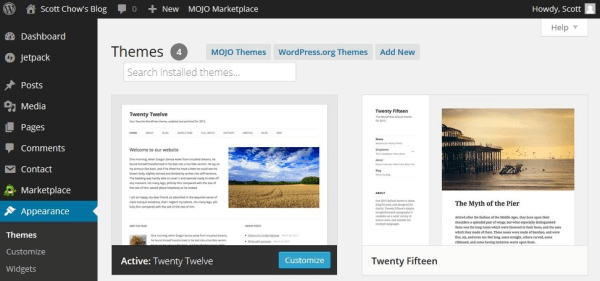
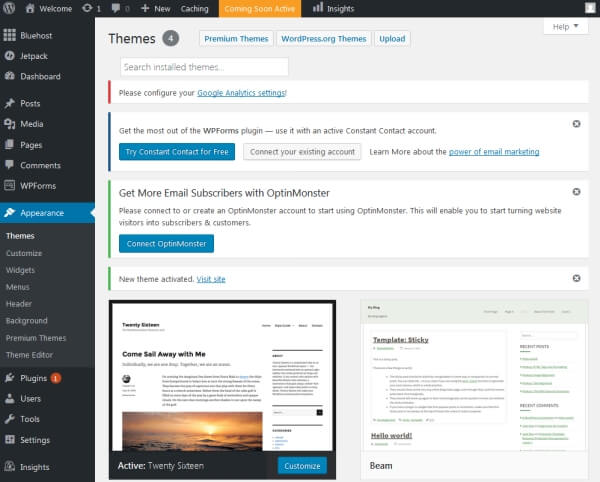
In WordPress, blog layouts are known as โ€œThemesโ€. What is a blog theme? Themes control the entire design of your blog. To change your theme you are going to click on the โ€œAppearanceโ€ tab on the left menu.

You will see several themes are already installed on your blog: Twenty Seventeen, Twenty Sixteen, etc. These are well-designed, clean-looking themes that can work for just about any type of blog. In fact, many of the worldโ€™s top bloggers use one of these themes.

Unless you have a very specific design in mind for your blog, I suggest you use one of these themes to start with. For our example, letโ€™s use the โ€œTwenty Sixteenโ€ theme. In order to activate the theme on your blog, hover over the theme and click the โ€œActivateโ€ button. Thatโ€™s it! You have changed the entire design of your blog with just one click!
How To Start A Blog In 2020An Easy Free Step-By-Step Beginnerโ€™s
Guide To Create A Blog In 20 Minutes

Updated July 5, 2020

Are you looking for a free, easy, step-by-step guide on how to start a blog?

My free guide on this page will show you how to create a blog that is beautiful and functional, all in an easy step-by-step tutorial (with pictures).

The Blog Starter's tutorial on how to start a blog for beginners

Ready to start the simple step-by-step tutorial? Click here to go to Step #1

My name is Scott Chow, and I am going to show you how to start blogging. I have been building blogs and websites since 2002. In that time I have launched several of my own blogs, and helped hundreds of others do the same.

I know that starting a blog can seem overwhelming and intimidating. This free guide is all about blogging for beginners, and will teach you how to be a blogger with just the most basic computer skills. So whether youโ€™re 8 or 88, you can create your own blog in less than 20 minutes.

I am not ashamed to admit that when I was first learning how to build a blog I made a ton of mistakes. You can benefit from more than a decade of my experience so that you donโ€™t repeat these same mistakes when you make your own blog. I created this free guide so that anyone can learn how to blog quickly and easily. And if you get stuck at any point, please send me a message and I will do my best to help you!

Skip the rest of this introduction and start building your blog!

What is a blog anyway?

In short, a blog is a type of website that focuses mainly on written content, also known as blog posts. In popular culture we most often hear about news blogs or celebrity blog sites, but as youโ€™ll see in this guide, you can start a successful blog on just about any topic imaginable.

Bloggers often write from a personal perspective that allows them to connect directly with their readers. In addition, most blogs also have a โ€œcommentsโ€ section where readers can correspond with the blogger. Interacting with your readers in the comments section helps to further the connection between the blogger and the reader.

This direct connection to the reader is one of the main benefits of starting a blog. This connection allows you to interact and share ideas with other like-minded people. It also allows you to build trust with your readers. Having the trust and loyalty of your readers also opens up the door to making money from your blog, which is something I discuss later in this guide.

Should you start a blog?

Simple steps to help you create a blog easily


One of the misconceptions about starting a blog is that you need to be a great writer to be successful. Nothing could be further from the truth. People read blog sites to get a personal perspective on things, so most bloggers write in a very informal and conversational style.

In addition, you donโ€™t need to be an expert on your topic in order to have a successful blog. For example, readers of a cooking blog donโ€™t want to read a textbook from a food scientist, they want to hear the experiences of someone who has actually cooked some real meals, mistakes and all.

To be successful as a blogger there is really just one requirement: a passion for your topic.

At its heart, blogging is about sharing your knowledge with the world. Choosing a topic that you are passionate about makes the process of starting a successful blog so much easier. Writing about more than one topic is totally fine too. As long as you are writing about things that you are genuinely interested in, your passion will shine through and keep your readers interested.

So why would you go to the trouble of blogging? There are a few reasons:

  • Make money from home. Blogging can be quite lucrative if done correctly. The top bloggers in the world obviously earn quite a bit, but even a part-time blogger can expect to make a nice profit if things are done correctly. The best part about it is that blogging is a form of passive income, since you can spend just a few hours a week writing a blog post and then continue to make money from it long after the blog post is written. I go into much more detail on how to blog for money later in this guide.
  • Share your story. A blog allows you to have a voice and be heard. You can share your story with the entire world if you so choose. One of the most common ways blogs are used are as a diary where the blogger writes about their daily experiences so that friends, family, and others can all be a part of their lives.
  • Recognition for yourself or your business. No, you probably wonโ€™t have paparazzi following you around because of your latest blog post. But a successful blog makes your idea into a reality, and can gain you a ton of recognition in your respective field. Many bloggers are known as experts just because of their blogs, and some have even gotten book and movie deals based on their blogs.
  • Find a community. Blogging at its heart is interactive. You write a blog post and people comment on it. This is a great way to connect with people who are interested in the same things as you are. Blogging allows you to teach these people based on your experience, and it gives you the opportunity to learn from your readers as well.

The good news is that the internet is exploding with growth right now. More people than ever are online. This explosion in growth means more potential readers for your blog. In short, if you are thinking about starting a blog then there is no better time than right now.

So, just how do you start a blog?

How to Start a Blog in 6 Steps

Learn how to create a blog in about 20 minutes following these steps:

  1. Pick a blog name. Choose something descriptive.
  2. Get your blog online. Register your blog and get hosting.
  3. Customize your blog. Choose a free template and tweak it.
  4. Write & publish your first post. The fun part!
  5. Promote your blog. Get more people to read your blog.
  6. Make money blogging. Choose from several options to monetize your blog.

Letโ€™s start your blog!

Step 1: Pick a blog name

The first step to finding a good blog name is choosing your topic.

If youโ€™re not sure what to blog about, there are a few ways to find a good blog topic:

  • Hobbies & passions. Hobbies or other interests you are passionate about are a great place to start. Cooking, travel, fashion, sports, and cars are all classic examples. But even blogs about more obscure hobbies can be successful, since the your audience is literally anyone in the world with the internet.
  • Life experiences. Everyone has lessons they have learned through life experience. Sharing this knowledge can be incredibly helpful to others in similar situations. For example, I recently helped a woman start her blog about being a firemanโ€™s wife. She has a lot of experience and knowledge to share with others about this topic, and it has helped her connect with others in similar situations.Think about the things you have experienced in life. This could be related to your family (example: a blog about being a stay at home mom), work (a blog about experiences dealing with clients), or other life experiences (a blog about dealing with a troubling time such as a disease or divorce, or about a happy time such as preparing for a wedding or a birth of a child).
  • A personal blog. A personal blog is a blog all about you. This will include a variety of topics, from things you do on a daily basis, to random thoughts and musings. This is a great way to share you thoughts with the world without having to stick to just one topic.

Once you have a topic itโ€™s time to choose your blog name.

A good blog name should be descriptive so that potential readers can instantly tell what your blog is about just from the name.

If you are blogging about one specific topic then you will definitely want to include that in some way in your blog name. Try not to get hung-up on just one word though. For example, a cooking blog doesnโ€™t necessarily have to have the word โ€œcookingโ€ in it. The words โ€œfoodโ€, โ€œrecipesโ€, and โ€œmealsโ€ would also let people know that your blog is about cooking.

If you are planning to create a personal blog where you discuss a variety of topics then I recommend using your name, or some variation of it, since your blog is all about you. For example, I own the blog scottchow.com. You can also add your middle name or middle initial if you find your name is already taken. Or you could use a variation like โ€œScott Chow Blogโ€ or โ€œBlogging with Scottโ€.

Canโ€™t decide on a good name for your blog? Contact me and I will help you personally (for free)!

Once you have some blog name ideas you will need to choose a domain extension.
A .com domain extension is the most preferred, but .net or .org work as well. It is also important to note that for the purposes of a blog domain you cannot have any spaces between words. So โ€œBlogging with Scottโ€ becomes bloggingwithscott.com

Now that youโ€™ve got your name and have picked an extension itโ€™s time to make sure that no one else has already registered the same name:

                      See if your blog name is available

Note: You cannot use any spaces or punctuation other than dashes in a domain name.

If you find that the name you wanted is already taken there are a few things you can do:

  • Try a different domain extension. If the .com version is already registered you may still be able to get the .net or .org version of your blog name.
  • Add small words. Words like โ€œaโ€, โ€œmyโ€, or โ€œtheโ€. For example, this site is called TheBlogStarter.com instead of BlogStarter.com.
  • Add dashes between words. For example, scott-chow.com

Step 2: Get your blog online

Now that youโ€™ve got a name picked out itโ€™s time to get your blog online. This might sound hard or technical, but the steps below will walk you right through and make the process easy.

To get your blog up and running you need two things: blog hosting and blogging software. The good news is that these typically come packaged together.

A blog host is a company that stores all of the files for your blog and delivers them to the user when they type in your blog name. You must have a blog host in order to have a blog.

Step 3: Customize your blog

Logging in

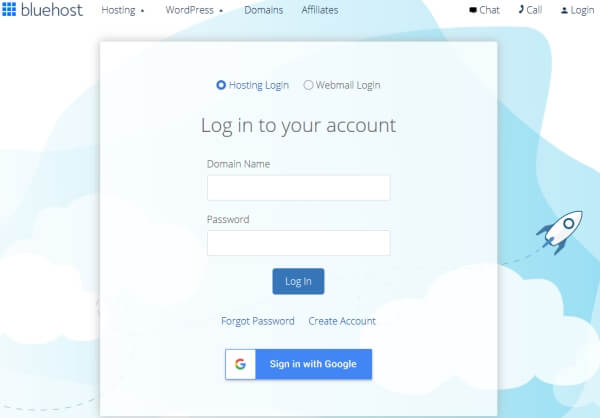
If you are not already logged-in from the previous step, go to Bluehost.com and click โ€œLoginโ€ on the top right to bring up the login screen.  You can then login using your domain name and the password you set in the previous step.  If you have misplaced your password you can reset it by clicking the โ€œForgot Passwordโ€ link.

Once you log-in you will be taken to your BlueHost Portal.  From the portal you can click the blue โ€œWordPressโ€ button to be logged-in automatically to your blog.

Changing your blog design

Once you login you will be in the WordPress administrator area. This is where you can make any changes you want to your blog.

Everyone has a different idea of how they want their blog to look. One of the great things about a WordPress blog is that you can change your entire layout and design with just a few clicks.

In WordPress, blog layouts are known as โ€œThemesโ€. What is a blog theme? Themes control the entire design of your blog. To change your theme you are going to click on the โ€œAppearanceโ€ tab on the left menu.

You will see several themes are already installed on your blog: Twenty Seventeen, Twenty Sixteen, etc. These are well-designed, clean-looking themes that can work for just about any type of blog. In fact, many of the worldโ€™s top bloggers use one of these themes.

Unless you have a very specific design in mind for your blog, I suggest you use one of these themes to start with. For our example, letโ€™s use the โ€œTwenty Sixteenโ€ theme. In order to activate the theme on your blog, hover over the theme and click the โ€œActivateโ€ button. Thatโ€™s it! You have changed the entire design of your blog with just one click!

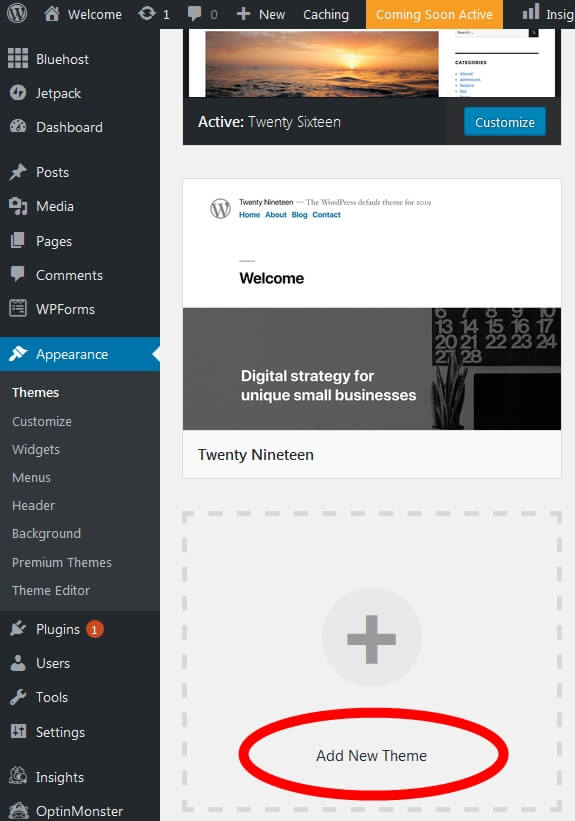
If you donโ€™t like any of the themes that are already installed you can easily choose from thousands of other free themes. To install a new theme, click on the โ€œAppearanceโ€ tab on the left menu and then click โ€œAdd New Themeโ€.

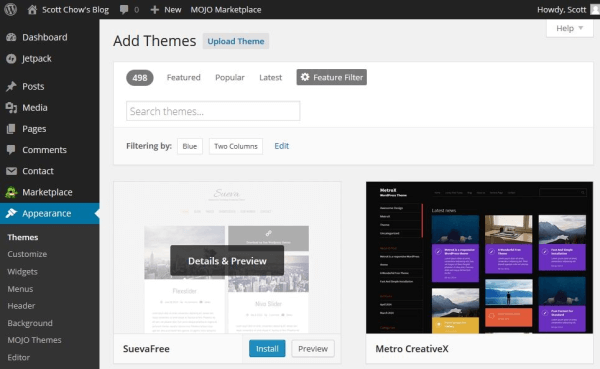
This is the theme search screen.  There are thousands of themes to choose from.  You can change your entire design at anytime simply by activating a new theme.  To find a theme you like, I suggest you click on the โ€œPopularโ€ tab and start browsing. When you find one that you like click the blue โ€œInstallโ€ button.

Once the theme is installed click โ€œActivateโ€ to activate the theme on your blog. To see your new theme in action, go to your blog and take a look!

Changing your theme is the simplest way to customize your blog, but there are lots of other customizations you can do. Check out my full post on customizing your blog for an in-depth step-by-step guide. You can also watch the video at the end of this guide to see me completely customize a blog from scratch.

Step 4: How to write a blog post & publish it

Now that your blog is up and running itโ€™s time to actually do some blogging!

Go to the left menu and click on โ€œPostsโ€.

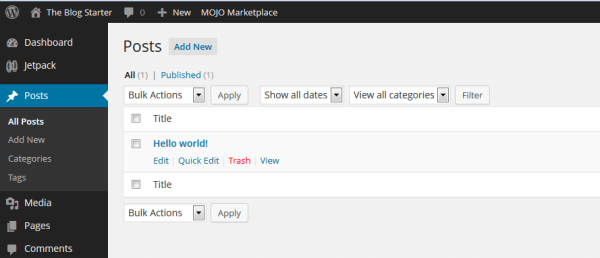
You will see there is already a post there. This is a default post on every new WordPress blog, and we donโ€™t need it. To delete it click โ€œTrashโ€ just under the post.

Step 5: Promote your blog

Creating a well-designed blog and writing great content is just the start. In order to get readers for your blog you will need spend some time promoting it, especially when you first start. Click on the strategies below for more info. 

How To Start A Blog In 2020An Easy Free Step-By-Step Beginnerโ€™s
Guide To Create A Blog In 20 Minutes

Updated July 5, 2020

Are you looking for a free, easy, step-by-step guide on how to start a blog?

My free guide on this page will show you how to create a blog that is beautiful and functional, all in an easy step-by-step tutorial (with pictures).

The Blog Starter's tutorial on how to start a blog for beginners

Ready to start the simple step-by-step tutorial? Click here to go to Step #1

My name is Scott Chow, and I am going to show you how to start blogging. I have been building blogs and websites since 2002. In that time I have launched several of my own blogs, and helped hundreds of others do the same.

I know that starting a blog can seem overwhelming and intimidating. This free guide is all about blogging for beginners, and will teach you how to be a blogger with just the most basic computer skills. So whether youโ€™re 8 or 88, you can create your own blog in less than 20 minutes.

I am not ashamed to admit that when I was first learning how to build a blog I made a ton of mistakes. You can benefit from more than a decade of my experience so that you donโ€™t repeat these same mistakes when you make your own blog. I created this free guide so that anyone can learn how to blog quickly and easily. And if you get stuck at any point, please send me a message and I will do my best to help you!

Skip the rest of this introduction and start building your blog!

What is a blog anyway?

In short, a blog is a type of website that focuses mainly on written content, also known as blog posts. In popular culture we most often hear about news blogs or celebrity blog sites, but as youโ€™ll see in this guide, you can start a successful blog on just about any topic imaginable.

Bloggers often write from a personal perspective that allows them to connect directly with their readers. In addition, most blogs also have a โ€œcommentsโ€ section where readers can correspond with the blogger. Interacting with your readers in the comments section helps to further the connection between the blogger and the reader.

This direct connection to the reader is one of the main benefits of starting a blog. This connection allows you to interact and share ideas with other like-minded people. It also allows you to build trust with your readers. Having the trust and loyalty of your readers also opens up the door to making money from your blog, which is something I discuss later in this guide.

Should you start a blog?

Simple steps to help you create a blog easily


One of the misconceptions about starting a blog is that you need to be a great writer to be successful. Nothing could be further from the truth. People read blog sites to get a personal perspective on things, so most bloggers write in a very informal and conversational style.

In addition, you donโ€™t need to be an expert on your topic in order to have a successful blog. For example, readers of a cooking blog donโ€™t want to read a textbook from a food scientist, they want to hear the experiences of someone who has actually cooked some real meals, mistakes and all.

To be successful as a blogger there is really just one requirement: a passion for your topic.

At its heart, blogging is about sharing your knowledge with the world. Choosing a topic that you are passionate about makes the process of starting a successful blog so much easier. Writing about more than one topic is totally fine too. As long as you are writing about things that you are genuinely interested in, your passion will shine through and keep your readers interested.

So why would you go to the trouble of blogging? There are a few reasons:

  • Make money from home. Blogging can be quite lucrative if done correctly. The top bloggers in the world obviously earn quite a bit, but even a part-time blogger can expect to make a nice profit if things are done correctly. The best part about it is that blogging is a form of passive income, since you can spend just a few hours a week writing a blog post and then continue to make money from it long after the blog post is written. I go into much more detail on how to blog for money later in this guide.
  • Share your story. A blog allows you to have a voice and be heard. You can share your story with the entire world if you so choose. One of the most common ways blogs are used are as a diary where the blogger writes about their daily experiences so that friends, family, and others can all be a part of their lives.
  • Recognition for yourself or your business. No, you probably wonโ€™t have paparazzi following you around because of your latest blog post. But a successful blog makes your idea into a reality, and can gain you a ton of recognition in your respective field. Many bloggers are known as experts just because of their blogs, and some have even gotten book and movie deals based on their blogs.
  • Find a community. Blogging at its heart is interactive. You write a blog post and people comment on it. This is a great way to connect with people who are interested in the same things as you are. Blogging allows you to teach these people based on your experience, and it gives you the opportunity to learn from your readers as well.

The good news is that the internet is exploding with growth right now. More people than ever are online. This explosion in growth means more potential readers for your blog. In short, if you are thinking about starting a blog then there is no better time than right now.

So, just how do you start a blog?

How to Start a Blog in 6 Steps

Learn how to create a blog in about 20 minutes following these steps:

  1. Pick a blog name. Choose something descriptive.
  2. Get your blog online. Register your blog and get hosting.
  3. Customize your blog. Choose a free template and tweak it.
  4. Write & publish your first post. The fun part!
  5. Promote your blog. Get more people to read your blog.
  6. Make money blogging. Choose from several options to monetize your blog.

Letโ€™s start your blog!

Step 1: Pick a blog name

The first step to finding a good blog name is choosing your topic.

If youโ€™re not sure what to blog about, there are a few ways to find a good blog topic:

  • Hobbies & passions. Hobbies or other interests you are passionate about are a great place to start. Cooking, travel, fashion, sports, and cars are all classic examples. But even blogs about more obscure hobbies can be successful, since the your audience is literally anyone in the world with the internet.
  • Life experiences. Everyone has lessons they have learned through life experience. Sharing this knowledge can be incredibly helpful to others in similar situations. For example, I recently helped a woman start her blog about being a firemanโ€™s wife. She has a lot of experience and knowledge to share with others about this topic, and it has helped her connect with others in similar situations.Think about the things you have experienced in life. This could be related to your family (example: a blog about being a stay at home mom), work (a blog about experiences dealing with clients), or other life experiences (a blog about dealing with a troubling time such as a disease or divorce, or about a happy time such as preparing for a wedding or a birth of a child).
  • A personal blog. A personal blog is a blog all about you. This will include a variety of topics, from things you do on a daily basis, to random thoughts and musings. This is a great way to share you thoughts with the world without having to stick to just one topic.

Once you have a topic itโ€™s time to choose your blog name.

A good blog name should be descriptive so that potential readers can instantly tell what your blog is about just from the name.

If you are blogging about one specific topic then you will definitely want to include that in some way in your blog name. Try not to get hung-up on just one word though. For example, a cooking blog doesnโ€™t necessarily have to have the word โ€œcookingโ€ in it. The words โ€œfoodโ€, โ€œrecipesโ€, and โ€œmealsโ€ would also let people know that your blog is about cooking.

If you are planning to create a personal blog where you discuss a variety of topics then I recommend using your name, or some variation of it, since your blog is all about you. For example, I own the blog scottchow.com. You can also add your middle name or middle initial if you find your name is already taken. Or you could use a variation like โ€œScott Chow Blogโ€ or โ€œBlogging with Scottโ€.

Canโ€™t decide on a good name for your blog? Contact me and I will help you personally (for free)!

Once you have some blog name ideas you will need to choose a domain extension.
A .com domain extension is the most preferred, but .net or .org work as well. It is also important to note that for the purposes of a blog domain you cannot have any spaces between words. So โ€œBlogging with Scottโ€ becomes bloggingwithscott.com

Now that youโ€™ve got your name and have picked an extension itโ€™s time to make sure that no one else has already registered the same name:

                      See if your blog name is available

Note: You cannot use any spaces or punctuation other than dashes in a domain name.

If you find that the name you wanted is already taken there are a few things you can do:

  • Try a different domain extension. If the .com version is already registered you may still be able to get the .net or .org version of your blog name.
  • Add small words. Words like โ€œaโ€, โ€œmyโ€, or โ€œtheโ€. For example, this site is called TheBlogStarter.com instead of BlogStarter.com.
  • Add dashes between words. For example, scott-chow.com

Step 2: Get your blog online

Now that youโ€™ve got a name picked out itโ€™s time to get your blog online. This might sound hard or technical, but the steps below will walk you right through and make the process easy.

To get your blog up and running you need two things: blog hosting and blogging software. The good news is that these typically come packaged together.

A blog host is a company that stores all of the files for your blog and delivers them to the user when they type in your blog name. You must have a blog host in order to have a blog.

You also need to have the software to build your blog. In this guide I will be showing you how to build a blog using the WordPress blogging software, because it is the most popular, customizable, and easiest to use.

post-it

The blog host I recommend, and the one I show you how to use in this guide, is BlueHost. I personally use BlueHost and I recommend them for all new bloggers because:

  • They will register your blog name for you for free, making sure no one else can take it.
  • They offer a free, simple installation of the WordPress blogging software (which I show you how to use in this guide).
  • They have been recommended by WordPress since 2005 and currently host over 2 million blogs and websites.
  • They have helpful 24/7 customer service via phone or web chat.
  • They have a 30 day money-back guarantee if you are unsatisfied for any reason.

Use any BlueHost link on this site to make sure you get the special discount price of $2.75 per month.

Disclosure: BlueHost compensates The Blog Starter when you purchase through this link, so my services are free of charge to you! In fact, if you have any trouble at all setting up a blog with this tutorial, just contact me and I will do it for you (free!).

1. Click here for the special $2.75 per month rate on BlueHost and then click โ€œget started nowโ€.

2. Select your plan. I recommend that new bloggers get the basic plan. Click โ€œSelectโ€ to choose your plan.

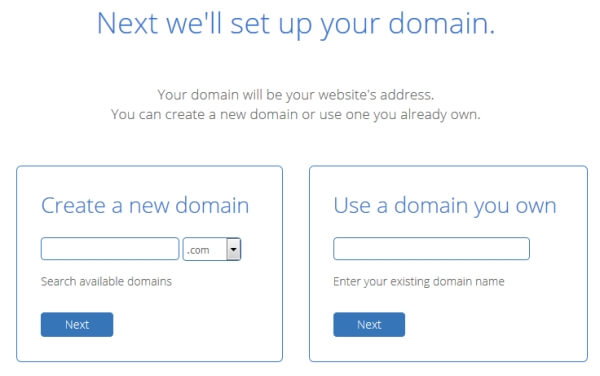
3. Type in your domain name in the left box and then click โ€œnextโ€ to start the registration process.

  • If you already own a domain name and want to use it for your blog, type your existing domain in the right box and then click โ€œnextโ€. Only use the right box if you have previously paid to register a domain!
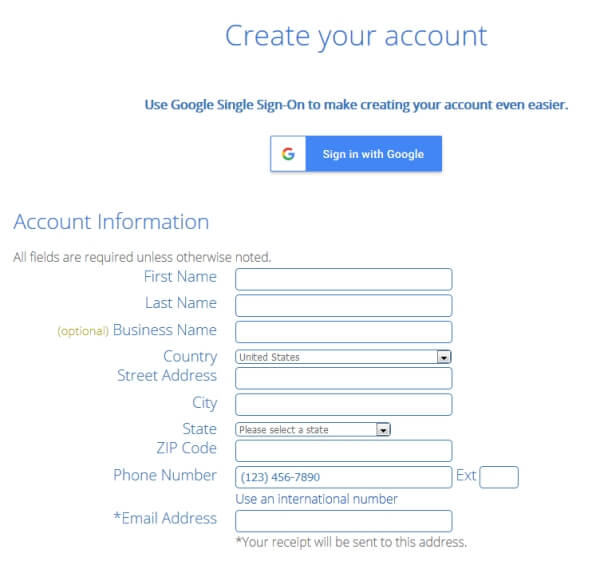
4. Fill out your billing details on the registration page.
5. You will also need to choose your hosting package and options.

  • All packages have everything you need to get your blog up and running, including a free domain name, easy WordPress blog installation, web hosting, and branded email accounts (e.g. yourname@yourdomain.com).
  • The 36 month package gets you the lowest monthly rate, while the 12 month package has a lower up-front cost.
  • uncheck the boxes next to the other products when I sign-up. You can always get these products later if you decide you need them.

6. You will then need to create your account and password.
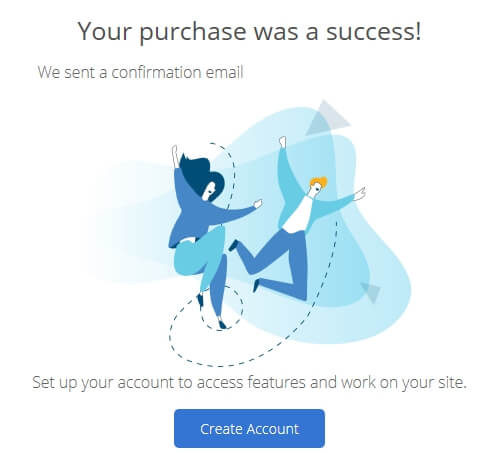
Once you do that you will be taken to an installation helper.  Since you are following this tutorial you can just click โ€œSkip this stepโ€ on the next few pages to be taken directly to the dashboard.
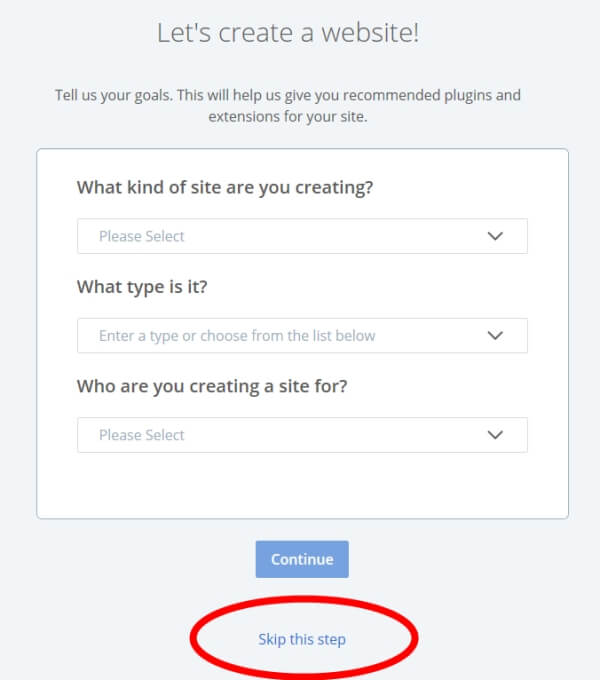
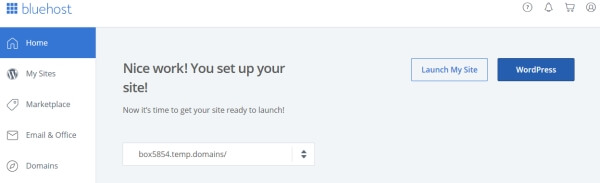
Now your blog software (WordPress) will be installed. Once the install is complete click the blue โ€œWordPressโ€ button to be logged-in to the administrator area of your blog.
Having trouble installing your blog? Get help here.

Step 3: Customize your blog

Logging in

If you are not already logged-in from the previous step, go to Bluehost.com and click โ€œLoginโ€ on the top right to bring up the login screen.  You can then login using your domain name and the password you set in the previous step.  If you have misplaced your password you can reset it by clicking the โ€œForgot Passwordโ€ link.

Once you log-in you will be taken to your BlueHost Portal.  From the portal you can click the blue โ€œWordPressโ€ button to be logged-in automatically to your blog.

Changing your blog design

Once you login you will be in the WordPress administrator area. This is where you can make any changes you want to your blog.

Everyone has a different idea of how they want their blog to look. One of the great things about a WordPress blog is that you can change your entire layout and design with just a few clicks.

In WordPress, blog layouts are known as โ€œThemesโ€. What is a blog theme? Themes control the entire design of your blog. To change your theme you are going to click on the โ€œAppearanceโ€ tab on the left menu.

You will see several themes are already installed on your blog: Twenty Seventeen, Twenty Sixteen, etc. These are well-designed, clean-looking themes that can work for just about any type of blog. In fact, many of the worldโ€™s top bloggers use one of these themes.

Unless you have a very specific design in mind for your blog, I suggest you use one of these themes to start with. For our example, letโ€™s use the โ€œTwenty Sixteenโ€ theme. In order to activate the theme on your blog, hover over the theme and click the โ€œActivateโ€ button. Thatโ€™s it! You have changed the entire design of your blog with just one click!

If you donโ€™t like any of the themes that are already installed you can easily choose from thousands of other free themes. To install a new theme, click on the โ€œAppearanceโ€ tab on the left menu and then click โ€œAdd New Themeโ€.

This is the theme search screen.  There are thousands of themes to choose from.  You can change your entire design at anytime simply by activating a new theme.  To find a theme you like, I suggest you click on the โ€œPopularโ€ tab and start browsing. When you find one that you like click the blue โ€œInstallโ€ button.

Once the theme is installed click โ€œActivateโ€ to activate the theme on your blog. To see your new theme in action, go to your blog and take a look!

Changing your theme is the simplest way to customize your blog, but there are lots of other customizations you can do. Check out my full post on customizing your blog for an in-depth step-by-step guide. You can also watch the video at the end of this guide to see me completely customize a blog from scratch.

Step 4: How to write a blog post & publish it

Now that your blog is up and running itโ€™s time to actually do some blogging!

Go to the left menu and click on โ€œPostsโ€.

You will see there is already a post there. This is a default post on every new WordPress blog, and we donโ€™t need it. To delete it click โ€œTrashโ€ just under the post.

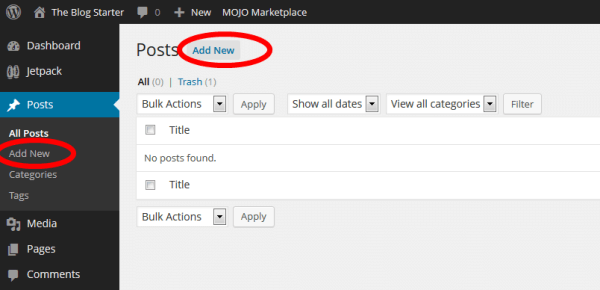
To begin writing a new post, click the โ€œAdd Newโ€ link.

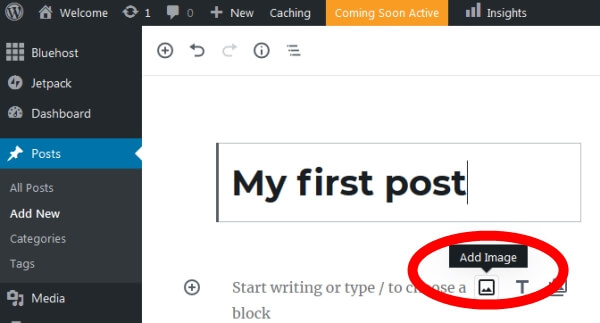
You are now on the post editor screen. Enter the title of your post in the top box and then begin writing your post in the lower box.

If you would like to add a picture to your post, click on the โ€œAdd Imageโ€ icon and click โ€œUploadโ€ to upload a picture from your computer. You can make adjustments to the picture size on the next screen. When you are ready click โ€œInsert into postโ€ to add the picture.

Once you have finished your post just click the โ€œPublishโ€ button on the top right side of the screen to publish it.

Publishing Your Blog

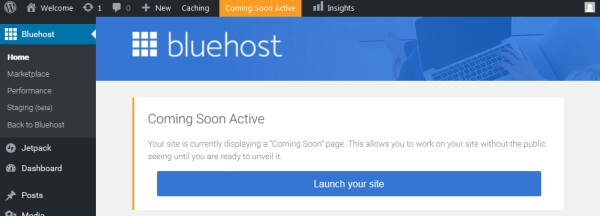
Even after you have written a post your blog may still be showing a โ€œComing Soonโ€ page.

When you are ready to make your blog public just click the โ€œBlueHostโ€ menu at the top left of the menu in your administrator area then click the blue โ€œLaunchโ€ button to remove the โ€œComing Soonโ€ page.

Congratulations! You now know how to start your own blog and publish content!

For more info on blog content guidelines, click the tabs below:

Content That Should be on Your Blog

How to write a great blog post

Step 5: Promote your blog

Creating a well-designed blog and writing great content is just the start. In order to get readers for your blog you will need spend some time promoting it, especially when you first start. Click on the strategies below for more info. For more tips on promoting your blog make sure to check out my in-depth guide to blog promotion.

Alert Your Inner Circle

Use Social Media

Comment on Other Blogs

Engage with Your Readers

Collaborate

Create an Email List

Submit to Search Engines

SEO

Step 6: Make money blogging

Once you have put in the effort of creating great blog content and promoting your blog, making money from your blog is actually the easy part.

Blogs have the potential to be extremely lucrative, but donโ€™t assume that youโ€™re going to start making money in the first week, or even in the first month. It could take six months to a year to start seeing a steady stream of income. Blogging takes work and dedication, but once you develop a large enough audience, there are several methods you can employ to monetize your blog. 

Fast Food and their Impact on Health

The lifestyle are metamorphosed to accommodate the new jet age and habits too is no exception. healthy nutritious foods have been replaced by the new food have been replace by the food mantra for junk food. The available of junk food ad snacks at low prices and marketing strategies adapted by manufactures of such food has triggered an evolution wherein, consumption of foods that require neither the structure nor the preparation of a formal meal. It seems to have engulfed every age; every race and newest entrants on stage are children, school going in particular. hence, a systematic presentation has been made in this review from the article from various source highlight eating habits, nutritional aspects and quality of unhealthy food, their health impact on consumption and prevention measure and prevention measure to be undertaken. Through health education, a change towards good eating practices and adaption of healthy living is possible. The Obesity account for 300,00 death in the U.S alone.

Research into food and fast food restaurant have found that there is a direct relationship between the number of the fast food restaurant located within the local area and obesity rate. According to a survey by the Institute of Food technologists of american are eating their dinner at home, nearly half those meals are fast food, delivery, or taken out from restaurant or grocery delis.

India is no exception this changing fast food trend In India’s fast food industry is growing by 40 % a year. Statistical place India in 10th place in fast food per capital spending figures with 2.1% of expenditure of annual total spending. According to the national sample 2005 released by the Delhi government, people living in Delhi spend rs – 371, on an average, on process food and beverage per month. They spend Rs – 290, on vegetable and around one – third of it on fruit. the value of junk food consumed in india in 2003 was about Rs. 41000 crore; of which rural area accounted for a little over Rs 22,000 corer as published in an little article in news paper by sudhanshu Ranade in Business Line on July 13th 2005. Nature in 2007 state that preventable diseases caused mainly due to smoking, Poor diet food consumption and lack of exercise could kill million in developing world in the next 10 years.

The junk food means the calories is not include. An empty or high calories rich food which lacks in micro nutrients such as vitamins, minerals, amino acids and fibers but has high energy. These foods don’t contain the nutrients that your body needs to stay healthy Hence, these foods that has poor nutritional value is considered unhealthy and may be called as junk food. Junk food is an informal term applied to some foods which is the perceived to have little or no nutritional value, but which also have ingredients considered unhealthy when eaten regularly or those consideration unhealthy to consume at all. The term Junk food was coined as a slang in the public interest in 1972 by Michael Jacobson, Director of the center for Science.

Improving your Communication Skills

how-to-improve-english-speaking-skills

English is the worldโ€™s lingua franca, a common language that people with different native languages can use to communicate.

Thanks to English, people with completely different native languagesโ€”maybe Hindi, French and Japaneseโ€”can sit down and have a conversation together.

English now spans across countries and cultures, and the ability to speak it well will open many doors for your career and social life.

The more fluent you are in English, the more interesting, exciting and insightful conversations you can have.

It enables life-enriching experiences like traveling, studying and working abroad, not only in the US but also many other countries where English is widely spoken.

The world is your oyster (the world is yours).

The other good news is that you can improve English speaking skills without a classroom partner or stressful lessons. Itโ€™s totally possible to have fun and master speaking a language at the same time.

Pronouncing the words correctlyย is the key to eloquence, but it is not everything. This article will take you beyond the foundational aspects toย reach communicative competence.

Build a Strong Foundation

In order to express yourself eloquently in English, you need a wide variety of vocabulary and the correct pronunciation.

1. Expand your vocabulary

Learn New Words Every Day

Gleaning new words day in, day out is a good way to widen your vocabulary. Commit to a suitable target: it can be three daily words or it can be ten daily words.

Even if you only have time to learn one new word per day, it is still worth trying. By learning one word every day, after one year you will have learned 365 new English words.

Write the number down to remind yourself frequently. If you have a learning partner, share it with her so that she can check on your progress.

Some good resources for words are the news, songs and TV shows, depending on your daily habits. If you love listening to music, pay attention to the lyrics and take note of the words you do not know. Songs often contain a lot of useful vocabulary, phrases and expressions, therefore, they are great for learning English. You can do the same thing with FluentU videos.

Learn Words in Phrases and Chunks

It is important that you learn words in groups. For example, you refer to beverages as a glass of wine, a pint of beer, a cup of tea, a pot of coffee, etc. It is better to learn those phrases than merely winebeertea and so on.

You can also benefit from learning words that are related. The moon has four phases during a lunar month: crescent, gibbon, waxing and waning. It is more efficient to learn all four words at the same time.

2. Improve your pronunciation

You might know a lot of words, but if you fail to say them correctly, you will not be understood. That seems like a waste of the time spent on remembering words, right?

When using online dictionaries such as Macmillan and Merriam-Webster, make use of the little speaker symbol to check the pronunciation of any word that you are not sure about. There are English pronunciation tutorials on YouTube or podcasts like English Pronunciation Pod or American English Pronunciation to teach you the many aspects of American English pronunciation.

When you are ready for something more challenging, try out tongue twisters. Some examples are available here. Personally, I love the Fork handles sketch from the show โ€œThe Two Ronnies.โ€ It might not be a typical example of everyday conversation, but it shows you the richness of spoken English. Besides, you will have a good laugh.

3. Learn the natural flow of English

Being able to say individual words correctly is great, but the secret of speaking fluently lies in the flow of sentences. Whenever you read a piece of poetry, listen to a melodic song or watch a hilarious sitcom, pay attention to the following:

  • Linking. Notice how native speakers link words together: joining two sounds, making a sound to disappear or changing a sound for a better flow.
  • Contractions. Contractions are shortened forms of two words. For example:
    • I + am = Iโ€™m
    • he + will = heโ€™ll
    • they + have = theyโ€™ve
    • do + not = donโ€™t
  • Stress. There are stressed syllables in a word and stressed words in a sentence.
  • Rhythm. The rhythm is the overall result of stress, contractions and linking. It is the ups and downs, the musical feature of English.

Techniques to Improve English Speaking Skills

Now that you have a strong foundation, you can apply some techniques to hone (improve) your English speaking skills.

4. Speech shadowing

In a nutshell, this technique is about imitation. You listen to how a native speaker says something and try to copy it.

  • Pick your favorite video with subtitles. Make sure that it is something you enjoy watching because you willโ€ฆ
  • Listen to it many times. Listen to the video once and read the subtitles to get a good grasp of the general content and flow. While you are playing it again, complete the next step.
  • Imitate the narrator sentence by sentence. Play. Listen. Pause. Speak. Record (optional). Copy the speech pattern as best as you can. If you choose to record your practice, you can compare yours and the original. Or else, just listen to your own sound and be critical of the difference or similarity. Repeat this step until the end of the video.

5. Self-talk

Talk to yourself in English loudly. It can be anything from a suggestion like, โ€œShall we go get a glass of water?โ€ or a reminder, โ€œI need to do a load of laundry today.โ€

Alternatively, pick up a book and read a couple of pages out loud. This exercise might slow down your reading, but it will speed up your speaking skills.

You can also record yourself, listen to the recording and watch out for any wrong pronunciations. If it is possible, ask for feedback from a native speaker.

6. Think in English

If you already think in English, it takes less time to produce or respond in everyday conversations. No translation needed!

A good way to start rethinking is to keep a diary where you express your daily thoughts in English. It does not have to be perfect, it is more about getting out thoughts in English with less and less effort.

7. Retell a story in English

Take the challenge a step further by retelling a story. You retrace other peopleโ€™s line of thoughts in your own words.

I would start with a familiar story from your culture. Your translation needs to convey not only the meaning of words but all rhetorical and cultural nuances.

Alternatively, you can choose different words to retell a simple story in English. Start from the basics, reading something like a fairy tale or a fable. Either way will be beneficial to your English communication skills.

Frequently Practice to Improve Your English Speaking Skills

Practice makes perfect, so do speak English in plenty. Some people think that they do not have the opportunity to practice speaking because they do not live in the US or another English-speaking country. They might also be discouraged because English is not used at their workplace, or they do not know any native speakers.

There is some validity in those excuses, but do not let them hinder your learning. Thanks to the growth of globalization and technology, you have more chances than ever to practice speaking English. Youโ€™ll find many ideas below.

8. Participate in public speaking events

Big universities, theaters and culture societies organize events like open debates, spoken word readings and improvised storytelling gatherings. These are places where you can come and mingle with like-minded people and practice speaking English.

Many cities are now hosting TED or TEDx talks where you can register to participate and share your innovative ideas. Check the events page of your local university to see if there are any available. It might be a nerve-racking experience, but it would be great for your English!

9. Go to language cafes

If public speaking terrifies you (and I know it does for many), you can opt for language cafes. Those cafes create a friendly and relaxing atmosphere for people who want to practice and exchange languages.

You can find language cafes through local universities or the Meetup groups available in your cities.

10. Using apps

Another option is to use an app to talk to native speakers online, in the comfort of your own home. Some popular apps are HelloTalk and Tandem. Basically, you register for an account, introduce yourself, your native language and your hobbies. The app will find you some matchesโ€”the people who speak English and want to practice the language you know well. All you need to do is to press a few buttons and start talking.

11. Chat with Siri

I find chatting with Siri is a great way to force myself to speak more clearly. As Siri is a machine, you cannot rely on environmental clues and facial gestures to get your ideas across. Your words are the only tool you have to make yourself understood. Thus, you need to speak as clearly and precisely as you could.

Another plus point of using Siri is that she is always available (as long as your phone is charged and connected to a WiFi network). Just press the home button and start asking questions.

If you own an Android smartphone, you can practice speaking with Google Now.

So, off you go! Choose your preferred method to expand your vocabulary, correct your pronunciation, and boost your English speaking with the methods that are right for you. Do not forget to practice as much as possible.

CORPORATE GOVERNANCE IN INDIA

Corporate Governance in India is a set on internal controls, policy and procedures which form the framework of a companyโ€™s operations and its dealings with various stakeholders such as customers, management, employees, government and industry bodies. The framework of such policies should be such as to uphold the principles of transparency, integrity, ethics and honesty. Corporate Governance is the soul of an organisation and must be adhered to while indulging in any business practices

It is indeed a proud moment for the Indian corporate sector. Around 12 Indian companies have featured in the Forbes list of the worldโ€™s 2,000 best regarded firms. Infosys. TCS, Tata Motors secured the 31st, 35th and 70th ranks, respectively.

Other Indian biggies like Tata Steel, L&T, Grasim, GIC, Mahindra & Mahindra, Asian Paints, SAIL and ITC are some of the other companies who have made it to this prestigious list. HDFC is the only company from the banking and financial sector to have attained a position in this list.

Forbes partnered with Statista, which surveyed 15,000 people from 60 countries regarding their opinion on top 2000 companies across the globe. Companies were evaluated on parameters such as trustworthiness, social conduct, performance of the companyโ€™s product or service and the company as an employer.

When bank scams, financial frauds, and cybercrimes become the order of the day, news like these reinstate our belief in the importance of sound Corporate Governance in India.

Why is Corporate Governance so important?

  • Risk Mitigation and compliance

There is a direct relationship between governance, risk mitigation and compliance. If a company is governed on the basis of sound principles, it will naturally work efficiently and ensure compliance with every statutory law and guideline. Being on track with the policies and law ensures that the company is braced well for any uncertainty and thus has risk mitigation mechanisms in place. More disciplined a company is in its operations, the better it is placed to face any risk or disruption arising out of political, technological and economic events.

  • Enhances shareholder value

While there is no established relation between corporate governance and market value of a company, it does enhance shareholder satisfaction. Corporate Governance in India plays a key role in protecting valuations of a company because the ultimate goal of good governance is to maximise the interest of all stakeholders. The value accumulated by the company over the years can be wiped away by a single unlawful incident, thus internal controls at the right place is mandatory.

  • Better image during economic downturns

During the last few months, we have heard many stories of banking frauds and financial malpractices. It is but natural for people to believe that all banks and financial institutions are involved in all these, which is not true. It is only when an organisation can ensure people about their inherent governance practises that people will believe them. Trustworthiness that has been established over ages plays a strong role in upholding the companyโ€™s image even during tough situations.

  • Improved organisational efficiency

Corporate Governance is an important determinant of industrial competitiveness. Nowadays there are many questions raised on the way a company is governed. Better governance ensures enhanced corporate performance and better economic results. Corporate Governance lays the foundation for behaviour of the company, the utilization of resources, product/service innovation and overall corporate strategies.

  • Crucial during mergers & acquisitions

Corporate Governance in India plays a critical role during restructuring events such as mergers and acquisitions. Not only does corporate governance of a company helps to differentiate between good deals from bad ones, but M&A activity by a company with good corporate governance is better received by stakeholders in the market. Another aspect to be mentioned is that mergers and acquisitions also has the power to improve the quality of corporate governance of the organisation.

Corporate Governance in India: The unseen force behind an organisation

A company is not all about just profits, market valuations, P/E multiples and turnovers, there is a lot that goes into building its position and image. Corporate Governance is one such hidden force. After numerous scandals, maligned reputations and economic downturns, companies are now realising that few concrete steps towards better governance could have saved years of their labour.

Most companies chase only monetary gains and take corporate governance for granted. Due to lack of trust on governance, investor sentiments go awry resulting in mass outflow of FII funds, sale by majority shareholders, reduced market value and so on.

Designing the framework of corporate governance in India is no mean task in itself. The requirement and fundamentals vary across sectors, industries as well as nationalities. Profound corporate governance is a must for banks and healthcare in particular.

Other sectors, such as FMCG, IT and Retail need to prioritize good governance, but this may not help them in enhancing their market value. The influence of governance on value also varies. It gains more importance during tough times rather than smooth sailing periods.

Nevertheless, corporate governance in India will continue to be crucial no matter what. The approach must be a perfect balance between excessive stringency and too much flexibility. Only the framework must be holistic and take the interests of all the stakeholders into account.

PERFORMANCE MANAGEMENT SYSTEM(PMS)

What Is Performance Management?

Performance management is the process of continuous feedback and communication between managers and their employees to ensure the achievement of the strategic objectives of the organization.

The definition of performance management has evolved since it first appeared as a concept. What was once an annual process is now transitioning to continuous performance management. The goal is to ensure that employees are performing efficiently throughout the year, and in the process, address any issues that may arise along the way that affect employee performance.

“Most workers perceive their organization’s performance management approach as confusing, subjective, and infrequent,” said Kathi Enderes (vice president, Talent, and Workforce Research Leader) and Matthew Shannon (senior research analyst) at Bersin, Deloitte Consulting LLP, in an exclusive with HR Technologist.

This is the current state of performance management. However, it doesn’t have to be that way. Automation now plays a significant role in performance management, and many of the processes involved can be streamlined so that employee performance can be strategically managed. This is the age of continuous performance management, and hereโ€™s everything you need to know about it.

Performance management differs from talent management in that the latter is a set of initiatives taken to engage employees to retain them. Performance management, on the other hand, is an initiative that guides employees towards establishing and achieving their goals in alignment with the organization’s immediate and overarching goals.

Why is performance management important?

1. Performance management supplements the annual performance review. This prepares both employees and managers about what to expect during the annual appraisal. It keeps both the manager and the employee in the loop about ongoing changes to the performance management process, what both can do to streamline it, and how performance overall can be improved.

2. To employees, continuous performance management indicates that managers value them. Employees believe that their managers are interested in their work and care about their goals and any issues they may face in the course of their job. They also become more open to receiving constructive feedback.

The Performance Management Cycle

The performance management process or cycle is a series of five key steps. These steps are imperative, regardless of how often you review employee performance.

1. Planning

This stage entails setting employees’ goals and communicating these goals with them. While these goals should be disclosed in the job description to attract quality candidates, they should be communicated once again when the candidate becomes a new hire. Depending on the performance management process in your organization, you may want to assign a percentage to each of these goals to be able to evaluate their achievement.

2. Monitoring

In this phase, managers are required to monitor the employeesโ€™ performance on the goal. This is where continuous performance management comes into the picture. With the right performance management software, you can track your teamโ€™s performance in real-time and modify and correct course whenever required.

3. Developing

This phase includes using the data obtained during the monitoring phase to improve the performance of employees. It may require suggesting refresher courses, providing an assignment that helps them improve their knowledge and performance on the job, or altering the course of employee development to enhance performance or sustain excellence.

4. Rating

Each employeeโ€™s performance must be rated periodically and then at the time of the performance appraisal. Ratings are essential to identify the state of employee performance and implement changes accordingly. Both peers and managers can provide these ratings for 360-degree feedback.

5. Rewarding

Recognizing and rewarding good performance is essential to the performance management process, as well as an important part of employee engagement. You can do this with a simple thank you, social recognition, or a full-scale employee rewards program that regularly recognizes and rewards excellent performance in the organization.

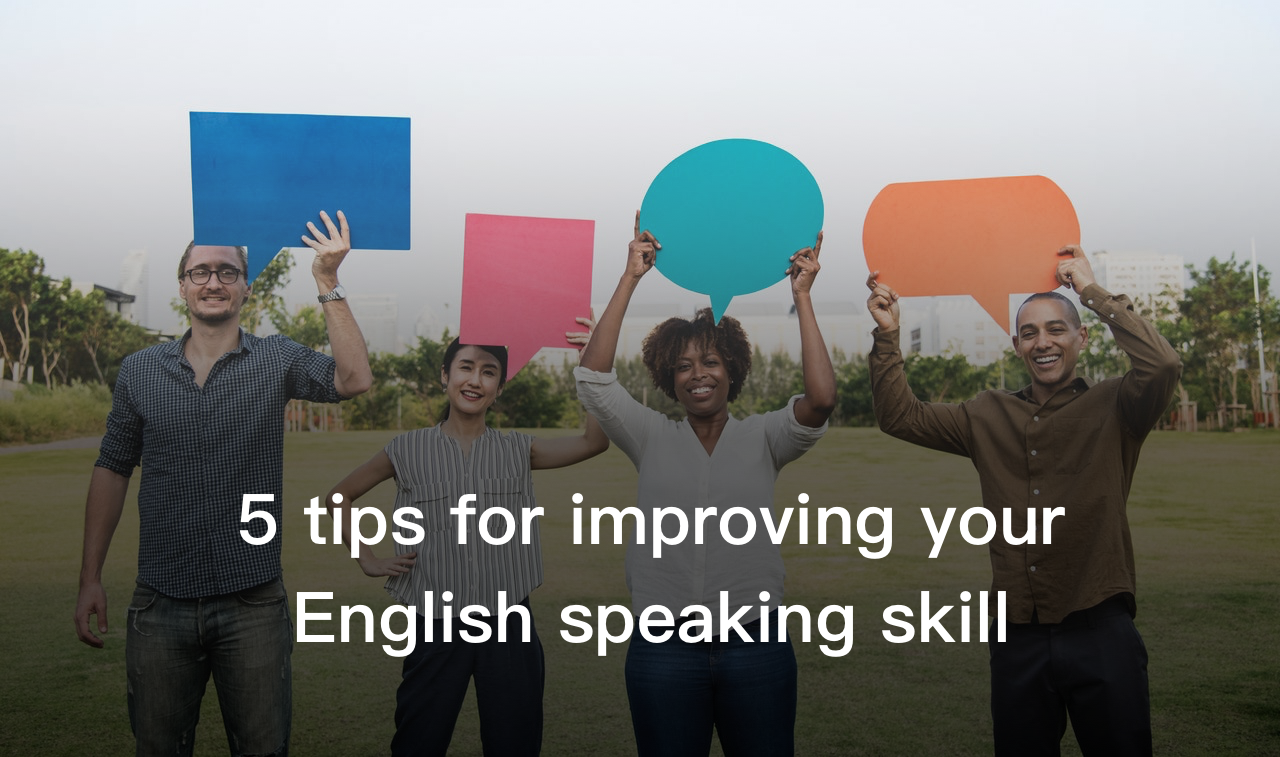
HOW TO IMPROVE ENGLISH SPEAKING SKILLS

Image for post

Many students master the fine points of English grammar but find themselves at a loss when it comes to actually having a conversation with native speakers. In reality, the only way to develop fluency in speaking is by huge amounts of listening, and then practicing. The following are a few tips for improving English speaking skills. Donโ€™t forget that listening is the foundation for speaking! When you also want to practice speaking, here are some suggestions for how to improve English speaking skills. 

Find An English-Speaking Conversation Partner

First of all, itโ€™s important to find native speakers to practice with. Students who are living around many English speakers may be able to find informal opportunities to chat with neighbors and local business people. Joining a club or a volunteer organization can be a great way to get to know people informally. If that isnโ€™t an option, consider hiring a private tutor. A lot of students find and meet with tutors online via tools like Skype or Google Hangouts.

Make Sure To Listen As Well As Speak

When practicing with a native speaker, try to balance your listening and speaking. Itโ€™s a good idea to prepare questions in advance so that the conversation will flow back and forth. If your conversation partner asks you a question and you answer at length, you can always turn the question back to your partner by asking, โ€œWhat do  you think?โ€ or โ€œWhat about you?โ€

Record Your Conversation Practice

Recording is a great way to get the maximum benefit from a conversation with a native speaker. When you listen again, you can evaluate your own pronunciation and notice areas where you need to improve. You can also review the content of the conversation, take notes on new vocabulary or misunderstandings, and prepare questions for the next meeting.

Surround Yourself With The English Language

Another way to improve your English speaking skills is to immerse yourself in English as much as possible. Watch movies or TV in English, with subtitles if you need them, and watch the same programs over and over. Most people find that they understand more each time. Listening helps you become familiar with the rhythms and intonations of English. Once the sounds are familiar, try imitating them.

Practice With Music and Movies

Listen to music in English and sing along. Music is one of the best tools for learning intonation pronunciation. Listening to and singing songs might also help you remember vocabulary and phrases (if the song is easy to understand), and it will help you learn to pronounce English rhythm in a more natural way. By unconsciously imitating the singer, youโ€™ll learn to pronounce phrases the way native speakers do. One good song for ESL or EFL students is โ€œTomโ€™s Dinerโ€ by Suzanne Vega because it uses simple language to describe everyday scenes and actions.  Movies are a much better choice for learning English.  Youโ€™ll learn vocabulary, idioms, slang, pronunciation, and listening by watching movies.  Be sure to use my movie technique when you do this!

Read Aloud

Reading out loud is a great way to practice speaking when there are no conversation partners available. Reading aloud gives you a chance to focus on pronunciation and pacing without worrying about coming up with words. Make sure to practice with material that you can understand. Some students find videos online that have transcripts. Many TED talks, for example, include word-for word transcripts of the talk. By reading aloud from a transcript, you can check your pronunciation by listening to how the speaker says something.

Talk To Yourself

Saying your thoughts out loud or narrating your actions (โ€œI am drinking coffee, and now Iโ€™m going to open my bookโ€) can be a very effective way to practice spoken English. By talking to yourself, you can become more fluent in translating your thoughts into spoken words. Practicing alone is also a low-pressure way to practice, since no one will hear your mistakes.

Many students master the finer points of English grammar, but find themselves at a loss when it comes to actually having a conversation with native speakers. In reality, the only way to develop fluency in another language is through huge amounts of listening and speaking. The following are a few tips for improving your English speaking skills.

HOW TO IMPROVE ENGLISH SPEAKING SKILLS

1. Speak, speak, speak!

Be confident and speak as often as possible, to as many people as you possibly can! Donโ€™t be shy to make mistakes! The more you practice, the better and more confident you will become in your pronunciation and vocabulary. Remember, speaking is a skill, like learning a musical instrument or new sport โ€” the only way you can get good is to actually do it!

2. Read Aloud

Read the newspaper or a magazine out loud to yourself. You can even find a script from your favorite TV show and act it out! This is a great way to practice pronunciation, as you can concentrate on how your English sounds without worrying about sentence structure or grammar.

3. Record your practice conversations

After a conversation is over, take a moment to reflect: How did it go? How much do you think you understood? How comfortable did you feel with the subject matter? Did you encounter any unknown words? The mere act of thinking about it in this way will increase your confidence the next time you speak (and give you targeted things to work on, such as, vocabulary you didnโ€™t understand).

4. Find an English-speaking conversation partner

Itโ€™s important to find a partner to practice with, ideally a native English speaker. If you live around English speakers try incorporating informal conversations into your daily life. If that isnโ€™t an option, consider hiring a private tutor you can meet online via tools like Skype or Google Hangouts.

5. Donโ€™t forget to use technology

A smartphone can be a powerful tool for learning languages. It can help you find reading material, converse with tutors, or even record yourself speaking!

There are some apps that can even help you to find a partner online:
We suggest you try the App โ€œLingo Blabla.โ€ You can easily find a conversation partner with just one click. Call and start talking in English anytime, anywhere. And, itโ€™s totally free!

How NGO can help in improving the lives of poor

“You will discover that you have two hands. One is for helping yourself and the other is for helping others.”

By Audrey Hepburn

This quote is only for NGOs and their volunteers who work selflessly and priceless for others. They are next to God for the one who get benefited from there services. Actually NGO’s help people for doing some worthy or deserving things in there life. These NGO’s are working so nicely because of the people who are associated with them and give their heart and soul for betterment of people, culture and environment.

NGO’s plays a significant role in providing services, relief and other amenities to individuals or community who are suffering from various problems like poverty, certain type of disease, child labour, etc. The main problem in our country is poverty as our country’s population is second largest in the world but these NGO’s are really doing great work by providing various opportunities to the people like employment opportunity, providing them training on various courses like plumbing, tailoring and beautician course and by forming self-help groups. These NGO’s are providing consistent benefits to many families both in rural and urban areas. NGO’s contribute in several ways to ensure that India sees poverty eradication, sustainable growth and empowerment of underprivileged section of our society. And these all can be achieved through following these points:

  • Sustainable Development- This idea is to help the present day community to grow and advance without affecting the resources of future generation as we have to pass these valuable resources to our coming generations. And this can be done with the help of our NGOs.
  • Poverty Alleviation- As our country has shifted towards developing nation and is showing tremendous economic advancement and is now access to clean water, sanitation, housing, quality education, healthcare and nutrition. But then also some sections of our country are deprived of these valuable resources and that’s why NGOs provide these information by spreading awareness, sensitisation and development programmes.
  • Children Empowerment- As they are considered as the future of our country and a well educated, happy and prosperous child will turn to be a responsible adult in future so providing them the essential services they deserve should be our priority and support is given by our NGOs. Some examples of well known NGOs are Goonj, Child in Need Institute, Katha, Help India, CRY, Lepra Society, Smile Foundation, Rural Health Care Foundation, etc.

But these NGOs face some challenges too they are lack of credibility, getting the right people on board, getting people to support an NGO, lack of funds and resources, absence of strategic planning, poor governance and networking, limited capacity, etc. So as these challenges are coming as a hurdle in front of the NGOs which we have to erradicate by taking some steps like spreading awareness, tracing the one who can donate, establishing network, etc.

Finally, with every passing day new NGOs are coming into existence but only a few of them are able to survive and are becoming successful as they are seriously doing their work as it is ultimately reflected from there work. Everybody should actively participate in these NGOs as they are also one of the part of our society. NGOs have bought a holistic change in socio-economic landscape of India. So lastly,

” No one has ever becoming poor by giving.”- By Anne Frank

Continue reading “How NGO can help in improving the lives of poor”

7 Emerging Technology Industries for Startups

The Most Important Factors for Startup Success - Salesforce Canada ...

There are two types of entrepreneur – the ones that have an original idea and the ones who just want to start their own business. Either way, an entrepreneur tries to solve a problem and improve human lives as a whole. There are so many startups in the market and they cease to exist due to the fierce competition they face. The entrepreneurs can either differentiate their businesses with a very strong USP or enter a virgin territory. The former will make the business capable of fighting against existing competitors while the latter wonโ€™t have many competitors to begin with.

Learn about personal USP here.

For the people who want to start a business but donโ€™t have any unique ideas, hereโ€™s a list of industries that are the future of technology and are yet to be fully exploited:

  1. Electronic Sports

It is hard to believe that people would watch other people play video games just like they watch their favourite footballers and cricketers on the field and in a stadium but Esports is becoming a reality now. The evidence of the same can be seen on Youtube where there is a whole section of trending gaming videos.

  1. Financial Technology

Fintech is simply the use of technology in financial services and it is becoming very popular as the days go by. Nearly everyone heard of Bitcoin when it came into the news and Fintech is behind the development of cryptocurrency. With the use of computers and smartphones in our daily activities, money related matters are also being digitalised every day.

  1. Blockchain

Blockchain is related to Bitcoin and it is very complex technology. It is used for handling of Bitcoins. It helps in keeping records of transactions that are made using the cryptocurrency and ensures that the information is unchangeable through advanced programming. The word โ€˜blockโ€™ means digital information which is stored on โ€˜chainโ€™, that is a public database but the technology is yet very confidential at the same time

  1. Big Data Analytics

Big data is simply the large amount of data stored in different formats, at high speed and with high accuracy. Almost all the gadgets and instruments that we use transmit data about us that helps the manufacturers and developers in giving us better services but such useful data needs to obtained from the big data and this is where the big data analytics comes in play.

Read more about big data here.

  1. Robotics

Making use of robots for day to day activities is the future of technology. Computer science and engineering have given birth to robotics and Artificial Intelligence is its brain. Robots can perform almost all works that are done by humans and even the things that cannot be done by humans. Activities that are hazardous to human life can be easily performed by robots.

Learn about the different types of human intelligence here.

  1. Electric Cars

With rising environmental concerns, the world is moving towards sustainable solutions and offerings to problems and needs. The chances of running out of non-renewable fuels like coal and petroleum have driven the automobile companies to develop electric cars and even though we donโ€™t see as many electric cars on the road, a Bloomberg study has found that by 2040, electric cars will outsell gasoline and diesel-fueled cars.

  1. Online Education

With the onset of the pandemic, the need for online education has been felt worldwide as almost all students shift to online learning. As life becomes more hectic and new technologies and subjects come to reality, almost everyone would want to learn about what is new and trending. Even elderly, retired people try to stay updated nowadays so online education has a huge market base and great potential.

Learn about skills that are in high demand here.

WATER

Water is a colorless and odorless substance found all over the earth.water is made up of billions of molecules……..water on our planet flows as liquid in river,steams and oceans ,.is solid as ice at the north and south poles .and is gas (vapor )in the atmosphere .water is also underground and inside plants and animals. Water is very very important for every .Because without water we cannot survive. Everyone wants water.

Importance of water.,water carries nutrients to all cellS in our body and oxygen to our brain .water allows the body to absorb and assimilate minerals, vitamins, amino acid .glucose and other substances .water flushes out toxins and waste.water helps to regulate body temperature.

Water,a substance composed of the chemical elements hydrogen and oxygen and existing in gaseous ,liquid, and solid states .it is one of the most plentiful and essential compounds .A testless and odourless liquid at room temperature. It has the important ability to dissolve many other substances .

68.7% of the fresh water on earth is trapped in glaciers .30% of fresh water is in the ground.1.7% of the world’s water is frozen and there fore unusable .approximately 400 billion gallons of water are used in the United state per day ……….nearly one-half of the water used by Americans is used for thermoelectric power generation.

The world water resources

Water resources are natural resources of water.that are potentially useful. Uses of water include agriculture, industrial, household, recreational and environmental activities .all living things require water to grow and reproduce .

97%of water on the earth is salt water and only 3% is fresh water. Slightly over two third of this is frozen in glicers and polar ice caps .this remaining unfrozen fresh water is found mainly as ground water ,with only a small fraction percent above ground or in the air

The world water

there’s a whole lot of water on Earth!something like (326 million trillion gallons )found in our earth

water is one of the most important substances on earth.All plant and animals must have water to survive. If there was no water .there would be no life on earth.

Bulimia Nervosa

Bulimia Nervosa, also called as Bulimia, is characterized by simultaneous episodes of over eating and purge through techniques of vomiting, laxative abuse, extreme dieting or exercising, drug or alcohol abuse. People suffering from this eating disorder usually are unhappy with their size and shape. The binge and purge cycle is typically done in secret and is usually associated with a feeling of shame and guilt.

Bulimia usually develops late in childhood or early adulthood. It affects women more than men. Bulimia affect 1-3 percent of women and an increasing number of men. Bulimic often suffer from physiological issues such as gastrointestinal problems, severe dehydration and heart diseases.

Cause of Bulimia

Though the exact cause of Bulimia, or any other eating disorder, cannot be clearly dictated. However researches suggest it as a combination of certain psychological, biological and environmental factors can be responsible. Researches also suggest Bulimia Nervosa may arise due to dissatisfaction of individual’s body and extreme concern about body size and shape.

These factors causing Bulimia include:

Biological factors include:
โ€ข Hormonal imbalance
โ€ข Genetic makeup
โ€ข Nutritional deficiencies

Psychological factors include:
โ€ข Poor self esteem
โ€ข Poor body image issues

Environmental factors include:
โ€ข Childhood trauma
โ€ข Peer pressure
โ€ข Poor family dynamics
โ€ข Professional requirements

Signs and symptoms

Bulimia is a eating disorders. It is characterized by a large number of symptoms. The signs and symptoms include the following:
โ€ข Eating uncontrollably followed by purging
โ€ข Vomiting or laxative abuse in an attempt to lose weight
โ€ข Excessive exercising
โ€ข Frequent use of washroom after each meal
โ€ข Sore throat
โ€ข Dental problems
โ€ข Preoccupation with body weight
โ€ข Depression
โ€ข Mood swings
โ€ข Feeling out of control
โ€ข Irregular periods
โ€ข Indigestion, heartburn and bloating
โ€ข Weakness and exhaustion
โ€ข Swollen gland in neck and face

Treating Bulimia Nervosa

Dealing with Bulimia Nervosa, or any other eating disorder for that matter is extremely difficult. It is not a one day thing. Dealing with Bulimia Nervosa is a long process.
Below mentioned are some ways to treat eating disorders, including Bulimia Nervosa.

โ€ข Medical care and monitoring: Anyone suffering from eating disorder usually has some inbuilt causes for it. Dealing with the health issues caused due to eating disorder is of primary importance. Thus medical care and monitoring is of utmost importance.

โ€ข Nutritional intake: It involves restoring normal weight and stabilizing the same. Proper and balanced diet is of prime importance in this stage.

โ€ข Therapy: Therapeutic help can help the individual to know about the underlying cause of eating disorder. It not only help individual to overcome the disorder, by also help develop self confidence and self esteem.

โ€ข Medication: Medication is helpful in dealing with anxiety and mood disorder that is usually associated with eating disorder. However medication should only be consumed when prescribed by a health professional.The antidepressant fluoxetine (Prozac) is FDA- approved for the treatment of bulimia.

Though there is no hard and fast rule on which in the most effective way to deal with eating disorder. Every one differs and so does the proportion of effectiveness of each treatment on each individual. Most medical health professionals however suggest the different combination of all the four treatments depending on the physical, mental and emotional state of the individual. Consulting a mental health professionals is the key.

Build Self-Confidence

One of the things that held me back from pursuing my dreams for many years was fear of failure โ€ฆ and the lack of self-confidence that I needed to overcome that fear.

Itโ€™s something we all face, to some degree, I think. The key question: how do you overcome that fear?

By working on your self-confidence and self-esteem. Without really thinking of it in those terms, thatโ€™s what Iโ€™ve been doing over the years, and thatโ€™s what helped me finally overcome my fears, and finally pursue my dreams.

I still have those fears, undoubtedly. But now I know that I can beat them, that I can break through that wall of fear and come out on the other side. Iโ€™ve done it many times now, and that success will fuel further success.

Many of the things you propose make people feel better about themselves and actually help building self-confidence. However, I would be interested on reading your input in general on this topic. Taking time out for your own plans and dreams, doing things another way than most other people and generally not necessarily โ€œfitting inโ€ can be quite hard with a low self-confidence.

Truer words have never been spoken. Itโ€™s near impossible to make time for your dreams, to break free from the traditional mold, and to truly be yourself, if you have low self-esteem and self-confidence.

As an aside, I know that some people make a strong distinction between self-esteem and self-confidence. In this article, I use them interchangeably, even if there is a subtle but perhaps important difference โ€ฆ the difference being whether you believe youโ€™re worthy of respect from others (self-esteem) and whether you believe in yourself (self-confidence). In the end, both amount to the same thing, and in the end, the actions I mention below give a boost to both self-esteem and self-confidence.

Taking control of your self-confidence
If you are low in self-confidence, is it possible to do things that will change that? Is your self-confidence in your control?

While it may not seem so, if you are low in self-confidence, I strongly believe that you can do things to increase your self-confidence. It is not genetic, and you do not have to be reliant on others to increase your self-confidence. And if you believe that you are not very competent, not very smart, not very attractive, etc. โ€ฆ that can be changed.

You can become someone worthy of respect, and someone who can pursue what he wantsย despite the naysaying of others.

You can do this by taking control of your life, and taking control of your self-confidence. By taking concrete actions that improve your competence, your self-image, you can increase that self-confidence, without the help of anyone else.

Below, I outline 5 things that will help you do that. None of them is revolutionary, none of them will do it all by themselves. The list certainly isnโ€™t comprehensive. These are just some of my favorite things, stuff thatโ€™s worked for me.

And you donโ€™t need to do all of them, as if this were a recipe โ€ฆ pick and choose those that appeal to you, maybe just a couple at first, and give them a try. If they work, try others. If they donโ€™t, try others.

Here they are, in no particular order:

1. Groom yourself. This seems like such an obvious one, but itโ€™s amazing how much of a difference a shower and a shave can make in your feelings of self-confidence and for your self-image. There have been days when I turned my mood around completely with this one little thing.

2. Dress nicely. A corollary of the first item above โ€ฆ if you dress nicely, youโ€™ll feel good about yourself. Youโ€™ll feel successful and presentable and ready to tackle the world. Now, dressing nicely means something different for everyone โ€ฆ it doesnโ€™t necessarily mean wearing a zara outfit, but could mean casual clothes that are nice looking and presentable.

3. Photoshop your self-image. Our self-image means so much to us, more than we often realize. We have a mental picture of ourselves, and it determines how confident we are in ourselves. But this picture isnโ€™t fixed and immutable. You can change it. Use your mental Photoshopping skills, and work on your self-image. If itโ€™s not a very good one, change it. Figure out why you see yourself that way, and find a way to fix it.

4. Think positive. One of the things I learned when I started running, about two years ago, what how to replace negative thoughts (see next item) with positive ones. How I can actually change my thoughts, and by doing so make great things happened. With this tiny little skill, I was able to train for and run a marathon within a year. It sounds so trite but my goodness this works. Seriously. Try it if you havenโ€™t.

5. Kill negative thoughts. Goes hand-in-hand with the above item, but itโ€™s so important that I made it a separate item. You have to learn to be aware of your self-talk, the thoughts you have about yourself and what youโ€™re doing. When I was running, sometimes my mind would start to say, โ€œThis is too hard. I want to stop and go watch TV.โ€ Well, I soon learned to recognize this negative self-talk, and soon I learned a trick that changed everything in my life: I would imagine that a negative thought was a bug, and I would vigilantly be on the lookout for these bugs. When I caught one, I would stomp on it (mentally of course) and squash it. Kill it dead. Then replace it with a positive one.

Appreciating my life

I found myself growing irritated and discontented with my life recently. It felt as if i was not doing enough and my life was just passing by. I was living in this bubble that something amazing would happen one day, take a miraculous turn on my life and make everything better. How wrong I was!

During this quarantine period, I realized that I had previously attached all my happiness to materialistic stuff and now I couldn’t have them anymore and that made me sad. I forgot about the happiness of the littlest moments of my life or the memories I created with my friends. I couldn’t look beyond the things I was stuck with and cherish what life had to offer for me. But spending time in quarantine period made me realize that I can be happy with minimalism as well.

Appreciating life means being grateful for the things life has offered to us and how we get to cherish them depends on us. The bad things will keep on happening and we will have to learn to deal with them in our own ways but it doesn’t mean that we spend our entire energy on obsessing over them. Telling a person to remain happy in his or her hard times seems shallow because we can not understand what someone is going through . That is why try to seek for satisfaction. Don’t attach high importance and your feelings to something that you know is not going to last forever.

Firstly, we need to give up on the cynicism. Thinking the worst of every situation is not going to help anyone. As someone once said, expect the best and prepare for the worst. Since you can’t prevent bad things from happening, try to change your reaction or outlook to it. GRATEFULNESS can be achieved if one wants to be grateful towards his life. You can try keeping a grateful journal where you note down the things that you are grateful for whenever you think as if everything feels way too overwhelming. Spend time with your family and friends or the people who make you feel good about yourself so that you realize that there are people who are always going to want the best for you. Ask people out on walks whenever you feel that the weather is nice or curl up with a book and a cup of tea in your study room when you feel like it. Don’t restrict yourself from making mistakes. Failures are very normal. You win some, you lose some. Right?

Why should we care about light pollution?

Among the various kinds of pollutions that we discuss about and find measures to deal with in the contemporary world , light pollution is probably the one least known and consequently least discussed. This is particularly a problem in developed countries and the metropolitan cities of the world owing to the increased commercial activity. Lights are always on and roads are always illuminated. People work longer into the night and many go to sleep late as a routine. This phenomenon is increasingly seen in different parts of the world as we move towards greater urbanization and longer days of work.

aerial photo of cityscape at night

Light pollution is also known as luminous pollution. It refers to the excessive use of artificial light to such an extent that it is obtrusive and starts harming the environment. This is a direct result of our modern and industrial lifestyle. Light pollution is important because it is also a way through which humans leave their carbon imprint on the planet. It is seen that increased light pollution can create health issues as well as be harmful to wildlife and the natural environment. It affects nocturnal animals more and can even have an effect on the physiology of plants. It can disrupt normal migration patterns and the biochemical rhythmic cycles of nature which rely on the variations of light and dark during the day. In humans, it can cause stress, headaches, fatigue, sleeplessness, and many lifestyle disorders. It can even cause depression or cardiovascular diseases. Light pollution makes it extremely difficult to see the night sky as it is without the extraneous lights that tend to get in our eyes thereby dimming our view of the sky. The peace of the night sky and the view it offers has become difficult to find. Increased light pollution also interferes with research related to astronomy and can lead to calculation errors as well. This interference is the reason even astro-photographers search for places where there are no extra lights to click pictures of the night sky. These dark spaces where only natural illumination is present are decreasing at a rapid rate. Many researchers opine that the darkness of the night is essential for us and have to be reclaimed. The excessive light used causes a massive waste of energy also which directly increased the carbon footprint that humans leave on the planet.

We can do much to reduce light pollution if we are thoughtful and take some simple measures. Making sure that we do not use an unnecessary amount of illumination in our homes and streets is an effective method that can help. Turn off lights that are unnecessary. Wastage of light energy has to be reduced as well. So, we can use light bulbs that are energy efficient and use light shields to reduce glares. LED lights if used well can be an answer here. We can also work towards policies that seek better strategies of utilizing light energy and is eco-friendly. Spread awareness about this issue and help others to use their lights efficiently. All these will aid us in protecting our planet better and being responsible guardians of it.

Blue Ocean Strategy

Someone said it rightly “To find the pearls in life’s ocean, you have to venture out past the shore”.

Blue ocean strategy denotes all the industries “not” in existence today, that is, the unknown market space. This is the space that is free from the scope of competition as this is not yet discovered. It creates uncontested marketplace and make the competition irrelevant. Blue ocean also captures new demand for the market.

Blue Ocean Strategy: Learn To Create Unique Marketing Opportunitie

Majorly, blue ocean strategy can be created:

  • When companies can give rise to completely new industries. For instance: Ebay in online Auction Industry
  • It is also created from red ocean where a company alters a boundary of an existing company or an industry.

Blue ocean are not only about technology innovation, but is is very important to link tech to what buyer’s value. Incumbents often create blue ocean and usually within their core business. For example, General Motors (GM) was an established player when they created blue ocean in Auto Industry.

“Strategic move is main”.ย One must keep in mind that in case of designing blue ocean strategy, never use competition as benchmark as it is all about discovering a new industry.

One of the best thing about blue ocean strategy is that it has considerable economic and cognitive barriers to imitation. A blue ocean is an analogy to describe the wider, deeper potential to be found in unexplored market space. A blue ocean is vast, deep, and powerful in terms of profitable growth. Some of the tools of blue ocean strategy include value innovation, strategy canvas, four actions framework and buyer utility map.

Apple has clearly used this strategy to make huge profit. It ventured into digital music in 2003 with its product iTunes. Apple users can download legal and high quality music at a reasonable price from iTunes which was something new as people have been listening to free music and downloading the same. They somehow made traditional sources of distribution of music irrelevant. Earlier compact disks or CDs were used as a traditional medium to distribute and listen to music. Apple was successful in capturing the growing demand of music for users on the go. All the available Apple products have iTunes for users to download music.

Formulating Blue Ocean Strategy:

  • Reconstruct Market Boundaries
  • Try to focus on the big picture and not just on numbers to get insights,
  • Reach beyond existing demand
  • Get the sequence of strategies planned and rightly executed.
  • Overcome key organization hurdles
  • Finally, build execution into strategies .


Aatma nirbhar bharat abhiyaan

Prime minister narendra modi announced a special economic package of Rs 20 lakh crore (equivalent to 10% of Indiaโ€™s GDP) with the aim of making the country independent against the tough competition in the global supply chain and to help in empowering the poor, labourers, migrants who have been adversely affected by COVID On 12 may .

Atmanirbhar Bharat has been called by some as a re-packaged version of the Make in India movement using new taglines such as ‘Vocal for Local’.

As part of the Atmanirbhar Bharat package, numerous government decisions have taken place such as changing the definition of MSMEs, boosting scope for private participation in numerous sectors, increasing FDI in the defence sector; and the vision has found support in many sectors such as the solar manufacturers sector.

The growth of India’s personal protective equipment (PPE) sector from zero before March, to 1,50,000 pieces a day by the beginning of May, is considered as a fine example of a self-reliant India. The PPE industry in India has become a โ‚น7,000 crore (US$980 million) in two months, the second largest after China. The largest fund in the country worth โ‚น21,000 crore (US$2.9 billion) was setup by the IIT Alumni Council with the aim of supporting the mission towards self-reliance.

This self-reliant policy does not aim to be protectionist in nature and as the Finance Minister clarified, “self-reliant India does not mean cutting off from rest of the world”. The law and IT minister, Ravi Shankar Prasad, said that self-reliance does “not mean isolating away from the world. Foreign direct investment is welcome, technology is welcome , self-reliant India… translates to being a bigger and more important part of the global economy.

The Five pillars of Atmanirbhar Bharat focus on:

  • Economy
  • Infrastructure
  • System
  • Vibrant Demography and
  • Demand

The Five phases of Atma nirbhar Bharat are:

Some details about phases of aatma nirbhar bharat :

MSME Sector

Rs 3 lakh crore Collateral free Automatic Loans have been announced for businesses including MSMEs. Some welfare measures include:

  • 1)Rs 50,000 crore equity infusion through MSME Fund of Funds
  • 2)reduction of EPF contribution for businesses and workers for 3 months
  • 3)extension of due date of all income tax returns for FY 2019-20 till Nov 30, 2020
  • 4)Rs 45,000 crore Partial Credit Guarantee Scheme 2.0

Poor including farmers and migrant workers

  1. Free supply of food grains to migrants for 2 months
  2. Affordable Rental Housing Complexes for migrants/urban poor
  3. Rs 5000 crore Special Credit Facility for street vendors
  4. Rs 30,000 crore Additional Emergency Working Capital Funding for farmers through NABARD
  5. Rs 2 lakh crore Concessional Credit Boost to 2.5 crore farmers through Kisan Credit Cards

Agriculture, Animal Husbandry, Fisheries

  1. Rs 1 lakh crore Agri Infrastructure Fund for farm gate infrastructure for farmers
  2. Rs 20,000 crore for fishermen through Pradhan Mantri Matsya Sampada Yojana (PMMSY)
  3. Rs 15,000 crore for Animal Husbandry Infrastructure Development Fund
  4. Rs 500 crore for beekeeping initiatives
  5. Amendments to Essential Commodities Act to enable better price realisation for farmers
  6. Agriculture Marketing Reforms to provide marketing choices to farmers
  7. Agriculture produce price and quality assurance

New Horizons of Growth

 1.Policy reforms to fast track investment to pave way towards Aatma Nirbhar Bharat
2. Policy reforms in coal sector, mineral sector, defense production
3. Private participation in space activities
4. More world class airports through PPP

Government Reforms and Enablers

1.Rs 40,000 crore increase in allocation for MGNREGA to boost employment
2. Health reforms and initiatives to increase investment in public health and to prepare the nation for future pandemics
3. Technology driven education with equity post COVID
4. Enhancement of Ease of Doing Business through IBC related measures
5. Public Sector Enterprise Policy for a Self Reliant India

These all policies can be successful when, india  accept the โ€˜make in indiaโ€™ products .

After this successful completion India would definitely become the aatma nirbhar and self reliant india in all over the world.

Social media detox

The quarantine period has made everyone glued to their screens. Since going out is not an option, people have attached themselves with social media to keep up with what’s happening around the world. Social media can be informative as long as its use is limited, otherwise it can be overwhelming at times. Being overloaded with so much information and at the same time, having no idea of what is actually true can make people anxious. In this case, social media can do more damage than good. The amount of mental health and energy we spend on social media can be put to some other use. In this case, social media detox can do a great job.

Social media detox doesn’t mean that one needs to delete all their accounts and go incognito for the rest of their lives, rather it means that using the platform selectively for a set period of time. Many people may even resort to deleting all their social media apps from the mobile phones or disabling their accounts for few days. If someone feels that social media is affecting them negatively and has consumed their minds, then it’s best to take some time off. Social media mostly presents us a picture of fabricated lives. It is easy to get influenced by the people and want the same things for yourself. This also builds an immense dissatisfaction in life and we end up comparing ourselves to those captured photos. Spending time away from social media can declutter your mind. It will give you space to invest your time and energy somewhere else, even though it may not be productive. Being attentive of one’s mental health should be paramount, the rest of the things can come next. There is nothing weak in caring for your own self and needs to be done more.

The applications are designed in a way that people become obsessed and start using them compulsively. We always wait around for new notifications and comments because this makes us excited. This is what the creators want the people to do. If you even detach yourself from the platform for a few days, you start having this “feeling of missing out” (FOMO). You start feeling as if you will be out of the loop. In this case, depend on your friends to feed you with important news. Staying in touch with people is healthy but social media doesn’t have to serve as the platform every time.

You can start with limiting your time on the platform if you are finding it hard. Also, decide what you will be doing with the free time on your hands so that you do remain preoccupied but with something better than social media. Try out a social media detox if you are feeling overwhelmed to deal with things and get a grip on your digital experiences.

Work Smarter, Not Harder: 7 Tips for Smart Work

Working Smart' โ€” Defined by a Study of Over 5,000 Managers and ...

Just what is the difference between smart work and hard work and which one of the two is better? To explain with an example, when the stone-age man picked up a boulder and carried it all the way to the place where it is supposed to be used, say building shelter, thatโ€™s hard work. Now after some time, when the man had invented the wheel and started using a bullock cart to carry several pieces of boulders in a single go, that is smart work.

It can be noted, from the example of the stone-age man, that hard work leads to the in-depth understanding which makes the brain look for more efficient and effective alternatives Both the smart work and hard work equally important but the understanding of smart work is essential for making the hard work more fruitful. The efforts you might put into something cannot make a difference unless you know whether that thing even requires the efforts or not.

While you are putting your blood and sweat into a task, the following suggestions will help you work smart:

  1. Avoid all possible distractions

When you have a task in hand, you must concentrate on it and avoid thinking about any other things like work or personal issues. You should turn your phone off because it can easily distract you even with promotion mail. Letting your friends, coworkers and family know that you are going to be busy for some time is a good way to avoid disruptions. 

  1. Automate any work that can be automated

With new technology, computers can do almost all tasks that were previously done manually and one must know how to exploit such a useful resource. It is possible to not have the knowledge of the function that is required but everything can be learned. Try not to think about the time that you spend on learning skills like Excel and Photoshop because they will help you in the long run.

  1. Learn to prioritize and donโ€™t multitask

Sometimes we have multiple things to do at a time but we must be mindful and pick the things that are more urgent or important. Choosing from a list of options can be difficult for most people but at times when it seems impossible, just follow your heart. Donโ€™t try to do two or more things at a time because then you might end up not doing well in any of them. Multitasking will also lead to undue stress.

  1. Have a routine and stick to it at all costs

Make weekly plans and set a routine so you donโ€™t waste time in thinking about what you need to do and when. Every day you can save so much time if you know what you are supposed to do beforehand. Being organised will reduce uncertainty and it will also give you a sense of control. Knowing what needs to be done can also be a source of motivation.

  1. Take regular breaks

When you do make a daily and weekly routine and plan, ensure that you give yourself an ample amount of breaks to avoid physical and emotional burnout. It is important to rejuvenate because when you give yourself time to relax before you start to work again, you can be more creative and much more productive with the regained energy. 

Read about Emotional Exhaustion here.

  1. Focus on results, not the time

Sometimes we spend a lot of days on a task and we start getting demotivated. We might reassure ourself by thinking that we have been working for so many days so we can stop working now and just take a long break, even when we arenโ€™t halfway through the task. It is important to keep track of the milestones than the time that we take to reach them. After all, results matter more and only the results will make people appreciate your time and dedication.

  1. Finish what you start

If you have started something, donโ€™t stop until you have finished it. Donโ€™t give up and donโ€™t procrastinate. It is not unusual for people to drop out of the project just because they lost interest. You need to make finishing what you start a habit. Whether it is a book or challenging research, reaching the end of everything keeps us going without having any bothersome thoughts in the back of our head.

Jobs of the Future

What could help wanted ads look like in two, five, ten years from now? And why is it that you should care? As the world evolves, so do the patterns in employment and job characterizations. Formulating your career is important so that your job will still be in demand in a few years.

Jobs of the future: Three roles you could be doing in 2040 - Verdict

Career # 1: Healthcare

According to recent data from the Labour Department, an aging population will place more requirement from healthcare workers such as doctors, nurses, physiotherapists, home health care aids, and other healthcare professionals. The same data indicates that this sector will have 4 million jobs added in 2018.

Training and skills in healthcare:

Workers in health care will love interacting with patients and having an aptitude for science and maths. Less-skilled and less-paid workers, such as aid workers, may require as little as a certification course, depending on the state in which they live and work, while physicians, nurses, nurse practitioners and pharmacists require specialized schooling after graduation. Those who wish to enter this field should start preparing early by taking Pre-med, Biology, and Science college courses.

Career # 2: Information Technology

Think of all the emerging technologies that we didn’t have a few decades ago, a decade ago, a couple of years ago. Computers and smartphones revolutionized the way we interact and conduct business. And they will carry on doing so. When more technology evolves, IT experts including engineers, network personnel and managers will be in high demand.

Training and know-how in information technology:

Analytical thinking should be embraced by whoever is in this area but should still be inventive problem solvers. As this career becomes more essential, more institutions of higher learning respond by offering courses and majors in areas such as computer networking and cyber security, applied computer science, and informatics and innovation. Because this field is rapidly improving, those who want to ensure the best positions should keep pace with those changes by looking for and participating in leading edge classes, continuing education and certification.

Career 3: Alternative energy

Do not wave farewell to oil and gas yet, but renewable energy like wind power, hydroelectric power, geothermal power, and solar power will generate thousands of new jobs, from technicians and plant managers to physicists, engineers, and even sales and marketing practitioners, as those technologies become more mainstream.

Education and skills for alternative energy:

Those with scientific minds who enjoy experiments and care about the future of the earth are excellent candidates for a renewable energy career.

Colleges and universities are offering associate degrees, bachelor’s degrees and even MBAs in clean power as this field becomes more popular.

Career # 4: International law

As the integration of global business and trade grows, institutions will be looking for individuals who would have the education, experience, and skill set to explore areas like international law, tax rules, work and environmental regulations, and even ethics.

Education and know-how in international law:

Individuals seeking to profit from this phenomenon would require a law degree with a emphasis on international law. It will also help to achieve excellent communication skills, as well as knowledge and/or fluency in one or more languages.

Individuals who pursue this route will always be able to stay in many foreign countries over the course of their lives, because that would be a potential phenomenon.

Turning your Hobby into a Career

Hobbies are very essential for personal development and relaxation, but the last thing you want to do is turn a means of relaxation from daily life’s hustle, commotion and grind into something exhausting and pressurized. So, in what group do you fall within? Hopefully, after following these tips, you’ll have a better idea. Well, it depends what type of hobby you have and whether the full-time career version of it is the right person. For many of us, it’s a dream-to splurge your working day doing what you love. However, sadly, for most people, it’s not the case. Then, there’s typically a difference between your professional career and the interests youโ€™re doing outside working hours. But what if you could pair the two together? Here are a few tips on how to make the dream come true:

8 Things to Consider Before Turning Your Hobby into Your Career ...

Speak to somebody in the area to which your hobby relates. A good place to start is to speak to someone who already works in the field to which your hobby relates. As a fellow enthusiast, approach them โ€“ use your mutual interest as an opening to start a conversation. Ask them about the trajectory they have taken to get to the position they are now in. What was it they were studying? What were the concessions they had to make? Are they satisfied in their current role?

Consider even farther study. You may want to consider examining some additional study that closely correlates to your hobby. You can spend hours dedicated to your hobby, but the odds are that you will still be completely self-educated.

Short courses can be searched online; you might find something in your local area. Even TAFE courses are another perfect choice if you want to get the additional training you may need to turn your passion into a profession. Be patient, and devote your hobby more time. It doesn’t matter how well youโ€™re at your hobby, there’s always room for improvement, says Farrow Jamieson’s Managing Director. Take a plan to dedicate more resources to your hobby. Make a list of all the contexts you want to improve and put together a strategy on how to do it. Allocate your hobby extra time per week and stick to your schedule.

Place yourself versatile. Things don’t necessarily go according to schedule, so be prepared for any setbacks. What is crucial is that you remain focused on your overall objective of transforming your passion into a profession. Tackle them as rationally as possible when you’re faced with certain challenges. Re-assess and see if that negative can be turned into a positive. Ask yourself: What do I need to do to get back on the right track with my vision?

Do not be afraid to start tiny when you embark on your quest to turn your passion into a profession. Start applying some of the suggestions above when you’re still in your present position. Understand the marketplace you want to enter, and start taking steps to position yourself for any future opportunities.

โ€œThe story of 2-minโ€

The story of two minutes is based on Maggi. It was for the first time launched by Nestle India in the year 1982.ย  Nestle is a well know brand hailing from Switzerland. This brand was so successful in India that in lesser days the hot bowl of Maggie replaced many Indian popular snacks. The category of the consumer who made this brand popular belongs to 12-30 age group. They used the famous tagline- Fast to cook, Good to eat Maggi 2 minutes noodles became an important part of groceries list. The masala flavor made its way into the heart of the consumers, and Maggi turned successful in establishing their territory.

The first time it was launched, the company focused on two important criteria- to promote the concept of noodles in India and establish the brand by educating the consumer. They took necessary steps like- distributing free samples in small towns and schools, many campaigns were run at the forefront. With time everybody started craving for this hot bowl and is still a good substitute for budgetary constraints.

In its successful career, Maggi like other brands also faced many competitions for survival. There was also a time in 1999 when the countdown of Maggiโ€™s failure started. When the substitutes like Top Ramen entered the Indian Market, people started having a second choice. To face this issue, Maggie played with many flavors but ultimately realized the importance of Original flavor. So, to heal the wound they again took a U-turn and re-introduced the same original flavors.

The Maggi dispute is still existent in the cognizance of consumers, and it left a momentous impression. In May 2015, food safety regulators from Barabanki, a district of Uttar Pradesh, India testified that trials of Maggi 2 Minute Noodles had surprisingly high levels of monosodium glutamate (MSG), as well as up to 17 times the permissible limit of lead. In all this, they lost more than 80% of market shares. Maggi never considered the time will come when they will be questioned at distance end to end in Mass media widespread. Maggi was banned in India and people was left empty-handed.

After one-two years, Maggi still never left hope and again stood on its feet to rule. But in all of this, many competitors entered the market and it was difficult for Maggie to grow. Consumers connect with the brand emotionally; it is very difficult to make them away from each other. Maggi was not just an integral part of Indian Households but also the necessity of satisfaction. They successfully break many barriers and again entered the Indian market with power. It is still loved by many and is holding the same place in our hearts.

Harmful effects of air conditioners.

Itโ€™s the dog days of July and not only is the temperature high, but the humidity may also make it difficult to breath outdoors. One of the saving graces that people have to combat the hot weather is air conditioning. Whether you are at work, in your home, in at shopping center or in your car, a cold air conditioner can be a very welcome relief for all in July and throughout the year. However, despite the fact that air conditioners can offer temporary relief from the hot and humid weather, it also can potentially be a source health concerns to people of all ages.

Dry Eyes

Dry eyes are irritating and can cause blurred vision, itchy eyes and a burning sensation. If you stay for long in an AC room, it can trigger dry eyes. If you tend to suffer from dry eyes, you should avoid staying long in AC-ventilated rooms as that would make the problem worse.

Dehydration


While cooling the room, ACs often suck out more moisture than necessary. If you set it to a low temperature, then the chances of the room going dry are quite high. Along with the room, ACs suck out humidity from the body as well. If you donโ€™t hydrate yourself enough, the chances of getting dehydrated are high.

Headache

The heat inside and outside the room is poles apart and on entering an AC room, you donโ€™t get enough time to acclimatise. The result โ€“ headache. It can also happen due to dehydration. Continuous exposure to AC can also trigger a headache in people who suffer from migraine.

Infections

This is another air conditioning health problem. Drying out of the nasal passage and the mucous membrane can trigger viral infections. Thatโ€™s because mucous casts a protective layer to keep the body away from infections. If it gets disturbed by the AC, infections would affect the body in no time.

Respiratory Problems


Constant exposure to AC can disturb the normal functioning of the nose and throat. It can lead to respiratory blockage and inflammation in the mucous membrane. ACs can also affect the lungs.

Dry Skin

ACโ€™s effect on the skin is startling. ACs may lead to dry and itchy skin and hair. By weakening the scalp, an AC can propel the hair damage rate.

Lethargy

People who stay for long in an AC room tend to become sluggish and lazy. Imagine how much this can affect workplace productivity! So, itโ€™s always better to have natural ventilation rather than an AC.

Asthma and Allergies

ACs can trigger an asthma attack if not cleaned properly. Timely removal of pollutants can help to prevent allergies.

Other Health Hazards

If there is leakage from the AC, the system can bring you in direct contact with harmful chemicals. This can cause health problems.

Things I Wish Someone Told Me Before Graduating School

It’s again the time to apply for colleges while you’re just out of school. This stage in life always involves uncertainty and stress, and in addition COVID-19 has made it even more challenging for students. Here are some things I wish I knew before I got out of school-

It’s okay to not have everything figured out just yet

I’m sure you have heard all types of questions about your future- ranging from which college would you like to get into to what do you want to major in, from what type of career do you want after college to what’s your plan-B. If you know the answer to such questions then, congratulations you’re the lucky one. But It’s okay if you don’t know the answers to these right now. Most people don’t have their entire life figured out at age of 17/18. You’ll get there eventually. Try exploring one question at a time instead of stressing about all of these at once. Small steps, remember?

Don’t be afraid to get out of your comfort zone

This is probably one of the biggest things I had to learn after getting out of school. It’s so important that you learn to step out of your comfort zone while you’re in school. School offers you a very sheltered environment, but college doesn’t. You’ll have to make ways to achieve things you want and even go and extra mile for them. Inculcating this habit will benefit you in the long run. You surely don’t want to miss out on opportunities in college simply because you were afraid to take a risk.

You and your friends might grow apart

I was fortunate enough to experience my school friendships grow even stronger after leaving school. But this wan’t the case with most of the friend groups in my school batch. It is something that happens when you all jet off to different cities, when you meet new people who you connect with better or when you see that people who you were close to in school aren’t making as much effort to communicate as you are, which happens a lot. It’s highly unlikely for your entire friend group to end up in the same university or college after graduation or for them to make the same efforts they were making when you all were meeting each day. Either way, don’t be discouraged if you realise you’re not as close as you were in school.

ask for help

Don’t be afraid to ask for help. Whether it’s your pride or your fear holding you back, try and get over it. You don’t have to force yourself to struggle when you can ask the ones you trust for help. Whether it’s related to academics or your personal struggle adjusting to a new environment, reach out for help. Looking back you will wish you had asked for help when you had the chance to. This will make your life a lot more easier.

PRIORITIzE your health, physical and mental

Learn to prioritize your health and pay attention to what your body needs from you. Pulling all nighters day after day after day will destroy you and your focus. And No, you can’t survive the whole day at college on a diet of lays and coke forever. Don’t skip your meals. Your health is very important.

You don’t have to be the same person you were in high school

College is the perfect time to reinvent yourself. It’s the perfect time to unlearn concepts and opinions that you no longer agree with. It’s the perfect time to to better yourself educating yourself with issues that are revenant around you. University offers you an environment suitable to reinvent yourself, it offers you the space to give educated opinions and to find like minded people who you willingly want to interact with online school where you had to interact with your classmates only. If you were the brainiac that always had a secret passion for art, then join your college’s art club. If in school you were into sports but always appreciated and enjoyed debating, then join the debate club while participate in the sports activities of your choice. You don’t have to stay the same and that’s the beauty of it.

Book review : Anxiety & Depression Workbook FOR DUMmIES

Title of the Book : Anxiety & Depression Workbook FOR DUMmIES

Authors : Charles H.Elliott, Ph.D. and Laura L.Smith, PhD
Introduction
This book is uniquely comprehensive and thoroughly covers the scientifically validated treatments for depression, including behavior therapy, medications, interpersonal therapy, and cognitive therapy. The authors have also included promising ideas based on mindfulness and positive psychology. Research-based strategies and plenty of practice opportunities are given to help you defeat depression and overcome anxiety.
Youโ€™ll be well paid if you spend some good amount of time doing the โ€œworkโ€ part of the workbook in the form of increased life satisfaction and reduced emotional distress. And the work is actually rather interesting because you discover new ways to live your life and get what you want.


Summary of the Book
Part I: Analyzing Angst and Preparing a Plan This part is all about helping you identify your problem(with anxiety or depression) and take the ๏ฌrst small steps toward recovery. The quizzes (The negative thinking Quiz, The Distraught Behavior Quiz, Personal Style Questionnaire (Thinkers, Doers, Feelers, Relaters), etc)
help you see what they do to your thoughts, behaviors, feelings, and relationships.
Thinkers require Thought Therapy, Doers need Behavior Therapy, Feelers require Physical Feelings and Relater need Relationship Therapy.
The Emotional origins ( from blood relations) , Physical contributors (genetics, drugs, illness) , The stressors in my world are sorted out. Change sometimes makes people feel overwhelming. The Fear of Change Quiz, The Unfair, Unjust Belief Quiz, Change-blocking belief, etc addresses self-sabotage and helps you keep moving forward by becoming more aware of your thoughts. Self-sabotage describes the things you do to keep from addressing and correcting your problems. Some people self-sabotage by telling themselves that change is impossible. Others defeat themselves by ๏ฌnding reasons to put off working on their issues.
Part II: Thinking About Thinking: Thought Therapy helps you become a thought detective to examine your thoughts for distortions. It then tells to prosecute those distorted thoughts, find out all possible causes & the Percentage of your Responsibility.
Life-lenses are the broad themes or assumptions you live by. These themes directly in๏ฌ‚uence the kinds of thoughts you have and, in turn, how you feel about what happens to you.
Certain core beliefs darken and distort your view of yourself, your world, and your future. Tools are included for regrinding your life-lenses so you see things more clearly. Finally, you have the opportunity to practice mindfulness and acceptance โ€” more techniques for handling troubling thoughts and preparing the Action strategy. Thank You Mind Exercise, Embracing Present Moments, Eating Mindfully, etc are some of them.
Part III: Actions Against Angst: Behavior Therapy – how you take direct action against the natural tendency to avoid what makes you depressed or anxious. It helps you to face those feelings by avoiding avoidance. When youโ€™re depressed or anxious, few activities sound like fun, for reintroducing pleasure into your life. Finally, helps you tackle life problems that grow out of your emotional distress.
Essentially, obsessions are unwanted images, impulses, or thoughts that ๏ฌ‚ood the mind. These thoughts may take the form of excessive worry about contamination by germs, chemicals, radiation, etc. Other obsessions include concerns about whether doors were left unlocked or appliances were turned off.
Part IV: Phocus on Physical Pheelings Addressing the physical side of distress is as important as addressing the mental or emotional side. Excessive stress associated with anxiety and depression produces hormones that ravage the body by increasing blood pressure and contributing to stomach problems, weight gain, and heart disease. Therefore, relaxation techniques play an important role in alleviating anxiety and depression. You ๏ฌnd a variety of exercises for reducing tension and stress. Because the medication is an additional option for many people who are depressed or anxious, guides you through the decision of whether or not medications are the right choice for you. Compulsions are undesired actions that people ๏ฌnd themselves doing over and over in order to temporarily reduce anxiety. Common compulsions include excessive hand washing, overcleaning, arranging objects in a particularly rigid manner, checking and rechecking things (such as locks), etc.
Part V: Relationship Therapy Depression and anxiety can spill over and contaminate your relationships like sewage dumped into a river. Good relationships offer support in dealing with emotional distress. This therapy finds out if your relationships are suffering and guide you in improving the quality of your relationships. It lifts the Mood through Exercise and tells you to fight de-motivating thoughts. It facilitates identifying Pleasurable Activities, Poisonous Pleasures, Pleasure Busters, etc.
Relationship therapy โ€“ It enables you to reveal the Emotion-Relationship Connection, by enhancing it through delightful doings and to deal with relationship loss. It helps to smoothen Out Con๏ฌ‚ict by Overriding Defensiveness, Softening the blow through buffered and unbuffered concerns.

Part VI: Looking Beyond Anxiety and Depression – Unfortunately, like the ๏ฌ‚u, you can catch depression or anxiety more than once. It helps you develop positive habits that lead to a more joyful, meaningful, and connected life.
When people are emotionally distressed, many situations seem overwhelmingly dif๏ฌcult. They make even small problems appear insurmountable because emotional pain interferes with clear thinking.
We have a way of breaking problems down and ๏ฌguring out what to do with them. We call the plan S.O.C.C.E.R. so that itโ€™s easy to remember. Hereโ€™s what S.O.C.C.E.R. stands for:
S: Situation, meaning the nature and causes of the problem as well as your beliefs and feelings about the issue.
O: All possible options for addressing the problem.
C: The consequences or results most likely to occur with each option.
C: Choosing which option to go with.
E: The emotional plan for dealing with distress associated with the solution you choose.
R: Running and reviewing your plan. Afterward, sit back and evaluate how well it worked; you may be pleased with the outcome, or you may want to revise your plan.
Part VII: The Part of Tens recommends resources for getting help in dealing with your depression and anxiety.
Relaxing the Heart and Soul by Breathing Tension Away. You may not realize it, but the way you breathe can either increase or decrease your tension. It can mellow your Muscles. Sleep-Sabotaging Thoughts & Sleep-Inducing Thoughts are listed out. Medication Indication is given.
Promoting Positives – Focusing on Gratitude by maintaining a My Gratitude Diary . It improves your mood to Making the World a Bit Nicer โ€“ letting go & forgive.
The way to use this book :
This book is meant to be written in. Writing enhances skills and commits the readers to take action. It is strongly encouraged that the readers do the work required for improving their moods and recovery by writing out their answers in the forms and worksheets.
Conclusion :
Spending Time with Self-Help Books, Browsing Helpful Web Sites, Sharing with Psychiatrists, Leaning on Family and Friends, Mellow with Music – Sound in๏ฌ‚uences the mind and body. Pacify with Pets, Distract Your Distress When youโ€™re upset is usually the only best thing to do.

To read the full content of the book , please use the below website links.

https://www.pdfdrive.com/anxiety-depression-workbook-e33698922.html

‘God’s Own Country’

Kerala was historically known as Keralam and it is located in Southern part of India on the Malabar Coast. Kerala has been a major source of exporter in spice since the very beginning. This beautiful state has the lowest population growth in India. The culture here is very deeply seated and rich and also shows off Aryan and Dravidian cultures.  The coastline here extends up to around 600 Kilometres. Kerala is apparently one of those tourist destinations which everyone wants to visit at least once in their lifetime with the rich natural diversity, food and breath taking backwaters. Here are the five reasons why Kerala is known as Godโ€™s own country:

Religion and cultural values:

untitled-18

As per the Hindu Mythology, Lord Parsurama who was an avatar of Vishnu once threw his axe from Kanyakumari towards the north and as a result a land arose from the ocean which is now known as Kerala. This story exactly makes Kerala โ€œGodโ€™s own countryโ€. On top of that, till date Kerala has kept its religious values undefiled. People from varied religions and cultures reside here. One must visit the august religious places like Sabrimala, Kottayam, St.Francis church to appreciate the religious values of this land created by God.

Gift of nature:

untitled-13

Kerala is gifted with the some of the incomparable flora and fauna. It is a land with diverse landscapes. The serene beaches especially the Kovalam beach, dense forests of Nilambur and Periyar, picturesque Athirappilly Waterfalls, the royal backwaters of Allepey and the beautiful tea plantation of Munnar make this place gods too must love to reside. Moreover, there are varied species of lovely animals living here. With this present of Flora and Fauna, Kerala is certainly โ€œGodโ€™s own countryโ€.

Scrumptious food:

untitled-15

How can we forget the mouth-watering โ€œSouth Indian Food?โ€ Kerala is known for the Sadya. It is a customary feast with rice, sambar, Thoran, Olan and assortment of pickles and coconut chutneys. Not to forget the delicious Appam, Iddiappam that is served as breakfast throughout the state. Itโ€™s like a haven for any foodie. With so much to serve on one banana leaf, Kerala is certainly known as โ€œGodโ€™s own countryโ€.

Richness of the land:

untitled-17

The soil of Kerala is highly fertile and rich in minerals. There are various non-native species of plants that grow in the soil of Kerala. The chief vegetation that grows here is Paddy, Coconut, Rubber, Banana, Tea, Coffee and many more. The land here is extremely fertile that spices like Pepper, Cardamom, Clove, Ginger grow here.

Thrill of adventure:

untitled-14

Kerala is also renowned for some sports events. One of the most famed sports in Kerala is the Snake boat race. It is held in August or September every single year. It is so thrilling to see hundred rovers row a hundred and thirty feet long snake boat in synchronization.

God has painted this land with all sorts of colors and with all the diligent time and efforts. It is truly โ€œGodโ€™s Own Countryโ€.

How to become a successful Entrepreneur?

Whether youโ€™re starting as a pro or an amateur, who doesnโ€™t want to be a successful entrepreneur? Owning your own business gives you a sense of freedom. You become more creative, release your ideas, visions, and make decisions yourself.

So to be strong at this game, here are some tips you may need:

  • Challenge Yourself: Every day is a new beginning. Your biggest motivation should be to keep challenging yourself. No one else is going to push, it is you who has to take the charge. Learn every day. Read books, blogs, and articles on entrepreneurs. Doing this will not only increase your knowledge but also expand your creativity.


  • Take Risks: Successful entrepreneurs always take risks. Without this one can never figure out what is good for their business and what is not. It is dangerous but sometimes it presents opportunities that often outweigh the potential danger.

ย 

  • Know your goals: Rome was not built in a day! Who hasnโ€™t heard this famous quote? Just like that, a startup also cannot be successful in a few days. One needs to be patient in their way up. You should have a proper goal plan. Work on all your plans, make mistakes, and explore.


  • Be passionate: Nothing in this world fuels you better than your passion does. When youโ€™re passionate about what you do, long hours wonโ€™t even matter. But if you are not, you wonโ€™t have any motivation when you are sleepy or tired. Ever noticed entrepreneurs who get that gleam in their eyes when they talk about what they do?

ย 

  • Support System: Letโ€™s be honest, achieving things on your own, will only double the trouble in your journey. One needs a supportive network to lean on. Hire someone you have great character and whom you respect too.

ย 

  • Put everything on Calendar: Yes, you heard that right! Put everything on the calendar. From every important meeting to working hours, meeting friends, workouts, games, etc. The reason being this will always keep you on your toes and you will have no time to waste. โ€˜ Time is moneyโ€™ โ€“ Every famous entrepreneur abides by this rule. Follow it and no one can stop you from being successful.


Whatโ€™s your favourite success tip for entrepreneurs? Share it in the comment section.


Pink City

The very first planned city of India, Jaipur has a rich history of a clan of rulers who lived in magnificent forts and palaces. But, thatโ€™s not only what the capital of Rajasthan is famous for. The entire city of Jaipur is painted in the colour pink and thereโ€™s a really engrossing story behind this. Hereโ€™s all you need to know about the โ€˜Pink Paint Cultureโ€™ of one of the most convivial cities on the planet. The cause behind the terracotta-pink colour of the city was the influence of a king named Sawai Ram Singh. In 1876, Queen Victoriaโ€™s son, Albert Edward, Prince of Wales visited India and, since pink was considered the colour of conviviality at the time, Maharaja Ram Singh had the entire city painted pink to welcome the royal guests. Lord Albert was said to have portrayed Jaipur as the โ€˜pink cityโ€™, hence creating the name Jaipur is known by today. The Maharaja made sure that Lord Albert visited Jaipur by constructing a lavish concert hall and naming it The Albert Hall, in his honor. The concert hall still dignifies the grounds of Ram Niwas Public gardens in Jaipur today. At the time of his rule, the Maharaja Sawai Ram Singh was one of the richest and most powerful men in the nation. His true power was displayed by the law passed by him to maintain the pink colour for any future buildings in the city. The law was passed in 1877 because legend has it that the Queen of Jaipur was very much into the color terracotta pink . As the law stayed in effect, the buildings of Jaipur is still painted in the pink colour today. For all I know the decision hasnโ€™t been challenged as the residents of the city understand the heritage value of the law. Aside from a few buildings, the entire city is painted in the colour of hospitality, and welcomes visitors and guests with open arms.

Jaipur, the pink and splendid city of India , is home to royal palaces and historical forts, rich in tradition, famous for its Rajasthani food and host to one of the biggest literary festivals in the country. A few places that one should definitely visit during there trip to Jaipur are:

Jaipur City Palace

Present in the heart of the old city of Jaipur, the city palace proves the style and elegance of the Rajput royalties. To blend in the glorious city, the first place to stop by is this capital palace which is a sprawling complex with arresting buildings and collection of marvelous artifacts. Built by the Rajput king Maharaja Sawai Jai Singh, a portion of the structure has now been converted into a museum, and it also houses two huge sterling silver vessels that can store 4,000 liters of liquid, recorded as the largest in the Guinness Book of World Records. The Royal Family still inhabits the palace.

Hawa Mahal

Just 700 meters from the palace is the โ€˜Palace of the Winds,โ€™ Hawa Mahal. The five-story building is in the shape of a semi-octagonal structure, with 953 small windows (jharokhas), akin to the honeycomb of a beehive. It is considered that the structure was made for the royal ladies to observe the everyday bustling life in the streets without being seen under the obligation to โ€˜purdahโ€™ (face cover).

Amber Fort

This fort is located on the outskirts of Jaipur. The lake in the front provides an exquisite reflection of the fort, which has four parts, including a temple, the meeting halls and the famous Sheesh Mahal. It is the same mahal where the song โ€˜Jab pyaar kiya to darna kyaโ€™ of Mughal-e-azam was shot. The mahal is magnificent with infinite mirrors used over the walls.

1135 AD

After appreciating the empire which was once home to the Royals, visit 1135 AD restaurant when youโ€™re set to have some lunch. Hardly a kilometre away, the restaurant blesses visitors with an imperial elegant ambiance. Served in silver cutlery, one can enjoy the taste of Mughali, Rajasthani and North Indian cuisine and have the perfect royal experience.

Street Shopping

Rajasthan is famous for its traditional jootis, eye-catching ghagras and the pretty jholas with small mirrors stitched to it. Therefore to get the best of these, do shop in places like Johari Bazaar (Jewelry Market), Nehru Bazaar, and Bapu Bazaar. Johari Bazaar is famous for its fabulous collection of jewelry, with gems and other semi-precious stones. The colorful textiles and jootis (sandals) can be bought in this area too. While youโ€™re shopping in Bapu Bazaar, you will also have the chance to notice the โ€˜pinkโ€™ in this pink city.

Help!!

Is the central government again going to demand funds from RBI?
Corona crisis has a profound impact on revenue collection.


Amidst the ongoing Corona crisis in the country, the news is coming that the Central Government can once again demand funds (money) from the Reserve Bank of India (RBI) for its urgent expenses. In fact, the government can also do so because the Corona epidemic has had a profound impact on revenue collection and is facing difficulties in meeting its regular expenses. In such a situation, it can ask the RBI directly to buy government bonds or ask for financial help in the form of a dividend.

According to the news published in the Economic Times, the coronavirus epidemic has had a major impact on the revenue of the government. The government’s budget has increased to 7 per cent of GDP. According to one estimate, this is the highest in two decades. Quoting Sabyasachi Kar, a New Delhi-based professor of public finance and policy (RBI chair), the newspaper has written that taking measures to reduce losses would be the right step. If the government spends, only then demand will arise in the economy.
Sabyasachi Kar said that central banks from America to Japan are helping their governments in combating the corona epidemic. This is also seen in emerging markets. This week, the central bank in Indonesia has agreed to buy billions of dollars of bonds directly from the government. However, countries with emerging economies have their own risks. This can affect inflation, currency and central bank autonomy.

In India, RBI cannot buy bonds directly from the government in primary markets. There is a provision in the Fiscal Responsibility and Budget Management Act, but this law is allowed to do so under special conditions. This can be done in an atmosphere of national emergency or too much economic lethargy. Although the RBI has made some purchases of bonds in the secondary market so far, it has not said yet how it will implement the plan to raise Rs 12 lakh crore of borrowings for the government in this financial year.

RBI works for the central government to raise debt from the market. Right now banks are investing in government bonds with the hope that the central bank will buy these bonds later. Right now, banks have a lot of cash and on the other hand, loan demand is limited. Because of this situation, they have invested their money in government bonds.  Investors of banks in government bonds reached Rs 41.4 lakh crore on June 19. This is 13 per cent additional, compared to the end of March.

It is worth noting that due to the autonomy of the Reserve Bank and the demand of Rs 3.6 lakh crore from RBI’s Reserve Fund by the Government, there was a fierce battle in the month of October-November of 2018. As a result, on 10 December 2018, the then RBI Governor Urjit Patel had to resign his post. After his resignation, the government appointed Shaktikanta Das as the Governor of the Reserve Bank.

Actually, the pull of 2018 was not just between the government and the RBI. It was the same at the level of fiscal policy and monetary policy in the economy. Fiscal policy and monetary policy have different effects on the economy. The Reserve Bank was established under the Reserve Bank of India Act. The central bank runs its monetary system through this act. Under Section 7 of the same Act, the government issues an order to the RBI if it considers it necessary to discuss any important issue.

How to be positive?

Positive thinking can lead to a lot of positive change in your life. Developing an optimistic outlook can be good for both your physical and mental health.

But sometimes, certain situations arise in life that makes it hard to keep a positive outlook. Take steps to make positive thinking become more like your second nature and youโ€™ll reap the biggest benefits.

1.ย Start the day with a positive affirmation.

How you start the morning sets the tone for the rest of the day. Have you ever woken up late, panicked, and then felt like nothing good happened the rest of the day? This is likely because you started out the day with a negative emotion and a pessimistic view that carried into every other event you experienced. Instead of letting this dominate you, start your day with positive affirmations. Talk to yourself in the mirror, even if you feel silly, with statements like, โ€œToday will be a good dayโ€ or โ€œIโ€™m going to be awesome today.โ€ Youโ€™ll be amazed how much your day improves.

2.ย Focus on the good things, however small

Almost invariably, youโ€™re going to encounter obstacles throughout the dayโ€”thereโ€™s no such thing as a perfect day. When you encounter such a challenge, focus on the benefits, no matter how slight or unimportant they seem. For example, if you get stuck in traffic, think about how you now have time to listen to the rest of your favorite podcast. If the store is out of the food you want to prepare, think about the thrill of trying something new.

3.ย Find humor in bad situations

Allow yourself to experience humor in even the darkest or most trying situations. Remind yourself that this situation will probably make for a good story later and try to crack a joke about it. Say youโ€™re laid off; imagine the most absurd way you could spend your last day, or the most ridiculous job you could pursue nextโ€”like kangaroo handler or bubblegum sculptor.

6.Turn failures into lessons.

You arenโ€™t perfect. Youโ€™re going to make mistakes and experience failure in multiple contexts, at multiple jobs and with multiple people. Instead of focusing on how you failed, think about what youโ€™re going to do next timeโ€”turn your failure into a lesson. Conceptualize this in concrete rules. For example, you could come up with three new rules for managing projects as a result.

5.ย Transform negative self-talk into positive self-talk.

Negative self-talk can creep up easily and is often hard to notice. You might thinkย Iโ€™m so bad at thisย orย I shouldnโ€™t have tried that. But these thoughts turn into internalized feelings and might cement your conceptions of yourself. When you catch yourself doing this, stop and replace those negative messages with positive ones. For example,ย Iโ€™m so bad at thisย becomesย Once I get more practice, Iโ€™ll be way better at this.ย I shouldnโ€™t have triedย becomesย That didnโ€™t work out as plannedโ€”maybe next time.

6.ย Focus on the present.

Iโ€™m talking about the presentโ€”not today, not this hour, only this exact moment. You might be getting chewed out by your boss, but what in this exact moment is happening thatโ€™s so bad? Forget the comment he made five minutes ago. Forget what he might say five minutes from now. Focus on this one, individual moment. In most situations, youโ€™ll find itโ€™s not as bad as you imagine it to be. Most sources of negativity stem from a memory of a recent event or the exaggerated imagination of a potential future event. Stay in the present moment

live life in your own terms

The life, do know about life? Who can explain clearly what is mean by life. Well the life in which we are watch everything like ups and downs, rejections, successes, broken, love, financially grow, may be down everything we can realized as well as experience on every single day with realize who care’s or not care’s for what you are doing or don’t just because of their are many different types of peoples for our surrounding.time you spend with yourself as much as the time you spend with others. It means having a purposeful career while also having the freedom and flexibility to pursue the passion and interests that add color to your life. A life lived on your own terms can include travel, volunteering, fitness or any other number of activities, tangible and intangible, real and imaged. When you are living your life on your own term, you get inspire to do more things can come easy and you do them well, because you are living aligned with your authentic self. The most beautiful kind of life there is with you.

Why important to live life on your own terms.

Just because of the you feel free for yourself. The idea is radically taking charge of your life can seem scary. After all we are live in society that encourage us to as little charges as possible. The problems with this, However is that when you go out though life without a purpose or a plan, you lose touch with what matter and you lose touch with your joy. Sometimes you will break some things you know or making radicals and dramatic changes to your personal and professional environment, However it’s being simple as being a little more mindful and little spending a little more time looking inward. Figuring out what you really want or what really matter isn’t always easy. It take a little drifting and it takes a little experiment to go the root of what you want; it’s not a process that can be rushes or worried over.

When you figure out principle or what it is that guide you, you’ll be able to stay on course and find a way to direct yourself joyfully through life. you have to ask yourself what really sums you up, however, and you have to make sure that you are one in control your through life. you have to ask yourself what really sums you up, however, and you have to make sure that you are one in control of your thoughts, will and emotions. Ask yourself what it is that light you up. Don’t assume you know yourself, but open up your heart and mind in a real and honest way. Reflect in a quiet space where you wont’s get disturbed and let your thoughts and emotions comes freely. you might be surprised and let your thoughts emotions come freely. you might be surprised by what you find waiting for you. More often than not, we fail to live life our own terms because we cannot keep our noses of other peoples business.

More often than not, we fail to live life on our own terms because we cannot keep our noses out of other peopleโ€™s business

Smart Cities Mission

National Smart Cities Missionย is an urban renewal andย retrofittingย program by theย Government of Indiaย with the mission to developย smart citiesย across the country, making them citizen friendly and sustainable.Theย Union Ministry of Urban Developmentย is responsible for implementing the mission in collaboration with the state governments of the respective cities. The mission initially included 100 cities, with the deadline for completion of the projects set between 2019 and 2023. On 7 September 2019, the 10,000-acreย Aurangabad Industrial Cityย (AURIC) inย Aurangabad,ย Maharashtraย was inaugurated as the firstย greenfieldย industrial smart city of India.

Cities accommodate nearly 31% of India’s current population and contribute 63% of GDP (Census 2011). Urban areas are expected to house 40% of India’s population and contribute 75% of India’s GDP by 2030. This requires comprehensive development of physical, institutional, social and economic infrastructure. All are important in improving the quality of life and attracting people and investment, setting in motion a virtuous cycle of growth and development. Development of Smart Cities is a step in that direction.

Theย Smart Cities Missionย is an innovative and new initiative by theย Government of Indiaย to drive economic growth and improve the quality of life of people by enabling local development and harnessing technology as a means to create smart outcomes for citizens.

Smart Cities focus on their most pressing needs and on the greatest opportunities to improve lives. They tap a range of approaches – digital and information technologies, urban planning best practices, public-private partnerships, and policy change – to make a difference. They always put people first.

In the approach to theย Smart Cities Mission, the objective is to promote cities that provide core infrastructure and give a decent quality of life to its citizens, a clean and sustainable environment and application of ‘Smart’ Solutions. The focus is on sustainable and inclusive development and the idea is to look at compact areas, create a replicable model which will act like a light house to other aspiring cities. Theย Smart Cities Missionย is meant to set examples that can be replicated both within and outside the Smart City, catalysing the creation of similar Smart Cities in various regions and parts of the country.

The total number of 100 Smart Cities have been distributed among the States and UTs on the basis of an equitable criteria. The formula gives equal weightage (50:50) to urban population of the State/UT and the number of statutory towns in the State/UT. Based on this formula, each State/UT will, therefore, have a certain number of potential Smart Cities, with each State/UT having at least one. The number of potential Smart Cities from each State/UT will be capped at the indicated number. This distribution formula has also been used for allocation of funds underย Atal Mission for Rejuvenation and Urban Transformation – AMRUT.

The distribution of Smart Cities will be reviewed after two years of the implementation of the Mission. Based on an assessment of the performance of States/ULBs in the Challenge, some re-allocation of the remaining potential Smart Cities among States may be required to be done by theย Ministry of Urban Development.

Pressure On Students To Do Well

Our extended families probably don’t wish us on our birthdays, don’t talk to us to ask about our general health from time to time. But they always call us the moment our results are declared. They pry on our very move after our results are out. And they always look out to see if their child is better than everyone else. Heck even our neighbors ring our doorbells to ask our parents about our result.

If you are a high achiever they would expect nothing less than admissions in the top universities. But if you are of any ‘other‘ category, you have to go through a kind of pressure that is worse than that of anything else. Your parents keep hovering over you to get good grades. Mostly because they want a bright future for you. Partly because they want to look proud infront of others. They want to boast about their child’s achievements. Sometimes, they worry a hundred times more than their child because they know what the society expects from them.

And because of all these multiple kinds of stress, the worst affected are the students. They study day and night, all year long. They study so much that sometimes they literally faint walking down their school halls. Because they too don’t want to disappoint their parents. They too, want their parents to boast about them in family and social gatherings. Why do we forget that ultimately they are just kids right now?!

Now with the current situation of Covid 19, I can’t imagine what these kids must be going through. Exams were cancelled. Students who were not very good at one subject were hoping that they would cover up in the upcoming exams. Now that the result is going to be declared soon, they are continuously on the edge. Some of them are sleeping too less or too much. Some of them are binge eating or not eating much. Their mental health is at stake and in grave danger.

So, to all those students who are going through a tough time, I would like to say that all this stress and anxiety is not worth it. Even if you don’t score as well as you expected, always remember that no matter what, your parents will never stop loving you. It all works out for the best in the end. If you score well, COODOES to you because you have made your life just a bit easier. Yes, just a little bit. Because this is just the beginning. Once you enter college it’s a whole different ball game. And once you get a job, forget about a comfortable social life.

Friends, it’s an endless cycle of struggle no matter how well you do. So take a break. Relax a little. Try to calm yourself down. Because that’s all you can do right now. What’s done is done. Start planning your timetable. For example, wake up, exercise a little, eat, spend a healthy time with your parents, call up your friends, play video games, watch movies and eat lots of food.

Because no matter what, at the end of the day you are going to make your parents proud. It’s a long way ahead. Don’t think too much about those prying relatives and neighbors. You are different. You are unique and you are special in your own way. Don’t forget that no one can steal this time from you. It’s yours. Develop a hobby and find out your zing. Live your life. Because if not now, then never!

How Can You Avoid Getting Sucked Into Toxic Behaviour Online

A lot of us, without even realising, engage in toxic and unhealthy behaviours online. I’ll shares some tips that I follow for avoiding getting sucked into such behaviours.

RECOGNISING TOXIC BEHAVIOUR ONLINE

People today are always on some form of social media all the time, whether it’s Facebook, Instagram, Snapchat, TikTok, Twitter, the list is never ending. Though using social media has its own benefits, I feel as though a lot of people get trapped in unhealthy behaviour patterns online without even knowing, as it isn’t something we talk about often.

step 1: Unfollow the ones you compare yourself to

It is a drastic step, but I really do believe that this helps you to stop comparing yourself to others online. If you compare yourself to people online and if youโ€™ve been doing for a while, then it will be natural for you to compare yourself to the ones that you deem perfect. The best way to stop doing this, is to unfollow such accounts and fill your feed with accounts that are raw and make you feel good and real about yourself. After you have completed this step, you will begin to feel positive about yourself when you scroll your feed.

step 2: Make yourself Realise that it’s just one photo not their whole life

When you post a picture on any social media platform, do you tend to post when youโ€™re having a bad day, or do you post it when you know you look your best? Itโ€™s more likely that you post a picture when you feel good about yourself, when you’re enjoying yourself, when you’re having fun and you then post the highlight of your day. When we look a someone’s picture, we automatically assume that you know everything about their lives, and that everything in their life is as perfect at their post. When you realise that every single person tends to post only the bits of the day that they love or enjoy, the sooner you’ll be able to ditch the unhealthy pattern and it will instantly make you feel good and much happierWhen you realise that every single person tends to post only those bits of their day that they love or enjoy, the sooner you’ll be able to ditch this unhealthy pattern and it will instantly make you feel good and much happier about where you are in life.

step 3: Set aside time to scroll

But I seem to have even 5 free minutes to myself I will pick up my phone and scrolled through my social media feed as if it is my daily newspaper. But this is something that I am working on and that something that you should aim to change too. The more you endlessly scroll through your social media feed, be it any platform, the more you will be out of touch with reality. That is why it is important to set aside some time for scrolling. In a long run this would allow you to focus throughout the day on things that you actually need to do as you know whenThat is why it is important to set aside some time for scrolling. In a long run this would allow you to focus throughout the day on things that you actually need to do as you know when you have allotted time to scroll.

Social Media can be a positive and an empowering place, but when/if it starts to have a negative impact on your mental health then something needs to change. Start making these small CHANGES today โ€“ you can do it

Employee Empowerment

“Empower your employees to make decision on their own, even if it means making a mistake.”

By Shep Hyken

Empowerment is the process of giving power, authority of decision making, responsibility and resources to an employee in the organisation. It is the process of empowering the employees so that they take the initiative and utilise their skills, knowledge, abilities and creativity by accepting accountability for their work. In order to take such initiatives and decision the employee needs adequate training, relevant information, tools and resources. Empowerment focuses on employees so that they can use their full potential towards taking decision, setting goals, accomplishing the goals and receiving rewards. Empowerment takes place when higher level transfers the power, authority and responsibility to lower level employees. Employee Empowerment is a continuous or ongoing process as it helps in achieving the predetermined goals of the organisation. Through empowering the employee becomes “self directed” and “self controlled”, they feel motivated and develops a sense of commitment. It helps in increasing the confidence of the employees. It generally occurs in human beings as we desire for recognition and rewards, power, status and responsibility. The process of empowerment also helps in increasing the productivity which can further reduce the cost. As we know that individual and organisational goals are not different from each other rather they are interdependent on eachother and if we empower an employee his morale will increase and this will help in achieving our organisational goals.

Pros of Employee Empowerment

  • Helps in saving cost – Empowering those employees who have years of experience and allowing these employees to suggest and make changes that can make their jobs more efficient, companies benefit by saving money.
  • Boost Morale – Employees who are empowered in their jobs experience a sense of responsibility. They know that there ideas matter a lot to the success of the organisation. This can even reduce employee turnover rate as they experience satisfaction from the organisation.
  • Less stress on Managers and Supervisors – As in employee empowerment, higher level transfers the power, authority, responsibility and accountability to lower level employees so now they don’t have to take day-to-day decisions and can focus on key areas like making strategies, network building, etc which reduces the stress on managers and supervisors.

Cons of Employee Empowerment

  • Demoralisation – Although empowerment seems attractive to many people but not every employee wants authority and responsibility that comes to them. So, if we force those employees for taking the additional responsibilities they may become seriously demoralised.
  • Security – Empowerment may lead to leakage of critical data as information comes and is shared by all.
  • Delay in taking important decision – When employees get authority and responsibility to make their own decisions, it can slow down the process of decision making as quick decisions can’t generally be made.
  • Increase in Risk – Empowering an employee who has lack of experience can increase the number of mistakes made and can put reputation at risk. So in order to minimise this situation proper training should be provided to the employee.

So, the key practices that will help you to empower your employees are delegate responsibility, share your vision and recognise good performance.

Last But Not the Least

We know that employee empowerment is a positive element in an organisation as it develops self confidence, commitment and loyalty among employees.

Break Up Grief

Going through a break up can be traumatic. Similar to other traumas, like the death of a loved one , break up can cause immense and long-lasting grief. But how do we mourn these losses, especially when the person may still pop up on social media or be connected with friends or colleagues.


In what ways are breakups like grief?
Similar to death, we carry the grief and inescapable pain of breakups with us for months, even sometimes for years. When people talk about a breakup, they often use the same language as when someone dies. I think itโ€™s because we have a relatively limited range of words for communication when it comes to loss. Often, with a breakup and when someone dies, we look for closure because weโ€™re uncomfortable with sadness. In this way, the losses are similar.
Weโ€™re losing someone who was embedded in our life. We no longer wake up to see the personโ€™s face beside us in the morning. We can no longer call the person to chat for a few moments in a busy day. Anniversaries take on a new, potent significance. And you may never again visit the places you shared together.
But with a breakup, the suffering can be magnified in a particular way, because you know the other person is still out there somewhere. In turn, we can be drawn to dwell on how our lost love is living without us.


How does social media make it difficult for people to move forward after a break up?
Even, when a relationship ends, whether itโ€™s a distant friendship or an intimate partnership, the digital footprint remains. Our feeds become a representation of the person we lost. And yet, in reality, weโ€™re seeing only a curated glimpse of their life. From that glimpse we weave fantasies, believing that our narratives are true.


How to deal with the grieving process?
While grieving a loss is an inevitable part of life, there are ways to help cope with the pain, come to terms with your grief, and eventually, find a way to pick up the pieces and move on with your life.
โ€ข Acknowledge your pain.
โ€ข Accept that grief can trigger many different and unexpected emotions.
โ€ข Understand that your grieving process will be unique to you.
โ€ข Seek out face-to-face support from people who care about you.
โ€ข Support yourself emotionally by taking care of yourself physically.
โ€ข Recognize the difference between grief and depression.

Air Pollution

What Is Air Pollution?

Air pollution refers to the release of pollutants into the air that are detrimental to human health and the planet as a whole.

The Clean Air Act authorizes the U.S. Environmental Protection Agency (EPA) to protect public health by regulating the emissions of these harmful air pollutants. The NRDC has been a leading authority on this law since it was established in 1970.

What Causes Air Pollution?

โ€œMost air pollution comes from energy use and production,โ€ says John Walke, director of the Clean Air Project, part of the Climate and Clean Air program at NRDC. โ€œBurning fossil fuels releases gases and chemicals into the air.โ€ And in an especially destructive feedback loop, air pollution not only contributes to climate change but is also exacerbated by it. โ€œAir pollution in the form of carbon dioxide and methane raises the earthโ€™s temperature,โ€ Walke says. โ€œAnother type of air pollution is then worsened by that increased heat: Smog forms when the weather is warmer and thereโ€™s more ultraviolet radiation.โ€ Climate change also increases the production of allergenic air pollutants including mold (thanks to damp conditions caused by extreme weather and increased flooding) and pollen (due to a longer pollen season and more pollen production).

Effects of Air Pollution

โ€œWhile weโ€™ve made progress over the last 40-plus years improving air quality in the U.S. thanks to the Clean Air Act, climate change will make it harder in the future to meet pollution standards, which are designed to protect health,โ€ says Kim Knowlton, senior scientist and deputy director of the NRDC Science Center.

Smog and soot

These two are the most prevalent types of air pollution. Smog, or โ€œground-level ozone,โ€ as it is more wonkily called, occurs when emissions from combusting fossil fuels react with sunlight. Soot, or โ€œparticulate matter,โ€ is made up of tiny particles of chemicals, soil, smoke, dust, or allergens, in the form of gas or solids, that are carried in the air. The EPAโ€™s โ€œPlain English Guide to the Clean Air Actโ€ states, โ€œIn many parts of the United States, pollution has reduced the distance and clarity of what we see by 70 percent.โ€ The sources of smog and soot are similar. โ€œBoth come from cars and trucks, factories, power plants, incinerators, enginesโ€”anything that combusts fossil fuels such as coal, gas, or natural gas,โ€ Walke says. The tiniest airborne particles in sootโ€”whether theyโ€™re in the form of gas or solidsโ€”are especially dangerous because they can penetrate the lungs and bloodstream and worsen bronchitis, lead to heart attacks, and even hasten death.

Smog can irritate the eyes and throat and also damage the lungsโ€”especially of people who work or exercise outside, children, and senior citizens. Itโ€™s even worse for people who have asthma or allergiesโ€”these extra pollutants only intensify their symptoms and can trigger asthma attacks.

Hazardous air pollutants

These are either deadly or have severe health risks even in small amounts. Almost 200 are regulated by law; some of the most common are mercury, lead, dioxins, and benzene. โ€œThese are also most often emitted during gas or coal combustion, incinerating, or in the case of benzene, found in gasoline,โ€ Walke says. Benzene, classified as a carcinogen by the EPA, can cause eye, skin, and lung irritation in the short term and blood disorders in the long term. Dioxins, more typically found in food but also present in small amounts in the air, can affect the liver in the short term and harm the immune, nervous, and endocrine systems, as well as reproductive functions. Lead in large amounts can damage childrenโ€™s brains and kidneys, and even in small amounts it can affect childrenโ€™s IQ and ability to learn. Mercury affects the central nervous system.

Polycyclic aromatic hydrocarbons, or PAHs, are toxic components of traffic exhaust and wildfire smoke. In large amounts, they have been linked to eye and lung irritation, blood and liver issues, and even cancer. In one recent study, the children of mothers whoโ€™d had higher PAH exposure during pregnancy had slower brain processing speeds and worse symptoms of ADHD.

Greenhouse gases

By trapping the earthโ€™s heat in the atmosphere, greenhouse gases lead to warmer temperatures and all the hallmarks of climate change: rising sea levels, more extreme weather, heat-related deaths, and increasing transmission of infectious diseases like Lyme. According to a 2014 EPA study, carbon dioxide was responsible for 81 percent of the countryโ€™s total greenhouse gas emissions, and methane made up 11 percent. โ€œCarbon dioxide comes from combusting fossil fuels, and methane comes from natural and industrial sources, including the large amounts that are released during oil and gas drilling,โ€ Walke says. โ€œWe emit far larger amounts of carbon dioxide, but methane is significantly more potent, so itโ€™s also very destructive.โ€ Another class of greenhouse gases, hydrofluorocarbons (HFCs), are thousands of times more powerful than carbon dioxide in their ability to trap heat. In October 2016, more than 140 countries reached an agreement to reduce the use of these chemicalsโ€”which are used in air conditioners and refrigeratorsโ€”and find greener alternatives over time. David Doniger, director of NRDCโ€™s Climate and Clean Air program, writes, โ€œNRDC estimates that the agreed HFC phase-down will avoid the equivalent of more than 80 billion tons of CO2 over the next 35 years.โ€

Pollen and mold

Mold and allergens from trees, weeds, and grass are also carried in the air, are exacerbated by climate change, and can be hazardous to health. They are not regulated by the government and are less directly connected to human actions, but they can be considered air pollution. โ€œWhen homes, schools, or businesses get water damage, mold can grow and can produce allergenic airborne pollutants,โ€ Knowlton says. โ€œMold exposure can precipitate asthma attacks or an allergic response, and some molds can even produce toxins that would be dangerous for anyone to inhale.โ€

Pollen allergies are worsening because of climate change. โ€œLab and field studies are showing that the more carbon dioxide pollen-producing plantsโ€”especially ragweedโ€”are grown in, the bigger they grow and the more pollen they produce,โ€ Knowlton says. โ€œClimate change also extends the pollen production season, and some studies are beginning to suggest that ragweed pollen itself might be becoming a more potent allergen.โ€ That means more people will suffer runny noses, fevers, itchy eyes, and other symptoms.

How to Help Reduce Air Pollution

โ€œThe less gasoline we burn, the better weโ€™re doing to reduce air pollution and harmful effects of climate change,โ€ Walke says. โ€œMake good choices about transportation. When you can, walk, ride a bike, or take public transportation. For driving, choose cars that get better miles per gallon of gas or choose an electric car.โ€ You can also investigate your power provider optionsโ€”you may be able to request that your electricity be supplied by wind or solar. Buying your food locally cuts down on the fossil fuels burned in trucking or flying food in from across the country. And perhaps most important, โ€œSupport leaders who push for clean air and water and responsible steps on climate change,โ€ Walke says.

How to Protect Your Health

  • โ€œWhen you see in the newspaper or hear on the weather report that pollution levels are high, it may be useful to limit the time when children go outside or you go for a jog,โ€ Walke says. Generally, ozone levels tend to be lower in the morning.
  • When you do exercise outside, stay as far as you can from heavily trafficked roads. Then shower and wash your clothes to remove fine particles.
  • If the air quality is bad, stay inside with windows closed.
  • Wear sunscreen. When ultraviolet radiation comes through the weakened ozone layer, it can cause skin damage and skin cancer.

Why Do Mosquitoes Buzz?

Theyโ€™re actually singing mating songs for each other.

mosquito buzz

The drawing to the right showing part of the mosquitoโ€™s wing is what makes the buzzing or whining sound. The comb-like half, shown in blue, scrapes against the part shown in yellow, whenever the mosquito flaps its wings. (Source: โ€œOn a Possible Stridulating Organ in the Mosquitoโ€)

Why do mosquitoes buzz in your ears? The short answer: They canโ€™t help it. Mosquitoesโ€™ wings make that annoying buzz or whining sound whenever they fly. When they circle your head, looking for a place to land and bite, their buzz sounds louder whenever theyโ€™re close to your ear.

Both male and female mosquitoes buzz, since they both have wings, but you probably wonโ€™t notice the whine of the males, because they donโ€™t want to drink your blood. So they stay away from your ears, eating nectar, while the females come near to annoy you.

Scientists have discovered that the buzz of mosquitoes is more than just a way to annoy you. Itโ€™s actually important to help them find suitable mates.

Since female mosquitoes are larger, they flap their wings slower, and males know it. They use the distinctive pitch of the femalesโ€™ buzz to recognize them. Louis M. Roth, who studied yellow fever mosquitoes for the U.S. Army during World War II, noticed that males ignored females whenever the females were quietly resting, but whenever the females were flying, and therefore buzzing, the males wanted to mate with them. The males even wanted to mate with recordings of female mosquitoes or tuning forks that vibrated at the same pitch.

โ€œA delightful African folk tale for anyone who hates the sound of mosquitoes buzzing in their ears. Kids will learn the lesson not to gossip, and theyโ€™ll enjoy looking for the little pink bird in the colorful pictures too.โ€

Dr. Christopher Johnston of Baltimore, Maryland had already discovered how mosquitoes can hear, almost a hundred years before. He found that they have an organ in their antenna, which was named the Johnston organ after him. It allows them to recognize the buzz of other mosquitoes.

It took other scientists to discover exactly what made the sound. Though you hear the buzz whenever mosquitoes fly, itโ€™s not actually caused by the wings beating against the air. Thereโ€™s an organ at the base of the wings which scrapes and makes the sound when the wings move. British entomologists A. E. Shipley and Edwin Wilson published a paper describing it in 1902, which they called โ€œOn a Possible Stridulating Organ in the Mosquito.โ€ Stridulating means to make noise, and the toothed organ they found made noise as it rubbed against itself, while the wings moved.

By the middle of the 20th Century, scientists had figured out that mosquitoes have special organs to whine or buzz as they fly, that other mosquitoes can hear the noise, and that the buzz of female mosquitoes makes males want to mate with them.

It wasnโ€™t until more recently that researchers Gabriella Gibson and Ian Russell discovered that mosquitoes actually change their buzz to โ€œsingโ€ to each other before they mate. They discovered that when males and females flew nearby, they altered the pitch of their buzz to match each other, and if they matched well enough, they mated. Cornell researchers tried the same experiment with mosquitoes which carry the dangerous disease dengue, and found the same thing.https://www.youtube.com/embed/F9uVyCInhhI?rel=0

As scientists learn more about why mosquitoes buzz, they may be able to use that knowledge to help keep them from mating. Fewer mosquitoes mean fewer mosquito bites, and fewer diseases being spread. For example, in this article, researcher Lauren Cator suggests that if scientists can make sterile male mosquitoes who โ€œsingโ€ to females just as well as fertile males, the females will choose the sterile males, and wonโ€™t produce fertile eggs.

There are a few myths about the mosquitoes you hear buzzing near your ears. Some people say that mosquitoes which buzz, donโ€™t bite. Well, thatโ€™s true. As long as theyโ€™re buzzing, theyโ€™re flying, so they wonโ€™t bite you. But as soon as they land, look out!

Does anybody actually enjoy the sound of mosquitoes buzzing? Apparently, teenagers do! With what scientists are learning about mosquitoes, I suppose itโ€™s fitting that teenagers are using an electronic sound called a mosquito buzz as their mating โ€œcall.โ€

Cornell researchers have found out that mosquitoes not only buzz in your ears, they buzz in each othersโ€™ โ€œearsโ€ too.

The commitment a mother bears her children, biological imperative though it may be, can produce some astounding behavior. Fathers, take note. Not one of the 3,000 known species of mosquitoes features a male willing to dine on blood for his kids.

In most species the female requires a meal of blood to aid in egg production, in addition to her usual diet of nectar.

To find victims, the mother-to-be follows cues like our body heat, moisture and carbon dioxide emissions. In particular, the carbon dioxide we exhale attracts the insect to our heads, where theyย flyย around looking for a tasty spot.

I would write a brilliant blog tonight, but I am tired. Not because of bad dreams or pressure at work. No, I am sleepy because of a small winged, creature who snuck into my room and proceeded to offer a high pitched tone directly into my ear. When I turned on the lights to find it, it was not there. When I gave up and attempted sleep, buzzzz… or maybe zzzzinnng? I would find the perfect word, but as mentioned, I am too tired.

Dang mosquito.

Mosquitoes are actually the most dangerous animals in the world, killing more than two million people per year. In the United States alone, there are 150 different species, each carrying a different type of disease. The most common species found in the U.S. include the Aedes albopictusCulex pipiens and Anopheles quadrimaculatus, but what I am interested in tonight is, why do they buzz? Why right in my ear? Why?

According to the West African tale, it happened this way: a mosquito said something foolish to the iguana who put sticks in his ears to hear no more of such foolishness. This frightened the next animal and thus created a chain of panic until a monkey killed an owlet which caused the mother owl to mourn and neglect her duties of waking the sun. The animals were furious with the mosquito. So, mosquitoes buzz in people’s ears cause they are asking if everyone is still angry with them. I’m not buying it.

A ranger at a local park told me that since mosquitoes are attracted by the smell of carbon dioxide, given off by us when we exhale, perhaps the mosquitoes benefit from our jumping about when they try to buzz us, causing more breathing and more carbon goodness. Another expert said it was a little warning sign, a gift from nature, like a snakeโ€™s rattle. Another said the tone attracts the male. Then why in MY ear? Does anybody really know?

Here’s a few things I do know:

  • Mosquitoes are crepuscular, most active at dawn and dusk.
  • Only female mosquitoes suck blood so that their eggs can mature prior to laying. The blood serves no nourishment. Both males and females feed on nectar.
  • She will often drink more than her weight in blood in one “sitting.”
  • A mosquito does not “bite”, but siphon the blood out by a tube.
  • The only place mosquitoes do not live is Antarctica.
  • You can scare off mosquitoes by eating garlic! For more tips on keeping them away, check out: http://www.doityourself.com/stry/mosquitopesticides
  • You can get a mosquito buzz ringtone on your mobile phone that is rumored to be at a frequency too high for those over 40 to hear. (17KHz Mosquito .wav). I could hear it fine, by the way, but why would anyone want to?

I am now off to sleep with no answers, fearing another night of mystery buzz tones. If anyone can tell my why mosquitoes buzz in our ears, please do. With sleep and knowledge, I promise my next blog will be brilliant.

The Dark Pandemic….

The black death or what we call the Bubonic Plague is the most feared epidemic in this whole world till date. The three types of plague are the result of the route of infection: bubonic plague, septicemic plague, and pneumonic plague. Bubonic plague is mainly spread by infected fleas from small animals.It may also result from exposure to the body fluids from a dead plague-infected animal. In the bubonic form of plague, the bacteria enter through the skin through a flea bite and travel via the lymphatic vessels to a lymph node, causing it to swell. Diagnosis is made by finding the bacteria in the blood, sputum, or fluid from lymph nodes.The plague was the cause of the Black Death that swept through Asia, Europe, and Africa in the 14th century and killed an estimated 50 million people.This was about 25% to 60% of the European population. Globally between 2010 and 2015 there were 3248 documented cases, which resulted in 584 deaths. The countries with the greatest number of cases are the Democratic Republic of the Congo, Madagascar, and Peru. For over a decade since 2001, Zambia, India, Malawi, Algeria, China, Peru, and the Democratic Republic of the Congo had the most plague cases with over 1,100 cases in the Democratic Republic of the Congo alone. From 1,000 to 2,000 cases are conservatively reported per year to the WHO. From 2012 to 2017, reflecting political unrest and poor hygienic conditions, Madagascar began to host regular epidemics. Between 1900 and 2015, the United States had 1,036 human plague cases with an average of 9 cases per year. In 2015, 16 people in the Western United States developed plague, including 2 cases in Yosemite National Park. These US cases usually occur in rural northern New Mexico, northern Arizona, southern Colorado, California, southern Oregon, and far western Nevada. In November 2017, the Madagascar Ministry of Health reported an outbreak to WHO (World Health Organization) with more cases and deaths than any recent outbreak in the country. Unusually most of the cases were pneumonic rather than bubonic. In June 2018, a child was confirmed to be the first person in Idaho to be infected by bubonic plague in nearly 30 years. A couple died in May 2019, in Mongolia, while hunting marmots.Another two people in the province of Inner Mongolia, China were treated in November 2019 for the disease. On July 2020, in Bayannur, Inner Mongolia of China it was reported that a case of bubonic plague happened since the last case on May across the border of Inner Mongolia. Then later, the authorities issued a third-level of warning for plague prevention that will last till the end of the year.

First pandemic

The first recorded epidemic affected the Sassanian Empire and their arch-rivals, the Eastern Roman Empire (Byzantine Empire) and was named the Plague of Justinian after emperor Justinian I, who was infected but survived through extensive treatment. The pandemic resulted in the deaths of an estimated 25 million (6th century outbreak) to 50 million people (two centuries of recurrence).The historian Procopius wrote, in Volume II of History of the Wars, of his personal encounter with the plague and the effect it had on the rising empire. In the spring of 542, the plague arrived in Constantinople, working its way from port city to port city and spreading around the Mediterranean Sea, later migrating inland eastward into Asia Minor and west into Greece and Italy. Because the infectious disease spread inland by the transferring of merchandise through Justinian’s efforts in acquiring luxurious goods of the time and exporting supplies, his capital became the leading exporter of the bubonic plague. Procopius, in his work Secret History, declared that Justinian was a demon of an emperor who either created the plague himself or was being punished for his sinfulness.

Second pandemic

In the Late Middle Ages Europe experienced the deadliest disease outbreak in history when the Black Death, the infamous pandemic of bubonic plague, hit in 1347, killing a third of the European human population. Some historians believe that society subsequently became more violent as the mass mortality rate cheapened life and thus increased warfare, crime, popular revolt, waves of flagellants, and persecution. The Black Death originated in Central Asia and spread from Italy and then throughout other European countries. Arab historians Ibn Al-Wardni and Almaqrizi believed the Black Death originated in Mongolia. Chinese records also showed a huge outbreak in Mongolia in the early 1330s.Research published in 2002 suggests that it began in early 1346 in the steppe region, where a plague reservoir stretches from the northwestern shore of the Caspian Sea into southern Russia. The Mongols had cut off the trade route, the Silk Road, between China and Europe which halted the spread of the Black Death from eastern Russia to Western Europe. The epidemic began with an attack that Mongols launched on the Italian merchants’ last trading station in the region, Caffa in the Crimea. In late 1346, plague broke out among the besiegers and from them penetrated into the town. The Mongol forces catapulted plague infected corpses into Caffa as a form of attack one of the first known instances of biological warfare When spring arrived, the Italian merchants fled on their ships, unknowingly carrying the Black Death. Carried by the fleas on rats, the plague initially spread to humans near the Black Sea and then outwards to the rest of Europe as a result of people fleeing from one area to another.

Biological warfare

Some of the earliest instances of biological warfare were said to have been products of the plague, as armies of the 14th century were recorded catapulting diseased corpses over the walls of towns and villages to spread the pestilence. This was done by Jani Beg when he attacked the city of Kaffa in 1343.Later, plague was used during the Second Sino-Japanese War as a bacteriological weapon by the Imperial Japanese Army. These weapons were provided by Shirล Ishii’s units and used in experiments on humans before being used on the field. For example, in 1940, the Imperial Japanese Army Air Service bombed Ningbo with fleas carrying the bubonic plague. During the Khabarovsk War Crime Trials, the accused, such as Major General Kiyoshi Kawashima, testified that, in 1941, 40 members of Unit 731 air-dropped plague-contaminated fleas on Changde. These operations caused epidemic plague outbreaks.

A Glare Beyond Ravages of Time: Lupine Arcticus

Lupinus arcticus is a species of flowering plant in the legume family known by the common names Arctic lupine or subalpine lupine. It is native to northwestern North America, where it occurs from Oregon north to Alaska and east to Nunavut. It is a common wildflower in British Columbia.This is a perennial herb growing from a taproot and producing an erect stem up to 50 centimeters tall. The dark green, hairy leaves are borne upon rough, hairy petioles up to 17 centimeters long. The leaves are palmately compound, made up of 3 to 9 leaflets each measuring up to 6 centimeters long. The inflorescence is a raceme up to 15 centimeters long bearing up to 30 flowers. The flowers are usually blue, sometimes purple, and occasionally white. The banners of the pealike flowers may be tinged with pink. The fruit is a hairy, greenish to blackish legume pod 2 or 3 centimeters long. It contains up to 10 white-speckled black seeds each about half a centimeter long. The plant may hybridize with other Lupine species when they grow together.

Lupinus arcticus - Wikipedia

This plant grows in several types of habitat, including fields of sedge and moss, alpine regions, and the hills of the Canadian Arctic Archipelago. It grows on tundra and in moist and wet substrates. This species has been the topic of some biological research. In 1967 it caused a stir when the seeds of this species were discovered in ancient lemming burrows dating back to the Pleistocene; the seeds were germinated and they produced plants, causing them to be declared the oldest viable seeds ever discovered. In 2009 a follow-up article detailed how radiocarbon dating was used to determine that the seeds were, in fact, just a few years old at the time of their discovery, and had probably fallen into the burrows not long before.

The plant contains a neurotoxin called sparteine, possibly as a deterrent to herbivores such as the snowshoe hare. The levels of sparteine in the leaves cycle, becoming higher at night, when herbivory is more likely to occur. In addition to the hare, species of ground squirrel have been known to feed on the plant.In Science, they described how these burrows, found at Miller Creek within the Yukon territory of western Canada, had been buried deep within frozen silt since the Pleistocene. That made them over 10,000 years old. As well as rodent nests, faecal pellets and seeds, they also contained an ancient lemming skull, further confirming their old age.Crucially, the seeds remained viable, as the scientists managed to germinate and cultivate normal healthy Arctic lupine (Lupinus arcticus) plants from them.”These were considered to be the oldest viable seeds to have ever grown,” says Grant Zazula, a scientist working for the Yukon Palaeontology Program run by the Government of Yukon, based in Whitehorse, Canada. They were found in ancient frozen lemming burrows and the radiocarbon dating did confirm that the lemming skull found alongside the seeds was from the Pleistocene. That validated the original researchers’ claim that they had collected Pleistocene samples from deep within the permafrost.But without their knowledge, the seeds must have fallen into the burrows just years before they were collected. The burrows had likely been exposed by mining activity in the region.More than four decades ago, Canadian scientists published details in one of the world’s foremost scientific journals of how they discovered two dozen seeds of an Arctic lupine plant within ancient lemming burrows and finally these plants survived and thrived as a few of the challengers to the tides and cleansing of that being called time.

How to Choose your Career?

With thousands of options, how will youย choose aย careerย that’s right for you? If you don’t have any idea what you want to do, the task may seem insurmountable. Fortunately, it isn’t. Follow an organized processย and you will increase yourย chances ofย making a good decision.

1.Assess Yourself
Before you can choose the right career, you must learn about yourself. Your values, interests, soft skills, and aptitudes, in combination with yourย personality type, make some occupations a good fit for you and others completely inappropriate.

Useย self-assessment tools, andย career testsย to gather information about your traits and, subsequently, generate a list of occupations that are a good fit based on them.ย Some people choose to work with aย career counselorย or other career development professionals who can help them navigate this process.

2.Make a List of Occupations to Explore
You probably have multiple lists of occupations in front of you at this pointโ€”one generated by each of the self-assessment tools you used. To keep yourself organized, you should combine them into one master list.

First, look for careers that appear on multiple lists and copy them onto a blank page. Title it “Occupations to Explore.” Yourย self-assessmentsย โ€‹indicated they are a good fit for you based on several of your traits, so they’re definitely worth exploring.

Next, find any occupations on your lists that appeal to you. They may be careers you know a bit about and want to explore further. Also, include professions about which you don’t know much. You might learn something unexpected
Explore the Occupations on Your List

3.Explore the Occupations on Your List
At this point, you’ll be thrilled you managed to narrow your list down to only 10 to 20 options. Now you can get some basic information about each of the occupations on your list.ย 

Findย job descriptionsย and educational, training, and licensing requirementsย in published sources. Learn aboutย advancement opportunities. Use government-producedย labor market informationย to get data about earnings and job outlook.

4.Create a “Short List”
Now you have more information, start to narrow down your list even further. Based on what you learned from your research so far, begin eliminating the careers you don’t want to pursue any further. You should end up withย two to five occupations on your “short list.”

If your reasons for finding a career unacceptable are non-negotiable, cross it off your list. Remove everything with duties that don’t appeal to you. Eliminate careers that have weakย job outlooks. Get rid of any occupation if you are unableย or unwilling to fulfill the educational or other requirements, or if you lack some of the soft skills necessary to succeed in it.

Never forget โ€“ if youโ€™ve got the interest, you can build theย skillsย and qualifications.

Thereโ€™s no one set path to a career destination, whatever careers you choose. We always list multiple career paths in all theย career ideasย we offer. You can go to university. You can start in a junior job and work your way up. And you can getย apprenticeshipsย for almost any career you can think of. Itโ€™s all aboutย finding the right apprenticeship for you. For example, if you want to get into aย finance careerย or aย digital career, financial service giantsย EYย offerย business apprenticeshipsย and evenย digital degree apprenticeshipsย โ€“ where you can become an apprentice and get a degree for free!

Remember โ€“ย  there is more than one path to your dream career, and thereโ€™s also more than one dream career.

Your skills and interests could be a great match for all kinds of careers โ€“ even some you havenโ€™t heard of yet. Whatโ€™s important is figuring out a range of careers that excites you, because a career path that starts with customer service (maybe you love being social) could lead to a career path inย healthcare,ย catering and hospitality,ย journalismย orย sales careersย โ€“ to name a few.

Personal Development

Personal development is a lifelong process. It is a way for people to assess their skills and qualities, consider their aims in life and set goals in order to realise and maximise their potential.

It helps you to identify the skills you need to set life goals which can enhance your employability prospects, raise your confidence, and lead to a more fulfilling, higher quality life.ย Plan to make relevant, positive and effective life choices and decisions for your future to enable personal empowerment.

Although early life development and early formative experiences within the family, at school, etc. can help to shape us as adults, personal development should not stop later in life.

Firstly are the basicย physiological needsย for food, drink, sex and sleep, i.e., the basics for survival.

Second are the needs forย safety and securityย in both the physical and economic sense.

Thirdly, progression can be made to satisfying the need forย love and belonging.

The fourth level refers to meeting theย need for self-esteem and self-worth.ย This is the level most closely related to โ€˜self-empowermentโ€™.

The fifth level relates to theย need to understand. This level includes more abstract ideas such as curiosity and the search for meaning or purpose and a deeper understanding.

The sixth relates toย aesthetic needsย of beauty, symmetry and order.

Self-actualisationย refers to the desire that everybody has โ€˜to become everything that they are capable of becomingโ€™.ย In other words, it refers to self-fulfilment and the need to reach full potential as a unique human being.

Managing Your Personal Development

There are a number of steps to take in managing your personal development.

1. Developing a Personal Vision

Personal development can simply be for fun. Most of us, however, find it easier to motivate ourselves to learn and improve if we have a purpose in doing so. Developing your personal vision – a clear idea of where you want to be in a few months or years, and why – is a crucial part of developing this purpose.

There is more about this in our pages onย Developing a Personal Vision,ย Refining and Narrowing Your Vision, andย Setting Personal Goals.

2. Planning Your Personal Development

Once you are clear about where you want to be, you can start planning how to get there. Drawing up a personal development plan is not essential, but it does make the planning process more realistic.

For more about this part of the process, take a look at our page onย Planning Your Personal Development.

If you are struggling to identify which areas to target for development and improvement, you may find it helpful to read onย Personal SWOT Analysisย andย Identifying Areas for Improvement.

3. Starting the Improvement Process

There are a number of different ways in which you can learn and develop.

Our page onย Improving Performance โ€“ Some Specific Techniquesย explains some ways of learning, including a technique called expertise transfer.

Our page onย Learning Preferencesย suggests how different types of learning process may be more effective for certain people. You may also find our page onย Learning Stylesย helpful in understanding how you like to learn.

4. Recording Your Personal Development

It is often a good idea to keep a record of your personal development. By writing down key developments in your learning and development as and when they occur, you will be able to reflect on your successes at a later date.

There is more about this on our page,ย Recording Your Personal Development.

This reflection may well help to motivate you to learn more skills in the future.ย Try keeping a learning log or journal as you develop your skills and knowledge.

See our page onย Reflective Practiceย for some ideas of how to do this.

5. Reviewing and Revising Personal Development Plans

ย Learning Stylesย uses Kolbโ€™s Experiential Learning Cycle to show that learning is a cycle. For more effective learning, it is important to reflect on your experience, and consider what you have learnt from it. Regular review of your personal development plans, and your development activities, will ensure that you learn from what you have done. It will also ensure that your activities continue to move you towards your goals, and that your goals or vision remain relevant to you.


ย 

ย 

ย 


Benefits of Learning Music

Music is one of the greatest gifts ever given to mankind. It has played an important role in the development of civilization and is an intrinsic part of all cultures. With a greater emphasis on overall personality development, we see many people opting to learn skills that are not academic in order to develop their talents. Co-curricular activities are necessary for the wholesome growth of a child as well as for the well-being of the individual at all stages of life. Learning music is one such activity that is fun and invigorating for people of all ages. This could mean being trained to sing, to play instruments or even to learn music theory like a subject in school. The number of music schools are on the rise in most of our urban cities. Many of them teach Western Music like an academic discipline with syllabus textbooks and exams. Indian classical and Carnatic music centres as well as other forms of traditional music are also taught, and one just needs to decide what to learn based on interest and talent.

piano

Learning music has multiple benefits, particularly for students. Let us look at some.

  1. It helps with cognition and brain development

Learning music involves utilizing multiple senses and processing information in particular ways that enhance brain functions and improves cognition. Faculties of perception and understanding are bettered through regular music lessons and practice. Researchers also say that the left side of the brain which accommodates the facilities of reasoning and understanding language also develops better if one is trained in music. They will also be better at coordination and listening.

  1. It helps with academics

Owing to the heightened cognitive abilities that learning music provides, students of music will also be able to perform better in academics. This is because their senses are trained and their ability to understand concepts, retain them in memory and even to use language well can be positively influenced by this. This is not to say that music training makes you a genius in every way but that it improves your individual capacities and helps you become more aware of who you are and how you perform.

  1. It nurtures discipline

Excelling at any skill requires a lot of attention, practice and discipline. This is especially true of music. It is in regular and thoughtful sessions of focused practice that one develops the skill over time. This also influences the other aspects of our life and will help with managing time and being disciplined with various other activities.

  1. It increases self-esteem and health

Musical training lets the individual explore his own individuality and interests. In a highly competitive world, it also increases his self confidence since he knows he is capable of using his talents and skills. It creates a healthy mindset where he recognizes that he is trained well and able to use what he has learnt in real life. It is also proved to be beneficial to physical health as a healthy frame of mind will also positively affect the body.

  1. It opens up new possibilities

Music lets us explore our own talents but also opens up new worlds which we can explore. We can become acquainted with multiple cultures and their practices, which will instill respect and appreciation in us. We will learn to appreciate diversity and the rich heritages of our own and othersโ€™ histories. One can become invested in learning instruments or musical styles of a different culture and grow in our understanding of humanity. Music itself can becomee a career for those especially talented in that arena and challenges the idea that only those who are academically strong can be successful in life.

Live your dream or leave your dream- The placement trap

We provide 100% placements- liar

Top companies come for recruitment- liar

Provide Average salary of ten lac- liar

Today, we are going to talk about the tricks which most of the private educational institutions fool around with their โ€œ#precious studentsโ€. Discuss this with any final year students and they will unpretentiously disclose how they are ensnared in the pawn of placement drives. Throughout the admission process, educational institutes falsified the information, they also photo-shopped the uncut procedure and funded in figures- to exert pull-on students or parents to take admission to their university. Unluckily, afterward, they get caught red-handed but the entire dealings live on consistently every year.

โ€œYou are communicated with a voice dripping honesty and flooded with sincerity that- placements are sure-fire, we provide hundred percent placements in the bag but not that everyone is not placed.โ€

โ€œPlacement ratio is poorer than they professedโ€.

Neeraj Kumar (Fake name) doing MBA, was shoved to undertake the offer letter of the company delivering 2 lac per annul for the reason that regardless of what university sworn โ€œnone of the big bulky guysโ€ visited him. He was not the only one, they are in thousands who donโ€™t even get an opportunity to serve.

We are the one who pays you

We are the one who makes you

If we deny, you will fall

Surviving will make you roll and roll

So, keep yourself guided and do not lie

Otherwise, if we take steps, you will cry.

Close your eyes and think about what you have done.

You have played with millions of life-line

Always speak the truth and donโ€™t be in denial.

Universities are made for Career growth

Not to bring our careers on road.

These scams are not new-fanged, they are running for decades. Whose fault is this? Is it us, who do not take the necessary steps against these money suckers? Or, it is none fault? Think.

WHAT IS BUSINESS

A business is an organization where people work together. In a business, people work to make and sell the product or services…….A business can earn a profit for the products and services it offers. The word business comes from the word busy,and means doing things.it works on regular basis this is called business.

What is a purpose of business. Business purpose is the reason you have formed your company boiled down to a single sentence.it can be industry specific or general enough to include ancillary and future business activities. To understand business purpose .

Understanding a business generally,A business begins with a business concept .depending on the nature of the business. Extensive market research may be neccessary to determine whether turning the idea into a business is feasible and if the business can deliver value to the consumers .

Business types

Sole proprietorship owned by one person No legal and financial distinction between business and business owners.

Partnership Business financial and legal responsibility equally divided. Must be registered for IRS purpose.

Limited partnership ideal for those interested in raising capital from investors who are not achieve in day to day duties .

Corporation independent, multiple shareholders appropriate for established businesses with employees .

LLC blend of partnership and corporation . No personal property at risk. Less regulation.

Non profit earning pay expenses of company . Can applyFor tax exempt status .

Co-OP members use it services.

Business is the activity of making one’s living or making money by producing .such as goods and services .simply put , it is “any activity or enterprise entered into for profit.it does not mean it is a company,a corporation, partnership, or have any such formal organization ,but it can range for a street peddler to general motors .

Having a business name does not separate the business entity from the owner, which means that the owner of the business is responsible and liable for debts incurred by the business. If the business acquires debts,the creditors can go after the owner’s personal possessions. A business structure does not allow for corporate tax rates. The proprietor is personally taxed on all income from the business.

The term is often used colloquially to refer to a company. A company ,on the other hand,is a separate legal entity and provides for liability, as well as corporate tax rates. A company structure is more complicated and expensive to set up,but offers more protection and benefits to the owner.

Re-imagine, Re-invent, Re-boot โ€“ B-Schools in the post Corona world

Management education is one of the most sought after disciplines and the students making the cut are exposed to a range of diverse opportunities within and outside the country across sectors. However, in the post-corona era, we will all need to reinvent ourselves and the way we work. 

The B-Schools are no exception. Even they would need to re-align themselves to the โ€˜New Normalโ€ since they cannot be teaching old rules of the old game. The game has changed and so have the rules. 

I keep telling trainees who we hired in the last couple of years from various B-Schools that now is the golden era to experience the unprecedented in their professional lives. Those who will weather this will have mastered skills that no book could ever teach, and such an experience would definitely enrich oneโ€™s CV.  Having said that, students who are currently undergoing their Bachelors or Masters in Management will need to be equipped with skills to deal with the โ€˜new normal โ€™to be successful.  

Here are some aspects that can further boost both confidence and performance of every B-School grad. This is not to say that B-Schools arenโ€™t already doing all of this and more. However, these are skills that most companies would look for in graduates from B-Schools, to face the new future.

Study the Case Study

Ensuring that students get exposure to relevant real life case studies so that they can understand the real life challenges and issues that could crop up on projects and watch out for potential pitfalls. Take for example the impact of the current pandemic. Scoping out the right case studies is literally learning from othersโ€™ mistakes. Practical learning like this where industry leaders engage with students and walk them through their own professional journey and their learnings from each crisis/challenge they faced is invaluable. Applied research, classroom discussions, case studies, role-plays, special sessions, management games, trainings, industrial visits, etc. all contribute immensely to the learning and development of a student. With the blend of technology, real time data and complex problems solving can become part of course design.

It is also suggested that B-Schools create a programme that enables their faculty members to shadow practitioners in their field of research and teaching. This will increase collaborations and enable faculty members to curate unique experiences and applied learning. Having industry leaders frequently participate and augment classroom learning is something that cannot be ever found in books.

Development of soft skills

Often times B-schools students are great at their jobs, they are sharp and smart, but their EQ, or Emotional Quotient, is not honed. EQ can be that differentiator between a good leader and a brilliant leader, and B-Schools would be adding a huge skill by building the emotional quotient of students, teaching them resilience, and inculcating in them the challenger mindset that gives them the confidence to move beyond their comfort zone and think out of the box to tackle real business challenges. There is also an increasing demand for young leaders to be involved in sustainability, environmental, CSR, and ethical initiatives in an organization as they are expected to walk the talk and do their bit to change the world for the better. Therefore, business programs must take part onus of creating leaders who are ethical along with being environment and community conscious.  Todayโ€™s new normal requires leaders to keep teams motivated even while working remotely and being forced to stay within the confines of their homes.  

Incorporate blended learning 

Today is the day of the digital natives, and the students of today have grown up with technology that is readily available and affordable. All management programs need to offer a well curated mix of in-class and virtual classroom education that aids optimum learning as well as convenience and flexibility. This not only enables students to learn better, it also empowers them with the savviness needed to use innovative technology to their advantage in the real world.  Therefore B-Schools must adopt a new approach towards design of their classroom, teaching materials, technology platforms, and of course the course itself! 

Connecting the Dots

Fresh recruits at any organization, especially from B-Schools, are expected to have the ability to get the big picture vision and ensure that all they do dovetails into driving results therein. Practical project work, inter disciplinary exposure and design thinking in B-Schools enable students to find solutions that work, if the regular is not working, they need to be able to think from a different perspective to arrive at the results desired. They need to relate and connect the external with the internal, the industry and competition vis-ร -vis their own organization and make their plans while keeping each aspect in mind for the best results. The need to be able to think lateral, circular, external, and internal to really keep focused on the bigger vision.

To put it succinctly the idea is to develop the ability of โ€œConceptualization to Executionโ€ โ€“ or the capability to think end-to-end.ย 

Project Management Skills

In their hurry to impress and off-load all they have learnt, at times freshers forget that if they want to be true leaders, project management is the first test they need to clear. To be a great project manager skills that play a critical role include time and team management, attention to detail, creation and adherence to timelines, the ability to stay calm and implement strategic change, and cost management, among others, and these are skills that can make or break B-Schoolsโ€™ reputations as each of their students is an ambassador for them.  

Increased emphasis on Experiential Learning

The experiential learnings inside the classroom will become more of threshold requirement going forward. The differential learning will come through a faculty guided projects with organizations for students to learn in the real time environment. This will provide then with the foundation of new skills required for a successful leader of future.

Looking Ahead

Whoever said that you canโ€™t really move forward if you are always looking in the rear view mirror was absolutely right. One hears about really bright students suddenly falling prey to low esteem and losing confidence. Most times it is because they are wallowing in past failures and not been able to bounce back. Itโ€™s critical that students learn the art and science of letting go of what has not worked and focus on what has worked and embrace failures as stepping stones to learning and moving forward. This will help them embrace ambiguity, build agility, resilience and a willingness to make change as the situation demands.

B-Schools today need to realize the responsibility they shoulder โ€“ that of shaping future leaders. It is imperative that these leaders are equipped with global technical, digital, and emotional skills for them to lead and grow the economy. Ethics play a huge role in how businesses are done today and I canโ€™t emphasize enough when I say that ethical behavior needs to be a huge focus of education.  The sooner all of this gets implemented the sooner we will have new batches of Leaders who can walk the talk.

Tobacco consumption

Tobacco consumption is a huge public health issue in India and its impact is especially devastating among the poor. Effective tobacco control should be a top priority, both as a health issue and as a method to reduce poverty. Tobacco use is deeply ingrained as a cultural practice and there are a myriad of tobacco types. We reviewed multiple determinants of tobacco consumption including socio-economic status, marriage, population growth, marketing strategies, and price. We also considered the tobacco burden including economic and social costs and adverse health impacts especially those resulting from oral cancer. We then addressed the history of tobacco control legislation in India and challenges in implementation. Tobacco consumption in India is continuing to increase despite tobacco control policy. Needed are more visible and aggressive anti-tobacco campaigns including increased public awareness of tobacco harms and active engagement of worksites and health professionals in promoting tobacco cessation.

Databases searched include PubMed, EMBASE, CINAHL, Google Scholar using key words tobacco use in India, cigarettes, beedis, smokeless tobacco, tobacco control, and legislation policies, and wide probability of these words was used in a variety of combinations. Reports of Government of India and World Health Organization (WHO), news reports from Web sites, names of individual states in India were used with the above key words to obtain state-specific information. The cross references of the selected articles were also considered. Nationally representative surveys conducted by Government of India time to time with tobacco as the component and large-scale and local community-based studies on tobacco were all taken into consideration. Articles reporting findings of empirical studies and were extended to increase use of evidence-based prevention and intervention to maximize review data. Most of the studies included are those relevant to Indian subcontinent.

India is the second largest consumer of tobacco.

Males contributed 91% of the entire economic burden and remaining accounted for the females. SLT accounts for 66% of direct medical costs among the females. SLT has grown at an alarming rate in India, about one-fifth of the world’s total production and cultivation is done by India.

Hazards of tobacco use

Tobacco is deadly in any form either be smoking or smokeless; scientific evidences have proved that tobacco leads to disease, disability, and death. According to the International Agency for Research on Cancer (IARC) monograph, there is sufficient evidence in humans that tobacco smoking causes cancer of the lung; oral cavity; naso-, oro-, and hypo-pharynx, nasal cavity, and paranasal sinuses; larynx; esophagus; stomach; pancreas; liver; kidney (body and pelvis); ureter; urinary bladder; uterine cervix; and bone marrow (myeloid leukemia). Colorectal cancer is seen to be associated with cigarette smoking, although there is insufficient evidence for it to be causal. Ninety percent of all lung cancer deaths in men and 80% in women are caused by smoking. Research has clearly indicated causal associations between active smoking and adverse reproductive outcomes, chronic obstructive pulmonary disease, and cardiovascular diseases. Studies on bidi smoking, the most common form of tobacco smoking in India, provide evidence toward causality of it as carcinogenic substance. Caseโ€“control studies demonstrate a strong association of bidi smoking with cancers at various sites, such as oral cavity (including subsites), pharynx, larynx, esophagus, lung, and stomach. The research has indicated the significant trends with the duration and number of bidi smoked with causation of any type of cancer; passive smoking also attributed to diseases related to tobacco consumption.

Prevalence of various smoking tobacco in India

People smoke more tobacco in urban areas as compared with rural mind. With increase in age, smoking prevalence increases, and in India, males smoke more tobacco as compared with females. As compared with the urban area, there is more consumption of bidi and hookah in the rural areas. Daily cigarette smoking is about 6% compared with bidi smoking, which is 10%. In total, 63% of cigarette smokers smoke cigarette every day, whereas 81% of bidi smokers smoke bidi every day. In rural and urban areas, prevalence of daily cigarette smoking is 3% and 5%, respectively, whereas that of daily bidi smoking is 9% and 5%, respectively.

Sociocultural factors influencing tobacco consumption in India

Prevalence studies of tobacco use in India have shown wide variations between urban and rural areas, regions, age, gender, education, and other sociodemographic variables across the country.

There has also been a complex interplay of sociocultural factors that not only influenced the acceptance or rejection of tobacco by sections of society but also determined the patterns of use. In ancient India, smoking tobacco in the joint family was considered as a taboo and was mostly consumed by the dominant male members of the family. The younger members of the family avoid consumption of tobacco products in presence of elder family members. The practice of members of different generations smoking together, in a home setting, is rare even today though modernity has led to some relaxation of these rules.

Now,tobacco prevention and control policies in India have largely focused on awareness and behavior change campaigns, with much weaker implementation of more effective population level interventions, such as taxation increases and the banning of smoking in public places.

Public policy and health promotion interventions (a part of the sociopolitical context) need to have an inequality perspective to have desired impact and accordingly modify tobacco control policies. Uniform population-based approach of health education had worsened social inequalities as major benefits are harnessed by upper economic classes. Tobacco control measures that differentially target the poor include banning of advertisements, raising tobacco prices, work place interventions, free supply of cessation aids, and telephone help lines. Taxation has been reported as the most effective policy measure to curb smoking epidemic in poor. A 10% increase in bidi prices cut down bidi consumption by 9.2%.

All in all, addressing the inequalities in tobacco consumption did not necessitate introducing new set of interventions for tobacco control, but modifying the existing ones. To reduce the mortality and morbidity related to tobacco, there should be suitable policy reformation with interventions like inclusion of large public health programs in relation with NCD program to solve this problem holistically.

Inaccessible or Untouchables?

There is more to this existence than meets the eye!

Our economy is being ruined between inefficient government and sluggish opposition, if the situation does not improve then we will become the new ‘Untouchables.’


Untouchability has been a stigma for our country for centuries. Ambedkar, who fought for his whole life, claimed that there is enough evidence to suggest that it has been going on since 400 BC and it has always been the way of Indians to live.
This is the reason why devout Hindus on one hand and committed inclusionist Gandhi, on the other hand, believed that it is good for us to end this deadly practice. And Nehru, who relied on social justice, had said that India will never reach its true height until we end the caste system and ensure equality for all Indians.

This is the motive that our constitution made untouchability illicit and considered it a punishable offence.
But is it over? No.
Untouchability is deeply ingrained in our thinking and is seen openly. Its ugliness has recently increased, which has been promoted by some political parties, who want to keep it alive to achieve ruthless majoritarianism.

Now only the lower castes, Dalits, are not suffering. In some parts of India, indigent people belonging to a particular community have become new untouchables. So in some parts, some tribes are the new untouchables, who have been left marginalized by governments to grab their land, forest and mineral wealth.

And now, after this pandemic in the country, we see a new class of untouchables is emerging. These are sick, migrant labourers, unemployed and extremely impoverished people. Their connection with the cities is broken and their villages do not want to take them back because they are unemployed and miserable and additionally there is a risk of health issues.

Today the suffering/affected people are being boycotted openly. Their wives and children are not allowed to be home quarantined as per the regulations. People are getting them out of the village, throwing them along with their family members from trains, refusing to burn in the crematorium when one dies. Dead bodies are being collected in hospital corridors. Nobody wants to accept them, not even own family. The corpses are placed next to the patients being treated. It is like a return to the fierce plague.

But, today who is the frustrated-indigent?
No, not the farmers who commit suicide every year due to poverty. Now, these dispirited poor are those who were working in our factories, offices and our homes till back in the days. It also includes small traders, food carts, autorickshaw drivers, small restaurant workers, multiplexes and security guards standing outside malls.

Viruses and lockdowns left them unemployed, homeless and nearly devastated. And now about 14 crores middle-class families have also been associated with them. According to research, their savings will end by the end of July. That is, they will be poverty-stricken.

A recent survey shows that 84 per cent of the households have suffered severe loss of income after lockdown. They are living on their savings right now. By the end of this month, with the increase in rains, many middle-class families will fall into the category of destitute.

They will also be unable to spend on treatment or meet basic family needs. They will have to leave the rented house, sell their goods and borrow money at such a rate, which will become impossible for them to repay later. They are also worried pensioners who relied on interest from the bank, as banks have reduced interest rates.

Those who counted on their children working abroad are also trapped because their children have lost their jobs or lost wages. Meanwhile, the prices of petrol and diesel are continuously increasing, while the prices should have been reduced based on the global trend. This is going to make everything expensive.

Overall, the pace of the wave is not stopping and more and more people will continue to drown.  The government is refusing to provide cash in their hands, as some other countries are doing. These are the new untouchables. Nobody has time for these and the government has the least interest in their future or prospect. Instead, govt is making hefty policies of millions for billions, which will never reach out to these people.

An economy that was ready for a better future, is being wrecked.

The origin history of Pride Movement

The Pride movement is self affirmative movement, celebrated by the LGBTQ+ community and itโ€™s supporters. The LGBTQ+ is an abbreviation for lesbians, gays, bisexuals, transgender, queer and everything in between. The Pride movement celebrates the spectrum of sexuality.

The Stonewall Riot is often considered as the birth of modern LGBTQ+ rights movement. The first pride parade was held one year after Stonewall riot incident, on 28 June 1970. The parade was then known as Christopher Street Liberation Day March, named after the street on which Stonewall was located.

Back then, the largest LGBTQ+ rights rally was a silent yearly vigil known as the โ€œThe Annual Remainderโ€ held in Philadelphia. The event was a remainder to American people that a substantial number of American citizens were denied the right to life, liberty, and pursuit of happiness. It was a sober and orchestrated event. It was a silent event, and both men and women had formal dress code. However after Stonewall riot, the need of an entirely new event arose.

Unlike the Annual Remainder, these new marches had no formal and gender- normative dress code. Rather, the marchers were encouraged to be themselves. It celebrated being gay with utmost pride.

People related to the initial movement

The Pride movement was not a one day thing. It took a lot of courage and determination to go ahead with this movement. It was due to the prime contribution of some individuals that we today celebrate the month of June as pride month.
โ€ข Mattachine Society, which was one of earlier LGBTQ+ right group in United States.
โ€ข Craig Rodwell, a member of Mattachine Society, originally came up with the idea of The Annual Remainder.
โ€ข Fred Sargeant was one who organisers of the first march.
โ€ข Ellen Brody and Linda Rhodes, activists who along with Rodwell and Sargeant attended the Eastern Regional Conference of Homophile Organisation (ERCHO) in Philadelphia and proposed the resolution of holding a annual march on last Sunday of June to commemorate Stonewall.
โ€ข Brenda Howard, known as โ€œMother of Prideโ€ coordinated week long series of event around the Pride day.
โ€ข Activist L. Craig Schoonmaker, the one who suggested the world โ€œPrideโ€ instead of โ€œgay powerโ€.
โ€ข Gilbert Baker, designed the Pride flag.

Pride Movement in India

In context of India, the Pride movement had a long struggle. During British Rule in 1860, homosexual intercourse was considered a criminal offence under Chapter 16, Section 377 of Indian Penal Code. Post independence, the right to equality was implemented on 26 November 1949, however homosexuality remained a criminal offence.
The first gay protest was conducted on 11 August 1992. In 1999, Kolkata hosted the first Gay Pride parade, however it was a small affairs with only 15 attendees. In 2009 the high court of Delhi held that considering consensual homosexual intercourse between two adults as a crime is violation of fundamental right to equality. However this was overturned by the supreme court in 2013.
Shashi Tharoor introduced the bill to decriminalise homosexuality in the year 2015, however it was rejected by Lok Sabha. In August 2017, the Supreme Court upheld the right to privacy as a fundamental right under the Constitution in the landmark Puttuswamy judgement, giving LGBTQ+ community a new hope. On September 6, 2018, the supreme court decriminalised homosexuality by scrapping Section 377, calling it unconstitutional.
The scrapping of Section 377 has been a partial win for the LGBTQ+ community. However a long battle is still ongoing. The battle is long, but the community is winning small successes.

Big fan of Korean Cuisine!

๋‚˜๋Š” ํ•œ๊ตญ ์Œ์‹์˜ ํฐ ํŒฌ์ž…๋‹ˆ๋‹ค

There is nothing wrong with saying that Globalization has changed our taste buds. Different varieties of delicacies present all over the world has attracted many people towards them. Letโ€™s talk about Korean dishes. There are many which has gained popularity In Asian and Western nations. People are becoming a die-hard fan of them. Kimchi is the foremost dish which come to our mind when we talk about Koreans. It is turn out to be a global sensation.

Today, I am going to tell you some of my favorite Korean cuisine.

Kimchi: Mixture of fermented vegetables. Itโ€™s a side dish but has gained so much popularity that UNESCO has identified it in the list of Cultural Heritage. Ingredients added in it are Korean chili peppers, garlic, ginger, and green chili. Korean believes itโ€™s rich for health, it contains vitamins that are needed for their glass skin. Kimchi is an enriching representation and state gem of South Korea.ย There is even a kimchi museum developed in a city of Seoul in South Korea.ย 

Bibimbap: It is a blend of rice along with desired vegetables, eggs, fried mushrooms, soy sauce, and beef. The color combination of the bowl filled looks great and attractive. Itโ€™s definitely added to my favorite list.

Makgeolli: If you love to drink, then you must try Makgeolli often called Drunken rice. Itโ€™s the easiest drink to be made at home. Korean generally ferment it at home and try it with Kimchi. Itโ€™s the best combination. It increased the flavor of your taste buds. Counted as an alcoholic beverage, it has milk consistency included with rice water, sweet and nuruk. It takes 5 days approximately to get fermented.

Jeon: Universally known as Korean pancake. It is definitely a type of snack that Koreans relish a lot. You have to pick beef, kimchi, or green onions, it will come layered in a mixture of eggs and flour.

The most significant superiority while eating Korean food is “sense of taste”

Korean food is good for your health for the reason that it comprises primarily of puffed rice and root vegetables.

Itโ€™s absolutely true that Korean foods are becoming the favorites among people universally. In this, the leading role portrayed by โ€œHallyu Waveโ€ has publicized successfully. If we grasp the whole situation, we could see the Korean Government has also worked a lot in globalizing the Korean food business in numerous nations like the USA, France, India. The drum up support by the Government also displayed a constructive impression on the preferences of people.

Breonna Taylorโ€™s Family Says She Was Still Alive After Being Shot, But Police Didnโ€™t Offer Aid

Breonna Taylorโ€™s family is once again speaking out about new details regarding the murder of the 26-year old EMT after a new report reveals that she was actually still alive after being shot in her home. On Monday (Jul 6), Breonna Taylorโ€™s family, who is currently in a lawsuit against police and the city of Louisville, revealed that Taylor was actually still alive after being shot more than 8 times while sleeping in her bed and only succumbed to her injuries after being denied medical attention by the detectives. 

Breonna Taylorโ€™s Family Says She Was Still Alive After Being Shot, But Police Didnโ€™t Offer Aid

Depression?

The term ‘depression’ is not just extreme sadness due to a situation. Its more than that. Depression is just like a cancer it kills you every day from inside till it takes your life completely.

People still do not get what is actual depression. They often misuse the depression word and relate it with some kind of temporary sadness or pain.

A lot of people need to understand the sensitivity of the situation that depression is much more than sadness. It is not a temporary pain that will go away instantly but also not a lifetime pain. Depression is different to each and every people dealing with it.

Depression is real. It cannot be compared with the sadness you feel for some time. I have seen many people who don’t understand the real meaning of depression and any small pain or small thing that hurts them they give it a name called ‘depression.’ If anything happens its depression. No, its not.

So what is Depression?

Depression is a mood disorder that causes a persistent feeling of sadness and loss of interest. It affects your mental health, your daily activities, your relations with others, your work, and most important yourself. Depression makes you lose interest in everything and sometimes you may even feel as if life isn’t worth living.

Everyone talks about the symptoms, causes, treatments, for the depression but no one talks about the pain that depressed person actually feel or go through.

Its true that there is help and we can get help from our friends, our parents, psychiatrists, doing yoga,etc.

Depression makes you feel lost in the world where you just exist but start losing hopes and a way to live your life to the full extent. It lives inside you. You take your depression for several years with you. Its like we never heal from the depression and as soon as you receive a new pain , it adds to your lists of pains which you were trying to heal from.

The sadness, the pain, the void, its just there. The pain is real. It makes you feeling unwanted, unworthy all the time. Sometimes you can’t even explain to anyone or yourself about the pain you actually feel inside you. The day you let go of all the pain that day you will be a free soul.

But, honestly its very easy to say that or to make someone explain but the person going through with the depression only knows his or her pain. No one can understand their pain what they go through.

All I want to say is some people choose to get out of depression, they try but still maybe they are more comfortable now in that pain. They love that pain and no matter what it remains with them for a very long time. I do not say that its okay to be depressed. No, not at all. But, healing takes time.

We can’t heal in a one day. Talking to our loved ones will help us but some people choose to not let their hearts out.They feel that no one can understand what they feel. And yes, it is the truth. People really do not try to understand the feeling that the other person is going through. Some show them concern, some joke about it.

Depression is not a joke. It can happen to anyone at any time for any reason.

What should we do?

– Just try to understand the people who are depressed, support them as much as you can and sooner or later they would start living their life once again.

-Depression is real and it can be healed. Give some time.

-If you want to help depressed persons, first help your close ones who are actually dealing with it.

– Be there for them when they really need it.

– Listen more. Sometimes, they just need a shoulder to cry.

– Encourage them.

Some choose to seek help from psychiatrists. Some ain’t that comfortable to seek help from them. They find it more easier to share their pain with their closed ones. Some prefer to deal with it all alone.

Still depression or mental health for that matter is known as a taboo in our country. People do hesitate to talk about it openly. It is not a disorder or disease.

We can’t change everyone’s mindset but yes we can create a change for someone close to us who is depressed by offering help to them. Start by helping your near and dear ones or any person where you feel you can really help them.

“I alone cannot change the world, but I can cast a stone across the waters to create many ripples.” – Mother Teresa

Charter Schools

Typically called a “School of Choice,” such schools can be set up by anyone; a neighbourhood group, a parents’ association, or a teachers’ group. They must however pursue the terms of a charter constrained by local, regional, national or oversight groups.

Charter Schools - Still Controversial (and Misunderstood) After ...

Since charter schools continue operating outside of the regulations that must be followed by in-district schools, they have the capability to customize classrooms that meet the needs of their students. Each of the dozens and dozens of charter schools has infinite possibilities and is unique in its design and operation. Some have longer school days, some teach the entire curriculum in various languages and some allow students to wear a uniform. Many people think that charter schools offer opportunities for improving our educational system. Others disagree strongly. For a better picture, let’s take a quick peek at the benefits and disadvantages of Public schools.

Charter Schooling Pros:

Supporters think that charter schools expand learning opportunities and have better access to higher education. Letโ€™s take a look at why.

1. Unique Educational approach:

Charter schools allow diverse educational approaches and styles. Most traditional public schools follow approximately the same teaching methods for the students. On the other hand, charter schools focus more on certain topics such as maths and science. They can use Montessori techniques or other forms of learning alternatives.

2. More Excitement:

Charter schools can help kids learn without harsh discipline. In Charter Schools, experience – based and imaginative learning is often seen because there is a sort of independence.

3. Competitive Environment:

Failure to perform could build laziness in the teaching and other policies.Even if they score badly, because they know they will still be operating, they don’t pay much attention to it. But public schools promote competitions creating accountability.

4. Private school atmosphere:

Though charter schools are funded by the public, they are more independent than public schools in the neighbourhood. This makes it more like private schools, with fees reduced. They will recruit qualified teachers and conduct state-commanded training. For under-performance they can be closed even.

5. Closely tied Communities

Most public schools prefer to be private campuses with lower class sizes, and have families similar to one another. Smaller group sizes have other benefits. They facilitate teachers to know the students at an interpersonal basis and have a greater understanding of their intellectual achievements and challenges which enables them to personalize their education more closely to what the student needs.

Disadvantages of Charter Schools:

Although going to study in a charter school has numerous benefits, there are also some negative aspects to it.

  1. Less outdoor activities:  Smaller charter schools often have fewer sporting and other co – curricular activities options. Extracurricular activities and sports are a tremendous part of the educational experience of children, and the comparatively limited possibilities that a charter school provides can be a major drawback.
  • More Secure: Charter schools aren’t as stable as traditional schools. They continue operating on contract and they can shut down at any time of the year even in the middle of the school year. That can have severe consequences.
  • Bribery: Up to $ 1 billion has been wasted on charter schools that never managed to open or managed to open and then closed because of corruption and incompetence and other reasons.

Conclusion:

Ultimately, how good or poor charter schools are, depends significantly on the school in question. The idea that charter schools are tax funded but administered independently has led to a degree of public debate. As the number of charter schools continues to climb, the debate surrounding these schools is likewise an alternative choice to public education.

Importance of Soft Skills

Unlike practical skills such as maths, reading, science and social studies, soft skills take priority around communication, relationships with others, and self-discipline. These essential skills are generally learned from their families and peers outside the school environment. Often these skill sets are not taught at all. Ever ask a teenager a question, shooting their hands in their pockets, averting their eyes and mumbling some incoherent answer. It makes you irritated, perhaps even sceptical, but that teen may not have learned the soft skills necessary for child development before you rush to judgement.

Typically these collections of behavioural skills are not learned in classrooms, but studying them in childhood will avoid potential problems.

Soft skills: The importance of and the existing situation in VET ...

Have you ever noticed the self-confident class president learnt from his history teacher how to smooth out his path to victory? He learned more than likely from imitating a member of the family or through a mentor. Yet just what exactly are these soft skills?

Inter-Personal Skills

Interpersonal skills may include greeting older people and colleagues and interacting with individuals outside their immediate family, peers and adults.

Good Manners:

Okay, thank you, youโ€™re welcome, yes ma’am, no sir. All interpersonal skills which are usually not addressed in the school curriculum are polite manners. Ever hold someone’s door open? Who showed you how to do it?

Communication:

How to hold a conversation with someone. Clear and precise, with no stammering, no hands over the mouth, or averted eyes and reclined posture to get your point across.

Listening:

Listening is just as critical as talking and for many this soft ability has fallen behind because of our dependence on electronics.

Rapport Building:

Producing mates and mergers. Also, due to our technologies, we rely more on messaging than face to face contact, which is important to establish good relations with others.

Being Empathetic:

To look at things from the shoes of another person. If you are facing a question from another person’s perspective, you are less likely to saunter over this situation without worrying about how the outcome might affect others.

How you can teach soft skills to your children

You showed your kids their ABC’s, how to recognize their address and telephone number, and how to ride a bike and now you have to show them social skills?! Kids learn a lot of interpersonal skills by example before you tear their hair out. Incorporating them into your daily life is easy โ€“ in fact you might already do most of them.

Learning Fine Manners:

You don’t need to send your children to the school to learn good manners. Inculcate the learning of fine manners in your kidโ€™s life through the way you go about your life. Always say thank you and please. Hold the door open to people, and use phrases such as ‘excuse me’ and ‘welcome.’ And expect your kids to follow suit.

Communication and building good relations:

Have your children look directly at the person theyโ€™re communicating with. Ear buds coming out of ears. Cell phone was tucked away in the pocket. They should concentrate on the individual and listen properly and react properly.

This will help them build good relationships also with people. If they sit in sufficient conversations with adults โ€“ with their electronics confiscated โ€“ they become aware of the gift and engage in good conversations.

A lesson in the shoes of somebody Else:

Both children will be experiencing a touch of empathy. All too often teens scream ‘get a job’ at a homeless person on the street corner and request other children’s names, without really thinking that there might be a story behind their situation. The girl at the school who stinks can be homeless and without running water. The beggar may be a proud veteran on his luck at the door.

NoSQL Databases


In Relational database management systems, data is organized as tables (called relations)in rows and columns. A table contains data about only one entity ( real-world object – employee details, patient details, book details, etc). Each table should have a primary key and the tables are linked by primary and foreign keys. The tables are created using SQL. SQL constraints ensure the accuracy and reliability of the data within the database. Database normalization is the method by which data is efficiently organized in the database. Eliminating redundant information, as an instance, storing the same data in more than one table. This reduces storage and increases the complexity of the system.ACID stands for Atomicity, Consistency, Isolation, and durability property of RDBMS.
A NoSQL ( referring to โ€œnon-SQLโ€ or โ€œnot only SQLโ€ or โ€œnon-relationalโ€) database store data in a non-tabular format compared to relational databases. They store the relationship information as well by allowing related data to be nested within a single data structure. Doesn’t use data normalization or complex features like query languages, integrity constraints, ACID property, etc.
BASE features of NoSQL Databases
( Basically Available, Soft state, Eventual consistency)
โ€ข Basically, available means the data is guaranteed to be available all the time. There is a response to any request ( can be a failure too).
โ€ข Soft state means even without an input; the system state may change over a period of time.
โ€ข Eventual consistency means that the system will become eventually consistent over time (maybe, once it stops receiving input).
The term “eventual consistency” means to have copies of data on multiple machines to get high availability and scalability. Data replication may not be instantaneous as some copies will be updated immediately while others in due course of time. These copies may be in due course of time, become consistent. Hence, the name eventual consistency.
Query Mechanism tools for NoSQL
The most common data retrieval mechanism is the REST-based retrieval of a value based on its key/ID to get the resource.
Shared-nothing architecture
In a shared-nothing design, Multiple NoSQL databases can be executed in a distributed fashion. Each server node in the cluster operates independently of every other node. The processes donโ€™t share memory or disk among them. The system doesnโ€™t have to get consensus from every single node to return the output data to a client. Queries are fast because they can be processed and the output is got by the node which received it. It typically involves sacrificing consistency across the cluster for performance.
Features of NoSQL
โ€ข Offers auto-scaling (both vertical and horizontal).
โ€ข Only provides eventual consistency.
โ€ข Shared Nothing Architecture. This enables less coordination and higher distribution.
Need for NoSQL Databases
NoSQL databases are especially useful for working with large sets of distributed data. NoSQL databases are widely used in many modern applications such as mobile, web, and gaming that require flexible, scalable, and high-performance.
Applications are moving to the cloud platform and big data is becoming bigger.
The concept of NoSQL databases became popular with Internet giants like Google, Facebook, Amazon, etc. who deal with huge volumes of data.
Tesco, Europeโ€™s No.1 retailer, uses NoSQL for e-commerce services and other applications.
GE and Marriott are also deploying NoSQL Database systems on a large scale.

undefined

Types of NoSQL Databases
There are four major types of NoSQL databases. They are document databases, key-value databases, wide-column stores, and graph databases.
Document databases store data in documents similar to JSON (JavaScript Object Notation) objects. Each document contains pairs of fields and values. The values can typically of types including strings, numbers, booleans, arrays, or objects.
MongoDB is consistently ranked as the worldโ€™s most popular NoSQL database and is an example of a document database. Other examples are Couchbase, CouchDB, IBM Domino, etc.
Key-value databases are a simpler type of database where each item contains keys and values. Key-value databases are great for use cases where you need to store large amounts of data but you donโ€™t need to perform complex queries to retrieve it. Common use cases include storing user preferences or caching. Redis and DynanoDB are popular key-value databases.
Wide-column stores store data in tables, rows, and dynamic columns. Wide-column stores provide a lot of flexibility over relational databases because each row is not required to have the same columns. Wide-column stores are commonly used for storing Internet of Things data and user profile data. Cassandra, Hypertable, and HBase are two of the most popular wide-column stores.
Graph databases store data in nodes and edges. Nodes typically store information about people, places, and things while edges store information about the relationships between the nodes. Graph databases are used in applications s where you need to traverse relationships to look for patterns such as social networks, public transport links, road maps, and recommendation engines. Neo4j and JanusGraph are examples of graph databases.
The final wordsโ€ฆ.

Since the NoSql databases often sacrifice the ACID property for its scalability (and does not support constraints), it cannot be used in transaction management like SQL and Relational databases. NoSQL offers limited query capabilities. GUI mode tools to access the database are not flexibly available in the market ( as NoSQL is an open-source software). Some databases store data that are quite large (BigData) and having descriptive key names actually increases the document size and it is very difficult to handle.

To know further about NoSql Databases, use the below link :
https://www.couchbase.com/resources/why-nosql
https://www.oracle.com/in/database/technologies/related/nosql.html

COVID-19 pandemic may lead to rise in child trafficking

The nationwide lockdown which was imposed in the nation to stop the spread of novel coronavirus can lead to a spike in child trafficking cases because of pandemic induced economic crisis.

The increased insecurity, financial constraints, and marginalization induced by COVID-19 are key drivers for families grasping onto straws of survival for pushing children into trafficking.ย  From states: Assam, Bihar, Chhattisgarh, Delhi, Maharashtra, Telangana, West Bengal, and Jharkhand cases have come up.

Since poignant reality has hit the migrant laborers, that poverty and hunger await them, many will be forced into a vicious debt cycle at predatory interest rates because of their dire financial situations, which will prove to be a fertile ground for child traffickers.

Children are trafficked first and then placed in labor, either forced or for a sub-minimal wage. However, the most unfortunate ones especially young girls are forced into sexual exploitation.

Ever since the lockdown has come into place, the traffickers have become active and have started approaching potential victims and families and even handling out advanced payments for their children. Not just this, once lockdown is lifted and normal manufacturing activity resumes. Factory owners will look to cover their losses by employing cheap labor and the easiest way of doing this is by employing child labor.

For this, policing alone would not be the solution and the problem of child trafficking persists because there is a ready market for child labor. The contractor who is engaged in supplying labor should be kept under strict vigilance in a bid to prevent child trafficking and child labor.

The apex court has contemplated setting up an expert committee to address this issue.

The business of commercial sexual exploitation which took a downturn due to lockdown restrictions would look for innovative ways to be back in the business and overcome the losses by engaging younger girls as they fetch more money. Underage girls will be sold into prostitution and the number of street children will be pushed into begging will also give up.

With the transportation be resumed, child laborers will be sent back home by their employers armed with fake id and documents. Children working in hazardous occupations are at a higher risk now since no employee will reveal their identities and numbers as employing them is a criminal offense.

There are reports that 136 minor girls have been married in Bengal as the agricultural class in the state had only lost the livelihood due to lockdown but was hit by Cyclone Amphan.

It has been found that in 115 districts of Bengal, Bihar, Jharkhand, Rajasthan, Assam, Chhattisgarh, Maharashtra, and Delhi where many families were rendered jobless, child trafficking and middlemen have become active. Middlemen have started making advance payments to poor families without livelihood for taking their children in the promise of providing employment or getting them married.

Over 39 crore โ€“ of unorganized and migrant workers on the fringes or outside the socio-economic security umbrella, are the most vulnerable. This makes them the easiest target for the organized crime network. Hundreds of thousands of children will be enslaved. A large number of these laborers will be children, forced out of school, bearing the burden of sustaining their families. Thousands of children will likely be trafficked across the country to work in manufacturing units where they will be paid meagre to no wages and will most likely face extreme physical, mental, and sexual violence.

Pornhub, the largest pornography platform in the world, has seen a 20-time jump in India, from 0.9% on February 24 to 18.1% as on March 16. A large segment of this ‘content’ includes trafficked children who are exploited to create pornographic material. Adults and children who consume this content are likely to ‘normalize and fetishize’ child rape and sexual violence, which may translate into offline sexual violence.

As the central and state governments struggle to contain the immediate health and economic challenges, a great amount of planning must go into dealing with the imminent impact of this crisis, especially in terms of the safety of the most vulnerable children.

The Perusal of Animus!

Racism is the belief that a specific race is superior or inferior to another, that an individual’s social and moral traits are predetermined by his or her inborn biological characteristics. It means prejudice and discrimination directed against other people because they are of a different race or ethnicity.

The idea of race was invented to magnify the differences between people of European origin and those of African descent whose ancestors had been involuntarily enslaved and transported to the Americans. By characterising Africans and their African American descendants as lesser human beings, the proponents of slavery tried to justify the system of exploitation while portraying the United States as the flag- of human freedom, with human rights, democratic institutions, unlimited opportunities and equality. Along with all these, they seemed to demand the dehumanisation of those enslaved. Source:(Britannica)

According to a “United Nation convention on racial discrimination” superiority based on racial differentiation is scientifically false, morally condemnable and socially unjust. The Convention also declared that there’s no justification for racialism, anywhere, in theory, or in practice.
Yet racism has existed throughout human history. It is defined as the hatred of one person by another- or the belief that another person is less than human because of his/her skin colour, language, customs, place of birth or any factor that supposedly reveals the fundamental nature of that person. It has influenced wars and slavery, the formation of nations and legal codes. **Racism has long existed in the society, but the current sociopolitical scenario demands an analysis of one’s own position in being an apologist of this utterly discriminatory system. Examining the complexities of White racial belief proves essential in understanding how race is framed and disseminated within the dominant culture. Racism is so ingrained in the system and people’s lives that the subtle indicators of racist behavioural patterns are often ignored as humorous remarks.

Studies applying the colourblind racism approach examine the ways in which Whites use rhetoric to deny the impact of race on the everyday lives of individuals (Bonilla-Silva, 2006; Bonilla-Silva et al., 2004). This denial of privilege is one of the most problematic aspects because of which racism exists, even in the 21st century.
For dismantling this system white folks first need to acknowledge it’s existence. They need to understand that black people have their own culture, their own faith and their own being. Giving space to black people’s voices through literature, popular culture and various other platforms are the requirements. It’s been so long that white folks have been speculating about the lives of the black people, now is the time to listen and understand their experiences from their perspective.

Africa is not the dark continent which would quench the imperialist thirst of the Europeans. Its indigenous culture, customs, literature, language etc. is of as much importance as that of any other European country. Its homogenization needs to be stopped and it’s history to be recognized which was never taught and talked about in the larger social setup. The white folks need to educate themselves about the existence of Africa and it’s people in their totality and not in their distorted representation which has been there for centuries.

Insomnia

Insomnia is a sleep disorder that regularly affects billions of people around the world. In a nutshell, people with insomnia find it difficult to fall asleep or stay asleep. The effects can be harmful. Insomnia often leads to daytime sleepiness, lethargy, and a general feeling of being unwell, both mentally and physically. Mood swings, irritability, and anxiety are common related symptoms. Insomnia has also been concerned with a higher risk of developing chronic diseases.

CAUSES

Insomnia can be due to physical and psychological factors. There is seldom an underlying medical condition that causes chronic insomnia, while transient insomnia may be caused by a recent event or occurrence. Insomnia is caused by:

  • Disruptions in circadian rhythm โ€“jet lag, job shift changes, high altitudes, environmental disturbance, extreme weather condition.
  • Psychological issues โ€“depression, bipolar disorder, anxiety disorders, or psychotic disorders.
  • Medical conditions โ€“ chronic pain, chronic fatigue syndrome, congestive heart failure, angina, acid-reflux disease (GERD), chronic obstructive pulmonary disease, asthma, sleep apnea, Parkinsonโ€™s and Alzheimerโ€™s diseases, hyperthyroidism, arthritis, brain lesions, tumors, stroke.
  • Hormones – estrogen, hormone shifts during menstruation.
  • Other factors โ€“ sleeping next to a snoring partner, parasites, genetic conditions, overactive mind, pregnancy.

Media technology in the bedroom

Several researches in adults and children have suggested that subjection to light from televisions and smartphones prior to going to sleep can affect natural melatonin levels and lead to increased time to sleep.

Moreover, a study conducted by Rensselaer Polytechnic Institute found that back-lit tablet computers can affect sleep patterns. These studies imply that technology in the bedroom can worsen insomnia, leading to more complications.

SIGNS AND SYMPTOMS

Insomnia itself may be a sign of an underlying medical condition. Even so, there are many signs and symptoms that are associated with insomnia:

  • Difficulty in falling asleep at night.
  • Waking during the night.
  • Waking earlier than desired.
  • Still feeling tired after a nightโ€™s sleep.
  • Daytime fatigue or sleepiness.
  • Irritability, depression, or anxiety.
  • Poor concentration and focus.
  • Difficulty socializing.
  • Gastrointestinal symptoms.
  • Worrying about sleeping.

Sleep deprivation can lead to other symptoms. The affected person may wake up not feeling fully awake and refreshed, and may have a feeling of tiredness and sleepiness throughout the day. Having trouble concentrating and focusing on tasks is common for people with insomnia.

TYPES

Insomnia includes a vast range of sleeping disorders, from lack of sleep quality to lack of sleep quantity. Insomnia is generally categorized into three categories:

  • Transient insomnia โ€“ occurs when symptoms last up to three nights.
  • Acute insomnia โ€“ also called short-term insomnia. Symptoms continue for several weeks.
  • Chronic insomnia โ€“ this one lasts for months, and sometimes years.

treatment

Few types of insomnia resolve when the underlying cause is treated or wears off. In general, insomnia treatment focuses on determining the cause. Once identified, this underlying cause can be correctly treated . Besides treating the underlying cause of insomnia, both medical and non-pharmacological (behavioral) treatments may be used as therapies. Non-pharmacological approaches are inclusive of cognitive behavioral (CBT) therapy in one-on-one counseling sessions or group therapy:

Medical treatments for insomnia include:

  • prescription sleeping pills
  • antidepressants
  • sleep aids available online or over-the-counter
  • antihistamines
  • melatonin, which can be purchased online
  • ramelteon

HOME REMEDIES

Home remedies for insomnia are:

  • Improving โ€œsleep hygieneโ€: Not sleeping too much or too little, exercising daily, not forcing sleep, maintaining a regular sleep schedule, avoiding caffeine containing products at night, avoiding smoking, avoiding going to bed on an empty stomach, and ensuring a comfortable sleeping environment.
  • Using relaxation techniques: Such as meditation and muscle relaxation.
  • Stimulus control therapy โ€“ only go to bed when sleepy. Avoid watching TV, reading, eating, or worrying in bed. Set an alarm for the same time every morning (even weekends) and avoid long daytime naps.
  • Sleep restriction: Decreasing the time spent in bed and partially depriving the body of sleep can increase tiredness, ready for the next night.

rISK FACTORS

Insomnia can afflict an individual of any age; it is more prevalent in adult females than adult males. It can erode school and work performance, as well as contributing to obesity, anxiety, depression, irritability, concentration problems, memory problems, poor immune system function, and reduced reaction time. Few people are more likely to experience insomnia. These include:

  • travelers, particularly through multiple time zones
  • shift workers with frequent changes in shifts (day vs. night)
  • the elderly
  • users of illegal drugs
  • adolescent or young adult students
  • pregnant women
  • menopausal women
  • those with mental health disorders

Nyctophile

What do you call a person who loves darkness? The answer is ‘Nyctophile.’ Nyctophile refers to a person who loves darkness and nights.

Nyctophile word is derived from the Ancient Greek word (nukt) which is a variation of ‘nรบx,’ meaning ‘night,’ plus (phile) meaning โ€œloving.โ€

Nyctophiles find relaxation and comfort in the darkness. It feels like a peace in the darkness. A sense of warmth in the nights where they are just with themselves and nobody else.

Nyctophiles are mesmerized by the darkness full of silence with no one in between where they don’t feel like talking to anybody. Where they feel safe and can enjoy the dark peacefully with no chaos and no people surrounded near them.

Nyctophile people feel they own this darkness. They wait for the whole day to end just to enjoy the night. Mornings are good but the peace that the darkness gives them it’s a completely different feeling which only nyctophile people experience.

Nyctophile is not kind of a disorder or a disease. It is really not. Some people love mornings, some love evenings, and some love the dark i.e the nights.

They can be their own self without having any fear of being judged. They don’t sleep at nights even if they feel drowsy, they just do not want to miss the darkness. How can they miss it? They would have to wait for an another day to end to just enjoy the darkness again.

Nyctophile doesn’t mean you have to go out to enjoy the darkness or your nights. You can enjoy it at the comfort of your home as well. Some poeple discover themselves in the dark. Everyone has a different idea of experiencing their love for the darkness.

Nyctophiles prefer to work more and dilligently in the dark instead of working in the day. They feel a comfort in the nights and tend to work woth full dedication and enjoy it. They feel that their minds are more powerful in the dark compared to the day light.

Would like to add some few words in hindi. “Raat me jo sukoon hain vo sukoon or kahan.”

Well, once you find your peace in the dark then there is no way of going back. You would love to spend more n more time every single night. You would stay up late nights just to feel that peace. After all peace is the most important thing that we all need in our life.

When lights leave, darkness gives them shelter. The person who walked so much through the dark eventually ends up loving the darkness and that is really not a problem. They just start loving the darkness so much that it makes them happy and alive. They start to feel free in the nights more than in the days.

So, being a nyctophile is an amazing feeling and you would always love it without any regrets.

Nyctophiles believe that they belong in the darkness. They accept that they love this darkness or nights more than anything. Once a nyctophile, always an nyctophile.

The City of Nawabs

The culture of Lucknow is still very much alive and retains its old world charm even today. Popularly known as the City of Nawabs, Lucknow is famous for its traditional cuisine, fine arts and the most courteous people you will ever find in India. The cultural heritage of Lucknow was pretty much influenced by the Mughal era and you find that Mughal touch in almost everything that relates to the culture of Lucknow. Be it the lip-smacking cuisine, the delightful music and dance forms or the conversation language, everything has a touch of the royal splendor that Lucknow once flourished in. Read on our related sections on Lucknow culture that shall tell you about the royal colors of Lucknow.

Lucknow People
The people of Lucknow are among the warmest and the most courteous people in India. They are known to be very soft spoken and treat guests like Gods. The place has a rich cultural heritage and is known to be the city of Nawabs.

Lucknow Cuisine
The cuisine of Lucknow has its own distinct individuality and identity. The traditional food of Lucknow was highly patronized by the Mughals thus giving it a very royal touch. The royal chefs and cooks were trained to give that distinct royal touch and regal look to anything they cooked.

Lucknow Music and Dance
Music and dance in Lucknow has been much influenced by the Mughal rule India. The kings were known to lead a life of pleasure and their main source of entertainment was to indulge in music and dance.

Lucknow Languages
In Lucknow, languages differ from region to region. Among the most common languages of Lucknow is Hindi, which is spoken all over India. However, the most prominent language spoken in Lucknow is the Urdu language. Though it is an ancient language, it is very much prevalent in Lucknow. In fact, the language is synonymous with Lucknow and is often referred to as Lucknowi Urdu. It is this form of Urdu that is used by most literary figures like poets and novel writers.

Urdu is also the official language of Lucknow. Apart from Urdu and Hindi, many other languages are spoken in different parts of Lucknow. These include the two thousand year old language called Braj, Awadhi, Koshali, Bhojpuri and Koeli. Bhojpuri is a widely spoken language in not just Lucknow but also most of Uttar Pradesh and the neighboring state of Bihar. The younger generation of Lucknow is well versed in English as most schools and educational institutions impart education in English medium.

Covid and the economy

According to the International Monetary Fund, India will be the large economy worst hit by the Covid pandemic. The Fund now says that Indian GDP in the ongoing financial year, which began in March 2020, will contract by 4.5%. Just a few weeks ago, it had been predicting 2% growth for the year.

The IMFโ€™s projection is by and large in line with estimates from investment banks and other international organizations. Indian officials have been reticent about their own estimates. This is not surprising: Indiaโ€™s economy has not contracted since 1979. For the government, this is uncharted territory.

A slowdown of this magnitude will have enormous human consequences. By some estimates, the loss of three monthsโ€™ income would leave nearly half of the countryโ€™s population mired in poverty, reversing all the gains made since the economy was liberalized in the early 1990s.

Worse, the governmentโ€™s finances are strained. Tax revenues are set to crash and Indiaโ€™s hitherto relatively stable debt-to-GDP ratio may spike up toward 90%. Controlling the spread of the pandemic will bleed state resources, leaving little for the welfare measures that will be essential in coming months.

Such economic pressures help explain why the government lifted Indiaโ€™s stringent lockdown even though the spread of Covid-19 clearly hadnโ€™t been controlled. India now has the worldโ€™s fourth-largest number of Covid-19 cases. While the country may be partly protected from a tide of deaths by its favorable age distribution, there is every reason to suppose that more lockdowns to protect its inadequate health infrastructure will be required. If nothing else, this complicates predictions for the medium term and makes the task of reviving the economy that much harder.

But donโ€™t let anyone tell you the pandemic is the main reason Indiaโ€™s growth has gone off a cliff. The economy had already been weakened by years of mismanagement before this crisis struck.

Figures released by national statisticians at the end of May explain what went wrong. Even before the pandemic properly hit India, in the financial year ending in March, GDP only grew at 4.2%. The sequence of quarterly GDP growth numbers leading up to that point tells a clear story: 7% growth shrunk to 6.2%, then to 5.6%, 5.7%, 4.4% and finally 3.1% in the quarter that ended with the lockdown.

What was behind this slowdown? The answer is a lack of investment. Investment shrank by almost 3% over the year. Until then, India hadnโ€™t seen investment shrink for almost two decades, according to World Bank data. (It grew about 10% in 2018-19.) And this shrinkage began well before the pandemic โ€” in April 2019. In India, the virus struck an economy with pre-existing conditions.

The investment crisis and Indiaโ€™s large debt pile have the same cause: a government that thinks its own spending is what will fuel economic growth. According to official statistics, government spending increased by 12% last year, more than twice the growth rate of private consumption. Government spending was similarly higher than the other components of GDP in the previous year as well.

As a consequence, the government last year โ€” again, before the pandemic properly hit โ€” had a fiscal deficit 4.6% higher than the one it inherited six years ago. This is pretty embarrassing, given the government has long claimed that its stewardship had provided macroeconomic stability following the turbulent last years of its predecessor.

This should all be enough to sober any government. Yet, policymakers in New Delhi seem to be oddly sanguine. On Tuesday, they posted a cheerful update praising their โ€œprompt policy measuresโ€ and touting an โ€œincrease in economic activity.โ€ Itโ€™s true that May looked like a better month than April, when the lockdown was at its height. But pretty much every indicator for May 2020 is in the red when compared to May 2019. And most analysts believe any recovery will now take two years or so, rather than a couple of months.

The governmentโ€™s confidence is inexplicable. It has not done enough to reinvigorate the economy. Its big weapon โ€” spending โ€” has failed and there is little left in its armory. Recovery needs reform. India has postponed competitiveness-enhancing measures long enough. In a crisis of this magnitude, there are no excuses left.

How to Sleep Better

Tired of tossing and turning at night? These simple tips will help you sleep better and be more energetic and productive during the day.

Basset hound asleep on masters' bed, its head supported by a billowy comforter, an ear flopped outward in each direction

How can I get a better nightโ€™s sleep?

Sleeping well directly affects your mental and physical health. Fall short and it can take a serious toll on your daytime energy, productivity, emotional balance, and even your weight. Yet many of us regularly toss and turn at night, struggling to get the sleep we need. Getting a good nightโ€™s sleep may seem like an impossible goal when youโ€™re wide awake at 3 a.m., but you have much more control over the quality of your sleep than you probably realize. Just as the way you feel during your waking hours often hinges on how well you sleep at night, so the cure for sleep difficulties can often be found in your daily routine.

Unhealthy daytime habits and lifestyle choices can leave you tossing and turning at night and adversely affect your mood, brain and heart health, immune system, creativity, vitality, and weight. But by experimenting with the following tips, you can enjoy better sleep at night, boost your health, and improve how you think and feel during the day.

Tip 1: Keep in sync with your bodyโ€™s natural sleep-wake cycle

Getting in sync with your bodyโ€™s natural sleep-wake cycle, or circadian rhythm, is one of the most important strategies for sleeping better. If you keep a regular sleep-wake schedule, youโ€™ll feel much more refreshed and energized than if you sleep the same number of hours at different times, even if you only alter your sleep schedule by an hour or two.

Try to go to sleep and get up at the same time every day. This helps set your bodyโ€™s internal clock and optimize the quality of your sleep. Choose a bed time when you normally feel tired, so that you donโ€™t toss and turn. If youโ€™re getting enough sleep, you should wake up naturally without an alarm. If you need an alarm clock, you may need an earlier bedtime.

Avoid sleeping inโ€”even on weekends. The more your weekend/weekday sleep schedules differ, the worse the jetlag-like symptoms youโ€™ll experience. If you need to make up for a late night, opt for a daytime nap rather than sleeping in. This allows you to pay off your sleep debt without disturbing your natural sleep-wake rhythm.

Be smart about napping. While napping is a good way to make up for lost sleep, if you have trouble falling asleep or staying asleep at night, napping can make things worse. Limit naps to 15 to 20 minutes in the early afternoon.

Fight after-dinner drowsiness. If you get sleepy way before your bedtime, get off the couch and do something mildly stimulating, such as washing the dishes, calling a friend, or getting clothes ready for the next day. If you give in to the drowsiness, you may wake up later in the night and have trouble getting back to sleep.

Tip 2: Control your exposure to light

Melatonin is a naturally occurring hormone controlled by light exposure that helps regulate your sleep-wake cycle. Your brain secretes more melatonin when itโ€™s darkโ€”making you sleepyโ€”and less when itโ€™s lightโ€”making you more alert. However, many aspects of modern life can alter your bodyโ€™s production of melatonin and shift your circadian rhythm.

How to influence your exposure to light

During the day:

Expose yourself to bright sunlight in the morning. The closer to the time you get up, the better. Have your coffee outside, for example, or eat breakfast by a sunny window. The light on your face will help you wake up

Spend more time outside during daylight. Take your work breaks outside in sunlight, exercise outside, or walk your dog during the day instead of at night.

Let as much natural light into your home or workspace as possible. Keep curtains and blinds open during the day, and try to move your desk closer to the window.

If necessary, use a light therapy box. This simulates sunshine and can be especially useful during short winter days.

At night:

Avoid bright screens within 1-2 hours of your bedtime. The blue light emitted by your phone, tablet, computer, or TV is especially disruptive. You can minimize the impact by using devices with smaller screens, turning the brightness down, or using light-altering software such as f.lux.

Say no to late-night television. Not only does the light from a TV suppress melatonin, but many programs are stimulating rather than relaxing. Try listening to music or audio books instead.

Donโ€™t read with backlit devices. Tablets that are backlit are more disruptive than e-readers that donโ€™t have their own light source.

When itโ€™s time to sleep, make sure the room is dark. Use heavy curtains or shades to block light from windows, or try a sleep mask. Also consider covering up electronics that emit light.

Keep the lights down if you get up during the night. If you need some light to move around safely, try installing a dim nightlight in the hall or bathroom or using a small flashlight. This will make it easier for you to fall back to sleep.

Tip 3: Exercise during the day

People who exercise regularly sleep better at night and feel less sleepy during the day. Regular exercise also improves the symptoms of insomnia and sleep apnea and increases the amount of time you spend in the deep, restorative stages of sleep.

  • The more vigorously you exercise, the more powerful the sleep benefits. But even light exerciseโ€”such as walking for just 10 minutes a dayโ€”improves sleep quality.
  • It can take several months of regular activity before you experience the full sleep-promoting effects. So be patient and focus on building an exercise habit that sticks.

For better sleep, time your exercise right

Exercise speeds up your metabolism, elevates body temperature, and stimulates hormones such as cortisol. This isnโ€™t a problem if youโ€™re exercising in the morning or afternoon, but too close to bed and it can interfere with sleep.

Try to finish moderate to vigorous workouts at least three hours before bedtime. If youโ€™re still experiencing sleep difficulties, move your workouts even earlier. Relaxing, low-impact exercises such as yoga or gentle stretching in the evening can help promote sleep.

Tip 4: Be smart about what you eat and drink

Your daytime eating habits play a role in how well you sleep, especially in the hours before bedtime.

Limit caffeine and nicotine. You might be surprised to know that caffeine can cause sleep problems up to ten to twelve hours after drinking it! Similarly, smoking is another stimulant that can disrupt your sleep, especially if you smoke close to bedtime.

Avoid big meals at night. Try to make dinnertime earlier in the evening, and avoid heavy, rich foods within two hours of bed. Spicy or acidic foods can cause stomach trouble and heartburn.

Avoid alcohol before bed. While a nightcap may help you relax, it interferes with your sleep cycle once youโ€™re out.

Avoid drinking too many liquids in the evening. Drinking lots of fluids may result in frequent bathroom trips throughout the night.

Cut back on sugary foods and refined carbs.ย Eating lots ofย sugar and refined carbsย such as white bread, white rice, and pasta during the day can trigger wakefulness at night and pull you out of the deep, restorative stages of sleep.

Tip 5: Wind down and clear your head

Do you often find yourself unable to get to sleep or regularly waking up night after night? Residual stress, worry, and anger from your day can make it very difficult to sleep well. Taking steps to manage your overall stress levels and learning how to curb the worry habit can make it easier to unwind at night. You can also try developing a relaxing bedtime ritual to help you prepare your mind for sleep, such as practicing a relaxation technique, taking a warm bath, or dimming the lights and listening to soft music or an audiobook.

Problems clearing you head at night can also stem from your daytime habits. The more overstimulated your brain becomes during the day, the harder it can be slow down and unwind at night. Maybe, like many of us, youโ€™re constantly interrupting tasks during the day to check your phone, email, or social media. Then when it comes to getting to sleep at night, your brain is so accustomed to seeking fresh stimulation, it becomes difficult to unwind. Help yourself by setting aside specific times during the day for checking your phone and social media and, as much as possible, try to focus on one task at a time. Youโ€™ll be better able to calm your mind at bedtime.Closeup of young bearded man lying on sheets of bed, hands folded behind bed, looking relaxed

A deep breathing exercise to help you sleep

Breathing from your belly rather than your chest can activate the relaxation response and lower your heart rate, blood pressure, and stress levels to help you drift off to sleep.

  • Lay down in bed and close your eyes.
  • Put one hand on your chest and the other on your stomach.
  • Breathe in through your nose. The hand on your stomach should rise. The hand on your chest should move very little.
  • Exhale through your mouth, pushing out as much air as you can while contracting your abdominal muscles. The hand on your stomach should move in as you exhale, but your other hand should move very little.
  • Continue to breathe in through your nose and out through your mouth. Try to inhale enough so that your lower abdomen rises and falls. Count slowly as you exhale.

To follow along with a guided deep breathing exercise, click here.

A body scan exercise to help you sleep

By focusing your attention on different parts of your body, you can identify where youโ€™re holding any stress or tension, and release it.

  • Lie on your back, legs uncrossed, arms relaxed at your sides, eyes closed. Focus on your breathing for about two minutes until you start to feel relaxed.
  • Turn your focus to the toes of your right foot. Notice any tension while continuing to also focus on your breathing. Imagine each deep breath flowing to your toes. Remain focused on this area for at least three to five seconds.
  • Move your focus to the sole of your right foot. Tune in to any sensations you feel in that part of your body and imagine each breath flowing from the sole of your foot. Then move your focus to your right ankle and repeat. Move to your calf, knee, thigh, hip, and then repeat the sequence for your left leg. From there, move up your torso, through your lower back and abdomen, your upper back and chest, and your shoulders. Pay close attention to any area of the body that feels tense.
  • After completing the body scan, relax, noting how your body feels. You should feel so relaxed you can easily fall asleep.

For a guided body scan meditation to help you wind down and clear your head at bedtime, click here.

Tip 6: Improve your sleep environment

A peaceful bedtime routine sends a powerful signal to your brain that itโ€™s time to wind down and let go of the dayโ€™s stresses. Sometimes even small changes to your environment can make a big difference to your quality of sleep.

Keep your room dark, cool, and quiet

Keep noise down. If you canโ€™t avoid or eliminate noise from neighbors, traffic, or other people in your household, try masking it with a fan or sound machine. Earplugs may also help.

Keep your room cool. Most people sleep best in a slightly cool room (around 65ยฐ F or 18ยฐ C) with adequate ventilation. A bedroom that is too hot or too cold can interfere with quality sleep.

Make sure your bed is comfortable. Your bed covers should leave you enough room to stretch and turn comfortably without becoming tangled. If you often wake up with a sore back or an aching neck, you may need to experiment with different levels of mattress firmness, foam toppers, and pillows that provide more or less support.

Reserve your bed for sleeping and sex. By not working, watching TV, or using your phone, tablet, or computer in bed, your brain will associate the bedroom with just sleep and sex, which makes it easier to wind down at night.

Tip 7: Learn ways to get back to sleep

Itโ€™s normal to wake briefly during the night but if youโ€™re having trouble falling back asleep, these tips may help:

Stay out of your head. Hard as it may be, try not to stress over your inability to fall asleep again, because that stress only encourages your body to stay awake. To stay out of your head, focus on the feelings in your body or practice breathing exercises. Take a breath in, then breathe out slowly while saying or thinking the word, โ€œAhhh.โ€ Take another breath and repeat.

Make relaxation your goal, not sleep. If you find it hard to fall back asleep, try a relaxation technique such as visualization, progressive muscle relaxation, or meditation, which can be done without even getting out of bed. Even though itโ€™s not a replacement for sleep, relaxation can still help rejuvenate your body.

Do a quiet, non-stimulating activity. If youโ€™ve been awake for more than 15 minutes, get out of bed and do a quiet, non-stimulating activity, such as reading a book. Keep the lights dim and avoid screens so as not to cue your body that itโ€™s time to wake up.

Postpone worrying and brainstorming. If you wake during the night feeling anxious about something, make a brief note of it on paper and postpone worrying about it until the next day when it will be easier to resolve. Similarly, if a great idea is keeping you awake, make a note of it on paper and fall back to sleep knowing youโ€™ll be much more productive after a good nightโ€™s rest.