JOB : A COMPUTER SCIENCE DEGREE?

Computer technologies are integral to modern life, so you’re likely to find your computer science skills in high demand across many different industries. These include financial organizations, management consultancy firms, software houses, communications companies, data warehouses, multinational companies, governmental agencies, universities and hospitals. 

As always, it’s extremely beneficial to have completed relevant work experience. You should also consider compiling a portfolio of your own independent projects outside of your degree, which could be in the form of programming, moderating online or even building an app. This will demonstrate to employers your interest in the subject and your problem-solving skills, creativity and initiative.

IT consultant

Working in partnership with clients, an IT consultant advises clients on the planning, design, installation and usage of information technology systems to meet their business objectives, overcome problems or improve the structure and efficiency of their IT systems. As you represent a broad role in IT, your job will be similar to that of systems analysts, systems designers and applications programmers, whose roles are more specialized but nonetheless work on a consultancy basis.

Cybersecurity consultant 

Depending on what computer science specializations you studied during your degree, you may wish to specialize as a cybersecurity consultant or an information security specialist. Maintaining cyber security has become increasingly important, so in this role you will focus on understanding the risks to the security of information or data.

You’ll analyze where security breaches may occur or have occurred, and restore or reinforce systems against such breaches, to ensure that confidential data is protected. This role could include ‘ethical hacking’, meaning deliberately attempting to hack into your employer’s network to expose any weaknesses. Alternatively, you could work as a computer forensics analyst or investigator to combat the increasing phenomenon of cyber-crime.

Information systems manager 

A similar role to an IT consultant, an information systems manager is usually a full-time member of staff, responsible for the secure and effective operation of computer systems within their company. You’ll be responsible (perhaps with the help of a team of IT staff) for the entire upkeep of the ICT infrastructure within your organization, with typical tasks involving the overseeing of system installation; ensuring systems are backed-up and that the back-up systems are operating effectively; purchasing hardware and software; setting up secure access for all users; ensuring security of data from internal and external attack; and providing IT support and advice for users. 

You’ll need to make sure the ICT facilities meet the needs of your company and are current, while remaining within a set budget, and within all relevant software licensing laws. You may also need an understanding of business and management principles in order to contribute to organizational policy regarding quality standards and strategic planning in relation to IT.

Database administrator 

database administrator (DBA) is responsible for accurately and securely using, developing and maintaining the performance, integrity and security of a computerized database. The specific role is always determined by the organization in question but is likely to mean being involved purely in database maintenance or specialized in database development. 

The role is also dependent on the type of database and processes and capabilities of the database management systems (DBMS) in use in your particular organization.

Typically, this role includes ensuring data remains consistent, is clearly defined, easily accessible, is secure and can be recovered in an emergency. You’ll also be required to troubleshoot should any problems arise; liaise with programmers, operational staff, IT project managers and technical staff; provide user training, support and feedback; and write reports, documentation and operating manuals.

MOBILE GAME: BRAWLHALLA

brawlhalla is a free-to-play 2D Platformer fighting game developed by Blue Mammoth Games and Ubisoft for Nintendo Switch, Xbox Series X|S, Xbox One, PS5, PS4, Steam, iOS, and Android, with full cross-play across all platforms. The game was shown at PAX East in April 2014, and went into alpha later that month. An open beta became available in November 2015, followed by the game’s release in October 2017. As of May 2021, the game features 53 playable characters called “Legends”, each with their own unique stats, loadout, and available cosmetic skins.

On March 5, 2018, Brawlhalla developer-publisher Blue Mammoth Games was acquired by video game publisher Ubisoft. As a result of this, Rayman, alongside two other characters from the franchise, were added into the game on November 6, 2018. Brawlhalla was released for Nintendo Switch and Xbox One on the same day.

On July 6, 2018, Ars Technica released an article detailing precise player counts for Steam games obtained through a leak as a result of a “hole” in its API. This leak showed Brawlhalla to be ranked 24th in player count on Steam with a total of 8,646,824 players, out of all games featuring the Steam Achievements system. Ubisoft reported more than 20 million players by February 2019. As of March 2021, Brawlhalla boasts more than 50 million players.

In most of Brawlhalla’s game modes, the goal is to knock one’s opponent off the stage, (cross the game’s borders which are the four dimensions of the screen) comparable to Super Smash Bros. This can be done by damaging them repeatedly. Damage can be seen on the color display around the opponent’s character icon, which goes from white to red to black as the player continues to get hit. The closer the color is to red, the farther the player will be knocked back, until they eventually get knocked out. Getting knocked off the stage will result in the player losing a life. Either the last player standing (the one who still has at least one life) or the player with the most points wins the match.

The game supports both local and online play. Competitive players can compete 1-on-1 to climb through the rankings. They can also find a partner to play against other duos to increase their collaborative rank in either the standard stock gamemode queue or a rotating queue that features a different gamemode each season. Brawlhalla also has several casual modes: Free-For-All, 1v1 Strikeout, Experimental 1v1, and a different featured mode every week. Free-For-All is a chaotic mode where 4 players knock each other out to gain points. In 1v1 Strikeout, players pick 3 characters which they play for 1 stock each. Experimental 1v1 allows players to test out upcoming features against each other. Custom games can be hosted online and locally, and they support up to 8 players per match, experimental maps, and region changing. You may join groups of your friends to create a clan, with multiple ranks within the clans. Clans are only available on PC. Clans gain experience from all members.

Brawlhalla features simple controls and one-button special moves. This allows new players to pick up the game quickly. Controls include movement keys and buttons for attacking, performing special moves, picking up or throwing weapons, and dodging. Keys can be rebound for keyboard and a large variety of controllers.

Players can move by running left and right and jumping. Players can perform quick dashes sideways while on the ground, and dodges while in the air or on the ground, either sideways or vertically. It is also possible to dodge right after an attack to keep pressure on the opponent. Once in the air, the player has the option to perform any combination of: three jumps, a directional air-dodge, a grounded move in the air by using a “gravity-cancel”, and “fast-falling”. It is also possible to hold on to the sides of stages, similar to the style in Mega Man X.

During a match, gadgets (which can be switched off in the ranked gamemodes) and weapon drops fall from the sky semi-randomly and can be picked up by the players. Although the weapon drop sprite has the appearance of a sword it turns into a corresponding weapon for the legend that picks it up. All of Brawlhalla’s characters can use 2 weapons out of 13 to fight each other. Weapons include blasters, katars, rocket lances, swords, spears, cannons, axes, gauntlets, grapple hammers, bows, scythes, magic orbs, and greatswords. Blasters, lances, bows, and spears perform well at a distance from the opponent, while katars and gauntlets are more effective up close. Rocket lance allows for quick traversal of the stage. Axes, cannons, greatswords, and hammers all do large amounts of damage. Swords, orbs, and scythes are fast and low damaging. All characters have unarmed attacks, should they be disarmed. Gadgets like bombs, mines, and spike balls are also used. Weapons can also be thrown to interrupt the enemy’s moves or to make it difficult for them to get back to the stage. Each character has 3 special or “signature” moves per weapon, for a total of 6 per character.

Four stats are assigned to each character: Strength, Dexterity, Defense and Speed. The combination of these stats determines the strengths and weaknesses of a character and affects how they’re played, and can be slightly modified using stances- which move a point from one stat to another.

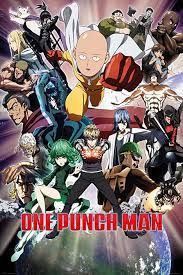
ONE PUNCH MAN

One-Punch Man (Japanese: ワンパンマン, Hepburn: Wanpanman) is a Japanese superhero franchise created by the artist ONE. It tells the story of Saitama, a superhero who can defeat any opponent with a single punch but seeks to find a worthy opponent after growing bored by a lack of challenge due to his overwhelming strength. ONE wrote the original webcomic version in early 2009.

A digital manga remake began publication on Shueisha’s Tonari no Young Jump website in June 2012. The manga is illustrated by Yusuke Murata, and its chapters are periodically compiled and published into individual tankōbon volumes. As of January 2021, 23 volumes have been released. In North America, Viz Media has licensed the remake manga for English language release and was serialized in its Weekly Shonen Jump digital magazine.

An anime adaptation of the manga, produced by Madhouse, was broadcast in Japan from October to December 2015. A second season, produced by J.C.Staff, was broadcast from April to July 2019. The anime series is licensed in North America by Viz Media, and premiered in the United States on Adult Swim’s Toonami programming block in July 2016. The second season premiered in October 2019.

As of June 2012, the original webcomic surpassed 7.9 million hits. As of April 2020, the manga remake had sold over 30 million copies.

On a supercontinent Earth, powerful monsters and villains have been wreaking havoc in the cities. In response, the millionaire Agoni creates the Hero Association, which employs superheroes to fight evil. Saitama, an unassociated hero, hails from City Z and performs heroic deeds as a hobby. He has trained himself to the point of being able to defeat any enemy with a single punch, but his unmatched strength has left him with an overwhelming sense of boredom. Saitama eventually becomes a reluctant mentor to Genos, a cyborg seeking revenge against another cyborg who killed his family and destroyed his hometown. Saitama and Genos join the Hero Association, but due to scoring low on the written entry exam, Saitama is placed at a low-entry rank, and his feats remain unnoticed and unappreciated by the public.

The Hero Association calls all the top heroes to a meeting, informing them that the seer Shibabawa had a vision that the world is in danger before dying. Immediately after, an alien named Boros invades the planet. The heroes fight the invaders outside Boros’s ship, while Saitama boards the ship and fights Boros, who notoriously survives more than one punch from Saitama before being defeated. Saitama meets other heroes, such as the martial artist Bang, the esper Blizzard, and King, a hero considered the strongest man on Earth. Monsters also begin to appear at a rising rate. Another growing threat is the rogue martial artist Garo, Bang’s former apprentice and self-dubbed “Hero Hunter” Garo, who fights and defeats heroes to grow stronger and become a “monster”.

The monster influx is revealed to be the doing of the Monster Association, an organization composed of monsters intent on destroying the Hero Association. They attack various cities, kidnap a Hero Association executive’s child, and recruit fighters by offering them “monster cells”, which cause humans to mutate into monsters with extraordinary abilities. Throughout all this, Garo bonds with a child who idolizes heroes, seeks out heroes to battle, and greatly improves his fighting abilities. The Monster Association attempts to recruit him, and kidnaps the child when Garo refuses. Garo enters the Monster Association headquarters in City Z to rescue the child, but is captured. The Hero Association also breaches the headquarters to rescue the executives’ child and a chaotic battle ensues, in which City Z is destroyed. The majority of the Monster Association’s leaders are slain, but many of the heroes, overconfident in their abilities, are defeated. Garo, having achieved tremendous power, defeats the remaining heroes, before Saitama in turn arrives and defeats him. Despite the objections of the other heroes, Saitama spares Garo’s life and lets him flee.

In the aftermath of the battle, the Hero Association’s poor performance leads to public opinion of them plummeting. Several heroes and officials decide to retire or defect to the Neo Heroes, a burgeoning rival group that appears to be more effective in handling the growing monster threats with its larger membership and the leadership of the hero Blue, who claims to be the son of the long-missing Blast.

WEBSERIES: THE FLASH

  • After being struck by lightning, Barry Allen wakes up from his coma to discover he’s been given the power of super speed, becoming the next Flash, fighting crime in Central City.
  • Barry Allen is a Central City police forensic scientist with a reasonably happy life, despite the childhood trauma of a mysterious red and yellow lightning killing his mother and framing his father. All that changes when a massive particle accelerator accident leads to Barry being struck by lightning in his lab. Coming out of coma nine months later, Barry and his new friends at S.T.A.R labs find that he now has the ability to move at superhuman speed. Furthermore, Barry learns that he is but one of many affected by that event, most of whom are using their powers for evil. Determined to make a difference, Barry dedicates his life to fighting such threats, as The Flash. While he gains allies he never expected, there are also secret forces determined to aid and manipulate him for their own agenda.—Kenneth Chisholm (kchishol@rogers.com)
  • Nine months after “The Particle Accelerator” explosion, Barry Allen wakes up from his coma and discovers that the explosion gave him the power of super speed. Others were affected and gained new abilities as well. However, not all of them use it for good. With Barry’s new powers and team of scientists, he becomes “The Flash” and helps fight crime and protects Central City.
  • Barry Allen was struck by lightning and got in a coma for 9 months. After he awoke from his coma 9 months later, Barry met Cisco Ramon, Harrison Wells and Caitlin Snow. He later on realized that he has powers and how it had been caused by the explosion of the particle accelerator.
  • Barry Allen is a forensic scientist and crime scene investigator at The Central City Police Department with a reasonable happy life, despite the childhood trauma of a man in a red and yellow bizarre killing his mother and framing his father for it. All that changes when a massive particle accelerator created by visionary physicist Dr. Harrison Wells and his team at S.T.A.R Labs causes a malfunction creating a freak storm, killing many people and Barry being struck by lightning in his lab. He wakes up after a coma nine months later. He and his new friends at S.T.A.R Labs discover that he has superhuman speed and can run on both land and water. He can move, think and react at light speeds. He can also vibrate so fast that he can pass through walls, travel through time and lend or borrow speed. He heals more quickly than an average human. Later, he learns that he is but one of the many affected by the incident, most of them who are using their powers for evil. Determined to make a difference, Barry dedicates his life to fighting such threats as The Flash.—Ron Shaju
  • After being struck by lightning and being affected by particle excelerator explosion, Barry Allen wakes up with incredible speed. He calls himself the flash. Now he is desperate to find the person that killed his mother when he was a child. Barry travels back in time on multiple occasions and screws everything up several times and ruins his friends lives but he’s a funny guy. He is also a superhero and has saved hundreds of people’s lives so he’s a good guy. The flash continually gets help from other superheroes like the arrow and Supergirl
  • After being struck by lightning, Barry Allen (Grant Gustin) is reborn. Now having super speed, he has a new name. The Flash. With the help of his friends, he fights crime and find other metahumans like him. And he will do anything to stop them. He is the Flash.
  • After a particle accelerator causes a freak storm, CSI Investigator Barry Allen is struck by lightning and falls into a coma. Months later he awakens with the power of super speed, granting him the ability to move through Central City like an unseen guardian angel. Though initially excited by his newfound powers, Barry is shocked to discover he is not the only “meta-human” who was created in the wake of the accelerator explosion — and not everyone is using their new powers for good. Barry partners with S.T.A.R. Labs and dedicates his life to protect the innocent. For now, only a few close friends and associates know that Barry is literally the fastest man alive, but it won’t be long before the world learns what Barry Allen has become…The Flash.

PUBLIC ADMINISTRATION IN INIDA

Public administration is the implementation of government policy and also an academic discipline that studies this implementation and prepares civil employees for working in the public service. As a “field of inquiry with a diverse scope” whose fundamental goal is to “advance management and policies so that government can function.” Some of the various definitions which have been offered for the term are: “the management of public programs”; the “translation of politics into the reality that citizens see every day”; and “the study of government decision making, the analysis of the policies themselves, the various inputs that have produced them, and the inputs necessary to produce alternative policies.” The word public administration is the combination of two words—public and administration. In every sphere of social, economic and political life there is administration which means that for the proper functioning of the organization or institution it must be properly ruled or managed and from this concept emerges the idea of administration.

Public administration is “centrally concerned with the organization of government policies and programs as well as the behavior of officials (usually non-elected) formally responsible for their conduct”. Many non-elected public employees can be considered to be public administrators, including heads of city, county, regional, state and federal departments such as municipal budget directors, human resources (HR) administrators, city managers, census managers, state mental health directors, and cabinet secretaries. Public administrators are public employees working in public departments and agencies, at all levels of government.

In the United States, civil employees and academics such as Woodrow Wilson promoted civil service reform in the 1880s, moving public administration into academia. However, “until the mid-20th century and the dissemination of the German sociologist Max Weber’s theory of bureaucracy” there was not “much interest in a theory of public administration”. The field is multidisciplinary in character; one of the various proposals for public administration’s sub-fields sets out six pillars, including human resources, organizational theory, policy analysis, statistics, budgeting, and ethics.

In 1947 Paul H. Appleby defined public administration as “public leadership of public affairs directly responsible for executive action”. In a democracy, it has to do with such leadership and executive action in terms that respect and contribute to the dignity, the worth, and the potentials of the citizen. One year later, Gordon Clapp, then Chairman of the Tennessee Valley Authority defined public administration “as a public instrument whereby democratic society may be more completely realized.” This implies that it must “relate itself to concepts of justice, liberty, and fuller economic opportunity for human beings” and is thus “concerned with “people, with ideas, and with things”. According to James D. Carroll & Alfred M. Zuck, the publication by “Woodrow Wilson of his essay, “The Study of Administration” in 1887 is generally regarded as the beginning of public administration as a specific field of study”.

Drawing on the democracy theme and discarding the link to the executive branch, Patricia M. Shields asserts that public administration “deals with the stewardship and implementation of the products of a living democracy”. The key term “product” refers to “those items that are constructed or produced” such as prisons, roads, laws, schools, and security. “As implementers, public managers engage these products.” They participate in the doing and making of the “living” democracy. A living democracy is “an environment that is changing, organic”, imperfect, inconsistent and teaming with values. “Stewardship is emphasized because public administration is concerned “with accountability and effective use of scarce resources and ultimately making the connection between the doing, the making and democratic values”.

History

India in the 600 BCE

Such neat and prosperous civilizations as Harappa and Mohenjo-daaro must have had a disciplined, benevolent and uncorrupt cadre of public servants. In support of this, there are many references to Brihaspati’s works on laws and governance. An interesting extract from Aaine-Akbari [vol.III, tr. by H. S. Barrett, pp217–218] written by Abul Fazl, the famous historian of Akbar’s court, mentions a symposium of philosophers of all faiths held in 1578 at Akbar’s instance. This sounds credible in the context of Akbar’s restless desire to find truth, reflected in his launching a new religion called Din-e-elaahi. The account under advisement is given by the well-known historian Vincent Smith, in his article titled “The Jain Teachers of Akbar”. Some Charvaka thinkers are said to have participated in the symposium. Under the heading “Naastika” Abul Fazl has referred to the good work, judicious administration and welfare schemes that were emphasized by the Charvaka law-makers. Somadeva has also mentioned the Charvaka method of defeating the enemies of the nation. He has referred to thirteen enemies who remain disguised in the kingdom for their selfish interests. They may contain a few relatives of the king and subsidiary rulers, but they should not be spared. They should be rigorously punished like any other such opponent. Kautilya, as already mentioned, has given a detailed scheme to remove the enemies in the garb of friends. The Charvaka stalwart, Brihaspati, is so much more ancient than Kautilya and Somadeva. He appears to be contemporaneous with the Harappa and Mohenjo-daaro culture.

The central point of traditional religious ritual is to earn ready money for its perpetrators. All unproductive, barren rites designed for various moments in human life starting from several months prior to birth and extending over several years beyond death in the form of the annual sraddha, many of which are current even today, are but channels to feed the priests. They are unreal, imagined and wasteful. While they are unreal, imagined and wasteful; the feeding is real.

This cunning paradox was realized by the Charvaka for its real worth. They wanted financial causes to produce financial results. Imagined causes only produced imagined results not real ones.

JOURNALISM IN INDIA

Media interview

Gathering, creating, preparation and distribution of reports of current events based on facts and information is journalism. The term journalism is used for the profession whereas a journalist is a person who is responsible for collecting and presenting the news. 

Journalism is mainly classified into two sections – Print Journalism and Electronic (Audio/Visual) Journalism. Print Journalism involves newspapers, magazines and journals. Different work profiles in Print Journalism includes reporters, editors, correspondents, columnists and many more. Meanwhile, Electronic Journalism is dissemination of news or information through electronic media like radio, television and web. Prominent work profiles in electronic media include anchor, reporter, editor, correspondent etc.

Journalism Courses:

Here is a list of mainstream journalism courses:

  • Bachelor of Mass Media and Journalism (UG, 3 years)
  • Bachelor of Communication and Journalism (UG, 3 years)
  • B.Sc. in Journalism and Mass Communication (UG, 3 years)
  • BA in Media and Communication (UG, 3 years)
  • BA in Journalism (UG, 3 years)
  • BBA in Mass Communication and Journalism (UG, 3 years)
  • MA in Journalism and Mass Communication (PG, 2 years)
  • M.Sc. in Mass Communication (PG, 2 years)

The Scope in Journalism

In the recent years, the communication channels have widened from radio, television to digital and social mediums. India has one of the biggest media industries in the world providing ample number of job opportunities to the suitable candidates. Currently, Journalism has become one of the most prestigious careers in India. Candidates can avail job as a journalist in English, Hindi and many other vernacular languages. Candidates can also avail jobs in different types in different types of journalism mentioned below:

Types of Journalism
Broadcast JournalismCommunications
Fashion JournalismForeign Correspondent
Freelance WritingInvestigative Journalism
Newspaper ReporterPhotojournalism
Social MediaSports Journalism

Print Media

Below are some important job profiles and their roles in print media.

  • Reporter:  The role of a reporter is to gather news and report with accuracy. News sense, objectivity and timeliness are few important qualities, which a reporter should possess.
  • Correspondent: Correspondents are also known as special reporters who are assigned for a particular purpose. Correspondents can be of any beat like politics, sports, crime etc.
  • Feature Writer: The responsibility of a feature writer is to write soft stories with deep research and observations on particular subject.
  • Proof Reader: The role of a proof reader is to assess the edited copy. A proof reader must have good grammatical and punctuation skills.
  • Leader Writer: The role of a leader writer is to write their views on the current topics through editorials.
  • Editor: Editor’s responsibility is to maintain a journal’s reputation. He also ensures that article corresponds with the media in-house style guides.
  • Columnist: The role of a columnist is to write for a specific column in detail in the newspaper or magazine. The column can be related to any topic highlighting his viewpoint on any subject like politics, fashion or films.

Photo Journalists, Cartoonists are some other profiles.

Electronic Media

Here are various job profiles included in electronic media.

  • Researchers: The role of researchers involves deep research on a particular topic. Significant qualities required for this job profile are creativity and excellent research skills.
  • Electronic Media Reporters: An electronic media or broadcast reporter should have good verbal and presentation skills. He should have a news sense.
  • Presenters/Anchors: A presenter should be confident. He must have excellent communication skills, ability to remain balanced in stressful conditions.
  • Freelancers: Apart from the above-mentioned job profiles, freelancers are informal employees who are assigned particular task and are paid according to it.

Areas of work for a journalist

Below are few areas where a journalist can work at different profiles.

Journalists and Their Work Areas
News AgenciesPress Information Bureau
Legal Affairs DepartmentTelevision Industry
NewspapersCirculation and Public Relations
All India RadioJournals
BlogsWebsites

Pay Scale in Journalism:

Most of the aspirants chose journalism due to interest and passion. Check out how well journalists are paid in India.

According to a report in Glassdoor, the annual salary of a journalist at The Times of India ranges from Rs 2.33-9.58 lakh. Meanwhile, the annual salary of a reporter at The Hindu is Rs7.30 lakh.

The pay-scale of a journalist in print, television and radio with similar experiences differ. For example, a senior journalist in electronic media is paid more than a journalist in radio and newspaper with similar experiences. The major difference is because of the higher advertising revenue in television.

Pros and Cons of Journalism:

Journalism is a profession for curious people and like every other profession; journalism too has both pros and cons.

Pros:

  • New opportunities and challenges
  • Opportunity to work with informed people
  • You learn for a living
  • Opportunity to meet people
  • Opportunity to travel
  • A strong sense of achievement
  • You get paid for writing
  • Benefits of a press card

Cons:

  • Not very lucrative
  • Challenging and demanding
  • Long workdays
  • Work pressure
  • Stressful
  • Risk to life

SCHOOL SYSTEM IN INDIA

The Indian education system has made significant progress in recent years to ensure that educational opportunities are available to all segments of society. According to the 2009 Right to Education Act, schooling is free and compulsory for all children from the ages of 6 to 14. However, improvements are slow being implemented and disadvantaged groups may still not have adequate access to education. A high value is placed on education, as it ensures a stable future. All parents want their children to attend the best private English schools, but places are limited. The admission process is therefore highly competitive. Most Indian schools have a strong focus on academic subjects, with little scope for creativity and few or no extra-curricular activities. Traditional schooling methods tend to emphasize rote learning and memorization, rather than encouraging independent or creative thinking. There is a strong focus on examinations from an early age. This makes the atmosphere at Indian schools competitive. Many expats prefer to send their children to international schools. Others choose a more progressive Indian school that is less traditional in its teaching style.

The Education System

The Indian education system is structured as follows:

  • Pre-school: Education at this level is not compulsory. The Montessori system is especially popular at the pre-school level
  • Private playschools: Catering for children between the ages of 18 months and three
  • Kindergarten: This is divided into lower kindergarten (for three- to four-year-olds) and upper kindergarten (for four- to five-year-olds)
  • Primary school: First to fifth standard/class/grade (for six- to ten-year-olds)
  • Middle school: Fifth to eighth standard/class/grade (for 11- to 14-year-olds)
  • Secondary school: Ninth and tenth standard/class/grade (for 14- to 16-year-olds)
  • Higher secondary or pre-university: 11th and 12th standard/class/grade (for 16- to 17-year-olds). This is when students choose an academic area on which to focus
  • Undergraduate: A BA is a three-year degree. Specialised courses such as medicine and engineering can be longer
  • Postgraduate: A one-year course

Types of Schools

  • Public/government schools: Most schools in India are funded and run by the government. However, the public education system faces serious challenges including a lack of adequate infrastructure, insufficient funding, a shortage of staff and scarce facilities
  • Private schools: Since many government schools do not provide adequate education, Indian parents aspire to send their children to a private school. Some expats choose to send their children to private Indian schools
  • International schools: There are international schools in all major cities. They are attended by expat and Indian children
  • National open schools: Provide education up to the higher secondary level for children whose schooling has been interrupted and have been unable to complete formal education
  • Special-needs schools: Provide non-formal education and vocational training to children with disabilities

Curricula Systems

There are different systems depending on which level of government or academic organization sets the curriculum and standards for examinations. Schools are affiliated to one of these “boards”.

  • State government boards: Each state government has a board that sets the syllabus and key examinations
  • Central Board of Secondary Education (CBSE): This is the most common curriculum in secondary schools. Standards are set by the national government for the syllabus and examinations for classes 9 to 12. There is a strong emphasis on math’s and science under this system
  • Council of Indian School Certificate Examination (CISCE): This is more commonly known as the Indian Certificate of Secondary Education (ICSE). The syllabus and exams are set by the CISCE, which is a private body. The subjects are more diverse and equal importance is given to arts, languages and sciences.
  • International Baccalaureate (IB): The curriculum is set by this non-profit educational foundation, which is recognized all over the world. It features a more innovative syllabus that focuses on all-round development rather than just academic subjects. Many international schools follow this curriculum. To find  schools offering the International Baccalaureate curriculum.
  • Cambridge IGCSE: Many international schools also offer the international Cambridge curriculum for 14- to 16-year-olds. The focus is on developing students’ skills in creative thinking and problem solving. For a list of schools in India following the Cambridge curriculum

For more background information, The British Council have published a detailed overview of the Indian School Education System

Fees and Enrolling at a School

As competition for places in good schools is high, parents must start the admission process at least six months prior to the start of the school year in June. An admission interview and/or exam is often required, even at the pre-school level. In addition, some schools admit students based on a list of preferential criteria such as place of residence, a sibling who is already enrolled at the school or a parent who is an alumnus. The documents required for admission include:

  • Application form and fee
  • The child’s birth certificate
  • Proof of residence (utility bill)
  • Report cards of previous school years (if applicable)

Annual fees can vary from Rs25,000 to Rs200,000 at the elite private schools. In addition to fees, a donation to the school is also usually expected, which can range from Rs50,000 to Rs100,000.

Economic Development of Bangladesh

Economic Development of Bangladesh

Bangladesh on World map

The poverty rate of Bangladesh fell from 38.8 per cent to 14.3 per cent over a span of forty years. And Bangladesh has been performing better than India and Pakistan recently in various social indicators like fertility rate and infant mortality rate. This has been possible with consistent efforts towards development.

Since the year 1975 Bangladesh has been classified as a ‘Least Developed’ country by the United Nations and it will likely graduate from this classification by the year 2024. But it was least expected at the time of Bangladesh’s independence. U. Alexis Johnson, Under Secretary of State of United Nations said Bangladesh was an “international basket case” while New York Times reported the country as a ‘Failure’. On the contrary Bangladesh outperformed many expectations.

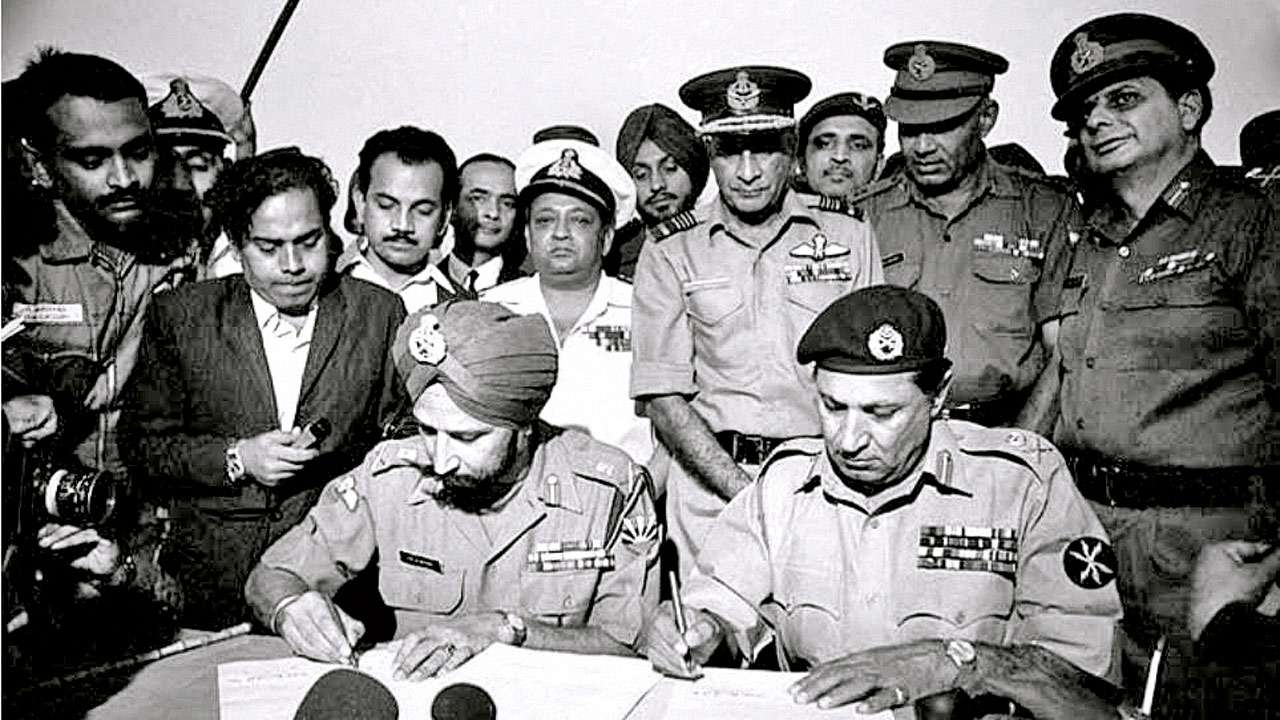
Bangladesh gained independence in the year 1971 with the help of Mukti Bahini and support from India. Since the country was established in prevailing conditions of violence, even the basic needs of the citizens could be barely met by the government of Bangladesh. In addition, the country the country faced a severe drought in 1975 which killed approximately 1500000 people. Political instability also contributed to make situations worse. Around 10000000 Bangladeshis immigrated to India because of the violent situations there. Due to several such reasons the country depended majorly on foreign aids.

But the situations improved due to these reasons:

  1. Manufacturing(textile industry): Bangladesh is world’s second largest exporter of textiles. According to garment associations of Bangladesh, the textile industry constitutes almost 10 per cent of the their national GDP. Textile industries of the country employ around 4 million people directly and 10 million indirectly.
  2. Women empowerment: Around 80 per cent of employees of the textile industries of Bangladesh are women. This hasn’t just helped women of the typical conservative society to get financial independence and better lives but has actually changed the future of the nation. An economic research paper showed that in the families where women were employed at garment factories witnessed a decline in fertility rate, the age of marriage increased and there was a rapid increase in girls’ educational attainment. The possible reason behind the improvements may be to take advantage of jobs and due to increased family income. The garment industry helped improve the lives of all women of the nation as World Bank showed a decrease in female-male wage gap due to increased employment of women in garment factories.
  3. NGO’s: Many NGO’s like ‘brac’ played a significant role in national development. These NGO’s fulfilled people’s financial and medical requirements, constructed schools and also conducted several public health campaigns. Arvind Subramanian, India’s ex-Chief Economic advisor says the development of Bangladesh in collaboration with NGO’s is no less than a miracle. As in democratic countries the governments tend to avoid much dependence on non-governmental organizations for public works as this leads to defamation of the governments and the chances of corruption are also lowered. But Bangladesh overcame this to which he explains reasons like the low tax to GDP ratio of the country and the poverty and violence at the time of establishment of democracy. Due to all such reasons NGO’s voluntarily took the responsibilities and have done well.
  4. Foreign relations: Pre-independence of Bangladesh, the geopolitical conditions were complex but still in the challenging situations Bangladesh has managed to have a good foreign policy. For example USA provided Bangladesh a good amount as foreign aid even though it was against Bangladesh’s independence. The second major factor is remittances. These remittances, or the earnings sent home by those working abroad constitute around 6 per cent of the national GDP. And the foreign policies of Bangladesh helped them export garments easily to several developed countries through which they avoided ‘aid curse’, or a situation where a country’s individual economic development is crippled due to excessive dependence on foreign aids.

Challenges ahead:

  1. End of duty free access: As Bangladesh is classified as ‘Least developed country’ by the UN, it enjoys duty free access to exports in several developed countries but as it will graduate from the classification in the coming years export duties would be imposed and specifically garments exports would get badly affected.
  2. Automation: The country’s GDP is largely depended on the textile industry but automation in the textile industry in the years ahead may replace a chunk of the employees leaving a worse impact on the economy as a whole. Thus the industries must be diversified making the economy less depended on the garment industry.
  3. Lack of political freedom: There have been several cases of threatening and even murders of journalists, political activists and media workers. This kind of governmental control and censorship might allow short term development but the long term impacts and overall developments get endangered.
  4. Climate change: This is probably the biggest challenge in the face of Bangladesh. It was the seventh on the list of countries under long term climate change risks. Floods and cyclones are common in the country now and the poor rural people are amongst the worst affected.

But besides everything Bangladesh’s development is worth learning while it outperformed all the expectations.

10 Lifestyle Habits of Successful Musicians

The manner a musician moves is thought to reveal a lot about him or her. Music is a way of life for successful musicians. These ten lifestyle habits are some of the keys that the great ones have in common.

Exercise Daily

Keeping your body in good form is essential for having a creative mind. The health of some of the most successful artists is credited with their musicianship. Many people feel that jogging, going to the gym, yoga, and other activities are beneficial to their musical careers. Make sure the workout you pick will have no detrimental consequences on your chosen instrument (i.e. making your hands or throat sore).

Eat Healthy

A healthy diet can help you have a clear mind and a responsive body. Make sure you’re eating a well-balanced diet rich in nutritious foods to ensure you’re performing at your best. Wherever possible, minimize your intake of processed foods. Above all, find out what works for you. No additional sugar is a motto for some individuals. For some, avoiding salt is the way to go. Practice with eliminating specific foods from your diet for a day or two to find what works best for you.

Practice Daily

This is self-evident to any musician who has reached a high degree of proficiency. On a hectic day, even 15 minutes of practice time may be incredibly beneficial. Prioritize quality above quantity, and ensure that you enter your practice space with a clean mind.

Seek Out A Teacher

While it’s tempting to absorb everything you can from YouTube videos, studying with an expert teacher provides essential knowledge. Find an instructor with whom you have a strong relationship and whose playing you like. A competent instructor will undoubtedly provide you with resources that will continually push your playing to a higher level and at a faster rate than you could achieve on your own.

Develop Your Sense Of Rhythm

Every musician is able to keep the band running instead of having to halt every time a misstep was heard by learning to stay with the flow and not falter because of playing the incorrect note. Keeping the band together is a crucial skill, and honing your sense of rhythm can help you achieve that. Using a metronome can also be beneficial.

Work On A Solo Performance Piece

One of the most important ways to improve your musicality, according to virtuoso vocalist Bobby McFerrin, is to select a challenging composition and study it well. This will expand your repertoire and provide you with a variety of techniques that you may use in improvisation.

Learn The Rudiments

Scales, arpeggios, paradiddles, voice scans, and other foundational exercises are essential for all artists. Each instrument has its own set of fundamental exercises that you should learn. You’ll be well prepared to handle music provided to you by composers once you’ve learned all of your major and minor scales and arpeggios, which may take some time. You can quit practicing these exercises once you’ve spent enough time with them since they’ll be imprinted in your musical vocab.

Study Musical Style

The majority of musicians do not confine their skills to a single style. It’s crucial to listen to and study music from other civilizations in order to achieve a synthesis in your performance. Ray Charles regarded himself as a cross between traditional gospel and modern R&B. Every artist is a culmination of all they’ve ever heard and practiced.

Apply Knowledge From Other Instruments

If you’re a trumpet player, listening to and learning anything played by a violinist is a fantastic idea. Learn a piece from the guitar canon if you’re a pianist. This will allow you to view music in a new light.

If You Are An Instrumentalist Sing! If You Are A Singer Play An INstrument!

Make it a point to sing along with whatever you play. This is how you may hone your hearing and learn to hear things before playing them. Many good improvisers have a large repertoire of licks and phrases that they can remember instantly from memory. This is a skill that may be learned via singing and practise. The piano or guitar is used by the majority of western composers and singer/songwriters. These chordal instruments serve as a foundation for learning how to read music. No matter what instrument you play, using your voice and playing chordal instruments are two of the most useful musical growth tools.

The Challenges Faced By Women in The Workplace

You’re in a meeting and the inquiry “Are you hitched?” or “Do you plan on having kids?” is tossed at you. You’re likely considering how your own arrangements identify with the capacities you can bring to the association. Regardless of whether the enlisting chief just needs to become acquainted with you on an individual level, the meeting isn’t the perfect spot to do as such. Likewise, for what reason aren’t folks asked exactly the same thing? Individual plans ought not be talked about on the grounds that they may imperil your shots at handling your fantasy profession.

Individual plans ought not be examined on the grounds that they may risk your shots at handling your fantasy vocation. Luckily, a few social government assistance associations, like the United Nations, are bringing issues to light about this issue all throughout the planet and vowing to kill sexual orientation predisposition in the work environment.

Social and Cultural factor.

Despite the fact that we’ve come a long way in history by gaining the right to work and vote, there is still gender bias in the workplace – whether it’s a man benefiting more from small talk than women, the office temperature being set to the average male comfort level, or a strong woman being labeled as “a b*tch.”

Men are dynamically sharing more neglected work in the “second shift,” yet ladies keep on enduring the worst part of home tasks and face substantially more breaks from family requests during their generally compelled working hours.

Being a human female and being a-lady are two exceptionally unmistakable things. The second is a social term. Ladies have muddled social, social, and individual narratives, not just organic creatures with actual highlights that vary from guys of similar species. Ladies’ and men’s lives, work, and bodies are not at all like such an extent that it’s protected to say we live in two universes. It’s useful to consider human social orders partitioned into two societies: his and hers. Ladies are bicultural along these lines. This implies that ladies are naturally introduced to a general public that couple of guys know about. Ladies comprehend the principles of our own portion of the world just as the guidelines of the other portion of the world since we are more in touch with one another.

Hidden Challenges

With regards to progressing in the working environment and in numerous different parts of society ladies keep on going up against deterrents. This is the reason, in the wake of the Women’s March on Washington (seriously! ), We’ve additionally incorporated a couple of activities that pioneers who are ready to be innovative and make room at the table for ladies to prevail at work should take.

Gender Pay Gap.

The gender pay gap is a hot topic in today’s workplace, with figures indicating that “women receive 76 cents on the dollar when compared to men.” Is it because we, as women, are more accommodating and less likely to speak up? Or the fact that men are still considered to be the breadwinners (how antiquated! )? Whatever the cause, being a woman will almost always result in a lower wage than a guy seeking for the same job.

Woman MBA graduates were paid $4,600 not as much as men in their first occupation after graduation, even subsequent to representing related knowledge, time since graduation, work level, industry, and topographical region.

Ascending the corporate ladder.

Young female experts face more noteworthy difficulties in propelling their professions, as they should work more enthusiastically than their male partners to acquire consideration or praise. Take a look at the top chiefs of the most notable associations, and you’ll see a typical topic: they’re all folks! The reason for this is obscure, yet there is a far and wide insight in many businesses that guys advance quicker and ladies are respected ‘inept,’ in any event, whenever they haven’t been allowed the opportunity to substantiate themselves.

Sexual Harassment.

Sexual Harassment is as yet an inescapable issue, with no less than one-fourth of ladies detailing some type of work environment badgering. Managers experience the ill effects of expanded non-attendance, high occupation turnover, and low usefulness and commitment because of this deceptive conduct. Separately, ladies feel troubled, restless, or surrender their positions with expectations of forestalling further badgering.

Appearance

For what reason is a lady’s appearance evaluated more brutally than a man’s? ‘ Whether it’s about clothing, body type, or cosmetics… Ladies are once in a while chastised for not looking cleaned enough, with the far and wide presumption that on the off chance that they aren’t wearing beautifying agents or high heels, they couldn’t care less about their positions.

Others may accept a woman is making a decent attempt on the off chance that she dresses her best and gives close consideration to the complexities of her appearance.’ It’s hard to find some kind of harmony between looking clean and expert while yet not showing up excessively cleaned or unkempt.

Pregnancy Discrimination.

Segregation can take the state of rude comments about an individual’s physical or ailment made by senior authorities, customers, friends, or clients. Bosses may diminish a female worker’s functioning hours, pay, or advantages, decline to advance her, or power her to get some much needed rest, in addition to other things (paid or neglected).

Ego conflict

Women in places of force are as often as possible stood up to by a boastful person who will not follow a lady’s orders — seems like stone age men gibberish, isn’t that so? Tragically, imbalance like this actually wins in the present work environment. A few guys would disparage a lady or address her like she is uneducated (when, truly, we presumably know more than them, yet we let them brag in their magnificence thinking they have the high ground). The best way to battle this is to disregard the downer and attempt to convince them to adjust their psyches so they can believe the solid woman and quit battling with her.

When on period

Women everywhere on the world have essentially once in their life have been liable to bias when on their periods. At the point when they show feelings like displeasure or bothering, they are ridiculed by remarks like, “quit objecting. Is it true that you are on your periods? ” Ladies go through overwhelming actual torment while on their periods. An exemplary illustration of ordinary sexism is male representatives considering ladies taking leaves while bleeding as a pardon not to come to work.

Favoritism in the workplace

Do you work in a male-dominated business and believe your boss favors one of your male coworkers? They’re usually joking around about the current football craze or debating the latest technical breakthrough, but you only talk to your boss about work-related subjects. If you want to see if you’re being treated unfairly, start a conversation about something you both care about. You can bet that your gut hunch was true if it was soon dismissed.

Inconsistent work-life

A work-life balance is another notable problem that today’s working women encounter. Work demands often take a toll on their personal lives, and vice versa. After countless nights of going late at the workplace to finish a crucial project, family members often feel neglected. On the other hand, because they have to leave work on time to pick up their children from their after-school activities, mothers find themselves in the same dead-end situation years later.

Shockingly, this is now and again self-delivered; to break out of it, we need to more readily sort out our time and focus on our destinations.

Conclusion

Individuals the whole way across the world are discussing progress and building a climate where everybody is dealt with decently. In any case, for what reason does it’s anything but a stop with ladies? Can any anyone explain why women are relied upon to find some kind of harmony among work and home while guys are required to accommodate the family? While a few men have ventured up to help ladies in their goals, for what reason is the expression “feminists” related with such aggression and hatred? It’s previous opportunity to expose harmful manliness and teach individuals about women’s liberation’s objective of shutting sexual orientation abberations and accomplishing political, monetary, individual, and social correspondence.


Deep Bar and Double Cage Rotors

What is the need of Deep-Bar and Double-Cage Rotor?

Conventional Squirrel Cage motors suffer from the disadvantages of low starting torque because of low rotor  resistance. The starting torque can be increased by using the bar material of higher resistivity. However high rotor resistance reduces the full-load speed, increases rotor ohmic loss and lower efficiency. Therefore in order to achieve high starting torque without effecting the efficiency, the rotor resistance is made higher at the time of starting & low under normal operating conditions. In wound rotor induction motors these conditions are met  by connecting external resistance in rotor circuit at the time of starting & resistances are cut out in steps as the motor attains its normal speed. In squirrel cage motor this is not feasible as the  conductors are short-circuited by end rings. In order to attain the above desired conditions following types of rotors are used:

  • Deep bar rotor
  • Double cage rotor.

Deep Bar Rotor:

Figure below shows a cage rotor with deep and  narrow bars. A bar may be assumed to be made up of number of narrow layers connected in parallel. It is seen that the top most layer element ‘A’ is linked with minimum leakage flux and therefore its leakage inductance is minimum. On the other hand, the bottom layer ‘C’ links maximum flux,  therefore its leakage inductance is maximum.

Deep Cage Rotor

At starting the rotor frequency is equal to the supply frequency. The bottom layer element ‘C’ offers more impedance to the current flow then upper layer ‘A’. Therefore the maximum current flows through the top layer and minimum through bottom layer. This unequal current distribution causes the effective rotor  resistance to increase. With a high rotor resistance at starting condition, the starting torque is relatively high & starting current is low as desired. Now under normal operating conditions, the slip and the rotor frequency are very small. The reactance of all the layers are  small compared to their resistances. The impedances of all the layers are nearly equal, so current flows through all the parts of the bar equally. The resulting large cross-section area makes rotor resistance small, resulting in good efficiency at low slips.

Double Cage Rotor:

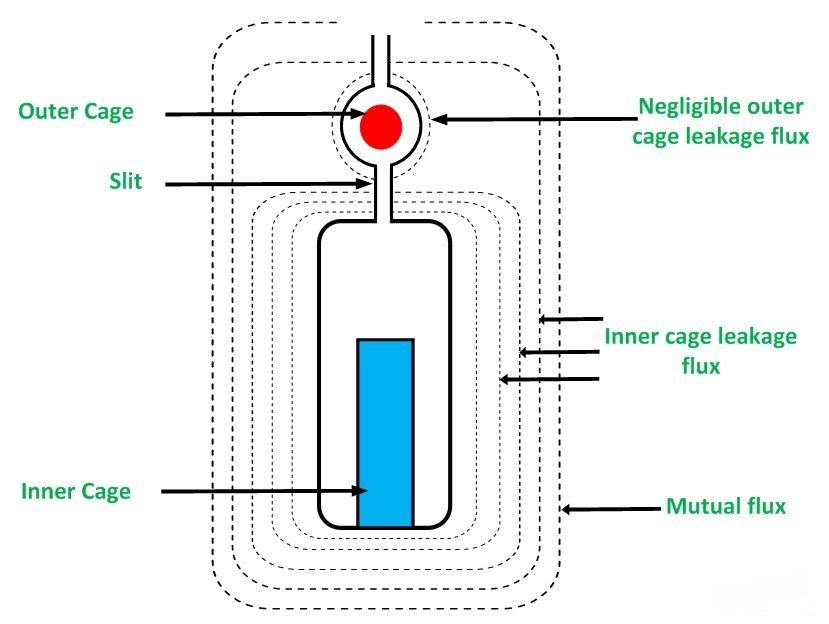
An induction motor with two rotor windings or cages is used forn obtaining high starting torque at low current. The stator of a double cage induction motor is similar to that of ordinary induction motor. In double cage rotor there are two layers of bars as shown. The outer cage bars have a  smaller cross-sectional area than the inner bars and are made of high resistivity materials like brass etc.

Double Cage Rotor

The inner cage bars are made up of low resistance material like copper. Thus the resistance of outer cage is greater than that of inner cage. There is a slit between the top and bottom slot. Thus the leakage flux linking the inner cage winding is much larger than that of outer cage. The inner cage winding, therefore has a greater self inductance. At starting voltage induced in the rotor is same as the supply frequency. Hence the leakage reactance of the inner cage winding is much larger than of the outer cage. Therefore most of the starting current is flowing in the outer cage winding which offer low impedance to current flow. The high resistance outer cage winding, therefore develops high starting torque. As the rotor speed increases, the frequency of rotor emf decreases.

At normal speed, the leakage reactance of both the winding becomes negligibly small. The rotor current division between the two cages is governed mainly by their resistances. Since the resistance of the outer cage is about 5 to 6 times that  of inner cage, most of the rotor current flows through the inner cage. Hence under normal operating speed, torque developed mainly by low resistance inner cage.

One Piece: Review

Is it really worth watching 900+ episodes ? Is it really worth giving my time?  These type of question may come in your mind before starting One piece which is absolutely natural.

I am going to be really frank and clear to you all,  I myself dropped this series just because it has 600+ episodes,  and when I started there were many series with much better graphics and animation that I could not hold on to one piece  for long,  but that cannot be blamed just because the show started in 1999 and we have to bear it for certain episodes (in starting for graphics) but when story took control over your mind there is no going back , you will be attached with the character to the fullest.

Story Starts with a boy named Monkey D. Luffy or a.k.a The Straw Hat Pirate(title came from his worn-out straw hat that he always have on). he sets off to find Shanks, his pirate idol to return his straw hat as promise and find One Piece to be able to earn the title of Pirate King. Along the way he gathers all kinds of oddballs for his crew, The Straw Hat Pirates . It’s not just the story of pirates and navy , but it’s much more than that , it will carry you on roller coaster of emotions where you will laugh, cry, feel almost all the emotions .

One Piece arcs can be surprisingly amazing. There were times when I rolled over my bed because of some plot twist. It has a very interesting setting as well, from starting it grabs your attention and don’t get loose , in the end of every season it gives you such an arc that you’ll stick to it again because one piece always left some unanswered question for the viewers which make us stick to it. One of the biggest reason for its success is that the shadow of protagonist never overlaps with another character and this enables other characters to put their light on the viewers and we did not get bored seeing the protagonist only . Story also depicts some harsh realities of the world like , how badly humans are treated or how badly humans behave with others  which is distressing to watch but we cannot turn our back from the truth and this makes it more exciting for the audience to watch. From taking you to the green land to rough desert from high mountain to deep sea, the creation  of another world is smoothly choreographed that you will see yourself floating into it.  And that my friend, is what an adventure anime should really be.

This Series have some of the best backstories in the anime world which will not even make you cry but also put so much anger into you that you want to go and punch the villain. Backstories is  one the strength of this anime/manga, you may get attracted towards the villains too with some of the backstories and you will be able to justify their deeds to a some point as well.

Wealth-Fame-Power (yes, we know these words  from the introduction of One piece, right ?), you will come across these three words from the starting of the series but behind these 3 words you will find  Trust-Friendship-Promise  which soak emotions deep into our heart . One Piece knows exactly when to do comedy and when to get emotional they have able to maintain the balance till now and we can hope it will not disappoint us . In search of comedy they never deviate from there 3 unspoken root of Trust-Friendship-Promise and these 3 forces  puts so much adrenaline in the viewers that it is coming from past 20 years and can go for 10 more years.

And that’s where the negative starts of this anime, after so much year when you see closely story has gone only about 60%, they have wasted so many episodes just for the sake world building which can be expected by shonen (it gives priority to setting the new world) and when they have so much episodes in their bag and story is so long then there is no need for filler episodes in my opinion. It has a slow start no doubt about it, some may take 8 episodes and some may take around 280 episodes to get attracted towards it and that is why people complains about it so much.

 So back to our original question Is one piece worth watching?

Obviously it is, once you have watched it surely it’s going to be in your top 5 anime list. If you’re new to this anime world and want to see something unique then this is your anime go for eye, and anime lovers if you’re fan of shonen then how can you miss its one of the best. Don’t get worried about 900+ episodes we all know how it feels when an anime gets over so, what better than never getting finished so watch 2 episodes a day, no need to watch it continuously or wrap 900 episodes in a single blow watch it in your free time, this anime will not leave you/or finishing soon if you start today it will be with you for years. You are not going to regret the time you will give to one piece.

It is an action adventure comedy drama superpower anime One Piece has had a total estimated circulation of approximately 3.1 billion copies in Weekly Shōnen Jump magazine  ,you may understand by the number only it’s not worth missing.. Thank you for reading.

Importance of Water Conservation

Water is one of the most essential natural resources for life on Earth. About 97% of the earth is surrounded by water with only 3% of this being fresh water, which can be used for consumption, agriculture and other usages. Water scarcity situation occurs when high rate of aggregate demand from all water-using sectors exceeds available supply, under the prevailing infrastructural conditions. From Cape Town to sub-Saharan Africa to Asia’s teeming megacities, there’s a global water crisis affecting millions of people. Water scarcity affects every continent and was listed in 2019 by the World Economic Forum as one of the largest global risks in terms of potential impact over the next decade.

India’s water problem

India, the second most populous country in the world, has a diverse population that is three times the size of the United States but lives in one-third the physical area. The usage of water across various sectors in India is on the rise, driven by a combination of population growth, socio-economic development and changing consumption patterns.

Geographically also, there is considerable variation within the country with respect to water availability. About 71 per cent of India’s water resources are available to only 36 per cent of the area while the remaining 64 per cent has to make do with 29 per cent of available water (India’s Water Future 2050; Verma & Phansalkar report). Irrigation perhaps the most important input in the agriculture production compared to all other key inputs like seed, fertiliser, etc. In fact, these inputs cease to realise their full benefit unless combined with irrigation. As with all countries with large agricultural output, excess water consumption for food production depletes the overall water table.

India has made massive improvements to both the availability and quality of municipal drinking water systems, however, due to increase in population and rapid growth in India’s urban areas, water scarcity is a looming problem in most major cities across the country. India’s water demand is expected to continue increasing at a similar rate until 2050, accounting for an increase of 20 to 30% above the current level of water use. This can be attributed mainly due to rising demand in the industrial and domestic sectors. Moreover, as the overall population is expected to reach 1.6 billion during the same time period, water scarcity situation, similarly, will further worsen in times to come. Therefore, sustainable management is essential to protect the water environment and to meet the increasing water demand in the future.

Countering India’s water problem

Many areas of India are fortunate to have a relatively wet climate, even in the most arid regions. In these areas, rainwater harvesting could be one solution for water collection. In India, rainwater harvesting has been in practice for more than 4000 years. It is basically a simple process of accumulating and storing of rainwater for drinking, irrigation, and water for livestock.

Rainwater harvesting and management hold tremendous potential for reducing rainwater runoff and reducing groundwater consumption, particularly in urban areas. These systems are acting as incredible support systems in many Indian cities by providing a superb alternative to the main water supply, especially during dry seasons. Widespread installation of these systems is also revitalizing the natural properties of land, helping to improve the quality of groundwater, raising its level, and preventing wells and tube wells from drying up. Additionally, efficient deployment of rainwater harvesting systems is limiting surface runoff of water, which is reducing soil erosion, and increasing its fertility.

More or less all states in India, have made rainwater harvesting mandatory in government institutions, commercial complexes, and residential high-rises. Some of these laws have already come into effect, and others are soon to follow. The Central Ministry for Drinking Water and Sanitation, in association with the Central Ground Water Board has prepared a conceptual document called the ‘Master Plan for Artificial Recharge to Ground Water in India’. The master plan envisages the construction of about 23 lakh rainwater harvesting structures in rural areas, and close to 88 lakh artificial recharge and rainwater harvesting installations in urban centres.

Conservation of water in the agricultural sector is essential since water is necessary for the growth of plants and crops. Only a part of the rainfall or irrigation water is taken up by plants, the rest percolates into the deep groundwater, or is lost by evaporation from the surface. In India’s arid and semi-arid areas, the ‘Tank System’ is traditionally the backbone of agricultural production. ‘Tank System’ refers to large tanks are constructed either by bunding or by excavating the ground to collect rainwater, check water flow and accumulate the run-off. Simple techniques like these can be used to reduce demand of ground water for irrigation. Therefore, by improving the efficiency of water use, and by reducing its loss due to evaporation, agricultural water demand can be reduced.

The Fashion Models Lifestyle

Fashion models’ ways of life are loaded up with fervor and challenge. Fashion models’ ways of life are “lived in the fast track” with photograph shoots, hairdressers, high style attire and design photographic artists. Everything sounds incredible and it’s anything but, a model should function like she is maintaining a business and she is the item that others need.

Most supermodels began their professions by being enlisted by demonstrating scouts who wander around the country in an eager quest for new faces. Different models have sent a couple of basic photos of themselves with a characteristic face, tight pants and basic top with medium heels. Others have been joined at offices’ open castings. Some supermodel’s have additionally been fortunate: Kate Moss and Gisele Bundchen were found by Mario Testino, perhaps the most regarded names in the realm of style photography.

Fashion Week- New York, Paris, London, Milan

Karlie Kloss, Martha Hunt, Irina Shayk, and Miranda Kerr are fashion models who have walked the runways in big apple, Paris, London, and Milan. A glimpse behind the curtain in their way of life is continually charming. Fashion week in those cities is filled with glamour and excitement of that world, but there also are instances of tedium and exhaustion that go hand-in-hand with journeying on planes and sitting forever and ever in makeup chairs. All enjoy the massive pay-checks and free garments that for them balances out the troubling realities of an industry that prizes youngsters and thinness. For these women, being a mode version isn’t a dehumanizing manner to form a dwelling a voiceless model. They enjoy their job and skill assembly other humans within the fashion industry whether dress designers, photographers, editors, agents, different models, and experts within the enterprise.

Typical Lifestyle

The common lifestyle of an ordinary operating model isn’t quite as glamorous on an everyday foundation. A version has to attend to herself and maintain a tremendous and professional attitude. A standard day inside the lifestyles of a version starts early with a trip to the gymnasium and schooling for a minimum of thirty mins before a calorie-controlled breakfast which includes meat and an egg for protein to present her energy. At 9 am she may additionally have her first casting of the day. This is wherein she has an appointment to look if she can win the job in the time allotted. She shows her model portfolio and leaves a comp card and her business card with the casting agent.

Traveling to any other casting takes money and time. If the model has a style fitting, the agents will need to ensure the garment will appearance good, sit down nicely, and can walk the runway to perfection.

Lunch is every other high-protein meal to provide lots of power without including fat. The shoot is for not less than three hours. Hair is executed by way of the stylist and then make-up, which may take an hour or greater.

The photoshoot finishes in the late afternoon and she calls her agent. Her agent tells her that she has won one task from the day gone by and it went properly this morning, however without an answer on casting as but.

She ends her day having made just over $500 for the day after charges. Her night meal is a salad as she wishes to maintain her weight low. The evening is spent on the internet catching up with the present-day shoe and undies styles. Her underwear remains on fashion, however she orders a pair of shoes to preserve beforehand of the style scene. She orders online because she doesn’t need to buy a shop selling closing seasons style. She desires seven hours of sleep to allow her body to relax and rejuvenate, prepared to copy the casting technique inside the wish she can be picked for another position, because of this she is in mattress with the aid of 11 pm. That is the way of life of a style model.

Windows 11 Update

It’s true: Windows 11 is coming. At a virtual occasion on June 24, Microsoft uncovered “the up and coming to age of Windows,” for certain large changes to the long-standing working framework, including its first-name change in quite a while. The update comes soon after Microsoft carried out the most recent form of Windows 10, the Windows 10 May 2021 update (otherwise called variant 21H1).

Windows 11 incorporates a lot of new highlights, including the capacity to download and run Android applications on your Windows PC and updates to Microsoft Groups, the Beginning menu and the general look of the product, which is all the more perfect and Windows like in plan. (Here are the entirety of our #1 new Windows 11 highlights and how to utilize them.)

WHAT NEW FEATURES DOES WINDOWS 11 INCLUDE?

i. A new, more mac-like interface. windows 11 features a clean design with rounded corners, pastel shades, and a centered start menu and taskbar.
ii. Integrated android apps. android apps will be coming to Windows 11 and installable from within the new Microsoft store via the amazon AppStore. (there were a couple of ways to access android apps on windows 10, including if you had a Samsung Galaxy phone, but this will make it native.)
iii. Widgets. while they’ve been around for a while (remember desktop gadgets on windows vista?), including in a recent windows 10 update, you can now access widgets directly from the taskbar and personalize them to see whatever you’d like.
iv. Microsoft teams integration. Teams are getting a face-lift and will be integrated directly into the Windows 11 taskbar, making it easier to access (and a bit more like apple’s facetime). you’ll be able to access teams from windows, mac, android, or ios.
v. Xbox tech for better gaming. windows 11 will get certain features found in Xbox consoles, like auto hdr and direct storage, to improve gaming on your windows pc.
vi. Better virtual desktop support. Windows 11 will let you set up virtual desktops in a way that’s more similar to macOS, toggling between multiple desktops for personal, work, school, or gaming use.
vii. Easier transition from monitor to the laptop, and better multitasking. the new os includes features called snap groups and snap layouts — collections of the apps you’re using at once that sit in the taskbar and can come up or be minimized at the same time for easier task switching. they also let you plug and unplug from a monitor more easily without losing where your open windows are located. 

When is the Windows 11 release date?

Windows 11 is now available as an insider preview build download for those in the windows insider program and will be available as a public beta in July. it will begin rolling out to all compatible pcs and new pcs around the 2021 holiday season, according to Microsoft, and will continue rolling out into 2022. however, several hints suggest that windows 11 could arrive as early as October. 

Will my computer be compatible with Windows 11?

To see if your current windows 10 pc is eligible for the free upgrade to Windows 11, go to Microsoft’s website for a list of requirements.

Originally, Microsoft was directing people to download the pc health check app to check if their machines were compatible. however, many users reported that it did not give adequate amounts of detail as to why a device was not compatible. on June 28, a Microsoft blog post said the company was “temporarily removing the app” to address this issue, and that the tool would return before the fall windows 11 release. (when it does return, we have step-by-step instructions for how to use the pc health check app, and what information it will give you. in the meanwhile, here’s how to check some hardware compatibility with Windows 11 without that tool.)


If you buy a new pc between now and the general release, that computer will also be eligible for the free upgrade.

Will it be free to download Windows 11?

If you’re already a Windows 10 user, Windows 11 will appear as a free upgrade for your machine.

For more, check out every feature we wanted in Windows 11 but didn’t get, everything to know about the most recent Windows 10 may 2021 update, the best Windows 10 hidden features we’ve found, and six simple security changes all Windows 10 users need to make.

Spiritual person

The Mindful World

The first thing that caught my eye about The Mindful World is just how beautiful their site design is. This is one good looking mindfulness blog.

It takes more than just good looks to be included in this list of the best spiritual blogs, though. And, indeed, The Mindful World has a lot of depth behind that pretty exterior.

The Mindful World is a group of individuals who are passionate about spreading mindfulness around the world. Their articles are very in-depth and some of the most professionally written pieces on any spiritual website.

Excerpt from CONFRONTING REALITY: The lie of Evidence-Based Treatment and how it affects psychological therapy for abused children

“The scientific process is supposed to be the golden standard for the pursuit of knowledge and truth. When asked to think of a scientist, many people will imagine a somewhat “nerdish” individual who’s often more comfortable with numbers than people.

We imagine these scientists as being wholly dedicated to their research and unwavering in their pursuit of the truth. The idea that many published scientists are heavily influenced by politics, that scientific journals often compromise their standards for publications, and that many universities look the other way to secure federal funding, often comes as a shock to most people.”

Change Your Energy

Change Your Energy is a spiritual healing blog. It reads like a self improvement blog, packed full of excellent advice on articles on all manner of self development topics. Every article is full of spiritual guidance and offers inspiration for developing your spiritual life. Change Your Energy is is also one of the most professionally presented spiritual blogs.

My favourite excerpt : From the article “Sing As If Speaking, Dance As If Walking”

“Do you pick up your smartphone, look for people to chat with, or go to the TV or Internet because time alone is lonely, strange, or difficult? You can be a wonderful friend to yourself, incomparably better than any person or any machine.

Here is a suggestion for enjoying spending time with yourself: Sing and dance for 30 minutes every day. Try to sing as if speaking and to dance as if walking.

Enjoy being immersed in yourself, regardless of what other people think. The time you enjoy spending with yourself is time for changing your energy and for accumulating energy. You can encounter your soul as you sing and dance.

Mom On A Spiritual Journey:
Mom on a Spiritual Journey is the blog of Sarah Lawrence Hinson. Sarah gives spiritual coaching sessions and writes articles about both her personal life and about spiritual energy.
My favourite excerpt:
From “6 tips for driving your car as a spiritual practice”
“MAKE YOUR CAR A NO PHONE ZONE LIKE OPRAH SAYS.  I’ll be the first to admit that I am useless at using a phone and driving, in fact I’m a downright danger so don’t do it at all.  Just because you might be better than me doesn’t mean you should do it too though.  If the phone rings and I am alone, I pull over if I know I’m waiting for an important call.  If you work a lot on your phone, get hands free…it’s not the greatest idea but it could save your life.  If I have the girls in the car then they answer the phone for me.  When it’s their turn to learn to drive, texting and driving will not be acceptable because I DON’T DO IT

Spiritual Awakening Process:

Spiritual Awakening Process discusses many aspects of spirituality and offers practical advice to improve your spiritual life. The best part of Spiritual Awakening Process is the one hour sessions that can be booked and which offer help for you on your spiritual journey. Definitely a great spiritual blog.

LINK: SPIRITUAL AWAKENING

Favourite Except: From “Awakening”

“Life inside the awakening is a whole other beast. Many people focus on the singular point of awakening, that amazing “Ah-ha!” moment. However, while that is a critical piece of the awakening process, so is the transition from sleep-mode to every moment awakeness. The awakening ushers in a time of transition that is unsettled, unstable, and unique. It is a time of embracing new and amazing parts of you and then trying to crawl right back into bed. It is a time of expansion and contraction as you grow and then shrink back to the core issues that are still unresolved and holding you back.”

Spiritual Awakening Process:

Spiritual Awakening Process discusses many aspects of spirituality and offers practical advice to improve your spiritual life. The best part of Spiritual Awakening Process is the one hour sessions that can be booked and which offer help for you on your spiritual journey. Definitely a great spiritual blog.

LINK: SPIRITUAL AWAKENING

Favourite Except: From “Awakening”

“Life inside the awakening is a whole other beast. Many people focus on the singular point of awakening, that amazing “Ah-ha!” moment. However, while that is a critical piece of the awakening process, so is the transition from sleep-mode to every moment awakeness. The awakening ushers in a time of transition that is unsettled, unstable, and unique. It is a time of embracing new and amazing parts of you and then trying to crawl right back into bed. It is a time of expansion and contraction as you grow and then shrink back to the core issues that are still unresolved and holding you back.”

Tiny Buddha

Tiny Buddha is an absolutely wonderful spiritual blog that is mostly a mindfulness blog. It matches cuteness and fun with insight and wisdom. It’s also got more Facebook followers than anyone else on this list, partly because it was a pioneer of the whole spiritual blogging movement.

Excerpt from : Boost Your Happiness: 10 Mindfulness Tips for Busy People

“Do you ever feel as though you would be happy if only things were a little different?

You know that happiness is important, but you keep putting it on the backburner because there simply isn’t enough time to prioritize your own inner joy.

And at the same time, you know that meditation would help, but you can’t even imagine where you’re going to get the spare time you need to sit still and meditate.

In an ideal world, we would schedule moments every day in which to cater to our health needs, because health and well-being are paramount. Yet despite our best efforts we will inevitably face those times when we’re busy every minute of the day. I know I’ve been there.”

Age discrimination

What is age discrimination?
This is when you are treated differently because of your age in one of the situations that are covered by the Equality Act.

The Equality Act has some exceptions. For example, students are not protected from age discrimination at school.

The treatment could be a one-off action or as a result of a rule or policy based on age. It doesn’t have to be intentional to be unlawful.

There are some circumstances when being treated differently due to age is lawful, explained below.

What the Equality Act says about age discrimination
The Equality Act 2010 says that you must not be discriminated against because:

you are (or are not) a certain age or in a certain age group
someone thinks you are (or are not) a specific age or age group, this is known as discrimination by perception
you are connected to someone of a specific age or age group, this is known as discrimination by association
Age groups can be quite wide (for example, ‘people under 50’ or ‘under 18s’). They can also be quite specific (for example, ‘people in their mid-40s’). Terms such as ‘young person’ and ‘youthful’ or ‘elderly’ and ‘pensioner’ can also indicate an age group.

Different types of age discrimination
There are four main types of age discrimination.

Direct discrimination
This happens when someone treats you worse than another person in a similar situation because of your age. For example:

your employer refuses to allow you to do a training course because she thinks you are ‘too old’, but allows younger colleagues to do the training.
Direct age discrimination is permitted provided that the organisation or employer can show that there is a good reason for the discrimination.

This is known as objective justification. For example:

you are 17 and apply for a job on a construction site. The building company refuses to employ under-18s on that site because accident statistics show that it can be dangerous for them. The company’s treatment of you is probably justified
a guest house owner charges twice her normal rates for people under 21. She hopes it will deter young people from booking because a few have caused damage recently. A more appropriate alternative would be to ask for a deposit. It is unlikely that the guest house can justify charging the increased rates
Indirect discrimination
Indirect discrimination happens when an organisation has a particular policy or way of working that applies to everyone but which puts people of your age group at a disadvantage. For example:

you are 22 and you find you are not eligible to be promoted because your employer has a policy that only workers with a post graduate qualification (such as a Masters) can be promoted. Although this applies to everyone it disadvantages people of your age because they are less likely to have that qualification
an optician allows customers to pay for their glasses by instalments, provided they are in employment. This could indirectly discriminate against older people, who are less likely to be working
Like direct age discrimination, indirect age discrimination can be permitted if the organisation or employer is able to show that there is a good reason for the policy. This is known as objective justification.

Harassment
Harassment occurs when someone makes you feel humiliated, offended or degraded. For example:

during a training session at work, the trainer keeps commenting how slow an older employee is at learning how to use a new software package because of his age. The employee finds this distressing. This could be considered harassment related to age
Harassment can never be justified. However, if an organisation or employer can show it did everything it could to prevent people who work for it from behaving like that, you will not be able to make a claim for harassment against it, although you could make a claim against the harasser.

Victimisation
This is when you are treated badly because you have made a complaint of age discrimination under the Equality Act. It can also occur if you are supporting someone who has made a complaint of age discrimination. For example:

your colleague complains of being called a ‘wrinkly’ at work. You help them complain to your manager. Your manager treats you badly as a result of getting involved

national doctor’s day

National Doctor’s Day is celebrated on 1 July in India. Doctor’s are highly respected in the world, in which they are worshipped in India. By the way, man is not capable of comparing him to the God, but the doctor has achieved this status through his work. By the way, life is not human, but death is in the hands of God, but now God has given the right to give experience to a person by making him a doctor. We call this life donor a doctor, who gives birth to us, as well as sometimes saves us from death. In the field of medicine, doctor have progressed day by day. Today, a doctor can cure the most significant diseases. With the help of the wonders of science, doctors are able to reach here today. Celebrations are made to honour and salute the doctor’s dedication, work, loyalty and honesty.

HISTORY

Since it is celebrated on different days in different countries, the history of celebrating this day is also our own. Doctor’s Day in India was started in 1991 by the then Government of India. Since then every year, the first date of July is established to be recognized and celebrating as National Doctor’s Day. This day was ensured to honour and pay tribute to the legendary doctor and other Chief Minister of West Bengal, Dr. Bidhan Chandra Roy, across India. He was born on July 1, 1882, A.D in Patna city, Bihar, and died on this day 80 years later. He was a noted physician and renowned educationist of the country as well as a freedom fighter because he participated in the movements made by Mahatma Gandhi, and also took care of him in his fast. After Independence, he became the leader of the Indian National Congress Party and then later became the Chief Minister of West Bengal. He was awarded the Bharat Ratna Award in February 1961. Apart from this, Dr. BC Roy National Award was instituted in 1976 to remember him. The award was to pay him respect and tribute. Therefore, to honour and remember such a great personality National Doctor’s Day was started.

OBJECTIVE

Be a person; a doctor plays a vital role in everyone’s life. On one hand, doctor play an essential role for the people, and on the other, doctor’s also fulfill their responsibilities towards their patients. In such a situation, his honour should be a matter of pride of us. For this purpose, the Government of India has started it as an awareness campaign, which is an annual festival and it helps the familiar people to become aware of the role, importance and precious care of doctors. This annual festival of doctor’s is a day of encouragement for all the doctors. This day is an eye opening day for those doctor’s who are not honest about their profession. By celebrating this day, he has awakened from his failed career due to a lack of commitment towards his job.

HOW TO CELEBRATE THIS DAY?

People celebrate this day in their way. But some organizations celebrate it in the following way-

  • On this day, health care organizations organize some medical checkup camps for the general public in many health centers and free public places.
  • In addition, general screening test camps are also organized between poor and senior citizens to assess health status, health counselling, talks on health nutrition and awareness of chronic diseases.
  • Free blood test, random sugar test, ECG, EEG, blood pressure checkup, etc. activities are organized to make aware of the critical roles of doctor’s in everyone’s life.
  • To encourage more young students toward the dedicated medical profession; some activities are organized at the level of schools and colleges, which discuss medical topics, quiz competitions, sports activities, new to make the medical profession more reliable and more responsible.
  • On July 1, most of the patients thank doctor’s and give them greeting cards, appreciation cards, bouquets, greeting messages through mail,etc. Special meetings, parties, and dinners are organized at health centers, hospitals, nursing homes or homes by doctor’s to remember the days of doctors and the importance of their contribution to the medical profession.

Spirituality

Spirituality is a broad concept with room for many perspectives. In general, it includes a sense of connection to something bigger than ourselves, and it typically involves a search for meaning in life. As such, it is a universal human experience—something that touches us all. People may describe a spiritual experience as sacred or transcendent or simply a deep sense of aliveness and interconnectedness.


Some may find that their spiritual life is intricately linked to their association with a church, temple, mosque, or synagogue. Others may pray or find comfort in a personal relationship with God or a higher power. Still others seek meaning through their connections to nature or art. Like your sense of purpose, your personal definition of spirituality may change throughout your life, adapting to your own experiences and relationships.


You will notice as you read on that many practices recommended for cultivating spirituality are similar to those recommended for improving emotional wellbeing. This is because there is a connection between the two—emotional and spiritual wellbeing influence one another and overlap, as do all aspects of wellbeing.


Spirituality is the broad concept of a belief in something beyond the self. It may involve religious traditions centering on the belief in a higher power, but it can also involve a holistic belief in an individual connection to others and to the world as a whole.


Instead, it suggests that there is something greater that connects all beings to each other and to the universe itself. It also proposes that there is ongoing existence after death and strives to answer questions about the meaning of life, how people are connected to each other, truths about the universe, and other mysteries of human existence.


Spirituality and religious activity have been a source of comfort and relief from stress for multitudes of people. While people use many different religions and paths to find God or to express their spirituality, ​research has shown that those who are more religious or spiritual and use their spirituality to cope with challenges in life experience many benefits to their health and well-being.


Whether you are rediscovering a forgotten spiritual path, reinforcing your commitment to an already well-established one, or seeking a new source of spiritual fulfillment, exploring your spiritual side may help improve your well-being.


Spirituality is a very personal experience, and everyone’s spiritual path may be unique. Research shows, however, that some spiritual stress relief strategies have been helpful to many, regardless of faith.


What is love…?

Could it actually be that one person loves and hates another person in the same time? Today he says ‘’I love you’’ but tomorrow he says ‘’I hate the day I met you’’.


Could it be that even if a person loves someone with whole heart, he hates him for a couple of minutes? Of course it does and we all have experienced that in our lives.


Think about a person you love more than God, have you loved him every single minute of your life? Have you never said ‘’ I hate you, stay away from me! Don’t come! Never, never again’’ to a person you love more that God? Of course you did, that’s not weird at all, we are all humans. When a person loves another person, regardless on what that person means to him, there is always one piece of his heart that loves that person so much that no one can explain amount of it and one part that can easily be affected by frustration and anger.


Love is not only loving someone, love is not only to be with someone you love, love is much more than that, love is when a person is worried about another person, when a person starts being angry because he is disappointed on the person he loves, when a person doesn’t think about words coming out of his mouth because love and everything that person has fought for has been hurt. If a person loves another person and in the meanwhile person has been hurt or disappointed from a person he loves, the only thing a person can get is huge and unstoppable wind which comes so fast and blows over person heart so that nothing can stop it, no one can think at something else but frustration, hate, anger and disappointment. That doesn’t happen because a person doesn’t love another person, it happens exactly because he actually loves that person, otherwise he wouldn’t care about that or be disappointed or angry.


One relationship between two persons can’t be successful without mixed feelings. You know why? Because that relationship wouldn’t be between two persons, not between humans. We are not created to have only one feeling in our heart, we are created to have mixed feelings, otherwise we wouldn’t exist, right? To have mixed feelings doesn’t always have to mean something bad, sometimes it can help in understanding of each other feelings. One human is not created to be robot, human is not created to be programmed, not to repeat same thing over and over without quitting or changing something. Of course that mixed feelings can lead to some bad stuff, like being disappointed or being angry, frustrated, but it cannot lead to an catastrophe, because if a person truly loves someone else, then relationship between them is unbreakable, then there is no problem that cant be solved for them, then there is no trap that cant be avoided, then everything is possible, even the things whole world thinks are not.


Its not possible for love to work if everything is peace and joy, love must be wounded, disappointed, cursed, hated, but still loved.


Where does the smell of rain comes from?

Ever experienced smelling that calm and earthy fragrance coming from the dry ground when it is raining? I bet all of us are attracted to that pleasant odour.

Matter of fact there is a term used for that particular smell it is called Petrichor.

But why are we all are such a fan of petrichor and where does petrichor arises from?

Scientists detected that the earth smell or petrichor come from the organic compound called Geosmin, which is actually produced by microbes of the genus Streptomyces. Also, the interesting fact is Streptomyces produces Geosmin when they are dying.

So, the question arises what makes the produce Geosmin when it starts raining? And are we the only species who love the smell of petrichor?

An insect called Springtails like humans also loves the smell of petrichor. Springtails have antennae and they can sense the Geosmin produced by the Streptomyces and this helps Springtails to find the Streptomyces and later consuming them as their food.

 But why would any creature produce a smell so that it could get eaten by another creature?

The thing is Streptomyces wants to be eaten by the Springtail so that after they are eaten and Springtails defecates. The spores of Streptomyces can proliferate further via the faecal pellet of Springtails. So, here we can understand how the Streptomyces are reproducing asexually.

All of this is actually a part of the lifecycle of Streptomyces.

Isn’t it amazing how nature works?

Next time when you smell petrichor remember there is a whole feast happening for the Springtails in that ground below you also  the circle of rebirth for Streptomyces is also circling.

Popular Music Genres

Essentially the entirety of the important genre of well-known music somewhat recently has come from the USA. This is the place where African and European melodic practices met up, and it’s this combination of customs that brought forth famous music.

BLUES

At the point when a huge number of Africans were shipped to America as slaves in the eighteenth and nineteenth hundreds years, their tunes and rhythms went with them. They realized that singing together made working simpler, and it was in these work tunes that African rhythms and songs were safeguarded until subjugation finished in 1865. Numerous African Americans became Christians and sang psalms in the chapel. Others figured out how to play well-known melodies and dance tunes for cash. Be that as it may, at whatever point they sang and played, the African rhythms of the old work tunes could be heard. Also, when they communicated their sentiments by making new tunes, African songs could be heard in the tunes.

It was this new blend of African and Western music that prompted the class we currently call “blues”. A few blues tunes recounted accounts of grievousness and torment, and these were regularly sluggish and tragic. Be that as it may, others were tied in with being infatuated, or having a great time, and these were up-rhythm and great to move to. Different blues styles created throughout the long term, some in humble communities of the American south and others in urban areas like Chicago and New Orleans. Yet, any place the music was played, audience members heard a sound that planned to impact essentially every kind of mainstream music to come, from jazz and soul to hip bounce. In the event that you’d prefer to hear some early blues, have a go at looking for the chronicles of Blind Willie McTell, Bukka White, and Lightnin’ Hopkins. For later blues, attempt Billie Holiday, Muddy Waters, Howlin’ Wolf, and John Lee Hooker.

JAZZ

Most African American performers just played blues, yet some played traditional music too and learned European amicability. Some even blended European amicability in with the rhythms and sizes of blues, and it was from this combination that “jazz” was conceived. Perhaps the best artist was the trumpet player Louis Armstrong, who assisted with creating numerous styles of jazz. He was in New Orleans, his old neighborhood, during the 1910s when the walking band style of New Orleans jazz (or “dixieland”) was being conceived. During the 1920s he was in Chicago creating better approaches for making do with Joe “Ruler” Oliver and his band. Then, at that point, he was in New York City during the 1930s when enormous band jazz and swing were creating. These recent trends were played by jazz symphonies with a cadence area (drums, twofold bass, piano, and guitar), metal and woodwind segments, and now and again strings and at least one artist. Swing was immensely mainstream in the 1940 s, turning into the music that almost everybody moved to. Probably the best jazz symphonies were those driven by Duke Ellington, Count Basie, and Fletcher Henderson, with whom Louis Armstrong played. Every one of the most mainstream vocalists of the day, such as Bing Crosby, Frank Sinatra, and Nat King Cole, sang with jazz symphonies.

Yet, by the 1950s numerous youthful artists not, at this point needed to play in jazz ensembles. They needed the opportunity to make do and started testing in their own groups. After a short time, they were playing energizing recent fads like bebop and modular jazz. These recent fads weren’t as simple to move to as swing, so they weren’t as famous, yet they tracked down another crowd of genuine audience members for whom present-day jazz was craftsmanship music instead of mainstream music. The best of these performers included Charlie Parker, Thelonious Monk, John Coltrane, Miles Davis, and Charles Mingus.

RHYTHMS AND BLUES

As jazz was getting increasingly more famous during the 1930s and 1940 s, another new type was beginning to create. Numerous African Americans were proficient blues artists, however bringing in cash wasn’t simple. They framed little groups and searched for work in modest bars and clubs. However, to get work, they needed to draw in crowds. Most youngsters who went to these spots thought blues was antiquated, so the groups needed to foster a recent trend, and what they made was “cadence and blues” (or R&B*).

The early types of R&B were uproarious and enthusiastic and generally played on drums, twofold bass, and electric guitar. Artists were men or ladies with large voices, and crowds adored it. The style immediately spread all through the country, with bigger groups adding piano, trumpet, and saxophone. R&B was incredibly fun and ideal for moving, and by the mid-1940s numerous groups were selling records. Two of the greatest dealers were T-Bone Walker and Louis Jordan’s “Tympany Five”, who had the main hit in 1944 with G.I. Jive. Later R&B specialists incorporate Ruth Brown, Bo Diddley, Muddy Waters, and Ray Charles.

*The term “R&B” is currently used to depict heartfelt soul melodies and numbers, a totally different style to the first R&B.

ROCK AND ROLL

By the mid-1950 s, another new sort called “rock and roll” (or “rock’n’roll”) was being made by performers who could play both R&B and Western Swing, a well-known style of nation-dance music. This new music was played on a similar arrangement of instruments as R&B – electric guitar, twofold bass, and drums – with the guitarist regularly singing also. It’s anything but solid blues beat and a R&B feel, however the songs resembled those of down home music. It was incredible to move to, and rowdy dance styles before long created also. The verses were enjoyable to pay attention to, and it immediately got famous, particularly when youngsters heard rowdy records on the radio.

One of the primary groups to record was “Bill Hayley and His Comets\” who had a hit single with Rock nonstop in 1954. They were enormously impacted by R&B specialists like Louis Jordan and Large Joe Turner, as were numerous others like Little Richard and Toss Berry, whose 1956 single Turn Over Beethoven turned into a gigantic hit. Jerry Lee Lewis, who stunned crowds with his wild piano playing, additionally turned out to be well known.

Be that as it may, rock and roll appeared to be wild and hazardous to numerous guardians, particularly when they saw the attractive moving of an attractive youthful vocalist named Elvis Presley. There was no way to prevent their children from cherishing rock and roll and being devotees of Elvis, nonetheless. He turned out to be colossally fruitful and made rowdy quite possibly the most famous styles of music in America, however across the world. Elvis had many hit singles, including Dog Canine, Catastrophe Inn, and Prison Rock, and he before long got known as “the ruler of rock and roll” or essentially “the king”.

THE 1960s

In the mid-60s another classification called Awesome Music started to foster when youthful performers consolidated the rock and roll of craftsmen like Elvis with components of R&B. Recent trends of Country Music likewise got well known during the 60s, as did a recent fad of melodic R&B called Soul Music. Later during 60’s 60’s soul craftsmen like James Earthy colored fostered a more cadenced style called funk, and funk prompted numerous recent trends of Dance Music during the 70s, the 80s and the past. In the last part of the 70s another kind called Hip Jump likewise created. Hip bounce is currently quite possibly the most famous styles of music on the planet, and like all significant classes of well-known music it’s created many hit singles on the Popular Music graphs.

10 ways to Build Your Self-Confidence

Above all else! We will discuss how to support your certainty and confidence, and there’s one thing you should know at the present time. “Be confident” is maybe the main suggestion you’ll get in the course of your life. We as a whole comprehend the qualities of confident individuals and how they benefit from them eventually, yet we think that its hard to impersonate them. The adage of “counterfeit it until you make it” will just bring you so far as far as confidence.

Confidence is something troublesome to acquire. We’ve assembled some supportive clues to help you. Try not to stress in case you’re actually experiencing difficulty subsequent to endeavoring these self improvement ideas. We’ve additionally incorporated a rundown of assets for getting further assistance and chipping away at building your certainty with the assistance of others.

Advantages of self confidence

Self confidence has numerous advantages that can have in your life including at home, at business, and seeing someone. Here are a portion of the useful results that Self-Confidence can have in your life.

  1. Better outcomes: Rather than sitting around idly puzzling over about whether you are adequate, you may zero in on your endeavors. therefore, when you’re sure, you’ll perform better.
  2. Connections that are solid: Self-certainty influences how you feel about yourself, yet additionally how you understand and love others. It additionally enables you to leave on the off chance that you’re not getting what you merit.
  3. Having faith in yourself can help you assemble strength, or the capacity to skip back from any mishaps or difficulty you may look throughout everyday life.

ways to build self confidence

Let’s concentrate on improving your ability to trust yourself to complete tasks, both old and new. These techniques aren’t groundbreaking, but they will assist you in recognizing your own ability to succeed.

In any case, quite possibly’s this lift in confidence will urge you to apply to NASA.

Put an end to comparing yourself with others.

Comparisons aren’t acceptable, regardless of whether it’s contrasting how you show up with your Facebook companions or comparing your pay with your companion’s pay. Indeed, a recent report distributed in the diary Personality and Individual Differences found a connection among jealousy and confidence.

Individuals who contrasted themselves with others were demonstrated to be jealous, as indicated by research. What’s more, the more jealousy individuals felt, the lower their confidence became.

Remind yourself of your own qualities and triumphs if you’re feeling envious of someone else’s life.

Take a look at what you’ve already accomplished.

On the off chance that you trust you haven’t accomplished anything, it’s easy to lose confidence. Make a rundown of all that you’re glad for in your life, regardless of whether it’s a decent test score or figuring out how to surf. Keep the rundown convenient and add to it whenever you achieve anything imperative. At the point when you’re feeling down, pull out the rundown and use it to help yourself to remember every one of the incredible things you’ve achieved.

Negative self-talk should be avoided.

Have you ever had the impression that the entire world is conspiring against you? For two reasons, it’s critical to remove the phrases “This usually happens to me” and “This is the tale of my life” from our everyday lexicon: first, we’re persuading ourselves of an untrue reality; second, we’re weakening our self-confidence.

Thus, the following time you fail to catch your plane or lose your office lift access card, recall that it happens to everybody.

Take a Risk and Leave Your Comfort Zone.

Quite possibly the best strategies to create is to venture outside of your usual range of familiarity. It will be terrifying to attempt new things, yet that is essential for the good times. Attempt to follow the guidance of the lululemon pack and do something terrifying each day. That is a decent spot to begin. Something startling each day is ideal since it permits you to approach it slowly and carefully while likewise pushing you out of your usual range of familiarity.

Make changes to your non-verbal communication.

According to her findings, arranging our bodies to take up more space results in more testosterone and lower cortisol levels, which decreases stress and boosts confidence. In fact, everything that causes your posture to expand sends a message to your body (and brain) that you are capable and in authority. Although these modifications may appear insignificant, they can make a significant difference for most of us who spend the most of our days seated, whether at school or at work.

Prioritize yourself.

Permitting somebody to abuse you is certainly not a smart thought. Advise yourself that you are important and meriting reasonable treatment. It’s okay to be egotistical sometimes.

When it comes to boosting our self confidence, our deeds might speak louder than our words (or ideas). When you help people who are less fortunate or in need, you are also helping to improve your own feeling of self.Finding a balance between self-care, self-compassion, and our obligation to others is difficult.

Make it a habit to say no.

You don’t have to do something only to impress other people. Simply say “no” if it goes against your ideas or ideals.People who have poor self-esteem are frequently afraid of social rejection or criticism.

They have a difficult time prioritizing their wants over others because they are nervous about their social group membership and uneasy about their self-worth.Of course, there will be those who take advantage of this. Your supervisor or coworker may expect you to take on work obligations that aren’t part of your job description.When you’re confronted with a power imbalance and you’ve made a habit of giving yes to unjust requests and demands saying no can be exceptionally difficult.

People who believe in you should be in your life.

We are frequently (though not always) our own harshest critics. If you’re having difficulties gaining confidence, consider surrounding yourself with individuals who believe in you. You can’t control everything, but you can typically control the people you spend time with to some level.Say your goodbyes to those who want to bring you down. Instead, surround yourself with people who encourage you and believe in you. Their encouragement will encourage you to believe in yourself as well.

Consider what you’re good at.

Everyone has their own set of skills and abilities. What are some of yours? Recognizing your strengths and attempting to improve on them will help you gain confidence in your own talents.

Enjoy What You’re Doing.

For everybody, present day life might be upsetting and depleting. You may feel constrained to continually work on yourself, center around your defects, or increment your efficiency. You need to make a stride back once in a while. Try doing the basic things that satisfy you.

Play a portion of your number one tunes. Put your thoughts down in writing. Take a walk, read a book, or watch a film. Take up another hobby or revive an interest you set to the side since you were engaged with your schooling, calling, or family. Some of the time you need to put your joy first. You may quit agonizing over whether you are “adequate” or have “done what’s needed” with your life on the off chance that you have a solid level of confidence.

Public health issues

Although the United States offers some of the highest quality health care in the world, there are still many difficult challenges left to solve. From heart disease and chronic illness to alcoholism and prescription drug abuse, there’s no shortage of public health problems that need to be addressed. And while public health professionals are constantly engaged at the local and national levels, making a positive impact isn’t easy.

Tackling key health issues in America requires input from a diverse range of stakeholders, including government agencies, nonprofit organizations, and private medical facilities. The ability to collaborate across industry lines is essential, as breakthrough medical treatments and public health initiatives depend on experts with different specializations. For example, educating citizens about the risks of excessive alcohol consumption relies on the knowledge of medical practitioners, the communication skills of health educators and the policy experience of lawmakers. But what exactly is a public health problem and how do experts keep track of them over time?

What makes something a public health problem?
Public health is the science of improving the well-being of communities through research, health programs, policies, and education. Unlike the health care field, public health is more about protecting entire populations (CDC Foundation, 2018). This could be something as small as a rural neighborhood, or as large as an entire country. Rather than treating existing medical issues, public health professionals try to prevent problems by promoting healthy lifestyles, designing outreach campaigns, and advising policymakers. They also work to eliminate health disparities by advocating for health care equity and accessibility.

Importance of Discipline

Discipline refers to the act of making people obey laws. In addition, it means adhering to certain accepted standards of conduct. Discipline is certainly a vital part of everyone’s life. An unruly life is a life full of chaos and confusion. Most importantly, discipline makes a person a better person. Discipline is a vital factor.

Why Is Discipline Important?
First, discipline helps a person to become more focused. In addition, the instructor tends to focus too much on his job, his activities, or his goals. Discipline, in turn, helps a person to avoid various distractions. A sense of sincerity and seriousness comes from discipline. As a result, high-quality focus is the result of discipline.

Discipline brings great honor to a person who is from others. A person who is disciplined by nature can take the respect of others. Bringing discipline into one’s life is a daunting task. As a result, people are drawn to such a person who is able to fill his life with discipline.

Another significant effect of discipline is good health. A qualified person has the right routine. Therefore, a trained person has a set time to eat, sleep, get up, exercise, work, etc. Moreover, such a person is very strict about his diet. As a result, all of these steps ensure the health and physical well-being of the person.

Self-control is a wonderful benefit of discipline. The disciplined person controls and controls his actions better. A person who has quit is careful not to use his words when talking to others. Moreover, such a person makes sure that his conduct is always honorable and appropriate.

Having more time is a valuable benefit of staying in education. A trained person will certainly have more time than an uncontrolled person. This is because a disciplinarian will not waste time on trivial or useless activities. In addition, a qualified person will not spend too much time on any one job. By following this method, people will have more free time with them. This free time certainly would not have happened if it had not been purified.

Time management is the most popular form of discipline. Time management uses time as a controller. In addition, time management uses a watchdog as a ruler. Most importantly, time management ensures that time management takes place in the right way. In addition, time management marks each task within the time limit. As a result, each task and task must begin and end at a specified time.

Load-based instruction is one way. In addition, this approach enables members of the organization to understand solutions to the problem. Load-based instruction includes placing instructions for changing performance in the future. Again, this happens by following good examples of respect.

Another important way to discipline is to punish someone. This method involves reprimanding, hitting, or hitting people. Most notably, this approach is helpful for schoolchildren. This is because; many students are rude and naughty. Therefore, small talk or instructions may not work with them.

In conclusion, discipline is a very important quality that we should have in all areas of life. Discipline is a stepping-stone to success. Moreover, discipline is beneficial for us. Most important, discipline keeps our bodies, mind, and soul in control.

LEADERSHIP

The above picture speaks volumes about being a leader.

Every time when we hear the success stories of any organisation, we are mainly reminded of the leadership.

Leadership is the art of motivating a group of people and maintaining good inter personal relationship with followers to work together towards the achievement of a common organisational goal. Both leaders and followers play a pivotal role in the success of an organisation.

FEATURES OF LEADERSHIP

  1. Leadership indicates ability of a leader to influence others.
  2. Leadership brings change in the attitude of followers.
  3. Leaderships also indicates an inter personal relationship between leaders and followers.
  4. Leadership is exercised by a manger of a company to achieve common goals of the organisation.
  5. Leadership is a continuous and flowing process.

There person who has leadership qualities is know as a ‘Leader’.

What are qualities needed to become a leader? Some of the qualities are explained below:

Physical features– Physical features like height, weight, health and appearance determine the physical personality of an individual. Health and endurance aid a leader to inspire his subordinates by working hard for the organisation

Knowledge– A leader must posses good knowledge which is essential for giving clear instructions to his subordinates.

Integrity– A leader should have high integrity and honesty. This inspires subordinates to follow his values.

Initiative– A leader must be confident enough to take initiatives and decisions wherever required. He shouldn’t wait for opportunities and must possess the talent of grabbing opportunities for advantages of the organisation.

Motivation skills– A leader should be good motivator and should understand the needs of each and every member and motivate them through satisfying their needs.

Communication skills– A leader should also be a good communicator. His instructions should not cause any ambiguity or chaos. He should not just be a good speaker but also a good listener, adviser, persuader etc.

Social skills– A leader should be sociable, friendly and approachable in times of need.

Self confidence– A leader should always be self confident in during hardships because he sets an example for followers to feel confident in their lower times.

LEADERSHIP STYLE

There are many styles of leadership which a person opts according to the use of authority. There are three basic styles of leadership:

  1. AUTOCRATIC LEADERSHIP: In this type of leadership, the autocratic leader is strict and expects perfect compliance of his orders from the end of the subordinates. In this style of leadership there is only one way communication. The leader does not like to be contradicted. This style of leadership is especially useful in getting productivity in situations like a factory where a supervisor is accountable for on time production.
  2. DEMOCRATIC OR PARTICIPATIVE LEADERSHIP: A democratic leader is open to views and ideas of his subordinates as he believes that people perform their best when they set their own objectives. Everybody’s opinion matters which helps in achieving organisational goals.
  3. LAISSEZ FAIRE LEADER: In this leadership style, the leader absolutely does not believe in power unless necessary. Subordinates are given independence in formulating their own objectives. The presence of the leader is purely to support them and supply them with information for the assigned task and thus, the subordinate also shoulders some responsibility.

RELEVANT LINKS:https://www.indeed.com/career-advice/resumes-cover-letters/leadership-skills https://www.adamenfroy.com/leadership-qualities

Yoga

Yoga is an art of ancient times which helps us to keep our mind at peace and our body fit. Yoga helps us to maintain control of our bodies and our minds. It is a good way to get rid of stress and anxiety. Yoga gained little popularity and is now spreading to all regions of the world.

The Origin of Yoga
Yoga is actually derived from the Indian subcontinent. It has been around since ancient times and is made from yogis. The word yoga comes from a Sanskrit word that translates primarily as association and guidance.

In the early days, the followers of Hinduism, Buddhism, and Jainism practiced it. Gradually, it found its way to the West. From then on people from all over the world practice yoga to relax their minds and keep their bodies balanced.

Moreover, in the aftermath of this yoga revolution, India is known for its yoga worldwide. People around the world are beginning to see the benefits of yoga. There are several workshops and now there are even professional yogi who teach this ancient practice to people to learn about it.

Surya Namaskar in Yoga
Surya Namaskar is a series of tweleve exercises in yoga. In addition to strenuous physical activity, Surya Namaskar is also known to have excellent physical and mental effects.

There are tweleve different exercised in Surya Namaskar. You need to do these fixed twelve exercises everytime you do Surya Namaskar. In addition to good health, Surya Namaskar also offers the opportunity to express gratitude for the sun for sustaining life on this planet.

Benefits of Yoga
Yoga has many benefits if we look at it carefully. You will find relief from constant practice. As it keeps diseases in our mind and body. In addition, when we practice a number of asanas, it strengthens our bodies and gives us a sense of well-being and health.

In addition, yoga helps to shape our mind and our mental faculties. We can achieve the highest level of torture through yoga and learn to strengthen our emotions. It connects us with an unprecedented environment and improves our well-being.

In addition, you can improve your self-discipline and self-awareness from yoga if you do it regularly. You will gain strength if you do it consistently and help you live a healthy life without problems. Anyone can practice yoga no matter how old you are or whatever religion you follow.

June 21 is celebrated as World Yoga Day where people are informed about the benefits of yoga. Yoga is a wonderful gift for humanity that helps us stay healthy and maintain our health. You also have a higher level of patience when doing yoga which helps keep negative thoughts away. You get greater mental clarity and better understanding.

In short, yoga has several benefits. Everyone has to do it to keep his life safe and to benefit from it. It is the secret to a healthy and long life without the use of any artificial methods such as drugs or other shortcuts of any kind.

Chart Topping History of the Worldwide Famous Band BTS

Breaking all the cultures and musical stereotypes against Asian artists, The South-Korean Band BTS changes the world with their influential music and message of unity

By Laavanya Jain, June 30 2021, 4:39pm IST

By now, there’s less than a little chance you haven’t heard about the most sensational band- BTS.

BTS (Bangtan Sonyeondan) or Bangtan Boys, is a South Korean Band which debuted on June 13, 2013 under BigHit Entertainment (now HYBE) with total seven members— RM, Jin, Suga, J-Hope, Jimin, V and Jungkook. Originally started as a hip-hop band, their music has evolved into a wide range of genre’s. Their lyrics, mostly focusing on issues like mental-health, school pressure, loss, troubles of loving oneself and also expressing their own struggles through the early years of their debut has touched the hearts of people all over the globe and also served as a cope up mechanism for many.

In the eight years since their debut, BTS has achieved the fame and recognition that many artists aspire to achieve but seldom attain. Their achievements have no bounds, going from being the first K-pop group ever to perform and get elected at Grammy’s to breaking the Guinness World Record for staging the biggest virtually attended livestream music performance.

After debuting on June 13, 2013 with their single album 2 Cool 4 Skool with its lead single ‘No more dream’ and their most latest Summer Hit ‘Butter’, BTS has crossed the global music industry, breaking numerous records and sales simultaneously. BTS also became the fastest group since The Beatles to earn four US number-one albums, doing so in less than two years. BTS has also appeared in the magazine’s lists of the 25 most influential people on the internet (2017-2019) and the 100 most influential people in the world (2019), where they were dubbed as “Princes of Pop”. Following the establishment of their Love Myself anti-violence campaign in partnership with UNICEF, BTS addressed the United Nations 73rd and 75th Genera Assemblies and became the youngest ever recipients of the Order of Cultural Merit from the President of South Korea due to their contributions in spreading Korean culture and language.

As BTS shifted from their hip-hop music genre to more diverse ones, they settled on expressing the beauty and anxiousness of “youth” and settled on the title “花樣年華” (Korean: Hwayangyeonhwa) which is loosely interpreted to define “youth” as “the most beautiful moment in life”. It explored the emotional agony of youth as well as its playful and brighter side.

BTS released their first English Single “Dynamite” on August 21, 2020, breaking the YouTube record for the most viewed premiere, with more than 3 million viewers, and set a record for the most viewed video in the first 24 hours of release. It also became the first Music Video to surpass 100 million views in less than a day. “Dynamite” debuted at number one on the Billboard Hot 100 Charts with over 260,000 pure sales. It remained at the top spot for a second consecutive week, dropped to number two in its third and fourth weeks, and reclaimed the top spot in its fifth week on the chart. Dynamite also became the first track to get a nomination in Grammy’s for The Best Pop Duo/Group Performance category making BTS the first ever K-Pop group to receive a Grammy Award Nomination.

With the release of their new album “BE” and its lead single “Life Goes On”, BTS achieved their third consecutive number one on the Hot 100 in just three months—the fastest of any band since the Beatles in 1964 to do so—and became the first group in the chart’s history to have two number one debuts, as well as seven songs appearing simultaneously on the chart.

Their new summer single “Butter” which was released on May 21, broke Dynamite’s YouTube record for the most viewed premiere, garnering 3.9 million viewers and also became the most viewed video in first 24 hours of release, with 108.2 million views. “Butter” debuted on number one on the US Billboard Hot 100 chart, staying at the first position for the consecutive five weeks.

In many of the interviews BTS has been on since the pandemic, they openly expressed their thoughts and struggles during the lockdown period and how hard they worked on their music and shrugging off the longing feeling to meet their fans (Army’s), to perform in front of them and to meet them eye-to-eye. BTS is a not just a band but a group of seven influential people who have broken the barrier of transgender and multiple superstitions about homosexual genders, encouraged people to walk on the path of keeping and loving themselves before anyone else, their songs acting as a coping mechanism for people suffering with depression.

“The fear of an obscure future as our daily lives turn upside down is a moment of realization of the self. The realization that makes me a true me, myself.”

-BTS, RM

5 Yoga Poses to curb with Depression

When depression attacks, life appears to be hopeless. But yoga can benefit you. Try these yoga poses to recover your mental health.

Are you often surrounded by feelings of irrelevance? Is getting out of bed is a task for you? Do you feel like you have no future? These are some things that could site towards depression.

If this is how you’ve been feeling, you could find some aid by practising yoga. When it comes to this age-old system, it is so significant to remember that yoga isn’t just for physical health but also adds to improving mental health.

Yoga has shown its efficacy in several things like weight loss, rational behaviour, physical diseases, and mental health is another thing that yoga can take treat of.

There have been several studies published in journals like PLOS ONEInternational Journal of Preventive MedicineJournal of Evidence-Based Complementary & Alternative Medicine, and more that have noted that yoga has shown favourable results when it comes to depression and nervousness.

Some poses in yoga are dominant when it comes to depression and anxiety.

But before we start on this yoga journey,  keep in mind that ease poses can reduce your depressive symptoms but cannot cure your depression. If you do have depression, please seek professional help.

Here are the five yoga poses that you can do daily to fight with depression:

1. Child’s pose aka balasana
Child’s pose is known to confer stability and serenity on you. According to an article published by Harvard Medical School and a study issued International Archives of Otorhinolaryngology, performing child’s pose daily can help in decreasing the symptoms of depression or anxiety.

2. Plow pose aka halasana
Halasana or Plow Pose increases your posture by decreasing the burden on your back. When the back is lengthened, it has a calming effect on your brain and reduces stress. This pose is very useful for those who suffer from headaches and insomnia. The pose of Halasana is such that the head is placed below the heart.

3. Bridge pose aka sethu bandhasana
Well, this one is not just eminent for depression and anxiety but it also assists your gut to stay proper.

4. Downward-facing dog aka adho Mukha Svanasana
This is one of the most lively poses in yoga and the flow of this pose is known to flow blood throughout our body.

5. Corpse pose aka savasana
According to the yoga guru, “Performed at the end of most physical yoga sessions, the corpse pose is a favourite pose for many. It’s easy and also very effective. Anxiety is exhausting, draining you both physically and mentally. When you get into savasana, the posture gives you a chance to relax and recoup. It begins to cool your mind.”

Bottom line is that you need to take care of your breathing techniques while doing these poses and take it slow to reap the maximum benefits.

So, try these yoga poses for at least two to three weeks regularly and let the peace prevail in your life.

ETHICAL HACKING

In this developing digital world, there has been a rise in cybercriminals and one must have definitely come across the word ETHICAL HACKING many a times but is often confused with HACKING.

Hacking refers to the illegal practice of accessing or stealing data that is stored in a system by experts and professionals called ‘Hackers’ who have all the knowledge about programming.

Ethical Hacking is a tool that is used by organizations across the globe to deal with cyber criminals and preventing them to access confidential and sensitive data. Ethical Hackers are employed by big companies to develop a security framework to prevent threats.

TYPES OF HACKERS

Hackers are of three types

  • White Hat Hackers- These people are usually software engineers who hack for good reasons and function respecting rules of businesses and corporate structures. It is another name for an Ethical Hacker.
  • Black Hat Hackers- These people steal and misuse data for no reason but their main intention is creating a chaos. There is a need for advanced cyber security just for the reason of protecting data from these hackers.
  • Grey Hat Hackers- They are a combination of both Black and White Hat Hackers who generally hack for fun with no bad intention of damaging systems.

There are various reasons for hacking such-

  • Damaging system
  • Steal data
  • For fun
  • Money extortion
  • Hampering privacy
  • Testing a system security

As we can get a vivid picture on Hacking and Ethical Hacking, let us understand the benefits of Ethical Hacking.

IMPORTANCE OF ETHICAL HACKING

  • Testing password strength
  • Ensuring security features in applications, which protects organisational and user databases
  • Rechecking the validity of authentication protocols
  • Ensuring data communication channels cannot be intercepted

BENEFITS OF ETHICAL HACKING

Though the primary benefit of Ethical Hacking is to prevent data from being stolen and misused by attackers, other benefits include-

  • Identifying vulnerabilities from the point of view of an attacker
  • Implementing a strong and secure network
  • Gaining the trustworthiness of the customers and investors by ensuring their data safety
  • Defending national security by protecting data from terrorists

STEPS TO PERFORM ETHICAL HACKING

Reconnaissance– This is the first step wherein the Hacker identifies his target and obtains the IP address, passwords, networks etc.

Scanning– This is the second stage wherein the Hacker starts assessing and testing the weakness of the target that can be abused by using apparatuses like dialers, port scanners etc.

Gaining Access-This is the third stage wherein hacker plans the outline of the organization of the objective with the assistance of information gathered during observation and now finds out a few alternatives to access the organization.

Maintaining Access– By this stage the hacker finds an entrance into the framework and introduces secondary passages for future purposes.

Clearing Tracks- This process is basically an unethical activity. It has to do with the erasure of logs of the multitude of exercises that occur during the hacking interaction.

Reporting– It is the last step of the ethical hacking process. In this the Ethical Hacker makes a report of his discoveries and the work that was done like the instruments utilized, weaknesses found, the achievement rate and the endeavour measures.

Relevant links: https://er.yuvayana.org/how-ethical-hacking-performed-advantages-and-disadvantages-of-ethical-hacking/ https://www.edureka.co/blog/advantages-and-disadvantages-of-ethical-hacking/

Greenhouse Gases

What Are Greenhouse Gases?

Earth’s greenhouse gases catch heat in the atmosphere and increase the temperature of the planet. The primary gases liable for the greenhouse effect comprises of carbon dioxide, methane, nitrous oxide, and water vapor (which all occur naturally), and fluorinated gases (which are artificial). Greenhouse gases have diverse chemical properties and are eliminated from the atmosphere, over time, by different processes. Carbon dioxide, for example, is absorbed by so-called carbon sinks such as plants, soil, and the ocean. Fluorinated gases are demolished only by sunlight in the far upper atmosphere.

How much any one greenhouse gas effects global warming varies on three key factors. The first is how much of it exists in the atmosphere. Concentrations are measured in parts per million (ppm), parts per billion (ppb), or parts per trillion (ppt); 1 ppm for a given gas means, for example suppose, that there is one molecule of that gas in every 1 million molecules of air. The second is its lifetime—how long it remains in the atmosphere. The third is how effectual it is at catching heat. This is known as its global warming potential, or GWP, and is a measure of the total energy that a gas understands over a given period of time (usually 100 years) comparative to the emissions of 1 ton of carbon dioxide.

What Are Greenhouse Gas Emissions?

Meanwhile the beginning of the Industrial Revolution and the arrival of coal-powered steam engines, human activities have massively enlarged the volume of greenhouse gases produced into the atmosphere. It is predictable that between 1750 and 2011, atmospheric concentrations of carbon dioxide boosted by 40 percent, methane by 150 percent, and nitrous oxide by 20 percent.

Five Major Greenhouse Gases

The most major gases that are responsible for global warming via the greenhouse effect are the following:

Carbon Dioxide
Reporting for about 76 percent of global human-caused emissions, carbon dioxide (CO2) sticks around for quite a while. Once it’s released into the atmosphere, 40 percent still rests after 100 years, 20 percent after 1,000 years, and 10 percent as long as 10,000 years later.

Methane
While methane (CH4) endures in the atmosphere for far less time than carbon dioxide (about a decade), it is much more effective in terms of the greenhouse effect. In fact, pound for pound, its global warming influence is 25 times greater than that of carbon dioxide over a 100-year period. 

Nitrous Oxide
Nitrous oxide (N2O) is an influential greenhouse gas: It has a GWP 300 times that of carbon dioxide on a 100-year time scale, and it residues in the atmosphere, on average, a little more than a century. It reports for about 6 percent of human-caused greenhouse gas emissions worldwide.

Fluorinated Gases
Ejected from a variety of manufacturing and industrial processes, fluorinated gases are man-made. There are four main types: hydrofluorocarbons (HFCs), perfluorocarbons (PFCs), sulphur hexafluoride (SF6), and nitrogen trifluoride (NF3).

Water Vapor
The amplest greenhouse gas overall, water vapor varies from other greenhouse gases in that changes in its atmospheric concentrations are joined not to human activities directly, but rather to the warming that results from the other greenhouse gases we emit.

Book Review – The palace of Illusions

Book – The palace of Illusions

Author – Chitra Banerjee Divakaruni

This book is a re-exploring of the world-famous Indian classic, the Mahabharat—told from the point of view of an astonishing woman-Draupadi.

Related to today’s war-scarred world, The Palace of Illusions takes us behind in a time that is half history and completely magical. Recited by Panchaali, the wife of the famous Pandavas brothers in the Mahabharat, the new story gives us a new clarification of this olden tale.

The Palace of Illusion by author Chitra Banerjee Divakaruni is a re-telling of the Indian epic, the Mahabarat, from the outlook of Draupadi. It is amusing and delightful story-lacing. It is entirely satisfying and at the same time enlightening.

This book is spellbound from the first page to the last, and adored the very human faces put on the achievements of the leads and gods in the story. Particularly Panchaali, the heroine, will twig in my mind as a flawed yet lovable woman, confounded in much, but writhing always to find truth and love. Krishna, too, in his many-faceted character, excels as an everlasting presence, only exposed in the end for his true identity.

Panchaali enters this world through a divine fire, an unwelcomed boon granted by the gods in addition to her brother, Dhristadhyumna, the child intended to kill their father’s biggest enemy, Drona. She weds with the five Pandava brothers, the eldest of whom, Yudhisthir, gambles and loses his kingdom to their cousins, Kauravas. After twelve years of banishment in the forest, the cousin declines to return the kingdom, and the Pandavas go to war against the Kauravas. It is a tale so epic that it has an epic name: the Mahabharata.

The Palace of Illusions is no alternate for the real Mahabharata, of course, but it’s a good place to start. Chitra Banerjee Divakaruni has taken one of the important pieces of Indian literature and absorbed on the story of Panchaali. Telling the events from Panchaali’s point, author searches Panchaali’s role in the battle between the Pandavas and the Kauravas. The result is a touching tale of human tragedy which, according to author, gives us vision into a character who is important in the Mahabharata but mainly silent on her purposes, thoughts, and feelings.

Since Author Chitra comprises her first person narrator, the epic possibility of the basis material suddenly becomes more personal. This in turn leads to a good question: can one really cleanse the essence of something as long and intricate as the Mahabharata in less than four hundred pages? Having not read the Mahabharata, I can’t say for sure; however, I’m sure the answer is “no.” One of the reasons this epic is beautiful is its lasting but flexible nature as a source material.

I can’t show to how well The Palace of Illusions supports the legacy of the Mahabharata. Regardless, it is a beautifully-written, moving story about Panchaali, the Pandavas, and the Kauravas. At times it doesn’t go as deep into Panchaali’s life as I would expect of a story narrated by and about her. But that’s a minor objection compared to the sad story, one of personal and epic scope, developed against the landscape of an India where magic is commonplace and gods walk among us.

Biography – Bhagat Singh

Bhagat Singh was born in Punjab, India (now Pakistan), on September 27, 1907, to a Sikh family extremely concerned in political activities. He left school at thirteen to dedicate his life to Indian independence. He happened to involved in various fierce protests of political disobedience and was sent in prison for several times. Singh was found culpable of killing a British police officer and hanged to death on March 23, 1931.
Early Years

Born on September 27, 1907, to a Sikh household in Punjab, India (now Pakistan), Bhagat Singh was the second son of Kishan Singh and Vidya Vati. The family was immersed in patriotism and was included in movements for independence. At the time of Bhagat’s birth, his father was in lockup for political campaigning. By the time Bhagat Singh was 13, he was well acquainted with this family’s rebellious activities. His father was a follower of Mahatma Gandhi, and after Gandhi called for refusing government-aided institutions, Singh left school and registered in the National College at Lahore, where he read European revolutionary movements. In time, he would become disillusioned with Gandhi’s non-violent campaign, trusting that equipped battle was the only way to political freedom.

Young Agitator

In 1926, Bhagat Singh originated the ‘Naujavan Bharat Sabha (Youth Society of India) and got connected to the Hindustan Republican Association (later known as Hindustan Socialist Republican Association), where he met numerous famous revolutionaries. A year later, Singh’s parents arranged to have him married, a move he passionately rejected, and he left school.

By this time, Bhagat Singh had developed interest to the police, and in May 1927, he was detained for supposedly being involved in a failing the previous October. He was freed several weeks later and started to write for various revolutionary newspapers. After getting reassurances from his parents that they wouldn’t force him to marry, he returned to Lahore.

Radical Revolutionary

In 1928, the British government held the Simon Commission to examine autonomy for the Indian people. Several Indian political organizations refused the event because the Commission had no Indian representatives. In October, Bhagat Singh’s companion, Lala Lajpat Rai led a march in complaint against the Commission. Police tried to pay the large crowd, and during the commotion, Rai was hurt by the superintendent of police, James A. Scott. Rai died of heart problems two weeks later. The British government deprived of any wrongdoing.

Arrest and Trial

The activities of the young revolutionaries were deeply convicted by followers of Gandhi, but Bhagat Singh was pleased to have a platform on which to promote his cause. He proposed no defence during the trial but disturbed the proceedings with outbursts of political dogma. He was found mortified and sentenced to life in prison.

Through further investigation, the police exposed the connection between Bhagat Singh and the murder of Officer Saunders and he was rearrested. While pending trial, he commanded a hunger strike in prison. Finally, Singh and his co-conspirators were tried and sentenced to hang. He was executed on March 23, 1931. It is said that he kissed the hangman’s noose before it was located around his neck. His death caused mixed emotions throughout India. Followers of Gandhi felt that he was too fundamental and hurt the quest for freedom, while his supporters considered him a martyr. Singh rests a significant, though controversial, figure in India’s independence movement.

Search Engine Optimisation: The Basics

SEO, shortened form of Search Engine Optimization, is an aspect of Online Marketing or Digital Marketing. To understand SEO, you should first know what is digital marketing. It is the component of marketing (the action to promote goods or services) that utilizes internet and online based digital technologies such as desktop computers, mobile phones and other online media components and platforms to promote products and services. Its development during the 1990s and 2000s, has changed the way how brands and businesses uses technology for marketing. So, the main motive for existence of SEO is promotion of website or selling product or services.

As more organizations now are moving their businesses online, search-engine rankings are becoming essential to marketing and sales. The main concern of any online organisation is to get noticed by as more people/customers as possible, to get that they have to bring their website to SERPs. Each search-engine results page (SERP), which are presented in response to a user’s request contains a series of snippets. Snippets are the clickable links that include preview text to establish the webpage’s relevance to the search. The snippet’s SERP ranking, which is based on a complex algorithm that considers more than 200 factors, can determine whether a user visits that page or not. A snippet is organic, if the organization has not paid a fee for the position instead has worked hard and provide the real and authenticate information to the user; it is inorganic, or sponsored, if the organization has paid a fee to gain that placement. Obviously, a high ranking in the first SERP can greatly boost an organization’s visibility.

A search engine is a software system that is designed to carry out web searches (Internet searches), which means to search the World Wide Web in a systematic way for a particular information specified in a query. The search results are generally presented in a line of results, often referred to as Search Engine Result Pages (SERPs). The information may be a mix of links to web pages, images, videos, infographics, articles, research papers, and other types of files. Search engines are used to find out any information across internet. Search Engine act as an interface between the user/searcher and the website. Some of the most popular search engines in the world are- Google, Microsoft Bing, YouTube, Pinterest, Amazon, Yahoo, Baidu, DuckDuckGo, Yandex, Ask.com. Google is the most popular search engine with the highest market share. What made google the most popular and trusted search engine is the quality of its search results. Google is using sophisticated algorithms to present the most accurate results to the users.

Top 12 Most Popular Search Engines in the World Right Now - SeoTips

Working of Search Engines:

You might think of a search engine as a website you visit to type (or speak) a question into a box and Google, Yahoo!, Bing, or whatever search engine you’re using magically replies with a long list of links to webpages that could potentially answer your question.

That’s true. But have you ever stopped to consider what’s behind those magical lists of links?

Here’s how it works, Google (or any search engine you’re using) has a crawler that goes out and gathers information about all the content they can find on the Internet.

  • Crawling Process of fetching all the web pages linked to a website. This task is performed by software, called a crawler or a spider or bot or Googlebot, in case of Google.
  • Indexing Process of creating index for all the fetched web pages and keeping them into a giant database from where it can later be retrieved. Processing – When a search request comes, the search engine processes it, i.e., it compares the search string in the search request with the indexed pages in the database.
  • Calculating Relevancy – It is likely that more than one page contains the search string, so the search engine starts calculating the relevancy of each of the pages in its index to the search string.
  • Retrieving Results – The last step in search engine activities is retrieving the best matched results. Basically, it is nothing more than simply displaying them in the browser.

What is SEO?

“Search Engine Optimization is the art of improving a website’s visibility in the main body of search engine results. This art of improving website’s visibility in the body of search engine result is possible using the techniques and tools available in the market.” 

“Search Engine Optimization is the practice of increasing the quantity and quality of traffic to your website through organic search engine results.”. Organic search traffic is specifically any “unpaid” traffic that comes from SERPs.

“Search engine optimization (SEO) is the process of affecting the visibility of a website or a web page in a search engine’s unpaid results – often referred to as “natural,” “organic,” or “earned” results”. 

It is the way of increasing the visibility of a website by natural means i.e., unpaid search results. Generally, people visit a website to find out information according to their need. But if they did not find right content, they became frustrated and immediately click away from site. So, in order to draw their attention and bring them back maximum number of times, website is built up with proper target and quality content. It fulfils user need as well as improves rank position in search engines result list. Search engine optimization (SEO) is the process of improving the number and quality of traffic to a web site from search engines via natural listing for targeted keywords. Search engine optimizers help in building a website such that it can be found easily to search engine crawler with relevant keywords. SEO help the web site’s designer to get top ranking position in search result list, attract more online visitors and finally improve the marketing capability of site.

How to fight with Depression?

Depression is categorized as a mood disorder. It may be defined as emotions of grief, loss, or anger that disturb a person’s everyday activities.

It’s honestly common. The Centres for Disease Control and Prevention (CDC)Trusted Source approximates that 8.1 percent of American adults ages 20 and over had depression in any given 2-week period from 2013 to 2016.

People feel depressed in many ways. It may hinder with your daily work, causing in loss of time and lower productivity. It can also have an effect on relationships and some chronic health conditions.

Few of the ways to fight with depression are:

Exercise:

Take a 15- to 30-minute refreshing walk daily— or dance, jog, or bike if you favour. People who are depressed may not feel much like being functioning. But make yourself do it anyway (ask a friend to exercise with you if you need to be provoked). Once you get in the exercise habit, it won’t take long to see a difference in your mood.

In addition to doing aerobic exercise, some yoga poses can help release feelings of depression. Attempt downward-facing dog or legs-up-the-wall pose (you can find these poses on yoga websites) to reduce depression. Two other features of yoga — breathing exercises and meditation — can also help people with depression feel healthier.

Nurture yourself with good nutrition.

Depression can disturb appetite. One person may not feel like consuming food at all, but another might eat too much. If depression has affected your eating, you’ll need to be extra aware of getting the right diet. Proper nourishment can impact a person’s mood and energy. So, eat adequate of fruits and vegetables and get regular meals (even if you don’t feel hungry, try to eat something light, like a piece of fruit, to keep you going).

Recognize your troubles, but don’t dwell on them

Try to classify any situations that have added to your depression. When you know what’s got you feeling blue and why, talk about it with your dear friend. Talking about it is a way to relieve the feelings and to receive some understanding.

Once you declare out these thoughts and feelings, turn your awareness to something positive. Take action to crack problems. Ask for help if you need it. Feeling connected to friends and family can help release depression. It may also help them feel there’s something they can do as an alternative of just watching you hurt.

Express yourself. 

With depression, a person’s imagination and sense of fun may seem obstructed. Exercise your imagination (painting, drawing, doodling, sewing, writing, dancing, composing music, etc.) and you not only get those creative juices pouring, you also relax up some positive emotions. Take some time to play with a friend or a pet, or do something creative for yourself to give you fun. Find something to giggle about — a funny movie, perhaps. Laughter helps lighten your mood and it’s the best medicine.

Try to notice good things.

Depression disturbs a person’s thoughts, making everything seem miserable, negative, and hopeless. If depression, has you noticing only the negative, make an attempt to notice the good things in life. Try to notice one thing, then try to think of one more. Consider your powers, gifts, or blessings. Most of all, don’t forget to be patient with yourself. Depression takes time to heal.

women empowerment

Women empowerment in India is the most effective tool for development as these days; women across the world are actively working as a leader and surpassing others in all spheres of life. As the entire world is grasping its breath and praying every single day for an incredible escape from thee COVID-19 pandemic, it is the women governors and nations steered by these amazing figures who are taking over the responsibility and marching ahead in the battle alone wherever required. Women empowerment in India is dependent up to a great extent on numerous different variables that encompass geographical setting, social status, educational status, and age factor. Actions on the women empowerment exist at the state, local, and national levels. However, women encounter differentiate in most sector like education, economic opportunities, health and medical assistance, and political participation, which demonstrates that there are substantial gaps between strategy advancements and real exercise at the community level. Crafting and execution of a concrete policy framework, dispersing civic awareness, and education concerning the empowerment of women can usher to accomplishing the desired missions in eradicating the plight of women in the society of India. The realm of women empowerment in India is limited to granting balanced rights to women. Still, it is also about assuring that they are ingrained and rightful partners in workforce.

The term women empowerment is all about authority, or the power embarked on women sharing indistinguishable rights. The term refers to the liberation of women from socio-economic restraints of reliance. Women comprise around 50% of the country’s population, and a bulk of them stays economically dependent on each other without employment. In the age of feminism, a small portion of women in India are freed and can employ their free will and are permitted to carve out their lives the way they want. But there is a considerable division of the women in this nation who require optimistic support. In most Indian villages and semi- urban cities, women are still denied fundamental education and are never authorized to continued higher education despite amassing the understanding required. Women are known for delivering multiple roles effortlessly per day, and thus, they are considered the backbone of every society. Living in male dominating societies, women play a wide range of roles, such as caring mothers, loving daughters, and capable colleagues. The best part is that they fit the bill perfectly in every role. Nonetheless, they’ve also stood as a neglected bunch of society in different parts of the world. In turn, it has resulted in women surviving the burnt of unevenness, financial trustworthiness, oppression, and distinct social evils. Women have been residing under the shackles of enslavement for centuries now that impedes them from attaining professionals as well as personal highs.

IMPORTANCE OF WOMEN EMPOWERMENT – In recent times, everyone is pointing on the empowerment of women. It’s right to say that women’s empowerment has become the necessity of the time. Women should possess liberty, faith, and self-worth to opt for their needs and demands. Discrimination based on gender is useless and is having zero worth by looking at the growth of women in the last few decades. Women are paid less and are treated as a cook and slaves in families, and their real potential fails to get highlighted. Women empowerment in India is required to overcome situations of such types and to provide them with their independent role in Indian society. Empowering women is a necessary right of women. They should have proportional rights to contribute to society, economies, education, and politics. They are approved to gain higher education and receive a similar treatment as men are receiving. Women empowerment in India is one of the principal terms for society’s overall development. There is nothing erroneous in participating in the development of society. In the world of corporates, women are playing numerous roles in meadows such as medical, engineering, and so on. Apart from taking part in the sphere of technology, they are energetically partaking in security services such as police, navy, military, etc. All these before mentioned services are taking the community to another level.

FACTORS AFFECTING WOMEN’S EMPOWERMENT IN INDIA

  • The problem of gender discrimination has affected the pace of women employment in India. Gender discrimination in all realms of action must be checked. Women must be furnished with a resort to take an active part in decision making at every level and direction procedures to attain the motive of empowering women. They need to get due admiration and prominence, which they rightfully earn on merit basis in society to accomplish their fate.
  • Education is the most vibrant factor of advancement and growth. It is the only significant tool for anticipating women empowerment in India and human resource development. It gives light to the possibilities for access to employment and making a livelihood, which in twirl revivify economic empowerment to women. In order to join the community of developed countries, people should understand the value and importance of women’s education and, thereby, put combined efforts to make India on the progressive track.
  • The mass media is responsible for playing a significant function to project and propagate associated issues, most specifically about women empowerment in India. The numerous programmes pertaining to women’s prestige revealed the mass media enable her husband to behave toward her wife with loads of honor and respect. He can remark his attitude and assist her in the the domestic domain to reduce stress and anxiety. The mass media performs a crucial role in repairing the attitude and way of conversation of husband and other family member toward women.
  • Women should empower themselves by becoming to be aware of their oppression, indicating initiative, and confiscating chances to bring a shift in their status. Empowerment must come from within the soul. Women need to empower themselves by bringing a major change in their attitude.

Women must know that opportunities will not reach their laps. They would have to determine ways to create them. They should fight back to rebuild their prominent position in Indian communities and societies. Women’s empowerment is valuable for the development and advancement of the family, community as well as the nation.

Mohandas Karamchand Gandhi-tribute

Mahatma Gandhi may be a well-known figure of peace everywhere on the planet. He was one of the foremost prominent figures to possess led the successful Indian struggle for independence. His peaceful teachings and non-violent methods of rights movements have inspired many movements of freedom across the planet. Born as Mohandas Karamchand Gandhi, he has conferred the honorific title of Mahatma which stands for venerable. His birthday is observed as a legal holiday in India and he’s lovingly mentioned as Bapu or the daddy of the state. he’s one of the foremost respected figures in India and therefore the Indian paper money has his image on all the denominations. His death day is additionally observed as Martyr’s Day in India.

Gandhi was born during a well to try to family in British colonized India and therefore the ancient Indian stories of peace, truth, and love had an excellent impact on him since his childhood. While he wanted to determine a practice firm, he found himself unable to cross-examine witnesses and criminals. He then moved to South Africa to figure as a lawyer for an Indian firm. South Africa exposed the planet of discrimination against the non-whites to Gandhi. He was often abused, beaten up, and was also thrown off by a primary-class train coach. Gandhi protested to all or any of those in a peaceful and non-violent manner and these events ignited a passion in him to fight against social discrimination.

Gandhi returned to India in 1915 and was dedicated to questioning the practices and therefore the injustice of the British Empire. His peaceful methods of demonstrations and his values of truth, love, and peace attracted a variety of individuals and shortly, almost the whole country was rallying behind him in support. He demonstrated and formed a variety of non-cooperative peaceful movements and was also recognized to be an eminent Indian leader by the British. After the wars as Britain looked to free its colonies, India gained its independence but was also weakened into India and Pakistan. This incident deeply grieved Gandhi but he couldn’t do much to prevent it from happening. After India’s successful independence, Gandhi was saddened to ascertain that folks were lusting for power which his vision had been diluted. In 1948, Gandhi was assassinated as he was thought to be the prime reason behind favoring a separate nation for Pakistan by the Hindu extremists.
Gandhi has always been extremely peaceful and has always adopted non-violent methods to oppose things. He has shown the planet tons in terms of peaceful demonstrations and he’s one of the foremost revered figures within the history of peace. You might find this topic boring because of history, but no matter what Gandhiji would always remain a leader for Indians. Gandhi- the man who fought for the country and devoted all his life to the freedom struggle. Every year, on his birthday at least try to study more facts about him and other freedom fighters as a tribute to their sacrifice. Mohandas Karamchand Gandhi- a true devotee!

The world of journalism

The word journalism was originally applied to the reportage of current events in printed form, specifically newspapers, but with the arrival of radio, television, and therefore the Internet within the 20th century the utilization of the term broadened to incorporate all printed and transmission handling current affairs.

Concepts of the acceptable role for journalism vary between countries. In some nations, journalism is controlled by government intervention and isn’t fully independent. In others, journalism is independent of the govt but instead operates as a private industry motivated by profit. additionally to the varying nature of how media organizations are run and funded, countries may have differing implementations of laws handling the liberty of speech and many libel cases.

History and Professionalism of Journalism- While publications reporting the news to the overall public during a standardized fashion only began to seem within the 17th century and later, governments as early because the Han China made use of regularly published news bulletins. Similar publications were established within the Republic of Venice in the 16th century. These bulletins, however, were intended just for officialdom, and thus weren’t journalistic news publications within the modern sense of the term. England took the publication of newspapers towards the top of the 16th century. The daily newspaper sponsored by Defoe appeared at the start of the 18th century.

Modern newspapers developed with the invention of the telegraph which made the possible swift transmission of stories across the planet. Reuter, the famous press agency, started the work first. There are several sorts of journalism with diverse audiences. Thus, journalism is claimed to serve the role of a “fourth estate”, acting as a watchdog on the workings of the govt . one publication (such as a newspaper) contains many sorts of journalism, each of which can be presented in several formats. Each section of a newspaper, magazine, or website may cater to a special audience.

Journalism within the 20th century was marked by a growing sense of professionalism. there have been four most important factors during this trend:

(1) the increasing organization of working journalists,

(2) specialized education for journalism,

(3) a growing literature handling the history, problems, and techniques of mass communication, and

(4) an increasing sense of social responsibility on the part of journalists.

Journalism has many competitors today. Chief of all is that the radio and therefore the televisions which not only broadcast and televises but have the added advantages of arranging talks of prominent leaders of the society and establish visual contact with them. But they can’t supersede the newspaper. Remaining glued to Radio or TV at a particular time isn’t always possible.

Besides, coverage of stories by the radio and television is limited; items must be hampered to the minimum so that the time limit isn’t exceeded. But a newspaper is often read at any time, suiting one’s convenience. Its coverage is extremely wide, and its scope for improvement is unlimited. But the journalist should guard against this tendency for trivializing and fragmenting news items, imposing the editor’s opinions upon readers.

Choosing a career- a perk

A career is that the most vital part of one’s life. to place bread on your board, to realize respect from society, and for your self-satisfaction, an honest career may be a must. But the definition of a “good career” is vague and depends on people to people.

There is no such thing called as an honest career. A career path that’s good on my behalf won’t be necessarily good for others. Therefore, during this particular essay on career, we might wish to dig deep and understand what a career is and the way to settle on one to steer a cheerful and content life.
Each and each one among us has faced a particular junction or a cross-road at some point in our lives that has had a serious impact on our lives. this will be both knowledgeable crossroads or personal crossroads. But during this career essay, I might wish to mention the cross-road that we see in our professional careers. It’s not just the scholars who would have faced a dilemma choose a career, even employees past 30 years aged face this crisis.

When a student’s face it is called a re-stage crisis, yet when an employee 6 years down the lane faces enigmas career choices, then its usually called a mid-life crisis or mid-career crisis. Midlife crisis may be a term that refers to people that are having second thoughts about their career a couple of years down after working within the same. There could be many reasons for these several which can be an everyday monologue, fatigue, salary issues, professional growth issues, internal office dilemmas, etc. during this career essay, I’m getting to mention both the sort of career choices.

A student’s life is that the first crossroad that we face in our lives. By keeping certain factors in mind, there’s many career choice a student can choose between. a number of the favored career choices are engineering, medicine, arts, and commerce. Which career to settle on and on what terms are some things that each student will need to worry about. There are certain criteria to settle on a career, but the foremost important one that is consistent with us is;
Passion: The word passion sounds cliche, but it’s a crucial criterion to think about before choosing a career path. If everyone follows their passion and chose a career accordingly, then the concept of a mid-career crisis wouldn’t have occurred in the first place. all folks would have dreamt of something during our childhood. We all wanted to become a police, a cricketer, an actor, a doctor or an engineer. But not everyone follows and listens to the kid in them. We ultimately hand over on our passions and choose a secure career that can give us an honest salary. Risk-taking may be a part and parcel of life and nobody should regret not doing something 80 years down the lane once they are on their deathbed.
Choose your career wisely not under pressure or burden, it is your choice.

Wildlife Conservation: Protecting the key Member of Ecosystem

Today, we see that the human population is growing exponentially to more than seven billion people and it continues to rapidly grow. Expanding population results in expanding demands on the land, sea, and freshwater by humans, along with the affecting the climate, have made the conservation and management of wild areas and wild animals a top priority. This just leads to continuous consumption of natural resources faster than ever by the billions of people on the planet.

Talking about wildlife, this type of rapid growth and development endangers the habitats and existence of various types of wildlife around the world, especially animals and plants that may be got displaced due to their habitat loss as their habitats were exploited for land development, or used for food or other human purposes. Hunting, fishing, and poaching are several other activities that are responsible for posing a threat to wildlife.

In terms of the roles the wildlife play, they have always been a crucial resource for human beings. Since ancient times, food, fur, and leather were fundamental to human survival. Several organizations such as the World Wildlife Fund, Conservation International, the Wildlife Conservation Society, and the United Nations are working towards spreading awareness and supporting global animal and habitat conservation efforts on many different fronts. Animals are key members of ecosystems on which humans rely for essential services. Organizations such as Wildlife Fund, Wildlife Conservation Society, etc. work with the government in protecting the protect public lands, like national parks and wildlife refuges. They fight against wildlife crimes, like wildlife trafficking and illegal hunting (poaching) with the help of courts. They also promote biodiversity to support the growing human population while preserving existing species and habitats.

In India, the government initiated various natural projects and wildlife conservation programs such as Project Tiger, Nature Camps, and Jungle Lodges to promote the awareness of wildlife among the people. These projects have not only helped in the preservation and protection of wildlife but have also encouraged the idea of eco-tourism. The Indian government has been successful in protecting the Tiger population. To save the endangered species of Rhinoceros in Assam, the Kaziranga National Park was an effort. Several others such as Gir National Park & Sanctuary in Gujarat, Sunderbans National Park in West Bengal, and Kanha National Park in Madhya Pradesh also contributed.

People like biologists, researchers, people working in NGOs, and even filmmakers are trying to contribute to the protection of wildlife. Conservation biologists Camille Coudrat and Titus Adhola who are also National Geographic Explorers, are working to slow the extinction of global species and to protect global biodiversity and habitats. Environmental filmmakers and photographers, like Thomas P. Peschak, play a vital role in the conservation efforts as well, documenting and bringing attention to endangered wildlife all over the world.

Therefore, habitat conservation, wildlife protection, and conservation are the need of the hour. We can help by demanding to stop activities such as hunting and poaching and also exploitation of their habitats. Wildlife conservation is as necessary as we are. 


References

https://www.nationalgeographic.org/encyclopedia/wildlife-conservation/

https://www.nature.com/scitable/knowledge/library/ethics-of-wildlife-management-and-conservation-what-80060473/

HAPPINESS: INVISIBLE ELIXIR

Being happy is something that we struggle with holding on to. We feel that our happy moments just slip away without us realizing. Most of the time we don’t even know what we do when we are extremely happy. But at the same time, when we are going through a hard time, we feel like time just doesn’t go forward. We take notice of everything that happens around us, and that happens to us.

Photo by Rebecca Zaal on Pexels.com

Why this change of attitude when we have no control to what is going to happen to us and when the future is uncertain? It is the perception and the ability to embrace our opportunities that differs from person to person. That doesn’t mean that we should try to be happy when we are arguing with our friends, or due to the death of a loved one. Those things happen to everyone, and it is our will to look for the light in the darkness.

It is extremely difficult to believe in something so bleak when the whole world crumbles down around us. We didn’t think this virus would take such a nasty turn, and we feared so much, but through the hard work of the medical technicians and caution from us, we are gearing through this together. At this point of time, we should focus on the positive note that our recovery rates are increasing and people are getting vaccinated tremendously.

It is like the classic experiment of “Half Empty, Half Full” mentality. The ability to look at grateful things in our life is what keeps us at peace, if not happy. If we have a roof over our head, food three times a day, decent clothing, then we are the most richest people on earth. We all would have seen the kids who are malnourished, without proper clothing, people who have lost their lives fighting the battle with Covid-19. Compared to them, we are much blessed in life.

Children worry about their exams and homework, fathers worry about earning money, mothers worry about the well-being of her family. This is common. We all might have at least one situation in which we felt where we thought the world is going to end because something didn’t go according to plan and everyone or everything fell apart. But looking back at that particular incident years later, though it might have been a bitter one, that would have what would have molded us today.

Happiness is such a petty thing. It is available in very little things like seeing a child happily playing, feeding the strays, watching mama bird feeding her babies, even watching the sunset, or feeling beautiful while looking in the mirror. It is the million little things that keep us going and keep us going through. Life is like a graph, with its ups and downs. As much as we need ups to keep us happy, we need the downs to be wise and experience. Just like we wouldn’t realize the worth of light without darkness.

Photo by cottonbro on Pexels.com

So starting from today, try to see the tiny sparks around you daily that you failed to notice, hug your family because you feel grateful for them, and be satisfied with whatever you have. Life will be blissful!

Bhagat Singh- Untold Hero

No one gets the liberty for free of charge . It comes at the value of lives and struggle. Independence isn’t gained by one soldier and one insurgent , but many lives struggled for it. These are the such Inspirational Short stories of Freedom Fighters, who lost their lives for a thought of a free country.
Saheed-e-Azam Bhagat Singh, he sacrificed his life for his country India, he happily kissed the noose and hung himself for the liberty of his beloved Bharat, merely, at the age of 23 years and 6 months.

He died the death of a martyr. Following the day of 23 April 1931, the supporters and followers of Bhagat Singh regarded him as a “Shaheed” (martyr).

Bhagat Singh could have asked for mercy but he refused. He wanted his death to ignite a robust fire at every nook and cranny of the country and wanted each and each citizen to participate within the struggle for freedom.

His dream was to ascertain India as a free country and may even die for his dream.

Bhagat Singh doesn’t believe violence from his childhood. His family believed within the Gandhian ideology of non-violence

And for a short time , he was also the supporter of the Gandhian philosophy but there have been the two incidents which shifted his heart faraway from Gandhi .

The incidents of Jallliawala Bagh massacre and therefore the Chauri Chaura.

Even at the top of their life, they weren’t frightened of the death and consulting the ways with the Britishers, they need to die. Such may be a brave heart.

It is said that they proceeded quite cheerfully towards the gallows while chanting their favorite slogans-Inquilab Zindabaad.
Bhagat Singh’s name is synonymous with the revolutionary movement that contributed to India’s freedom struggle. Celebrated for his gusto and courage to face up to British rule, Bhagat Singh was born in 1907 and gave his life for the country when he was sentenced to death by execution at the ripe age of 23 along side his associates Rajguru and Sukhdev on the fees of assassinating British policeman John Saunders, who had ordered brutal military action on independence movement leader Lala Lajpat Rai.
Bhagat Singh lay hungry in jail for 116 days. Even during this point , he completed all his daily work including reading and writing books, visiting court a day and even singing.
He escaped to Kanpur, When his parents put pressure on him about marriage. He told his parents, “if i will be able to marry in colonial India, where British Raj is there, then my bride are going to be my death. Therefore, there’s no rest or worldly desire which will lure me now’.
It is believed that when his mother had come to go to him in jail, Bhagat Singh was laughing loudly. Seeing this, jail authorities were shocked considering he was so on the brink of death.
He was hanged an hour before the official time on March 23, 1931. it’s said that Bhagat Singh was smiling at the time of hanging. The britishers did took one of the greatest hereos from us but they can not take his legacy.

Facing trouble in starting a new business?

Starting a little business is that the best thanks to gain freedom. Although this statement is disputable, it’s sense.

Why do people plan to become entrepreneurs? they’re looking for independence. Small business helps one manage his time within the way he wants. He can produce the products and services he likes. Finally, he’s ready to attempt to be responsible and artistic . Small business is extremely important for the economy of each state. Small entrepreneurs contribute into the state budget tons . it’s possible to mention that the complex of small and middle firms provides the country with an equivalent profit as business does. In simple words, a prosperous state cannot survive without small business. it’s impossible to defeat poverty without small business. Thus, if you’ve got any genuine and uncommon ideas concerning the assembly of useful goods and services, establish your own small firm.

Starting up isn’t easy
Starting alittle business isn’t a simple thing. Whether you’re doing something as simple as business paper writing as a business or as grand as running a construction company building skyscrapers, you ought to be psychologically and financially prepared to numerous challenges. Moreover, it’s vital to understand something about business, management and marketing.

You should also study the market so as to find out about the products and services that are required by consumers. This factor is that the crucial one. once you discover that folks demand an item but nobody has produced it yet, you’ve got the simplest chances to overcome the chosen sector of the market. Secondly, you need to believe the worth and quality of your product.

There are two options. The foremost one is that the production of high-quality and expensive goods which will serve long. The second option is said to consumerism. You produce poor-quality cheap goods and attract clients with the assistance of rock bottom prices.

Create a business plan
Then, you ought to create your own business plan which will contain the whole information about the functioning of your firm. believe the target groups of consumers , production, logistics, storage and retail.

Apparently, you ought to produce and store your goods somewhere. Then, you’ll meet with such issues as revenue and expense. you’ll got to hire a couple of employees to run your business rewardingly. doubtless , you’ll need to be selective, demanding and attentive so as to recruit the proper people into your firm. Finally, you’ll meet the matter of rent, taxation, etc. A firm resembles a household. you ought to concentrate to the slightest problem, question and misunderstanding if you would like to extend your income and develop your small firm into something bigger.

The ups and downs
As could be expected, starting alittle business has many advantages and drawbacks . the foremost solid strong side is independence. you are doing not need to work for somebody else. you’re employed for your own profit. You possess the liberty of choice and actions. If you’re not respected and appreciated at work, you’ll embody your original and amusing ideas in your own business.

Ambitious people always attempt to start alittle business if they receive such a chance . you are doing not got to hear the instructions and threats of your boss once you are late. At long last, you’ll earn extra money . you’re the boss and therefore the entire profit is yours.


Smriti Mandhana – Female Yuvraj Singh

Mandhana’s dream of batting alongside her idol, Mithali Raj, came straight in 2014 when she and Raj led India to their first Test win in eight years during a tense run-chase in Wormsley. But, it had been only during the 2017 Womens World Cup when the 23-year-old left-hander shot into fame.

Mandhana struck a match-winning 90 and followed it up with a swashbuckling hundred within the next game. aside from the runs, what struck everyone was Mandhana’s strokeplay and particularly her backlift. Few likened her comparisons with Sourav Ganguly for her off-side play. a replacement star had been born. Social media was trending with Mandhana’s name. Fans were googling her cricket profile; some girl next door’ images.
Mandhana had become the talk about social media, Indian cricket, and therefore the whole country, for that matter. But International cricket is brutal. In fact, sport is brutal. it’s demanding, unrelenting and super competitive. Oppositions work you out over a period of your time and if you only sit back resting on your past laurels, the sport can expose you to the hilt. it’s exactly what happened with Smriti Mandhana.

Following a 90 and a century, Mandhana’s suffered an enormous slump in her form. The left-hander could just manage 26 runs in her next seven World Cup innings with the opposition bowlers exposing her inability to figure the ball towards mid-on was exposed to the hilt.
Down in her dumps, Mandhana quickly visited the drafting board once she came to India. Assisted by her coach, Anant Tambwekar, Smriti made a couple of technical changes; the foremost profound of them being her twiddling with an open stance, that allowed her the liberty to play shots on the leg-side, and what followed was mayhem.

The southpaw, together with her new stance, lit up the 2018 Kia Super League, scoring 421 runs at a mean of 60.14 and a strike-rate of 174.68 for the Western Storm franchise, paving her sides’ thanks to the finals. Mandhana’s strike-rate- 174.68- was the very best for any women cricketer within the KSL or the ladies BBL, and couple it together with her astounding consistency, the thing was clear; we were certain Mandhana 2.0.

Smriti’s consistency and therefore the elegance of her stroke-play, whether it’s her inside-out hit over covers, or the pristine cover-drives or square-cuts and to not forget her backlift [That backlift], made the whole world get up to her amazing talent. Some likened her to Adam Gilchrist, some to Sourav Ganguly and a few to Yuvraj Singh. But Mandhana’s wasn’t looking to become the second someone, she was committed to carving out her own identity, to become the primary Mandhana and her performances within the succeeding months ensured it to the hilt.
n a card that has been mired by inconsistency, controversies, underperformance, and whatnot, Mandhana has emerged because the bedrock. within the 2018 World Twenty20, the left-hander scored 178 runs across five games and was one among the few Indian batters who looked comfortable on the dual-pace wickets of the Caribbean. Mandhana continued her propriety on the tour of latest Zealand, leading India to a 2-1 series win in ODIs, scoring 196 runs in 3 ODIs then followed it up with another impressive show within the T20s- 180 runs at a strike-rate of 146.34.

Kathputlis of Rajasthan

“Art is an effort to create, beside the real world, a more humane world.” – Andre Maurois, French Author

A Kathputli is the Hindi word for a puppet that is made of wood. Kathputlis is an ancient art that is used to address a famous string puppet performance and is a form of folk entertainment in the state of Rajasthan and its one of the major tourist attractions of the state. Jaipur and Jodhpur are some of the major places in Rajasthan where these are prepared. The Kathputlis are basically of two types a male and a female one which is inspired by the Rajput miniature paintings of Rajasthan. 

The style of headdress, the shape of the eye, the beard, and the moustache style are used to suggest the character of the puppet. The height of the puppets is usually two feet having a wooden head with a huge nose and large eyes. The rest of the bodies of the puppets are painted with bright colours and then covered with pieces of cloth and stuffed clothes which also allow for free movement. Unless they are horse riders, the puppets have no legs but are covered with a long pleated skirt. 

It is said that puppeteers nowadays use a few characters whose identities they have modified to suit the current needs of the public. e.g., Munnajaan was renamed Anarkali and even this was later changed to Helen. Other than putting a cultural puppet show the puppeteers sell the Kathputlis to domestic and foreign tourists and earn their major part of the income from this. The costumes of the kathputhlis are made keeping in mind the regional and traditional traits. The puppet show is entirely based on the Rajasthani historical tales and local culture and traditions. Other than the male and female kathputlis, there are several other characters and items as well which are included in the show such as the court dancer, stunt horse rider, and snake charmer. The puppeteers who make these puppets and perform with them belong to the traveling Bhatt communities who have been performing for thousands of years.

What makes the Kathputlis unique?

What makes the Rajasthani Kathputlis unique is the fact that these are only one of their kind in the whole entire world. The puppeteers exhibit a great deal of virtuosity and skill as the puppets are operated through strings that are attached to the puppeteers’ fingers directly. The strings vary from 2 to 8, the larger the puppets, the more the movement and agility of the character. The famous “Bengali jadugar” Kathputli is manipulated using 8 strings, in such a way such that when the puppets hold its heads with its legs, it turns upside down, or pulls its extended head back into position, making the audience laugh. Talking about the hands of the puppets, they have no joints unlike the other string puppets of India.

When it comes to a well-known source of amusement filled with cultural and traditional stories the Kathputlis of Rajasthan are on the top of the list. This art of puppetry is practiced by a community of people called the Baths. These people have been connected with Rajasthani string puppetry to carry forward their traditional profession. Also known by the name of the “kathputliwalas”, they usually perform the puppet shows during the late evenings.


References

http://ipindiaservices.gov.in/GIRPublic/Application/ViewDocument

https://industries.rajasthan.gov.in/content/industries/handmadeinrajasthandepartment/artandcraft/woodandsandlewoodwork/kathputli.html

FOCUS: key to success

To perform better at work, learn new skills, be more productive, make decisions, study smarter, and make progress in basically anything that involves your brain, it’s advisable to work on how to focus better.

Image result for Mental Focus

Your attention is your biggest asset, so it’s important to keep it where it’s supposed to be — on the task at hand that is getting you one step closer to achieving your goals and dreams.

So much is going on around us at any moment though — it can become a struggle to stay concentrated on the one activity, task, or even person, in front of us.

Knowing how to focus is crucial; especially today, as we live in the era of distraction.

Obstacles, however, will still come in the form of temptations, distractions (such as social media, messages, and television), and the hundreds of thoughts in our mind at any given minute. If we could eliminate all of these, it would be just us, and our-laser focused the mind. However, it doesn’t seem to work like that.


There are several techniques that can help you zone in on the task in front of you. If you need help staying focused  

Image result for Mental Focus
1. First things first: You need to eliminate distractions. While you can’t do away with everything, you can make an effort to reduce or get rid of as many distractions as possible.
2. Drinking coffee, or other caffeinated beverages, in small doses may have a positive impact on your ability to focus
3. Fuel Your Body: We all know what happens when “hanger” strikes. This dreaded combination of hunger and anger is a major focus fail. So, to keep your brain focused, your energy levels up, and your emotions on an even keel, make sure you don’t delay or skip meals.
4. Sleep Well: The recommended amount of sleep trusted Source for adults aged 18 to 60 years old is 7 or more hours a night. Older adults may need up to 9 hours per night.
5. Be SMART: If your lack of focus is a result of feeling overwhelmed by a complex project, try breaking it down into smaller parts and plugging the smaller steps into the SMART formula.
SMART stands for:
Specific. What exactly needs to be done?
Measurable. How will you track your progress?
Achievable. Is it realistic? Can it be done by the deadline?
Relevant. How does it fit with the overall plan or bigger goal?
Timely. When does it need to be done?

refence link:

https://www.healthline.com/health/mental-health/how-to-stay-focused

4 Proven Ways On How To Focus Better

Sex education in India

Sex education is the instruction of issues related to human sexuality and to help young people gain information about sexual activity including emotional relations, consent and awareness about sexual abuse.

It is often believed that these educative values would necessarily lead to identity formation and affect the behavioral patterns of the children. It has been observed that excessive ‘openness’ towards simply knowing about same gender relationships, especially when these relationships are presented in a positive way, can make child more likely to become ‘homosexual’. School is not considered to be the ideal place where much concern should be provided to the idea of homosexuality.

In India, topics such as menstruation and homosexuality are avoided and much more emphasis is given on HIV/AIDS infection. Regardless of the growing child abuse and rape cases, there is no heed paid to explaining these kind of issues to teenagers, let even differentiating between non-sexual and sexual touch. A study conducted by The Ministry of Women’s and Children Development revealed that 53% of children between 5 to 12 years have been sexually abused which was mostly the parents doing, legal guardians or a close member of the family. Many programs were initiated by the government to educate children about Sexual Education, body image, violence and abuse, especially drugs and other toxic attitudes like Adolescent Education Program, The Adolescence Reproductive and Sexual Health Education etc. were banned by most of the states because the programs content were considered ‘inappropriate’. There has been this constant claim that sexual education will spread risky behavior among teens and adolescents.

The sexual and reproductive health needs of adolescents in India are overlooked or are simply not understood by the healthcare system. Due to the cultural and traditional “norms” of the society and their homophobic behaviour, topics like these are prevented from being publicly expressed.

In 2014, India’s Health Minister Harsh Vardhan expressed his thoughts about Sex Ed, further leading to ban it and said instead of that yoga should be made compulsory in schools. According to him it was against the Indian values. His comments about these raised an uproar among opposers. Around the same time as Vardhan’s comments, the right wing group Rashtriya Swayamsevak Sangh and Shiksha Bachao Andolan Samiti led an attack against teachers and schools that included threats of physical violence against teachers and schools that dared to carry out the 2007 health education program.

And after years of Sex Education being banned in India, Prime Minister Narendra Modi introduced an sexual education program in 2018. In this program students will be taught about sexual violence and health among other topics.

We need to make sure that parents and legal guardians are able to improve interpersonal interactions with adolescents and can help in creating spaces for dialogues that are free of stigma and bias. This might be the most sustainable way to improve outcomes in adolescent sexual and reproductive health.

The biggest barrier towards sexual education in India will probably be cultural norms against talking about sex. These norms are heavily ingrained in Indian society. However, India is making small but important steps to provide more comprehensive sex education.

-Emily Joy Oomen

Biography – Sardar Vallabh Bhai Patel

Vallabhbhai Patel was born on October 31, 1875, in Nadiad, Gujarat, India. He was Indian lawyer and statesman, one of the heads of the Indian National Congress during the fight for Indian independence. During the first three years of Indian independence after 1947, he worked as deputy prime minister, minister of home affairs, minister of information, and minister of states.

Early life and legal career

Patel was born into a family of self-sufficient landowning family of the Leva Patidar caste. Raised in an impression of traditional Hinduism, he took admission in primary school at Karamasad and high school at Petlad but was mostly self-taught. Patel wedded at the age of 16, graduated at 22, and passed the district pleader’s examination, which allowed him to rehearse law. In 1900 he set up an self-governing office of district advocate in Godhra, and after two years he shifted to Borsad.

As a advocate, Patel differentiated himself in staging an incontrovertible case in a accurate way and in confronting police witnesses and British judges. In 1908 Patel lost his wife, who had borne him a son and daughter, and afterwards endured as a widower. Determined to improve his career in the legal profession. Patel toured to London in August 1910 to study at the Middle Temple. There he learnt industriously and approved the final examinations with high honors.

Political philosophy

In the vital debate over the aimsof the Indian National Congress during the years 1928 to 1931, Patel trusted that the goal of the Indian National Congress should be power status within the British Commonwealth—not independence. In comparison to Jawaharlal Nehru, who overlooked violence in the fight for independence, Patel governed armed revolution, not on ethical but on practical grounds. Patel held that it would be unsuccessful and would involve severe suppression. Patel, like Gandhi, saw benefits in the future contribution of a free India in a British Commonwealth, offered that India was permitted as an equal member. He highlighted the want to nurture Indian self-reliance and self-confidence, but, dissimilar to Gandhi, he did not honour Hindu-Muslim unity as a prerequisite for independence.

Patel differed with Jawaharlal Nehru on the want to bring about economic and social changes by compulsion. A tradition rooted in traditional Hindu values, Patel demeaned the practicality of adapting collective ideas to the Indian social and economic structure. He trusted in free enterprise, thus gaining the trust of conservative elements, and thereby gathered the funds that continued the activities of the Indian National Congress.

Patel was the second applicant after Gandhi to the presidency of the 1929 Lahore session of the Indian National Congress. Gandhi avoided the presidency in an effort to avoid the adoption of the resolution of independence and exerted pressure on Patel to withdraw, thus, Jawaharlal Nehru was elected. During the 1930 Salt Satyagraha, Patel helped three months’ custody. In March 1931 Patel controlled over the Karachi session of the Indian National Congress.

Benefits of Internships

People at times become a bit doubtful when deciding whether or not to take an internship. Frequently, when newly graduating you lack sufficient experience to get a full-time stable job, so internships, traineeships and work experience are your only choices.

Although, we require to stop considering these things negatively and think of everything we can obtain from internships and work placements. They are frequently the best option for you because you want to get a feel for work without being thrown into the deep end straight away and this gives you with the opportunity to learn and grow.

Here are 5 reasons you should take the internship and feel good about your decision:

1. To gain experience.

You lack experience and this is the solitary way to get it. The finest experience hail from internships because you get to do a bit of the whole thing! You get to observe and experience the special roles that people play in particular companies and glance the working life from different perspectives. This is nice to take into the working world with you because at times, you will be enquired to do various tasks including different elements of the company. This way, you would have already had a go at things and comprehended how to multitask.

2. To have a better understanding.

An internship permits you to take time to realize your role, responsibilities and the industry. Internships want you to leave knowledge more than you came with, and this is most likely the result. Take this chance to recognize each task you are given and each new tool you use. Scribble things down, ask questions and do things repeatedly to make sure you are doing everything with 100% effort.

3. Have the opportunity to learn and watch.

You can learn from the best during an internship. People will be viewing over you and working carefully with you on projects so that you have somebody to consult to and a goal to work towards. Maybe you will learn new skills from these people and new things about the industry and life that you didn’t saw before. Communication and relations is key so ask plenty of questions and don’t be afraid to offer new ideas!

4. Gain the ability to put new things into practice.

You can attempt new skills and tools without the burden of being wrong and doing any mistake. Internships are a time to try new things and do experiment, and people who employ you for that internship know that. They suppose you to learn from your mistakes and apply this as motivation to get better at the things you were not so great at before! Take these new ideas and skills to your next job and find a way to include them into any tasks you are given.

5. To communicate

Internships provide you the chance to work with both independently and within a team. You study to communicate in new ways to build professional working relationships with people of all ages. This is good because it permits you to be open to other people’s ideas and to get imaginative in a team in order to construct better ideas and eventually, to build a better company.

Causes of stress

What Causes Stress in the Workplace?

Stress points certainly vary among industries and different roles, but many overlap. These can include:

Downsizing

A bad economy or a company experiencing a budget crunch leads to downsizing. Every worker, whether hourly or salaried, experience stress from the fear of losing their job, particularly if they see others around them getting the pink slip.

Increased work loads

When there are layoffs, other workers are required to pick up the extra load. This is both physically and mentally exhausting. Salaried workers may find themselves putting in longer hours to get their work done without the benefit of overtime, and hourly workers may be forced to work harder to get the job done in the same amount of time. Either way, it’s stressful.

Pressure to perform

A workplace that fixates heavily on measuring performance and productivity might not realize that those things are putting stress on workers.

Longer work hours.

Foreign Markets entry strategy-an overview

Direct Export

The organisation produces their product in their home market and then sells them to customers overseas.

Indirect Export

The organisations sells their product to a third party who then sells it on within the foreign market.

Licensing

Another less risky market entry method is licensing. Here the Licensor will grant an organisation in the foreign market a license to produce the product, use the brand name etc. in return that they will receive a royalty payment.

Franchising

Franchising is another form of licensing. Here the organisation puts together a package of the ‘successful’ ingredients that made them a success in their home market and then franchise this package to overseas investors. The Franchise holder may help out by providing training and marketing the services or product. McDonalds is a popular example of a Franchising option for expanding in international markets.

Financial Consultant

consultant is essentially the same . They often offer a number of services, with their financial advice being based on the client’s specific needs and goals. In some cases, a financial consultant may have more financial planning experience than the typical financial advisor. Financial consultants usually provide investment services as well, though. To find a financial advisor or consultant in your

What Is a Financial Consultant?

“Financial consultant” is a somewhat antiquated term that’s largely been replaced by the term “financial advisor.” Financial consultants may work for a firm or as a self-employed contractor, and their clients may be companies or individuals.

In short, financial consultants offer personalized advice to help investors build wealth. They may offer financial planning, identify well-suited investments and guide insurance decisions. They often direct the buying and selling like stocks and bonds, on their clients’ behalf. Some may also sell financial products.

A financial consultant usually meets with clients to assess their financial situation before they make any recommendations. Any time a client experiences a major life change (marriagethey’ll likely request another meeting.

Consultants also spend time marketing their businesses. They often travel and work outside normal business hours to accommodate their clients’ schedules.

Social Responsibility for Business

Social Responsibility

What Is Social Responsibility?

Social responsibility means that businesses, in addition to maximizing value, must act in a manner that benefits society. Social responsibility has become increasingly important to investors and consumers who seek investments that are not just profitable but also contribute to the welfare of society and the environment. However, critics argue that the basic nature of business does not consider society as a st

KEY TAKEAWAYS

  • Social responsibility means that businesses, in addition to maximizing shareholder value, should act in a manner that benefits society.
  • Socially responsible companies should adopt policies that promote the well-being of society and the environment while lessening negative impacts on them.
  • Companies can act responsibly in many ways, such as promoting volunteering, making changes that benefit the environment, and engaging in charitable giving.
  • Consumers are more actively looking to buy goods and services from socially responsible companies, hence impacting their profitability.
  • Critics assert that being socially responsible is the opposite of why businesses exist.

What is Corporate Social Responsibility?

Understanding Social Responsibility

Social responsibility means that individuals and companies have a duty to act in the best interests of their environment and society as a whole. Social responsibility, as it applies to business, is known as (CSR), and is becoming a more prominent area of focus within businesses due to shifting social norms.

The crux of this theory is to enact policies that promote an ethical balance between the dual mandates of striving for profitability and benefiting society as a whole. These policies can be either ones of commission (philanthropy: donations of money, time, or resources) or omission (e.g., “go green” initiatives like reducing greenhouse gases or abiding by EPA regulations to limit pollution).

Additionally, more and more investors and consumers are factoring in a company’s commitment to socially responsible practices before making an investment or purchase. As such, embracing social responsibility can benefit the prime directive: maximization of shareholder value.

There is a moral imperative, as well. Actions, or lack thereof, will affect future generations. Put simply, being socially responsible is just good business practice, and a failure to do so can have a deleterious effect on the balance sheet.

In general, social responsibility is more effective when a company takes it on voluntarily, as opposed to being required by the government to do so through regulation. Social responsibility can boost company morale, and this is especially true when a company can engage employees with its social causes.

Social Responsibility in Practice

emphasizes that a business’s ability to maintain a balance between pursuing economic performance and adhering to societal and environmental issues is a critical factor in operating efficiently and effectively. 

Social responsibility takes on different meanings within industries and companies. For example, Starbucks Corp. and Ben & Jerry’s Homemade Holdings Inc. have blended social responsibility into the core of their operations.

Both companies purchase Fair Trade Certified ingredients to manufacture their products and actively support sustainable farming in the regions where they source ingredients. Big-box retailer Target Corp., also well known for its social responsibility programs, has donated money to communities in which the stores operate, including education grants. 

The key ways a company embraces social responsibility include philanthropy, promoting volunteering, and environmental changes. Companies managing their environmental impact might look to reduce their carbon footprint and limit waste. There’s also the social responsibility of ethical practices for employees, which can mean offering a fair wage, which arises when there are limited employee protection laws.

Criticism of Social Responsibility

Not everyone believes that businesses should have a social conscience. Econ stated that “social responsibilities of business are notable for their analytical looseness and lack of rigor.” Friedman believed that only individuals can have a sense of social responsibility. Businesses, by their very nature, cannot. Some experts believe that social responsibility defies the very point of being in business: profit above all else.

ARTICLE SOURCES

Divestment vs Disinvestment

One of the most common reasons for both is to raise capital. Other common reasons include social or political pressures from third parties. There is very little difference between divestment and disinvestment, and both achieve the same goal of reducing and not replenishing capital.

Divestment

When a company divests, the company disposes of part or all of its business. Divestments commonly occur when a particular division of a company does not live up to its expectations. This can result from financial reasons or because the division has violated the principles of the parent company. Another common reason for divestment is social pressure placed on a company conducting business in or with a country that has an unfavorable political climate.

Disinvestment

Disinvestment, also known as divestiture, occurs when an organization liquidates or sells part of its assets or an entire division without the intent of reinvesting in it. The divestiture typically occurs so that the organization can use the assets to improve another division. A disinvestment can occur with the sale of capital goods or closure of a division.

Interpersonal skills

Interpersonal Skills Definition

So what are interpersonal skills and why are they important? Before we get to examples, it is essential to first define interpersonal skills.

Interpersonal skills are the qualities and behaviors we exhibit while interacting with other people. They are considered to be one of the most

We demonstrate them whenever we engage in any kind of verbal or nonverbal communication. In fact, qualities as basic as body language and attitude toward others

Strong interpersonal skills are a key indicator of success in a working environment, as benefits include the ability to cooperate with teammates to solve difficult problems, as well as simply enhancing your popularity around the office.

On the other hand, lacking them might lead to conflicts with colleagues or management and cause others to see you as a hindrance to getting the job done.

When applying for a position, consider what interpersonal skills are necessary in your target role and industry. You then need to make every effort to match those requirements with demonstrated examples from your own experiences.

After all, employers are not only looking for a candidate with the right credentials, but also one who will fit in with the culture of the company and contribute to its growth.

Business Communication-An overview

Managementcannot be performed well without effective communication.

Business communication involves constant flow of information. Feedback is integral part of business communication. Organizations these days are verly large and involve large number of people. There are various levels of hierarchy in an organization. Greater the number of levels, the more difficult is the job of managing the organization. Communication here plays a very important role in process of directing and controlling the people in the oragnization. Immediate feedback can be obtained and misunderstandings if any can be avoided. There should be effective communication between superiors and subordinated in an organization, between organization and society at large (for example between management and trade unions). It is essential for success and growth of an organization. Communication gaps should not occur in any organization.

Leadership in organisation

Leadership Basics

What is Leadership

Leadership is a process by which an executive can direct, guide and influence the behavior and work of others towards accomplishment of specific goals in a given situation. Leadership is the ability of a manager to induce the subordinates to work with confidence and zeal.

Leadership is the potential to influence behaviour of others. It is also defined as the capacity to influence a group towards the realization of a goal. Leaders are required to develop future visions, and to motivate the organizational members to want to achieve the visions.

According to Keith Davis, “Leadership is the ability to persuade others to seek defined objectives enthusiastically. It is the human factor which binds a group together and motivates it towards goals.”

Characteristics of Leadership

  1. It is a inter-personal process in which a manager is into influencing and guiding workers towards attainment of goals.
  2. It denotes a few qualities to be present in a person which includes intelligence, maturity and personality.
  3. It is a group process. It involves two or more people interacting with each other.
  4. A leader is involved in shaping and moulding the behaviour of the group towards accomplishment of organizational goals.
  5. Leadership is situation bound. There is no best style of leadership. It all depends upon tackling with the situations.

Foreign Direct investment- An overview

Foreign Direct Investment or FDI

Foreign Direct Investment, or FDI, is one of the most crucial channels of direct investments between countries. Unlike Foreign Portfolio Investment or FPIs, an investor in one country can hold a controlling stake of any business or organisation in a foreign country that receives the investment. FDI is also a significant and insightful indicator of a certain country’s political and socio-economic stability.

This essentially implies a country that receives large amounts of investments from foreign entities on a regular basis is more likely to have a dynamic and vibrant economy.

Understanding Foreign Direct Investment Better

Foreign investments can be either ‘organic’ or ‘inorganic’. With organic investments, a foreign investor will pump in funds to expand and accelerate growth in established businesses. Inorganic investments are instances when an investing entity buys out a business in their target country.

In developing and emerging economies like India and other parts of South-East Asia, FDIs offer a much-needed fillip to businesses which may be in poor financial shape. The Government of India has undertaken several measures to ensure that larger chunks of investments pour into the country across sectors including defence production, the telecom sector, PSU oil refineries and IT.

Since Foreign Direct Investment is a non-debt financial resource, it has the potential to become a major driver of economic development in India.

Globalisation and internationalisation are 2 factors which made FDI possible. However, the celebrated Canadian economist Stephen Hymer, considered the ‘Father of International Business‘, theorised in the 1960s that foreign investments would continue growing rapidly because –

  • It provided control over companies in a foreign land.
  • It helped certain business sectors overthrow monopolistic practices, and
  • Most importantly, since market imperfections will always exist, such investments provide companies with a cushioning effect if there was a sharp and unpredictable decline in business activity.

Perks of Maintaining Day Journal/Diary

There are several reasons why we should maintain journal. From travel journals, dream journals, gratitude journals to prayer journals, we keep specific journals for various parts of our life. Earlier, many people used to keep private journals, where they detailed their day’s events and their observations. Without memoir writer like Anne Frank and Samuel Pepys, we would not be able to know much about the personal side of our history. Though people nowadays keep blogs or vlogs, and record their lives on social media, very rare people among us jot in a journal and write down their experiences. So why not give it a try?

There are many perks of keeping a journal. Here are the top 8 reasons why you should start writing a journal today:

Keep your thoughts Arranged.

Diaries assist us to systematize our opinions and make them understandable. We can jot daily events, thoughts and feelings about certain occurrences or opinions.

Help you to progress your writing.

Journaling assists you to train your writing. If you want to rehearse or expand on your writing, one of the finest things to do is to start a journal. You may not have the flawless topic. All you need to do is to start writing your thoughts and opinions in Journey. The more you write, the more your writing improves.

Set & achieve your goals.

A journal is a suitable place to write your goals, objectives, ambitions and new year resolutions. By maintaining them in a diary, you can check your progress and feel driven to continue to focus on your next milestone!

Record ideas on-the-go.

The pros of maintaining a daily journal is that you can record all of your ideas in one place anytime and at anywhere. At whatever time an idea comes to your mind, you can write it down in your journal. You can then re-enter into these ideas later on to look for new links, form conclusions or even get a fresh and new idea!

Releases stress.

Scripting down your feelings and moods helps you to “brain-dump” your worries, irritations and pains on a journal. This can help you to decrease and relieve any stress which you have gathered overtime. A good way to relive stress is to script in the flow of consciousness style first thing in the morning called “Morning pages”. You can also use the mood trailer found in Journey to signify your emotional level. Overall, conveying yourself in a diary is a fine way to let go any tension that restricts you from feeling happy.

Allow yourself to self-reflect.

As Ferris Bueller once said, “Life moves pretty fast. If you don’t stop and look around once in a while, you could miss it.” Our fast-paced lives can become even more frenzied as we start bearing on more responsibilities, making us feel the burden as others place high hopes on us. This causes in us getting hectic as we are easily caught up with the day-to-day.

Improves your memory.

Your brain is likely to accumulate information that you have written down in your diary. Your brain will make tougher connections with the information you have learnt after you jot them down in a diary, making it easier for you to remember in the future too!