FEMINISM

N kavya

Feminism is a range of socio-political movements and ideologies that aim to define and establish the political, economic, personal, and social equality of the sexes. Feminism incorporates the position that society prioritizes the male point of view and that women are treated unjustly in these societies.

Who started Feminism ?

Mary Wollstonecraft is seen by many as a founder of feminism due to her 1792 book titled A Vindication of the Rights of Woman in which she argues for women’s education. Charles Fourier, a utopian socialist and French philosopher are credited with having coined the word “fรฉminisme” in 1837.

The important aspect of feminism:

1. Feminism is defined as the belief in the social, political, and economic equality of the sexes.


2. The goal of feminism is to challenge the systemic inequalities women face daily.


3. Contrary to popular belief feminism has nothing to do with belittling men feminism does support sexism against either gender. Feminism works towards equality, not female superiority.


4. Feminists respect individual, informed choices and believe there shouldn’t be a double standard in judging a person. Everyone has the right to sexual autonomy and the ability to make decisions about when, how, and with whom to conduct their sexual life.


5. There isn’t just one type of feminism, there are a variety of feminist groups including girlie feminists, third-wave feminists, pro-sex feminists, and so on. All these groups aim to deal with different types of discrimination women, and sometimes men, face.


6. Women earn 78 cents for every dollar a man makes.


7. Only 17% of the seats in Congress are held by women.


8. Although 48% of law school graduates and 45% of law firm associates are female, women make up only 22% of federal-level and 26% of state-level judgeships.


9. Even in the 10 top paying jobs for women, females earn less than men; only one career, speech pathology, pays the same regardless of gender.


10. Despite previous attempts to ratify a UN treaty guaranteeing the elimination of all forms of discrimination against women, the U.S. refuses to support an international bill of rights for women signed by nearly every other nation on the planet.


11. What feminists want the world to know, or at least acknowledge is the different ways men and women are treated, and although there have been great strides towards equality, women and men are far from playing on the same field.

The First Wave of Feminism:

This first wave of feminism activism included mass demonstrations, the publishing of newspapers, organized debates, and the establishment of international womenโ€™s organizations. At around the same time, women became more active in communist, socialist and social democratic parties because increasing numbers of women began to work outside the home in factories and offices. Women were first allowed to go to university in the early 20th century, having both a career and a family. In certain countries, when fascist parties gained power the feminist movement was banned. Women started organizing again after the end of the Second World War, and they soon gained equal political rights in most European countries, with womenโ€™s emancipation becoming an important aim and most women being allowed to take on full-time jobs, divorce their husbands and go to university.

The Second Wave of Feminism:

The second wave of feminism aimed to achieve โ€˜womenโ€™s liberation, different groups had different ideas about how this should be done. Liberal feminists wanted better equality laws and reform of institutions such as schools, churches, and the media. Radical feminists argued that the root cause of womenโ€™s inequality is patriarchy: men, as a group, oppress women. They also focused on violence against women by men and started to talk about violence in the family, and rape. Socialist feminists argued that it is a combination of patriarchy and capitalism that causes womenโ€™s oppression. The second wave of feminism also resulted in new areas of science: womenโ€™s studies became a discipline to be studied at university, and books began to be published about womenโ€™s achievements in literature, music, and science and recording womenโ€™s previously unwritten history.

The womenโ€™s movement played an important role in the drafting of international documents about womenโ€™s rights, such as the Universal Declaration of Human Rights and the Convention on the Elimination of all Forms of Discrimination Against Women (CEDAW, 1979).

The Third Wave of Feminism:

The third wave of feminism mainly refers to the American movement in the 1990s, and was a reaction to the backlash of conservative media and politicians announcing the end of feminism or referring to โ€˜post-feminismโ€™.t the third wave of feminism can be characterized by increased awareness of overlapping categories, such as race, class, gender, sexual orientation. More emphasis was also placed on racial issues, including the status of women in other parts of the world (global feminism). This was also a moment when several feminist non-governmental organizations were established, but focused on specific feminist issues, rather than claiming to represent general feminist ideas. Third-wave feminism actively uses media and pop culture to promote its ideas and to run activities, for example by publishing blogs or e-zines. It focuses on bringing feminism closer to peopleโ€™s daily lives. The main issues that third-wave feminists are concerned about include: sexual harassment, domestic violence, the pay gap between men and women, eating disorders and body image, sexual and reproductive rights, honor crimes, and female genital mutilation.

The Fourth Wave of Feminism:

The term cyberfeminism is used to describe the work of feminists interested in theorizing, critiquing, and making use of the Internet, cyberspace, and new media technologies in general. The term and movement grew out of ‘third-wave’ feminism. Cyberfeminism is considered to be a predecessor of โ€˜networked feminismโ€™, which refers generally to feminism on the Internet: for example, mobilizing people to take action against sexism, misogyny, or gender-based violence against women. One example is the online movement in 2017, which was a response on social networks from women all over the world to the case of Harvey Weinstein, a Hollywood producer who was accused of sexually harassing female staff in the movie industry.

Feminism Activists in India:

1. Aranya Johar. 2. Kamla Bhasin. 3. Aruna Roy. 4. Vandana Shiva. 5. Medha Patkar. 6. Manasi Pradhan. 7. Urvashi Butalia. 8. Laxmi Agarwal. 9. Deepa Malik. 10. Swati Maliwal

Conclusion:

Feminism can be seen as a movement to put an end to sexism, sexist exploitation, and oppression and to achieve full gender equality in law and practice. The womenโ€™s movement is made up of women and men who work and fight to achieve gender equality and to improve the lives of women as a social group.

Radio In India

N kavya

Radio broadcasting began in India in 1922. The Government owned radio station All India Radio dominated broadcasting since 1936.

Broadcasting in India actually began about 13 years before AIR came into existence. In June 1923 the Radio Club of Bombay made the first ever broadcast in the country. This was followed by the setting up of the Calcutta Radio Club five months later. The Indian Broadcasting Company (IBC) came into being on July 23, 1927, only to face liquidation in less than three years.

In April 1930, the Indian Broadcasting Service, under the Department of Industries and Labour, commenced its operations on an experimental basis. Lionel Fielden was appointed the first Controller of Broadcasting in August 1935. In the following month Akashvani Mysore, a private radio station was set up. On June 8, 1936, the Indian State Broadcasting Service became All India Radio.

The Central News Organisation (CNO) came into existence in August, 1937. In the same year, AIR came under the Department of Communications and four years later came under the Department of Information and Broadcasting. When India attained independence, there were six radio stations in India, at Delhi, Bombay, Calcutta, Madras, Tiruchirapalli and Lucknow. The following year, CNO was split up into two divisions, the News Services Division (NSD) and the External Services Division (ESD). In 1956 the name AKASHVANI was adopted for the National Broadcaster. The Vividh Bharati Service was launched in 1957 with popular film music as its main component

The phenomenal growth achieved by All India Radio has made it one of the largest media organisations in the world. With a network of 262 radio stations, AIR today is accessible to almost the entire population of the country and nearly 92% of the total area. A broadcasting giant, AIR today broadcasts in 23 languages and 146 dialects catering to a vast spectrum of socio-economically and culturally diverse populace.

Programmes of the External Services Division are broadcast in 11 Indian and 16 foreign languages reaching out to more than 100 countries. These external broadcasts aim to keep the overseas listeners informed about developments in the country and provide a rich fare of entertainment as well.

The News Services Division, of All India Radio broadcasts 647 bulletins daily for a total duration of nearly 56 hours in about 90 Languages/Dialects in Home, Regional, External and DTH Services. 314 news headlines on hourly basis are also being mounted on FM mode from 41 AIR Stations. 44 Regional News Units originate 469 daily news bulletins in 75 languages. In addition to the daily news bulletins, the News Services Division also mounts number of news-based programmes on topical subjects from Delhi and its Regional News Units

AIR operates at present 18 FM stereo channels, called AIR FM Rainbow, targeting the urban audience in a refreshing style of presentation. Four more FM channels called, AIR FM Gold, broadcast composite news and entertainment programmes from Delhi, Kolkata, Chennai and Mumbai. With the FM wave sweeping the country, AIR is augmenting its Medium Wave transmission with additional FM transmitters at Regional stations.

In April 2020, as per a survey by AZ Research PPL, commissioned by the Association of Radio Operators for India (AORI) Radio listenership in India touched a peak of 51 million.

Does radio have a future?

The consoles, connected watches and TV’s that we use every day will be just another way in which radio stations can broadcast and increase their audience numbers. Since its creation, radio has continually evolved with the times

Why Radio is still popular?

Portable and Inexpensive: Radio is portable among many modes of communication. They can be used in cars, stores, and other places, which helps to reach the targeted audience. According to researchers, broadcast radio reaches 99% of the Indian population today.

The Government decision for transition to the digital mode of transmission, AIR is switching from analog to digital in a phased manner. The technology adopted is the Digital Radio Mondiale or DRM. With the target of complete digitization by 2017, the listeners can look forward to highly enhanced transmission quality in the near future.

DEPRESSION

N kavya

Depression is a mood disorder that causes a persistent feeling of sadness and loss of interest, also called major depressive disorder or clinical depression. It affects how you feel, think, and behave and can lead to a variety of emotional and physical problems. Depression is not a weakness; you cannot simply โ€œsnap out โ€œof it. Depression may require long-term treatment. But we should not feel discouraged because most people with depression feel better with medication, psychotherapy, or both.

Let us see know about the symptoms of depression โ€“:

โ€ข Feelings of sadness, tearfulness, emptiness, or hopelessness
โ€ข Angry outbursts, irritability or frustration, even over small matters
โ€ข Loss of interest or pleasure in most or all normal activities, in their hobbies or sports
โ€ข Sleep disturbances, including insomnia or sleeping too much
โ€ข Tiredness and lack of energy, so even small tasks take extra effort
โ€ข Reduced appetite and weight loss or increased cravings for food and weight gain
โ€ข Anxiety, agitation, or restlessness
โ€ข Slowed thinking, speaking, or body movements
โ€ข Feelings of worthlessness or guilt fixating on past failures or self-blame
โ€ข Trouble thinking, concentrating, making decisions, and remembering things
โ€ข Frequent or recurrent thoughts of death, suicidal thoughts, suicide attempts, or suicide
โ€ข Unexplained physical problems, such as back pain or headaches.

People dealing with depression may occur only once during their life, people typically have multiple episodes, and during these episodes, symptoms occur most of the day, nearly every day which also affects their day-to-day activities, such as work, school, social activities, or relationships with others. Some people might even feel generally miserable without really knowing the exact reason.

โ€ข Depression in children and teens may include sadness, irritability, clinginess, worry, aches, pains, being extremely sensitive, feeling misunderstood, anger, and poor performance.
โ€ข Depression in symptoms in older adults may include memory, difficulties or personality changes, fatigue, and often wanting to stay at home, rather than go out to socialize or do new things.

Causes of depression โ€“:

โ€ข Biological differences โ€“ People with depression appear to have physical changes in their brains. The significance of these changes is still uncertain.
โ€ข Brain chemistry โ€“ Neurotransmitters are naturally occurring brain chemicals that likely play a role in depression.
โ€ข Hormones โ€“ Changes in the bodyโ€™s balance of hormones may be involved in causing or triggering depression.
โ€ข Inherited traits โ€“ Depression is more common in people whose blood relatives also have this condition. Research shows genes may be involved in causing depression.

Risk factors of depression โ€“:

โ€ข Certain personality traits, such as low self-esteem and being too dependent, self-critical, or pessimistic
โ€ข Traumatic or stressful events, such as physical or sexual abuse, the death or loss of a loved one, a difficult relationship, or financial problems.
โ€ข History of other mental health disorders, such as anxiety disorder, eating disorders, or post-traumatic stress disorder. Abuse of alcohol or recreational drugs.
โ€ข Serious or chronic illness, including cancer, stroke, chronic pain, or heart disease. Certain medications may also trigger depression such as some high blood pressure medications or sleeping pills.

Complications in depression โ€“ :

โ€ข Excess weight or obesity, which can lead to heart disease and diabetes
โ€ข Pain or physical illness
โ€ข Alcohol or drug misuse
โ€ข Anxiety, panic disorder, or social phobia
โ€ข Family conflicts, relationship difficulties, and work or school problems
โ€ข Social isolation
โ€ข Suicidal feelings, suicide attempts, or suicide
โ€ข Self-mutation, such as cutting
โ€ข Premature death from medical conditions

Prevention of depression -:

There is no fixed way to prevent depression but these strategies may play a major role –
โ€ข Take steps to control stress
โ€ข Reach out to family and friends
โ€ข Get treatment at the earliest sign of a problem
โ€ข Consider getting longโ€“term treatment because it helps to prevent a relapse of symptoms.

Types of depressive disorders -:

โ€ข Major depressive disorder
โ€ข Anxious distress, Melancholy, Agitated (Major depression looks different in different people. So they are characterized into three types.)
โ€ข Persistent depressive disorder
โ€ข Bipolar disorder
โ€ข Seasonal affective disorder (SAD)
โ€ข Psychotic disorder
โ€ข Peripartum (Postpartum) Depression
โ€ข Premenstrual Dysphoric Disorder
โ€ข โ€˜Situational โ€™Depression
โ€ข Atypical depression
โ€ข Clinical depression

AIR POLLUTION โ€“ A GLOBAL ISSUE

Introduction: One of the significant global threats to our health and food safety is air pollution. Air contamination kills around 3.7 million individuals all throughout the world and makes sufficient harm to crops. It is mainly caused by smoke and other harmful gases, fundamentally oxides of carbon, nitrogen, and furthermore sulphur. It is the presence of a substance in the environment that can make hurt human health and furthermore other living creatures on this planet. The sources for air pollution can be divided into two significant categories: 

โ€ขAnthropogenic (human-made sources): are for the most part identified with the consumption of fuel. This may likewise incorporate little sources other than ignition like exhaust of paint, hair splash, and different solvents. Military assets, for example, atomic weapons additionally go under this kind of contamination. 

โ€ขNatural sources: This might incorporate normal causes, for example, volcanic ejections and woodland fires likewise dust from huge spaces of land with little vegetation.

Ambient air pollution: An expected 4.2 million deaths each year are ascribed to ambient air pollution because of stroke, coronary illness, cellular breakdown in the lungs, and persistent respiratory infections. Around 91% of the total population lives in regions where air quality levels surpass WHO guidelines. While both developed and agricultural nations are influenced by fine particulate matter, low-and middle pay nations bear the biggest weight, with the best conceivable cost in the WHO West Pacific and South-East Asia regions. With investments in cleaner transportation, energy-proficient lodging, power generation, industry, and further developed municipal waste administration can altogether decrease ambient air pollution.

Data: Source: https://www.who.int/data/gho/data/indicators/indicator-details/GHO/ambient-air-pollution-attributable-deaths

Household air pollution: Household air pollution is caused by the burning of household fuels, which causes indoor air contamination and adds to open air contamination. In 2016, 3.8 million deaths were reported because of indoor air pollution. Therefore, this risk factor is perhaps the main natural supporters of chronic weakness. The significance of household air pollution as a public health threat shifts extraordinarily relying upon the degree of advancement: in low-and centre pay nations, it is answerable for essentially 10% of death rates; around the world, it is liable for 7.7% of mortality.

Data: 

Source: https://www.who.int/data/gho/data/indicators/indicator-details/GHO/household-air-pollution-attributable-deaths

Major sources of exposure: 

โ— Contaminant emitting from power plants, refineries, and petrochemical plants, just as chemical and fertiliser industry, Industrial plants, lastly government incineration. 

โ— Domestic cleaning exercises, cleaners, printing shops, and service stations are instances of indoor sources. 

โ— Automobiles, vehicles, railroads, aviation routes, and different sorts of vehicles are instances of versatile sources. 

โ— Finally, as mentioned earlier, normal sources incorporate actual fiascos like forest fires, volcanic erosion, dust storms, and agricultural burning.

Environment and health impacts of air pollution: Various contaminations are significant supporters of human sickness. Particulate Matter, particles with shifting yet tiny measurements, enter the respiratory system through breathing causing cardiovascular and respiratory diseases, fertility and central nervous system dysfunction, and cancer. Despite the fact that ozone protects against ultraviolet radiation, it is unsafe at ground level, influencing the respiratory and cardiovascular systems.

Air pollution: A development issue

Effects on the economic development: In 2015, WHO estimated that the financial expense of unexpected passing and disability from air contamination in Europe is near USD 1.6 trillion. Air contamination influences the economy from various perspectives. It reduces individuals’ capacity to work and kills trillions of individuals consistently. Besides, it obliterates government properties like monuments which will influence the economy by decreasing the tourist destinations.

Effects on food Production: Food creation contributes recognizably to air contamination and the other way around. Air contamination impacts the dirt and lessens its capacity to the creation of good yields and as trade in agricultural products grows it increases the air contamination discharged from producer nations. This outcomes in an irregularity causing expanding pollution emission from producer countries rather than importing countries.

Measures are taken to eradicate air pollution: 

By the government:

โ— Action Plans for Improvement of Air Quality: Under the central sector of control of pollution, (NCAP) ‘national clean air program’ was launched to address the country’s increasing air pollution problem.

โ— The government even informed a detailed action plan in the year 2018 for the prevention and control of air pollution in Delhi and the national capital region.

โ— In 2018, a graded response action plan was notified for again the prevention, control, and eradication of pollution in the national capital region. Which was divided into 4 main categories: moderate to poor, very poor, severe, and emergency.

To spread awareness:

โ— The SAMEER app, which provides public access to air quality information as well as the ability to file complaints about air pollution-causing activities, has been launched.

โ— The government also encourages people to spread awareness among the people and grow more trees, save water, electricity, maintenance vehicle for less smoke emission.

โ— Since 2019, central pollution control board teams have been placed to provide field feedback in Delhi and the national capital region.

How can we reduce air pollution? 

โ— Conservation of energy.

โ— Look for the ‘energy star’ label while buying products.

โ— Using public transportation and carpooling can also help.

โ— Avoid using hair spray and other solvents.

โ— Avoid using an air conditioner.

โ— Recycle and reuse.

โ— Afforestation.

โ— Environment safe paints should be used more often.

โ— Mulch or compost leaves and yard waste do not burn it.

Development of Rural Women in Vidarbha Region, Maharashtra

Credits- The guardian

The Vidarbha region of Maharashtra primarily consists of four major cities. Nagpur being the largest has a huge rural population which is deprived of stable sources of income and is riddled with social problems including alcoholism. The primary contributor to the alcoholism problem is the male population. Inadvertently, the women of the household have to take up the responsibility of earning the bread. In regions lacking educational infrastructure, women have to not only overcome sexism, misogyny and toxic masculinity to earn, but they also have to battle the unavailability of jobs and the unwillingness of employers to employ women just to keep the food on the table. Out of the 48 lakh unemployed people in Maharashtra, the Vidarbha region contributes 6 lakh of them. Although an older report, according to the 2013-14 Report on District Level Estimates for the state of Maharashtra, Nagpur reported 27% unemployment in urban areas and a staggering 55.3% in rural areas. As mentioned earlier, this was a relatively old statistic. However, going through the Covid-19 pandemic hasnโ€™t done any good in the rural employment sector.

Taking the dire unemployment situation into consideration as well as considering the rising issue of alcoholism amongst the general male population in the region, it has also given rise to domestic violence, marital rape and sexual assault under influence. The Covid-19 pandemic and the Lockdown made this situation a lot worse as unemployment was peaking and the availability of alcoholic beverages was very low. Upon gathering statistics from an NGO called Aroha working for the development of rural women, it was found that domestic violence cases simply multiplied by 2.3 times during the first lockdown (March – July 2020). This is an extremely dire situation and it is continually worsening with the increase in economic disparity and water shortages reaching an all-time high. This is the time when the need to empower women to gain financial stability and independence is the most. The NGO Aroha has taken this as their mission and has been working towards training women in making handicraft items and selling them on an international market through powerful marketing and product development via their brand Rangers.

Rangers is a traditional eco-friendly, high-quality handicrafts store based in Nagpur which sells purses, handbags, lamp shades etc which are made by women from rural areas and all the profit is evenly divided between all women involved, contributing to their financial independence.

Aroha starts by enrolling women who are in dire need of financial assistance. They start by providing them with training in handcrafting, Warli art, stitching, embroidery and block printing. Then, once the women graduate with enough skills, theyโ€™re hired by Rangaresha which provides them with employment, stable income as well as incentives for them to work. Aroha is financially supported by Larsen & Toubro Ltd. Since 2004, Aroha steadfastly remained focused on the promotion of livelihoods, capacity-building initiatives and extending training support as well as surfacing as a resource agency for all of the above for the benefit of other allied agencies. With time self-help group formation activities were also undertaken. In the past 17 years, Aroha has helped 1739 women overcome poverty and has made them

capable of standing up for themselves and fighting back against years of oppression. Although the actual statistical data about profits and actual gross income from handicrafts remains unknown and the organisation didnโ€™t provide that information, it is undeniable that the organisation and their vision had been successful in their initiative and continue to empower women to date.

Marital Rape

This report is an excerpt of an interview project that i completed for one of my practical classes. I had to interview people working in NGO working for marital rapes analyze the interview.In this project iโ€™ve interviewed Dr. Chitra Awasthi, the founder of RIT foundation that in collaboration with many NGOs to promote gender equality in India.

NATURE OF REPORT

In order to gain insight on the prevalence of marital rape in India and to promote gender and social equality in the country, the students of Mass communication and journalism were instructed to interview an NFPO (RIT Foundation) within the field of awareness through Media

There were no stipulations about the medium used or the questions to be asked. Students were permitted to select their own respondent owing to their comfort as well as good knowledge of the field. The report is directed to citizens of the country and people across nations. The report aims to start a conversation on this topic, to give women under martial rape the courage to raise their voice and to pressurize the law-makers to criminalize such acts.

MARITAL RAPE

The act of sexual intercourse with one’s spouse without the consent of the partner is known as marital rape. Whether the perpetrator is a stranger or a spouse, it is one of the most horrific acts a man can conduct against a woman. Though marital rape is the most common and repugnant form of masochism in Indian society, it is hidden behind the iron curtain of marriage.  83% of married women i.e. nearly one in every 3 women have been subjected to physical, sexual and emotional violence from their spouse. Almost 31% of married women between the ages 15 and 49 have suffered from sexual abuse cite their current husband as the perpetrator. 

Any undesired sexual actions by a spouse or ex-spouse conducted without consent and/or against a person’s will, achieved by force, threat of force, intimidation, or when a person is unable to consent, are classified as marital rape. Intercourse, anal or oral sex, forced sexual conduct with other people, and other sexual practices that the victim finds degrading, humiliating, painful, or unwelcome are examples of these sexual actions.

Rape is a crime that occurs when a woman refuses to provide her consent. It’s crucial to remember that lack of consent doesn’t always have to take the form of the word ‘no.’ It’s reasonable to assume given the circumstances. If a woman consents to sexual intercourse within a marriage because of the threat of harm to her children or herself, the woman loses her right to stay in the house or get maintenance, it is not valid consent. It is still rape.

THE CURRENT SITUATION AND STATISTICS

140 of the world’s 195 countries have already made marital rape a criminal offence. The United States, the United Kingdom, Germany, France, Australia, and Russia are among the countries on the list.

However, 55 countries, including India, China, and Singapore, are countries where it is still OK to rape your wife.

The concept of marital rape has not been recognized until today. We’ve been lobbying for a law to make it a crime, but first we need to gather statistics on rape in marriage.

 And according to the latest National Health and Family Survey (NFHS-4) for 2015-16, 5.4% women have experienced marital rape, under this category. But while the data on marital rape in India exists, marital rape as a crime โ€œdoes not existโ€.

And yet 5.4% of married Indian women say they have experienced marital rape. 4.4% of them say they have experienced marital rape in just the last 12 months before this survey. The figure recorded by NFHS-3 for 2005-6 was 9.5%.

But while the data on marital rape in India exists, marital rape as a crime โ€œdoes not existโ€.

The data also includes entries for “forced her to perform any sexual actions that she did not want to” and “forced her to perform any sexual acts that she did not want to with threats or in any other way.”  Overall, 2.5% and 3.6% of married Indian women answered affirmatively to these categories as well. That brings the number of married women who have been subjected to what would be called rape or sexual violence if the perpetrator had not been their husband to 11.5 percent.

According to the National Crime Records Bureauโ€™s (NCRB) โ€˜Crime in Indiaโ€™ 2019 report, about 70% of women in India are victims of domestic violence.

Marital rape exists in the data, but not in law

Despite the historical misconception that rape by one’s partner is a minor occurrence that causes little damage, research shows that marital rape has serious and long-term implications for women. Injuries to private organs, lacerations, discomfort, bruising, torn muscles, tiredness, and vomiting are some of the physical repercussions of marital rape. In addition to broken bones, black eyes, bloody noses, and knife wounds, women who have been assaulted and raped by their husbands may experience other physical consequences such as broken bones, black eyes, bloody noses, and knife wounds as a result of the sexual violence. Miscarriages, stillbirths, bladder infections, infertility, and the risk of contracting sexually transmitted diseases like HIV are all gynecological repercussions of marital rape.

Women who have been raped by their partners are likely to experience significant psychological repercussions. Anxiety, shock, acute dread, despair, suicidal ideation, and post-traumatic stress disorder are some of the short-term symptoms of marital rape. Disordered eating, sleep issues, depression, difficulties forming trusting relationships, and increased negative thoughts about themselves are all common long-term impacts. The psychological consequences are likely to linger for a long time. For years after the abuse, some marital rape survivors describe flashbacks, sexual dysfunction, and emotional pain.

OTHER COUNTRIES’ LEGAL STATUS

In the United States, experts estimate that 10% to 14% of married women are raped throughout their marriage. Researchers discovered that marital rape accounted for almost 25% of all rapes when they looked at the frequency of different types of rape. Given the popularity of marital rape, social scientists, practitioners, the criminal justice system, and society as a whole have paid little attention to the issue. In fact, it wasn’t until the 1970s that society began to recognize the possibility of rape in marriage. Until recently, the usual rule was that a husband could not be convicted of raping his wife because he has an implicit right to sexual intercourse with his wife under the marital contract.

Resistance restrictions are still in place in the majority of American states. There are no exemptions for husbands from rape prosecution in seventeen states and the District of Columbia. There are still certain exemptions for husbands from rape prosecution in thirty-three states. In several of these thirty-three states, a husband is excused from prosecution when his wife is most vulnerable (e.g., she is mentally or physically disabled, unconscious, asleep, etc.) and legally unable to consent. The majority of States have certain spousal exemptions, indicating that rape in marriage is still considered a lesser offence than other types of rape.

When we look at the laws of various countries, we can find that most of them punish rape both within and outside of marriage.

In Australia, for example, if a person has achieved the age of 16, he or she can petition to a judge or magistrate for an order permitting them to marry.

By 1991, however, the marital rape exception had been repealed in every state in Australia.

In New Zealand, a person under the age of 20 but over the age of 16 can only marry with the approval of their parents. For women, the age of sexual consent is similarly 16 years. The New Zealand Crimes Act of 1961 makes no provision for marital rape. In 1985, the marital rape exemption was repealed.  In the United Kingdom, a marriage between two people under the age of 16 is void.  In 1991, the marital rape exemption was completely repealed.

A marriage between two people under the age of 16 is void in the United Kingdom. In 1991, the marital rape exemption was completely repealed. In Egypt, the age of majority is 21 years old for all legal reasons except marriage. The legal age for consent is 18, and intercourse with a female under the age of 18 is considered rape under the penal code.

Various states in the United States have different laws. In the United States, the marital rape exception has been repealed in 50 states. In Indonesia, the age of majority, as well as the age at which girls and boys can marry, is 16 for girls and 19 for boys. A girl’s legal age for giving valid consent to a sexual act is also established at 16 years. Any marriage that occurs before the age of majority is null and invalid.

LEGAL POSITION IN INDIA

In India, marital rape is legal but not de facto. While in other nations, the legislative has either criminalized marital rape or the judiciary has actively participated in recognizing it as a crime, the judiciary in India appears to be working at cross-purposes. The Supreme Court ruled in Bodhisattwa Gautam v. Subhra Chakraborty that rape is a crime against basic human rights and a breach of the victim’s most prized fundamental right, the right to life, which is contained in Article 21 of the Constitution. However, it contradicts this declaration by failing to recognize marital rape. Though there have been some advancements in Indian domestic violence legislation, they have mostly been limited to physical rather than sexual abuse.

This established the notion that a woman does not have the right to refuse sex with her spouse once they are married. This gives husbands sexual access to their spouses, which is in clear violation of human rights principles and gives husbands permission to rape their women. The rape legislation only applies to two types of married women: those under the age of 15 and those who are separated from their spouses. While rape of a girl under the age of 12 may result in a sentence of ten years or more in jail, rape of a girl under the age of 15 results in a lower punishment if the rapist is married to the victim. When Section 376-A of the Indian Penal Code, 1860, was added in 1983, it made some headway toward criminalizing domestic abuse against the wife.

The Law Commission’s proposed definition of sexual assault, which is wide, complete, and acceptable, could be used in place of the existing term of rape in Section 375 IPC, according to the report. The Task Force, like the Law Commission, stopped short of suggesting that marital rape be included in the new definition. Currently, India’s legal framework is severely inadequate in terms of safeguarding women’s bodily integrity and sexual autonomy.

ABOUT THE FOUNDATION

The RIT Foundation is a non-profit organizationcreated in 2009 by Dr. Chitra Awasthi, an educationist, writer, and philanthropist. The RIT Foundation is collaborating with a number of non-governmental organizations in India to promote social and gender equality.

In 2015, they filed a petition – RIT Foundation v. Union of India writ petition c no. 284 of 2015 seeking to criminalize marital rape. It will be coming up before the Delhi High Court for final hearing early next year.

“The first step to breaking the silence is having the tool to validate,” Chitra Awasthi says. The last refuge of male dominance is the control of women’s sexuality and bodies. It will take time to smash it. However, as a society, we must begin a dialogue and put pressure on lawmakers to act.”

Respondent’s Background

Dr. Chitra Awasthi is the president and founder of RIT Foundation. She has been working as an educationist with children and young adults for the past 36 years now. She is well-known in academics for her psychological insights and comprehensive understanding of holistic living solutions. With a postgraduate degree, a university topper, in sociology from Kanpur University, she has authored a wide range of books on sociology and allied subjects. Her major interest, however, has always been in religion and spiritualism. She has translated, edited, and produced secret treasures from English, Sanskrit, and Hindi, and she is an eager student of spiritual literature in the Indian tradition. Rit International is her first foray into the corporate world. She does, however, wish to help share the same knowledge to children who are less privileged, so that they can benefit from high-quality education and knowledge.

The imbalance in cricketโ€™s Ecosystem

Credits- wall arts

Cricket has shifted completely in the last 10 years. T20 cricket gives the game such a high economic drive that every other format lives in the shadow of it. With that said, people have constantly raised their voices and have made efforts to keep test cricket alive. Weโ€™ve seen some great test matches in the last 3 years. One of the biggest problems the game faces right now is scheduling. Thereโ€™s so much cricket being played all over the world. The majority of it is franchise cricket. Franchise cricket brings the majority of the money to the game and every player wants to be a part of it because of how economically convenient it is. Now, these tournaments take a big window out of the calendar. That leaves very little time for international bilateral series.

South Africa cancelled the one-day international tour to Australia to make sure that all top South African Players are available for CSAโ€™s newly announced T20 franchise league. It seems clear which way the game is heading. Although, we cannot solely blame CSA for choosing franchise cricket over international cricket. If they didnโ€™t make that decision, they couldโ€™ve almost been on the verge of being broke. They require investment to kick off their new league and that couldโ€™ve only been possible if the investors were sure that the international South African players will be available for the league from the start. Opting out from the Australia series means South Africa might not qualify for the world cup directly and will have to go to the qualifiers first. Thatโ€™d indeed be something to keep an eye on.

One great issue is the imbalance in international cricket. There are only 3 cricket boards that can sustain their cricket on their own. India, Australia and England. Everyone else is dependent on each other. For example- if India tours West Indies for a test series, West Indies will make so much money that they wonโ€™t have to play cricket for the whole year because of how bad their economic situation is. Boards other than the strong 3 find it difficult to ask their players to play for their country rather than their franchises because they cannot offer the kind of money these Franchises do.

Credits- wikipedia

Cricket has reached a tipping point now. With more games being played than ever before. Players retire from a particular format because they cannot see a way to play all formats and sustain. Franchise cricket taking a huge chunk of time out of the calendar. All these things have made a lot of administrators reach to a conclusion. Theyโ€™ve planned to reduce the number of bilateral series. Especially ODIs. The future for ODI looks rather bleak. Test cricket is not going anywhere and the same goes for the Revolutionary T20 form. ODI format finds itself in a tough position because it seems irrelevant in todayโ€™s age. The quality of cricket is not the same anymore. It feels like an extended version of T20 cricket. The most prominent ODIs that weโ€™ll see in the future will be the World Cup. Cricket has truly changed.

Pharmacology

Pharmacology is the science that deals with drugs.Pharmacology consists of detailed study of drugs, particularly drugs action on living animals, tissues or organs. The action of drugs may be beneficial or harmful.Pharmacology is the science in which we study the response of living animals to chemicals drug Pharmacology is defined as the study of the effects of drugs on the structures and metabolism of natural tissues.Pharmacology can be defined as the study of the manner in which the functions of living system is affected or influenced by chemicals.This subject deals with the properties and effects of drugs and in broad sense, it can be defined as the study of interactions between chemical substances and biological systems.While defining in broad sense, it includes the knowledge of the history, source, physical and chemical properties, compounding, bio-chemical and physiological effects, mechanism of action, absorption, distribution, metabolism, excretion and therapeutic and other effects of drugs.

Diseases are as old as man. Fighting disease with drugs is an endless task that originated from existence of mankind. Drugs have its origin with illness and the later has been associated with evolution. Just imagine about the nomads, the primitive man, who was wanderer, a food gatherer and shelter seeking. There was no concept of family.There were no clothes, men and women were wandering naked. Gradually the notion of family started and he lived together with so called his family members. If any of them died the pain of death he might have felt. He must have thought about death. Why some person dies? And then fear of death might have occurred to him. He must have started thinking about death.Homosapiens being the intelligent most among the species evolved, based on the principles of โ€œnecessityโ€ and โ€œtrialโ€ could observe effectiveness of many plants in relief for his pains and sufferings. The primitive (early) history of the causative agents of diseases included wrong Gods, spirits witches and other evil influences.
The form of therapy was incantation, prayer and ceremony designed to appease the evil agents of the diseases. They were using sacrifice of animals, individuals and prayers.The tribal leaders were known as medicine men or the expert or witch doctors (Ojha), were very powerful men and leader in such all ceremonies. In addition, they had knowledge about certain plants and animal products to be used in the treatment of certain diseases. The first treatise on medicine was undoubtedly the Ayurveda in India and that is at least 500 years ahead of the Greek Medicine.The medical literature was related to metaphysics, hypnotism etc. and belief in supernatural agencies as the cause and cure of diseases. Thus, in India, this was originally a part of the fourth Veda called the Atharva Veda. The real father of Indian Medicine was Atrya with his distinguished disciples-Agnivesha, Bhala, Jatukarana, parasara, Harita and Ksharapani.

Started with Oswald Schmiedeberg (1838-1921). He was excellent teacher of Pharmacology and attracted many persons to study this subject. Like other experimental sciences, Pharmacology, too, is highly dependent upon development in other branches of science.Spectacular developments in physiology, biochemistry, organic chemistry and molecular biology have greatly contributed in advancement of pharmacology. Conversion of the old pharmacology into modern pharmacology is fairly recent and probably started taking shape following introduction of experimental procedures in animals by Francois Megendie (1783-1855) and Claude Bernard (1813-1978).Oswald Schmiedeberg (1838-1921) introduced the technique of per-fusing isolated organs and study the effects of drugs on them. Abel, Cushny, Gottlieb and a galaxy of his other students popularized the expertise in their respective, countries. Thus Oswald become popular as โ€˜Father of modern Pharmacologyโ€™.


Pharmacology is benefited by the prepared mind. You need to know what you are looking for.

Psychology

Psychology has become a very important and popular subject today. It deals with many problems of everyday life. Psychology helps us to understand the behaviour of people around us, to find out why they behave differently and what forces are responsible to make them so different from others.It tries to explain wide array of factors involved in what we human beings do. The principles explained by psychology give us a rational basis of understanding of what we and others do. Psychology has been defined in many ways. In ancient days people were analysing the behavioural aspects on the basis of philosophy. They believed that there is a soul in every individual and this is responsible for all our activities.
This view led to the opinion that the subject matter of psychology must be the study of soul. But this definition could not answer the questions regarding the existence of soul and its accessibility for study. This condition led to a new definition by Greek philosophers who defined psychology as a โ€˜science of mindโ€™. But this definition was also rejected on the same grounds as soul was rejected.

Gradually, as a result of the development of scientific outlook people started thinking on scientific basis and began to define psychology as a science of behaviour. Finally, it is JB Watson (1913) defined psychology as a science of behaviour of human as well as animal beings.Today this is the most accepted definition. In this definition the term behaviour includes the cognitive activities like thinking, reasoning, intelligence, imagining, memory, etc., co-native activities like walking, dancing, fighting, attacking and other action tendencies and also the affective activities like feeling, joy, happiness, sympathy, anger, jealousy, etc. in a person. This definition also includes the behaviour not only of human beings and animals, but also all living organisms and their mental processes.

Psychologists do experiments and make observations which others can repeat; they obtain data often in the form of quantitative measurements which others can verify. Like any other positive science psychology is also systematic in its approach. Measurement in psychology is often more difficult of course, than it is in other sciences.However, psychologists have devised many ingenious tests to assign numbers to data. Psychology is following all the principles of science like principles of behaviour,objective experimentation, analysis of data and behaviour, formulation of hypothesis, verification and generalization, etc.As a result of such a scientific approach many theories have been developed to explain the behaviour. Psychology believes in cause and effect relationship in behaviour. It is considered as a behavioural science as it deals with behaviour of the organism.

However, because of its objectivity in analysis of behaviour through experiments, it may be considered as a developing positive science of behaviour.


Psychology has a long past, but only a short history

Horticulture

The science and art of growing, producing, marketing, and utilizing high-value, intensively grown food, and ornamental plants in a sustainable manner is known as Horticulture.Annual and perennial plants, fruits and vegetables, decorative indoor plants, and landscape plants are all examples of horticulture crops.

Horticulture farming also aims to enhance the quality of life, as well as the beauty, sustainability, and recovery of our ecosystem and the human condition.
Horticulture is divided into the cultivation of plants for food (pomology and olericulture) and plants for ornament (floriculture and landscape horticulture). Pomology deals with fruit and nut crops. Olericulture deals with herbaceous plants for the kitchen, including, for example, carrots (edible root), asparagus (edible stem), lettuce (edible leaf), cauliflower (edible flower buds), tomatoes (edible fruit), and peas (edible seed). Floriculture deals with the production of flowers and ornamental plants; generally, cut flowers, pot plants, and greenery. Landscape horticulture is a broad category that includes plants for the landscape, including lawn turf but particularly nursery crops such as shrubs, trees, and vines.

Temperate zones for horticulture cannot be defined exactly by lines of latitude or longitude but are usually regarded as including those areas where frost in winter occurs, even though rarely. Thus, most parts of Europe, North America, and northern Asia are included, though some parts of the United States, such as southern Florida, are considered subtropical. A few parts of the north coast of the Mediterranean and the Mediterranean islands are also subtropical. In the Southern Hemisphere, practically all of New Zealand, a few parts of Australia, and the southern part of South America have temperate climates. For horticultural purposes altitude is also a factor; the lower slopes of great mountain ranges, such as the Himalayas and the Andes, are included. Thus, the temperate zones are very wide and the range of plants that can be grown in them is enormous, probably greater than in either the subtropical or tropical zones. In the temperate zones are the great coniferous and deciduous forests: pine, spruce, fir, most of the cypresses, the deciduous oaks (but excluding many of the evergreen ones), ash, birch, and linden.

There is no sharp line of demarcation between the tropics and the subtropics. Just as many tropical plants can be cultivated in the subtropics, so also many subtropical and even temperate plants can be grown satisfactorily in the tropics. Elevation is a determining factor. For example, the scarlet runner bean, a common plant in temperate regions, grows, flowers, and develops pods normally on the high slopes of Mount Meru in Africa near the Equator, but it will not set pods in Hong Kong, a subtropical situation a little south of the Tropic of Cancer but at a low elevation.In addition to elevation, another determinant is the annual distribution of rainfall. Plants that grow and flower in the monsoon areas, as in India, will not succeed where the climate is uniformly wet, as in Bougainville in the Solomon Islands. Another factor is the length of day, the number of hours the Sun is above the horizon; some plants flower only if the day is long, but others make their growth during the long days and flower when the day is short. Certain strains of the cosmos plant are so sensitive to light that where the day is always about 12 hours, as near the Equator, they flower when only a few inches high; if grown near the Tropic of Cancer or the Tropic of Capricorn, they attain a height of several feet, if the seeds are sown in the spring, before flowering in the short days of autumn and winter. Poinsettia is a short-day plant that may be seen in flower in Singapore on any day of the year, while in Trinidad it is a blaze of glory only in late December.


The glory of gardening: hands in the dirt, head in the sun, heart with nature.

To nurture a garden is to feed not just on the body, but the soul.

Stating the importance of Fundamental Rights

Credits- paathshaala

Imagine waking up to see a day where you are denied using the cafeteria of the college or denied using the vending machine in the office because of your race or your caste, it would probably be the most horrible day of your life. To make sure that these things never happen to you, a lot of people fought and gave their lives to make sure that the future society is egalitarian. Fundamental rights ensure that you have the liberty to do what you want to do, how you want to do it and where you want to do it. You have the right to equality in a consumer market, in your workplace and in the social places you visit. You have the freedom of speech to voice your opinion wherever you feel itโ€™s needed. Without fundamental rights, everything will be in a state of chaos

These are the basic rights that help the human being reach his maximum intellect and intelligence. Our rights ensure that we are governed by a law which respects our human rights. It ensures that the government stays well within their limits and cannot compromise the dignity of any human being whatsoever. We as human beings need a certain environment to achieve our intelligence and find ourselves. Fundamental Rights tries to ensure that we get that environment. The highlights of the preamble are justice, liberty, fraternity and republic. Your rights allow you to fight for your justice, it allows you to be liberal, it allows you to form your fraternity which makes you feel welcome and the republic ensures that the power is always within the people.

Credits- topper guide

Dr B R Ambedkar and a lot of other people saw a dream in which every Indian citizen should be equal before the law. When we look back at the colonial period, Our society was segregated into different parts because there was no sense of unity among people. This led to isolation from each other. This environment led us to disarray. To make sure a healthy relationship between the state and the people, fundamental rights play a huge part as it ensures freedom of speech which leads to better communication. Fundamental rights also ensure that society is always progressive because it promotes growth and stimulation. Our constitution is designed in such a way that it supports flexibility but that does not put our fundamental rights in threat in any way. It is the backbone of our country or any country.

Communalism

For centuries people belonging to different religious communities have been living together in India without any friction or ill will. Major communities in India being the Hindus, the Muslims, the Sikhs, the Christians, the Parsees, the Jains, the Buddhists, etc.All these communities lived with each other in perfect toleration. It was only at the turn of the century that the British rulers in India followed policy of divide and rule and with that the gulf between various religious communities very considerably increased.The device of giving separate representation to each major community in elected bodies and civil services widened the gap, particularly among two major Indian communities, namely, the Hindus and the Muslims. When late Muhammed Ali Jinnah expounded his two nation theory, gap between these communities still more widened.The result of all this was that there was communal hatred. Before the partition of the country, there were communal riots in some parts of the country resulting in the killing of several hundred people and looting and burning property worth crores of rupees. Everything inhuman and unhuman was done in the name of religion.The country had to be partitioned because the Muslim League, under the leadership of M.A. Jinnah made it clear that the Muslims and the Hindus were two separate nations, which could not live together and partition of India was the only solution of communal and political problems of the country.

Communalism as a political philosophy has its roots in the religious and cultural diversity of India.It has been used as a political propaganda tool to create divide, differences and tensions between the communities on the basis of religious and ethnic identity leading to communal hatred and violence.In ancient Indian society, people of different faith coexisted peacefully.Buddha was perhaps the first Indian prophet who gave the concept of secularism.Meanwhile, Kings like Ashoka followed a policy of peace and religious tolerance.Medieval India witnessed the arrival of Islam in India marked by occasional occurrences of violence such as Mahmud Ghazniโ€™s destruction of Hindu temples and Mahmud of Ghorโ€™s attack on Hindus, Jains and Buddhists.While, religion was an important part of peopleโ€™s lives but there was no communal ideology or communal politics.Rulers like Akbar and Sher Shah Suri followed the religious policy of toleration towards different cultures and tradition practiced across country.However, some sectarian rulers like Aurangzeb were among the least tolerant towards other religious practises.
As a modern phenomenon it has arose as a result of British colonial impact and the response of Indian social strata.

There is need to reform in present criminal justice system, speedy trials and adequate compensation to the victims, may act as deterrent.Increase in representation of minority community and weaker sections in all wings of law-enforcement, training of forces in human rights, especially in the use of firearms in accordance with UN code of conduct.Codified guidelines for the administration, specialised training for the police force to handle communal riots and setting up special investigating and prosecuting agencies can help in damping major communal disgruntlement.
Emphasis on value-oriented education with focus on the values of peace, non-violence, compassion, secularism and humanism as well as developing scientific temper (enshrined as a fundamental duty) and rationalism as core values in children both in schools and colleges/universities, can prove vital in preventing communal feelings.Government can adopt models followed by countries like Malaysia that has developed early-warning indicators to prevent racial clashes.The Malaysian Ethnic Relations Monitoring System (known by its acronym Mesra) that makes use of a quality of life index (included criteria such as housing, health, income and education) and a perception index to gauge peopleโ€™s needs and feelings about race relations in their area.Also the Hong Kong model of combating communalism by setting up a โ€œRace Relation Unitโ€ to promote racial harmony and facilitate integration of ethnic minorities, can be emulated by India.RRU has established a hotline for complaints and inquiries on racial discrimination. Meanwhile, to create awareness about communal harmony, RRU talks to schools on culture of ethnic minorities and concept of racial discrimination.Government can encourage and support civil society and NGOs to run projects that help create communal awareness, build stronger community relation and cultivating values of communal harmony in next generation.
There is a need for minority welfare schemes to be launched and implemented efficiently by administration to address the challenges and various forms of discrimination faced by them in jobs, housing and daily life.A pro-active approach by National Foundation for Communal Harmony (NFCH), the body responsible for promoting communal harmony is needed.NFCH provides assistance for the physical and psychological rehabilitation of the child victims of communal, caste, ethnic or terrorist violence, besides promoting communal harmony, fraternity and national integration.A legislation is required to curb the communal violence. Communal Violence (Prevention, Control and Rehabilitation of Victims) Bill, 2005 must be enacted soon.


When people unfortunately use religion to facilitate their envy, arrogance and hate, communalism surfaces.

Salient features of worldโ€™s physical geography.

Earth is splendid terrestrial haven. It is imperative to know physical geography through its display of environmental diversity. In scientific studies, it is established that Geography is a word that originated from two Greek roots. Geo-denotes to “Earth,” and graphy stands for “picture or writing.” Geography is the study of earth as the home of present day human being (Sagmit, 1998).The main objective of geography is the assessment, and explanation of Earth, its variability from place to place, the way places and features transform over time, and the processes responsible for these variations and changes. Geography is termed as the spatial science because it incorporates recognizing, analysing, and explaining the variations, similarities, or differences in phenomena situated on the surface of Earth. Geography is unique among the sciences by virtue of its characterization and central purpose. It describes the values and attitudes towards environment and sharpen intellectual and practice skill.

Earth’s structure is divided into three zones that include crust, Mantle and core. Crust is the solid outer layer of the Earth, and its depth is usually never more than 1 per cent of the Earth’s radius, or averaging 40โ€“50 km, but this varies significantly around the sphere. These are two different types: oceanic and continental. Mantle is the region within the Earth’s interior that range from 25 to 70 km below the surface, to a depth of ~2,900 km. It is composed mainly of silicate rocks, rich in iron and magnesium. At the base of the mantle, temperatures may reach up to 5,000ยฐC. These high temperatures may help to generate convection currents which drive plate tectonics. Core is the very centre of the Earth and is composed of iron and nickel. It consists of an outer core (semi-molten) and inner core (solid). The temperature at the very centre of the Earth (~6,300 km below surface) may reach 5,500ยฐC.

Geography is inherently encompassing discipline. It brings together facts from other sciences such as physical biological and social. Physical geography is related to the physical science. Physical geography includes the processes and attributes that constitute Earth which incorporate human activities where they interface with the atmosphere. Different branches of Physical geography are climatology, Meteorology, Geomorphology and pedageography (Sagmit, 1998).Scientific studies have revealed that physical geographers are more interested in comprehending all aspects of Earth and can be considered generalists because they are qualified to scrutinize a natural environment in its entirety, and how it functions as a unit. In physical geography, researchers study about lithosphere, atmosphere, hydrosphere, and biosphere. Due to interaction of these elements, numerous changes occur on earth surface. Most physical geographers concentrate on advanced study in one or two specialties. For instance, meteorologists and climatologists believe how the interaction of atmospheric components influences weather and climate. Meteorologists focus their studies learning the atmospheric processes that affect daily weather, and they use current data to predict weather conditions. Climatologists are interested in the averages and extremes of long-term weather data, regional classification of climates, monitoring and understanding climatic change and climatic hazard, and the long term impact of atmospheric conditions on human actions and the surroundings.

The factors involved in landform development are as varied as the environments on Earth, and include gravity, running water, stresses in the Earth’s crust, flowing ice in glaciers, volcanic activity, and the erosion or deposition of Earth’s surface materials. Biogeographers scrutinize natural and human-modified environments and the ecological processes that influence their characteristics and distributions, including vegetation change over time. They also research and explain the ranges and patterns of vegetation and animal species, seeking to find out the environmental factors that limit or facilitate their distributions. Several soil scientists are geographers, who are concerned in mapping and analysing soil types, determining the aptness of soils for certain uses, such as agriculture, and working to conserve soil as a natural resource. Geographers are broadly concerned to study water bodies and their processes, movements, impact, quality, and other features. They may serve as hydrologists, oceanographers, or glaciologists. Many geographers involved with water studies also function as water resource managers, who work to ensure that lakes, watersheds, springs, and groundwater sources are suitable to meet human or environmental needs, provide an adequate water supply, and are as free of pollution as possible. Hydrology is merging science. It helps to understand the processes in which water plays an important role in nature through oceans, rivers and glaciers in sustaining life forms of earth surface.


IN OUR CHANGING WORLD NOTHING CHANGES MORE THAN GEOGRAPHY

History of India & Indian National Movement.

Early times the Indian subcontinent appears to have provided an attractive habitat for human occupation. Toward the south it is effectively sheltered by wide expanses of ocean, which tended to isolate it culturally in ancient times, while to the north it is protected by the massive ranges of the Himalayas, which also sheltered it from the Arctic winds and the air currents of Central Asia. Only in the northwest and northeast is there easier access by land, and it was through those two sectors that most of the early contacts with the outside world took place.

Within the framework of hills and mountains represented by the Indo-Iranian borderlands on the west, the Indo-Myanmar borderlands in the east, and the Himalayas to the north, the subcontinent may in broadest terms be divided into two major divisions: in the north, the basins of the Indus and Ganges (Ganga) rivers (the Indo-Gangetic Plain) and, to the south, the block of Archean rocks that forms the Deccan plateau region. The expansive alluvial plain of the river basins provided the environment and focus for the rise of two great phases of city life: the civilization of the Indus valley, known as the Indus civilization, during the 3rd millennium BCE; and, during the 1st millennium BCE, that of the Ganges. To the south of this zone, and separating it from the peninsula proper, is a belt of hills and forests, running generally from west to east and to this day largely inhabited by tribal people. This belt has played mainly a negative role throughout Indian history in that it remained relatively thinly populated and did not form the focal point of any of the principal regional cultural developments of South Asia. However, it is traversed by various routes linking the more-attractive areas north and south of it. The Narmada (Narbada) River flows through this belt toward the west, mostly along the Vindhya Range, which has long been regarded as the symbolic boundary between northern and southern India.

India’s movement for Independence occurred in stages elicit by the inflexibility of the Britishers and in various instances, their violent responses to non-violent protests. It was understood that the British were controlling the resources of India and the lives of its people, and as far as this control was ended India could not be for Indians.

On 28 December 1885 Indian National Congress (INC) was founded on the premises of Gokuldas Tejpal Sanskrit School at Bombay. It was presided over by W.C Banerjee and attended by 72 delegates. A.O Hume played an instrumental role in the foundation of INC with an aim to provide Safety Valve to the British Government.
A.O Hume served as the first General Secretary of INC.
The real Aim of Congress is to train the Indian youth in political agitation and to organise or to create public opinion in the country. For this, they use the method of an annual session where they discuss the problem and passed the resolution.
The first or early phase of Indian Nationalism is also termed as Moderate Phase (1885-1905). Moderate leaders were W.C Banerjee, Gopal Krishna Gokhale, R.C Dutt, Ferozeshah Mehta, George Yule, etc.
Moderates have full faith in British Government and adopted the PPP path i.e. Protest, Prayer, and Petition.
Due to disillusionment from Moderates’ methods of work, extremism began to develop within the congress after 1892. The Extremist leaders were Lala Lajpat Rai, Bal Gangadhar Tilak, Bipin Chandra Pal, and Aurobindo Ghosh. Instead of the PPP path, they emphasise on self-reliance, constructive work, and swadeshi.
With the announcement of the Partition of Bengal (1905) by Lord Curzon for administrative convenience, Swadeshi and Boycott resolution was passed in 1905.


ONE INDIVIDUAL MAY DIE; BUT THAT IDEA WILL, AFTER HIS DEATH, INCARNATE ITSELF IN A THOUSAND LIVES.

-Netaji Subhash Chandra Bose

Citizenship Journalism

Credits- ISTE

What is citizenship journalism? It is more or less a medium through which rural people can communicate and share the ongoing problems in their state. One such example is cgnet Swara. Cgnet Swara started in 2004 as a website which acted as a middleman between the people and the news. Using the site is simple. All you need to do is call a number and tell them your problem and theyโ€™ll report it. A lot of times these stories have broken up like wildfire.

Ndtv once reported a piece of news that was reported by cgnet Swara first. The wonderful thing about this is illiterate people can also tell the news from the ground in a very convenient way. This is revolutionary. Keeping in mind that most of the people only speak their tribal language, it becomes hard for them to understand English or Hindi. But the problem with citizen journalism is that its structure is not very professional. Most of the time the calls might not result in anything because they are just opinions.

This is one of the reasons journalists are sceptical about this. Sometimes the mainstream media has used information from cgnet Swara and didnโ€™t credit them. This makes the relationship worse. One of the officials from cgnet Swara said โ€œTheir relationship has become more antagonistic โ€ฆ It is very unfortunate, that local media see us as a competitorโ€”which we cannot be and never intended to be. Every platform has its problems and strengths. We understand the structural problems of mainstream media and we want to fill in the gaps.โ€ The initial goal of citizen journalism was to bridge the gap between the alienated theories that mainstream media provides us as entertainment. This is why the big conglomerates donโ€™t like the idea of citizen journalism. Although itโ€™s unprofessional, it represents the voices of the people in the rawest way possible. Since the narrative in India is controlled by a handful of people, theyโ€™ll always try to not let citizenship journalism grow. Going forward, one of the major challenges for citizen journalism is building a structure and improving fact-checking.

Plato and his allegory of the cave.

Credits – thoughtco

Plato was born in Athens, Greece, around 429 B.C. He was expected to become a politician by his family but he chose not to for two reasons and took the road of philosophy and mathematics. The first reason was the Peloponnesian War where he found out that some of his relatives were part of a dictatorship and were removed for corruption. The second reason was the death of Socrates who was the biggest influence in Plato’s life. Socrates was executed by the new Athenian government. Plato started writing and became a philosopher. He studied under Pythagoras in Sicily. After returning from there, he founded The Academy, a place where he and other people discussed philosophy and mathematics to come to better conclusions.

Platoโ€™s allegory of the cave proves the power of reasoning over the senses. Personal human experiences will not amount to the truth. Proper philosophical reasoning is the only way to find the truth. To understand his allegory of the cave, you first need to understand his theory of forms. So Plato states that reality exists on two specific levels. First is the visible world which has sight and sound. Second is the intelligible world which gives the visible world its being. For example, when a person sees an ugly face heโ€™s quickly able to identify its ugliness of it. Because in his mind he has an idea of ugly that allows him to point out ugly. He was able to spot the ugliness because he has an abstract idea of what ugliness is. The current state of that ugly face might change in the future because everything keeps changing in the visible world but the form of beauty, ugly etc is eternal and never changes. This is the theory of forms.

Credits- Amelia

Coming onto the theory of caves, The allegory of caves was a conversation between Socrates and Plato’s brother, Glaucon. Socrates asks Glaucon to imagine a world where illusion is believed to be reality. To prove his point further, he asks him to imagine a scenario where thereโ€™s a cave and 3 people are locked up inside the cave since their birth. Their necks and legs are chained and cannot escape from the cave. They can only see what is in front of them. Behind and above the prisoners is a fire, and between the fire and prisoners, there is a low wall from where people walk with objects in their heads. Now, these prisoners can only see the shadow of the object and therefore they believe the shadow to be the real form of the object. Because the prisoners have never been exposed to real objects, they start to believe that the real form of that object looks like a shadow. If a shadow of a hammer were to appear, theyโ€™d believe the shadow of the hammer to be the real hammer. They are not saying that itโ€™s a shadow because in their reality no shadows exist. They think itโ€™s an actual hammer. One of the prisoners will eventually be able to understand the nature of this illusionary world and would be able to guess what shadow will come next. This will lead to him being praised by the other 2 prisoners.

Suppose, one of the prisoners is set free. He escapes the cave and gets to see the world. He gets angry and frustrated after seeing the real world because he believes the cave illusion to be his reality. When his reality is disproved, he becomes angry, sad and frustrated because he is now forced to believe something else and step out of his comfort zone. Eventually, heโ€™ll be able to make sense of what he has seen and accept that the cave illusion was not his reality. He has now accepted that his past was based on a lie and that is not the way he should perceive things going ahead because he has now found out that it was all an illusion. He goes back to the cave to tell the other prisoners about the real world. When he tells them whatever he has witnessed, they donโ€™t believe him and threaten to kill him if he tries to free them. They are so comfortable in their fake reality that they donโ€™t even want to make the effort of exploring a new possibility because that might lead them out of their comfort zone and face chaos. People mistake what is in front of them as reality and choose to live in ignorance. And when parts of the truth start to emerge in front of their eyes, they get frightened. Because that threatens their ignorant reality. However, a person who pays attention to these flashes of truth and is open to the idea of exploration will always have a better understanding of the world around him. Always aim for reasoning rather than simply believing what seems easy to believe.

Credits- steemit

*I was influenced to write this article after coming across the book Philosophy 101 by Paul Kleinman*

The Pre-socratic era (Origins of Western philosophy)

Credits- Study maps.

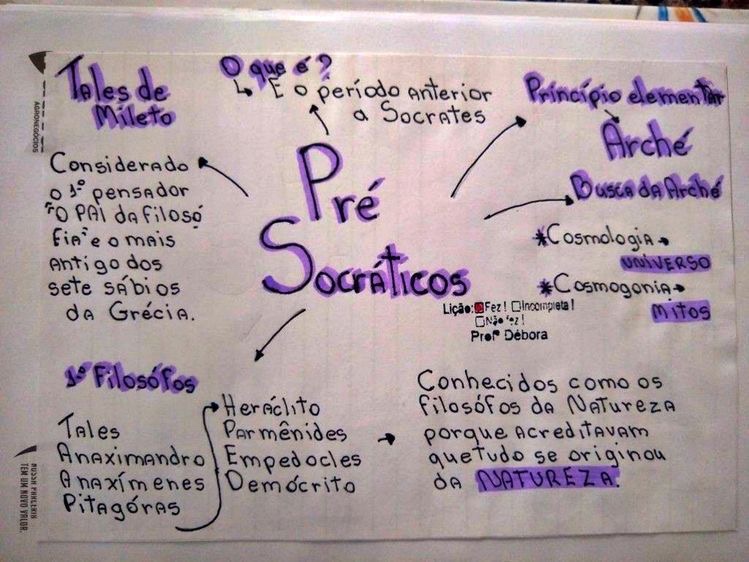
Greek philosophers in the 5th and 6th centuries started to question the world around them. They thought that greek mythology was too vague, and irrational and did not ask the right questions. They were in search of a more rational approach to the truths of life. They questioned where everything came from, what everything was, the role of mathematics and the existence of plurality in nature. They believed that not everything in the world is the same and some materials donโ€™t stay in their present state forever. Thatโ€™s why they laid the principles of change which they called archรช.

The term โ€œpre-Socraticโ€ meaning before Socrates was coined and popularised by Hermann Diels. Socrates was alive at the same time when some of the pre-socratic philosophers existed so this term doesnโ€™t necessarily mean philosophers before the birth of Socrates. It just means a different take from Socrates’ philosophical work. Pre-socratic philosophers produced texts. No texts have survived fully. These philosophies are based on the texts that could be gathered and quoted from the later historian which was usually biased.

There were some different schools of thought during this era. Some of them were The Milesian school, The Pythagorean school, The Eleatic school and The Atomist school. The Milesian school consisted of three important philosophers. Thales was the first. Thales claimed that a single element was water. Thales determined that water could go through changes of state like evaporation and condensation. He also knew that it was responsible for moisture. The second philosopher was Anaximander. Anaximander claimed that the single element was an undefined, unlimited and indefinite substance, known as Apeiron. The thing that separates Hot and Cold, solid and liquid is the Apeiron. His philosophy is similar to the Chinese philosophy of yin-yang. The third and last philosopher from The Milesian school was Anaximenes. He believed the single element to be air. According to him, the air is everywhere and can transform into something else. For example water, objects, clouds etc.

Anaximenes. (credits- stratis)

The Pythagorean school was formed by philosopher and mathematician Pythagoras believed that every answer to life can be found through mathematical calculations. Every rationale of life is derived from mathematics. He had a very cult-like following. His students were very true to his rules and ways of life. Theyโ€™d often follow his exact instructions. His students believed that his studies were the prophecies of God.

The Eleatic school was based in the colophon. It had four main philosophers. The first one was Xenophanes. He did not believe that gods were anthropomorphic or had human characteristics in other words. He believed that there was only one god and he didnโ€™t have a physical form but he can See, Hear, Think and control the world with his thoughts. The second philosopher was Parmenides. He believed that individual experiences donโ€™t amount to the real truth. Truth can only be found through reason and not senses. His foundations hugely influenced Plato and the whole of western philosophy. The school of Elea started using reason to find the truth because of him. The third philosopher is Zeno. He was Parmenides’s most famous student and probably his lover too. He spent most of his life creating arguments that defended parmenidesโ€™ ideas. His most famous Argument is about pluralism. The notion that many things exist as opposed to one, will lead to more absurd conclusions. He believed plurality was an illusion. His work was later disproved but was hugely influential. The last one is the melissus of Samos. His philosophy was that what it differs from what it seems. According to him it never really is what it seems.

*I was influenced to write this article after coming across the book philosophy 101 written by Paul Kleiman*

Women organizations and their role in India

Women’s Organisations emerged in India as a result of the spread of education and the establishment of the notion of the new woman. There was an improved level of communication among women which made them aware of the different problems that they faced and their rights and accountabilities in society. This awareness led to the upsurge of women’s organizations that fought for and signified women’s causes

An exclusive feature of the Indian women’s crusade is the fact that early efforts at women’s liberation were set in motion by men. Social reformers such as Raja Ram Mohan Roy, Maharishi Karve, and Swami Dayanand Saraswati challenged the conventional subservience of women, stimulated widow remarriage, and supported female education and impartiality in matters of religion, among other issues. Mahila mandals organized by Hindu reformist organizations such as the Arya Samaj and Brahmo Samaj encouraged women to go out of the boundaries of their homes and interact with other members of society. Pandita Ramabai, who was considered as one of the innovators of the feminist movement, with the help of Justice Ranade established the Arya Mahila Samaj in 1882. She envisioned creating a support network for newly educated women through weekly lectures and lessons at homes, where women could learn and gain confidence through interactions.

Women’s auxiliaries of general reform associations also served as a ground for women to deliberate social issues, express opinions, and share experiences. The Bharata Mahila Parishad of the National Social Conference was the most protruding among such opportunities. Though the National Social Conference was formed at the third meeting of the Indian National Congress in 1887, the Mahila Parishad was launched only in 1905.

The preโ€Independence period saw women’s issues related to the nationalist agenda at various junctures. In this period, a major enhancement of women was in terms of political participation of women, calling for a redefinition of conventional gender roles. Women began openly demonstrating their opposition to foreign control by supporting civil disobedience actions and other forms of protest against the British. Opportunities to organize and participate in agitations gave women muchโ€needed confidence and a chance to develop their leadership skills. Cutting across communal and religious barriers, women associated themselves with larger problems of society and opposed sectarian issues such as communal electorates. Political awareness among women grew, owing to a general understanding that women’s issues could not be separated from the political environment of the country. During this period, the initial women’s organizations formed within the historical background of the social reform movement and the nationalist movement were as follows.

โ€ขThe Women’s India Association (WIA).
National Council of Women in India (NCWI).
โ€ขThe All India Women’s Conference (AIWC) in 1917, 1925, and 1927 correspondingly.
โ€ขEach of these organizations emphasized the importance of education in women’s progress.
โ€ขThe WIA, created by Margaret Cousins in Madras, worked widely for the social and educational emancipation of women. โ€ขAssociated with the Theosophical Society, it encouraged nonโ€sectarian religious activity and did creditable work in promoting literacy, setting up shelters for widows, and providing relief for disaster victims.
โ€ขWomen in Mumbai, Chennai, and Kolkata through networks developed during World War I work, allied their associations together, and created the NCWI in 1925. A national branch of the International Council of Women, its most prominent member was Mehribai Tata, who aggressively campaigned against inert charity and advised men to support female education.
โ€ขThe most important of the women’s organizations of the time was the All India Women’s Conference. Though its initial efforts were directed towards improving female education, its scope later extended to include a host of women’s issues such as women’s franchise, inheritance rights.

The Constitution of India enlisted in 1950 which permitted equal rights to men and women. Rights such as the right to vote, right to education, right to enter into public service, and political offices brought in satisfaction among women’s groups. In this period, there was limited activity in the area of women’s rights. Many women’s organizations such as the National Federation of Indian Women (1954) the Samajwadi Mahila Sabha (1559) were formed to work for supporting the cause of Indian women. Since the country was facing a social, political crisis after British rule, many demands of the women activists were not supported by the Government. But during this period from 1945, the Indian women got an opportunity to participate in confrontational politics.

In post-independent India, the women’s crusade was divided, as the common opponent, foreign rule, was no longer there. Some of the women leaders formally joined the Indian National Congress and took a powerful position as Ministers, Governors, and Ambassadors. Free India’s Constitution gave universal adult franchise and by the mid-fifties, India had fairly liberal laws concerning women. Most of the demands of the women’s movement had been met and there seemed few issues left to organize around. Women’s organizations now observed that there was an issue of implementation and consequently there was a pause in the women’s movement.

Some women organizations such as the Banga Mahila Samaj, and the Ladies Theosophical Society functioned at local levels to promote contemporary ideas for women. These organizations deal with issues like women’s education, abolition of social evils like purdah and Child marriage, Hindu law reform, moral and material progress of women, equality of rights and opportunities.

It can be believed that the Indian women’s movement worked for two goals.

โ€ขUplift of women.
โ€ขEqual rights for both men and women.

Currently, there are many women organizations in India:

โ€ขAll India Federation of Women Lawyers
โ€ขAll India Women’s Conference
โ€ขAppan Samachar
โ€ขAssociation of Theologically Trained Women of India
โ€ขBharatiya Grameen Mahila Sangh
โ€ขBharatiya Mahila Bank
โ€ขConfederation of Women Entrepreneurs
Durga Vahini
โ€ขFriends of Women’s World Banking
โ€ขKrantikari Adivasi Mahila Sangathan

The major objective of this organization is:

โ€ขStrengthening and building new initiatives, networks, forums, etc., for protecting women’s rights
โ€ขMonitoring the Government of India’s commitments, implementing the Platform for Action with special focus on the eight-point agenda discussed at the Conference of Commitment, CEDAW, the Human Rights, and other United Nations Convention.
โ€ขAdvocacy, lobbying, and campaigning on women-related issues.
โ€ขInformation Dissemination and Documentation.
โ€ขSolidarity and linkages with other regional and global forums.


Another women organization in India is Swadhina (Self-esteemed Women) which was formed in 1986. It is principally a civil society organization focused on the Empowerment of women and Child Development based on Sustainable Development and Right Lively hood. At Swadhina, it is believed that positive social change has a direct effect on the lives of women and that change is possible only through equal and spontaneous participation of Women. Organization members are active in five states across the country in remote tribal districts of Singbhums in Jharkhand, Purulia, and West Midnapur in West Bengal, Kanya Kumari in Tamil Nadu, Mayurbhanj in Orissa, and East Champaran in Bihar.

Due to the womenโ€™s movement, several legislations were passed like the Equal Remuneration Act, Minimum Wage Act, Maternity Benefit Act, etc. to ensure equal status to women in society & more importantly at work. However, illiteracy amongst the major women workforce (87% of women are employed in the unorganized sector), fear of losing employment & lack of awareness of the laws enacted to protect them, make it difficult for women to benefit from them.


A girl should be two things:

who and what she wants.

Inculcating Stoicism in your life

Credits- art.com

Stoicism is a philosophy founded by the Zeno of Citium in Athens in the early 3rd century BC. According to this school of philosophy, there are two factors. The internal world and the external world. The internal world contains emotions, reactions, behaviour and all the things that a human being controls. The external world is wealth, status, validation etc. Stoicism describes wealth as neither good nor bad. Although a human being should always live a life of modesty and should not pay much attention to the external world. We do not control what happens in the external control but we do control our actions and our reaction toward the external world. We should build such a mindset where the external world doesnโ€™t have an overwhelming effect on us.

In todayโ€™s generation, everyoneโ€™s life is a busy one. No one has the time to be free and reconnect with themselves. This makes us lose touch with ourselves. This is how the world moves. We are controlled by the external narrative and are always chasing some illusionary goal that we think will give us all the joy and happiness needed in life. Weโ€™re all chasing one thing or the other. But stoicism has always said that no material thing in the external world can attain happiness. You always have to look within. Bureaucracy makes us a slave to the external world and we do not break the pattern until we are dead.

Credits- words of wisdom

Stoicism teaches us to take control of our lives. It tells us not to be controlled by the greed of wealth and status. It encourages us to find ourselves. You can inculcate stoicism in your life by getting across some of the stoic readings. Marcus Aurelius was a believer In stoicism. He was probably the richest man when he existed. He was still believed to live a modest life and people around him worshipped his virtue. One has to grasp an understanding of the world he lives in and more importantly they have to grasp an understanding of themselves. Stoicism encourages independence in thinking. It makes us see what really exists.

Personally, stoicism gave me an understanding of what the external world is. I came across it when I was 16 years old. I was very materialistic as a kid. I used to seek joy in buying all the gadgets that I wanted. There were times when I used to feel hollow but I never really knew what it was and why do I feel that? Stoicism made me understand that void. The void had been created due to the lack of real value in my life. I realised it and started studying stoicism. With time, my understanding of the world got better. Sometimes it makes me laugh how unconcerned I was. We all get lost in our lives sometimes. The games that we make for ourselves can sometimes trap us. But a true human being will always find a way to see through the fake and embrace reality.

โ€œ I THINK, THEREFORE I AMโ€

โ€ข Rene Descartes

School of lifeโ€™s video about stoicism

As Frank as the Oceanโ€ฆ

Credits-frankfan76

Blonde was released in 2016. The album has completed 6 years since its release. An albumโ€™s success is divided into 2 parts. The first one is the quality of the lyrics and the story of it. The second and a really important one is sound production. Sound production means the quality of sound. When you listen to any of the blondeโ€™s track, youโ€™ll realise how well produced the sound is. Every beat is so clean and soothing to the ears. Sound production makes a huge difference in the overall quality of the album. For example, Dondaโ€™s sound production was not very well done and lets the album down in a lot of ways. Blondeโ€™s production was probably the best of this decade. The transition in the song โ€œNightsโ€ is so sick and is the highlight of the amazing sound production.

The album has some of the most diverse tracks. Ivy is a melodic soft indie lost love song whereas solo (reprised) is a fast and very catchy beat with a really good flow. Futura free is 10 mins long and continuously progresses its flow. There are abrupt audio clips filled in this album and that is a signature of frank ocean. Self-control starts in a very poppy fashion and translates into a coming of age song quick. Be yourself is a voice note from frankโ€™s mom telling him not to get addicted to alcohol, drugs or marijuana because it will make him stupid, lazy and unconcerned. She also speaks about the importance of being yourself. Frank always finds a way to make his album feel more personal and intimate as he did with channel orange. After her motherโ€™s voice note, he talks about rolling a solo for himself right in the next track. The album feels like a very honest and a true deep dive into frankโ€™s life.

Credits- miranda devis

I think this is the reason people relate to it so much. I listen to some of the tracks every day like Self Control, Nights, Good Guy and Futura Free. Good guy is a cute lofi track where he is talking about a girl jasmine and reminiscing about how the relationship actually had more substance than he thought it had. Soon after good guy, Nights kicks and boy it kicks in so well. Everything about that song is perfect. The Pacing, Lyrics and the Transition. Apple Music in its description of blonde writes โ€œan album weโ€™ll be talking about for years to comeโ€ and here we are after 6 years of talking about it.

In the song solo, frank is talking about how he was very loud in public once and the police turned them down and suddenly very abruptly he says โ€œI forgot to tell you how much I vibe with youโ€ this feels so abrupt but so personal at the same time. Itโ€™s like youโ€™re talking to someone about something and suddenly you tell them something totally different. Frank does it so beautifully. Another instance of his lyrical genius is spotted in the song self-control. Heโ€™s having some poolside conversation with a girl about her summer and this translates into something more. He says โ€œ cause I made you use your self-control and you made me lose my self-control โ€œ this is just brilliant writing. In the end, Blond is a very catchy, a very poppy but at the same time a very deep and personal album. Catch it if you still havenโ€™t somehow.

Taoism- finding your own โ€œwayโ€

Taoism is an ancient Chinese philosophy. This philosophy was supposedly written by Lao Tzu during 500 B.C.E. We donโ€™t know if Lao Tzu existed. We have no living proof of his presence. Taoism is a philosophy that is based on non-doing. Not getting in your way. Respecting the natural flow of this universe. For example, if the force of the river is on the right side then youโ€™d be a fool to swim towards the left side. Taoism is about going with the force of life or with the TAO. Tao is not a god but itโ€™s us all, every living being is a part of the tao.

One of the key things about Taoism is yin & yang. It talks about the balancing force of this universe. Action and non-action, dark and light, hot and cold. Every example has meaning because their opposites exist. There is no action without non-action or no light without dark. This teaches us to accept all things for what they are. Taoism finds power in the natural truths of life. It promotes harmony. When we accept the natural form of this universe, we become one and attain harmony. The tao canโ€™t be explained or held. It can only be felt by letting go.

โ€œLook, but you canโ€™t see it.

Listen, but you canโ€™t hear it.

Reach out, but you canโ€™t touch it.

Invisible,inaudible,intangible.

Elusive.

The one, the taoโ€.

โ€ข Lao Tzu.

What does getting in your way mean? We often second guess our instincts and in some situations that is necessary. Taoism is all about making things simpler rather than complex. Living in the now, acknowledging everything but still detached from it. Creating your own โ€œwayโ€. Inculcating meditation in your life is one way to do it. I canโ€™t stress how much meditation helps in finding yourself. Taoist meditation is a little different from the normal one. Itโ€™s more about communicating with your own body.

Like stoicism, Taoism believes in a modest approach to life. If I were to give a personal example, my mind automatically dived toward the future and I wouldnโ€™t even know that it did. It was an automatic reaction that kept happening. But since Iโ€™ve come across Taoism, this situation has gotten much better. It has made me more accepting of my habits and given me a โ€œwayโ€ to deal with them. You canโ€™t change everything about who you are, you can accept it and get better at dealing with it. Taoism helped me do that. The teachings of Lao Tzu make you go into a state of Nirvana. That state canโ€™t be explained because it is something beyond words. The tao cannot be held or explained. It can only be felt.

What is Tao? It is just this. It cannot be rendered into speech. If you insist on an explanation, This means exactly this.

โ€ข Yuan mei

Micro Learning

Micro learning is a form of short-term learning. Micro learning means learning small bits of information at a time that is simple to process. Over the last few years, everyoneโ€™s attention span is on a constant decline. In times like these, micro learning is a very efficient way of training people. It has its own pros and cons. It is very time efficient. Itโ€™s budget-friendly. It also keeps the learner hooked. But one of the biggest issues with this is that you canโ€™t make people learn complex problems or concepts through this concept. Micro learning is a concept of an oversimplification to reduce the time and effort required to train. It may not be very useful when you aim to teach people complex concepts. In todayโ€™s world, we are surrounded by micro learning. Letโ€™s take the internet, for example, a lot of people refer to different creators and sources for their consumption of information. They provide them with a total overview of a particular matter. This overview is rather oversimplified.

People seek political, local and lifestyle news in a simplified way. Short-duration content like reels and shorts or a ted talk are living examples of micro learning. Micro learning is a very good way to teach people small skills that are a means to a different end. For example, teaching someone how to operate a device or how to follow protocols. But it may not be very useful for teaching complex skills like writing, speaking and photography. Micro learning is the new way that people have preferred to learn about things that are relevant to them. If you can give them exactly what they need then itโ€™s also not a very bad career choice. You must have come across many YouTube creators that simplify complex news and provide it to their viewers. That is a form of microlearning. It is a very popular and very effective way of grasping peopleโ€™s attention.

Importance of seeking a spiritual experience.

I went into the Osho centre expecting a breath of fresh air and a new perspective on life. I had reached my saturation point and was seeking something meaningful. I learned a meditation technique there which changed my life forever. So the process, is that you have to lay down and breathe slower than you usually do. After doing that, you focus on your left leg and try to breathe through it. You move your attention towards the right leg and do the same. That’ll make your legs very light and peaceful. After doing this, you move all your attention to your navel centre which is the centre of your body and breath through it. If you do this correctly then that’ll give you immense harmony and peace. It feels as if all the negative vibrations are leaving your body. After this, you move your focus to your heart and breathe through it. And then from the face. In the end, you try to feel your whole body and try to breathe through your whole body. After this, you reflect on your meditation and take 3 deep breaths.

Iโ€™ve been practising this meditation for the last 2 months and it has made me comfortable with myself. I am now more accepting than ever, more confident than ever. It gave me a roadmap to working towards myself. Meditation makes you interact with yourself. When you do that consistently, you become more sure of who you are and what you want in life. I feel if you have clarity in life, everything automatically falls into place. Meditation definitely helped me do that.

I also met people from different walks of life in the centre. Middle-aged people, old people and young people doing completely different things. But doing things at their own pace and getting better at dealing with it every day. I came across a man whose name is Aditya. He is a middle-aged man in his 30s. He is not married and lives alone. In India, more often than not you expect a man in his 30s to be married cause thatโ€™s what society dictates. But he was completely free and detached from the social bounds we have. He was an artist working as a freelancer for the last 10 years. His energy was just different from the normal crowd. It was so refreshing to meet someone like that.

I always wanted to inculcate meditation in my life but I never had the discipline to do it until I started going to this centre. Meditation is so helpful for any human being because it makes you more conscious about yourself and when you are self-aware, you tend to make better decisions that affect you and you are aware of your flaws and you respect them. You find a way to deal with your vulnerabilities. Iโ€™d encourage my fellow members to go and seek out a spiritual experience free from the bounds of bureaucracy. This experience was personally so therapeutic for me and encouraged me to think in different ways and change my brain pattern towards life. It made me conquer my fear. And the only way to conquer fear is to accept it. Iโ€™d leave it at that.

The Night ofโ€ฆ.. another show where Riz ahmed shows his quality as an actor.

A still from the night of.

A boy raised in a conservative Muslim family in America. What do you expect? Innocence right? Maybe you are right. It’s a normal night. Nasir wants to go to a party he was invited to but a friend who he was supposed to go with cancelled the plan last minute. He takes his fatherโ€™s taxi without asking him, he really wants to go to the party. On the way to the party, he comes across some customers who ask him to drop them at a destination but he informs them heโ€™s off duty, he gets into a little spat but they get out of the taxi eventually. After that, a girl comes and asks him to drop her at a beach. He doesnโ€™t say no to the girl. Although, they do argue but he takes her nevertheless. On the way, he buys her a beer. They both sit down across a river and talk about their respective lives. Nasir likes her carefree nature because no one was as frank with him as Andrea was. They both go to her place to spend the rest of the night. Andrea traps Nasir into taking some drugs and eventually they sleep together.

Sounds like a night well spent right? The next day he wakes up and finds the girl dead!!!! Stabbed 22 times in her body. Nasir panics. He gathers his things and runs away and obviously so. He gets caught eventually which is also a long story but Iโ€˜d avoid telling that.  Nasir eventually lands in jail and he encounters some crazy people. Heโ€™s very scared initially as anyone will be. According to me the jail part of the story is the best because it changed Nasir completely.

Even though he didnโ€™t kill the girl but in the end, you are not quite sure if he deserves to be out of jail because the people around him Transform him completely. He is addicted now, he threatens people and does all the things a criminal would do. But one thing that the story makes you believe is that he didnโ€™t kill the girl(which I am not quite sure of). Almost every subplot of the film leaves you with something to think about. His lawyer is a lonely person and fights his loneliness throughout the series. The friends he makes in jail are all the products of their surroundings. His parents are in self-doubt. And thereโ€™s courtroom drama which we all love. The show is so well layered and so well nuanced. It makes you think about a lot of things. It gives you the exposure to explore different human beings (their greys especially).

There are 2 kinds of cinema. One is which gives you a message and thereโ€™s another kind which makes you think about things. The highest quality of cinema is the one which makes you question your existence and your surroundings and that’s what the night of is. One thing which the show makes clear is human beings are a product of their surroundings as claimed by Kafka. Nasir was an innocent boy until he landed in jail where he met criminals who turned him into a criminal. It also makes you wonder that you really have very little to no control over your life. One day you are with a nice girl and the next day you are in jail.

Iโ€™d like to end this by saying that the night of at any moment doesnโ€™t let you feel that whatever is happening is not real, they donโ€™t use cliche filmmaking techniques. It has a very unique quality to it which makes you think about every character. There are films which make you feel very excited but when you leave the theatre you donโ€™t even think of those films and then there are films which bore you and make you doze off but you canโ€™t keep these films out of your mind because it constantly makes you think and those are the films worth watching. I donโ€™t rate films because I think itโ€™s unfair to rate someoneโ€™s vision and hard work but I can tell you that youโ€™ll not be disappointed watching this beautiful show on Hotstar.

The night of trailer.

Psychedelics substances and their magic.

The world we live in today continues to grow more anxious and ignorant of their surroundings. Information is indeed a boon for humankind but thereโ€™s only so much data we can process in a day. The problem is that we have an abundance of data available which is harming us in ways we canโ€™t imagine. To reduce our tension we seek help from pharmaceutical industries but are they worthy of our trust? No. Then, what is our substitute? Or rather I should say whatโ€™s better for us? A possible answer can be psychedelic substances. In the recent past, there have been a lot of studies and experiments in the psychedelic environment which have been successful. These substances can help human beings fight depression, anxiety issues and different brain disorders. And this is just one of the realms of possibilities that psychedelics are capable of.

I will be discussing two case studies carried out by robin Carhart-harris who is a neuroscientist at imperial college. The first study revolves around the story of a man called kirk rutter who was in grief after his motherโ€™s demise followed by a break-up and a car accident. Such events can disturb any human being. Kirk was in depression. He couldnโ€™t think of anything but negative thoughts. He felt guilty, disturbed and sad. He called his condition โ€œan automatic circuitโ€ as he lost control over his thoughts. He had been on a lot of different medications but nothing helped him. Finally, he decided to participate in a study conducted by Carhart-harris. Rutter was taken into a room where the researchers studied his brain activity through magnetic resonance imaging [MRI]. Then harris explained to him about the drugs which heโ€™ll receive and told him heโ€™ll neutralize the hallucinogen if he couldnโ€™t handle it. Then the two practised a technique whichโ€™ll help him calm down if he becomes overwhelmed. Rutter burst into tears while doing that. The next day he came back and was handed two pills by a researcher containing a synthetic form of psilocybin [psychedelic substance]. He lay on a bed and put on his headphones and an eye mask. The process began, the first hallucinations that he saw were some Sanskrit words and then he went on to reflect on his grief. He took his eye mask off and noticed that harris had an eye in the centre of his face[of course heโ€™s hallucinating] and harris joked โ€œI might be looking very different to youโ€ they both laughed. Rutter talked about his resentment and discussed his life with harris like he never did before. The next day he returned for the second dose which was stronger. The trip was followed by an integration session where he would discuss his experience.

Rutter went on record to say โ€œ This process made me look at grief differently. It was a realization that it wasnโ€™t helping. Letting go was not a betrayalโ€. Rutter was depressed for more than 6 years before this study.  He was convinced that this experience changed his life for the better. He feared sometimes will the automatic circuit return? But he has some control over it now. 5 years later, his depression has not returned.

The second study carried out by harris included 12 people who were clinically depressed for more than 17.8 years on average. I am stressing over the term โ€œclinically depressedโ€. They were also given the psychoactive substance available in magic mushrooms called psilocybin. No other medication could help this lad. One week after the oral dose all the patients experienced improvements in their symptoms. After 3 months, 5 of them were in complete remission. Harris said, โ€œthis is remarkable in the context of currently available treatmentsโ€. These researchers do not claim psilocybin to be the last resort to cure depression. They just claim that this can be done. After all, they were able to cure clinically depressed patients which no other legal medication could do.

The major argument that concerns psychedelics right now is the legalization of the substance. The science community believes that it should be legalized because it can help a lot of people fight their condition. If it becomes legal we can regulate the product and we can also create a safer environment whenever anyone consumes it. Researchers have enough evidence about its therapeutic potential and if this movement is promoted by authorities then itโ€™ll be a huge boon for humanity. Legalization of anything increases the consumer’s safety as it’s labelled and safe for consumption. There are no major arguments against it but some scientists do believe that open consumption of psychedelics can lead to chaos but they have not considered the fact that if it gets legal itโ€™ll be regulated. The scientists have virtually no funding to continue their research on these substances and also the public perception of these substances is very vague and false. Scientists argue that the awareness around this should be increased.

The public perception of these substances is the real problem. People put these drugs in the same category as crack and cocaine which is a very dangerous simplification. Although the majority of people are unaware of these substances but false interpretation dampers the image of the product. Psychedelics are referred to as โ€œparty drugsโ€ but they are much more than that. The people who are aware of it are very limited and are unable to successfully communicate about it. Psychedelics needs to step out of its ivory tower and try to spread its importance where people donโ€™t know anything about it. There are some communities in places like Haiti and amazon forest that celebrate the psychedelic culture and fully embrace it. But they are very small in number.

Before 1968, LSD and Psylocibin were legal. There were a lot of reasons for it getting banned. One of the reasons was the irresponsible behaviour of the civilians. People used it without really knowing about the substance. Your environment plays a big role when you are under the influence of psychedelics. If your environment is appropriate then your trip can be very soothing but if itโ€™s not then it can result in psychosis. Some people ended up murdering someone. Although the biggest reason was the tyranny of the US government. Countries that had a well established psychoactive and pharmaceutical industry wouldโ€™ve suffered huge losses if psychedelics expanded. The USA was one of them. The USA introduced a new classified system called scheduling. Under this system, drugs marked under schedule 1 are dangerous and offer no therapeutic value and the drugs marked under schedule 5 are safe and have some therapeutic value. LSD and Psylocibin were marked under schedule 1 even though enough evidence concluded that these substances have promising therapeutic potential. There was a conference organized between countries that had strong pharmaceutical markets and countries that we’re struggling to establish a pharmaceutical market. You can guess who won. psychedelics became illegal in most parts of the world. President Nixon’s assistant to the president John Ehrlichman went on record to say and I quote โ€œThe Nixon campaign in 1968, and the Nixon White House after that, had two enemies: the antiwar left and black people. Do you understand what Iโ€™m saying? We knew we couldnโ€™t make it illegal to be either against the war or black, but by getting the public to associate the hippies with marijuana and blacks with heroin, and then criminalizing both heavily, we could disrupt those communities. We could arrest their leaders, raid their homes, break up their meetings, and vilify them night after night on the evening news. Did we know we were lying about the drugs? Of course, we did.โ€ And after that, the criminalization has never stopped.

My opinion on this is every person who can experience these substances should do it.  I am saying this because Iโ€™ve had some personal experiences with LSD. I have consumed LSD a couple of times and I can say without a doubt that It was the most profound experience of my life. What it does is it makes you reflect on your vulnerabilities. It doesnโ€™t matter if you like it or not. You question your rights and wrongs and your worldview. We all are insecure about ourselves but we never take out the time to reflect and introspect. Lsd made me do that. It made me more aware of my surroundings, it made me more empathetic towards people so I can see things from their perspective. And most importantly, it made me resolve the conflicts within me.  I had created an elite class system within me that I was hardly aware of. I used to judge and see people through this class system. During my trip, I realised that and immediately made a promise to myself that I will resolve this. Thatโ€™s why I chose this topic. I was personally affected and I thought I can explain to people what a wonderful thing psychedelics can be.  Like me, a lot of people find it hard to deal with their conflicts and I genuinely feel LSD can help them. If thereโ€™s such an efficient and wonderful medicine available to us, why donโ€™t we use it for our benefit?  Thereโ€™s a reason we have a DMT receptor in our brain.

I would like to conclude by saying that with proper regulations psychedelics can help human beings increase their quality of life. Iโ€™ve given enough evidence to back my statement. All it needs is some support from the government and some positive word of mouth. Soon, there will be a lot of experiments and trials concerning this.

My sources-

https://www.nature.com/articles/d41586-021-00187-9

https://www.nature.com/articles/d41591-020-00001-5

https://www.researchgate.net/publication/254121216_SocioCultural_and_Psychological_Aspects_of_Contemporary_LSD_use_in_Germany

Trying to make sense of viratโ€™s lacklustre form.

Virat Kohli has found life to be tough over the last 3 years or so. His form has dipped massively. Heโ€™s clearly not the same batter right now as we know him to be. There is nothing wrong with his technique in particular. There are some areas for improvement but that is a natural progression for any batsmen. He recently gave up captaincy of all formats. He also gave up his franchise Royal Challengers Bangaloreโ€™s captaincy. There has been a lot going on around him. Iโ€™ll try to breakdown his game plan in each format of the game.

Viratโ€™s problem in T20 cricket has been his low striking ability against spin. Weโ€™ve often seen him struggling against spin in the middle overs failing to find boundaries and sometimes even struggling to rotate strike which has been his biggest strength for a long time. He tries to compensate for his limitations with spin bowling by being extra aggressive against pace. He has a strike rate of 145 inside the powerplay. Although, it dropped down to 90 in the middle overs during IPL 2021. This yearโ€™s IPL was Virat’s most forgettable season of all time. He averaged an abysmal 22.5 per innings with a strike rate of 115. This is very unlike Kohli. He just looked overcooked and completely out of his fluent touch this season.

He hasnโ€™t played a lot of ODI cricket in the last few years and I believe this is the format that will help him get back into form. India plays England today at the oval. There are reports that he might not play today due to a groin strain. But, I hope that he plays today because he should use every opportunity that he has to get back to form. In ODI cricket, there is no added pressure to increase the run rate and the ball also doesnโ€™t do much in the middle overs. Thus, this format is his best chance to get back to form. He can rotate the strike in the middle overs and extend his innings till the death overs to attack as he has done so many times.

Virat Kohli is a true ambassador of test cricket. He is the most successful test captain of India in so many ways. He made India successful in overseas conditions. India developed their best pace attacks in ages during his reign. His test form recently has been a disappointment. I believe, his main problem in test cricket has been a lack of scoring areas. If you look at some of the centuries that have been scored by Indians in test cricket have been attacking innings. They had to take the attacking option at some point in the game. While Virat has shown immense discipline and exemplary technique in the last few years. He played an exceptional innings of 79 runs against South Africa in the last test of the series. His problem has been a lack of scoring phases in his innings. He has to find more scoring options in test cricket. Because with the kind of quality test sides have in their bowling, you canโ€™t just play the waiting game. You have to attack at some point.

Virat Kohli is already a legend. He has achieved everything that he can possibly dream of. Although, for him to get back to form now. He has to play one-day internationals. We all hope to see the best batsmen weโ€™ve possibly ever witnessed get back to form.

5 Best cities to live in India.ย 

This is an image of 5 best cities to live in india.
Photo by Asif Methar on Pexels.com

The cities mentioned in this list belong to different states in India. Each city showcases the distinct culture and beauty of their state. Many companies and factories have been set up in these cities since the beginning of globalisation. This has led to people migrating from different parts of the country in search of a livelihood. 

Today these cities are commonly rich in manpower and resources which increases its scope of development. Although they are overpopulated, residents and visitors alike benefit from modern facilities and technological advancements that are introduced on a regular basis. 

So, welcome to some of the best cities to live in India.

1.Bangalore- The start-up city

This is an image of Bangalore- the start-up city.
Photo by Keith Lobo on Pexels.com

Ever came across the news about people quitting their 9 to 5 jobs and starting their own businesses? It might probably have occurred in the city of Bangalore. It is an IT hub for people doing their 9 to 5 jobs, and a start-up city for people starting their own businesses. Bangalore is located in one of the southern states of India. It also bags the title of the third largest city in India. 

It has everything you can expect from a tier one city. Shopping hubs, entertainment opportunities, buzzing nightlife, art, culture and so on. Thanks to its rapid industrialisation. The city also has lakes, gardens and generous spaces for recreation. However, the goodness it reeks of also becomes the reason for overpopulation, it is infamously known for its hour long traffic jams! 

2. Pune- The cultural capital of Maharashtra

This is an image of Pune- The cultural capital of Maharashtra.
Photo by Aniket Dhakate on Pexels.com

Pune houses some of the best educational centres and IT companies that attract youngsters who are yearning for a livelihood. Housing, transport and food are affordable if spent wisely. Thus, making it one of the best cities to live in India. It is indeed known as the cultural capital of Maharashtra, due to its historical sites, museums and heritage. It is an ideal city for tourism as it has many sightseeing options such as Sinhagad Fort, Khadakwasla Dam, Tulsibaug, Shaniwar Wada, etc. 

3. Ahmedabad

This is an image of Ahmedabad.
Photo by NAUSHIL ANSARI on Pexels.com

Ahmedabad, the city in Gujarat, is famous for its Sabarmati Ashram, which carries the pride of once being Mahatma Gandhiโ€™s residence. Today it has been established into a museum which is visited by millions of tourists every year. Ahmedabad is one of the best cities to live in India due to its affordability and ideal places to stay. 

Manek Chowk, Lal Darwaja Market, and the famous shopping centre at Dhalgarwad are some of weekend getaways and visual treats for the explorers of Ahmedabad. 

4. Chennai

This is an image of Chennai
Photo by VARAN NM on Pexels.com

Chennai is not only the best, but also one of the cheapest cities to live in india. It is the capital city of Tamil Nadu

which is well known for its extravagant temples, beautiful churches, passion for classical music and popular beaches. Like Bangalore, it also comprises factories and industries of the elites that support the economy of the city and its residents. 

Chennai boasts awesome connectivity with its expansive transport system of buses, rickshaws and cabs. It also acts as a host of several start-ups and unique initiatives in an effort to suffice development in the city. 

5. Navi Mumbai

This is an image of Navi Mumbai
Photo by Darshak Pandya on Pexels.com

Navi Mumbai is a booming town, nearer to Mumbai, the city of dreams. It holds the title of the largest planned city in the entire world that boasts of tourist attractions such as Golf courses, waterfalls, wonderful parks, etc. Plans of establishing an international airport and metro train connectivity are being carried on with great enthusiasm.  

What makes it one of the best cities to live in India is itโ€™s relatively calmer, less polluted and populated environment in comparison to Mumbai. But itโ€™s relatively higher cost of living and rent can be a turnoff for many. 

Want to experience the city lifestyle or planning on settling in a new city? Do check out at least four of the cities mentioned in the list. 

Your body when you Swim

Harvard medical school published a study which looked at over 40,000 men, aged 20-90 who were either runners, walkers, swimmers, and physically in active people. With an average length of 13 years of observation and in that time

  • 2% of swimmers passed away
  • 8% of runners passed away
  • 9% of walkers passed away
  • 11% of physically inactive people passed away

This study showed that swimmers are much healthier later on in life than the rest of the population and for women swimming just 30 mins a day can decrease coronary heart disease by 30 to 40 percent.

It also helps to increase HDL aka good Colestrol. Some studies have also shown that aerobic excercise can keep the cells in the lining of your arteries more flexible and healthier. Hence there is no question that swimming is an awesome form of fitness.

Body during swimming

What do you actually feel when you go into the water? Here are some main elements of the human body that gets impacted during swimming.

1. Blood

According to the America Heart Association, swimming is considered as Aerobic activity. Aerobic excercise enlarges the heart and it increases the blood flow through the entire boby. Because swimming is an excercise, the blood has to pump all the molecules into the body.

2. Heart

Since so much of blood has to be pumped into the body, that ties into how it impacts your heart because we know that after 2 mins your body goes into aerobic respiratory because your heart has to pump all the oxygenated blood through the body. So as you swim, your heart is circulating the blood which help your body to perform and achieve the required goals.

3. Skin

You must have seen that the skin color changes of swimmers. For example, some swimmers face turns red when the swim, that happens because your blood vessels are dilating and the brings the heat to the surface into the skin then some people turn red, as a result your skin is showing the effort that you’re putting in the water.

4.Muscles

There’s a reason why swimmers are considered to have best body and physiques in the world compared to any athlete, because swimming engages every single muscles in the water when it comes to your core stability, your upper body, your biceps, your hamstrings, your calves, everything is engaged when you swim.

When you’re swimming, you are micro tearing your muscles while swinging it. And the muscles requires 24-48 hrs to recover those muscles. That’s when sometimes you might feel sore.

5. Lungs

Swimming can actually help increase your lungs volume because in swimming different than other sports, you can’t actually breath whenever you want. It’s not like running when you have full access to oxygen.

In swimming you’re engaging your muscles and you’re not allowed to breathe necessarily at the time when your body might want it. So because you have to get used to this, you actually increase your Vo to max (maximum amount of oxygen body is able to use). So basically you are making your lungs more efficient at functioning.

6. Brain

The Brain loves swimming, because of all the extra blood flow moving through these endorphins that makes you more awake, alert and focus.

But this could happen in any type of sport but swimming is something really special because you’re sort of in your own world where the medium is 800 times more dense than air, which makes you feel free and relaxed.

Hence, from physical health to mental health, swimming is an incredible benefit human body and after reading this you must be thinking of trying swimming.

Being Bilingual

People have very different opinions on what bilingualism really is. For some it means speaking two languages fluently and with little to no effort rather strongly consider a person bilingual, if it has perfect pronounciation in both languages and makes very few grammatical errors while talking.

The truth is that, even with a bad accent and making some mistake, being able to speak in two or more languages rather than one has practical benefits in an increasingly globalised world.

Multilingualism

Multilingualism has been shown to have many psychological and social advantages that can go something simply as

  • watching movies with no subtitles
  • to having less problems in traveling and
  • even getting a job or business opportunities specially in tourist areas.

Types of Bilingualism

It is considered to be two types of Bilingualism

1. Compound Bilingualism

Compound Bilingualism, also called addictive Bilingualism happens for example when a child is raised by bilingual parents and both languages are used in home, the child grows when both languages are used simultaneously in the same environment.

With this type of Bilingualism, the person does not see the two languages as separate it is common to hear such people speaking different languages in the same sentence or using a word of a different language from the one they’re talking to better express themselves.

2. Coordinate Bilingualism

This is the second type of Bilingualism also know as Subtractive Bilingualism. In this type, the person perceive two languages as separate because he learns them separately and in different environments in context.

I am an example of coordinate Bilingualism, most of the time i talk Hindi when I’m in my college environment or to people who talks only that language, I use the language specifically for those context but to my family members i usually talk in Bengali which is my native language, the language related to my home environment. I see these two language as separate since I learned and used them in completely different environments.

Officially Monolingual Countries

Only a few countries in the world including the U.S, England, and Australia are officially Monolingual but even in these countries only a considerable percent of people who speaking and understand more than one language.

Advantage

Researchers suggest that bilingualism can slow the advance of age-related mental issues such as Dementia and Alzheimer’s by up to 4 years.

Also in bilingual adult, brain tissue called grey matter is denser compared with Monolingual adults.

Although speaking more than one language does not necessarily make you more intelligent person, it helps stimulates and increase brain connections. Learning a new language is like an excercise to the brain that will improve your Cognitive skills and even if you grew up in a Monolingual environment, it is never too late to start learning a different language.

Where did Necktie came from?

The neckties, also known as decorative noose are a narrow piece of fabric designed to be worn around the neck and tied at the throat. They can be made from many materials but commonly constructed from silk or cotton.

Varieties

Today there are many different kinds of neckties:-

  • Ascot tie
  • The zipper tie
  • Clip on tie
  • The tie dye tie

So when did wrapping a piece of fabric around your neck become a formal style necessity. The length of World War to blame can partially be placed on the French Military. While humans have been tying fabric around their neck since they could sew.

History

The neckties is been known as it didn’t start crowding collars until the 17th century. King Louis XIII of France had hired Croatian mercenaries to fight for him during the 30-year war and the king was impressed by the length of cloth the Croatian used to keep their jackets together.

Croatian

Louis liked it so much that he required his entire royal court to wear them a tradition that his son will continue in his court. The trend soon spread across the French aristocracy and it wasn’t long before all of the Europe had converted to the curve at.

Tying a Necktie

There are four main ways to tie a neckties;

  1. The Four-in-hand knot
  2. The Pratt knot aka The Shelby knot
  3. Half-windsor knot
  4. The Windsor knot

According to researchers from Cambridge Cavendish Laboratory, there are 85 ways to tie a tie. Thomas Fink and Yong Mao actually use Mathematical modeling to figure this out and publish a book on their finding.

Towards the end of tie fashion

The necktie is losing its grip around the throat of male fashion. Tech companies such as Google, Amazon, and eBay actually encourage their employees to dress casually with some going as far as banning traditional office wear entirely and other companies are following suits.

Its fast become a power move to dress drown to the office in the 21st century as a statement of fellow workers, you can wear what ever you want.

Californian companies have led the charge in disrupting many common business practices, by rejecting aspects of corporate life that once seemed to given such as

  • Traditional working hours
  • Corporate hierarchies
  • Paying employees a living wage

Now politicians and even royalty are leaving tie in their dresses so it many not be long before neckties joins the history books of pointless male neck fashion.

BODY DYSMORPHIC DISORDER(BDD)

Body Dysmorphic disorder is a mental disorder marked by an obsessive of perceived defects or flaws in once appearance. A flaw that to others is considered minor or not observable.

People suffering from BDD

  1. Can feel emotion such as shame and disgust concerning a part or parts of their body part and fixate on this.
  2. The obsession is so intense that the person repeatedly checks and compares the perceived flaw seeks reassurance sometimes for several hours each day.
  3. The person can also adopt unusual routines to avoid social contact that exposes the perceived flaw.
  4. This pervasive thoughts about their appearance and body image interfere with their daily life via
    • Educational
    • Occupational dysfunction and
    • Isolation

No matter how many times people assure them that there is no flaw, they cannot accept that the issue doesn’t exist.

The most common features about which people obsess includes:-

  • Nose
  • Wrinkles
  • Acne
  • Complexion
  • Blemishes
  • Hair
  • Skin
  • Vein appearance
  • Muscles size
  • Tone
  • Breast size
  • Buttocks
  • Genitalia

BDD is estimated to affect up to 2.4% of the population. The condition usually starts during adolescence affecting both men and women. BDD does not go away on its own if Untreated it may get worse with time leading to

  • severe depression
  • Anxiety
  • Substance abuse
  • Suicidal thoughts and behavior

Causes

The exact cause is unknown, but like every other disorder BDD may result from a combination of causes such as:-

  1. Brain differences
  2. Environmental factors; special if they involve negative social evaluations about the body or Self-image
  3. Childhood trauma
  4. Genetics; studies suggest that BDD is likely to run in family.

Certain factors that may increase the risk of developing the condition may include:-

  1. A family history
  2. Negative body image
  3. Perfectionism
  4. Negative life experiences such as bullying or teasing
  5. Introversion
  6. Media influence.

Symptoms

Extreme preoccupation with a perceived flaw in your physical appearance that appear minor to others for at least one hour a day. Attempting to hide perceived flaw with –

  • styling, makeup or clothes – to seeking plastic or cosmetic surgery,
  • avoiding social situations,
  • constantly comparing appearance with others,
  • always seeking assurance about appearance from others,
  • low self-esteem, compulsive behaviour such as skin picking and frequent clothes changing.

Extreme preoccupation with an appearance that interferes with social life work, school, or other functionality.

Diagnosis

A medical evaluation will be carried out other medical conditions after which further evaluation is carried out by a mental health professional.

Diagnosis is based on:-

  1. A psychological evaluation; which aims at assessing risk factors and thoughts feeling as well as behavior can be associated with a negative self-image.
  2. Personal, medical, family and social health history.

Treatment

Treatment option may include therapy and medication includes:-

  1. Cognitive behavioral therapy; that helps you learn how to cope and behave to improve your mental health
  2. Medications; such as SSRIs may help is control obsession and control repetitive behaviours

Psychiatric hospital may be suggested if the symptom is severe such as when you’re in immediate danger of harming yourself.

Famous personality with BDD

Here is a list of people with BDD;

  • Michael Jackson(singer, dancer)
  • Billie Elish (singer)
  • Robert Pattinson (from twilight)
  • Ileana D’Cruz (from Rustom)
  • Miguel Herrรกn (from money heist)

History of Indian Stamps

India got independence on 15th August of 1947 assured in a new era in the history of the country but philatelist had to wait another 98 days for the release of India’s most commemorate stamp on 21st of November 1947.

First stamp

The Postal Telegraph Department however came out with a large Kashi postmarked with the slogan “Jai hind” for the occasion and letters mailed that the major post offices of the country were cancelled with this post mark.

The India’s first commemorative stamp features the Lion capital of Ashoka which had one set on the top of a column of Sarnath near Varanasi. The lion capital has since been around at the state emblem of India the denomination of the stamp was one and a half annas and an inspiration of “Jai hind” in Hindi was also depicted in the stamps.

Other stamps

Actually three stamps were planned to release at the time of Independence. The rest two stamps were released in the 15th of December 1947 with the three and a half annas stamp with portray of the national flag in tricolor Saffron on the top, white in the middle and green in the bottom.

The twelve annas stamp depicts an aircraft a symbol of the modern age. These stamps also have inscription “Jai hind” in hindi, they are also known are Jai Hind stamps.

The stamps were printed offset lithography. As the three and a half annas stamp was printed in three colors in three steps because difference in inking at different stages, because specimens having the top of the flag in deep orange or pale orange and the lower part in pale green and deep green were coming across.

Petroleum Jelly is harmful to skin

You probably have a jar of Vaseline somewhere in your house. Millions of people swear by it as a remedy for clapped lips, congestions, diaper rash and dry skin. Unfortunately the popular product is more harmful than many realise.

What is Petroleum Jelly?

Petroleum jelly, commonly known by the brand name Vaseline, is a byproduct of the oil refining process. It was originally found coating the bottom of oil rigs in the mid 1800s. As a byproduct of the oil industry, it’s an unsustainable resource and far from eco-friendly.

How does it work?

Used in everything from lotions to baby products, petroleum jelly works by creating a protective barrier on the skin to hold in moisture. The waterproof barrier it created on the skin blocks pores and can lock in residue and bacteria.

When used on a burn or a sunburn area, it locks in heat and can block the body’s ability to heal. You need to stop using Vaseline for these four reasons:

  1. It contains harmful Hydrocarbon. The skin is unable to metabolize petroleum jelly, so it sits as a barrier on the skin untill it wears off. This blocks the body from gaining any benefit from the substance. A 2011 study found strong evidence that the mineral oil hydrocarbon Vaseline contains are “the greatest contaminant of the human body”
  2. It Promotes Collagen Breakdown. Due to the barrier that petroleum jelly creates on skin, it blocks the skin ability to breathe and absorb nutrients. This can cause the skin to pull the moisture and nutrients it needs from within, leading to collagen breakdown.
  3. It can leads to Estrogen dominance. Estrogen dominance occurs when the body has high levels of estrogen and low levels of progesterone. It has linked to infertility, menstrual problems, allergies and autoimmune problems. Petroleum jelly contains chemicals called xenoestrogens which are believed to increase estrogen problems.
  4. It can cause pneumonia. Although rare, a condition known as lipid pneumonia can occur when small amounts of petroleum jelly is inhaled and build up in the lungs. Because the body can’t metabolize or breakdown the substance, a severe inflammation in the lungs can occur.

Natural Alternatives

There are several natural alternatives to petroleum jelly that you can use without worrying about health risks. If you’re looking for a simple alternative, try one of these options:-

  • Shea butter – High is vitamin A, E and F, shea butter works to nourish the skin through the beneficial fatty acids it contains. It can also help reduce inflammation and increase collagen productions.
  • Beeswax – a great alternative to petroleum jelly is Beeswax. It can be blended into homemade beauty products to protect the skin. Add it to a homemade lip balm and body cream.
  • Coconut oil – this oil loaded with health benefits. It works to nourish the skin through the fatty acids, lauric acids and anti-inflammatory compounds.
  • Coco butter – it contains antioxidants and benefits fatty acids. It may even reduce the signs of ageing.

Why does a student need to be industry ready & how they can be?

What do you mean by industry ready?

An industry expects their employees to have Non-technical skills and personal attributes such as team work, communication skills, integrity, reliability and self-motivation are considered more important than purely technical skills to get industry ready.

Importance

A study shows that 50% of the curriculum that are been taught in college/universities, by the time students will graduate, it will get auxiliated with new technologies in the market.

Let’s say for example, a product manager of a company who advertises the product, collects data and analysis the data to improve the marketing strategies of company. He can do it manually, but with time if an app is developed for this work, the company won’t be requiring any product manager.

Although degrees are important for future but it is also important to have a knowledge about what all techniques and skills that will be there in future and also to start developing those skills.

How can students be industry ready?

Here are some ways of getting industry ready:-

  1. Practical Knowledge of Doing Things:- If you can demonstrate how to implement the theoretical knowledge you have then your chances of getting hired will improve significantly.
  2. Sharpen Your Communication Skills:- If you are not able to communicate properly, your knowledge will be of little use to you.
  3. Inculcate the Habit of Innovation:- Form a habit to think out of the box, if you can provide a company with a method to save on expenditure or increase their profit, you have better chances of getting hired.
  4. Read Books and Newspapers Regularly:- Form a habit to read a newspaper or book at least half an hour daily, as this will improve your thinking process as well.
  5. Build Your Profile to Show Your Accomplishments:- One needs to be presentable and be able to exhibit his or her qualifications and capabilities convincingly.
  6. Pursue Online Courses to Hone Your Skills:- To make yourself industry ready, it is better to learn some new skills online.
  7. Work on Your Weak Areas:- The trick here is to present your weaknesses in a way that it looks profitable to the company for whom you want to work for.
  8. Learn to Organize and Manage Your Time:- It is about getting the maximum output in a given amount of time. Productivity matters a lot when you are working for a company.

So start investing more on prolonged and sustainable skills because knowledge and degrees are not going to be most required in future. This is the time to decide what is to be done and how should the steps be taken forward.

Will you take Chinese vaccine?

Made in China, accept it or not but for many of us this label has become synonymous with low cost and low quality. So how true is the stereotype and what has Chinese done to deserve such a bad reputation? Well the list goes long, the latest item is vaccine.

China has sold vaccines to the World which may not be working. It is currently exporting vaccine to 43 countries with:-

  • a total of 742 million doses that have been sold,
  • 22 million doses have been donated,
  • 262 million doses have been delivered.

China is exporting 3 major vaccines:-

  1. Sinovac
  2. CanSino BIO
  3. Sinopharm

But do these vaccines even work? Let’s look at some of the countries those have received Chinese vaccines.

Mongolia

In Mongolia, more than half of the population is fully vaccinated but daily infection has risen by more than 70% in the last 2 weeks, and they’re using the Chinese vaccine Sinopharm. No doubt Mongolians are questioning the effectiveness of the Chinese vaccine.

Bahrain

Bahrain an Asian country is witnessing a surge. There’s a sharp rise in the number of infections and this dispite of high levels of inoculation. How will China explain this? China’s Sinopharm vaccine, accounts for 60% of the inoculation. Bahrain is now administering a Pfizer booster shot for those who have received both doses of vaccine.

Seychelles

Seychelles of East Africa, 61% of the population have been vaccinated with just 100,000 of people. This island nation has the highest vaccination cover globally. It’s daily average cases rose up to 400 with 37% of the fresh infections reported in fully vaccinated people. This is the result of the Chinese vaccine they’re using which is Sinopharm.

UAE

The United Arab Emirates has vaccinated more than 38% of the population with more than 51% have received first dose and yet daily new cases exceeded to 1700. And they are also using the vaccine Sinopharm that was received from China and UAE is also questioning the efficacy of the Chinese vaccine and also giving a Pfizer booster shot to Sinopharm recipient.

Countries who have refused

Philippines

In the month of May, the Philippines President apologized and asked China to take away Sinopharm vaccine back. He sent back the doses because Chinese cure is unproven.

Saudi Arabia

Saudi Arabia has also refused to recognise certificates of Sinovac and Sinopharm. It is recommending Pfizer and AstraZeneca instead.

Do Chinese vaccines works in China

There’s a fresh out break of new infections that are been reported in the Guangdong province of China. Guangdong with its capital Guangzhou, accounting of 90% of the confirmed cases. Health authorities of the capital blames the delete variant which was first identified in India. A strict lockdown has been composed there overseas arrivals are being quarantined, million have forced to indoors.

Hence its proven that the rumours of China had conquered the pandemic was false. The virus is unpredictable, it keeps spreading. Vaccines are not full proof in preventing infections but if one vaccine has repeatedly proven ineffective then it’s time for some reflection.

Narcissistic Personality Disorder

Narcissistic personality disorder or NDP is a personality disorder characterized by grandiosity. You may see it in people who have an inflated ego, with little regards to others. It is important to note that NDP is a psychiatric condition, and it is more complex than simply being arrogant. It’s distressing for those who have it and for those who’re around them. Hoping to shed some light on the condition, and sign that a person should seek help. While much of T.V and movies portray narcissism as people who feel like they’re better than everyone else, it’s usually not just the case.

What is narcissism?

Narcissism is a set of traits classified and studied by psychologists. The psychological definition of narcissism is an inflated, grandiose self-image. To varying degrees, narcissists think they’re better looking, smart and more important than other people and that they deserve special treatment.

Psychologists recognize two form of narcissism as personality traits:

  • Grandiose
  • Vulnerable

What is NDP?

  • NPD is a personality disorder in which the person feels self-important and craves constant validation.
  • Their feelings of superiority often hint at a deeper problem.
  • As their need of validation often comes from a place of insecurity and instability rather than genuine self love which they may not be aware of.

What causes NPD?

  1. While the cause of NPD is unknown, researchers believe that it has to do with a combination of genetic and environmental factors.
  2. It’s believed that 6% of people have this disorder. Men have a higher chance of this disorder than women.
  3. Some believe that NPD is developed to cope with trauma and feelings of inadequacy. Others believe it may be learned in early childhood from dealing with anything, from abuse to excessive pampering.
  4. There is even a debate as to how much of the disorder is passed down from parents to children acquiring the disorder.

What are the signs and Symptoms?

The feeling of grandiosity where they feel that they’re superior to others and low empathy are often seen in those with NPD; they don’t care much for others expecting to receive constant validation.

  • People with NPD feel as though they’re entitled to whatever they want which can be dangerous as it can manifest into toxic relationships.
  • They may manipulate others to get what they want.
  • They brag and exaggerate their achievements or feel envious of anyone that outperforms them, but deep down the person with NPD may be really dealing with their own feeling of inadequacy.

How to get help?

  • People with NPD may not seek help for the disorder itself as they may not know that there’s an issue.
  • Usually, people are diagnosed because they seek treatment for other issues such as depression or addiction.

However people who feel that they may have the condition and urged to reach out for help. NPD and the underlying feelings of inadequacy can be treated. It not only benefits the individual, but also to people around them.

What treatment options are available?

People diagnosed with narcissistic personality disorder will most likely work with a therapist using psychotherapy methods.

Other self-improving activities such as:-

  • Doing exercises and,
  • Hobbies may be used in conjunction with therapy.

Coming to a conclusion, we do live in a very materialistic and Consumersious society and as long as that’s the case, narcissism is going to win because it’s about putting yourself first and not caring as much about others. Not to mention people with NPD can be very generous when it’s going to get them what they need. They may buy everyone big dinners and take everyone on a big vacation so it creates this illusion that there’s lots of people all around them, because it’s all the stuff that they’re making possible for them. It’s important to know that treatment is available and that life can be made more manageable.

Story of Cellular Jail of India

You might have heard about the deadliest punishment that one could never wonder in their dreams. It is also known by the name Kala paani ki saza or by the name The black water punishment. So why is this jail different from other jails?

Emergence

During the colonial rule, Britishers got short of places where they could keep and punish the freedom fighters and political activists who were emerging against them. So they made single cellular jail punishment there they can punish the freedom fighters. In the year 1896, Britishers decided to build this jail on Andaman & Nicobar islands and in the year 1906 it was completed.

It was named as “cellular jail” because every jailer was kept in a single cell, so that the one jailer could not talk to others. As the jailers were freedom fighters so if they communicate somehow they will be able to find a way out. The cellular jail is also on an island which is surrounded by water so that the jailer won’t ran way.

The Punishment

The cellular jail wasn’t any normal jail it was like an experimental jail for the Britishers which involved torture, medical tests, forced labor and also some of these punishment which are unimaginable. The Britishers used to send freedom fighters to 1300 km across the water to the Andaman & Nicobar islands. It was so far away from India that people would die even on the boat voyage. So if the prisoners made it that far, they were kept in the cells which were designed for solitary confinement.

The cells of the jail is made up of brick and concrete where there is no toilet, the jailers were allowed to go to the toilet in the morning and at night and the rest of the time they were just locked in the cell. They prisoners were also forced to do labor like to extract 30 pounds of coconut oil and 10 pounds of mustard oil in a day. And if they don’t, then they have to face the consequences by beating up with iron rods while they are chained in iron chains.

Britishers in their own jail

In the year 1944, Japanese came to India and invaded the Islands and took over. The Japanese prisoned the Britishers in their own prison. As per Mahatma gandhi and Rabindranath Tagore’s demand the Indian prisoners were set free.

After the Japanese lost in World War II, they had to retreat, and the Andaman & Nicobar Islands became India’s part when it got independent in the year 1947.

After independence the cellular jail was declared as a National Memorial which is now a tourist place for all. There is also a Museum where you can get to know about all the freedom fighters along with their stories.

History of Dentistry

From brushing and flossing to straightening and whitening, people today put a lot of work into maintaining a health and appearance to their smile. The current trend is for straight, pearly white teeth. But history of dental care stretches all the way back to the beginning of human society.

Ancient ways of cleaning teeth

Prehistoric humans who lived before the advert of oral care actually had very few dental problems. Scientists believe this is on account of their diet, which consisted of unprocessed fibrous foods that help clean their teeth while they ate. However as human evolved, so did the food on menu. Overtime, people found if they didn’t take care of their teeth, they developed dental problems.

Archaeology found evidence that early humans cleaned their teeth by picking at them with things like porcupine quills, animal bones, and tree twigs.

In earlier 3,500 BCE, Mesopotamians were using chew sticks to clean their teeth. Egyptian and Chinese have known to use them as well.

Tooth Decay

Ancient people were always aware of the tooth decay. But the first known scientific theory about its causes dates back at least 5,000 years, to Ancient Sumeria. The theory was that cavities were caused by a creature known as the tooth worm, which they believed would wore holes in teeth.

Cavities can actually resemble the kinds of holes that the worms bore through other materials, like wood. The Sumerians, Greeks, Egyptian, Chinese, Japanese, and Indian people all believed in the tooth worm. Some European doctors were still warning people that worms were the cause of their tooth decay as late as the 14th century.

First Toothbrush

Though no one knows exactly when people started brushing their teeth, archeologists believed the practice originated somewhere in the neighborhood of 3,000 BCE. The Babylonians and the Egyptians were the first cultures we know of to fashion rudimentary toothbrushes, which were made mostly from twigs.

The first used bristle toothbrush was created in China sometime during the Tang dynasty, between the 7tg and 10th centuries. It was made from hog bristles which would have been attached to a handle carved from bone or bamboo.

Explorers eventually brought these to the West. And in the 17th century, they began to be adopted in Europe.

New trend

In modern times, the dental ideal is considered to be a bright smile with straight white teeth. People will wear braces, use whiteners, to achieve the look. But most didn’t realise, its a relatively new fashion.

The popularity of look really only goes back to the 20th century and was greatly created by Hollywood movies. The trend, arguably, began their veneers, created by cosmetic dentist named Marcus Pincus in the 1940s. It was spotted by movie stars, like Shirley Temple and Judy Garland, who became famous for perfect smiles.

Judy Garland

While mass market teeth whitening products didn’t became a thing until the 1980s, teeth whitening itself is nothing new.

Introducing Skateboarding in Olympics

In recent history, skateboarding has become a pop culture phenomenon. We see it in everything, from T.V advertisements to fashion shows. And for the first time ever, skateboarding will be introduced in the 2020 summer Olympics. But, skateboarding hasn’t always had the mass appeal we see today.

Brief history

Sometime in the late 1940s or early 1950s, skateboarding was born out of the boredom of surfers when the waves were no good. They would remove the wheels from the roller skates and attach them to a piece of wood to create a skateboard.

By the 1960s, skateboarding’s popularity has grown with rise of surf culture. Contest were held all over and the first sponsored skateboarders were beginning to emerge. However, the popularity of skating in the 60’s dropped just as fast as it rose.

The 1970’s brought along one with the most important changes to the skateboarding world, the advent of the Urethane wheel, which allows skaters to ride faster are over rougher types of ground than ever before.

In 1976, a horrible drought in southern California forced most homeowners with backyard swimming pools to drain them, giving way to birthplace of pool skating. This was the first major shift in how people rode there skateboards. No longer were they limited to the abysmal, flat grounds of parking lots and sidewalks.

The 1980s were a time of Renaissance in skateboarding. People were constantly inventing new tricks, pros were earning unheard of amounts if money, and skateboarder-own companies were thriving.

The vert

The favourable terrain for most of this era was vert. And even though there was a high level of progression occurring, to the untrained eye, skateboarding had gone stale and the popularity once again fell flat.

This lull in skateboarding led to the introduction of street skating which brings us into the 1990s. Skating during the era was at its most raw. Skaters took to the streets, to find new terrain, abandoning traditional skaters parks for something that felt more natural and could be done anywhere, by anyone.

Popularity

Skating things that occur almost anywhere, like sets of stairs, handrails, benches, curbs, and just about anywhere four wheels can roll. From there, skateboarding has been a nonstop, uphill climb to what it is today.

At its core, skateboarding has traditionally been for the underdogs, the outcasts, the misfits, and in result has been thought of negatively by a large major of its existence. But now, with generation of young adults who grew up with skateboarding and the exposure at an all-time high, the future of skateboarding is looking bright.

Why India can’t have an Official Language

Our Home Minister Amit Shah mentioned about promoting one nation, one language in one of his tweets in 2019. He also added that it should not be done at the cost of other languages. Some of us might know that 14th September is celebrated as Hindi Diwas in our country. So why can’t we have Hindi as an official language?

Critics

After Amit Shah statement, critics said that if Hindi becomes the official language, then other languages like malayalam, tamil, telugu and more, will lost their importance. South Congress leader Jairam Ramesh also said “this one nation, one language will never be a reality” because it will never be easy to have a common language in India.

Also in the New Education Policy (NEP) draft in the year 2019, Hindi was asked to make mandatory in every state. This was also criticized by the South Indian governments and they refused to dilute the state’s two language formula. This resulted in changing the draft and not to have Hindi as an official language.

Steps taken

India is a big nation, so there should be a language that will represent India on world stage. Talking about Hindi, it is spoken in India, Fiji, Suriname, Mauritius, Trinidad, Tabogo and Guyana. So India is working actively to have Hindi recognised as an official language of the UN.

Advantage of having an official language

A Chinese research concluded that

  1. When we have an official language, it can even help to eliminating poverty. As China have experience in fight poverty so we can also learn the power of having an official language.
  2. China also mentioned that an official language also helps in having communicate without any language barrier.
  3. Official language also help to built unity among the citizens
  4. Also helps when people migrate from one city to another, as they can communicate in the same language.

Disadvantage of having an official language

According to the 2001 Census, 41% of India population are native speaker of Hindi dialect. But what about 59% of the population who are non – Hindi speakers? Politician Shashi Tharur said

India should not even try to add Hindi to the list of official language of UN because what if in future our PM is from South part of India and does not speak Hindi, then how will he give speech in Hindi on behalf of India.

But apart from all these we still agree that there should be an official language for a country to function.

As per as official language is concerned,

  1. English is also been promoted in India. Promoting English can result in heavy school fees, as we’ll have to teach the whole population to speak English.
  2. Enough English teacher will also be required and if not then it won’t be successfully become the official language.
  3. This will also result in neglecting the weaker section of the society who won’t be able to speak English and their career opportunity will get affected.

Eventually we need to figure out to take a right decision about official language and keeping in mind of the consequences that could possibly be in long terms situations.

Why do Insectivorous plants exist?

If you find insectivorous plants strange and fascinating then this blog is for you.

What are insectivorous plants?

Insectivorous plants are those plants that derive some nutrients by trapping and consuming animals, mainly insects.

Categories of being insectivorous

There are essential two things that a plant has to do to be considered insectivorous:-

  1. Ability to take nutrients from dead prey:- a plant should have the ability to trap the prey and absorb nutrients from it. Those prey is usually insects or small vertebrates like, salamanders. It is not enough for the plant just to have defenses that can kill an animal that’s trying to snack on it. It also has to get it’s animal’s nutrients.
  2. At least have one adaption:- the plant need to have one adaption that actively lures in, catches, or digests it’s prey.

Doing at least one of these things and absorbing the nutrients for it’s benefit make it a insectivorous plant.

Plant traps

Over millions of years and across hundreds of species, plants have developed five different types of traps, most of them are from different times. And traps can be passive, if prey just fall into them and can’t escape, or active, if plant actually moves to catch its prey.

  1. Pitcher plant:- pitfall traps are the standard and passive trap used by plants like pitcher plants. Prey lands on the plants slippery surface and slides down into a pool of digestive juices.
  2. Sundews:- these are flypaper traps in which the prey become stuck in a sticky substance that is produced by the plant leaves. These traps can be passive as well as active. Sundews have sticky moving tentacles that react to contract with prey.
  3. Venus fly trap:- these are snap traps which are active, using rapid modified leave
  4. Bladderworts: they have bladder-suction. This creates little negative pressure vacuum inside their traps, which, when triggered by prey, pop open and suck the victim inside before snapping close.
  5. Lobster-pot trap:- they passive traps that force prey to move towards the plant’s digestive organ by having little inward pointing hairs that keep prey from moving backward out of the trap.
Venus fly trap
Lobster-pot trap
Bladderworts
Sundew
Pitcher plant

All of these unrelated plants have not only developed the same kinds of traps but it looks like they have also developed that same molecular mechanism for digesting their prey.

Reason of existence

It goes back to idea of convergent evolution. All these different insectivorous plants are responding to similar environmental pressure:-

  1. Found in open sunny places that have moist but nutrients – poor – acidic soil. Many of them live in bogs and fens.
  2. In these kind of habitat where nitrogen and phosphorus is not present in the soil, the plant tend to developed two kinds of leaves one for normal photosynthesis and one that are modified onto their particular type of trap.
  3. This results them to invest more in modified leaves than normal photosynthesis leaves as they have to live in a place with enough sunlight as well as to trap preys

Insectivorous plants can stop paying carnivorous temporally once they’re put in nutrients rich soil and if they don’t get enough sunlight and water.

Insectivorous plants are pretty rare and they are only found in certain kinds of habitats, they are just less likely to fossilize than other kinds of plants that are more widespread.

Blogging: my experience

I never really thought about writing blogs before but I did, with this post I’ll be completing 30 blogs. Lie is unexpected isn’t it, you do what you have never thought of before. Writing blogs was all just a part of my internship that I HAD TO DO, but it became a wonderful experience. When I started posting the major problem I faced was What should I post about? I don’t know the first thing about it. I am not a technology geek who can talk about various new gadgets that came out in the market, nor do I like cars, nor am I much of a reader to write book reviews or a movie enthusiast for that matter. I am a simple, LAZY student who likes to do craft (yes my hobby is to make best out of waste kind of things), watching anime (It also helps practice my listening skills and get accustomed to listening Japanese; I am a Japanese language student) and listen to music (ARMYYYY!!; if you are new to this, ARMY is BTS’s fandom); these are the only three things that I do, of course beside studying and all (I DO STUDY OKAY(ใƒŽเฒ ็›Šเฒ )ใƒŽๅฝกโ”ปโ”โ”ป).

As I mentioned above I don’t really have the kind of hobbies I can write 30 posts about so I thought, Why not write about the thing that I love; I love Japan (so much that I am learning the language and want to go study there). Yes studying there is my ultimate dream, and to achieve my destination I am doing this internship right now, blogging which I never really thought about doing ever (sometimes you need to do those things that you never thought you will ever do just for the sake of making your dreams a reality).

Photo by Suzy Hazelwood on Pexels.com

But even if I never thought of blogging, I still enjoyed it sooo much; it was such a different experience, I did have some difficulty in deciding the topics, had to study a lot but, at the end it was worth it, I was able to share with you my knowledge about what I have learnt about Japan. Although my posts were a bit (okay a lot educational) and not really fun, but as a language student I am very well aware of the difficulties we face while learning about such topics, simply because enough material is not available online and our teachers ask us to write about these topics in 2500-3000 words โ”ฌโ”€โ”ฌใƒŽ( ยบ _ ยบใƒŽ). So all those students or Japanese enthusiasts out there I hope my posts will help you a teensy bit. I am not a professional blogger but thank you if you liked my intense educational posts (ใฅ๏ฟฃ ยณ๏ฟฃ)ใฅ.

Sayounara.

Tips to learn a new language faster

Learning a new language often considered as really tough task, but is it true? Maybe for some, but the real truth is if followed right resources and direction is definitely an task to do so. So for this here are some tips that might help you.

1) Know about the language that you are going to learn

By writing this I mean one should know what language is he or she going to learn. If you have clear idea of what actually you are going to learn will help you to set almost perfect goals which will ultimately help you to do what you want.

2) Set goals

Setting goals to learn a new language will help you to go far and keep yourself ahead. Goal setting should be done after being familiar by the subject.

3) Set small goals

Setting small goals will help you to complete your work on given time. Setting small goals will also help you to analyse yourself and keep your records on track.

4) Analyse yourself

Analysing is an art if done properly will take you way to far. Whenever do things do them on time and analyse what mistakes you make or what are the problem that you have encountered.

5) Challenge yourself

This part will help you to grow. grow beyond your limits. But one thing to keep in mind while doing so is do not challenge yourself more than what will harm you. Doing this in moderation will definitely help but if done excessive will also harm.

6) Use the language as frequently as you can

If you do so it will help you to retain things faster. It will also help you to clear your vocabulary and pronunciation and also will help you to keep everything you learn stored in your brain for a long time.

7) Test yourself

At the end complete your learning and test your self this will help you to know how much you have learn about the language.

Hope you will like my blog follow the steps and go ahead. Happy learning!

Top 5 venomous snake species

Snake are deadliest animal. Whenever one encounters it many get hurt or you can easily say they are dangerous to humans. They have aggressive nature. They are very dangerous especially for rural area people’s. There are estimated 3,500 snake species out of which 600 are venomous. Their estimated yearly attacks ranges from 53 lakhs to 54 lakhs, out of which more than 1 lakh people die due to their attack.

1) Inland Taipan

They are also known as fierce snake. They has the most toxic venom in the world. The average quantity venom give by this snake is 44mg while the most given is 110mg, which is enough to kill 100 people. Its venom consists of neurotoxins, Hemotoxins (procoagulants) affecting the blood, myotoxin affecting the muscles, nephrotoxins affecting the kidneys and hemorrhaggins causing hemorrhage. Its venom paralysis the body and cause hemorrhage. It is found in Australia.

2) Dubois sea snake

Dubois sea snake is also known as reef shallow sea snake. It is a species of venomous sea snake. Adult sea snake grows upto 4.86ft but usually grow upto 2.6ft. It is most venomous sea snake and one of the top three most venomous snakes in the world. The venom is lethal and contains neurotoxin that act on the nerve cell, myotoxins acting on muscles. The venom of this snake paralysis the respiratory system which ultimately cause death of the person. They feed on fish and swallow the whole fish. True incident of sea snake bite has not been recorded but they might have caused bite in rural area where taking record might not be possible. They are not aggressive but can bite if feel threatened or surprised. Fisherman’s are more likely to get trapped in their bites often when they try to remove them from fishing net. They are found in Australia, and some parts of Indian Ocean and Timor sea.

3) Eastern brown snake

Eastern brown snake or also known as common brown snake. This snake is highly venomous snake in the family Elapidae. Adult eastern brown snake goes upto 2m or 7ft. The venom of the snake mainly affects the circulatory system, coagulopathy, hemorrhage, cardiovascular collapse and cardiac arrest mainly the death occurs due to cardiac arrest. And one of the main components of venom is prothombinase which breaks down prothrombin. It is responsible for about 60% of snake bite death in Australia. They are native to eastern and central Australia and southern New Guinea.

4) Black mamba

Black mamba also belongs to highly venomous species of family Elapidae. It is second longest venomous snake after king cobra. It grows upto 2m (6ft 7in) and commonly grow to 3m (9ft 10in). Its colour varies from grey to dark brown and it’s species is both terrestrial and arboreal (found on trees). It is native to parts of Sub Sahara Africa. Its venom is composed of neurotoxins and it’s induce symptoms within ten minutes and is frequently fatal. This species of snake is aggressive but only attack when threatened or cornered. It constantly bites more than once and it’s bite derive 100mg-120mg of venom, the highest venom recorded is 400mg. It is considered as snake of medical importance by World Health Organization. Its venom if not treated on time will result in respiratory failure, cardiovascular collapse and ultimately death.

5) Boomslang

Boomslang snake is one of the venomous snake of family Colubridae Average adult Boomslang is 100-160 cm in total length and exceeds to 183cm. Colouration is very different like males are light green with black or blue scale edge while females may be brown. Their weight varies from 175 to 510 g. The Boomslang snake is able to open its jaws up to 170 degree when butting. It is found in sub Saharan Africa, south africa, Botswana and Namibia. Its venom is hemotoxin and disables coagulation process and the victim die as a result of internal or external bleeding. Its venom cause hemorrhaging in to tissue such as muscles and the brain tissue. Its venom is slow acting. This snake is timid and only bite if attempted to handle, catch or kill.

Music can change you

These days we hear music all the time, it wakes us up, motivates our workouts, keeps us company on our commutes. It doesn’t matter what kind of music it is, it itself has the ability to affect our moods and our bodies in all sorts of ways. It can give us chills even can make us cry.

Effects on Brain

Music activates every area of the brain that scientists have mapped so far. In fact, there is no area of the brain that music doesn’t touching some ways.

25 years ago there was an idea which said that language is in left side of the brain and music is in right side of the brain but now with better quality tools, higher resolution, neuroimaging and better experimental methods, it is discovered that thats not at all right so how does it effects our brain?

When music enters and then gets shuttled off to different parts of the brain:-

  1. It stops at specialise processing units in auditory cortex, they track loudness, pitch, rhythm, etc.
  2. The visual cortex activates when you’re reading notes as a musician or watching music.
  3. Motor cortex activates when you move or dance or tap your feet, snap fingers, clapping your hands.
  4. The Cerebellum activates and immediate the emotional responses.
  5. The memory system in the Hippocampus will activate and will help you to recognise any familiar music or lines that you listen

Hence, music is going on in both halves of the brain, left and right, the front, back, the inside, and the outside.

How playing Instruments helps?

We can start learning to play instrument at any age. Picking up an instrument can provide some huge benefits for Intelligence, Physical well-being, Brain.

Playing an instrument requires:-

  • Auditory motor
  • Sensory
  • Visual system to work together

This inner system cooperation has some incredible outcomes that can affect many areas of life.

Different intensities of training produce different outcomes, even the most minimal practice can make a difference. Starting to play an instrument just one hour a week for few months can cause growth and increased activity in the parts of the brain responsible for memory, hearing, and motor. Researchers have found that this kind of activities can even increase IQ by 7 point or more.

Its also known that people who play musical instrument are better at other practical things too such as:-

  • Practical emotions
  • Learning new things/tasks
  • Creative problem solving

Musicians brain have better communication between left and right hemisphere which allows for more cooperation and out of the box thinking. Playing an instrument can also has benefits for brain and body.

  • boosting immune system function
  • Increase in resilience to hearing lose
  • Helps stroke patients regain motor skills

It’s been found that just listening to music can prompt the repair and regeneration of damage nerves in the brain.

Music is so much more than notes on a page, it can change the way we think, speak and feel. Music making and listen is really complex it’s not demystified till now it’s more mysterious than ever.

Book review: A novel: It ends with us

BOOK:- It ends with us

AUTHOR:- Colleen Hoover

GENRES:- It is a standalone contemporary romance novel, fiction.

RELEASE DATE:- 2nd August, 2016.

ADAPTATIONS:- It ends with us (play) and It ends with us (movie).

MAIN CHARACTERS:- Lily Bloom ( female protagonist), Ryle Kincaid ( Lily’s husband, a surgeon) & Atlas Corrigan ( Lily’s teenage love interest, a homeless boy later owner of a restraunt). And many supporting characters like Lily’s father, her mother, ryle’s sister, his sister’s husband, ryle’s mother.

Fifteen seconds, That’s all it takes to completely change everything about a person. Fifteen seconds that we’ll never get back.”

– Line said by the protagonist Lily in the book.

SUMMARY:-

The book starts with introducing the female protagonist Lily Bloom. Lily is a twenty-three year old business graduate. She has grown up in an abusive family where her father was usually abusive towards her mother. At the age of fifteen she fell in love with Atlas, a eighteen year old homeless boy from her neighbourhood. She cares for Atlas. She loved him so much. But he left her promising to come to her when he will join military. She was all alone at this time but she didn’t loose hope. She left her past life and started her own flower business in Boston.

In Boston, she met Ryle, a neurosurgeon and soon fall in love with him. But he was not ready to be in a relationship and they parted their ways. After six months, Lily hired an employee named Allysa, who was Ryle’s sister. After many encounters Ryle finally realised that he can’t live without Lily so decided to marry her. Everything was perfect, the romance between Ryle and Lily was increasing day by day. One day Ryle decided to meet Lily and her mother, there she encounters Atlas, and was not able to control her feelings, which was not loves by Ryle for sure. Slowly he started to abuse her,Whenever he can. Lily always told herself that she was not like her mother and Ryle was not like her father.

She started to live with Ryle and she found a deep dark past of Ryle and was shocked. His behaviour towards Lily was being more and more abusive day by day until one day when he can’t control himself and almost raped her. She asked Atlas help in that situation and found that she was pregnant. She doesn’t know whether to love Ryle or hate him for his behaviour. After two months she witnessed a knock on her door and she was sacred to find that he was none other than Ryle. He told her that he just came to talk to her and he did so, but she wasn’t happy with it. She missed him. But also she cannot forget what he did to her. And the story continues how ryle’s sister and Lily’s mother help her, how she allowed Ryle to be with her in her pregnancy dates, how she told Ryle what she felt about him.

BOOK REVIEW:-

Overall the book is just beyond fabulous The characters, the narration and everything seems to be perfect. I personally loved the character of Lily and Atlas. Lily’s strong decision and ability to do justice to herself and her daughter was remarkable. The narration was so strong that you will personally think of yourself in the characters place.

Firstly while reading the book I thought it will be just an average but as soon the book started every single page hooked me to read more and more. Especially I loved the narration it was just awesome. The character of Lily was so very incredible. Atlas has great chemistry with Lily like after so long they had the same feelings for each other.

This is the must read book though sometimes the story didn’t bother me but it was such a great piece of writing that can’t be expressed in words. I hadn’t given the spoiler because it would be far better to read and enjoy it at the same time.

Countries that haven’t reported a Single case of Covid-19.

Most of the world has been struggling to contain COVID-19. The disease which was first reported in China, has become a global pandemic that many countries are still trying to get under control. But a hand full of nation have not reported a single case of COVID-19 to the World Health Organization (WHO).

Most are in southern and central area of Pacific ocean.

  1. Federated States of Micronesia
  2. The Marshall Islands
  3. Naru
  4. The Solomon Islands
  5. Vanuatu
  6. Tuvalu
  7. Kiribati
  8. Samoa
  9. Niue
  10. Tonga
  11. The Cook Islands
  12. Palau

These small islands are all technically Covid-19 free. Health experts these 12 countries escaped the pandemic because of a combination of remoteness, small number of people as their combined population adds up to just 1.6 million and because they closed borders when the Corona virus that causes Covid-19 began to spread widely. But just because they haven’t reported any Corona virus cases, does not mean these nations have entirely dodged the effect of the pandemic.

Tourism plays a major role in the economics of most of these countries. And as in many around the world, a lack of visitors has left hotels and restaurants struggling. The owner of the hotel says since March 2020 they have lost their whole business and have zero income.

Palau is one of the island nation feeling the economic pain of Covid-19. Streets that are normally bustling with visitors from abroad have been all but empty for months. With no guests, hotel in the country have also had to make serious cuts. A hotel owner says

No one in our hotel is making their full salary. Most people are 50% or below. Everybody is feeling the pain as thers is no economic opportunity left.

The Palau government recognized early on the economic toll of shutting it’s borders to foreigners. He says

Our capacity, our reality a situation here its that you’re better of with prevention than trying to do something about it later on. So, it became a question of economics or people’s lives, and the right thing to do for anybody in this world is to consider people’s lives.

The Government provided generous subsidies of up to US $10,000 for local people and a few hundred dollars for foreign workers affected by the halt in tourism. Not all Pacific countries rely on tourism as a main driver for their economies.

Countries like Marshall Islands and Federated States of Micronesia rely on fishing and farming and financial aid from the US. But with limited health care facilities and population spread across many islands, the nation’s priority has been keeping COVID-19 from their shores and educating citizens about thorough handwashing, social distancing and other precautionary measures.

Other than Island Nations

In addition to these tiny island nations, there are other countries that haven’t reported a single case of COVID-19 to the WHO: North Korea and Turkmenistan.

North Korea closed its borders in January 2020 and it’s leader Kim Jung-un has repeatedly said the disease is a “potential” threat. He even put the town of Kaesong, which borders South Korea, under lockdown in July 2020. But many observers are are sceptical about the country’s official statistics. They say North Korea’s weak healthcare system may not be able to confirm Corona virus infections, or that the ruling party may simply not be very transparent about whether there are any cases.

Health experts are also wary of Turkmenistan’s claim to be COVID-19 free. It is among the hardest countries in the world for foreigners to enter, and it also closes its borders early on in the pandemic. The authorities government in Turkmenistan also says there are no people in the country living with HIV or Aids, a claim most scientists say is just not plausible.

Back in Paula, where people are doing their best to ride out the economic toll of the pandemic, hotel owner have a bleak prediction about the future. They’re predicting how long will they continue to lose money before suspending more operations or total operations and just wait for the whole world to settle down? Because it’s a financial question arises, we’re willing to lose money, but how much money are we willing to lose?

So while border control, good hygiene and social distancing seem to have effectively kept the disease away from these places, there is no defence against the economic devastation caused by the global pandemic.

Food : the path to the Heart

Indians have always been heavy diners, be it at home or any place else. Going easy on the diet is often portrayed offensive in our culture. Our vigorously immense tummies, a testament of our love towards food. I guess itโ€™s never too late to admit that the foods are not the ones to blame, but us, and our wicked choices.

The very idea of eating healthy is contradictory to the popular paradigm. We munch on especially all things that scream โ€˜fattyโ€™. Subject to popular opinion, people around the globe, โ€˜eat to live.โ€™ To sustain life. Except for us, we โ€˜live to eat.โ€™ Food goes with every occasion, would seem indifferent if not.

The very idea about jotting down what food means to us is putting me into a fit. A rush of thoughts flow to the mind but reluctant to appear as I type it in. I believe this symbolises our relationship with food. Itโ€™s an emotion, or above and beyond it.

Photo by Lum3n on Pexels.com

Good food is indeed the key to the heart and will never go unappreciated. As George Bernard Shaw has brilliantly put it, โ€œthereโ€™s no sincerer love than the love for food.โ€

It nurtures, comforts and sustains us. Might be the most subjective item in this world and the next. Itโ€™s amazing how a necessity is so necessarily personal, different from other necessities in more ways than none.

Food is definitely a jack of all trades. A vigilante with many names. The very thought about it makes me smile and Iโ€™m sure itโ€™d make you too.

I guess weโ€™ve all fancied eating out more than the food made with love at home.

โ€˜Eating inโ€™ is often dreaded for not being exquisite enough, if we dined out for a week, weโ€™d be squandering for a homely meal by the end; for sure.

The major food ordering apps were an instant hit in our markets. It took the better out of our laziness by catering to our tastebuds economically at our doorsteps. Even though delivery options were always available, the costs made us think otherwise.

More or less we believed what made us eat out at every instance possible was the experience of planning ahead and going out to dine at a fine restaurant. But the arrival of the apps proved otherwise, it has only made us eat more of food at home.

The whole lockdown had affected our eating habits altogether, we were munching on some eatables and then woke up having to much on another, eating only what we had. Teaching us that, our food preferences and choices always lies to us.

When the cravings got the best of the whole waiting it out strategy, we took to reinventing all what we had a sweet tooth towards. We went onto making Dalgona coffees to instant bread pan pizzas that would make established eateries a run for their money.

We had the best of times cooking up all that we can in the kitchen, swearing to never turn to restaurant food ever; when you couldโ€™ve all the fun prepping and gulping it down too. Rekindling the family spirit, a fire that was on low flame for while, leaving the pot on it going colder by the moment.

The ease of restrictions paved the way to more experiments, from making steaming hot porottas to baking bread. Bringing out the masterchefs hidden deep within us. A wake up call stirred up by necessities. After all, โ€œNecessity is indeed the mother of all inventions.โ€

The fire we rekindled is something worth holding onto, it brought us closer whilst indulging healthily. Having all the food you can have to yourself wonโ€™t matter I guess, if you canโ€™t share it and have it with the ones you care dearest for, and that the very emotional aspect arises out of sharing it with the ones that really care. Above all, it goes easy on the wallet too.

PETS AND US

Our unconditional support systems.

Thereโ€™s something about those animals that makes us not resist the urge to stop and play with them a little. Maybe itโ€™s those eyes, dreamy eyes, โ€˜they say the eyes donโ€™t lie.โ€™ The innocence. Serene smiles. The enthusiasm. Unparalleled.

We get drawn to them like moth to fire. Lures us in and makes us pour our hearts out for them. Makes us slip into a beautiful vibe, pushing all worries and troubles aside. Reminding us there are no things in this world that can elude us, of our cheerfulness, but us.

Itโ€™s hard not to budge and ogle at a strangerโ€™s pet. As cliche it may have been portrayed in motion pictures, itโ€™s true.

To vibe with your own tribe. To strike up a conversation with somebody who you wouldnโ€™t have, if not for his little friend.

Coming across a person whoโ€™s not a pet person seems paradoxical. With the reason of such a peeve mostly from a traumatic experience in the past. Something that can be worked on effectively to eradicate.

They say Exposure is key, perennial for growth. To elevate the character of a person. Unknowingly or knowingly paving the way to learn a thing or two. Be it whatever the species, a bird, fish or Manโ€™s best friend our beloved little hairy friends.

From dealing with responsibilities like catering to their needs- from feeding them to taking care of them. To learning a thing or two about giving and taking respect, on how to respect the boundaries of other beings. What little time spend with them is never wasted.

For we can learn or a thing or two from them. About compassion and the love for the family. After all home is where the heart is right? Life lessons at our disposal.

To live our lives carefree and free from the shackles of worries and self doubt. To live and let live. Being unconditional to the love you give out to the ones around us. To be full of life and a little mischievous, because you only live once.

Pets are synonymous for unconditional love. Even if youโ€™re having the baddest of days, spending a little time with them elevates the mood to a higher level. Itโ€™s funny how they can totally read the situation and act aptly, when most of our two legged buddies fail to do so.

No matter whatever you have or who you are, their love for us never flutters.

A loyal comrade. What more do you need when you can live with your best friend?

People complain how deceitful and tragic the world is. I believe in doing and not complaining. โ€œBeing the change you want to see in the world,โ€ the best way to live.

By adopting a pet, I believe it can have umpteen effect on making the people more compassionate and generous, like they say, little acts of kindness makes the world a place.

Adopting a pet could just be a part of oneโ€™s life, but for the pet itโ€™ll be his whole world.

Landing Your Dream Job

Photo by fauxels on Pexels.com

Did you recognize that an individual referred for employment is 15 times more likely to urge a job? Job boards have just a 0.4 percent effectiveness rate, consistent with a recent Jobvite study, while the speed for somebody who comes within the door via an employee referral is over 5 percent. the simplest job search is that the job search that you simply donโ€™t get to do. while some job seekers seem clued into that fact โ€” almost 35 percent applied to their most up-to-date position through a referral โ€” the bulk haven’t. So, how does one get that referral then sell yourself on the following application? Allow us to see how-

  1. Be prepared before diving into the work search- Although leaving your current job hasnโ€™t crossed your mind, you ought to always have two things ready and up so far โ€” your resume and LinkedIn profile. Thatโ€™s where employers are getting to search for you. And if the thought of a replacement opportunity has crossed your mind? Before you start applying, know this: In cover letters, most of the people tend to speak about what they need rather than how they will help a corporation reach its goals. Many think the latter is implied, but itโ€™s not โ€” and youโ€™ve needed to draw that very specific line. Itโ€™s your responsibility to match those description keywords and show how you line up with the role. Thereโ€™s a difference between โ€˜I can contribute to your success in XYZ waysโ€™ versus โ€˜Iโ€™m an excellent candidate, check out me’. The key here is to seem at the success marker for the work then be very specific about how what youโ€™ve done can help replicate that sort of success. Use concrete numbers wherever possible.
  2. Start connecting- As you begin brooding about making a move, prepare a shortlist of companies (maybe three to five) youโ€™d wish to work for and do extensive research on them. you would like to be as certain as possible that the corporate you would possibly jump to will cause you to happier than the one youโ€™re leaving, and itโ€™s hard to understand that until you hear from people that currently work there. Try reaching bent people that work on your shortlisted companies that you simply have something in common with โ€” an equivalent school, major, interests, hometown, or LinkedIn group. Invite a number of them to coffee โ€” your treat if possible โ€” to ask them about what it wishes to work there. People generally will want to assist if it doesnโ€™t cost them much.
  3. Think “relationship” or “networking”- If you’re making a habit to nurture your network along the way, then you wonโ€™t be seen as checking out employment. Youโ€™ll just be within the right place when an opportunity opens its door. The thought of networking can indeed make some people feel drained or maybe fake. But if thatโ€™s the case, you would possibly be doing it wrong. Networking isnโ€™t about you. Itโ€™s about the person youโ€™re lecture. Take an interest within the other person by asking about their interests, goals, challenges, and where theyโ€™d wish to enter their career. See if you’ll help them. Another key: Do more listening than talking. The irony is that opportunities tend to return faster when people specialize in fostering a real connection. Another pro tip: attempt to avoid getting impatient and feeling the urge to maneuver on if someone isnโ€™t directly tied to the career path you see for yourself. Usually, the one that can assist you is 2 to 3 degrees of separation away, for instance, that person won’t be in your chosen field, but their relative, sister or friend might be. Something else to stay in mind when youโ€™re relationship-building? It’s an ongoing effort. It could assist you to unearth hidden jobs or create custom opportunities for yourself.

Fitness Myths

The explosion of wellness as a mainstream trend has affected some positive change: healthier options at major restaurants, an influx of boutique fitness studios, and a renewed interest in self- care among them. But the invigorated interest in our health has also opened the floodgates for information โ€“ particularly around diet and fitness โ€“ that isnโ€™t always the foremost reliable. There is so much information floating around about exercise, that itโ€™s sometimes hard to discern fact from myth. And unfortunately for several folks, hearing is believing. Here are some common myths regarding fitness which are commonly believed and followed.

Photo by Jonathan Borba on Pexels.com

1. Stretch before you workout- We all must have heard this one and believed it without even questioning it. The importance of a pre-workout stretch is that the favorite most-believed myth, with nearly 3 in 5 believers. Studies have shown that the main advantage of stretching is maintaining or increasing range of motion through a joint. What about injury prevention and improved performance? Stretching has historically been prescribed for tight muscles as a way to get the body to relax but recently the fitness industry has discovered that stretching a โ€˜coldโ€™ body could have negative impacts. But that doesnโ€™t mean jumping right into your workout is the better option; instead, keep the pre-workout warm-up but change what it consists of. A proper workout schedule should be a cardiovascular exercise to warm the body up and get the blood flowing for about 5 to 15 minutes, followed by a sequence of dynamic exercises.

Photo by Victor Freitas on Pexels.com

2. Lifting weights will pump up your body- For a long time weight lifting was put in the spotlight by bodybuilders, strongmen, and professional athletes determined to be the biggest and worst on the block. It bred the longstanding misnomer that you lift heavy weights minimal times for size and strength and you lift little weight a lot of times to lose weight/lean out … not true. At all. Itโ€™s important to dispel this myth because strength training is a vital component of any fitness routine. Lifting weights regularly (and appropriately) will: improve your heart health, keep your tendons/joints/ligaments lubricated and feeling good, boost your metabolism, correct your posture, regulate your hormones and make you stronger. t does all this because lifting weights taps into all of your body’s energy/movement systems while challenging it in a way that forces the response of all that was previously mentioned. What lifting weights won’t do is give you unwanted bulkiness unless you are specifically training for that.

Photo by Kat Jayne on Pexels.com

3. Muscles turn into fat if you stop working out- This is a popular myth in part because of an optical illusion. If I transition from a lively lifestyle of building mass to whatever an alternate lifestyle seems like, there’s a chance. The muscles get smaller and therefore the body fat will probably rise counting on the diet. This leads most people to believe that their muscle is turning into fat. The real story is that muscle and fat are two different tissue systems with different functions. Muscle tissue is what gives you mass and what is constantly burning calories. The fat tissue is what gives you the โ€˜gutโ€™ and is where excess energy is stored. Although energy is shared between the 2 systems, muscle and fat don’t convert to at least one another. They simply move up and down on a spectrum independently and in most cases simultaneously. The confusion for people probably come therein once they are inactive, their muscle size and productivity decreases. This results in less of a demand for โ€˜fuelโ€™ or energy from food consumption. When your body has excess fuel from unused food its default is to convert it into long term storage, aka ‘fat.’ When you have an increased demand for storage your fat cells expand or grow larger and in some instances, new ones are created.

Addressing Mental Health

Photo by Madison Inouye on Pexels.com

Mental health refers to cognitive, behavioral, and emotional well-being. It is all about how people think, feel, and behave. Trying to tell the difference between expected behavior and signs of mental illness isn’t always easy, there is not a simple standard test to diagnose someone with a mental health issue. Having a gene with links to a mental health disorder, such as depression or schizophrenia, does not guarantee that a condition will develop. Likewise, people without related genes or a family history of mental illness can still have mental health issues.

Mental health conditions such as stress, depression, and anxiety may develop due to underlying, life-changing physical health problems, such as cancer, diabetes, and chronic pain. Each issue related to mental health has different symptoms but the common signs of disturbed mental health in adults and teenagers can be excessive worrying or fear, confused thought or problems concentrating and learning, extreme mood changes, avoiding friends and social activities, strong feelings of irritability and anger, difficulty in relating to people, change in sleep schedules or feeling tired all the time, change in eating habits, delusions or hallucinations, overuse of alcohol or drugs, suicidal tendencies, inability to carry out daily activities, and changes in personality.

Photo by Zachary DeBottis on Pexels.com

Everyone has some risk of developing a mental health disorder, no matter their age, sex, income, or ethnicity. Young children can develop mental health conditions but their behavior and symptoms are mostly ignored. The most important thing is not to be afraid of reaching out to someone for help, acceptance is the first and most important step towards your mental health. Talk to people you trust.

Acknowledging the warning signs can help, getting an accurate diagnosis helps and for that seeking professional help is a good plan, to begin with. After a proper diagnosis, a psychiatrist can help develop a treatment plan which could be medication or therapy. Getting a proper diagnosis is just a first step, working on your goals is very important. Treatment varies from diagnosis and by the person, there is no fixed treatment of the same diagnosis, for some medication can help while for some counseling or therapy or social support can work.

Easy Ways To Live More Sustainably

Photo by Markus Spiske on Pexels.com

How beautiful is our planet earth, refreshing and clear lakes, gorgeous sunsets, glorious mountains, and that’s the reason why we love it so much but what if this beautiful nature starts asking for something in return, something as simple as using less water, would we still claim to love it? It is not news that factors like climate change and pollution are a threat to our planet, it been decades that scientists and activists are begging people to be considerate towards our unsustainable lifestyles which are hurting the planet. But our habits and convenience are not letting us change and we chose to ignore the dire warnings, continuing our usage of plastic and burning fuel like there is no tomorrow, which at this rate might be true. While the changes are not just needed for an individual but a policy and behavior changes of companies is also essential in saving the planet and being more sustainable. There was a study conducted in 2017, which stated that 71% of the global emissions were generated by just 100 companies. But as charity begins at home, change also begins from an individual, so here are some extremely simple ways in which we can move to a sustainable lifestyle, help the planet and be the change we want to see in this world.

1. Turn off the tap when you brush your teeth – It is a habit of most people that they leave the tap running while brushing their teeth, leaving a tap open can waste eight gallons of water per day which is a ridiculous amount considering that the precious water is going to waste. It can be hard breaking a habit which you have been carrying all your life but there is no reason in continuing such a habit knowing the amount of clean water going to waste like that. Water may be a renewable resource but we just have a limited amount of clean, fresh, and unpolluted water, which is not available everywhere, and hence saving even a drop is important. With groundwater being polluted and lack of clean water, we rely on water from rainfall which is also decreased due to climate change. If the situation continues like this by 2030 half of the world population would face a major water crisis. And if you need a monetary motivation, saving water can reduce your water bill too.

2. Use Public Transportation- We always complain and crib about public transports and avoid them at any chance we get. But the truth being told embracing buses, metros, and trains is one of the best things we can do to save our planet since transport is the second-largest emitter of greenhouse gases around the world. Using public transport and avoiding your car is the most beneficial way to curb climate change. An average car emits around 4.6 metric tons of carbon dioxide every year, so living car-free has the highest potential of mitigating a person’s carbon emissions. If you don’t have a choice but to drive, try using carpooling if the travel is unavoidable, it not only decreases the carbon but also saves you money.

3. Stop Buying Packaged Water- People prefer buying single-use plastic bottles of water every time they go out and then throw that plastic away which may never decompose, instead make it a habit of filling up a water bottle from home and carry it whenever you go out, it may take a tiny effort but it can delay the inevitable end of the planet. Almost all the plastic produced to date still exist in the environment and is likely to stay forever as it takes over 500 years for plastic to decompose into smaller particles.

There is no doubt that these suggestions cannot be feasible for everyone, like one won’t take pubic transport if the time of travel becomes three-times but this does not mean we should not try changing and embrace it, trying is the least we can do. If we wish to make the biggest impact on the climate for the least amount of effort, the best place to start is by making small changes individually and then taking it up to our communities, schools, colleges, and workplaces.

Lockdowns And Decreased Seismic Noise

Scientists from the Royal Observatory of Belgium in Brussels recently shared an observation that after lockdowns were imposed by governments all over the world due to the COVID-19 pandemic, there has been a remarkable decline in human-linked vibrations within the crust of the Earth. And the scientists in Brussels, with the help of other scientists around the world, have published a new study in the journal “SCIENCE“, which shows how the ‘Seismic Noise’ has reduced, allowing them to observe and record previously concealed earthquakes better.

Courtesy- Stephen Hicks @seismo_steve

Measured using seismometers, seismic waves are the vibrations traveling within the Earth that could be set off by earthquakes or volcanoes. The waves could be subject to the disturbance caused due to human activities or naturally. In the study, it is found that the reduced human activity led to an average drop of around 50% human-caused seismic noise, which was recorded between March 2020 to May 2020. The drops in the seismic noise, especially in the urban areas, are unprecedented and are observed to be more than what is considered usual quiet periods like weekends, holidays, or during the night.

The scientists have termed this time of global anthropogenic or human-based seismic noise deduction as ‘Anthropause’. This anthropause can help the scientists get a more accurate measure of the seismic waves and to differentiate between human and natural seismic noise clearly.

Lead author of the study, Dr. Thomas Lecocq from the Royal Observatory of Belgium explains, “With increasing urbanization and growing global populations, more people will be living in geologically hazardous areas. It will, therefore, become more important than ever to differentiate between natural and human-caused noise so that we can โ€˜listen inโ€™ and better monitor the ground movements beneath our feet.โ€

The scientists and researchers are hoping to move forward with their study of seismic lockdown and the previously hidden indications of earthquakes and volcanoes would be easier to be recognized and there will be a better understanding of the natural seismic waves.

Hate Binge And Chill

Over the last weekend, all I can notice on social media was Netflix’s latest docu-reality series, which was trending on number “Indian Matchmaking”. People on Instagram, Twitter, and Facebook were criticizing the show and the memes were being circulated, I am no fan reality shows but I was just curious to know what the fuzz is all about.

The show begins with a woman (Akshay’s mom) listing all the qualities, to a Mumbai based matchmaker- Sima Taparia, that she is looking for in her future daughter-in-law, and trust me when I say this that 10 minutes into the show and I am already hating it but I still watched 2 episodes in the same sitting. โ€œI shouldnโ€™t be watching this shit,โ€ I say to myself but somehow, I finished all eight episodes of the show in a matter of hours within a day. The show is downright cringe-worthy. Sima Taparia, the narrator makes pretty nasty and mean comments, especially about girls who are ambitious, independent, and looking for a partner that would treat her as an equal. Such girls for Sima Aunty are stubborn, not-flexible, demanding, and difficult to find a match for; while on the other hand if a boy demands those qualities then it is normal. So much for the double standards. The show without doubts contains all the elements of a binge-worthy reality show- A man-child, who wants a wife like his mother, nosy mother, who blackmails by pointing to her high blood pressure the boy into marrying, a most probably closeted guy, an ambitious, career-oriented woman, a face reader, astrologers, life-coach, and US-based scenes. It is worth all the hate and I too watched it under the hate spell.

It happens to a lot of us that we get glued to television for such shows that we hate, those shows don’t make any sense, we make fun of them, get offended by them but we still binge them. But why does that happen? Why can’t we stop watching something that we do not like? According to psychology and communications experts, love and hate are 2 strong emotions and once our emotions are unleashed, whether it’s because we’re very attracted to something or very repelled by something if we feel strongly enough about it, we want to know more, we grow curious about it.

The same happened with Indian Matchmaking, I was annoyed by Sima Taparia and other problematic characters and it unleashed my emotions. I was furious when Sima Taparia said, “Indians don’t like lawyers as a daughter-in-law”, words like “flexible”, “compromise”, “tall”, “well-settled” were thrown around and I was screaming, “Why even bother getting married then?” at my TV screen when Sima Taparia said, “In India, marriages are breaking like biscuits” and thus her job is getting tougher. But with every episode I felt that I do want to know what is going to happen next in their lives, I might miss something and everyone is already talking about it. When there are no good options about what to do, we tend to do this like binge-watching a show that you dislike because you have developed an interest as it is more interesting than doing nothing.

When we start a show that we begin to hate, we think that we have wasted our time by start watching it in the first place and to compensate the lost time and effort we keep going on in a hope that we will get at least something out of it in the end. And eventually what happens is you dislike it more and more, you waste more and more money, and things generally just get worse.

But how do we stop this hate-binge? Well, psychologists suggest that turning off the auto-play is a good start, if you don’t like something in the first two episodes stop watching it then and there and if you feel peer pressure by the Social Media into watching the entire series because everyone else has, try to start a new series and then go back to the one you hated. I honestly would love to try this technique out because hate-binge just makes you feel guilty and nothing good comes out of that.

10,000 Digits Of Pi

More often people complain about having a terrible memory, things like birthdays, anniversaries, grocery lists, etc. tend to slip off their minds. One might imagine memory like something set in stone but it is not the case, with the right technique you can train your brain to remember almost anything you want. A four-time USA Memory Champion, Nelson Dellis, who has memorized 10,000 digits of pi, the lists of hundreds of names after only one hearing, and the order of more than nine shuffled cards, says that anyone can improve their memory with a little dedication. Here are five steps that can help in training your brain to remember things.

Photo by meo on Pexels.com
  1. Start With Strong Images- Dellis suggests that to memorize anything, start turning it into an image. Let u take seven wonders of the world, for example, for the Great Wall of China you might just want to imagine a wall or for Petra of Jordan, you can just go for an image of your pet. Images that are weird or gross or emotional tend to stay in the brain for a longer time. When looking at the brain, researchers found that the amygdalaโ€”a part of the brain that is important for processing emotionโ€”encourages other parts of the brain to store memories. Thatโ€™s why strong emotions make it more likely that memories will stay.
  2. Put Those Images in a Location- Next, you have to locate those mental images in a setting that is familiar with you. Using Dellis’ example, he locates the seven wonders of the world on a route through his house, starting with a wall in his entryway, then Christโ€”representing Christ the Redeemerโ€” lounging around on his sofa. He also mentions that the weirder the location, the better are the chances of staying in the memory. Linking images to a place are called the memory palace, which capitalizes on your existing memory of a real place. It is usually a place you are familiar with, which can be your house or workplace which you know very well. Neuro-imaging research has shown increased activity in the occipito-parietal area of the brain when learning memories using a memory palace. This technique helps the brain to bring in parts that are dedicated to other sense-the parietal lobe is responsible for navigation, and the occipital lobe is related to seeing images.
  3. Pay Attention- Memorizing seven wonders of the World is not as hard as memorizing 10,000 digits of pi or 100 names in one hearing, and doing that needs more motivation and more attention. According to Dellis, he motivates himself with the mantra “I want to memorize this”, it may be simple but this mantra helps him focus on the task by concentrating his attention on the task in hand and it helps him remember better.
  4. Break Things Up- For a long sequence of cards or a large number, it is a good technique to break things up into smaller sequences. Dellis says that it is easy to remember words as you can associate words easily with images but numbers or names or cards can be tricky, and for that, he has a technique that whenever we see a name or a number or a card, we already have an image preset for it.
  5. Finish Up by Reviewing– After getting the images and their location sorted in the memory, all we have to do is make sure that it stays in the brain. Most of the memories don’t even get to the long-term memory part of the brain and that is why it is important to repeat the information, again and again, to turn short-term memory into the long term. There is no shortcut for that, all you have to do is practice and persistence.

Training the brain is not as easy as it sounds or seems, it takes a lot of efforts, repetiton, hard work and training on a daily basis. Train hard, work hard, practice hard, then it can become instinctive, says the memory champion.

Work From Home Effect

Photo by bongkarn thanyakij on Pexels.com

“Work from home” is a phrase that has always been in our lives but it hit unprecedented levels of popularity in 2020. With the start of the spread of the COVID pandemic in March, thousands of employees across India begin working from home and everyone thought it would be a short-term thing and things will go back to normal soon. But it is almost the end of July and “WFH” has become the new normal. IT companies have been directed by the government now to extend work from home until December. The apex court in Switzerland ruled that the employees’ house rent should also be contributed by the company.


There are a lot of start-ups that are planning a permanent WFH set up for their employees. With the pandemic showing no signs of stopping anytime soon, WFH may well be the only hopes of saving our economy. Research conducted revealed that people working from home were working on sofas, dining tables, and beds which are not suitable for long working hours on laptops. The demand for office furniture has been on a rise since the lock-down and after the deliveries were opened there was a jump in sales of office furniture. The employees are thus demanding a work-from-home allowance from their companies.


Responding to the demands, companies are offering allowances to their employees to help them buy things necessary for a WFH setup, such as furniture and Internet connection. The employees are also demanding food allowance, a fixed amount per day so that the employees can order food as working from home adds the responsibility of the home, especially for those who live by themselves and have to prepare their meals which would otherwise be made available at the office cafeteria. The companies are even planning to offer allowances for increased Internet and electricity bills. While OYO, Zomato are few companies planning on permanent work from home, Google has already set aside $1000 (75,000 Rs for India) for each employee as WFH allowance as it has declared working from home until the end of this year. Companies have been sending office furniture and laptops to help out their employees and also ensuring proper Internet connections for them.


Companies believe that a comfortable work environment at home is the primary need and it should be ensured for better work results. Everyone might not have a good Internet connection at home or a comfortable work desk, so it is the responsibility of the company to make sure the employees are provided with every possible equipment they need to get better results. They are thus being provided with a “No-questions-asked” allowance to set up a home office to make the lives of the employees much easier and provide them better work conditions.


The fantasy gaming company, Dream11 has even planned on delivering goodies to their employees to cheer them up while they work from home. Bengaluru based, Razorpay has partnered with Rentlite, to help provide office furniture to their employees on corporate discounts and are encouraging their employees to work digitally. Start-up company Spring Works shipped Office furniture, electronic accessories like keyboard, monitor, to employees who are in Bengaluru, and a one-time Rs. 10,000 per person reimbursement.

5 Books To Read Before You Die

Losing yourself in a great book, is one of the most endearing and satisfying joys. Every book has a different style, different attitude, different perspective but every book teaches and leaves you with a different feeling. It is hard to choose a favorite but let’s talk about 5 books that you must read.

  1. To Kill A Mocking Bird, by Harper Lee- A novel before its time, Harper Leeโ€™s Pulitzer-prize winner addresses issues of race, inequality and segregation with both levity and compassion. While To Kill a Mockingbird could be a favorite book of just about everyone who has read it, it is important to recollect that it continues to be subversive and challenging to the establishment. The story revolves around the cute, lovable kids, Scout and Jem, and undoubtedly one of the most loved character in literature, Atticus Finch. Most of the characters within the book are marginalized by the facility structure of their town โ€” a structure that also exists nearly everywhere โ€” where wealthy white men control the lives of everyone else, and even the members of that group who want to use their status for something honorable, cannot win against the flattening wave of power.

2. The Book Thief, by Markus Zusak– Set in Germany during 1939, The Book Thief follows a young girl, Liesel, growing up in Germany amidst World War II. Liesel is living with foster parents, Hans and Rosa. Throughout the story, Liesel steals many books. At first, she doesn’t even know how to read, but she knows that the book is important. Hans notices and teaches her how to make sense of the letters, as she rescues books from the tyranny of Nazi rule. Meanwhile, her family has hidden a Jewish fighter in their basement and death looks down on the family, narrating our tale. Experience bravery that is rarely found in the world, and friendship that is formed in the most unlikely of situations.

3. The Catcher in the Rye by J.D. Salinger- It only takes one sentence, written in the first person, for Salingerโ€™s Holden Caulfield to announce himself in all his teenage nihilism, sneering at you for wanting to know his biographical details โ€œand all that David Copperfield kind of crapโ€. The Catcher in the Rye is the quintessential novel of the adolescent experience, captured in deathless prose. 

4. The God of Small Things, by Arundhati Roy-Roy won the 1997 Booker Prize with her debut novel, a powerful inter-generational tale of love that crosses caste lines in southern India, and the appalling consequences for those who break the taboos dictating โ€œwho should be loved, and how. And how much.โ€ Sex, death, religion, the ambivalent pull of motherhood: itโ€™s all there in this beautiful and haunting book.ย 

5. The Handmaid’s Tale by Margaret Atwood– Atwood’s classic dystopian novel of a terrifying (and terrifyingly plausible) future America has rewarded rereading like no other book; I’ve probably read it 30 times by now. the globe of the narrator, Offred (from “Of Fred” โ€” women not have their names), is chilling, but she could be a magnificent survivor and chronicler, and also the details of everything from a mundane way of life to ritualized sex and violence to her reminiscences of the time before (our contemporary reality, as seen within the ’80s) are realistic. The novel is as relevant today as ever; feminist backlashes still wax and wane, but women’s rights remain within the spotlight. And despite its scenarios of great despair, The Handmaid’s Tale is ultimately a hopeful book โ€” Offred, and others, simply can’t be human without the chance of hope, and therein lies the strength of the resistance. All of Atwood is worth reading, but this book best exemplifies the cultural and psychological impact that a piece of fiction can create.

Indian Education System

Photo by Pragyan Bezbaruah on Pexels.com

India produces more engineers than the total population of Switzerland, even after that Switzerland is number one when it comes to research and innovation. Since our independence, India has not produced a Nobel laureate in science, whereas the USA has produced a hundred plus. According to the National Employability Report of 2019, 80% of the engineers in India are unemployable. And if we want to look for the root cause of this problem then we have to go back to the time Britishers were ruling us and The East India Company was facing 2 major challenges- 1. Communication with Indians. 2. They needed more workers; then Thomas Babington Macaulay gave us the “English Education Act of 1835”. It fulfilled both their purposes- of finding people who would sit behind desks and work for them without asking questions, and the other was communication in English. English is not a widely spoken language, even then it has become an attribute that defines your education. Russia, China, France, and many other countries are not as obsessed with English as we are. In India, a person is said to have “Poor Communication Skills” if his/her English is not good.
Even a 2-3 years old iOS is considered outdated but a system which is as important as our education system is almost 185 years old, with just minor changes here and there. Our education system is a rat race, churning out robots who are proficient only in mugging up. A simple example of the incompetence of the system is that even after scoring 95 out of 100 in a Sanskrit exam a person is unable to speak the language. Instead of having a precise basic history syllabus, the students are made to learn a wide syllabus which is mostly just mugging up date(that could easily be looked up on the Internet now). Every class has English as a compulsory subject, but even after being taught English for 12 years most of the people are not able to speak the language properly, even a 5-year-old kid learns his/her mother tongue without cramming books. The techniques used in kindergarten to teach kids is better than the “fill out the sheets” technique to score marks taught in colleges. Everyone is taught the same subjects, the same syllabus regardless of the person’s capabilities, caliber, or creativity. Even Dronacharya taught his pupils according to their capabilities and specialties he did not force everyone to learn the same thing.

We do not have many options, to begin with. We have Science stream on top, then comes Commerce and then comes the least dignified stream Humanities or Arts. Every parent wants their child to be either a doctor or an engineer. Your training begins early, you are taught from an early age that marks matter the most if you don’t get good marks you won’t get a good job and you’ll end up being a failure. Just think about the person whom you admire and who’s success story inspires you, be it anyone I am sure that they succeeded because they didn’t get trapped into this education system. If you ask the CEO of any company to appear for an interview in all the departments of his firm, there is no chance that he would succeed in all of them and there is a high chance that he won’t be qualified educationally enough to even appear for half of the posts.
We spend 25% of our lives getting educated to work for someone who is most probably less educationally qualified than them. If the education system of India is so good then why do the kids of elites, politicians, actors, etc. go abroad to complete their education? Graduates and post-graduates are preparing for 5-6 years just to get a government job, just because a government job provides security. We look for a job with security because we don’t have confidence in our skills that we are capable of landing a job where we will stay purely based on our skills and creativity.

With the rapid growth in technology, I believe that we will reach a point, within not more than 5 years, where technology will make what we teach in schools irrelevant. Jobs in Digital Marketing, SEO, Cloud Computing, etc. didn’t even exist a few years back. We need to be open towards change, towards learning new things, towards being creative.

Be Civilized

Anthropologist Margaret Mead was asked by a student what she considered to be the first sign of civilization in a culture. The student expected Mead to talk about clay pots, tools for hunting, grinding-stones, or religious artifacts, but Mead said that the first sign of civilization in an ancient culture was a 15,000 years old fractured femur found in an archaeological site.ย Femur (thighbone) that had been broken and then healed. ย In societies without the benefits of modern medicine, it takes about six weeks of rest for a fractured femur to heal. This particular bone had been broken and had healed. Mead explained that in the animal kingdom, you break your leg, you die. You cannot run from danger, get to the river for a drink or hunt for food. You are meat for prowling beasts. No animal survives a broken leg long enough for the bone to heal. Broken femur that has healed is evidence that someone has taken time to stay with the one who fell, has bound up the wound, has carried the person to safety and has tended the person through recovery. Helping someone else through difficulty is where civilization starts. We are at our best when we serve others. Be civilized.

Sometimes I’m wondering if we’ve lost the primary sign of true civilization. When I hear the angry rhetoric and therefore the arrogant talk about a number of our chat show pundits and political candidates, I’m wondering what has become of compassion. When I happen to catch a flash of a vicious voice like Ann Coulter (I can only take a few minutes) I’m wondering what has become of civilization. When I hear even Christians talk in such bitter tones about immigrants and minorities, anybody who is โ€œdifferentโ€, I’m wondering if they need ever read the Gospels and if they care about the values of the Kingdom of God. I know it is an extreme voice, but I even heard a web preacher say he thought we should always take the Bible literally and stone homosexuals. God have mercy! If Margaret Meade is correct that the primary sign of true civilization is compassion, I’m wondering just how civilized we are.
Of course, there was an enormous outpouring of well-deserved compassion and bonafide outrage over the death of Cecil the Lion, but what about the death of innocent children caught amid war, or homeless families in our uncivilized urban centers? The Old Testament all for welcoming the alien and therefore the stranger and the first ministry of the first church was to worry for the widows and orphans. Compassion isn’t just the primary sign of civilization, it’s central to what it means to be a lover of Christ. St. Paul draws a sharp contrast between the โ€œworks of the fleshโ€ which include strife, anger, quarrels, factions, envyโ€ (โ€ฆsounds like our current political climate) and the โ€œfruits of the spiritโ€ which are love, joy, peace, patience, kindness, generosity, faithfulness, gentleness and self-control.โ€ (Gal. 5:19-23).


And soโ€ฆI check my own heart and spirit. Even when handling people I afflict, am I able to commit to measuring by the primary sign of civilization, to measure with compassion?